Transport yourself “in spirit” to the Church in Prague where the original Statue of the Infant still stands and let Jesus help you with your intentions!
This wonderful prayer to the Infant Jesus of Prague is known as the Prayer of Father Cyrillus, (c 1637) truly one of the first champions of the loving little Infant!
Prayer of Fr Cyrillus, to the Beloved and Miraculous Infant Jesus of Prague
Jesus, unto Thee I flee, Through Thy Mother praying Thee In my need to succour me. Truly, I believe of Thee God Thou art with strength to shield me; Full of trust, I hope of Thee Thou, Thy grace wilt give to me. All my heart I give to Thee, Therefore, do my sins repent me; From them breaking, I beseech Thee, Jesus, from their bonds to free me. Firm my purpose, is to mend me; Never more will I offend Thee. Wholly unto Thee I give me, Patiently to suffer for Thee, Thee to serve eternally. And my neighbour like to me I will love, for love of Thee. Little Jesus, I beseech Thee, In my need, to succour me, That with Joseph and Mary And the Angels, I may Thee Once enjoy eternally. Amen.
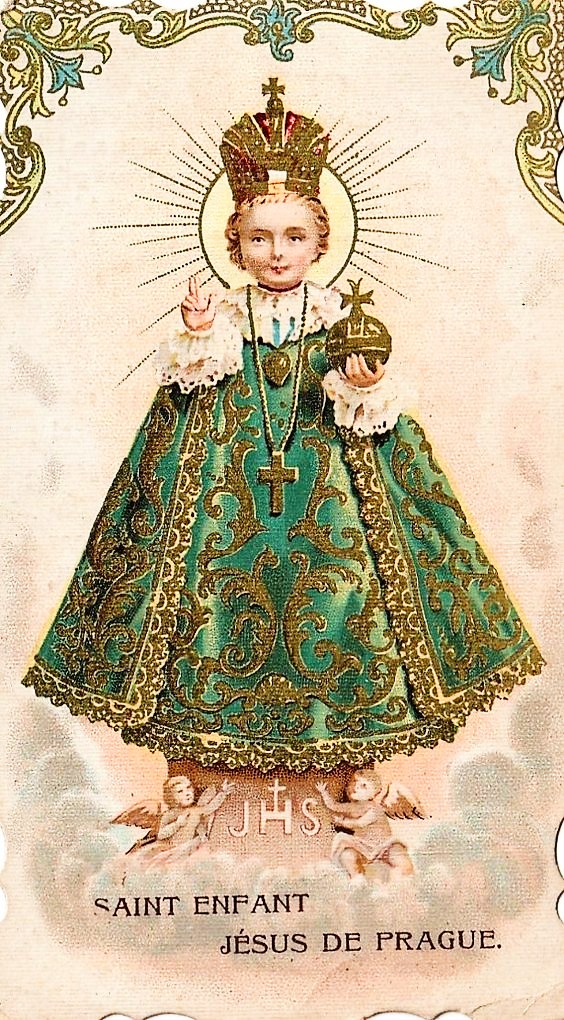
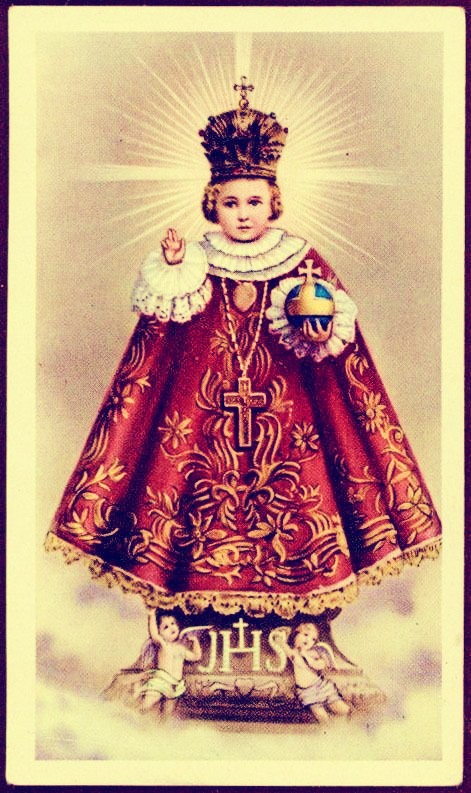
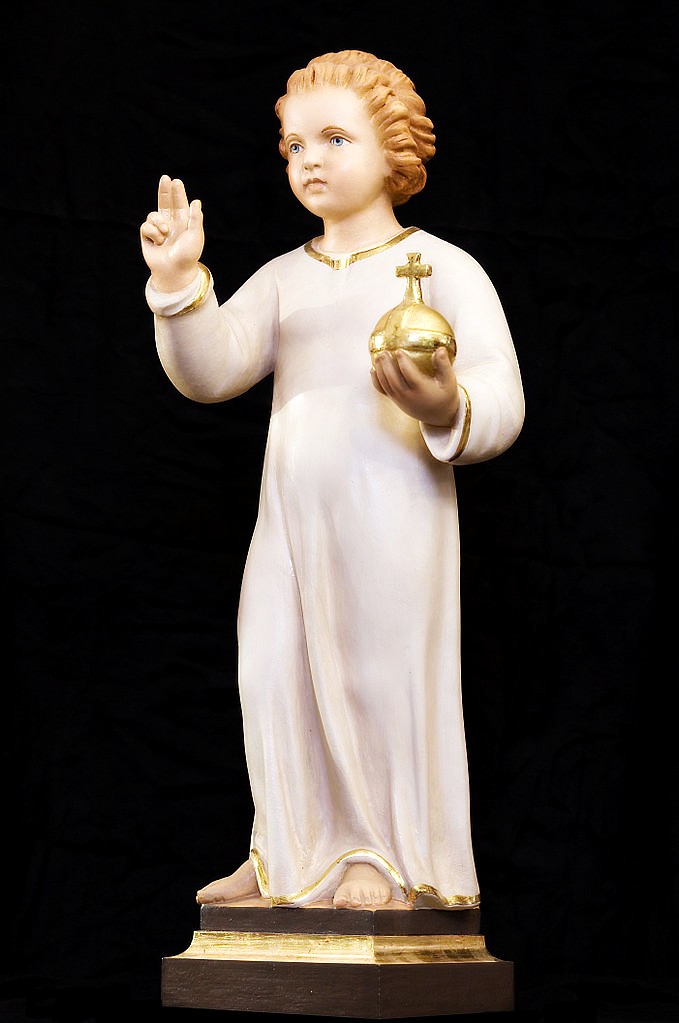
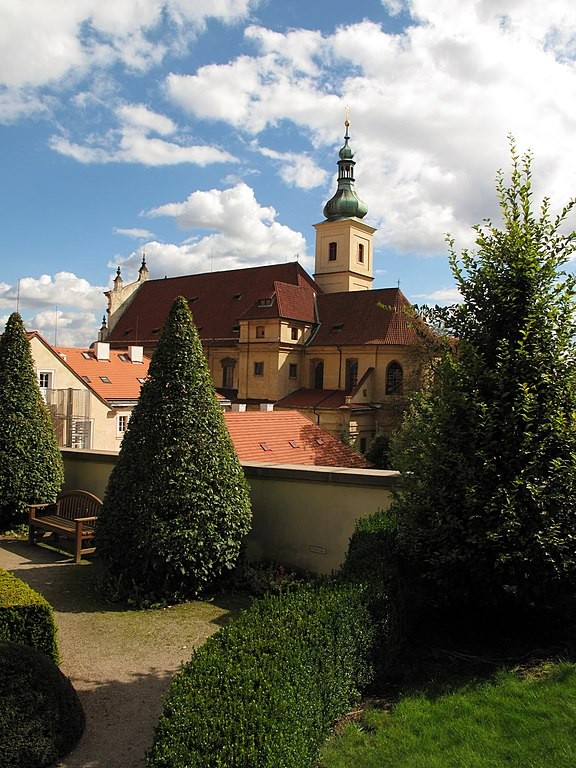
Saint of the Day – 2 January – Feast of the Infant Jesus of Prague – the 16th Century wax-coated wooden Statue of the Child Jesus, holding a globus cruciger (the Orb and Cross) with the right hand being raised in benediction, is of Spanish origin and is just under half a metre in height. It is now located in the Discalced Carmelite Church of Our Lady of Victories in Malá Strana, Prague, Czech Republic, see the Church at the bottom (one where I have been immensely blessed to attend Holy Mass before the Infant each day for a week some years ago). The Statue is venerated on 2 January, on 14 January and on the first Sunday of May.
The Infant above the Altar at Our Lady of Victories in Malá Strana, Prague
In 1556, pious legends claim that the Statue once belonged to St Teresa of Ávila and was donated to the Carmelite Friars by Princess Polyxena of Lobkowicz in 1628 upon her marriage to Czech nobleman.
The image is routinely clothed by the Carmelite Nuns in luxurious fabrics often in the Liturgical Vestment colours relevant to the Seasons and with imperial regalia and a golden crown. In thanksgiving for the numerous graces and cures received, the miraculous Statue at Prague , was solemnly crowned when Pope Leo XII signed and granted its first Pontifical Decree of Canonical Coronation on 24 September 1824. St Pius X granted authorisation via the Decree “Significat Nobis” to erect a namesake Confraternity.
Disturbances in Bohemia due to the Thirty Years’ War brought an end to the special devotions and on 15 November 1631 the army of King Gustavus Adolphus of Sweden took possession of Bohemia’s Capital City. The Carmelite Friary was plundered and the image of the Infant of Prague was thrown into a pile of rubbish behind the Altar. Here it lay forgotten for seven years, its hands broken off, until in 1637, it was found again by Father Cyrillus and placed in the Church’s oratory. One day, while praying before the Statue, Cyrillus heard a voice say, “Have pity on Me and I will have pity on you. Give Me my hands and I will give you peace. The more you honour Me, the more I will bless you.”
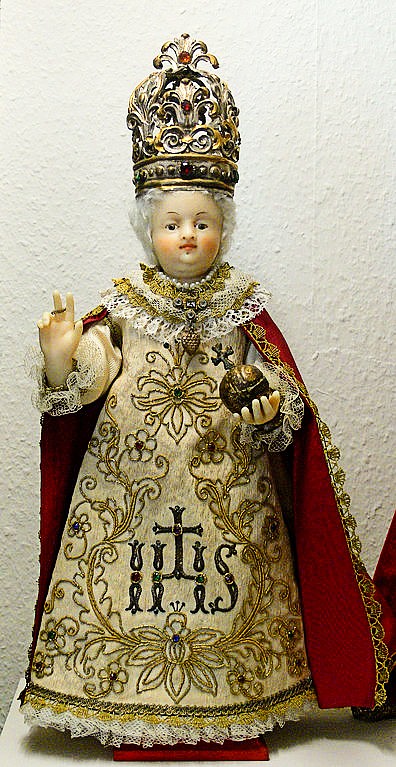
A German copy of the Statue, with a white wig instead of the traditional blonde hair, circa. 1870
Copies of the Infant Jesus arrived in Poland in 1680 and it has been popular in Polish homes and Bohemia in general, where the copies are typically placed in glass-enclosed cases. After the start of the Counter-Reformation era of the 17th Century, the Statue spread among Catholics all over the world, with particular devotion developing in South Africa, Australia, Caribbean, Thailand and Sri Lanka.
So many graces have been received by those who invoke the Divine Child before the original Statue that it has been called “The Miraculous Infant Jesus of Prague.” We read the following in an old book printed in Kempt: “All who approach the miraculous Statue and pray there with confidence, receive assistance in danger, consolation in sorrows, aid in poverty, comfort in anxiety, light in spiritual darkness, streams of grace in dryness of soul, health in sickness and hope in despair.”
The Infant in it’s bare format
From small beginnings, this devotion has grown to great proportions. The Divine Child attracts an ever increasing number of clients, who appeal to Him in every need.
The Church of Our Lady Victorious, in Malá Strana, Prague, Czech Republic.
Bl Airaldus of Maurienne St Alverius of Agaunum St Asclepius of Limoges St Aspasius of Auch St Baudimius of Auvergne St Blidulf of Bobbio St Dietmar of Prague Bl Guillaume Répin Bl Guillermo de Loarte St Hortulana of Assisi St Isidore of Antioch St Isidore of Nitri St John Camillus the Good St Macarius of Rome
St Mark the Mute St Maximus of Vienne St Munchin of Limerick Bl Odino of Rot St Paracodius of Vienne St Sebastian of Agaunum St Seiriol Bl Stephana de Quinzanis Bl Sylvester of Troina St Telesphorus, Pope St Theodota St Theopistus St Vincentian of Tulle St Viance of Anjou
Many Martyrs Who Suffered in Rome: There were many Martyrs who suffered in the persecutions of Diocletian for refusing to surrender the holy books. Though we know these atrocities occurred, we do not know the names of the Saints and we honour them as a group. c 303 in Rome, Italy.
Martyrs of Antioch – 5 Saints: A group of Christian soldiers Martyred together for their faith. We know the names of five – Albanus, Macarius, Possessor, Starus and Stratonicus. They were born in Greece and were Martyred in Antioch (modern Antakya, Turkey).
Many Martyrs of Britain: The Christians of Britain appear to have escaped unharmed in the earlier persecutions which afflicted the Church but the cruel edicts of Diocletian were enforced in every corner of the Roman Empire and the faithful inhabitants of this land, whether native Britons or Roman colonists, were called upon to furnish their full number of holy Martyrs and Confessors. The names of few are on record but the British historian, Saint Gildas, after relating the Martyrdom of Saint Alban, tells us, that many others were seized, some put to the most unheard-of tortures and others immediately executed, while not a few hid themselves in forests and the caves of the earth, where they endured a prolonged death until God called them to their reward. The same writer attributes it to the subsequent invasion of the English, then a pagan people, that the recollection of the places, sanctified by these Martyrdoms, has been lost and so little honour paid to their memory. It may be added, that, according to one tradition, a thousand of these Christians were overtaken in their flight near Lichfield and cruelly massacred and that the name of Lichfield, or Field of the Dead, is derived from them.
Martyrs of Ethiopia – 3 Saints: A group of Christians Martyred together for their faith. We know the names of three – Auriga, Claudia and Rutile.
Martyrs of Jerusalem – 2 Saints: A group of Christians Martyred together for their faith. We know the names of two – Stephen and Vitalis.
Martyrs of Lichfield: Many Christians suffered at Lichfield (aka Lyke-field, meaning field of dead bodies), England in the persecutions of Diocletian. Though we know these atrocities occurred, we do not know the names of the Saints and we honour them as a group. Their Martyrdom occurred in 304 at Lichfield, England.
Martyrs of Piacenza: A group of Christians who died together for their faith in the persecutions of Diocletian. No details about them have survived. They were Martyred on the site of Church of Madonna di Campagna, Piacenza, Italy.
Martyrs of Puy – 4 Saints: Missionaries, sent by Saint Fronto of Périgueux to the area of Puy, France. Tortured and Martyred by local pagans. We know the names – Frontasius, Severinus, Severian and Silanus. They were beheaded in Puy (modern Puy-en-Velay), France and buried together in the Church of Notre Dame, Puy-en-Velay by Saint Fronto, their bodies laid out to form a cross.
Martyrs of Syrmium – 7 Saints: Group of Christians Martyred together, date unknown. We know the names of seven – Acutus, Artaxus, Eugenda, Maximianus, Timothy, Tobias and Vitus – but very little else. This occurred in the 3rd or 4th century at Syrmium, Pannonia (modern Sremska Mitrovica, Serbia).
Martyrs of Tomi – 3 Saints: Three brothers, all Christian soldiers, in the Imperial Roman army and all three Martyred in the persecutions of Emperor Licinius Licinianus. We know their names – Argeus, Marcellinus and Narcissus – but little else. They were Martyred in 320 at Tomi, Exinius Pontus, Moesia (modern Constanta, Romania).





 AnaStpaul
You must be logged in to post a comment.