
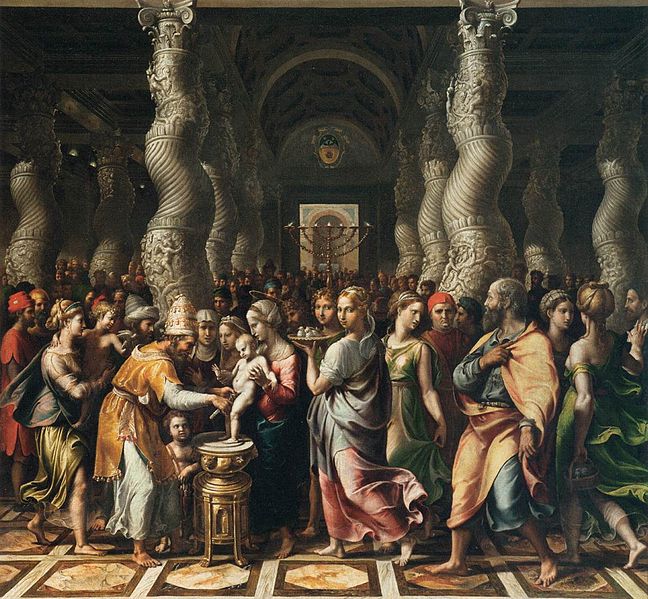
At an early stage the Church in Rome celebrated on 1 January a feast that it called the anniversary (Natale) of the Mother of God. When this was overshadowed by the feasts of the Annunciation and the Assumption, adopted from Constantinople at the start of the 7th century, 1 January began to be celebrated simply as the octave day of Christmas, the “eighth day” on which, according to Luke 2:21, the child was circumcised and given the name Jesus. In the 13th or 14th century 1 January began to be celebrated in Rome, as already in Spain and Gaul, as the feast of the Circumcision of the Lord and the Octave of the Nativity, while still oriented towards Mary and Christmas. The emphasis that Saint Bernardine of Siena (1380–1444) laid on the name of Jesus in his preaching led in 1721 to the institution of a separate Feast of the Holy Name of Jesus. Pope John XXIII’s 1960 rubrical and calendrical revision called 1 January simply the Octave of the Nativity. (This 1960 calendar was incorporated into the 1962 Roman Missal, whose continued use is authorized by the motu proprio Summorum Pontificum.) The 1969 revision states: “1 January, the Octave Day of the Nativity of the Lord, is the Solemnity of Mary, the Holy Mother of God and also the commemoration of the conferral of the Most Holy Name of Jesus.”



 AnaStpaul