Posted in MORNING Prayers, PRAYERS of the SAINTS, SAINT of the DAY

Our Morning Offering – 4 January

Our Morning Offering – 4 January
PRAYER of ST ELIZABETH ANN SETON

O Father, the first rule of Our dear
Saviour’s life was to do Your Will.
Let His Will  of the present moment
be the first rule of our daily life and work,
with no other desire but for its most full
and complete accomplishment.
Help us to follow it faithfully,
so that doing what You wish
we will be pleasing to You,
amen.

prayer-of-st-e-a-seton

Posted in SAINT of the DAY

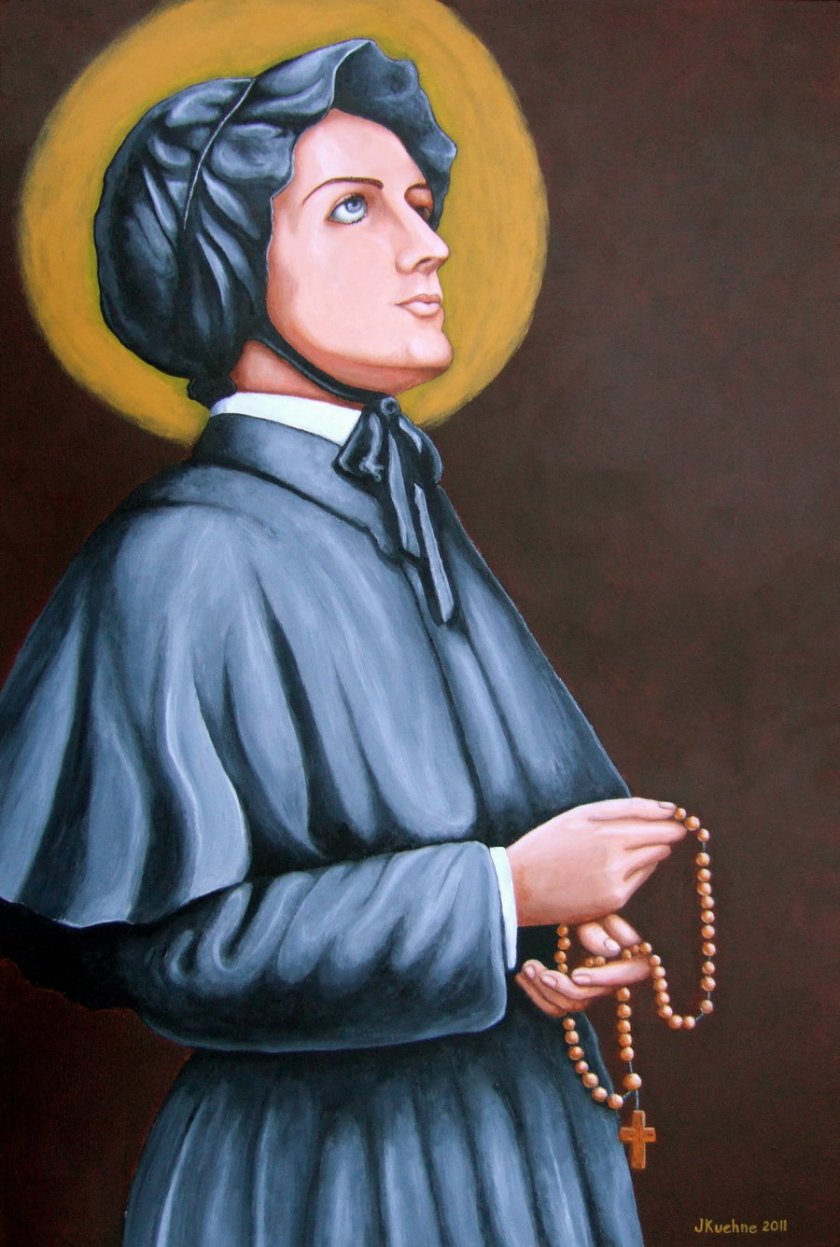
Saint of the Day – 4 January – St Elizabeth Ann Seton SC (1774-1821 Died 1846)

Saint of the Day – 4 January – St Elizabeth Ann Seton SC (1774-1821 Died 1846)  Widow, Mother, Religious, Founder, Teacher, Missionary, Apostle of Charity – Patron of Catholic Schools; Shreveport, Louisana and the State of Maryland.

Who was the first person born in the United States to be declared a saint? Who opened the first American Catholic parish school and established the first American Catholic orphanage? Who founded the first native American religious community of women? The answers to all these questions are the same: Elizabeth Ann Bayley Seton.

Elizabeth’s Episcopalian parents handed on to her their own faith. Her mother and stepmother taught her to pray and read Scripture. Her father, a doctor, taught her to love and serve the poor. As a young girl, Elizabeth took food to the poor near her home. After she was married, she and her sister-in-law Rebecca visited the poor and sick in slums.

Elizabeth was prepared for New York high society. At the age of nineteen she married handsome William Seton, the son and business partner of the owner of a wealthy shipping firm. No one could have guessed the plans God had for her. Will and Elizabeth were devoted to each other. They loved their five children—three girls and two boys.

Everything went well until 1803, when Will Seton’s business went bankrupt and his health failed. The Filicchi family in Italy invited Will, Elizabeth and their oldest daughter Anne to visit so that Will could recuperate in the warm, sunny Italian climate.

The journey was rough. Because there had been an epidemic in New York before the Setons left, when they landed in Italy the police quarantined them in an old fort. If after six weeks they did not come down with the disease, they would be able to enter Italy. Will, already ill, had to lie in the cold, damp room. Elizabeth cared for him as well as she could but a few weeks after they were freed, Will died.

The Filicchis, who were Catholic, helped Elizabeth. Finally, she realized that God was calling her to become a Catholic. She went to a priest to learn about the truths of the faith. Later, she and her children became Catholics. Because of their decision, her family and many friends turned against her, and she found herself on her own.

To support herself and her children, she opened a Catholic boarding school for girls in Maryland. Women came to help Elizabeth and the school grew. Soon it seemed obvious that God was asking Elizabeth to dedicate her life completely to Him. She and the other women began a community of religious Sisters, who later became known as the Daughters of Charity. Elizabeth Seton received the title of “Mother,” head of the community.

Elizabeth raised her children. Her two sons entered the navy. Anna became a nun but died at an early age, as did Rebecca. Catherine became a Sister of Mercy and worked with those in prison.

The thousand or more letters of Mother Seton reveal the development of her spiritual life from ordinary goodness to heroic sanctity. She suffered great trials of sickness, misunderstanding, the death of loved ones (her husband and two young daughters) and the heartache of a wayward son. She died January 4, 1821, and became the first American-born citizen to be beatified (1963) and then canonized (1975). She is buried in Emmitsburg, Maryland.  Today thousands of Daughters of Charity carry on Mother Seton’s work. They serve in hospitals, homes for the aged, and schools.

seton-1

Posted in SAINT of the DAY

Saints for 4 January

St Elizabeth Ann Seton (Memorial, United States)

St Aedh Dubh
St Aggaeus the Martyr
St Angela of Foligno
St St Celsus of Trier
Bl Chiara de Ugarte
St Chroman
St Dafrosa of Acquapendente
St Ferreolus of Uzès
St Gaius of Moesia
St Gregory of Langres
St Hermes of Moesia
St Libentius of Hamburg
Bl Louis de Halles
Bl Manuel Gonzalez Garcia
St Mavilus of Adrumetum
St Neophytos
St Neopista of Rome
St St St Oringa of the Cross
Bl Palumbus of Subiaco
St Pharaildis of Ghent
St Rigobert of Rheims
Bl Roger of Ellant
St Stephen du Bourg
St Theoctistus
Bl Thomas Plumtree

Martyrs of Africa – 7 saints
Martyrs of Rome – 3 saints

Posted in Uncategorized

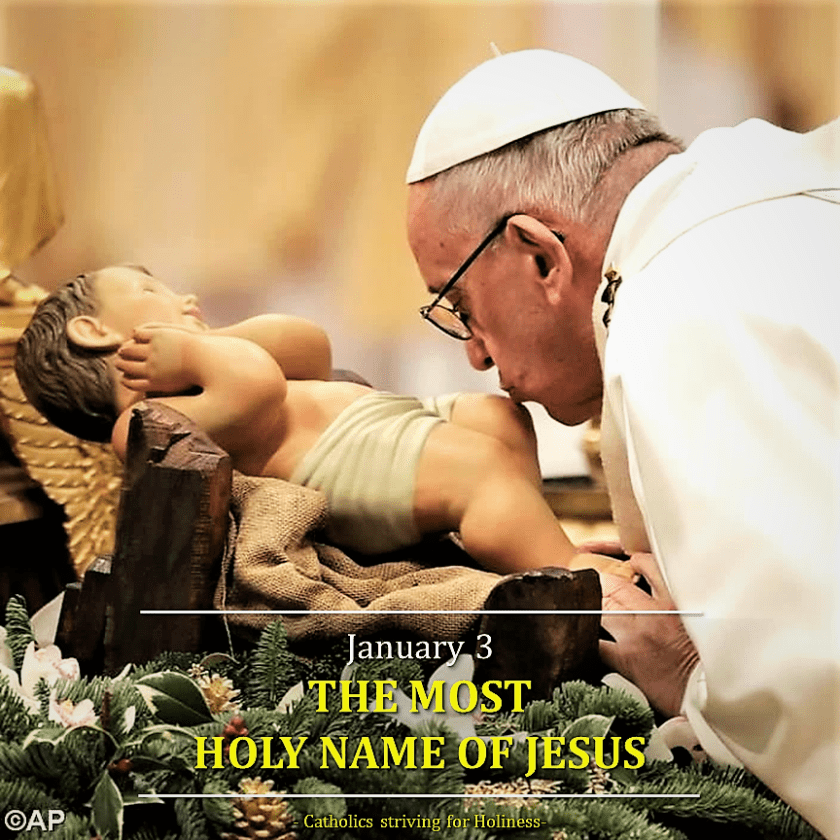
January 3. THE MOST HOLY NAME OF JESUS (FEAST). AV & text.

Posted in CHRISTMASTIDE!, The WORD

Celebrating CHRISTMAS The Second Week Tuesday 3 January 2017

Celebrating CHRISTMAS
The Second Week
Tuesday 3 January 2017

“Lord, open my lips, and my mouth shall declare your praise.”

Daily Meditation:
In this is love: not that we have loved God,
but that he loved us and sent his Son
as expiation for our sins. ….1 John 4

O God, give your judgment to the king; your justice to the son of kings;
That he may govern your people with justice, your oppressed with right judgment, …
That he may defend the oppressed among the people, save the poor and crush the oppressor. Psalm 72

His heart was moved with pity for them, for they were like sheep without a shepherd;
and he began to teach them many things. …
They all ate and were satisfied. Mark 6

Jesus is full of compassion for us in His unconditional love for us.
Even when it seems impossible, He still shows us the way
and nourishes us with His love.

May we be grateful for His love for us.
May we be like Him in our love for one another.

Closing Prayer:
Jesus, You became one of us on this earth.
What I want now is to be more like You:
more compassionate and patient,
more guided by Your Holy Spirit.

‘In this is love.’ It is impossible to believe
in the kind of love You have for me.
If only I believed it – how different my life would be!
It seems impossible that You could love me as You do
and yet You are the very center of that impossible love.

Help me to be more grateful for all You have given me
so that my response might be one of generosity
to You and those You have placed in my life.

May the Lord bless us,
protect us from all evil
and bring us to everlasting life.
Amen.

tues-of-the-second-week

Posted in FEASTS and SOLEMNITIES, JESUIT SJ, SAINT of the DAY

Thought for the Day – 3 January

Saints like St Genevieve believed in the power of prayer and in a kind and loving Providence watching over human affairs.  By their own faith, they inspired others to this same kind of trust in God – that they were not alone in the human struggle and that God does marvelous things in answer to prayer.  Prayer is and always will be a powerful means of accomplishing wonders.

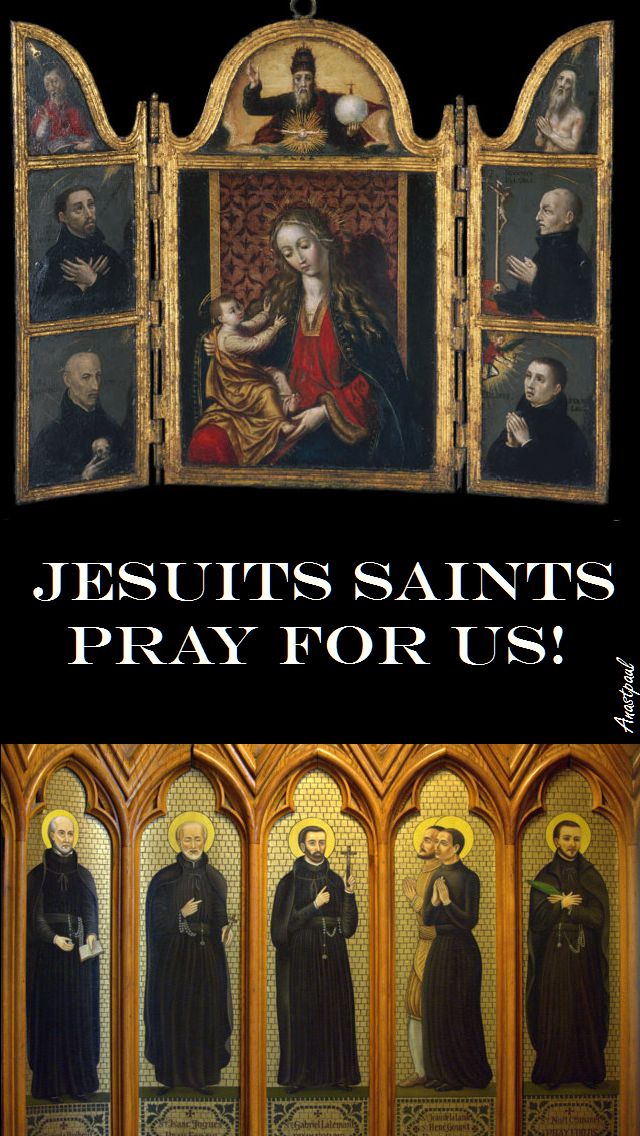
St Genevieve and all you Jesuit Sains, Pray for us!

“So You haven’t really sent me away from You, after all. When You assigned me the task of going out among men, You were only repeating to me Your one and only commandment: to find my way home to You in love. All care of souls is ultimately possible only in union with You, only in the love that binds me to You and thus makes me Your companion in finding a path to the hearts of men.”   (Encounters with Silence, Karl Rahner, translated and foreword by James M. Demske, SJ, South Bend, IN: St. Augustine’s Press 1999, p. 67.)

st-genevieve-pray-for-usjesuits-saints-pray-for-us

Posted in CATHOLIC Quotes, FEASTS and SOLEMNITIES, JESUIT SJ

Quote of the Day – 3 January

Quote of the Day – 3 January

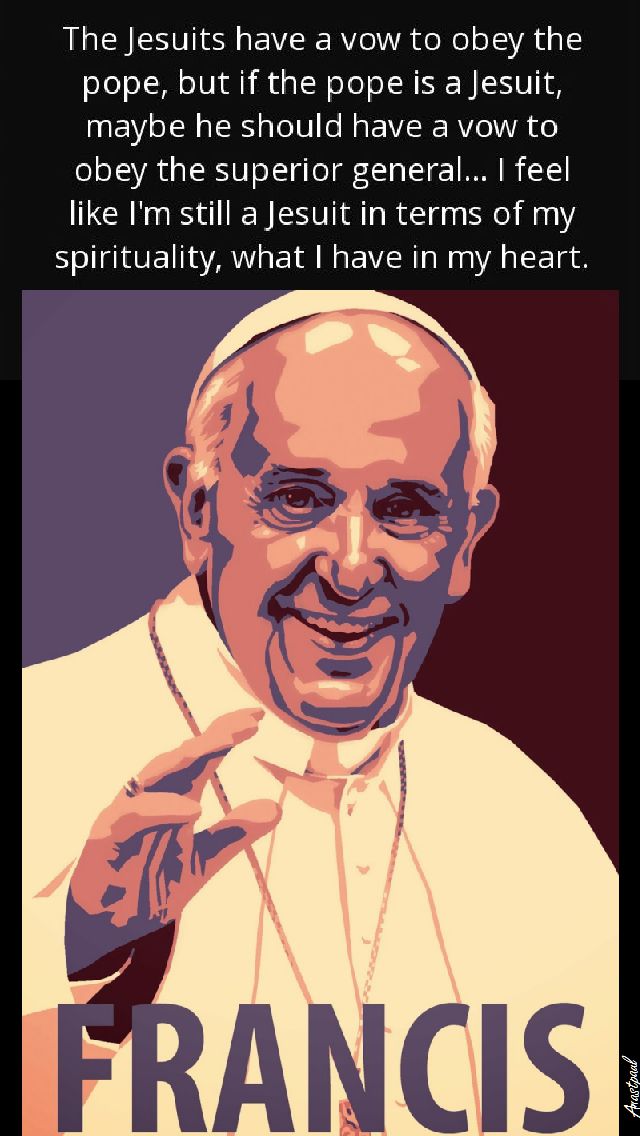
“The Jesuits have a vow to obey the pope but if the pope is a Jesuit, maybe he should have a vow to obey the superior general… I feel like I’m still a Jesuit in terms of my spirituality, what I have in my heart.”

~~~~Pope Francis
francis-quote

Posted in FEASTS and SOLEMNITIES, JESUIT SJ, MORNING Prayers, QUOTES of the SAINTS, SAINT of the DAY, The WORD

One Minute Reflection – 3 January

One Minute Reflection – 3 January

I planted the seed and Apollos watered it but God made it grow…………1 Cor 3:6

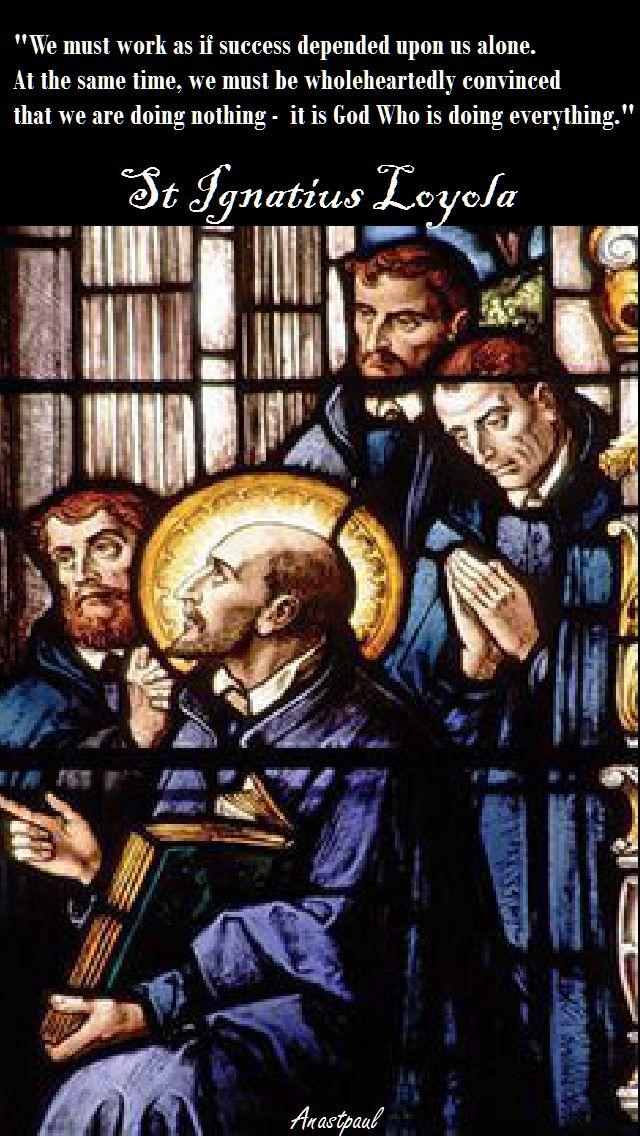
REFLECTION – We must work as if success depended upon us alone.

At the same time, we must be wholeheartedly convinced that we are doing nothing –  it is God Who is doing everything………St Ignatius Loyola

PRAYER – All-powerful God, let me realise that no matter what I do, it is only through You that I do it.  Help me to work as if all depended on me and pray as if all depended on You.  St Genevieve you were a sure example of working as if all dependd on you, please pray for us.  St Ignatius and all the great saints of the Society of Jesus, pray for us unceasingly, amen!

131029691288fb5eb308d48c663513056773fa1718edf9937216e343fa5471bbst-genevieve-jan-3

Posted in JESUIT SJ, MORNING Prayers

Our Morning Offering – 3 January

Our Morning Offering – 3 January

I Choose to Breathe the Breath of Christ

I choose to breathe the breath of Christ
that makes all life holy.

I choose to live the flesh of Christ
that outlasts sin’s corrosion and decay.

I choose the blood of Christ
along my veins and in my heart
that dizzies me with joy.

I choose the living waters flowing from His side
to wash and clean my own self and the world itself.

I choose the awful agony of Christ
to charge my senseless sorrows with meaning
and to make my pain pregnant with power.

I choose You, good Jesus, You know.

I choose You, good Lord;
count me among the victories
that You have won in bitter woundedness.

Never number me among those alien to You.

Make me safe from all that seeks to destroy me.

Summon me to come to You.

Stand me solid among angels and saints
chanting yes to all You have done,
exulting in all You mean to do forever and ever.

Then for this time, Father of all,
keep me, from the core of my self,
choosing Christ in the world. Amen

by Fr Joseph Tetlow SJ

i-choose-to-breath-the-breath-of-christ


Posted in FEASTS and SOLEMNITIES, JESUIT SJ

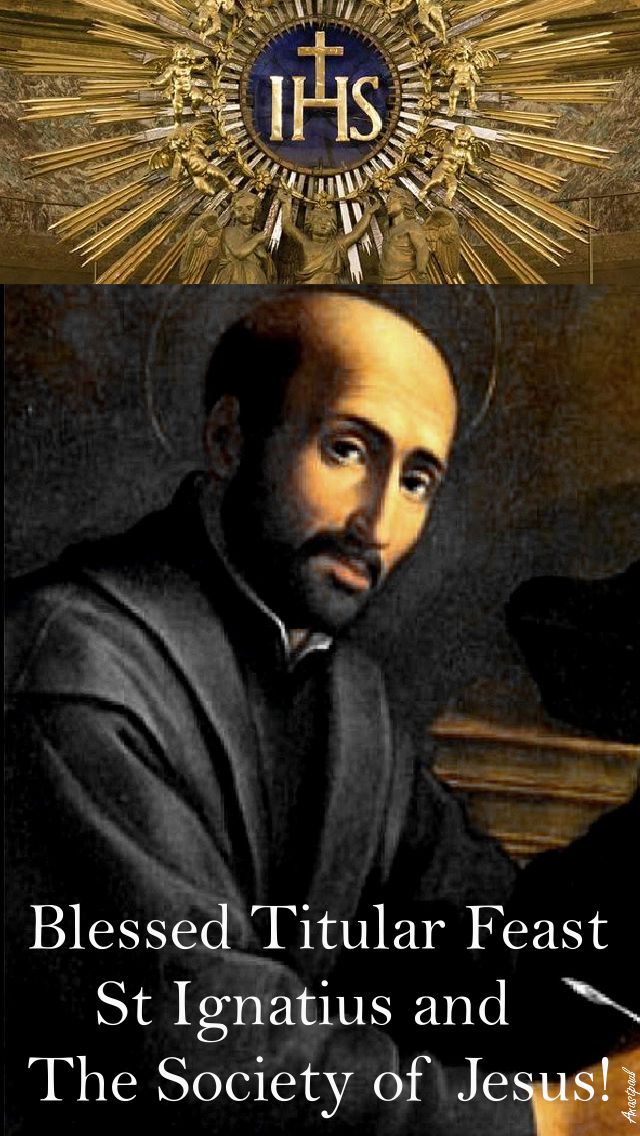
THE TITULAR FEAST OF THE JESUITS

Today, 3 January, the Celebration of the Feast of the Holy Name of Jesus, we celebrate too, the gift of the Society of Jesus.

See Video 3 January 2014 – https://www.youtube.com/watch?v=kUuOT_rre0w
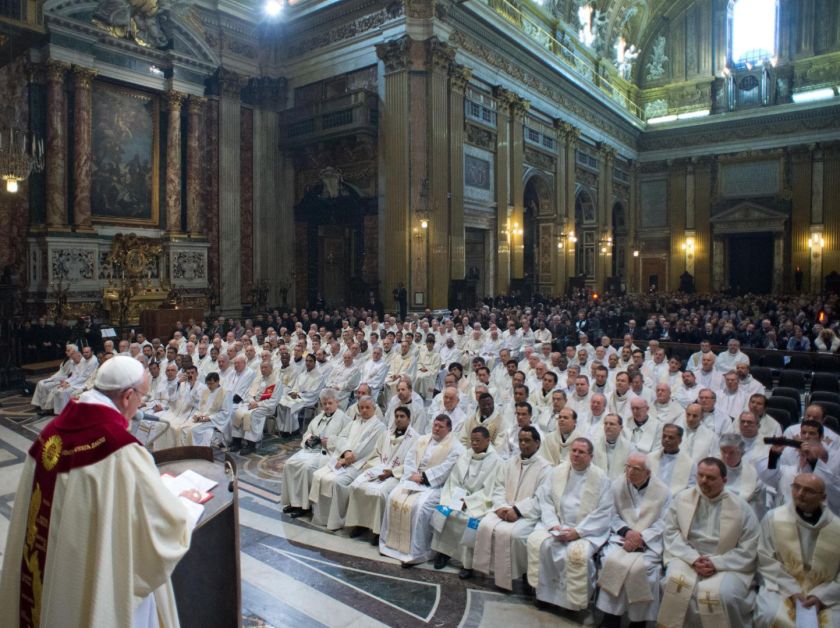
Pope Francis celebrates the Holy Mass at the Church of the
Jesus, with all the Jesuits in Rome, for thanksgiving for the entry of
Blessed Peter Faber into the catalogue of Saint and on the Solemnity of the
Holy Name of Jesus, the titular feast of the Society of Jesus.

17449930

Jesus said to him, “I am the way and the truth and the life.  No one comes to the Father except through me.”………..John 14:6

The giving of the name “Company (Society) of Jesus” occurred in September 1540 when the early companions and Ignatius were founded as a religious institute.

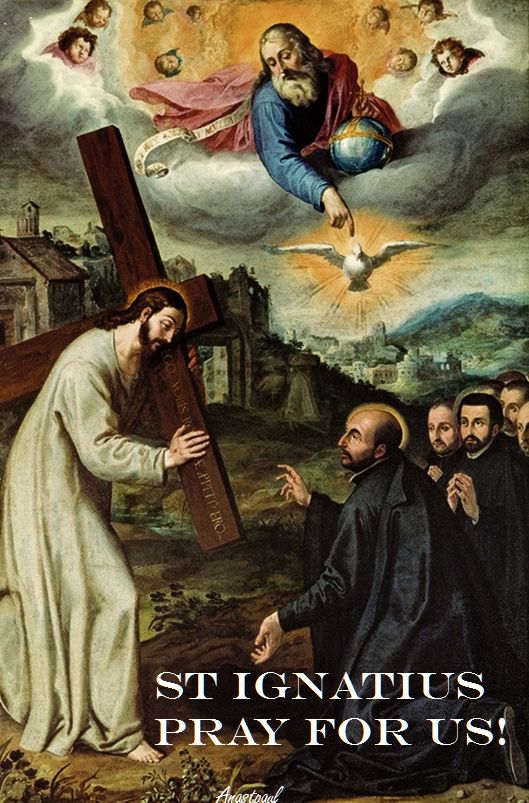
Ignatius and two of his companions, Peter Faber and James Lainez, decided to go to Rome to place themselves and the other companions at the disposal of the Pope. A few miles outside of Rome at a chapel at La Storta, the companions stopped to pray. At this spot, Ignatius had the second most significant of his mystical experiences. In his vision, God the Father told Ignatius, “I will be favourable to you in Rome” and that he would place him (Ignatius) with His Son. Ignatius did not know what his experience meant, for it could mean persecution as well as success since Jesus experienced both.

Formal approval of this new order was given by Pope Paul III on September 27, 1540. Since they had referred to themselves as the Company of Jesus, in English their order became known as the Society of Jesus. Ignatius was elected on the first ballot of the group to be superior but he begged them to reconsider, pray and vote again a few days later. The second ballot came out as the first, unanimous for Ignatius, except for his own vote. He was still reluctant to accept but his Franciscan confessor told him it was God’s will, so he acquiesced. On the Friday of Easter week, April 22, 1541, at the Church of St. Paul Outside-the-Walls, the friends pronounced their vows in the newly formed Order.

titular-feast-jesuit

Posted in SAINT of the DAY

Saint of the Day – 3 January

Saint of the Day – 3 January –  St Genevieve – (419-512) – Virgin/Lay Apostle of Charity and Prayer/Servant of God- Patron of Paris

On his way to combat heresy in Britain, St. Germanus of Auxerre made an overnight stop at Nanterre, France. In the crowd that gathered to hear him speak, Germanus spotted Genevieve (or Genovefa), a beautiful 7-year-old girl, and he foresaw her future holiness. When he asked little St. Genevieve if she wanted to dedicate her life to God, she enthusiastically said yes. So he laid hands on her with a blessing, thus launching the spiritual career of one of France’s most admired saints.

At 15, Genevieve formally consecrated herself as a virgin, but continued to live as a laywoman. Because of her generous giving to the poor, she became widely known in the vicinity around Paris. At first, however, for some unknown reason Genevieve met great hostility. But St. Germanus defused it by authorizing her with public signs of his support.

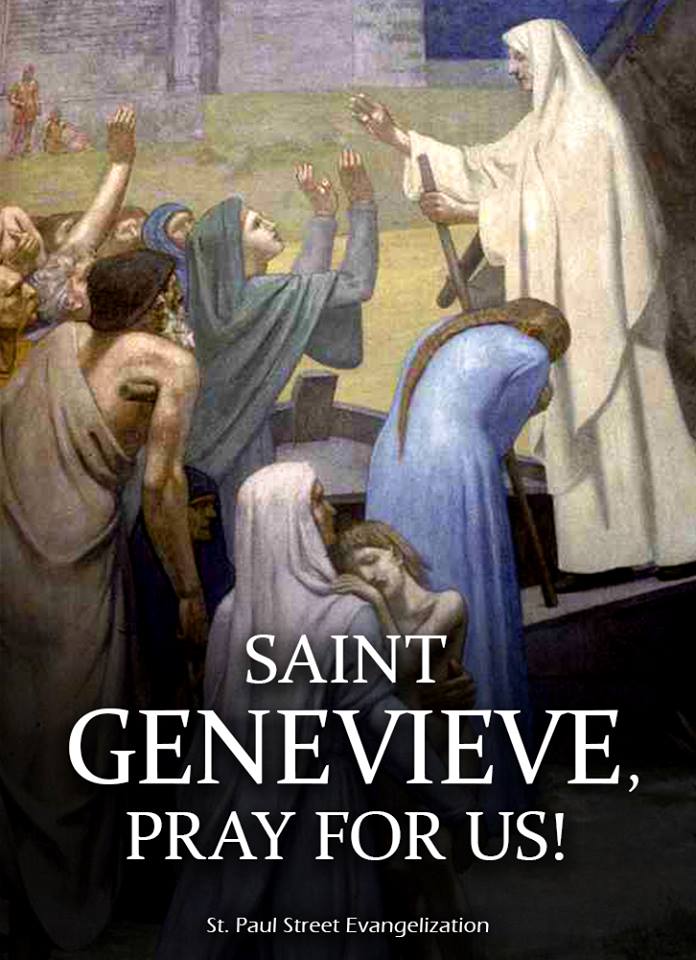
Once when the Franks were besieging Paris, Genevieve rescued the city from starvation by leading a convoy of ships up the Seine to Troyes to obtain food. In this selection from her biography, we learn that she had to work a miracle to bring it home safely:

During the return voyage, however, their ships were so buffeted by the wind . . . that the high holds fore and aft in which they had stored the grain tipped over on their sides. And the ships filled with water. Quickly Genovefa, her hands stretched toward heaven, begged Christ for assistance. Immediately the ships were righted. Thus through her our God . . . saved eleven grain-laden ships. . . .

When she returned to Paris, her sole concern was to distribute the grain to all according to their needs. She made it her first priority to provide a whole loaf to those whose strength had been sapped by hunger. Thus when her servant girls went to the ovens they would often find only part of the bread they had baked. . . . But it was soon clear who had taken the bread from the ovens for they noticed the needy carrying loaves throughout the city and heard them magnifying and blessing the name of Genovefa. For she put her hopes not in what is seen but in what is not seen. For she knew the Prophet spoke truly who said: “Whoever is kind to the poor is lending to Yahweh” (Proverbs 19:17 NJB). For through a revelation of the Holy Spirit she had once been shown that land, where those who lend their treasure to the poor expect to find it again. And for this reason, she was accustomed to weep and pray incessantly: for she knew that as long as she was in the flesh she was exiled from the Lord.

From that time Genevieve enjoyed a heroine’s status, and used her influence and wonders on the city’s behalf. For example, she persuaded Childeric, who had conquered Paris, to release many captives. And in 451, when Attila the Hun was advancing on the city, she got the populace to pray and fast for their safety. The invader changed his course and Paris was spared. She also became a trusted adviser to Clovis, the king of the Franks.

When Genevieve died, she was buried in the church of Sts. Peter and Paul at Paris. So many miracles occurred through her intercession there that it became a pilgrimage spot and came to be called St. Genevieve.

Posted in CHRISTMASTIDE!

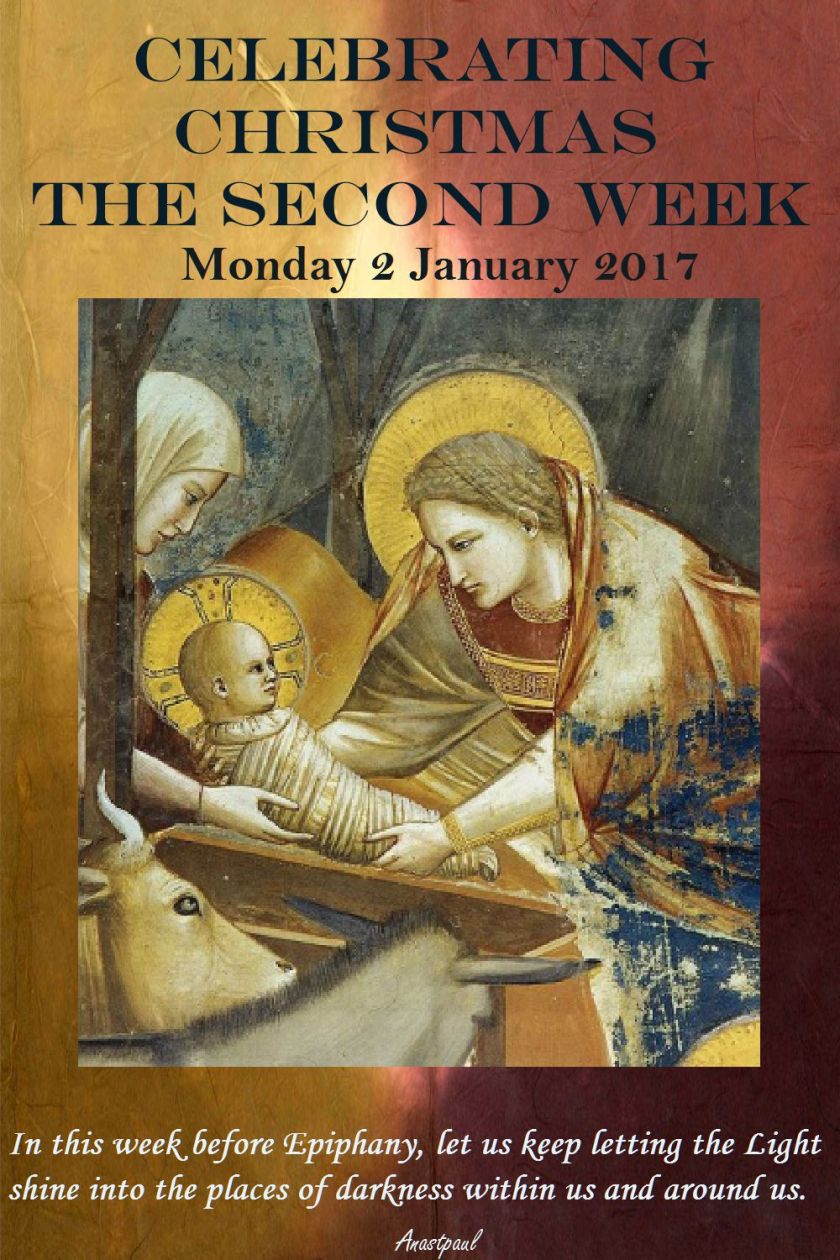
Celebrating Christmas – the Second Week: Monday 2 January 2017

Celebrating Christmas the Second Week Monday 2 January 2017

“Lord, open my lips, and my mouth shall declare your praise.”

Daily Meditation:
This is how you can know the Spirit of God:
every spirit that acknowledges Jesus Christ come in the flesh belongs to God,
and every spirit that does not acknowledge Jesus. 1 John 3

“The people who sit in darkness have seen a great light,
on those dwelling in a land overshadowed by death light has arisen.” Mt. 4

Jesus hears that John has been jailed.
He realises His time has come.
He begins by quoting Isaiah, chapter 8.
He is the light who has come into our lives,
which are so often overshadowed by death, in so many ways.

In this week before Epiphany, let us keep letting the Light
shine into the places of darkness within us and around us.
And where we have seen and felt His enlightening, freeing presence,
let us continue to rejoice with Christmas joy.

Closing Prayer:
Radiance.
Your radiant light blazes in my world today.
I know I will have difficult times
and the darkness will gather around me again.
But today the shining light of Your love
comes into my life and frees me.

There are other days that are shadowy,
when I don’t always know where I am going, Lord.
When the gloom gathers in my life, lead me through it.
I will reach out my hand in the darkness,
put aside my fears
and walk next to You, comforted by Your presence
and the warmth of Your unending love.

May the Lord bless us,
protect us from all evil
and bring us to everlasting life.
Amen.

monday-of-the-second-week

Posted in MORNING Prayers, SAINT of the DAY

Thought for the Day – 2 January

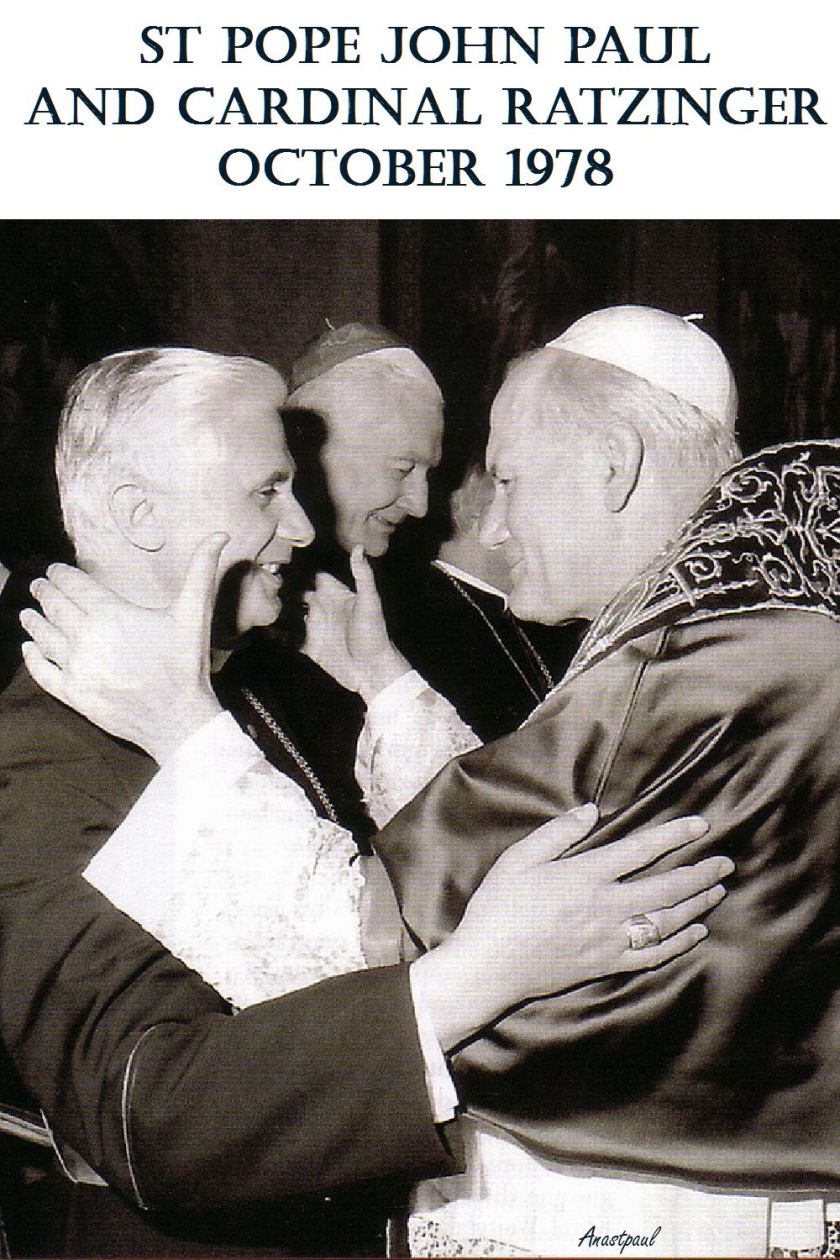
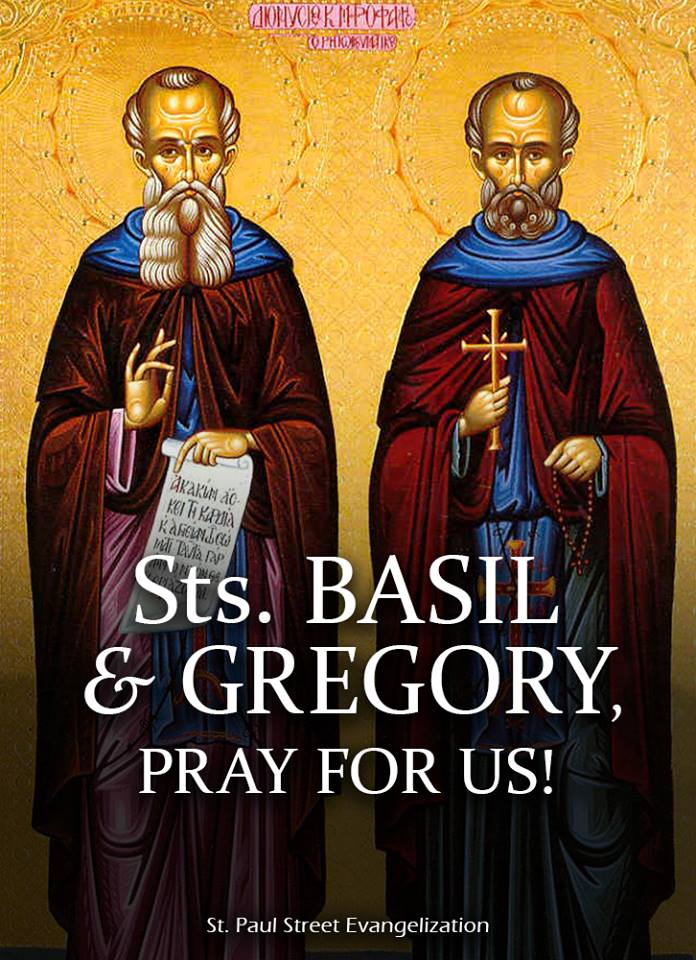
Learning of these two great Doctors of the Church, St Basil the Great and St Gregory of Nazianzen and their lifelong friendship, their collaboration, most especially against the battle against Arianism, cannot help but call to our minds a similar and immensely brilliant collaboration and personal friendship, which yielded endless fruit for the life of the Church.

Do you know of whom I speak?   Of course – St Pope John Paul and Pope Benedict XVI – one already in the Halls of Heaven.  Both these great modern fathers are “Doctors” of the Church – whether yet recognised officially or not and the one blessedly still with us is a saint amongst the faithful.

Sts Basil and Gregory Pray for us!

friendssts-basil-and-grefory-jan-2

Posted in QUOTES of the SAINTS, SAINT of the DAY

Quote/s of the Day – 2 January

Quote/s of the Day – 2 January

“The hairsplitting difference between
formed and unformed makes no difference to us.
Whoever deliberately commits abortion
is subject to the penalty for homicide.”

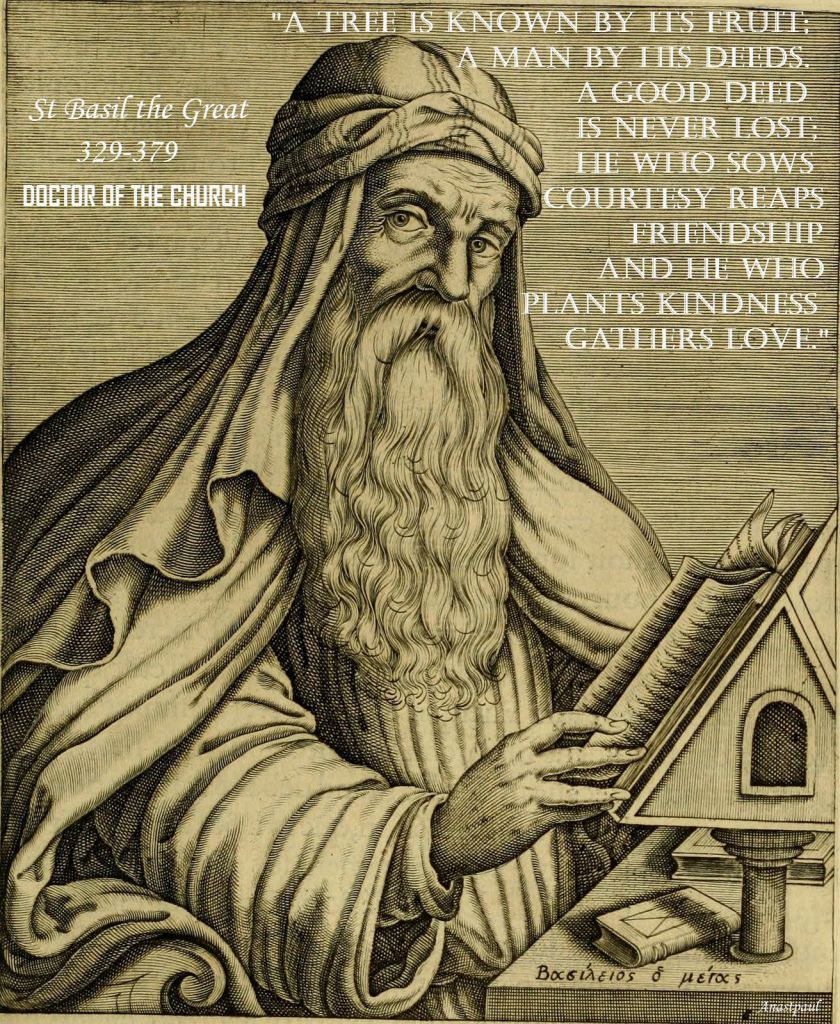
“A tree is known by its fruit;
a man by his deeds.
A good deed is never lost;
he who sows courtesy reaps friendship
and he who plants kindness gathers love.”

St Basil (329-379) Doctor of the Church

quote-of-the-daya-tree-is-known

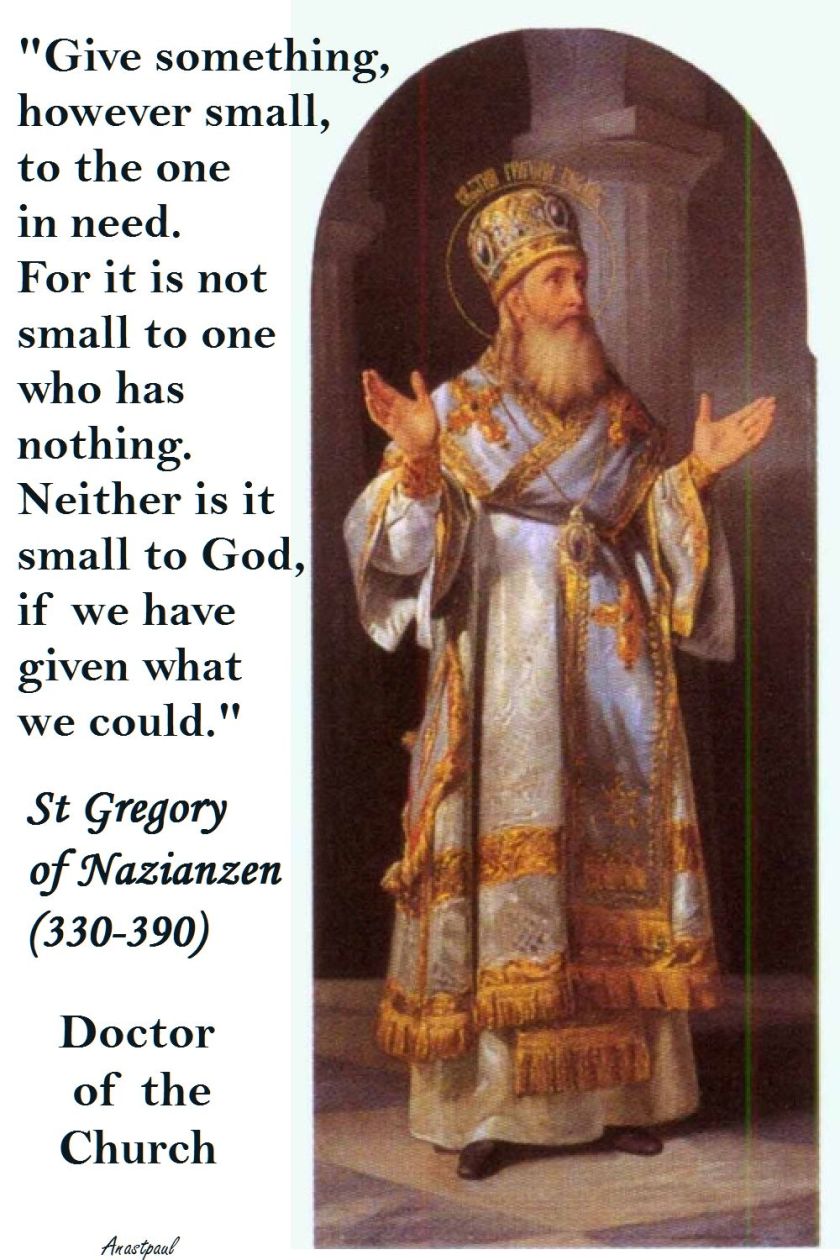
“Give something, however small,
to the one in need.
For it is not small to one who has nothing.
Neither is it small to God, if we have given what we could.”

“If anyone does not believe that Holy Mary
is the Mother of God, such a one is a stranger
to the Godhead.”
St Gregory of Nazianzen (330-390) Doctor of the Church

give-somethin

stranger


Posted in MORNING Prayers, PRAYERS of the SAINTS

Our Morning Offering/s – 2 January

Our Morning Offering – 2 January

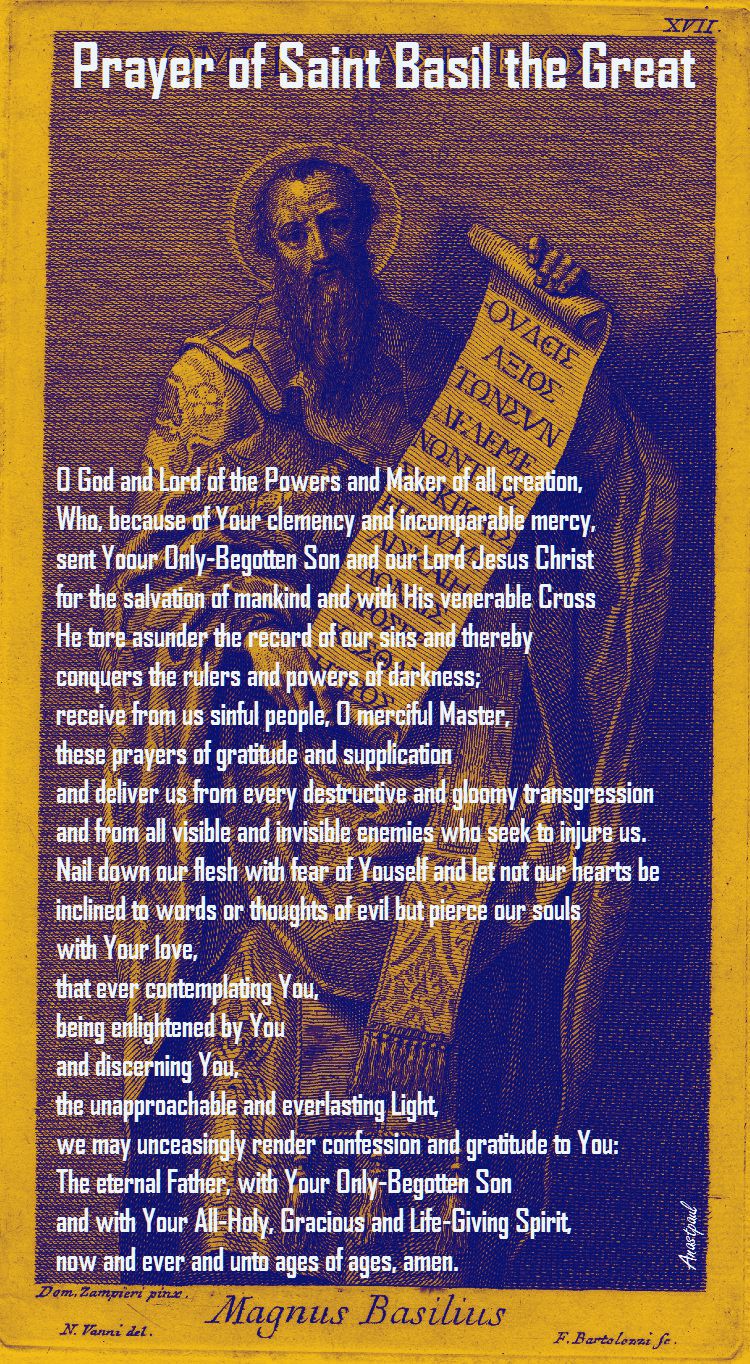
Prayer of Saint Basil the Great

O God and Lord of the Powers and Maker of all creation,
Who, because of Your clemency and incomparable mercy,
sent Yoour Only-Begotten Son and our Lord Jesus Christ
for the salvation of mankind and with His venerable Cross
He tore asunder the record of our sins and thereby
conquers the rulers and powers of darkness;
receive from us sinful people, O merciful Master,
these prayers of gratitude and supplication
and deliver us from every destructive and gloomy transgression
and from all visible and invisible enemies who seek to injure us.
Nail down our flesh with fear of Youself and let not our hearts be
inclined to words or thoughts of evil but pierce our souls
with Your love,
that ever contemplating You,
being enlightened by You
and discerning You,
the unapproachable and everlasting Light,
we may unceasingly render confession and gratitude to You:
The eternal Father, with Your Only-Begotten Son
and with Your All-Holy, Gracious and Life-Giving Spirit,
now and ever and unto ages of ages, amen.

prayer-of-st-basil

PRAYER OF ST. GREGORY OF NAZIANZEN
To The All-Transcendent God

O All-Transcendent God
(and what other name could describe You?),
what words can hymn Your praises?
No word does You justice.
What mind can probe Your secret?
No mind can encompass You.
You are alone are beyond the power of speech,
yet all that we speak stems from You.
You are alone are beyond the power of thought,
yet all that we can conceive springs from You.
All things proclaim You,
those endowed with reason and those bereft of it.
All the expectation and pain of the world
coalesces in You.
All things utter a prayer to You,
a silent hymn composed by You.
You sustain everything that exists,
and all things move together to Your orders.
You are the goal of all that exists.
You are one and You are all,
yet You are none of the things that exist,
neither a part nor the whole.
You can avail Yourself of any name;
how shall I call You,
the only unnameable?
All-transcendent God!

prayer-of-st-gregory

Posted in Uncategorized

Saint/s of the Day -2 January

Saint/s of the Day -2 January – Sts Basil the Great and Gregory Nazianzen

ST BASIL the GREAT – (329-379) Bishop, Confessor and Doctor of the Church – Patron of  Hospital administrators, Reformers, Monks, education, exorcism, Liturgists, Russia, Cappadocia.

St Basil the Great, the illustrious doctor and intrepid champion of the church, was born towards the close of the year 329 at Caesarea, the metropolis of Cappadocia. His parents were Cappadocians by birth, both equally illustrious for their nobility and descended from a long line of renowned heroes.  Our saint’s father, St. Basil the Elder, and his wife, St. Emmelia, adorned the conjugal state by their saintly conversation. Their marriage was blessed with ten children, of which they left nine living, all eminent for virtue; those that were married and lived in the world seeming no way inferior in piety to those who served God in holy virginity, as St. Gregory Nazianzen tells us. Four were sons and the other five daughters. St. Macrina the Younger, was the eldest of all these children, and assisted her mother in training up the rest in perfect virtue. The eldest among the boys was St. Basil; the other three were Naucratius, St. Gregory of Nyssa, and St. Peter of Sebaste. Our saint was the fruit of his mother’s prayers, and in his infancy by the same means recovered his health in dangerous sickness, when he had been given over by the physicians, as St. Gregory of Nyssa relates. He received the first tincture of virtue from his grandmother, St. Macrina the Elder, under whose care he passed his infancy in a country house near Neocaesarea, in Pontus; and he testifies himself that during his whole life he never forgot the strong impressions of piety which her exhortations and holy example made upon his tender mind.

Basil was educated in Caesarea, Constantinople, and Athens in the fourth century. He enjoyed stimulating university life. There he met Gregory Nazianzen, a quiet, scholarly man. The two became close friends.

Basil traveled through the East and studied monastic life. As a result, he formed his own monastic group. Gregory joined him. From their discussions, Basil composed a rule of life for monks. He allowed monks and nuns to operate hospitals and guesthouses and work outside the community. His principles still influence Eastern monasticism.

The two friends lived the monastic life for only about five years. Then Gregory had to return home to care for his father, who was a bishop. When Gregory got home, he was ordained a priest, although he did not think himself worthy. He watched over his father’s diocese.

In 374, Basil was made bishop of Caesarea. The Church called on him to refute the Arian heresy, which claimed that Jesus was not God. Emperor Valens promoted the heresy. Basil believed the Church must remain independent of the emperor and boldly defended the Church. He preached morning and evening to large crowds. When a famine struck, he gave his money to people who were poor. He organized a soup kitchen and served the people himself. Basil even built a town, which included a church, a hospital and a guesthouse.

Basil continued to write for the Church and to clarify the doctrines of the Trinity and the Incarnation. When one town was falling away from the faith, Basil ordained Gregory bishop and sent him there. Gregory went unhappily because he disliked conflict. The two friends were later reconciled.

St Basil died on the 1 or 2 of January 379.  We commemorate and celebrate his memory on 2 January.   The emperor had tried to tax St Basil’s diocese (area) so much, that he would not be able to pay. However, the many faithful followers, gave him money and jewels to help pay the taxes. The tax-collector was so amazed that he refused the money. t Basil had no way of knowing who to return the money and jewels to.  So, he had many cakes baked and in them placed the coins and jewels; he then distributed these cakes to the poor. Traditionally Basil’s cakes or sweet bread) is made in Orthodox households and they are also brought to the church. There they (called  Vasilopita) are blessed and cut by the priest; pieces are cut to honour Jesus Christ, the Mother of God, St Basil, the priest, the poor and others.


St Gregory of Nazianzen (330-390) Bishop, Theologian, Doctor of the Church Patron of Harvests and Poets

St Gregory who, from his profound skill in sacred learning, is surnamed the Theologian, was a native of Arianzum, an obscure village in the territory of Nazianzum, a small town in Cappadocia not far from Caesarea His parents are both honoured in the calendars of the church: his father on the 1st of January and his mother Nonna on the 5th of August.

After his baptism at 30, Gregory gladly accepted his friend Basil’s invitation to join him in a newly founded monastery. The solitude was broken when Gregory’s father, a bishop, needed help in his diocese and estate. It seems that Gregory was ordained a priest practically by force and only reluctantly accepted the responsibility. He skillfully avoided a schism that threatened when his own father made compromises with Arianism. At 41, Gregory was chosen suffragan bishop of Caesarea and at once came into conflict with Valens, the emperor, who supported the Arians.

For 30 years, Constantinople had been under the leadership of supporters of the Arian movement. The bishops of the surrounding areas begged Gregory to come and restore the faith, and again he went, dreading the task. When protection for Arianism ended with the death of Valens, Gregory was called to rebuild the faith in the great see of Constantinople, which had been under Arian teachers for three decades. Retiring and sensitive, he dreaded being drawn into the whirlpool of corruption and violence. He first stayed at a friend’s home, which became the only orthodox church in the city. In such surroundings, he began giving the great sermons on the Trinity for which he is famous. In time, Gregory did rebuild the faith in the city but at the cost of great suffering, slander, insults and even personal violence. An interloper even tried to take over his bishopric.

His last days were spent in solitude and austerity. He wrote religious poetry, some of it autobiographical, of great depth and beauty. He was acclaimed simply as “the Theologian.”


Both Basil and Gregory were misunderstood, but in spite of this, they rebuilt the faith. Basil died at age 49. Gregory resigned from Constantinople because of opposition and spent his last years reading, writing his autobiography, and enjoying his gardens.

Posted in SAINT of the DAY

Saints for 2 January

St Basil the Great (Memorial)
St Gregory of Nazianzen (Memorial) – VIDEO ewtn – https://www.youtube.com/watch?v=IYRt9DkyKqY

St Adelard of Corbie
Bl Airaldus of Maurienne
St Asclepius of Limoges
St Aspasius of Auch
St Blidulf of Bobbio
St Gaspare Bufalo
Bl Guillaume Répin
St Hortulana of Assisi
St Isidore of Antioch
St Isidore of Nitria
St Laurent Bâtard
St Macarius the Younger
St Maximus of Vienne
Bl Odino of Rot
St Paracodius of Vienne
St Seraphim of Sarov
St Seiriol
Bl Stephana de Quinzanis
St Telesphorus, Pope
St Theodota
St Theopistus
St Vincentian of Tulle

Many Martyrs Who Suffered in Rome
Martyrs of Antioch – 5 saints
Martyrs of Britain
Martyrs of Ethiopia – 3 saints
Martyrs of Jerusalem – 2 saints
Martyrs of Lichfield
Martyrs of Piacenza
Martyrs of Puy – 4 saints
Martyrs of Syrmium – 7 saints
Martyrs of Tomi – 3 saints

Posted in Uncategorized

Blessed 2017!

My wishes to you all for a Blessed and Grace-filled 2017!

The LORD said to Moses:
Speak to Aaron and his sons and tell them:
This is how you shall bless the Israelites.
Say to them:
“The LORD bless you and keep you!
The LORD let his face shine upon you
and be gracious to you!
The LORD look upon you kindly and give you peace!*
Numbers 6:22-27

francesco-conti_return-to-nazareth-from-egypt_cleveland-museum-of-art_1734-jpg-2017

Posted in FEASTS and SOLEMNITIES, SAINT of the DAY

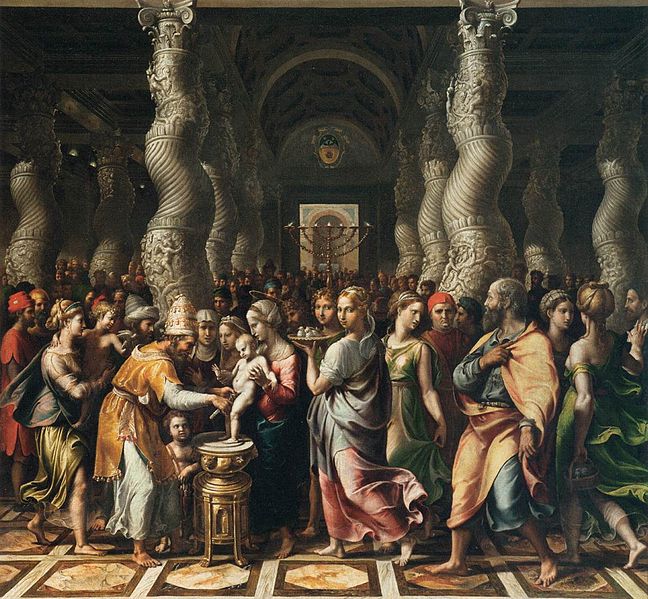
Feast of the Circumcision of Jesus Christ – 1 January

At an early stage the Church in Rome celebrated on 1 January a feast that it called the anniversary (Natale) of the Mother of God.  When this was overshadowed by the feasts of the Annunciation and the Assumption, adopted from Constantinople at the start of the 7th century, 1 January began to be celebrated simply as the octave day of Christmas, the “eighth day” on which, according to Luke 2:21, the child was circumcised and given the name Jesus.  In the 13th or 14th century 1 January began to be celebrated in Rome, as already in Spain and Gaul, as the feast of the Circumcision of the Lord and the Octave of the Nativity, while still oriented towards Mary and Christmas.  The emphasis that Saint Bernardine of Siena (1380–1444) laid on the name of Jesus in his preaching led in 1721 to the institution of a separate Feast of the Holy Name of Jesus. Pope John XXIII’s 1960 rubrical and calendrical revision called 1 January simply the Octave of the Nativity. (This 1960 calendar was incorporated into the 1962 Roman Missal, whose continued use is authorized by the motu proprio Summorum Pontificum.) The 1969 revision states: “1 January, the Octave Day of the Nativity of the Lord, is the Solemnity of Mary, the Holy Mother of God and also the commemoration of the conferral of the Most Holy Name of Jesus.”

the_circumcision_by_luca_signorelli
Luca Signorelli
648px-giulio_romano_-_the_circumcision_-_wga09617
Giulio Romano
Posted in FEASTS and SOLEMNITIES, MORNING Prayers, Uncategorized

Thought for the Day 1 January 2017

Thought for the Day 1 January 2017

Many themes come together at today’s celebration. It is the Octave of Christmas: Our remembrance of Mary’s divine motherhood injects a further note of Christmas joy. It is a day of prayer for world peace: Mary is the mother of the Prince of Peace. It is the first day of a new year: Mary continues to bring new life to her children—who are also God’s children

Mary, Mother of God, Pray for us!

mary-mother-of-god-1-jan

Posted in Uncategorized

World Day of Peace – 1 January 2017

World Day of Peace – https://vimeo.com/196321647

The Solemnity of Mary, the Holy Mother of God, the Roman Catholic Church also celebrates the World Day of Peace which was established by Pope Paul VI in 1967. On this day, the Popes have issued messages in support of peace and justice throughout the world. In 2017, Pope Francis writes about: Nonviolence: a Style of Politics for Peace. This video presents a few excerpts from the document for prayer and reflection. To read the entire message visit http://bit.ly/2017WorldDayofPeace.or https://w2.vatican.va/content/francesco/en/messages/peace/documents/papa-francesco_20161208_messaggio-l-giornata-mondiale-pace-2017.html

“The Good News

3. Jesus himself lived in violent times. Yet he taught that the true battlefield, where violence and peace meet, is the human heart: for “it is from within, from the human heart, that evil intentions come” (Mk 7:21). But Christ’s message in this regard offers a radically positive approach. He unfailingly preached God’s unconditional love, which welcomes and forgives. He taught his disciples to love their enemies (cf. Mt 5:44) and to turn the other cheek (cf. Mt 5:39). When he stopped her accusers from stoning the woman caught in adultery (cf. Jn 8:1-11), and when, on the night before he died, he told Peter to put away his sword (cf. Mt 26:52), Jesus marked out the path of nonviolence. He walked that path to the very end, to the cross, whereby he became our peace and put an end to hostility (cf. Eph 2:14-16). Whoever accepts the Good News of Jesus is able to acknowledge the violence within and be healed by God’s mercy, becoming in turn an instrument of reconciliation. In the words of Saint Francis of Assisi: “As you announce peace with your mouth, make sure that you have greater peace in your hearts”.

To be true followers of Jesus today also includes embracing his teaching about nonviolence. As my predecessor Benedict XVI observed, that teaching “is realistic because it takes into account that in the world there is too much violence, too much injustice, and therefore that this situation cannot be overcome except by countering it with more love, with more goodness. This ‘more’ comes from God”.[4] He went on to stress that: “For Christians, nonviolence is not merely tactical behaviour but a person’s way of being, the attitude of one who is so convinced of God’s love and power that he or she is not afraid to tackle evil with the weapons of love and truth alone. Love of one’s enemy constitutes the nucleus of the ‘Christian revolution’”.[5] The Gospel command to love your enemies (cf. Lk 6:27) “is rightly considered the magna carta of Christian nonviolence. It does not consist in succumbing to evil…, but in responding to evil with good (cf. Rom 12:17-21), and thereby breaking the chain of injustice”

In conclusion

7. As is traditional, I am signing this Message on 8 December, the Solemnity of the Immaculate Conception of the Blessed Virgin Mary. Mary is the Queen of Peace. At the birth of her Son, the angels gave glory to God and wished peace on earth to men and women of good will (cf. Luke 2:14). Let us pray for her guidance.

“All of us want peace. Many people build it day by day through small gestures and acts; many of them are suffering, yet patiently persevere in their efforts to be peacemakers”

In 2017, may we dedicate ourselves prayerfully and actively to banishing violence from our hearts, words and deeds, and to becoming nonviolent people and to building nonviolent communities that care for our common home. “Nothing is impossible if we turn to God in prayer. Everyone can be an artisan of peace”.

From the Vatican, 8 December 2016

world-day-of-peace

Posted in CATHOLIC DEVOTIONS of the Month, MORNING Prayers

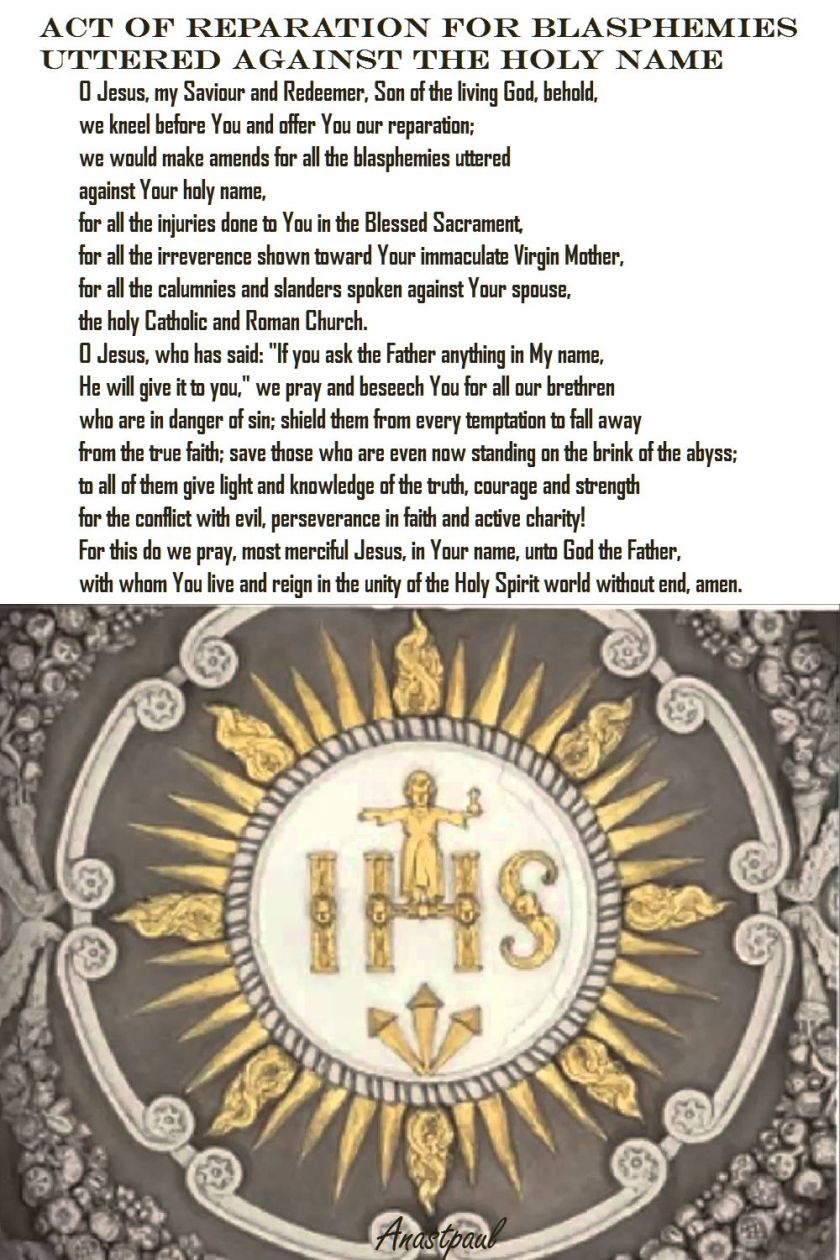
ACT OF REPARATION FOR BLASPHEMIES UTTERED AGAINST THE HOLY NAME

Act of Reparation for Blasphemies Uttered Against the Holy Name

O Jesus, my Saviour and Redeemer, Son of the living God, behold,

we kneel before You and offer You our reparation;

we would make amends for all the blasphemies uttered against Your holy name,

for all the injuries done to You in the Blessed Sacrament,

for all the irreverence shown toward Your immaculate Virgin Mother,

for all the calumnies and slanders spoken against Your spouse,

the holy Catholic and Roman Church.

O Jesus, who has said: “If you ask the Father anything in My name,

He will give it to you,” we pray and beseech You for all our brethren

who are in danger of sin; shield them from every temptation to fall away

from the true faith; save those who are even now standing on the brink of the abyss;

to all of them give light and knowledge of the truth, courage and strength

for the conflict with evil, perseverance in faith and active charity!

For this do we pray, most merciful Jesus, in Your name, unto God the Father,

with whom You live and reign in the unity of the Holy Spirit world without end. Amen


act-of-reparation


Posted in CATHOLIC DEVOTIONS of the Month, DEVOTIO

Monthly Catholic Devotions: What has happened to the tradition of honouring the Holy Name of Jesus?

What has happened to the tradition of honouring the Holy Name of Jesus?

Question Time with Fr John Flader
When I was growing up I was taught to bow my head whenever I said or heard the name “Jesus”.  I have noticed that some priests still bow their heads in Mass but no one else seems to do it anymore except for some brought up within Convent Schools and homes of “the latin countries” and these will persist regardless. How has this come about?”
I TOO belong to the generation that learned to bow our heads at the name of Jesus, but, as you say, the custom seems to be falling into disuse.
So important is respect for the divine name that God chose to give us a separate commandment regarding it: “You shall not take the name of the Lord your God in vain” (Deuteronomy 5:11).
Elsewhere in the Old Testament there are numerous passages that speak of the holiness of God’s name, among them: “O Lord, our Lord, how majestic is your name in all the earth”. (Psalm 8:1; cf. Zechariah 2:13; Psalm 29:2; 96:2; 113:1-2).
In the New Testament St James denounces those “who blaspheme that honourable name by which you are called” (James 2:7).
And St Paul, referring to Jesus emptying himself to take the form of a servant and then becoming obedient unto death, writes: “Therefore God has highly exalted him and bestowed on him the name which is above every name, that at the name of Jesus every knee should bow, in heaven and on earth and under the earth, and every tongue confess that Jesus Christ is Lord, to the glory of God the Father” (Philippians 2:9-11).
By way of concretising respect for the name of Jesus in a formal way the Second Council of Lyons in 1274 decreed that “at the name of Jesus every knee should bow; whenever that glorious name is recalled, especially during the sacred mysteries of the Mass, everyone should bow the knees of his heart, which he can do even by a bow of his head”.
As regards what is to be done in Mass today, the General Instruction of the Roman Missal says: “A bow of the head is made when the three Divine Persons are named together and at the names of Jesus, of the Blessed Virgin Mary and of the saint in whose honour Mass is being celebrated” (GIRM 275).
The importance of honouring the holy name of Jesus is seen too in the feast of that name, which has been celebrated, at least at the local level, since the end of the 15th century.   The feast was inserted into the universal calendar by Pope Innocent XIII in 1721 and is now celebrated on 3 January.

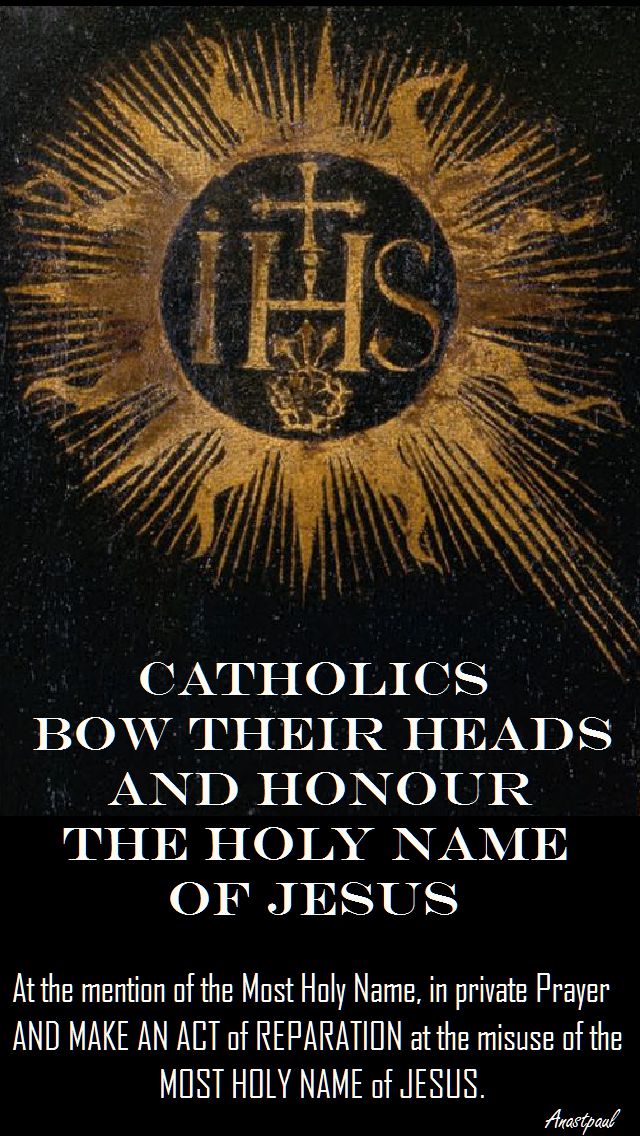
Given the widespread misuse of the names of God and Jesus today in ordinary life, as well as on television, in films and in other forms of entertainment, it is especially important to do all we can to restore respect for the name of God.
Bowing our head when we pronounce or hear the name of Jesus is a good way to do this.
Also important is to make an internal act of reparation whenever we hear the name of God or Jesus blasphemed.
It should hurt us that the object of our love is mistreated in this way.
It may very well be that the custom of bowing the head at the name of Jesus will pass out of general use, as have other laudable customs in recent times but that does not prevent us personally from continuing to live it and passing on to our children this ancient custom.

LET US EACH ONE BRING IT BACK for the very Angels in Heaven bow at the name of Jesus. And even the demons in Hell.

catholic-do-this

Posted in CATHOLIC DEVOTIONS of the Month, MORNING Prayers

Monthly Catholic Devotions: JANUARY is the Month of THE MOST HOLY NAME OF JESUS

JANUARY is the Month of THE MOST HOLY NAME OF JESUS

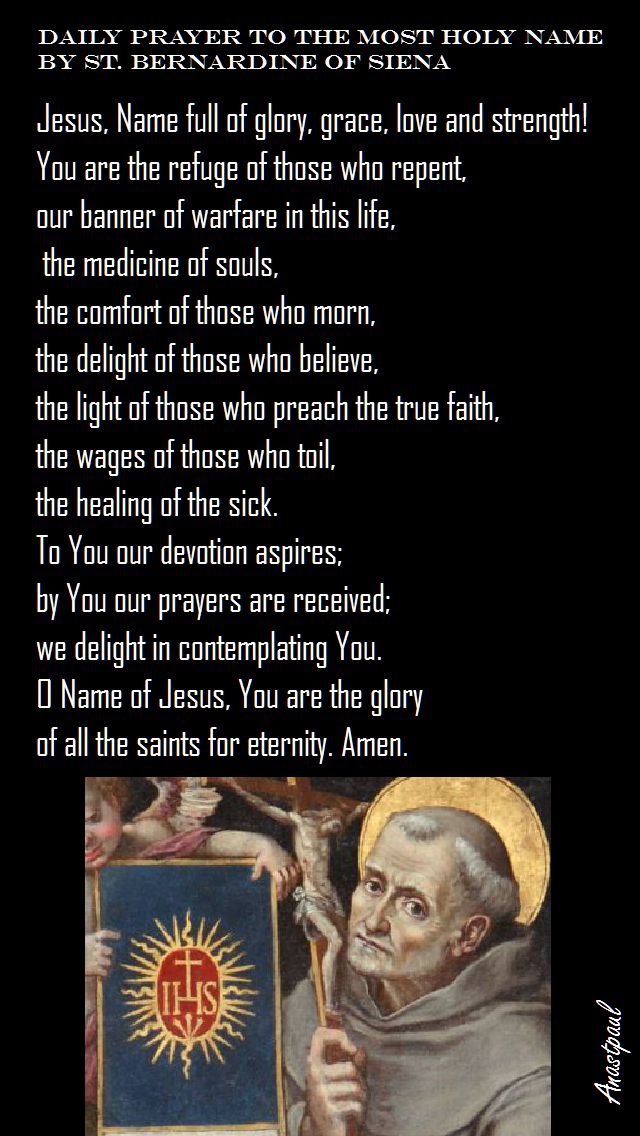
DAILY PRAYER TO THE MOST HOLY NAME
by St. Bernardine of Siena

Jesus, Name full of glory, grace, love and strength!
You are the refuge of those who repent,
our banner of warfare in this life,
the medicine of souls,
the comfort of those who morn,
the delight of those who believe,
the light of those who preach the true faith,
the wages of those who toil,
the healing of the sick.
To You our devotion aspires;
by You our prayers are received;
we delight in contemplating You.
O Name of Jesus, You are the glory
of all the saints for eternity. Amen.

holy-name-prayer


Posted in DEVOTIO, MORNING Prayers

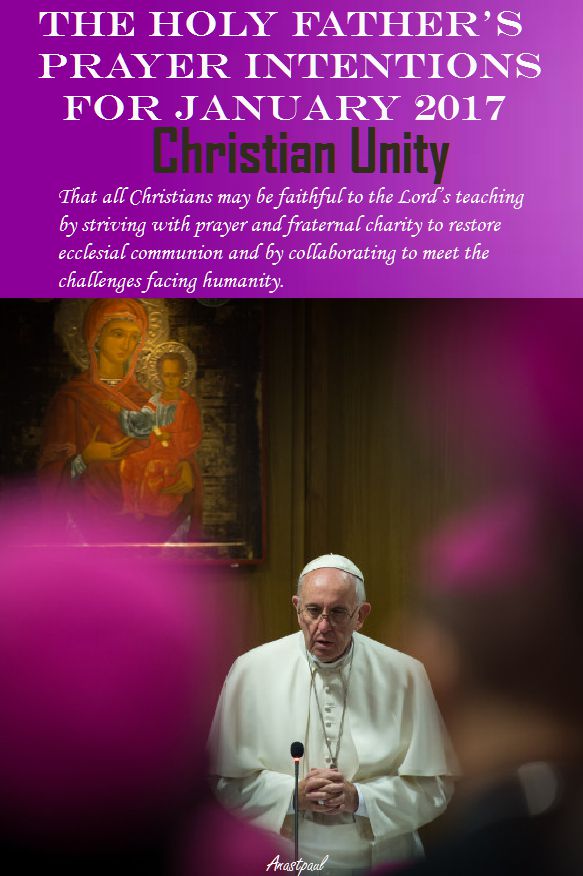
1 January 2017 – The Holy Father’s Monthly Intentions

1 January – The Holy Father’s Monthly Intentions

Starting in 2017 the Pope will present only one prepared prayer intention per month, rather than the two presented before this year. He plans, however, to add a second prayer intention each month related to current events or urgent needs, like disaster relief. The urgent prayer request will help mobilize prayer and action related to the urgent situation. The Apostleship of Prayer will publish these urgent prayer intentions on this website as soon as we receive them from the Vatican.

What is the process in the preparation of the prepared prayer intentions? The faithful from around the world suggest papal prayer intentions to the international office of the Apostleship of Prayer in Rome. Through prayerful discernment the Apostleship selects a large number of them and submits them to the Vatican for further selection, with the Pope making the final selection. The Vatican then entrusts to the Apostleship of Prayer the official set of monthly prayer intentions, which the Apostleship then translates into the major world languages and publishes in print and digital formats.

JANUARY: – Christian Unity

That all Christians may be faithful to the Lord’s teaching by striving with prayer and fraternal charity to restore ecclesial communion and by collaborating to meet the challenges facing humanity.

holy-father-jan-intentions


Posted in CHRISTMASTIDE!, The BLESSED VIRGIN MARY, The WORD

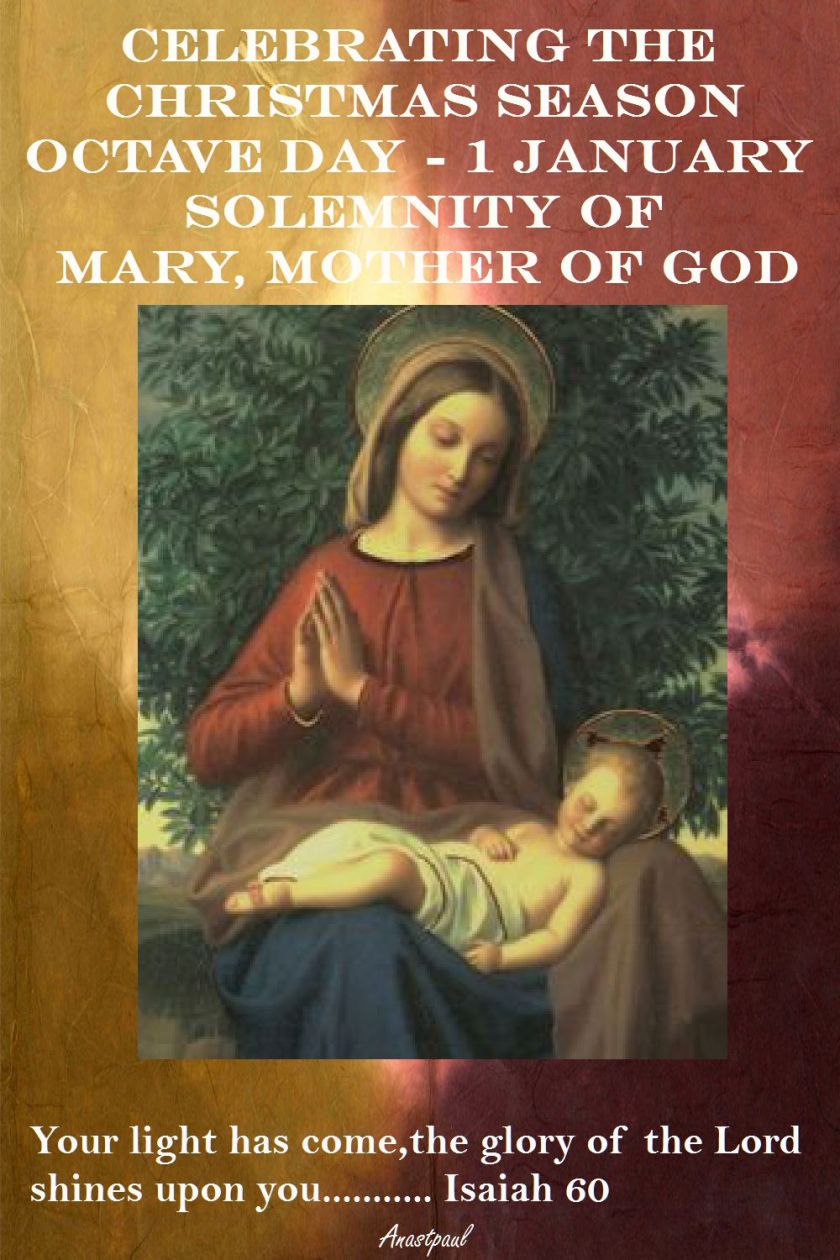
Celebrating the CHRISTMAS SEASON OCTAVE DAY – 1 JANUARY SOLEMNITY of MARY, MOTHER OF GOD

Celebrating the CHRISTMAS SEASON
OCTAVE DAY – 1 JANUARY
SOLEMNITY of MARY, MOTHER OF GOD

Sunday, 1st January is the Solemnity of Mary the Mother of God. It is also the World Day of Prayer for Peace.

“Lord, open my lips, and my mouth shall declare your praise.”

Daily Meditation:
Your light has come, the glory of the Lord shines upon you. Isaiah 60

May the kings of Tarshish and the islands bring tribute, the kings of Arabia and Seba offer gifts.
May all kings bow before him, all nations serve him.
For he rescues the poor when they cry out, the oppressed who have no one to help.
He shows pity to the needy and the poor and saves the lives of the poor. Psalm 72

The Gentiles are coheirs, members of the same body and co-partners in the promise in Christ Jesus through the gospel.
Ephesians 3

This great feast – celebrated in the East as the Baptism of the Lord – is a feast of “revelation.”
Jesus is the beloved Son of God,
a light for the whole world,
the very one who comes to us in time, this year,
to be our saviour:
to rescue the poor, to hear our cry,
to save us in our need, in our poverty.

May we bring Him the gifts of our faith and trust and hope.
May we recognize Him as our Saviour
who gave His own life to set us free from the power of sin and death.
Come, let us adore Him.

Closing Prayer:
Light of the world,
You have come into my life; You are here for me in my poverty.
I am dazzled by the gifts You bring to me on this day:
“Your light is strong, your love is near.”

Truly You have drawn me far beyond the limits of the world,
and into the limit-less boundaries of Your dizzying love.

My gifts are small, and often filled with fear.
They are my trust and my hope.
Please accept them and heal me
and let me be free enough to rejoice
that You are the Beloved Son
and that You have come for me

May the Lord bless us,
protect us from all evil
and bring us to everlasting life.
Amen.

octave-day

Posted in FEASTS and SOLEMNITIES, SAINT of the DAY, The BLESSED VIRGIN MARY, Uncategorized

Solemnity of Mary, Mother of God Octave Day of Christmas

The precise title “Mother of God” goes back at least to the third or fourth century. In the Greek form Theotokos (God-bearer), it became the touchstone of the Church’s teaching about the Incarnation. The Council of Ephesus in 431 insisted that the holy Fathers were right in calling the holy virgin Theotokos. At the end of this particular session, crowds of people marched through the street shouting: “Praised be the Theotokos!” The tradition reaches to our own day. In its chapter on Mary’s role in the Church, Vatican II’s Dogmatic Constitution on the Church calls Mary “Mother of God” 12 times.

We learn the great truth that Mary is the Mother of God from St. Luke’s Gospel, in the message given by the angel to Mary: “You are going to be the mother of a Son and you will call Him Jesus, and He will be called the Son of the Most High.”  Once she said yes, the Holy Spirit created in her womb the human nature that God the Son would assume. Since motherhood is of the person and not of the nature alone and since Mary is the mother of Jesus, true God and true Man, then she is rightly called the Mother of God. After the angel had appeared to her and told her that she would be the mother of Jesus, the Blessed Virgin Mary visited Elizabeth. At Mary’s greeting Elizabeth said, “Why should this great thing happen to me, that my Lord’s mother comes to visit me?” [Lk 1:43]. The Holy Scriptures teach us that Jesus was both God and man.   John writes: “The Word became flesh and lived among us” [Jn 1:14].  St. Paul refers to this event when he writes to the Galatians, “God sent forth His Son, born of a woman,” and as, “eternally begotten of the Father.”  So Bible teaches that Mary was the mother of the God-Man Jesus, not in the sense that she gave birth to Jesus as God but in the sense that the Baby she bore had the nature of God and the nature of Man.

For centuries, Mary has been praised because she believed. She is Mother of God because of her faith in God. The Solemnity of Mary, Mother of God, celebrates Mary’s faith and trust in God alone. The Church wants us to imitate her faith.

Holy Mary, Mother of God, Pray for us!

326_600

1460-64-giovanni-bellini-italian-early-renaissance-painter-1430-1516-presentation-at-the-temple
Giovanni Bellini 1430
2861e5ec88d90c872f154accc9a23223
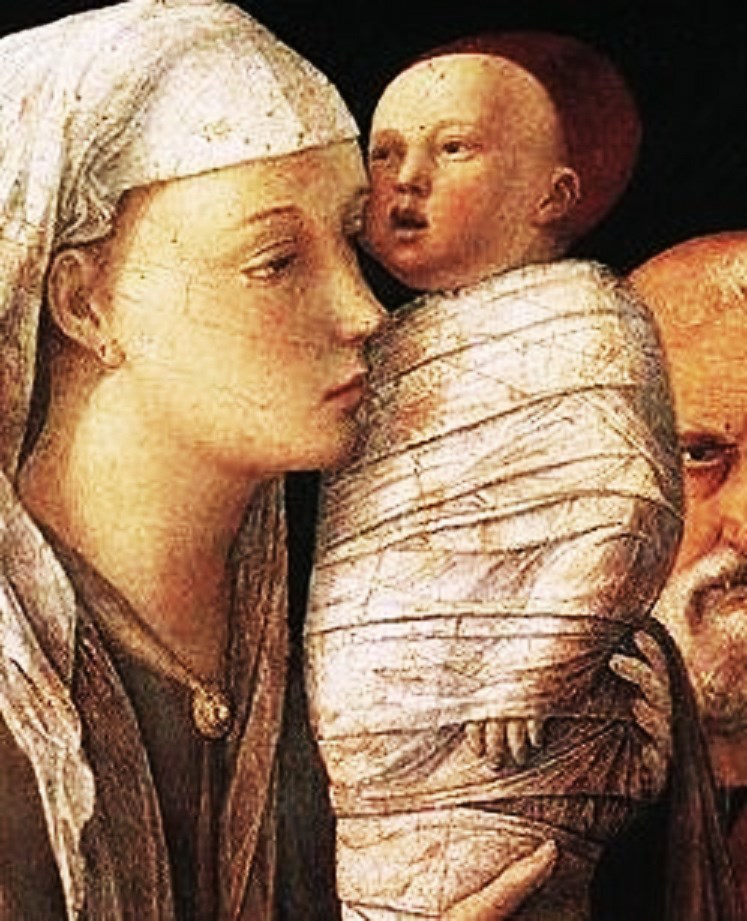
Mantegna 1465-1470


mary-mother-of-god

mary-mother-of-god-jan-1

Posted in SAINT of the DAY

Saints for 1 January

Mary, Mother of God (Solemnity)
Circumcision of the Lord (Feast)
Octave Day of the Nativity of the Lord
World Day of Peace
Bl Adalbero of Liege
St Baglan of Wales
St Basil of Aix
Bl Bonannus of Roio
St Brogan
St Buonfiglio Monaldi
Bl Catherine de Solaguti
St Clarus of Vallis Regia
St Clarus of Vienne
St Colman mac Rónán
St Colman Muillin of Derrykeighan
St Concordius of Arles
St Connat
St Cuan
St Demet of Plozévet
St Elvan
St Eugendus of Condat
St Euphrosyne of Alexandria
St Fanchea of Rossory
St Felix of Bourges
St Frodobert of Troyes
St Fulgentius of Ruspe
St Gisela of Rosstreppe
St Gregory Nazianzen the Elder
Bl Hugolinus of Gualdo Cattaneo
Bl Jean-Baptiste Lego
Bl Jean of Saint-Just-en-Chaussée
St Joseph Mary Tomasi
St Justin of Chieti
Bl Lojze Grozde
St Maelrhys
St Magnus the Martyr
Bl Marian Konopinski
St Mydwyn
St Odilo of Cluny
St Odilo of Stavelot
St Peter of Atroa
St Peter of Temissis
Bl René Lego
St Sciath of Ardskeagh
St Severino Gallo
St Telemachus
St Thaumastus of Mainz
St Theodotus
St Tyfrydog
Bl Valentin Paquay
St Vincent Strambi
St William of Dijon
St Zedislava Berka
St Zygmunt Gorazdowski

Breton Missionaries to Britain
Martyred Soldiers of Rome
Martyrs of Africa – 8 saints
Martyred in the Spanish Civil War
Bl Andrés Gómez Sáez