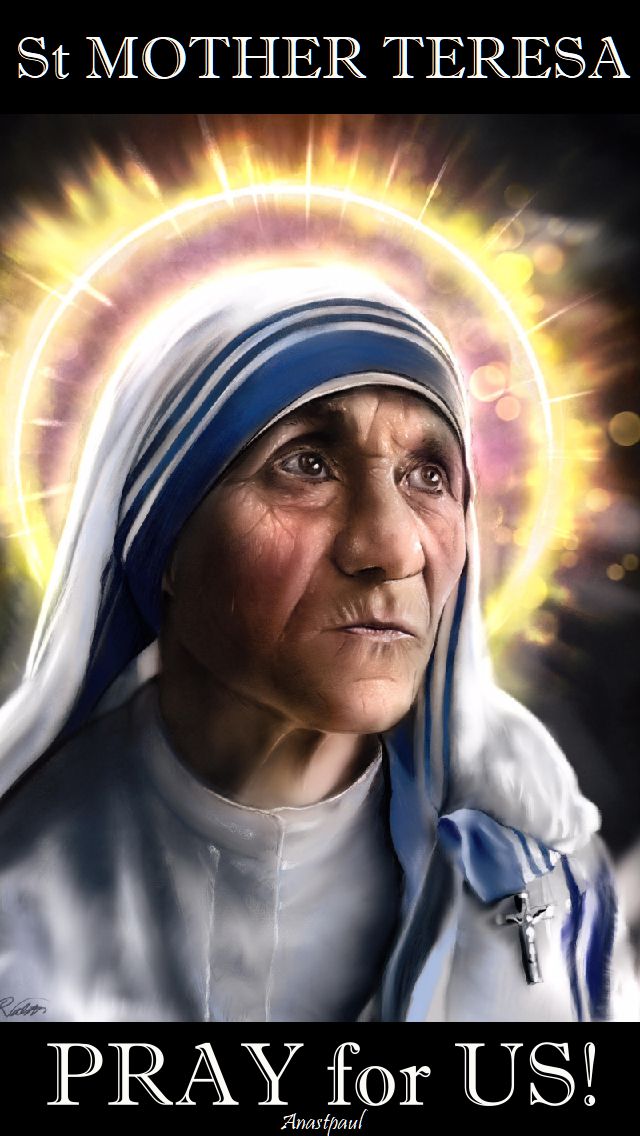
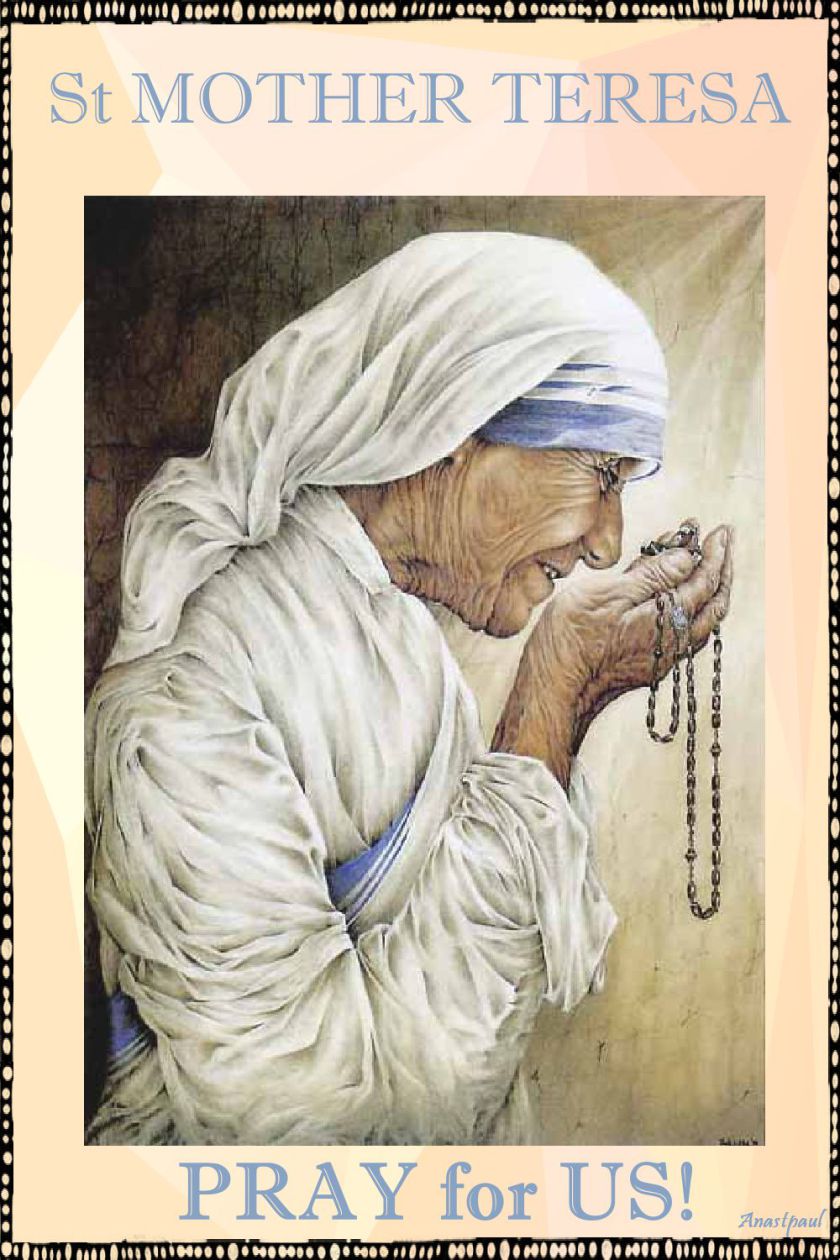
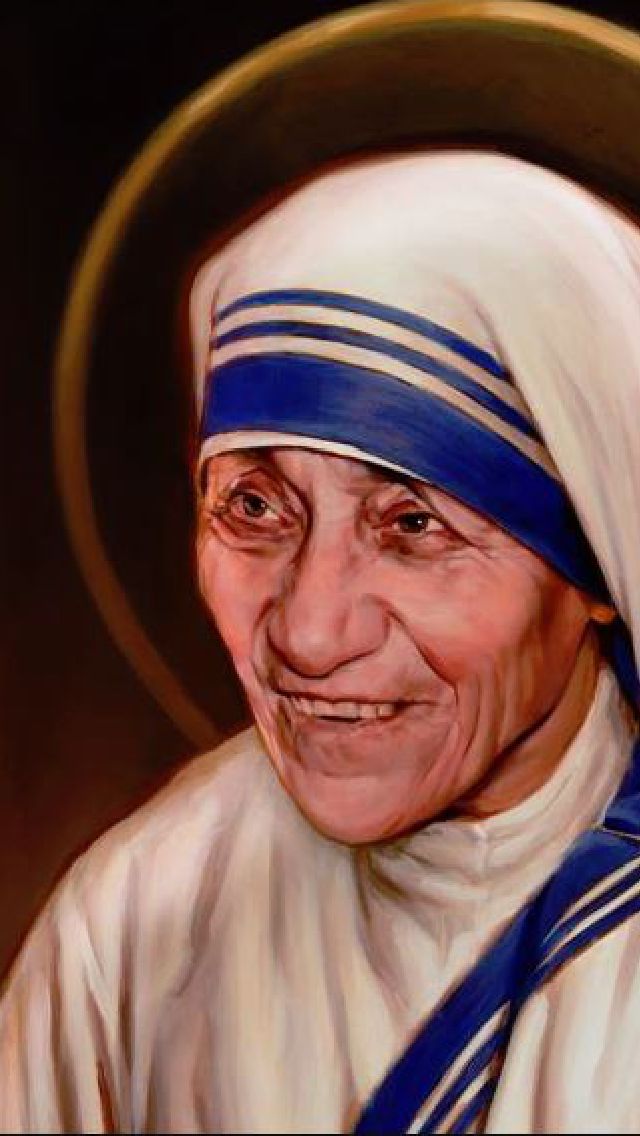
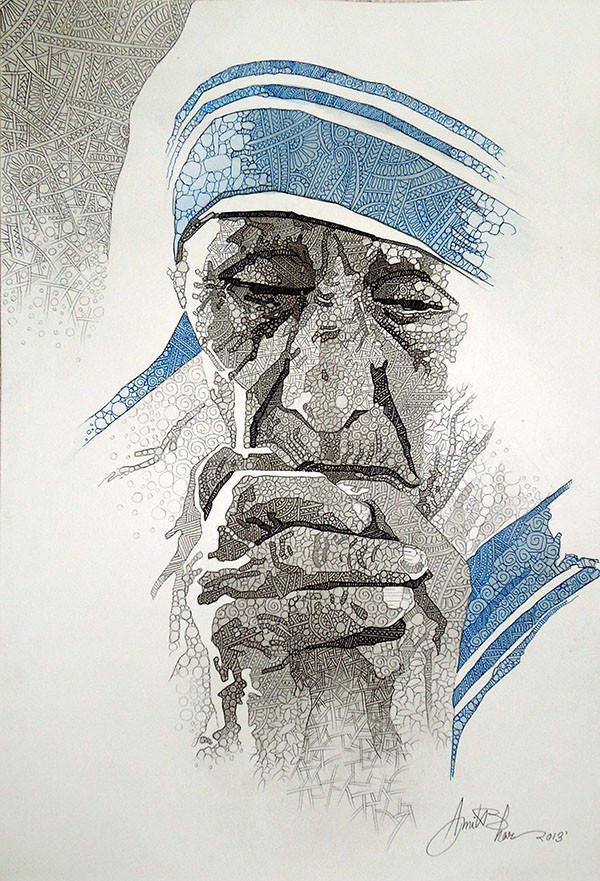
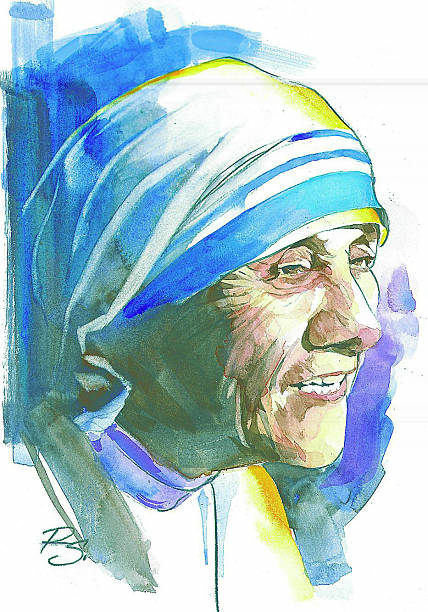
Thought for the Day – 5 September – The Memorial of St Mother Teresa (1910-1997)
Mother Teresa, in all aspects of her life, was a generous dispenser of divine mercy, making herself available for everyone through her welcome and defence of human life, those unborn and those abandoned and discarded. She was committed to defending life, ceaselessly proclaiming that “the unborn are the weakest, the smallest, the most vulnerable”. She bowed down before those who were spent, left to die on the side of the road, seeing in them their God-given dignity, she made her voice heard before the powers of this world, so that they might recognise their guilt for the crime – the crimes! – of poverty they created. For Mother Teresa, mercy was the “salt” which gave flavour to her work, it was the “light” which shone in the darkness of the many who no longer had tears to shed for their poverty and suffering.
Her mission to the urban and existential peripheries remains for us today an eloquent witness to God’s closeness to the poorest of the poor. Today, I pass on this emblematic figure of womanhood and of consecrated life to the whole world of volunteers, may she be your model of holiness! I think, perhaps, we may have some difficult in calling her “Saint Teresa”, her holiness is so near to us, so tender and so fruitful that we continual to spontaneously call her “Mother Teresa”.
May this tireless worker of mercy help us increasingly to understand that our only criterion for action is gratuitous love, free from every ideology and all obligations, offered freely to everyone without distinction of language, culture, race or religion. Mother Teresa loved to say, “Perhaps I don’t speak their language, but I can smile”. Let us carry her smile in our hearts and give it to those whom we meet along our journey, especially those who suffer. In this way, we will open up opportunities of joy and hope for our many brothers and sisters who are discouraged and who stand in need of understanding and tenderness…… Excerpt from the Homily of His Holiness, Pope Francis on the Canonisation of St Teresa of Calcutta, Sunday, 4 September 2016 (it was also the Jubilee of Workers of Mercy and Volunteers)
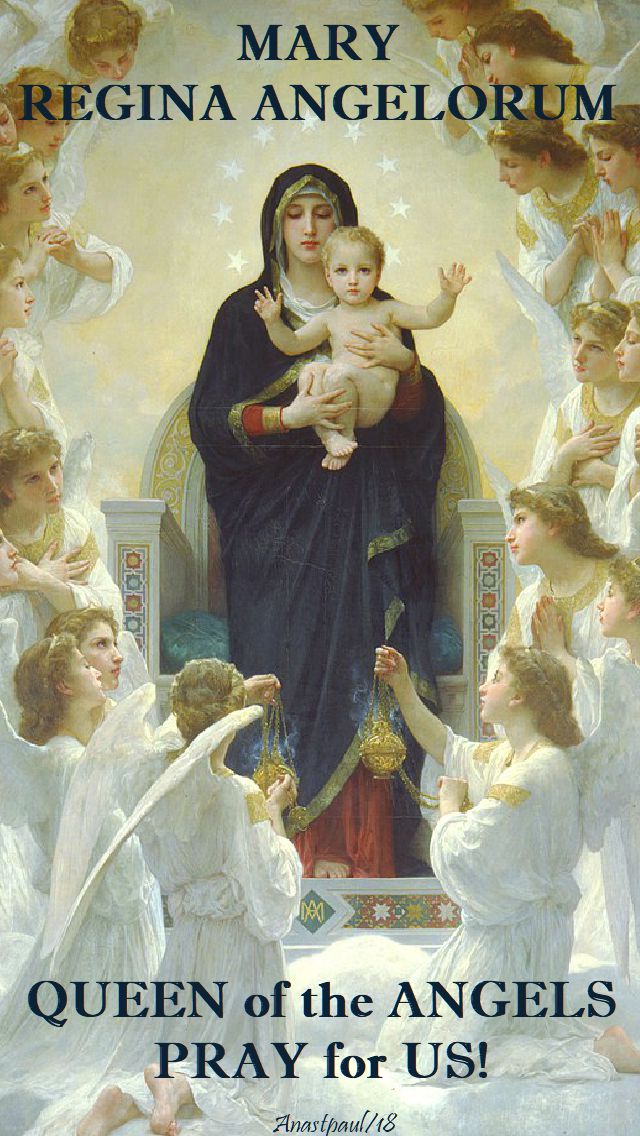
Virgin Mary, Queen of all the Saints, help us to be gentle and humble of heart like this fearless messenger of Love. Help us to serve every person we meet with joy and a smile. Help us to be missionaries of Christ, our peace and our hope. Amen!…
One Minute Reflection – 5 September – Today’s Gospel: Luke 4:38-44 – Wednesday of the Twenty-second week in Ordinary Time and the Memorial of St Mother Teresa (1910-1997)
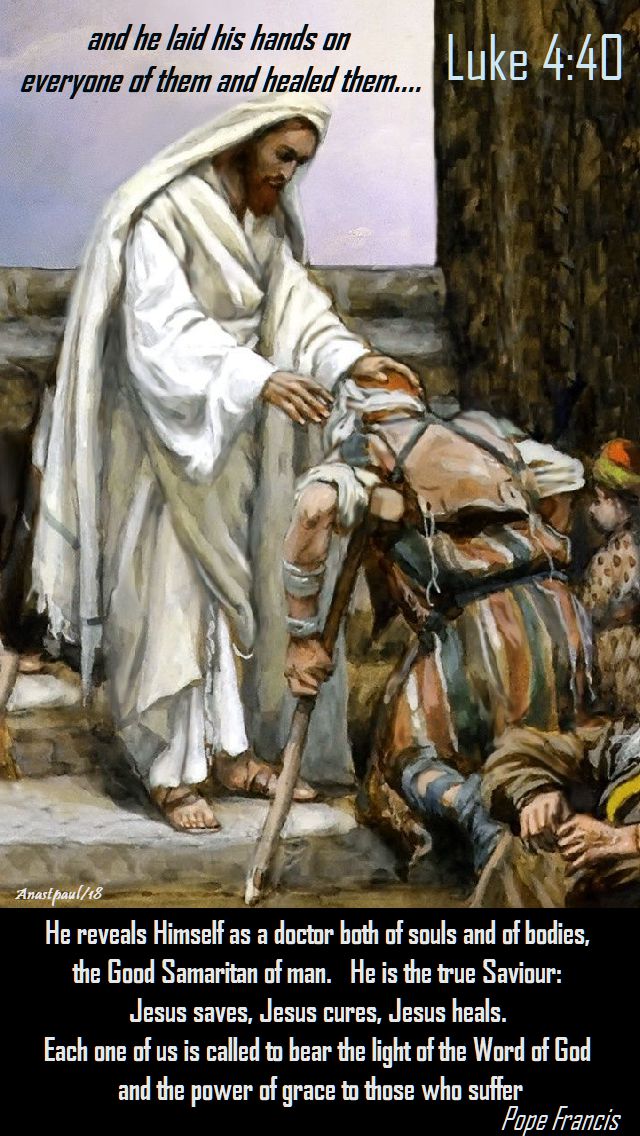
Now when the sun was setting, all those who had any that were sick with various diseases brought them to him and he laid his hands on every one of them and healed them….Luke 4:40
REFLECTION – “Having come to earth to proclaim and to realise the salvation of the whole man and of all people, Jesus shows a particular predilection for those who are wounded in body and in spirit: the poor, the sinners, the possessed, the sick, the marginalised. Thus, He reveals Himself as a doctor both of souls and of bodies, the Good Samaritan of man. He is the true Saviour: Jesus saves, Jesus cures, Jesus heals. Each one of us is called to bear the light of the Word of God and the power of grace to those who suffer and to those who assist them — family, doctors, nurses — so that the service to the sick might always be better accomplished with more humanity, with generous dedication, with evangelical love, with tenderness.”… Pope Francis – Angelus, 8 February 2015
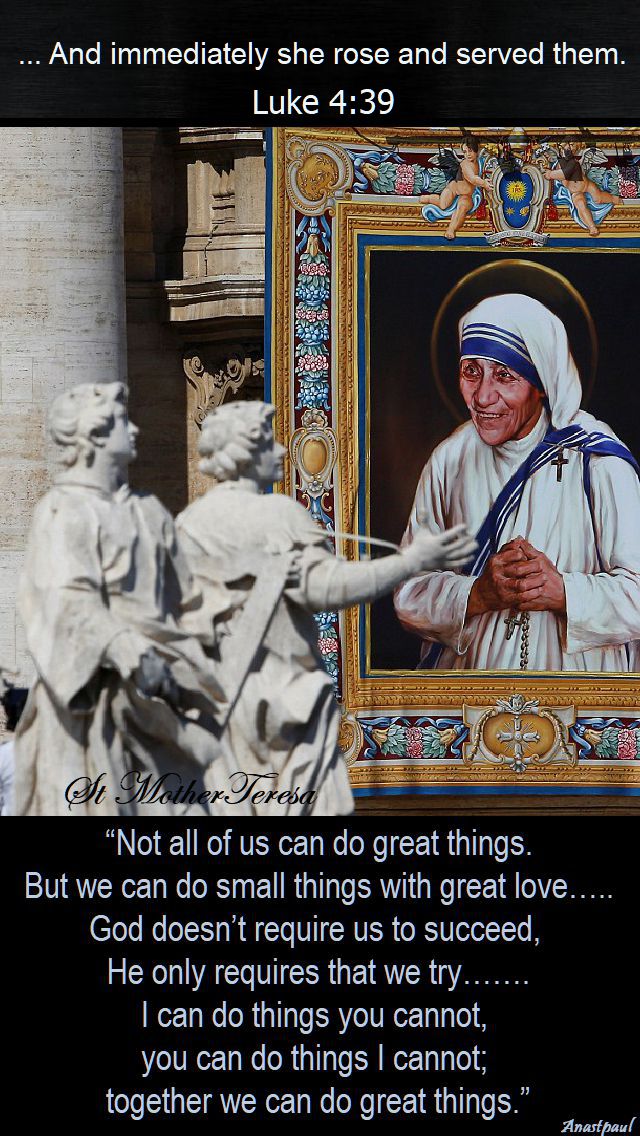
“Not all of us can do great things. But we can do small things with great love…..God doesn’t require us to succeed, He only requires that we try…….I can do things you cannot, you can do things I cannot; together we can do great things.” ….St Mother Teresa of Calcutta
PRAYER – Heavenly Father, help us to be holy in the way that You have laid out for all of us. Let us carry out the duties of our state in life to the full and so attain the holiness proper to each one. May the prayers of St Mother Teresa assist us in using the gifts You have been given us, for the Glory of God. We make our prayer through our Lord, Jesus Christ with the Holy Spirit, one God, forever, amen.
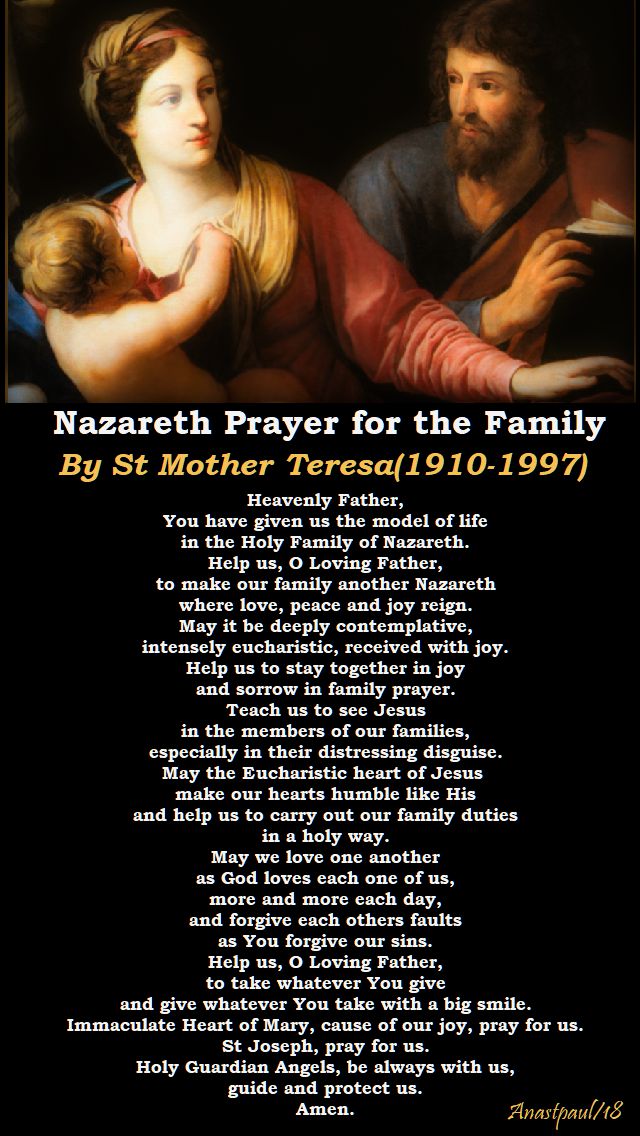
Our Morning Offering – 5 September – The Memorial of St Mother Teresa of Calcutta M.C. (1910-1997) This is a very appropriate prayer as the Church focuses on Family Life.
Nazareth Prayer for the Family By St Mother Teresa(1910-1997)
Heavenly Father,
You have given us the model of life
in the Holy Family of Nazareth.
Help us, O Loving Father,
to make our family another Nazareth
where love, peace and joy reign.
May it be deeply contemplative,
intensely eucharistic, received with joy.
Help us to stay together in joy
and sorrow in family prayer.
Teach us to see Jesus
in the members of our families,
especially in their distressing disguise.
May the Eucharistic heart of Jesus
make our hearts humble like His
and help us to carry out our family duties
in a holy way.
May we love one another
as God loves each one of us,
more and more each day,
and forgive each others faults
as You forgive our sins.
Help us, O Loving Father,
to take whatever You give
and give whatever You take with a big smile.
Immaculate Heart of Mary,
cause of our joy, pray for us.
St Joseph, pray for us.
Holy Guardian Angels,
be always with us,
guide and protect us.
Amen.
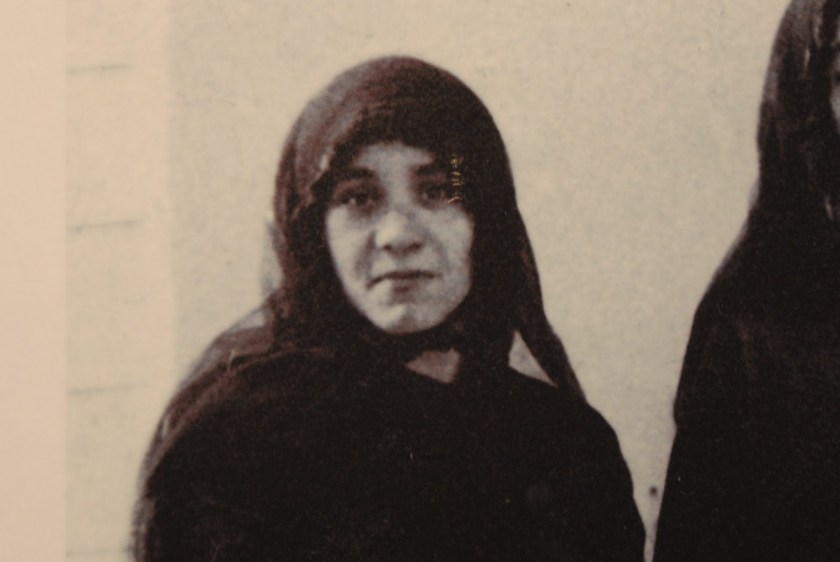
Saint of the Day – 5 September – St Teresa of Calcutta M.C. (1910-1997) (born Agnes Gonxha Bojaxhiu) – Consecrated Religious Nun, Founder of the Order of the Missionaries of Charity, Apostle of Charity, Missionary, Nobel Peace Prize Winner 1978, Anti-Abortion Activist – (26 August 1910 in Skopje, Albania (modern Macedonia) – 5 September 1997 in Calcutta, West Bengal, India of natural causes). She was Beatified on 19 October 2003 by St John Paul and Canonised on 4 September 2016 by Pope Francis. Patronages – World Youth Day, Missionaries of Charity, co-Patron of the Archdiocese of Calcutta.
“By blood, I am Albanian. By citizenship, an Indian. By faith, I am a Catholic nun. As to my calling, I belong to the world. As to my heart, I belong entirely to the Heart of Jesus.” Small of stature, rocklike in faith, Mother Teresa of Calcutta was entrusted with the mission of proclaiming God’s thirsting love for humanity, especially for the poorest of the poor. “God still loves the world and He sends you and me to be His love and His compassion to the poor.” She was a soul filled with the light of Christ, on fire with love for Him and burning with one desire.
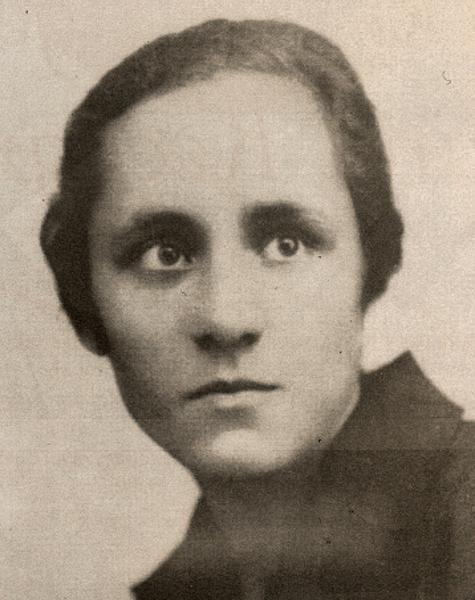
This luminous messenger of God’s love was born on 26 August 1910 in Skopje, a city situated at the crossroads of Balkan history. The youngest of the children born to Nikola and Drane Bojaxhiu, she was baptised Gonxha Agnes, received her First Communion at the age of five and a half and was confirmed in November 1916. From the day of her First Holy Communion, a love for souls was within her. Her father’s sudden death when Gonxha was about eight years old left in the family in financial straits. Drane raised her children firmly and lovingly, greatly influencing her daughter’s character and vocation. Gonxha’s religious formation was further assisted by the vibrant Jesuit parish of the Sacred Heart in which she was much involved.
At the age of eighteen, moved by a desire to become a missionary, Gonxha left her home in September 1928 to join the Institute of the Blessed Virgin Mary, known as the Sisters of Loreto, in Ireland. There she received the name Sister Mary Teresa after St Thérèse of Lisieux. In December, she departed for India, arriving in Calcutta on 6 January 1929. After making her First Profession of Vows in May 1931, Sister Teresa was assigned to the Loreto Entally community in Calcutta and taught at St Mary’s School for girls. On 24 May 1937, Sister Teresa made her Final Profession of Vows, becoming, as she said, the “spouse of Jesus” for “all eternity.” From that time on she was called Mother Teresa. She continued teaching at St Mary’s and in 1944 became the school’s principal. A person of profound prayer and deep love for her religious sisters and her students, Mother Teresa’s twenty years in Loreto were filled with profound happiness. Noted for her charity, unselfishness and courage, her capacity for hard work and a natural talent for organisation, she lived out her consecration to Jesus, in the midst of her companions, with fidelity and joy.
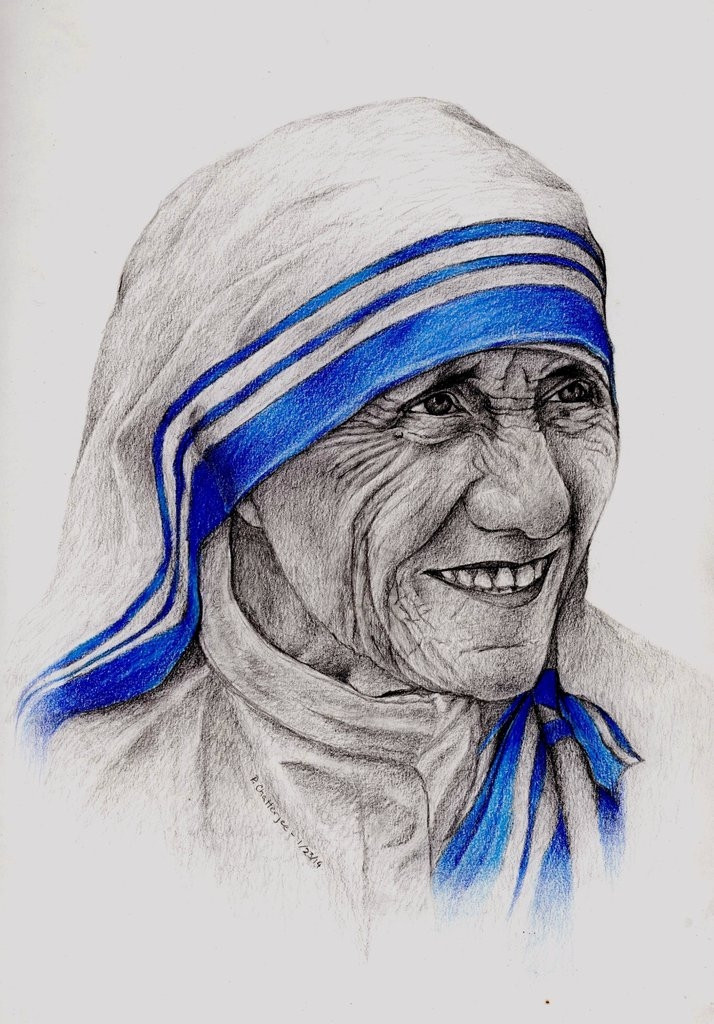
On 10 September 1946 during the train ride from Calcutta to Darjeeling for her annual retreat, Mother Teresa received her “inspiration,” her “call within a call.” On that day, in a way she would never explain, Jesus’ thirst for love and for souls took hold of her heart and the desire to satiate His thirst became the driving force of her life. Over the course of the next weeks and months, by means of interior locutions and visions, Jesus revealed to her the desire of His heart for “victims of love” who would “radiate His love on souls.”“Come be My light,” He begged her. “I cannot go alone.” He revealed His pain at the neglect of the poor, His sorrow at their ignorance of Him and His longing for their love. He asked Mother Teresa to establish a religious community, Missionaries of Charity, dedicated to the service of the poorest of the poor. Nearly two years of testing and discernment passed before Mother Teresa received permission to begin. On 17 August 1948, she dressed for the first time in a white, blue-bordered sari and passed through the gates of her beloved Loreto convent to enter the world of the poor.
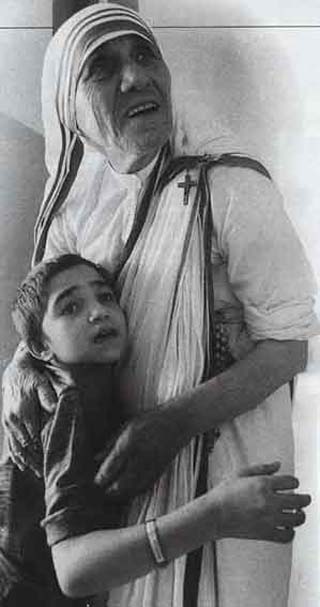
After a short course with the Medical Mission Sisters in Patna, Mother Teresa returned to Calcutta and found temporary lodging with the Little Sisters of the Poor. On 21 December she went for the first time to the slums. She visited families, washed the sores of some children, cared for an old man lying sick on the road and nursed a woman dying of hunger and TB. She started each day in communion with Jesus in the Eucharist and then went out, rosary in her hand, to find and serve Him in “the unwanted, the unloved, the uncared for.”After some months, she was joined, one by one, by her former students.
On 7 October 1950 the new congregation of the Missionaries of Charity was officially established in the Archdiocese of Calcutta. By the early 1960s, Mother Teresa began to send her Sisters to other parts of India. The Decree of Praise granted to the Congregation by Pope Paul VI in February 1965 encouraged her to open a house in Venezuela. It was soon followed by foundations in Rome and Tanzania and, eventually, on every continent. Starting in 1980 and continuing through the 1990s, Mother Teresa opened houses in almost all of the communist countries, including the former Soviet Union, Albania and Cuba.
In order to respond better to both the physical and spiritual needs of the poor, Mother Teresa founded the Missionaries of Charity Brothers in 1963, in 1976 the contemplative branch of the Sisters, in 1979 the Contemplative Brothers and in 1984 the Missionaries of Charity Fathers. Yet her inspiration was not limited to those with religious vocations. She formed the Co-Workers of Mother Teresa and the Sick and Suffering Co-Workers, people of many faiths and nationalities with whom she shared her spirit of prayer, simplicity, sacrifice and her apostolate of humble works of love. This spirit later inspired the Lay Missionaries of Charity. In answer to the requests of many priests, in 1981 Mother Teresa also began the Corpus Christi Movement for Priests as a “little way of holiness” for those who desire to share in her charism and spirit.
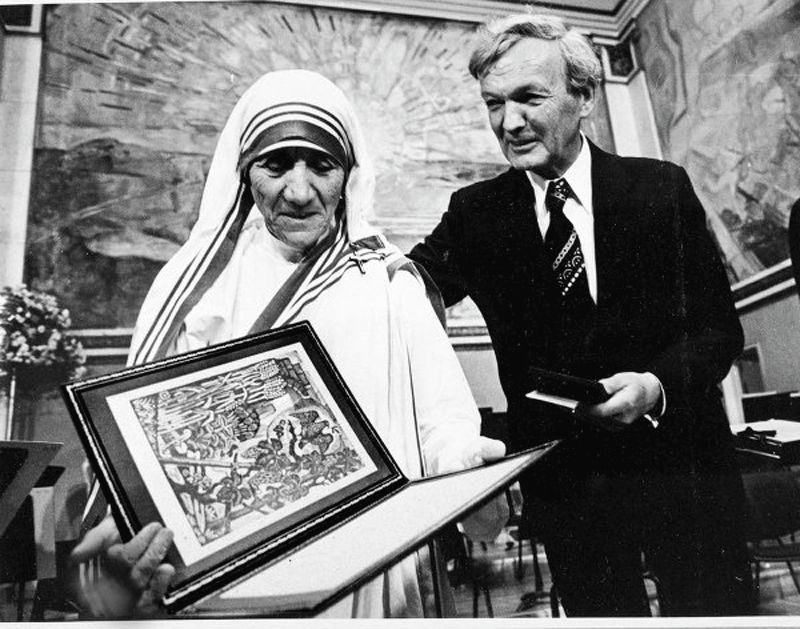
During the years of rapid growth the world began to turn its eyes towards Mother Teresa and the work she had started. Numerous awards, beginning with the Indian Padmashri Award in 1962 and notably the Nobel Peace Prize in 1979, honoured her work, while an increasingly interested media began to follow her activities. She received both prizes and attention “for the glory of God and in the name of the poor.”
Mother Teresa, with Chairman of the Norwegian Nobel Committee, John Sanness
The whole of Mother Teresa’s life and labour bore witness to the joy of loving, the greatness and dignity of every human person, the value of little things done faithfully and with love and the surpassing worth of friendship with God. But there was another heroic side of this great woman that was revealed only after her death. Hidden from all eyes, hidden even from those closest to her, was her interior life marked by an experience of a deep, painful and abiding feeling of being separated from God, even rejected by Him, along with an ever-increasing longing for His love. She called her inner experience, “the darkness.” The “painful night” of her soul, which began around the time she started her work for the poor and continued to the end of her life, led Mother Teresa to an ever more profound union with God. Through the darkness she mystically participated in the thirst of Jesus, in His painful and burning longing for love and she shared in the interior desolation of the poor.
During the last years of her life, despite increasingly severe health problems, Mother Teresa continued to govern her Society and respond to the needs of the poor and the Church. By 1997, Mother Teresa’s Sisters numbered nearly 4,000 members and were established in 610 foundations in 123 countries of the world. In March 1997 she blessed her newly-elected successor as Superior General of the Missionaries of Charity and then made one more trip abroad. After meeting Pope John Paul II for the last time, she returned to Calcutta and spent her final weeks receiving visitors and instructing her Sisters. On 5 September Mother Teresa’s earthly life came to an end. She was given the honour of a state funeral by the Government of India and her body was buried in the Mother House of the Missionaries of Charity. Her tomb quickly became a place of pilgrimage and prayer for people of all faiths, rich and poor alike. Mother Teresa left a testament of unshakable faith, invincible hope and extraordinary charity. Her response to Jesus’ plea, “Come be My light,”made her a Missionary of Charity, a “mother to the poor,”a symbol of compassion to the world and a living witness to the thirsting love of God.
Less than two years after her death, in view of Mother Teresa’s widespread reputation of holiness and the favours being reported, Pope John Paul II permitted the opening of her Cause of Canonisation. On 20 December 2002 he approved the decrees of her heroic virtues and miracles.”…vatican.va
Mother Teresa was Beatified on Sunday, 19 October 2003 by St Pope John Paul II and Canonised by Pope Francis on 4 September 2016.
St Albert of Butrio
St Alvitus of León
Bl Anselm of Anchin
St Anseric of Soissons
St Bertin the Great
St Charbel
Bl Florent Dumontet de Cardaillac
St Genebald of Laon
Bl Gentilis
Bl Gerbrand of Dokkum
St Guise Hoang Luong Canh
Bl John the Good of Siponto
Bl Jordan of Pulsano
St Obdulia
St Phêrô Nguyen Van Tu
St Romulus of Rome
St Mother Teresa of Calcutta (1910-1997)
Full Biography here: https://anastpaul.wordpress.com/2017/09/05/saint-of-the-day-5-september-st-mother-teresa-of-calcutta-mc/
St Victorinus of Amiterme
St Victorinus of Como
Bl William Browne
—
Martyrs of Armenia – 1,000 saints: A group of up to 1,000 Christian soldiers in the 2nd century imperial Roman army of Trajan, stationed in Gaul. Ordered to sacrifice to pagan gods, they refused and were transferred to Armenia. Ordered again to sacrifice to pagan gods, they refused again. Martyrs. We know the names of three of them, but nothing else – Eudoxius, Macarius and Zeno.
Martyrs of Capua – 3 saints: Three Christians who were martyred together. Long venerated in Capua, Italy. We know their names, but little else – Arcontius, Donatus and Quintius. They were martyred in Capua, Italy.
Martyrs of Nicomedia – 80 saints: A group of 80 Christians, lay and clergy, martyred together in the persecutions of Valens. We know little more than the names of three of them – Menedemo, Teodoro and Urbano. They were locked on a boat which was then set on fire on the shore of Nicomedia, Bithynia (in modern Turkey) c 370.
Martyrs of Porto Romano – 4+ saints: A group of Christians martyred together in the persecutions of Marcus Aurelius. We know little more than their names – Aconto, Herculanus, Nonno and Taurino. c180 at Porto Romano, Italy
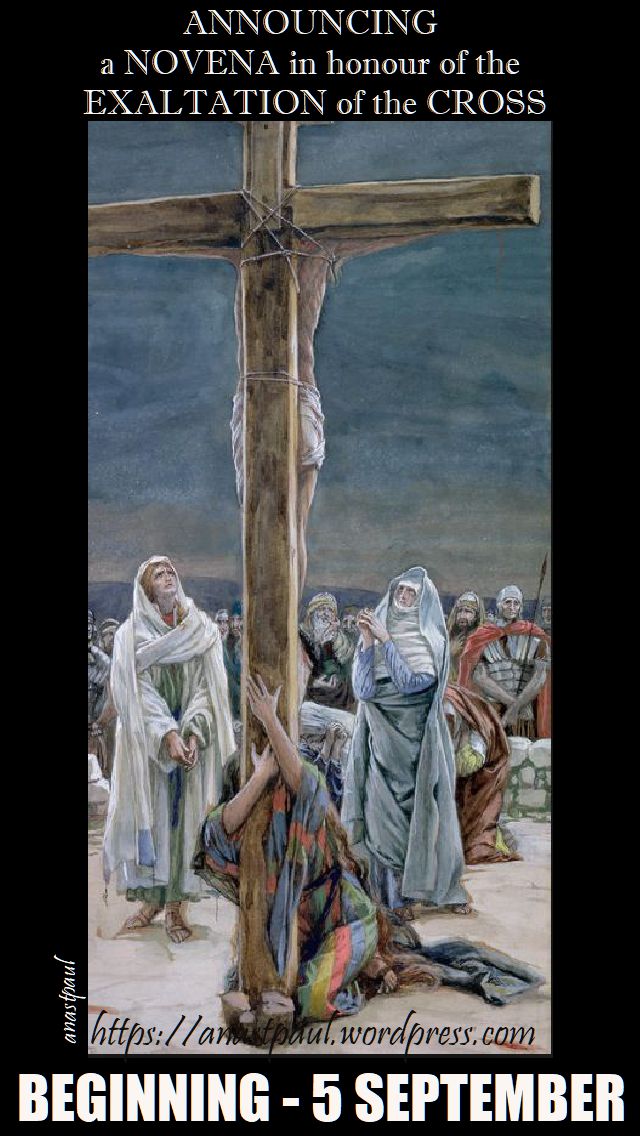
This feast was observed in Rome before the end of the seventh century. It commemorates the recovery of the Holy Cross, which had been placed on Mount Calvary by St. Helena and preserved in Jerusalem but then had fallen into the hands of Chosroas, King of the Persians. The precious relic was recovered and returned to Jerusalem by Emperor Heralius in 629.
The lessons from the Breviary tell us that Emperor Heraclius carried the Cross back to Jerusalem on his shoulders. He was clothed with costly garments and with ornaments of precious stones. But at the entrance to Mount Calvary a strange incident occurred. Try as hard as he would, he could not go forward. Zacharias, the Bishop of Jerusalem, then said to the astonished monarch: “Consider, O Emperor, that with these triumphal ornaments you are far from resembling Jesus carrying His Cross.” The…
Thought for the Day – 4 September – The Feast of Our Lady of Consolation
The tradition of praying to the Mother of God for the gift of consolation dates back to the early centuries. The first written evidence of prayer to the Mother of God, Mary, the Theotokos, is written in Greek on a scrap of Egyptian papyrus dating from between 300-540. In that prayer, she is invoked as the compassionate one:
“Beneath the shelter of your tender compassion we fly for refuge, Mother of God. Do not overlook our supplications in adversity but deliver us out of danger”
This prayer makes clear, a vivid faith in Mary’s consoling role.
To our Lord and our God, Jesus Christ, we pray for a greater love of His Mother and to our Blessed Mother, Our Lady of Consolation, we lift our prayers for patience, for support and for comfort in our times of confusion, fear and anxiety. Pray for us, Our Lady of Consolation!
“The Church calls Mary the “Queen of Mercy” because we believe she opens the abyss of God’s mercy to whomever she wills, when she wills and as she wills. No sinner — no matter how great — who has Mary as protector, is ever lost.”
St Bernard of Clairvaux (1090-1153) – Doctor of the Church
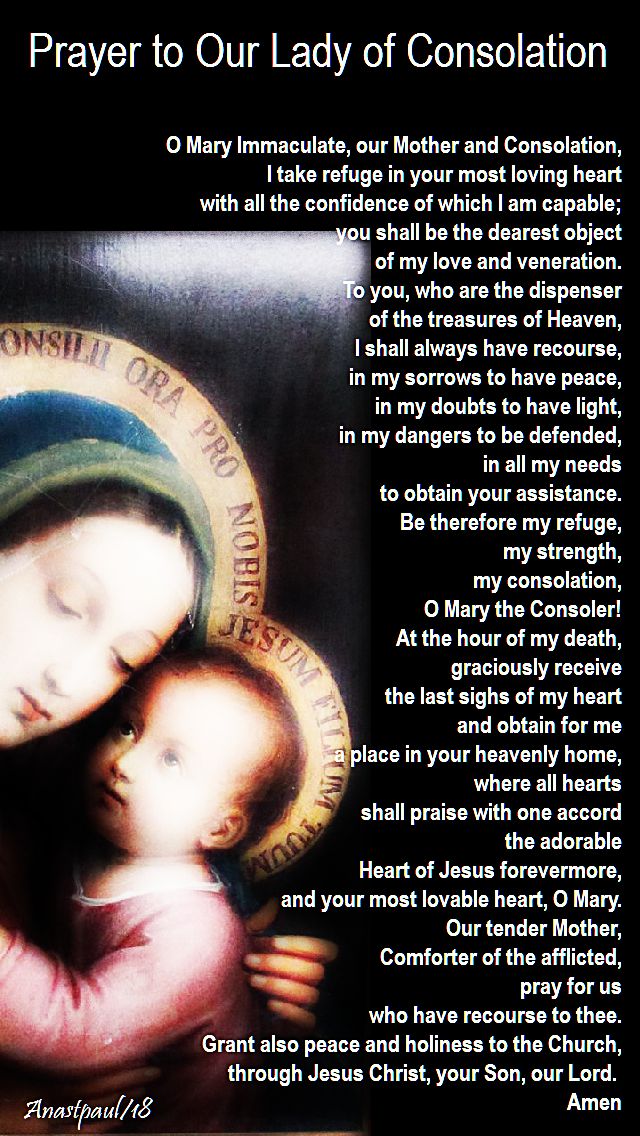
Prayer to Our Lady of Consolation
O Mary Immaculate, our Mother and Consolation, I take refuge in your most loving heart with all the confidence of which I am capable; you shall be the dearest object of my love and veneration. To you, who are the dispenser of the treasures of Heaven, I shall always have recourse, in my sorrows to have peace, in my doubts to have light, in my dangers to be defended, in all my needs to obtain your assistance. Be therefore my refuge, my strength, my consolation, O Mary the Consoler! At the hour of my death, graciously receive the last sighs of my heart and obtain for me a place in your heavenly home, where all hearts shall praise with one accord the adorable Heart of Jesus forevermore, and your most lovable heart, O Mary. Our tender Mother, Comforter of the afflicted, pray for us who have recourse to thee. Grant also peace and holiness to the Church, through Jesus Christ, your Son, our Lord. Amen
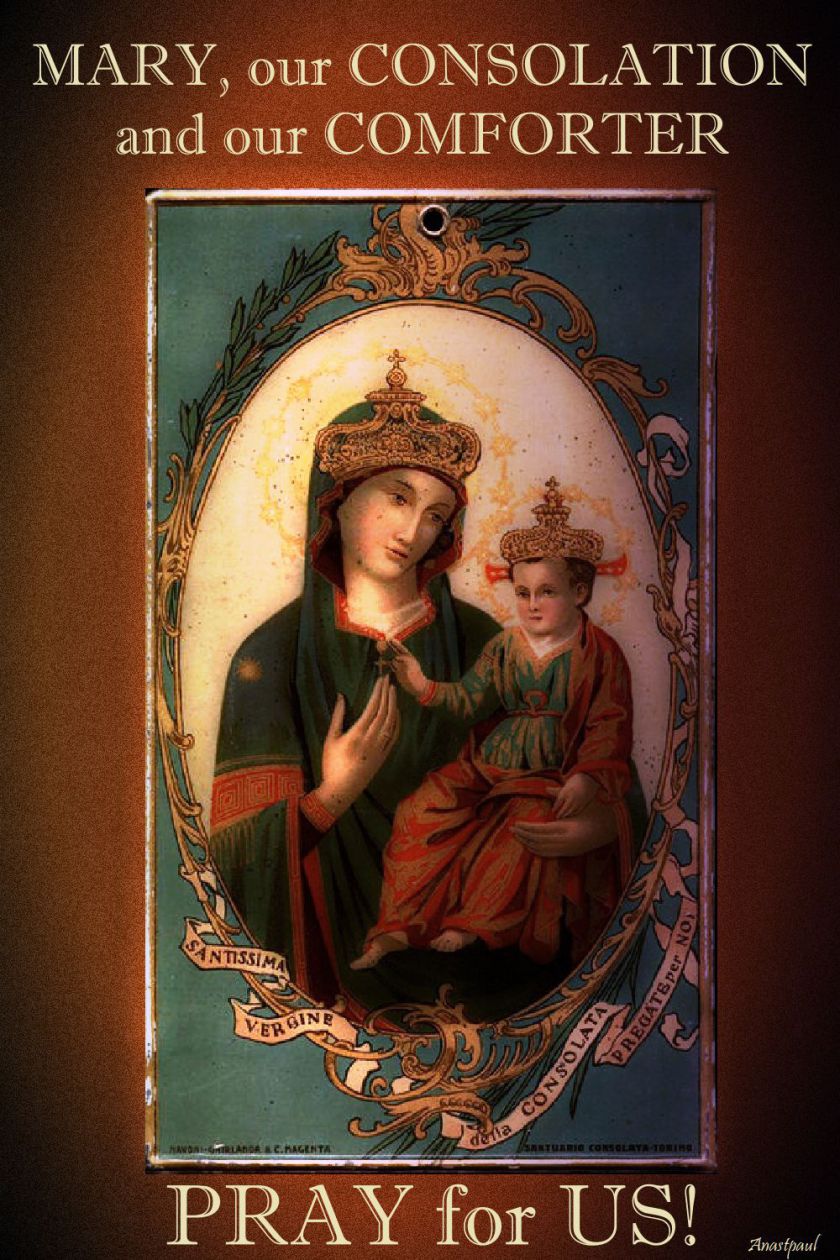
Mary, our Consolation and our Comforter, Pray for us!
One Minute Reflection – 4 September – Today’s Gospel: Luke 4:31–37 – Tuesday of the Twenty-second week in Ordinary Time and the Memorial of Our Lady of Consolation
And they were all amazed and said to one another, “What is this word? For with authority and power he commands the unclean spirits, and they come out.”…Luke 4:36
REFLECTION – “The power of Jesus confirms the authority of His teaching. He does not just speak with words but He takes action. In the Gospel in fact, we see that in His earthly mission, Jesus reveals the love of God both through preaching and through countless gestures of attention and aid to the sick, the needy, children and sinners.
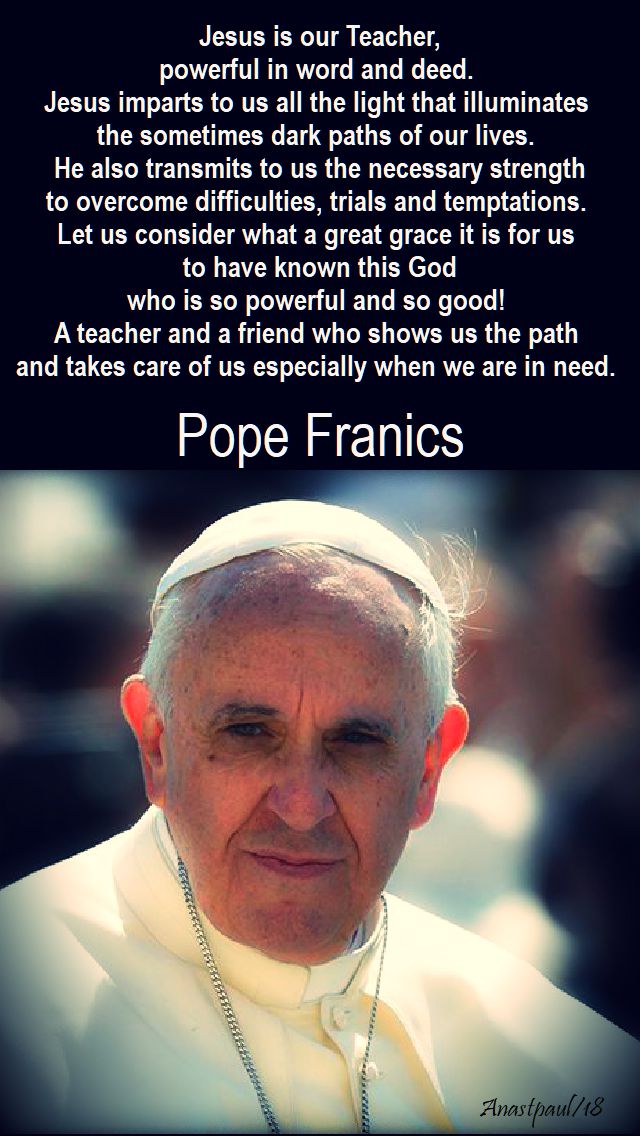
Jesus is our Teacher, powerful in word and deed. Jesus imparts to us all the light that illuminates the sometimes dark paths of our lives. He also transmits to us the necessary strength to overcome difficulties, trials and temptations. Let us consider what a great grace it is for us to have known this God who is so powerful and so good! A teacher and a friend who shows us the path and takes care of us especially when we are in need.
May the Virgin Mary, the woman of listening, help us to create silence around us and within us, in order to hear, through the din of the messages of the world, the most authoritative word that there is: that of her Son Jesus, who proclaims the meaning of our existence and delivers us from all slavery, even that of the Evil one.”...Pope Francis – Angelus, 28 January 2018
PRAYER – True Light of the world, Lord Jesus Christ, as You enlighten all men for their salvation, give us grace, we pray, to live in Your Light and follow Your teachings. May Your Mother and ours, help us to hear Your Voice and teach us to enclose our hearts in silence and thus hear Your Voice. You, Who live and reign with the Father and the Holy Spirit, God, forever and ever, amen.
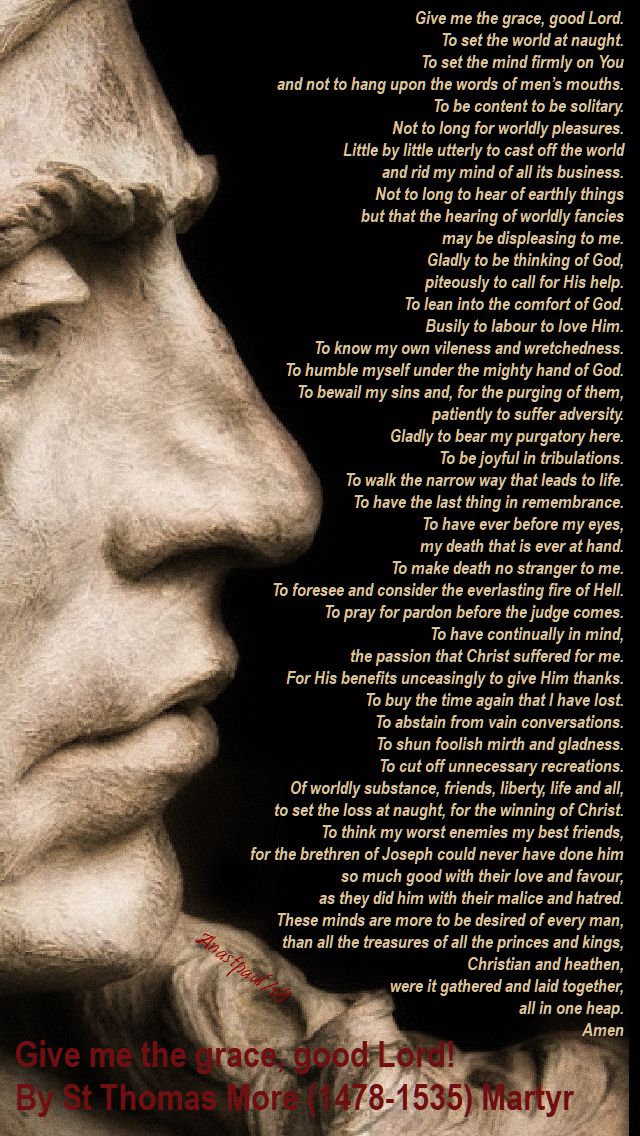
The prayer below, was written by Saint Thomas More while he was imprisoned in the Tower of London, awaiting execution by King Henry VIII.
Give me the grace, good Lord! By St Thomas More (1478-1535)
Give me the grace, good Lord.
To set the world at naught.
To set the mind firmly on You
and not to hang upon the words of men’s mouths.
To be content to be solitary.
Not to long for worldly pleasures.
Little by little utterly to cast off the world
and rid my mind of all its business.
Not to long to hear of earthly things
but that the hearing of worldly fancies
may be displeasing to me.
Gladly to be thinking of God,
piteously to call for His help.
To lean into the comfort of God.
Busily to labour to love Him.
To know my own vileness and wretchedness.
To humble myself under the mighty hand of God.
To bewail my sins and, for the purging of them,
patiently to suffer adversity.
Gladly to bear my purgatory here.
To be joyful in tribulations.
To walk the narrow way that leads to life.
To have the last thing in remembrance.
To have ever before my eyes,
my death that is ever at hand.
To make death no stranger to me.
To foresee and consider the everlasting fire of Hell.
To pray for pardon before the judge comes.
To have continually in mind,
the passion that Christ suffered for me.
For His benefits unceasingly to give Him thanks.
To buy the time again that I have lost.
To abstain from vain conversations.
To shun foolish mirth and gladness.
To cut off unnecessary recreations.
Of worldly substance, friends, liberty, life and all,
to set the loss at naught, for the winning of Christ.
To think my worst enemies my best friends,
for the brethren of Joseph could never have done him
so much good with their love and favour,
as they did him with their malice and hatred.
These minds are more to be desired of every man,
than all the treasures of all the princes and kings,
Christian and heathen,
were it gathered and laid together, all in one heap.
Amen
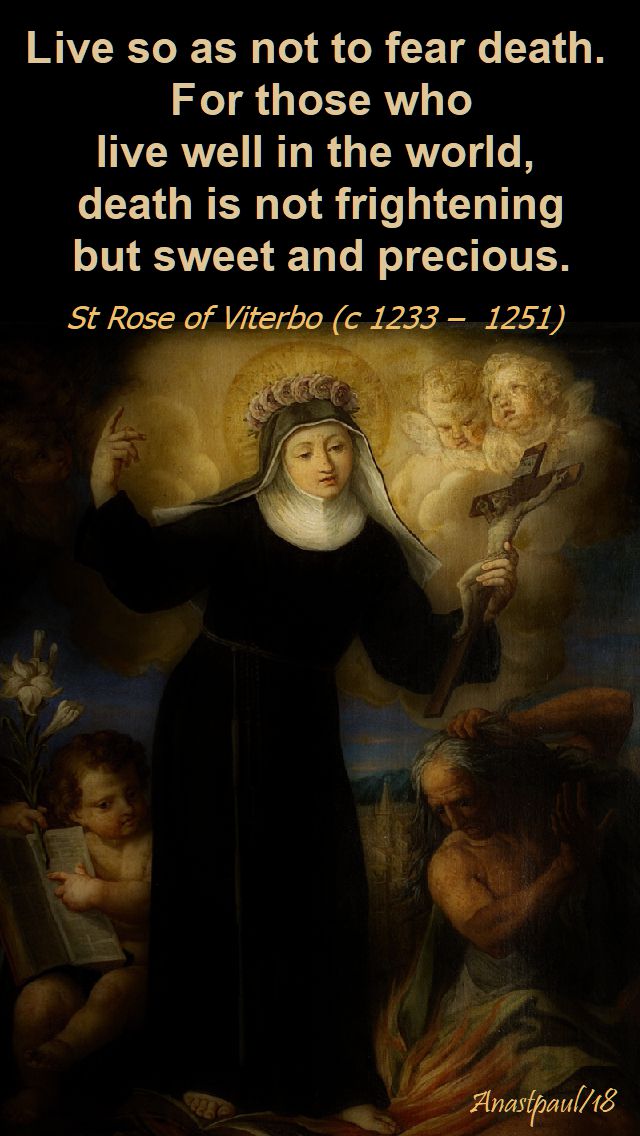
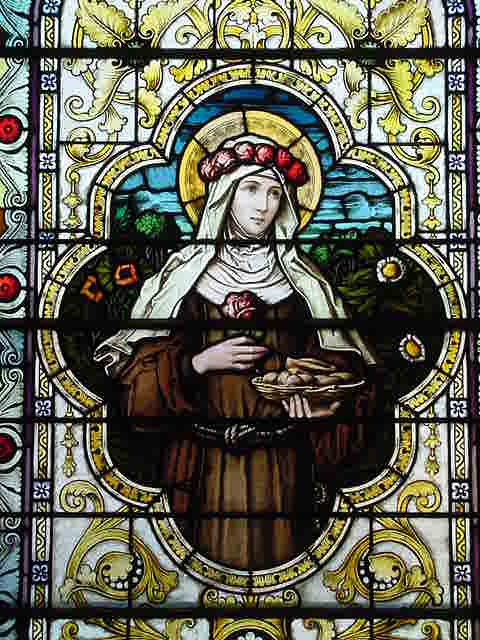
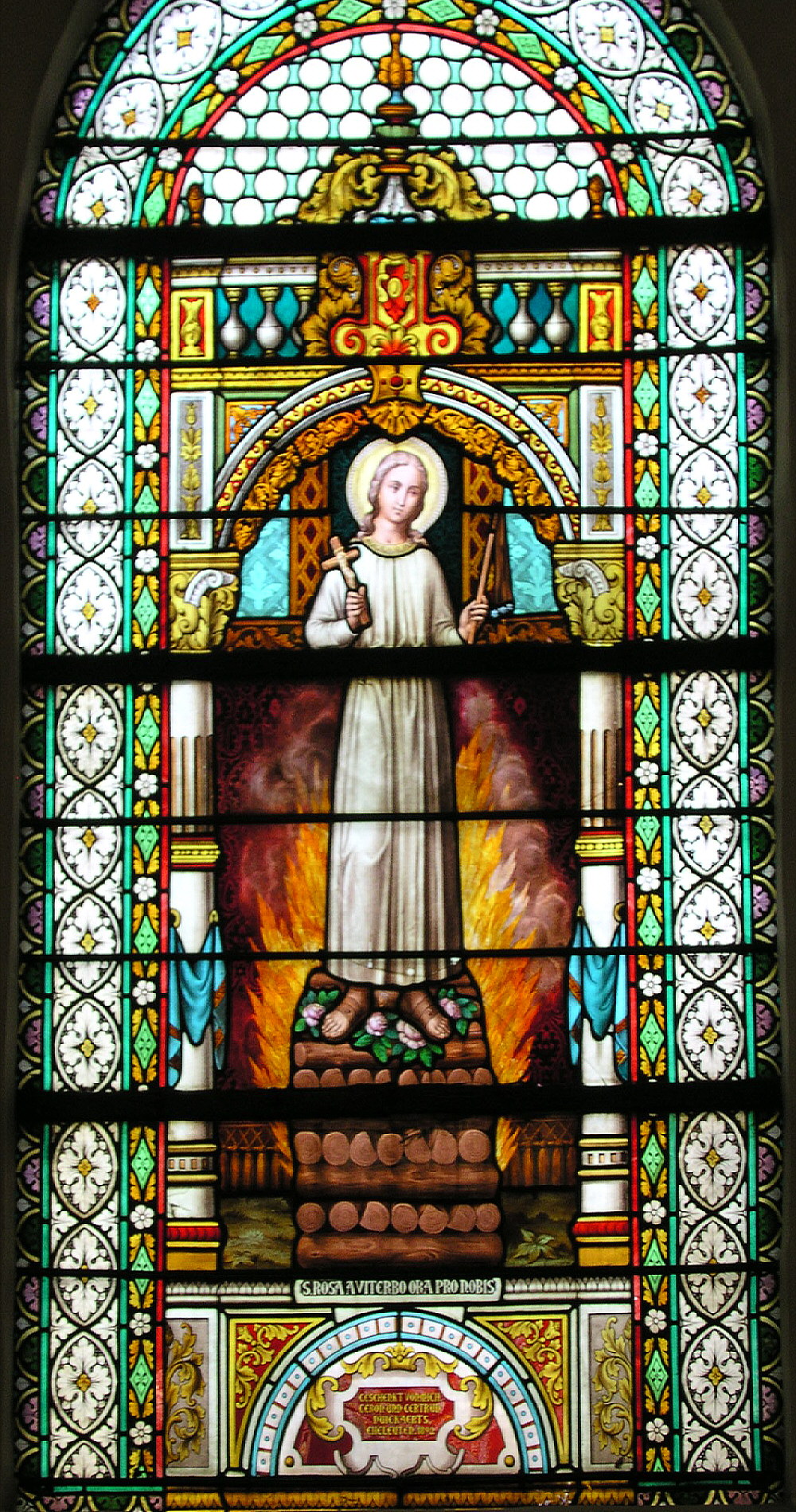
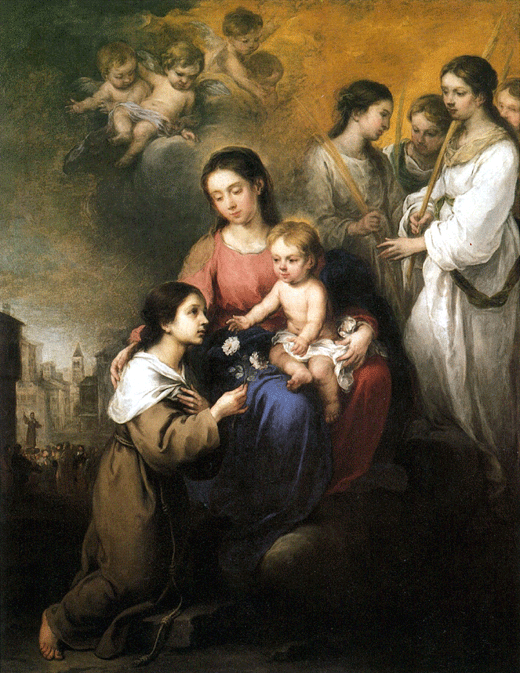
Saint of the Day – 4 September – St Rose of Viterbo (c1233 – 1251) TOSF – Virgin, Preacher – Member of the Franciscan Third Order, Recluse, Miracle-Worker.
Today the Franciscan family celebrates the memory of St Rose of Viterbo (c. 1233-1251), an audacious young Secular Franciscan woman who challenged her contemporaries as a public preacher.
Born in the City of Viterbo to a working-class family, Rose was captivated by the Franciscan Friars who had established a Church there. She began dressing in their habit and devoted herself to prayer and ascetical practices in her home. She also experienced visions and gained a reputation of being able to foretell the future.
To the consternation of her parents, people flocked to their home to hear Rose speak. In time, they allowed her to join the Brothers and Sisters of Penance (the Franciscan “Third Order”). Although still in early adolescence, Rose began preaching publicly, dressed in a Franciscan cord, leading her followers through the streets, urging people to do penance and turn their lives to God.
The leaders of Viterbo were loyal to the Emperor Frederick II at a time when he was locked in conflict with Pope Innocent IV. Rose preached loyalty to the Church and so she and her family were exiled from the City. As the political tide turned, they were allowed to return.
In her late teens, she sought admission to the local Poor Clare Monastery but the Nuns refused because of her controversial reputation and the fact that her family could not provide a dowry. She continued her life of penance in her family home, where she died on 6 March 1251. Her body remains an object of great veneration in Viterbo today. Recent examination of her remains indicate that she died of a rare enlarged heart condition. Rose was quickly acclaimed a Saint by the people of Viterbo who brought her incorrupt body to the Poor Clare Monastery which had refused her entry in life. Pope Innocent IV immediately began the process for her Canonisation but for various reasons her cause did not proceed until 1457 when she was Canonised .
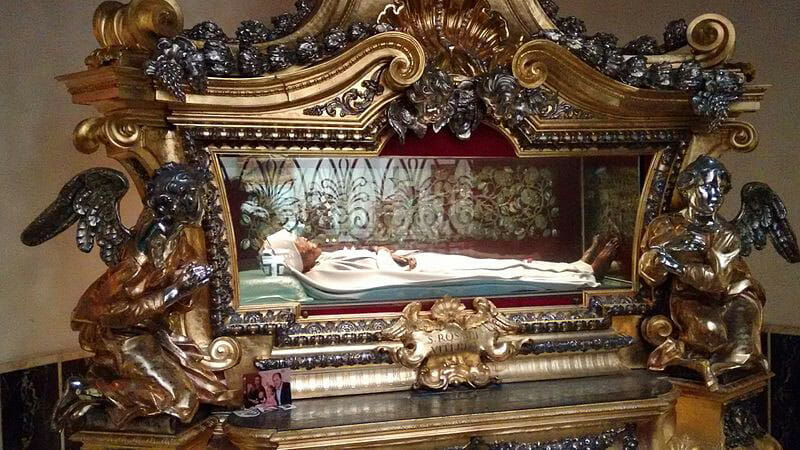
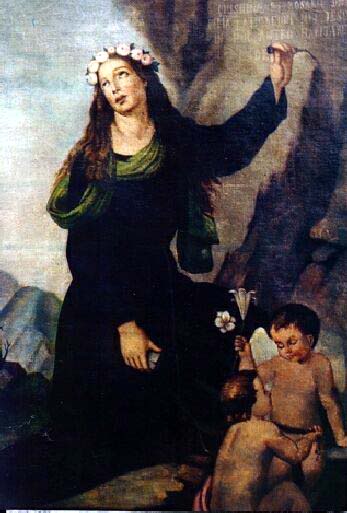
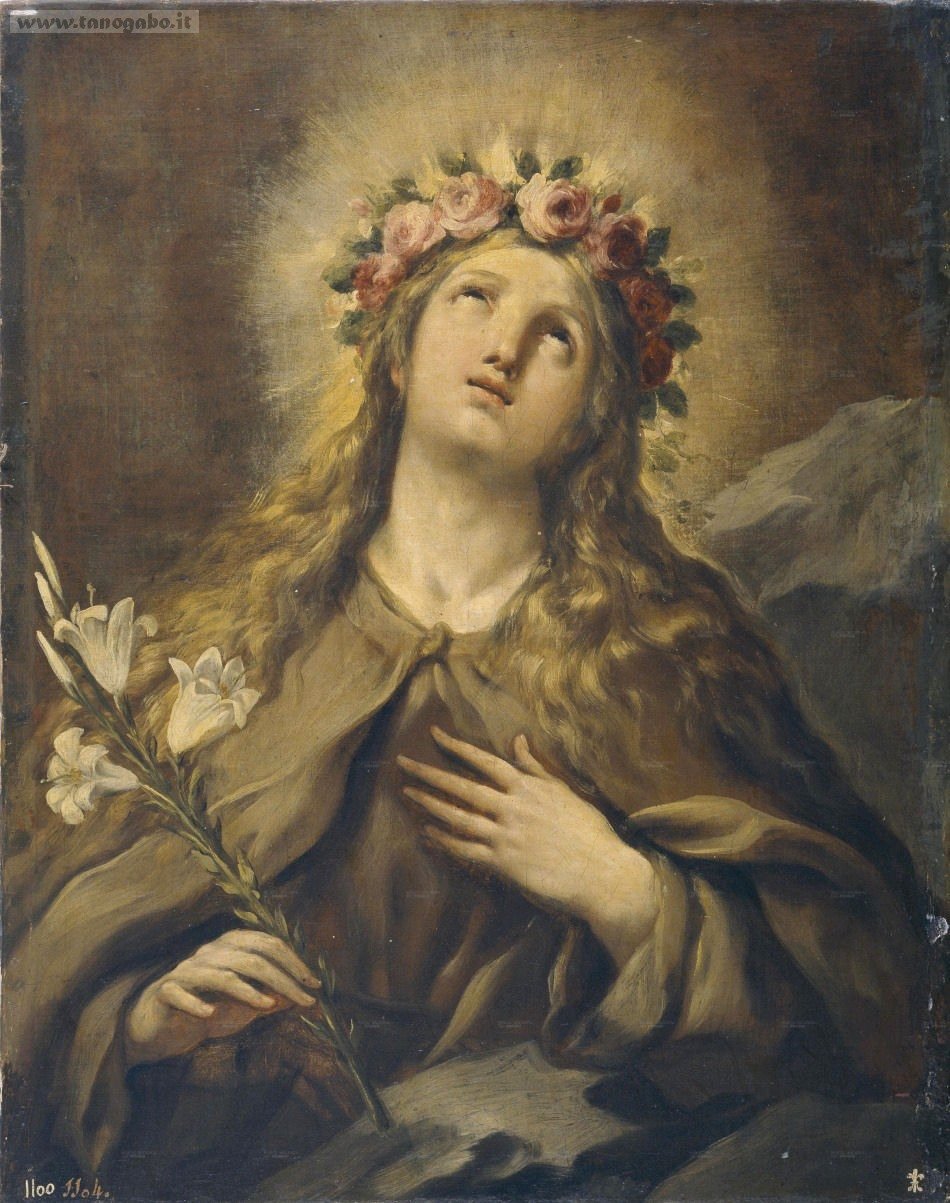
Be careful folks, today is also the Memorial of St Rosalia (1130–1166). There is great confusion with the 2 biographies and artworks but I think I have sorted out whose who here.
St Rosalia was daughter of a noble family descended from Charlemagne. She was born at Palermo in Sicily and despising in her youth worldly vanities, made herself an abode in a cave on Mount Pelegrino, three miles from Palermo, where she completed the sacrifice of her heart to God by austere penance and manual labour, sanctified by assiduous prayer and the constant union of her soul with God.
She died in 1160. Her body was found buried in a cave under the mountain, in the year of the jubilee, 1625, under Pope Urban VIII and was translated into the metropolitan church of Palermo, of which she was chosen a patroness. To her patronage that island ascribes the ceasing of a grievous pestilence at the same time.
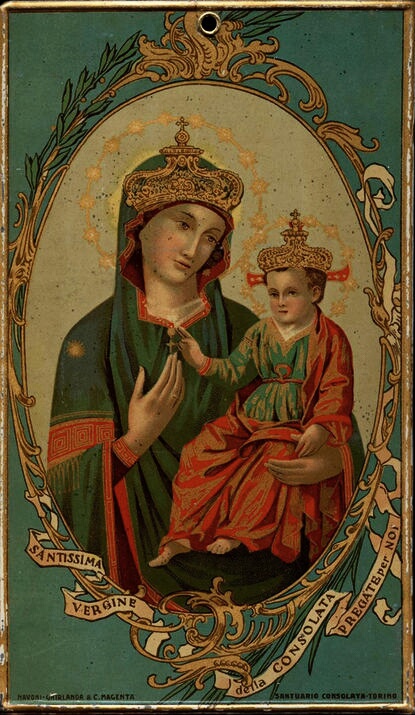
Our Lady of Consolation:
Starting in the 2nd century, Catholics venerated Mary as Our Lady of Consolation, one of her earliest titles of honour. The title of Our Lady of Consolation, or Mary, Consoler of the Afflicted, comes from the Latin Consolatrix Afflictorum. It is found in the Litany of Loreto. The feast of Our Lady of Consolation is one of the solemnities not inscribed in the General Roman Calendar but which are observed in particular places, regions, churches or religious institutes. Augustinians and many regions, observe today 4 September, the Benedictines 5 July.
More about Our Lady of Consolation here: https://anastpaul.wordpress.com/2017/09/04/4-september-feast-of-our-lady-of-consolation/
St Ammianus the Martyr
St Pope Boniface I
St Caletricus of Chartres
St Candida of Naples
St Candida the Elder
St Castus of Ancyra
Bl Catherine of Racconigi
St Fredaldo of Mende
St Hermione
St Ida of Herzfeld
St Irmgard of Süchteln
St Julian the Martyr
St Magnus of Ancyra
St Marcellus of Chalon-sur-Saône
St Marcellus of Treves
St Maximus of Ancyra
St Monessa
St Moses the Prophet
Bl Nicolò Rusca
St Oceanus the Martyr
Bl Peter of Saint James
St Rebecca of Alexandria
St Rhuddlad
St Rosalia/Rose of Viterbo T.O.S.F. (c 1233 – 1251)
St Rufinus of Ancyra
St Salvinus of Verdun
Bl Scipion-Jérôme Brigeat Lambert
St Silvanus of Ancyra
St Sulpicius of Bayeux
St Thamel
St Theodore the Martyr
St Ultan of Ardbraccan
St Victalicus
—
Martyred in the Spanish Civil War:
• Blessed Adrián Saiz y Saiz
• Blessed Baltasar Mariano Muñoz Martínez
• Facundo Fernández Rodríguez
• Blessed Francisco Sendra Ivars
• Blessed José Bleda Grau
• Blessed José Muñoz Quero
• Blessed José Pascual Carda Saporta
• Blessed Juan Moreno Juárez
• Blessed José Vicente Hormaechea Apoita
• Blessed Pedro Sánchez Barba
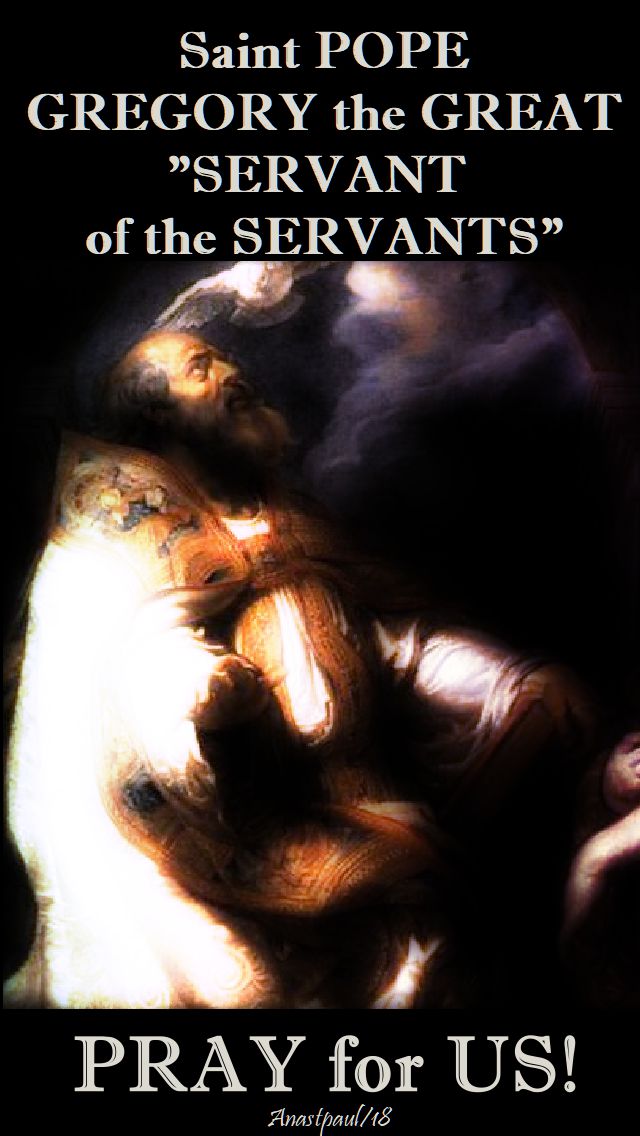
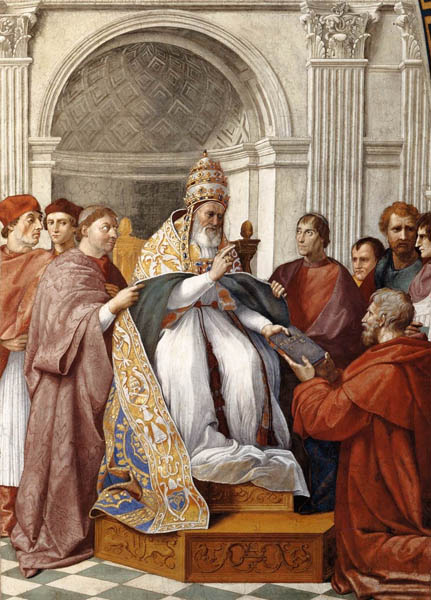
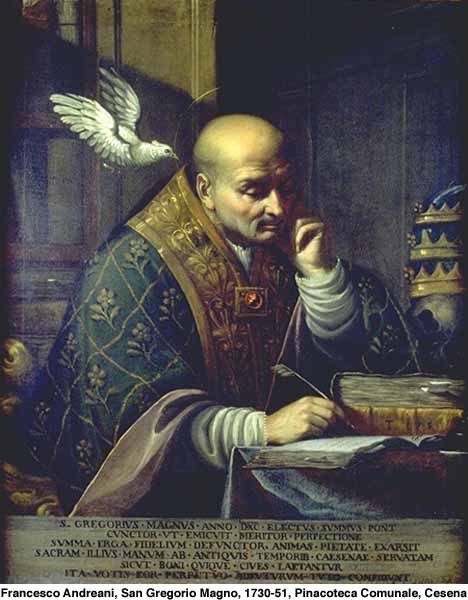
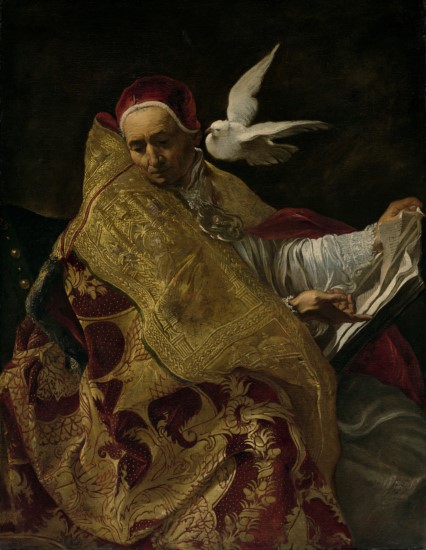
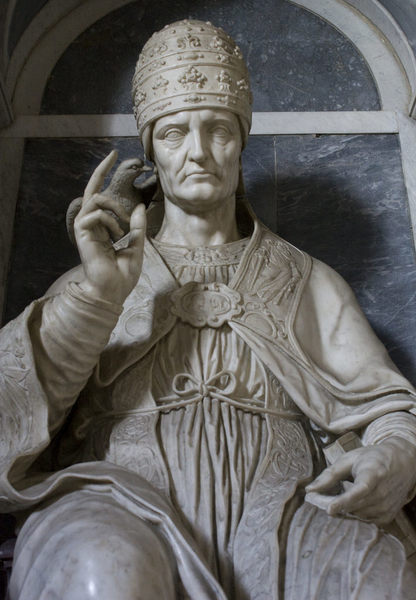
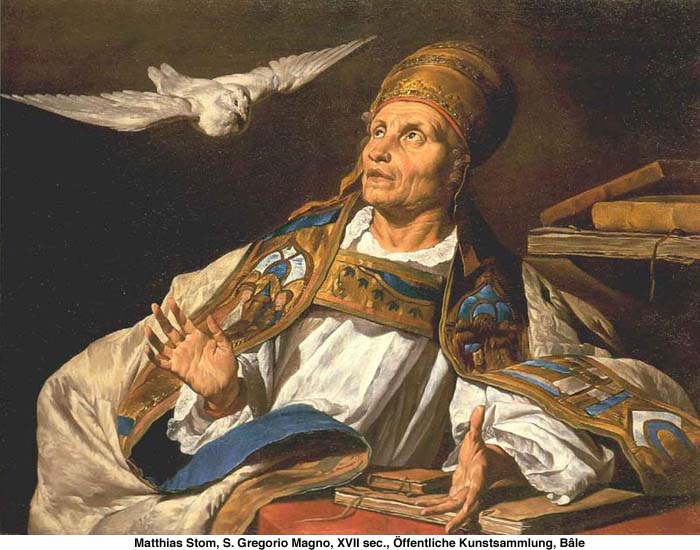
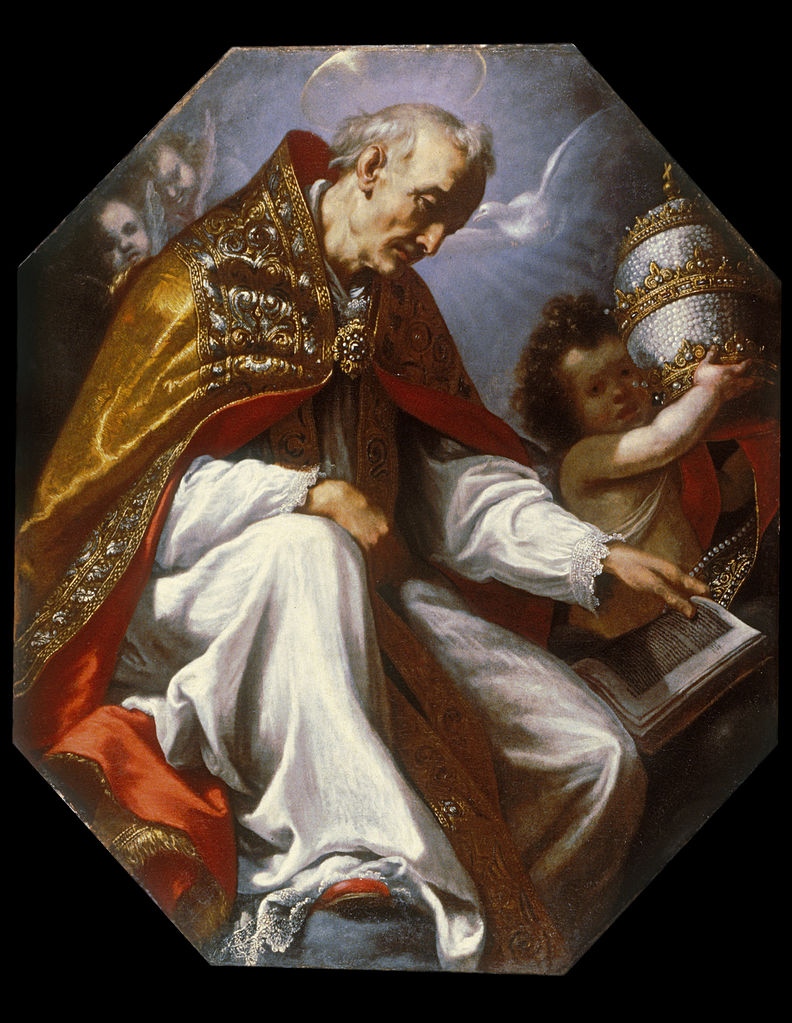
Thought for the Day – 3 September – The Memorial of St Pope Gregory the Great (540-604) Father & Doctor of the Church “Father of the Fathers” “Servant of the Servants”
Excerpt from Pope Benedict XVI’s Homily – General Audience – 4 June 2009
St Pope Gregory the Great “Servant of the Servants” “Servus Servorum Dei”
“Probably the most systematic text of Gregory the Great is the Pastoral Rule, written in the first years of his Pontificate. In it, Gregory proposed to treat the figure of the ideal Bishop, the teacher and guide of his flock. To this end he illustrated the seriousness of the office of Pastor of the Church and its inherent duties. Therefore, those who were not called to this office may not seek it with superficiality, instead those who assumed it without due reflection necessarily feel trepidation rise within their soul. Taking up again a favourite theme, he affirmed that the Bishop is above all the “preacher” par excellence; for this reason he must be above all an example for others, so that his behaviour may be a point of reference for all. Efficacious pastoral action requires that he know his audience and adapt his words to the situation of each person – here Gregory paused to illustrate the various categories of the faithful with acute and precise annotations, which can justify the evaluation of those who have also seen in this work a treatise on psychology. From this one understands that he really knew his flock and spoke of all things with the people of his time and his city.
Nevertheless, the great Pontiff insisted on the Pastor’s duty to recognise daily his own unworthiness in the eyes of the Supreme Judge, so that pride did not negate the good accomplished. For this the final chapter of the Rule is dedicated to humility : “When one is pleased to have achieved many virtues, it is well to reflect on one’s own inadequacies and to humble oneself, instead of considering the good accomplished, it is necessary to consider what was neglected”.All these precious indications demonstrate the lofty concept that St Gregory had for the care of souls, which he defined as the “ars artium”, the art of arts. The Rule had such great and the rather rare, good fortune to have been quickly translated into Greek and Anglo-Saxon.
He wanted to be – and this is his expression – “Servus Servorum Dei”. Coined by him, this phrase was not just a pious formula on his lips but a true manifestation of his way of living and acting. He was intimately struck by the humility of God, who in Christ made Himself our servant. He washed and washes our dirty feet. Therefore, he was convinced that a Bishop, above all, should imitate this humility of God and follow Christ in this way.
His desire was to live truly as a monk, in permanent contact with the Word of God but for love of God he knew how to make himself the servant of all in a time full of tribulation and suffering. He knew how to make himself the “servant of the servants”. Precisely because he was this, he is great and also shows us the measure of true greatness.”
St Pope Gregory the Great, “Servant of the Servants”, Pray for Us!
Quote/s of the Day – 3 September – The Memorial of St Pope Gregory the Great (540-604) – Father & Doctor of the Church “Father of the Fathers”
“If we knew at what time we were to depart from this world, we would be able to select a season for pleasure and another for repentance. But God, who has promised pardon to every repentant sinner, has not promised us tomorrow. Therefore we must always dread the final day, which we can never foresee. This VERY DAY is a day of truce, a day for conversion. And yet we refuse to cry over the evil we have done! Not only do we not weep for the sins we have committed, we even add to them…”
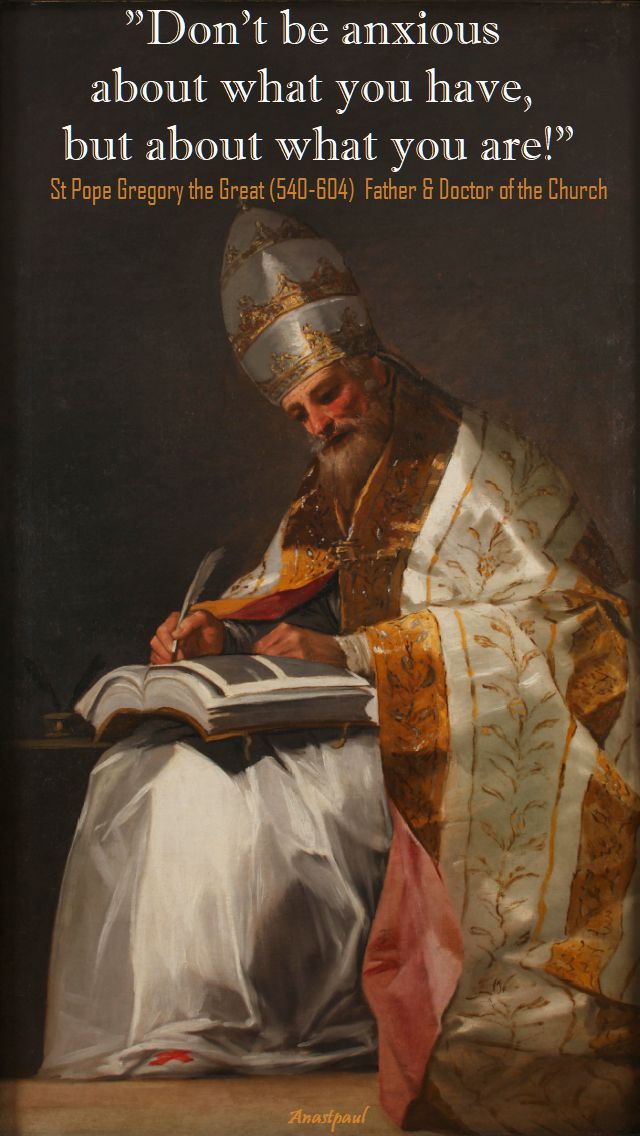
“Don’t be anxious about what you have, but about what you are!”
“When we attend to the needs of those in want, we give them what is theirs, not ours. More than performing works of mercy, we are paying a debt of justice.”
“The proof of love is in the works. Where love exists, it works great things. But when it ceases to act, it ceases to exist.”
“He who would climb to a lofty height must go by steps, not leaps.”
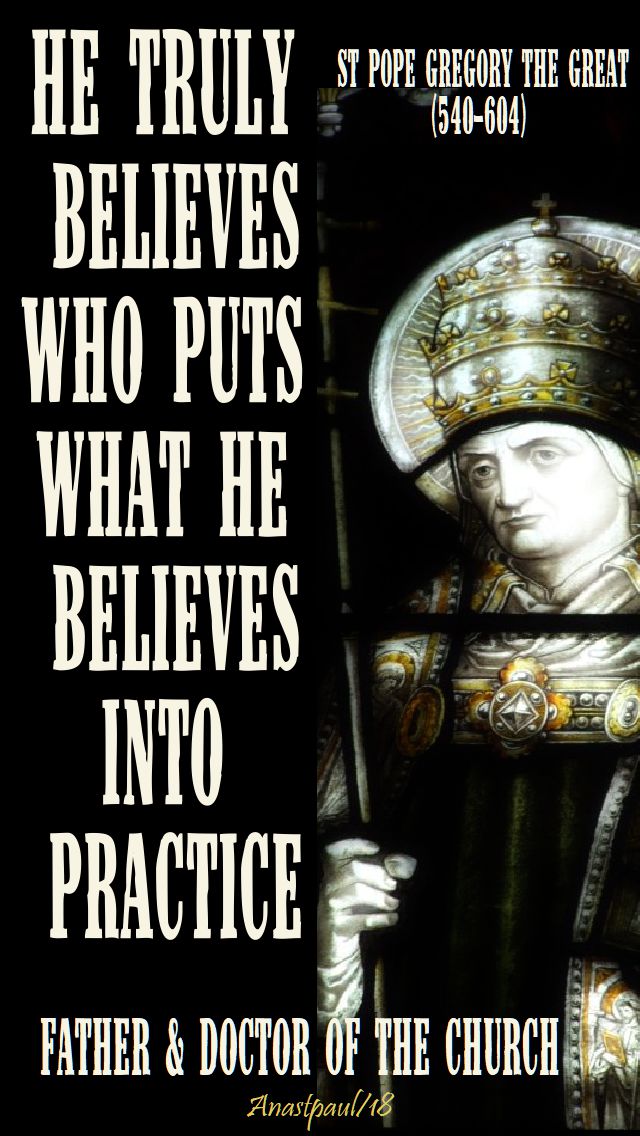
“He truly believes who puts what he believes into practice.”
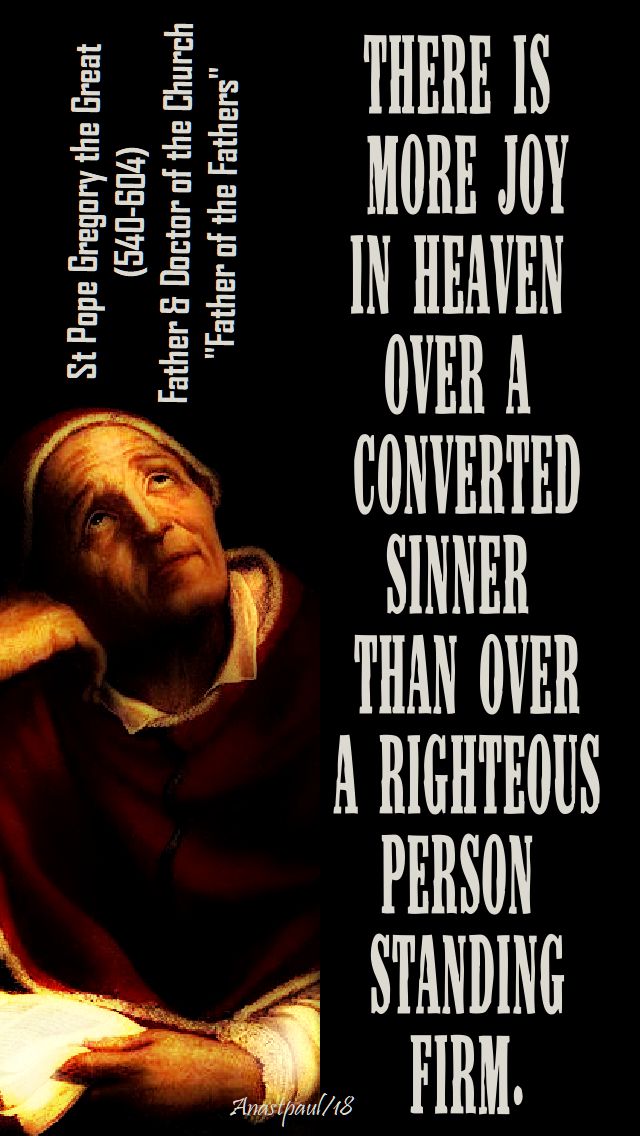
There is more joy in heaven over a converted sinner than over a righteous person standing firm. A leader in battle has more love for a soldier who returns after fleeing and who valiantly pursues the enemy, than for one who never turned back but who never acted valiantly either. A farmer has greater love for land which bears fruitfully, after he has cleared it of thorns, than for land which never had thorns but which never yielded a fruitful harvest.”
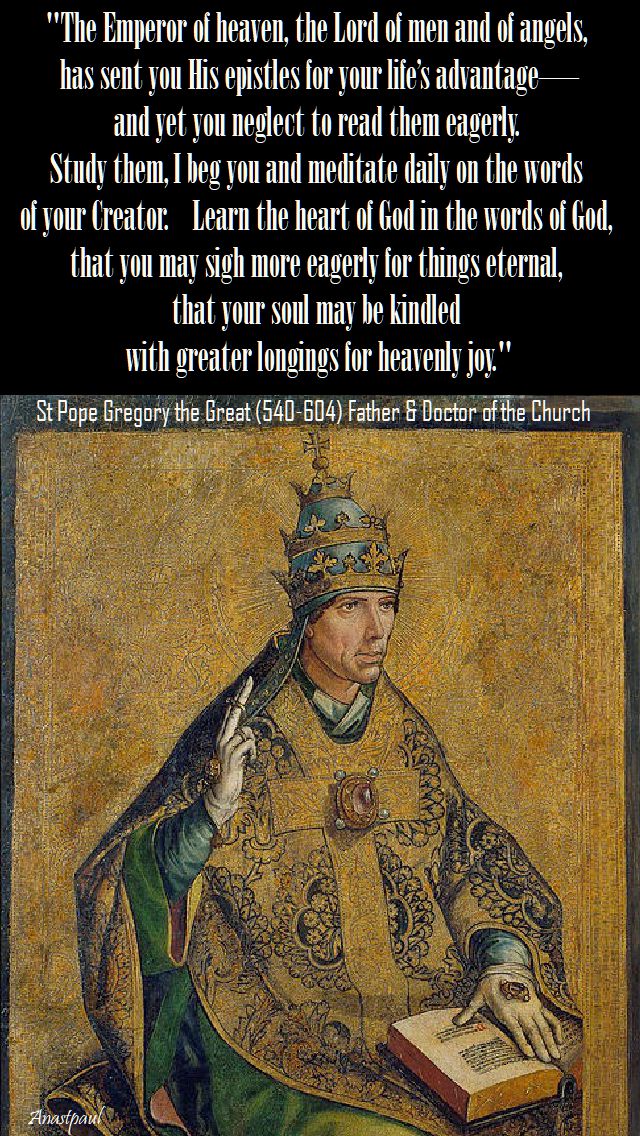
“The Emperor of heaven, the Lord of men and of angels, has sent you His epistles for your life’s advantage— and yet you neglect to read them eagerly. Study them, I beg you and meditate daily on the words of your Creator. Learn the heart of God in the words of God, that you may sigh more eagerly for things eternal, that your soul may be kindled with greater longings for heavenly joy.”
“No one does more harm in the Church than he who has the title or rank of holiness and acts perversely.”
St Pope Gregory the Great (540-604)
Father & Doctor of the Church
“Father of the Fathers”
One Minute Reflection – 3 September – Today’s First Reading: 1 Corinthians 2:1–5 – Monday of the Twenty-second week in Ordinary Time, Year B & the Memorial of St Pope Gregory the Great (540-604) – Father & Doctor “Father of the Fathers”
…”my speech and my message were not in plausible words of wisdom but in demonstration of the Spirit and of power, that your faith might not rest in the wisdom of men but in the power of God.”…1 Corinthians 2:4-5
REFLECTION – “Holy Scripture presents a kind of mirror to the eyes of the mind, so that our inner face may be seen in it. There we learn our own ugliness, there our own beauty. And there too we discover the progress we are making and how far we are from perfection.”….St Pope Gregory the Great (540-604)
PRAYER – God our Father, Your rule is a rule of love, Your providence is full of mercy for Your people. Through the intercession of St Gregory, grant the spirit of wisdom and understanding in Your Word through Your Son Jesus Christ. Grant that by the light of His Resurrection we may know our eternal home and strive to attain eternal joy there with You. Through Jesus Christ our Lord, with the Holy Spirit, one God forever, amen.
Our Morning Offering – 3 September – The Memorial of St Pope Gregory the Great (540-604) – Father & Doctor “Father of the Fathers”
Prayer of Praise St Pope Gregory the Great (540-604)
It is only right,
with all the powers of our heart and mind,
to praise You Father
and Your Only-Begotten Son,
Our Lord Jesus Christ.
Dear Father,
by Your wondrous condescension
of loving-kindness toward us, Your servants,
You gave up Your Son.
Dear Jesus,
You paid the debt of Adam for us
to the Eternal Father by Your Blood
poured forth in loving-kindness.
You cleared away the darkness of sin
by Your magnificent and radiant Resurrection.
You broke the bonds of death
and rose from the grave as a Conqueror.
You reconciled heaven and earth.
Our life had no hope of eternal happiness
before You redeemed us.
Your Resurrection has washed away our sins,
restored our innocence and brought us joy.
How inestimable is the tenderness
of Your Love!
Amen
Saint of the Day – 3 September – St Pope Gregory the Great (540-604) – Father & Doctor of the Church – “Father of the Fathers” – Pope, Prefect of Rome, Monk, Abbot, Writer, Theologian, Teacher, Liturgist, Administrator, Diplomat, Political Negotiator, Apostle of Charity and Social Justice, Apostle of Pastoral Ministry, PeaceMaker. Patronages – • against gout • against plague/epidemics,• choir boys,• teachers• stone masons, stonecutters, • students, school children,• Popes, the Papacy,• musicians,• singers,• England, • West Indies,• Legazpi, Philippines, Diocese of,• Order of Knights of Saint Gregory, • Kercem, Malta,• Montone, Italy,• San Gregorio nelle Alpi, Italy.
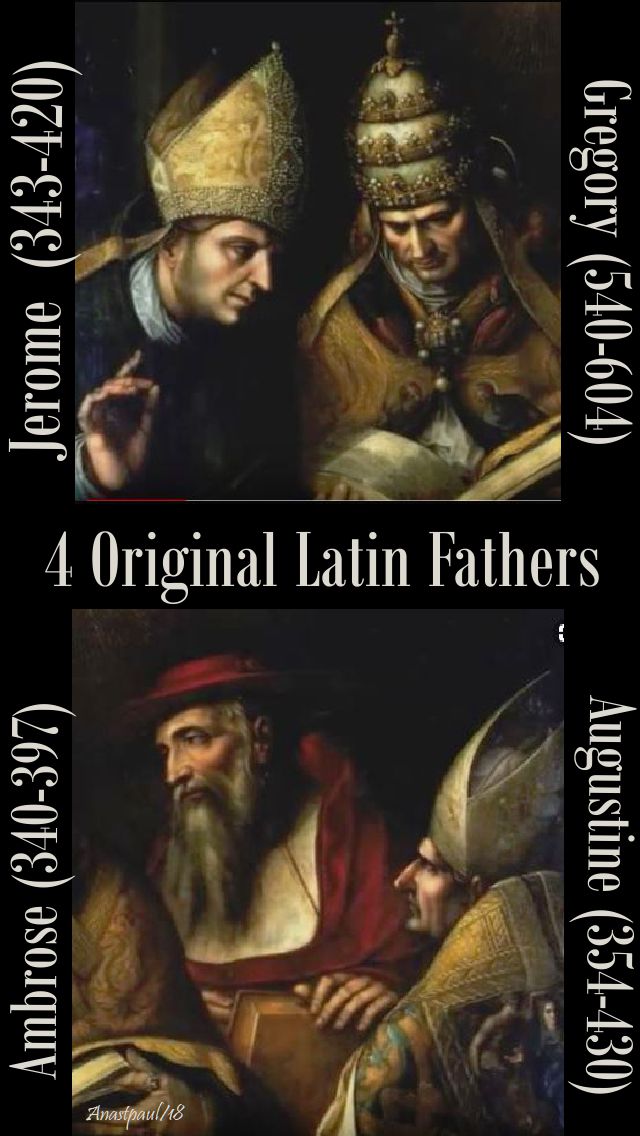
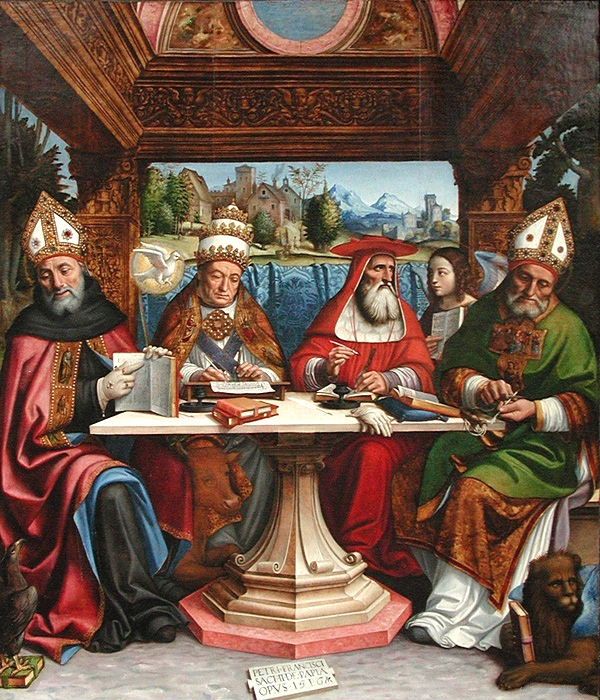
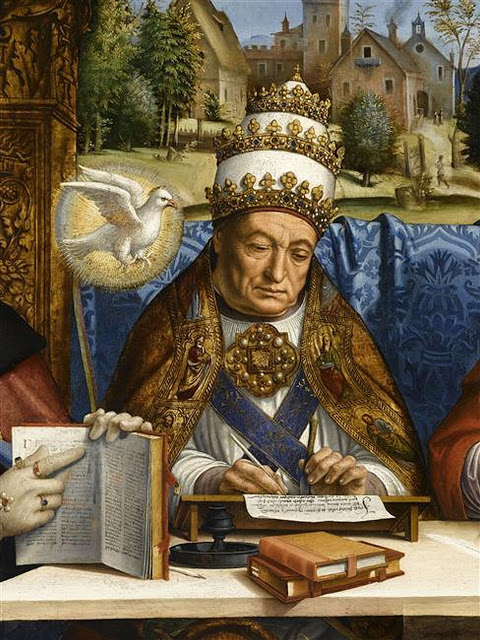
Pier Francesco Sacchi – Dottori della Chiesa c 1516 Four doctors of the Church represented with attributes of the Four Evangelists: St Augustine with an eagle, St Gregory the Great with a bull, St Hieronymus with an angel, St Ambrosius with a winged lion.
Pope Benedict’s Catechesis on St Pope Gregory the Great
Today I would like to present the figure of one of the greatest Fathers in the history of the Church, one of four Doctors of the West, Pope St Gregory, who was Bishop of Rome from 590 to 604 and who earned the traditional title of Magnus/the Great. Gregory was truly a great Pope and a great Doctor of the Church!
He was born in Rome about 540 into a rich patrician family of the gens Anicia, who were distinguished not only for their noble blood but also for their adherence to the Christian faith and for their service to the Apostolic See. Two Popes came from this family : Felix III (483-492), the great-great grandfather of Gregory and Agapetus (535-536). The house in which Gregory grew up stood on the Clivus Scauri, surrounded by majestic buildings that attested to the greatness of ancient Rome and the spiritual strength of Christianity. The example of his parents Gordian and Sylvia, both venerated as Saints and those of his father’s sisters, Aemiliana and Tharsilla, who lived in their own home as consecrated virgins following a path of prayer and self-denial, inspired lofty Christian sentiments in him.
In the footsteps of his father, Gregory entered early into an administrative career which reached its climax in 572 when he became Prefect of the city. This office, complicated by the sorry times, allowed him to apply himself on a vast range to every type of administrative problem, drawing light for future duties from them. In particular, he retained a deep sense of order and discipline: having become Pope, he advised Bishops to take as a model for the management of ecclesial affairs the diligence and respect for the law like civil functionaries . Yet this life could not have satisfied him since shortly after, he decided to leave every civil assignment in order to withdraw to his home to begin the monastic life, transforming his family home into the monastery of St Andrew on the Coelian Hill. This period of monastic life, the life of permanent dialogue with the Lord in listening to His word, constituted a perennial nostalgia which he referred to ever anew and ever more in his homilies. In the midst of the pressure of pastoral worries, he often recalled it in his writings as a happy time of recollection in God, dedication to prayer and peaceful immersion in study. Thus, he could acquire that deep understanding of Sacred Scripture and of the Fathers of the Church that later served him in his work.
But the cloistered withdrawal of Gregory did not last long. The precious experience that he gained in civil administration during a period marked by serious problems, the relationships he had had in this post with the Byzantines and the universal respect that he acquired induced Pope Pelagius to appoint him deacon and to send him to Constantinople as his “apocrisarius” – today one would say “Apostolic Nuncio” in order to help overcome the last traces of the Monophysite controversy and above all to obtain the Emperor’s support in the effort to check the Lombard invaders. The stay at Constantinople, where he resumed monastic life with a group of monks, was very important for Gregory, since it permitted him to acquire direct experience of the Byzantine world, as well as to approach the problem of the Lombards, who would later put his ability and energy to the test during the years of his Pontificate. After some years he was recalled to Rome by the Pope, who appointed him his secretary. They were difficult years – the continual rain, flooding due to overflowing rivers, the famine that afflicted many regions of Italy as well as Rome. Finally, even the plague broke out, which claimed numerous victims, among whom was also Pope Pelagius II. The clergy, people and senate were unanimous in choosing Gregory as his successor to the See of Peter. He tried to resist, even attempting to flee but to no avail, finally, he had to yield. The year was 590.
Recognising the will of God in what had happened, the new Pontiff immediately and enthusiastically set to work. From the beginning he showed a singularly enlightened vision of realty with which he had to deal, an extraordinary capacity for work confronting both ecclesial and civil affairs, a constant and even balance in making decisions, at times with courage, imposed on him by his office.
Abundant documentation has been preserved from his governance thanks to the Register of his Letters (approximately 800), reflecting the complex questions that arrived on his desk on a daily basis. They were questions that came from Bishops, Abbots, clergy and even from civil authorities of every order and rank. Among the problems that afflicted Italy and Rome at that time was one of special importance both in the civil and ecclesial spheres – the Lombard question. The Pope dedicated every possible energy to it in view of a truly peaceful solution. Contrary to the Byzantine Emperor who assumed that the Lombards were only uncouth individuals and predators to be defeated or exterminated, St Gregory saw this people with the eyes of a good pastor and was concerned with proclaiming the word of salvation to them, establishing fraternal relationships with them in view of a future peace founded on mutual respect and peaceful coexistence between Italians, Imperials and Lombards. He was concerned with the conversion of the young people and the new civil structure of Europe – the Visigoths of Spain, the Franks, the Saxons, the immigrants in Britain and the Lombards, were the privileged recipients of his evangelising mission. Yesterday we celebrated the liturgical memorial of St Augustine of Canterbury, the leader of a group of monks Gregory assigned to go to Britain to evangelise England.
The Pope – who was a true peacemaker – deeply committed himself to establish an effective peace in Rome and in Italy by undertaking intense negotiations with Agilulf, the Lombard King. This negotiation led to a period of truce that lasted for about three years (598-601), after which, in 603, it was possible to stipulate a more stable armistice. This positive result was obtained also thanks to the parallel contacts that, meanwhile, the Pope undertook with Queen Theodolinda, a Bavarian princess who, unlike the leaders of other Germanic peoples, was Catholic deeply Catholic. A series of Letters of Pope Gregory to this Queen has been preserved in which he reveals his respect and friendship for her. Theodolinda, little by little was able to guide the King to Catholicism, thus preparing the way to peace. The Pope also was careful to send her relics for the Basilica of St John the Baptist which she had had built in Monza and did not fail to send his congratulations and precious gifts for the same Cathedral of Monza on the occasion of the birth and baptism of her son, Adaloald. The series of events concerning this Queen constitutes a beautiful testimony to the importance of women in the history of the Church. Gregory constantly focused on three basic objectives: to limit the Lombard expansion in Italy, to preserve Queen Theodolinda from the influence of schismatics and to strengthen the Catholic faith and to mediate between the Lombards and the Byzantines in view of an accord that guaranteed peace in the peninsula and at the same time permitted the evangelisation of the Lombards themselves. Therefore, in the complex situation his scope was constantly twofold: to promote understanding on the diplomatic-political level and to spread the proclamation of the true faith among the peoples.
Along with his purely spiritual and pastoral action, Pope Gregory also became an active protagonist in multifaceted social activities. With the revenues from the Roman See’s substantial patrimony in Italy, especially in Sicily, he bought and distributed grain, assisted those in need, helped priests, monks and nuns who lived in poverty, paid the ransom for citizens held captive by the Lombards and purchased armistices and truces. Moreover, whether in Rome or other parts of Italy, he carefully carried out the administrative reorganisation, giving precise instructions so that the goods of the Church, useful for her sustenance and evangelising work in the world, were managed with absolute rectitude and according to the rules of justice and mercy. He demanded that the tenants on Church territory be protected from dishonest agents and, in cases of fraud, were to be quickly compensated, so that the face of the Bride of Christ was not soiled with dishonest profits..
Gregory carried out this intense activity notwithstanding his poor health, which often forced him to remain in bed for days on end. The fasts practised during the years of monastic life had caused him serious digestive problems. Furthermore, his voice was so feeble that he was often obliged to entrust the reading of his homilies to the deacon, so that the faithful present in the Roman Basilicas could hear him. On feast days he did his best to celebrate the Missarum sollemnia, that is the solemn Mas, and then he met personally with the people of God, who were very fond of him, because they saw in him the authoritative reference from whom to draw security – not by chance was the title Consul Dei quickly attributed to him. Notwithstanding the very difficult conditions in which he had to work, he gained the faithful’s trust, thanks to his holiness of life and rich humanity, achieving truly magnificent results for his time and for the future. He was a man immersed in God – his desire for God was always alive in the depths of his soul and precisely because of this he was always close to his neighbour, to the needy people of his time. Indeed, during a desperate period of havoc, he was able to create peace and give hope. This man of God shows us the true sources of peace, from which true hope comes. Thus, he becomes a guide also for us today.
Pope Benedict XVI, General Audience, Wednesday 28 May 2008
More about Gregory here: https://anastpaul.wordpress.com/2017/09/03/saint-of-the-day-3-september-st-pope-gregory-the-great-540-604-father-doctor-of-the-church/
Prayer to Saint Gregory, Pope and Confessor for the Universal Church and for Pope Francis
O invincible defender of Holy Church’s freedom,
Saint Gregory of great renown,
by that firmness you showed
in maintaining the Church’s rights
against all her enemies,
stretch forth from heaven your mighty arm,
we beseech you, to comfort her
and defend her in the fearful battle
she must ever wage with the powers of darkness.
May you, in a special manner,
give strength in this dread conflict,
to the venerable Pontiff Francis,
who has fallen heir not only to your throne
but likewise to the fearlessness of your mighty heart.
Obtain for him the joy of beholding
his holy endeavours crowned by the triumph of the Church
and the return of the lost sheep into the right path.
Grant, finally, that all may understand,
how vain it is to strive against that faith,
which has always conquered
and is destined always to conquer –
“this is the victory which overcomes the world, our faith.”
This is the prayer that we raise to you with one accord
and we are confident, that,
after you have heard our prayers on earth,
you will one day call us to stand with you in heaven,
before the eternal High Priest,
who with the Father and the Holy Spirit
lives and reigns, world without end.
Amen
St Aigulphus of Lérins
St Ambrose of Sens
St Ammon of Heraclea
Bl Andrew Dotti
St Auxanus
St Balin
St Basilissa of Nicomedia
Bl Brigida of Jesus
St Chariton
St Chrodegang of Séez
St Frugentius the Martyr
Bl Guala of Brescia
St Hereswitha
Bl Herman of Heidelberg
St Macanisius
St Mansuetus of Toul
St Marinus
St Martiniano of Como
St Natalis of Casale
St Phoebe
St Regulus of Rheims
St Remaclus
St Sandila of Cordoba
St Zeno
—
Martyrs of Aquileia – 4 saints: Four young women, variously sisters and cousins, who were born to the nobility, the daughters of the pagans Valentinianus of Aquileia and Valentius of Aquileia. Each woman converted and made private vows, dedicating themselves to God. They were arrested, tortured and martyred by order of Valentius for becoming a Christian. We know little else but their names – Dorothy, Erasma, Euphemia and Thecla. They were martyred by beheaded in the 1st century in Aquileia, Italy and their bodies were thrown into a nearby river.
Martyrs of Nagasaki – 6 beati: A group of priests and clerics, native and foreign, murdered together in the anti-Christian persecutions in Japan. They were scalded in boiling water and then burned alive on 3 September 1632 in Nishizaka, Nagasaki, Japan and Beatified on 7 May 1867 by Pope Pius IX.
• Anthony Ishida
• Bartolomé Gutiérrez Rodríguez
• Francisco Terrero de Ortega Pérez
• Gabriel Tarazona Rodríguez
• Jerome of the Cross de Torres
• Vicente Simões de Carvalho
Martyrs of Seoul – 6 saints: A group of Christian lay people martyred together in the persecutions in Korea. They were beheaded on 3 September 1839 at the Small West Gate, Seoul, South Korea and Canonised on 6 May 1984 by Pope John Paul II.
• Agnes Kim Hyo-Ch’u
• Barbara Kwon Hui
• Barbara Yi Chong-hui
• Ioannes Pak Hu-jae
• Maria Pak K’Un-agi
• Maria Yi Yon-hui
Martyred in the Spanish Civil War:
• Blessed Andrea Calle González
• Blessed Concepción Pérez Giral
• Blessed Dolores Úrsula Caro Martín
• Blessed Joaquim Balcells Bosch
• Blessed Pius Salvans Corominas
Sunday Reflection – 2 September – Today’s Gospel: Mark 7:1–23 – Twenty-second Sunday in Ordinary Time, Year B
John Paul and Jean-Marie
When the Curé of Ars spoke of the Sacrament of the Altar, he glowed! He communicated to his hearers the Eucharistic fire that burned in his own heart. Thirty-two years ago, St Pope John Paul II (1920-2005) devoted his Holy Thursday Letter to Priests, to Saint Jean-Marie Vianney. I think that today we can read that letter as one saint talking about another. This is what Pope John Paul II said:
“The Eucharist was at the very centre of Saint Jean Vianney’s spiritual life and pastoral work. He said: “All good works put together are not equivalent to the Sacrifice of the Mass, because they are the works of men and the Holy Mass is the work of God.” It is in the Mass that the sacrifice of Calvary is made present for the Redemption of the world. Clearly, the priest must unite the daily gift of himself to the offering of the Mass: “How well a priest does, therefore, to offer himself to God in sacrifice every morning!” “Holy Communion and the Holy Sacrifice of the Mass are the two most efficacious actions for obtaining the conversion of hearts.”
Recollection and Adoration
Thus the Mass was for John Mary Vianney the great joy and comfort of his priestly life. He took great care, despite the crowds of penitents, to spend more than a quarter of an hour in silent preparation. He celebrated with recollection, clearly expressing his adoration at the consecration and communion. He accurately remarked:
“The cause of priestly laxity is not paying attention to the Mass!”
Let us always, daily, pray for all our Priests!
St John Vianney (1786-1859) Patron of Priests Prayer for Priests By St John Vianney
God, please give to Your Church today many more priests after Your own heart. May they be worthy representatives of Christ the Good Shepherd. May they wholeheartedly devote themselves to prayer and penance; be examples of humility and poverty; shining models of holiness; tireless and powerful preachers of the Word of God; zealous dispensers of Your grace in the sacraments. May their loving devotion to Your Son, Jesus in the Eucharist and to Mary His Mother, be the twin fountains of fruitfulness for their ministry. Amen
Thought for the Day – 2 September – Today’s Gospel: Mark 7:1–23 – Twenty-second Sunday in Ordinary Time, Year B
‘This people honours me with their lips but their heart is far from me…”…Mark 7:6
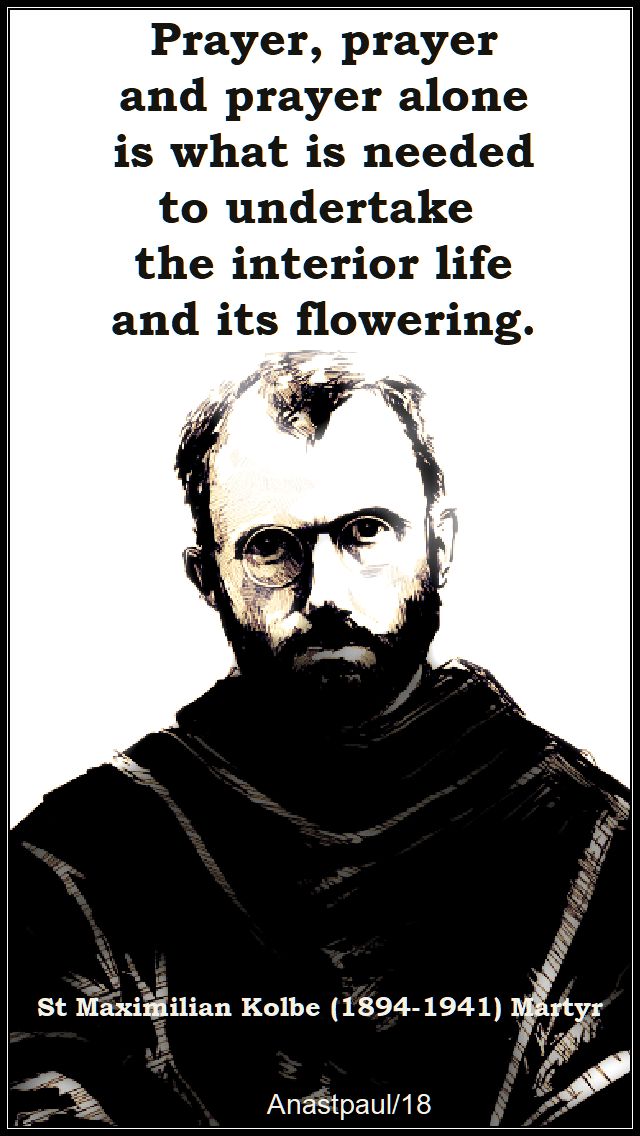
“The interior life is primordial… The active life is the consequence of the interior life and has no value unless it depends upon it. We should like to do everything to the best of our ability, perfectly. But if it isn’t linked to our interior life it is to no purpose. All the value of our life and activity stems from our interior life, the life of love for God and the Virgin Mary, the Immaculata – not in theories or sweetness but in the practice of a love that consists in the union of our will with the will of the Immaculate Virgin.
Above and over all we must deepen this interior life. If it is truly a case of spiritual life then supernatural means are required. Prayer, prayer and prayer alone is what is needed to undertake the interior life and its flowering. Interior recollection is necessary.
Let us not be anxious about unnecessary things but gently, peacefully, let us try to preserve recollection of spirit and be attentive to God’s grace. That is why silence helps us.”…St Maximilian Kolbe (1894-1941) Martyr
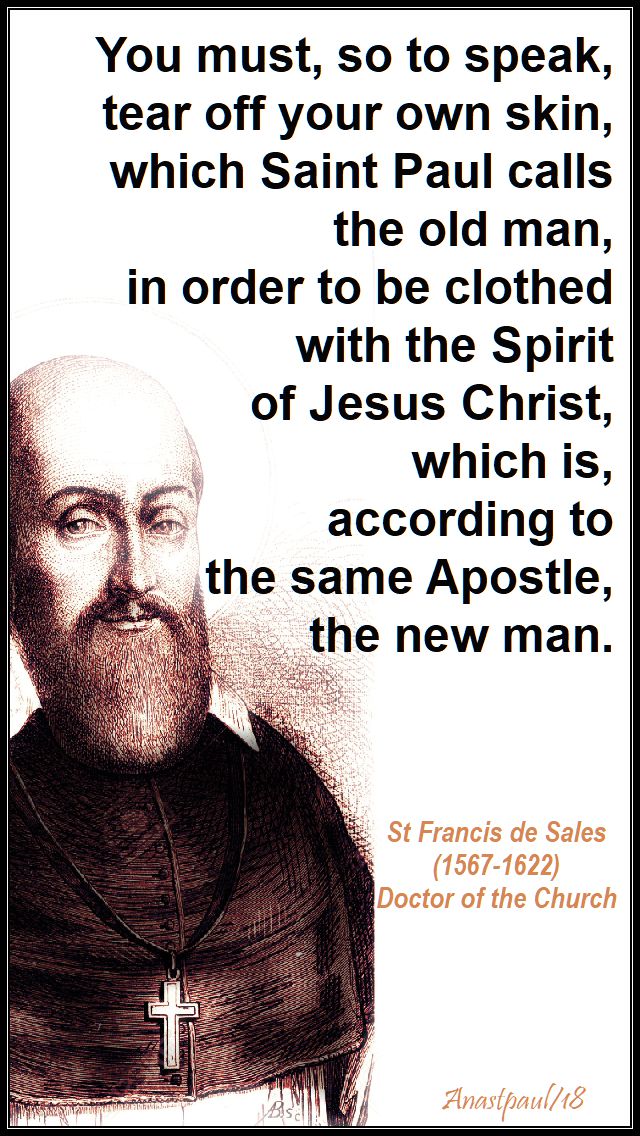
“You must, so to speak, tear off your own skin, which Saint Paul calls the old man, in order to be clothed with the Spirit of Jesus Christ, which is, according to the same Apostle, the new man.”
.St Francis de Sales (1567-1622) Doctor of the Church
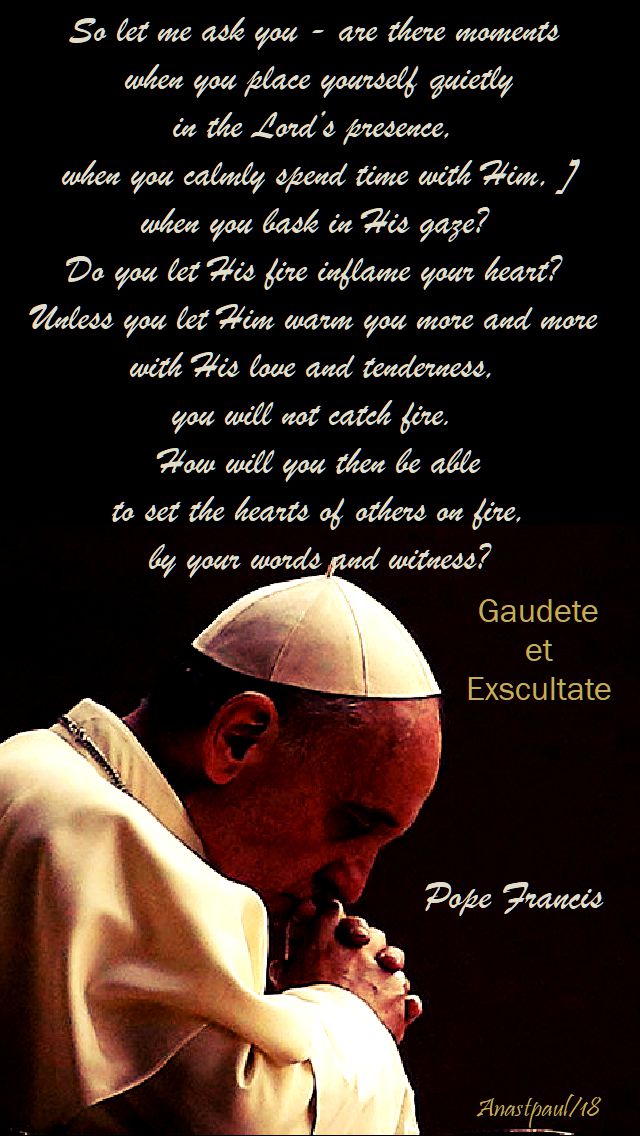
“So let me ask you – are there moments when you place yourself quietly in the Lord’s presence, when you calmly spend time with Him, when you bask in His gaze? Do you let His fire inflame your heart? Unless you let Him warm you more and more with His love and tenderness, you will not catch fire. How will you then be able to set the hearts of others on fire by your words and witness?
Pope Francis Gaudete et Exscultate
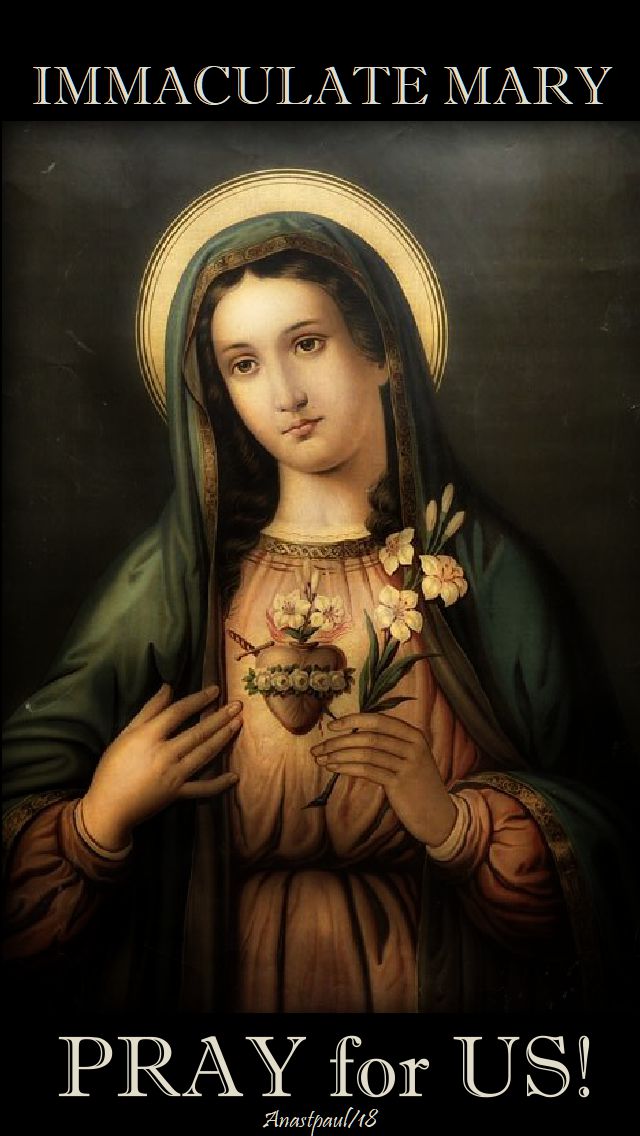
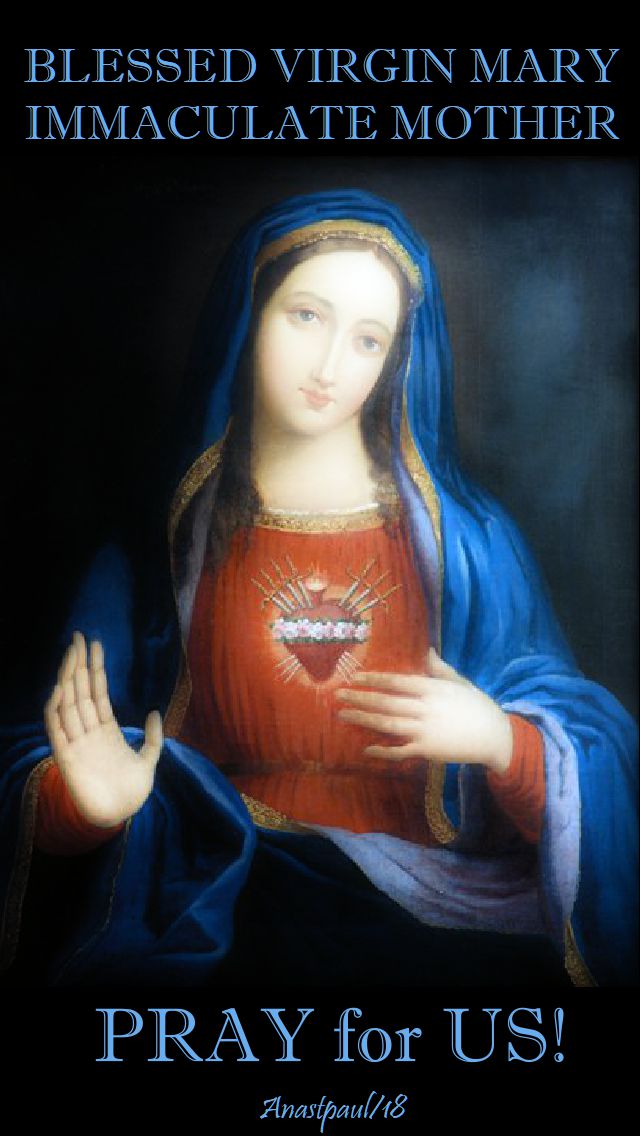
And you Immaculata, who are our example, who are our constant intercessor, pray for us!
Quote of the Day – 2 September – The Memorial of St Solomon le Clercq FSC (1745-1792) Martyr
“I’m Solomon Le Clercq and I want, I want to sign, to say that I’ll die, I’ll die a happy man if Jesus is at my side and I say: I want to live for Jesus, I want! I want to die for Jesus, I want! To live and to die a real man of God! To live and die a real Brother from God!”
One Minute Reflection – 2 September – Today’s Gospel: Mark 7:1–23 – Twenty-second Sunday in Ordinary Time, Year B
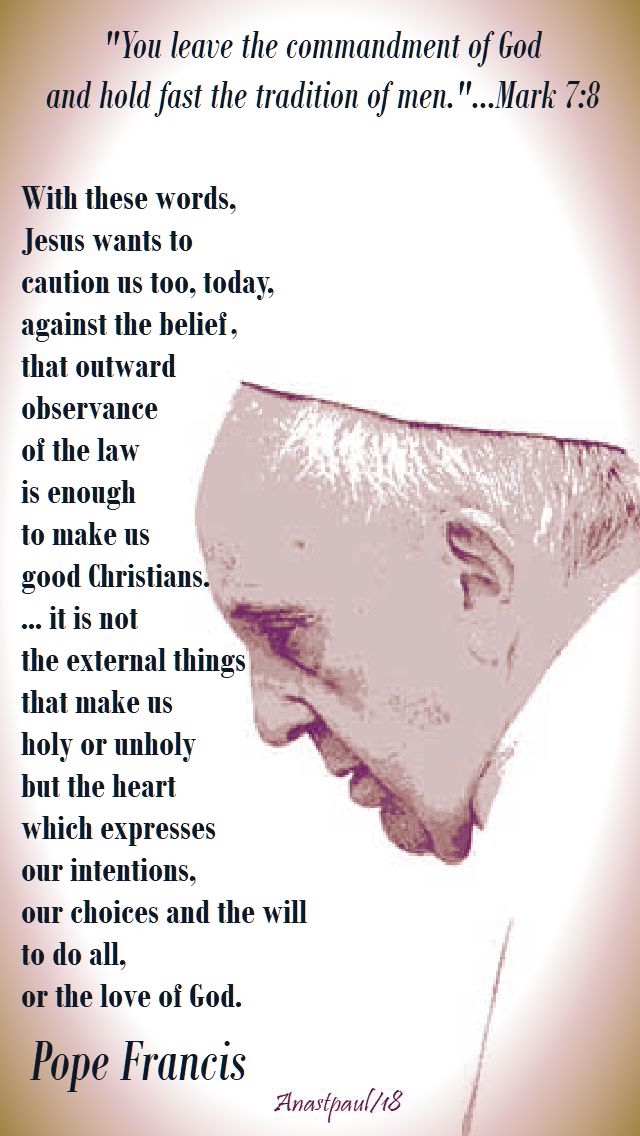
“You leave the commandment of God, and hold fast the tradition of men.”..Mark 7:8
REFLECTION – “With these words, Jesus wants to caution us too, today, against the belief, that outward observance of the law is enough to make us good Christians. This is what Jesus condemns because this is a counter-witness to Christianity. After His exhortation, Jesus focuses attention on a deeper aspect and states: “there is nothing outside a man which by going into him can defile him; but the things which come out of a man are what defile him” (v. 15). In this way he emphasises the primacy of interiority, that is, the primacy of the “heart, it is not the external things that make us holy or unholy but the heart, which expresses our intentions, our choices and the will to do all, for the love of God….Pope Francis – Angelus, 30 August 2015
PRAYER – Father of might and power, every good and perfect gift comes down to us from You. Implant in our hearts, the love of Your name, increase our zeal for Your service, nourish what is good in us and tend it with watchful care. May our blessed Mother, guide and protect us on our journey and may Your holy Saints, pray for us. We make our prayer through our Lord Jesus Christ, in union with the Holy Spirit, one God forever, amen.
Our Morning Offering – 2 September – Twenty-second Sunday in Ordinary Time, Year B
To Jesus in the Blessed Sacrament By St John Neumann (1811-1860)
How much do I love You,
O my Jesus!
I wish to love You
with my whole heart,
yet I do not love You enough.
I have but one desire,
that of being near You,
in the Blessed Sacrament.
You are the sweet Bridegroom of my soul.
My Jesus, my love, my all,
gladly would I endure
hunger, thirst, heat and cold
to remain always with You
in the Blessed Sacrament.
Amen
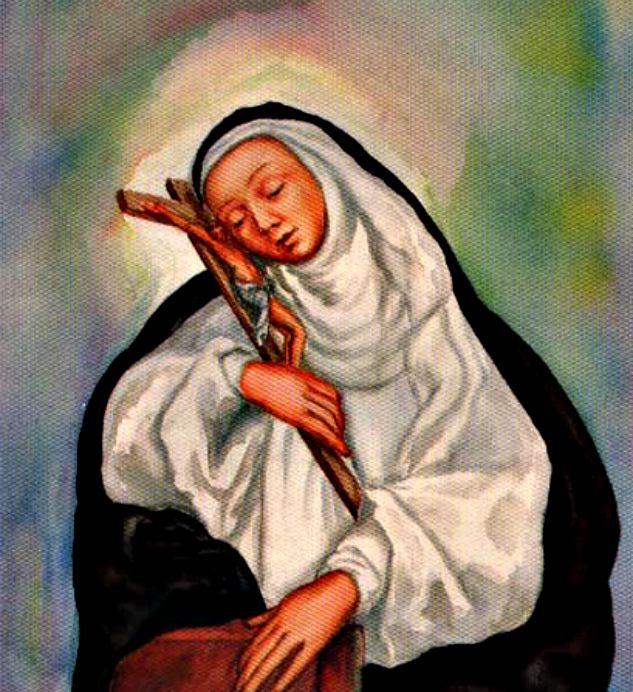
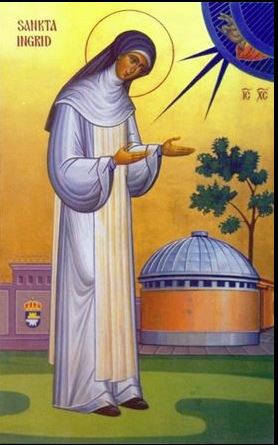
Saint of the Day – 2 September – St Ingrid of Sweden O.P. (Died 1292) – also known as St Ingrid of Skänninge – Dominican Religious and Mystic.
Ingrid Elovsdotter was born in Skänninge, Sweden, in the 13th century. Following the death of her husband, she resolved to consecrate the rest of her life to God. She placed herself under the spiritual direction of Peter of Dacia, a Dominican priest. In one of his letters, Petrus de Dacia has left a description of the ascetic life style and mystic revelations of one of his “spiritual daughters” in this circle of women, which likely refers to Ingrid.
She was the first Dominican nun in Sweden and in 1281 after making a pilgrimage to Rome she founded the first Dominican cloister, called St Martin’s in Skänning, which was formally recognised in 1281, 1 year prior to her death. Ingrid made pilgrimages to Santiago de Compostela, Jerusalem and Rome.
She died in 1282 surrounded by an aura of sanctity. After her death in 1282, Ingrid became object of veneration and pilgrimages to her convent. She was, however, not formally recognised by the Pope as such. When her relative, Bridget of Sweden, was formally recognised by the Pope in 1391, it caused a need to have Ingrid to be granted a similar status as well. At the Council of Costance, an application was made for her canonisation. In 1499, Pope Alexander VI agreed to a Translation (relic), which took place in her convent in 1507.
The remains of Ingrid was removed to the Vadstena Abbey after the Swedish Reformation. In 1645, the skull was stolen from the Vadstena church by Antoine de Beaulieu, who believed it to be the skull of Bridget of Sweden. Antoine de Beaulieu gave the skull to the French ambassador Gaspard Coignet de la Thullerie, who in turn placed it in the church of Courson-les-Carrières in France. In 1959, it was given to the Brigitinesse abbey of Mary’s Refuge in Uden in the Netherlands, where it is exhibited as the skull of Bridget of Sweden.
Bl Albert of Pontida
St Antoninus of Pamiers
St Antoninus of Syria
Bl Antonio Franco
St Brocard
St Castor of Apt
St Comus of Crete
St Eleazar the Patriarch
St Elpidius of Lyon
St Elpidius the Cappadocian
St Hieu
St Ingrid of Sweden (died 1282)
St Justus of Lyons
St Lanfranco of Vercelli
St Lolanus
St Margaret of Louvain
St Maxima
St Nonnossus
St Prospero of Tarragona
St Solomon le Clerq FSC (1745-1792) Martyr
About St Solomon here: https://anastpaul.wordpress.com/2017/09/02/saint-of-the-day-2-september-st-solomon-le-clercq-fsc/
St Theodota of Bithynia
St Valentine of Strasbourg
St William of Roeskilde
—
Marytrs of Nicomedia – 3 saints: Three Christians who were martyred together in the persecutions of Diocletian. No details about them but their names have survived – Concordius, Theodore and Zenone. They were martyrd in
Nicomedia, Bithynia (in modern Turkey).
Martyrs of September – 191 beati: Also known as – • Martyrs of Paris,• Martyrs of Carmes.
A group of 191 martyrs who died in the French Revolution. They were imprisoned in the Abbey of St-Germain-des-Prés, Hôtel des Carmes in the rue de Rennes, Prison de la Force and Seminaire de Saint-Firmin in Paris, France by the Legislative Assembly for refusing to take the oath to support the civil constitution of the clergy. This act placed priests under the control of the state, and had been condemned by the Vatican.
They were massacred by a mob on 2 September and 3 September 1792 and Beatified on 17 October 1926 by Pope Pius XI.
Martyrs of 2 September – 10 saints: A group of ten Christian martyrs; their names are on old martyrologies but we have lost all record of their lives and deaths. They were canonised.
• Antoninus
• Diomedes
• Eutychian
• Hesychius
• Julian
• Leonides
• Menalippus
• Pantagapes
• Philadelphus
• Philip
Martyred in the Spanish Civil War:
• Blessed Baldomer Margenat Puigmitja
• Blessed Fortunato Barrón Nanclares
• Blessed Joan Franquesa Costa
• Blessed José María Laguía Puerto
• Blessed Lorenzo Insa Celma
World Day of Prayer for the Care of Creation – 1 September
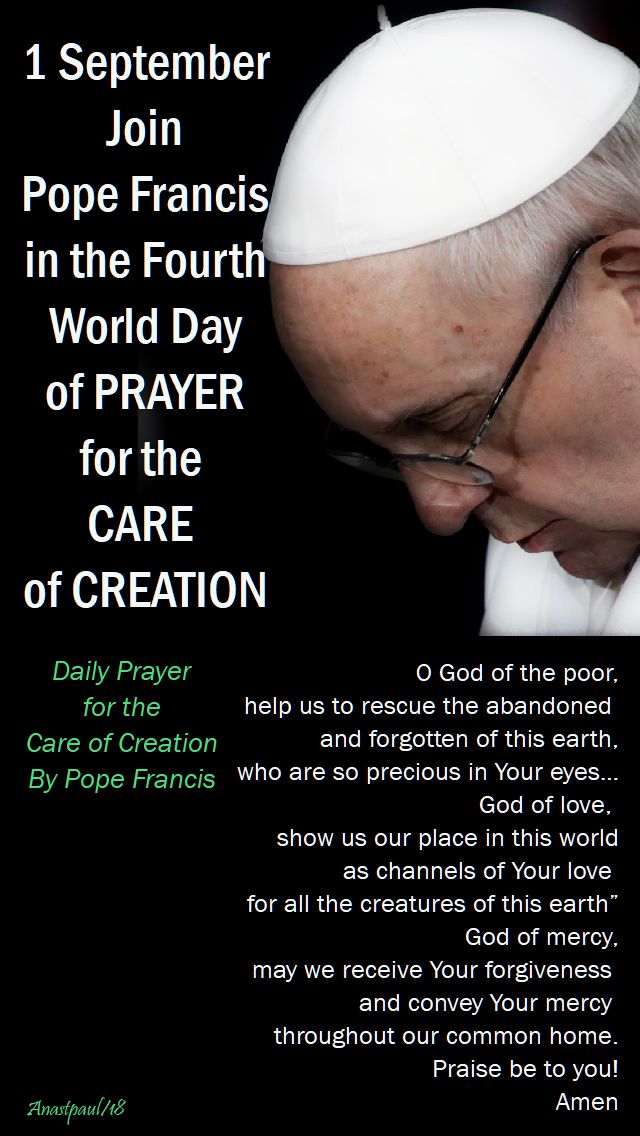
Pope Francis has designated 1 September as the annual World Day of Prayer for the Care of Creation. He hopes this day will be a time for individuals and communities to “reaffirm their personal vocation to be stewards of creation, to thank God for the wonderful handiwork which He has entrusted to our care and to implore His help for the protection of creation as well as His pardon for the sins committed against the world in which we live.”
For this the 4th Annual World Day of Prayer, Pope Francis said: “In this year’s message,I wish to draw attention to the issue of water, the primary good to be protected and made available to all.”
His full message will be published later today.
The Ecology Encyclical: Care for Our Common Home:
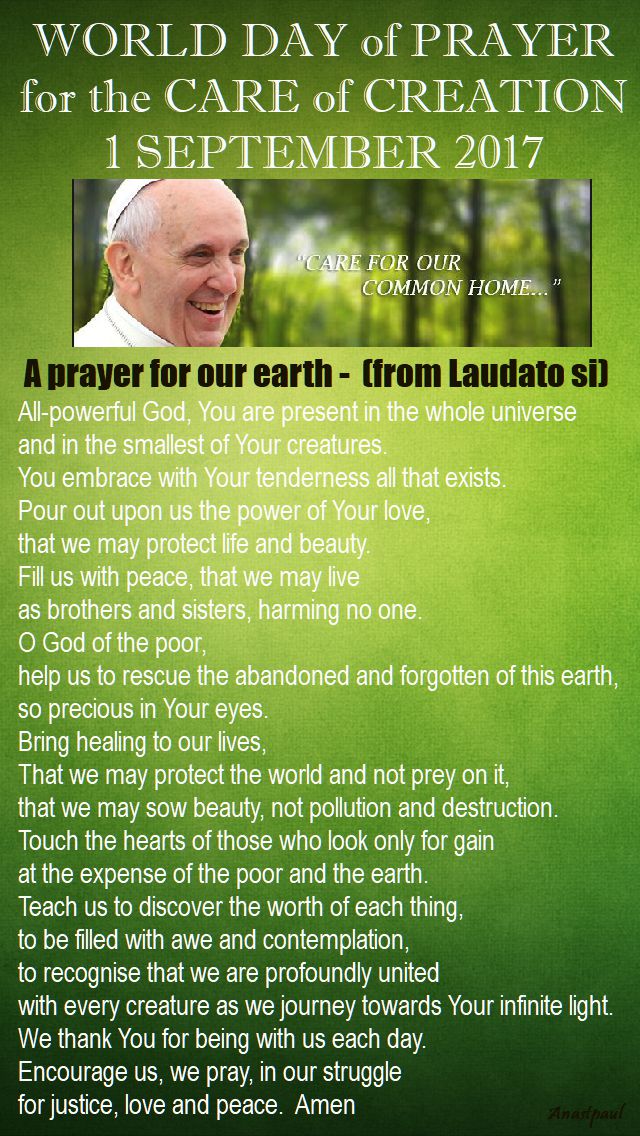
A prayer for our earth (from Laudato si’)
All-powerful God, You are present in the whole universe and in the smallest of Your creatures. You embrace with Your tenderness all that exists. Pour out upon us the power of Your love, that we may protect life and beauty. Fill us with peace, that we may live as brothers and sisters, harming no one. O God of the poor, help us to rescue the abandoned and forgotten of this earth, so precious in Your eyes. Bring healing to our lives, That we may protect the world and not prey on it, that we may sow beauty, not pollution and destruction. Touch the hearts of those who look only for gain at the expense of the poor and the earth. Teach us to discover the worth of each thing, to be filled with awe and contemplation, to recognise that we are profoundly united with every creature as we journey towards Your infinite light. We thank You for being with us each day. Encourage us, we pray, in our struggle for justice, love and peace. Amen
Devotion for September: The Seven Sorrows of the Blessed Virgin Mary
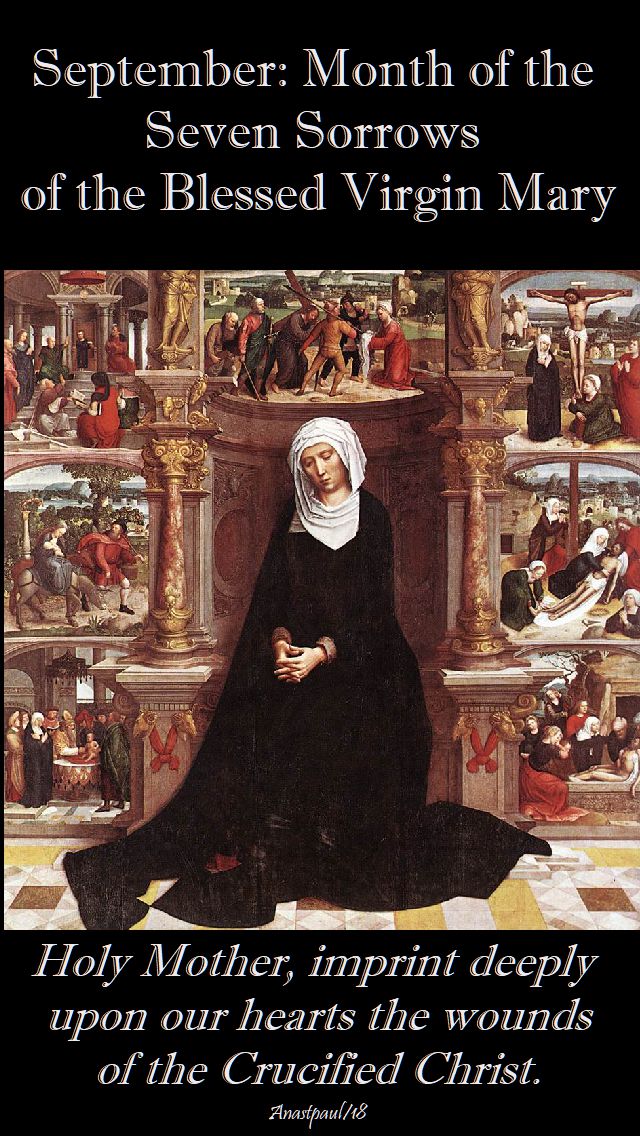
The Seven Sorrows of the Blessed Virgin Mary
1. The prophecy of Simeon 2. The Flight to Egypt 3. Loss of Child Jesus for 3 days 4. Meeting Jesus carrying His Cross 5. The Crucifixion of Jesus 6. The Pieta – receiving Jesus’ Body 7. The Burial of Jesus
Each month of the liturgical year is devoted to a particular Catholic tradition, usually centered on a Feast during that month. As August is the Month of the Immaculate Heart of Mary, September follows as the Month of Our Lady of Sorrows.
We see this theme of joy followed by affliction mirrored in the liturgical calendar in two September Feasts – the Exaltation of the Holy Cross on September 14 and the Feast of Our Lady of Sorrows on 15 September. Happy the heart of the blessed Virgin Mary! She, without dying, earned the treasure of martyrdom beneath the Cross of our Lord for her anguish.
The name of Our Lady of Sorrows centres on the extraordinary and bittersweet suffering the Blessed Mother experienced during Christ’s Passion. As seen in the artwork below, her agony is composed of “The Seven Dolors,” that pierced the Heart of Mary.
During this month of September, we are drawn into the spiritual martyrdom that the Blessed Mother experienced during the physical martyrdom of Jesus. The evils of sin are manifest but conquered through intense suffering. The Blessed Mother’s tears of anguish reflect God’s washing away of sin. If you haven’t ever prayed the Seven Sorrows chaplet, you might want to consider exploring this devotion.
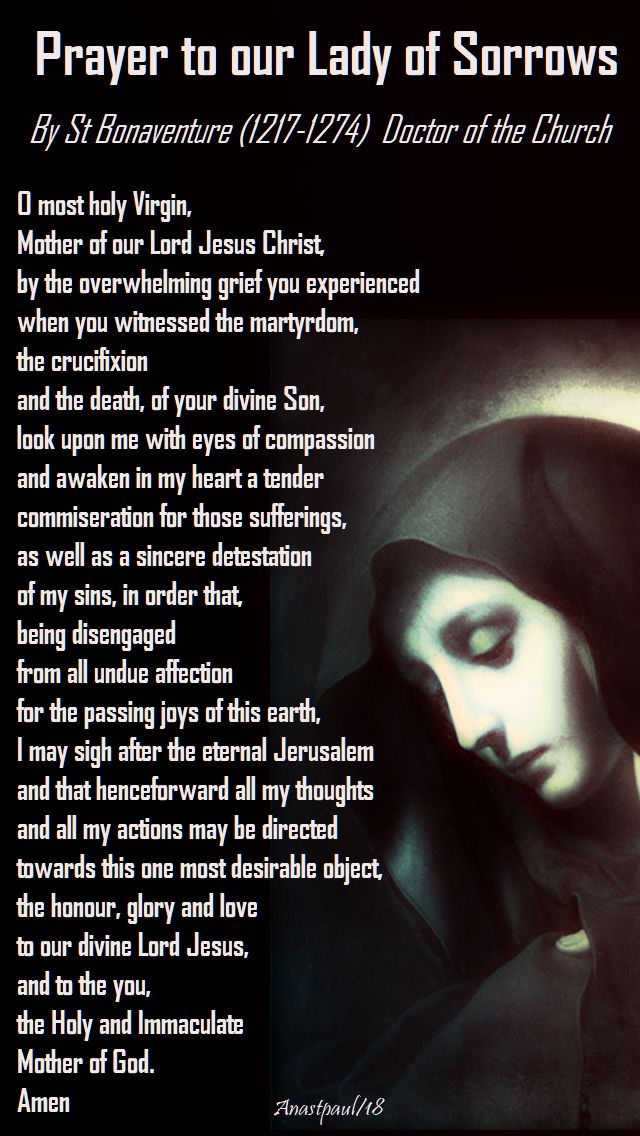
Prayer to our Lady of Sorrows By St Bonaventure (1217-1274) Doctor of the Church
O most holy Virgin, Mother of our Lord Jesus Christ, by the overwhelming grief you experienced when you witnessed the martyrdom, the crucifixion and the death, of your divine Son, look upon me with eyes of compassion and awaken in my heart a tender commiseration for those sufferings, as well as a sincere detestation of my sins, in order that, being disengaged from all undue affection for the passing joys of this earth, I may sigh after the eternal Jerusalem and that henceforward all my thoughts and all my actions may be directed towards this one most desirable object, the honour, glory and love to our divine Lord Jesus, and to the you, the Holy and Immaculate Mother of God. Amen
Thought for the Day – 1 September – The 4th World Day of Prayer for the Care of Creation
Excerpt – Message of His Holiness, Pope Francis, 1 SEPTEMBER 2016
Show Mercy to our Common Home
Examining our consciences, repentance and confession to our Father who is rich in mercy lead to a firm purpose of amendment. This in turn must translate into concrete ways of thinking and acting that are more respectful of creation. For example: “avoiding the use of plastic and paper, reducing water consumption, separating refuse, cooking only what can reasonably be consumed, showing care for other living beings, using public transport or car-pooling, planting trees, turning off unnecessary lights, or any number of other practices” (Laudato Si’, 211). We must not think that these efforts are too small to improve our world. They “call forth a goodness which, albeit unseen, inevitably tends to spread” and encourage “a prophetic and contemplative lifestyle, one capable of deep enjoyment free of the obsession with consumption” (ibid., 212, 222).
In the same way, the resolve to live differently should affect our various contributions to shaping the culture and society in which we live. Indeed, “care for nature is part of a lifestyle which includes the capacity for living together and communion” (Laudato Si’, 228). Economics and politics, society and culture cannot be dominated by thinking only of the short-term and immediate financial or electoral gains. Instead, they urgently need to be redirected to the common good, which includes sustainability and care for creation.
Despite our sins and the daunting challenges before us, we never lose heart. “The Creator does not abandon us; He never forsakes His loving plan or repents of having created us… for He has united himself definitively to our earth and His love constantly impels us to find new ways forward” (Laudato Si’, 13; 245). In a particular way, let us pray on 1 September and indeed throughout the year:
“O God of the poor, help us to rescue the abandoned and forgotten of this earth, who are so precious in your eyes…
God of love, show us our place in this world as channels of Your love for all the creatures of this earth God of mercy, may we receive Your forgiveness and convey Your mercy throughout our common home.
The 4th World Day of Prayer for the Care of Creation
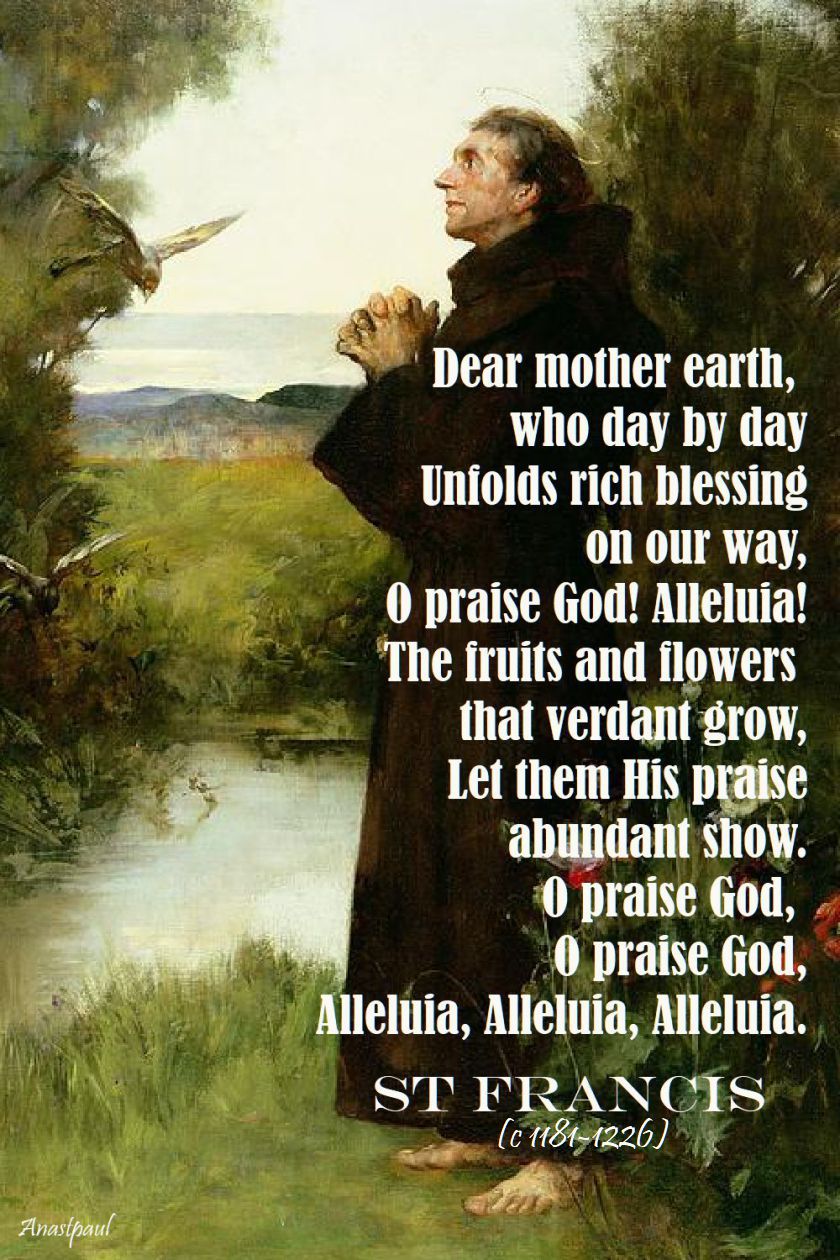
Dear mother earth, who day by day Unfolds rich blessing on our way, O praise God! Alleluia! The fruits and flowers that verdant grow, Let them His praise abundant show. O praise God, O praise God, Alleluia, Alleluia, Alleluia.
St Francis of Assisi (c 1181-1226)
(Translated by William H Draper) (Image by St Francis by Albert Chevallier Tayler)
















 AnaStpaul
You must be logged in to post a comment.