Thought for the Day – 16 June – Meditations with Antonio Cardinal Bacci (1881-1971)
Steadfastness in Suffering
“We are all obliged to suffer in soul and body.
Suffering begins at birth and ends at death. “The whole life of a Christian is a cross,” (Sermon 31) says St Augustine.
For this reason, we have to develop the virtue of patience. “Let patience have it’s perfect work,” says St James, “that you may be perfect and entire” (Js 1:4).
If we are to be perfect, we must accept suffering and trials from the hands of God and offer them to Him in a spirit of harmony with His holy will.
In this way, all our actions become valuable, for they are acts of reparation and of love, which will be rewarded in Heaven.
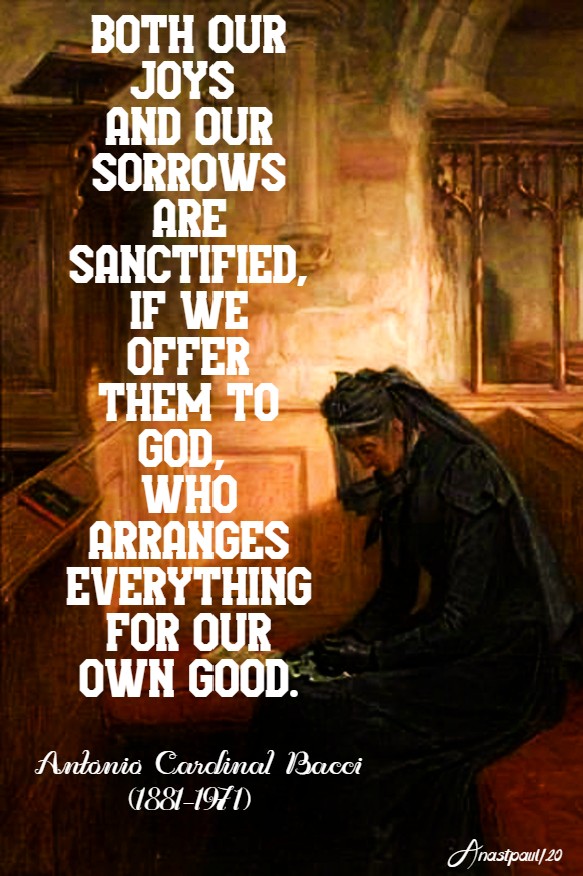
Both our joys and our sorrows are sanctified, if we offer them to God, Who arranges everything for our own good.
The Saints longed to suffer because, they loved God and knew that suffering is the only true way in which we can prove our love.
Suffering is the best medicine for the soul, for when it is endured with patience, it purifies us and prepares us for Heaven. “If God does not punish you for our sins,” says St Augustine, “it is a sign that you are no longer counted among His sons” (De Pastoribus liber unus, c 5). “Whom the Lord loves, he chastises,” St Paul writes “and, he scourges every son whom he receives” (Heb 12:6).
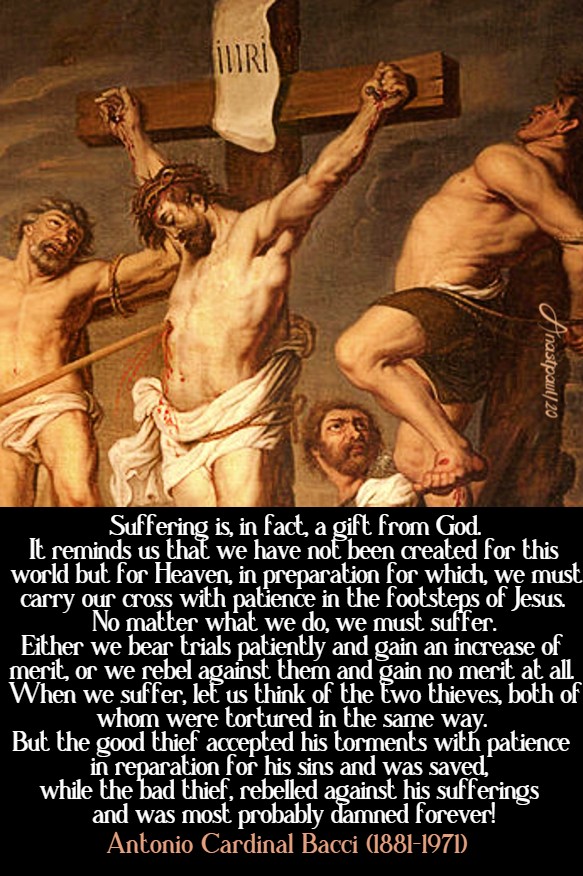
Suffering is, in fact, a gift from God.
It reminds us that we have not been created for this world but for Heaven, in preparation for which, we must carry our cross with patience in the footsteps of Jesus.
No matter what we do, we must suffer.
Either we bear trials patiently and gain an increase of merit, or we rebel against them and gain no merit at all.
When we suffer, let us think of the two thieves, both of whom were tortured in the same way.
But the good thief accepted his torments with patience in reparation for his sins and was saved, while the bad thief, rebelled against his sufferings and was most probably damned forever!”
Quote/s of the Day – 16 June – “Month of the Sacred Heart” – Tuesday of the Eleventh week in Ordinary Time, Year A, Readings: 1 Kings 21:17-29, Psalm 51:3-6, 11, 16, Matthew 5:43-48
“You shall not hate your brother in your heart but you shall reason with your neighbour, lest you bear sin because of him. You shall not take vengeance or bear any grudge against the sons of your own people but, you shall love your neighbour as yourself: I am the Lord”
Leviticus 19:17-18
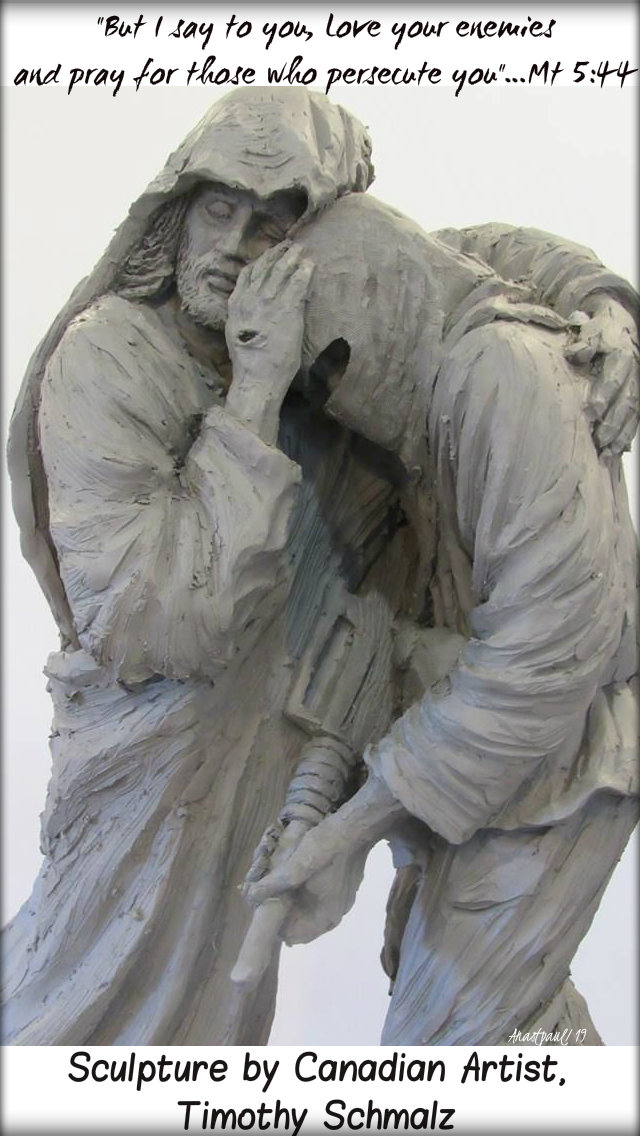
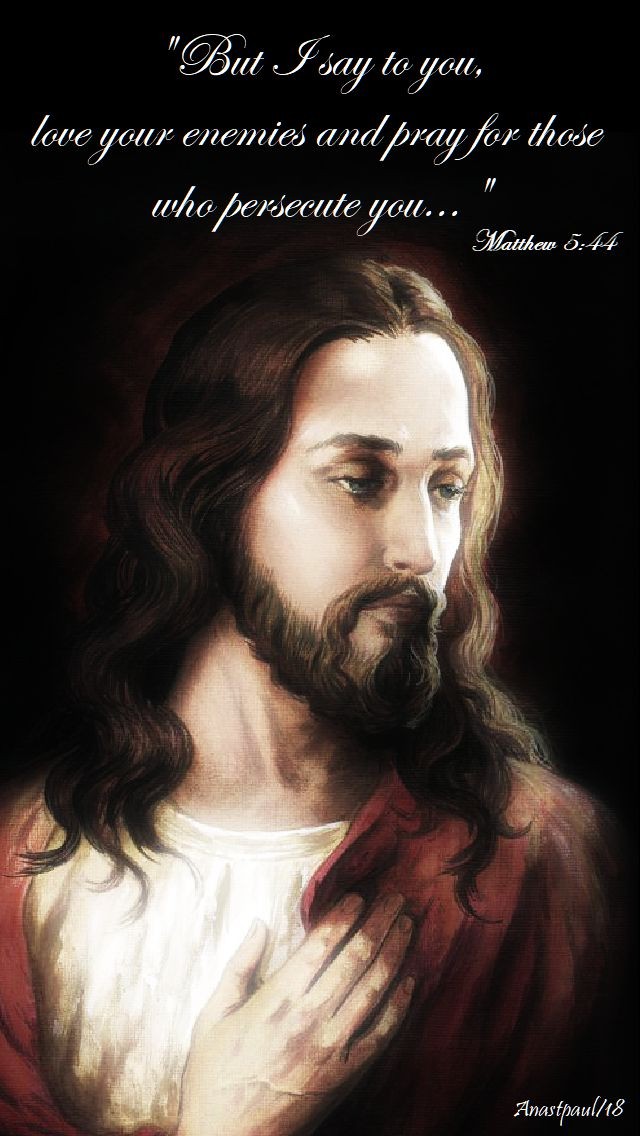
“But I say to you, love your enemies and pray for those who persecute you…”
Matthew 5:44
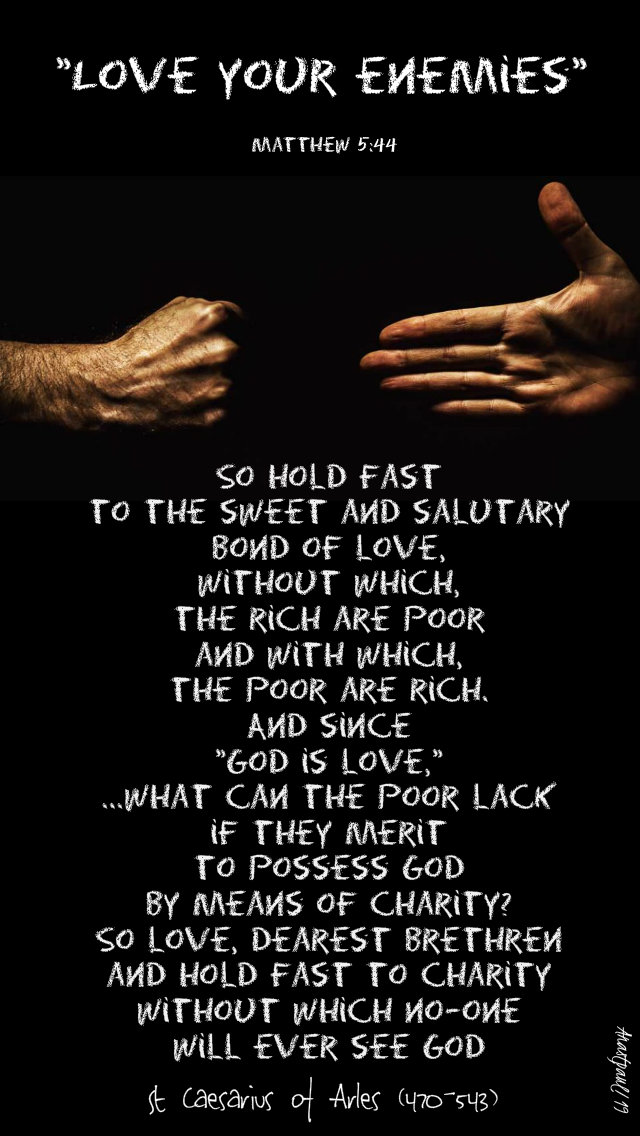
“So hold fast to the sweet and salutary bond of love, without which, the rich are poor and with which the poor are rich. What do the rich possess if not charity? … And since “God is love,” (1 Jn 4:8) as John the evangelist says, what can the poor lack, if they merit to possess God by means of charity? … So love, dearest brethren and hold fast to charity without which, no-one will ever see God.”
St Caesarius of Arles (470-543)
Monk and Bishop
Sermons addressed to the people, no. 23, 3
“We must show love for those who do evil to us and pray for them. Nothing is dearer or more pleasing to God than this.”
St Bridget of Sweden (c 1303-1373)
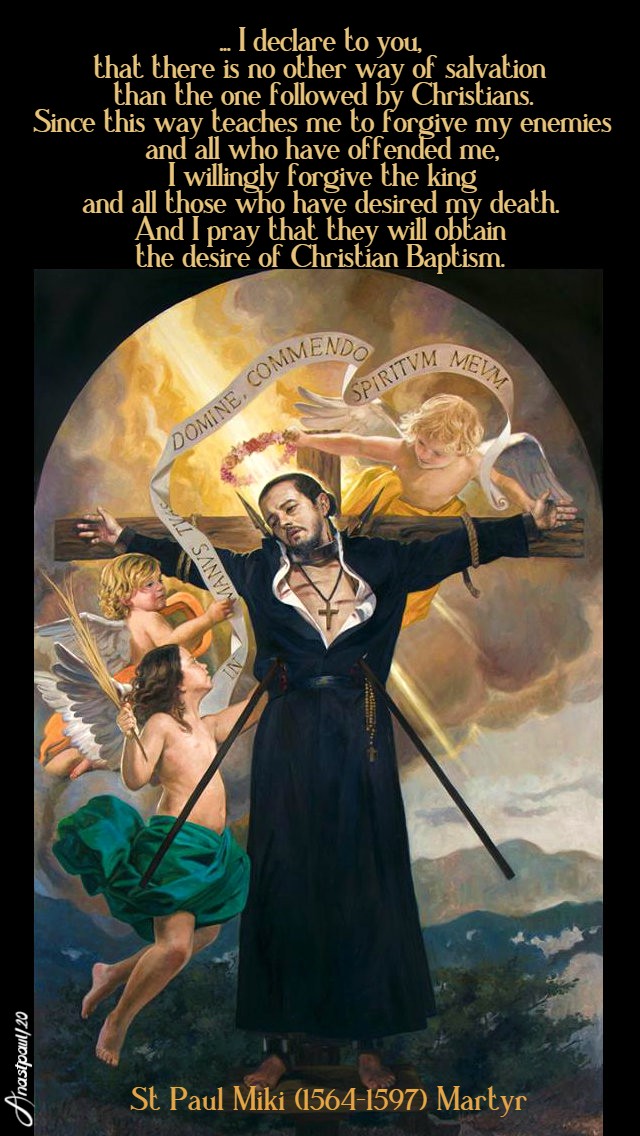
“… I declare to you, that there is no other way of salvation than the one followed by Christians. Since this way teaches me to forgive my enemies and all who have offended me, I willingly forgive the king and all those who have desired my death. And I pray that they will obtain the desire of Christian Baptism.”
St Paul Miki SJ (1564-1597) Martyr
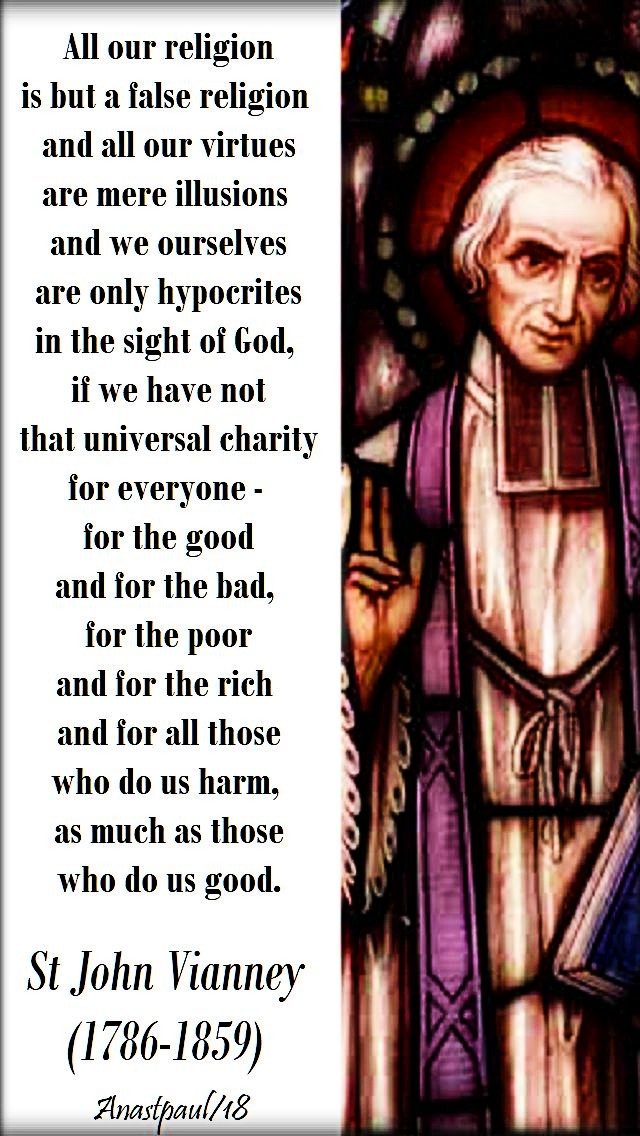
“All our religion is but a false religion and all our virtues are mere illusions and we ourselves are only hypocrites in the sight of God, if we have not that universal charity for everyone – for the good and for the bad, for the poor and for the rich and for all those who do us harm, as much as those who do us good.”
St John Vianney (1786-1859)
“When we talk about the coming of the Kingdom and pray for its coming, we are not thinking of a discrimination according to race or blood but of the brotherhood of all, for all men are our brothers – not excluding even those who hate and attack us – in a close bond with the One, who causes the sun to rise on the good and the bad alike (Mt 5:45).”
Blessed Titus Brandsma (1881-1942) Martyr
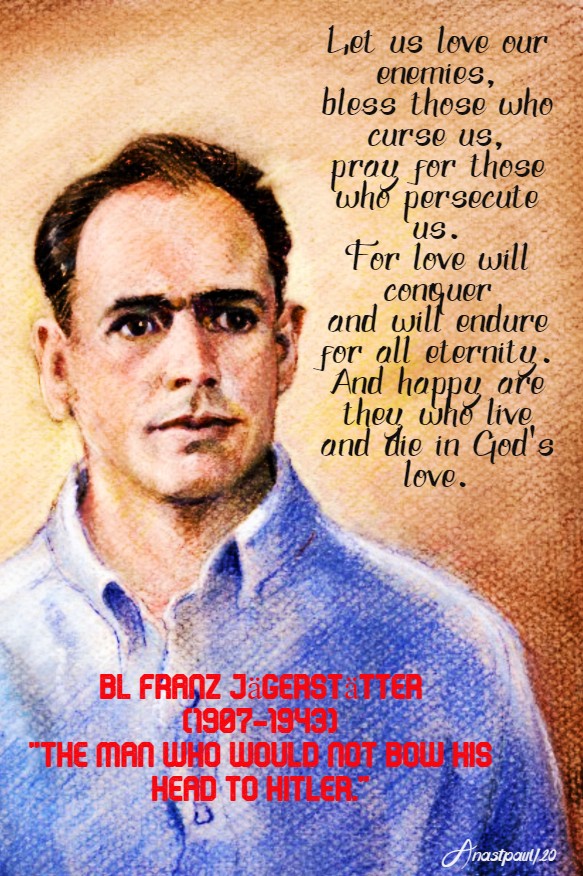
“Let us love our enemies, bless those who curse us, pray for Those who persecute us. For love will conquer and will endure for all eternity. And happy are they who live and die in God’s love.”
Blessed Franz Jägerstätter (1907-1943)
“Called-up to a Higher Order”
Martyr of Conscientious Objection
One Minute Reflection – 16 June – “Month of the Sacred Heart” – Tuesday of the Eleventh week in Ordinary Time, Year A, Readings: 1 Kings 21:17-29, Psalm 51:3-6, 11, 16, Matthew 5:43-48 and the Memorial of Bl Donizetti Tavares de Lima (1882-1961)
“But I say to you, love your enemies and pray for those who persecute you… For if you love those who love you, what recompense will you have?” … Matthew 5:44,46
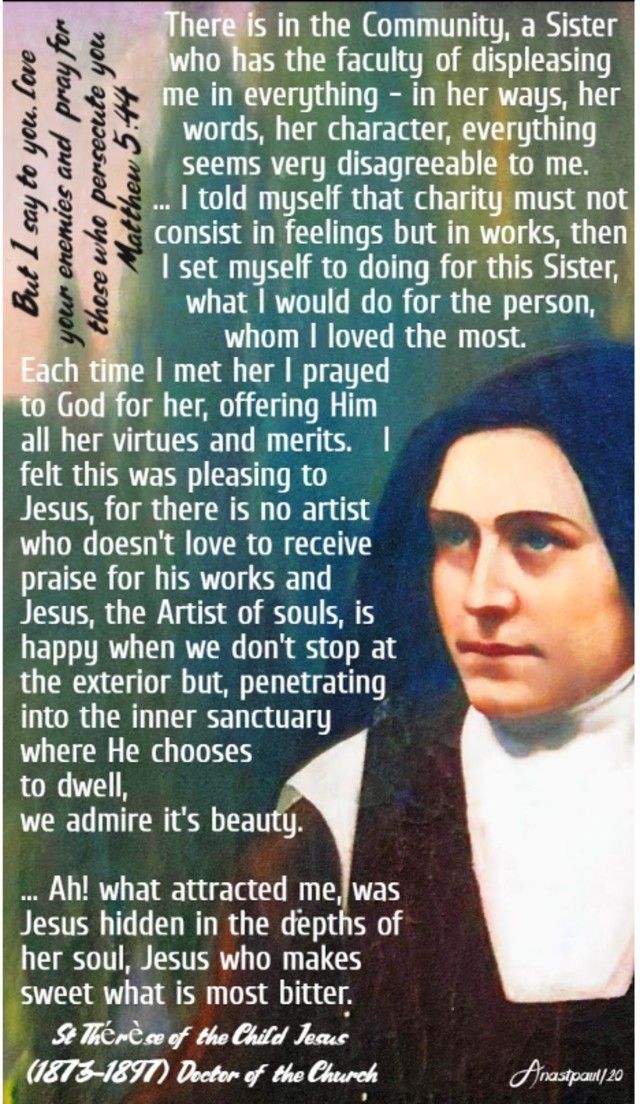
REFLECTION – “There is in the Community, a Sister who has the faculty of displeasing me in everything – in her ways, her words, her character, everything seems very disagreeable to me. And still, she is a holy religious who must be very pleasing to God. Not wishing to give into the natural antipathy I was experiencing, I told myself that charity must not consist in feelings but in works, then I set myself to doing for this Sister, what I would do for the person, whom I loved the most. Each time I met her I prayed to God for her, offering Him all her virtues and merits. I felt this was pleasing to Jesus, for there is no artist who doesn’t love to receive praise for his works and Jesus, the Artist of souls, is happy when we don’t stop at the exterior but, penetrating into the inner sanctuary where He chooses to dwell, we admire it’s beauty.
I wasn’t content simply with praying very much for this Sister, who gave me so many struggles but I took care to render her all the services possible and when I was tempted to answer her back in a disagreeable manner, I was content with giving her my most friendly smile and with changing the subject of the conversation. … Frequently, when… I had occasion to work with this Sister, I used to run away like a deserter, whenever my struggles became too violent. As she was absolutely unaware of my feelings for her, never did she suspect the motives for my conduct and she remained convinced that her character was very pleasing to me. One day, at recreation, she asked in almost these words: “Would you tell me, Sister Therese of the Child Jesus, what attracts you so much toward me, every time you look at me, I see you smile?” Ah! what attracted me, was Jesus hidden in the depths of her soul, Jesus who makes sweet what is most bitter.” … St Thérèse of the Child Jesus (1873-1897) Doctor of the Church
PRAYER – Almighty God, to whom this world, with all it’s goodness and beauty belongs, give us grace joyfully, to begin this day for Christ Your Son, in Him and with Him and to fill it, with an active love for all Your children, even those who may not like or who do us harm. Help us to love as You do, so that we may become like You. Bl Donizetti Tavares de Lima, you who spread your charity far and wide, pray for us. Through Christ our Lord, with the Holy Spirit, one God, forever, amen.
Our Morning Offering – 16 June – “Month of the Sacred Heart” – Tuesday of the Eleventh week in Ordinary Time, Year A
Daily Offering to the Sacred Heart By St Therese of the Child Jesus/Lisieux (1873-1897) Doctor of the Church
O my God!
I offer You all my actions of this day
for the intentions and for the glory
of the Sacred Heart of Jesus.
I desire to sanctify
every beat of my heart,
my every thought,
my simplest works,
by uniting them
to His infinite merits
and I wish to make reparation for my sins
by casting them into the furnace
of His Merciful Love.
O my God! I ask of You for myself
and for those whom I hold dear,
the grace to fulfil perfectly
Your Holy Will,
to accept for love of You
the joys and sorrows of this passing life,
so that we may one day be united together
in heaven for all Eternity.
Amen
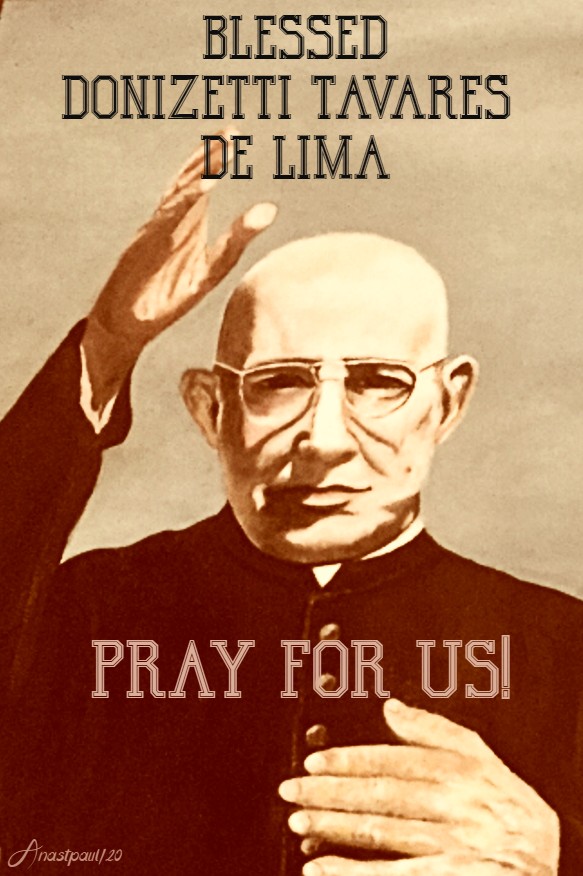
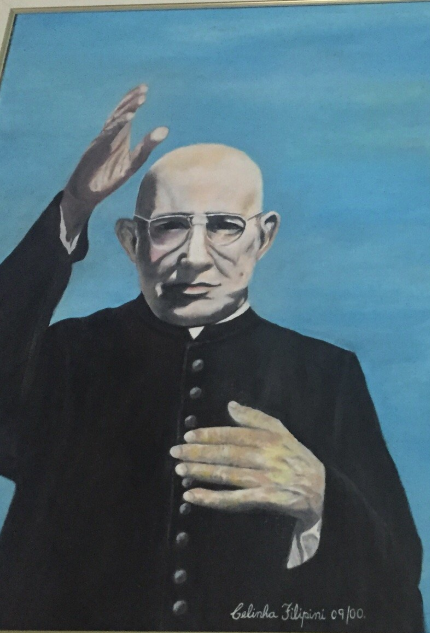
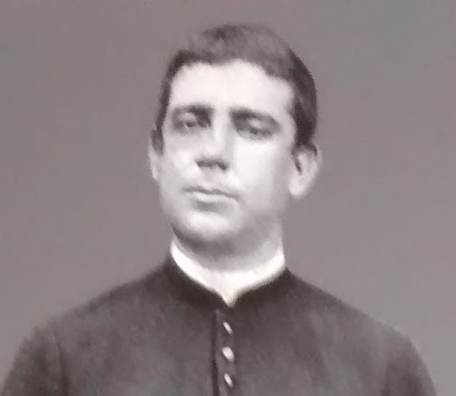
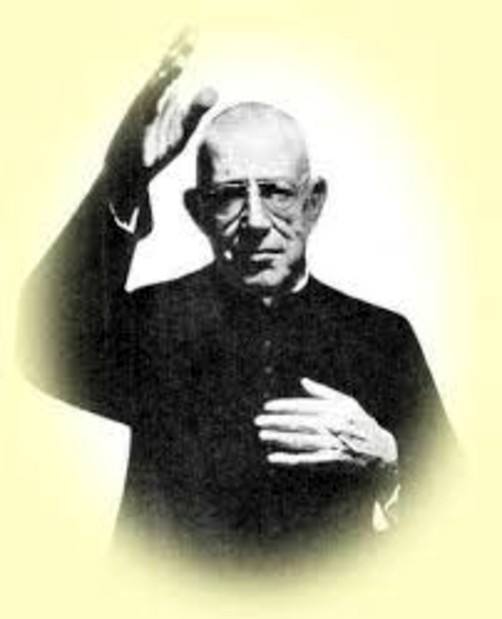
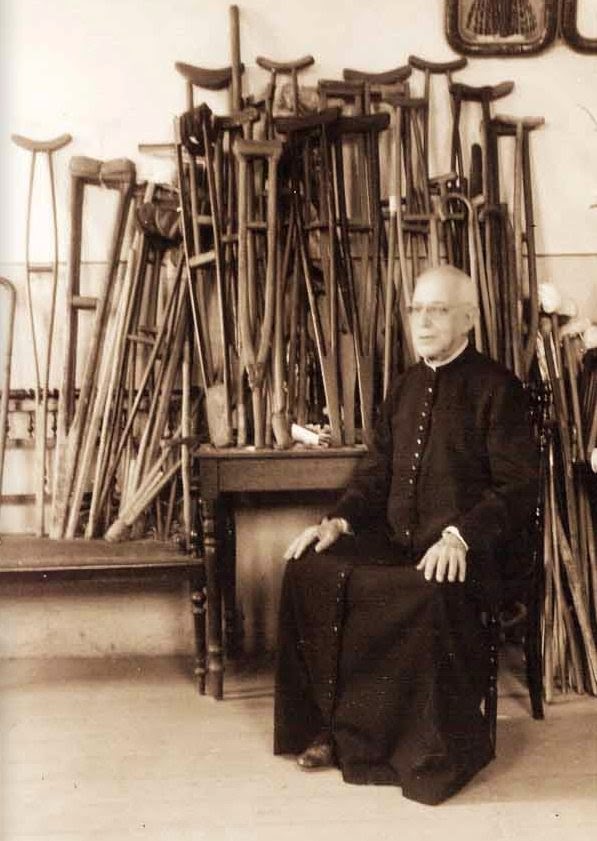
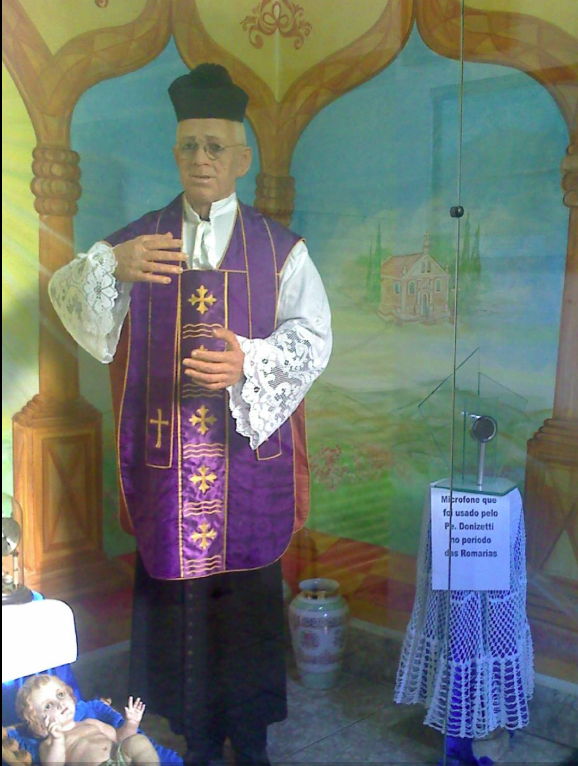
Saint of the Day – 16 June – Blessed Donizetti Tavares de Lima (1882-1961) Priest, Apostle of the poor, the elderly and the sick, miracle-worker, known to bilocate – born on 3 January 1881 in Cássia, Brazil and died at 11.15am on 16 June 1961 in at the parish hall in Tambaú, Brazil of natural causes,he was 80 years old.
Donizetti was born in 1882 to Minas Gerais de Tristão and Francisca Cândida Tavares de Lima. He was one of eight brothers. His father worked in law and his mother worked as a professor. In 1886, the Tavares de Limas family relocated to Franca in São Paulo, where he attended school and learned music.
In 1894 he commenced his ecclesial studies where he soon became the organist at the institute where he studied and later started to teach music to the seminarians. In 1897 he moved to a college to further his education but later returned to teach music to seminarians. In 1900 he commenced a law course and in 1903 his philosophical and theological formation in preparation for the priesthood.
He received his Ordination as a Priest on 12 July 1908 from the Bishop of Pouso Alegre. He began work in the San Gaetano Parish and then spent time in the Campinas Diocese where he served as an auxiallary Priest.
In 1909, he was appointed as the Parish Priest for the Sant’Ana Church Vargem Grande do Sul in the Ribeirão Preto Diocese, where he defended the rights of the poor. This staunch advocacy for the poor led to the rich and his other detractors to accuse him of being a communist. He also helped construct Chapels to Nossa Senhora Aparecida and to Saint Benedict of Nursia. He was stationed at the Sant’Ana church from 20 April to 8 August 1909 before being transferred again. On 24 May 1926 he was appointed as the newest Parish Priest for the Church of St Anthony in Tambaú. He arrived in the town on 12 June and was inaugurated at the parish with his first Mass there on 13 June. It was there, that he oversaw the establishment of the Saint Vincent de Paul Sanatorium for the abandoned and for elderly people who lived alone. The first miracle attributed to him occurred in 1927 – torrential rain threatened a procession of a statue of Our Lady of Aparecida but the storm subsided and was quieted when Fr Donizetti led the procession himself.
In 1960, the Archbishop of Ribeirão Preto city, Dom Luiz do Amaral Mousinho, went to Tambau, to visit the parish of Saint Anthony and met Fr Donizetti. As soon as he saw the Archbishop, he told him:
“Archbishop, I had a terrible nightmare! I saw the demon entering in the Cathedral of Saint Sebastian (in Ribeirão Preto city-SP) with some priests with him and all of them were armed with picks in hand. They were walking to the side altars of the Cathedral, screaming loudly. When they reached the altar of St Anthony, the image of the holy Friar of Lisbon looked with authority to the devil and his minions, then they left the place fast. Archbishop, for goodness sake, do not let them overthrow the altars of the Cathedral!”
At that moment, the Archbishop told him that it was just a dream, a nightmare and no one would remove the altars but Fr Donizetti told again:
“No, no, Archbishop! We won’t see this disgrace (prophesying that they both would die soon) but it will come! This was not just a dream, nor a nightmare! The darkness will fall over this world! I beg you: don’t let them destroy the altars!”
Kindly, as usual he was, the Archbishop smiled and told to him: “Fr Donizetti, I promise you, I won’t let anyone destroy the altars of our Cathedral!”
A few years later, after the introduction of the New Mass, Fr Agmar Marques remembered this fact and he avoided the removal of the altars of Saint Sebastian Cathedral.
Father Horacio Longo also remembered the “nightmare of the altars” prophesied by Father Donizetti when they removed the side altars of the parish of Franca city, now the Our Lady of Conception Cathedral.
Father Saverio Brugnara reported that Father Donizetti received a picture of St Pope John XXIII in 1959. At that momen,t Fr Donizetti looked for a time at the picture, smiled and said to an acolyte that they both should pray a lot for the Pope and for the Church. One of the acolytes wanted to remove the old picture of Pope Pius XII on the wall and put the picture of the new Pope, John XXIII but Fr Donizetti said: “No, my son! Leave the picture there! Soon I will meet him! As for the new Pope’s picture, leave it there, where it is.”
The picture of Pope John XXIII was placed on a dresser and Pius XII’s picture continued on the wall, at the main place of the sacristy.
Many miracles were witness through the piety and devotion of Father Donizetti. He was just a living saint and he used to be called as “the thaumaturge of Tambau.” One of the miracles which Father Donizetti always attributed to the intercession of Our Lady of Aparecida, was witnessed by one of the most respected journalists in Brazil, Joelmir Beting (1936-2012) who was born and lived in Tambau. Local officials came to him to seek out his advice on social matters. Even President Getúlio Vargas spoke with Fr Donizetti about social matters, that culminated legislation governing proper work ethics
On a radio program the journalist told that on the Easter Sunday of 1953, Fr Donizetti prayed the Mass in the church of Saint Anthony for thousands people and at the same time, he was seen by about 2 thousand people in the City of São Pedro dos Morrinhos, attending an auction of cattle to raise money for his sanatorium. This was one of the many miracles that made him known in the state of São Paulo and other states of the country.
Another famous miracle happened in 1955 when José Alexandre Braga, a boy of 5 years old, was cured of osteochondritis, a disease that prevented him from walking.
José Alexandre Braga (the child in the picture left) after he was cured. In the picture right a most recent photo.
About the miracles, Father Donizetti used to say that the most important were not the cures but the conversions to Catholicism.
Fr Donizetti died in Tambaú on 16 June 1961 due to cardiac complications and diabetic complications that had caused several hospitalisations in the past. He died in the morning at 11:15 am while seated in a chair. His remains were interred on 17 June and exhumed on 7–8 May 2009 in Tambaú for canonical inspection and relocation, which was done at night to avoid a large crowd forming. Later his body was moved to his old parish church and now attract, between 10 and 12 thousand people per month who come as pilgrims. Thousands also visit the ‘House of Father Donizetti’ (in Portuguese “casa do Padre Donizetti”). Inside the house, there are many objects related to the miracles, such as crutches, etc.
This slideshow requires JavaScript.
The Priest had been hailed as a Saint his entire life and efforts to launch a Beatification process started in 1991. The cause opened towards the decade’s end and he became titled as a Servant of God. Pope Francis confirmed his heroic virtue on 9 October 2017 and named him as Venerable. Pope Francis also signed a decree on 6 April 2019 that recognised a miracle attributed to his intercession which made it possible for him to be Beatified in Tambaú on 23 November 2019. He was Beatified on 23 November 2019 by Pope Francis. The Beatification ceremony was celebrated by Cardinal Giovanni Angelo Becciu.
This Statue of Bl Donizetti resides in the MuseumBl Donizetti saying Mass
St Actinea of Volterra
St Aitheachan of Colpe
St Amandus of Beaumont
Bl Antoine Auriel
St Aurelian of Arles
St Aureus of Mainz St Benno of Meissen (1010-1106) Biography: https://anastpaul.com/2018/06/16/saint-of-the-day-st-benno-1010-1106/
St Berthaldus
St Ceccardus of Luni
St Cettin of Oran
St Colman McRhoi
St Crescentius of Antioch
St Cunigunde of Rapperswil
St Curig of Wales
St Cyriacus of Iconium Blessed Donizetti Tavares de Lima (1882-1961)
St Elidan
St Felix of San Felice
St Ferreolus of Besançon
St Ferrutio of Besançon
Bl Gaspare Burgherre
St Graecina of Volterra
St Ismael of Wales
St Julitta of Iconium
St Justina of Mainz St Lutgarde of Aywières (1182-1246) Her Life: https://anastpaul.com/2017/06/16/saint-of-the-day-16-june-st-lutgarde-of-aywieres-the-first-known-woman-stigmatic-of-the-church-and-one-of-the-first-promoters-of-devotion-to-the-sacred-heart/
St Maurus of San Felice
St Palerio of Telese
St Similian of Nantes
Bl Thomas Redyng
St Tycho of Amathus
—
Martyrs of Africa: A group of five Christians martyred together. We know nothing else but the names – Cyriacus, Diogenes, Marcia, Mica, Valeria. They were martyred in an unknown location in Africa, date unknown.
Martyrs of Làng Cóc: A group of five Christian laymen, four farmers and a doctor, from the same village in the apostolic vicariate of Central Tonkin (in modern Vietnam). During the persecutions of emperor Tu Duc, they were each ordered to stomp on a cross to show their contempt for Christianity; they each refused. Imprisoned, tortured and martyred.
• Anrê Tuong
• Ðaminh Nguyen
• Ðaminh Nguyen Ðuc Mao
• Ðaminh Nhi
• Vinh Son Tuong
The were beheaded on 16 June 1862 in Làng Cóc, Nam Ðinh, Vietnam and canonised on 19 June 1988 by St Pope John Paul II.
Novena in Honour of the Sacred Heart of Jesus Day Six – 15 June
Honesty in Prayer
Today’s Scripture When Jesus arrived, he found that Lazarus had already been in the tomb for four days. Now Bethany was near Jerusalem, some two miles away and many of the Jews had come to Martha and Mary to console them about their brother. When Martha heard that Jesus was coming, she went and met him, while Mary stayed at home. Martha said to Jesus, ‘Lord, if you had been here, my brother would not have died. But even now I know that God will give you whatever you ask of him.’ Jesus said to her, ‘Your brother will rise again.’ Martha said to him, ‘I know that he will rise again in the resurrection on the last day.’ … John 11:17-24
Reflection for the Sixth Day
St Ignatius Loyola said that we should always speak to Jesus in prayer just as one close friend would speak to another.
Don’t be afraid to express your real feelings to Jesus – anger, hurt, joy, sorrow, etc.
When you’ve made your complaint or expressed your joy, don’t forget one thing Listen for God’s response!
It may come in surprising ways.
If, you concentrate on Him all day, at every task, you will hear Him!
Today’s Prayer
Jesus, I have to be honest and tell You,
that there have been times when I’ve been angry with You
and I feel that You’ve let me down.
Help me to trust
that You really do have a loving plan for me
and for everyone,
a plan that most times I find hard to fathom.
I love and trust You Lord,
help me to love and trust You more each day!
Amen
Daily Invocation Sacred Heart of Jesus, I place all my trust in you.
Novena Prayer
Lord Jesus,
the needs of Your people open Your heart in love for each of us.
You care for us when we are lost,
sympathise with us in loneliness
and comfort us in mourning;
You are closest to us where we are weakest.
You love us most, when we love ourselves least;
You forgive us mos, when we forgive ourselves least
and You call us to spread Your love in whatever way we can.
Lord Jesus, Your heart is moved with compassion
when we are suffering,
when we need your help
and when we pray for each other.
I ask You to listen to my prayer during this Novena
and grant what I ask.
…………………………. (Mention your intention silently.)
If what I ask, is not for my own good and the good of others,
grant me what is best,
that I may build up Your kingdom of love in our world.
Amen
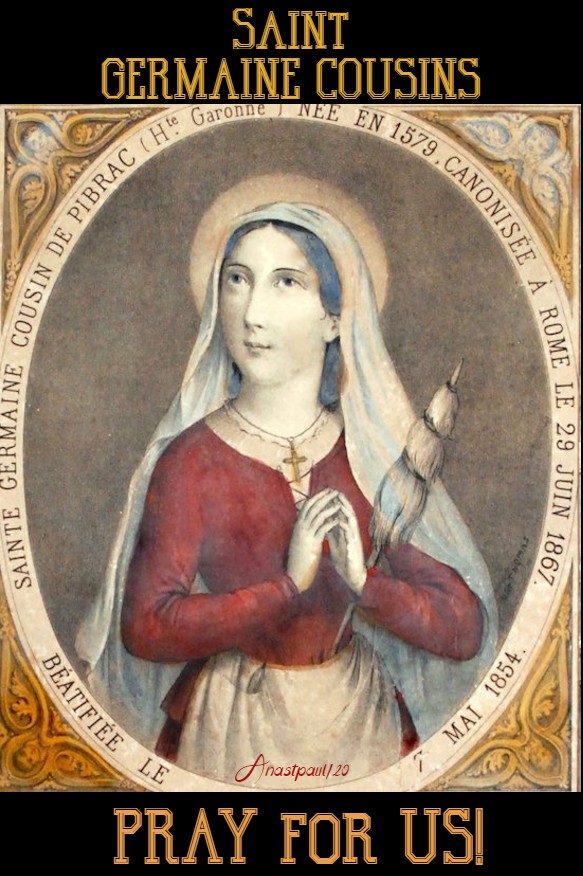
Thought for the Day – 15 June – Meditations with Antonio Cardinal Bacci (1881-1971) and the Memorial of St Germaine Cousin (1579–1601) Shepherdess
The Divine Worker
“Let us open the Gospel of St John.
“In the beginning was the Word and the Word was with God and the Word ws God. He was in the beginning with God. All things were made through him and without him, was made nothing that has been made” (John 1:1-3).
The work of creation is attributed in a special way, to the Eternal Word, the Son of God.
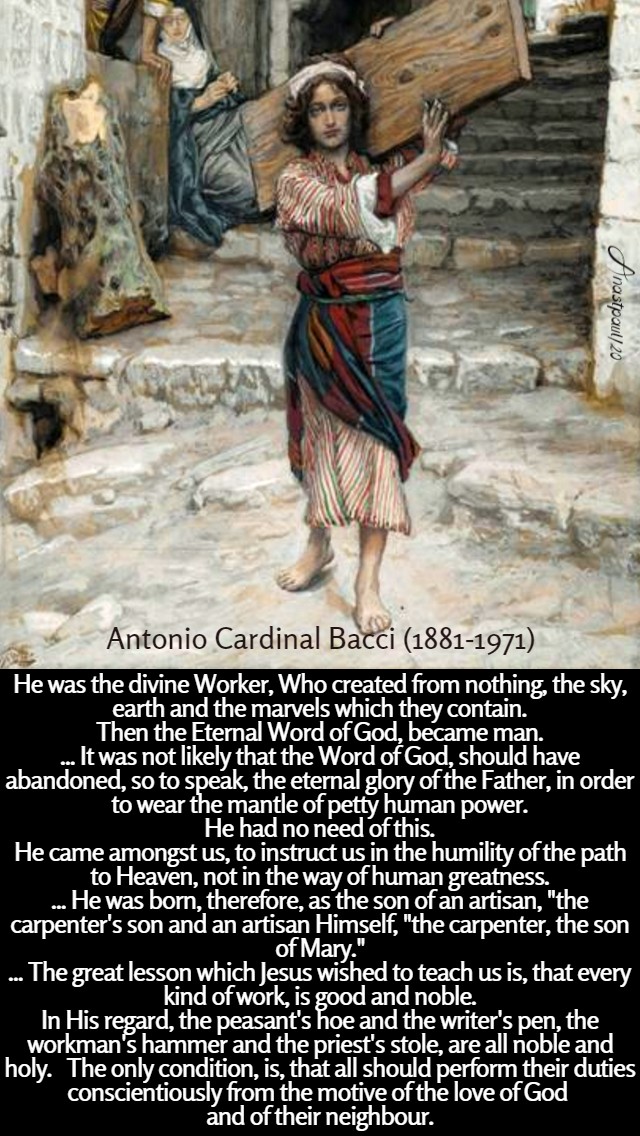
He was the divine Worker, Who created from nothing, the sky, earth and the marvels which they contain.
Then the Eternal Word of God, became man (Jn 1:14).
But what position did He choose to occupy amongst us?
He could have been born heir to the illustrious throne of Rome, the most powerful in history.
He could have been born in Athens amongst the philosophers of the Areopagus, who handed down, through the centuries, the light of human wisdom and beauty.
But, it was not likely that the Word of God, should have abandoned, so to speak, the eternal glory of the Father, in order to wear the mantle of petty human power.
He had no need of this.
He came amongst us, to instruct us in the humility of the path to Heaven, not in the way of human greatness.
He was born, therefore, as the son of an artisan, “the carpenter’s son, (Mt 13:55) and an artisan Himself, “the carpenter, the son of Mary” (Mk 6:3).
According to the most ancient and most reliable tradition, He was one of the many carpenters in the Palestinian countryside who were prepared to adapt themselves to whatever job arose, whether it was the making of a door, a handle for a hoe, or a plough (Cf Justin Martyr, Dialogue with Trypho, 88:8).
From His youth, therefore, Jesus was a carpenter’s apprentice and, when St Joseph died, He carried on His trade and earned a livelihood for His Mother Mary and Himself.
It was only after many years of manual labour that Jesus ceased to be an artisan and dedicated Himself to work of the mind and heart.
In the three years of His public life, He was an Apostle of truth and goodness.
In this way, He sanctified every type of work, manual, intellectual and spiritual.
The great lesson which Jesus wished to teach us is, that every kind of work, is good and noble.
The manual labour of the farm-hand and of the artisan, is, a co-operation in the work of the Redemption.
Both were made holy by Jesus.
Let those who work with their hands take inspiration from Jesus, Who subjected Himself, for thirty years to all the sacrifices involved in manual labour.
Let intellectuals and apostolic workers look to Jesus also, for when His Hour had come, He sacrificed Himself in His apostolate and gave His life for us.
In His regard, the peasant’s hoe and the writer’s pen, the workman’s hammer and the priest’s stole, are all noble and holy.
The only condition, is that, all should perform their duties conscientiously from the motive of the love of God and of their neighbour.”
Antonio Cardinal Bacci
Cardinal Bacci and I did not plan that this post should fall on the Feast day of little St Germaine Cousins, the Shepherdess who gave every second of her labour and her life, for the love of God and His Will. She teaches us to sanctify the meanest of tasks, to constantly remember our daily offering of each and every form of our work for the glory of God and to honour His Divine Will and Providence.
Quote/s of the Day – 15 June – “Month of the Sacred Heart” – Monday of the Eleventh Week of Ordinary Time, Year A, Readings: 1 Kings 21:1-16, Psalm 5:2-3, 4-7, Matthew 5:38-42 and the Memorial of St Germaine Cousin (1579–1601)
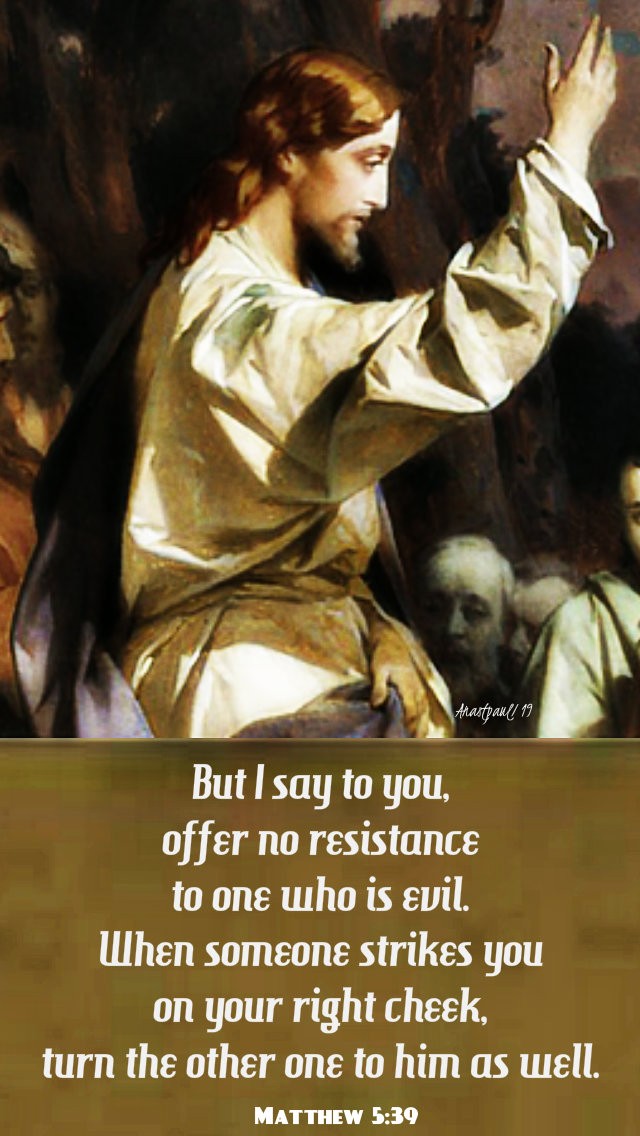
“But I say to you, offer no resistance to one who is evil. When someone strikes you on your right cheek, turn the other one to him as well.”
Matthew 5:39
“But I say to you, love your enemies and pray for those who persecute you”
Matthew 5:44
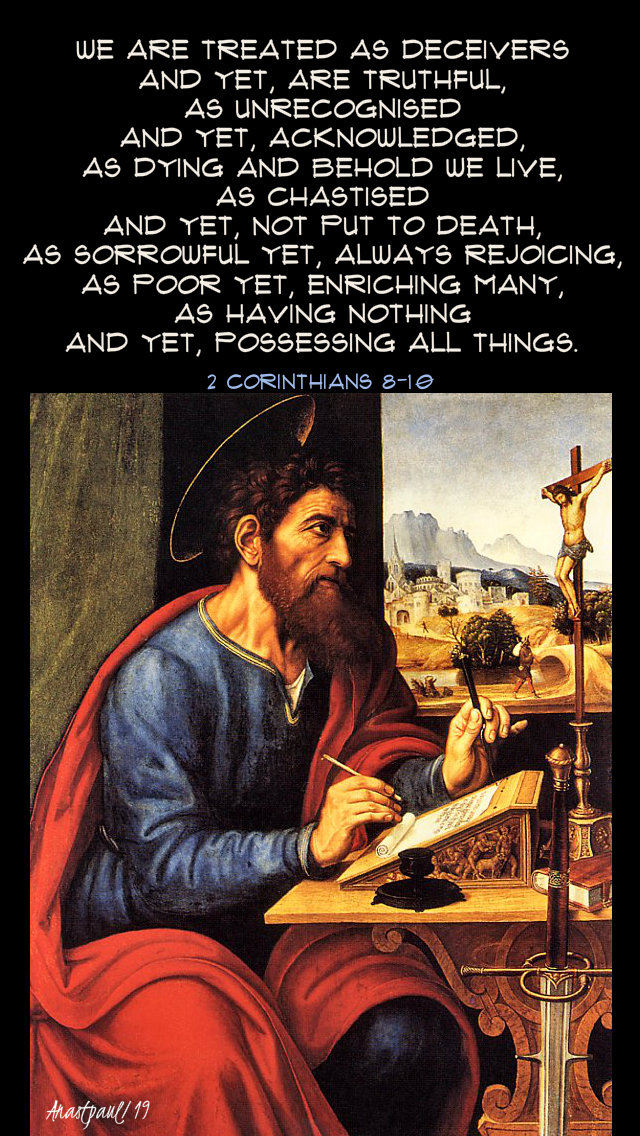
“We are treated as deceivers and yet, are truthful, as unrecognised and yet, acknowledged, as dying and behold we live, as chastised and yet, not put to death, as sorrowful yet, always rejoicing, as poor yet, enriching many, as having nothing and yet, possessing all things.”
2 Corinthians 8-10
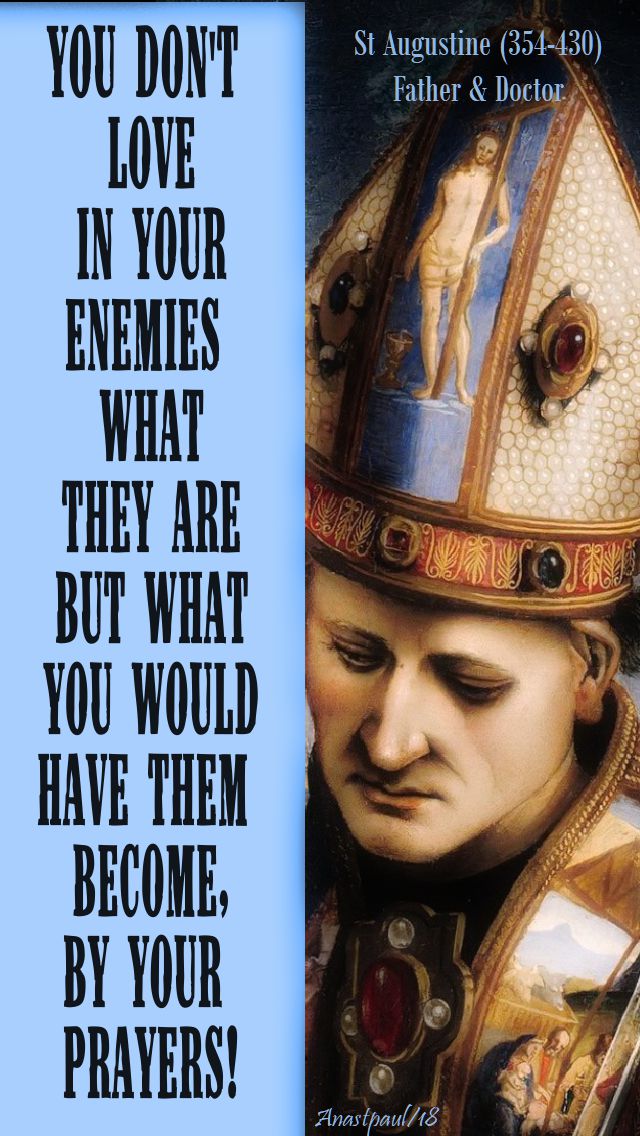
“You don’t love in your enemies what they are but what you would have them become, by your prayers!”
St Augustine (354-430) Father & Doctor
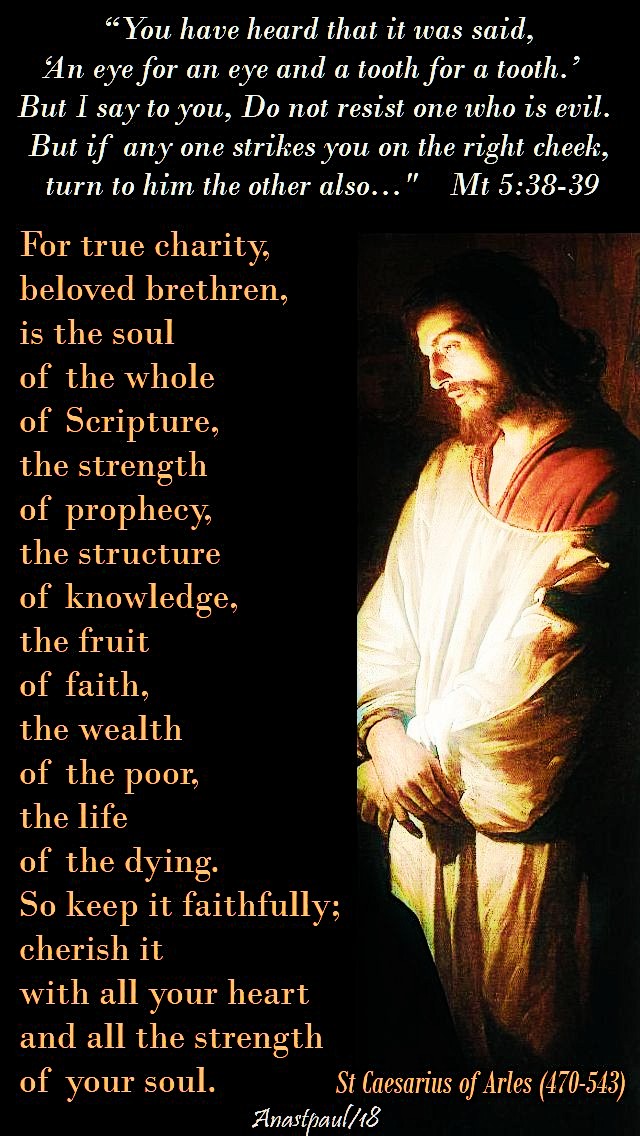
“For true charity, beloved brethren, is the soul of the whole of Scripture, the strength of prophecy, the structure of knowledge, the fruit of faith, the wealth of the poor, the life of the dying. So keep it faithfully; cherish it with all your heart and all the strength of your soul (cf Mk 12:30).”
St Caesarius of Arles (470-543)
Bishop and Monk
(Sermons to the people, no. 23, 4-5, which draws its inspiration from Saint Augustine)
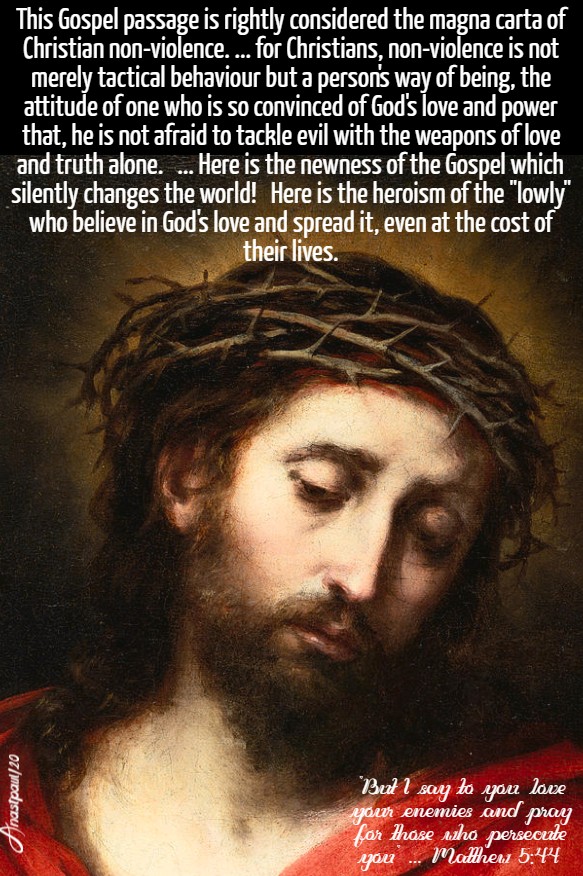
“This Gospel passage is rightly considered, the magna carta of Christian non-violence. One then understands that for Christians, non-violence is not merely tactical behaviour but a person’s way of being, the attitude of one who is so convinced of God’s love and power that, he is not afraid to tackle evil with the weapons of love and truth alone. … Here is the newness of the Gospel which silently changes the world! Here is the heroism of the “lowly” who believe in God’s love and spread it, even at the cost of their lives.”
Pope Benedict XVI
Angelus, St Peter’s Square, Sunday, 18 February 2007
One Minute Reflection – 15 June – “Month of the Sacred Heart” – Monday of the Eleventh Week of Ordinary Time, Year A, Readings: 1 Kings 21:1-16, Psalm 5:2-3, 4-7, Matthew5:38-42 and the Memorial of St Germaine Cousin (1579–1601)
“Should anyone press you into service for one mile, go with him for two miles.” … Matthew 5:41
REFLECTION – “Do you grasp the excellence of a Christian disposition? After you give your coat and your cloak, even if your enemy should wish to subject your naked body to hardships and labours, not even then, Jesus says, must you forbid him. For He would have us possess all things in common, both our bodies and our goods, as with them that are in need, so with them that insult us. For the latter response comes from a courageous spirit, the former from mercy. Because of this, Jesus said, “If any one shall compel you to go one mile, go with him two.” Again He leads you to higher ground and commands you to manifest the same type of aspiration. For if the lesser things He spoke of at the beginning receive such great blessings, consider what sort of reward awaits those who duly perform these and what they become even before we hear of receiving rewards. You are winning full freedom from unworthy passions in a human and passible body.” … St John Chrysostom (347-407) Bishop, Father & Doctor (The Gospel of Matthew: Homily 18)
PRAYER – King of heaven and earth, Lord God, rule over or hearts and bodies this day. Sanctify us and guide our every thought, word and deed according to the commandments of Your law, so that now and forever, Your grace may free and save us. Teach us Lord to walk in the ways of the Cross of Your Son, our Saviour, as St Germaine Cousin so lovingly and willingly inspires us to do. Through Christ our Lord, with the Holy Spirit, God, forever, amen
Our Morning Offering – 15 June – “Month of the Sacred Heart” – Monday of the Eleventh Week of Ordinary Time, Year A
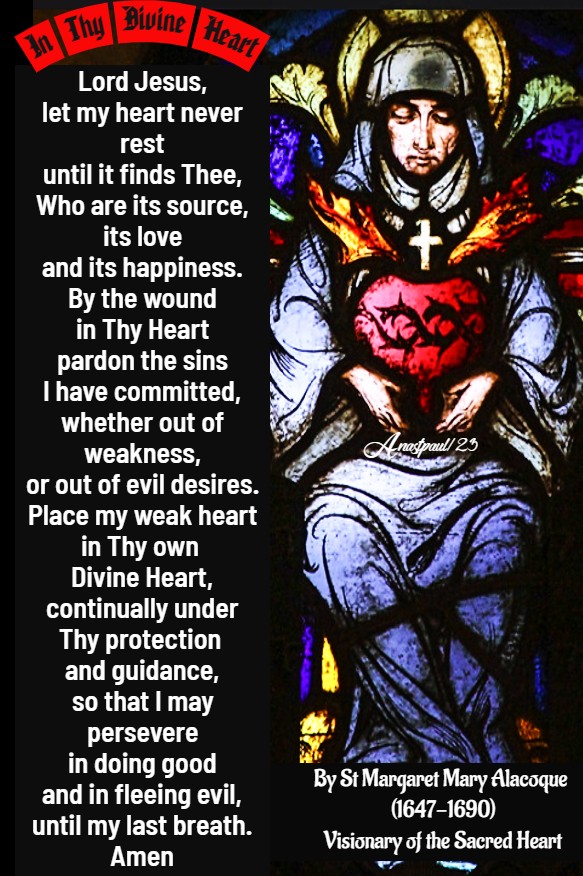
In Thy Divine Heart By St Margaret Mary Alacoque (1647-1690) Visionary of the Sacred Heart
Lord Jesus, let my heart never rest until it finds Thee, Who are its source, its love and its happiness. By the wound in Thy Heart pardon the sins I have committed, whether out of weakness, or out of evil desires. Place my weak heart in Thy own Divine Heart, continually under Thy protection and guidance, so that I may persevere in doing good and in fleeing evil, until my last breath. Amen
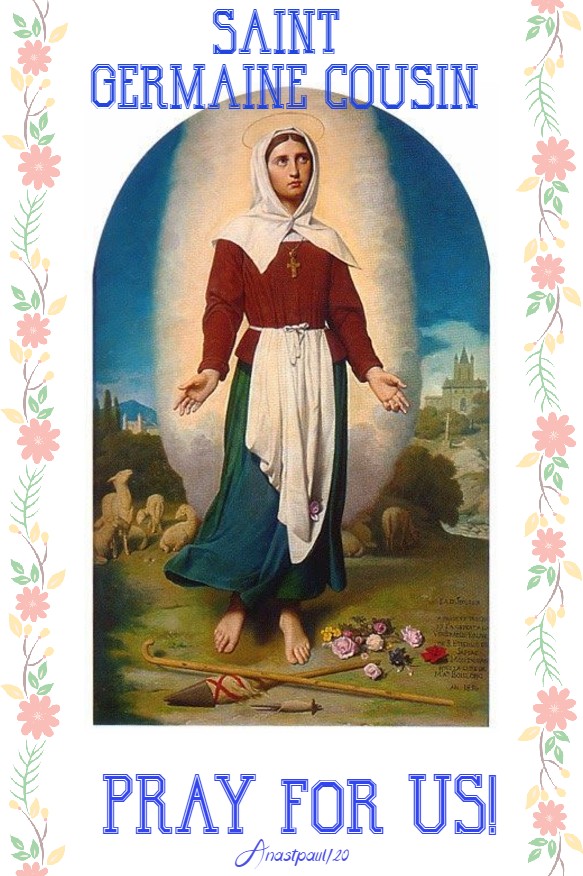
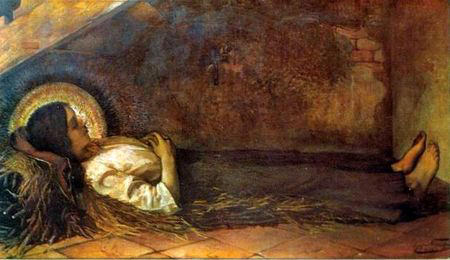
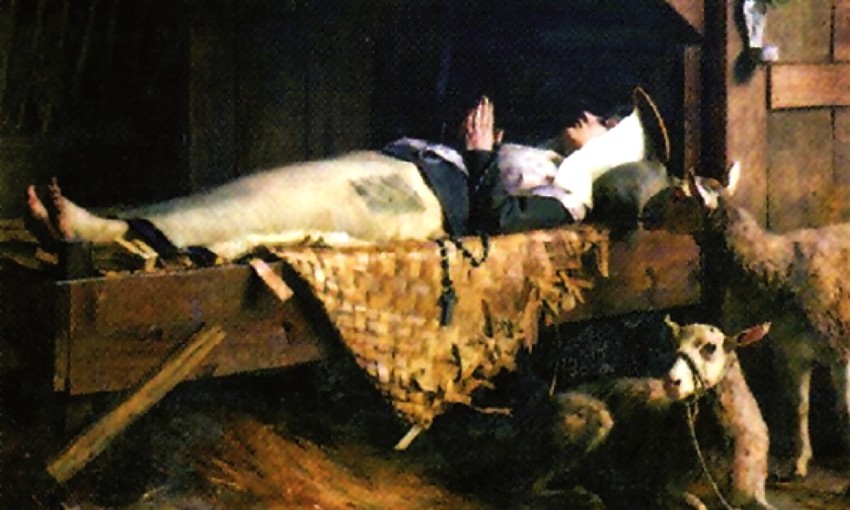
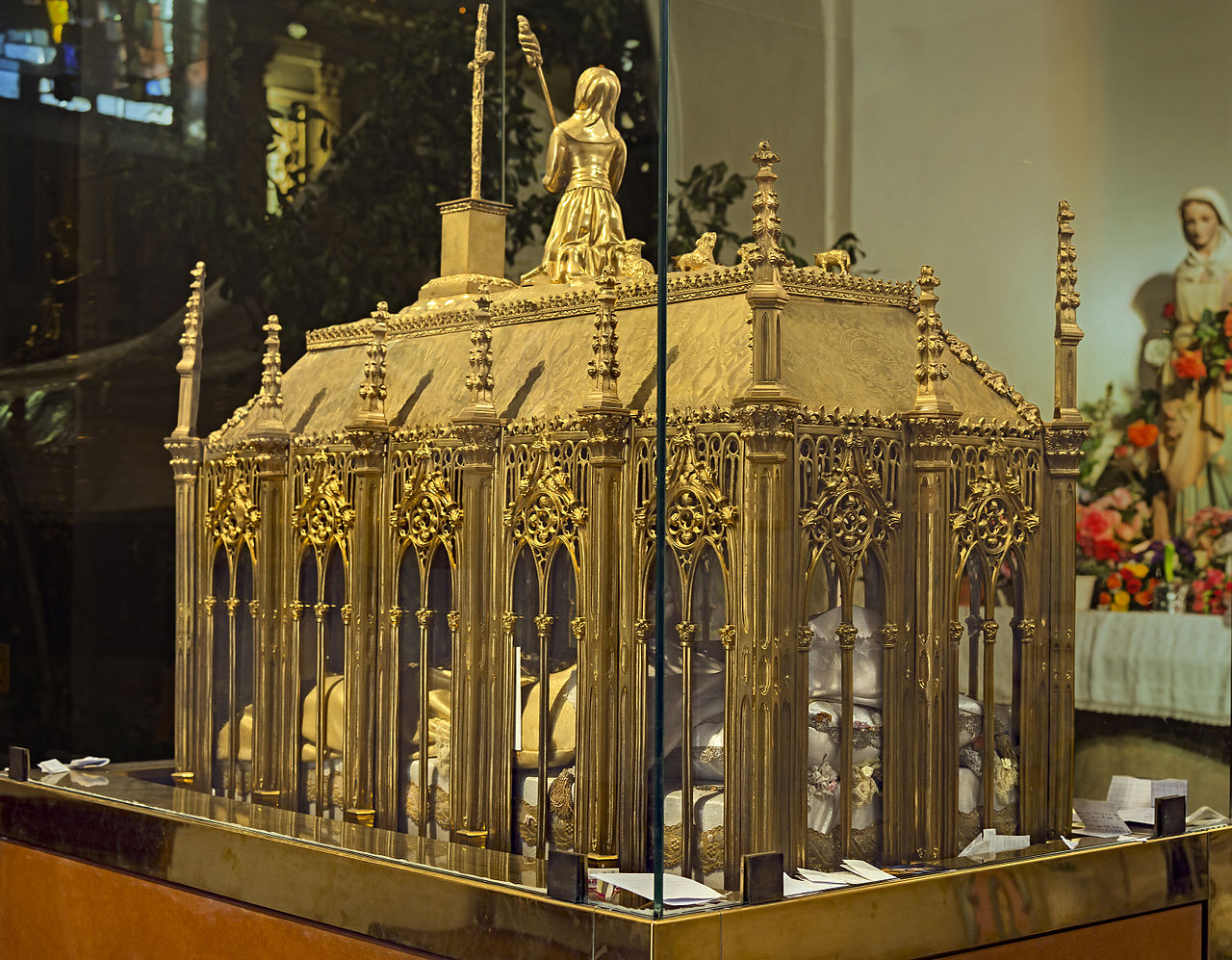
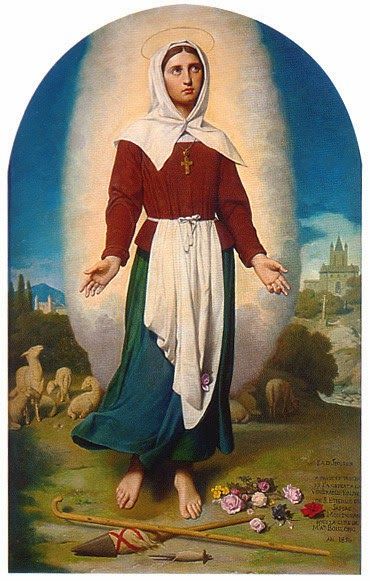
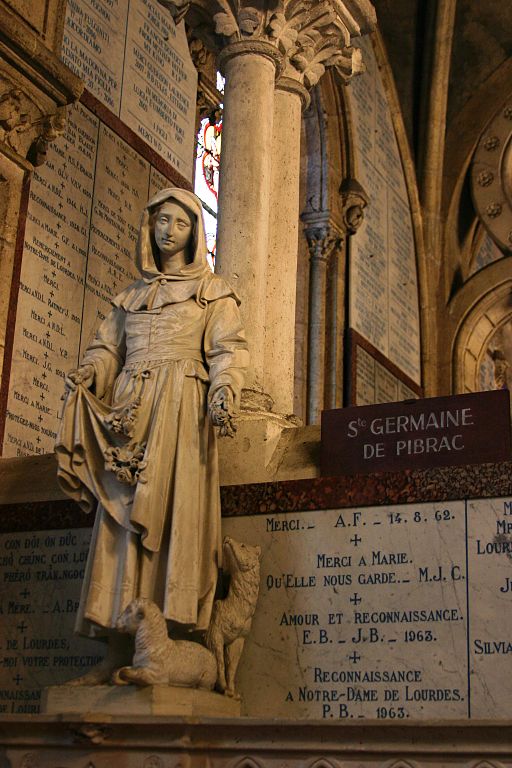
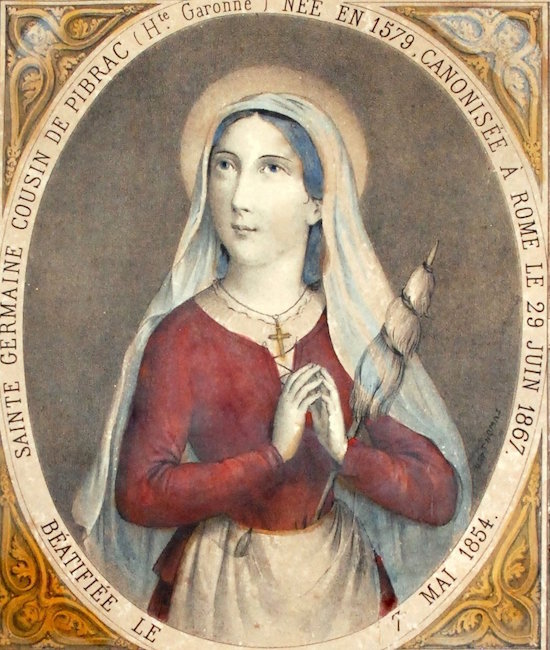
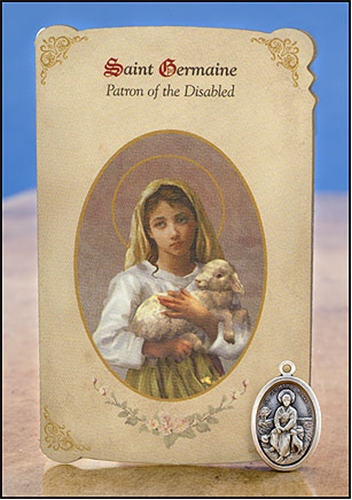
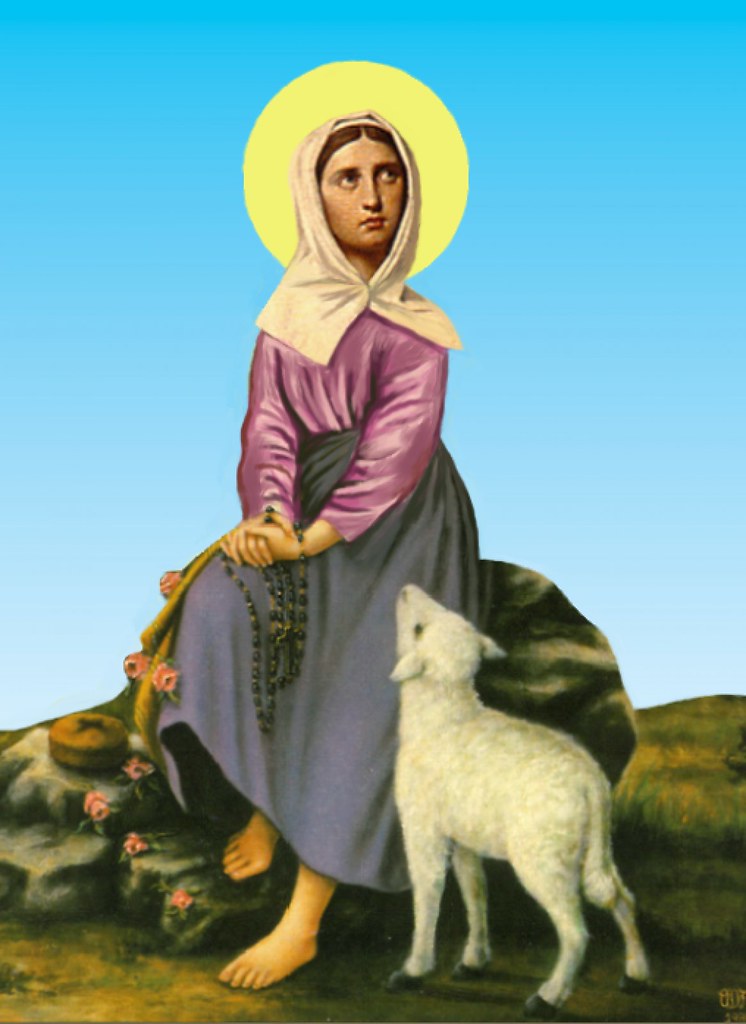
Saint of the Day – 15 June – Saint Germaine Cousin (1579–1601) Laywoman, Penitent, Apostle of Charity, miracle-worker – born in 1579 at Pibrac, France and died in 1601 in her parents’ home in Pibrac, France, apparently of natural causes, aged 22. Also known as Germana Cousin, Germaine of Pibrac. Patronages – abandoned people, abuse victims, child abuse victims, against poverty, disabled and handicapped, people, girls from rural areas, illness, impoverishment, loss of parents, shepherdesses, people disfigured by disease, physical therapists. Her body is incorrupt.
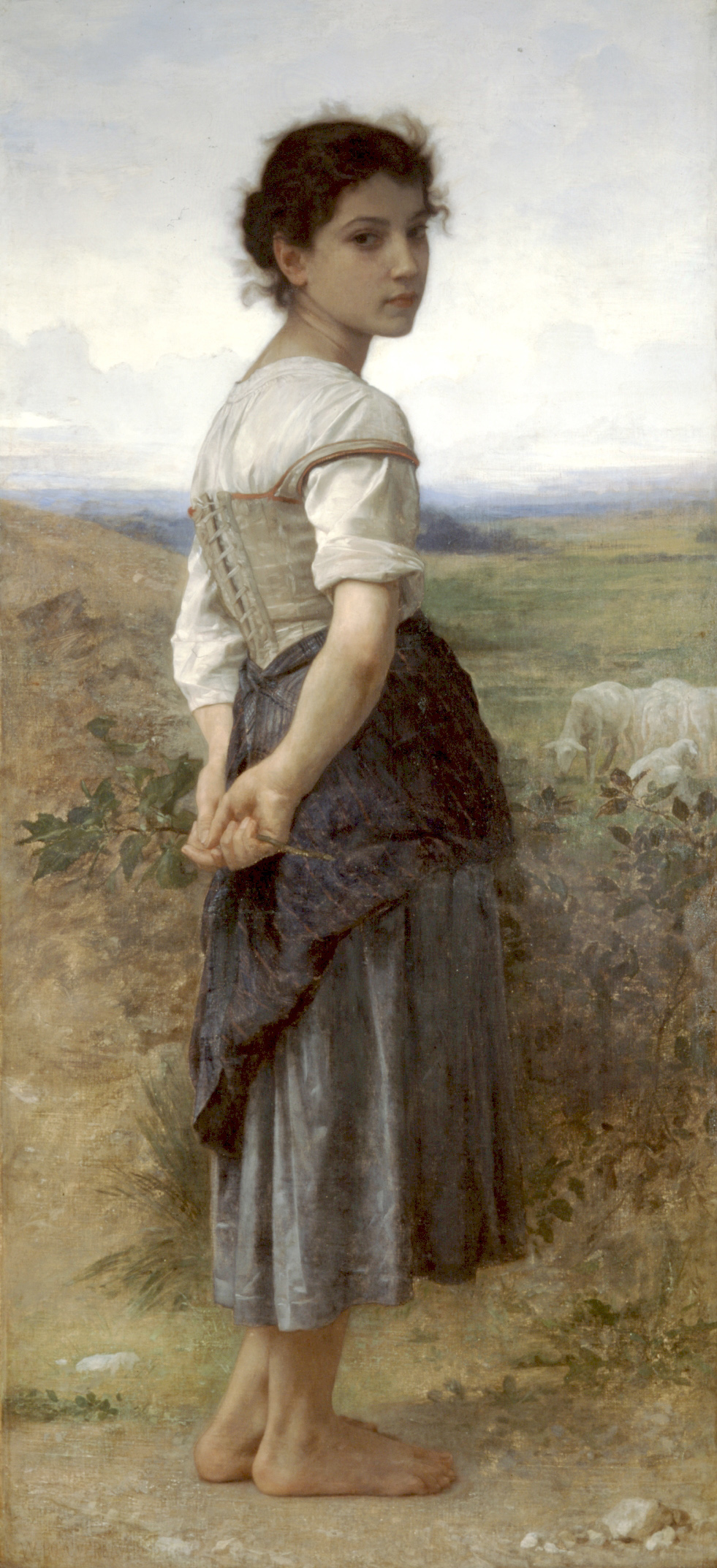
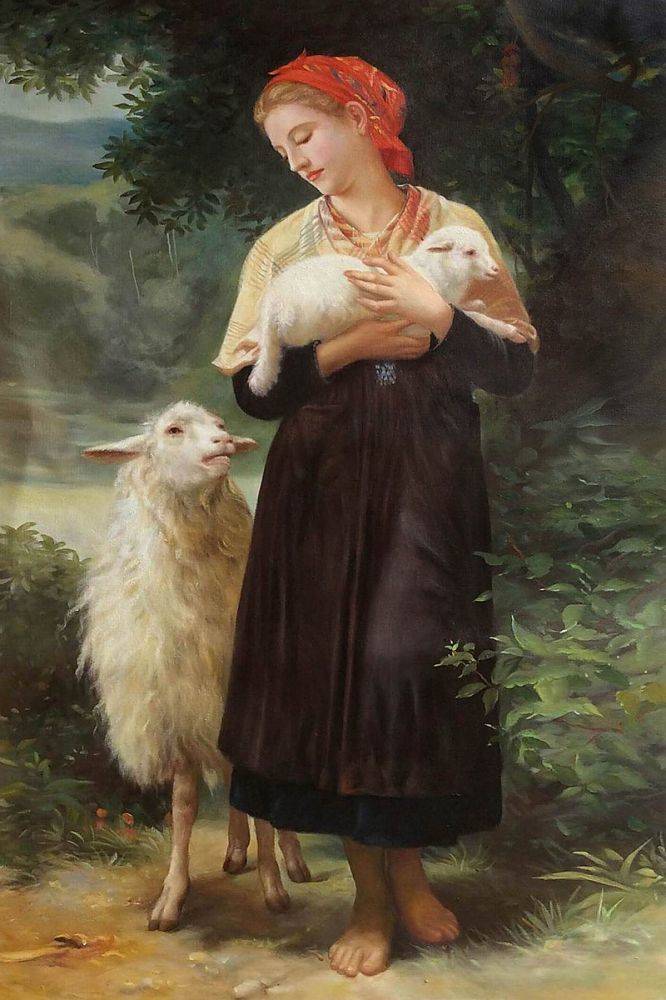
These two “Shepherdesses” by William-Adolphe Bougereau are believed to be depictions of St Germaine
Germaine Cousin was a 16th-century shepherdess who lived from 1579 to 1601. Born with a lame right hand and the disease scrofula (a non-tuberculous infection of the lymph nodes of the neck), she projected quite an unsightly appearance. The only child of Laurent Cousin and Marie Laroche, Germaine lived about 1.5 miles west of Pibrac, France. When she was just five years old, the plague suddenly took her dear mother and her father soon after remarried. Germaine was physically and mentally abused by her new stepmother, Armande de Rajols.
Armande’s hatred of little Germaine was so intense that she forced her to live for 17 years in the family barn and to watch the sheep near the wolf-infested La Bouconne forest, hoping the wolves would kill her. Isolated, cold and lonely, Germaine embraced a life of prayer, penance, and almsgiving, she assisted the poor and hungry, even though she herself was malnourished. She offered up her suffering to God.
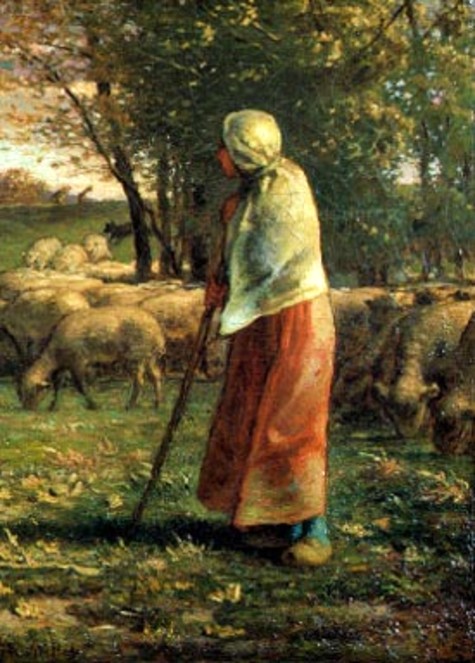
By Jean F Millet artist of “The Angelus”
She is practised many austerities as reparation for the sacrileges perpetrated by heretics in the neighbouring churches. She frequented the Sacraments of Penance and the Holy Eucharist and it was observed that her piety increased on the approach of every feast of Our Lady. The Rosary was her only book and her devotion to the Angelus was so great that she used to fall on her knees at the first sound of the bell, even though she heard it when crossing a stream. The villagers are said to have inclined at first to treat her piety with mild derision, until certain signs of God’s signal favour made her an object of reverence and awe.
It was while these abuses were taking place that miraculous wonders began to surround Germaine. People from the village witnessed her, on several occasions, parting the turbulent spring waters of the Courbet, which she had to cross to get to Mass in the morning.
On another occasion, Germaine had filled her apron with surplus bread from her meagre daily rations so that she may feed the poor. Her stepmother pursued her into town, hoping to expose her to the townspeople as a miscreant and a thief, who was stealing from her household pantry. After catching up with her in the public square, she forced her to reveal the contents of her apron. When Germaine opened her apron, it wasn’t bread that came flowing out but summer flowers. It was the middle of winter. Everyone was amazed and began to see Germaine in a different light. The stepmother, however, was unmoved and continued to persecute the young girl until her death. This wasn’t for much longer, as Germaine soon died alone in the barn where she had been forced to live for 17 years.
Her father at last came to a sense of his duty, forbade her stepmother henceforth to treat her harshly and wished to give her a place in the home with his other children but Germaine begged to be allowed to remain in the humbler position. At this point, when men were beginning to realise the beauty of her life, she died. One morning in the early summer of 1601, her father found that she had not risen at the usual hour and went to call her, finding her dead on her pallet of vine-twigs. She was 22 years old at the time.
Mysterious lights enveloped the barn the night she died. Two monks who were travelling from Gascony noticed the light from far off. Approaching cautiously, they witnessed angels descending upon the barn in large numbers and taking a soul robed in a virgin’s gown, up to heaven. It was only at Germaine’s deathbed that the stepmother finally began to weep bitterly for her mistreatment of the girl she eventually repented.
But, the story of Germaine’s life was soon forgotten.
In 1644, some 43 years following her death, the body of a noblewoman was being interred in front of the sanctuary of the church, when a workman accidentally exhumed Germaine’s incorrupt body from under the flagstone floor. Her body looked and smelled as fresh as the day she had passed away. News spread like wildfire throughout the town. Her body was exposed in the Church in the hopes of eliciting religious fervour.
Madame de Beauregard, a prominent lady, put a stop to this. She complained to the Parish Priest about the disgusting exhibit of a corpse near her pew. She threatened to withhold alms if Germaine’s corpse continued to be exposed. The Priest complied with her request and removed the casket. Not long after, Madame de Beauregard was stricken with a fatal disease. Distressed by his wife’s condition and her irreverence toward a possible saint, her husband pleaded for her life before the Tabernacle, requesting that Germaine intercede. Moments later, Germaine appeared in spirit to Madame de Beauregard and healed her instantly of her ailment.
Despite these apparent signs of sanctity and several attempts at initiating the cause of her Canonisation, Germaine wasn’t Beatified until May 7, 1854 – 210 years after her incorrupt body had been found. Her Canonisation finally took place on 29 June 1867 By Pope Pius IX.
Saint Germaine was forgotten, neglected and unloved for most of her life. Even after her death, it seemed that the Lord purposely kept her well hidden. Most Catholics have never heard of her and that includes Religious and Priests. In our complex and fast-paced world, Germaine’s simplicity, charity and piety don’t seem to fit in anywhere.
The reason is, that we have now brought up entire generations of entitled young people, who see themselves as central to the universe’s purpose. They are the first to complain if things don’t go their way. In recent news, is it not surprising to learn about a woman stabbing her fiancé over their wedding colour scheme? We are witnessing the consequences of a narcissistic culture that seeks pleasure without any kind of moral compass to guide the conscience.
How could Germaine’s life story fit into such a culture? It would seem, that we are not quite ready yet.
We and our children were brought up on the idea that our “self-esteem” needed to be enhanced. In this way, we’ve made an entire generation incapable of seeing it’s own darkness, empowered with the perception of its own strength and unique gifts. At the same time, this generation’s children, disconnected from any moral compass, think they can do no harm. Meanwhile, a mother in her thirties was sucker-punched while walking with her daughter. No apparent reason was reported, but the public was outraged that such random acts of violence could take place. It was part of the “knockout game,” a depraved form of entertainment for young people.
It is imperative that we begin, once again, to talk to our children about living virtuous lives of self-effacement and not self-empowerment – lives of temperance and not overindulgence. It is pressing, that we share with our children, the idea of living a simpler life that is rooted in love, penance, almsgiving and prayer.
Our children need to hear that the Lord Jesus is drawn to those who are small, hidden and pure, not just to those who are smart, rich, attractive and self-empowered.
In the book Germaine: Requiem of a Soul, Andrew St-James recounts the full history of Saint Germaine. She was a pure soul who abandoned herself completely to divine providence, who learned to surrender her will completely to God.
This inspirational story shatters all the conventional theories modern man may have about God and about the modern concepts of self-empowerment . For when Jesus approaches, He does not strengthen and empower the individual, as most Protestant evangelists claim. Instead, as Jean-Pierre de Caussade writes, “when the Lord approaches, he weakens.”
God is not distant from the suffering of man. The story of Germaine Cousin attests to that truth. The events that surround the life of Saint Germaine have been clearly documented and can be regarded as a reliable historical record of her most remarkable life. It’s a story that has been lost but it is time now for it be told to our children and loved ones. Amen
St Constantine of Beauvais
St Domitian of Lobbes
St Edburgh of Winchester
St Eigil
St Eutropia of Palmyra
St Fortunatus of Corinth St Germaine Cousin (1579–1601) Incorrupt
St Hadelinus of Lobbes
St Hesychius of Durostorum
St Hilarion of Espalion
Bl Juan Rodriguez
St Julius of Durostorum
St Landelin of Crespin
St Leonides of Palmyra
St Libya of Palmyra
St Lotharius of Séez
St Melan of Viviers
St Orsisius
Bl Pedro da Teruel
Bl Peter Snow
St Pierre de Cervis
Bl Ralph Grimston
St Tatian of Cilicia
Bl Thomas Scryven
St Trillo of Wales
St Vaughen of Ireland St Vitus (c 290-c 303) – Martyr, One of the Seven Holy Helpers His very short life: https://anastpaul.com/2017/06/15/saint-of-the-day-15-june-st-vitus/
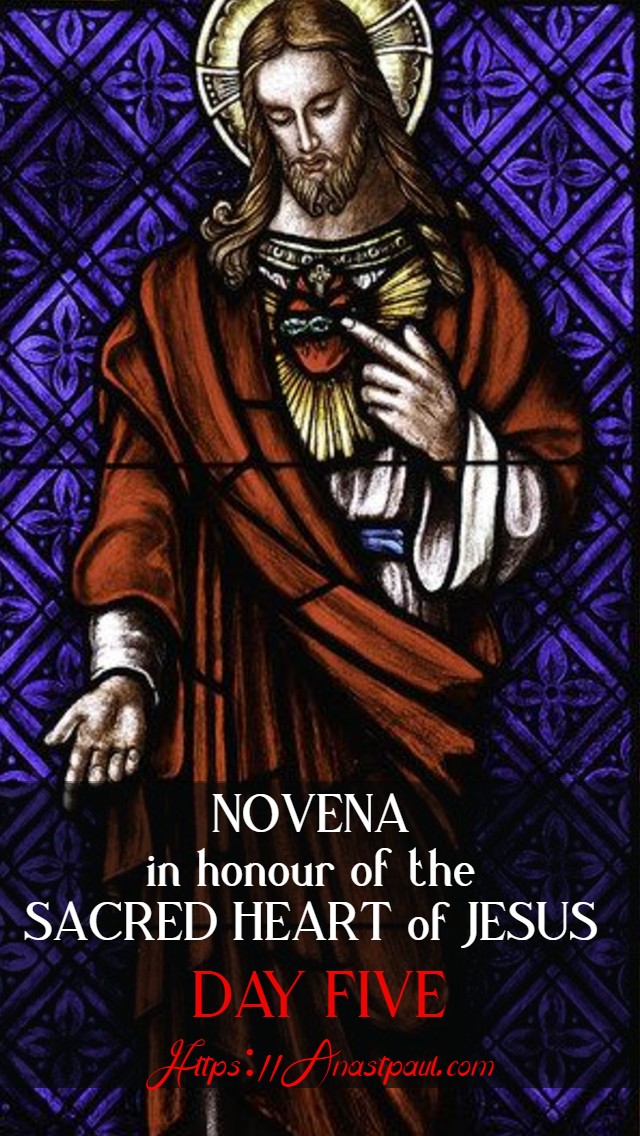
Novena in Honour of the Sacred Heart of Jesus Day Five – 14 June
Has no-one condemned you?
Today’s Scripture Jesus straightened up and said to her, ‘Woman, where are they? Has no-one condemned you?’ She said, ‘No-one, sir.’ And Jesus said, ‘Neither do I condemn you. Go your way and from now on do not sin again.’… John 8:10-11
Reflection for the Fifth Day
I read something recently which went like this: ‘You do not have to be good before God will love you, you do not have to repent before you will be absolved by God. It is all the other way around. If you are good, it is because God’s love has already made you so, if you want to be forgiven, that is because God is forgiving you because you want to be forgiven!’
Today’s Prayer
Jesus, as I reflect upon Your Sacred Heart,
help me to have a deep felt knowledge
that You long to forgive my sins.
Your Sacred Heart is love made visible.
I need to love Your love and repent and repair.
Daily Invocation Sacred Heart of Jesus, I place all my trust in you.
Novena Prayer
Lord Jesus,
the needs of Your people open Your heart in love for each of us.
You care for us when we are lost,
sympathise with us in loneliness
and comfort us in mourning;
You are closest to us where we are weakest.
You love us most, when we love ourselves least;
You forgive us mos, when we forgive ourselves least
and You call us to spread Your love in whatever way we can.
Lord Jesus, Your heart is moved with compassion
when we are suffering,
when we need your help
and when we pray for each other.
I ask You to listen to my prayer during this Novena
and grant what I ask.
…………………………. (Mention your intention silently.)
If what I ask, is not for my own good and the good of others,
grant me what is best,
that I may build up Your kingdom of love in our world.
Amen
Thought for the Day – 14 June – Meditations with Antonio Cardinal Bacci (1881-1971)
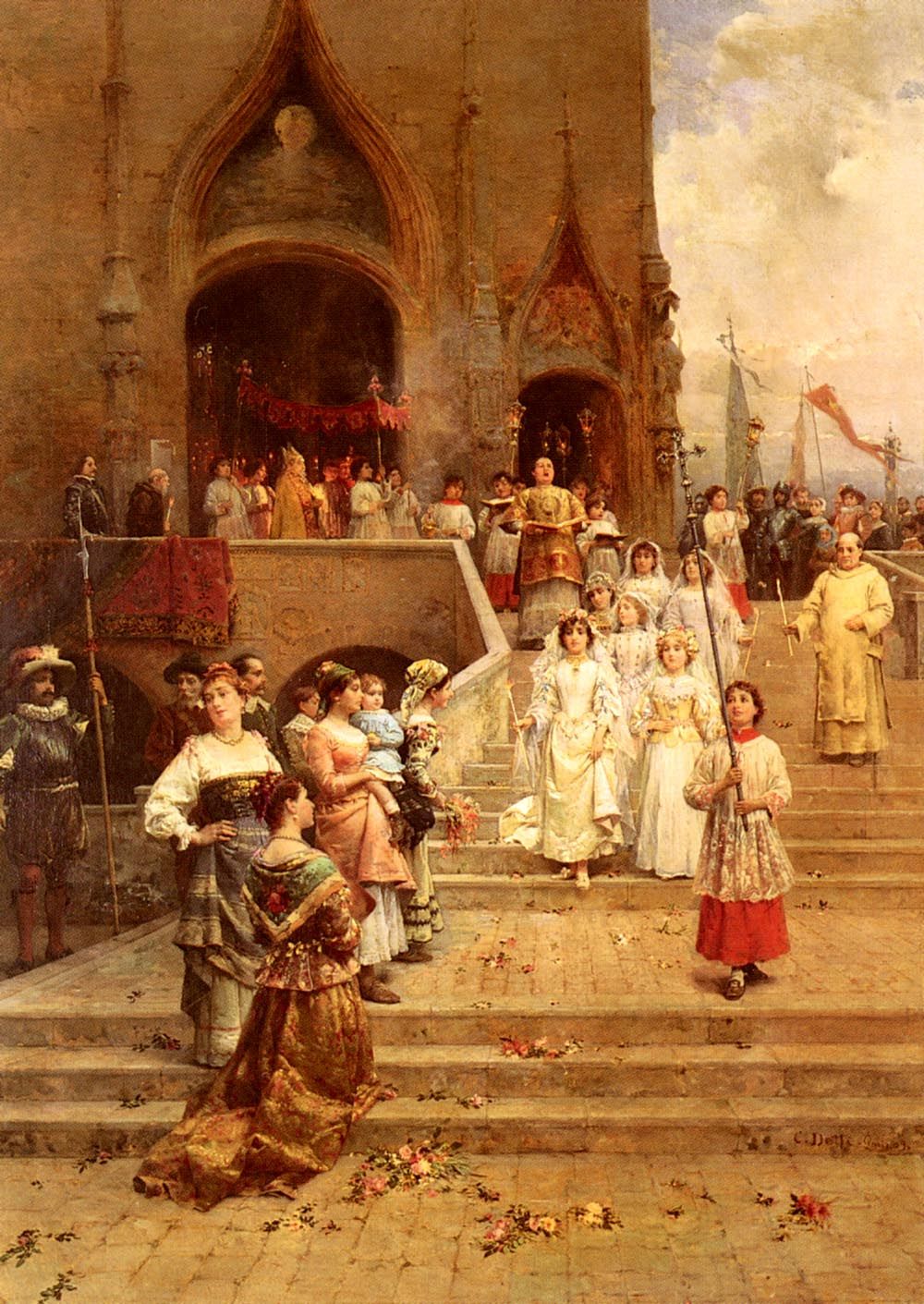
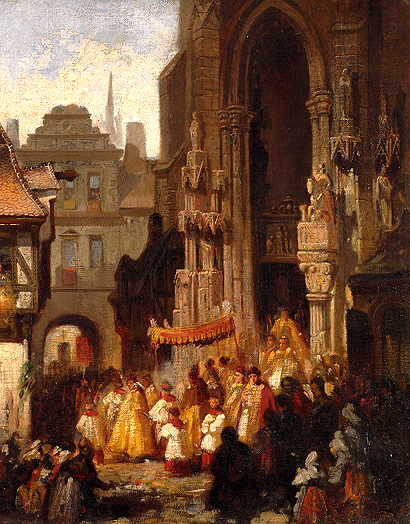
The Feast of Corpus Christi
“St Thomas Aquinas refers to the Blessed Eucharist as the greatest of all Jesus Christ’s miracles.
All the other miracles were accomplished in an instant or, at the most, protracted over a few years, like the raising to live of Lazarus, or the widow’s son at Naim.
The Eucharist, on the contrary, is a miracle which continues throughout the centuries and all over the world!
The other miracles, moreover, gave us a part of the power and goodness of Jesus.
But, the Eucharist gives us Jesus Himself with all His graces and gifts.
It was not enough for Our Lord to offer Himself on Calvary as a propitiary host for our sins.
It was not enough for Him to shed His precious Blood for our redemption.
It was not enough to give us the Church to instruct us and to guide us on the way to Heaven.
He wished to give us Himself in addition.
He wished to remain with us as our companion on our mortal pilgrimage and as the spiritual nourishment of our souls.
The power of Jesus is as infinite as His charity.
Nevertheless, in the Eucharist, this power and charity are, as it were, exhausted.
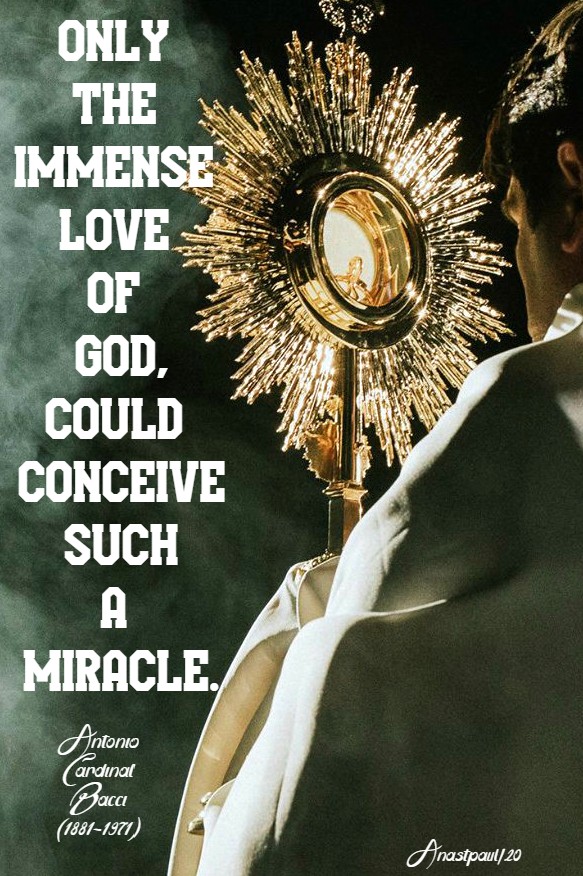
Only the immense love of God, could conceive such a miracle.
When we consider this mysterious gift which Jesus has given to each of us, we cannot say that it is too difficult for us to conquer the perverse inclinations of our corrupted nature and that we lack the strength to continue on the way of perfection.
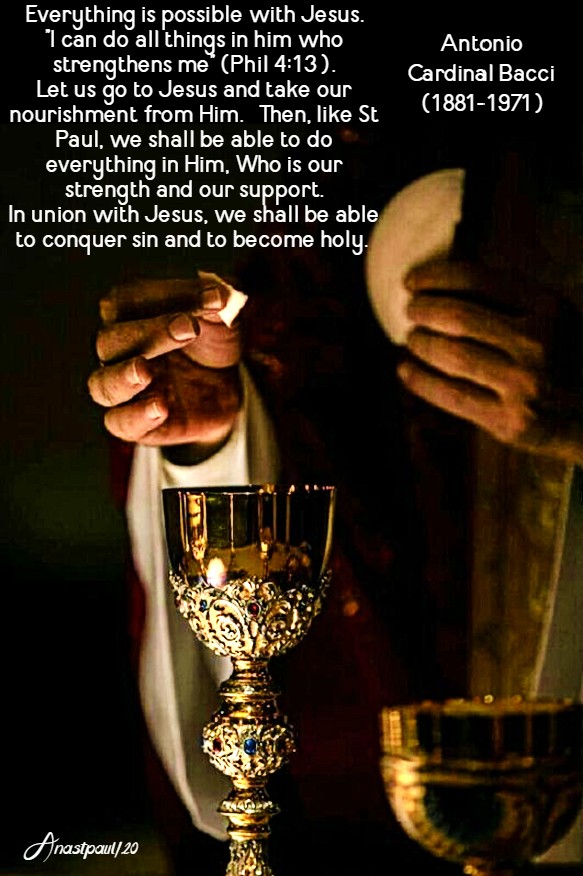
Everything is possible with Jesus.
“I can do all things in him who strengthens me” (Phil 4:13).
Let us go to Jesus and take our nourishment from Him.
Then, like St Paul, we shall be able to do everything in Him, Who is our strength and our support.
In union with Jesus, we shall be able to conquer sin and to become holy. amen.”
Quote/s of the Day – 14 June – “Month of the Sacred Heart” – Corpus Christi, The Solemnity of The Most Holy Body and Blood of Christ, Readings: Deuteronomy 8:2-3, 14-16, Psalm 147:12-15, 19-20, 1 Corinthians 10:16-17, John 6:51-58
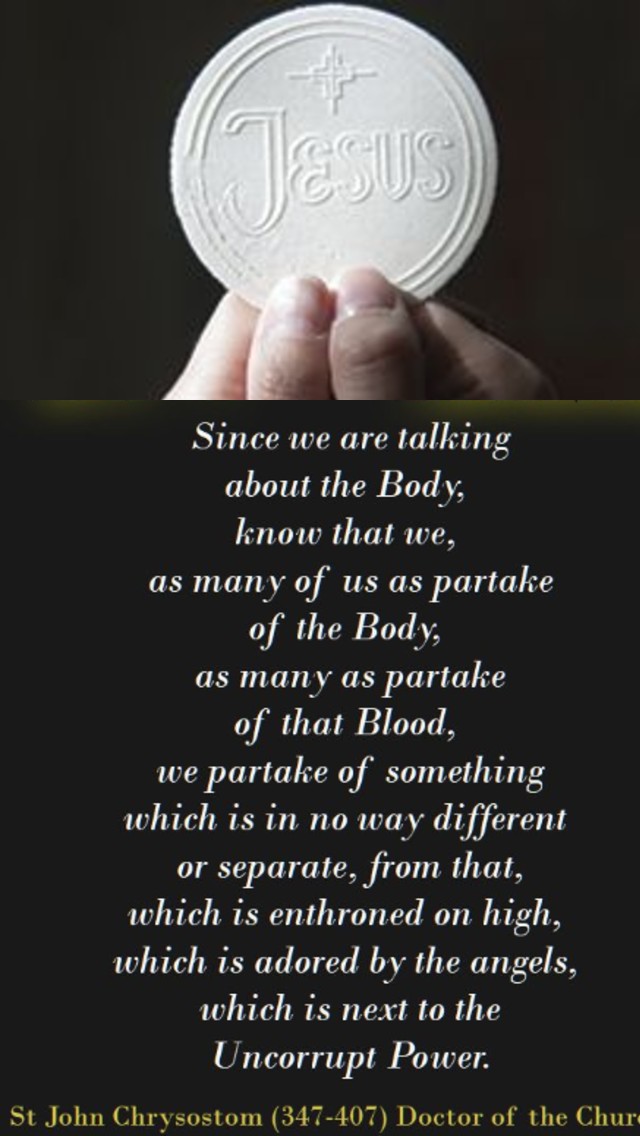
“Since we are talking about the Body, know that we, as many of us as partake of the Body, as many as partake of that Blood, we partake of something which is in no way different or separate from that which is enthroned on high, which is adored by the angels, which is next to Uncorrupt Power.”
St John Chrysostom (347-407)
Father & Doctor of the Church
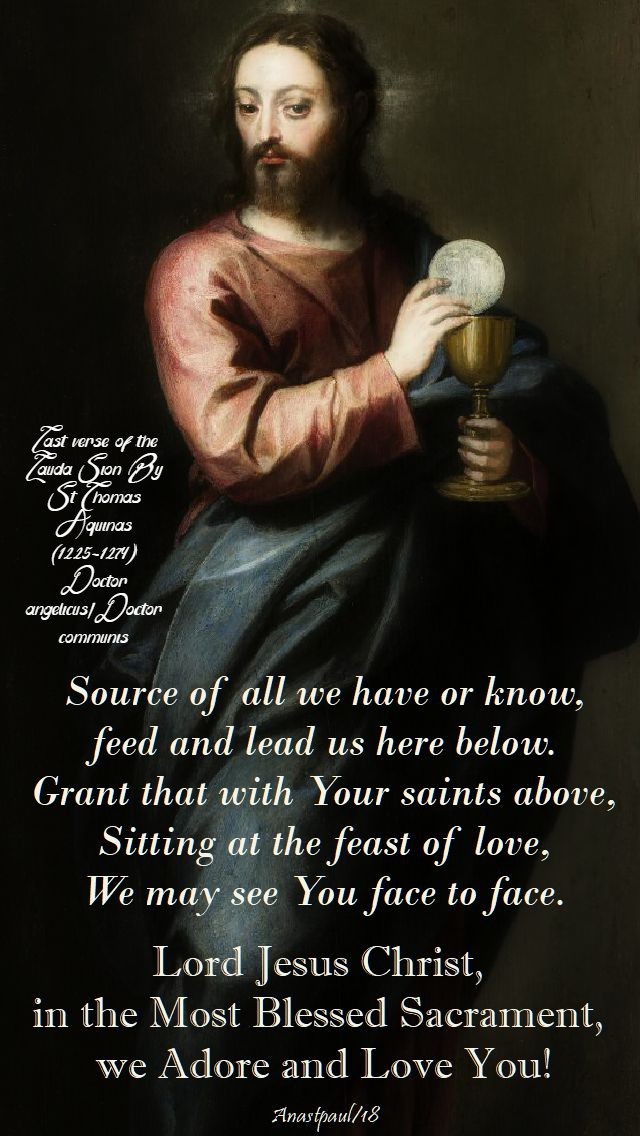
“Source of all we have or know, feed and lead us here below. Grant that with Your saints above, Sitting at the feast of love, We may see You face to face.
Amen Alleluia!
St Thomas Aquinas (1225-1274)
Doctor angelicus/Doctor communis
(Last verse of the Lauda Sion)
Lord Jesus Christ, in the Most Blessed Sacrament,
we Adore and Love You!
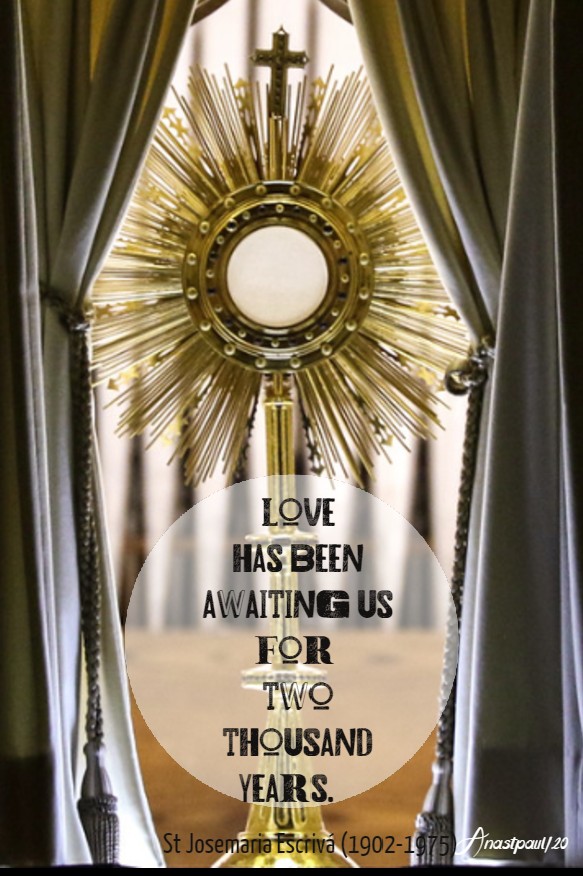
“Perfect God and perfect man, Lord of heaven and earth, He offers Himself to us as nourishment in the most natural and ordinary way. Love has been awaiting us for two thousand years. That’s a long time and yet it’s not, for when you are in love time flies.”
St Josemaria Escrivá (1902-1975)
“Christ is PassingBy”
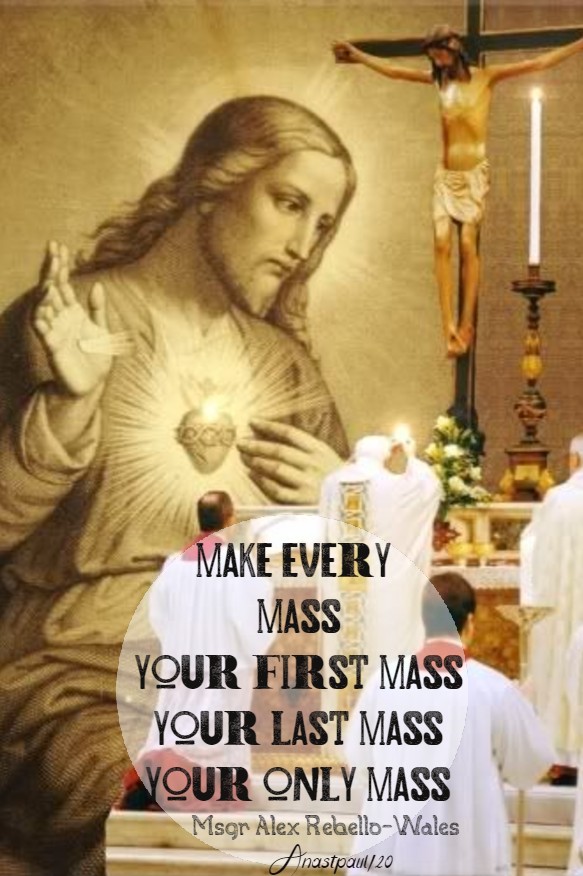
“Make every Mass your FIRST Mass, your LAST Mass your ONLY Mass.”
Sunday Reflection – 14 June – “Month of the Sacred Heart” – Corpus Christi, The Solemnity of The Most Holy Body and Blood of Christ, Readings: Deuteronomy 8:2-3, 14-16, Psalm 147:12-15, 19-20, 1 Corinthians 10:16-17, John 6:51-58
Moments with St John XXIII (1881-1963)
Sacrament of Love
When the Christians of the first centuries met around the Table of the Eucharist, they prayed with hearts full of love and longing:
“To You, O Lord, be glory forever! As this Bread we have broken together, was once scattered in ears of corn on the hills and became one, when it was harvested, so let Your Church be gathered from the ends of the earth into Your Kingdom. For Yours is the glory and the power, through Jesus Christ, forever.”
The doctrine of the Mystical Body, has cast gleams of shining light on this question of the union of Christians with Christ and, for their union with each other.
It has resulted in an amazing understanding of the union of the masses of the faithful, through the power of the Body and Blood of Christ, drawn together to scale the heights of Christian perfection.
In the light of this teaching, we find the truest conception of human, and Catholic brotherhood, inspired and renewed by the Holy Eucharist.
O Sacrament of love, may You always remain inviolate at the summit of Catholic doctrine and devotion!
Open our minds to soaring flights of thought and our hearts to the impulses of charity.
Lead us onto the fulfilment of the supreme ideals of justice and social peace.
Amen
ENGLISH TRANSLATIONS OF THE “PANGE LINGUA” but still using the tune in the Gregorian Chant, Mode III
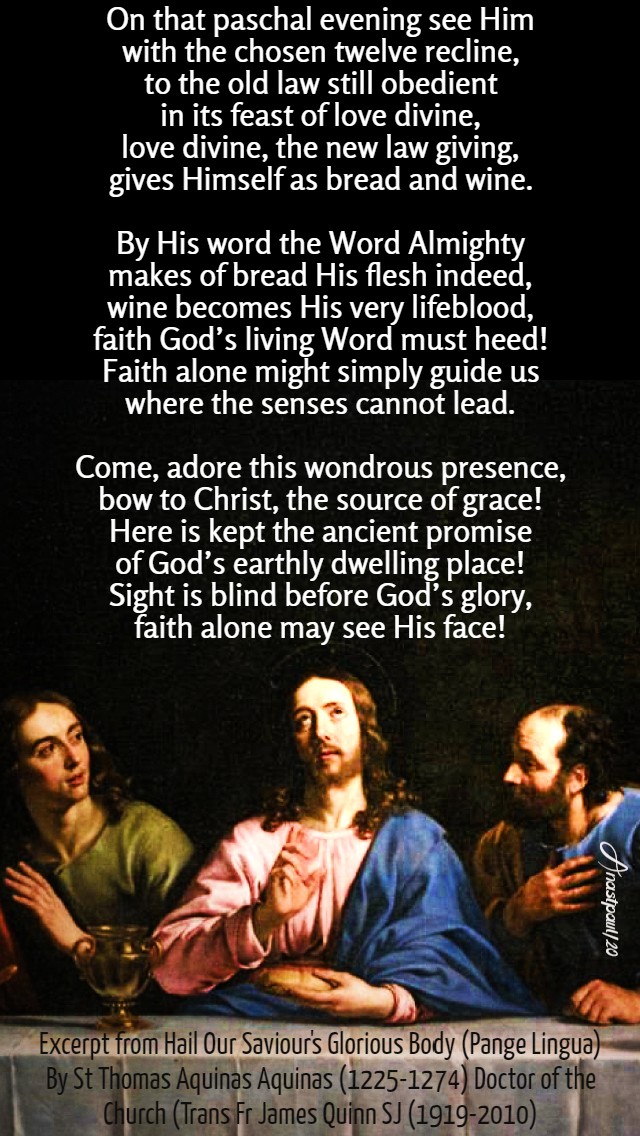
Hail Our Saviour’s Glorious Body By St Thomas Aquinas Aquinas (1225-1274)
Doctor angelicus/Doctor communis Translated by Fr James Quinn SJ (1919-2010)
Hail our Saviour’s glorious Body,
which His Virgin Mother bore.
Hail the blood which bled for sinners,
did a broken world restore.
Hail the sacrament most holy,
flesh and blood of Christ adore!
To the Virgin, for our healing,
His own Son, the Father sends.
From the Father’s love proceeding
sower, seed and word descends;
wondrous life of Word Incarnate
with His greatest wonder ends.
On that paschal evening see Him
with the chosen twelve recline,
to the old law still obedient
in its feast of love divine,
love divine, the new law giving,
gives Himself as bread and wine.
By His word the Word Almighty
makes of bread His flesh indeed,
wine becomes His very lifeblood,
faith God’s living Word must heed!
Faith alone might simply guide us
where the senses cannot lead.
When the Procession reaches the place of Benediction, the priest sets the Monstrance down. Then he puts incense in the thurible and, kneeling, incenses the Blessed Sacrament, while Tantum ergo Sacramentum is sung.
Come, adore this wondrous presence,
bow to Christ, the source of grace!
Here is kept the ancient promise
of God’s earthly dwelling place!
Sight is blind before God’s glory,
faith alone may see His face!
Glory be to God the Father,
praise to His co-equal Son,
Adoration to the Spirit,
bond of love, in God-head one!
Blest be God by all creation
joyously while ages run!
(Fr James Quinn SJ (21 April 1919 – 8 April 2010) was a Scottish Jesuit Priest, Theologian and Hymnist.
One Minute Reflection – 14 June – Corpus Christi, The Solemnity of The Most Holy Body and Blood of Christ, Readings: Deuteronomy 8:2-3, 14-16, Psalm 147:12-15, 19-20, 1 Corinthians 10:16-17, John 6:51-58
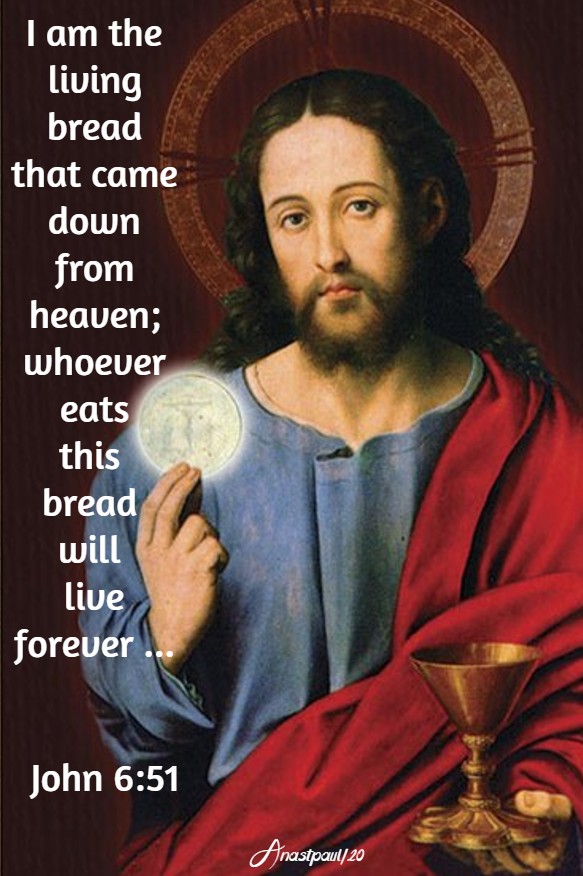
“I am the living bread that came down from heaven; whoever eats this bread will live forever and the bread that I will give, is my flesh for the life of the world.” ... John 6:51
REFLECTION – “God elaborates on a suitable and wholesome new diet for the newly-formed and newborn babe. He says it consists of the one who nourishes and who is the Father of all, that are generated and regenerated—just as manna, the celestial food of angels, flowed down from heaven on the ancient Hebrews.
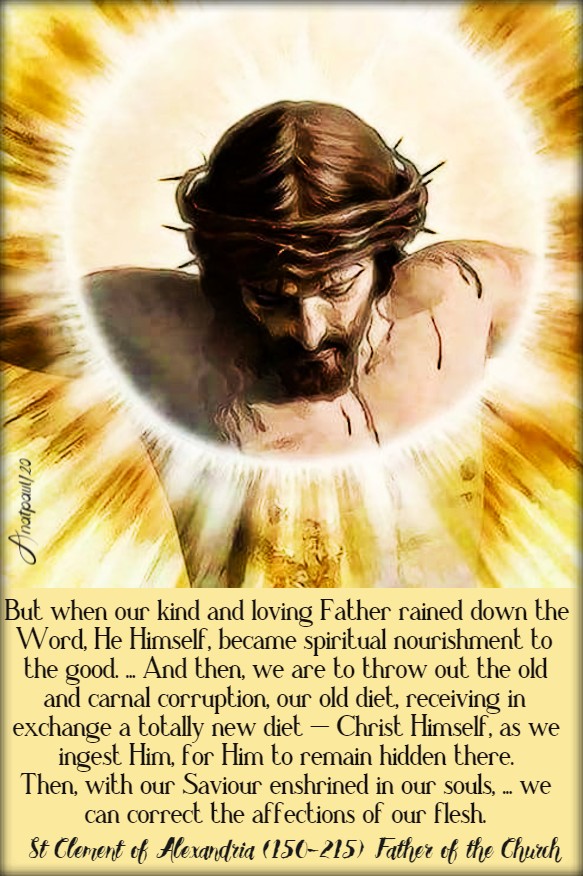
But when our kind and loving Father rained down the Word, He Himself, became spiritual nourishment to the good.
This is a truly amazing mystery because, this is the kind of diet the Lord administers, He offers His flesh and pours out His blood so that nothing is lacking for His children’s growth. This is almost too much to take in!
And then, we are to throw out the old and carnal corruption, our old diet, receiving in exchange a totally new diet — Christ Himself, as we ingest Him for Him to remain hidden there.
Then, with our Saviour enshrined in our souls, as it were, we can correct the affections of our flesh.” … St Clement of Alexandria (150-215) Father of the Church – Christ the Educator, 1
PRAYER – Lord Jesus Christ, You gave Your Church, an admirable Sacrament as the abiding memorial of Your Passion. Teach us to worship the sacred mystery of Your Body and Blood, that it’s redeeming power may sanctify us always. Who live and reign with the Father and the Holy Spirit, God, forever, amen.
Our Morning Offering – 14 June – “Month of the Sacred Heart” – Corpus Christi, The Solemnity of The Most Holy Body and Blood of Christ
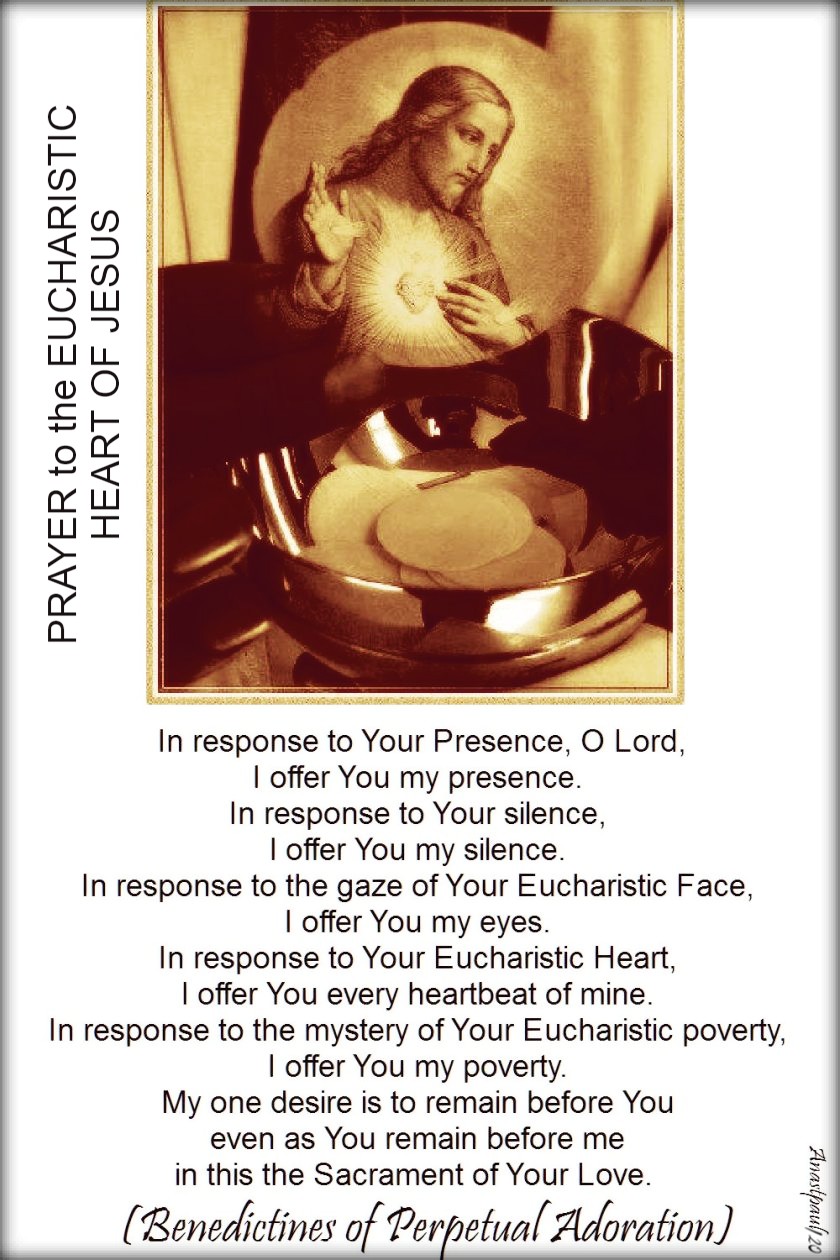
Prayer to the Eucharistic Heart of Jesus By The Benedictines of Perpetual Adoration
In response to Your Presence, O Lord,
I offer You my presence.
In response to Your silence,
I offer You my silence.
In response to the gaze of Your Eucharistic Face,
I offer You my eyes.
In response to Your Eucharistic Heart,
I offer You every heartbeat of mine.
In response to the mystery of Your Eucharistic poverty,
I offer You my poverty.
My one desire is to remain before You
even as You remain before me
in this the Sacrament of Your Love.
Amen
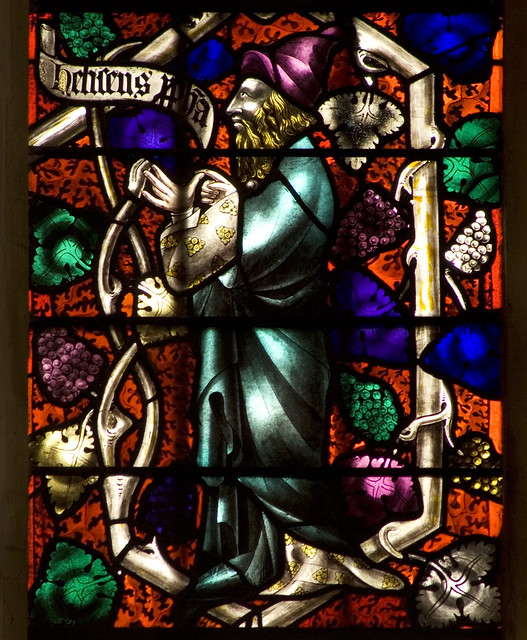
Saint of the Day – 14 June – Saint Elisha the Prophet “My God is salvation” (c 790 BC) was a a disciple and protégé of St Elijah and after Elijah was taken up in a chariot of fire, he gave Elisha a double portion of his power and he was accepted as the leader of the sons of the prophets. Elisha then went on to perform twice as many miracles as Elijah. Patronage – Prophets. St Elisha is commemorated in the calendar of saints of the Carmelite Order following a decree of the Carmelite General Chapter of 1399.
Elijah set out and came upon Elisha, son of Shaphat, as he was ploughing with twelve yoke of oxen, he was following the twelfth. Elijah went over to him and threw his cloak on him. ―1 Kings 19:19
Elisha was a prophet in the northern kingdom of Israel. His moment of calling was rather mystical – Elisha was ploughing a field with twelve yoke of oxen when his predecessor, Elijah, came along and placed his mantle over Elisha’s shoulders―a symbol of a call to share in prophetic work. Elisha requested time to say farewell to his parents and then slew the oxen, gave the meat to the people and joined Elijah.
Elisha, whose name in Hebrew means “My God is Salvation,” was the son of Shaphat.
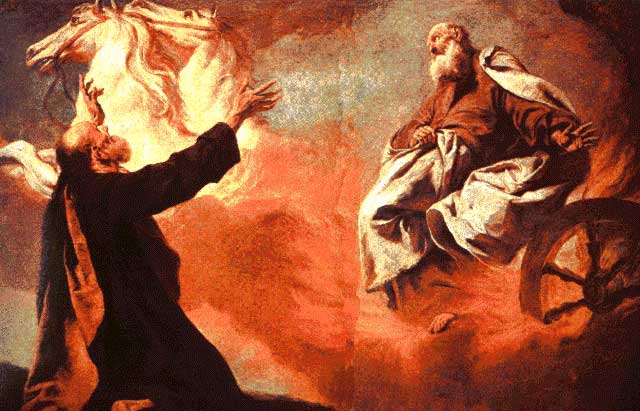
Before Elijah was taken up in a fiery chariot and into the whirlwind, Elisha asked to “inherit a double-portion” of Elijah’s spirit. He won the gratitude of the people of Jericho for healing it’s barren ground by adding salt to its waters.
When the armies of Judah, Israel and Edom, then allied against Mesa, the Moabite king, were being tortured by drought in the Idumæan desert, Elisha consented to intervene. His double prediction regarding relief from drought and victory over the Moabites was fulfilled on the following morning (2 Kgs 3:4-24).
“Elisha’s Spring” (Ain es-Sultan) in Jericho
To relieve the widow importuned by a hard creditor, Elisha so multiplied a little oil as to enable her, not only to pay her indebtedness but to provide for her family needs (2 Kgs 4:1-7).
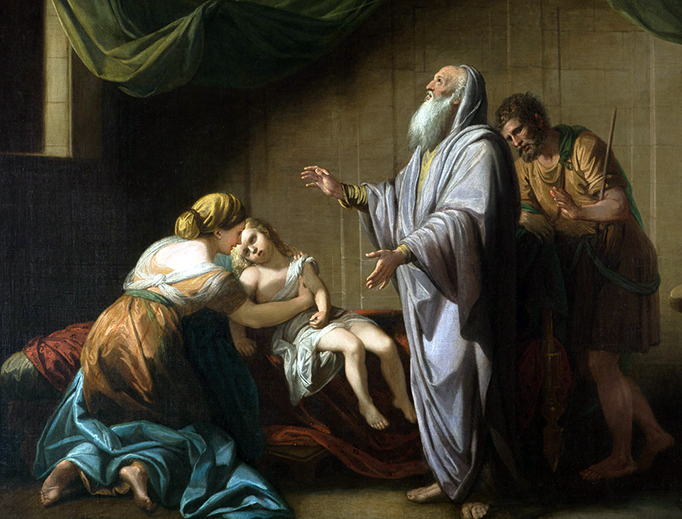
To reward the rich lady of Shunam for her hospitality, he restored to life her son (2 Kgs 4:18-37).
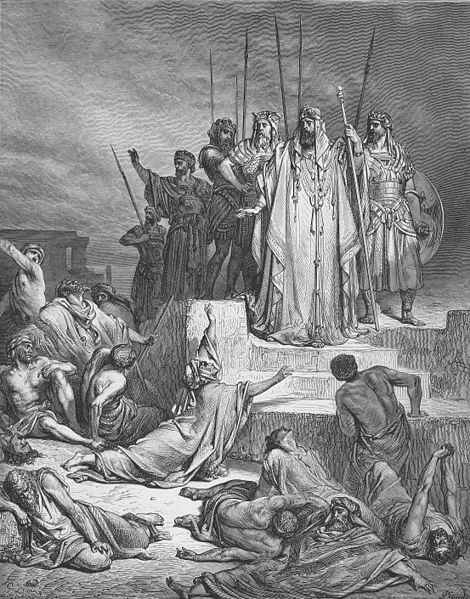
To nourish the sons of the prophets pressed by famine, Elisha changed, into wholesome food, the pottage made from poisonous gourds (2 Kgs 4:38-41).
A Famine in Samaria (illustration by Gustave Doré from the 1866 La Sainte Bible)
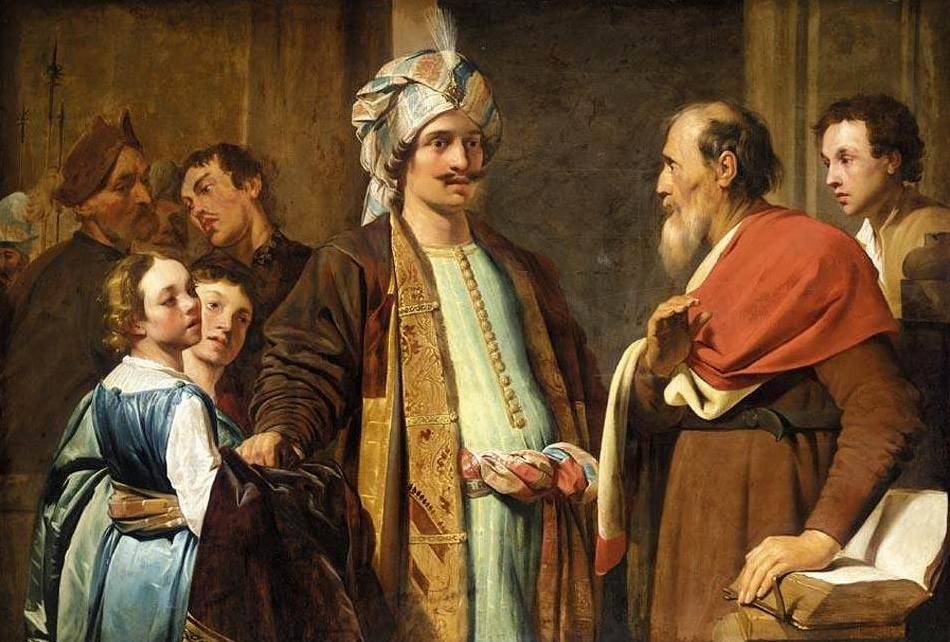
During the military incursions of Syria into Israel, Elisha cured Naaman the Syrian of his leprosy by simply sending him word that he was to bathe in the Jordan seven times. At first reluctant, Naaman obeyed the Prophet and after washed seven times in the Jordan, he was healed. Jesus referred to this when he said: “And there were many lepers in Israel in the time of Elisha the prophet and none of them was cleansed but Naaman the Syrian” (Luke 4:27).
Elisha refusing the gifts offered by Naaman
Elisha’s life and activities are found in 1 and 2 Kings and he is commemorated on this date in the 2004 Roman Martyrology.
Julian the Apostate (361–363) gave orders to burn the relics of the prophets Elisha, Obadiah and John the Baptist, who were buried next to each other in Sebastia but they were rescued by the Christians and part of them were transferred to Alexandria. Today, the relics of Elisha are claimed to be among the possessions of the Coptic Orthodox Monastery of Saint Macarius the Great in Scetes, Egypt.
The miracle at the grave of Elisha. (Jan Nagel, 1596)
As Elisha’s desire was to “Make known the Divine Will of God” to the people of their times, we can benefit from that today. So many times in our lives we ask the simple question, “What is God’s Will for me?” By asking for the intercession of St Elisha, we can obtain the Grace to know more of the Divine Will God has for us, in our lives. Only by living in union with God, can we know in our hearts, we are doing what HE created us for. By asking St Elisha to help us to discern that, God’s Will can be made more clear to us.
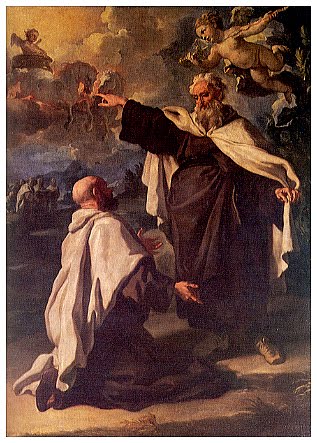
Elijah send Elisha forth
Prayer
O God,
protector and redeemer of the human family,
whose wonders have been proclaimed through the wonders accomplished by Your chosen prophets,
You have bestowed the spirit of Elijah on Your prophet Elisha.
In Your kindness grant us too
an increase in the gifts of the Holy Spirit
so that, living as prophets,
we will bear constant witness to Your abiding presence and providence.
We ask this through Christ our Lord, in the unity of the Holy Spirit, God for all eternity.
Amen
(The Title of the video is extremely appropriate as many of us are still living without “Sunday” in it’s holy and proper form!)
Our Lady of the Trellis:
On 14 June 1234, 53 disabled people were cured upon praying before the statue of Our Lady of the Trellis, installed behind a latticework fence in St Peter’s Collegiate Church in Lille, France.
A procession held annually on the second Sunday after Pentecost commemorates the miracles. Saved during the destruction of St Peter’s Church in the French Revolution, the statue moved afterwards to St Catherine’s Church.
Devotion to Our Lady of the Trellis revived in the mid-1800s and a grand neo-Gothic church arose in her honour, where the statue was installed in 1872 and canonically crowned in 1874.
After the theft of the original in 1959, sculptor Marie Madeleine Weerts carved the image now displayed in Lille’s Catholic Cathedral, the Basilica of Notre-Dame de la Treille.
St Anastasius of Córdoba
St Burchard of Meissen
St Caomhán of Inisheer
St Castora Gabrielli
St Cearan the Devout
Bl Constance de Castro
St Cyprien
St Cyriacus of Zeganea
St Davnet
St Digna of Córdoba
St Dogmael of Wales
St Elgar of Bardsey St Elisha the Prophet “My God is salvation” (790 BC)
St Etherius of Vienne
St Felix of Córdoba
Bl Fortunatus of Napoli
Bl Francisca de Paula de Jesus Isabel
St Gerold of Evreux
Bl Hartwig of Salzburg
St Joseph the Hymnographer
St Marcian of Syracuse
St Mark of Lucera St Methodius of Constantinople (born 8th Century – 847) His Life: https://anastpaul.com/2018/06/14/saint-of-the-day-14-june-st-methodius-i-of-constantinople-8th-cent-847-defender-of-icons/
St Nennus of Arran
Bl Peter de Bustamante
St Protus of Aquileia
St Quintian
St Richard of Saint Vannes
St Rufinus of Soissons
St Thecla
St Theopista
St Valerius of Soissons
Bl Walter Eustace
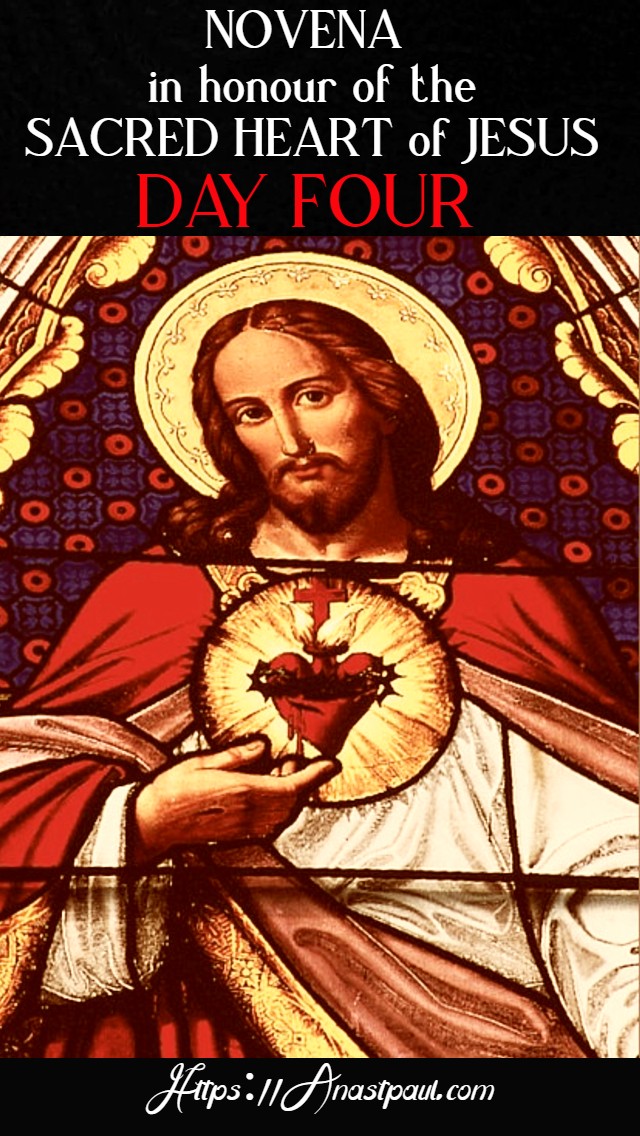
Novena in Honour of the Sacred Heart of Jesus Day Four – 13 June
How Do We Look at Each Other?
Today’s Scripture Jesus, looking at him, loved him and said, ‘You lack one thing; go, sell what you own and give the money to the poor and you will have treasure in heaven; then come, follow me.’ When he heard this, he was shocked and went away grieving, for he had many possessions. … Mark 10: 21-22
Reflection for the Fourth Day
A Dominican theologian once wrote, ‘A person is enlightened not when they get an idea but when someone looks at them.’ How we look at another has tremendous consequences for self-esteem. The Sacred Heart looks at each one of us with deep love, understanding and compassion. We are called to look at others in the same way.
Today’s Prayer
Jesus,
You looked at the rich young man with love
and yet, he could not respond to Your call.
Help our prayer, to become,
our looking at You looking at us
and smiling with love,
so that we will not run
from the love that You offer.
Daily Invocation Sacred Heart of Jesus, I place all my trust in You.
Novena Prayer
Lord Jesus,
the needs of Your people open Your heart in love for each of us.
You care for us when we are lost,
sympathise with us in loneliness
and comfort us in mourning;
You are closest to us where we are weakest.
You love us most, when we love ourselves least;
You forgive us mos, when we forgive ourselves least
and You call us to spread Your love in whatever way we can.
Lord Jesus, Your heart is moved with compassion
when we are suffering,
when we need your help
and when we pray for each other.
I ask You to listen to my prayer during this Novena
and grant what I ask.
…………………………. (Mention your intention silently.)
If what I ask, is not for my own good and the good of others,
grant me what is best,
that I may build up Your kingdom of love in our world.
Amen
Thought for the Day – 13 June – Meditations with Antonio Cardinal Bacci (1881-1971)
St Anthony
“St Anthony of Padua was not born a saint but he became one as the result of prayer, self-denial and penance, which attracted to him, God’s many graces.
On a summer evening in the year 1219, five mendicant friars arrived at the gate of the ancient Abbey of Coimbra, asking for hospitality from the Canons Regular of St Augustine.
They received a whole-hearted welcome.
When they had refreshed themselves, they revealed that they belonged to the new Religious Family founded by St Francis of Assisi.
They said that they hoped to reach Morocco, in order to convert the Saracens and, if it was God’s pleasure, to receive the palm of Martyrdom.
Amongst the Canons Regular, who were listening to them, was the youthful Anthony, who had already consecrated his life to God.
Not long afterwards, this little band of Franciscan Missionaries, was cut down by the scimitars of the infidels and became a glorious band of Martyrs.
Their bodies were brought back in triumph to the Abbey which they had visited and there they were buried with great honour.
When they were going away, Anthony had listened enthusiastically to all that they had said and felt a noble envy.
Now that he was in the presence of their hallowed remains, he experienced an urge to follow in their footsteps.
St Anthony joined the Franciscan Order and joyfully set off for the coast of Morocco in search of Missionary labour and of Martyrdom.
But, when he landed on African soil, he was struck down by a serious attack of malaria, which compelled him to return to his native land.
There is no foreseeing the designs of Divine Providence.
The boat in which Anthony was travelling was battered by a tempest and had to go ashore in Italy.
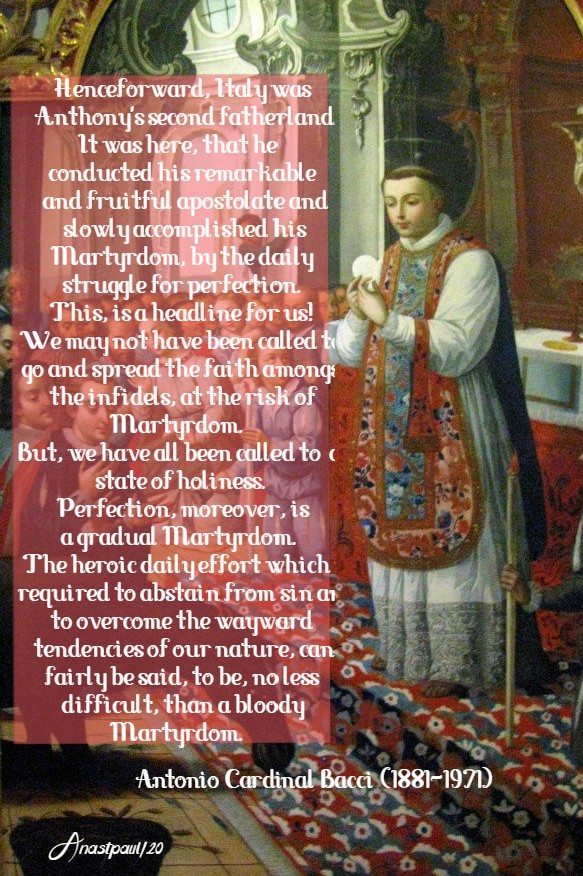
Henceforward, Italy was Anthony’s second fatherland.
It was here, that he conducted his remarkable and fruitful apostolate and slowly accomplished his Martyrdom, by the daily struggle for perfection.
This, is a headline for us!
We may not have been called to go and spread the faith amongst the infidels, at the risk of Martyrdom.
But, we have all been called to a state of holiness.
Perfection, moreover, is a gradual Martyrdom.
The heroic daily effort which is required to abstain from sin and to overcome the wayward tendencies of our nature, can fairly be said, to be, no less difficult, than a bloody Martyrdom.
This is the kind of Martyrdom which we must all endure.
St Anthony of Padua, will obtain for us the grace, to undergo it with the same generosity and constancy, which he displayed.”
Quote/s of the Day – 13 June – The Memorial of St Anthony of Padua (1195-1231) Evangelical Doctor of the Church
“Damned money! Alas! … Money is the ‘droppings of birds’ that blinded the eyes of Tobit.”
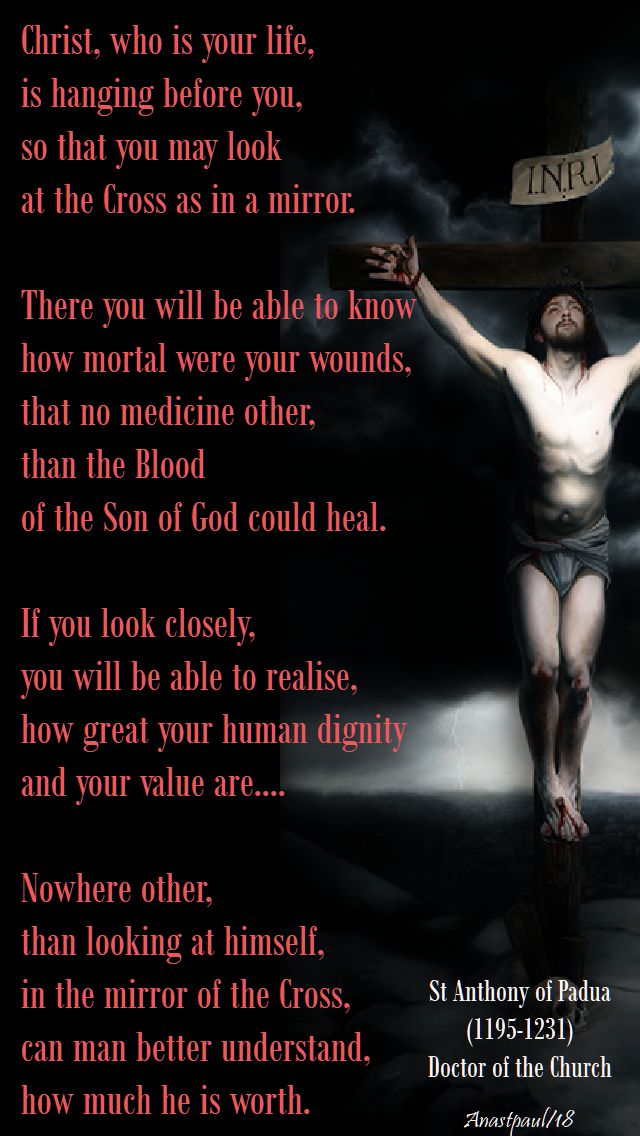
“Christ, who is your life, is hanging before you, so that you may look at the Cross, as in a mirror. There you will be able to know, how mortal were your wounds, that no medicine other, than the Blood of the Son of God, could heal. If you look closely, you will be able to realise, how great your human dignity and your value are…. Nowhere other than looking at himself, in the mirror of the Cross, can man better understand how much he is worth”
(Sermones Dominicales et Festivi III, pp. 213-214)
“The devil is afraid of us when we pray and make sacrifices. He is also afraid when we are humble and good. He is especially afraid when we love Jesus very much. He runs away when we make the Sign of the Cross.”
“The spirit of humility is sweeter than honey and those, who nourish themselves with this honey produce sweet fruit.”
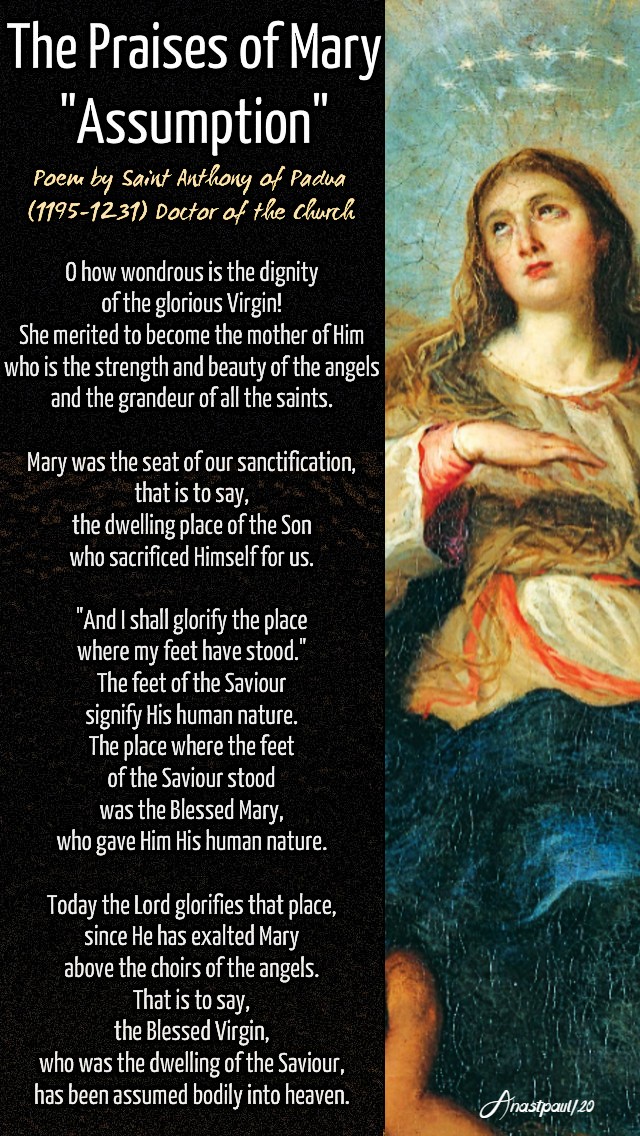
The Praises of Mary “Assumption” Poem by Saint Anthony
O how wondrous is the dignity of the glorious Virgin! She merited to become the mother of Him who is the strength and beauty of the angels and the grandeur of all the saints.
Mary was the seat of our sanctification, that is to say, the dwelling place of the Son who sacrificed Himself for us.
“And I shall glorify the place where my feet have stood.” The feet of the Saviour signify His human nature. The place where the feet of the Saviour stood was the Blessed Mary, who gave Him His human nature.
Today the Lord glorifies that place, since He has exalted Mary above the choirs of the angels. That is to say, the Blessed Virgin, who was the dwelling of the Saviour, has been assumed bodily into heaven.
St Anthony of Padua (1195-1231)
Evangelical Doctor of the Church
One Minute Reflection – 13 June – “Month of the Sacred Heart” – Saturday of the Tenth Week in Ordinary Time, Year A, Readings: 1 Kings 19:19-21, Psalm 16:1-2, 5, 7-10, Matthew 5:33-37 and the Memorial of St Anthony of Padua (1195-1231) Doctor of the Church
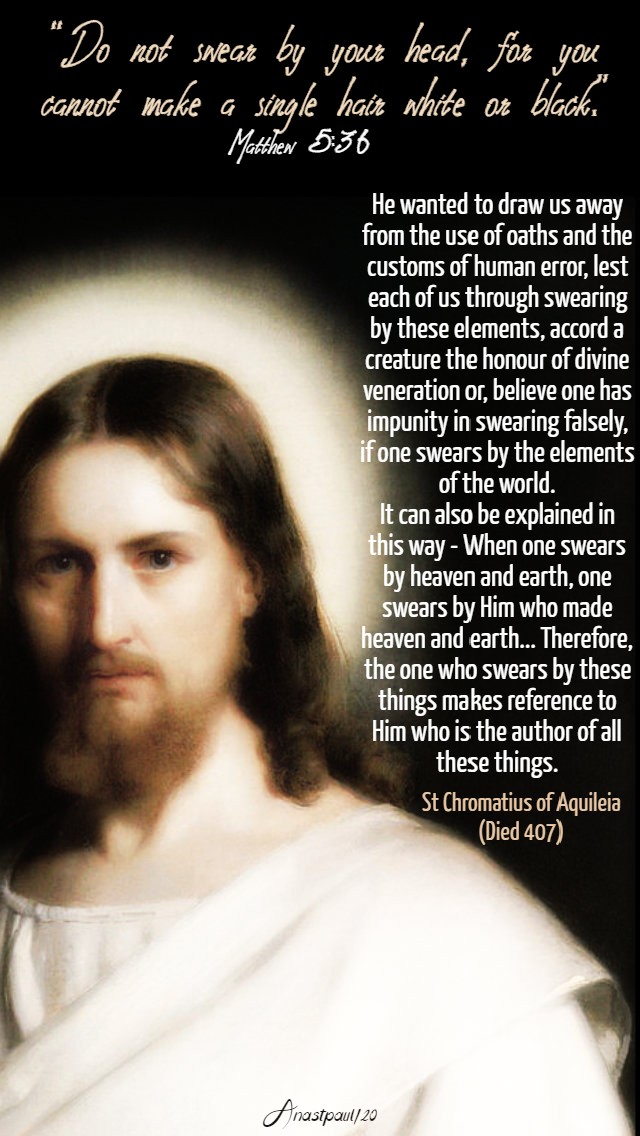
“Do not swear by your head, for you cannot make a single hair white or black.” … Matthew 5:36
REFLECTION – “These words of the Lord whereby He forbids us to swear by these different elements, invites a double explanation. Firstly, He wanted to draw us away from the use of oaths and the customs of human error, lest each of us through swearing by these elements, accord a creature the honour of divine veneration or, believe one has impunity in swearing falsely, if one swears by the elements of the world.
It can also be explained in this way – When one swears by heaven and earth, one swears by Him who made heaven and earth, as the Lord Himself declared elsewhere: “He who swears by the altar, swears by it and by all things that are on it and, he who swears by the temple, swears by it and by him who dwells in it.” Jesus goes on to say, “nor by Jerusalem,” for it is the city of the great King, that is, the symbol of Christ’s body, which is the spiritual and heavenly church. “Neither shall you swear,” he says, “by your head,” for according to the apostle, “the head of every man is Christ.” Therefore, the one who swears by these things makes reference to Him who is the author of all these things.” … St Chromatius of Aquileia (Died 407) Bishop, Theologian, Defender of the Faith against Arianism, Friend and supporter of St Jerome, St John Chrysostom, St Ambrose – Tractate on Matthew 24)
PRAYER – Almighty, everliving God, You gave St Anthony of Padua to Your people as a preacher and teacher and a patron in their needs. Grant that we may learn from his words inspired by Your Holy Spirit and by his prayers, grow in faith, hope and humility. We make our prayer through Christ our Lord, in the unity of the Holy Spirit, all-glorious God, now and forever, amen.
Our Morning Offering – 13 June – “Month of the Sacred Heart” – Saturday of the Tenth Week in Ordinary Time, Year A
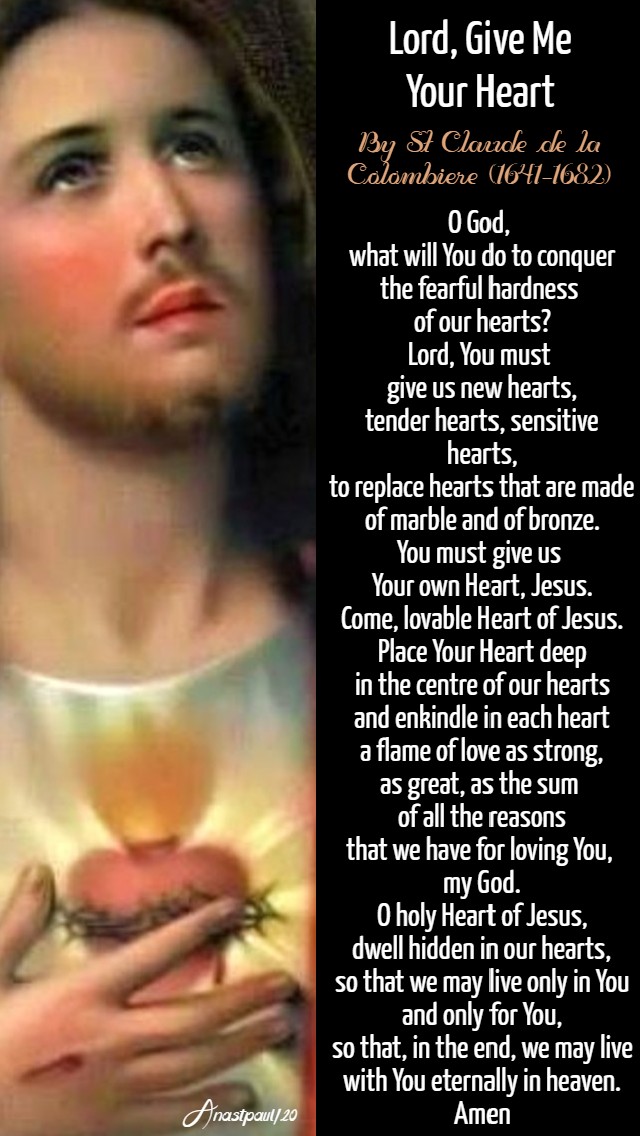
Lord, Give Me Your Heart By St Claude de la Colombiere SJ (1641-1682) Apostle of Devotion to the Sacred Heart and Spiritual Director to St Margaret Mary Alacoque
O God, what will You do to conquer
the fearful hardness of our hearts?
Lord, You must give us new hearts,
tender hearts, sensitive hearts,
to replace hearts that are made
of marble and of bronze.
You must give us Your own Heart, Jesus.
Come, lovable Heart of Jesus.
Place Your Heart deep
in the centre of our hearts
and enkindle in each heart
a flame of love as strong,
as great, as the sum of all the reasons
that we have for loving You, my God.
O holy Heart of Jesus,
dwell hidden in our hearts,
so that we may live only in You
and only for You,
so that, in the end, we may live
with You eternally in heaven.
Amen
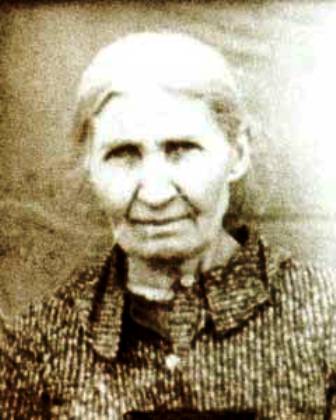
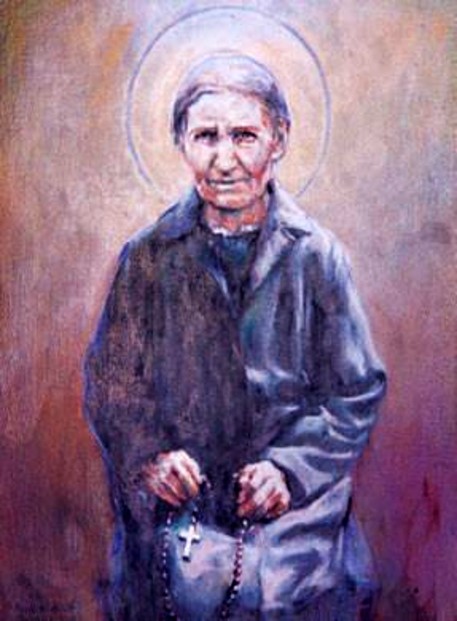
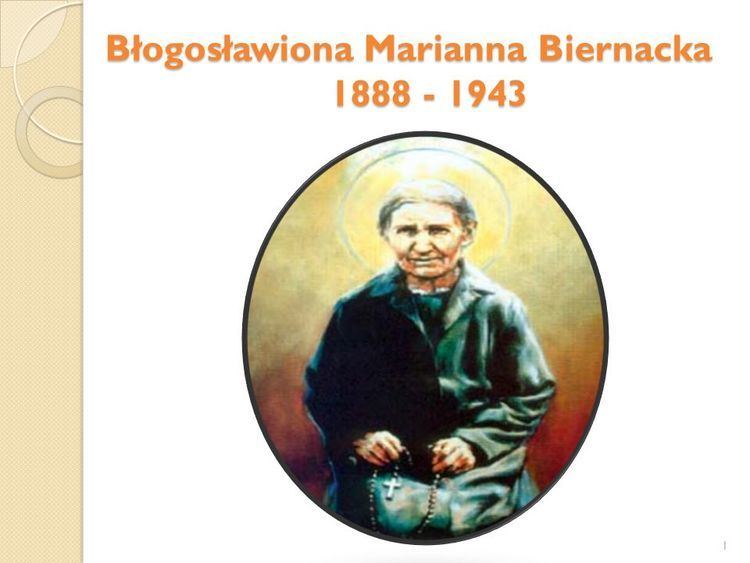
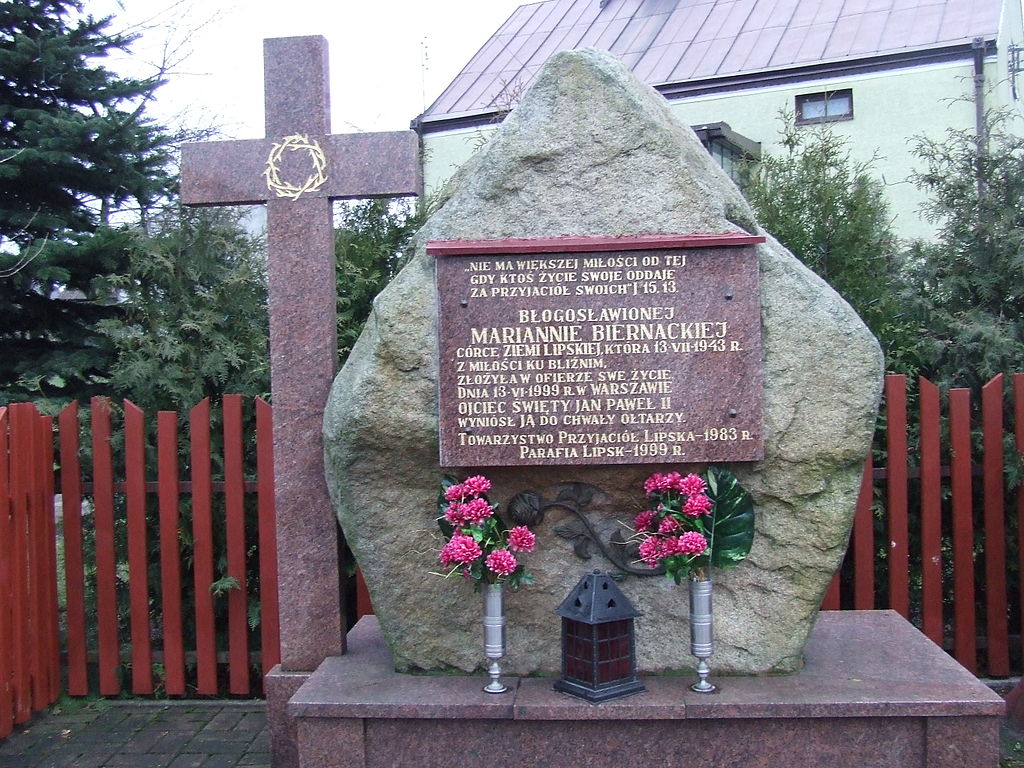
Saint of the Day – 13 June – Blessed Marianna Biernacka (1888-1943) Martyr, Laywoman, Mother, Grandmother, Widow – Born as Marianna Czokala in 1888 in Lipsk, Podlaskie, Poland and died by being shot by firing squad on 13 June 1943 in Naumovichi (aka Naumowicze), Belarus. She was 54-55. She is also remembered on 12 June as one of the 108 Martyrs of World War II.
Blessed Marianna Biernacka is described, in many reports, as leading a “simple” life. But it’s my experience that there are really no simple lives. Marianna knew heartbreak. She knew fear. She knew backbreaking work. She knew loss. And she knew God’s love.
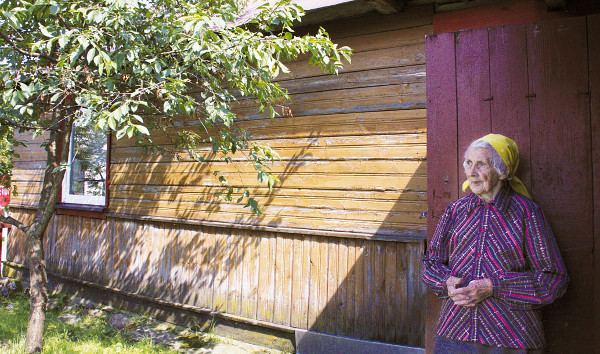
This may be or not, Blessed Marianna, sources are uncertain
Marianna was born in 1888. At the age of twenty she married a local man, Louis Biernacki. Together, they had six children, four of whom died shortly after birth. The only source of survival for the family was their family farm.
After the death of Louis in 1929, Marianna lived with her son Stanislaw. Stanislaw eventually married a young woman, Anna Szymczyk and they all lived together. Prayer and song were a large part of their lives. Soon after the couple were married, the two had a daughter.
Bishop Jerzy Mazur, Bishop of Elk, said on the occasion of the 70th anniversary of the death of Bl Marianna Biernacka that “Staring at her ordinary life, we see that it was imbued with faith, love, prayer, work and suffering. Each day began with prayer and common singing Hours. Everyday life was filled with a difficult job in summer in a field and in winter, spun flax and hemp and weaving on a loom. Recitation of the Rosary prayer and devotional singing songs allowed the dignity to endure the pain of bereavement, hard work and daily poverty.”
In 1939, the Nazis invaded Poland. To understand, the Nazi occupation of Poland is to label it as one of the worst and most brutal genocides in the history of the world. Adolf Hitler himself is reported to have authorised his commanders to kill “without pity or mercy, all men, women and children of Polish decent or language.” When a German soldier was killed by any resistance, the Gestapo made it a practice to round up a large number of Polish civilians randomly and kill them in retaliation. It was just such an incident that brought the Nazis to the door of Marianna Biernacka.
In July of 1943, the Nazis arrested many people in and around the city of Lipsk as retribution for a German killed by the resistance. Randomly, Stanislaw Biernacka, along with his pregnant wife Anna, were selected to be killed. Nobody believed they had anything to do with the resistance but they were to be killed for events outside of their control. When the armed soldiers came to arrest them, Stanislaw’s mother, Marianna, reportedly dropped to her knees and begged the Nazis to take her instead of Anna.
“She is already in the last weeks of her pregnancy,” she pleaded. “I will go for her.”Her daughter-in-law begged her not to make this sacrifice but Marianna insisted, reportedly saying “You are young, you must live.”As the Nazis didn’t particularly care who they killed, as they were simply filling a quota, so they took Marianna and her son instead of the pregnant Anna.
The Nazis took Marianna and her son to the prison in Grodno. While in the prison, she only requested a pillow and a rosary. After two weeks in prison in which she spent much of her time praying, Marianna was shot and killed on 13 July 1943 in Naumowicze along with her son. Their bodies were thrown into a common grave.
Around that time, Anna gave birth to a son. She named his Stanislaw.
On 13 June 1999, Marianna was Beatified and recognised as a Martyr, along with 107 other victims, by Pope John Paul II. The liturgical feast day of the 108 Martyrs of World War II is June 12.
Sadly, the child, Stanislaw, only lived for about a year, according to reports. Anna lived to age 98 and her daughter, Eugenia, still lives in the family home, according to some Polish websites. She said that her mother, Anna, would often say that she had been given life twice. Once by her own mother and then from her mother-in-law.
—
Bl Achilleo of Alexandria
Bl Alfonso Gomez de Encinas
Bl Anthony of Ilbenstadt
St Aquilina of Syria
St Augustine Phan Viet Huy
St Aventino of Arbusto
St Damhnade
St Diodorus of Emesa
St Eulogius of Alexandria
St Fandilas of Penamelaria
St Felicula of Rome
St Fortunatus of North Africa
Bl Gerard of Clairvaux – was the brother of Saint Bernard of Clairvaux. He was a Soldier. When he was wounded in combat at the siege of Grancy, Gerard resolved to become a monk. He became a Benedictine Cistercian monk at Citeaux. He worked with Saint Bernard at Clairvaux and became his closest confidant. He died in 1138 of natural causes.
St Lucian of North Africa
St Mac Nissi of Clonmacno
Blessed Marianna Biernacka (1888-1943) Martyr of the Nazi Regime
Below is a video I believe features Anna herself. I, of course, do not know Polish, but another website had a picture of Anna and it was the same woman, so I believe I am correct in this supposition. It’s in Polish and throughout much of the video she is singing a song. It’s quite beautiful. If any of you know Polish I’d be grateful for information about what’s she’s saying and singing or if it is in fact Anna.
St Maximus of Cravagliana
St Nicolas Bùi Ðuc The
St Peregrinus of Amiterno
St Rambert
St Salmodio
Bl Servatius Scharff
St Thecla
St Tryphillius of Leucosia
St Victorinus of Assisi
St Wilicarius of Vienne
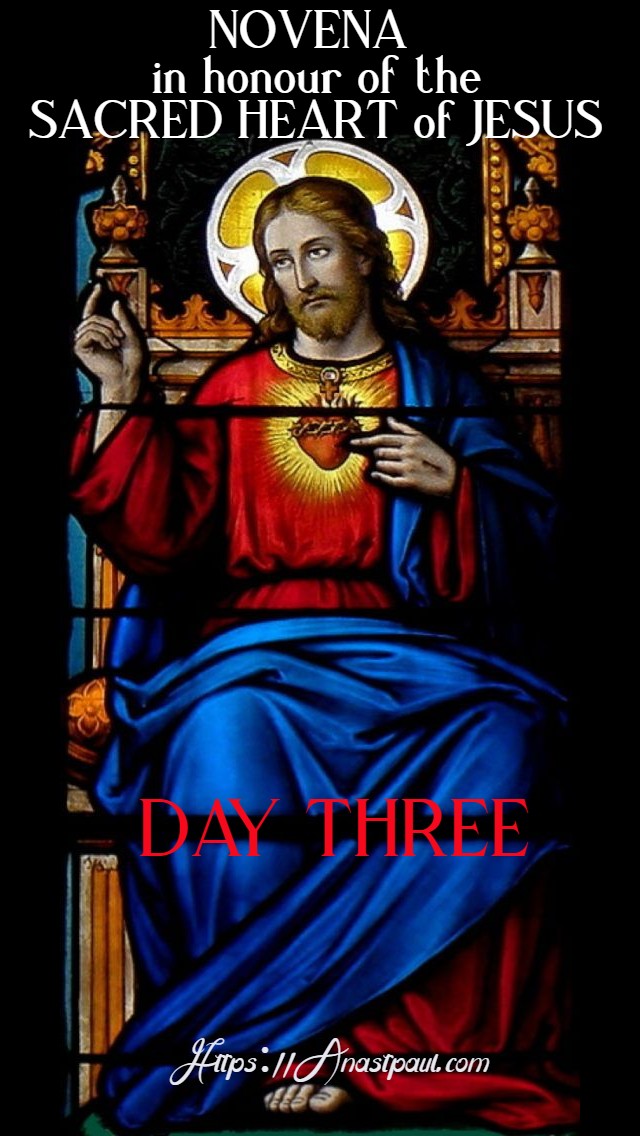
Novena in Honour of the Sacred Heart of Jesus Day Three – 12 June
When I find Prayer difficult.
Today’s Scripture Likewise the Spirit helps us in our weakness, for we do not know how to pray as we ought but that very Spirit intercedes with sighs too deep for words. And God, who searches the heart, knows what is the mind of the Spirit because the Spirit intercedes for the saints, according to the will of God. We know that all things work together for good for those who love God, who are called according to his purpose. …Romans 8: 26-28
Reflection for the Third Day
St Thérèse of the Child Jesus (1873-1897) once said, that love was her vocation in life. Never was this vocation tested more than in the last nine months of her life, as she lay dying with tuberculosis. She wrote a note to her sister Céline ‘Here is great love, to love Jesus without feeling the sweetness of His love – that is love, pushed to the point of heroism.’
Today’s Prayer
Jesus, I believe.
Help my unbelief.
Jesus, You are the real bedrock of my hope.
Help me always to rely on You,
especially in times of doubt and trouble.
For in You, I live and move and have my being!
Daily Invocation Sacred Heart of Jesus, I place all my trust in you.
Novena Prayer
Lord Jesus,
the needs of Your people open Your heart in love for each of us.
You care for us when we are lost,
sympathise with us in loneliness
and comfort us in mourning;
You are closest to us where we are weakest.
You love us most, when we love ourselves least;
You forgive us mos, when we forgive ourselves least
and You call us to spread Your love in whatever way we can.
Lord Jesus, Your heart is moved with compassion
when we are suffering,
when we need your help
and when we pray for each other.
I ask You to listen to my prayer during this Novena
and grant what I ask.
…………………………. (Mention your intention silently.)
If what I ask, is not for my own good and the good of others,
grant me what is best,
that I may build up Your kingdom of love in our world.
Amen













![st Elijah[1].0](https://anastpaul.com/wp-content/uploads/2020/06/st-elijah1.0.jpg)









 AnaStpaul
You must be logged in to post a comment.