
Saint of the Day – 8 July – Blessed Pope Eugene III (c 1080-1153) the first Cistercian Monk to be raised to the Chair of St Peter, Born Bernardo Pignatelli, in Montemagno, Pisa, Italy and died on 8 July 1151 at Tivoli, Italy of natural causes. In response to the fall of Edessa to the Muslims in 1144, Eugene proclaimed the Second Crusade. The Crusade however, failed to recapture Edessa. Also known as – Peter dei Paganelli di Montemagno, Bernard of Pisa, Bernardo Pignatelli.

Bernardo was born in the vicinity of Pisa. Little is known about his origins and family except that he was son of a certain Godius.[3] From the 16th century he is commonly identified as member of the family of Paganelli di Montemagno, which belonged to the Pisan aristocracy.
Between May 1134 and February 1137 he was Ordained to the Priesthood by Pope Innocent II, who resided at that time in Pisa. Under the influence of Bernard of Clairvaux he entered the Cistercian Order in the Monastery of Clairvaux in 1138. A year later he returned to Italy as leader of the Cistercian community in Scandriglia.
After he became a Cistercian he took the name of “Bernard” in honour of his friend, Saint Bernard of Clairvaux. Father Bernard was appointed Abbot of Tre Fontaine in Rome. Following the death of Pope Lucius II (+1145) the Cardinals elected Abbot Bernard to be Pope, who was not present at the conclave due to not being a Cardinal. It is reported that ALL were surprised. But he always remained a Cistercian Monk at heart.

Bernardo’s election was assisted by being a friend and pupil of Bernard of Clairvaux, the most influential ecclesiastic of the Church and a strong assertor of the pope’s temporal authority. The choice did not have the approval of Bernard, however, who remonstrated against the election, writing to the entire Curia:
“May God forgive you what you have done! … What reason or counsel, when the Supreme Pontiff was dead, made you rush upon a mere rustic, lay hands on him in his refuge, wrest from his hands the axe, pick or hoe, and lift him to a throne?”
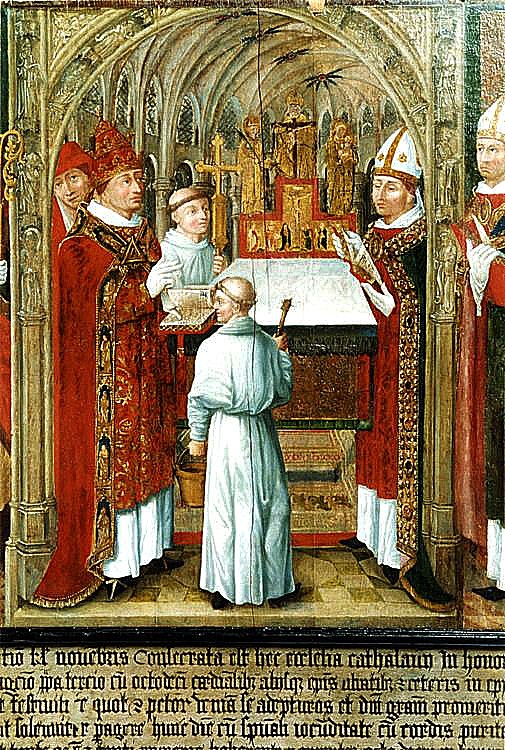
Bernard was equally forthright in his views directly to Eugene, writing:
“Thus does the finger of God raise up the poor out of the dust and lift up the beggar from the dunghill that he may sit with princes and inherit the throne of glory.”
Never a shy man and passionate teacher, Saint Bernard wrote De consideratione to instruct him, that is Eugene, in Papal duties. Despite these criticisms, Eugene seems to have borne no resentment to Bernard and notwithstanding these criticisms, after the choice was made, Bernard took advantage of the qualities in Eugene III which he objected to, so as virtually to rule in his name.
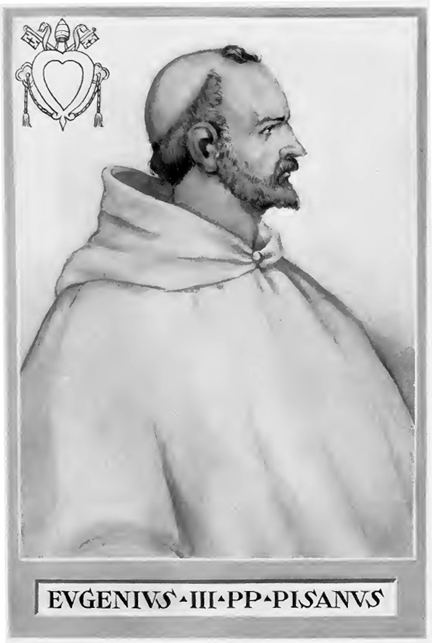
On hearing of the fall of Edessa (now the modern day city of Urfa, the first of the Crusader states established in the Levant) to the Turks, which occurred in 1144, he had, in December 1145, addressed the bull Quantum praedecessores to Louis VII of France, calling on him to take part in another Crusade. At a great diet held at Speyer in 1146, King Conrad III of Germany and many of his nobles were also incited to dedicate themselves to the Crusade by the eloquence of St Bernard of Clairvaux, preached to an enormous crowd at Vézelay. The Second Crusade turned out to be “an ignominious fiasco” and, after travelling for a year, the army abandoned their campaign after just five days of siege “having regained not one inch of Muslim territory.”
The Dominican, St Antoninus called Pope Eugene “a great Pope with great sufferings.” And, St Bernard spoke of Pope Eugene in this way: “There is no arrogance or domineering way in him.” Eugene III held synods in northern Europe at Paris, Rheims, and Trier in 1147 and 1149 that were devoted to the reform of clerical life. He also considered and approved the works of Hildegard of Bingen
Throughout most of his Papacy, Eugene had been an “absentee landlord” of Rome, due to the infighting of those who rejected his claim to temporal, as well as spiritual power over its citizens. Although the citizens of Rome resented Eugene III’s effort to assert his temporal authority, they recognised him as their spiritual lord. Until the day of his death he continued to wear the coarse habit of a Cistercian Monk under his robe. He was buried in the Vatican with every mark of respect and veneration. The people of Rome speedily recognised him as a pious figure who was meek and spiritual. His tomb acquired considerable fame due to the miracle which occurred there and his cause for sainthood commenced. Pope Pius IX Beatified him on 28 December in 1872.
With the Church we pray:
Almighty ever-living God, Who chose blessed Eugene III to preside over Your whole people and benefit them by word and example, keep safe, we pray, by his intercession, the shepherds of your Church along with the flocks entrusted to their care and direct them in the way of eternal salvation. Through our Lord Jesus Christ, Your Son in the unity ofthe Holy Ghost, one God now and forever, amen.



 AnaStpaul
3 thoughts on “Saint of the Day – 8 July – Blessed Pope Eugene III (c 1080-1153) t”