Thought for the Day – 26 December – Meditations with Antonio Cardinal Bacci (1881-1971)
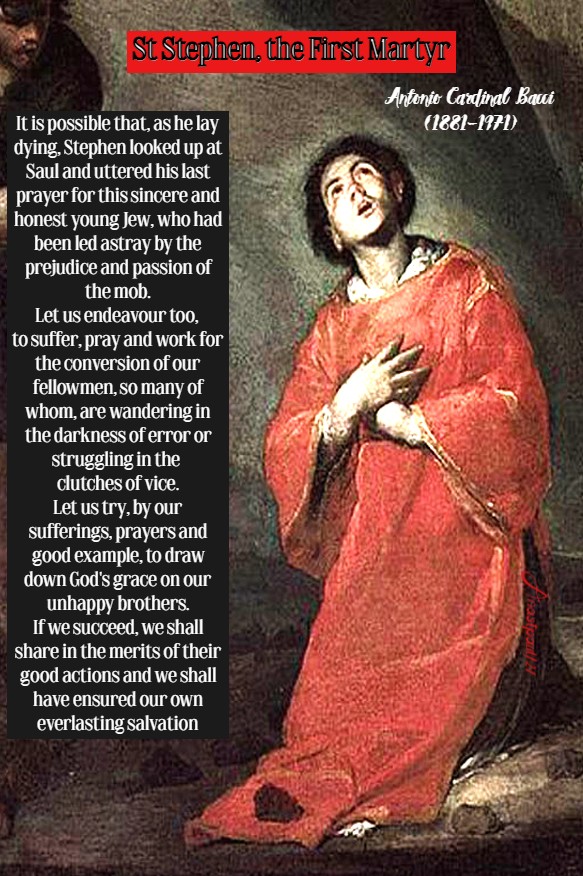
St Stephen, the First Martyr
“Saul was a member of the band which led Stephen to his death. He did not actually take part in the stoning of the saintly Deacod but, he co-operated with the executioners. It is possible that, as he lay dying, Stephen looked up at Saul and uttered his last prayer for this sincere and honest young Jew, who had been led astray by the prejudice and passion of the mob. In God’s plan, the Martyrdom of Stephen was, in some way connected with the conversion of St Paul, who was soon afterward dramatically won over by the grace of God on the road to Damascus.
Let us endeavour too, to suffer, pray and work for the conversion of our fellowmen, so many of whom, are wandering in the darkness of error or struggling in the clutches of vice. Let us try, by our sufferings, prayers and good example, to draw down God’s grace on our unhappy brothers. If we succeed, we shall share in the merits of their good actions and we shall have ensured our own everlasting salvation.”
Quote/s of the Day – 26 December – The Second Day in the Christmas Octave
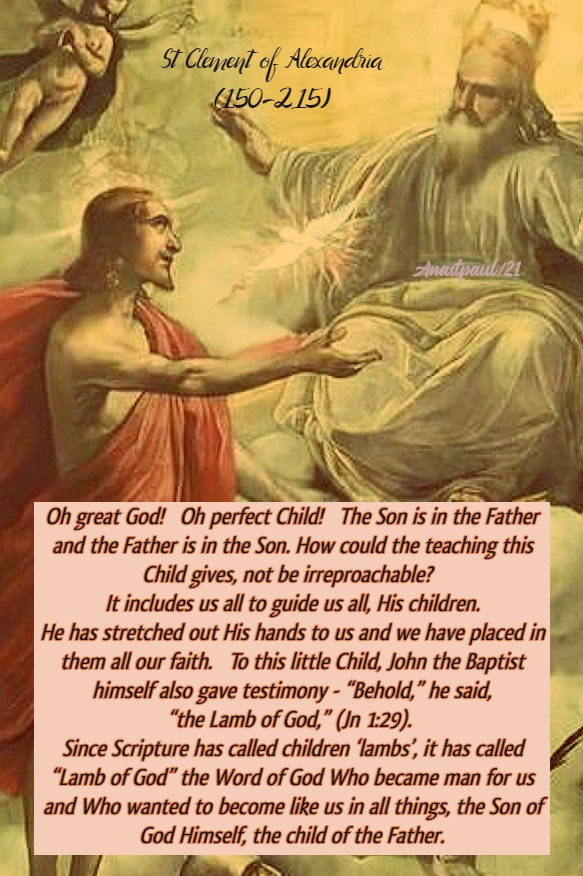
Christ, the Child
“Oh great God! Oh perfect Child! The Son is in the Father and the Father is in the Son. How could the teaching this Child gives, not be irreproachable? It includes us all to guide us all, His children. He has stretched out His hands to us and we have placed in them all our faith. To this little Child, John the Baptist himself also gave testimony – “Behold,” he said, “the Lamb of God,” (Jn 1:29). Since Scripture has called children ‘lambs,’ it has called “Lamb of God” the Word of God Who became man for us and Who wanted to become like us in all things, the Son of God Himself, the child of the Father.”
St Clement of Alexandria (150-215) Theologian, Father
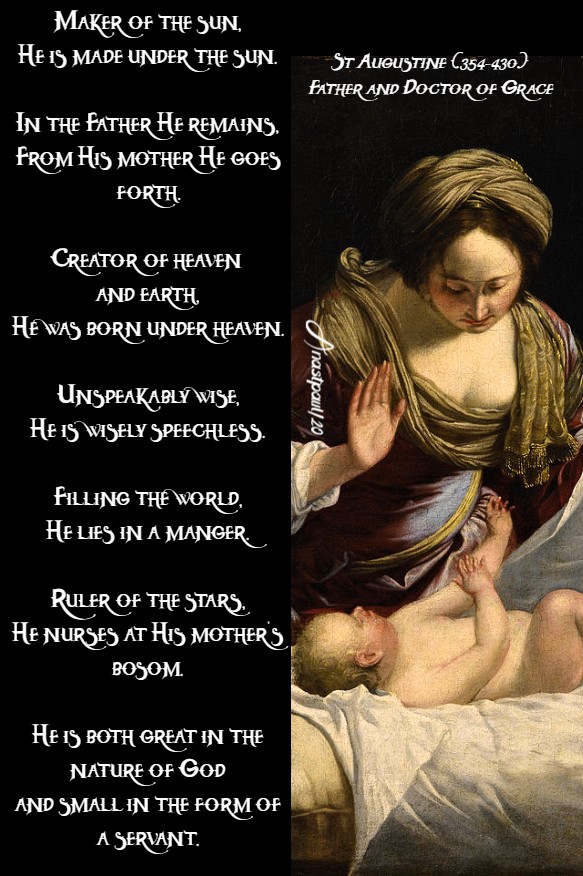
“Maker of the sun, He is made under the sun.
In the Father He remains, From His mother He goes forth.
Creator of heaven and earth, He was born under heaven.
Unspeakably wise, He is wisely speechless.
Filling the world, He lies in a manger.
Ruler of the stars, He nurses at His mother’s bosom.
He is both great in the nature of God and small in the form of a servant.”
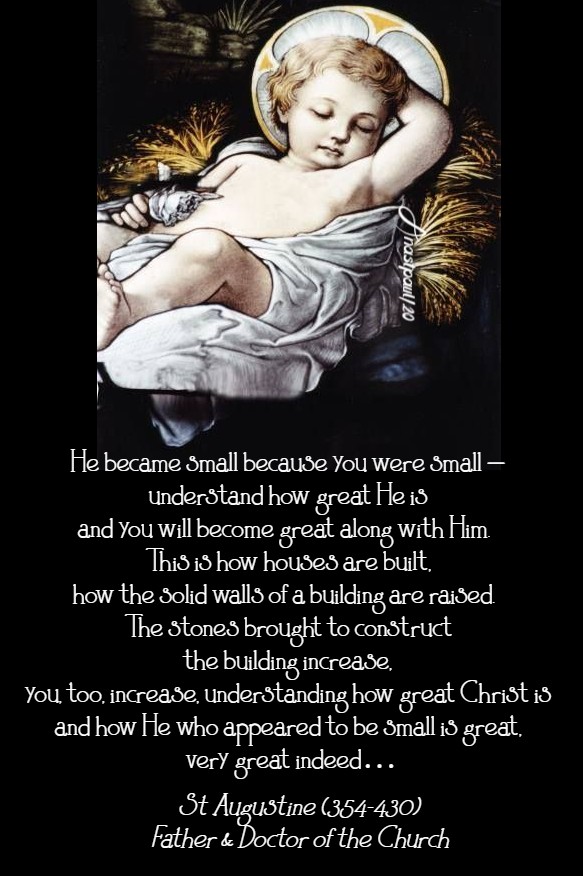
“He became small because you were small – understand how great He is and you will become great along with Him. This is how houses are built, how the solid walls of a building are raised. The stones brought to construct the building increase, you, too, increase, understanding how great Christ is and how He who appeared to be small is great, very great indeed…”
St Augustine (354-430) Father & Doctor of the Church
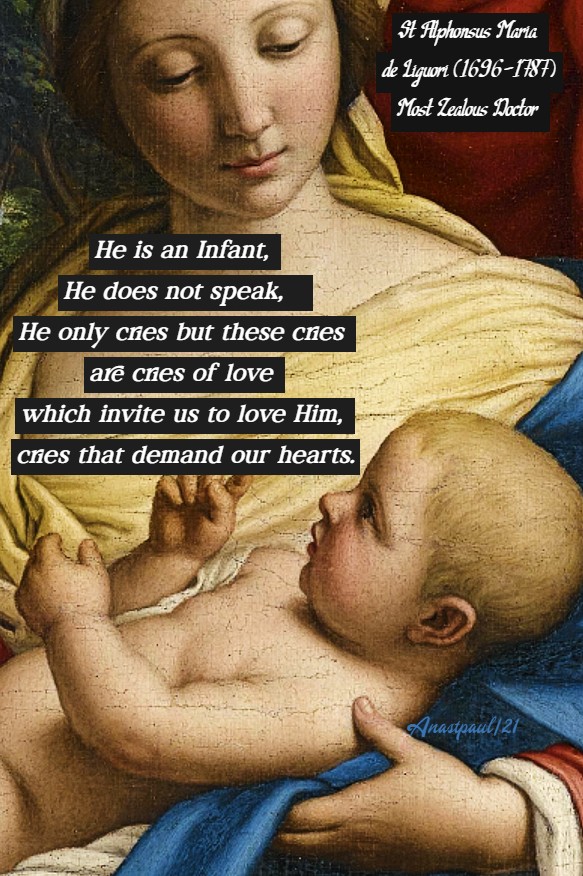
“He is an infant, He does not speak, He only cries but these cries are cries of love which invite us to love Him, cries that demand our hearts.”
St Alphonsus Maria de Liguori (1696-1787) Most Zealous Doctor
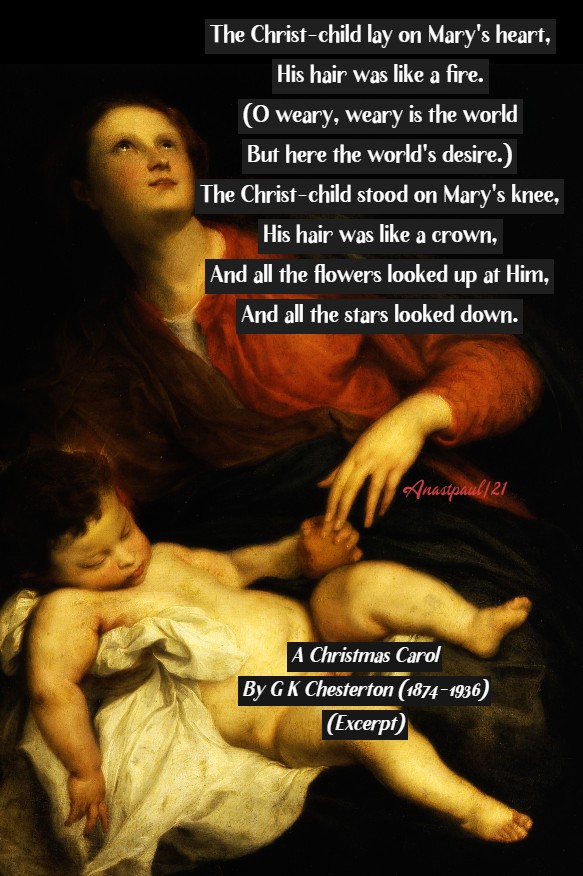
A Christmas Carol By G K Chesterton (1874-1936) English Catholic Convert, Writer, Poet.
The Christ-child lay on Mary’s lap, His hair was like a light. (O weary, weary were the world, But here is all aright.)
The Christ-child lay on Mary’s breast His hair was like a star. (O stern and cunning are the kings But here the true hearts are.)
The Christ-child lay on Mary’s heart, His hair was like a fire. (O weary, weary is the world But here the world’s desire.) The Christ-child stood on Mary’s knee, His hair was like a crown, And all the flowers looked up at Him, And all the stars looked down.
One Minute Reflection – 26 December – Feast of St Stephen the ProtoMartyr and The Second Day in the Christmas Octave, Readings: Acts 6:8-10; 7:54-59, Psalm31:3-4, 6, 8, 16-17, Matthew 10:17-22
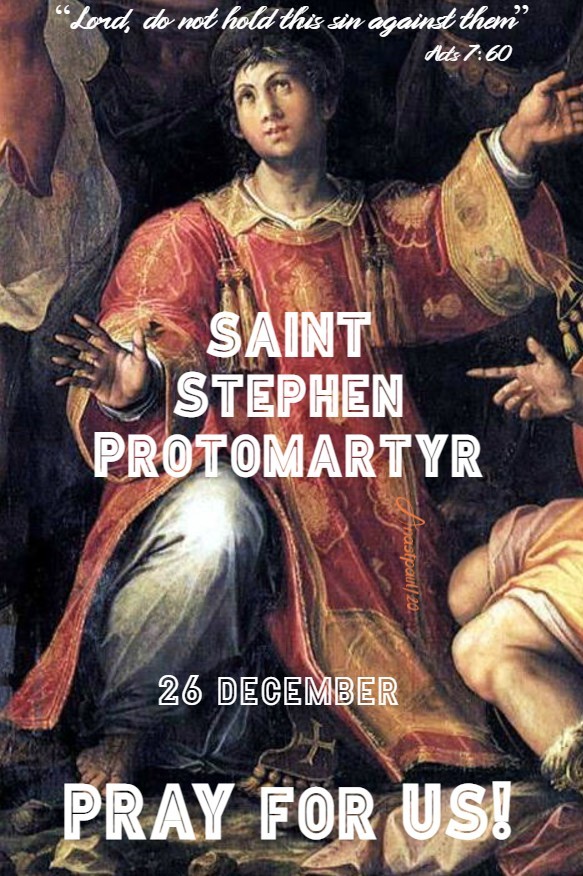
“Lord, do not hold this sin against them” – Acts 7:60
REFLECTION – “Let us imitate our Lord and pray for our enemies … He was Crucified yet, at the same time, prayed to His Father for the sake of those who were crucifying Him. But how could I possibly imitate our Lord, one might ask? If you want to, you can. If you were not able to do it, how could He have said: “Learn from me for I am meek and humble of heart”? (Mt 11:29) …
If you have difficulty in imitating our Lord, at least imitate him who is also His servant, His Deacon – I would speak of Stephen. Just as Christ, in the midst of those crucifying Him, without considering the cross, without considering His own predicament, pleaded with the Father on behalf of His tormentors (Lk 23:34), so His servant, surrounded by those who were stoning him, attacked by all, crushed beneath a hail of stones and, without taking any account of the suffering they were causing him, said: “Lord, do not hold this sin against them” (Acts 7:60). Do you see how the Son spoke and how His servant prayed? The former said: “Father, forgive them for they know not what they do,” and the latter said: “Lord, do not hold this sin against them.” Moreover, to make us realise better the fervour with which he was praying, he did not just pray, as he stood beneath the blows of the stones but, he spoke on his knees with sincerity and compassion …
Christ said: “Father, forgive them for they know not what they do.” Stephen cried out: “Lord, do not hold this sin against them.” Paul, in his turn, said: “I offer up this sacrifice for my brethren, my kin according to race” (cf Rm 9:3). Moses said: “If you would only forgive their sin! And if you will not, then strike me out of the book that you have written!” (Ex 32:32). David said: “May your hand fall on me and my kindred,” (2 Sam 24:17). … What kind of forgiveness do we think we shall receive if we ourselves do the opposite of what is asked of us and pray against our enemies, when the Lord Himself and His servants of both Old and New Testaments, direct us to pray on their behalf?” – St John Chrysostom (345-407) Father and Doctor of the Church – Sermon for Good Friday “The Cross and the bandit”
PRAYER – Grant us Your Grace, Lord God Almighty, to practise what we worship. Teach us to love our enemies and to pray for those who persecute us. As we keep the feast of Saint Stephen, may we learn from him, who learned from You and prayed, even for the men who stoned him to death. Through Christ our Lord, with the Holy Spirit, God now and forever, amen.
Our Morning Offering – 26 December – Feast of St Stephen the ProtoMartyr and The Second Day in the Christmas Octave
Sleep, Holy Babe By Fr Edward Caswell C.Orat. (1814-1878)
Sleep, holy Babe, Upon Your Mother’s breast! Great Lord of earth and sea and sky, How sweet it is to see You lie In such a place of rest! Sleep, holy Babe, Your angels watch around, All bending low with folded wings Before th’incarnate King of kings In rev’rent awe profound! Sleep, holy Babe, While I with Mary gaze In joy upon that face awhile, Upon the loving Infant smile Which there divinely plays. Sleep, holy Babe, And take Your brief repose; Too quickly will Your slumbers break And You to lengthened pains awake, That death alone shall close. Amen
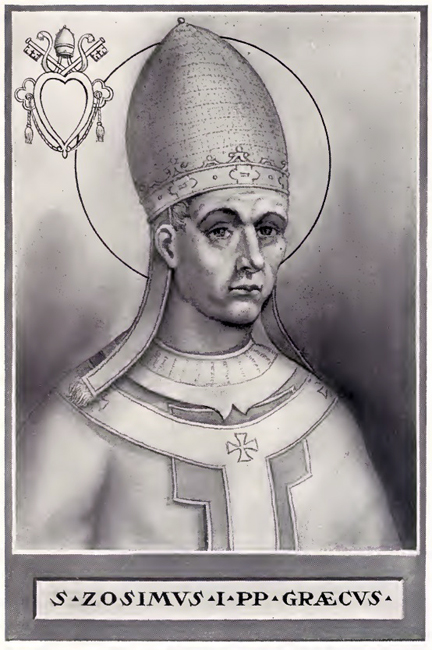
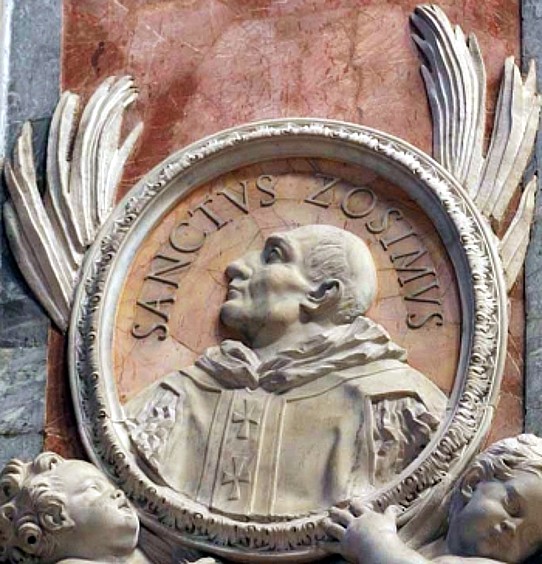
Saint of the Day – Saint Pope Zosimus (Died 418) Bishop of Rome from 18 March 417 to his death, of natural causes, on 26 December 418, Confessor. Greek by birth, his short Pontificate was characterised by serious conflicts with the Bishops of Gaul and those of Africa.
The Roman Martyrology states today: “In Rome on the Via Tiburtina near San Lorenzo, deposition of San Zosimo, Pope and Confessor.”
With the exception of the brief notes reported in the Liber Pontificalis, nothing is known of its history before the election. Zosimo was a Roman Priest at the time of the Pontificate of St Innocent I (401-417), Greek by birth, perhaps descended from a Jewish family, given that his father was called Abraham. He was elected as the successor of Pope Innocent and consecrated on 18 March 417.
Zosimus devoted most of his brief reign to advancing the cause of Papal supremacy, albeit with very little success. Zosimus wrote Episiola Thactaria, condemning Pelagianism.
While personally blameless in his private life, Zosimus did have a tactless and hasty personality, so much so, that he found himself embroiled in various clashes with prelates throughout the Church. In fact he died while preparing to excommunicate a group of troublesome clerics.
In the last months of his life, he also saw an opposition against him arise in Rome, to the point that he turned to complain about it, at the court of Ravenna, he was preparing to fight against this group, when he fell ill, dying on 26 December 418 and being buried. in the Basilica of St Laurence in Rome.
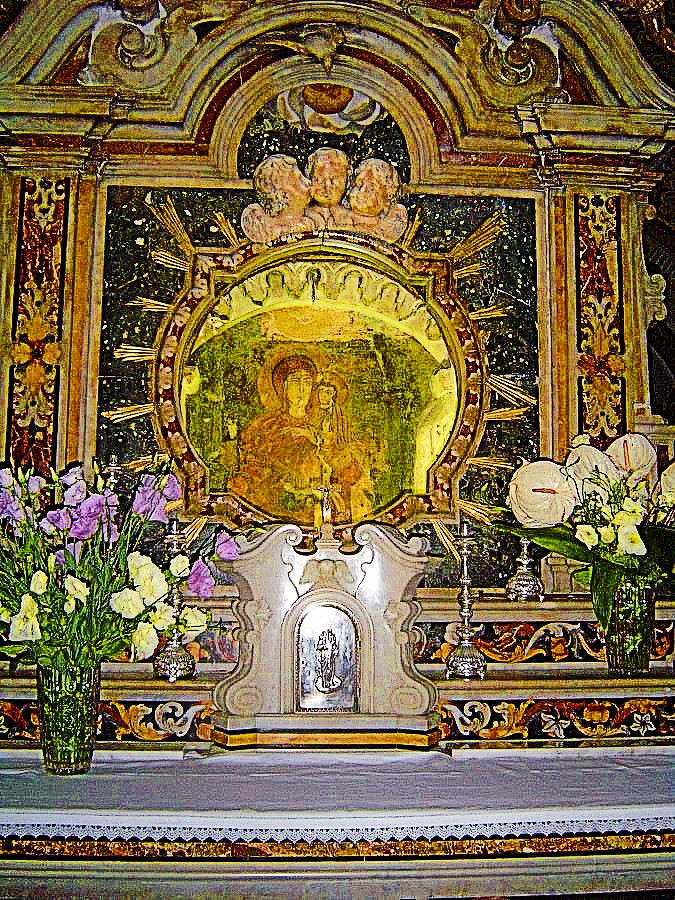
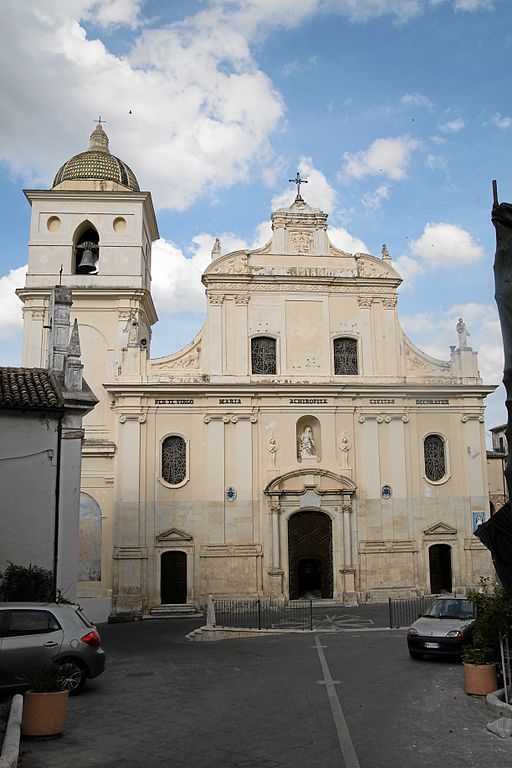
Madonna della Acheropita, Maria Santissima Acheropita / Our Lady of Acheropita, Rossano, Italy (1140) – 26 December:
The Abbot Orsini relates: “Tradition has it that one night, a woman in great brightness appeared to a watchman on duty where a new Church was being built in Rossano, Italy. She asked him to withdraw from the place. The next morning there was seen in the building a picture of the Blessed Virgin, painted but not by the hand of man. For that reason it came to be called “Acheropita,” not made by human hands.”
The latest historical research has established that the image of Acheropita – a fresco on a pillar – was found in a small Chapel near the cave of one of the many hermits who formed the aura of Saint Nicholas of Vallone in the 6th century. It seems a holy hermit named Ephrem was very devoted to the Blessed Virgin Mary. In the year 580, a certain Captain Mauricio, was deflected from his course by the winds and landed near present day Rossano. The hermit Ephrem went to meet him with the strange sounding greeting of: “It was not the winds that brought you here but Our Lady, for once you are appointed emperor, you will build a Church here.” A mere two year later, in the year 582, Mauritius was crowned Emperor and remembering the prophesy, had artists brought to the cave to paint a fitting image of the Blessed Virgin Mary. Although the artists toiled all day, during the night their work always mysteriously disappeared. The Governor, unsure of what was happening, ordered that the cave be guarded at night. That night as the guards went about their duty in front of the cave, a young woman of rare beauty came out of nowhere amidst a bright light wearing a white silk cape. She asked the guard to depart from the site, which they did. Informed the next morning of what had happened, the Governor went to the Church. To everyone’s surprise he observed an image that perplexed him, for painted on the bottom of the inner wall was a beautiful picture of Our Lady, similar to the Byzantine icons he had seen before. It was exactly where his artists had been trying in vain to draw the image. The news of the miracle soon spread throughout the City. The faithful began arriving to the place, shouting in wonder and cheering in tears with songs of praise, “Acheropita! Acheropita!” The image became an object of veneration for the people of Rossano and a new Church had to be built to satisfy popular piety in a more worthy manner. That Church is now known as the Rossano Cathedral, and it was built next to the grotto where the image is still preserved. It is also said, that later, the Saracens attacked, trying to surprise the City of Rossano but they were repulsed by Our Lady, who appeared dressed in purple and holding in her hand a lighted torch. The sight of her majesty terrified the Saracens, who turned and fled. On 26 May 1949, the Diocesan Cathedral was erected at the Shrine. From 16 August to 16 October 1949, a silver Statue of Our Lady was carried on a triumphal pilgrimage through the Archdiocese. 15 August is the annual date for the celebration of the Madonna Acheropita and it is said that during the celebration a wonderful atmosphere envelops the whole of the City, with the festival offering an opportunity for the faithful to demonstrate their love for the Blessed Virgin. On 18 June 1950, Cardinal Micara crowned the image of the Blessed Virgin.
St Abadiu of Antinoë Bl Agata Phutta Bi Bl Agnès Phila St Amaethlu of Anglesey St Archelaus of Mesopotamia Bl Bibiana Khamphai Bl Cecilia Butsi Bl Daniel of Villiers
St Euthymius of Sardis St Evaristo of Constantinople Bl Giovanni Orsini Bl Jean of Hainaut Bl Lucie Khambang St Margaret of Hohenfels Bl Maria Phon Bl Marinus of Rome Bl Paganus of Lecco Bl Pierre Boffet St Tathai of Wales St Theodore the Sacristan
I offer today, special Prayers for you ALL and for all my extended family on WordPress. Most especially, my heart’s deepest thanksgiving for those most generous and loving Benefactors, who, in their generosity have constantly contributed to the upkeep of this site. For those who, in the midst of their manifold duties during this very busy time, have still found time to send Christmas donations and prayers.
Thank you!
“Give, and there will be gifts for you: a full measure, pressed down, shaken togethe and overflowing, will be poured into your lap …”
Luke 6:38
And my wishes for a most Holy and Blessed Christmas May the Divine Babe of Bethlehem fill your hearts with His joy, peace and love! And my Love and Prayers to you and yours. Ana
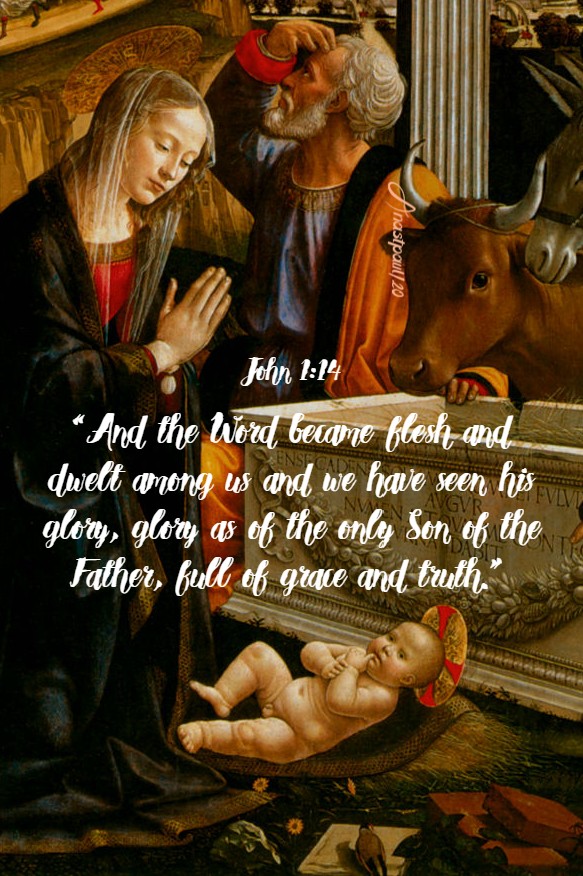
“And the Word became flesh and dwelt among us, full of grace and truth; we have beheld his glory, glory as of the only Son from the Father.”
Thought for the Day – 25 December – Meditations with Antonio Cardinal Bacci (1881-1971)
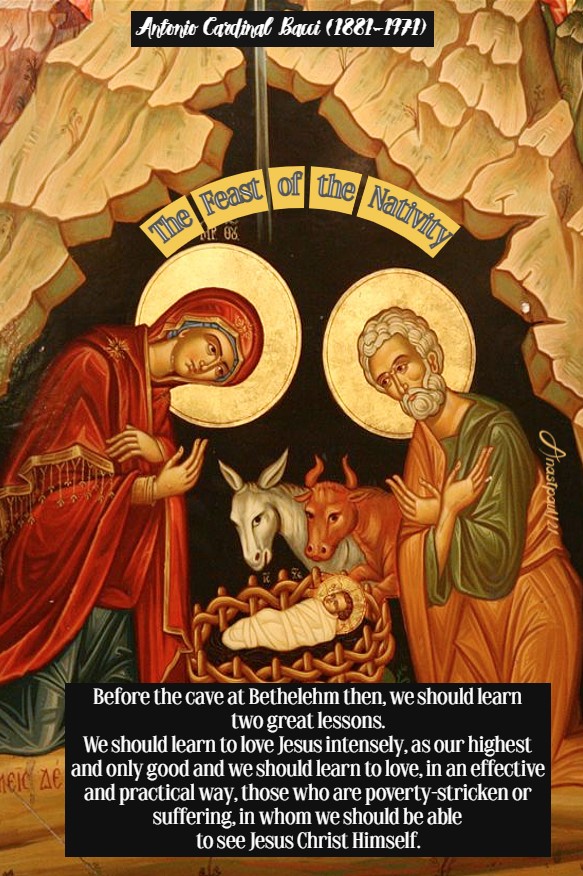
The Feast of the Nativity
“The world ignores the Birth of Jesus. There is no room for Him in the inns of Bethlehem and no room for Mary and Joseph, two poverty-stricken travellers, who are obliged, as a result, to take refuge in a miserable hovel. In the world, it is always so, for men judge one another by external appearances and by financial standards.
How do we behave towards Jesus Christ? How do we behave towards the needy and the afflicted, in whom we should discern the Person of Christ Himself?
If we are prepared to open our hearts to Jesus and to welcome Him as our King and absolute Master, we shall be so transformed, that we shall live His life and act in unison with Him. In short, we shall become saints! But if we are lacking in generosity and are reluctant to welcome Jesus unreservedly into our hearts, we shall never be more than half-Christian, tepid and ungrateful! We should even be prepared to welcome the poor as the representatives of Christ. “As long as you did it for one of these, the least of my brethren,” He has assured us, “you did it for me” (Mt 25-40).
Before the cave at Bethelehm then, we should learn two great lessons. We should learn to love Jesus intensely, as our highest and only good and we should learn to love, in an effective and practical way, those who are poverty-stricken or suffering, in whom we should be able to see Jesus Christ Himself.”
Quote/s of the Day – 25 December – The Solemnity of the Nativity of Our Lord, Jesus Christ
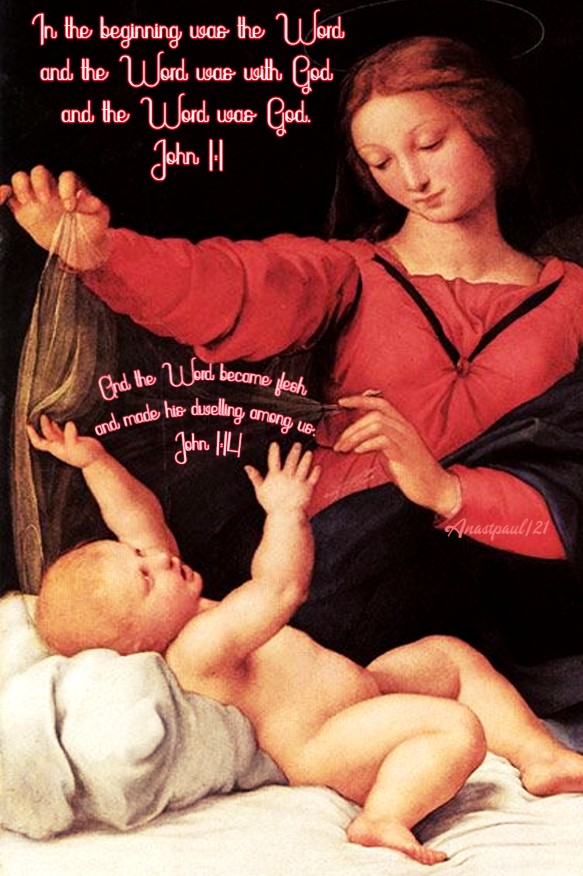
“In the beginning was the Word and the Word was with God and the Word was God.”
John 1:1
“And the Word became flesh and made his dwelling among us and we saw his glory, the glory as of the Father’s only Son, full of grace and truth.”
John 1:14
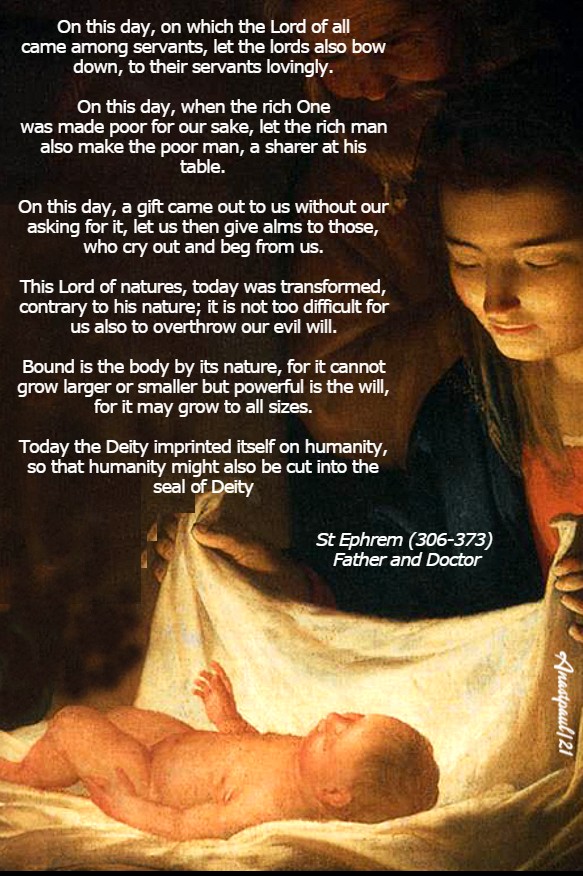
“On this day, on which the Lord of all came among servants, let the lords also bow down, to their servants lovingly.
On this day, when the rich One was made poor for our sake, let the rich man also make the poor man, a sharer at his table.
On this day, a gift came out to us without our asking for it, let us then give alms to those, who cry out and beg from us.
This Lord of natures, today was transformed, contrary to his nature; it is not too difficult for us also to overthrow our evil will.
Bound is the body by its nature, for it cannot grow larger or smaller but powerful is the will, for it may grow to all sizes.
Today the Deity imprinted itself on humanity, so that humanity might also be cut into the seal of Deity.”
St Ephrem (306-373) Father and Doctor
(Homily on Our Lord, 21)
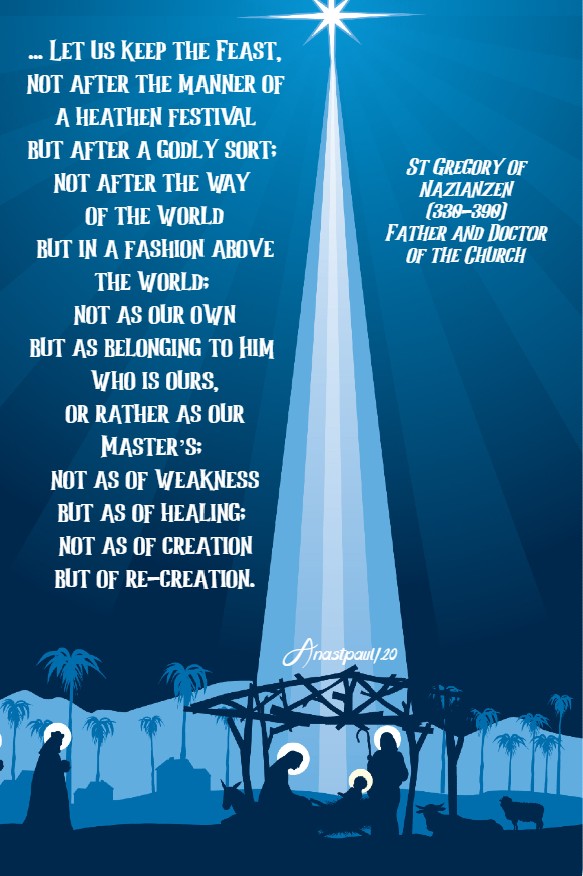
“… Let us keep the Feast, not after the manner of a heathen festival but after a godly sort; not after the way of the world but in a fashion above the world; not as our own but as belonging to Him who is ours, or rather as our Master’s; not as of weakness but as of healing; not as of creation but of re-creation.”
St Gregory of Nazianzen (330-390) Father and Doctor of the Church
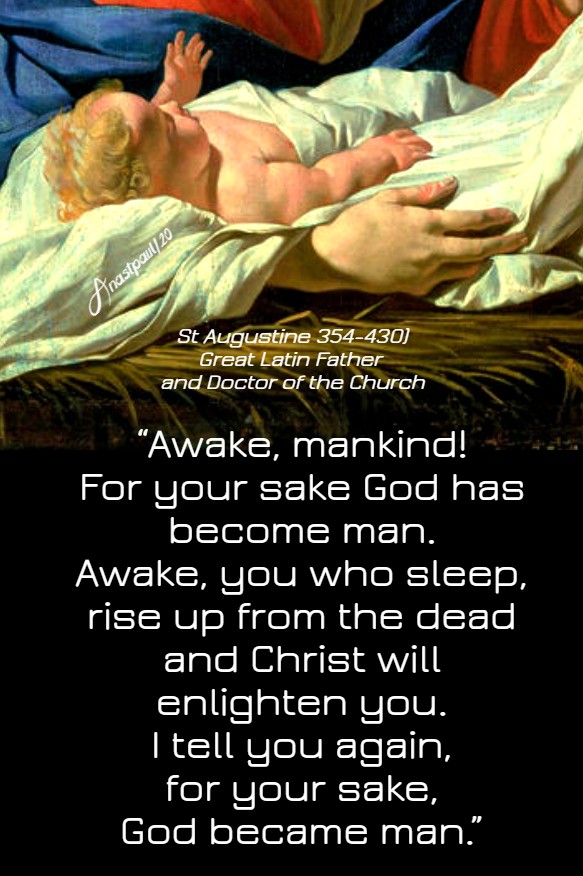
“Awake, mankind! For your sake God has become man. Awake, you who sleep, rise up from the dead and Christ will enlighten you. I tell you again, for your sake, God became man.”
St Augustine 354-430) Great Latin Father and Doctor of the Church
One Minute Reflection – 25 December – The Solemnity of the Nativity of Our Lord, Jesus Christ – Mass during the day – Readings: Isaiah 52:7-10, Psalm 98:1-6, Hebrews 1:1-6, John 1:1-18
Christ has been born for us, come, let us adore Him!
And the Word became flesh and dwelt among us, full of grace and truth; we have beheld his glory, glory as of the only Son from the Father. … John 1:14
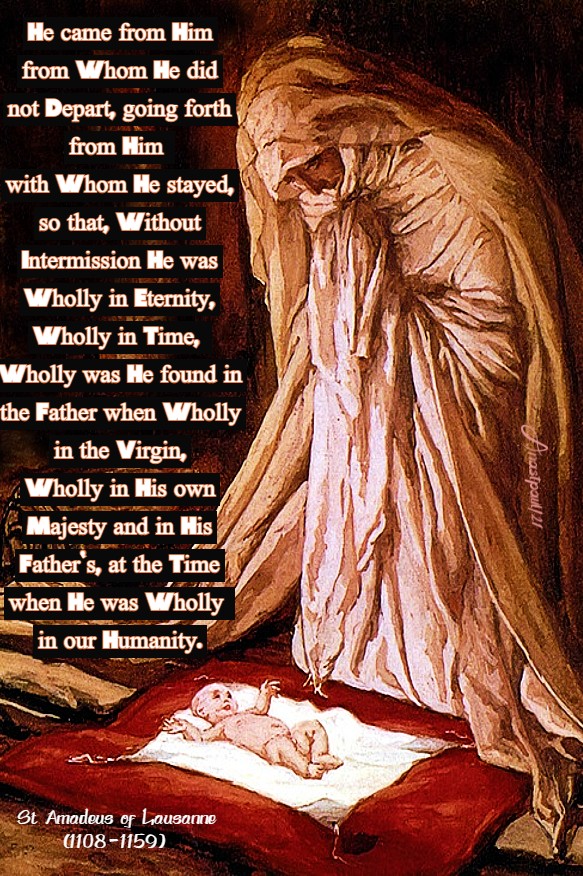
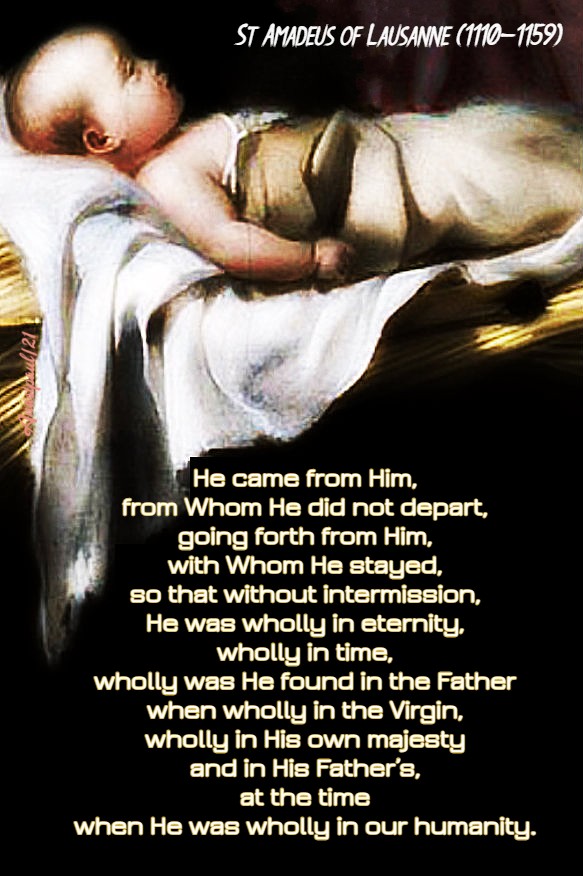
REFLECTION – “Christ has come from the Father, He has come from the Word, He has come from the Holy Spirit, since the whole Trinity accomplished His conception and His incarnation. For to come from the highest Trinity was, no other, than to be conceived and to become, a human being, by the same Trinity. Therefore, it was said: “His going forth is form the highest heaven.” (cf. Ps 18[19]:6) The Only-Begotten … begotten of the Father eternally, begotten in time, He came forth from His Mother, remaining invisibly with the Father and dwelling visibly with us. For to go forth from the Father was this – to enter upon our world, to be seen openly and to become what, from the nature of the Father, He was not. This indeed is wonderful, He came from Him from Whom He did not depart, going forth from Him, with Whom He stayed, so that without intermission, He was wholly in eternity, wholly in time, wholly was He found in the Father, when wholly in the Virgin, wholly in His own Majesty and in His Father’s at the time, when He was wholly in our humanity. If you ask how, gather the truth by means of an illustration. A word conceived in the heart goes forth complete in the voice, so that it comes perfectly to others, yet remains wholly in the heart. So the good Word, spoken forth from the heart of the Father, went forth into the broad plain, yet did not leave the Father.” … St Amadeus of Lausanne (1108-1159) Cistercian Monk and Bishop (On the praises of the Blessed Mary, homily II).
PRAYER – Almighty God, Your incarnate Word fills us with the new light He brought to men. Let the light of faith in our hearts, shine through all that we do and say. We make our prayer through Jesus Christ, our Lord, with the Holy Spirit, God forever, amen.
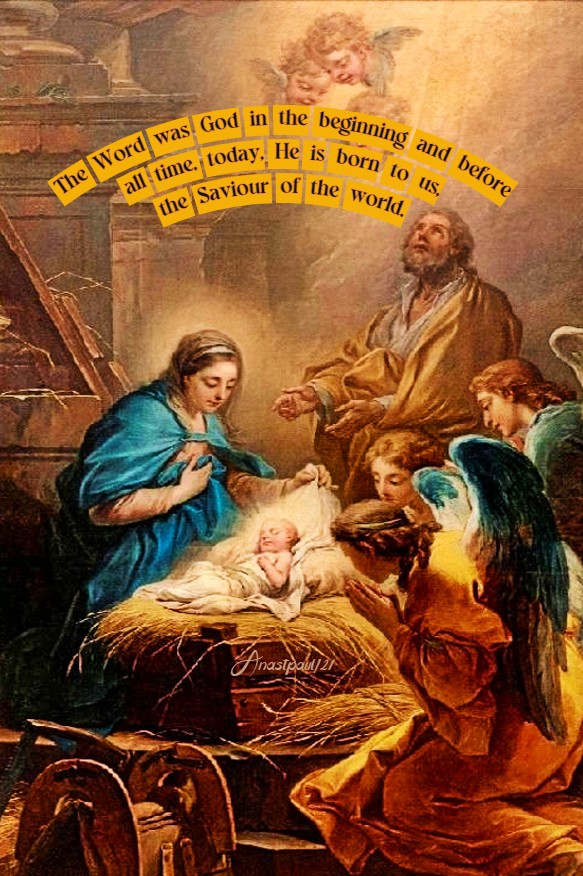
The Word was God in the beginning and before all time, today, He is born to us, the Saviour of the world.
Our Morning Offering – 25 December – The Solemnity of the Nativity of the Lord, Jesus Christ
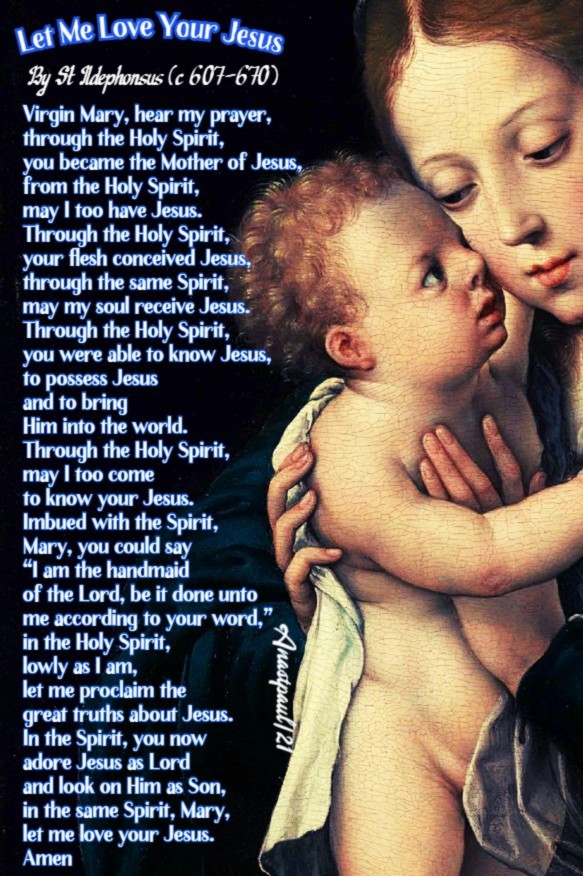
Let Me Love Your Jesus By St Ildephonsus (c 607-670)
Virgin Mary, hear my prayer, through the Holy Spirit, you became the Mother of Jesus, from the Holy Spirit, may I too have Jesus. Through the Holy Spirit, your flesh conceived Jesus, through the same Spirit, may my soul receive Jesus. Through the Holy Spirit, you were able to know Jesus, to possess Jesus and to bring Him into the world. Through the Holy Spirit, may I too come to know your Jesus. Imbued with the Spirit, Mary, you could say “I am the handmaid of the Lord, be it done unto me according to your word,” in the Holy Spirit, lowly as I am, let me proclaim the great truths about Jesus. In the Spirit, you now adore Jesus as Lord and look on Him as Son, in the same Spirit, Mary, let me love your Jesus. Amen
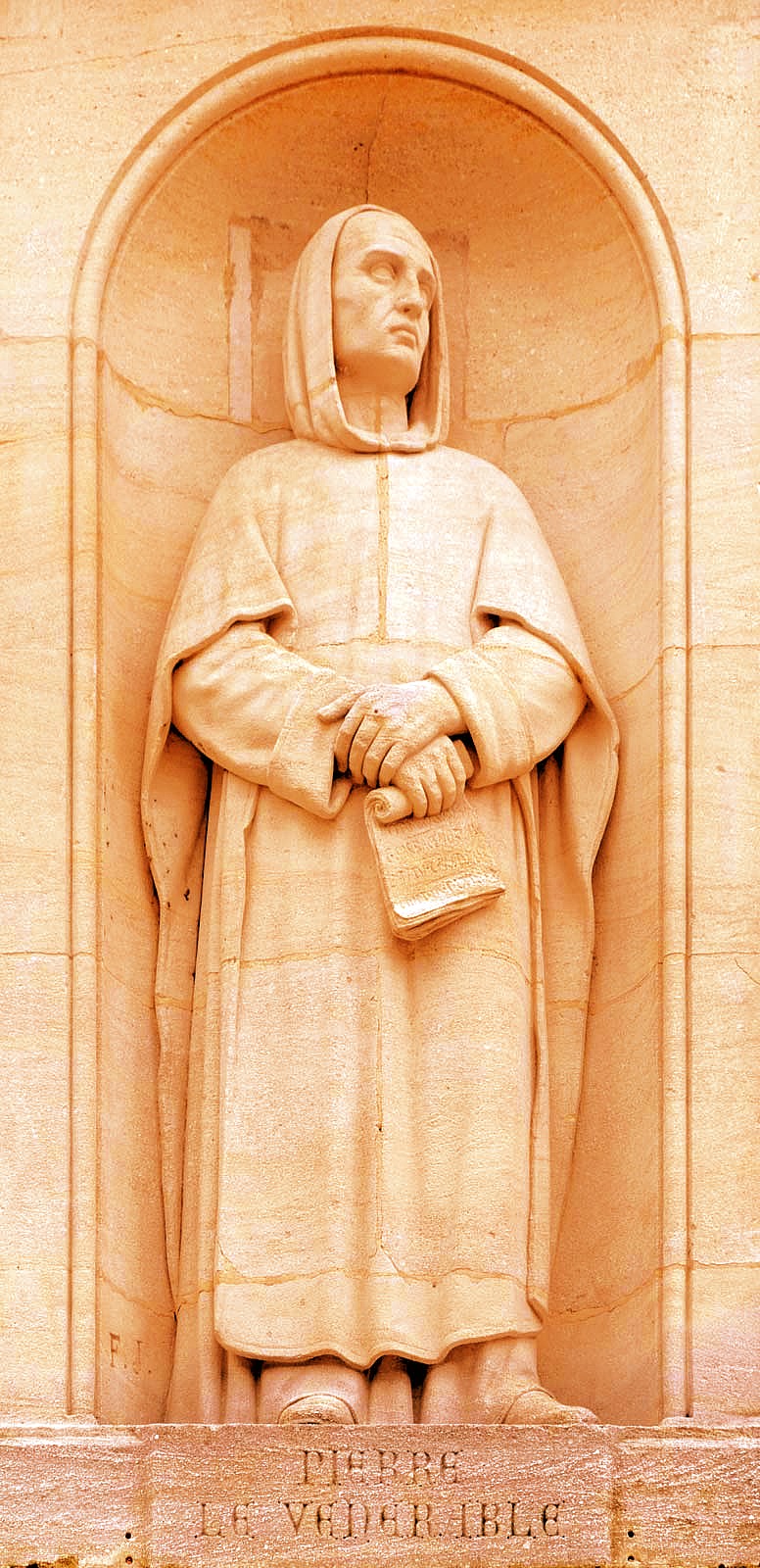
Saint of the Day – 25 December – Blessed Peter the Venerable (c 1092–1156) Eighth Abbot of Cluny, Reformer, Scholar and Writer, Poet. Born in c 1092 in Auvergne, France and died on 25 December 1156 of natural causes. Also known as – Peter of Cluny, Peter of Montboissier. Additional Memorials – 29 April as one of the Abbots of Cluny, 11 May (Benedictine calendar), 29 or 30 December on some calendars.
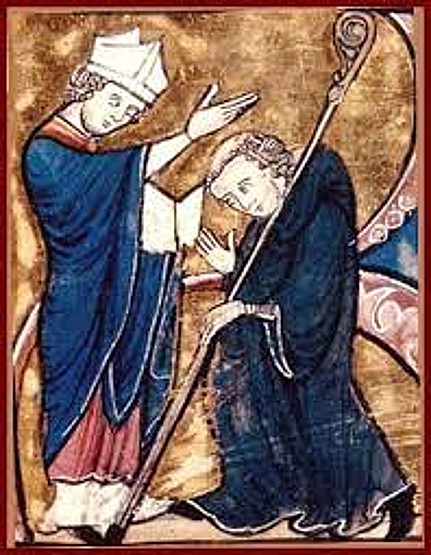
A descendant of the noble family of Montboissier, Peter was born to Blessed Raingarde in Auvergne, He was “Dedicated to God” at birth and was educated at the Mmonastery at Sauxillanges of the Congregation of Cluny. Peter, aged seventeen, made his profession to his Abbot, St Hugh, shortly before the latter’s death in 1109.. By the age of twenty he gained a professorship and was appointed Prior of the Monastery of Vézelay, before he moved to the Monastery at Domène.
Success at Vézelay and Domène led to his election as General of the Order, aged thirty. After his predecessor, the Abbot Pontius, had been deposed by the Pope, Peter became a tireless reformer of the Cluniac Order, in the face of criticism from other Orders and prominent Monks and theologians, including his great friend, St Bernard of Clairvaux. His defence of his Order against critics and his introduction of radical reforms, earned him the appellation of “venerable”.
Peter making his profession to St Hugh
His interest in the pursuit of studies at Cluny brought about a controversy with his intimate friend, St Bernard, who wished to see the monastic life confined to prayer and manual work. In 1130 Peter supported Pope Innocent II against the antipope Anacletus II, himself a Cluniac Monk and in 1140, he gave shelter to Abelard first at Cluny and later at the priory of St-Marcel-de-Chalon.
Between his numerous journeys, which took him to Spain in 1142, to Germany in 1147, twice to England and ten times to Italy, he frequently retired to a hermitage to devote himself to study and meditation. He was the first to have the Koran translated into Latin (completed 1143) and himself, wrote against the Muslims. His works, among which are treatises against Peter de Bruys and against the Jews (1144–7), a number of sermons and some poems, show comparatively little acquaintance with the Fathers but profound knowledge of the Scriptures and a preference for the literal sense, which causes him to avoid allegorical speculations. His friendship and correspondence with Bishop Henry of Blois of Winchester and Glastonbury, between 1138 and 1142, together with his debating skills, brought wider recognition of his scholarship. And, his moderation and gentleness earned him the veneration of his contemporaries but, in the eyes of posterity, he was overshadowed by the great figure of his illustrious friend, St Bernard.
Peter died a holy death on Christmas Day in 1156. He was in buried in the southern end of the cloister of the Monastery Church of Cluny Abbey. Sadly, his grave was desecrated by the Huguenots in 1562 and most of his relics were destroyed in 1792 in the anti–Catholic excesses of the French Revolution.
Although he has always been honoured as a Saint, he was never canonised and the Martyrologies grants him the title of Blessed. His cult was finally confirmed in 1862 by Blessed Pope Pius IX. and in France and around Europe, he is called “Saint.”
The Solemnity of the Nativity of the Lord, Jesus Christ – Celebration of the anniversary of the Birth of Our Lord. In the earliest days of the Church there was no such Feast, the Saviour’s Birth was commemorated with the Epiphany by the Greek and other Eastern Churches. First mention of the Feast, then kept on 20 May, was made by Clement of Alexandria c 200. The Latin Church began c 300 to observe it on 25 December, though there is no certainty that Our Lord was born on that day. Priests have the privilege of saying three Masses, at midnight, daybreak and morning. This was originally reserved to the Holy Father alone – beginning about the 4th century he celebrated a midnight Mass in the Lateran Basilica (in which according to tradition, the manger of Bethlehem is preserved), a second in the church of Saint Anastasia, whose Feast comes on 25 December and a third at the Vatican Basilica. Many peculiar customs of the day are the outcome of the pagan celebrations of the January calendar. The Christmas tree, of which the first known mention was made in 1605 at Strasbourg, was introduced into France and England in 1840. The feast is a holy day of obligation, preceded by the preparatory season of Advent and by a special Vigil – should it fall on a Friday it abrogates the law of abstinence. Today’s Gospel is the prologue of John.
I know not how, dear Lady love, To offer you my praise, I cannot fashion as I wish The words that I world raise. You stand afar, celestial Queen, The stars are in your crown, They spangle at each gesture’s path And dust upon your gown. Perhaps I might recall the night You knelt beside the crib, The night when doors and casements shut And left a mountain’s rib, Alone, exposed, to hoard you close Beside the new-born Child And seek in Joseph’s kindly eyes For something worldly-mild. To counteract such mundane chill I hereby set my heart, Dim mirror of an Infant’s warmth, Its flaming but a part, A small, sad part of Endless Love That came on Christmas day To show a mother wonder-bright To guide us on our way.
St Adalsindis of Hamay St Alburga of Wilton St Anastasia of Sirmium Bl Artale St Basilée of the Via Latina Bl Bentivoglio de Bonis Bl Diego de Aro St Eugenia of Rome St Fulk of Toulouse
St Jovin of the Via Latina Bl Maria Therese von Wüllenweber Bl Matthew of Albano Bl Michael Nakashima Saburoemon Bl Nera Blessed Peter the Venerable (c 1092–1156) Abbot St Romulus of Berry —
Martyrs of Nicomedia: 20,000 Christians martyred by order of Diocletian. They were reported to have all been in the single basilica to celebrate Christmas. While there unquestionably was an endless series of martyrs under Diocletian, it’s likely the ancient sources exaggerated the numbers of this incident. And as the Christmas holy day was not celebrated in the East in 303, they were probably gathered for another feast. They were burned alive in 303 in the basilica of Nicomedia.
Thought for the Day – 24 December – Meditations with Antonio Cardinal Bacci (1881-1971)
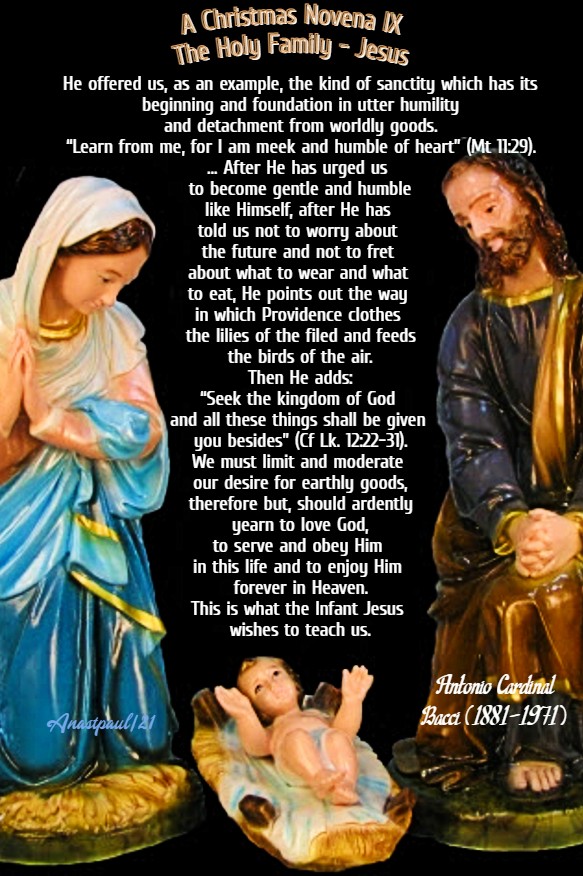
A Christmas Novena IX The Holy Family – Jesus
“We have in the Holy Family, the highest possible models of perfection – Jesus, Mary and Joseph. As God, Jesus is essentially holy. By means of the Hypostatic Union, this sanctity is transmitted also to His human nature. The holiness of Jesus was only gradually revealed as He grew older because He wished to be like us in everything, save in sin. As the Gospel says, He “advanced in wisdom and age and grace before God and men” (Lk 2:52). Jesus gave us an example of holiness which we should find easier to imitate because it was eternally increasing all the time. He offered us, as an example, the kind of sanctity which has its beginning and foundation in utter humility and detachment from worldly goods. “Learn from me, for I am meek and humble of heart” (Mt 11:29).
Socrates advised his followers to have few desires and to desire these as little as possible, in order to remain content, for the man who is full of desires is always uneasy and restless. This human counsel is very true but, it is incomplete. It recommends detachment from earthly things but fails to teach the ardent and practical desire for supernatural things. Jesus Christ teaches us both. After He has urged us to become gentle and humble like Himself, after He has told us not to worry about the future and not to fret about what to wear and what to eat, He points out the way in which Providence clothes the lilies of the filed and feeds the birds of the air. Then He adds: “Seek the kingdom of God and all these things shall be given you besides” (Cf Lk. 12:22-31).
We must limit and moderate our desire for earthly goods, therefore but, should ardently yearn to love God, to serve and obey Him in this life and to enjoy Him forever in Heaven. This is what the Infant Jesus wishes to teach us.”
Quote/s of the Day – 24 December – The Nativity of the Lord, Mass at Midnight
The Burning Babe St Robert Southwell SJ (1561-1595) Priest and Martyr
As I in hoary winter’s night stood shivering in the snow, Surprised I was with sudden heat which made my heart to glow; And lifting up a fearful eye to view what fire was near, A pretty Babe all burning bright did in the air appear; Who, scorchëd with excessive heat, such floods of tears did shed As though His floods should quench His flames which with His tears were fed. Alas, quoth He but newly born in fiery heats I fry, Yet none approach to warm their hearts or feel My fire but I! My faultless breast the furnace is, the fuel ,wounding thorns, Love is the fire and sighs, the smoke, the ashes, shame and scorns; The fuel, justice layeth on and mercy blows the coals, The metal in this furnace wrought, are men’s defiled souls, For which, as now on fire I am, to work them to their good, So will I melt into a bath, to wash them in My Blood. With this He vanished, out of sight and swiftly shrunk away, And straight I called unto mind that it was Christmas day.
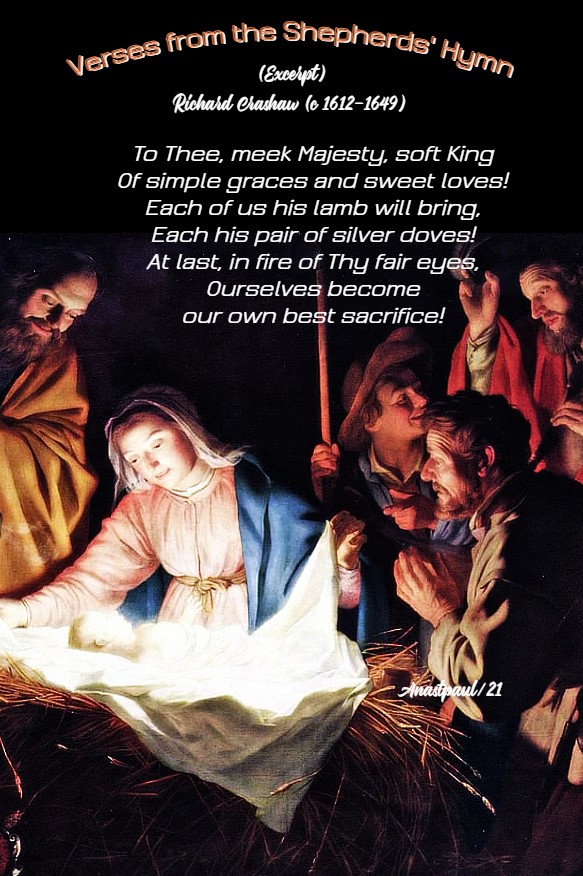
Verses from the Shepherds’ Hymn Richard Crashaw (c 1612-1649) Canon of the Holy House of Loreto
WE saw Thee in Thy balmy nest, Young Dawn of our eternal day; We saw Thine eyes break from the East, And chase the trembling shades away: We saw Thee and we blest the sight, We saw Thee by Thine own sweet Light.
Poor world, said I, what wilt thou do To entertain this starry stranger? Is this the best thou canst bestow— A cold and not too cleanly manger? Contend, the powers of heaven and earth, To fit a bed for this huge birth.
Proud world, said I, cease your contest, And let the mighty Babe alone; The phoenix builds the phoenix’ nest, Love’s architecture is His own. The Babe, whose birth embraves this morn, Made His own bed ere He was born.
I saw the curl’d drops, soft and slow, Come hovering o’er the place’s head, Off’ring their whitest sheets of snow, To furnish the fair Infant’s bed. Forbear, said I, be not too bold; Your fleece is white, but ’tis too cold.
I saw th’ obsequious Seraphim Their rosy fleece of fire bestow, For well they now can spare their wings, Since Heaven itself, lies here below. Well done, said I but are you sure Your down, so warm, will pass for pure?
No, no, your King ‘s not yet to seek Where to repose His royal head; See, see how soon His new-bloom’d cheek ‘Twixt mother’s breasts is gone to bed! Sweet choice, said we; no way but so, Not to lie cold, you sleep in snow!
She sings Thy tears asleep and dips Her kisses in Thy weeping eye; She spreads the red leaves of Thy lips, That in their buds yet blushing lie. She ‘gainst those mother diamonds tries The points of her young eagle’s eyes.
Welcome—tho’ not to those gay flies, Gilded i’ th’ beams of earthly kings, Slippery souls in smiling eyes— But to poor shepherds, homespun things, Whose wealth ‘s their flocks, whose wit ‘s to be Well read in their simplicity.
Yet, when young April’s husband show’rs Shall bless the fruitful Maia’s bed, We’ll bring the first-born of her flowers, To kiss Thy feet and crown Thy head. To Thee, dread Lamb! whose love must keep The shepherds, while they feed their sheep.
To Thee, meek Majesty, soft King Of simple graces and sweet loves! Each of us his lamb will bring, Each his pair of silver doves! At last, in fire of Thy fair eyes, Ourselves become our own best sacrifice!
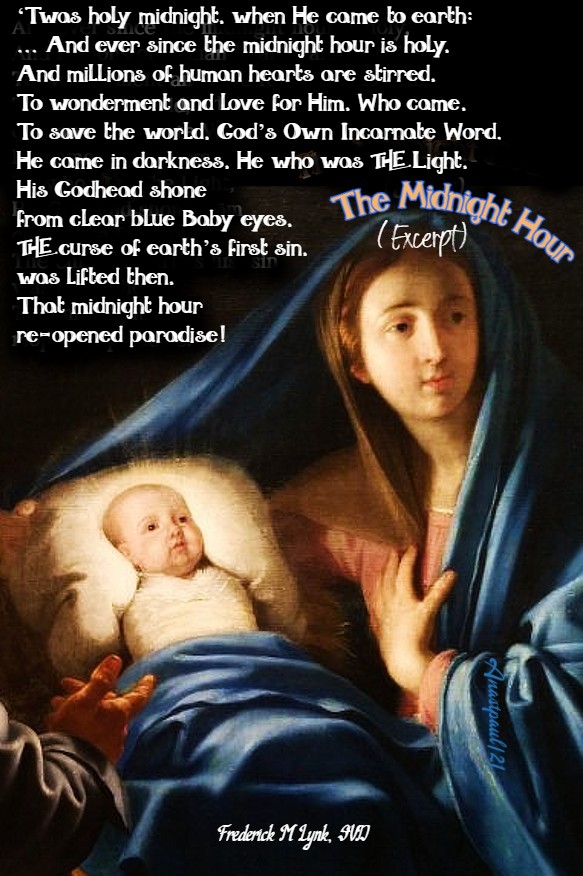
The Midnight Hour (Fr or Br) Frederick M Lynk, SVD
The Virgin Mother kneels upon the floor And holds her Baby in her arm, Her heart is gladder than her lips can say, To keep her newborn Baby snug and warm, A Babe more sweet and fair and dear Than any rosebud in the bright sunshine, Whose little eyes look straight into her own, O, blessed maid, God’s Son is also thine.
‘Twas holy midnight, when He came to earth: As pours a sun ray through a limpid glass, Not leaving any mark upon its face; A drop of dew upon the fresh green grass, A little star that fell upon her lap, A cooing Babe, that seeks her virgin breast. The hopes of all the sin-cursed world Upon this Baby’s eyelids rest.
And ever since the midnight hour is holy, And millions of human hearts are stirred, To wonderment and love for Him, Who came, To save the world, God’s own Incarnate Word. He came in darkness, He who was The Light, His Godhead shone from clear blue Baby eyes, The curse of earth’s first sin, was lifted then, That midnight hour re-opened paradise!
One Minute Reflection – 24 December – “Month of the Immaculate Conception” – “Rejoice! Rejoice! Emmanuel” – The Nativity of the Lord, Mass at Midnight – Readings: Isaiah 62:1-5, Psalms 89:4-5, 16-17, 27, 29, Acts 13:16-17, 22-25, Luke 2:1-14
Know today that the Lord will come – in the morning you will see His glory.
Rejoice! Rejoice! Emmanuel Shall come to thee, O Israel! May the Lord bless us, protect us from all evil and bring us to everlasting life.
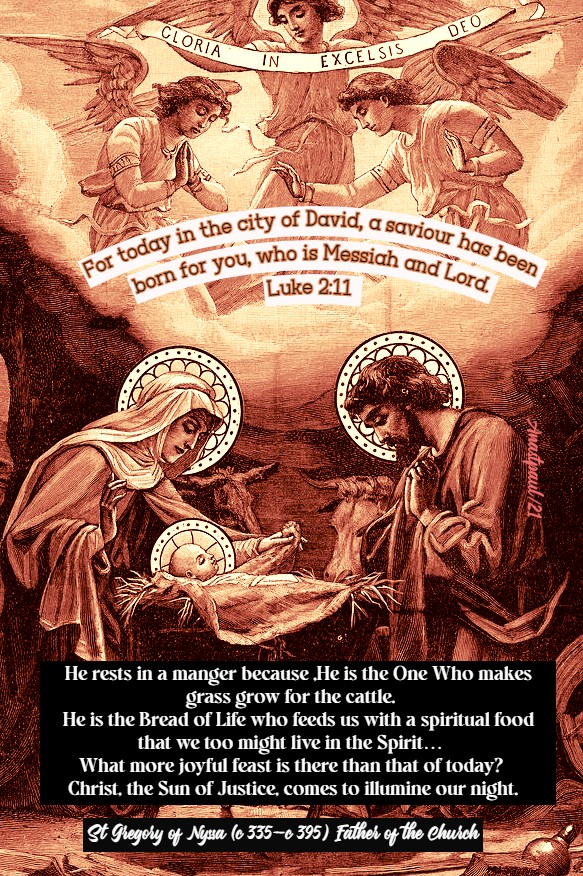
“For today in the city of David, a saviour has been born for you, who is Messiah and Lord.” – Luke 2:11
REFLECTION – “Brethren, now we have been told about the miracle, let us turn aside to see this unusual sight as Moses did (Ex 3:3) – in Mary, the burning bush is not consumed, the Virgin gives birth to the Light, without defilement … Let us then run to Bethlehem, the town of the Good News! If we are real shepherds, staying awake on our watch, then it is to us that the voice of the angels is addressed, announcing a great joy … “Glory to God in the highest for peace is coming down to earth!” There where, only yesterday, there was nothing but misfortune, battlefields and exile, now earth receives peace for today “Truth shall spring out of the earth and justice shall look down from heaven” (Ps 84[85]:12). Behold the fruit earth gives to humankind, in reward for the goodwill reigning among men (Lk 2:14). God is joined to man, to raise man to the stature of God.
At this news, my brethren, let us go to Bethlehem to behold … the mystery of the crib, a child wrapped in swaddling clothes rests in a manger. A Virgin, after giving birth, His undefiled Mother, embraces her Son. Let us repeat the words of the prophet along with the shepherds: “As we have heard, so we have seen in the city of our God.” (Ps 47[48]:9)
But why does our Lord seek shelter in this cave at Bethlehem? Why is He sleeping in a manger? Why does He participate in Israel’s census? My brethren, He who brings liberty to the world, comes to be born into our slavery to death. He is born in this cave to reveal Himself to us, who are immersed in darkness and the shadow of death. He rests in a manger because ,He is the One Who makes grass grow for the cattle (Ps 104[103],14). He is the Bread of Life who feeds us with a spiritual food that we too might live in the Spirit… What more joyful feast is there than that of today? Christ, the Sun of Justice (Mal 3,20), comes to illumine our night. What had fallen, is raised up again, what was overcome, is now set free… what was dead is restored to life… Let us all sing today with one voice over all the earth: “Death came through one man, Adam, today salvation has come through one man (cf Rom 5,17)” … St Gregory of Nyssa (c 335–c 395) Bishop, Father of the Church (Sermon on the Nativity).
PRAYER – Almighty God, Your Incarnate Word fills us with the new Light, He brings to men. Let the light of faith in our hearts shine through all that we do and say. And may the Immaculate Virgin Mother of our Saviour, be ever near to help and protect us. Through Christ, our Lord and Saviour, with the Holy Spirit, one God with You, now and for all time and eternity, amen.
Our Morning Offering – 24 December – Vigil of the Nativity of the Lord/Mass at Midnight
Silent Night, Holy Night! Stille Nacht, heilige Nacht! By Father Joseph Mohr (1792-1818)
Silent night, holy night! All is calm, all is bright, Round yon Virgin Mother and Child! Holy Infant so tender and mild, Sleep in heavenly peace, Sleep in heavenly peace.
Silent night, holy night! Son of God, how the light Radiates love from Thy heavenly face, At the dawn of redeeming grace, Jesus, Lord at Thy birth, Jesus, Lord at Thy birth.
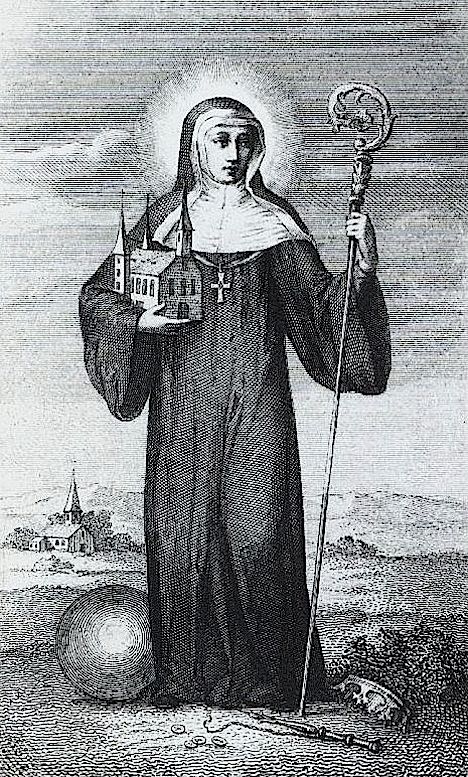
Saint of the Day – 24 December – Saint Irmina of Oehren (Died c 716) Virgin Princess, Nun, Abbess, Founder and Co-founder of 2 Monasteries, benefactress of St Willibrord, the great Missionary Saint of Germany. Died c 716 at the Monastery of Weissenburg, Germany of natural causes. Patronages – Trier, City and Diocese. Also known as – Irmina of Trier, Irmina of Treves, Irma…Ermina… Hermione… Ymena… Additional Memorials – 3 January in Luxembourg, 30 January in the Diocese of Trier, Germany.
The Roman Martyrology states: “In Trier in Austrasia, in Germany, Saint Irmina, Abbess of the Monastery of Öhren, who, a virgin consecrated to God, gave Saint Willibrord a small Monastery she founded in her villa in Echternach and was a generous giver of her goods.”
Various traditions exist of her parentage but what is certain is that she came from one of the most powerful families in the Merovingian kingdom.
According to many versions of Irmina’s biography, when she was fifteen years old, she was engaged to marry a man named Count Hermann but just before they were to marry, he was killed by one of his servants, who “admired Irmina and could not bear that his master should have he,”
Irmina’s father was ready to marry her to another man but she chose to become a Nun instead, a decision he supported, building her a Convent in Oeren, which was eventually named after her and where she later became its second Abbess. She was succeeded as Abbess by her sister, Saint Modesta.
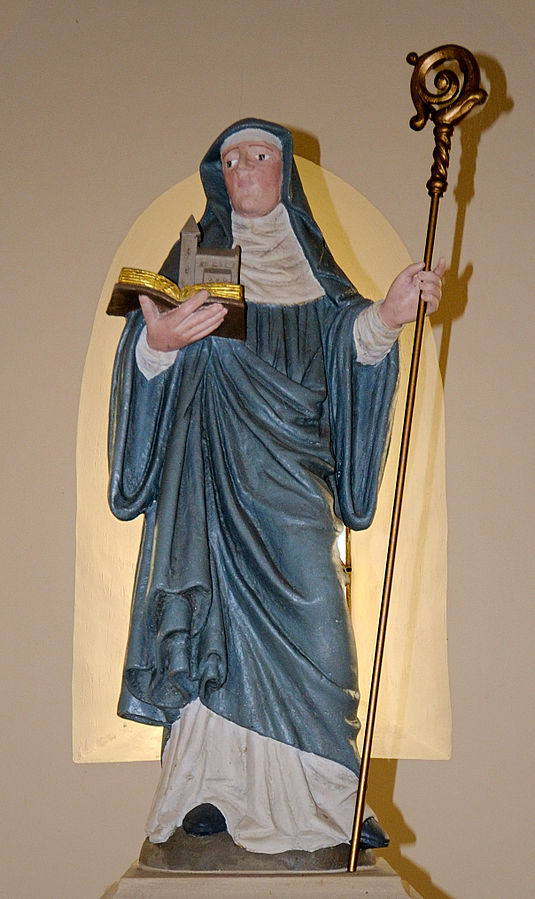
Statue of Saint Irmina at the cCnvent in Echternach
In 697, Irmina donated lands to help co-found, with Saint Willibrord the Convent in Echternacht. Historian Jamie Kreiner called the founding of the Echternacht Convent “a co-operative venture” between Willibrord and Irmina’s family, who later promised to protect the Convent and its holdings after Willibrord promised fidelity to them in 706.
Another document reports that Irmina was “generous to both Celtic and Saxon missionary Monks“. Irmina died in c 716 at the Monastery at Weissenburg, which was also founded by her father
24 December – Vigil of the Nativity of the Lord/Mass at Midnight Midnight Mass is the first liturgy of Christmastide that is celebrated on the night of Christmas Eve, traditionally beginning at midnight when Christmas Eve gives way to Christmas Day. This popular Christmas custom is a jubilant celebration of the Mass in honour of the Nativity of Jesus Christ.
Saint Thomas Aquinas wrote a commentary on these words and explained in his Summa Theologiae, “And from this ,the Mass derives its name … the deacon on festival days ‘dismisses’ the people at the end of the Mass, by saying: ‘Ite, missa est,’ that is, the victim [Jesus] has been sent to God through the angel, so that it may be accepted by God.”
St Adam the Patriarch St Adela of Pfalzel Bl Alberic of Gladbach Bl Brocard of Strasbourg St Bruno of Ottobeuren St Caran of Scotland St Delphinus of Bordeaux
Bl Peter de Solanes Bl Venerandus of Clermont — • Blessed Dionysius Roneo • Blessed Philip Claro • Blessed Giulio Pons • Blessed Peter of Valladolid
Blessed Mercedarian Sisters – (6 beati): Six cloistered Mercedarian nuns at the convent of Vera Cruz in Berriz, Spain. Noted for their devotion to the rules of the Order and for their deep prayer lives. • Blessed Anna Maria Prieto • Blessed Anna de Arrano • Blessed Orsola de Larisgoizia • Blessed Maguna Mary • Blessed Margaret • Blessed Mary of the Assumption Sarria
Martyred Maidens of Antioch – (40 saints): A group of forty virgins martyred in the persecutions of Decius. None of their names have come down to us. They were martyred in 250 in Antioch, Syria.
Martyrs of Tripoli – (6 saints): A group of Christians martyred together, date unknown. The only details that have survived are six of the names – Drusus, Lucian, Metrobius, Paul, Theotimus and Zenobius. They were martyred in Tripoli, Libya.
Thought for the Day – 23 December – Meditations with Antonio Cardinal Bacci (1881-1971)
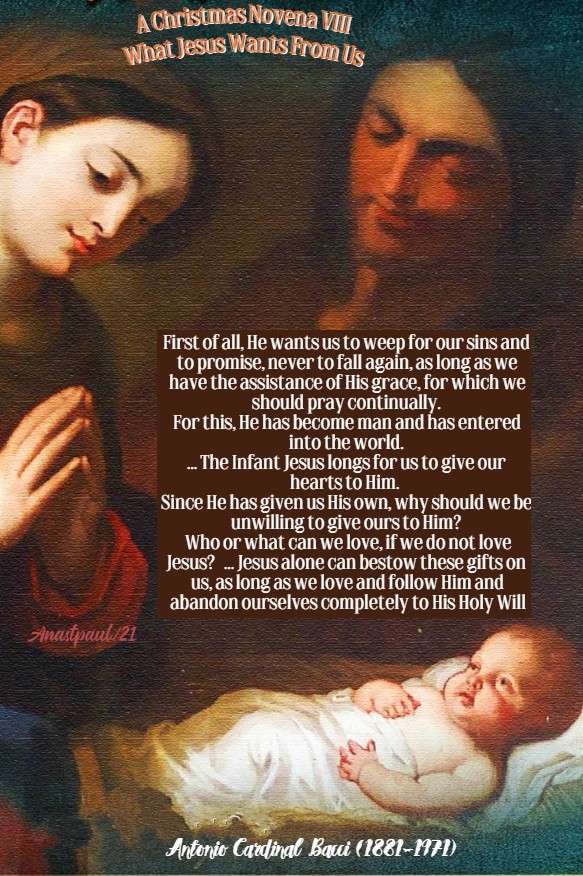
A Christmas Novena VIII What Jesus Wants From Us
“Let us contemplate Jesus lying on a rough pallet of straw in the manger. When we see Him looking at us, let us ask ourselves what it is that He requires of us. In fact, He wants many things from us. First of all, He wants us to weep for our sins and to promise, never to fall again, as long as we have the assistance of His grace, for which we should pray continually. For this, He has become man and has entered into the world. For this He will work miracles, preach His doctrine and shed His Precious Blood on the Cross. All this He will do to redeem us from sin and to win Heaven for us.
If we return to the path of sin, we destroy the divine work of redemption, inasfar as it applies to ourselves. We make Christ’s passion, death and resurrection useless in our case. We brush aside the chain of favours with which His love has girdled us – the Gospel, the Sacraments and the Church, our good mother who is always at our side to instruct and direct us, to rescue us from peril and, to distribute to us, the gifts of her divine Founder. When we sin, we commit an act of base ingratitude to Jesus and accomplish our own eternal ruin.
The Infant Jesus longs for us to give our hearts to Him. Since He has given us His own, why should we be unwilling to give ours to Him? Who or what can we love, if we do not love Jesus? Nothing else is capable of giving us peace of soul and resignation in suffering. Jesus alone can bestow these gifts on us, as long as we love and follow Him and abandon ourselves completely to His Holy Will.”
“And so, when God’s birth is proclaimed to you, keep silent. Let Gabriel’s word be held in your mind for nothing is impossible to this glorious Majesty, who humbled Himself for us and was born of our humanity.”
St Ephrem (306-373) Father & Doctor
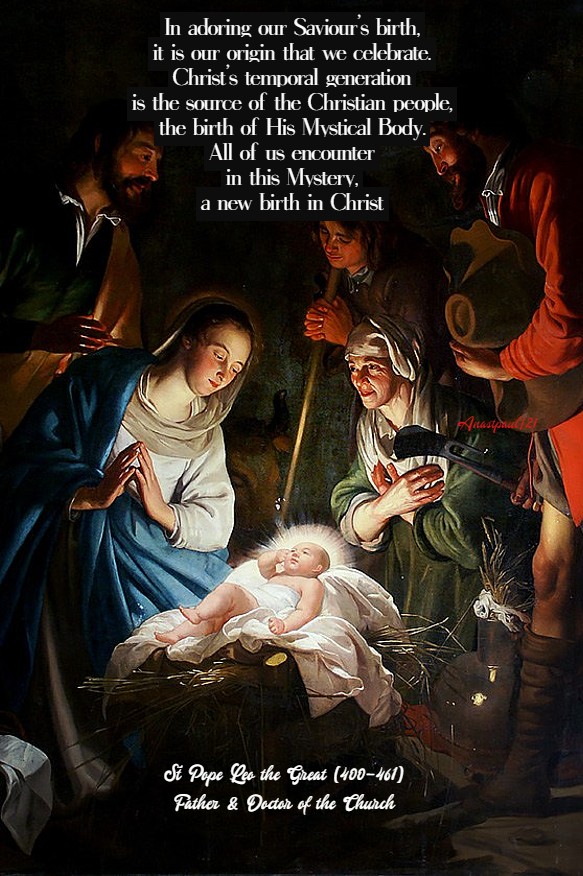
“In adoring our Saviour’s birth, it is our origin that we celebrate. Christ’s temporal generation is the source of the Christian people, the birth of His Mystical Body. All of us encounter in this Mystery, a new birth in Christ.”
St Pope Leo the Great (400-461) Father & Doctor of the Church
“He came from Him, from Whom He did not depart, going forth from Him, with Whom He stayed, so that without intermission, He was wholly in eternity, wholly in time, wholly was He found in the Father when wholly in the Virgin, wholly in His own Majesty and in His Father’s, at the time when He was wholly in our humanity. ”
One Minute Reflection – 23 December – O Emmanuel – Readings: Malachi 3:1-4, 23-24, Psalms 25:4-5,8-9, 10 and 14, Luke 1:57-66
The Lord is at hand, come, let us adore Him.
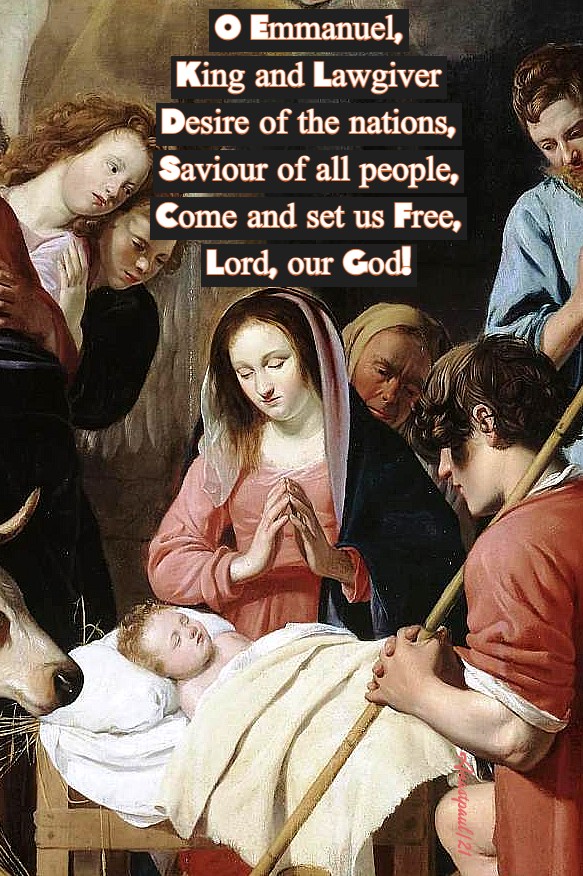
O Emmanuel, King and Lawgiver Desire of the nations, Saviour of all people, Come and set us free, Lord, our God!
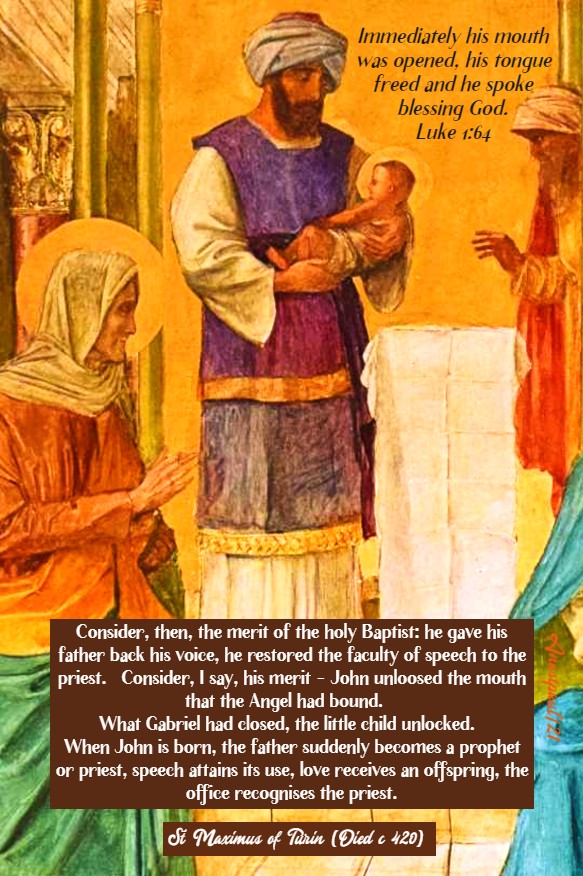
“Immediately his mouth was opened, his tongue freed and he spoke blessing God.” – Luke 1:64
REFLECTION – “When John, his son was born, among his neighbours there was concern about what name he should be given. Writing tablets were offered to his father, so that he himself could put down the name that he had decided upon, so that he might express, in writing, what he could not, in speech. Then, in a wonderful manner, when he had taken the tablets in order to begin writing, his tongue was loosened, the written word gave way to speech and he did not write “John” but spoke it. Consider, then, the merit of the holy Baptist: he gave his father back his voice, he restored the faculty of speech to the priest. Consider, I say, his merit – John unloosed the mouth that the angel had bound. What Gabriel had closed, the little child unlocked. When John is born, the father suddenly becomes a prophet or priest, speech attains its use, love receives an offspring, the office recognises the priest.” – St Maximus of Turin (Died c 420) Bishop of Turin (Sermon 6)
PRAYER – Almighty God, now that the birth of Your Son is drawing near, we pray that Your eternal Word, Who took flesh in the womb of the Virgin Mary and came to dwell amongst men, will show Your unworthy people, the greatness of His love. And by the intercession of His Holy Mother, may we be granted Your grace. Through Emmanuel, our Lord, Who lives and reigns with You and the Holy Spirit, God forever and ever, amen.
O Come, O come, Emmanuel And ransom captive Israel, That mourns in lonely exile here Until the Son of God appear. Refrain: Rejoice! Rejoice! Emmanuel Shall come to thee, O Israel!
O come, Thou Wisdom, from on high And order all things far and nigh, To us the path of knowledge show And teach us in her ways to go. Refrain
O come, o come, Thou Lord of might, Who to thy tribes on Sinai’s height In ancient times did give the law, In cloud, and majesty and awe. Refrain
O come, Thou Rod of Jesse’s stem, From ev’ry foe deliver them That trust Thy mighty power to save And give them vict’ry o’er the grave. Refrain
O come, Thou Key of David, come And open wide our heav’nly home, Make safe the way that leads on high, That we no more have cause to sigh. Refrain
O come, Thou Dayspring from on high And cheer us by thy drawing nigh. Disperse the gloomy clouds of night And death’s dark shadow put to flight. Refrain
O come, Desire of nations, bind In one the hearts of all mankind. Bid every strife and quarrel cease And fill the world with heaven’s peace. Refrain
The favourite O Come, O Come Emmanuel carol was originally written in Latin text in the 12th Century. The author of the words and composer to the music of O Come, O Come Emmanuel is unknown. It is, however, believed that the melody was of French origin and added to the text a hundred years later. The Latin was translated into English by John Mason Neale in 1851.
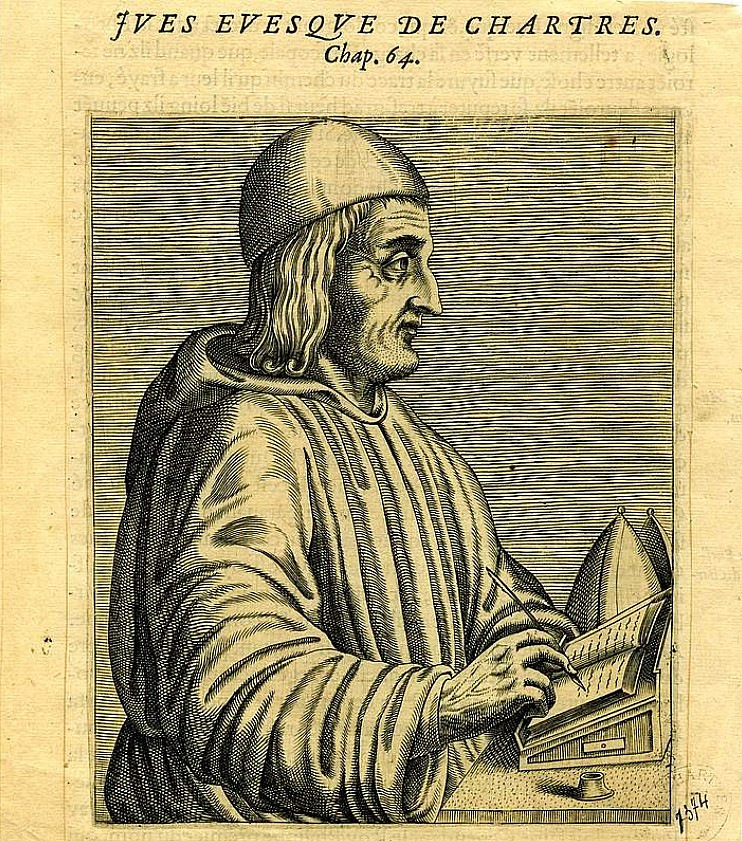
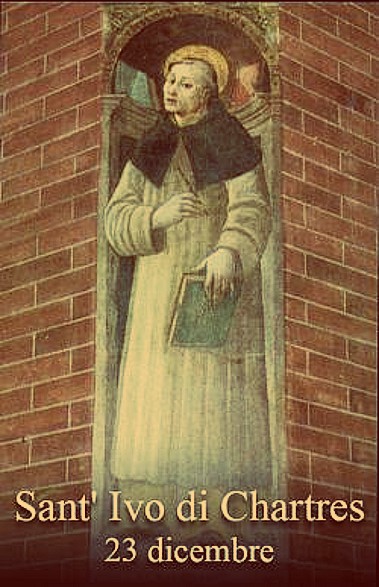
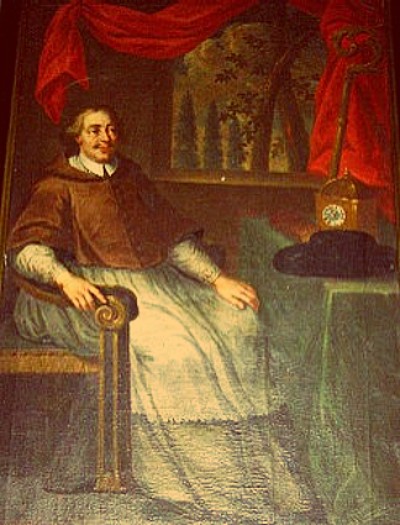
Saint of the Day – 23 December – Saint Ivo of Chartres (c 1040-1115) Bishop of Chartres, France from 1090 until his death, Confessor, Reformer, Defender of the Faith, Lawyer, Canon Lawyer, Teacher and Theologian, Writer. Born in c 1040 at Beauvais, France as Yves and died on 23 December 1115 of natural causes. Patronage – Canonists, Canon Lawyers. Also known as – Yves, Yvo, Ives.
The Roman Martyrology states: “In Chartres in France, Saint Ivo, Bishop, who re-established the Order of the Canons and did much work and wrote to promote harmony between the clergy and the civil powers and for the good of the Church.”
Ivo was born around 1040 near Beauvais (Rouen) to Ugo d’Auteuil and Ilmenberga, wealthy parents who gave him a good basic education, increased by the studies he continued at the University of Paris , already a great cultural centre at that time.
He continued his studies in theology in the Abbey of Le Bec in Normandy, where he met Saint Anselm of Canterbury, the great scholastic theologian. as a fellow student and as his teacher, the future Bishop, then a Monk, Lanfranc of Pavia, who became the Archbishop of Canterbury in 1070. Here he was Ordained as a Priest.
Ivo was then appointed Canon of Nesles in Picardy but after a few years he was recalled to Beauvais by Bishop Guido, who entrusted him with the direction of the newly founded Monastery of the Canons Regular of Saint-Quentin. Ivo became its guide from 1078 to 1090. Here Ivo established himself as one of the best teachers in France. St Quentin’s came to be known as a great school of theology. Ivo was skeptical of religious excess and always stressed moderation in practice.
He was about 50 years old when the clergy and faithful people of Chartres, where construction of the grandiose Gothic Cathedral would begin a few years later designated Ivo as their Bishop, replacing the deposed Godfrey accused of simony.
Goffred appealed to Rome but Pope Urban II ruled against him and confirmed the investiture of Ivo. His election to the See of Chartres was also confirmed by the King of France Philip I. At that point it was the Archbishop of Sens, Richer who opposed it, not having been consulted in the Roman trial against Godfrey. Ivo then, decided to go directly to the Pope, who, in the meantime, had had to leave Rome to take refuge in Capua, fleeing the army of the German Emperor Henry IV (1050 – 1106) engaged in the fight for investitures, already against the Pope Gregory VII his predecessor and it was in Capua, towards the end of 1090, that Pope Urban II Consecrated him Bishop of Chartres.
His strong faith, piety,and principles led to some troubles for him during his twenty-five year episcopacy at Chartres .The first years were marked by the clash with the French King Philip I, who had contracted an adulterous marriage with Bertranda of Montfort. Ivo opposed this and thus aroused the anger of the King who had him put in prison for many months. After his release, Ivo resumed his protests, both against the King and against the Bishops who were in favour of the adulterous relationship of the King and failed to defend Church doctrine. Finally, in 1095, Ivo resorted to Rome, so that the partisans of the King were rebuked and the King himself, was excommunicated. In this same year, Pope Urban II came to France to attend the Council of Clermont , where the foundations of the first Crusade were laid. Ivo was also present at this Council, as well as at that of Poitiers in 1100.
Bishop Ivo, continued the fight against Royal abuse, until in 1104. King Philip I separated from Bertranda and was re-admitted into the Catholic community by the new Pope Paschal II. In 1107 Ivo received Pope Paschal II in Chartres who was on a visit to France.
Ivo was always a staunch defender of Papal authority and a strenuous protagonist in the struggle between the Papacy and the Empire, particularly in regard to the investitures of Bishops, Ivo also had to enter into conflict with his Chapter, for his reforming ideas, a Chapter that was largely supported by King Louis VI the Successor of Philip. In 1114, a Papal Bull decreed in Ivo’s favour, confirming his stance and supporting the Church against the state.
Ivo died on 23 December 1115 in Chartres and was immediately raised to the Altars, particularly in the Dioceses of Beauvais and Chartres, which honoured and venerated him with great devotion. On 18 December 1570, Pope Pius V Canonised him and granted his Office to the Canons Regular and Pope Benedict XIV added his name to the Martyrology.
Ivo was a prolific writer but is most known for his canonical works: the Decretum,, composed in 1094 the Panormia (in Latin and Greek) of the following year the Tripartite composed between 1094 and 1096 All three compilations contain texts of the Holy Scriptures , letters of Popes, texts of Roman law, texts of the Fathers of the Church and finally, Canons of the Councils .
Twenty-four sermons are known , almost all pronounced in Synods and Councils, on dogmatic, disciplinary or liturgical topics and from these writings, his profound knowledge of the Sacred Scripture and of the liturgical texts is evident.. He always professed a great attachment to the teaching of the Church and everyone of his writings abounds with doctrinal citations. His fame was notable and the care with which his writings have been preserved testifies to the honour with which he is held.
There are also 288 letters from the saintly Bishop, full of canonical and theological consultations, administrative practices, interventions in the big business of his time, which allow us to know the progress of the Gregorian Reform, implemented by means of the episcopal competence and zeal that distinguished him and an insight into the history of the Church and of France in his time.
His works are replete with treatments of charity and dispensation in a pastoral manner regarding the Holy See. He believed that caritas was the solution for sin and not harsh punishment without contrition. This theme is most evident in his Prologus, which is most often compared to the teachings of the Church Fathers than those of the scholars of his day. Paul’s message of loving one’s fellow man as one would oneself, is particularly prevalent in Ivo’s works:
“He was called to teach. His lesson was love. It was all that mattered.“
It is also believed, that St Ivo’s teachings influenced the final agreement of the Concordat of Worms in 1122.
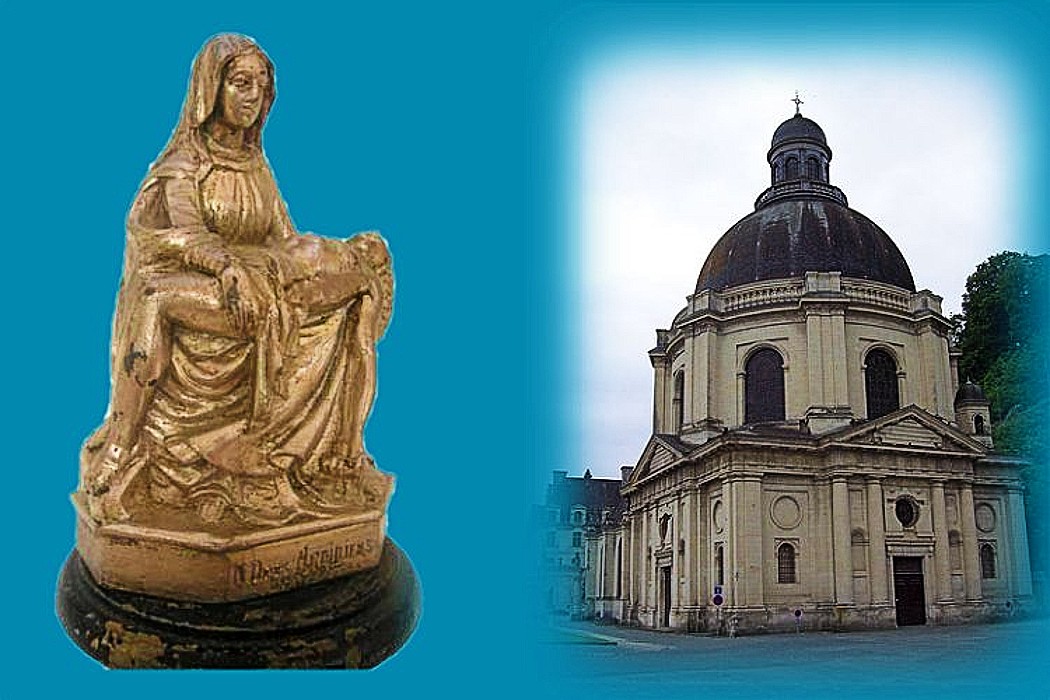
Notre-Dame de Ardilliers de Saumur / Our Lady of Ardilliers, Saumur, Anjou, France (1454) – 23 December:
Our Lady of Ardilliers, located at Saumur, in Anjou, France. Its name is illustrious throughout France, as well on account of the concourse of people who were attracted there, as from a fountain which cured several maladies. This image represents Our Lady of Pity, who holds in her arms her dead Son, whose head is supported by an Angel. Notre Dame Ardilliers has a Statue, a fountain and a Church dedicated to Our Ladye. In 1454 a farmer, while ploughing his field, discovered in the “ardille” ( meaning “clay” – a word which will give its name, according to the legend, to Notre-Dame-des-Ardilliers) a stone Statuette of about thirty centimeters high representing a Pietà . The peasant took it home. On two occasions he discovered the Pietà had returned to its place of discovery, near a fountain already known for its beneficial virtues. From then on, devotions began. It was placed in a niche under a stone arch at its place of discovery. Jean Olivier , Bishop of Angers , laid the foundations of the Notre-Dame-des-Ardilliers Chapel in Saumur on1 August 1534 in the presence of Jean de Castagnier, Mayor of Saumur and Guillaume Bourdeau, Alderman. Msgr Gabriel Bouvery , Bishop of Angers, Consecrated the new Church on 30 July1553 Crowds of people were attracted to the Shrine and its name was illustrious throughout that country, for there Our Lady cured many maladies. The Sanctuary attained magnificent proportions as successive additions were made, notably by Cardinal Richelieu. Devotion to Our Lady became widespread as many miracles occurred. Mary’s clients at Ardilliers number such illustrious persons as Louis XII, Anne of Austria, Marie de Medici, Henrietta of England, Cardinal Richelieu and others. The Founders of the Sulpician Company went there for inspiration; Saint Louis de Montfort begged blessings and Mary’s help on the Institute of the Fathers of the Holy Ghost and the Daughters of Wisdom he was about to found. Cities placed themselves under the protection of Notre-Dame des Ardilliers and promised annual pilgrimages. During the Revolution the Church and Shrine were despoiled of their treasures but not destroyed and the image was left unharmed. In 1849 the ravages of time necessitated the renovation of the Chapel and pilgrimages became more frequent than ever.
And today? We hardly speak of the Pilgrimages to Ardilliers but guided tours of the remarkable architectural continue. In July and August, except on Sundays, the Association Patrimoine Religieux en Saumurois, in partnership with the City of Saumur, provides guided tours of the Notre-Dame des Ardilliers Chapel. We are very saddened aren’t we, that this former great Marian Shrine has become today, above all a tourist destination. So why shouldn’t one of our readers launch a Pilgrimage to Notre-Dame des Ardilliers. This would justify its second name, Notre-Dame de Bon Retour, Our Lady of Good Return.
St Besa of Egypt Bl Bincema St Dagobert II of Austrasia Bl Epifanio Gómez Alvaro St Frithbert of Hexham Bl Hartmann of Brixen Bl Herman of Scheda Bl James Aymerich St Ivo of Chartres (c 1040-1115) Bishop, Confessor St John Cirita St John Stone St Joseph Cho Yun-ho St Mardonius of Rome St Mazota of Abernethy St Migdonius of Rome
St Servulus (Died c 590) Layman, Beggar, paralysed by Palsy from birth. Saint Servulus was a perfect model of submission to the divine Will; it would be difficult to offer a more consoling example to persons afflicted by poverty, illnesses and the other miseries of life. It is Saint Gregory the Great who narrates for us his edifying story. St Servulus’ Life of devotion: https://anastpaul.com/2020/12/23/saint-of-the-day-23-december-saint-servulus-died-c-590/
Martyred Dominicans of Santander – (9 beati) – Martyred in the Spanish Civil War: • Blessed Bernardino Irurzun Otermín • Blessed Eleuterio Marne Mansilla • Blessed Eliseo Miguel Lagro • Blessed Enrique Cañal Gómez • Blessed Enrique Izquierdo Palacios • Blessed Epifanio Gómez Alvaro • Blessed José María García Tabar • Blessed Manuel Gutiérrez Ceballos • Blessed Miguel Rodríguez González • Blessed Pedro Luís y Luís
Martyrs of Crete – (10 saints): A group of ten Christians who died in the persecutions of Decius. They were – • Agathopus • Basilides • Cleomenes • Eunician • Euporus • Evaristus • Gelasius • Saturninus • Theodulus • Zeticus They were martyred in 250 on the island of Crete.
Thought for the Day – 22 December – Meditations with Antonio Cardinal Bacci (1881-1971)
A Christmas Novena VII Prayer and Dedication
“Let us kneel once more before the crib. Like other newborn infants, Jesus is sometimes asleep and sometimes awake, sometimes crying and sometimes smiling. Often His tiny eyes silently watch Mary and Joseph. Surely, this seems a useless existence for Almighty God. But we know that it is not purposeless. This is the first great lesson which God wishes to give to the proud and corrupt human race. It is the lesson of humility, prayer and total dedication to God.
To outward appearances, Jesus is behaving like any other baby. Internally, however, His soul is hypostatically united to the Eternal Word and dwells in the Presence of the Heavenly Father, Whom He loves with a burning and infinite love. Heart and soul, He offers Himself as a holocaust on behalf of sinful humanity and implores His Heavenly Father, to enlighten minds darkened by error, to strengthen weak human wills and to make all men holy. It may well be said, that already, in the silence and obscurity of the cradle, Jesus has begun to redeem the world, for every one of His human-divine actions has an infinite value. Whether He is awake or asleep, crying or smiling, He offers Himself silently to His Eternal Father as a holocaust of propitiation for our sins.
Let us adore the Divine Infant, therefore and thank Him for the priceless gift of our Redemption, which is already accomplished in the silence and obscurity of the manger. Let us implore the grace to love Him and to imitate Him more closely.
As we kneel before the Infant Jesus, let us beseech Him to enable us to grasp the truth of these reflections. Let us take more care of our soul than we do of our external talents and possessions. May God occupy the foremost place in our minds and may He be the principal object of our thoughts, desires and affections. Let us imitate the humble recollection and ardent love for God of the Holy Infant. Like Him, let us offer ourselves entirely to God. Let us ask Him to make us like Him, in complete acceptance of the Divine Will, especially when we are in trouble or in pain, for in this way, we shall be able to show God how sincerely we love Him.”
Quote of the Day – 22 December – Wednesday of the Fourth Week of Advent, O Rex Gentium/O King of all Nations,
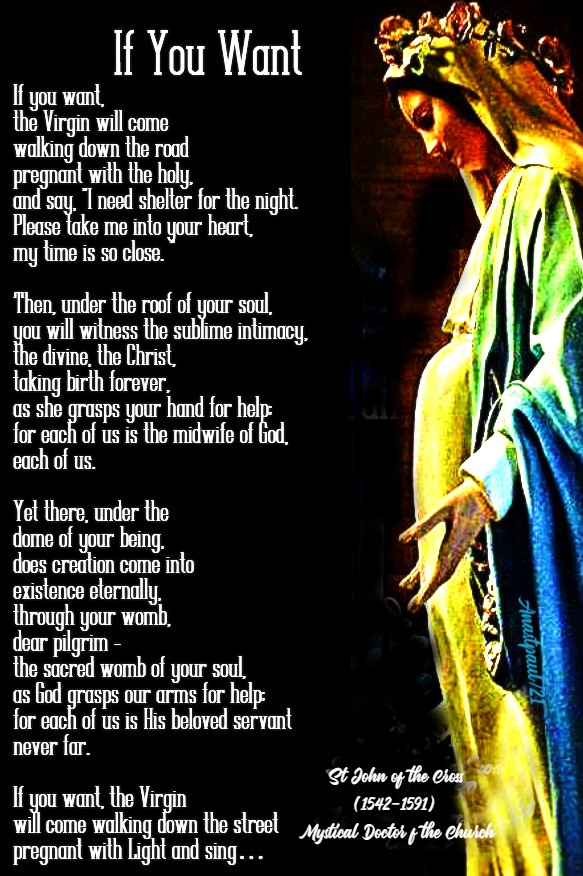
“If you want, the Virgin will come walking down the road pregnant with the Holy and say: “I need shelter for the night. Please take me inside your heart. My time is so close.” Then, under the roof of your soul, you will witness the sublime intimacy, the Divine, the Christ, taking birth forever. As she grasps your hand for help, for each of us is the midwife of God, each of us. Yes, there, under the dome of your being, does creation come into existence eternally– through your womb, dear pilgrim–the sacred womb of your soul! As God grasps our arms for help; for each of us is His beloved servant never far. If you want, the Virgin will come, walking down the street, pregnant with Light and sing!”
St John of the Cross (1542-1591) Mystical Doctor of the Church
One Minute Reflection – 22 December – “Month of the Immaculate Conception” – Wednesday of the Fourth Week of Advent, O Rex Gentium/O King of all Nations, Readings: Samuel 1:24-28; First Samuel 2: 1, 4-8; Luke 1:46-56
The Lord is at hand, come let us adore Him.
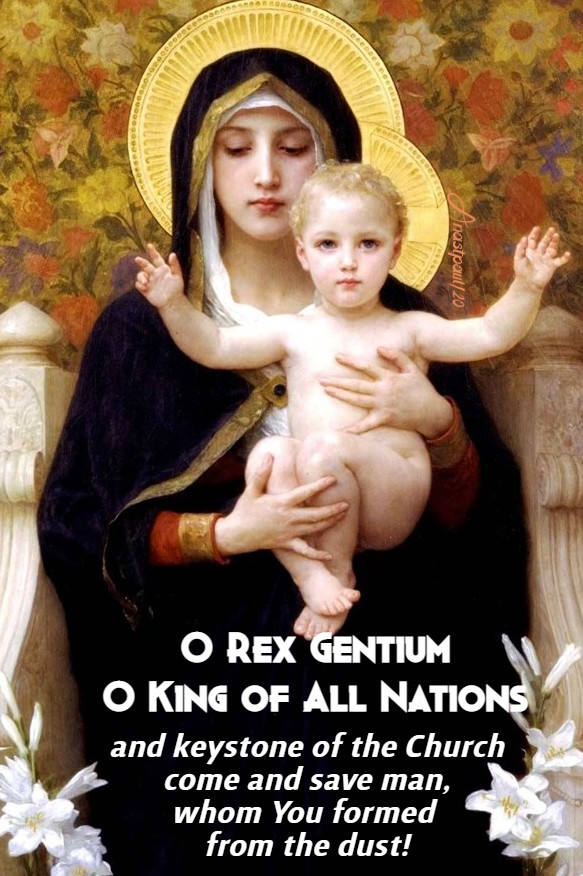
O KING OF ALL NATIONS and keystone of the Church come and save man, whom You formed from the dust!
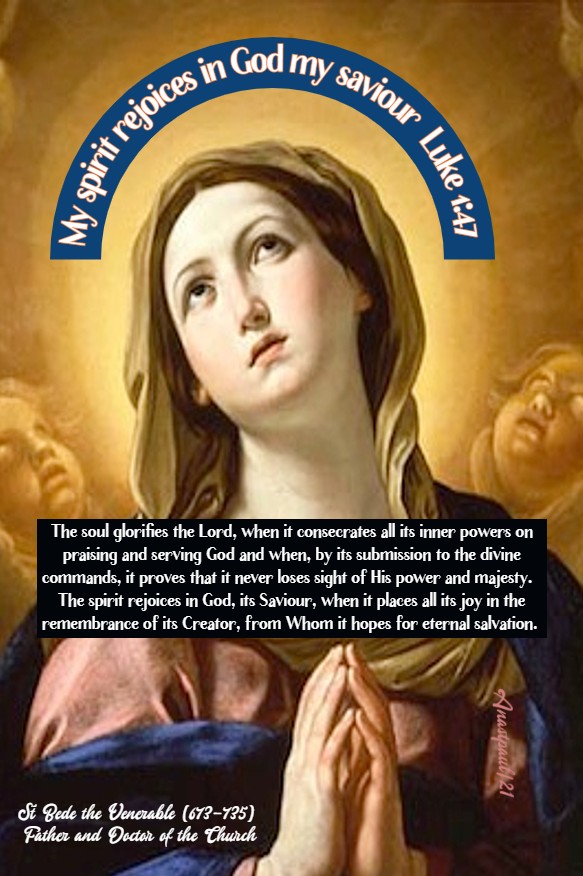
“My spirit rejoices in God my saviour” – Luke 1:47
REFLECTION – “My soul magnifies the Lord, my spirit rejoices in God my Saviour.”. The first interpretation of these words is undoubtedly to acknowledge the gifts granted to her, to Mary in particular, by God. But then she recalls the universal blessing with which God never ceases to surround the human race.
The soul glorifies the Lord, when it consecrates all its inner powers on praising and serving God and when, by its submission to the divine commands, it proves that it never loses sight of His power and majesty. The spirit rejoices in God, its Saviour, when it places all its joy in the remembrance of its Creator, from Whom it hopes for eternal salvation. Without doubt, these words exactly express the thought of all the Saints but it was most especially fitting they should be spoken by the blessed Mother of God, who, filled with a special privilege, burned with a wholly spiritual love for the One she had the joy of conceiving in her flesh. More than any other Saint she had good reason to rejoice in Jesus – that is to say, in her Saviour – because He Whom she acknowledged to be the Eternal Author of our salvation, would in time, as she knew, be born in His own flesh and with such authenticity, that in one and the same Person her Son and her God, would be truly present…
Hence it is a praiseworthy and salutary custom, whose fragrance perfumes Holy Church, when everyday at Vespers, we sing the Canticle of the Virgin. We may well expect from this, that the souls of the faithful, by so often calling to mind the Lord’s Incarnation, will be enflamed with even greater fervour and that, such a frequent reminder of His Holy Mother’s example, will strengthen them in virtue. And Vespers is the best time to come back to this song, since our souls, tired by the day and drawn this way and that by the day’s thoughts, need to come back together again, when the hour of rest draws near, so that they may find, once more, their singleness of focus.” – St Bede the Venerable (673-735) Monk, Father and Doctor of the Church (Homilies on the Gospel, I, 4 ; CCL 122, 25f)
PRAYER –The Magnificat The Canticle of Mary Luke 1:46-55
My soul glorifies the Lord, my spirit rejoices in God, my Saviour He looks on His servant in her lowliness Henceforth, all ages will call me blessed: The Almighty works marvels for me, holy is His Name! His mercy is from age to age, on those who fear Him. He puts forth His arm in strength and scatters the proud-hearted. He casts the mighty from their thrones and raises the lowly. He fills the starving with good things, sends the rich away empty. He protects Israel, His servant, remembering His mercy, the mercy promised to our fathers, to Abraham and his sons forever. Amen.
Saint of the Day – 22 December – Saint Flavian of Acquapendente (Died 363) Martyr, Married Layman, Prefect of Imperial Rome, Husband of Saint Dafrosa, Father of Saint Bibiana and Saint Demetria. The Roman Martyrology states: “At Rome, ex-Prefect, who, under Julian the Apostate, was condemned to be branded for Christ and banished to Aquae Taurinae, where he gave up his soul to God in prayer.”
Saint Flavian, the father of two holy daughters, Bibiana and Demetria and the husband of Saint Dafrosa, was a descendant of a noble Roman family. His incomparable talents, great knowledge and holy life, made him so beloved and esteemed, not only by the people but also by Constantine the Great, that the latter raised him to the high office of Governor of Rome. The duties of this exalted dignity he fulfilled untiringly but, at the same time, neglected nothing that his faith demanded of him, on the contrary, his principal thought was to disseminate more and more the Catholic Faith among his subjects. Those who had already embraced Christianity he endeavoured to assist whenever an opportunity presented itself. After the death of Constantine the Great, his son Constantius, persuaded by his wicked Empress, favoured the Arian heresy and persecuted the Catholics, almost as much as had formerly been done, by the heathen Emperors.
Flavian endeavoured to strengthen the Catholics in their faith and to defend the divinity of Jesus Christ against the Arian blasphemies. This zeal made him hateful to the Emperor and, as neither promises, nor menaces, had any power to change him, he was divested of the high office which he had filled for so many years, to the satisfaction of all Rome. Flavian was not cast down but rather, rejoiced because, for the sake of the true Faith, he suffered so great a loss and no less ignominy. . The Officers whom Julian had appointed to apprehend and torture the Christians, took no notice of this for some time, as Flavian was still greatly esteemed on account of his high rank and the dignity, of the office with which he had been invested but at last, they informed the tyrant of it.
The latter commanded his new Governor, Apronian, to apprehend Flavian immediately and either force him to abandon his faith, or to take his life, by the most cruel tortures. Apronian obeyed the order, Flavian was seized and brought before him. The Governor endeavoured to persuade him to forsake his faith but Flavian said fearlessly: “I am a Christian and will remain a Christian and, further, I consider it the greatest honour to give, not only all I possess but also my life, for the honour of Christ.” The Governor, greatly embittered, sentenced him to be dispossessed of his nobility and placed in the rank of the most abject slaves, which, to a high-minded man, must have been more cruel than death. Hence, they tore off the insignia of his nobility and of his former high office from his body and, with a red-hot iron, burned a mark on his forehead. The pain was great, the ignominy and disgrace much greater but Flavian bore it cheerfully. “I receive,” said he, “this disgrace as the greatest honour that was ever bestowed upon me.” Apronian would have tortured him still more but as he knew that Flavian was highly esteemed on account of the faithfulness with which he had laboured for the public, he desisted, fearing a revolt. He deprived him, therefore, of all his possessions, and sent him into banishment, giving orders to those who were to transport him, to torment him on the road in every possible manner, in order that misery and grief might soon kill him. Flavian received the sentence of his banishment with the same joy that he had manifested at the preceding ignominy.
The most difficult sorrow for him to bear ,was to leave his spouse and his two daughters, as he foresaw that they would not be treated better than he had been. But this, also, he bore heroically and placing them under the protection of the Most High, he went into his banishment, guarded by a troop of soldiers, who delighted in obeying the orders of Apronian and maltreated him most cruelly. Not much better was the treatment which he received at the place to which he was exiled, where he soon ended his life. His only comfort was prayer, which so greatly supported him that, notwithstanding the hardships he endured, he was never seen looking downcast but always joyful. It was also in prayer that he closed his holy life for, one day, when conversing with God, his head sank quietly upon his breast and his heroic soul became free. He was, indeed, worthy to be placed among the greatest martyrs of the holy Church; as what he had suffered for his faith will appear to many much harder to endure than the bodily martyrdom of so many other Saints.





















 AnaStpaul
You must be logged in to post a comment.