
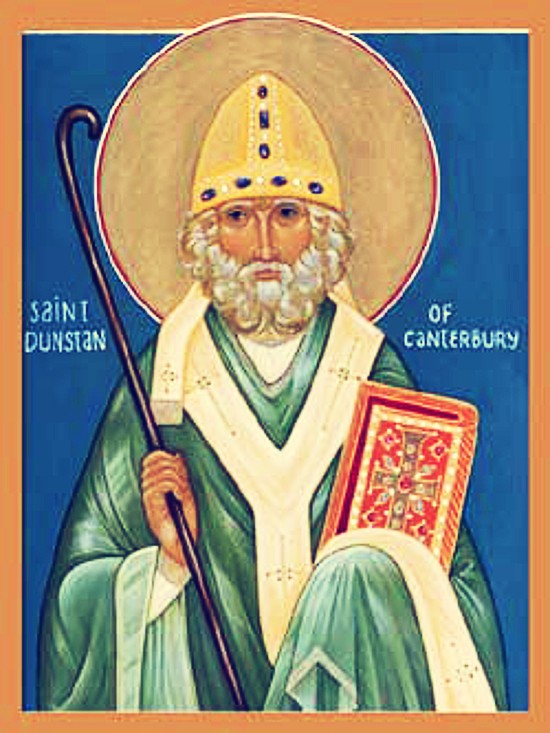
Saint of the Day – 19 May – Saint Dunstan of Canterbury (909-988) Bishop of London, Worcester then Archbishop of Canterbury, Priest, Monk, Abbot. As Abbot, he was the principal agent in the restoration of English monasticism, following the devastation of the Viking invasions. He was renowned as a great Scholar, Painter, Musician and Metalsmith, Writer and Poet, as well as being a Counsellor of Kings and a zealous reforming Bishop. Born in 909 at Baltonsborough, Glastonbury, England and died on 19 May 988 at Canterbury, England of natural causes. Patronages – Armourers, blacksmiths, the blind and sight-impaired, bell-ringers, goldsmiths, silversmiths, jewellers, lighthouse keepers, locksmiths, musicians, swordsmiths, Diocese of Charlottetown, Prince Edward Island, Canada.
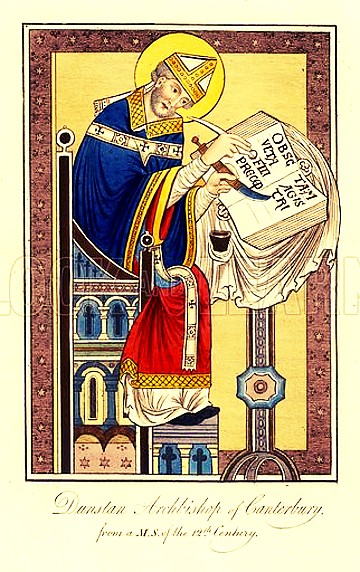
St Dunstan was the son of Heorstan, Anglo-Saxon nobleman, born in the early 10th century near Glastonbury during the reign of King Athelstan. Northern Europe and the British Isles had been under attack and conquest from the Danes and Vikings for several centuries and many coastal communities and monasteries, had been destroyed by the invaders. As a young boy he was introduced to the Irish scholars who visited the renowned Monastery at Glastonbury.
After recovering from a near fatal illness, beloved to be leprosy, he pursued his studies with a zeal for knowledge and artistic skills. He became well known for his devotion and was summoned by his uncle Athelm, Archbishop of Canterbury, to enter his service. He soon became a favourite of King Aethelstan which aroused the envy of the King’s Court. St. Dunstan was accused of studying magic and heathen literature and was attacked by his enemies who bound, gagged him and threw him into a filthy pit . He escaped to Winchester and entered the service of the Bishop, another uncle, St Alphege. Following an illness caused by his treatment at Court, he was persuaded by his uncle to become a Monk.
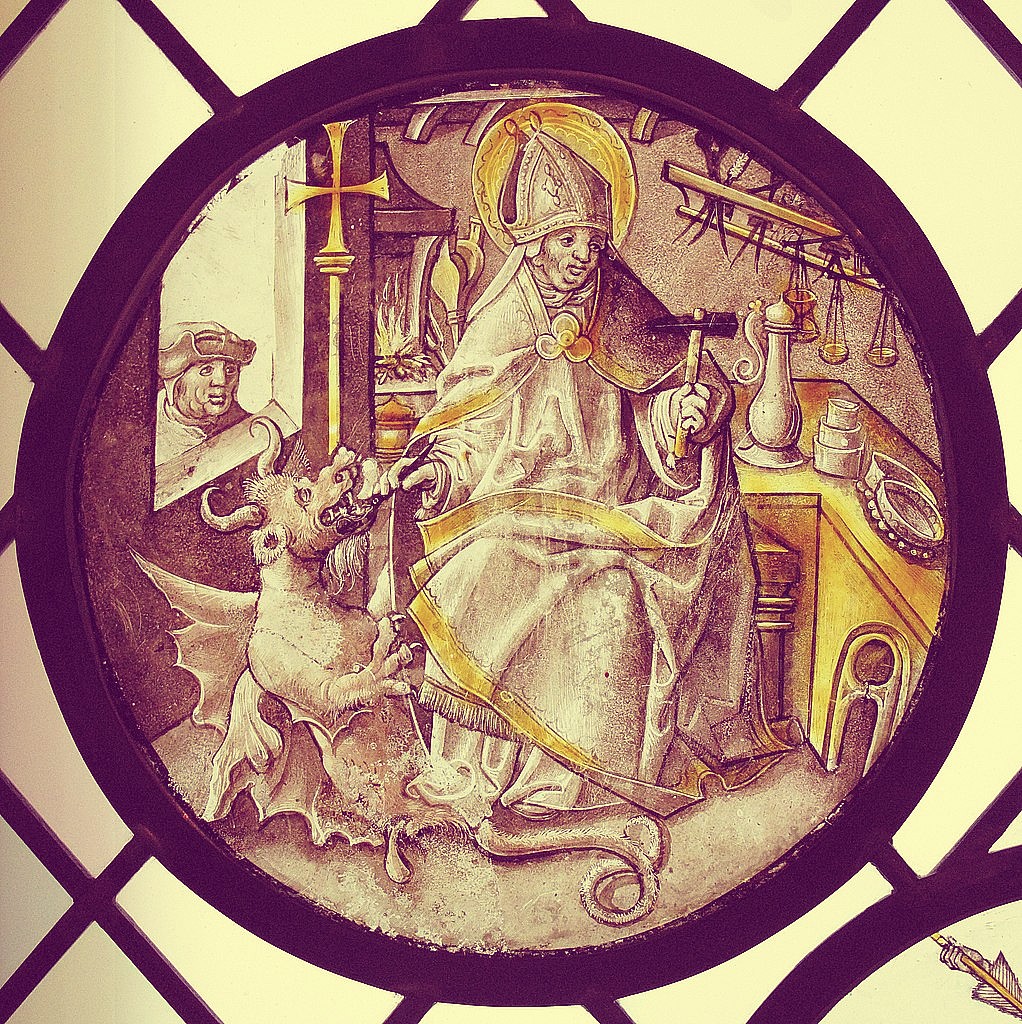
Following his Ordination to the Priesthood by his uncle in 934, he returned to Glastonbury and built a cell alongside the Church of St Mary. His cell was tiny only 5 feet (150 cms) long by 2ft 6ins(75 cms) wide. At this time, the devil tempted him but Dunstan seized Satan’s face with his smith’s tongs.
In 940 after the death of King Aethelstan, he was summoned by the new King, Eadmund and appointed a Counsellor but again he was driven from the Court by jealous courtiers. After narrowly escaping death while hunting, the King remembered the harsh treatment that Dunstan had received at Court. At Glastonbury, he took St Dunstan by the hand, gave him a kiss of peace and led him to the Abbot’s throne.
In his position as Abbot of Glastonbury, St Dunstan set about recreating the monastic life and rebuilding the Abbey. He rebuilt the Church of St Peter, the cloister and reestablished the monastic enclosure. Only two years later, King Eadmond was assassinated, and was succeeded by Eadred. As Abbot of Glastonbury, Dunstan was appointed Guardian of the Royal treasure. The new King encouraged the spread of Christian devotion and observance and the expulsion of heathendom. Dunstan became deeply involved in secular politics and incurred the enmity of the West Saxon nobles, for denouncing their immorality and for urging peace with the Danes.
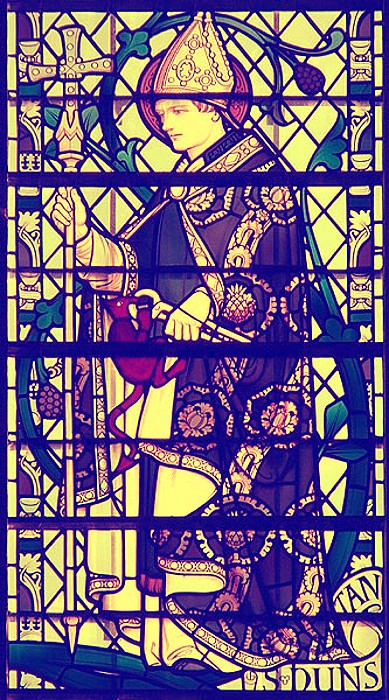
In 955, Eadred died and was succeeded by Eadwig. Different from his predecessor he was under the influence of two unprincipled women. After the coronation, Dunstan discovered the King with his two harlots and was again forced to flee from the Court in exile. He took refuge at a Benedictine Monastery in Ghent. He stayed in Ghent for a year, during which time he came into contact with the reformed continental monasticism which was to inspire his vision of Benedictine perfection.
In 957, the nobles, unable to endure the excesses of King Eadwig, drove him out. His successor Eadgar, asked St Dunstan to return and appointed him Archbishop of Worchester In the following year, the See of London became vacant and was conferred on Dunstan, who held it simultaneously with Worcester.
One of Eadwig’s final acts had been to appoint a successor to Archbishop Oda of Canterbury, who died on 2 June 958. The chosen candidate was Ælfsige of Winchester but he died of cold in the Alps as he journeyed to Rome to receive the Pallium. In his place. Eadwig then nominated the Bishop of Wells, Byrhthelm. However, as soon as Edgar became King, he reversed this second choice on the ground that Byrhthelm had not been able to govern even his first Diocese in a successful manner. The Archbishopric was then conferred on Dunstan.
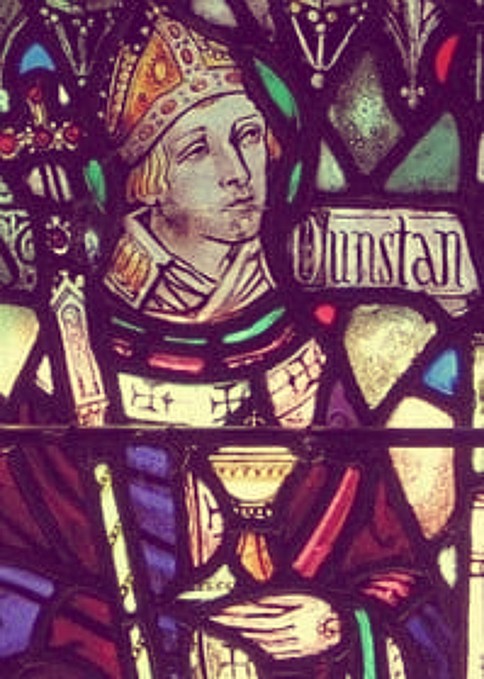
In 960, Dunstan journeyed to Rome to receive the Pallium from Pope John XII. On his journey there, Dunstan’s acts of charity were so lavish as to leave nothing for himself and his attendants. His steward complained but Dunstan replied that they trust in the Lord Jesus Christ and all would be well..
On his return from Rome, Dunstan at once regained his position as virtual prime minister of the Kingdom. By his advice, Ælfstan was appointed to the Bishopric of London and Oswald, to that of Worcester. In 963, Æthelwold, the Abbot of Abingdon, was appointed to the See of Winchester. With their aid and with the ready support of King Edgar, Dunstan was able to implement his reforms in the English Church. The Monks were taught to live in a spirit of self-sacrifice and Dunstan actively enforced the law of celibacy. He forbade the practices of simony (selling ecclesiastical offices for money) and ended the custom of clerics appointing relatives to offices under their jurisdiction. New Monasteries were built and in some of the great Cathedrals, Monks took the place of the Secular Canons and Canons were obliged to live according to rule. The Parish Priests were compelled to be qualified for their office; they were urged to teach Parishioners not only the truths of the Christian faith but als, trades to improve their lives. The state saw reforms as well. Good order was maintained throughout the realm and there was respect for the law. Trained bands policed the north and a navy guarded the shores from Viking raids. There was a level of peace in the Kingdom unknown in living memory.
Dunstan’s influence under the new Monarch began to wane and he retired to Canterbury. His retirement at Canterbury consisted of long hours, both day and night, spent in private prayer, as well as his regular attendance at Mass and the daily Office. He visited the Shrines of St Augustine and St Æthelberht, and there are reports of a vision of angels who sang to him heavenly canticles. He worked to improve the spiritual and temporal well-being of his people, to build and restore Churches, to establish schools, to judge suits, to defend widows and orphans, to promote peace and to enforce respect for purity. He practised his crafts, made bells and organs and collated the books in the Cathedral library. He encouraged and protected European scholars who came to England, and was active as a Teacher in the Cathedral school.
On the Vigil of Ascension Day 988, it is recorded that a vision of angels warned he would die in three days. On the Feast day of Ascension itself, Dunstan celebrated Holy Mass and preached three times to the faithful. In this last address, he announced his impending death and wished his congregation well. That afternoon he chose the spot for his tomb, then went to his bed. His strength failed rapidly and on Saturday morning, 19 May, he caused the Clergy to assemble. Mass was celebrated in his presence, then he received Extreme Unction and the Viaticum and died. Dunstan’s final words are reported to have been, “He hath made a remembrance of His wonderful works, being a merciful and gracious Lord: He hath given food to them that fear Him.“
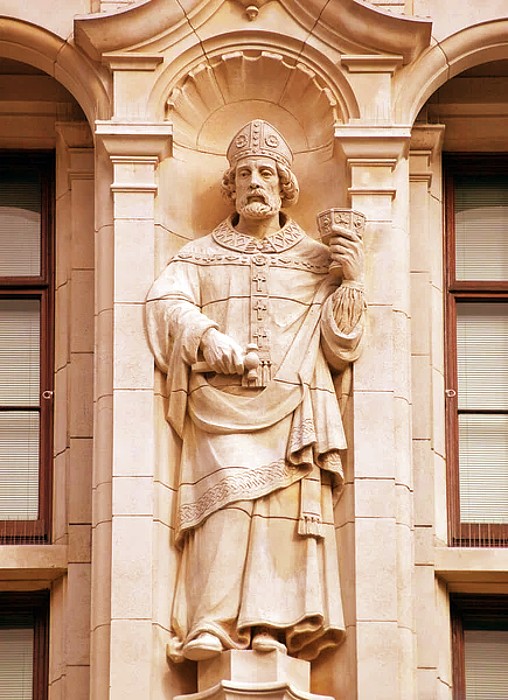
The English people accepted him as a Saint shortly thereafter. He was formally Canonised in 1029 Pope John XIX. That year, at the Synod of Winchester, St Dunstan’s feast was ordered to be kept solemnly throughout England
English literature contains many references to St Dunstan, for example, in A Christmas Carol by Charles Dickens and in this folk rhyme:
St Dunstan, as the story goes,
Once pull’d the devil by the nose
With red-hot tongs, which made him roar,
That he was heard three miles or more.
Another story relates how Dunstan nailed a horseshoe to the Devil’s hoof when he was asked to re-shoe the Devil’s horse. This caused the Devil great pain and Dunstan only agreed to remove the shoe and release the Devil, after he promised never to enter a place where a horseshoe is over the door. This is the origin of the lucky horseshoe. Until St Thomas Becket’s fame overshadowed Dunstan’s, St Dunstan was the most popular Saint in England for nearly two centuries, having gained fame for the many stories of his greatness, not least among which, were those concerning his famed cunning in defeating the Devil. Eighteen Churches in England are named after St Dunstan, including two famous ones in the City of London, as well as a number of schools, hospitals and other institutions, including the Charity established to help those blinded as a result of war.
Dunstan had been buried in his Cathedral and when that building was destroyed by a fire in 1074, his relics were translated by Archbishop St Lanfranc to a tomb on the south side of the High Altar, in the rebuilt Canterbury Cathedral. The Monks of Glastonbury used to claim, that during the sack of Canterbury by the Danes in 1012, Dunstan’s body had been carried ,for safety, to their Abbey. This story was disproved by Archbishop William Warham, who opened the tomb at Canterbury in 1508. They found Dunstan’s relics still to be there. Within a century, however, his s=Shrine was destroyed during the English Reformation.
BEFORE YOU ASK: _ I have been unsuccessful in ascertaining the reason for St Dunstan’s Patronage of the Blind. All I have so far found is the result of his Patronage – the worldwide organisations under his Patronage which are dedicated to the care and assistance of the blind and sight-impaired. I will keep trying.
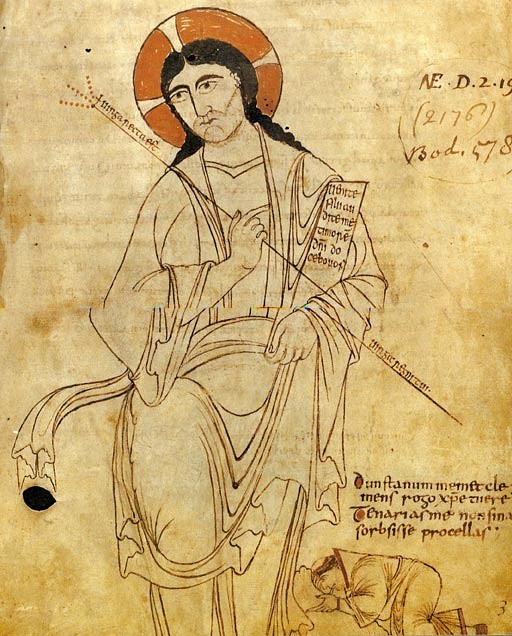
The image below is from the Manuscript known as the “Glastonbury Classbook” – it is a portrait of Christ,and the Monk kneeling beside Him is believed to be a self-portrait of St Dunstan.
The text beside the Monk says: “Dunstanum memet clemens rogo, Christe, tuere / Tenarias me non sinas sorbsisse procellas” (‘I ask, merciful Christ, that You protect me, Dunstan; do not permit the Taenarian storms to swallow me‘).
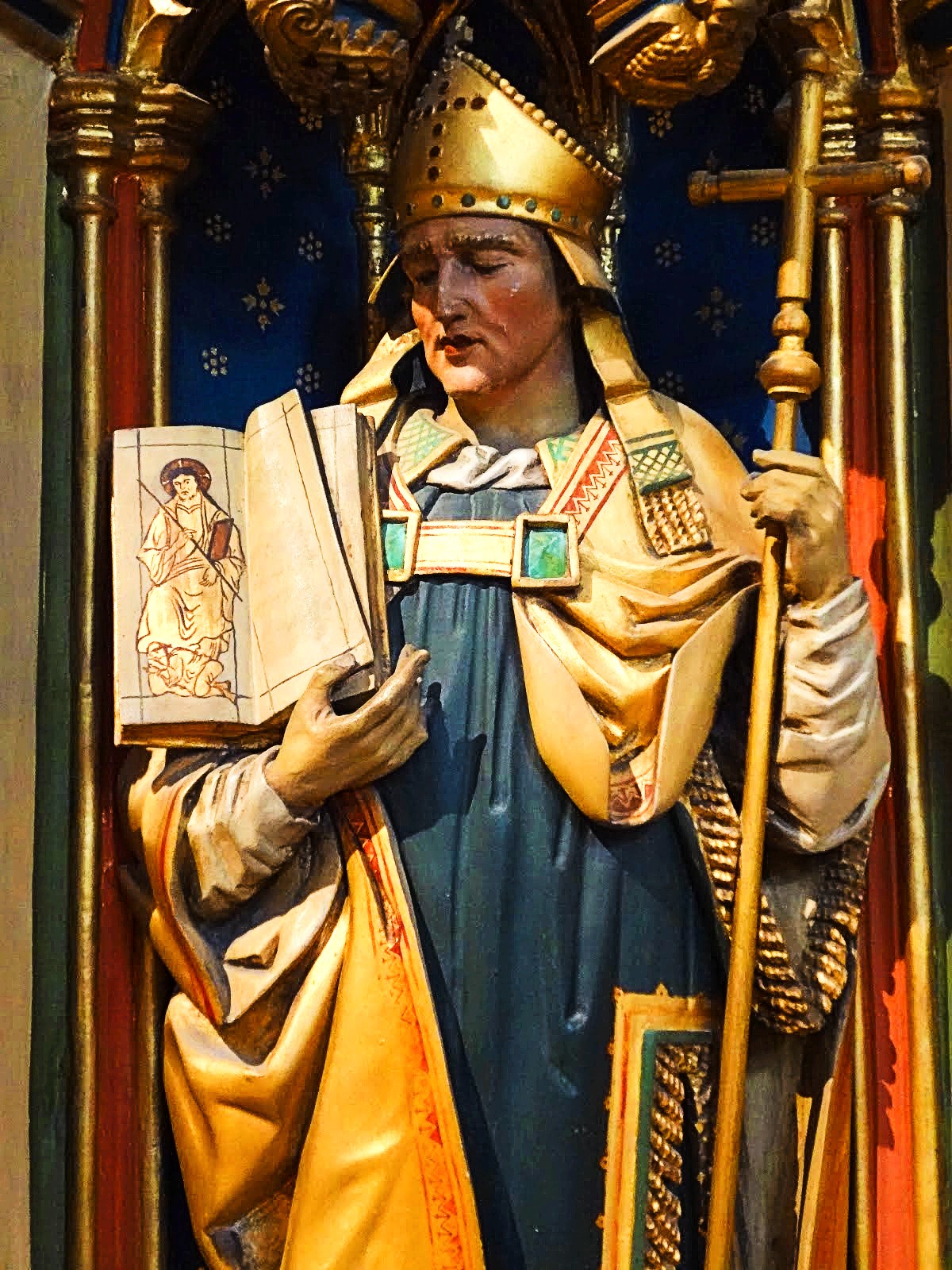
Then the Statue of St Dunstan beneath the above, is on his tomb in Canterbury Cathedral and shows him holding the Glastonbury Classbook – how lovely!


 AnaStpaul
2 thoughts on “Saint of the Day – 19 May – Saint Dunstan of Canterbury (909-988) Bishop of London, Worcester then Archbishop of Canterbury,”