
Saint of the Day – 21 May – Saint Godric of Finchale (c 1070-1170) Hermit, Merchant, Pilgrim, Hymnist, Spiritual Advisor to Saints, both great and small, friend of all animals. Born in c 1070 at Walpole, Norfolk, England and died in 1170 at Finchale, County Durham, England of natural causes, Also known as – Godrick
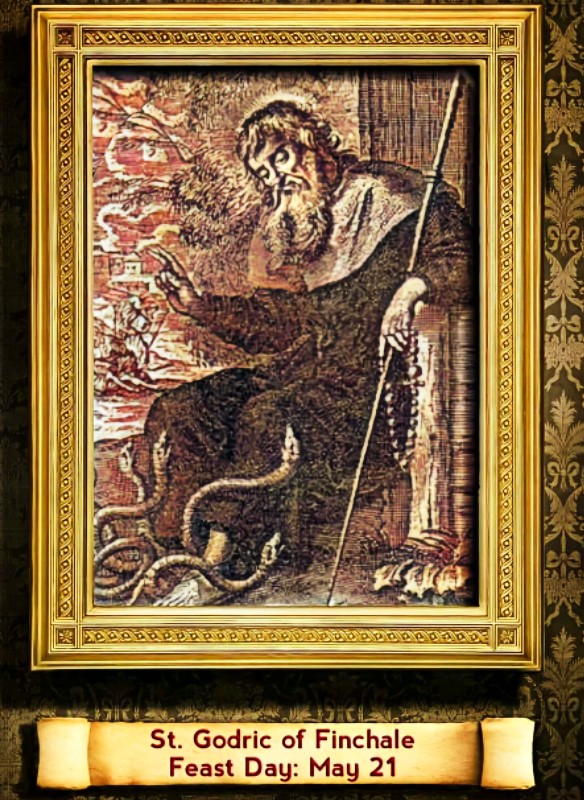
Godric’s life was recorded by a his contemporary, a Monk named Reginald of Durham. Several other Hagiographies are also extant. According to these accounts, Godric, who began from humble beginnings as the son of Ailward and Edwenna, “both of slender rank and wealth but abundant in righteousness and virtue,” was a pedlar, then a sailor and entrepreneur and may have been the captain and owner of the ship which conveyed King Baldwin I of Jerusalem to Jaffa in 1102.
After years at sea, Godric went to the Island of Lindisfarne and there experienced a vision of St Cuthbert. This encounter changed his life and, thereafter, he devoted himself to Christianity and service to God.
After many pilgrimages around the Mediterranean, Godric returned to England and lived with an elderly hermit named Aelric for two years. Upon Aelric’s death, Godric made one last pilgrimage to Jerusalem and then returned home, where he convinced Ranulf Flambard, the Bishop of Durham, to grant him a place to live as a Hermit at Finchale near the Monastery, by the River Wear. He had previously served as doorkeeper, the lowest of the minor orders, at the hospital Church of nearby St Giles Hospital in Durham. He is recorded to have lived at Finchale for the final sixty three years of his life, occasionally meeting with visitors approved by the Prior of Finchale Monaster, under whose care and obedience he lived and died. A Monk of that house was his Confessor, said Mass for him and administered him the Sacraments in a Chapel adjoining to his cell, which the holy man had built in honour of St John the Baptist.
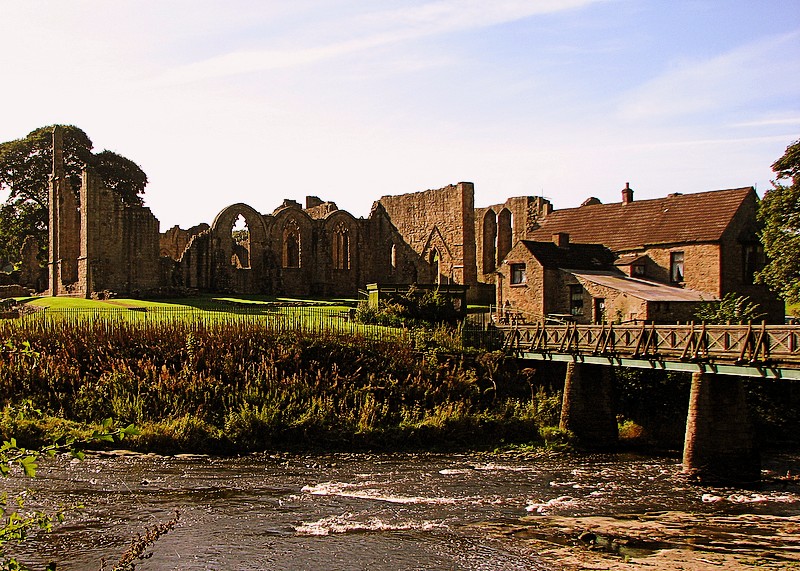
As the years passed, his reputation grew, and St Thomas à Becket (Martyr) (1118-1170) and Pope Alexander III, both reportedly sought Godric’s advice as a wise and holy man.
Reginald of Durham.describes Godric’s physical attributes:
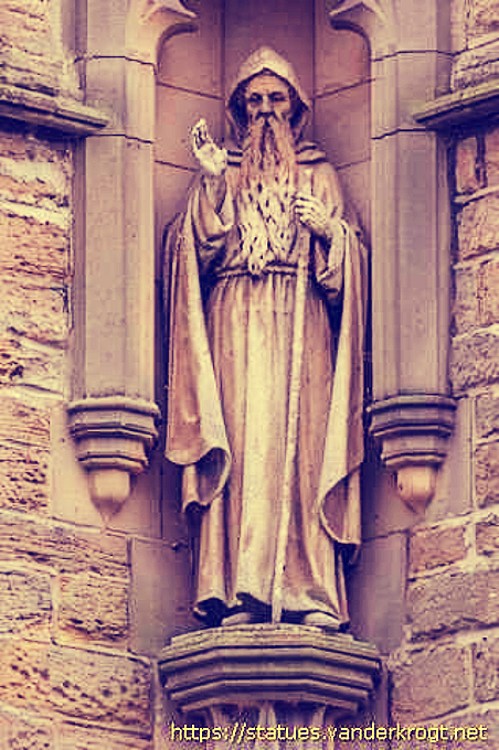
For he was vigorous and strenuous in mind, whole of limb and strong in body. He was of middle stature, broad-shouldered and deep-chested, with a long face, grey eyes most clear and piercing, bushy brows, a broad forehead, long and open nostrils, a nose of comely curve and a pointed chin. His beard was thick and longer than the ordinary, his mouth well-shaped, with lips of moderate thickness, in youth, his hair was black, in age as white as snow; his neck was short and thick, knotted with veins and sinews; his legs were somewhat slender, his instep high, his knees hardened and horny with frequent kneeling; his whole skin rough beyond the ordinary, until all this roughness was softened by old age.
For several years before his death, Godric was confined to his bed by sickness and old age. Father William of Newburgh OSA, Augustinian Priest and Historian, who visited him during that time, tells us that although his body appeared in a manner dead, his tongue was ever repeating the sacred names of the Three Divine Persons and, in his countenance, there appeared a wonderful dignity, accompanied with an unusual grace and sweetness. Having remained in his desert for sixty-three years, he was seized with his last illness and happily departed to his Lord on the 21st of May, 1170,

His body was buried in the Chapel of St John Baptist. Many miracles confirmed the opinion of his sanctity and a little Chapel was built in his memory by Richard, brother to Hugh Pidsey, Bishop of Durham.
St Godric is often remembered for his affinity with and kindness toward animals and many stories recall his protection of the creatures, who lived near his forest home. According to one of these, he hid a stag from pursuing hunters; according to another, he even allowed snakes to warm themselves by his fire.
Godric lived on a diet of herbs, wild honey, acorns, crab-apples and nuts. He slept on the bare ground.
Reginald of Durham recorded four hymns of St Godric. They are the oldest hymns in English for which the original musical settings survive. Reginald describes the circumstances in which Godric learnt the first hymn. In a vision, the Virgin Mary appeared to Godric “two maidens of surpassing beauty clad in shining white raiments,” at her side. They pledged to come to his aid in times of need and the Virgin herself, taught Godric a hymn of consolation, to overcome grief or temptation Saintë Marië Virginë.
The novel Godric (1981) by Frederick Buechner is a fictional retelling of his life and travels. It was a finalist for a Pulitzer Prize.


 AnaStpaul
One thought on “Saint of the Day – 21 May – Saint Godric of Finchale (c 1070-1170)”