One Minute Reflection – 6 August – The Transfiguration of Our Lord – 2 Peter 1:16-19, Matthew 17:1-9..
“His face shone like the sunand His garments became white as snow.” – Matthew 17:2
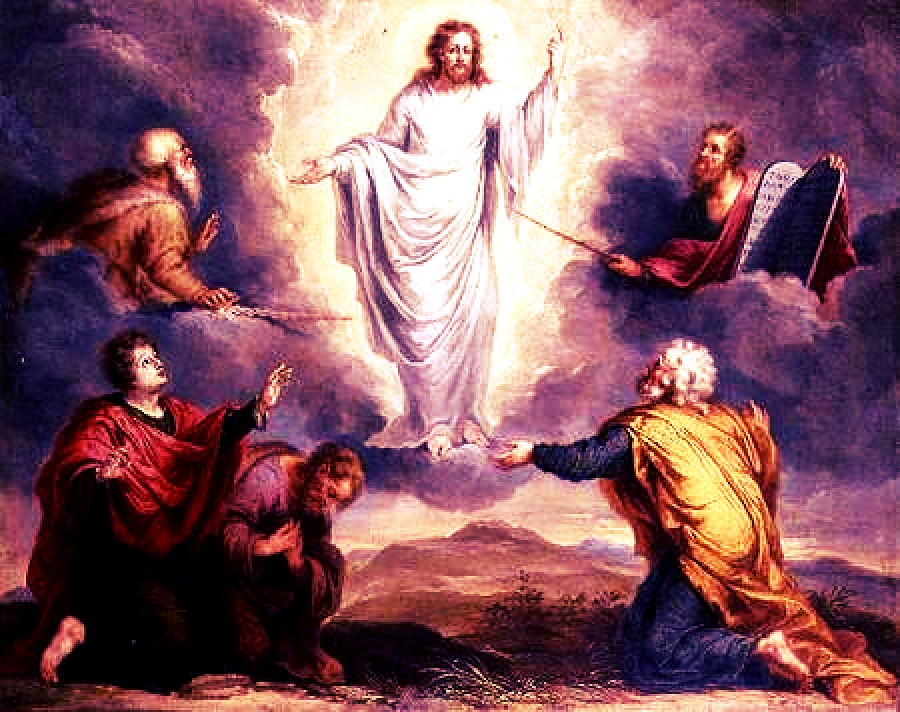
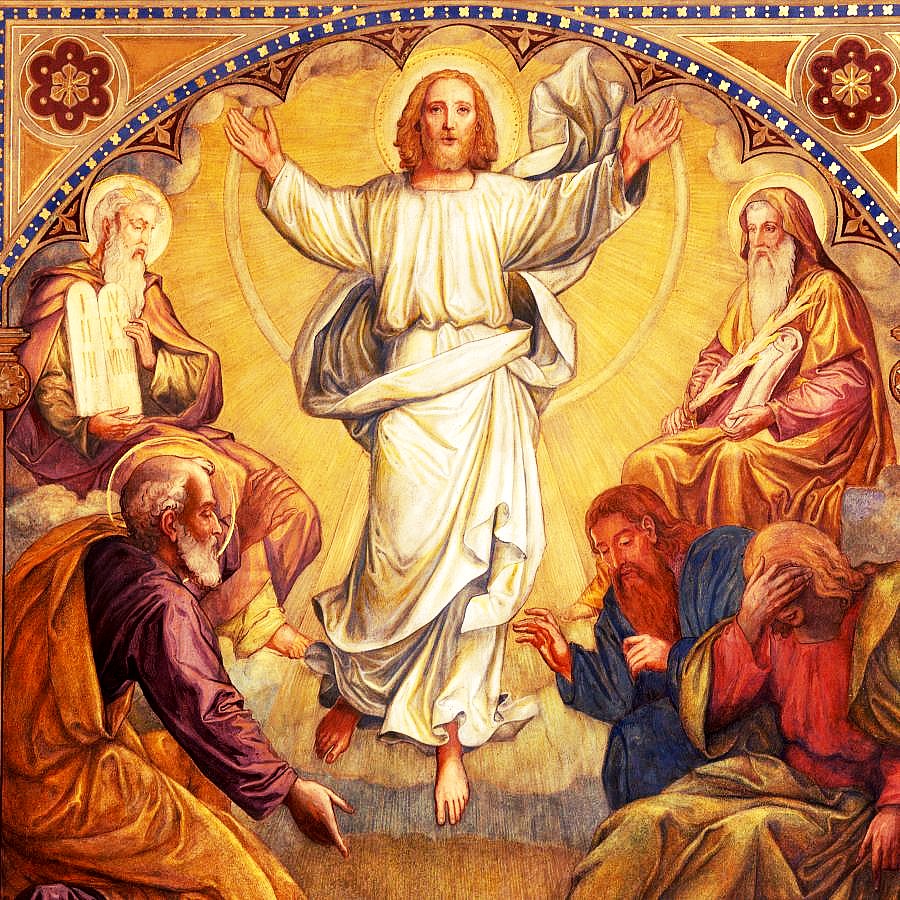
REFLECTION – “The Lord displays His glory before chosen witnesses and makes illustrious that bodily shape which He shared with others, with such splendour that His countenance shone like the sun and His garments were as white as snow. In this Transfiguration, the chief object was to remove the scandal of the Cross from the hearts of the disciples and, to prevent their faith being disturbed, at the humiliation of His voluntary Passion, by revealing the excellence of His hidden dignity. But with no less foresight, the foundation was laid of the hope of holy Church that the whole Body of Christ, might realise, with what a change it was to be endowed and that the members, might promise themselves, a share in that honour which had shone forth in their Head.
But to confirm the Apostles and to lead them onto all knowledge, still further, instruction was conveyed by this miracle. For Moses and Elias, that is, the law and the prophets, appeared talking with the Lord, so that, in the presence of these five men, might most truly be fulfilled, what was said – In two or three witnesses every word stands. What more stable, what more steadfast, than the word, in the proclamation of which, the trumpet of the old and of the new TestamentS, sounds forth and the records of ancient witnesses, agree with the teaching of the Gospel? For the pages of both Covenants corroborate each other and He, Whom, under the veil of Mysteries, the types that went before, had promised, is displayed clearly and manifestly by the splendour of His present glory.
The Apostle Peter, therefore, being stirred by the revelation of these Mysteries, despising things worldly and scorning things earthly, was carried away by a certain excess of mind, to the desire of things eternal and, being filled with rapture at the whole vision, longed to make his abode with Jesus, in the place where he was gladdened by the sight of His glory. And so also he says: Lord, it is good for us to be here: if Thou wilt, let us set up here, three tents, one for Thee and one for Moses and one for Elias. But to this proposal the Lord made no reply, signifying that what he asked was not indeed wicked, but irregular, since the world could not be saved, except by Christ’s Death and by the Lord’s example in this, the faithful were called upon to believe that, although there ought not to be any doubt about the promises of happiness, yet, we should understand that, amid the trials of this life, we must ask for power to endure, rather than for glory.” – St Leo the Great (400-461) Pope, Father and Doctor (Sermon on the Transfiguration – excerpt).
PRAYER – O God, Who in the glorious Transfiguration of Thy Only-begotten Son strengthened the Mysteries of faith, by the testimony of the fathers and, by the Voice coming down in a shining cloud, miraculously betokened the complete adoption of Thy children, mercifully grant that we, be made co-heirs with that King of glory and sharers in that same glory .Through Jesus Christ, Thy Son our Lord, Who lives and reigns with Thee, in the unity of the Holy Ghost, God, world without end. Amen (Collect).
Our Morning Offering – 6 August – The Transfiguration of Our Lord
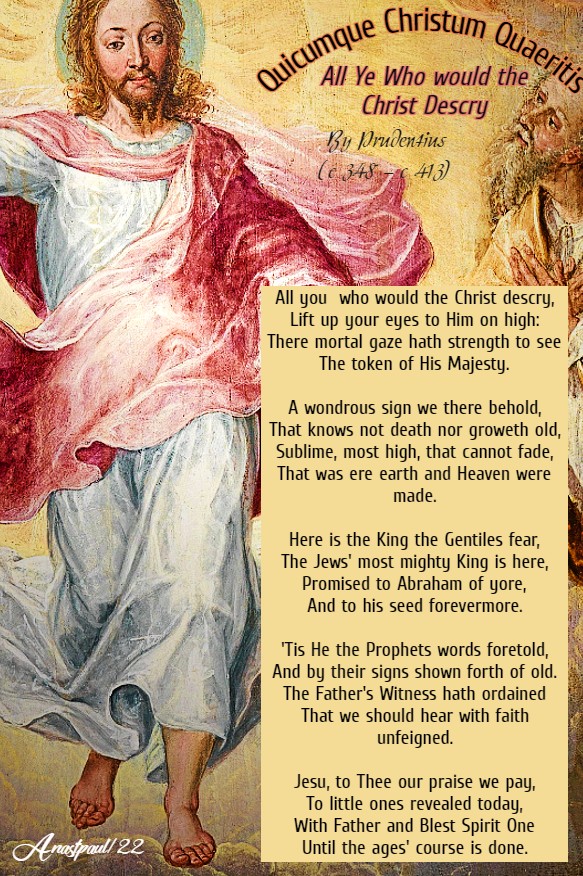
Quicumque Christum Quaeritis All Ye Who would the Christ Descry By Prudentius (c 348 – c 413) (Aurelius Prudentius Clemens) The Renowned Poet
All you who would the Christ descry, Lift up your eyes to Him on high: There mortal gaze hath strength to see The token of His Majesty.
A wondrous sign we there behold, That knows not death nor groweth old, Sublime, most high, that cannot fade, That was ere earth and Heaven were made.
Here is the King the Gentiles fear, The Jews’ most mighty King is here, Promised to Abraham of yore, And to his seed forevermore.
‘Tis He the Prophets words foretold, And by their signs shown forth of old. The Father’s Witness hath ordained That we should hear with faith unfeigned.
Jesu, to Thee our praise we pay, To little ones revealed today, With Father and Blest Spirit One Until the ages’ course is done.
The Hymn Quicumque Christum quaeritis is the twelfth and last poem in the Cathemerino of Prudentius, originally written in honour of the Epiphany. Its 208 lines has furnished four hymns to the Roman Breviary, Latin below the image. On the Feast of the Transfiguration the verses are above are used. There is a short biography of Prudentius here: https://anastpaul.com/2020/01/08/quote-s-of-the-day-8-january-take-courage-it-is-i-and-bl-titus-zeman/
Quicumque Christum quaeritis, Uculos in altum tollite: Illic licebit visere Signum perennis glorias.
Illustre quiddam cernimus, Quod nesciat finem pati, Sublime, celsum, interminum, Antiquius ccelo et chao.
Hic ille Rex est Gentium, Populique Rex Judaici, Promissus Abraha patri, Ejusque in aevum semini.
Hunc et Prophetis testibus, Iisdemque signatoribus Testator et Pater jubet Audire nos, et credere.
Jesu, tibi sit gloria, Qui te revelas parvulis, Cum Patre et almo Spiritu In sempiterna saecula.
Sermon on the Transfiguration (Excerpt) by Father Prosper Gueranger (1805 – 1875)
This Transfiguration of the Son of Man, this manifestation of His Glory, lasted but a few moments – His mission was not on Thabor, it was humiliation and suffering in Jerusalem. He, therefore, withdrew into Himself, the brightness He had allowed to transpire and, when He came to the three Apostles, who, on hearing the Voice from the cloud, had fallen on their faces with fear — they could see no-one, save only Jesus. The bright cloud was gone, Moses and Elias had disappeared. What a favour they have had bestowed upon them! Will they remember what they have seen and heard? They have had such a revelation of the Divinity of their dear Master! — is it possible, that when the hour of trial comes, they will forget it and doubt His being God? and, when they see Him suffer and die, be ashamed of Him and deny Him? Alas! the Gospel has told us what happened to them.
A short time after this, our Lord celebrated his Last Supper with His Disciples. When the Supper was over, He took them to another mount, Mount Olivet, which lies to the east of Jerusalem. Leaving the rest at the entrance of the Garden, He advances with Peter, James and John and then says to them: My soul is sorrowful even unto death: stay you here, and watch with Me (Matthew xxvi.). He then retires some little distance from them and prays to His Eternal Father. The Heart of our Redeemer is weighed down with anguish. When He returns to His three Disciples, He is enfeebled by the Agony, He has suffered and His garments are saturated with Blood. The Apostles are aware that He is sad even unto death and that the hour is close at hand when He is to be attacked — are they keeping watch? are they ready to defend Him? No, they seem to have forgotten Him, they are fast asleep, for their eyes are heavy. Yet a few moments and all will have fled from Him and Peter, the bravest of them all, will be taking his oath that he never knew the Man!
After the Resurrection, our three Apostles made ample atonement for this cowardly and sinful conduct and acknowledged the mercy, wherewith Jesus had sought to fortify them, against temptation, by showing them His Glory on Thabor, a few days before His Passion. Let us not wait until we have betrayed Him: let us at once acknowledge that He is our Lord and our God! We are soon to be keeping the anniversary of His Sacrifice like the Apostles, we are to see Him humbled by His enemies and bearing, in our stead, the chastisements of Divine Justice. We must not allow our faith to be weakened, when we behold the fulfilment of those prophecies of David and Isaias, that the Messias is to be treated as a worm of the earth (Ps xxi. 7), and be covered with wounds, so as to become like a leper, the most abject of men and the Man of sorrows (Is. liii. 3, 4).
We must remember the grand things of Thabor and the adorations paid Him by Moses and Elias and the bright cloud and the Voice of the Eternal Father. The more we see Him humbled, the more must we proclaim His Glory and Divinity. We must join our acclamations with those of the Angels and the Four and Twenty Elders, whom St John, (one of the witnesses of the Transfiguration) heard crying out with a loud voice: The Lamb that was slain, is worthy to receive power, and divinity and wisdom, and strength, and honour,and glory and benediction (Apoc. v. 12)!
St Pope Sixtus II/ Xystus (Died 258) Pope and Martyr, Philosopher. 25th Pope from St Peter. Papal Ascension 30 August 257. He was Martyred along with seven deacons, (St Lawrence of Rome a few days later) during the persecutions of Christianity by Emperor Valerian. This is the St Sixtus who is commemorated in the Roman Canon Eucharistic Prayer. His Life and Death: https://anastpaul.com/2021/08/06/saint-of-the-day-6-august-saint-sixtus-ii-died-258-pope-and-martyr/
Bl Gezelin of Schlebusch O.Cist. (Died 1149) Lay Brother of the Cistercian Order, Hermit St Gislain of Luxemburg St Glisente of Brescia Bl Goderanno Bl Guillermo Sanz St Hardulf of Breedon
Bl Octavian of Savona St Stephen of Cardeña Bl William of Altavilla
Martyrs of Cardeña: Two hundred Benedictine Monks at the Saint Peter of Cardegna monastery, Burgos, Spain who were Martyred in the 8th century by invading Saracens. They were buried by local Christians in a nearby churchyard in Burgos, Spain and Beatified in 1603 by Pope Clement VIII (cultus confirmed).
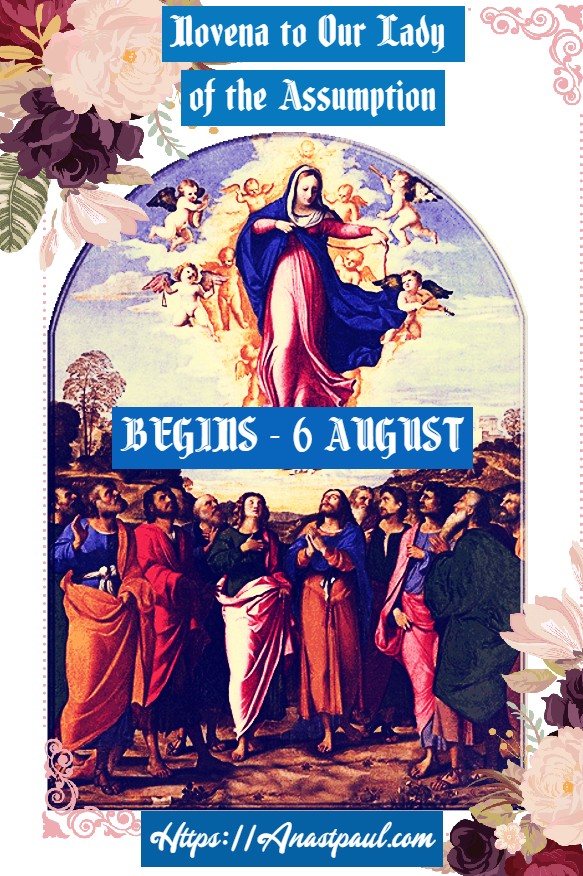
Begins 6 August in preparation for the Feast on 15 August – a Holy Day.
On 1 November 1950, Pope Pius XII defined the Dogma of the Assumption. Thus he solemnly proclaimed that the belief whereby, the Blessed Virgin Mary, at the close of her earthly life, was taken up, body and soul, into the Glory of Heaven, definitively forms part of the deposit of faith, received from the Apostles. To avoid all that is uncertain, the Pope did not state either the manner or the circumstances of time and place in which the Assumption took place — only the fact of the Assumption of Mary, body and soul, into the Glory of Heaven, is the matter of the definition.
Lord Jesus Christ, Thou has destroyed the power of death and given the hope of eternal life, for body and soul.
Thou granted Thy Mother a special place in Thy glory and did not allow decay to touch her body.
As we rejoice in the Assumption of the Blessed Virgin Mary, grant us renewed confidence in the victory of life over death. Amen.
Thought for the Day – 5 August – Meditations with Antonio Cardinal Bacci (1881-1971)
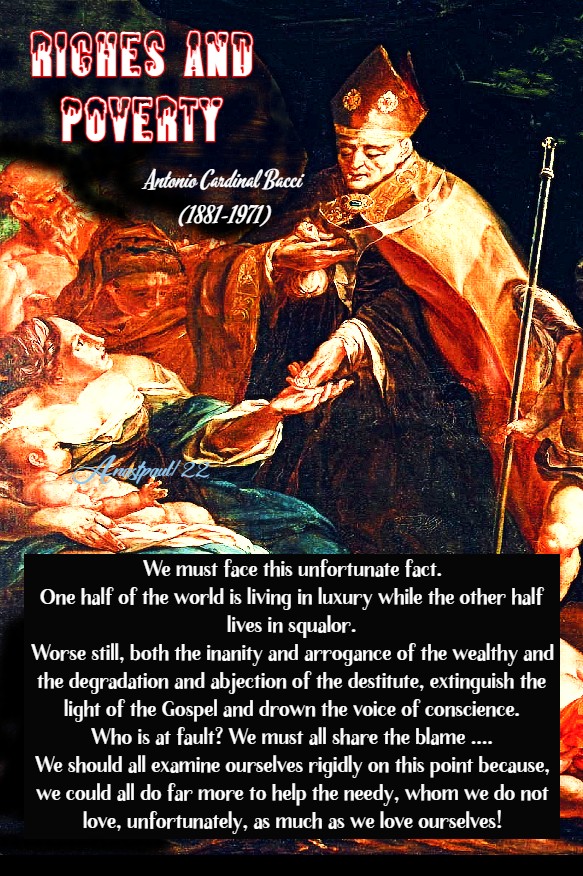
Riches and Poverty
“We must face this unfortunate fact. One half of the world is living in luxury while the other half lives in squalor. Worse still, both the inanity and arrogance of the wealthy and the degradation and abjection of the destitute, extinguish the light of the Gospel and drown the voice of conscience.
Who is at fault? We must all share the blame, for nobody has ever fully implemented the Gospel teaching, which alone contains a complete solution for the problems of the human race. A great deal of want and misery would disappear, if all those whose assets exceed what they need for themselves, remembered that they are obliged to love their neighbour as themselves. They would then take heed of the precept: “Give that which remains as alms” (Lk 11:41), We should all examine ourselves rigidly on this point because, we could all do far more to help the needy, whom we do not love, unfortunately, as much as we love ourselves!”
Quote/s of the Day – 5 August – “The Month of the Immaculate Heart of Mary” – Santa Mariæ ad Nives, Dedication of the Basilica of Our Lady of the Snows
“Mary, Mother of Grace, it becomes you to be mindful of us, as you stand near Him who granted you all graces, for you are the Mother of God and our Queen. Help us for the sake of the King, the Lord God and Master, Who was born of you.”
St Athanasius (297-373) Father & Doctor of the Church
“Mary was placed by God in the centre of history and we can say that everything was made through her and with her and in her.”
St Bernard (1090-1153) Mellifluous Doctor of the Church
“Mary is the divine Page on which God the Father wrote the Word of God, His Son. Let us draw near to her and read her!”
St Albert the Great (1200-1280) Doctor of the Church
“Mary seeks for those who approach her devoutly and with reverence, for such she loves, nourishes, and adopts as her children. ”
St Bonaventure (1221-1274) Seraphic Doctor of the Church
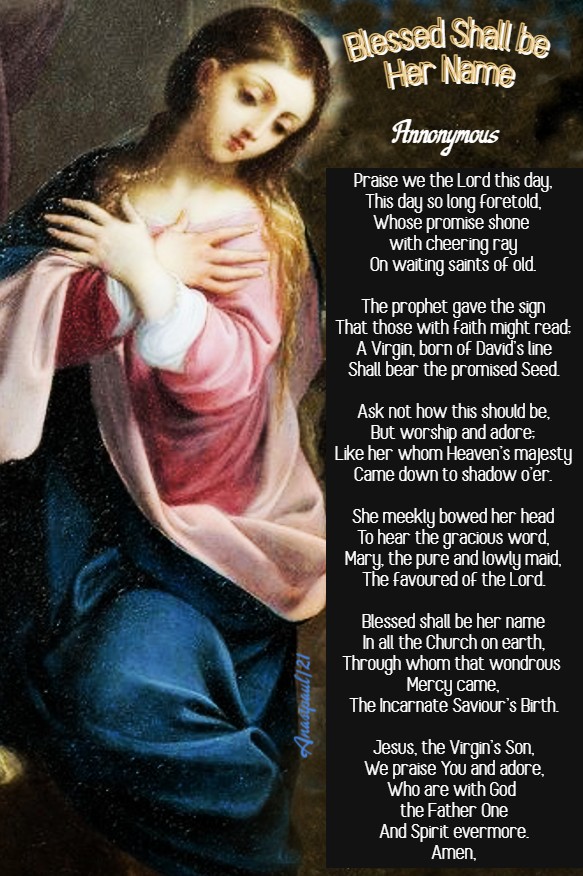
Blessed Shall be Her Name Anonymous Author
Praise we the Lord this day, This day so long foretold, Whose promise shone with cheering ray On waiting saints of old.
The prophet gave the sign That those with faith might read; A Virgin, born of David’s line Shall bear the promised Seed.
Ask not how this should be, But worship and adore; Like her whom Heaven’s majesty Came down to shadow o’er.
She meekly bowed her head To hear the gracious word, Mary, the pure and lowly maid, The favoured of the Lord.
Blessed shall be her name In all the Church on earth, Through whom that wondrous Mercy came, The Incarnate Saviour’s Birth.
Jesus, the Virgin’s Son, We praise You and adore, Who are with God the Father One And Spirit evermore. Amen
One Minute Reflection – 5 August – “The Month of the Immaculate Heart of Mary” – Santa Mariæ ad Nives, Dedication of the Basilica of Our Lady of the Snows – Sirach 24:14-16, Luke 11:27-28
“Blessed are they who hear the word of God and keep it.” – Luke 11:28
REFLECTION – “If you say, “Show me your God,” I will say to you, “Show me what kind of person you are and I will show you my God.” Show me then whether the eyes of your mind, can see and the ears of your heart, hear.
It is like this. Those who can see with the eyes of their bodies, are aware of what is happening in this life on earth. They get to know things that are different from each other. They distinguish light and darkness, black and white, ugliness and beauty, elegance and inelegance, proportion and lack of proportion, excess and defect. The same is true of the sounds we hear: high or low or pleasant. So it is with the ears of our heart and the eyes of our mind, in their capacity to hear or see God.
God is seen by those who have the capacity to see Him, provided that they keep the eyes of their mind open. All have eyes but some have eyes that are shrouded in darkness, unable to see the Light of the Sun. Because the blind cannot see it, it does not follow that the sun does not shine. The blind must trace the cause back to themselves and their eyes . In the same way, you have eyes in your mind that are shrouded in darkness because of your sins and evil deeds. …
But if you will, you can be healed. Hand yourself over to the Doctor, and He will open the eyes and ears of your mind and heart. Who is to be the Doctor? It is God, Who heals and gives life through His Word and Wisdom. … ” – St Theophilus of Antioch (Died c 185) Bishop of Antioch, Confessor, Apologist, Father (An excerpt from: A Book addressed to Autolycus).
PRAYER – Grant us, Thy servants, O Lord God, we beseech Thee, to enjoy lasting health of mind and body and by the intercession of glorious and Blessed Mary, ever Virgin, may be delivered from present sorrow and partake of the fullness of eternal happiness. Through Jesus Christ, Thy Son our Lord, Who lives and reigns with Thee, in the unity of the Holy Ghost, God, world without end. Amen (Collect).
Our Morning Offering – 5 August – “The Month of the Immaculate Heart of Mary” – Dedication of the Basilica of Our Lady of the Snows
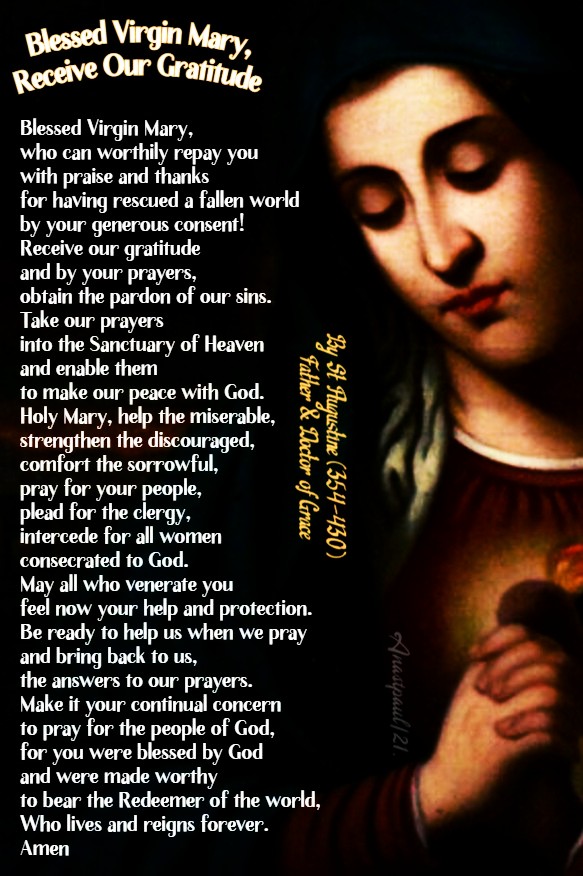
Blessed Virgin Mary, Receive Our Gratitude! By St Augustine (354-430) Father & Doctor of Grace
Blessed Virgin Mary, who can worthily repay you with praise and thanks for having rescued a fallen world by your generous consent! Receive our gratitude and by your prayers, obtain the pardon of our sins. Take our prayers into the Sanctuary of Heaven and enable them to make our peace with God. Holy Mary, help the miserable, strengthen the discouraged, comfort the sorrowful, pray for your people, plead for the clergy, intercede for all women consecrated to God. May all who venerate you feel now your help and protection. Be ready to help us when we pray and bring back to us, the answers to our prayers. Make it your continual concern to pray for the people of God, for you were blessed by God and were made worthy to bear the Redeemer of the world, Who lives and reigns forever. Amen
St Eusignius St Gormeal of Ardoilen Bl James Gerius St Margaret the Barefooted (1335-1395) Married Laywoman St Mari St Memmius of Châlons-sur-Marne St Nonna
St Sobel St Theodoric of Cambrai-Arras St Venantius of Viviers St Viator
Martyrs of the Salarian Way: Twenty-three Christians who were Martyred together in the persecutions of Diocletian. 303 on the Salarian Way in Rome, Italy.
Saint of the Day – 5 August – Saint Margaret the Barefooted (1335-1395) Married Laywoman, Widow, Apostle of the poor. Born in 1325 at Cesolo, San Severino, Italy and died on 5 August 1395 of natural causes. Patronages – brides, difficult marriages, victims of abuse, spusal abuse, widows. Also known as – Margaret of Cesolo, • Margaret la Picena, Margherita… of Ancona, of San Severino.
Margaret was born into a poor family in San Severino, Italy but she was married to a wealthy man at the age of 15.
However, he was cruelly abusive to her, beating her often for many years but Margaret never complained. He was angry at her love of the Faith, dedication to the Church and her assistance to the poor and needy. Margaret hid her bruises from the eyes of her neighbours, that her husband might not be blamed.
She walked barefooted as a beggar to better associate herself with the poor and to suffer herself as little as she felt she could to offer her hardships to God for the conversion of her husband and in reparation for sin. Margaret picked up her cross in humility and gratitude, happy to bear her sufferings with Christ Crucified.
Margaret prayers and sufferings did not go unanswered. Before his death, her husband converted and returned to the Faith, confessing his sins and attempting to make reparation to Margaret. He was blessed with a holy death. Margaret, herself continued her work for the poor and the sick, dying in 1395 of natural causes.
Thought for the Day – 4 August – Meditations with Antonio Cardinal Bacci (1881-1971)
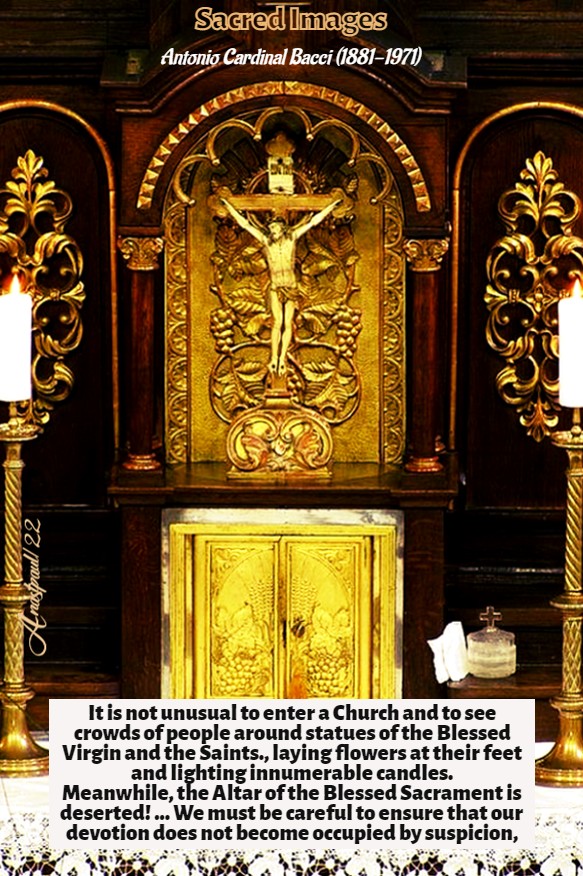
Sacred Images
“The opposite extreme of over-superstitious veneration of images must also be avoided. As St Gregory the Great observed, Sacred images should be regarded as a means of impressing, on simple minds, the virtues which they ought to emplant. Sometimes, however, the ignorance or the faithful, in this regard, needs to be corrected.
It is not unusual to enter a Church and to see crowds of people around statues of the Blessed Virgin and the Saints., laying flowers at their feet and lighting innumerable candles. Meanwhile, the Altar of the Blessed Sacrament is deserted! Excessive homage can be paid to particular images, in such a manner, as to suggest that the piety of the worshippers is directed towards the material images themselves, rather than towards the Redeemer or our Divine Mother or the Saints. We must be careful to ensure that our devotion does not become occupied by suspicion,”
Quote/s of the Day – 4 August – The Memorial of St Dominic (1170-1221) Confessor
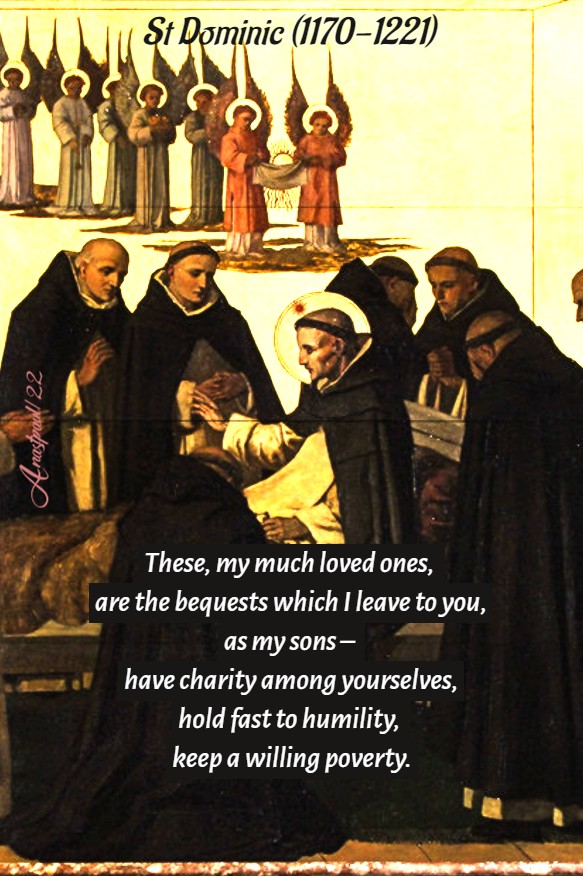
“These, my much loved ones, are the bequests which I leave to you, as my sons – have charity among yourselves, hold fast to humility, keep a willing poverty.”
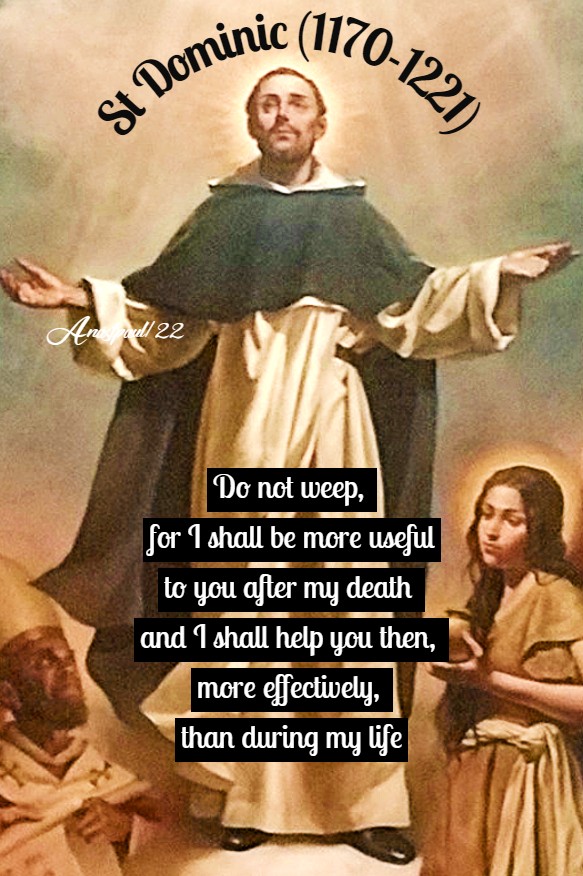
“Do not weep, for I shall be more useful to you after my death and I shall help you then, more effectively, than during my life.”
One Minute Reflection – 4 August – “The Month of the Immaculate Heart of Mary” – The Memorial of St Dominic de Guzman OP (1170-1221) – 2 Timothy 4:1-8, Luke 12:35-40
“Stay dressed for action and keep your lamps burning and be like men who are waiting for their master to come home from the wedding feast, so that they may open the door to him at once when he comes and knocks.” – Luke 12:35-36
REFLECTION – “God, the Word, stirs up the lazy and arouses the sleeper. For indeed, someone who comes knocking at the door is always wanting to come in. But it depends on us, if He does not always enter or always remain.,, May your door be open to Him who comes; open your soul, enlarge your spiritual capacities, that you may discover the riches of simplicity, the treasures of peace and sweetness of grace. Expand your heart; run to meet the Sun of that Eternal Light that “enlightens everyone” (Jn 1,9). It is certain, that this true Light shines for all but, if anyone shuts their windows, then they themselves, shut themselves off from this Eternal Light.
So even Christ remains outside, if you shut the door of your soul. It is true, that He could enter but He does not want to use force, He doesn’t put those who refuse under pressure. Descended from the Virgin, born from her womb, He shines throughout the universe to give light to all. Those who long to receive the light, that shines with an everlasting brightness, open up to Him. No night comes to intervene. Indeed, the sun we see each day, gives way to night’s darkness but the Sun of Justice (Mal 3,20) knows no setting, for Wisdom is not overcome by evil.” – St Ambrose (340-397) Bishop of Milan and Father and Doctor of the Church – 12th Sermon on Psalm 118
PRAYER – O God, Who graciously enlightened Thy Church by the good works and teaching of St Dominic, Thy Confessor, grant by his intercession, that she may never be deprived of temporal helps and may ever advance in spiritual growth.Through Jesus Christ, Thy Son our Lord, Who lives and reigns with Thee, in the unity of the Holy Ghost, God, world without end. Amen (Collect).
Our Morning Offering – 4 August – The Memorial of St Dominic de Guzman OP (1170-1221)
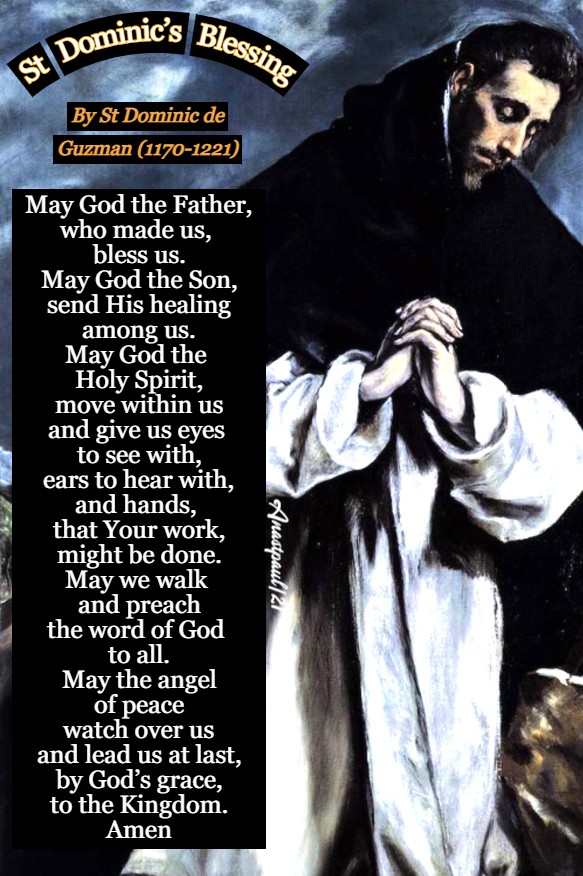
St Dominic’s Blessing By St Dominic de Guzman (1170-1221)
May God the Father, who made us, bless us. May God the Son, send His healing among us. May God the Holy Spirit, move within us and give us eyes to see with, ears to hear with, and hands, that Your work, might be done. May we walk and preach the word of God to all. May the angel of peace watch over us and lead us at last, by God’s grace, to the Kingdom. Amen
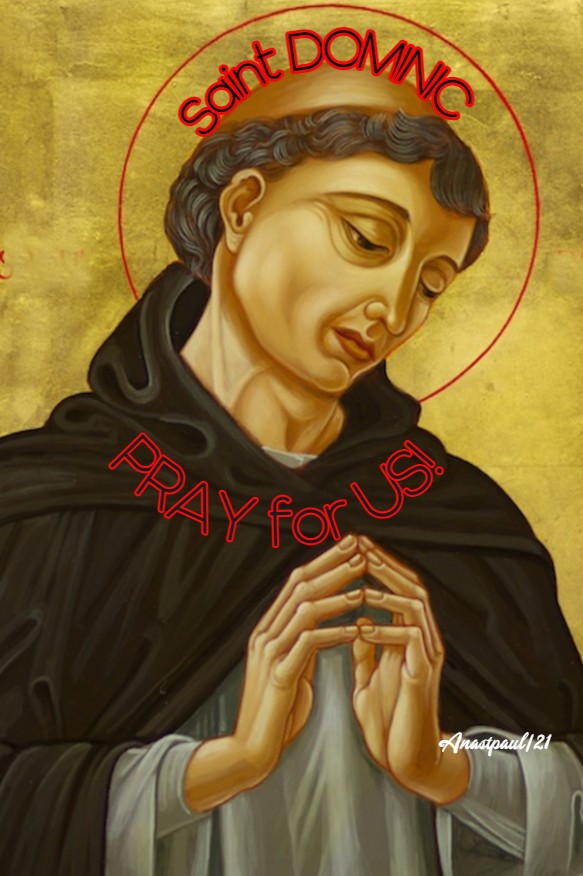
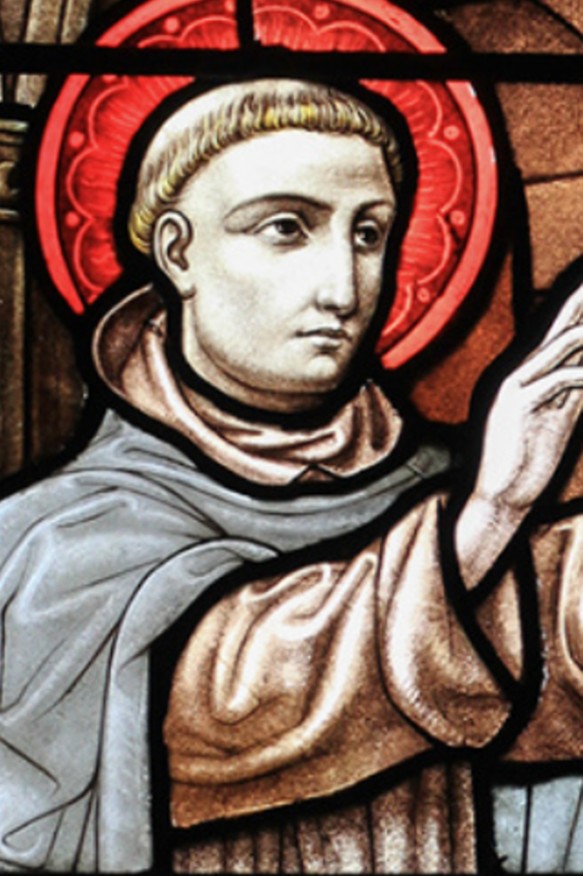
Saint of the Day – 4 August – St Dominic de Guzman OP (1170-1221) Confessor, Founder of the Dominican Order of Preachers – Priest, Founder, Teacher, Preacher, Mystic, Miracle-Worker, Apostle of the Holy Rosary
The Roman Martyrology states today: “At Bologna, St Dominic, Confessor, Founder of the Order of Friars Preachers, most renowned for sanctity and learning. He preserved his chastity unsullied to the end of his life and by his great merits, raised three persons from the dead. After having repressed heresies by his preaching and instructed many in the religious and Godly life, he rested in peace on the 6th of this month. His Feast, however, is celebrated on this day by decree of Pope Paul IV.”
The Virtues and Gifts of Saint Dominic (By the Order of Preachers, England and Wales)
Dominic was of middling height and slender build. His face was ruddy and his hair and beard had a reddish colour. His eyes were striking and he was said to have a beautiful face and one, which seemed to radiate a certain light. He was intelligent but sensitive, usually cheerful except when moved, as quite often occurred, to tears, by people’s suffering. He was known as a man of humility and purity, of prayer and penance and of deep compassionate love.
Dominic was very disciplined with himself but merciful with others. He was noted for his peace and joy. He had great patience and courage. He made good friendships with both men and women and was a good companion, enjoying others and being enjoyed by them.
He was generous, putting God and others before his own needs and wants. He loved Jesus and the Gospel, always carrying some of the Sacred Scriptures (Matthew’s Gospel and Paul’s letters, in particular) with him. He had a great passion for helping people know and love Jesus and so ‘save their soul.s’ He had great energy and commitment to the works of Jesus, his Master and His God.
When Dominic preached, His passion was so patent that, he often moved people to tears for their errors and sins. He explained the Truth of Jesus Christ so well that his listeners were eager to confess and repent.
Dominic’s life and conversation were so Godly, so full of the Lord and heavenly thoughts, that it was said that he only ever spoke to God or about God – yet, he seems to have done this in ways which were warm, appealing, human and attractive to all who heard him.
He was a good leader and a good organiser and good at making sensible laws to organise communities. He trusted others and gave them freedom and opportunities and encouragement to develop and use their gifts. In these ways, he showed himself a true spiritual father. He was also wise and diplomatic. He saw clearly the needs of people in his time and what the Church needed to do and set about bringing this about, in other words, our Saint Dominic was a true Shepherd – never absent, never belittling the problems the faithful faced in their daily lives but assisting them, in many ways, to devoutly submit to the Will of God and learn the great gift of suffering in silence. In all this, Dominic placed himself in the hands of the Holy Ghost
St Francesc Mercader Rendé St Hyacinth of Rome St Ia of Persia St Isidore of Besançon St Lua of Limerick St Onofrio of Panaia St Perpetua of Rome St Protasius of Cologne St Rainerio of Split St Sithney (Died c 529) St Tertullinus of Rome Bl William Horne
Thought for the Day – 3 August – Meditations with Antonio Cardinal Bacci (1881-1971)
A Holy Death
“When we meditate on death, then we should resolve to remain always prepared. Besides this, we should make an Act of Perfect Resignation to the Will of God, accepting from Him, whatever illnesses He may ask us to endure and, whatever kind of death He has destined for us. We should promise to accept everything, as long as He will allow us to die in the state of grace.
We should frequently offer to God, as a guarantee of our love and, as satisfaction for our sins and negligences, the sufferings with which we shall be afflicted during our last illness. We shall be comforted in our final hours by the remembrance of this total offering of ourselves, which we have so often repeated. Like Jesus in the Garden of Gethsemane, we shall be able to pray: “Father, if it is possible, let this cup pass away from me, yet, not as I will but as Thou willest” (Mt 26:39).”
Quote of the Day – 3 August – The Finding of the Relics of St Stephen, Protomarty – Acts 6:8-10; 7:54-60. Matthew 23:34-39
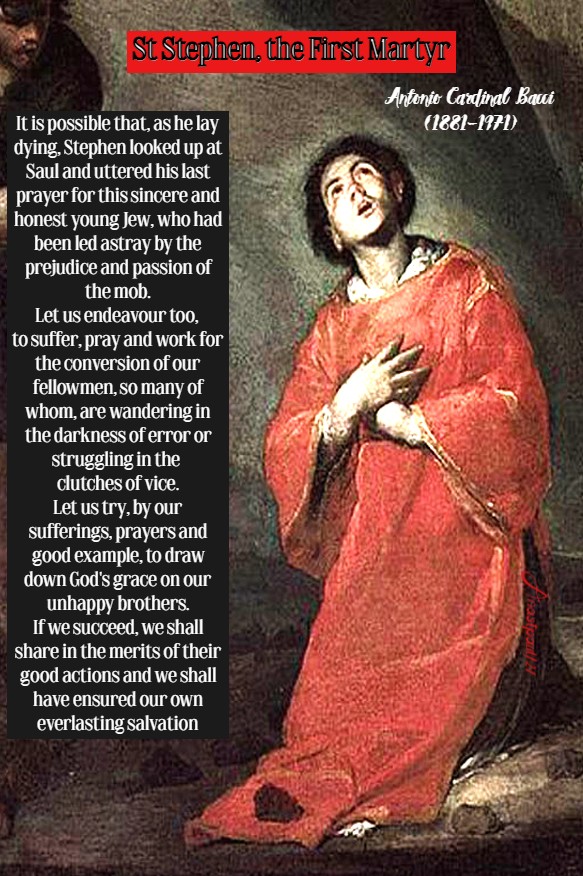
“It is possible that, as he lay dying, Stephen looked up at Saul and uttered his last prayer for this sincere and honest young Jew, who had been led astray by the prejudice and passion of the mob. … Let us endeavour too, to suffer, pray and work for the conversion of our fellowmen, so many of whom, are wandering in the darkness of error or struggling in the clutches of vice. Let us try, by our sufferings, prayers and good example, to draw down God’s grace on our unhappy brothers. If we succeed, we shall share in the merits of their good actions and we shall have ensured our own everlasting salvation.”
One Minute Reflection – 3 August – “The Month of the Immaculate Heart of Mary” – The Finding of the Relics of St Stephen, Protomartyr – Acts 6:8-10; 7:54-60. Matthew 23:34-39
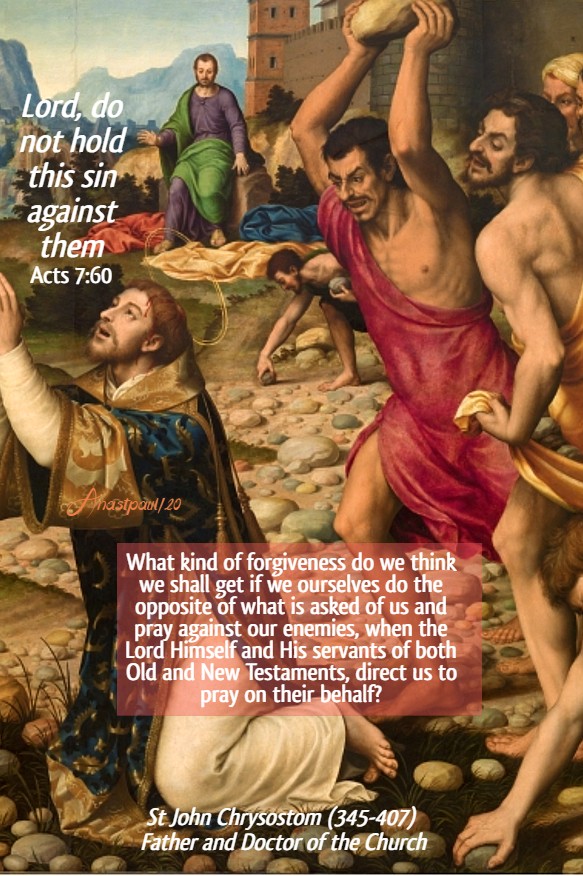
“Lord, do not hold this sin against them” – Acts 7:60
REFLECTION – “Let us imitate our Lord and pray for our enemies … He was Crucified and yet, at the same time, prayed to His Father for the sake of those who were crucifying Him. But how could I possibly imitate our Lord, one might ask? If you want to, you can. If you weren’t able to do it how could He have said: “Learn from me for I am meek and humble of heart”? (Mt 11:29) …
If you have difficulty in imitating our Lord, at least imitate him who is also His servant, His Deacon – I would speak of Stephen. Just as Christ, in the midst of those crucifying Him, without considering the Cross, without considering His own predicament, pleaded with the Father, on behalf of His tormentors (Lk 23:34), so His servant, surrounded by those who were stoning him, attacked by all, crushed beneath a hail of stones and, without taking any account of the suffering they were causing him, said: “Lord, do not hold this sin against them” (Acts 7:60). Do you see how the Son spoke and how His servant prayed? The former said: “Father, forgive them for they know not what they do,” and the latter said: “Lord, do not hold this sin against them.” Moreover, to make us realise the fervour with which he was praying, he did not just pray, as he stood beneath the blows of the stones but, he spoke on his knees with sincerity and compassion …
Christ said: “Father, forgive them for they know not what they do.” Stephen cried out: “Lord, do not hold this sin against them.” Paul, in his turn, said: “I offer up this sacrifice for my brethren, my kin according to race” (cf. Rm 9:3). Moses said: “If you would only forgive their sin! And if you will not, then strike me out of the book that you have written!” (Ex 32:32). David said: “May your hand fall on me and my kindred,” (2 Sam 24:17). … What kind of forgiveness do we think we shall get if we ourselves do the opposite of what is asked of us and pray against our enemies, when the Lord Himself and His servants, of both Old and New Testaments, direct us to pray on their behalf?” – St John Chrysostom (345-407) Father and Doctor of the Church – Sermon for Good Friday “The Cross and the bandit”
PRAYER – Grant us, we beseech Thee, O Lord, to imitate what we celebrate, so that we may learn to love, even our enemies; because we keep the anniversary of the invention of Him, Who knew how to plead even for His persecutors with our Lord, Jesus Christ, Thy Son, Who with |Thee. lives and reigns with Thee, in the unity of the Holy Ghost, God, world without end. Amen (Collect).
Our Morning Offering – 3 August – “The Month of the Immaculate Heart of Mary”
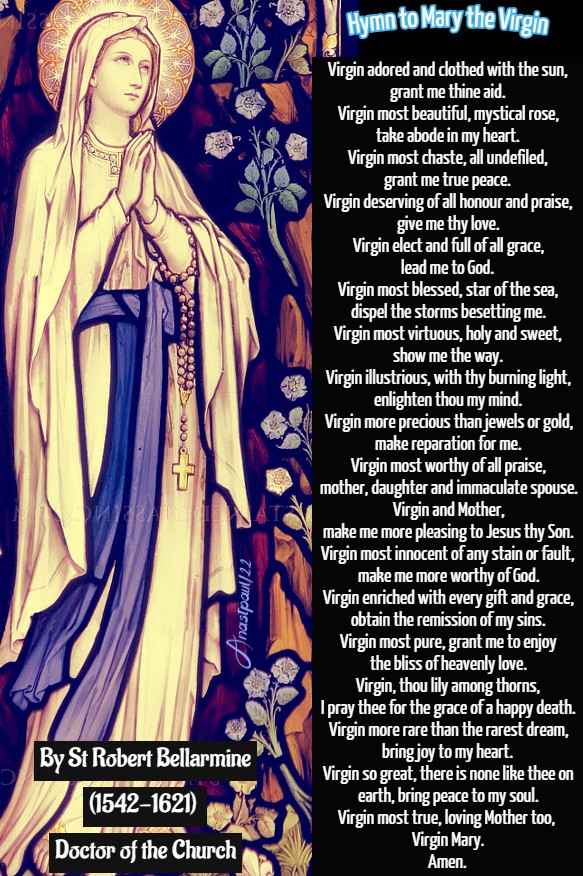
Hymn to Mary the Virgin By St Robert Bellarmine (1542-1621) Doctor of the Church.
Virgin adored and clothed with the sun, grant me thine aid. Virgin most beautiful, mystical rose, take abode in my heart. Virgin most chaste, all undefiled, grant me true peace. Virgin deserving of all honour and praise, give me thy love. Virgin elect and full of all grace, lead me to God. Virgin most blessed, star of the sea, dispel the storms besetting me. Virgin most virtuous, holy and sweet, show me the way. Virgin illustrious, with thy burning light, enlighten thou my mind. Virgin more precious than jewels or gold, make reparation for me. Virgin most worthy of all praise, mother, daughter and immaculate spouse. Virgin and Mother, make me more pleasing to Jesus thy Son. Virgin most innocent of any stain or fault, make me more worthy of God. Virgin enriched with every gift and grace, obtain the remission of my sins. Virgin most pure, grant me to enjoy the bliss of heavenly love. Virgin, thou lily among thorns, I pray thee for the grace of a happy death. Virgin more rare than the rarest dream, bring joy to my heart. Virgin so great, there is none like thee on earth, bring peace to my soul. Virgin most true, loving Mother too, Virgin Mary. Amen.
St Robert Bellarmine’s Hymn to Mary the Virgin: Among St Robert’s extant writing, there is a short poem of twenty stanzas which he composed in the nature of a Litany to the Blessed Virgin. The text was first published in Italian some fifty years ago and to the best of the writer’s knowledge, has never been translated into English. Each verse-line begins with the name “Virgin,” joined to a title and petition to Our Lady, starting with the letter “A” and going down the Italian alphabet to “V.” Thus the first seven verses begin with the invocation: “Vergine adorna … Vergine Bella …Vergine casta … Vergine degna … Vergine eletta … Vergine felice … Vergine gradita …”
A translation to this tribute to the Virgin Mother reads as follows: – Servant of God Fr John A Hardon SJ (1914-2000).
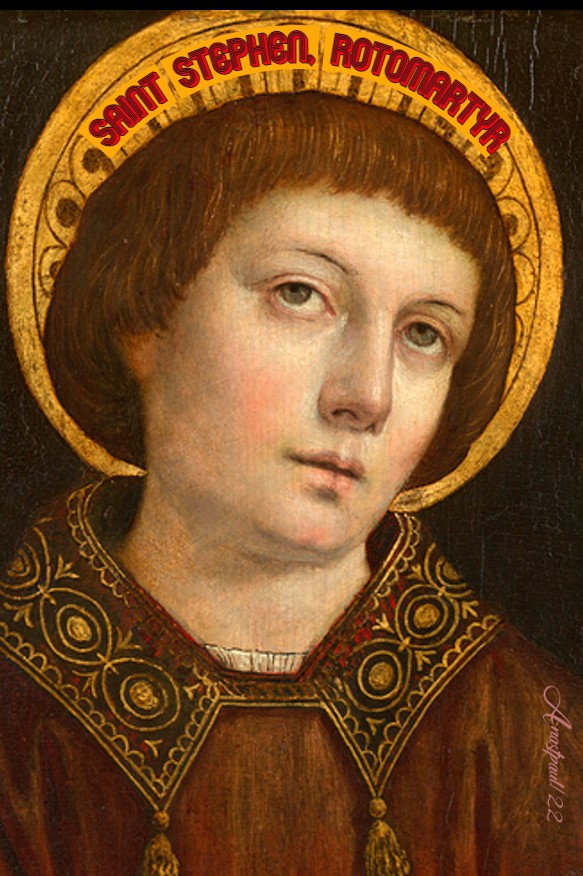
Saint of the Day – 3 August – The Finding of the Relics of St Stephen, Protomartyr. St Stephen, the ProtoMartyr (c 05-c 34) – 26 December the Second Day in the Octave of Christmas. The Roman Martyrology reads today: “At Jerusalem, the finding of the body of most blessed Saint Stephen, the first Martyr and of the Saints Gamaliel, Nicodemus and Abibo, through a Divine revelation made to the Priest Lucian, in the time of the Emperor Honorius.”
The Finding of the Relics of St Stephen, the ProtoMartyr By Fr Francis Xavier Weninger SJ (1805-1888)
After St Stephen, the First Martyr, had been stoned to death by the Jews for having uncontestably proved that Christ, Whom they had Crucified, was the true Messiah, some pious men, filled with deep sorrow, buried him with all due reverence. Foremost among these was St Gamaliel, who had formerly been a rabbi and later a disciple of St Paul. He arranged everything, so that the body of St Stephen was carried, during the night, by some Christians, from the spot in which it lay, to his country-seat, which was a few miles from Jerusalem.
The burial of St Stephen
“In the course of time and in consequence of the persecution of the Christians in Juda, the location of his tomb was forgotten, until it pleased the Almighty to reveal it, in the time of the Emperor Honorius. There lived, at that period, in the place where St Stephen was buried, a Priest of the Church of Jerusalem, named Lucian. St Gamaliel appeared to this holy man in his sleep and disclosed to him where the bodies of St Stephen, St Nicodemus, his son St Abibon and his own body, were lying, telling him, at the same time, to inform St John, Bishop of Jerusalem, of this fact and to say that it was the will of God that he should exhume them for the benefit of many men. Lucian awakening and fearing it was but a dream, or perhaps even a delusion from Satan, did not tell the Bishop but humbly prayed to God that, if it were a revelation from on high, He would grant him a repetition of the vision. To this effect, Lucian continued in prayer and fasting for eight days, when Gamaliel again appeared to him and repeated all he had said before.
Lucian did not yet obey but, to be more certain, fasted and prayed eight days more. St Gamaliel appeared to him for the third time and, with a severe countenance, reproving him for not believing his words, commanded him to make the Bishop acquainted with the facts immediately, in order that the faithful might no longer be deprived of the benefits which they would obtain by the intercession of St Stephen and the other Saints.
After this third apparition, Lucian could no longer doubt and, betaking himself to the Bishop of Jerusalem, he communicated to him all that had happened. The joy of the holy Bishop was exceedingly great. He called the Bishops and Priests of the neighbouring Churches and, accompanied by them and a great number of Christians, he went to the place indicated and had the satisfaction of finding four coffins, on which were engraven the names of the Saints abovementioned – St Stephen, St Nicodemus, St Abibon, St.Gamaliel. When the coffins were reverently opened, there issued from them a fragrance as if the place had been filled with blooming flowers.
St Stephen mourned by Saints Gamaliel and Nicodemus
More than seventy persons, some of whom were sick and others possessed by evil spirits, were instantly restored to health, or relieved of their torments, upon touching the Sacred Relics, especially those of St Stephen. The body of the Protomartyr was carried with great solemnity to Jerusalem, and deposited in the Church of Sion, the oldest and largest Church in that City.
During the reign of Theodosius the Younger, it was transported to Constantinople, and thence to Rome in the reign of Pope Pelagius I. The rearkable discovery of the relics of St Stephen and the miracles, which had been wrought at their touch, were soon known all over the Christian world. The heretics, who, at that time persecuted the Church, were ashamed and the faithful strengthened in the True Faith and animated in their veneration for the Protomartyr.
All Countries and Cities applied for portions of the Relics and many were favoured with them, to the great benefit of the people. Many received only some of the earth in which the holy body had rested; others, a piece of linen which had touched his coffin but, by the pious use of them, as many miracles were wrought as by the relics themselves.
In St Augustine, we have an indisputable witness of this, as he lived at the time of the discovery. Among other things, he tells us, in the twenty second book of the “City of God,” of many great miracles wrought, in his presence, by these relics, in the city of Hippo, of which he was bishop, as also in adjacent Countries. A few of these we will here relate.
A blind woman’s sight was immediately restored, by touching her eyes with a flower, which, at her request, had been laid on the Relics of St Stephen. Lucillus, a Bishop, was cured of a dangerous fistula by devoutly carrying the Sacred Relics. Eucharius, a Priest, arose again to life, when they placed upon his corpse, a tunic which had rested on St Stephen’s body. Two men suffering with gout were cured by the same. A lad who was killed by being run over by a carriage, was not only restored to life, but his broken limbs were healed. A nun who had died, retuned to life and health, when her habit was laid upon her, ,after it had touched the Sacred Relics. Eleusinus placed the corpse of his child upon the spot where the Relics of the Saint had rested, and immediately, the child lived again. Upon the head of Marial, a hardened Jew, his brother-in-law–a Christian–laid a flower, which had been on the Altar near the Relics and the next day the Jew requested to be Baptised. Two sisters, who were afflicted with epilepsy, were instantly cured by these relics. Many other miracles are narrated by St Augustine and he concludes with these words: “If I alone were to relate what I know of the miraculous cures performed by St Stephen at Calama and in its neighbourhood, I should have to write many books and yet, not be able to collect all of them!”
What does a non-Catholic think or say on reading or hearing these and many other things which the holy Fathers have written of the Sacred Relics? He rejects all these histories and accuses St Augustine and other great teachers, of falsehood and superstition. But, if he believes even one of these miracles, how can he, according to the doctrines of his religion, condemn the veneration of Relics and the invocation of the Saints!?”
For us, who believe in the powerful intercession of our Saints through their holy Relics, let us pray:
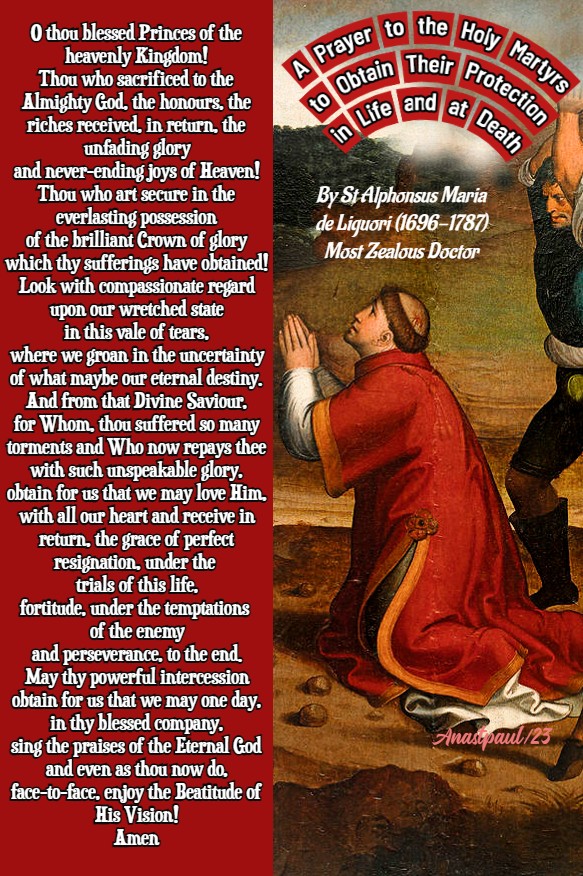
A Prayer to the Holy Martyrs to Obtain Their Protection By St Alphonsus Maria de Liguori (1696-1787)
O thou blessed Princes of the heavenly Kingdom! Thou who sacrificed to the Almighty God, the honours, the riches received, in return, the unfading glory and never-ending joys of Heaven! Thou who art secure in the everlasting possession of the brilliant Crown of glory which thy sufferings have obtained! Look with compassionate regard upon our wretched state in this vale of tears, where we groan in the uncertainty of what maybe our eternal destiny. And from that Divine Saviour, for Whom, thou suffered so many torments and Who now repays thee with such unspeakable glory, obtain for us that we may love Him, with all our heart and receive in return, the grace of perfect resignation, under the trials of this life, fortitude, under the temptations of the enemy and perseverance, to the end. May thy powerful intercession obtain for us that we may one day, in thy blessed company, sing the praises of the Eternal God and even as thou now do, face-to-face, enjoy the Beatitude of His Vision! Amen
Blessed Augustine Gazotich OP (1262-1323) Bishop of Lucera, Croatia, Of the Order of Preachers. He was also noted for being the guide for Dante Alighieri as the poet travelled through Croatia. His reputation for personal holiness remained noted long after his death; this resulted in Pope Innocent XII confirming the late Bishop’s Beatification in 1700. Biography: https://anastpaul.com/2018/08/03/saint-of-the-day-3-august-blessed-augustine-gazotich-o-p-1262-1323/
St Dalmatius St Euphronius of Autun St Gamaliel St Gaudentia Bl Godfrey of Le Mans Bl Gregory of Nonantula St Hermellus St Nicodemus St Senach of Clonard (Died 6th Century) One of the Twelve Apostles of Ireland St Trea of Ardtree
Thought for the Day – 2 August – Meditations with Antonio Cardinal Bacci (1881-1971)
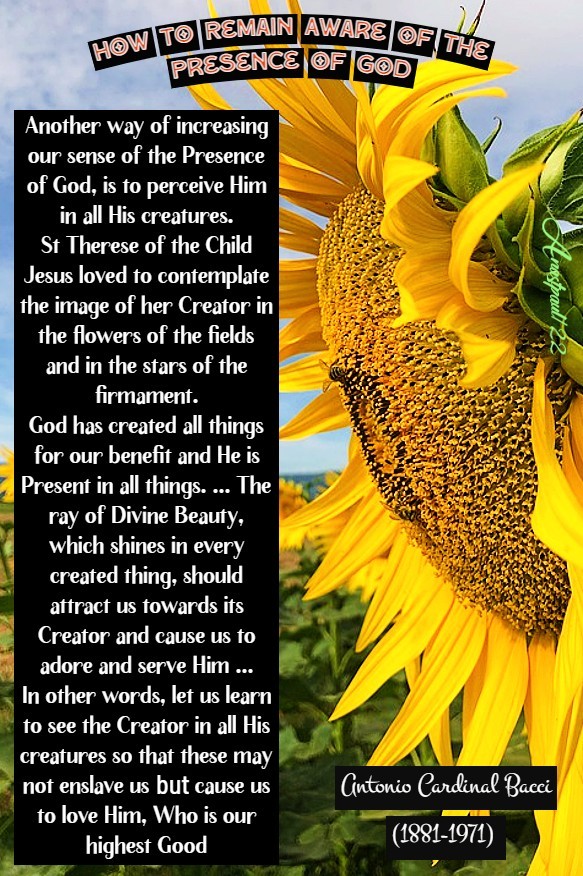
How to Remain Aware of the Presence of God
“Another way of increasing our sense of the Presence of God, is to perceive Him in all His creatures. St Therese of the Child Jesus loved to contemplate the image of her Creator in the flowers of the fields and in the stars of the firmament.
God has created all things for our benefit and He is Present in all things. He sees what use we make of them and can judge whether we employ them to honour Him, Who is our beginning and our end. The ray of Divine Beauty,which shines in every created thing, should attract us towards its Creator and cause us to adore and serve Him. Whenever we meet a learned and holy person, moreover, the reflection of God’s Power and Goodness, is even more compelling. “Learn to love the Creator in the creature,” says St Augustine, “lest the thing which He has made should grip you and you shuld lose Him by Whom you also were created” (In Ps 19),
In other words, let us learn to see the Creator in all His creatures so that these may not enslave us but cause us to love Him, Who is our highest Good.”
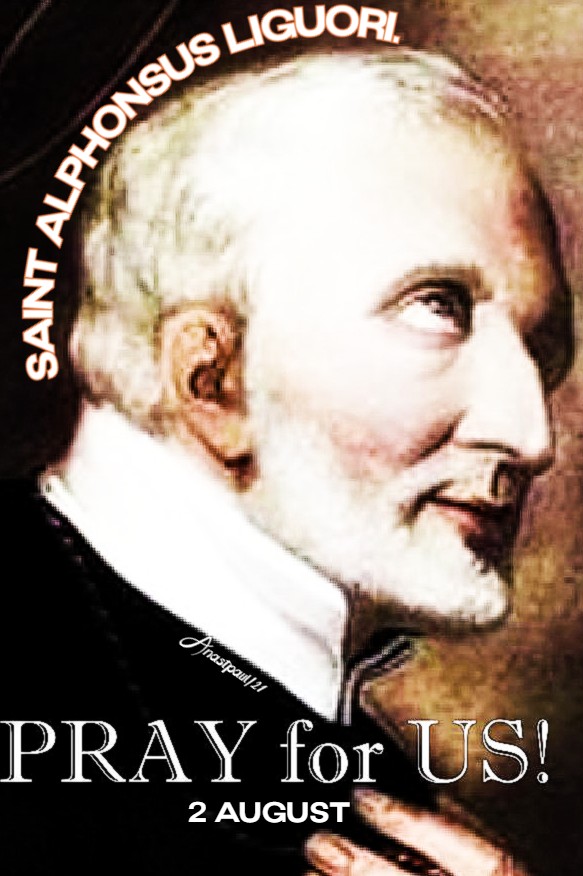
Quote/s of the Day – 2 August – The Memorial of St Alphonsus Maria de Liguori (1696-1787) Bishop, Confessor, Doctor of the Church
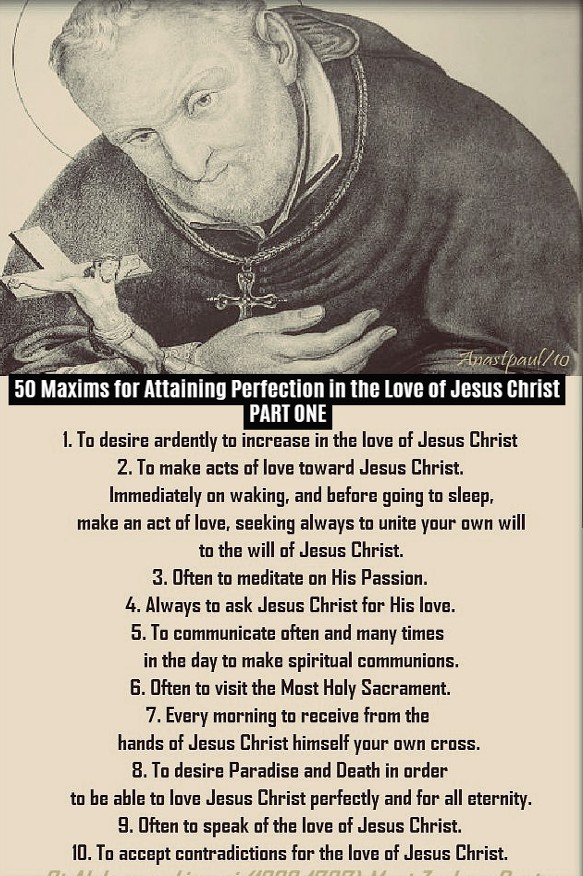
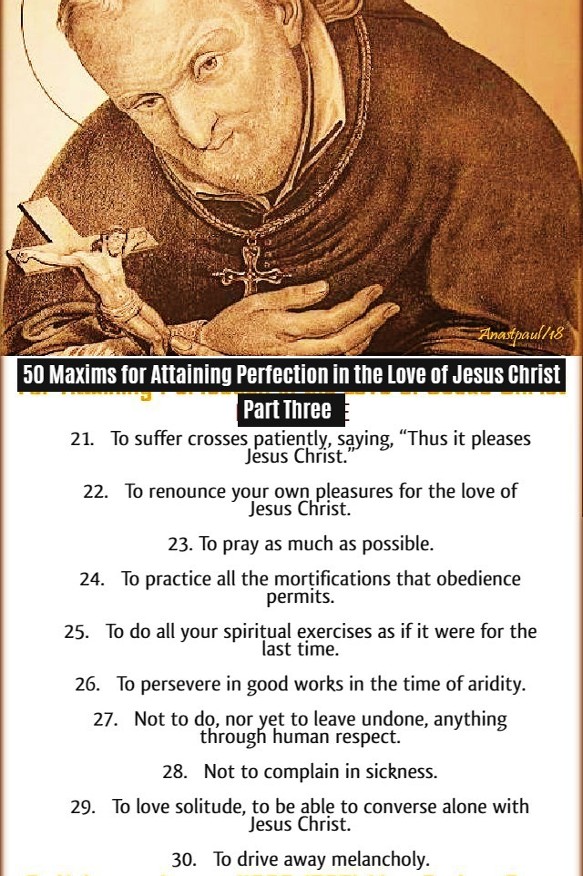
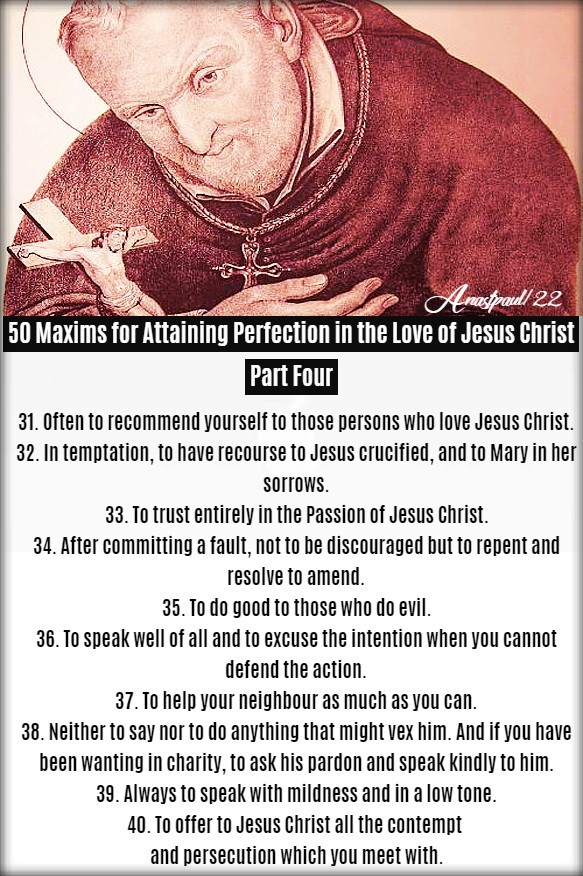
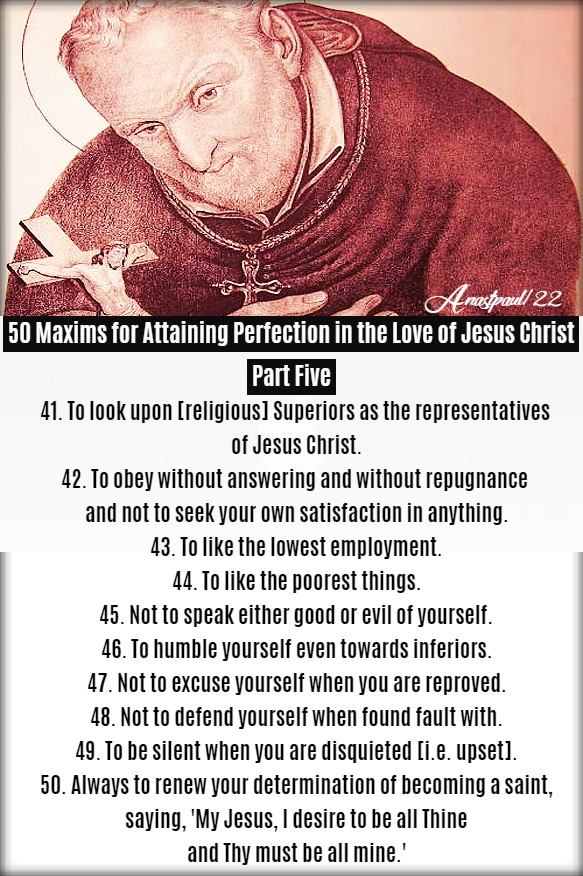
St Alphonsus de Liguori’s “50 Maxims for Attaining Perfection in the Love of Jesus Christ”
To desire ardently to increase in the love of Jesus Christ
To make acts of love toward Jesus Christ. Immediately on waking and before going to sleep, make an act of love, seeking always to unite your own will to the will of Jesus Christ.
Often to meditate on His Passion.
Always to ask Jesus Christ for His love.
To communicate often and many times in the day to make spiritual communions.
Often to visit the Most Holy Sacrament.
Every morning to receive from the hands of Jesus Christ Himself your own cross.
To desire Paradise and Death in order to be able to love Jesus Christ perfectly and for all eternity.
Often to speak of the love of Jesus Christ.
To accept contradictions for the love of Jesus Christ.
To rejoice in the happiness of God.
To do that which is most pleasing to Jesus Christ, and not to refuse Him anything that is agreeable to Him.
To desire and to endeavour that all should love Jesus Christ.
To pray always for sinners and for the souls in Purgatory.
To drive from your heart every affection that does not belong to Jesus Christ.
Always to have recourse to the Most Holy Mary, that she may obtain for us the love of Jesus Christ.
To honour Mary in order to please Jesus Christ.
To seek to please Jesus Christ in all of your actions.
To offer yourself to Jesus Christ to suffer any pain for is love.
To be always determined to die rather than commit a wilful venial sin.
To suffer crosses patiently, saying, “Thus it pleases Jesus Christ.”
To renounce your own pleasures for the love of Jesus Christ.
To pray as much as possible.
To practice all the mortifications that obedience permits.
To do all your spiritual exercises as if it were for the last time.
To persevere in good works in the time of aridity.
Not to do, nor yet to leave undone, anything through human respect.
Not to complain in sickness.
To love solitude, to be able to converse alone with Jesus Christ.
To drive away melancholy.
Often to recommend yourself to those persons who love Jesus Christ.
In temptation, to have recourse to Jesus crucified, and to Mary in her sorrows.
To trust entirely in the Passion of Jesus Christ.
After committing a fault, not to be discouraged, but to repent and resolve to amend.
To do good to those who do evil.
To speak well of all, and to excuse the intention when you cannot defend the action.
To help your neighbour as much as you can.
Neither to say nor to do anything that might vex him. And if you have been wanting in charity, to ask his pardon and speak kindly to him.
Always to speak with mildness and in a low tone.
To offer to Jesus Christ all the contempt and persecution which you meet with.
To look upon [religious] Superiors as the representatives of Jesus Christ.
To obey without answering and without repugnance and not to seek your own satisfaction in anything.
To like the lowest employment.
To like the poorest things.
Not to speak either good or evil of yourself.
To humble yourself even towards inferiors.
Not to excuse yourself when you are reproved.
Not to defend yourself when found fault with.
To be silent when you are disquieted [i.e. upset].
Always to renew your determination of becoming a saint, saying, ‘My Jesus, I desire to be all Thine and Thy must be all mine.
One Minute Reflection – 2 August – “The Month of the Immaculate Heart of Mary” – The Memorial of St Alphonsus Maria de Liguori (1696-1787) Bishop, Confessor, Doctor of the Church – Timothy 2:1-7, Luke 10:1-9
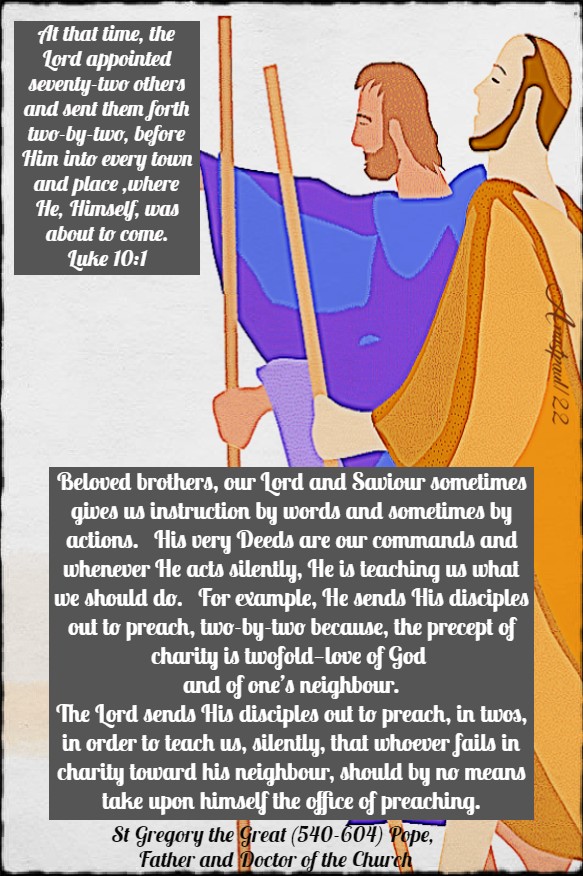
“At that time, the Lord appointed seventy-two others and sent them forth two-by-two, before Him into every town and place, where He, Himself, was about to come.” – Luke 10:1
REFLECTION – “Beloved brothers, our Lord and Saviour sometimes gives us instruction by Words and sometimes by Actions. His very Deeds are our commands and whenever He acts silently, He is teaching us what we should do. For example, He sends His disciples out to preach, two-by-two because the precept of charity is twofold—love of God and of one’s neighbour.
The Lord sends His disciples out to preach in twos, in order to teach us, silently, that whoever fails in charity toward his neighbour, should by no means take upon himself the office of preaching.
Rightly is it said, that He sent them ahead of Him into every city and place, where He ,Himself was to go. For the Lord follows after the preachers because preaching goes ahead to prepare the way and then, when the words of exhortation have gone ahead and established Truth in our minds, the Lord comes to live within us. To those who preach ,Isaiah says: Prepare the way of the Lord, make straight the paths of our God. And the psalmist tells them: Make a way for Him who rises above the sunset. The Lord rises above the sunset because, from that very place where He slept in death, He rose again and manifested a greater glory. He rises above the sunset because, in His Resurrection, He trampled underfoot the death, which He endured. Therefore, we make a way for Him who rises above the sunset ,when we preach His glory to you, so that when He, Himself follows after us, He may illumine you with His Love.
Let us listen now to His words as He sends His preachers forth: The harvest is great but the labourers are few. Pray, therefore, the Lord of the harvest to send labourers into His harvest. That the harvest is good but the labourers are few cannot be said without a heavy heart, for although there are many to hear the good news there are only a few to preach it. Indeed, see how full the world is of Priests but yet, in God’s harvest, a true labourer is rarely to be found;,although we have accepted the Priestly office, we do not fulfil its demands!
Think over, my beloved brothers, think over His Words: Pray the Lord of the harvest to send labourers into His harvest. Pray for us, so that we may be able to labour worthily on your behalf, that our tongue may not grow weary of exhortation, that after we have taken up the office of preaching, our silence may not bring us condemnation from the Just Judge! ” – St Gregory the Great (540-604) Pope, Father and Doctor of the Church (An excerpt from his Homily 17, On the Gospels).
PRAYER – O God, Who through blessed Alphonsus Maria, Thy Confessor and Bishop, fired with love for souls, enriched Thy Church with a new family; we beseech Thee that, taught by his saving counsels and strengthened by his example, we may be enabled, happily to come to Thee. Through Jesus Christ, Thy Son our Lord, Who lives and reigns with Thee, in the unity of the Holy Ghost, God, world without end. Amen (Collect).
Our Morning Offering – 2 August – The Memorial of St Alphonsus Maria de Liguori (1696-1787) Bishop, Confessor, Doctor of the Church
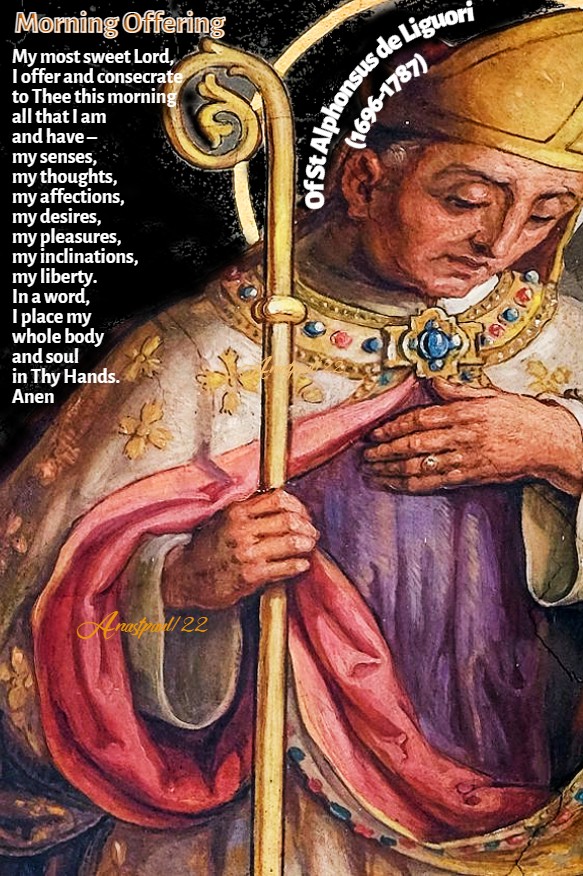
Morning Offering Of St Alphonsus de Liguori (1696-1787) Most Zealous Doctor of Church
My most sweet Lord, I offer and consecrate to Thee this morning all that I am and have – my senses, my thoughts, my affections, my desires, my pleasures, my inclinations, my liberty. In a word, I place my whole body and soul in Thy Hands. Amen
Saint of the Day – 2 August – Saint Stephen I (Died 257) Pope, Martyr, Bishop of Rome from 12 May 254 until his death. Born in Rome and died on 1 August 257 by being beheaded as he concluded Holy Mass in the Cemetery of Callistus. Patronage – Fiano Romano, Italy.
The Roman Martyrology reads today: “At Rome, in the Cemetery of Callistus, the birthday of St Stephen, Pope and Martyr. In the persecutions of Valerian, the soldiers suddenly entered whilst he was celebrating Holy Mass but he remained before the Altar and concluded the Sacred Mysteries, with intrepidity and was beheaded on his Throne.”
Stephen was by birth a Roman but had Greek ancestry.. After being promoted to Holy Orders, he was made Archdeacon of Rome under the holy Popes Saint Cornelius and Saint Lucius. When these had both suffered Martyrdom, Saint Stephen was elected Head of the Church in the year 254.
Controversy concerning the re-baptising of heretics gave Saint Stephen much trouble. The heretics themselves were re-baptising Catholics who left the orthodox faith to join them. Certain African Bishops decided then to rebaptise those who returned to the True Faith from their errors and some other Bishops joined them in this practice. It is the teaching of the Catholic Church, however, that baptism given with natural water and in the name of the Three Persons of the Blessed Trinity is valid, even if conferred by those in error. Saint Stephen suffered patiently when accused of favouring heresy by ratifying such baptisms – he did not doubt that the great men in whom a mistaken zeal seemed to obscure the Truth would, when the heat of the dispute had subsided, calmly open their eyes to the Truth. Thus by his zeal, he preserved the integrity of the Faith and by his gentleness and forbearance, saved many souls.
When the persecutions grew violent, he assembled the faithful in the underground tombs of the Martyrs, going from one catacomb to another to baptise neophytes, celebrate Mass and exhort them to remain true to Christ. After twelve members of his clergy were Martyred, he himself was arrested but he was set free when a violent storm so frightened the soldiers and executioners sent to put him to death, that they fled. Nonetheless, he was followed to a catacomb by the Emperor’s soldiers and, on 2 August 257, while seated in his Pontifical chair in the Callistus Catacomb, after concluding Holy Mass, he was beheaded.
The chair, stained with his blood, was placed with his relics in the Church which he had built and is still shown in the same Church, today, Saint Sylvester in capite.
St Pope Stephen I (Died 257) Pope, Martyr, Bishop of Rome from 12 May 254 until his death.
St Auspicius of Apt St Betharius of Chartres St Centolla of Burgos St Etheldritha of Croyland Bl Frederic Campisani Bl Gundekar of Eichstätt Bl Joanna of Aza Bl John of Rieti St Maximus of Padua St Pedro de Osma St Plegmund St Rutilius
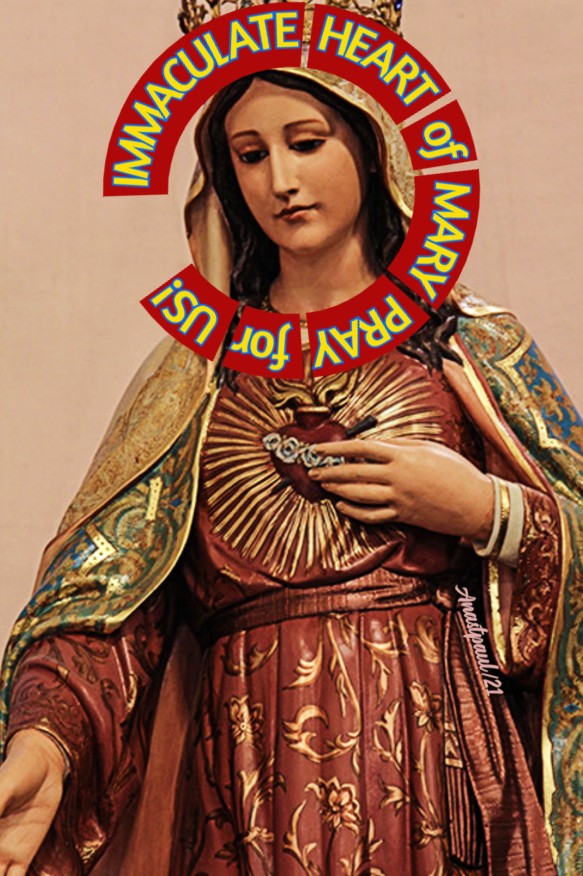
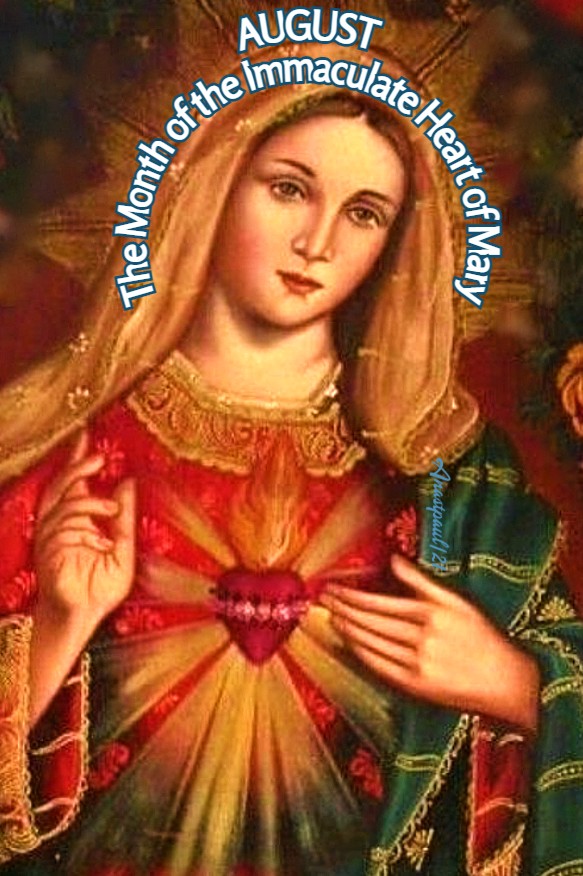
August – The Month of the Immaculate Heart of Mary
Devotion to the Heart of Mary
Devotion to the Heart of Mary is but the consequence of the devotion due to the Heart of Jesus. It is a consequence of that boundless love of Jesus for His Most Holy Mother, which leads Him, to share with her ,all the riches and honours, as far as they can be communicated to a creature.
The Church never disassociates the Mother from her Divine Son, in the festivals which she celebrates in His honour. If she celebrates the Mysteries of the Saviour, from His Incarnation to His Ascension, she celebrates, likewise, all the Mysteries of Mary, from her Conceptions to her Assumption. The Feast of the Sacred Heart of Mary (Immaculate Heart of Mary) is, therefore, but the natural consequence of the Feast of the Sacred Heart of Jesus.
Let us love and honour these Two Hearts, so intimately united; let us go to the Father through the Heart of Jesus; let us go to the Saviour through the Heart of Mary. Let us render to God the Father, through the Heart of Jesus, what we owe to His infinite justice and goodness and let us render to God, the Son, through the Heart of Mary what we owe to His Mercy and all His benefits to us. We shall obtain everything from the Father and the Holy Ghost through the Heart of Jesus and we shall obtain everything, through the Heart of Mary.
It is customary with many pious persons, to dedicate the Five First Saturdays of the month to the particular honour of the Immaculate Heart of Mary, as the Nine First Friday are devoted to the Sacred Heart of Jesus.

























 AnaStpaul
You must be logged in to post a comment.