One Minute Reflection – 26 September – “The Month of the Seven Sorrows of the Blessed Virgin Mary and the Holy Cross” – St Isaac Jogues SJ (1607-1646) Priest, Martyr, Missionary and Companions – Hebrews 10:32-38, Luke 12:1-8 Sacred Scripture seach here: https://www.drbo.org/
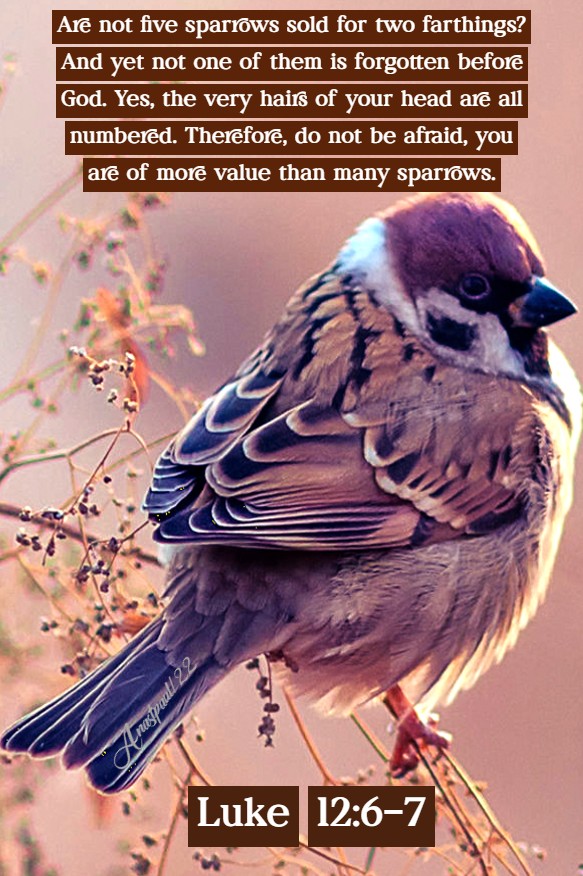
“Are not five sparrows sold for two farthings? And yet not one of them is forgotten before God. Yes, the very hairs of your head are all numbered. Therefore, do not be afraid, you are of more value than many sparrows.” – Luke 12:6-7
REFLECTION – “Do not look forward to the changes and chances of this life in fear – rather look to them with full hope that, as they arise, God, whose you are, will deliver you out of them. He is your keeper. He has kept you hitherto. Do you but hold fast to His dear hand and He will lead you safely through all things and, when you cannot stand, He will bear you in His arms. Do not look forward to what may happen tomorrow. Our Father will either shield you from suffering, or He will give you strength to bear it.” – St Francis de Sales (1567-1622) Doctor of the Church.
PRAYER – May the continual protection of the blessed Martyrs comfort us, O Lord, for Thou do not cease to behold with favour those whom You have granted the grace of such assistance. Through Jesus Christ, Thy Son our Lord, Who lives and reigns with Thee, in the unity of the Holy Ghost, God, world without end. Amen (Collect).
Our Morning Offering – 26 September – St Isaac Jogues SJ (1607-1646), St Isaac Jogues SJ (1607-1646) Priest, Martyr, Missionary and Companions
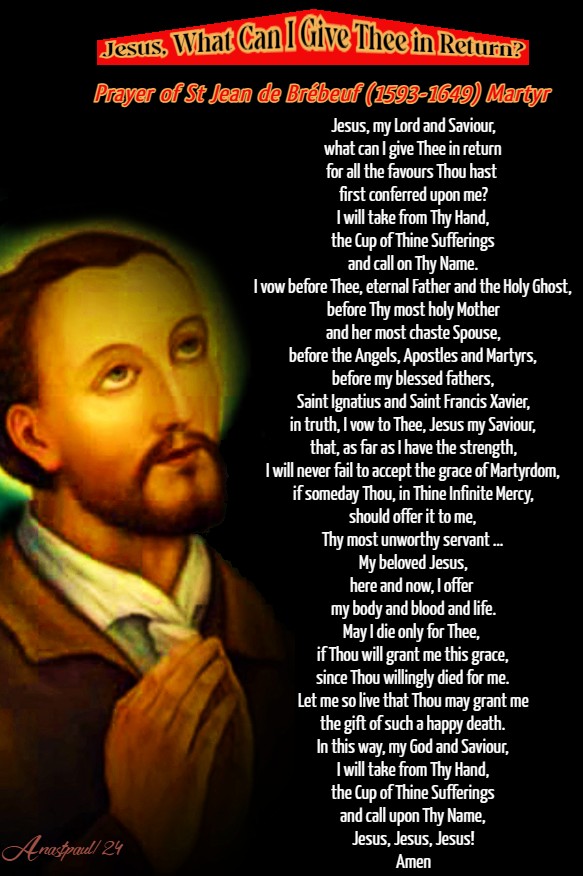
Jesus, What Can I Give Thee in Return? The Prayer of St Jean de Brébeuf SJ (1593-1649)
Jesus, my Lord and Saviour, what can I give Thee in return for all the favours Thou hast first conferred upon me? I will take from Thy Hand, the Cup of Thine Sufferings and call on Thy Name. I vow before Thee, eternal Father and the Holy Ghost, before Thy most holy Mother and her most chaste Spouse, before the Angels, Apostles and Martyrs, before my blessed fathers, Saint Ignatius and Saint Francis Xavier, in truth, I vow to Thee, Jesus my Saviour, that, as far as I have the strength, I will never fail to accept the grace of Martyrdom, if someday Thou, in Thine Infinite Mercy, should offer it to me, Thy most unworthy servant … My beloved Jesus, here and now, I offer my body and blood and life. May I die only for Thee, if Thou will grant me this grace, since Thou willingly died for me. Let me so live that Thou may grant me the gift of such a happy death. In this way, my God and Saviour, I will take from Thy Hand, the Cup of Thine Sufferings and call upon Thy Name, Jesus, Jesus, Jesus! Amen
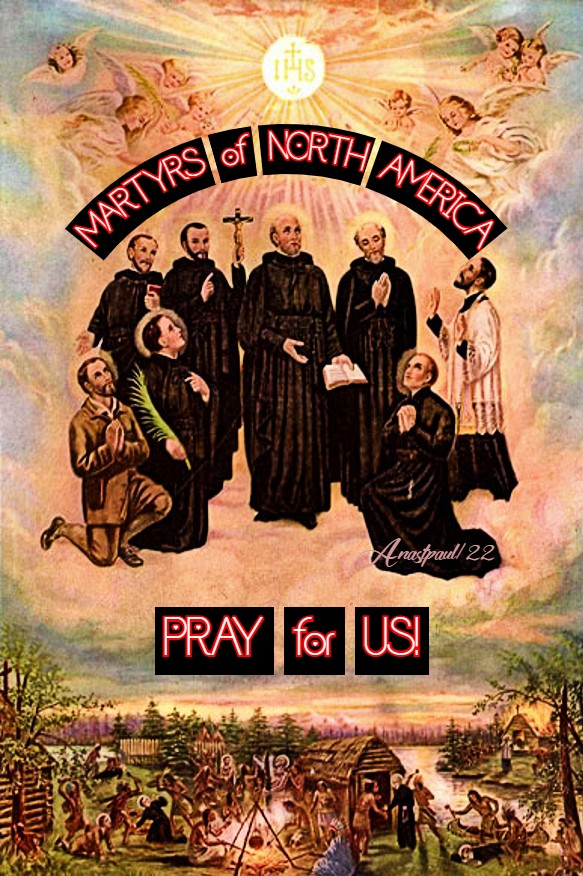
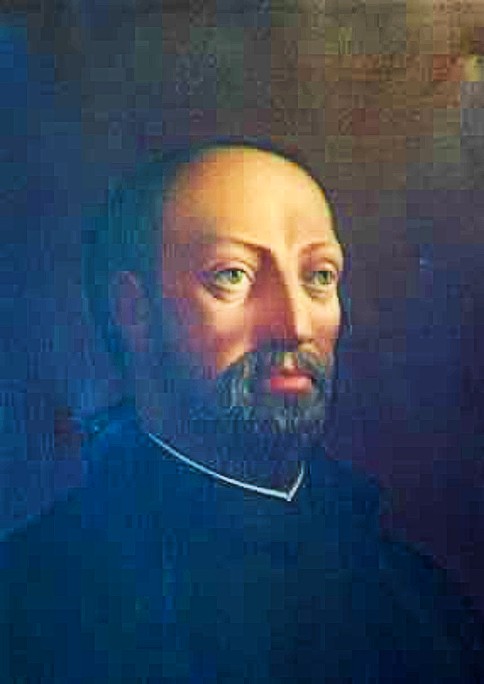
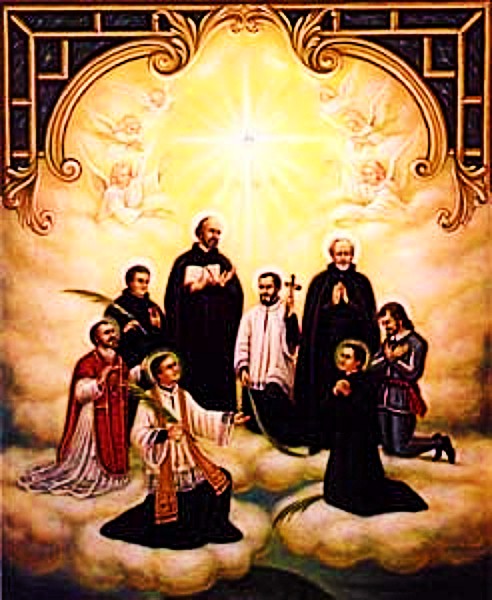
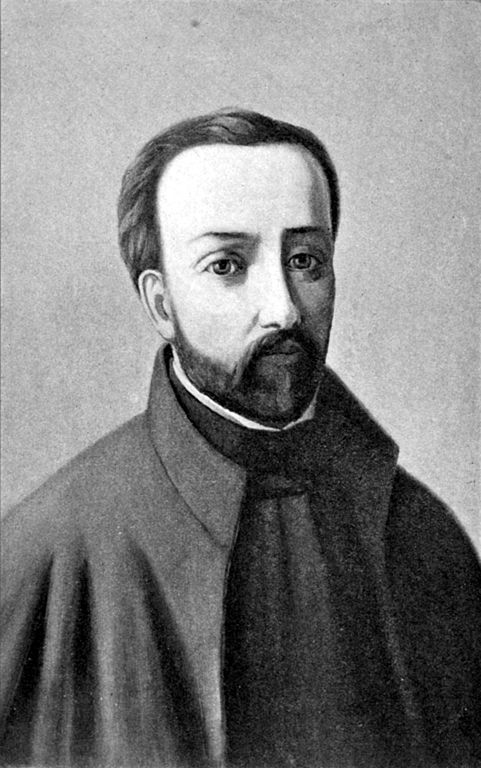
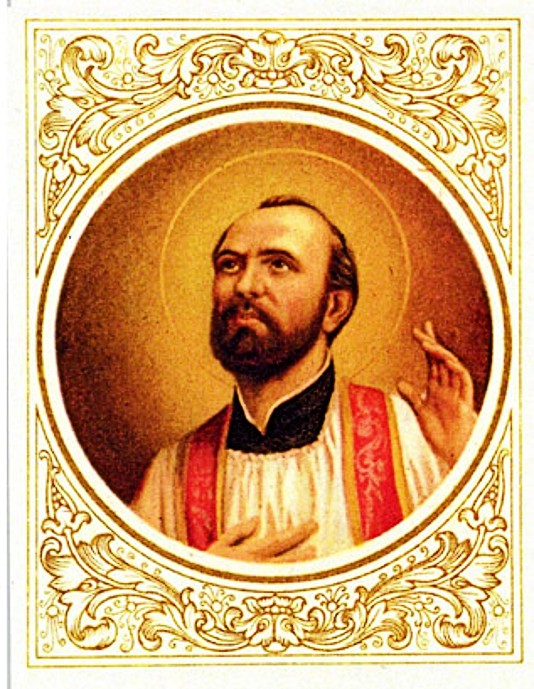
Saints of the Day – 26 September – St Isaac Jogues SJ (1607-1646) Priests, Martyrs, Missionary and Companions – known as The North American or the Canadian Martyrs. Born on 10 January 1607 o, Orléans, Orléanais, France. In 1646, Jogues was Martyred by the Mohawk at their village of Ossernenon, near the Mohawk River. They were Beatified on 21 June 1925, by Pope Pius XI and Canonised on 29 June 1930, by Pope Pius XI. They are collectively the secondary Patron Saints of Canada.
St Isaac Jogues and Companions from the Roman Breviary
Among the members of the Society of Jesus who brought most renown to the infant Church in North America, in the middle of the seventeenth Century, God chose as victims eight men of outstanding integrity, that from the seeds of faith watered with their blood, there might spring up a more abundant harvest.
All these Martyrs–six Priests and two Laymen–natives of France, were sent by their Superiors to the Missions in Canada, at that time known as New France. With Quebec as a centre, they made numberless missionary journeys to the various sectors of this vast territory, labouring amidst the greatest hardships. In the end, all were most cruelly put to death and for the same reaso – their faith, although not at the same time and place.
Jean de Brebeuf, born at Conde-sur-Vire, in the Diocese of Bajon (now Constance), of an illustrious family and Isaac Jogues, born in Orleans, are regarded as their leaders and masters and rightly so. For they were valiant men, fired with apostolic zeal, living most mortified lives, in intimate prayerful union with God and, at times, were honoured with heavenly visions.
St Jean de Brébeuf (1607-1646 aged 39) Priest
Not unlike them, were their four companion Priests: Antoine Daniel, born at Dieppe, Gabriel Lalemant and Charles Gamier, both Parisian born and Noel Chabanel, a native of Mende – all of these faithfully fulfilled their Priestly functions, labouring principally in various villages of the Huron country.
Frequent raids by the Iroquois, a hostile neighbouring tribe, often wrought havoc in the Huron missions and seriously endangered the lives of the Fathers in charge of them. In 1642, on a journey from Quebec to the Huron country, Isaac Jogues, together with Rene Goupil, a lay co-adjutor of the Society of Jesus, fell in with the Iroquois, who held him and his companion as slaves and subjected them to most horrible torments. In the same year on the 29th of September, Rene was killed by order of an old savage, out of hatred for the Cross of salvation. It was near Auriesville, in the present State of New York, where this most sincere man breathed forth his soul to God.
In the following year Isaac managed to escape and made his way back to France. He returned to America after another year and along with John Lalande, who was also a co-adjutor of the Society of Jesus, made a second and third journey to the savages, his erstwhile tormentors.
On 18 October 1646, in the present diocese of Albany, Isaac was struck with a tomahawk and thus obtained the Palm of Martyrdom. The following day his companion, John, meeting with a like fate, took his flight to Heaven, to be rewarded with the same Crown of Martyrdom.
St Isaac Jogues (1607-1646) aged 39) Priest
On 4 July 1648, in an attack upon the village of St Joseph by the Iroquois, Antoine Daniel, in charge of the Huron mission there, was slain while fearlessly defending his flock. Overwhelmed by a shower of arrows and bullets at the entrance of the Church, like a good shepherd he laid down his life for his sheep. Within a year, on 16 March 1649, at St Ignace, a village situated in what is now the Province of Ontario, Canada, John de Brebeuf and Gabriel Lalemant were captured by the Iroquois. That same day, Brebeuf, rightly called the Apostle of the Hurons, died a glorious death, after undergoing long drawn-out tortures of the most atrocious description, during which, this gallant soldier of Christ manifested such fortitude, as to excite even the admiration of the savages themselves. On the following day Gabriel Lalemant suffered the same cruel Martyrdom, during which, he showed the same heroic virtue.
St Gabriel Lalemant (1610-1649) aged 38 Priest
St Antoine Daniel (1601-1648) aged 47) Priest
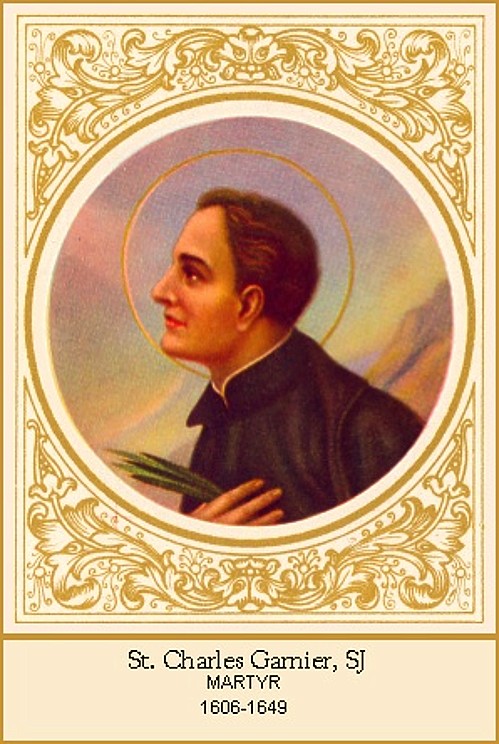
In December of the same year, 1649, on the eve of the Immaculate Conception of the Blessed Virgin Mary, Charles Garnier, after several bullet Wounds was killed by a blow from a hatchet, thereby adding a glorious Crown to a life of exceptional innocence. On the following day Noel Chabanel became the victim of the treachery of a Huron apostate, who killed him and threw his body into a river. His longing for the Palm of Martyrdom was thus realised in his own beloved mission. Although he felt a natural repugnance for this work among the savages, hero that he was, he bound himself by a vow to remain in this mission until death.
St Charles Garnier (1606-1649) aged 33) Priest
These eight Martyrs, the first in North America, were Beatified by Pope Pius XI in 1925 and were Canonised by the same Pontiff five years later.
Thought for the Day – 25 September – Meditations with Antonio Cardinal Bacci (1881-1971)
The Sacrifices of Life
“When we say that we must be prepared to make any sacrifice, even to die, rather than offend God and risk eternal damnation, we mean exactly what we say. “If thy right eye is an occasion of sin to thee,” Jesus says in the Gospel, “pluck it out and cast it from thee; for it is better for thee that one of thy members should perish than that thy whole body should be thrown into hell. And if thy right hand is an occasion of sin to thee, cut it off and cast it from thee; for it is better for thee that one of thy members should be lost, than thy whole body should go into hell” (Mt 5:29-30).
We are prepared to do all this when there is a question of preserving mortal life; we are prepared to undergo an amputation in order to avoid death. Are we prepared to do as much for eternal salvation?
Sometimes, when we wish to set ourselves free from the danger of sin, we must deprive ourselves of things that are dear to us; we must suppress our natural instincts and affections and we must impose on ourselves severe penances and bodily mortifications. All this is demanded from us by Jesus in these words which seem hard and almost cruel but are none other than a just and necessary commandment. In certain grave cases, heroism is necessary for all – now is the time of heroes! Are we courageous for Christ and for eternal life with Him?”
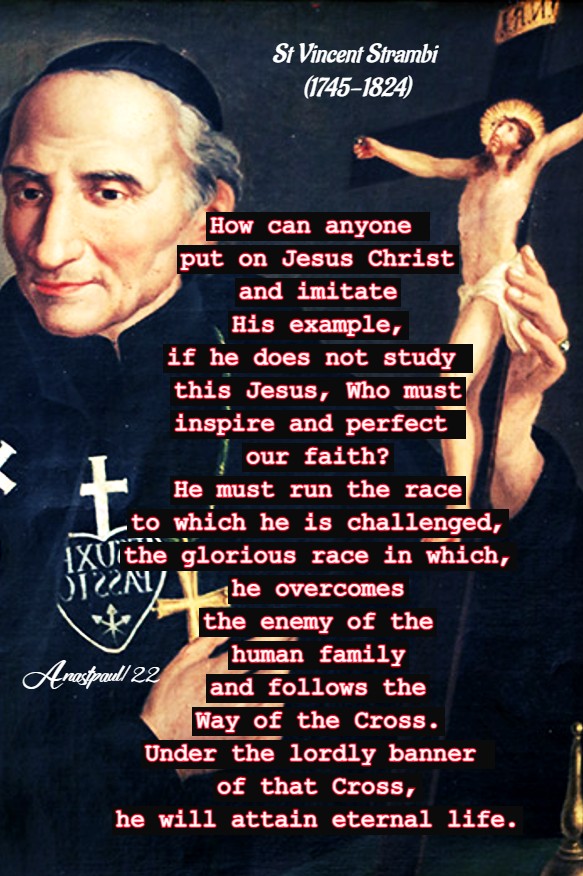
Quote/s of the Day – 25 September – “The Month of the Seven Sorrows of the Blessed Virgin Mary and the Holy Cross” and the Memnorial of St Vincent Strambi CP (1745-1824) Bishop
“… How can anyone put on Jesus Christ and imitate His example, if he does not study this Jesus, who must inspire and perfect our faith? He must run the race to which he is challenged, the glorious race in which, he overcomes the enemy of the human family and follows the Way of the Cross. Under the lordly banner of that Cross, he will attain eternal life.”
(From his first Pastoral Letter as Bishop)
“The poor are my supervisors and I am their treasurer.”
One Minute Reflection – 25 September – “The Month of the Seven Sorrows of the Blessed Virgin Mary and the Holy Cross” – Ephesians 3:13-21, Luke 14:1-11 – Seardh Scripture here: https://www.drbo.org/
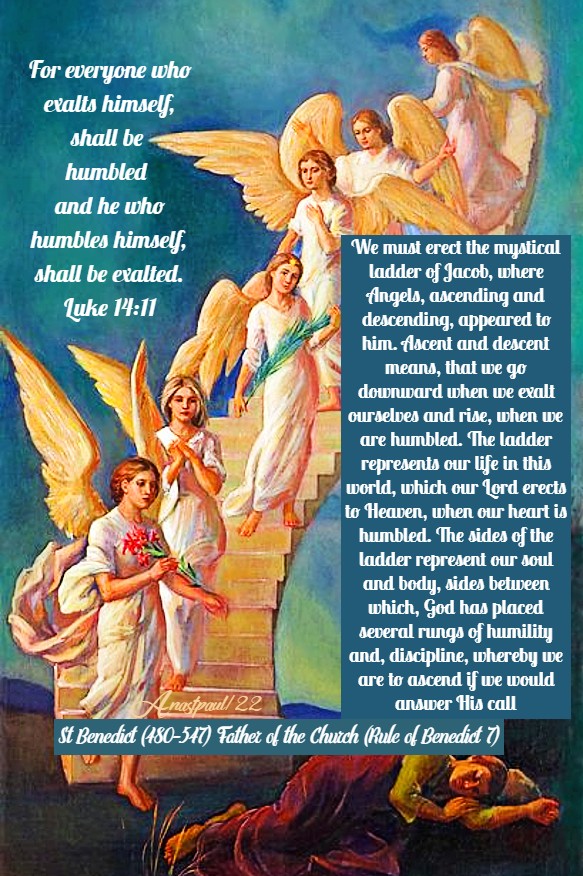
“For everyone who exalts himself, shall be humbled and he who humbles himself, shall be exalted.” – Luke 14:11
REFLECTION – “The Scripture asserts that “everyone who exalts himself shall be humbled and he who humbles himself shall be exalted.” If we want to attain to true humility and come quickly to the top of that heavenly ascent, to which we can only mount, by lowliness in this present life, we must ascend by good works.
We must erect the mystical ladder of Jacob, where Angels, ascending and descending, appeared to him. Ascent and descent means, that we go downward when we exalt ourselves and rise, when we are humbled. The ladder represents our life in this world, which our Lord erects to Heaven, when our heart is humbled. The sides of the ladder represent our soul and body, sides between which, God has placed several rungs of humility and, discipline, whereby we are to ascend if we would answer His call.”– St Benedict (480-547) Father of the Church (Rule of Benedict #7)
PRAYER – Grant, we beseech Thee, O Lord God, unto all Thy servants, that they may remain continually in the enjoyment of soundness, both of mind and body and by the glorious intercession of the Blessed Mary, always a Virgin, our sorrowful Mother, may be delivered from present sadnes, and enter into the joy of thine eternal gladness.Through Jesus Christ, Thy Son our Lord, Who lives and reigns with Thee, in the unity of the Holy Ghost, God, world without end. Amen (Collect).
Our Morning Offering – 25 September – The Sixteenth Sunday after Pentecost +
An Act of Consecration to the Holy Trinity By St Francis de Sales (1567-1622) Doctor of Charity
I vow and consecrate to God all that is in me: my memory and my actions to God the Father; my understanding and my words to God the Son; my will and my thoughts to God the Holy Ghost; my heart, my body, my tongue, my senses and all my sorrows to the Sacred Humanity of Jesus Christ, “who was content to be betrayed into the hands of wicked men and to suffer the torment of the Cross..” Amen
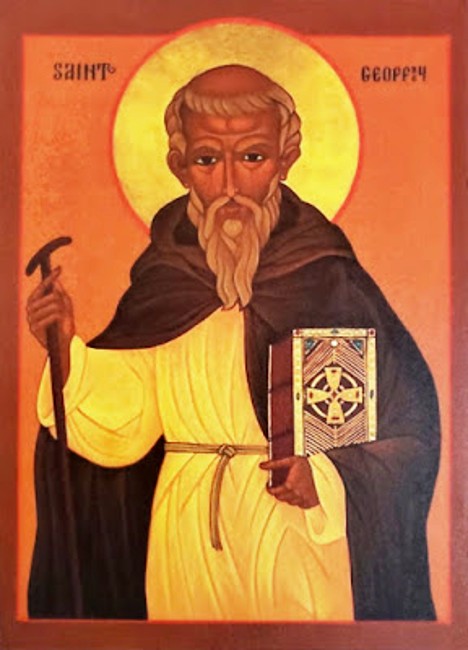
Saint of the Day – 25 September – Saint Ceolfrid (642-716) Abbot and Guardian of the Venerable St Bede, who was placed in his care when the child was 7 years old, for his education in the Monastery. He built an immense library at Jarrow and was himself a man of great knowledge of the Sacred writings. He was the Abbot of Monkwearmouth-Jarrow Abbey, of Wiremouth,Monastery and a major contributor to the production of the the famous Codex Amiatinus, which is considered the best-preserved manuscript of the Latin Vulgate. It was one of three giant single-volume Scriptures then made at Monkwearmouth–Jarrow and is the earliest complete, one-volume Latin Vulgates to survive. Born in 642 in Northumbria, England and died on 25 September 716 at Longres, Champagne, France of natural causes, whilst en route to Rome, to deliver a copy of the Codex to Pope Gregory II. Also known as – Ceolfrith, Ceufrey, Gaufrid, Geoffrey, Geoffroy, Geofroi, Gioffredo, Godefrid, Godefridus, Godfrey, Goffredo, Goffrey, Gofrido, Gotfrid, Gottfried, Jeffrey. CEOLFRID is the same Teutonic name as Geoffrey and signifies “Joyful.”
Ceolfrid was nobly born in Bernicia and related to St Benedict Biscop (c 628-690), (Tutor of the Venerable St Bede) wth whom he joined in the generous resolution of turning their backs upon the world and gave themselves to God.. With him, he made a journey to Rome, partly out of devotion, and partly for improvement in sacred studies and divine knowledge.
After their return he was St. Benedict’s assistant in the foundation of his Monastery of St Peter at Wiremouth, on the north bank of the river, in the Bishopric of Durham. S. Ceolfrid would have regarded it as his greatest felicity on earth, if he could have been as much forgotten by all creatures and despised by everyne as he studied to forget himself. He lived in his, community as St Antony and St Hilarion lived, on their mountains, in the most profound recollection and in the practice of the most austere penance.
When St Benedict built the Monastery of St Paul at Jarrow, he sent Ceolfrid, with seventeen Monks, to lay the foundation of that house and appointed him Abbot. Our Saint governed this Abbey for seven years in St Benedict’s life-time and was constituted, at the desire of that saint, in his last sickness, Abbot also of Wiremouth, from which time, he presided, for twenty-eight years, over both those Monasteries, which, for their proximity and constant interaction, were usually esteemed as one and were generally subject to one Abbot..
The remains of St Paul’s Monastery, Jarrow, where Ceolfrid was Abbot.
St Ceolfrid was diligent and active in everything he took in hand, of a sharp wit, wise and mature in judgement and fervent in zeal. the Venerable St Bede, who had the happiness to live under this admirable man, has left us most authentic testimonies of his learning, abilities and extraordinary sanctity. He was a great lover of Sacred literature and enriched the libraries of his two Monasteries with a great number of excellent volumnes but banished those which could only serve to entertain curiosity.
To how great a pitch he carried the Sacred sciences in his Monasteries, St Bede is an instance. He was himself very learned. Naitan, King of the Picts, sent to him, desiring to be informed concerning the right time of celebrating Easter and the true form of the clerical tonsure. The holy Abbot strongly proved and recommended to him ,the Catholic custom of observing Easter and the Roman tonsure called St Peter’s, by a letter which Bede hath inserted in his history. The King received it with great joy and satisfaction and commanded both points to be received and observed throughout his dominions. This King, likewise desired our Saint to send him builders, who might erect a stone Church, after the manner of the Romans, promising to dedicate it in honour of St Peter. The Abbot complied also with this request.
St Ceolfrid, finding himself broken with age and infirmities and no longer capable of teaching his Monks, by word and example, the perfect form of monastic observance, resigned his Abbacy. The Monks entreated him on their knees to alter his resolution but were obliged to acquiesce and, upon his recommendation, chose Hubert, a very learned Priest, Abbot of both Monasteries, in which then lived six hundred Monks.
This being done, the Saint, having sung Mass in the morning, made them a strong exhortation to mutual love and concord and, for fear of being stopped by the grandees of the kingdom, who all held him in great veneration, set out immediately with a design to perform a pilgrimage to the tombs of the Apostles at Rome. On the road, besides the canonical hours, he everyday sung the whole Psalter twice over and also, offered to God, the saving victim in the Mass which he sung everyday, except one when he was upon the sea and the three last days of his life.
After travelling one hundred and fourteen days, he arrived at Langres, in France, where, being stopped by sickness, he happily died on the 25th of September, in the year of our Lord 716, of his age seventy-four, of his sacerdotal character forty-seven and his Abbatial dignity, thirty-five years.
He was buried in the Church of the three brother Martyrs, Saints Speusippus, Eleusippus and Meleusippus. His relics were afterwards removed to his Monastery of Jarrow and thence, in the time of the Danish devastations, to Glastenbury. On a square stone at Jarrow, this inscription was found: “The dedication of the Church of St Paul at Jarrow, on the ninth day before the ides of May, in the fifteenth year of King Ecfrid and the fourth of the Abbot Ceolfrid, the builder of this Church.”
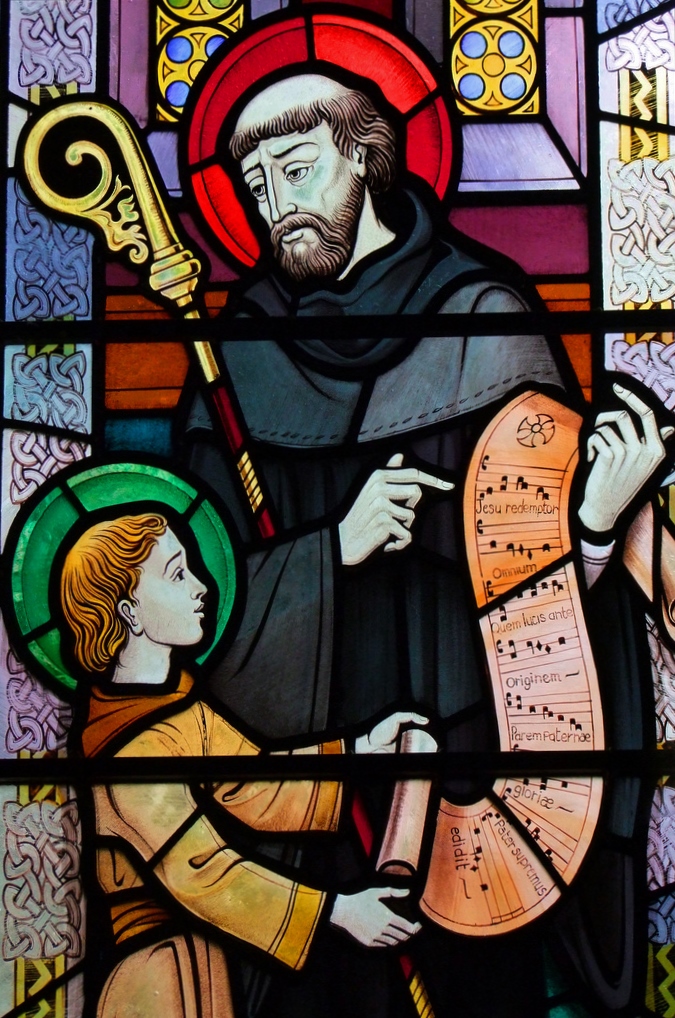
Blessed Herman of Reichenau/the Cripple (1013–1054) Benedictine Monk, Confessor, Scholar, Scientist, Writer, Hymnist, Poet, Musical Composer, Teacher. In his own day, the heroic cripple who achieved learning and holiness was called ‘The Wonder of His Age.’. Composer of the “Salve Regina” Hail Holy Queen, “Veni Sancte Spiritus” Come Holy Spirit and “Alma Redemptoris Mater” amongst many others. His Amazing Life and Works: https://anastpaul.com/2019/09/25/saint-of-the-day-blessed-herman-of-reichenau-the-cripple-osb-1013-1054-the-wonder-of-his-age/
St Fymbert Bl Marco Criado St Mewrog St Neomisia of Mecerata St Paphnutius of Alexandria St Principius of Soissons St Sergius of Moscow St Solemnis of Chartres
Martyrs of Damascus: A Christian family of six who were tortured to death in a persecution by Roman authorities. They were: Eugenia, Maximus, Paul, Rufus, Sabinian and Tatta. They were tortured to death in Damascus, Syria, date unknown.
The Holy Bishops of Milan: Imagine being part of a Diocese in which 36 of your past Bishops are Saints and some are also Doctors of the Church and Popes (and others being considered for Sainthood)! Today, the Church in Milan commemorates these holy Bishops. They are: • Blessed Alfredo Ildefonso Schuster • Blessed Andrea Carlo Ferrari • Pope Pius XI • Saint Ambrose of Milan • Saint Ampelius of Milan • Saint Anathalon of Milan • Saint Antoninus of Milan • Saint Auxanus of Milan • Saint Benedict Crispus of Milan • Saint Benignus of Milan • Saint Calimerius of Milan • Saint Castritian of Milan • Saint Charles Borromeo • Saint Datius of Milan • Saint Dionysius of Milan • Saint Eugene of Milan • Saint Eusebius of Milan • Saint Eustorgius II of Milan • Saint Eustorgius of Milan • Saint Gaius of Milan • Saint Galdinus of Milan • Saint Geruntius of Milan • Saint Glycerius of Milan • Saint Honoratus of Milan • Saint John Camillus the Good • Saint Lazarus of Milan • Saint Magnus of Milan • Saint Mansuetus of Milan • Saint Marolus of Milan • Saint Martinian of Milan • Saint Mirocles of Milan • Saint Mona of Milan • Saint Natalis of Milan • Saint Protasius of Milan • Saint Senator of Milan • Saint Simplician of Milan • Saint Venerius of Milan
Thought for the Day – 24 September – Meditations with Antonio Cardinal Bacci (1881-1971)
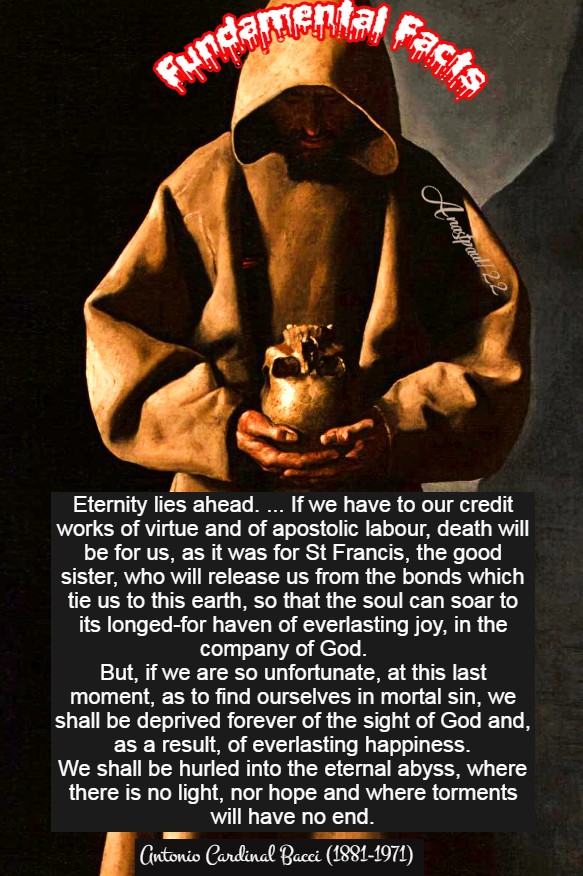
Fundamental Facts
“Eternity lies ahead. Where the tree falls, there it will remain. So it will be with us. If we have to our credit works of virtue and of apostolic labour, death will be for us, as it was for St Francis, the good sister, who will release us from the bonds which tie us to this earth, so that the soul can soar to its longed-for haven of everlasting joy, in the company of God. But, if we are so unfortunate, at this last moment, as to find ourselves in mortal sin, we shall be deprived forever of the sight of God and, as a result, of everlasting happiness. We shall be hurled into the eternal abyss, where there is no light, nor hope and where torments will have no end!
While there is still time, let us meditate on these truths. Remember – this hour, might be our last!”
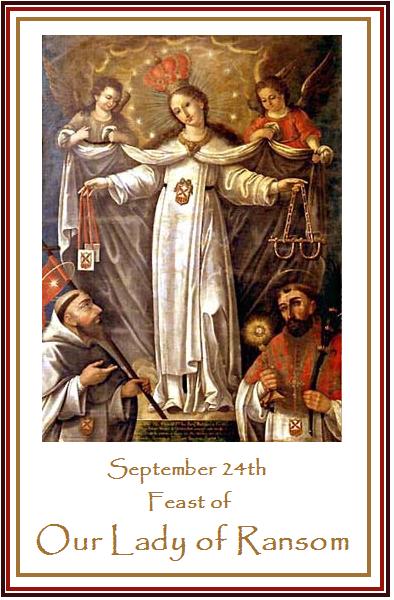
Quote/s of the Day – 24 September – Our Lady of Ransom
“No matter how sinful one may have been, if he has devotion to Mary, it is impossible that he be lost.”
St Hilary of Poitiers (315-368) Father & Doctor of the Church
“Go to Mary and sing her praises and you will be enlightened. For it is through her, that the true Light shines on the sea of this life.”
St Ildephonsus (607-670)
“O great, O gentle, O most lovable Mary, thy Holy Name cannot be spoken without inflaming the heart. To those who love thee, it is unspeakable consolation and joy even to think of thee; thou art a sweet memory to those who honour thee.”
“O Mary, I have not doubt that whenever we run to you, we shall obtain all that we desire. Let those then who have no hope, hope in you!”
St Bernard (1090-1153) Mellifluous Doctor of the Church
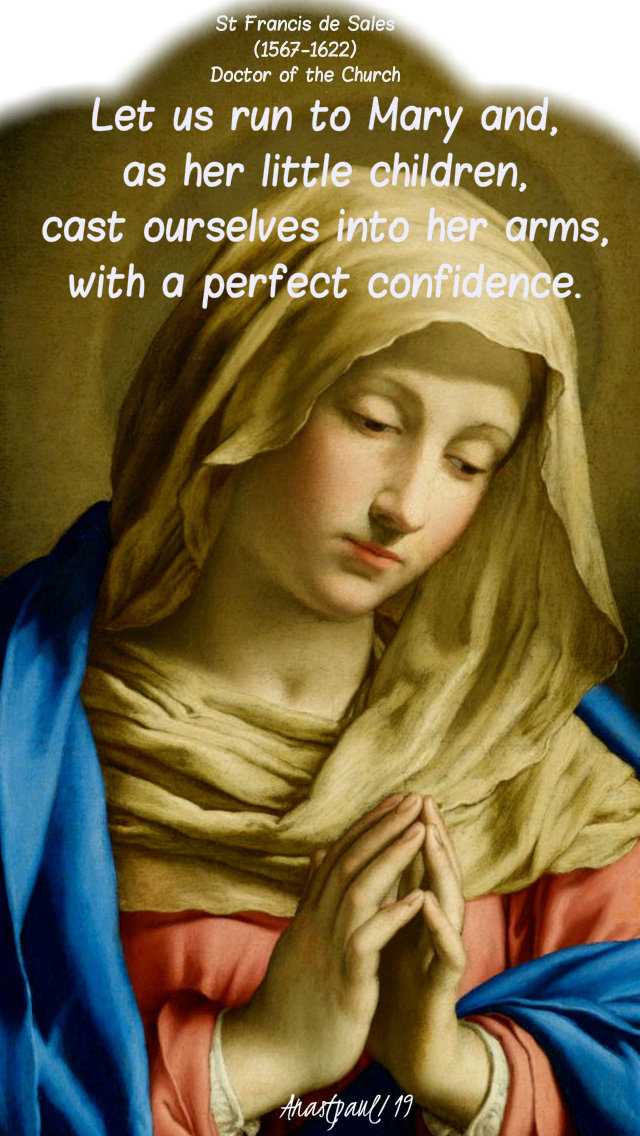
“Let us run to Mary and, as her little children, cast ourselves into her arms with a perfect confidence.”
St Francis de Sales (1567-1622) Doctor of the Church
“No-one who shall invoke this Mother of Grace, with devotion and perseverance, can possibly perish forever.”
St John Eudes (1601-1680) “The Apostle of Two Hearts”
“Truly we are passing through disastrous times, when we may well make our own, the lamentation of the Prophet: “There is no truth and there is no mercy and there is no knowledge of God in the land” (Hosea 4:1). Yet in the midst of this tide of evil, the Virgin Most Merciful rises before our eyes like a rainbow, as the arbiter of peace between God and man.”
St Pope Pius X (1835-1914)
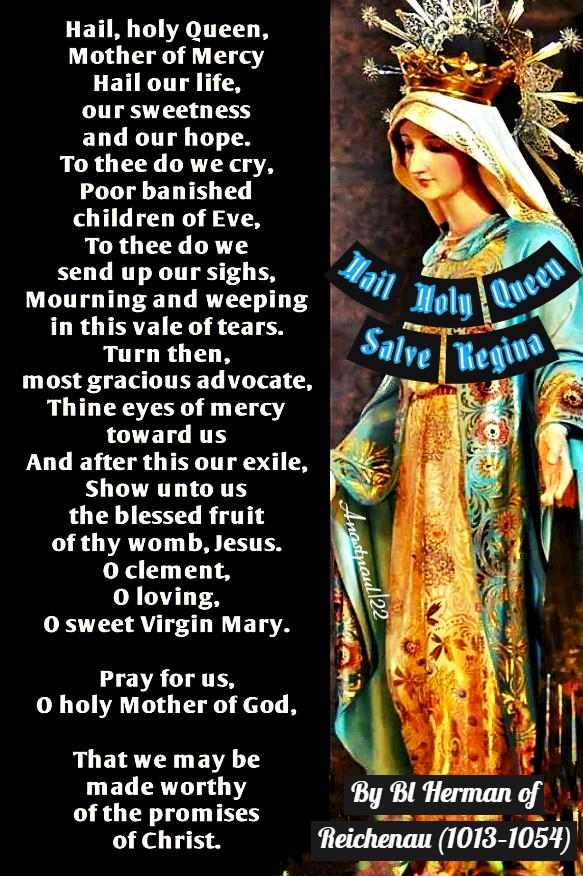
Salve Regina Hail Holy Queen By Blessed Herman of Reichenau (1013–1054)
Hail, holy Queen, Mother of Mercy, Hail our life, our sweetness and our hope. To thee do we cry, Poor banished children of Eve; To thee do we send up our sighs, Mourning and weeping in this valley of tears. Turn then, most gracious advocate, Thine eyes of mercy toward us; And after this our exile, Show unto us the blessed fruit of thy womb, Jesus.
This line, below, by St Bernard of Clairvaux (1090-1153) Doctor of the Church
O clement, O loving, O sweet Virgin Mary.
℣ Pray for us, O holy Mother of God, ℟ that we may be made worthy of the promises of Christ.
One Minute Reflection – 24 September – “The Month of the Seven Sorrows of the Blessed Virgin Mary and the Holy Cross” – Our Lady of Ransom – Sirach 24:14-16, Luke 11:27-28
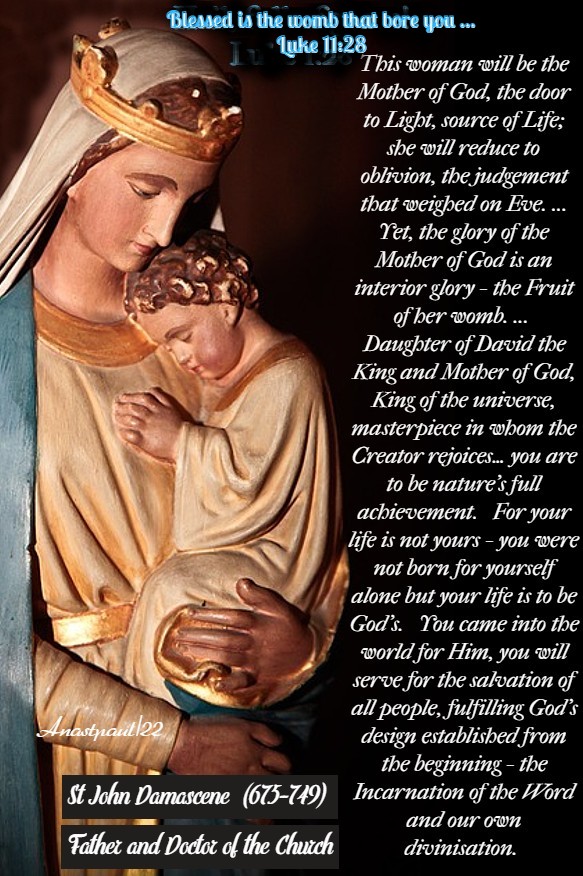
“Blessed is the womb that bore you” – Luke 11:27
REFLECTION – “This woman will be the Mother of God, the door to Light, source of Life; she will reduce to oblivion the judgement that weighed on Eve. “The rich among the people seek the face” of this woman, “the kings of the nations shall pay her homage” they shall “ offer gifts”…, yet the glory of the Mother of God is an interior glory: the fruit of her womb.
O woman, so worthy of love, thrice happy, “blessed are you among women and blessed is the fruit of your womb.” Daughter of David the king and Mother of God, King of the universe, masterpiece in whom the Creator rejoices…: you are to be nature’s full achievement. For you, life is not yours; you were not born for yourself alone but your life is to be God’s. You came into the world for Him, you will serve for the salvation of all people, fulfilling God’s design established from the beginning: the Incarnation of the Word and our own divinisation. Your whole desire is to feed on the words of God, to be strengthened by their sap, like “a green olive tree in the house of God,” “like a tree planted by running water,” you are the “tree of life” who “yielded its fruit in due season”…
He Who is Infinite, Limitless, came to dwell in your womb; God, the Child Jesus, was nourished by your milk. You are the ever virginal Doorway of God; your hands hold your God; your lap is a throne raised up above the Cherubim… You are the wedding chamber of the Spirit, the “city of the living God, gladdened by the runlets of the stream”, that is to say, the waves of the Spirit’s gifts. You are “all fair, the Beloved” of God.” – St John Damascene (675-749) Monk, Theologian, Father and Doctor of the Church (Homily on the Nativity of the Virgin, # 9 ; SC 80) [ ( Biblical references : Ps 44[45],13; 71[72],11.10; Mt 2,11; Lk 1,42; Is 62,5; Ps 51[52],10; 1,3; cf Gn 2,9, Rv 22,2; cf Ez 44,2; Ps 79[80],2; cf Sg 1,4; Ps 45[46],5; Sg 4,7]. Link to searchable Sacred Scripture here: https://www.drbo.org/
PRAYER – O God, Who for the deliverance of Christians from the power of the pagans, graciously willed to enrich Thy Church by a new religious offspring through the most glorious Mother of Thy Son; grant, we beseech Thee, that by the merits and intercession of her, whom we piously venerate, as the founder of so great a work, we may be delivered from all our sins and from the captivity of the devil. Through Jesus Christ, Thy Son our Lord, Who lives and reigns with Thee, in the unity of the Holy Ghost, God, world without end. Amen (Collect).
Our Morning Offering –24 September – “The Month of the Seven Sorrows of the Blessed Virgin Mary and the Holy Cross” and Mary’s Day
O Afflicted Virgin! By St Alphonsus de Liguori (1696-1787) Most Zealous Doctor
O afflicted Virgin! O soul, great in virtues and great also in sorrows! for both arise from that great fire of love thou hast for God; thou “whose heart can love nothing but God.” O Mother, have pity on me, for I have not loved God and I have so much offended Him. Thy sorrows give me great confidence to hope for pardon. But this is not enough; I wish to love my Lord and who can better obtain this for me than thou, thou who art the Mother of fair love? O Mary, thou dost console all, comfort me also. Amen
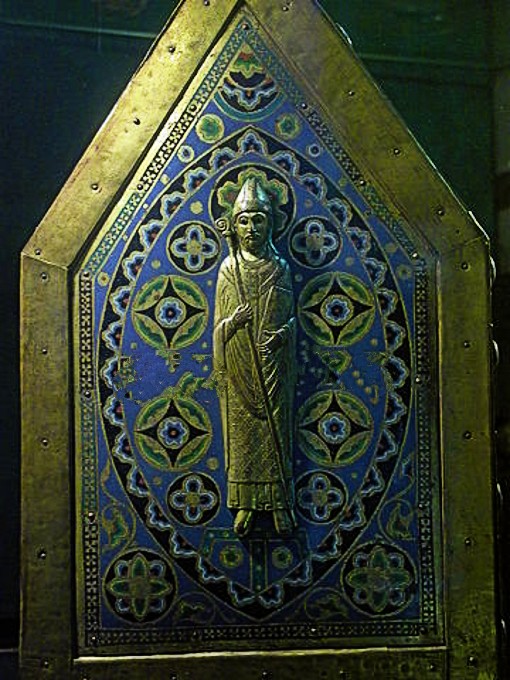
Saint of the Day – 24 September – Saint Rusticus of Clermont (Died 446) Bishop of Clermont, Confessor – the Seventh Bishop of Clermont in Auvergne, concerning whose election Saint Gregory of Tours relates, that it was brought about by a special intervention of Divine Providence. Born in Auvergne, France and died in 446 in Clermont, Auvergne of natural causes. Also known as – Rustique, Rotiri. Rusticus of Auvergne.
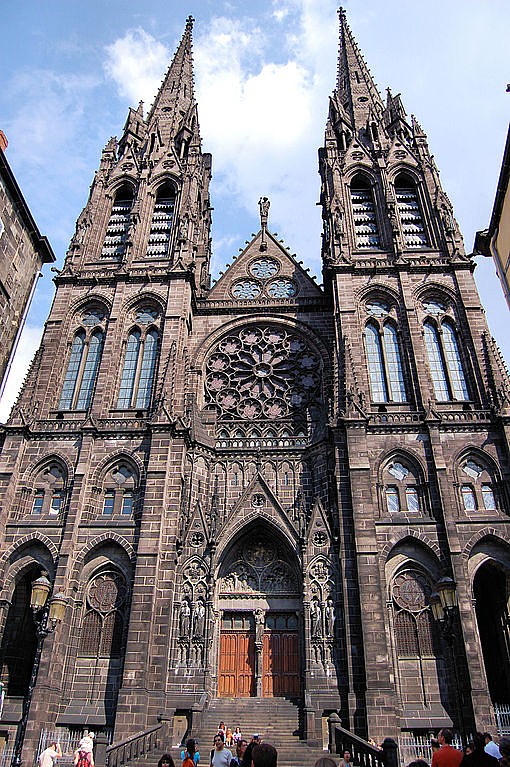
At Clermont Cathedral
Rusticus was a Priest in Clermont, remarkable for the sanctity of his manners. He was a native of the Diocess and had the administration of a Parish there. This is all which is known, with any cerntainty, concerning his life.
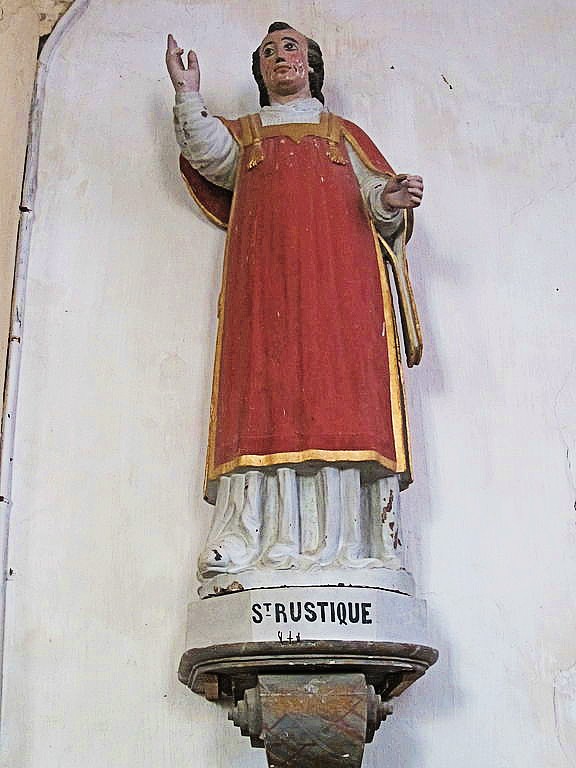
Église Saint-Denis in Saint-Denis-le-Vêtu – Statue of saint Rustique
When the former Bishop, Venerandus, died on the 24th of December, 423,. It is said that an assembly of citizens were adiscussing candidates to succeed Venerandus, when a veiled Nun told them to let the Lord make the choice and the chosen would appear.
At that moment, Rusticus arrived and the woman cried out that he was the one appointed by the Lord.
Rusticus duly succeeded as the Bishop of Clermont. His term as the Bishop was 22 years long , from 424 to 446. He was succeeded by Saint Namatius, who was the Bishop from 446 to 462 and founded Clermont Cathedral.
Martyrs of Chalcedon – (49 Saints): Forty-nine Christian choir singers of the Church in Chalcedon in Asia Minor who were Martyred together in their persecutions of Diocletian in 304.
Thought for the Day – 23 September – Meditations with Antonio Cardinal Bacci (1881-1971)
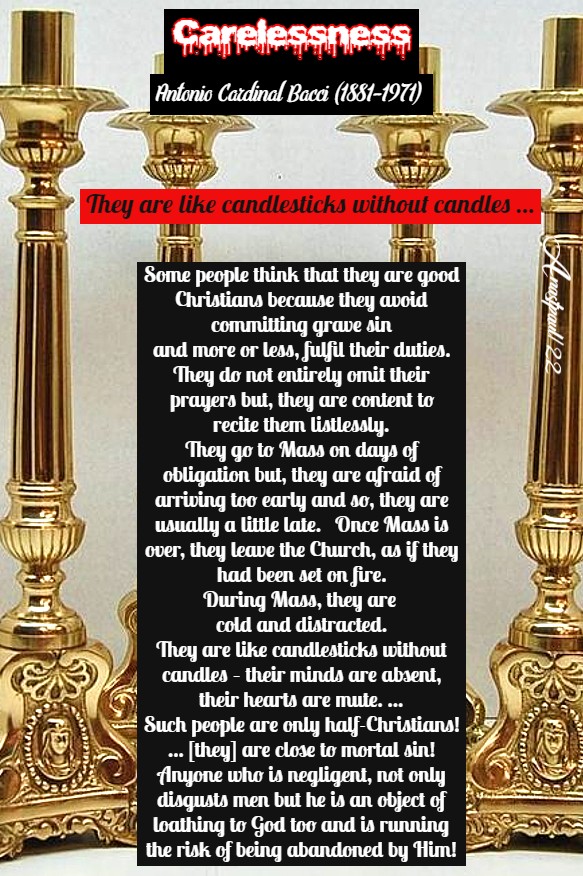
Carelessness
“Some people think that they are good Christians because they avoid committing grave sin and more or less, fulfil their duties. They do not entirely omit their prayers but, they are content to recite them listlessly.
They go to Mass on days of obligation but, they are afraid of arriving too early and so, they are usually a little late. Once Mass is over, they leave the Church, as if they had been set on fire. During Mass, they are cold and distracted. They are like candlesticks without candles – their minds are absent, their hearts are mute.
In regard to their work or other obligations, any excuse suffices to escape or to leave a job half-done. It is useless to expect from them, anything like fervour in prayer, attention to duty, or a spirit of sacrifice in the performance of good works.
Such people are only half-Christians. They do not wish to serve Satan but, they lack the generosity ad the strength of will to become true sons of God. Do you belong to this category? If your carelessness derives from a lack of appreciation of divine things and of your duty in life, you can hardly avoid grave fault. If it comes from laziness, tepidity or lack of mortification, there is no doubt but that you are close to mortal sin! Anyone who is negligent, not only disgusts men but he is an object of loathing to God too and is running the risk of being abandoned by Him! We should examine ourselves seriously and, if we discover this indifference in ourselves, we should shake off our lethargy and make good resolutions to love God more and to serve Him with greater fidelity and diligence. We should be ready, no matter how great the sacrifice, to avoid every imperfection and sin. Any offence against God can lead us nearer to eternal damnation!”
Quote/s of the Day – 23 September – Osee 14:2-10, Luke 7:36-50
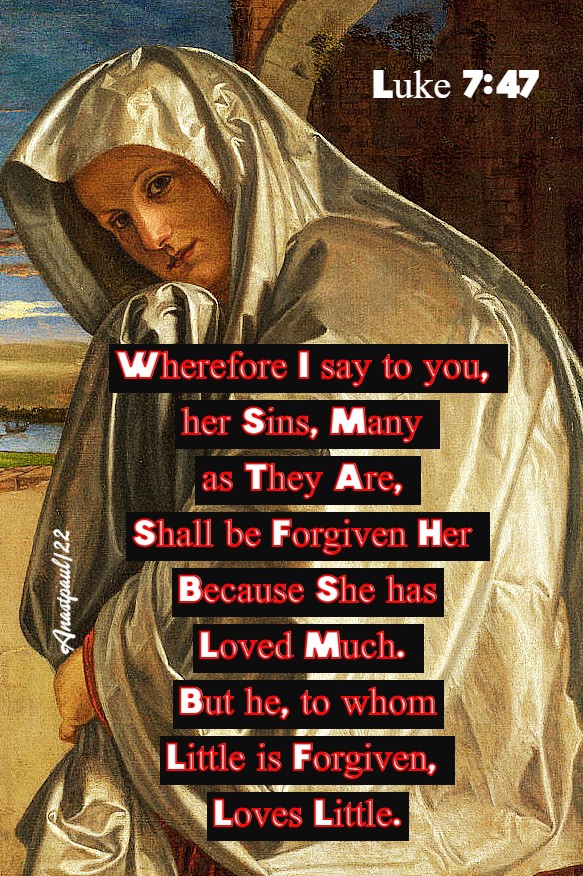
“Wherefore I say to you, her sins, many as they are, shall be forgiven her because she has loved much. But he, to whom little is forgiven, loves little.”
Luke 7:47
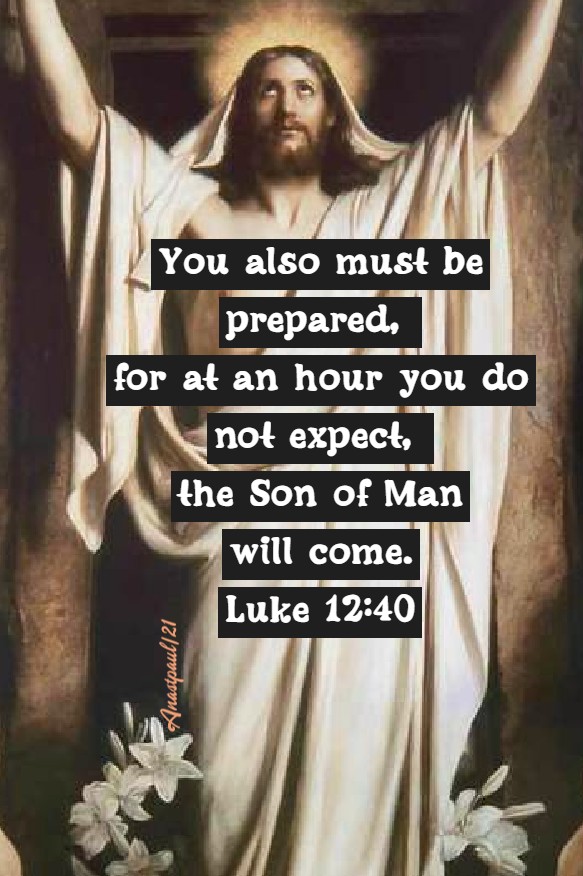
“You also must be prepared, for at an hour you do not expect, the Son of Man will come.”
Luke 12:40
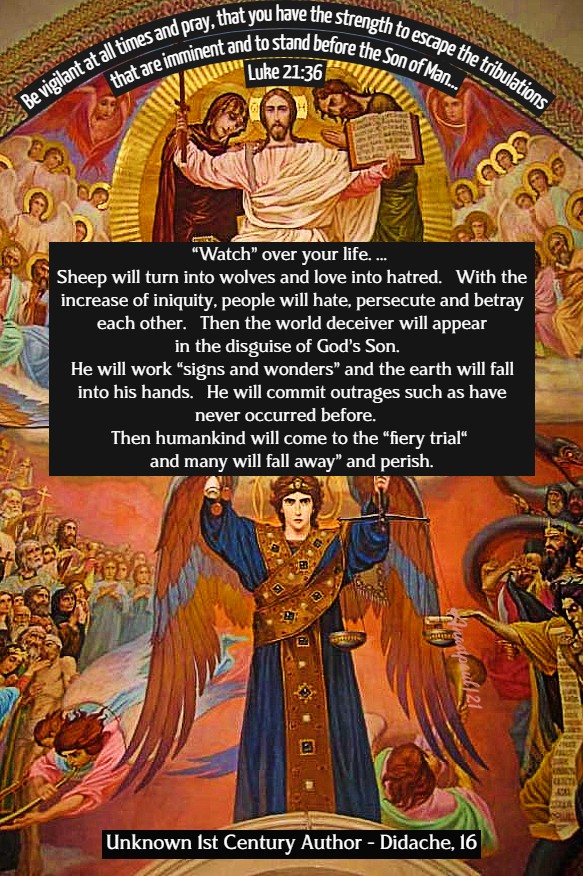
“Be vigilant at all times and pray, that you have the strength to escape the tribulations that are imminent and to stand before the Son of Man…”
Luke 21:36
“Watch” over your life. … Sheep will turn into wolves and love into hatred. With the increase of iniquity, people will hate, persecute and betray each other. Then the world deceiver will appear in the disguise of God’s Son. He will work “signs and wonders” and the earth will fall into his hands. He will commit outrages such as have never occurred before. Then humankind will come to the “fiery trial“ and many will fall away” and perish.”
Unknown 1st Century Author of this early Treatise (Didache, 16)
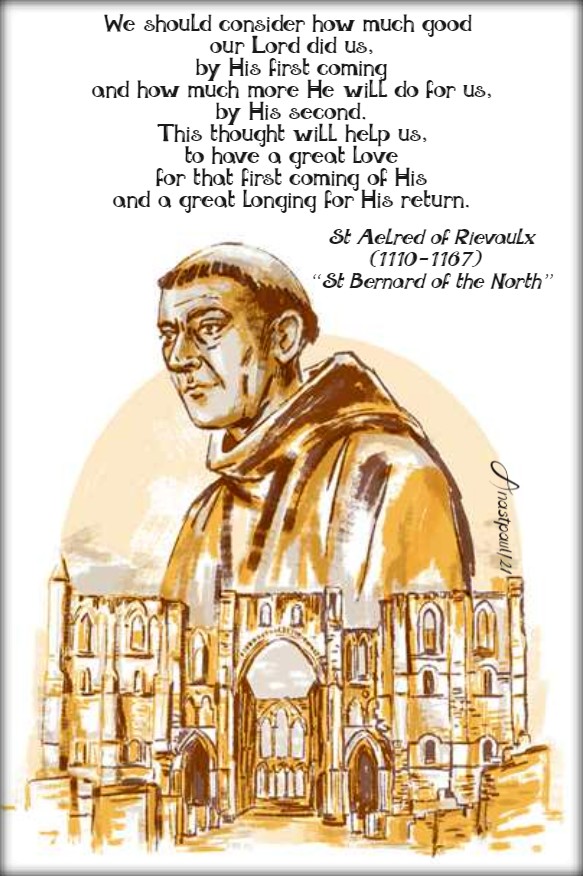
“We should consider how much good our Lord did us, by His first coming and how much more He will do for us, by His second. This thought will help us, to have a great love for that first coming of His and a great longing for His return.”
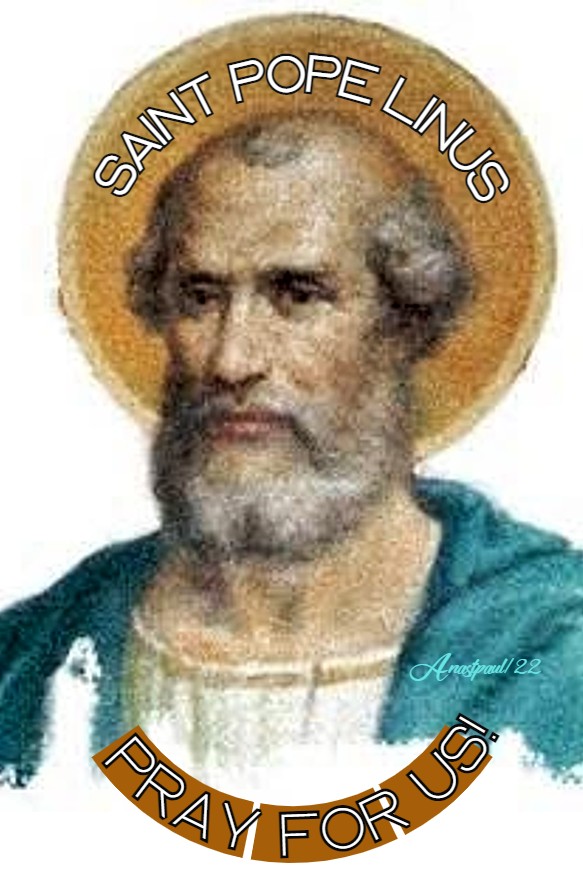
One Minute Reflection – 23 September – “The Month of the Seven Sorrows of the Blessed Virgin Mary and the Holy Cross” and the Mermorial of St Pope Linus (c 10 – c 76) Successor to St Peter – Osee 14:2-10, Luke 7:36-50
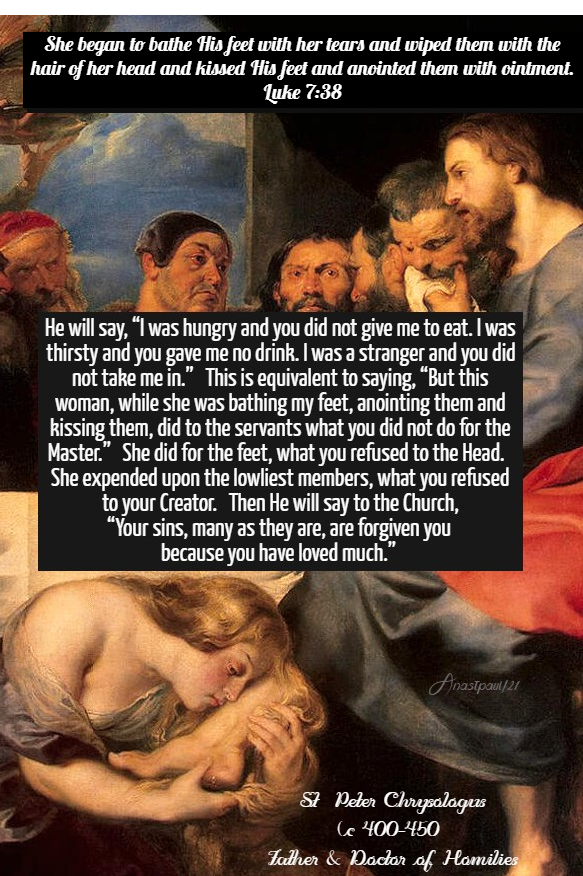
“She began to bathe His feet with her tears and wiped them with the hair of her head and kissed is feet and anointed them with ointment.” – Luke 7:38
REFLECTION – “With her hands of good works, she holds the feet of those who preach His Kingdom. She washes them with tears of charity, kisses them with praising lips and pours out the whole ointment of mercy, until He will turn her. This means that He will come back to her and say to Simon, to the Pharisees, to those who deny, to the nation of the Jews, “I came into your house. You gave me no water for my feet.”
When will He speak these words? He will speak them when He will come in the Majesty of His Father and separate the righteous from the unrighteous, like a shepherd who separates the sheep from the goats. He will say, “I was hungry and you did not give me to eat. I was thirsty and you gave me no drink. I was a stranger and you did not take me in.” This is equivalent to saying, “But this woman, while she was bathing my feet, anointing them and kissing them, did to the servants, what you did not do for the Master.” She did for the feet, what you refused to the Head. She expended upon the lowliest members, what you refused to your Creator. Then He will say to the Church, “Your sins, many as they are, are forgiven you because you have loved much.”– St Peter Chrysologus (c 400-450) Bishop of Ravenna, Father and “Doctor of Homilies” (Sermon 95).
PRAYER – Look forgivingly on Thy flock, Eternal Shepherd, and keep it in Thy constant protection, by the intercession of blessed Linus Thy Sovereign Pontiff, whom Thou didst constitute Shepherd of the whole Church. Through the same Jesus Christ, Who lives and reigns with God the Father, in the unity of the Holy Spirit, God, world without end. Amen (Collect).
Our Morning Offering – 23 September – “The Month of the Seven Sorrows of the Blessed Virgin Mary and the Holy Cross”
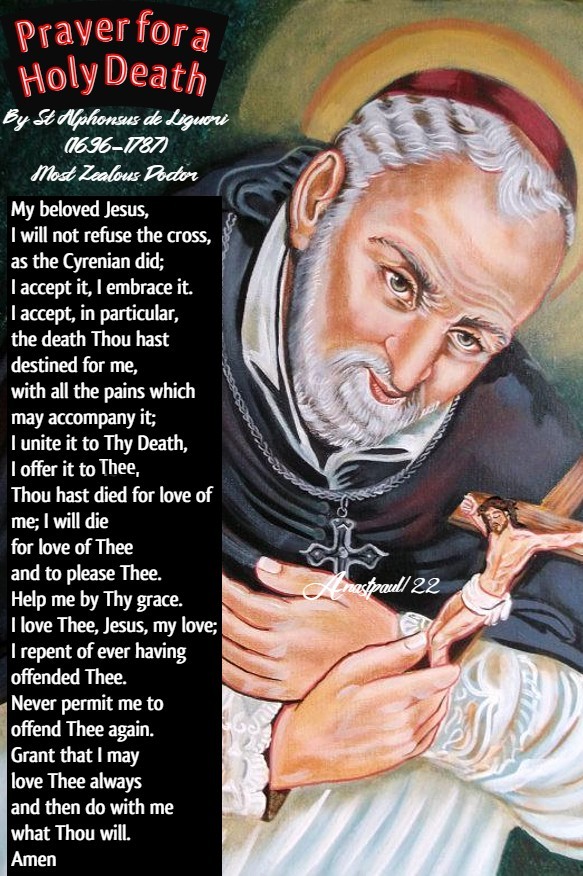
Prayer for a Holy Death By St Alphonsus de Liguori (1696-1787) Most Zealous Doctor
My beloved Jesus, I will not refuse the cross, as the Cyrenian did; I accept it, I embrace it. I accept, in particular, the death Thou hast destined for me, with all the pains which may accompany it; I unite it to Thy Death, I offer it to Thee Thou hast died for love of me; I will die for love of Thee and to please Thee. Help me by Thy grace. I love Thee, Jesus, my love; I repent of ever having offended Thee. Never permit me to offend Thee again. Grant that I may love Thee always and then do with me what Thou will. Amen
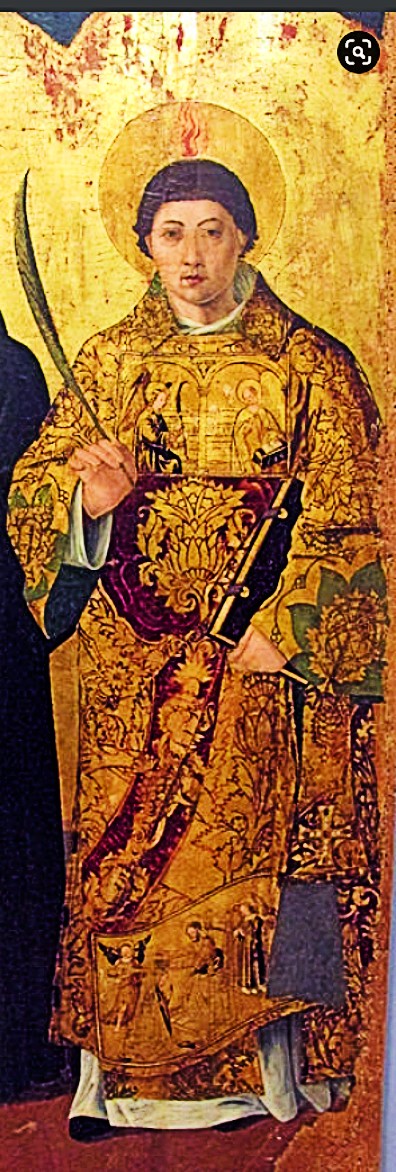
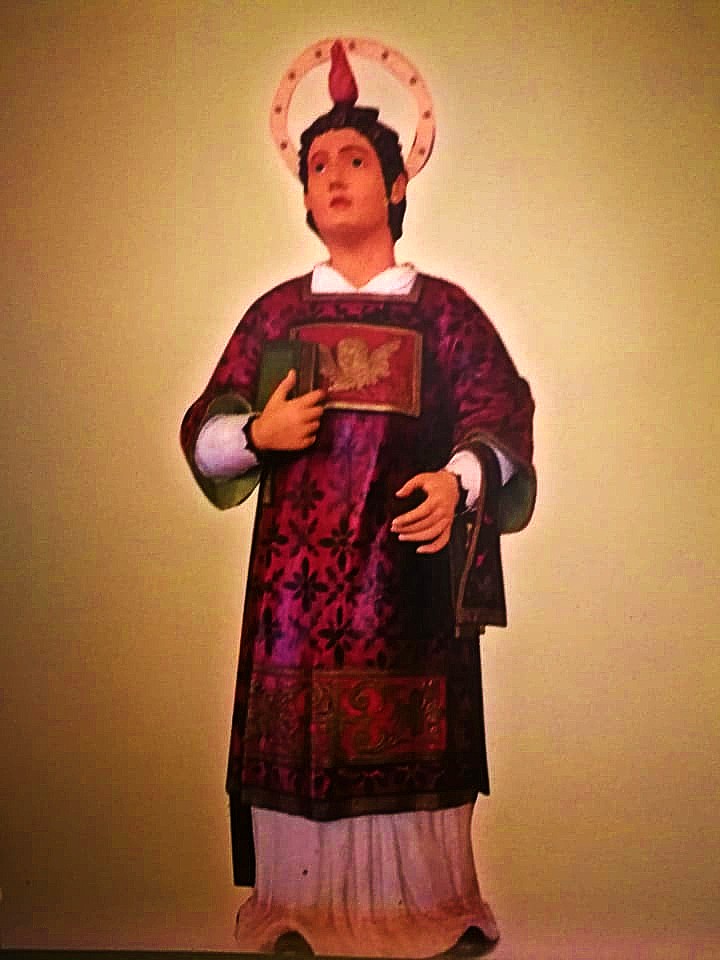
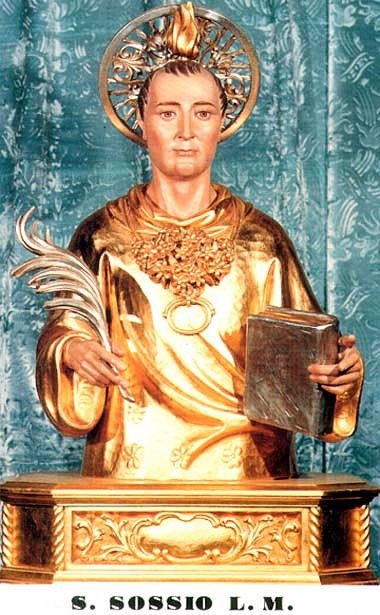
Saint of the Day –23 September – Saint Sosius (275-305) Confessor, Deacon and Martyr. His holiness and wisdom drew many Prelates to his feet, seeking spiritual assistance. St Sosius was a Deacon of Misenum, an important naval base of the Roman Empire in the Bay of Naples. Born in 275 in Miseno, Italy and died by being beheaded on 19 September 305, along with St Januarius, at Pozzuoli, Campagna, Italy. Patronages – ailments of the bones, of Frattamaggiore, Italy, San Sossio Baronia, Italy. Also known as – Sosius of Misenum, of Miseno, Sosius of Puzzuoli, Sosier, Sosio, Sosius, Sossio, Sossius, Sosso.
The Roman Martyrology reads: “At Capo Miseno in Campania, St Sosius, Deacon and Martyr, who, as Pope St Symmachus reports, wishing to save his Bishop from death, instead found death together with him, obtaining equal glory at the same price.””
Sosius was born in Miseno in 275, as reported by the Martyrology of the Venerable Bede. He was one of the most ardent leaders of early Christian groups. Giovanni Diacono defined him as “a man in whom all the charisms of Grace were crowded.”
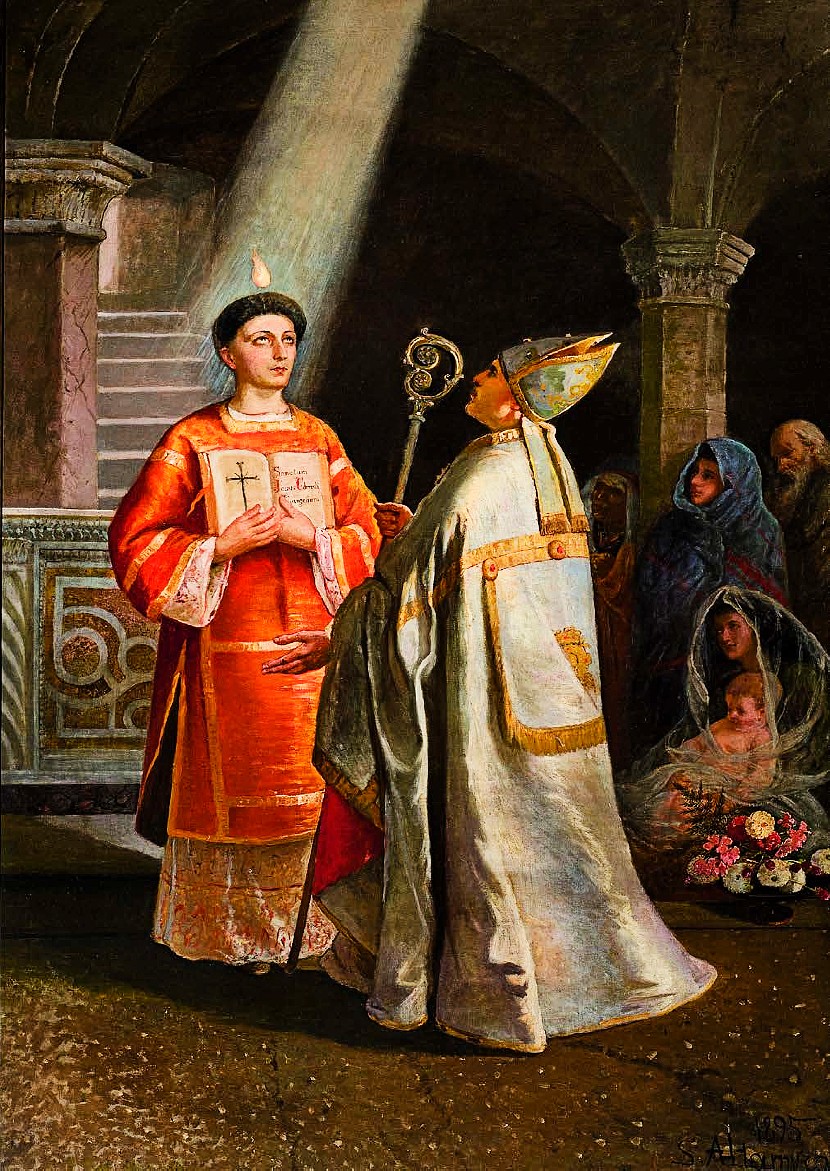
To demonstrate the fame of holiness which he enjoyed, while still alive, it is enough to remember that illustrious Prelates felt the need to come to Miseno to confer with the seraphic Deacon. Pope Symmachus shows him very zealous to the point of sacrifice and he was so full of the Holy Spirit that his advice was also requested by the great Neapolitan Bishop, St Januarius. During one of these visits, in 304, St Januarius,, celebrating the Holy Mass on the third Sunday of Easter, saw a flame similar to that descending on the forehead of the Apostles, on the day of Pentecost, appear on the head of Sosius, while he was reading the Gospel. St Januarius, evealed the vision to many there.
Sts Sosius and Januarius
The persecution started the year before by Diocletian had, in the meantime, reached its peak and Misenus, seat of the imperial praetorian fleet, was an extremely dangerous place for Christians. But not for this reason, not for any dangers, would Sosius limit his work, continuing with fervour in the preaching of the word of Christ against false idols.
Betrayed by informers, he was taken to prison in Pozzuoli and tortured to deny his faith. St Januarius himself, who was not unaware of the danger to which he was exposed, went to visit him in prison and on that occasion, he too was imprisoned, along with Sts Desiderius and Festus. All were destined to be fed to the beasts in the Amphitheater of Pozzuoli but, a series of miraculous events did not allow the condemnation to be carried out, “…when the animals came near the Saints, they fell affectionately at their feet and refused to harm them,” therefore, they were condemned to be beheaded.
Sosius’ body was transferred to Miseno on 23 September of the same year, which was set as his feast day. The destruction of Miseno by the Saracens caused the migration of the population towards the interior, with the subsequent foundation of Frattamaggiore. here the Misenati brought with them the cult of the Saint, making him the Patron Saint of the City.
The Benedictines, who, at the beginning of the 10th Century, found the remains in the ruins of the Church of Misenate, kept the body in Naples, at the Convent of St Severinus, preserving it from the raids of the Saracens. Thanks to them, the cult spread in Campania, in Lazio and even in Africa.
In 1807, following the suppression of the Convent by Napoleon, the remains of the Saint, together with those of the Apostle of Norico St Severinus, who for many centuries had rested next to the Benedictine Convent, were translated to the mother Church of Frattamaggiore, where still today, they are the object of the love and veneration of all.
St Sosius is also particularly venerated in Castro dei Volsci (Frosinone). The people effectively invoke him against the ailments of the bones.
Saint Sossius (right) with Saint Severinus, Altar painting from the eponymous Church of Saints Severinuaande Sossius in Naples, late 15th Century.
St Pope Linus (c 10 – c 76) Successor to St Peter. Papacy lasted from c 67 to his death. Among those to have held the position of pope, Peter, Linus and Clement are specifically mentioned in the New Testament. Linus is mentioned in the closing greeting of the Second Epistle to Timothy as being with Paul in Rome near the end of Paul’s life. About St Pope Linus: https://anastpaul.com/2018/09/23/saint-of-the-day-23-september-st-pope-linus-c-10-c-76-successor-to-st-peter/
St Cissa of Northumbria St Constantius of Ancona Bl Francisco de Paula Victor Bl Guy of Durnes Bl Helen Duglioli St Peter Acontanto St Polyxena St Sosius (275-305) Confessor, Deacon and Martyr Bl William Way St Xantippa
Martyrs of Syracuse – (4 Saints): Group of Christians deported from Syracuse, Sicily by invading Saracens and sent to North Africa where they were tortured and executed for their faith. Martyrs. The names that have survived are Andrew, Antony, John and Peter. c900
Thought for the Day – 22 September – Meditations with Antonio Cardinal Bacci (1881-1971)
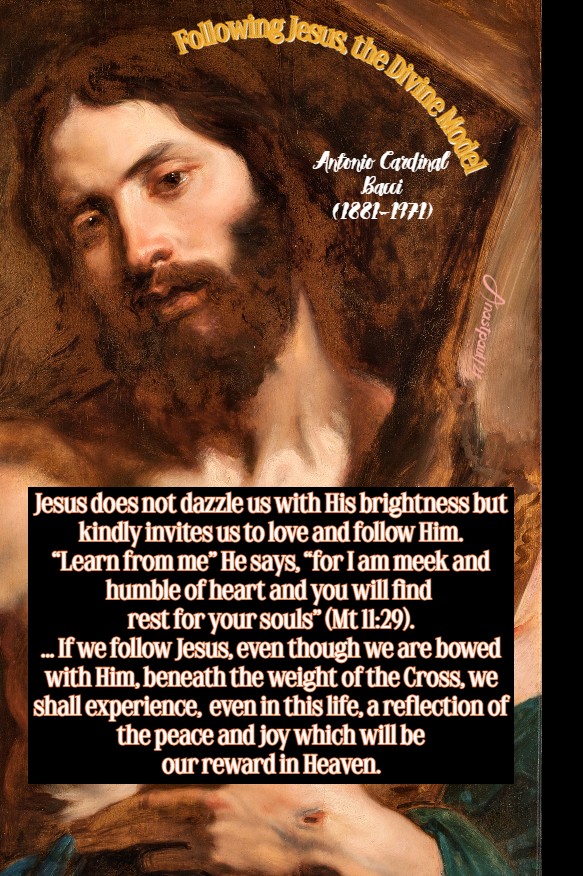
Following Jesus, the Divine Model
“Jesus is the Divine Model, Whom we ought to follow and imitate. In Him, the virtues possess both the infinite splendour of the Divinity and the gentle appeal of glorified Humanity. Jesus does not dazzle us with His brightness but kindly invites us to love and follow Him. “Learn from me” He says, “for I am meek and humble of heart and you will find rest for your souls” (Mt 11:29). After He has indicated humility, meekness and interior peace, as the foundations of the spiritual life, He invites us to take up the yoke of His law and assures us, that we shall find it light (Mt 11).
If we follow Jesus, even though we are bowed with Him, beneath the weight of the Cross, we shall experience, even in this life, a reflection of the peace and joy which will be our reward in Heaven.”
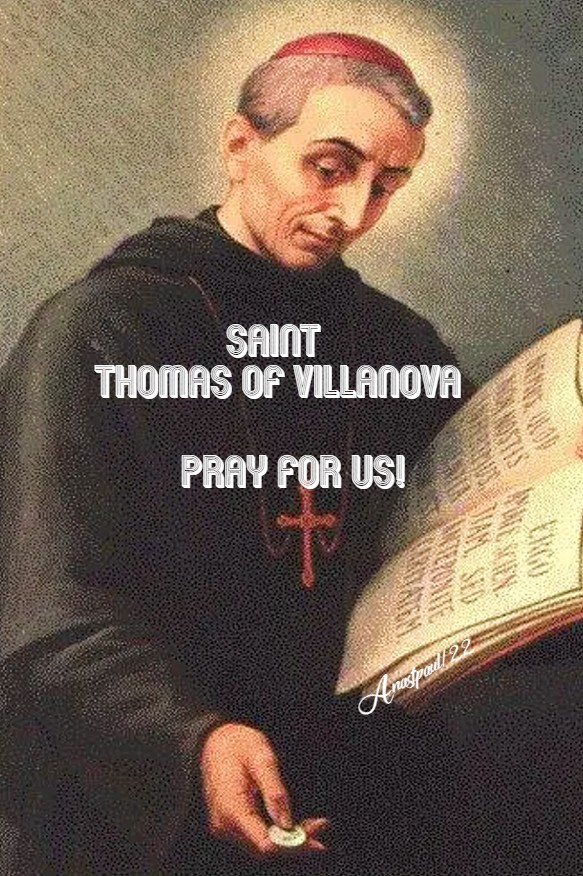
Quote/s of the Day – 22 September – The Memorial of St Thomas of Villanova OSA (1488-1555) Archbishop, Confessor
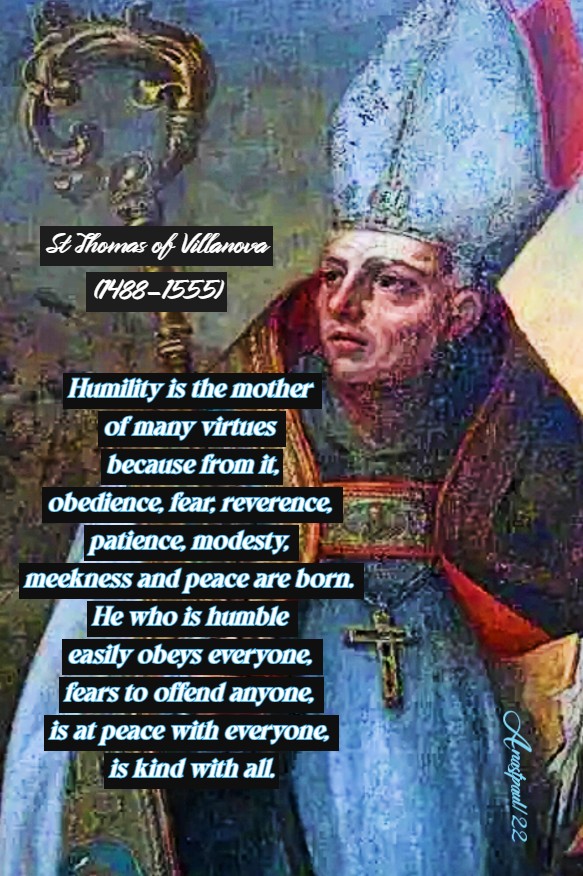
“Humility is the mother of many virtues because from it, obedience, fear, reverence, patience, modesty, meekness and peace are born. He who is humble easily obeys everyone, fears to offend anyone, is at peace with everyone, is kind with all.”
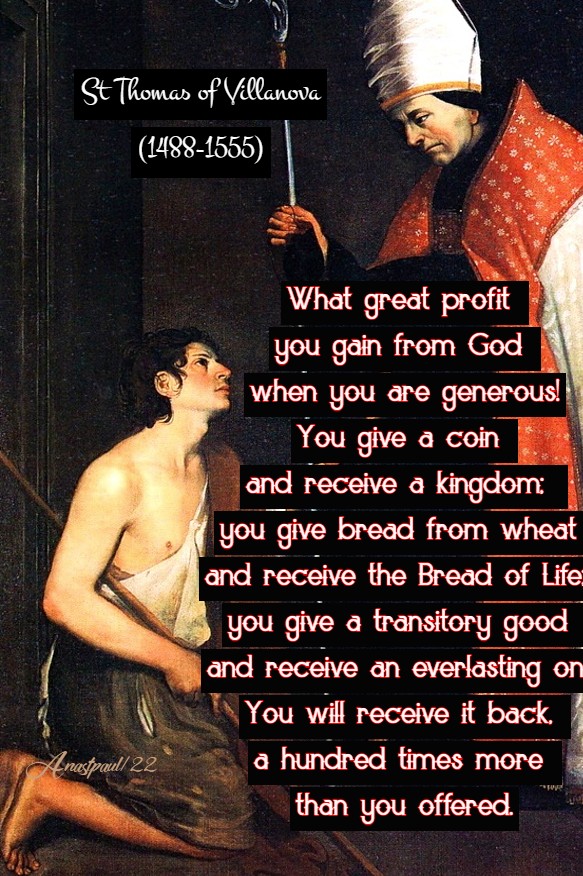
“What great profit you gain from God when you are generous! You give a coin and receive a kingdom; you give bread from wheat and receive the Bread of Life; you give a transitory good and receive an everlasting one. You will receive it back, a hundred times more than you offered.”
“If you want God to hear your prayers, hear the voice of the poor. If you wish God to anticipate your wants, provide for those of the need, without waiting for them to ask you. Especially, anticipate the needs of those, who are ashamed to beg. To make them ask for alms, is to make them buy it!”
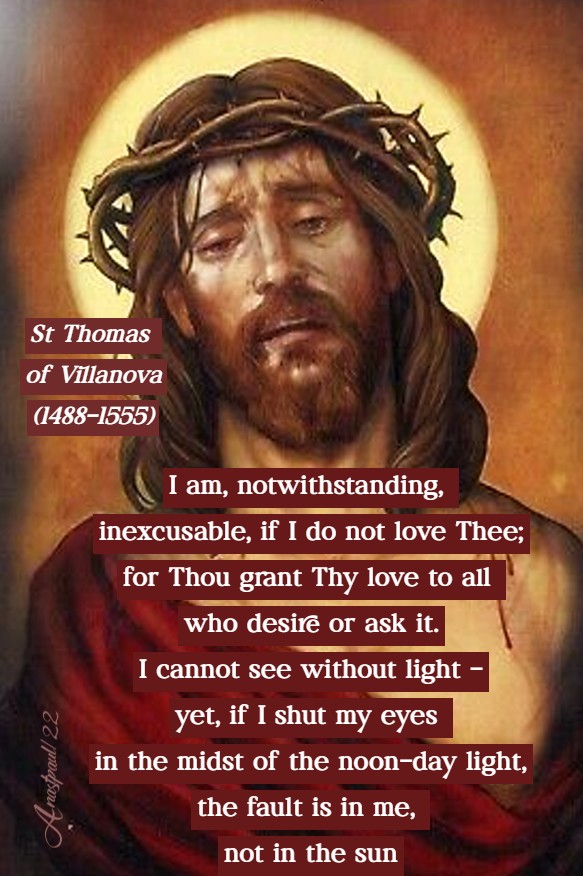
“I am, notwithstanding, inexcusable, if I do not love Thee for Thou grant Thy love to all who desire or ask it. I cannot see without light – yet, if I shut my eyes in the midst of the noon-day light, the fault is in me, not in the sun.”
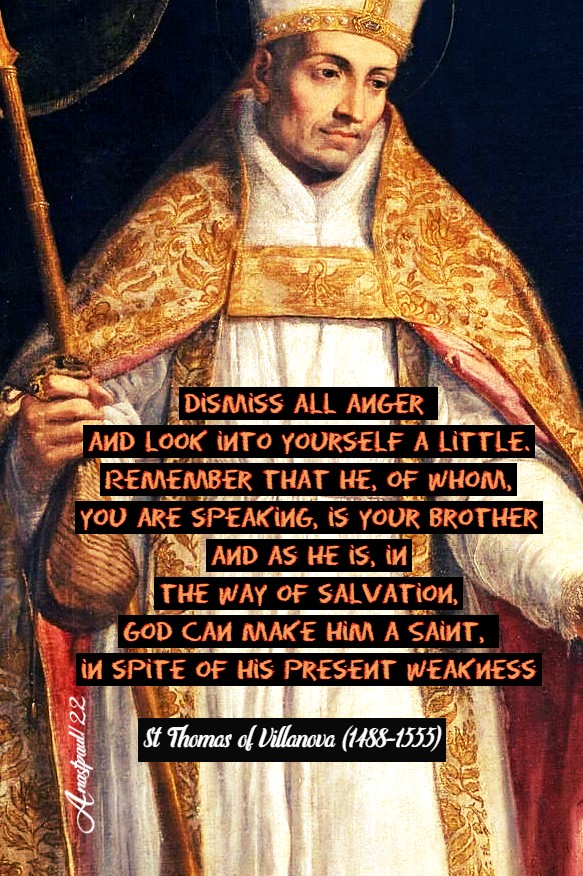
“Dismiss all anger and look into yourself a little. Remember that he, of whom, you are speaking, is your brother and as he is, in the way of salvation, God can make him a Saint, in spite of his present weakness.”
One Minute Reflection – 22 September – The Memorial of St Thomas of Villanueva OSA (1488-1555) Archbishop, Confessor – Sirach 44:16-27; 45:3-20, Matthew 25:14-23
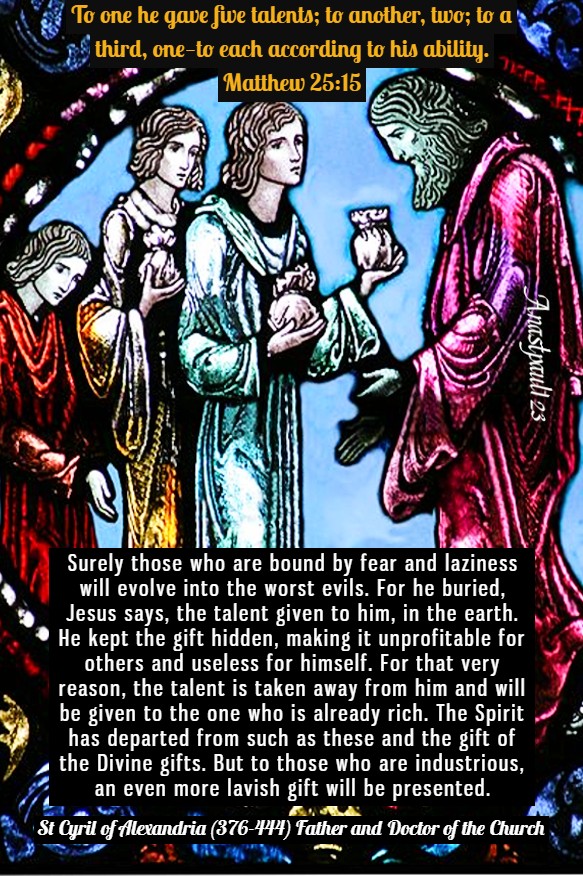
“To one he gave five talents; to another, two; to a third, one—to each according to his ability. Then he went away. Immediately …” – Matthew 25:15
REFLECTION – “The man who is the landowner is actually the Creator and Lord of all. The Word compares the time the landowner spends away from home, in the parable, to either the Ascension of Christ into Heaven, or, at any rate, to the unseen and invisible character of the Divine Nature. Now, one must conceive of the property of God, as those in each country and city who believe in Him. He calls His servants, those who according to the times, Christ crowns with the glory of the Priesthood. For the holy Paul writes, “No-one takes this honoUr upon himself; he must be called by God.”
He hands over [His property] to those who are under Him, to each giving a spiritual gift, so that he might have character and aptitude. We think that this distribution of the talents, is not supplied to the household servants in equal measure because, each is quite different from the other, in their understanding. Immediately they head out for their labours, He says, directly, indicating to us here, that apart from the procrastination of one, they are fit to carry out the work of God.
Surely those who are bound by fear and laziness will evolve into the worst evils. For he buried, Jesus says, the talent given to him in the earth. He kept the gift hidden, making it unprofitable for others and useless for himself. For that very reason, the talent is taken away from him and will be given to the one who is already rich. The Spirit has departed from such as these and the gift of the divine gifts. But to those who are industrious, an even more lavish gift will be presented.” – St Cyril of Alexandria (376-444) Archbishop of Alexandria, Father and Doctor of the Church (Fragment 283)
PRAYER – O God, Who endowed blessed Bishop Thomas with the virtue of special pity for the poor, we beseech Thee, through his intercession, generously to pour forth the riches of Thy mercy upon all those who pray to Thee. Through Jesus Christ, Thy Son our Lord, Who lives and reigns with Thee, in the unity of the Holy Ghost, God, world without end. Amen (Collect).
Our Morning Offering – 22 September – “The Month of the Seven Sorrows of the Blessed Virgin Mary and the Holy Cross”
My Most Sorrowful Lady By St Anselm (1033-1109) Marian Doctor Magnificent Doctor
My most sorrowful Lady, what can I say about the fountains, that flowed from your most pure eyes, when you saw your only Son before you, bound, beaten and suffering? What do I know of the flood, that drenched your matchless face, when you beheld your Son, your Lord and your God, stretched on the Cross without guilt, when the flesh of your flesh, was cruelly butchered by wicked me? How can I judge what sobs troubled your most pure breast when you heard, “Woman, behold your son,” and the disciple, “Behold, your Mother,” when you received, as a son, the disciple, in place of the Master, the servant, for the Lord? Amen
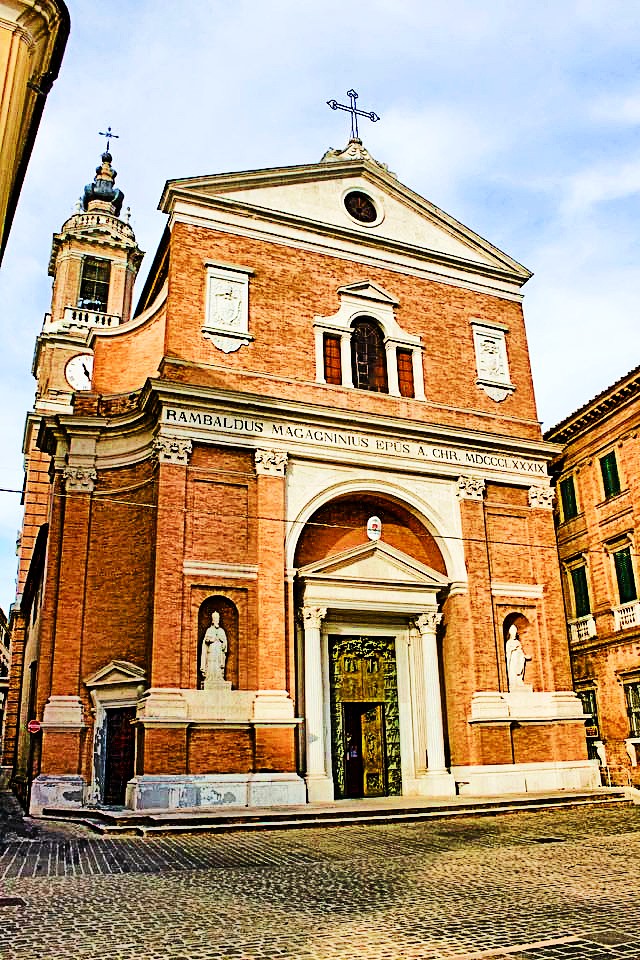
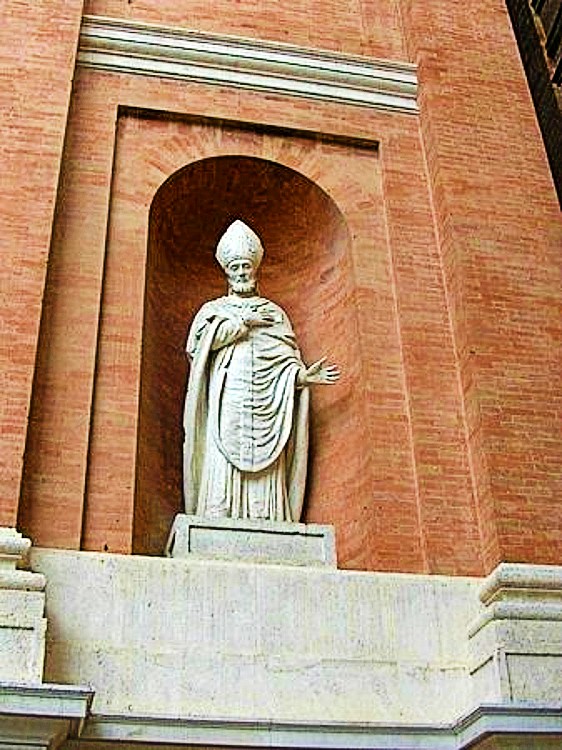
Saint of the Day – 22 September – Saint Septimius of Jesi (Died c 307) the first Bishop of Jesi in Italy, Confessor, Martyr., Miracle-worker Born in Germany and died by being beheaded in Jesi, Italy. Patronages – the City and Diocese of Jesi. Also known as – Settimio.
St Septimius is venerated as the first Bishop of the Diocese of Jesi and is considered the builder of the first Cathedral,which, although dedicated to the Holy Saviour retained the name of Septimius as the name of the founder (as was the custom).
Fresco of St Septimius, by Biagio Bigatti, 1937. Iesi Cathedral.
Very ancient documents from Jesi, bear 461 as the date of the death of the holy Bishop and Martyr, however, this date seems to be in error when contrasted with the other historical events of the time. The office tells us that Septimius, born in Germany, devoted himself to liberal studies and a military life, then, in contrast to the opinion of his relatives, he converted to Christianity and came to Italy with some friends.
He began to preach the faith in Milan but was forced to leave that City, following the spread of Diocletian’s persecution. He travelled to Rome where he worked wonders and converted many to the True Faith. He was so successful in evangelising the pagans and became so renowned for the many miracles worked through his prayers, that Pope Marcellus I (308-309) Consecrates him as the Bishop of Jesi.
Septimius began immediately his pastoral mission and, at the same time, began the work of building a Cathedral. But in this City he found the Judge Florentius, who forbid him to continue his apostolate and gave him the ultimatum to sacrifice to the gods within five days, according to the imperial edict. Septimius, however, ignored Florentius’ demands and continues to preach the Gospel of Christ and convert pagans and perform miracles, At the end of the five days, Septimius was arrested and beheaded.
Although his place of burial was lost, by 1208 the Cathedral was named for him, His body was finally rediscovered in 1469 and translated to the Cathedral. In 1623 a new Altar was Consecrated to him where his body is now enshrined. His cult, however, had always been venerated because the Cathedral of Jesi was already dedicated to St Septimius.
Until 1623, St Septimius’ celebration was on 5 September and after that year, it was fixed at 22 September. St Septimius is the Patron Saint of the City of Jesi and of the Diocese, which he had established.
St Thomas of Villanueva/Villanova OSA (1488-1555) Archbishop, Confessor, Religious Priest of the Order of St Augustine,Writer, Preacher, Teacher, Apostle of Charity, Mystic, Miracle-Worker often called “the Almsgiver” and “the Father of the Poor“, Reformer. Canonised on 1 November 1658 by Pope Alexander VII. About St Thomas here: https://anastpaul.com/2017/09/22/saint-of-the-day-22-september-st-thomas-of-villanova-o-s-a/
St Irais St Jonas St Lauto of Coutances St Lindru of Partois Bl Otto of Freising St Sadalberga St Sanctinus of Meaux St Septimius of Jesi (Died c 307) Bishop, Confessor, Martyr St Sigfrid of Wearmouth St Silvanus of Levroux St Symphorian
Martyrs of the Theban Legion: + Martyrs (c 287) A Roman imperial legion of 6,600 soldiers, all of whom were Christians; they had been recruited from the area around Thebes in Upper Egypt, were led by Saint Maurice and served under Emperor Maximian Herculeus. Around the year 287, Maximian led the army across the Alps to Agaunum, an area in modern Switzerland, in order to suppress a revolt by the Bagandre in Gaul. In connection with battle, the army offered public sacrifices to the Roman gods; the Theban Legion refused to participate. For refusing orders, the Legion was decimated – one tenth of them were executed. When the remainder refused to sacrifice to the gods, they were decimated again. When the survivors still refused to sacrifice, Maximinian ordered them all killed. Martyrs. Known members of the Legion include: Alexander of Bergamo Candidus the Theban Chiaffredo of Saluzzo Exuperius Fortunato Innocent of Agaunum Maurice Secundus the Theban Ursus the Theban Victor of Agaunum Victor of Xanten Victor the Theban Vitalis of Agaunum Other profiled Saints associated with the Legion include: Antoninus of Piacenza (martyred soldier; associated by later story tellers) Adventor of Turin (not a member; associated by later story tellers) Cassius (may have been a member) Florentius the Martyr (may have been a member) George of San Giorio (not a member; associated by later story tellers) Gereon (not a member, but another soldier who was martyred for refusing to make a sacrifice to Roman gods) Octavius of Turin (not a member; associated by later story tellers) Pons of Pradleves (escaped the massacre to become an evangelists in northern Italy) Secundus of Asti (not a member but linked due to art work) Solutor of Turin (not a member; associated by later story tellers) Tiberio of Pinerolo (may have been a member) Verena (wife of a member of the Legion) They were Martyred c 287 in Agaunum (modern Saint-Maurice-en-Valais, Switzerland. A Basilica was built in Agaunum to enshrine the relics of the Legion. The full story: https://anastpaul.com/2018/09/22/saints-of-the-day-22-september-st-maurice-and-the-martyrs-of-the-theban-legion-martyrs-c
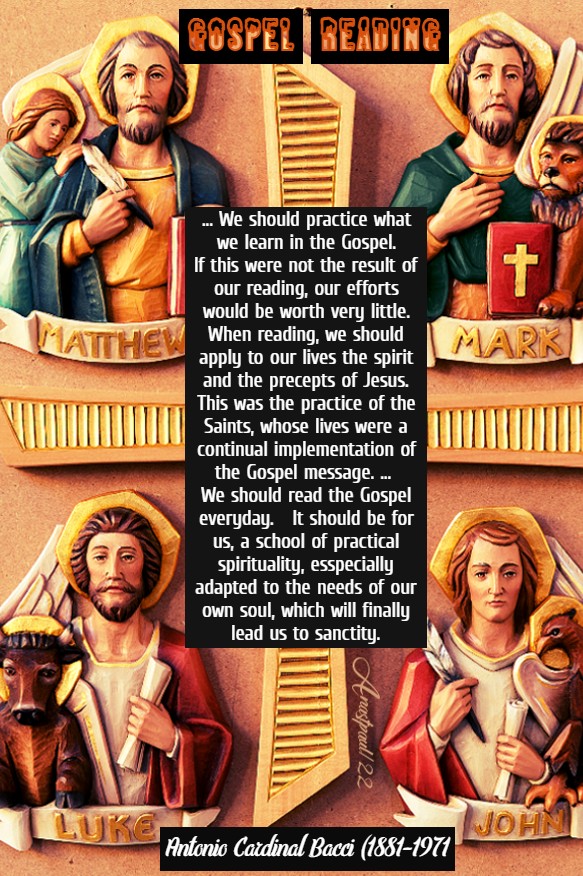
Thought for the Day – 21 September – Meditations with Antonio Cardinal Bacci (1881-1971) – The Feast of St Matthew, Apostle and Evangelist, Martyr
Gospel Reading
“Finally, we should practice what we learn in the Gospel. If this were not the result of our reading, our efforts would be worth very little. When reading, we should apply to our lives the spirit and the precepts of Jesus. This was the practice of the Saints, whose lives were a continual implementation of the Gospel message. So, St Aloysius and others, understood and applied to their own lives, the maxim: “Blessed are pure of heart.” St Francis and his followers, applied another maxim: “Blessed are the poor in spirit.” St Francis de Sales applied to himself, in a special way, the words: “Blessed are the meek.” As a result, he was noted for his gentleness of character, this man, known as “The Gentleman Saint” and “The Gentle Christ of Geneva!”
We should read the Gospel everyday. It should be for us, a school of practical spirituality, esspecially adapted to the needs of our own soul, which will finally lead us to sanctity.”































 AnaStpaul
You must be logged in to post a comment.