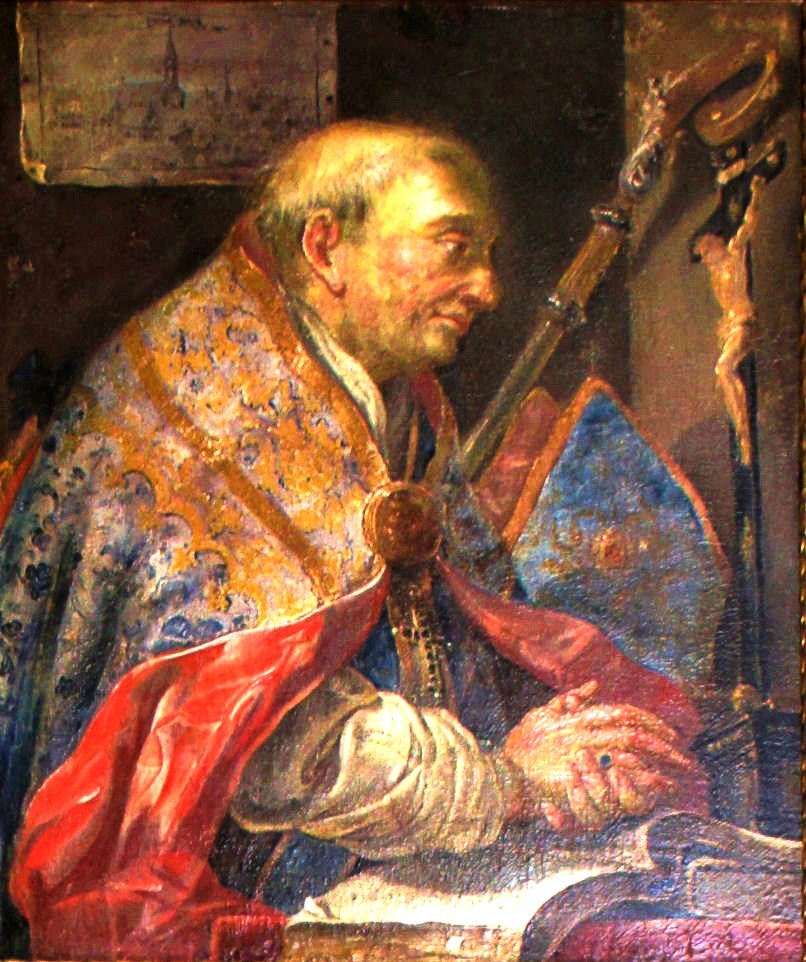
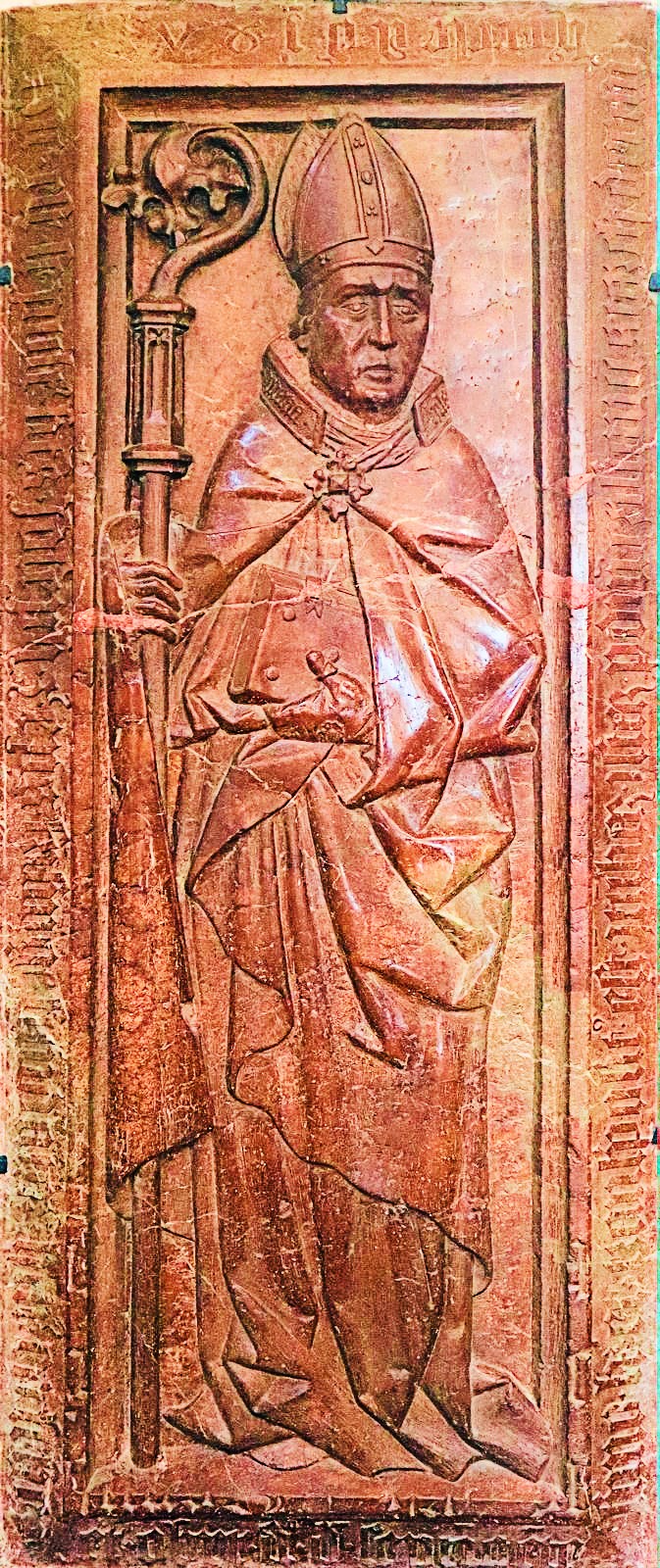
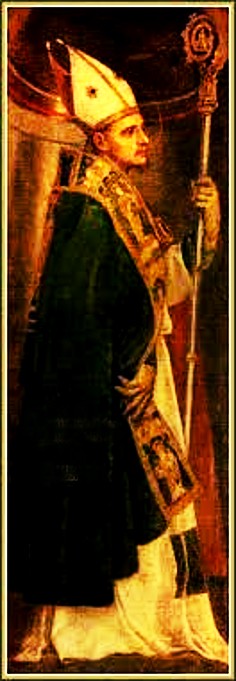
Saint of the Day – 17 January – Blessed Joseph of Freising (Died 764) the 3rd Bishop of Freising from 747/8 until his death., Founder of Churches and Monasteries. Died 17 January 764 of natural cause, Germanys. Also known as – Joseppus/Josef of Verona.
There is no direct evidence of Joseph’s place of origin, or place of birth. It is sometimes claimed that he was a native of Verona in Italy, whence his alternative name but it is equally possible that he was from Bavaria or northern Austria, or perhaps the Tyrol.
He is presumed to have been a Monk in St Corbinian’s new foundation, Freising Abbey before being appointed at the Bishop of Freising, the third to hold the office. The previous Bishop, St Erembert is believed to have been his Tutor and to have brought him up in the Monastery of St Corbinian.
As Bishop, Joseph paid special attention to increasing the possessions of his Diocese – a document dated in the year 750 has been preserved which records the donation to Joseph, of the area around Erching – today’s district of Hallbergmoos – by Bavarian Duke Tassilo III.
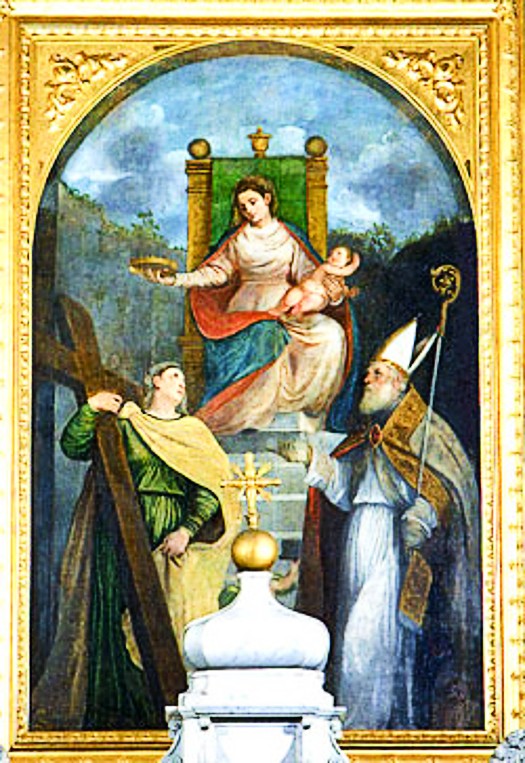
Joseph was also active as a founder of Churches and religious houses. In particular, he founded Isen Abbey in 752 and dedicated it to Saint Zeno of Verona.
After 760, he was closely involved, with the respective founders in the establishment of Schäftlarn and Scharnitz Abbeys. At Schäftlarn the founders gave him the power of supervision of the Monastery and the right to appoint the Abbots. Here, his first appointment was Aribo, Joseph’s successor as Bishop. At Scharnitz he appointed Atto, Aribo’s successor as Bishop of Freising, also to be highly successful in the acquisition of estates for the Diocese.
After his death on 17 January 764, Joseph was buried in the Church of Isen Abbey, founded by himself, where his tomb was restored in 1743. The Church survived the secularisation of Bavaria in 1802-03 and is still in service as St Zeno’s, the Parish Church of Isen.
St Achillas of Sketis St Amoes of Sketis St Anthony of Rome Bl Euphemia Domitilla
Blessed Gamelbert of Michaelsbuch (c 720-c 802) Priest, Monk, Hermit. “Such was his kindness of heart, that he used to buy the little birds caught by the peasants, in order to set them free. He never allowed his servants to work in the fields or woods, if bad weather threatened. He valued, above everything, peace and concord and kept the peace among his parishioners, as far as he possibly could.” – from “The Little Bollandists” by Monsignor Paul Guérin, 1882 Biography: https://anastpaul.com/2022/01/17/saint-of-the-day-17-january-blessed-gamelbert-of-michaelsbuch-c-720-c-802/
St Genitus St Genulfus St John of Rome Blessed Joseph of Freising (Died 764) Bishop St Julian Sabas the Elder St Marcellus of Die St Merulus of Rome St Mildgytha St Nennius St Neosnadia St Pior St Richimir
Martyrs of Langres – Triplet Brothers with their Grandmother: At Langres, in the time of Marcus Aurelius, the Saints Eleusippus, Meleusippus, Speusippus, born at one birth, who were crowned with Martyrdom, together with their grandmother, Leonilla,
Thought for the Day – 16 January – Meditations with Antonio Cardinal Bacci (1881-1971)
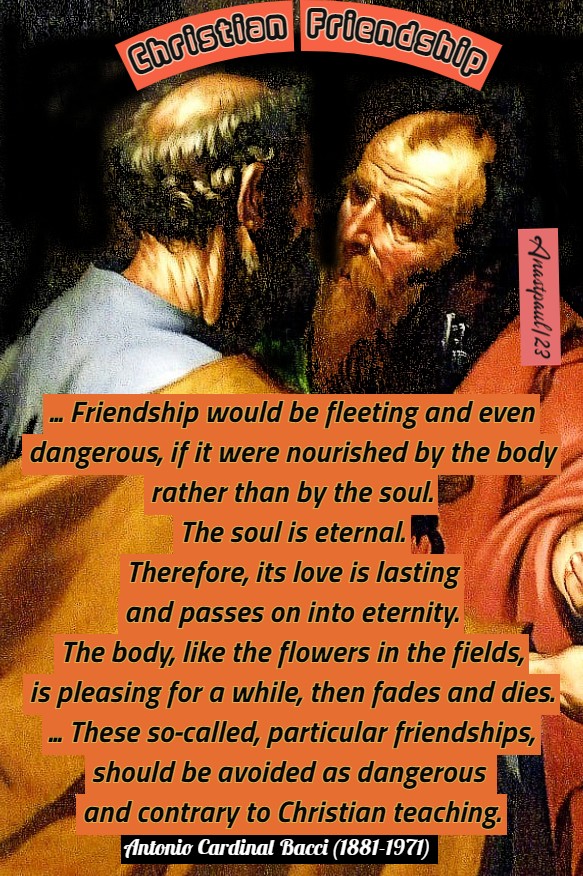
Christian Friendship
“Forget the series of useless and often academic questions which the philosophers asked concerning the nature of friendship. Cicero’s definition, however, is worth recording because it is not far from the Christian concept of friendship. Friends, he says, are those who are united by a bond of affection and of agreement in matters of spiritual and human importance. True friendship is the result of a mysterious and mutual attraction between two persons, who grow to know, respect and love one another (De Amicitia VI).
Thus, friendship would be fleeting and even dangerous, if it were nourished by the body rather than by the soul. The soul is eternal. Therefore, its love is lasting and passes on into eternity. The body, like the flowers in the fields, is pleasing for a while, then fades and dies. St Augustine tells us, in his Confessions that he was passionately attached to a young man of his own age, who was blooming with the flower of adolescence. But he adds, immediately, that this was not a genuine friendship because it did not spring from the charity which the Spirit of God pours into our hearts (Confessions IV, 4:7). These so-called, particular friendships, should be avoided as dangerous and contrary to Christian teaching.”
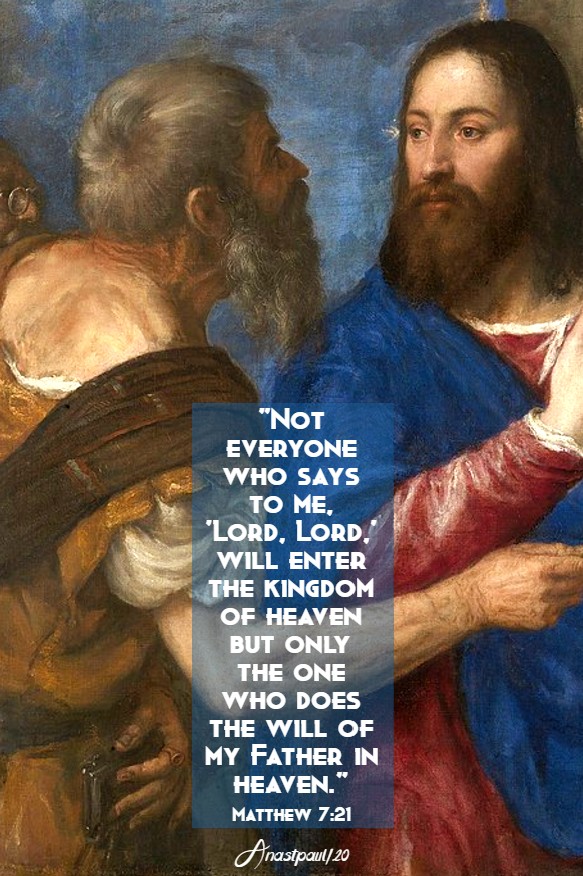
“Not everyone who says to Me, ‘Lord, Lord,’ will enter the Kingdom of Heaven but only the one who does the will of My Father in Heaven.”
Matthew 7:21
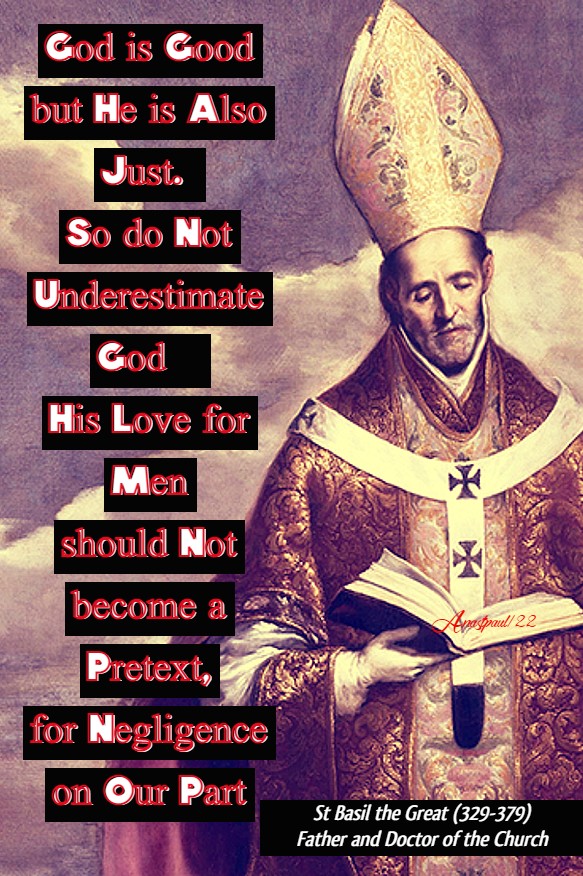
“God is Good but He is also Just… So do not underestimate God – His love for men should not become a pretext, for negligence on our part.”
St Basil the Great (329-379) Father and Doctor of the Church
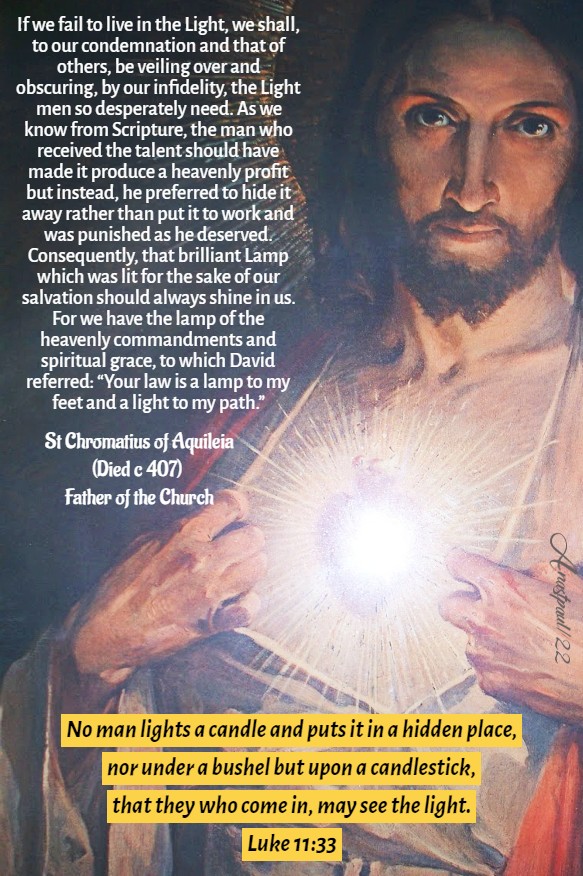
“If we fail to live in the Light, we shall, to our condemnation and that of others, be veiling over and obscuring, by our infidelity, the Light men so desperately need. As we know from Scripture, the man who received the talent should have made it produce a heavenly profit but instead, he preferred to hide it away rather than put it to work and was punished as he deserved. Consequently, that brilliant Lamp which was lit for the sake of our salvation should always shine in us. For we have the lamp of the heavenly commandments and spiritual grace, to which David referred: Your law is a lamp to my feet and a light to my path.”
St Chromatius of Aquileia (Died c 407) Bishop of Aquileia, Father of the Church
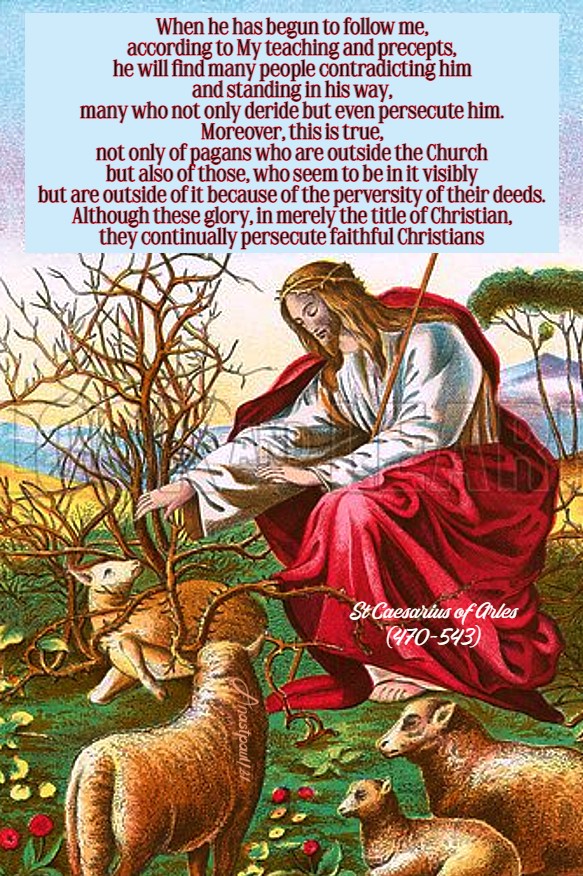
“When he has begun to follow Me, according to My teaching and precepts, he will find many people contradicting him and standing in his way, many who not only deride but even persecute him. Moreover, this is true, not only of pagans who are outside the Church but also of those, who seem to be in it visibly but are outside of it because of the perversity of their deeds. Although these glory, in merely the title of Christian, they continually persecute faithful Christians.”
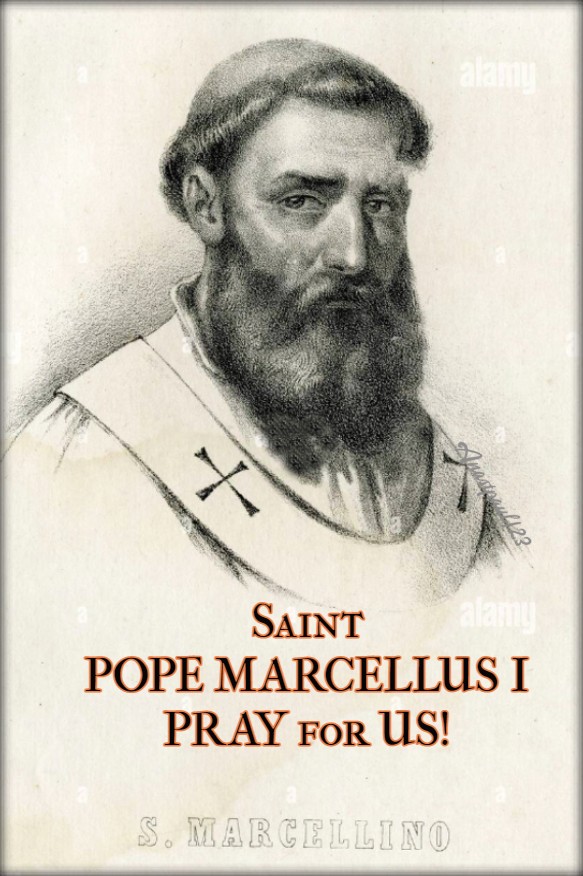
One Minute Reflection – 16 January – Saint Pope Marcellus I (Died 309) – 1 Peter 5:1-4, 10-11, Matthew 16:13-19 – Scripture search here: https://www.drbo.org/
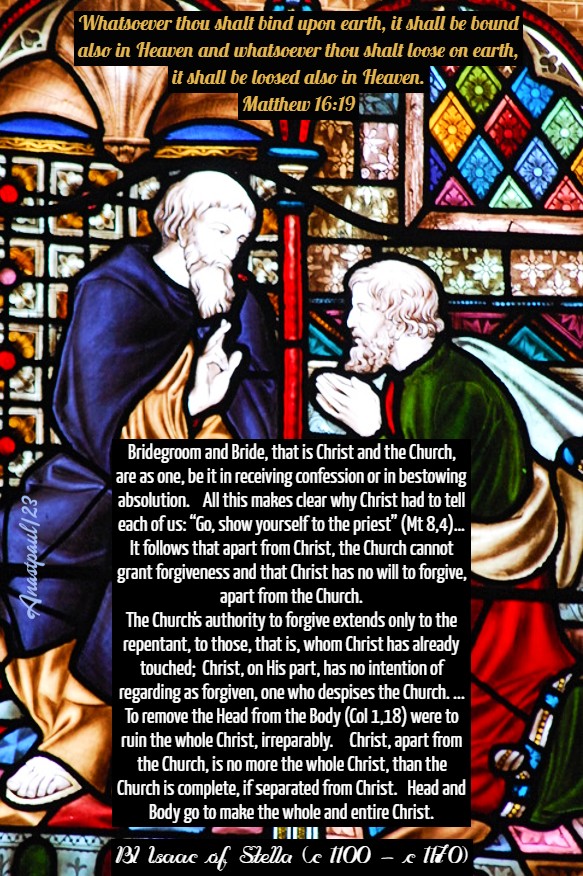
“Whatsoever thou shalt bind upon earth, it shall be bound also in Heaven and whatsoever thou shalt loose on earth, it shall be loosed also in Heaven.” – Matthew 16:19
REFLECTION – “Bridegroom and Bride, that is Christ and the Church, are as one, be it in receiving confession or in bestowing absolution. All this makes clear why Christ had to tell each of us: “Go, show yourself to the priest” (Mt 8,4)… It follows that apart from Christ, the Church cannot grant forgiveness and that Christ has no will to forgive, apart from the Church. The Church’s authority to forgive extends only to the repentant, to those, that is, whom Christ has already touched; Christ, on His part, has no intention of regarding as forgiven, one who despises the Church.
Doubtless, Christ need accept no restraints to His power of Baptising, Consecrating the Eucharist, Ordaining Priests, forgiving sins and the like but, the humble and faithful Bridegroom, prefers to confer such blessings, with the co-operation of His Bride. “What God,” then, “has joined, let no man put asunder” (Mt 19,6). “I say this is a great mystery and refers to Christ and the Church” (Eph 5,32)… To remove the Head from the Body (Col 1,18) were to ruin the whole Christ, irreparably. Christ, apart from the Church, is no more the whole Christ, than the Church is complete, if separated from Christ. Head and Body go to make the whole and entire Christ.” – Bl Isaac of Stella (c 1100 – c 1170) Cistercian Monk, Abbot, Theologian, Philosopher (Sermon 11, §11-814).
PRAYER – O Lord, we beseech Thee, graciously hear the prayers of Thy people, that we may be helped by the merits of blessed Marcellus, Thy Pope and Martyr, whose sufferings we celebrate. Through the same Jesus Christ, Thy Son our Lord, Who lives and reigns with Thee, in the unity of the Holy Ghost, God, world without end. Amen (Collect).
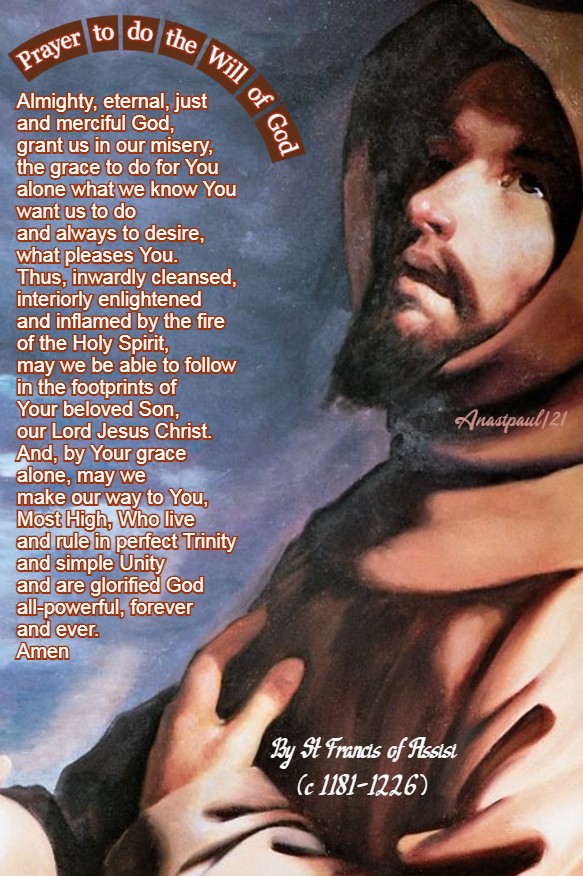
Prayer to do the Will of God By St Francis of Assisi (c 1181-1226)
Almighty, eternal, just and merciful God, grant us in our misery, the grace to do for You alone what we know You want us to do and always to desire, what pleases You. Thus, inwardly cleansed, interiorly enlightened and inflamed by the fire of the Holy Spirit, may we be able to follow in the footprints of Your beloved Son, our Lord Jesus Christ. And, by Your grace alone, may we make our way to You, Most High, Who live and rule in perfect Trinity and simple Unity and are glorified God all-powerful, forever and ever. Amen
Saint of the Day – 16 January – Saint Titian of Oderzo (Died 632) Bishop of Oderzo and Confessor, Defender of the True Faith against the heresy of the Arians, Miracle-worker. Born in Heraclea, Italy and died on 16 January 632 in Oderzo, Italy of natural causes. Patronages – the City and Diocese of Oderzo, Treviso, Italy and of the Diocese of Vittorio Veneto (which,until 1939, bore the ancient name of Ceneda) also in Italy. Also known as – Titian of Venice, Tiziano of Oderzo.
According to ancient tradition, Titian belonging to a wealthy and distinguished family, was born around the year 555: on the Island of Eraclea/Heraclea. In his adolescence, Titian was sent to Oderzo, for his education, where St Florian was Bishop and where the Cathedral school was highly regarded.
As he grew older, Titian felt his vocation to the Priesthood mature prompted by his inclination to put himself at the service of poor people but also by the examples of his teacher St Florian. The latter, in due course, was happy to Ordain him a Deacon and then a Priest. Having demonstrated an excellent pastoral preparation, Titian was entrusted with the task of Treasurer and was promoted to Archpriest of the Cathedral. In exercising these trusted duties, Titian found a new opportunity to exercise charity towards the poor, who were many.
St Florian, having renounced the Episcopate, desiring to become a missionary among the pagans, with the hope, moreover, of seizing the Palm of Martyrdom, the clergy and people found no person more worthy than Titian to succeed him as shepherd and guide. According to ancient tradition, he was the Bishop of Oderzo for about 25 years.
As the Bishop, Titian had to fight strenuously to protect his See from the Arians. As historians assure us, by the zealous protection of their Bishop Titian, the Diocese of Oderzo remained immune from yielding to the heresy.
The civil situation, in those days, was profoundly upset by the invasion of the Longobards, against whom, Bishop Titian protect his people. The Lombards did not occupy the City of Oderzo, which still remained, for more than a century, the stronghold of the Byzantine Empire of the Venices.
Titian, rich in virtues and merits, surrounded by fame as a miracle-worker, died on 16 January 632. His body was placed in a separate tomb in the Church of his City, where the people immediately flocked to venerate him as a Saint, recognising the great merits acquired during his lifetime and testifying to the many miracles obtained through his intercession.
The Heracleans for their part did not delay in claiming the relics but in vain, due to the strenuous opposition of the Opitergians. Fellow citizens and relatives of the Saintly Titian, who came one day to Oderzo from Eraclea, under the pretext of visiting his tomb, abducted his body when night fell and carried it off by boat. The locals, soon realising what had happened, gave chase to the robbers and caught up with them in the vicinity of the castle of Motta, where the Monticano flows into the Livenza.
At this point a beautiful miracle, so dear to the people devoted to St Titian occurred and is illustrated by the painter Pomponio Amalteo in five splendid panels (1530) is conserved in the Diocesan Museum of Sacred Art. At the gates of the City. St Titian performed a great miracle, suddenly curing a young woman who had been seriously ill for a long time.
The Translation and the miracle which occurred
To solve the problem, after a fierce battle between the inhabitants of Oderzo and Eraclea, it was decided that St Titian’s Relics should be placed in a wagon pulled by oxen. Wherever the oxen stopped would be where the Relics would be housed. The oxen stopped at Ceneda and this is where the relics have remained to this day.
His Relics are now in the crypt of the Cathedral of Ceneda, in a bronze urn fashioned in neo-Byzantine style, in the form of a sarcophagus. He is depicted in various paintings in the Cathedrals of Oderzo and Ceneda and there are ten Parishes dedicated in his name
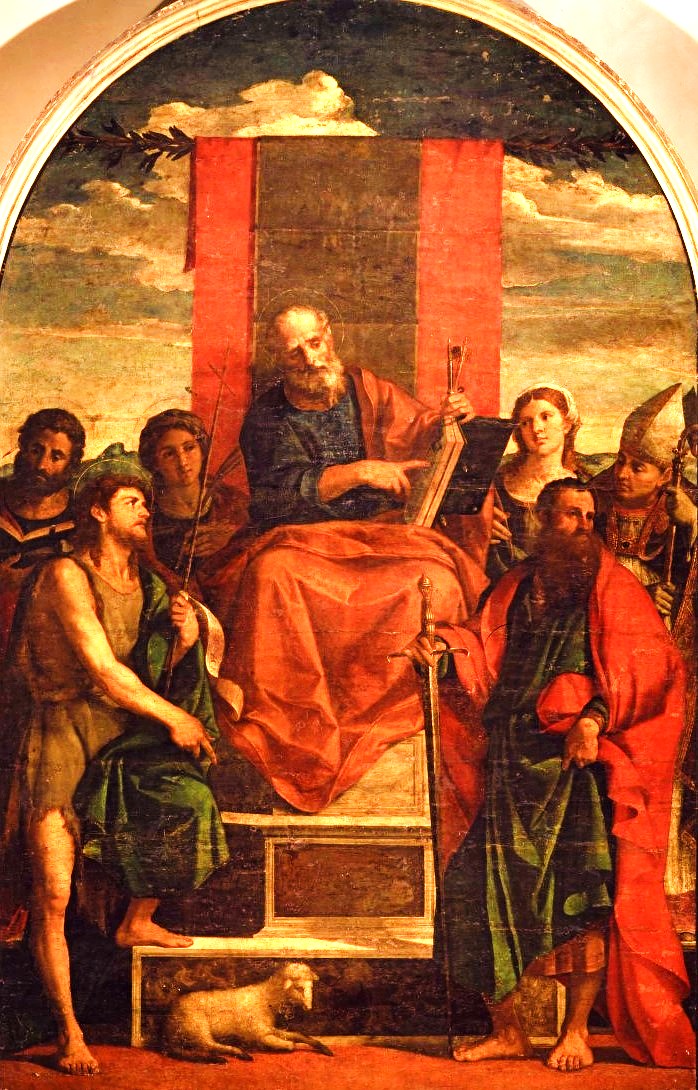
St Peter Enthroned with Sts Paul, Titian of Oderzo (to the left of St Peter), Justina of Padua, John the Baptist, Mark and Augusta. The Painting resides in tSt Titian’s Patronal Church of Fontanelle in Ceneda.
St Henry of Coquet St Honoratus of Arles St Honoratus of Fondi Bl James of Luino St James of Tarentaise Bl Joan of Bagno di Romagna Bl Konrad II of Mondsee St Leobazio St Liberata of Pavia St Melas of Rhinocolura St Otto of Morocco St Peter of Morocco St Priscilla of Rome St Sigeberht of East Anglia St Titian of Oderzo (Died 632) Bishop St Triverius St Valerius of Sorrento
Thought for the Day – 15 January – Meditations with Antonio Cardinal Bacci (1881-1971)
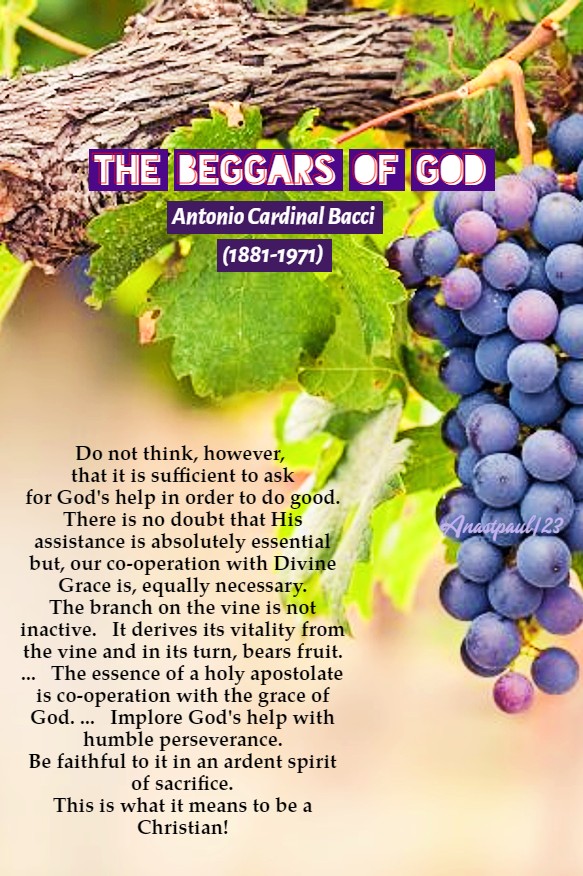
The Beggars of God
“Do not think, however, that it is sufficient to ask for God’s help in order to do good. There is no doubt that His assistance is absolutely essential but, our co-operation with Divine Grace is, equally necessary. The branch on the vine is not inactive. It derives its vitality from the vine and in its turn, bears fruit. In the same way, we must nurture the supernatural life which God infuses into our souls, so that it will mature in good works.
The essence of a holy apostolate is co-operation with the grace of God. This spirit of generous co-operation, must transform us personally, so that we maybe able to change others. This is how the Apostles and Saints acted, this is how we must all act. “By the grace of God, I am what I am” St Paul tells us, “and His grace in me, has not been fruitless – in fact, I have laboured more than any of them, yet, not I but the grace of God, with me” (1 Cor 15:10).
Implore God’s help with humble perseverance. Be faithful to it in an ardent spirit of sacrifice. This is what it means to be a Christian!”
Quote/s of the Day – 15 January – The Memorial of St Macarius of Egypt (c 300-390) Priest, Abbot, Hermit, Father
“The heart itself is only a small vessel, yet dragons are there and lions, there are poisonous beasts and all the treasures of evil, there are rough and uneven roads, there are precipices but there too is God and the Angels, life is there and the Kingdom, there too is light and there, the Apostles and heavenly cities and treasures of grace. All things lie within that little space!”
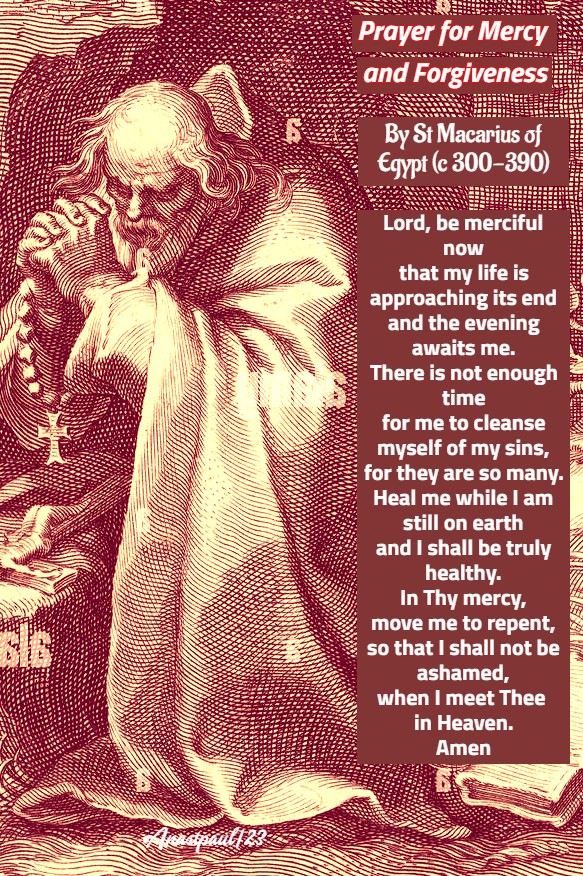
Prayer for Mercy and Forgiveness By St Macarius of Egypt (c 300-390)
Lord, be merciful now that my life is approaching its end and the evening awaits me. There is not enough time for me to cleanse myself of my sins, for they are so many. Heal me while I am still on earth and I shall be truly healthy. In Thy mercy, move me to repent, so that I shall not be ashamed, when I meet Thee in Heaven. Amen
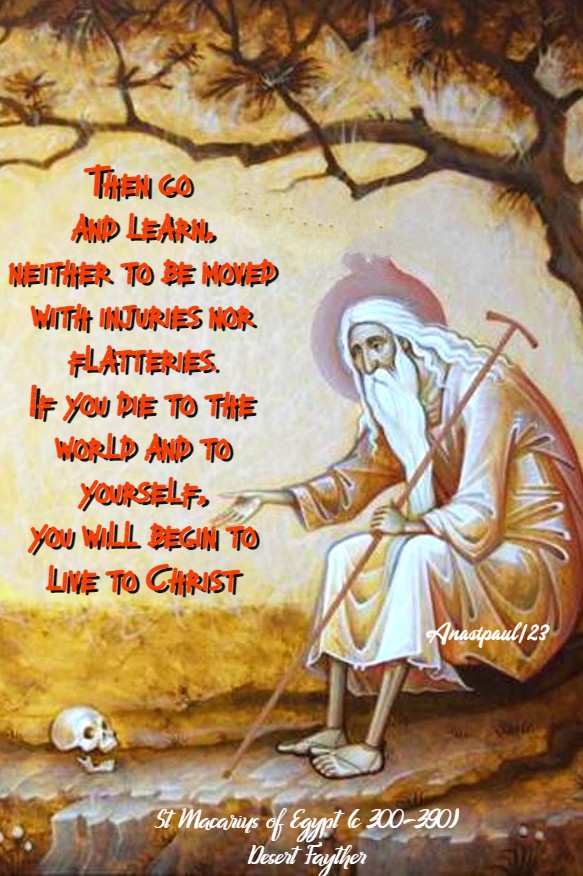
“Then go and learn, neither to be moved with injuries nor flatteries. If you die to the world and to yourself, you will begin to live to Christ.”
“The Son of man is Lord of the Sabbath.” Luke 6:5
“ … The Lord calls on us to rest, telling us: “Come to me, all you who labour and are burdened and I will give you rest” (Mt 11:28) And He gives rest to all souls who trust Him and come to Him, by delivering them from painful, oppressive and impure thoughts. Then they completely stop indulging in evil, celebrating a true, a delightful and holy Sabbath, a feast of the Spirit in inexpressible joy and rejoicing. They offer a pure and acceptable worship to God, coming from a pure heart. That is the true and holy Sabbath.”
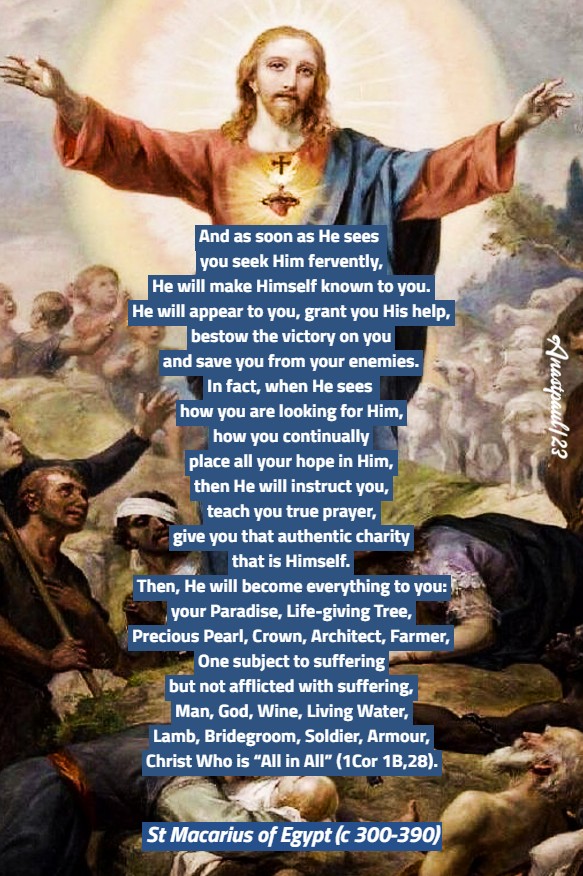
“And as soon as He sees you seek Him fervently, He will make Himself known to you. He will appear to you, grant you His help, bestow the victory on you and save you from your enemies. In fact, when He sees how you are looking for Him, how you continually place all your hope in Him, then He will instruct you, teach you true prayer, give you that authentic charity that is Himself. Then, He will become everything to you: your Paradise, Life-giving Tree, Precious Pearl, Crown, Architect, Farmer, One subject to suffering but not afflicted with suffering, Man, God, Wine, Living Water, Lamb, Bridegroom, Soldier, Armour, Christ Who is “All in All” (1Cor 1B,28).
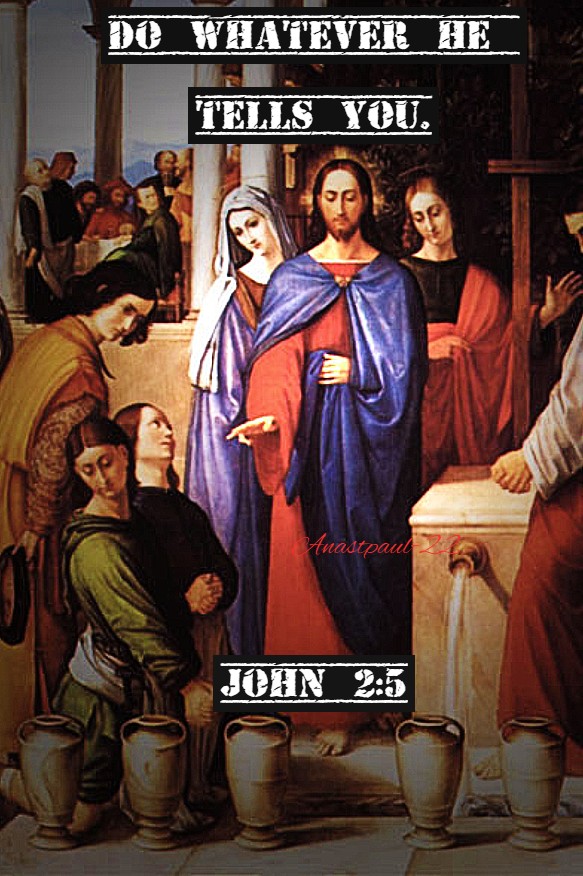
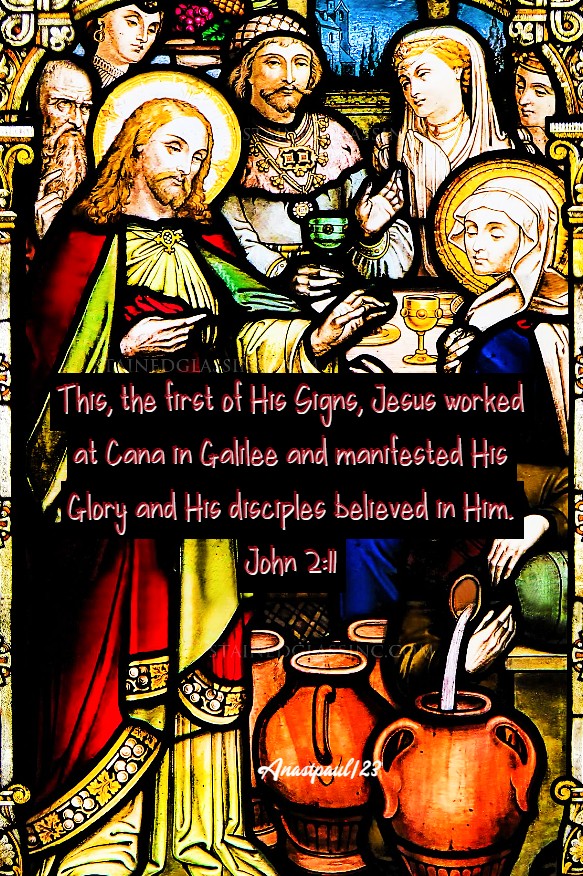
One Minute Reflection – 15 January – Second Sunday after the Epiphany – Romans 12:6-16, John 2:1-11 – Scripture search here: https://www.drbo.org/
“This, the first of His Signs, Jesus worked at Cana in Galilee and manifested His Glory and His disciples believed in Him…” – John 2:11
REFLECTION – “Why did our Lord change water into wine as His first Sign? It was to show how God, Who transforms nature into something else, also works His transformation in the womb of the Virgin. In the same way, as the crown of His miraculous deeds, Jesus opened a tomb to make known His freedom, with regard to the death, which is hungry to swallow up everything.
To both authenticate and confirm, the twofold reversal of nature, brought by His Birth and His Resurrection, Jesus changed water into wine, without in any way altering the stone water-jars. This was the symbol of His own Body, miraculously conceived and wonderfully created in a virgin, without the working of a man… Contrary to their normal use, the jars… brought new wine into the world, without ever repeating the same miracle again. In the same way the Virgin conceived and brought Emmanuel into the world, (Is 7,14) without afterwards conceiving again. The miracle of the stone water-jars was that what was small, became great, sparseness was changed into superabundance, plain water into sweet wine… In Mary, on the other hand, the greatness and glory of the Godhead changed its appearance to take on the aspect of weakness and humiliation.
Those jars were used for the Jewish purifications; into them our Lord poured His teaching: He demonstrated that He came according to the Law and the prophets but with the purpose of changing them all, through His teaching, as the water became wine… «The Law was given through Moses; grace and truth came through Jesus Christ» (Jn 1,17). The bridegroom who lived in Cana, invited the Bridegroom from Heaven and the Lord, Who was ready for that wedding, answered His invitation. Those seated at table invited Him, Who sets worlds in His Kingdom, and He sent them a wedding gift, able to delight them… They had no wine, even of an ordinary sort; He poured a little from His own abundance for them. In return for their invitation, He Himself, invited them to His own wedding!” – St Ephrem (306-373) Deacon in Syria, Father and Doctor of the Church (Commentary on the Diatessaron, 5, 6f).
PRAYER – Almighty, everlasting God, Thou Who govern both the heavens and the earth, graciously hear the humble prayers of Thy people and grant us Thy peace, all the days of our lives. Through the same Jesus Christ, Thy Son our Lord, Who lives and reigns with Thee, in the unity of the Holy Ghost, God, world without end. Amen (Collect).
Our Morning Offering – 15 January – Second Sunday after the Epiphany
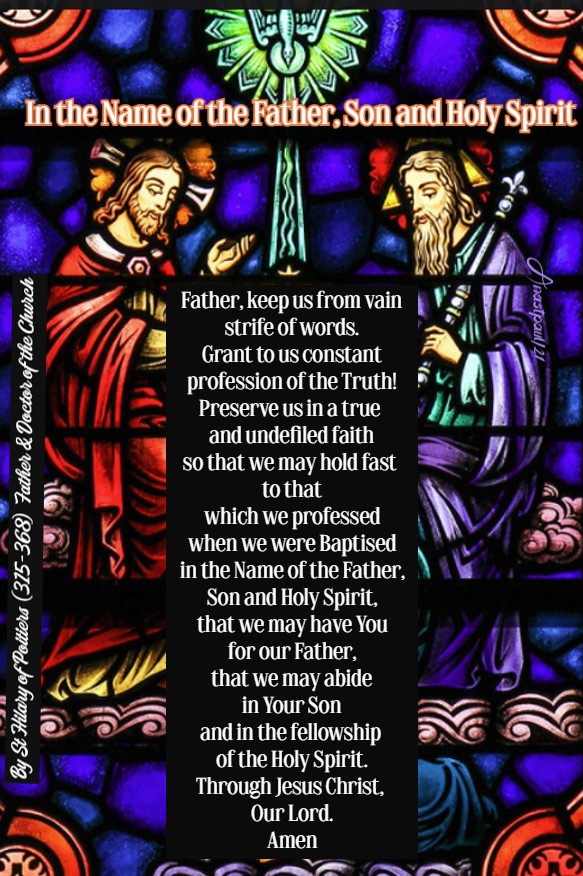
In the Name of the Father, Son and Holy Spirit By St Hilary (315-368) Father & Doctor of the Church
Father, keep us from vain strife of words. Grant to us constant profession of the Truth! Preserve us in a true and undefiled faith so that we may hold fast to that which we professed when we were Baptised in the Name of the Father, Son and Holy Spirit, that we may have You for our Father, that we may abide in Your Son and in the fellowship of the Holy Spirit. Through Jesus Christ, Our Lord. Amen
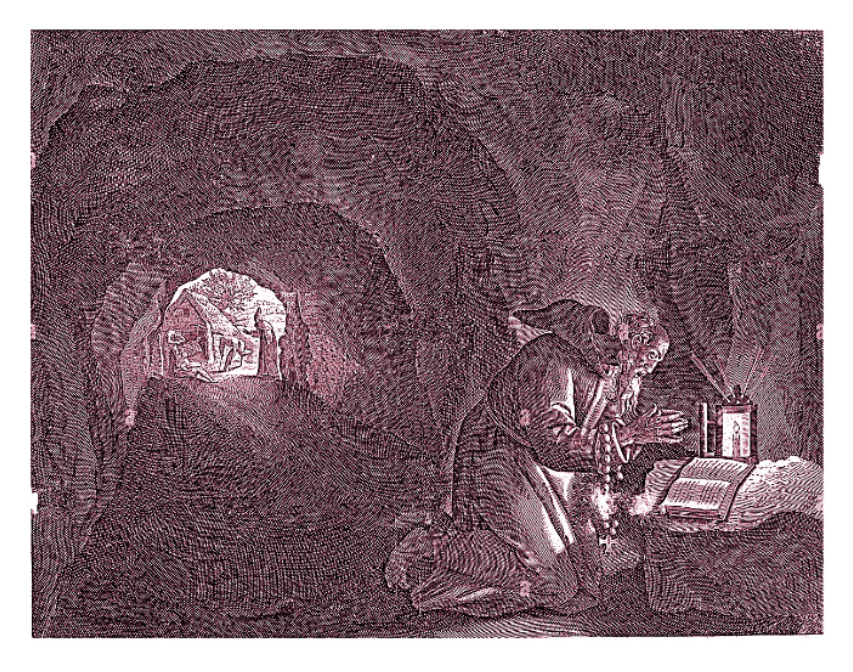
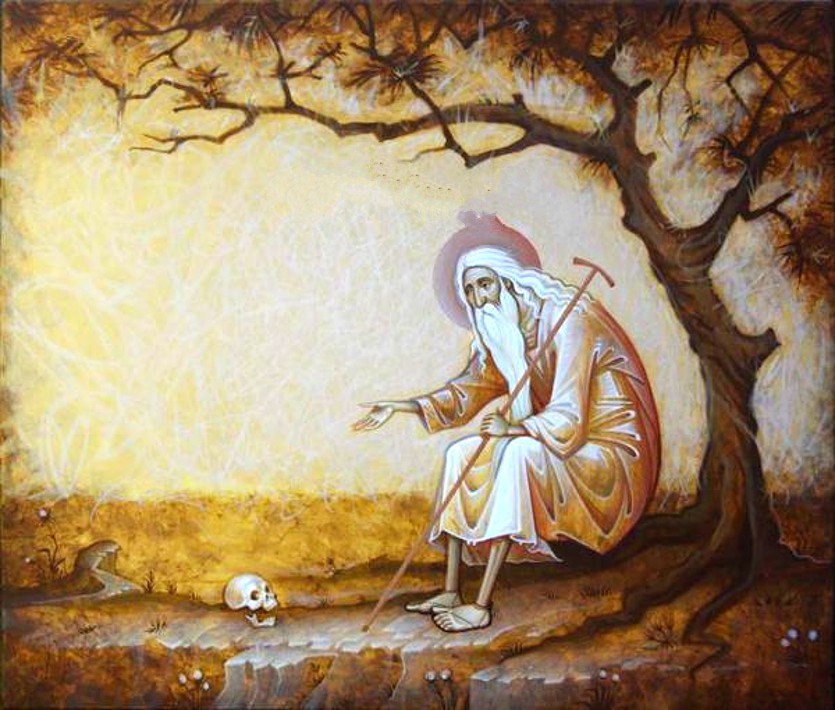
Saint of the Day – 15 January – St Macarius of Egypt (c 300-390) Priest, Abbot, Hermit, Desert Father of the Church, Spiritual student of Saint Anthony Abbot, Ascetic, Miracle-worker , known as “The Glowing Lantern.” Macarius was one of the famed Desert Fathers, who fled society in the fourth century to live a life of austerity and prayer in the desert.Born in c 300 at Upper Egypt and died in 390 of natural causes. Also known as – Macarius the Elder, Macarius the Great, “The Glowing Lantern.”
The Roman Martyrology reads today: “In Egypt. St Macarius, Abbot, disciple of St Anthony, very celebrated for his life, wisdom and miracles.”
Macarius was born in Lower Egypt around the year 300. At the wish of his parents Macarius entered into marriage but was soon widowed. Shortly after, his parents died. Macarius distributed all his money among the poor and needy. He found a teacher in an experienced Hermit, who lived in the desert not far from the village. The Hermit accepted the youth, guided him in the spiritual science of solitude and silence, fasting and prayer and taught him the handicraft of weaving baskets.
A while later, a pregnant woman accused him of having defiled her. Macarius did not attempt to defend himself and accepted the accusation in silence. However, when the woman’s delivery drew near, her labour became exceedingly difficult. She did not manage to give birth until she confessed Macarius’s innocence. A multitude of people then came asking for his forgiveness but he fled to the Nitrian Desert to escape all mundane glory.
As a Hermit, Macarius spent seven years living on only pulse and raw herbs. He spent the following three years consuming four or five ounces of bread a day and only one vessel of oil a year. While in the desert, he visited St Anthony Abbot and learned from him the laws and rules of monasticism. When he returned to the Scetic Desert at the age of forty, he bwas Ordained a Priest. The fame of his sanctity drew many followers. The community, which took up its residence in the desert, was of the semi-eremitical type. The Monks were not bound by any fixed rule; their cells were close together and they met for the celebratiion of the Holy Mass only on Sundays. He presided, as Abbot, over this monastic community for the rest of his life.
A young man applying to Macarius for spiritual advice, he directed him to go to a burying-place, and upbraid the dead; and after, to go and flatter them. When he came back, the saint asked him what answer the dead had made: “None at all,” said the other, “either to reproaches or praises.” “Then,” replied Macarius, “go and learn, neither to be moved with injuries nor flatteries. If you die to the world and to yourself, you will begin to live to Christ.” He said to another: “Receive, from the hand of God, poverty as cheerfully as riches, hunger and want as plenty and you will conquer the devil and subdue all your passions.” A certain Monk complained to him, that in solitude he was always tempted to break his fast, whereas in the Monastery, he could fast the whole week cheerfully. “Vain-glory is the reason,” replied the Saint; “fasting pleases, when men see you but seems intolerable, when that passion is not gratified.”
For a brief period of time, Macarius was banished to an island in the Nile by the Emperor Valens, along with St Macarius of Alexandria (Died 395), during a dispute over the doctrine of the Nicene Creed. Both men were victims of religious persecution by the followers of then Bishop Lucius of Alexandria. During their time on the island, the daughter of a pagan priest had become ill. The people of the island believed that she was possessed by an evil spirit. Both Saints prayed over the daughter and by their intercession she was cured. saved her. The pagan people of the island were so impressed and grateful that they were converted and built a Church. When word of this got back to the Emperor Valens and Bishop Lucius of Alexandria, they quickly allowed both men to return home. At their return they were met by a multitude of Monks in joyous celebration.
Macarius’ face used to be enlightened with grace in an amazing way, to the extent that many fathers testified that his face used to glow in the dark and thus, he was called “The Glowing Lantern.” This description was transferred to his Monastery, and thus it was called “the glowing lantern of the wilderness” or “the glowing Monastery,” which meant the place of high wisdom and constant prayer. Today it belongs to the Coptic Orthodox Church.
Macarius died peacefully around the age of 90, in the year 390. After his death, the natives of his village appropriated his body and built a great Church for him in their village. Today, the body of Macarius is found in his Monastery, the Monastery of Saint Macarius in Scetes, Egypt.
The entirety of the Nitrian Desert is sometimes called the Desert of Macarius, for he was the pioneer Monk in the region. The ruins of numerous Cells in this region, support the local tradition that the cloisters of Macarius, were equal in number to the days of the year.
We have 50 of his sermons to savour his wisdom. Below is a link to a video series of the sermons as well as a Pdf, which also contains great details of his life.
St Maurus OSB (c 512-584) Benedictine Monk, Abbot and Deacon, Miracle-worker. Maurus was the first disciple of Saint Benedict of Nursia (512–584). He is mentioned in Saint Gregory the Great’s biography of the latter as the first oblate, offered to the Monastery by his noble Roman parents as a young boy, to be brought up in the monastic life. The formula and blessing of St Maurus were universally adopted and approved for use in the Blessing of the Sick. His Life and Miracles: https://anastpaul.com/2021/01/15/saint-of-the-day-15-january-saint-maurus-osb-c-512-584/
St Blaithmaic of Iona St Bonitus of Clermont St Britta St Ceolwulf of Northumbria St Emebert of Cambrai St Ephysius of Sardinia St Eugyppius Bl Geoffrey of Peronne Bl Giacomo Villa St Gwrnerth St Habakkuk the Prophet St Isidore of Scété St Isidore the Egyptian St Ita of Killeedy St John Calabytes St Liewellyn St Lleudadd of Bardsey St Macarius of Egypt (c 300-390) Priest, Hermit, Spiritual student of Saint Anthony Abbot.
St Malard of Chartres St Maximus of Nola Bl Peter of Castelnau St Placidus
Thought for the Day – 14 January – Meditations with Antonio Cardinal Bacci (1881-1971)
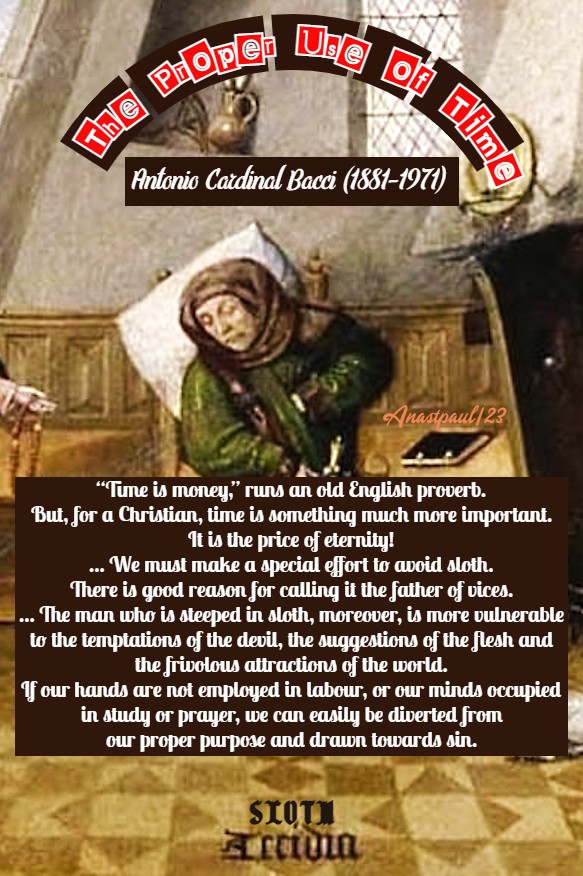
The Proper Use of Time
“Time is money,” runs an old English proverb. But, for a Christian, time is something much more important. It is the price of eternity! With time well spoent or badly spent, we can purchase a life of eternal happiness with God, or of eternal suffering in hell. Since our true destiny is God and everlasting happiness, all the time which we spend with this in view, is well spent, whereas, all that is not devoted to this end, is useless or harmful.
We must make a special effort to avoid sloth. There is good reason for calling it the father of vices. When a man surrenders to laziness, he is squandering a priceless treasure, which was intended to be used in the service of God and for the sanctification of his own soul and the souls of his fellowmen. He is also disobeying the clear command which God issued after the sin of Adam: “In the sweat of your brow you shall eat bread” (Gen 3:29).
The man who is steeped in sloth, moreover, is more vulnerable to the temptations of the devil, the suggestions of the flesh and the frivolous attractions of the world. If our hands are not employed in labour, or our minds occupied in study or prayer, we can easily be diverted from our proper purpose and drawn towards sin.”
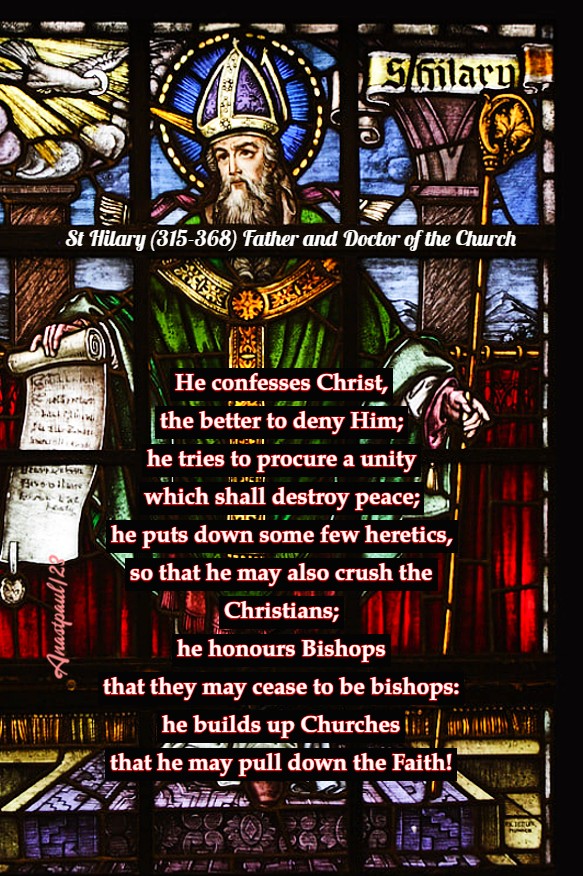
Quote/s of the Day – 14 January – St Hilary (315-368) Confessor, Bishop, Father and Doctor of the Church
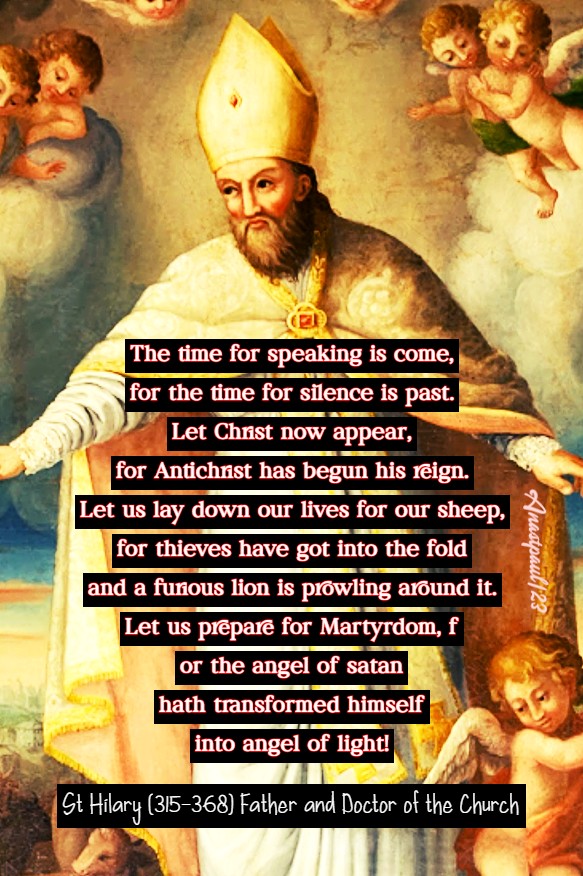
“The time for speaking is come, for the time for silence is past. Let Christ now appear, for Antichrist has begun his reign. Let us lay down our lives for our sheep, for thieves have got into the fold and a furious lion is prowling around it. Let us prepare for Martyrdom, f or the angel of satan hath transformed himself into angel of light!”
“He confesses Christ, the better to deny Him; he tries to procure a unity which shall destroy peace; he puts down some few heretics, so that he may also crush the Christians; he honours Bishops that they may cease to be bishops: he builds up Churches that he may pull down the Faith!”
One Minute Reflection – 14 January – St Hilary (315-368) Confessor, Bishop, Father and Doctor of the Church – 2 Timothy 4:1-8, Matthew 5:13-19 – Scripture search here: https://www.drbo.org/
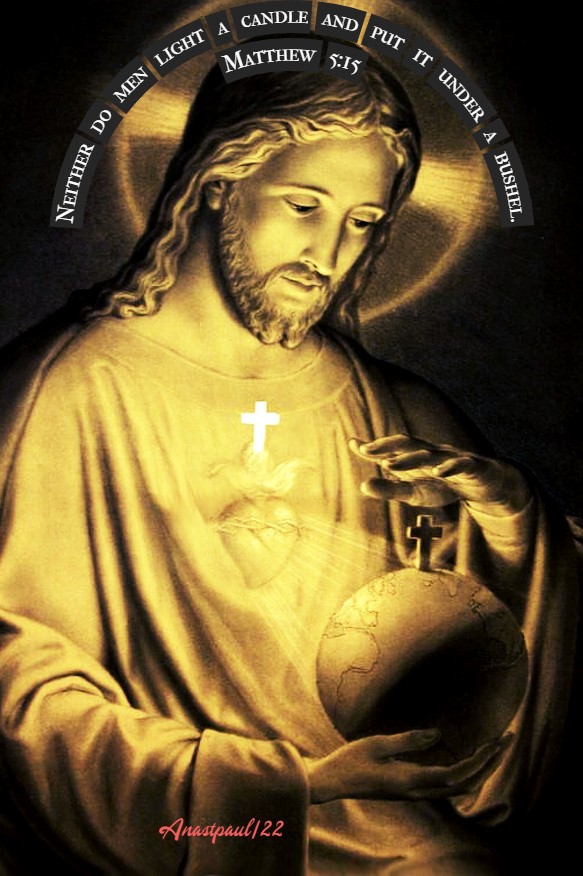
“Neither do men light a candle and put it under a bushel but upon a candlestick that it may shine to all that are in the house. … ” – Matthew 5:15
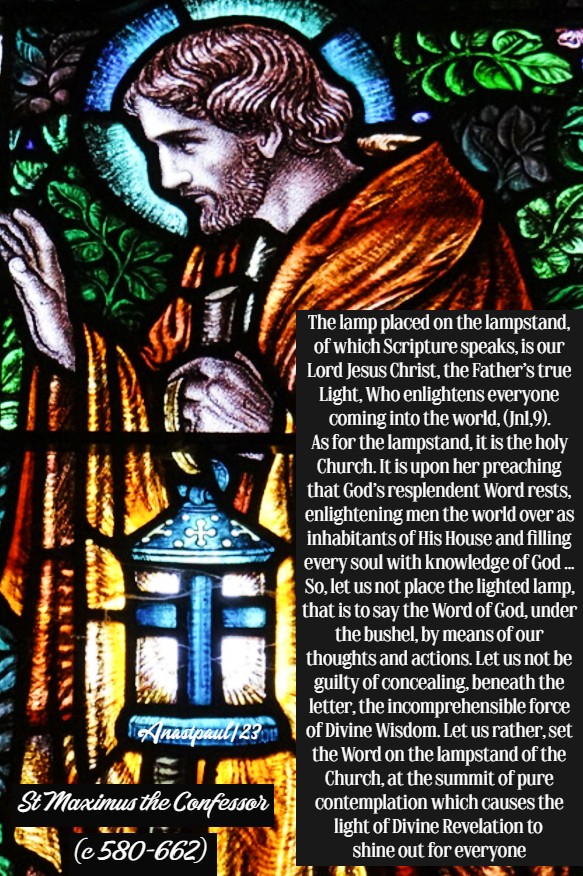
REFLECTION – “The lamp placed on the lampstand, of which Scripture speaks, is our Lord Jesus Christ, the Father’s true Light, Who enlightens everyone coming into the world, (Jn1,9). As for the lampstand, it is the holy Church. It is upon her preaching that God’s resplendent Word rests, enlightening men the world over as inhabitants of His House and filling every soul with knowledge of God…
The Word has no wish to remain under a bushel; it longs to be set well in view, on the Church’s summit. Concealed beneath the letter of the Law, as under a bushel, the Word would have deprived everyone of Eternal Light. It would have been unable to grant spiritual contemplation to those who try to disengage themselves from the seduction of the senses, which are subject to illusion and quick to see only material, passing things. But if placed on the lampstand of the Church, that is to say, founded on worship in spirit and truth (Jn 4,24), it enlightens everyone… For the letter, unless it is understood according to the spirit, has only a material and limited value; of itself, it does not allow the mind to grasp the import of the written word…
So, let us not place the lighted lamp, that is to say the Word of God, under the bushel, by means of our thoughts and actions. Let us not be guilty of concealing, beneath the letter, the incomprehensible force of Divine Wisdom. Let us rather, set the Word on the lampstand of the Church, at the summit of pure contemplation which causes the light of Divine Revelation to shine out for everyone!” – St Maximus the Confessor (c 580-662) Abbot, Theologian, Father (Question 63 to Thalassius: PG 90, 667-670).
PRAYER – O God, Who gave to Thy people blessed Hilary, as a minister of salvation, grant we beseech Thee that we, who cherished him on earth as a teacher of life, may be found worthy to have him as an intercessor in Heaven. Through Jesus Christ, Thy Son our Lord, Who lives and reigns with Thee, in the unity of the Holy Ghost, God, world without end. Amen (Collect).
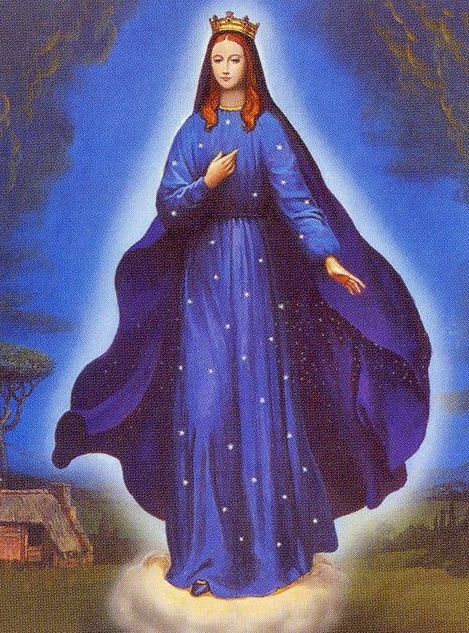
Mother of Salvation, Blessed Lady By St Anselm (1033-1109) Magnificent Doctor Marian Doctor
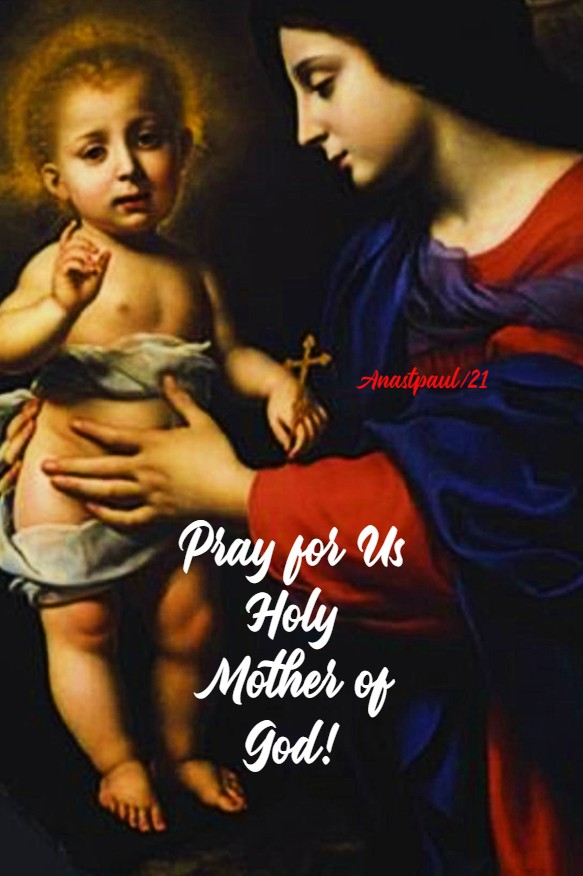
Mother of Salvation, Blessed Lady, you are the Mother of Justification and those who are justified; the Mother of Reconciliation and those who are reconciled; the Mother of Salvation and those who are saved. What a blessed trust and what a secure refuge! The Mother of God is our Mother. The Mother of the One in Whom alone, we hope and Whom alone, we fear, is our Mother! … The One Who partook of our nature and by restoring us to life, made us children of His Mother, invites us by this grace, to proclaim that we are His brothers and sisters. Therefore, our Judge, is also our Brother. The Saviour of the world, is our Brother. Our God has become – through Mary – our Brother! Anen
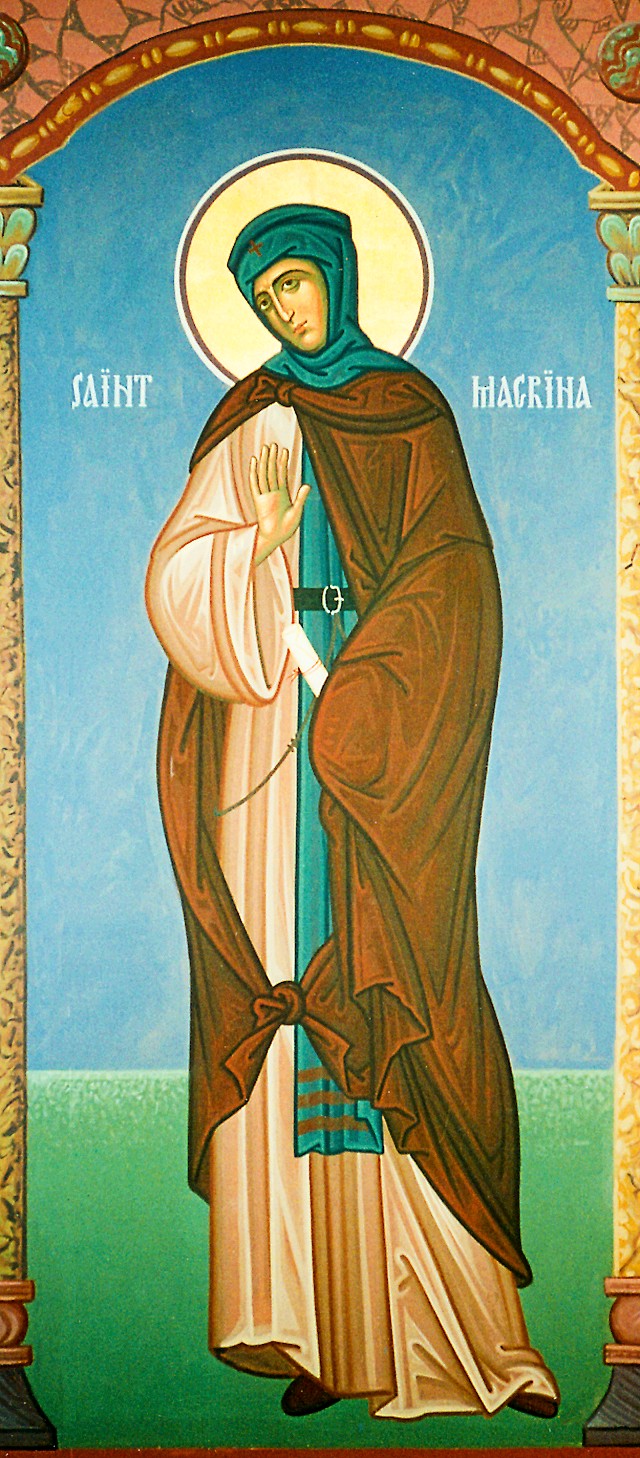
Saint of the Day – 14 January – St Macrina the Elder (Died c 340) Widow, Mother of the elder St Basil and, therefore, the Grandmother of St Basil the Great, St Gregory of Nyssa, St Peter of Sebaste and St Macrina the Younger. Macrina was a native of Cappadocia, in what is now eastern Turkey. Patronages – against poverty, of the poor, of widows. Also known as – Macrina of Caesarea.
The Roman Martyrology says today: “St Macrina, disciple of St Gregory Thaumaturgus and the grandmother of St Basil, whom she brought up in the Faith.”
Our knowledge of the life of the elder Macrina is derived mainly from the testimony of the great Cappadocian Fathers of the Church, her grandchildren – Basil, Gregory of Nyssa (Vita Macrinae Junioris) and the panegyric of St Gregory of Nazianzen on St Basil.
Two of these grandsons helped shape the Faith which we proclaim today—Basil the Great, a Doctor of the Church and his brother, Gregory of Nyssa, who helped the Church better articulate her understanding of the Trinity. Both of these men played crucial roles in formulating the Nicene Creed which Catholics still recite every Sunday at Mass. Macrina raised both of these men and their influential younger sister, Macrina the Younger. She gave all these great Saints their first religious instruction as children.
The works of Basil indicate that she studied under Gregory Thaumaturgus (or the Wonderworker), the great father of the Faith in Cappadocia, he of whom it is said that when he arrived in the territory, there were only seventeen Christians in the Town of Neocaesarea; when he died in 268, there were only seventeen pagans. It was his teachings, handed down through Macrina to Basil and Gregory that were particularly formative for the two Cappadocian brothers.
Her home was at Neocaesarea in Pontus and according to Gregory Nazianzen, during the persecution of Christians under Galerius and Diocletian, Macrina fled with her husband to the shores of the Black Sea. They left their home and hid in the woods for seven years. They were often hungry and had to live off the land and whatever animals they could hunt. After they were finally allowed to go home to Neocaesarea, another round of persecution took effect and their possessions were confiscated. These trials are the reason for her patronage of the poor.
She was widowed and is also the Patron of widows. She is said to have died in the early 340s
Bl Amadeus of Clermont St Barbasymas St Caldeoldus of Vienne St Datius of Milan St Engelmaro St Eufrasio of Clermont St Euphrasius the Martyr
St Felix of Nola (Died c 253) Priest, Confessor, Apostle of Charity .Patronages – against eye disease, against eye trouble, against false witness, against lies, against perjury, domestic animals, of Nola, Italy. The Roman Martyrology states of him today: “At Nola in Campania, the birthday of St Felix, Priest, who (as is related by Bishop, St Paulinus of Nola), after beomg subjected to torments by the persecutors, was cast into prison and extended, bound hand foot, on (snail) shells and broken earthenware. During the night, however, his bonds were loosened and he was delivered by an Angel. The persecution over, he brought many to the Faith of Christ by his exemplary life and teaching and renowned for many miracles, he rested in peace.” Biography: https://anastpaul.com/2019/01/14/saint-of-the-day-14-january-st-felix-of-nola-died-c-253/
St Felix of Rome St Fermin of Mende St Fulgentius of Ecija St Glycerius of Antioch
St Isaias the Martyr St Jesaja of Sinai St Macrina the Elder (Died c 340) Widow, Grandmother of St Basil the Great, St Gregory of Nyssa, St Peter of Sebaste and St Macrina the Younger. St Nino of Georgia Bl Odoric of Pordenone
St Paul of Africa St Potitus Bl Rainer of Arnsberg St Sabas of Sinai St Sava of Serbia St Successus of Africa St Theodolus of Sinai Bl William de Sanjulia
Martyrs of Mount Sinai: A group of Monks on Mount Sinai who were Martyred by desert Bedouins. Their names and exact number have not come down to us. Martyred by Bedouins.
Martyrs of Raithu – 43 Saints: A group of 43 Monks in the Raithu Desert near Mount Sinai, Palestine, near the Red Sea. They were Martyred for their faith by desert Bedouins. Their names have not come down to us. Martyred by Bedouins.
Thought for the Day – 13 January – Meditations with Antonio Cardinal Bacci (1881-1971)
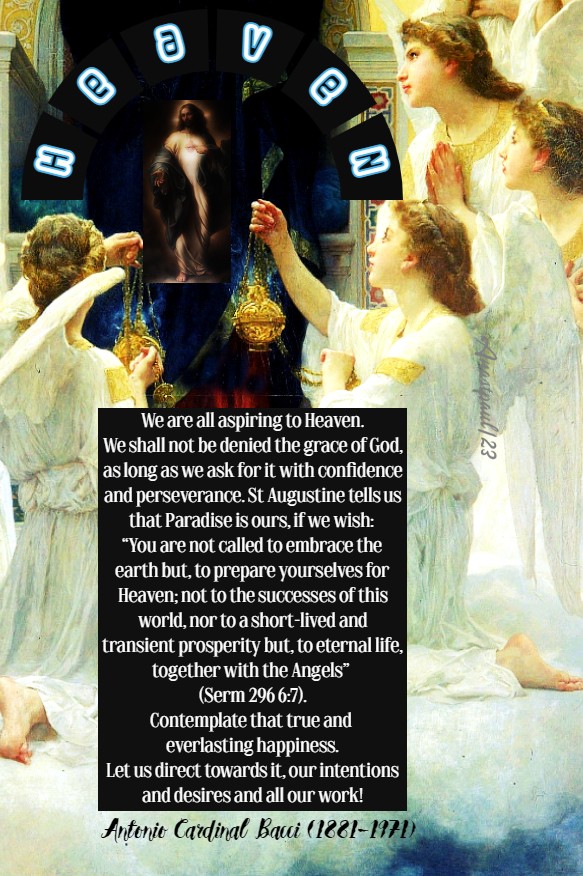
HEAVEN
“God desires our salvation. “God wishes all men to be saved” (1 Tim 2:4). We are all aspiring to Heaven. We shall not be denied the grace of God, as long as we ask for it with confidence and perseverance. St Augustine tells us that Paradise is ours, if we wish: “You are not called to embrace the earth but, to prepare yourselves for Heaven; not to the successes of this world, nor to a short-lived and transient prosperity but, to eternal life, together with the Angels” (Serm 296 6:7).
Contemplate that true and everlasting happiness. Let us direct towards it, our intentions and desires and all our work! Then the day will come when we shall be really happy for all eternity.”
Quote/s of the Day – 13 January – Octave Day of Epiphany – Isaias 60:1-6, John 1:29-34 – Scripture search here: https://www.drbo.org/
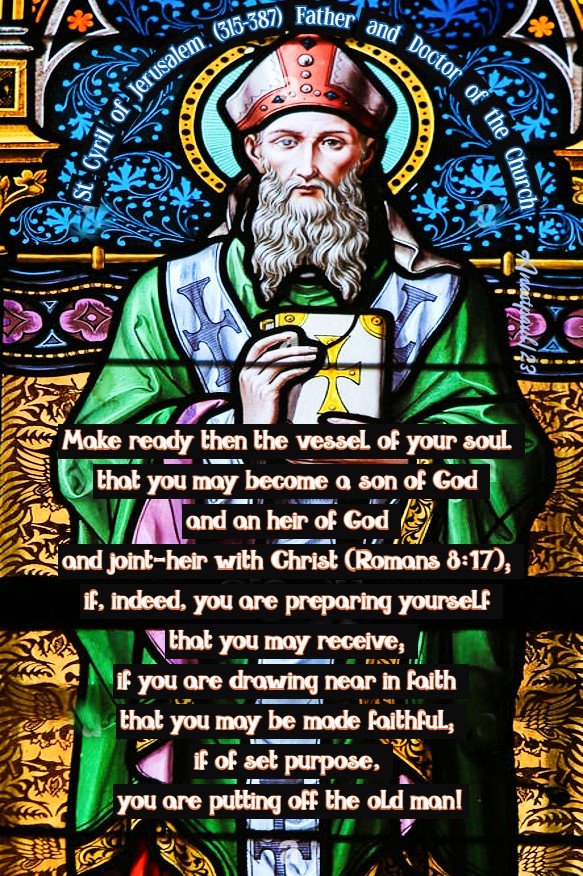
“Make ready then the vessel of your soul that you may become a son of God and an heir of God and joint-heir with Christ (Romans 8:17); if, indeed, you are preparing yourself that you may receive; if you are drawing near in faith that you may be made faithful; if of set purpose, you are putting off the old man!”
St Cyril of Jerusalem (315-387) Father and Doctor of the Church
“Let us become like Christ, since Christ became like us. He assumed the worse, that He might give us the better; He became poor, that we through His poverty, might be rich.”
St Gregory of Nazianzen (330-390) Father and Doctor of the Church
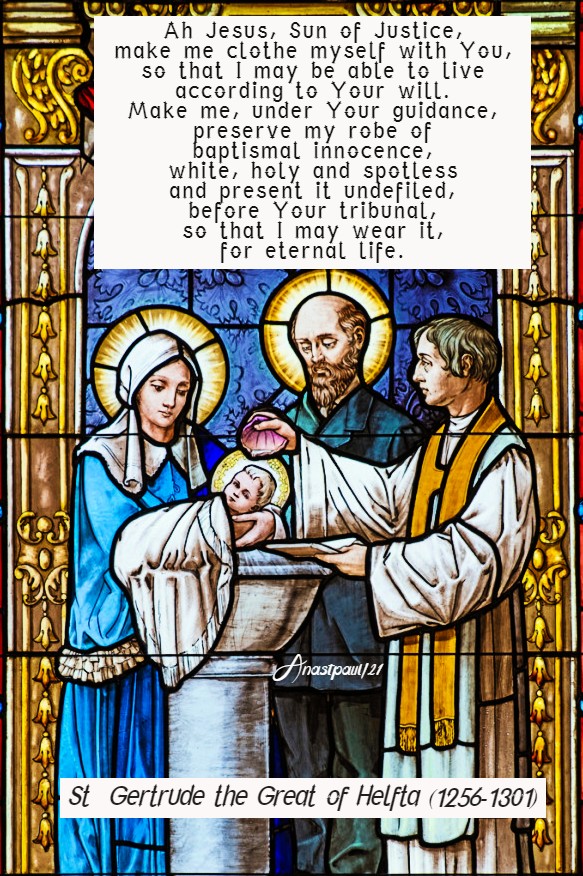
“Ah Jesus, Sun of Justice, make me clothe myself with You, so that I may be able to live according to Your will. Make me, under Your guidance, preserve my robe of Baptismal innocence, white, holy and spotless and present it undefiled, before Your tribunal, so that I may wear it, for eternal life.”
St Gertrude the Great of Helfta (1256-1301)
“If we wish to make any progress in the service of God, we must begin everyday of our life, with new eagerness. We must keep ourselves, in the presence of God, as much as possible and have no other view or end, in all our actions but the divine honour.”
St Charles Borromeo (1538-1584)
“Anyone who takes life seriously in the Christian sense, will regard it as a difficult journey towards perfection and towards God. This journey will be, at the same time, painful and joyful. … It is our own loss if we sit down lazily on the side of the road, which should lead us to Heaven. It is even more disastrous, if we acknowledge defeat and lay down the spiritual weapons of prayer and renunciation, in order to surrender ourselves to sin or to indifference. Everyday we should say to ourselves, in the presence of God – A new life is beginning … in You, by Your grac and for You! Amen”
One Minute Reflection – 13 January – Octave Day of Epiphany – Isaias 60:1-6, John 1:29-34 – Scripture search here: https://www.drbo.org/
“And I knew Him not but he who sent me to Baptise with water said to me: He upon whom thou shalt see the Spirit descending and remaining upon Him, He it IS, Who Baptises with the Holy Spirit. And I saw and I gave testimony that this is the Son of God.” – John 1:33-34
REFLECTION – “Jesus Christ was the Son of God, yet He preached not the Gospel before His Baptism. If the Master Himself followed the right time in due order, ought we, His servants, to venture out of order? From that time Jesus began to preach (Matthew 4:17) , when the Holy Ghost had descended upon Him in a bodily shape, like a Dove, (Luke 3:22) not that Jesus might see Him first, for He knew Him even before He came in a bodily shape but that John, who was Baptising Him, might behold Him. For I, says he, knew Him not but He that sent me to Baptise with water, He said to me, Upon whomsoever you shall see the Spirit descending and abiding on Him that is He (John 1:33).
If you too have unfeigned piety, the Holy Ghost comes down on you also and a Father’s voice sounds over you from on high — not, ‘This is My Son’ alone because ‘In the beginning was the Word, and the Word was with God and the Word was God.’ To Him belongs the ‘IS’ since He is always the Son of God – but to you, has now been made, since you have not the sonship by nature but receive it by adoption. He eternally ‘IS’ but you receive the grace progressively.
Make ready then the vessel of your soul that you may become a son of God and an heir of God and joint-heir with Christ (Romans 8:17); if, indeed, you are preparing yourself that you may receive; if you are drawing near in faith that you may be made faithful; if of set purpose, you are putting off the old man!” – St Cyril of Jerusalem (315-387) Bishop of Jerusalem, Father and Doctor of the Church (Catechetical Lecture 3: 14-15).
PRAYER – O God, Whose Only-begotten Son appeared in the substance of our flesh, grant, we pray Thee that we, who acknowledge His outward likeness to us, may deserve to be inwardly refashioned in His Image. Through the same Jesus Christ, Thy Son our Lord, Who lives and reigns with Thee, in the unity of the Holy Ghost, God, world without end. Amen (Collect).
Saint of the Day – 13 January – Saint Leontius of Caesarea (Died 337) Bishop of Caesarea in Cappadocia. Leontius died in 337 of natural causes. He is sometimes called “the Angel of Peace.”
The Roman Martyrology states today: “At Caesarea, in Cappadocia, St Leontius, the Bishop, who strongly opposed the Gentiles under Licinius and the Arians, under Constantine.”
Leontius attended the First Council of Nicaea in 325 and was highly praised in the writings of Saint Athanasius (297-373) the Archbishop of Alexandria, a Father and Doctor of the Church. He was known to the Greeks by the spiritual title “the Angel of Peace.”
St Agrecius of Trier St Andrew of Trier St Berno of Cluny St Designatus of Maastricht St Elian of Brittany St Enogatus of Aleth St Erbin of Cornwall St Glaphyra St Gumesindus of Córdoba St Hermylus Bl Hildemar of Arrouaise Bl Ida of Argensolles Bl Ivetta of Huy Widow, Mother, Recluse, Mystic
Thought for the Day – 12 January – Meditations with Antonio Cardinal Bacci (1881-1971)
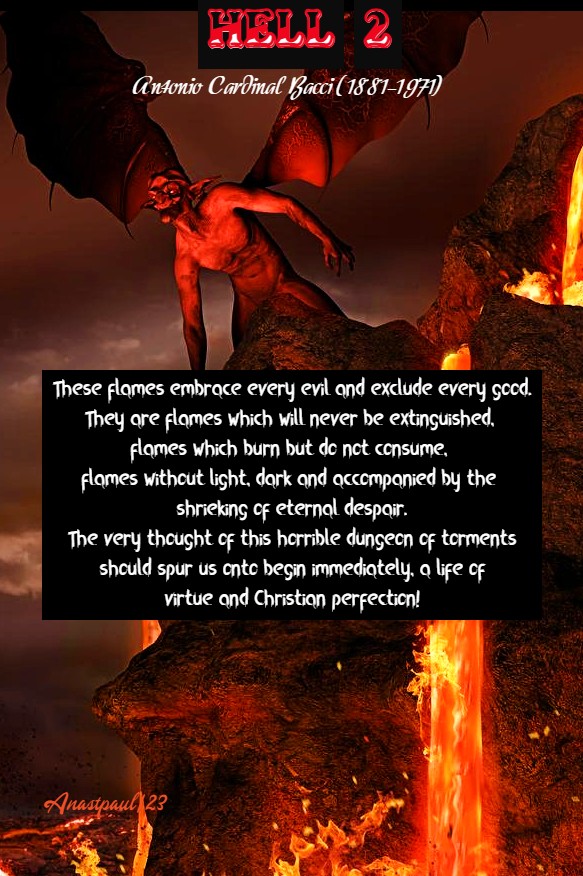
HELL 2
“In that place of never-ending suffering, there will be three punishments to torture us. There will be the worm of conscience which does not die – “Their worm dies not” (Mk 9:43). This is the awful realisation that we could have saved ourselves but are lost for all eternity; that God gave us so many graces and we damned ourselves by abusing them. Now, there is no longer any remedy because the Mercy of God has been succeeded once and for all, by His Justice!
In the second place, there is fire. This is a real fire but altogether different from the material fire we know in this world which was created by God for our benefit and service. The fire of hell, on the other hand, was created by Divine Justice, purely to punish us. It is a special kind of fire which tortures body and soul and the rebel angels, as well as damned human beings. It could be called, discerning, insofar, as it torments more or less mercilessly, according to the gravity of the sin. These flames embrace every evil and exclude every good. They are flames which will never be extinguished, flames which burn but do not consume, flames without light, dark and accompanied by the shrieking of eternal despair. The very thought of this horrible dungeon of torments should spur us onto begin immediately, a life of virtue and Christian perfection!”
Quote/s of the Day – 12January – Within the Octave of Epiphany – Isaias 60:1-6, Matthew 2:1-12 – Scripture search here: https://www.drbo.org/
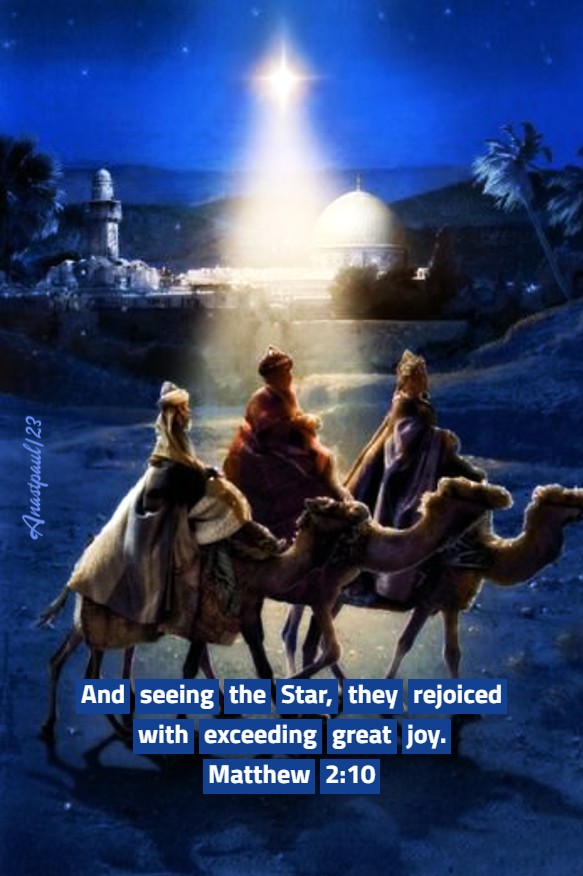
“And seeing the star they rejoiced with exceeding great joy.”
Matthew 2:10
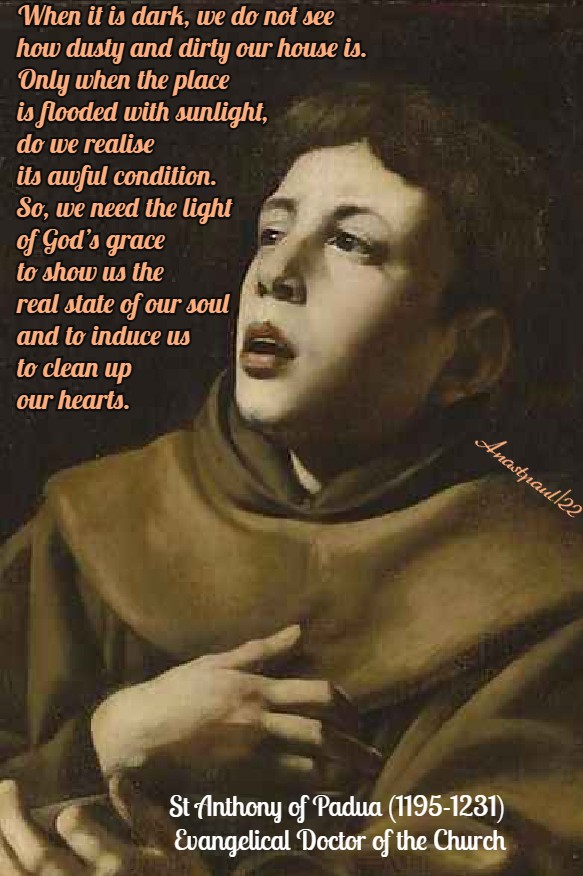
“When it is dark, we do not see how dusty and dirty our house is. Only when the place is flooded with sunlight, do we realise its awful condition. So, we need the light of God’s grace to show us the real state of our soul and to induce us to clean up our hearts!”
St Anthony of Padua (1195-1231) Evangelical Doctor of the Church
Grant me, O my God By St Vincent Ferrer OP (1350-1419)
Good Jesus, let me be penetrated with love to the very marrow of my bones, with fear and respect toward You. Let me burn with zeal for Your honour, so that I may resent terribly, all the outrages committed against You, especially those of which I myself have been guilty. Grant further, O my God, that I may adore and acknowledge You humbly, as my Creator and that, penetrated with gratitude for all Your benefits, I may never cease to render You thanks. Grant that I may bless You in all things, praise and glorify You with a heart full of joy and gladness and that, obeying You with docility in every respect, I may one day, despite my ingratitude and unworthiness, be seated at Your table together with Your Holy Angels and Apostles to enjoy ineffable delights. Amen
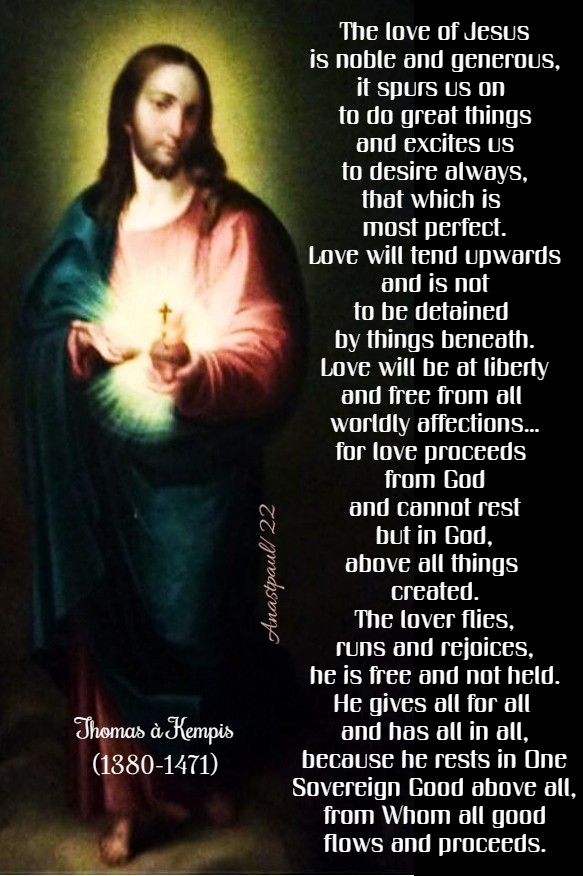
“The love of Jesus is noble and generous, it spurs us on to do great things and excites us to desire always, that which is most perfect. Love will tend upwards and is not to be detained by things beneath. Love will be at liberty and free from all worldly affections… for love proceeds from God and cannot rest but in God, above all things created. The lover flies, runs and rejoices, he is free and not held. He gives all for all and has all in all, because he rests in One Sovereign Good above all, from Whom all good flows and proceeds.”
Thomas à Kempis CRSA (1380-1471) (Book III, Chapter V, 3-4)
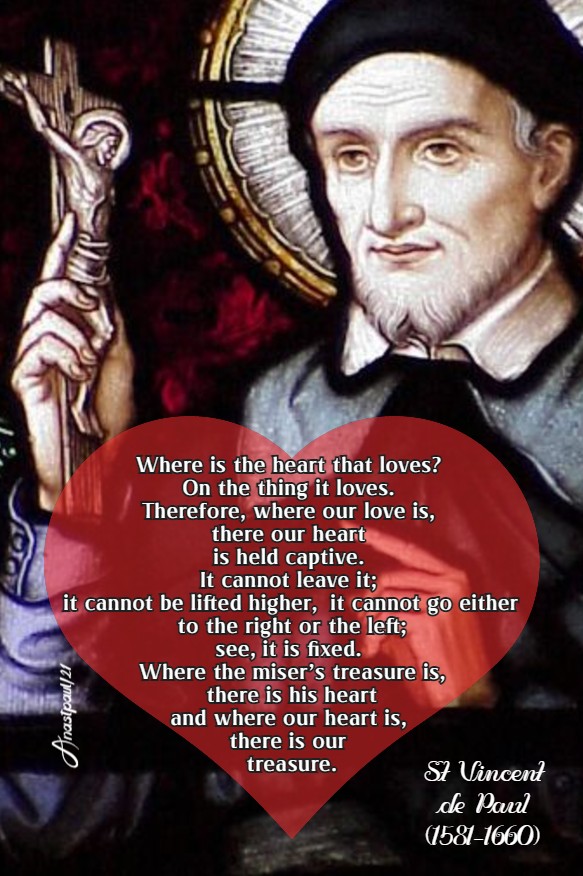
“Where is the heart that loves? On the thing it loves. Therefore, where our love is, there our heart is held captive. It cannot leave it; it cannot be lifted higher, it cannot go either to the right or the left; see, it is fixed. Where the miser’s treasure is, there is his heart and where our heart is, there is our treasure.”
St Vincent de Paul (1581-1660)
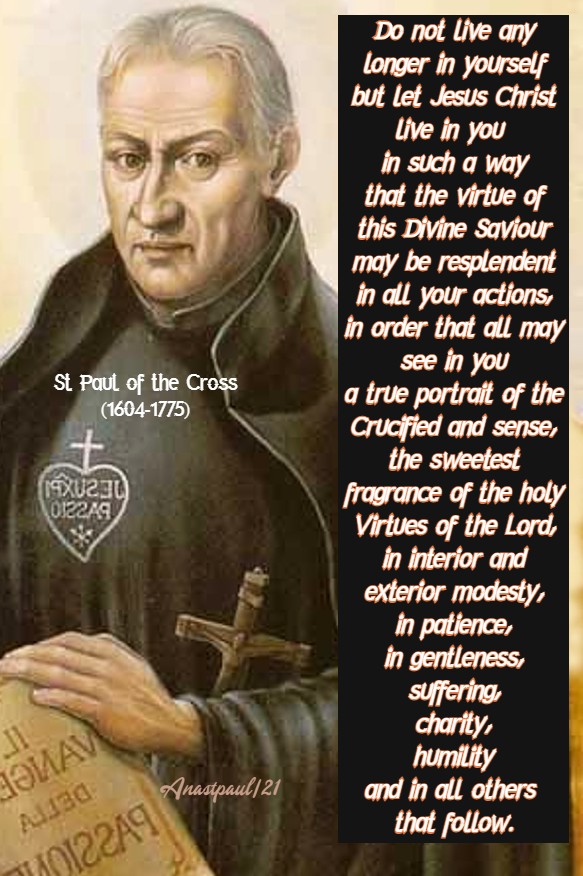
“Do not live any longer in yourself but let Jesus Christ live in you in such a way that the virtue of this Divine Saviour may be resplendent in all your actions, in order that all may see in you a true portrait of the Crucified and sense, the sweetest fragrance of the holy virtues of the Lord, in interior and exterior modesty, in patience, in gentleness, suffering, charity, humility and in all others that follow.”
One Minute Reflection – 12 January – “The Month of the Most Holy Name of Jesus” – Within the Octave of Epiphany – Isaias 60:1-6, Matthew 2:1-12 – Scripture search here: https://www.drbo.org/
“And seeing the Star, they rejoiced with exceeding great joy.” – Matthew 2:10
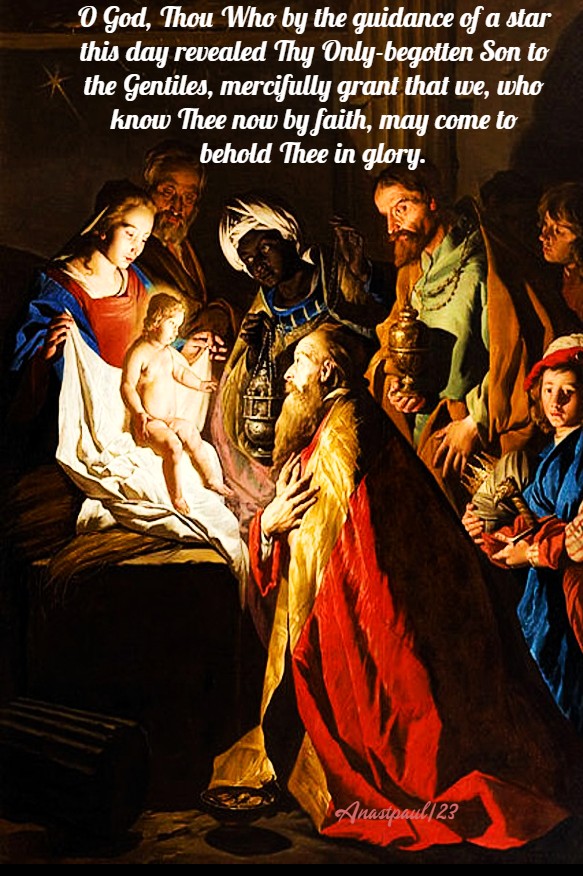
REFLECTION – “Jesus is born poor in a stable; the Angels of Heaven indeed acknowledge Him but men abandon and forsake Him on earth. Only a few shepherds come and pay Him homage. But our Redeemer was desirous of communicating to us the grace of His redemption and begins, therefore, to manifest Himself to the Gentiles, Who knew Him least. Therefore, He sends a Star to enlighten the holy Magi, in order that they may come and acknowledge and adore their Saviour. This was the first and sovereign grace bestowed upon us–our vocation to the Faith which was succeeded by our vocation to grace, of which men were deprived.
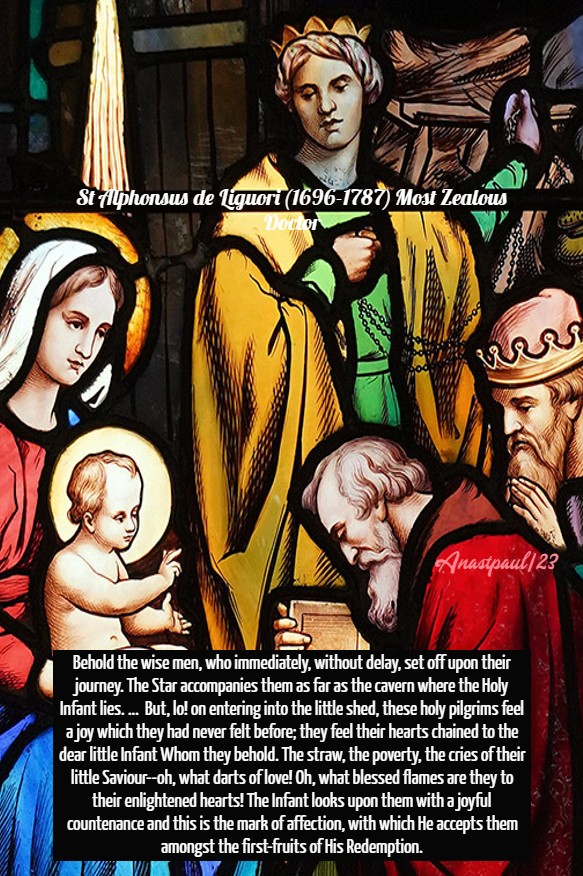
Behold the wise men, who immediately, without delay, set off upon their journey. The Star accompanies them as far as the cavern where the Holy Infant lies. On their arrival, they enter and what do they find? They found the Child with Mary. They find a poor maiden and a poor Infant wrapped in poor swaddling-clothes, without anyone to attend on Him or assist Him. But, lo! on entering into the little shed, these holy pilgrims feel a joy which they had never felt before; they feel their hearts chained to the dear little Infant Whom they behold. The straw, the poverty, the cries of their little Saviour–oh, what darts of love! Oh, what blessed flames are they to their enlightened hearts! The Infant looks upon them with a joyful countenance and this is the mark of affection, with which He accepts them amongst the first-fruits of His Redemption.
The holy kings then look at Mary, who does not speak –she remains silent but with her blessed countenance which breathes the sweetness of paradise, she welcomes them and thanks them for having been the first to come and acknowledge Her Son (as indeed He is) for their Sovereign Lord. See also how, out of reverence, they adore Him in silence and acknowledge Him for their God, kissing His Feet and offering Him their gifts of gold, frankincense and myrrh. Let us too, with the holy Magi, adore our little King Jesus and let us offer Him all our hearts.” – St Alphonsus de Liguori (1696-1787) Bishop, Founder of the Redemptorists, Most Zealous Doctor (The Adoration of the Magi),
PRAYER – O God, Thou Who by the guidance of a star this day revealed Thy Only-begotten Son to the Gentiles, mercifully grant that we, who know Thee now by faith, may come to behold Thee in glory. Through the same Jesus Christ, Thy Son our Lord, Who lives and reigns with Thee, in the unity of the Holy Ghost, God, world without end. Amen (Collect).
Our Morning Offering – 12 January – Within the Octave of Epiphany – “The Month of the Most Holy Name of Jesus”
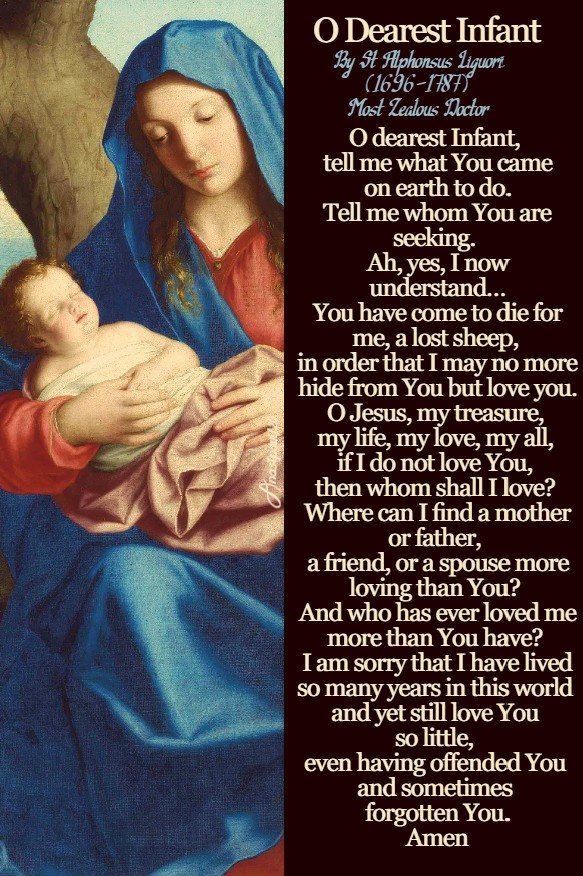
O Dearest Infant By St Alphonsus Liguori (1696-1787) Most Zealous Doctor
O dearest Infant, tell me what You came on earth to do. Tell me whom You are seeking. Ah, yes, I now understand… You have come to die for me, a lost sheep, in order that I may no more hide from You but love You. O Jesus, my treasure, my life, my love, my all, if I do not love You, then whom shall I love? Where can I find a mother or father, a friend, or a spouse more loving than You? And who has ever loved me more than You have? I am sorry that I have lived so many years in this world and yet still love You so little, even having offended You and sometimes forgotten You. Amen



























 AnaStpaul
You must be logged in to post a comment.