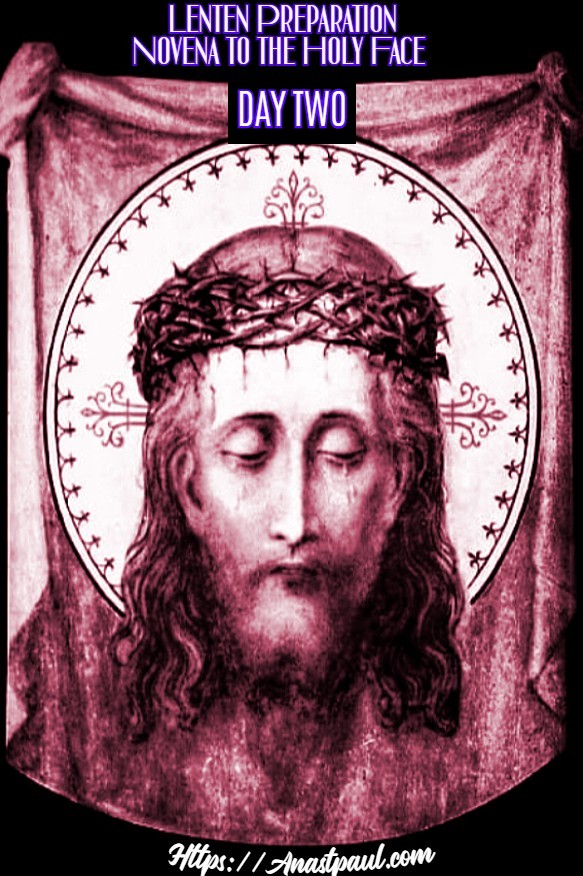
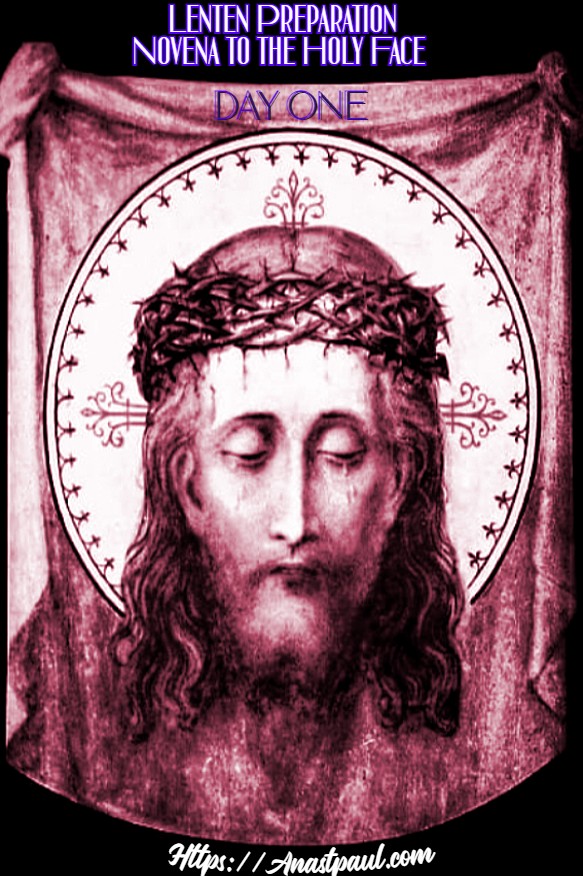
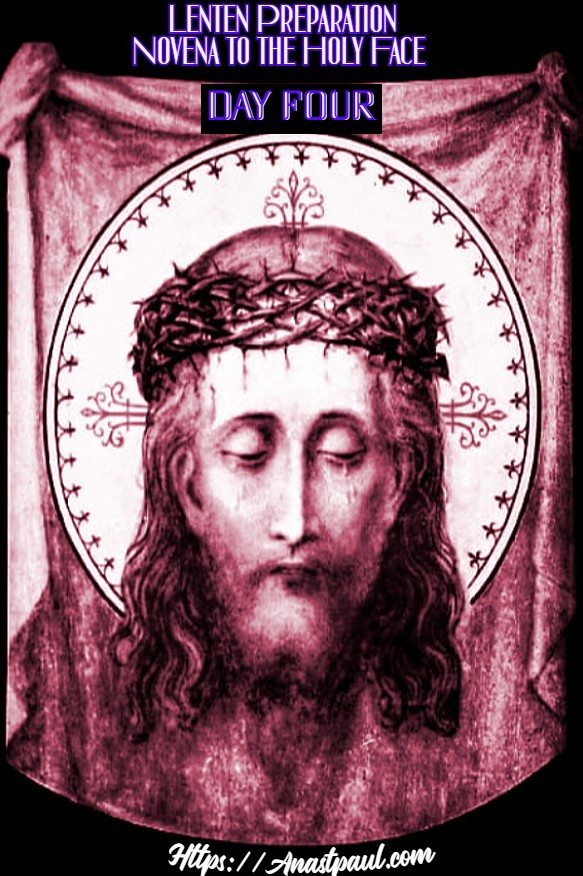
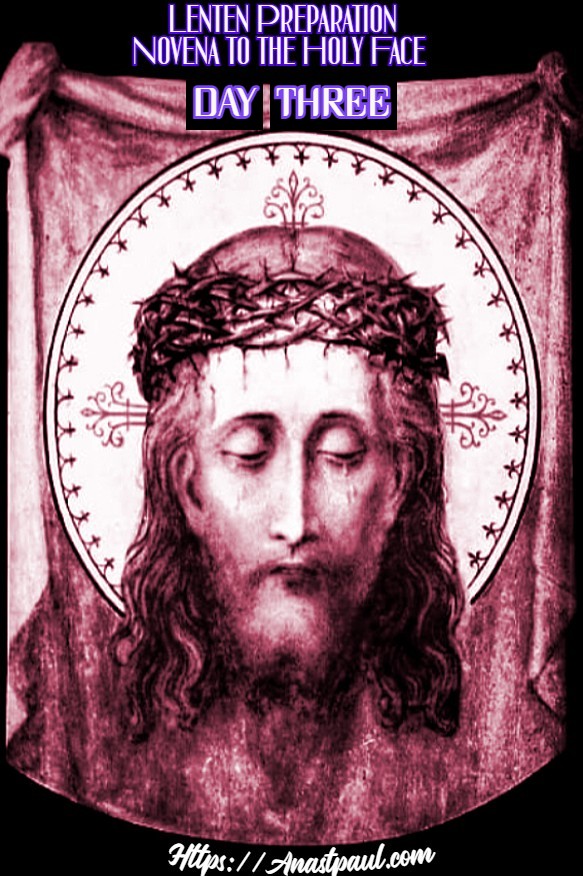
Lenten Preparation Novena to the Holy Face To end on Shrove Tuesday, The Feast of the Holy Face
“All those who, attracted by My Love and venerating My Countenance, shall receive, by virtue of My Humanity, a brilliant and vivid impression of My Divinity. This splendour shall enlighten the depths of their souls, so that in eternal glory the celestial court shall marvel at the marked likeness of their features, with My Divine Countenance.” … (Our Lord Jesus Christ to St Gertrude the Great)
(Console the Holy Face and recite Daily Preparatory Prayer) below.
Psalm 51:8-9:
Indeed you love truth in the heart, then in the secret of my heart, teach me Wisdom. O purify me, then I shall be clean, O wash me, I shall be whiter than snow.
DAILY PREPARATORY PRAYER
O Most Holy and Blessed Trinity, through the intercession of Holy Mary, whose soul was pierced through by a sword of sorrow at the sight of the Passion of her Divine Son, we ask Thy help, in making a perfect Novena of Reparation with Jesus, united with all His sorrows, love and total abandonment. We now implore all the Angels and Saints to intercede for us as we pray this Holy Novena to the Most Holy Face of Jesus and for the glory of the most Holy Trinity, Father, Son and Holy Ghost. Amen
THE FOURTH DAY:
O Lord Jesus, Who has said, learn of Me for I am meek and gentle of heart and Who didst manifest upon Thy Holy Face, the sentiments of Thy Divine Heart, grant that we may love to meditate upon Thy Divine Countenance, that we may read there, Thy gentleness and Thy humility and learn from Thee to form our hearts in the practice of these two virtues, which Thou desires to see shine in Thy servants.
Mary our Mother and Saint Joseph help us.
Through the merits of Thy Precious Blood and Thy Holy Face, O Jesus, grant us our petition ……………… Pardon and mercy. Amen
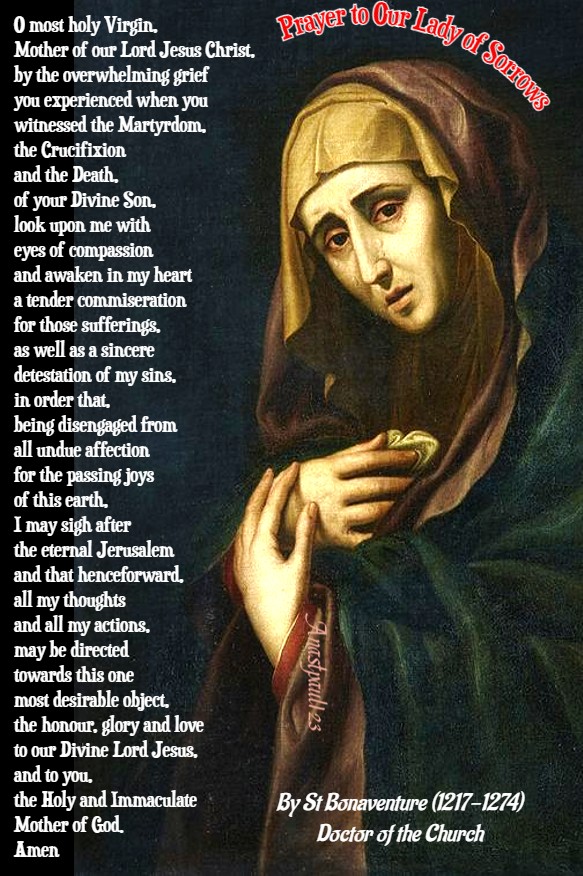
Prayer in Honour of the Dolours of the Blessed Virgin By St Bonaventure (1217-1274) Doctor of the Church
O most holy Virgin, Mother of our Lord Jesus Christ, by the overwhelming grief you experienced when you witnessed the Martyrdom, the Crucifixion and the Death, of your Divine Son, look upon me with eyes of compassion and awaken in my heart a tender commiseration for those sufferings, as well as a sincere detestation of my sins, in order that, being disengaged from all undue affection for the passing joys of this earth, I may sigh after the eternal Jerusalem and that henceforward, all my thoughts and all my actions, may be directed towards this one most desirable object, the honour, glory and love to our Divine Lord Jesus, and to you, the Holy and Immaculate Mother of God. Amen
Pray (1) Our Father, three (3) Hail Marys, one (1) Glory Be.
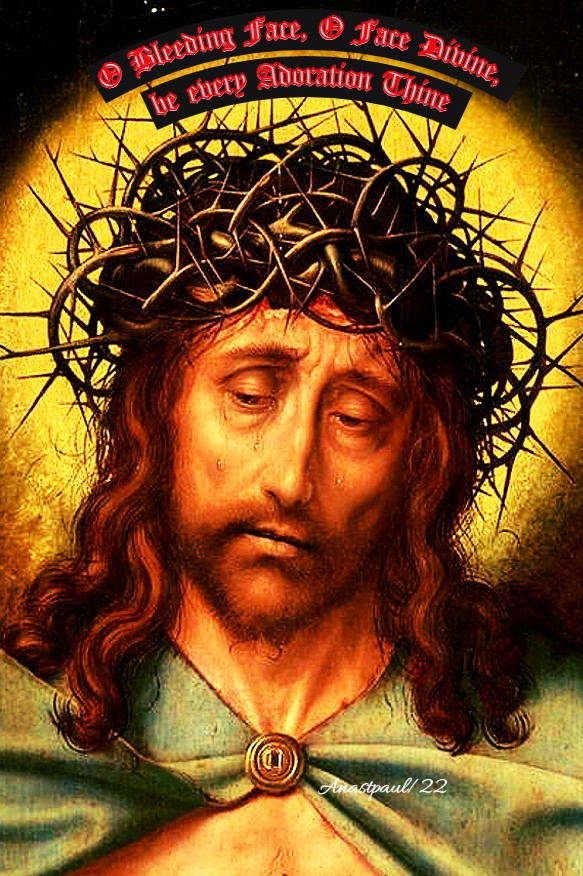
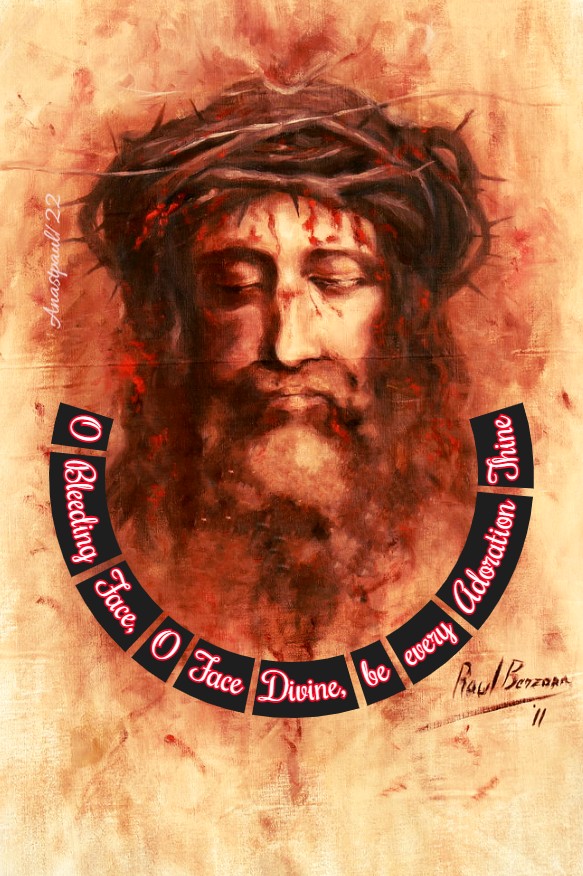
O Bleeding Face, O Face Divine, be every Adoration Thine (Three times)
Lenten Preparation Novena to the Holy Face To end on Shrove Tuesday, The Feast of the Holy Face
“All those who, attracted by My Love and venerating My Countenance, shall receive, by virtue of My Humanity, a brilliant and vivid impression of My Divinity. This splendour shall enlighten the depths of their souls, so that in eternal glory the celestial court shall marvel at the marked likeness of their features, with My Divine Countenance.” … (Our Lord Jesus Christ to St Gertrude the Great)
(Console the Holy Face and recite Daily Preparatory Prayer) below.
Psalm 51:6b-7: You are just when you pass sentence on me, blameless, when you give judgement. You know I was born guilty, a sinner from the moment of conception.
DAILY PREPARATORY PRAYER
O Most Holy and Blessed Trinity, through the intercession of Holy Mary, whose soul was pierced through by a sword of sorrow at the sight of the Passion of her Divine Son, we ask Thy help, in making a perfect Novena of Reparation with Jesus, united with all His sorrows, love and total abandonment. We now implore all the Angels and Saints to intercede for us as we pray this Holy Novena to the Most Holy Face of Jesus and for the glory of the most Holy Trinity, Father, Son and Holy Ghost. Amen
THE THIRD DAY:
Prayer to The Holy Face By Pope Pius IX (1792-1878)
O Jesus! Cast upon us a look of mercy, turn Thy Face towards each of us as Thou did to Veronica, not that we may see It, with our bodily eyes, for this we do not deserve but turn It towards our hearts, so that, remembering Thee, we may ever draw from this Fountain of Strength, the vigour necessary, to sustain the combats of life. Amen
Mary, our Mother and Saint Joseph, pray for us.
Through the merits of Thy Precious Blood and Thy Holy Face, O Jesus, grant us our petition ……………… Pardon and mercy. Amen
Prayer to the Angels and Saints We salute you, through the Holy Face and Sacred Heart of Jesus, O all you Holy Angels and Saints of God. We rejoice in your glory and we give thanks to our Lord for all the benefits which He has showered upon you, we praise Him and glorify Him and, for an increase of your joy and honour, we offer Him the most Holy Face and gentle Heart of Jesus. Pray that we may become formed according to the Heart of God. Amen.
Pray (1) Our Father, three (3) Hail Marys, one (1) Glory Be.
O Bleeding Face, O Face Divine, be every Adoration Thine (Three times)
Lenten Preparation Novena to the Holy Face To end on Shrove Tuesday, The Feast of the Holy Face
“All those who, attracted by My Love and venerating My Countenance, shall receive, by virtue of My Humanity, a brilliant and vivid impression of My Divinity. This splendour shall enlighten the depths of their souls, so that in eternal glory the celestial court shall marvel at the marked likeness of their features, with My Divine Countenance.” … (Our Lord Jesus Christ to St Gertrude the Great)
(Console the Holy Face and recite Daily Preparatory Prayer) below. Psalm 51:5-6a My offences truly I know them; My sin is always before me Against You, You alone, have I sinned, What is evil in Your sight I have done.
DAILY PREPARATORY PRAYER
O Most Holy and Blessed Trinity, through the intercession of Holy Mary, whose soul was pierced through by a sword of sorrow at the sight of the Passion of her Divine Son, we ask Thy help, in making a perfect Novena of Reparation with Jesus, united with all His sorrows, love and total abandonment. We now implore all the Angels and Saints to intercede for us as we pray this Holy Novena to the Most Holy Face of Jesus and for the glory of the most Holy Trinity, Father, Son and Holy Ghost. Amen
THE SECOND DAY:
PRAYER: Most Holy Face of Jesus, we are truly sorrowful, for we have hurt Thee so much. By our sins, we have disobeyed Thee, turned away from Thee and omitted to please Thee by our lives. But now, we wish to do penance and amend our lives. Immaculate Heart of Mary, intercede for us, help us to console the Most Holy Face of Jesus. Pray for us, that we may share in the tremendous love you have for the most Holy and Blessed Trinity. Through the merits of Thy Most Precious Blood and Thy Most Holy Face, O Jesus, grant us our petition ……………… Pardon and mercy. Amen
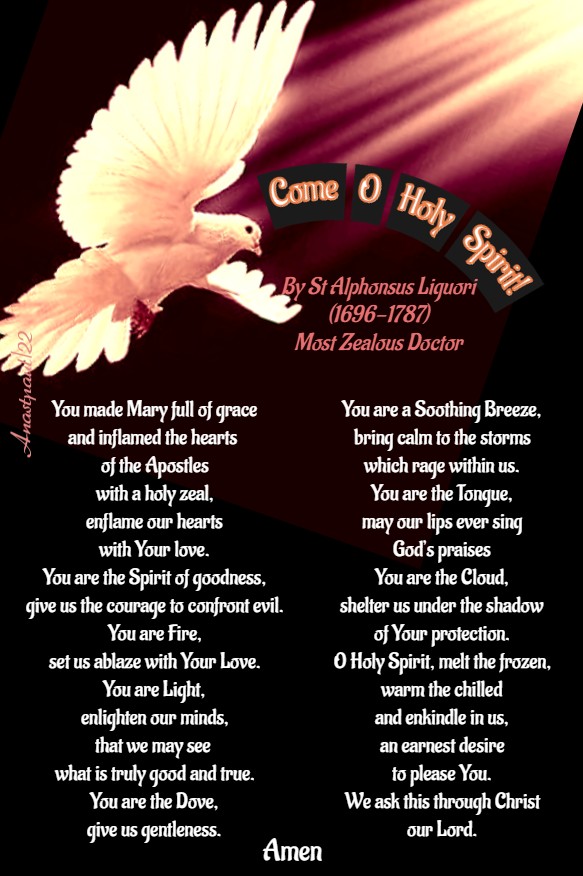
Come O Holy Spirit! By St Alphonsus Liguori (1696-1787) Most Zealous Doctor
You made Mary full of grace and inflamed the hearts of the Apostles with a holy zeal, enflame our hearts with Your love. You are the Spirit of goodness, give us the courage to confront evil. You are Fire, set us ablaze with Your Love. You are Light, enlighten our minds, that we may see what is truly igood and true. You are the Dove, give us gentleness. You are a Soothing Breeze, bring calm to the storms which rage within us. You are the Tongue, may our lips ever sing God’s praises You are the Cloud, shelter us under the shadow of Your protection. O Holy Spirit, melt the frozen, warm the chilled and enkindle in us, an earnest desire to please You. We ask this through Christ our Lord. Amen
Pray (1) Our Father, (3) Hail Marys, (1) Glory Be.
O Bleeding Face, O Face Divine, be every Adoration Thine (Three times)
Lenten Preparation Novena to the Holy Face To end on Shrove Tuesday, The Feast of the Holy Face
For so many, Shrove Tuesday is a date on the calendar that is often overshadowed by Ash Wednesday that memorable day we wear the outward sign of repentance and recall our mortality. How much more meaningful will our Ash Wednesday be, if we first mark Shrove Tuesday as a Feast of the Holy Face, concluding the Novena we began in the time of preparation and beginning Lent more in love with the Countenance of Christ and, through Him, made more beautiful in our own soul. AMEN, Let us Pray ………….
“I firmly wish that My Face reflecting the intimate pains of My Soul, the suffering and love of My Heart, be more honoured! Whoever gazes upon Me already consoles Me.” – (Our Lord Jesus Christ to Sister Pierina)
“All those who, attracted by My Love and venerating My Countenance, shall receive, by virtue of My Humanity, a brilliant and vivid impression of My Divinity. This splendour shall enlighten the depths of their souls, so that in eternal glory the celestial court shall marvel at the marked likeness of their features, with My Divine Countenance.” … (Our Lord Jesus Christ to St Gertrude)
This Novena prayer may be said at any time but especially in the nine days leading up to the Feast of the Holy Face on Shrove Tuesday. The first Medal of the Holy Face was offered to Pope Pius XII who approved the Devotion and the Medal. In 1958, he formally declared the Feast of the Holy Face of Jesus as Shrove Tuesday.
(Console the Holy Face and recite Daily Preparatory Prayer) below. Psalm 51:3-4. Have mercy on me, O God in Thy goodness, in Thy great tenderness wipe away my faults, wash me clean of my guilt, purify me from my sin.
DAILY PREPARATORY PRAYER
O Most Holy and Blessed Trinity, through the intercession of Holy Mary, whose soul was pierced through by a sword of sorrow at the sight of the Passion of her Divine Son, we ask Thy help, in making a perfect Novena of Reparation with Jesus, united with all His sorrows, love and total abandonment. We now implore all the Angels and Saints to intercede for us as we pray this Holy Novena to the Most Holy Face of Jesus and for the glory of the most Holy Trinity, Father, Son and Holy Ghost. Amen
THE FIRST DAY:
PRAYER: O most Holy Face of Jesus, look with tenderness on us who are sinners. You are a merciful God, full of love and compassion. Keep us pure of heart, so that we may see Thee always. Mary, our Mother, intercede for us, Saint Joseph, pray for us. Through the merits of Your Precious Blood and Your Holy Face, O Jesus, grant us our petition……………… and Your pardon and mercy.
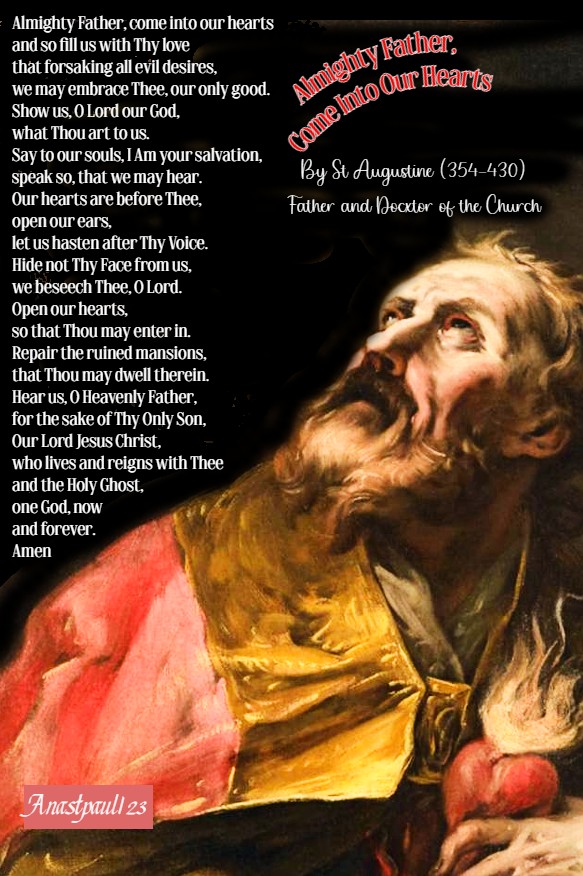
Almighty Father, Come Into Our Hearts By St Augustine (354-430)
Almighty Father, come into our hearts and so fill us with Thy love that forsaking all evil desires, we may embrace Thee, our only good. Show us, O Lord our God, what Thou art to us. Say to our souls, I Am your salvation, speak so, that we may hear. Our hearts are before Thee, open our ears, let us hasten after Thy Voice. Hide not Thy Face from us, we beseech Thee, O Lord. Open our hearts, so that Thou may enter in. Repair the ruined mansions, that Thou may dwell therein. Hear us, O Heavenly Father, for the sake of Thy Only Son, Our Lord Jesus Christ, who lives and reigns with Thee and the Holy Ghost, one God, now and forever. Amen
Pray (1) Our Father, (3) Hail Marys, (1) Glory Be.
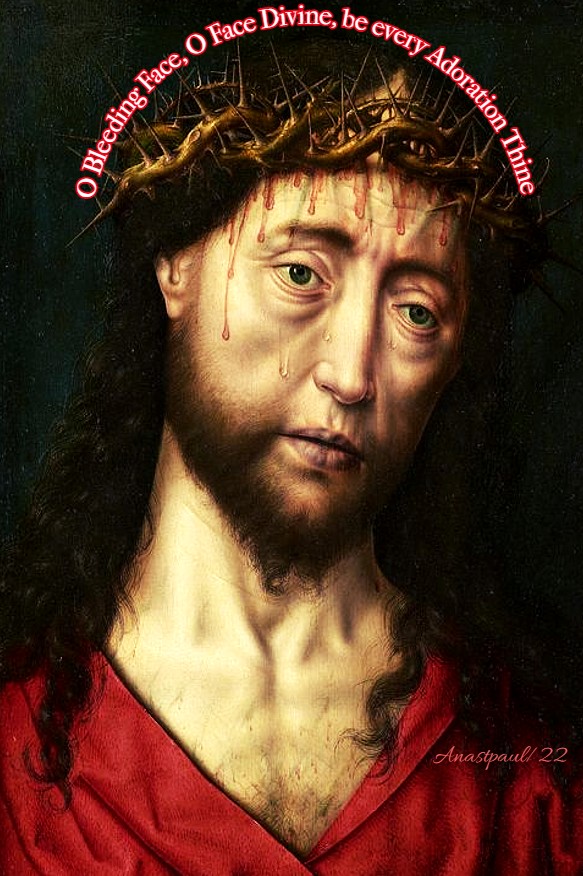
O Bleeding Face, O Face Divine, be every Adoration Thine (Three times)
Thought for the Day – 12 February – Meditations with Antonio Cardinal Bacci (1881-1971)
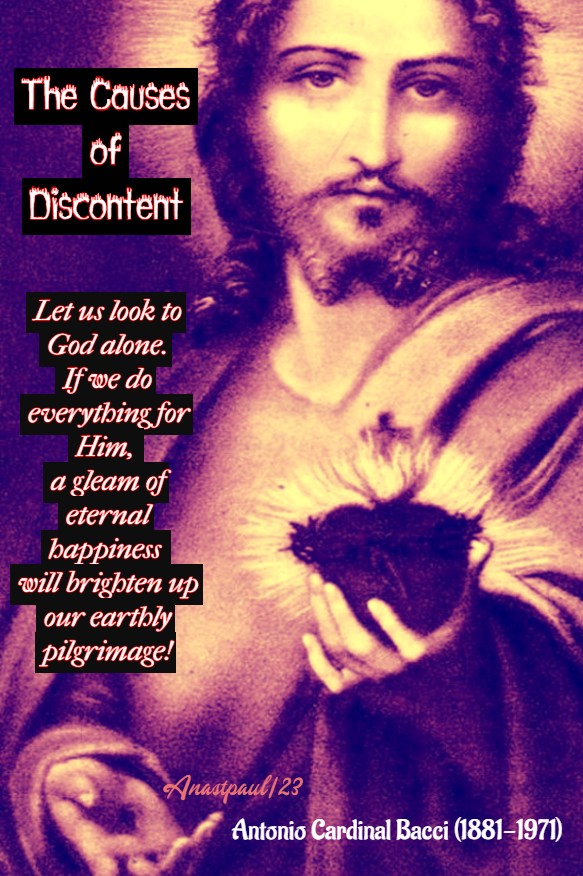
The Causes of Discontent
“There is only one reason for our dissatisfaction. It is given by St Augustine, profound observer that he was of the human heart: “You have made us for Yourself alone, O God and our hearts will always be restless, until they rest in You” (Confessions 1, 1:11). If anyone rushes in all directions looking for happiness, he will never find it. The created things of the world cannot satisfy our hearts which are on a far higher plane than these worldly things are. Worse still, a man may look for happiness in pleasure or in sin but he will find only bitterness and disgust.
Let us look to God alone. If we do everything for Him, a gleam of eternal happiness will brighten up our earthly pilgrimage!
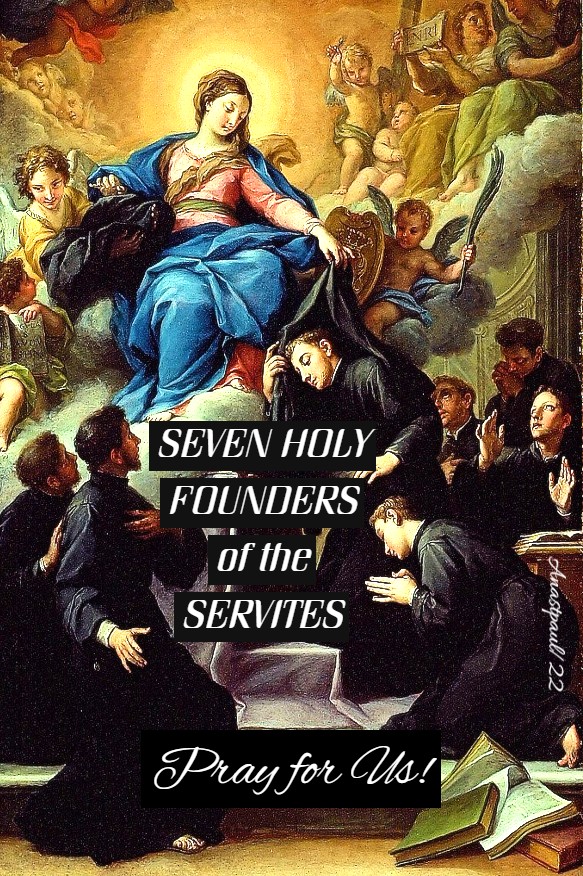
One Minute Reflection – 12 February – The Seven Holy Founders of the Servite Order (1233) – Sexagesima Sunday – 2 Corinthians 11:19-33; 12:1-9, Luke 8:4-15 – Scripture search here: https://www.drbo.org/Because it is Sexagesima Sunday I popped in to post the Reflection and the explanation of Sexagesima, posted at the end below, for those who might have forgotten.And while I was here, our dear Cardinal Bacci gave me a nudge too 🤗
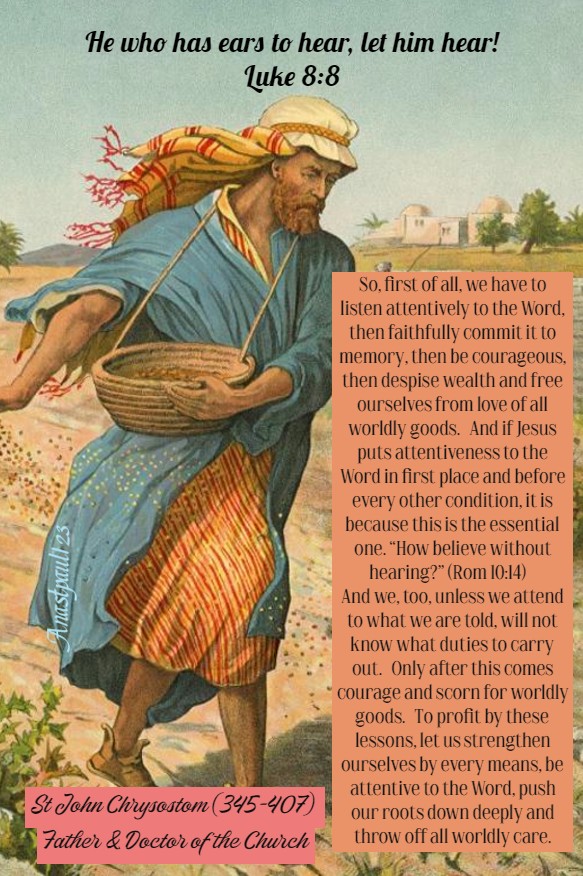
“He who has ears to hear, let him hear!” – Luke 8:8
REFLECTION – “If the seed dries up, this is not due to the heat. Jesus did not say that it had dried up because of the heat but “for lack of roots.” If the Word is choked, it is not due to the thorns but to those who allowed them to spring up, unhindered. With a little bit of willpower, you could stop them from growing, you could put your riches to good use. That is why our Saviour does not talk about “the world” but about “the cares of the world,” not of “riches” but of “the lure of riches.” So do not let us blame the things themselves but the perversion of our consciences .…
You see, it is not the gardener, it is not the seed but it is the earth where it falls which provides the answer – namely, the dispositions of our hearts. And here, too, God’s goodness towards us is very great, in that, far from demanding an identical measure of virtue, He welcomes the firstcomers, does not turn away those who come second and makes room for the third…
So, first of all, we have to listen attentively to the Word, then faithfully commit it to memory, then be courageous, then despise wealth and free ourselves from love of all worldly goods. And if Jesus puts attentiveness to the Word in first place and before every other condition, it is because this is the essential one. “How believe without hearing?” (Rom 10:14) And we, too, unless we attend to what we are told, will not know what duties to carry out. Only after this comes courage and scorn for worldly goods. To profit by these lessons, let us strengthen ourselves by every means, be attentive to the Word, push our roots down deeply and throw off all worldly care.” – St John Chrysostom (345-407) Bishop of Constantinople, Father and Doctor of the Church (Sermon 44 on St Matthew’s Gospel).
PRAYER – O Lord Jesus Christ, Who, to keep alive the memory of Thy most holy Mother’s sorrows, through the Seven Holy Fathers enriched Thy Church with a new family of her Servants, graciously grant that we, maybe so united with them in their sorrows, as also to share their joys. Through the same Jesus Christ, Thy Son our Lord, Who lives and reigns with Thee, in the unity of the Holy Ghost, God, world without end. Amen (Collect).
Sexagesima Sunday: (Latin – Sexagesima, sixtieth) is the eighth Sunday before Easter and the second before Lent. The Ordo Romanus, St Alcuin and others, count the Sexagesima from this day to Wednesday after Easter. The name was already known to the Fourth Council of Orléans in 541. To the Latins it is also known as “Exsurge” from the beginning of the Introit. The station was at Saint Paul’s Outside the Walls of Rome and hence, the oratio calls upon the Doctor of the Gentiles. The Epistle is from Paul, 2 Corinthians 11 and 12, describing his suffering and labours for the Church. The Gospel (Luke 8) relates the falling of the seed on good and on bad ground, while the Lessons of the first Nocturn continue the history of man’s iniquity and speak of Noah and of the Deluge.
Lenten Preparation Novena to the Holy Face Begins Monday 13 February Ends on Shrove Tuesday, The Feast of the Holy Face
Shrove Tuesday is also the Feast of the Holy Face. Many who discover this are quickly struck by the significance of beginning Lent more in love with His countenance. For having made reparation “with Jesus, united with all His sorrows, love and total abandonment” through the Novena, we can begin our Lenten walk with Christ, more ready to comfort Him along the way, as St Veronica did.
In 1938, Jesus appeared to Blessed Maria Pierina de Micheli (1890-1945), His face bloodied by His Passion and said, speaking of His Face: “I wish that it be venerated by a special Feast on Tuesday, the day before Ash Wednesday. I wish that the Feast be preceded by a Novena in which the faithful make reparation to Me, joining together and sharing in My sorrow.” For “Those on earth who contemplate the wounds of My Face, shall in Heaven, behold It, radiant with glory.”
Following that request, in 1958, Pope Pius XII named Shrove Tuesday as the official Feast of the Holy Face.
We pray our Novena in fine company. St Augustine (354-430), St Gertrude the Great (1256-1302), St Bernard (1090-1153), St Therese of Lisieux (1873-1897), among many others, all venerated the Holy Face.
Our Lenten devotion to the Wounds on His Hands and Feet is inadequate, if we have not first contemplated His Face, bitterly kissed by Judas, spat upon, battered, covered with sweat and blood and crowned with thorns, continuing to be dishonoured even today, through the Blessed Sacrament, by profanations, abuse and neglect!
Thought for the Day – 10 February – Meditations with Antonio Cardinal Bacci (1881-1971)
SELF-LOVE
“There are three tiny blossoms which can scarcely be seen – those of the corn, the olive and the vine. Nevertheless, from these we receive grain, oil and wine – three very precious commodities. These three little blossoms are almost invisible in comparision with other larger flowers, such as that of the magnolia which do not yield any useful fruit. They should present us with a starting-point for meditation. Would we like our actions to be valuable in the sight of God and bring forth good fruit?
Let us be humble and suppress love of self. Then God will look on us with favour. He will give us His grace and make fertile the work which we do purely for Him. “God resists the proud but gives grace to the humble” (Is 4:6).
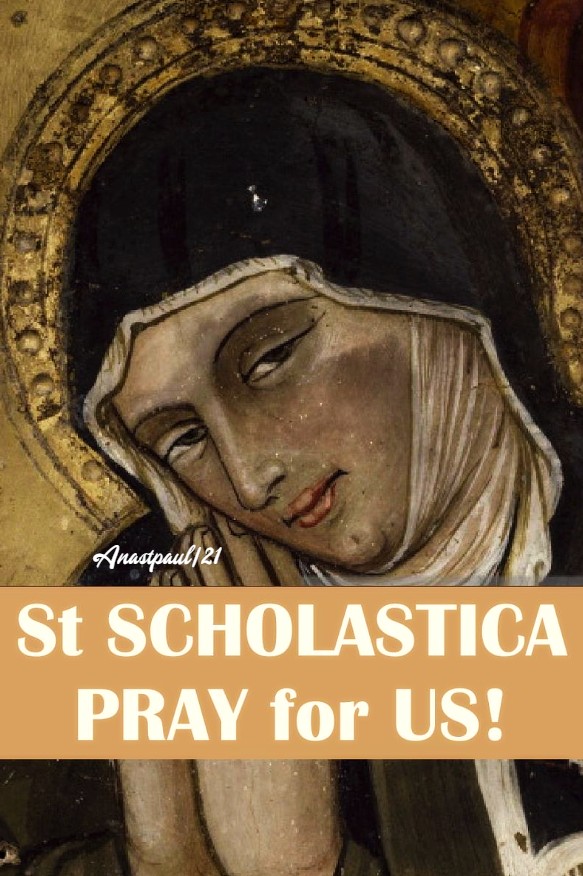
Quote of the Day – 10 February – St Scholastica (c482-543) Twin sister of St Benedict (c482-547)
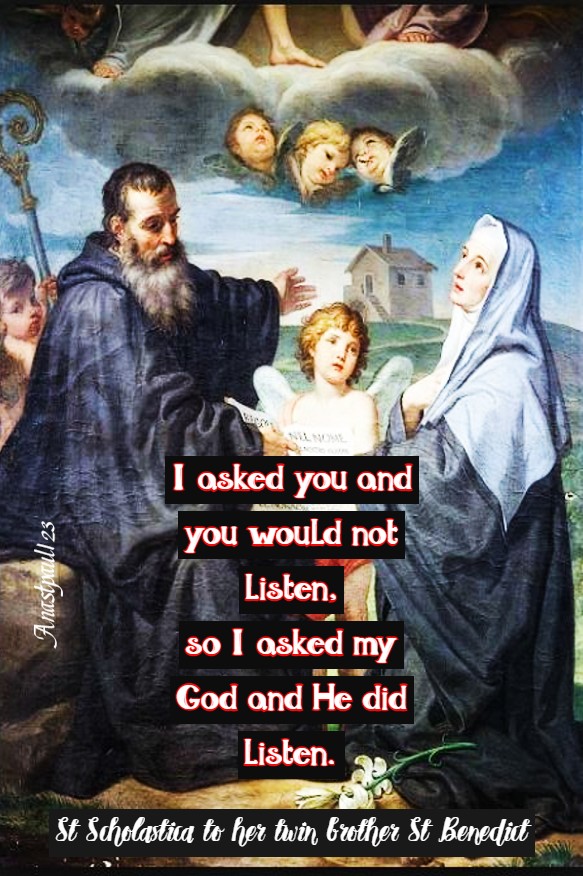
“When she heard her brother refuse her request, the holy woman joined her hands on the table, laid her head on them and began to pray. As she raised her head from the table, there were such brilliant flashes of lightning, such great peals of thunder and such a heavy downpour of rain that neither Benedict nor his brethren could stir across the threshold of the place where they had been seated. Sadly he began to complain: “May God forgive you, sister. What have you done?” “Well,” she answered, “I asked you and you would not listen, so I asked my God and He did listen. So now go off, if you can, leave me and return to your Monastery.” …
(St Pope Gregory the Great (540-604) on St Scholastica)
“I asked you and you would not listen, so I asked my God and He did listen.”
One Minute Reflection – 10 February – St Scholastica (c482-547) Virgin Nun, St Benedict’s twin – 2 Corinthians 10:17-18; 11:1-2, Matt 25:1-13 – Scripture search here: https://www.drbo.org/
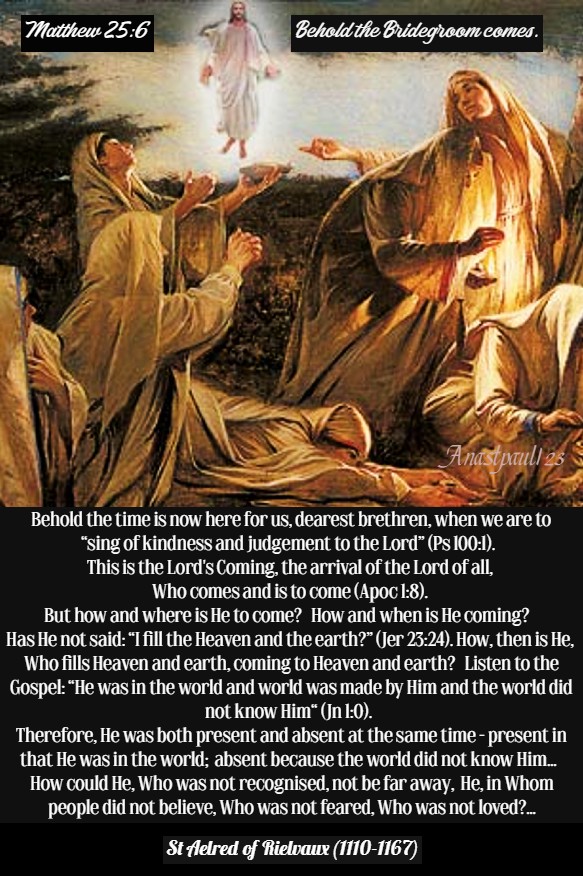
“… Behold the Bridegroom comes.” – Matthew 25:6
REFLECTION – “Behold the time is now here for us, dearest brethren, when we are to “sing of kindness and judgement to the Lord” (Ps 100:1). This is the Lord’s Coming, the arrival of the Lord of all, Who comes and is to come (Apoc 1:8). But how and where is He to come? How and when is He coming? Has He not said: “I fill the Heaven and the earth?” (Jer 23:24). How, then is He, Who fills Heaven and earth, coming to Heaven and earth? Listen to the Gospel: “He was in the world and world was made by Him and the world did not know Him“ (Jn 1:0). Therefore, He was both present and absent ,at the same time – present in that He was in the world; absent because the world did not know Him… How could He, Who was not recognised, not be far away, He, in Whom people did not believe, Who was not feared, Who was not loved?…
He comes, then, so that He, Who was not known might be recognised; He in Whom no-one believed might be believed; He, Who was not loved might be loved. He, Who was present according to His nature, is coming in His mercy… Think on God a little and see what it means that He should transfer so great a might; how He humbles so great a power, weakens so great a strength, makes feeble so great a wisdom! Was this a requirement of justice towards us? Most certainly not!…
In truth, my Lord, not my righteousness but Thy mercy guided Thee; not Thy necessity but my need. As Thou hast said: “My mercy is established in the heavens” (Ps 89[88],3). Rightly so, for our neediness abounds on earth. That is why “I shall sing forever of Thy love, O Lord,” which Thou manifested at Thy coming. When He showed Himself humble in His humanity, powerful in His miracles, strong against the tyranny of the demons, gentle in His welcome of sinners: all these things came from His mercy, all came from His inmost goodness. That is why “I shall sing Thy love, O Lord“ made known at Thy First Coming. And rightly so, for “the earth is filled with the mercy of the Lord” (Ps 118:64).” – St Aelred of Rielvaux (1110-1167) Cistercian Monk [Sermon for Advent (Durham collection)].
PRAYER – O God, Who, to show us the way of innocence, caused the soul of Thy Virgin, blessed Scholastica, to fly up to heaven in the likeness of a dove, grant us, through her merits and prayers, to live innocently, so that we may be found worthy to reach everlasting joys. Through tesus Christ, Thy Son our Lord, Who lives and reigns with Thee, in the unity of the Holy Ghost, God, world without end. Amen (Collect).
Our Morning Offering – 10 February – Friday of Septuagesima Week
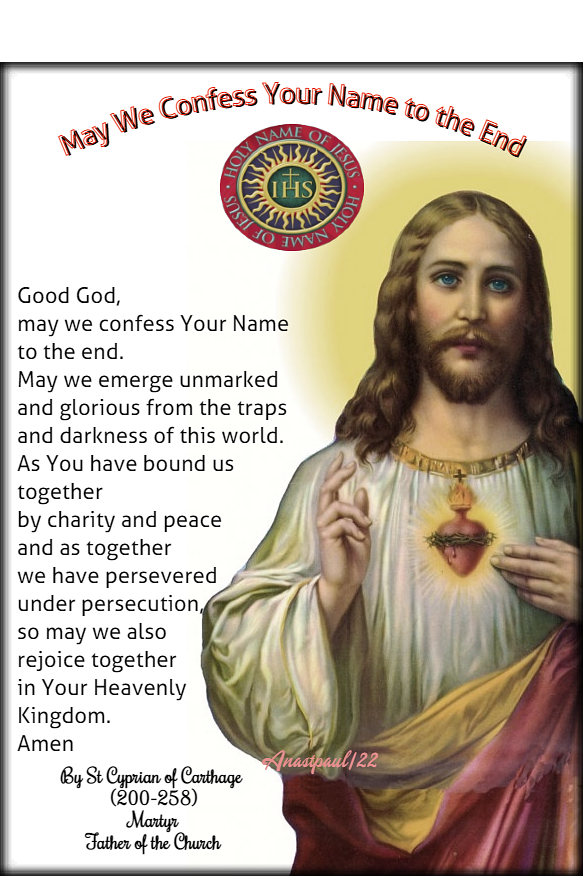
May We Confess Your Name to the End By St Cyprian of Carthage (200-258) Bishop and Martyr Apostolic Father of the Church
Good God, may we confess Your Name to the end. May we emerge unmarked and glorious from the traps and darkness of this world. As You have bound us together, by charity and peace and as together, we have persevered under persecution, so may we also rejoice together in Your heavenly kingdom. Amen
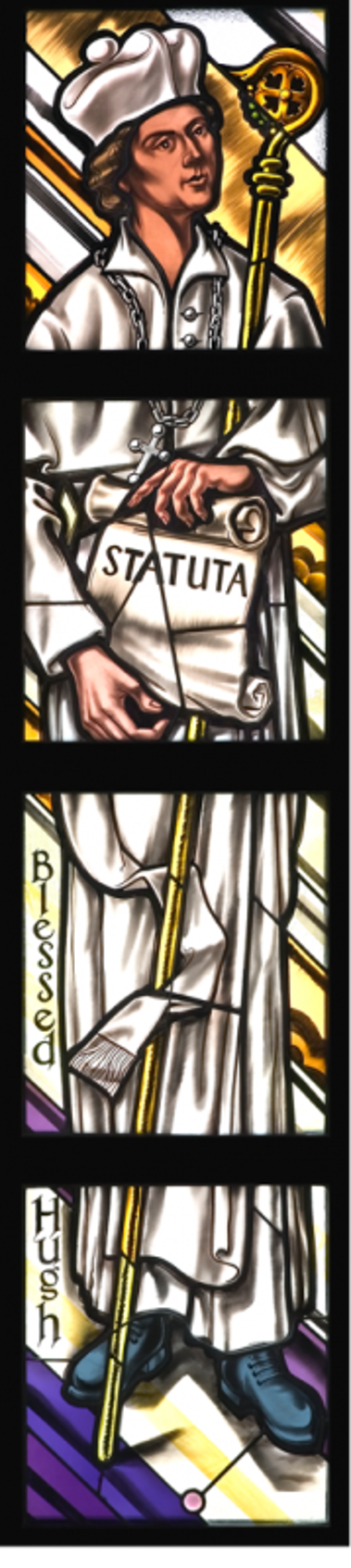
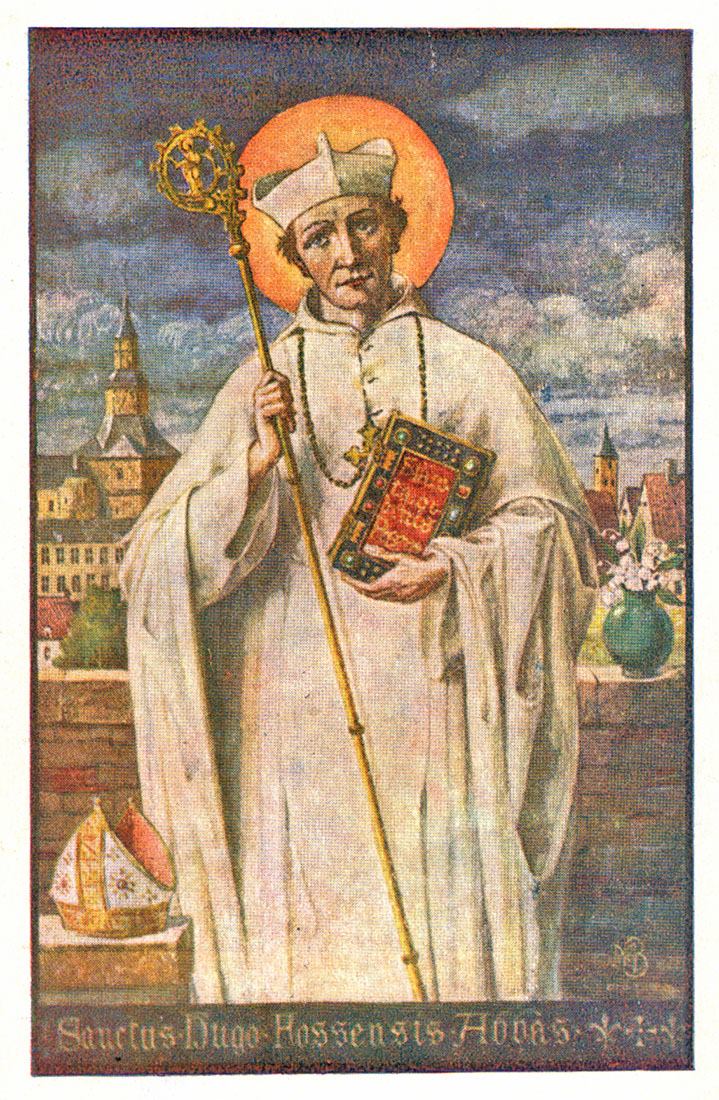
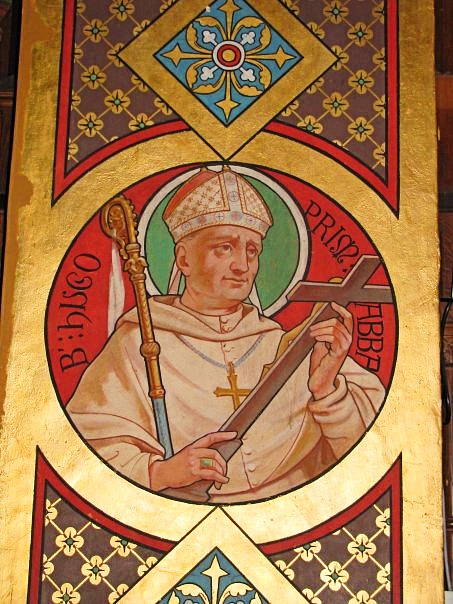
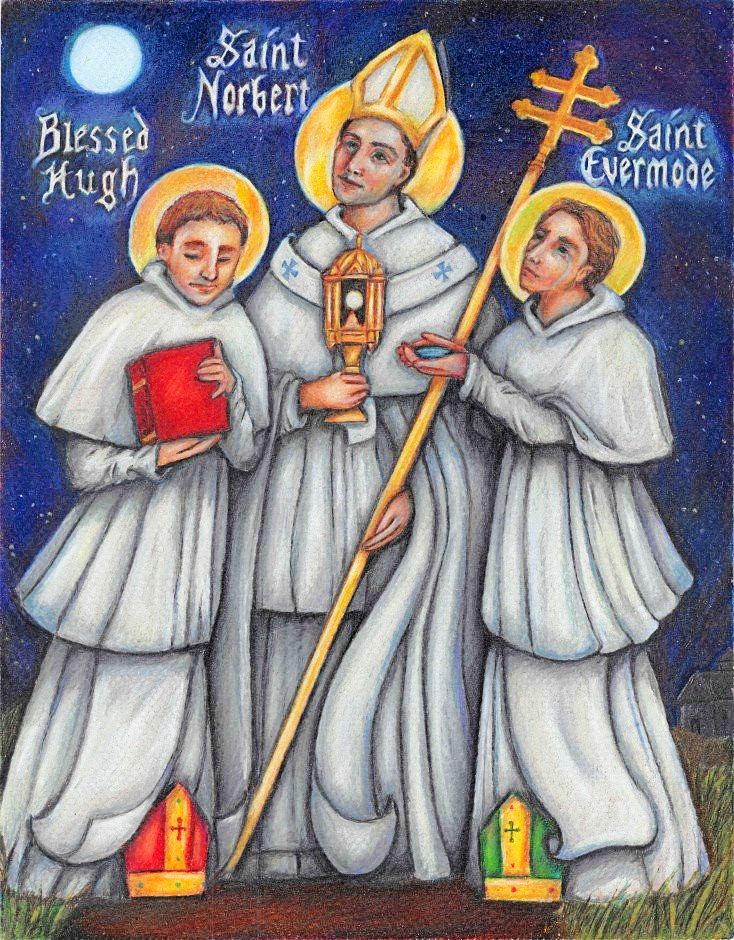
Saint of the Day – 10 February – Blessed Hugh of Fosse OPraem (c1093-1164) Priest of the Order of Canons Regular of Prémontré, also known as the Premonstratensians, the Norbertines and the White Canons. Hugh was one of St Norbert’s first disciples and later became the first Abbot of Prémontré, Born at Fosse, Belgium and died in 1164 of natural causes. Also known as – Hugues. Beatified on 13 July 1927 by Pope Pius XI.
He was born at Fosses-la-Ville in what is now Belgium around the year 1093. He seems to have been orphaned early in life and was educated at the collegiate Church of St Feuillien at Fosses. Upon Ordination, he was made Secretary to Burchard, the Bishop of Cambrai. Whilst accompanying the Bishop through Valenciennes, Hugh and Burchard happened upon St Norbert who was there preaching. St Norbert came to visit the Bishop and was led into the Episcopal presence by a Cleric.
The Bishop, looking at him standing there with bare frozen feet and dressed in rough clothing, absolutely amazed and dumbfounded, fell upon his neck with a gasp and cried out: “Oh Norbert, who would ever have believed or even thought this of you!” The Cleric who had admitted Norbert, wondered about the Bishop’s affection for him and asked the reason. The Bishop answered: “This man whom you see, was brought up with me in the Court of the King, a man noble and abounding in delights, to such a degree that he refused my Bishopric when it was offered to him.” Hearing this, the Cleric’s eyes filled with tears, both because he saw his master weeping but also because, he longed for a similar way of life. Secretly he discovered when and where Norbert would be continuing his journey.
But Norbert was suddenly seized by a serious illness while still in the City. The Bishop kindly tended his illness, daily visiting him, both himself and through the members of his Court. The aforementioned Cleric was among those visitors and when Norbert grew stronger he approached him and promised to accompany him in his profession and journey. Norbert thanked God thinking that the man was going to set out with him right away. But when the Cleric stated that he first wanted to set his affairs in order, Norbert was troubled at his words and said only: “Ah, brother, if this is of God, it will not be undone.” The Cleric left, promising to return and, disposing of his possessions, a little later did return, henceforth to follow the man of God. The name of that cleric was Hugh.
After returning to Norbert’s side, Hugh followed St Norbert on his many journeys over northern Europe and was present at the foundation of Prémontré in 1120. Hugh was made the first Prior of the Abbey and when Norbert took up his appointment of Archbishop of Magdeburg, Hugh became the first Abbot.
As Abbot, Hugh laid the foundations of the legislative and liturgical life of the Order. He organised the system of General Chapters, wrote the first Statutes of the Order and organised the various liturgical offices. He was also devoted to the education and training of his clerics and governed the Order during those early years of rapid expansion.
Known especially for his humility, Hugh never signed his name with ‘Abbot’ but only as ‘Servant of God and Norbert.’ Having laboured so hard for the good of the Order, Hugh died at Prémontré on 10 February 1164. In 1279 his Relics were moved to the High Altar of the Abbey Church of Prémontré and in 1660, given more elaborate furnishings. With the coming of the Revolution Hugh’s Relics were safely hidden in a number of locations until they found a place at the Abbey of Bois-Seigneur-Isaac.
In 2010, his Relics finally found a permanent home in Rome, at the Generalate of the Order. How appropriate that the first Abbot of Prémontré, should now ever be close to his successors.
Prayer: Almighty eternal God, Who always calls new men, so that they might make Thy way known to others, we humbly entreat Thee, through the merits and intercession of Thy Abbot, Blessed Hugh that by praying and working, we may build up Thy people into one. We ask this through our Lord Jesus Christ, Thy Son, Who lives and reigns with Thee in the unity of the Holy Ghost, one God forever and ever. Amen.
St Desideratus of Clermont St Erluph of Werden Blessed Hugh of Fosse OPraem (c1093-1164) Priest of the Order of Canons Regular of Prémontré, also known as the Premonstratensians, the Norbertines and the White Canons. Bl Paganus Bl Paul of Wallachia Bl Pierre Frémond St Porfirio St Prothadius of Besançon St Salvius of Albelda St Silvanus of Terracina St Soteris the Martyr St Troiano of Saintes St Trumwin of Whitby
Martyred Soldiers in Rome: A group of ten Christian soldiers who were Martyred together for their faith. We know little more about them but four of their names – Amantius, Hyacinth, Irenaeus and Zoticus. • 120 at Rome, Italy. They were buried on the Via Lavicana outside RomeAmantius, Hyacinth, Irenaeus, Zoticus.
Thought for the Day – 9 February – Meditations with Antonio Cardinal Bacci (1881-1971)
The Love of Our Neighbour
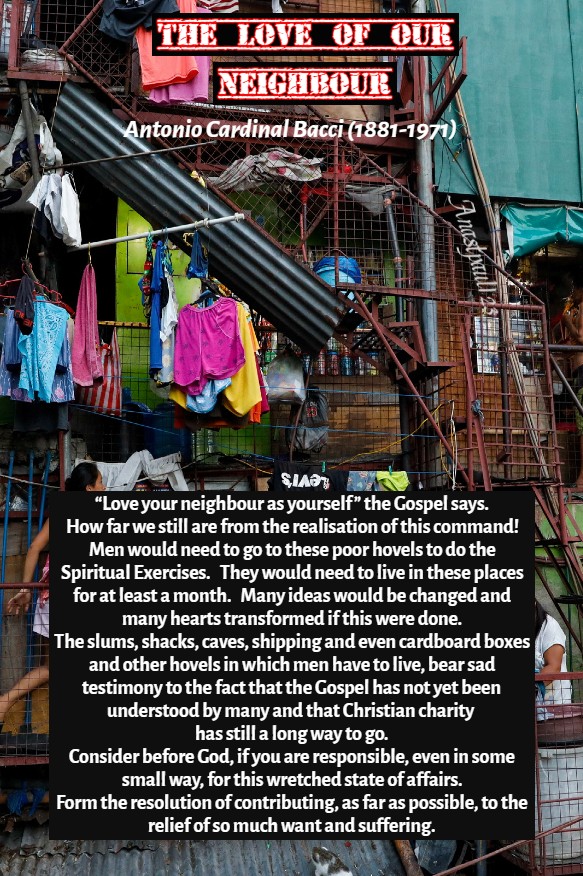
“A few hundred yards from the centre of a big City, one often finds groups of hovels in which large numbers of families are living, herded together in poverty. There, in the wintertime, these poor people suffer from the cold and damp and, in hot areas, from the burning heat in summer. Often their hovels are badly roofed and protect from neither the cold nor the heat. They are hungry and have not even a loaf of bread to kill the pangs of their deprived bodies.
Not very far away, there are luxurious mansions and expensive villas and up and down the streets, drift splendidly upholstered cars, carrying men and women for whom the only thing in life that matters, is pleasure and comfort.
“Love your neighbour as yourself” the Gospel says. How far we still are from the realisation of this command! Men would need to go to these poor hovels to do the Spiritual Exercises. They would need to live in these places for at least a month. Many ideas would be changed and many hearts transformed if this were done. The slums, shacks, caves, shipping and even cardboard boxes and other hovels in which men have to live, bear sad testimony to the fact that the Gospel has not yet been understood by many and that Christian charity has still a long way to go.
Consider before God, if you are responsible, even in some small way, for this wretched state of affairs. Form the resolution of contributing, as far as possible, to the relief of so much want and suffering. Now is the time – Lent is nearly here!”
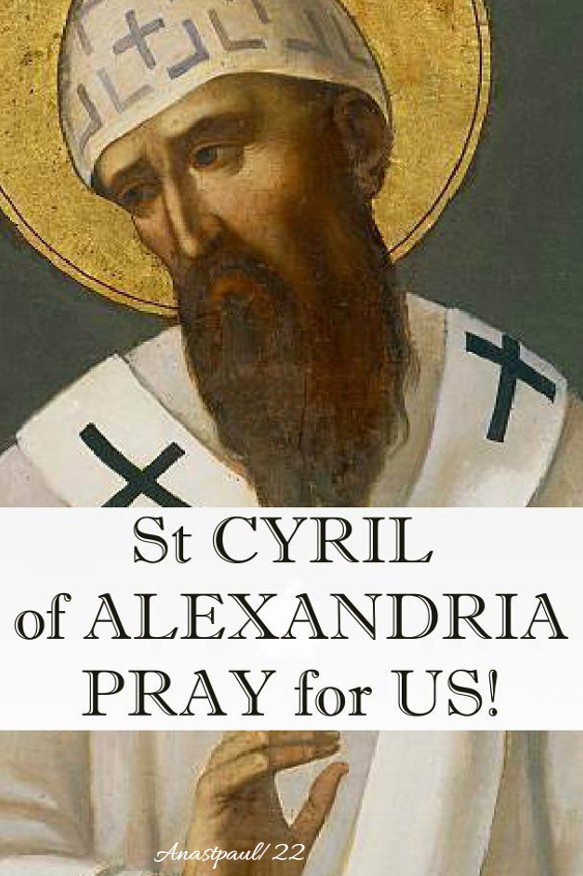
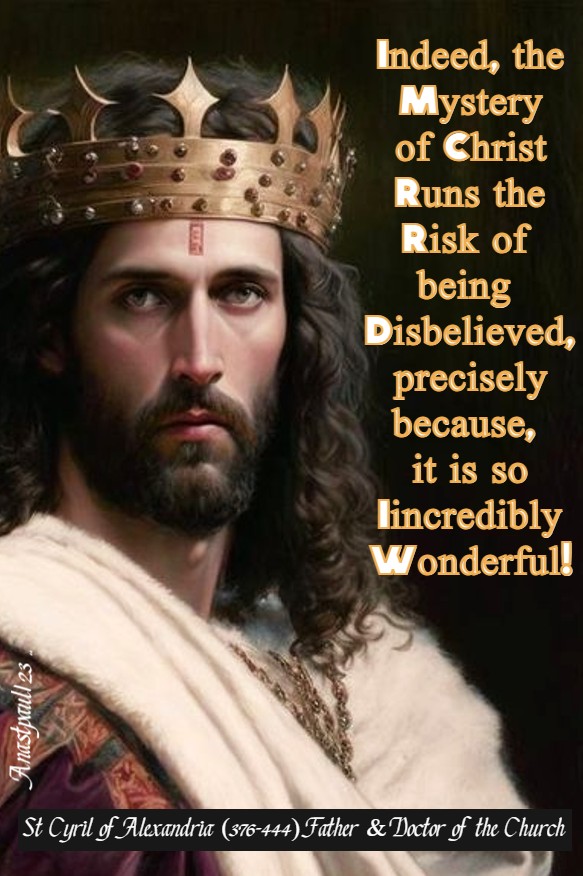
Quote/s of the Day – 9 February – St Cyril of Alexandria (376-444) “The Pillar of Faith” “Doctor of the Incarnation,” Bishop,Confessor, Father and Doctor, of the Church
“Indeed, the Mystery of Christ runs the risk of being disbelieved, precisely because, it is so incredibly wonderful!”
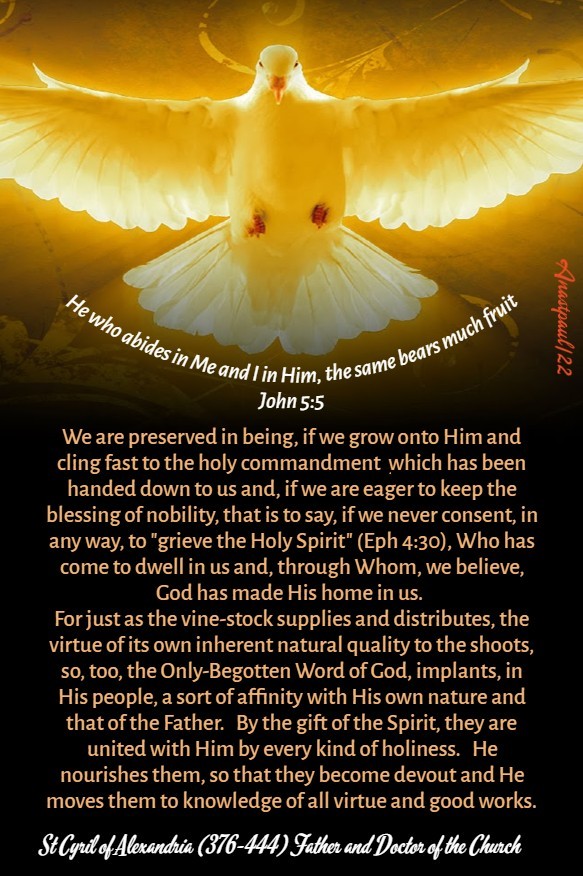
“He who abides in Me and I in Him, the same bears much fruit”
John 5:5
“We are preserved in being, if we grow onto Him and cling fast to the holy commandment, which has been handed down to us and, if we are eager to keep the blessing of nobility, that is to say, if we never consent, in any way, to “grieve the Holy Spirit” (Eph 4:30), Who has come to dwell in us and, through Whom, we believe, God has made His home in us. … For just as the vine-stock supplies and distributes, the virtue of its own inherent natural quality to the shoots, so, too, the Only-Begotten Word of God, implants, in His people, a sort of affinity with His own nature and that of the Father. By the gift of the Spirit, they are united with Him by every kind of holiness. He nourishes them, so that they become devout and He moves them to knowledge of all virtue and good works.”
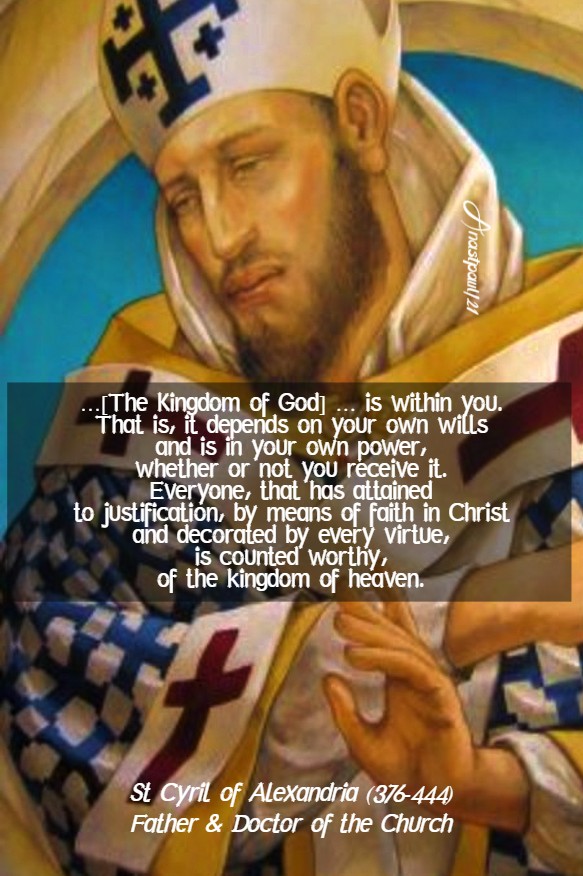
“… [The Kingdom of God] … is within you. That is, it depends on your own wills and is in your own power, whether or not you receive it. Everyone, that has attained to justification, by means of faith in Christ and decorated by every virtue, is counted worthy, of the Kingdom of Heaven.”
“He says that these temptations must come. Is this then because God, Who governs all, forces people to their commission of sin? Away with the thought! Nothing that is evil comes from Him. He is the fountain of all virtue. Why then must this happen? They clearly happen because of our infirmity, for all of us stumble in many things, as it is written. Nevertheless, He says, that there will be woe to the person who lays the stumbling blocks in the way. He does not leave indifference in these things without rebuke but restrains it by fear of punishment. He still commands us to bear with patience “ those who cause sins to happen.”
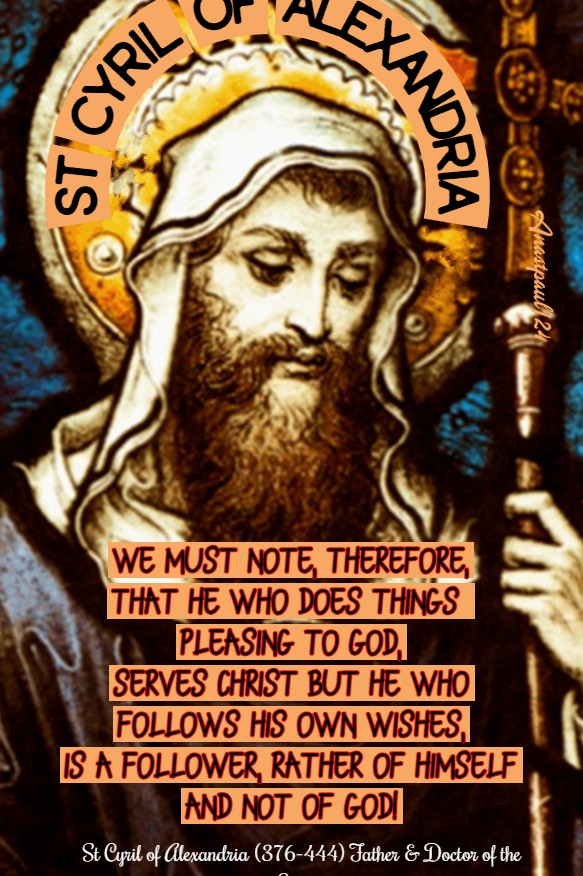
“We must note, therefore, that he who does things pleasing to God, serves Christ but he who follows his own wishes, is a follower, rather of himself and not of God!”
One Minute Reflection – 9 February – St Cyril of Alexandria (376-444) “The Pillar of Faith” “Doctor of the Incarnation”& “Seal of all the Fathers” Bishop,Confessor, Father and Doctor, of the Church – 2 Timothy 4:1-8, Matthew 5:13-19 – Scripture search here: https://www.drbo.org/
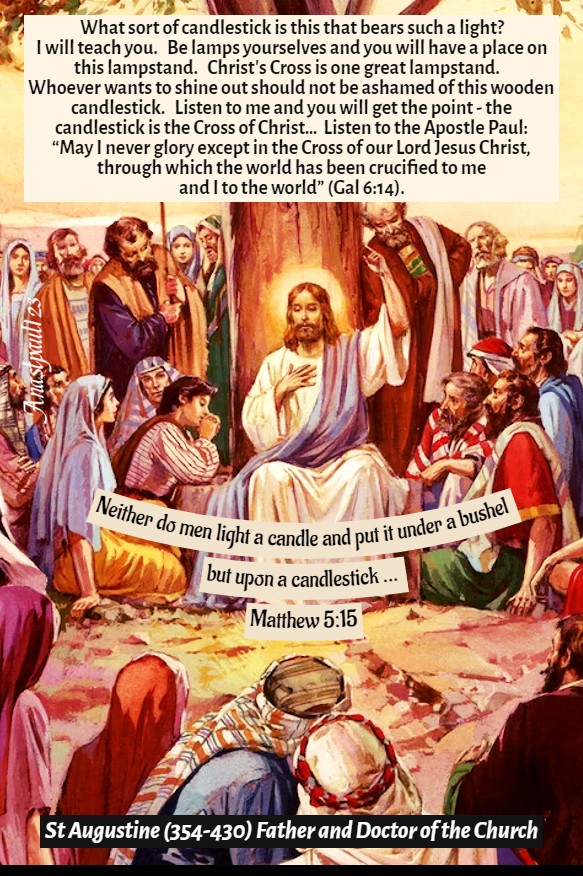
“Neither do men light a candle and put it under a bushel but upon a candlestick …” – Matthew 5:15
REFLECTION – “Brethren, the Apostles are lamps enabling us to wait for the coming of Christ’s Day. Our Lord tells them: “You are the light of the world.” And since they cannot believe themselves to be a light, like that of which it is said: “He was the true Light Who enlightens everyone” (Jn 1:9), He at once teaches them what that true light is. Having declared to them: “You are the light of the world,” He continues: “No-one lights a lamp to put it under a bushel basket.” I have called you lights, He says but I must clarify – you are only lamps. So do not give in, to the stirrings of pride, if you do not want to see this wick burning out. I am not putting you under the bushel basket but on the lampstand to cast light over everything with your rays.
What sort of candlestick is this that bears such a light? I will teach you. Be lamps yourselves and you will have a place on this lampstand. Christ’s Cross is one great lampstand. Whoever wants to shine out should not be ashamed of this wooden candlestick. Listen to me and you will get the point – the candlestick is the Cross of Christ…
“So will your light shine before others, so that they may see your good works and glorify” Glorify whom? Not yourself, since to seek your own glory is to want to be extinguished! “Glorify your heavenly Father.” Yes, that they may glorify Him, your heavenly Father, when they see your good works… Listen to the Apostle Paul: “May I never glory except in the Cross of our Lord Jesus Christ, through which the world has been crucified to me and I to the world” (Gal 6:14).” – St Augustine (354-430) Father and Doctor of the Church (Sermon 289, 6 PL 38, 1311-1312).
PRAYER – O God, Who made Cyril, Thy Confessor and Bishop, an unconquerable champion of the most Blessed Virgin Mary’s Divine Motherhood, grant that we, who believe that she is truly the Mother of God, may be saved by her motherly protection. Through Jesus Christ, Thy Son our Lord, Who lives and reigns with Thee, in the unity of the Holy Ghost, God, world without end. Amen (Collect).
Our Morning Offering – 9 February – Feast of St Cyril of Alexandria (376-444) “The Pillar of Faith” “Doctor of the Incarnation”& “Seal of all the Fathers” Bishop,Confessor, Father and Doctor, of the Church.
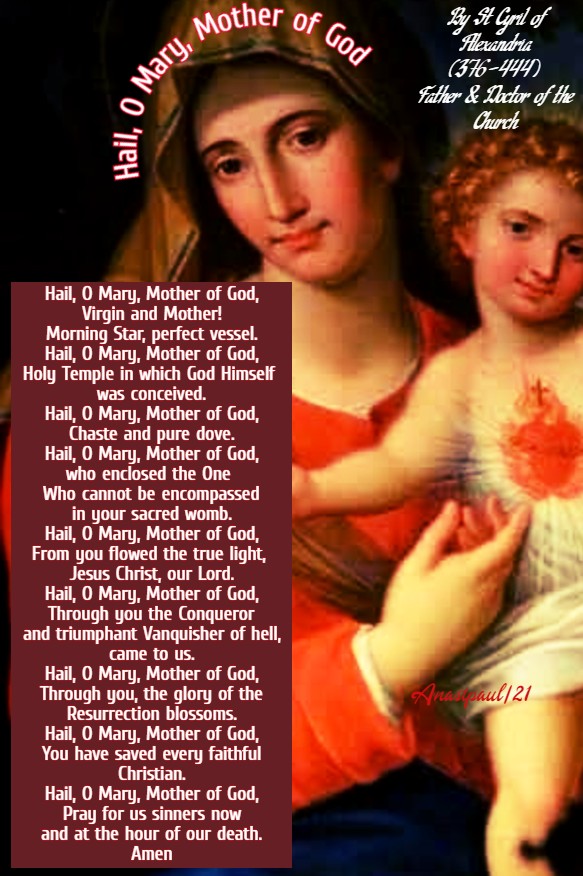
Hail, O Mary, Mother of God By St Cyril of Alexandria (376-444) Father & Doctor of the Church
Hail, O Mary, Mother of God, Virgin and Mother! Morning Star, perfect vessel. Hail, O Mary, Mother of God, Holy Temple in which God Himself was conceived. Hail, O Mary, Mother of God, Chaste and pure dove. Hail, O Mary, Mother of God, who enclosed the One Who cannot be encompassed in your sacred womb. Hail, O Mary, Mother of God, From you flowed the true light, Jesus Christ, our Lord. Hail, O Mary, Mother of God, Through you the Conqueror and triumphant Vanquisher of hell, came to us. Hail, O Mary, Mother of God, Through you, the glory of the Resurrection blossoms. Hail, O Mary, Mother of God, You have saved every faithful Christian. Hail, O Mary, Mother of God, Pray for us sinners now and at the hour of our death. Amen
Adapted from a sermon preached by St Cyril, Archbishop of Alexandria (444), presiding as representative of the Holy See at the Ecumenical Council of Ephesus, in 431. In refuting Nestorianism, he is called “Doctor of the Incarnation.”
Saint of the Day – 9 February – St Cyril of Alexandria (376-444) “The Pillar of Faith” “Doctor of the Incarnation” – Bshop, Confessor, Father and Doctor, of the Church.
St Cyril of Alexandria From the Roman Breviary
The praises of Cyril of Alexandria have been celebrated, not only by one writer or another but have even been registered in the acts of the Ecumenical Councils of Ephesus and Chalcedon. He was born of distinguished parents and was the nephew of Theophilus, Bishop of Alexandria. While he was still young, he gave clear proof of his excellent understanding. After giving a deep study to letters and science, he betook himself to John, Bishop of Jerusalem, to be perfected in the Christian Faith. After his return to Alexandria, and the death of Theophilus, he was raised to that See. In this Office, he kept ever before his eyes, the type of the Shepherd of souls described by the Apostle and, by ever adhering thereto, deservedly earned the glory of a holy Bishop.
He burned with zeal for the salvation of souls and took all care to keep the flock entrusted to him in purity of faith and lif, and to guard them from the poisonous pastures of heresy and infidelity. Hence, in accordance with law, he caused the followers of Novatus to be expelled from the City and procured the punishment of the Jews, whose rage had led them to plan a massacre of the Christians. Cyril’s singular care for the preservation of the Catholic Faith shone forth, especially in his conflict with Nestorius, Bishop of Constantinople, who declared that Jesus Christ had been born of the Virgin Mary as Man only and not as God and, that the Divinity had been bestowed upon Him because of His merits. Cyril in vain attempted to convert Nestorius and then denounced him to Pope St. Celestine.
A delegate of Pope Celestine, Cyril presided at the Council of Ephesus where the Nestorian heresy was absolutely proscribed. Nestorius was condemned and deprived of his See and the Catholic Doctrine, as to the unity of Person in Christ and the Divine Motherhood of the glorious Virgin Mary, was laid down amid the rejoicings of all the people, who escorted the Bishops to their lodgings with a torch-light procession. For this reason Nestorius and his followers, made Cyril the object of slanders, insults and persecutions which he bore with profound patience, for he cared only for the Faith and paid no attention to what the heretics might do or say against himself.
At length he died a holy death, in the year of salvation 444, the thirty-second of his Episcopacy, after having performed great labours for the Church of God and having composed numerous works, both in refutation of paganism and heresy, in exposition of Sacred Scripture and in explanation of Catholic Dogmas.
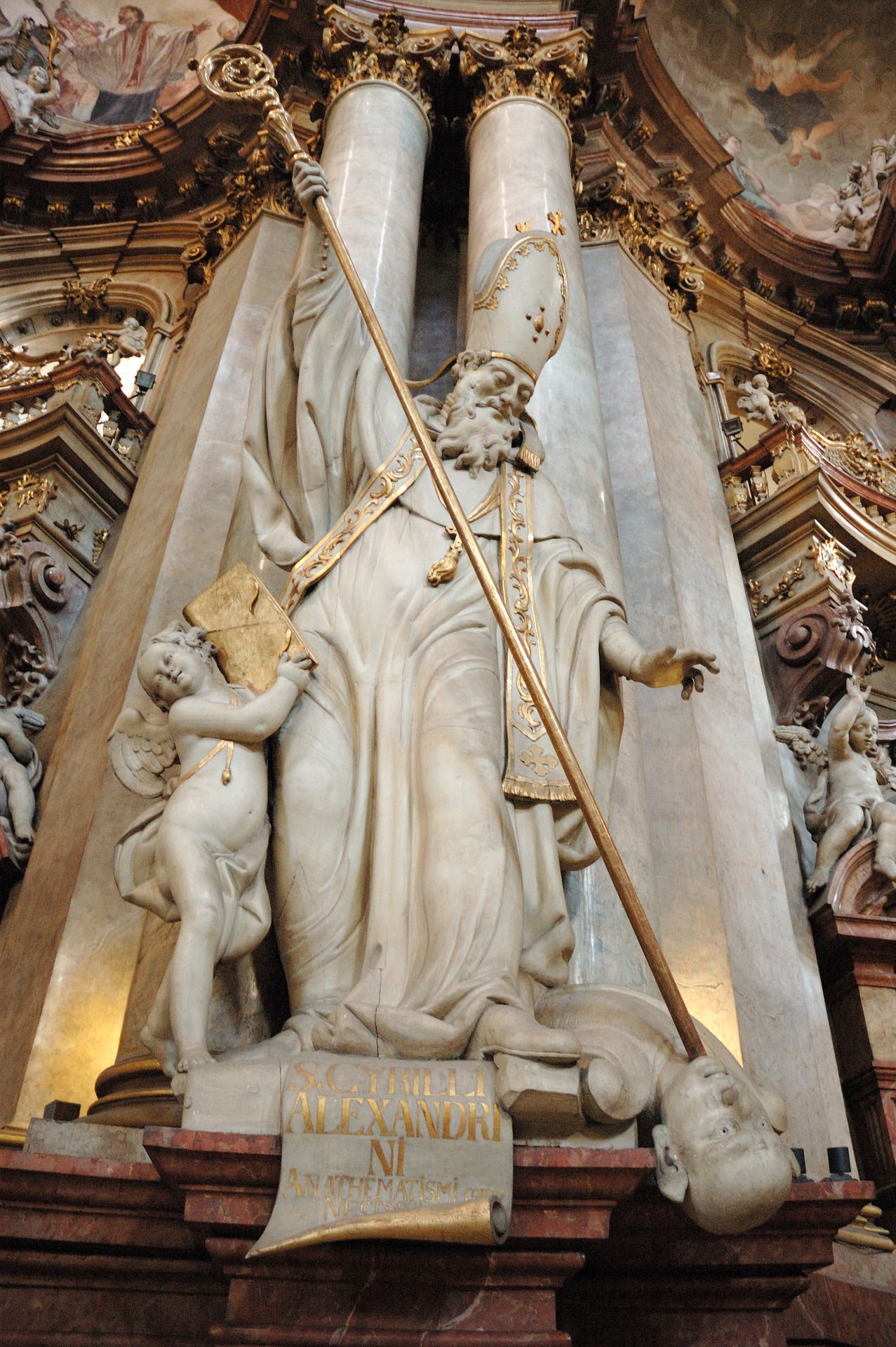
St Cyril of Alexandria, at St Nicholas’ Church, Prague
St Alexander of Rome St Alexander of Soli St Alto of Altomünster St Ammon of Membressa St Ammonius of Soli St Ansbert of Rouen St Attracta of Killaraght St Brachio of Auvergne St Cuaran the Wise St Didymus of Membressa St Donatus the Deacon St Eingan of Llanengan St Emilian of Membressa Bl Erizzo Bl Francisco Sanchez Marquez Bl Godeschalk of Želiv St Lassa of Membressa Bl Marianus Scotus St Maro St Nebridius of Egara St Nicephorus of Antioch St Poëmus of Membressa St Primus the Deacon
St Raynald of Nocera (c1150-1217) Bishop of Nocera, Umbria, Italy, Hermit, Monk, Abbot. His body is incorrupt. The Roman Martyrology reads: “In Nocera Umbra, St. Rainaldo, Bishop, formerly a Camaldolese Monk of Fonte Avellana, who, while carrying out the Episcopal office, firmly preserved the habits of monastic life.” Biography: https://anastpaul.com/2022/02/09/saint-of-the-day-9-february-saint-raynald-of-nocera-c-1150-1217/
St Romanus the Wonder Worker St Ronan of Lismore St Sabino of Abellinum
St Sabinus of Canosa (c461–566) Bishop, Confessor, Benedictine Monk, Papal Legate, miracle-worker, graced with the charism of prophecy, Defender of the Faith against heretics, friend of Saint Benedict of Nursia, builder of Churches and Monasteries, following the Benedictine discipline of Ora et labora. His Life: https://anastpaul.com/2021/02/09/saint-of-the-day-9-february-saint-sabinus-of-canosa-c-461-566-bishop/
St Teilo of Llandaff
Martyrs of Alexandria: An unknown number of Christians who were massacred inthe 4th Century Alexandria, Egypt by Arian heretics for adhering to the true Faith.
Martyrs of Membressa: A group of 44 Christians Martyred together. We know little else about them some names – Ammon, Didymus, Emilian, Lassa, Poemus They were Martyred in Membressa in Africa.
Thought for the Day – 8 February – Meditations with Antonio Cardinal Bacci (1881-1971)
The Use of Creatures
“St Ignatius Loyola investigates this subject in his Spiritual Exercises. He writes that we ought to use things, insofar as they bring us nearer to our final end. We ought to avoid things completely, he continues, insofar as they separate or distract us from this end.
The function of creatures in our regard, is to lead us nearer to God, to remind us of God and to make us love God. But if they are a source of scandal to us, we must avoid them. The Gospel is very strict on this matter when it says, “If thy hand or foot is an occasion of sin to thee, cut it off and cast it from thee” (Mt 5:29-30; 18:8).
This means that we must be ready to give up anything or anyone, rather than endanger our souls and risk the loss of Divine grace and eternal life.”
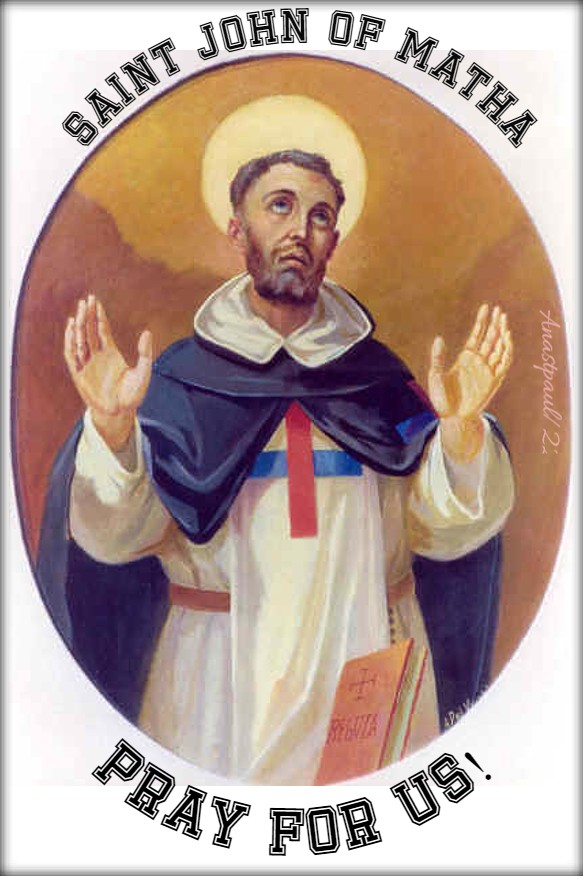
Quote of the Day – 8 February –St John of Matha O.SS.T (1160-1213) Confessor, Priest, Founder of The Order of the Most Holy Trinity and of the Captives
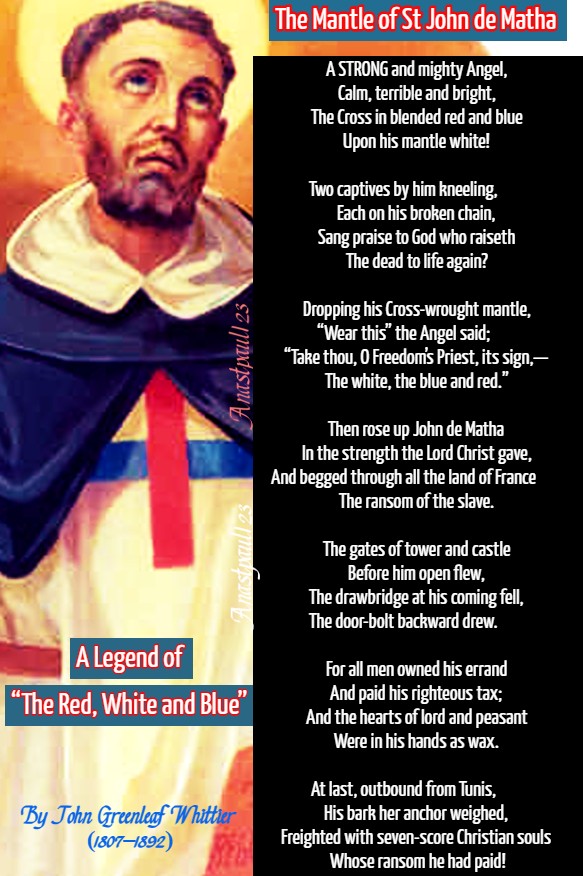
Excerpt from The Mantle of St John de Matha A Legend of “The Red, White and Blue” (1154–1864) By John Greenleaf Whittier (1807–1892).
A STRONG and mighty Angel, Calm, terrible and bright, The Cross in blended red and blue Upon his mantle white!
Two captives by him kneeling, Each on his broken chain, Sang praise to God who raiseth The dead to life again?
Dropping his Cross-wrought mantle, “Wear this” the Angel said; “Take thou, O Freedom’s Priest, its sign,— The white, the blue and red.”
Then rose up John de Matha In the strength the Lord Christ gave, And begged through all the land of France The ransom of the slave.
The gates of tower and castle Before him open flew, The drawbridge at his coming fell, The door-bolt backward drew.
For all men owned his errand And paid his righteous tax; And the hearts of lord and peasant Were in his hands as wax.
At last, outbound from Tunis, His bark her anchor weighed, Freighted with seven-score Christian souls Whose ransom he had paid!
One Minute Reflection – 8 February – St John of Matha (1160-1213) – Confessor, Priest, Founder – Sirach 31:8-11, Luke 12:35-40 – Scripture search here: https://www.drbo.org/
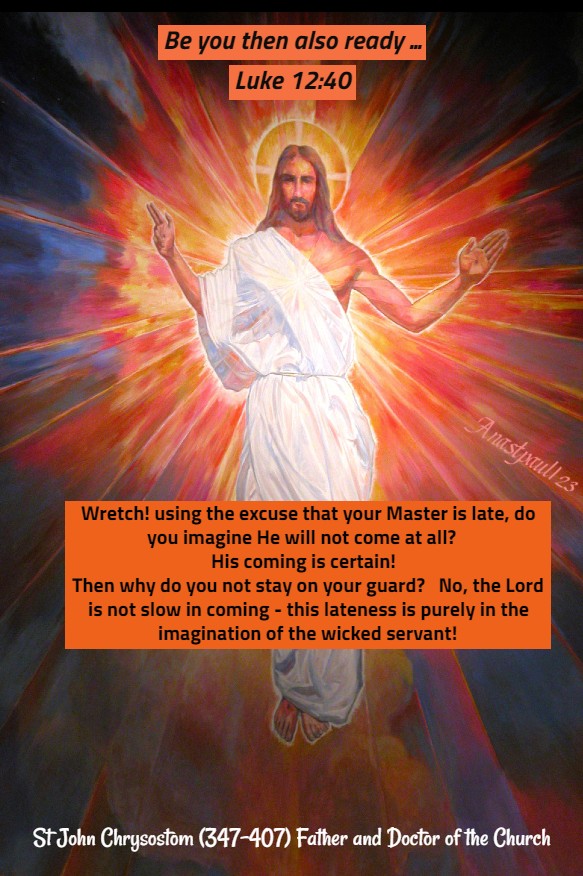
“Be you then also ready …” – Luke 12:40
REFLECTION – “At an hour you do not expect, the Son of Man will come.” Jesus says this to them so that the disciples would stay awake and always be ready. If He tells them, He will come when they are not expecting Him, this is because He wants to make them practice virtue zealously, without relaxing. It is as though He were saying to them: “If people knew when they were going to die, they would be completely ready for the day”… But the end of our life is a secret, hidden from us all…
This is why the Lord expects two qualities of His steward – that he should be faithful, lest he attribute to himself anything that belongs to his Master and that he should be wise, so that he might suitably administer everything put in his charge. So we too ought to have these two qualities if we are to be ready at the Master’s coming… Because this is what happens due to our not knowing the day we shall meet Him – we say to ourselves: “My Master is delayed in coming.” The faithful and wise steward has no such thoughts. Wretch! using the excuse that your Master is late, do you imagine He will not come at all? His coming is certain! Then why do you not stay on your guard? No, the Lord is not slow in coming – this lateness is purely in the imagination of the wicked servant!” – St John Chrysostom (347-407) Bishop of Constantinople, Father and Doctor of the Church (Sermon 77 on St Matthew).
PRAYER – O God, Who graciously and by Divine means founded, through blessed John, the Order of the Most Holy Trinity to ransom captives from the hands of the Saracens, grant, we beseech Thee that through Thy help and the merits of his prayers, we may be freed body and soul from captivity. Through Jesus Christ, Thy Son our Lord, Who lives and reigns with Thee, in the unity of the Holy Ghost, God, world without end. Amen (Collect).
Our Morning Offering – 8 February – Septuagesima Week – Help us Lord!
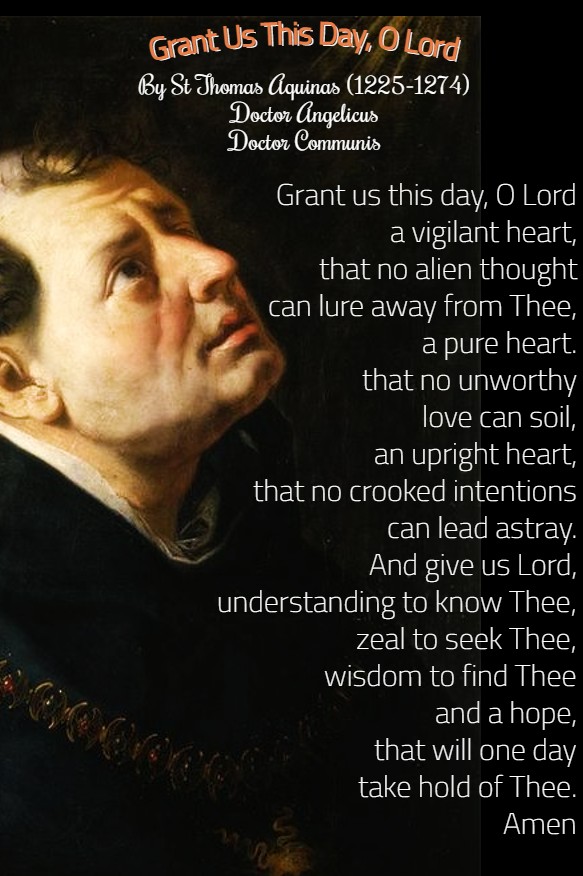
Grant Us This Day, O Lord By St Thomas Aquinas (1225-1274) Doctor Angelicus Doctor Communis
Grant us this day, O Lord a vigilant heart, that no alien thought can lure away from Thee, a pure heart. that no unworthy love can soil, an upright heart, that no crooked intentions can lead astray. And give us Lord, understanding to know Thee, zeal to seek Thee, wisdom to find Thee and a hope, that will one day take hold of Thee. Amen
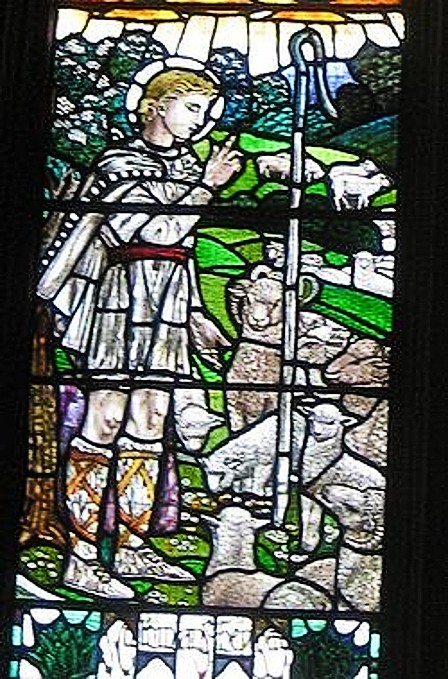
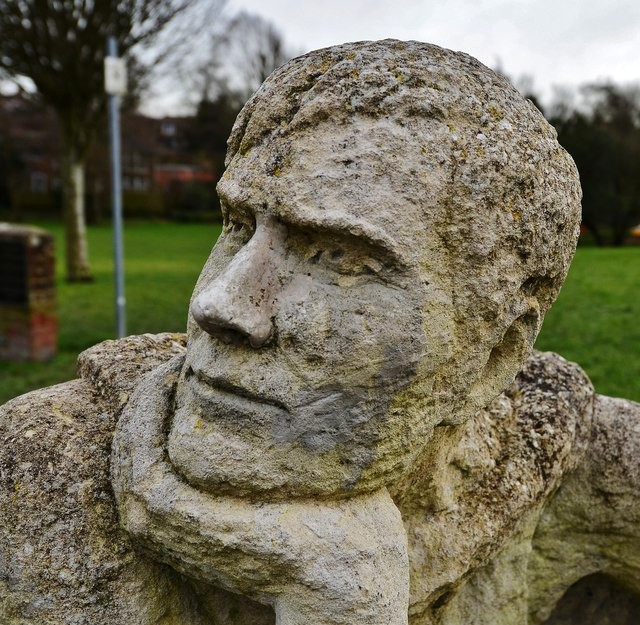
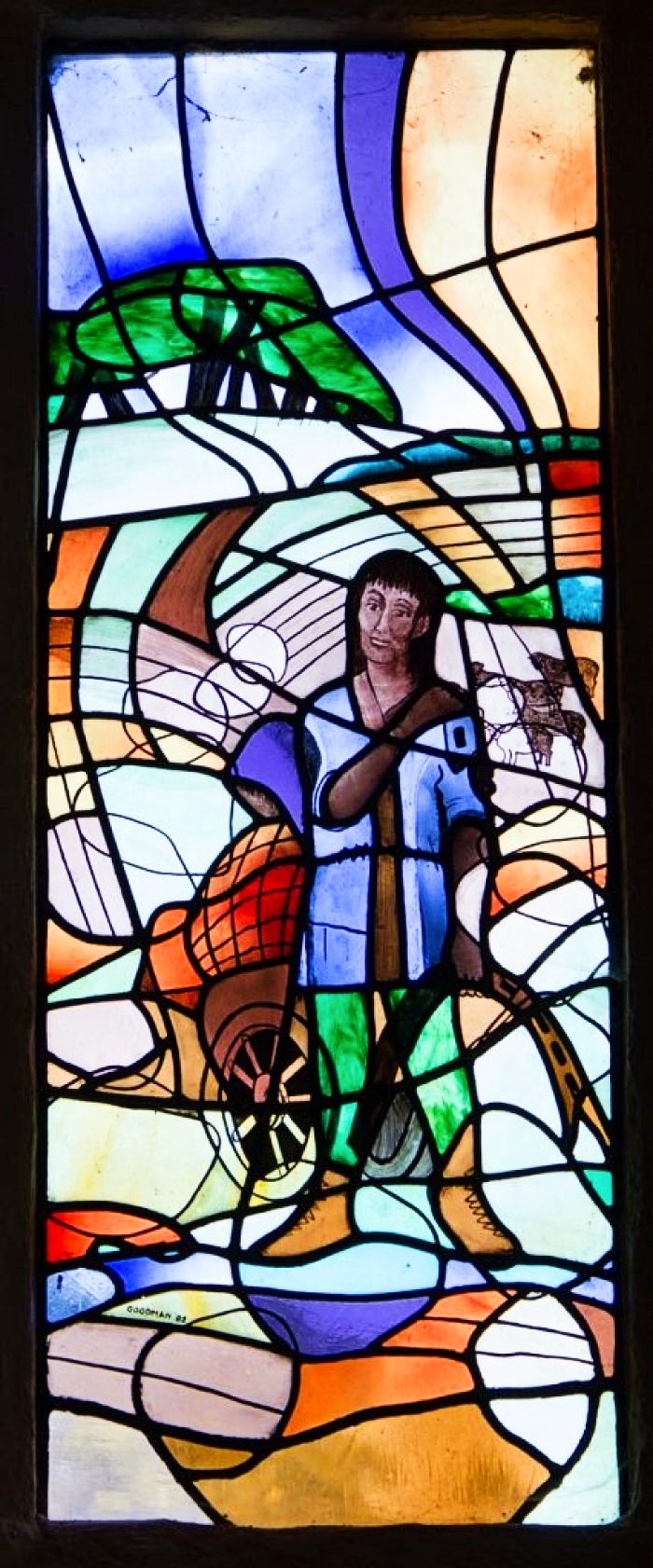
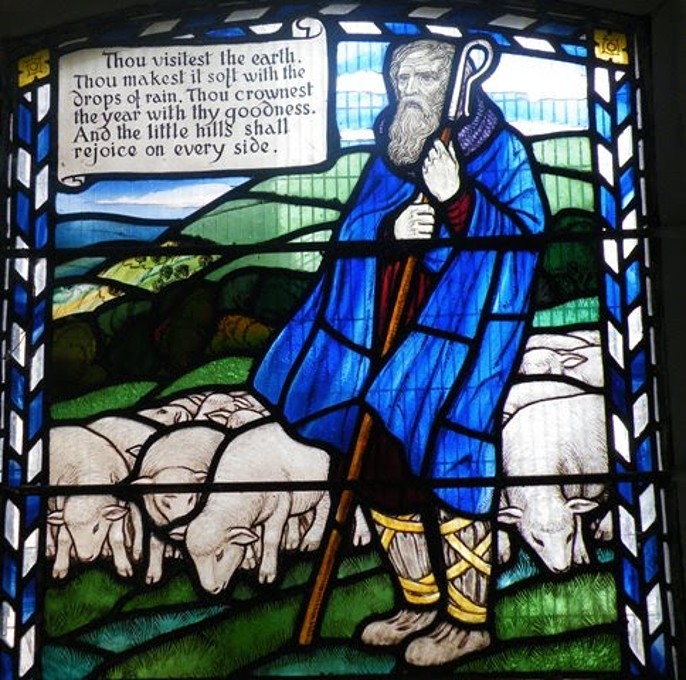
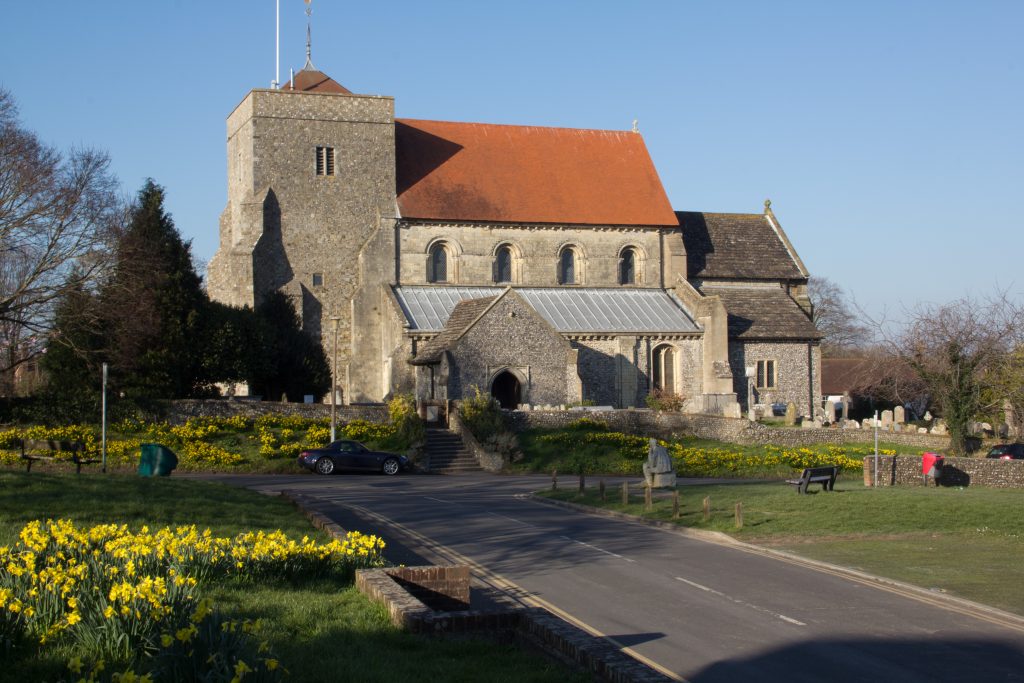
Saint of the Day – 8 February – Saint Cuthman of Steyning (Died 8th Century) Hermit, builder of Churches, Miracle-worker. Born in c681 at Chidham, near Bosham, Sussex (some legends say Devon or Cornwall) in England and diedin the 8th Century at Steyning, Sussex, England. Patronages – against poverty, bachelors, poor people, shepherds, of Steyning, England. Also known as – Cuthmann, Cutmano, Cutmanus.
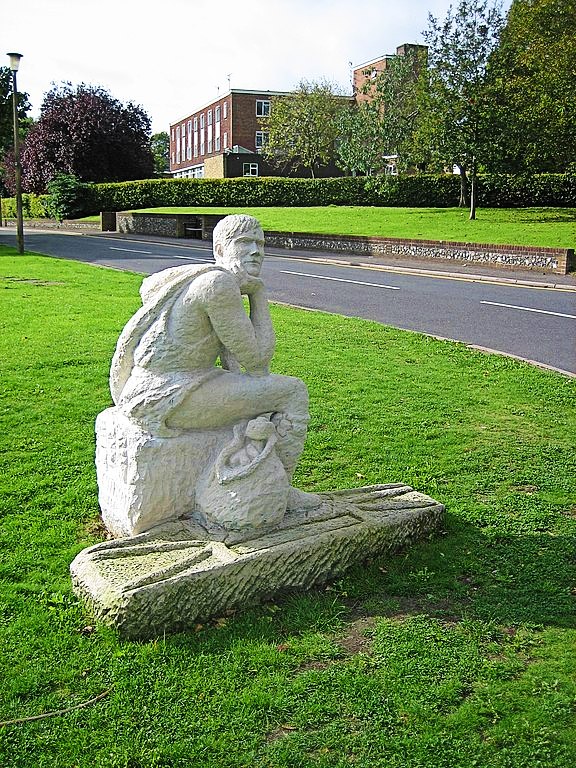
Modern statue of St Cuthman by Penny Reeve, looking over the road to the Church he founded at Steyning.
The earliest surviving written record of Cuthman’s life is a volume of the Acta Sanctorum, published by the Bollandists at Antwerp in 1658. According to the story, Cuthman was a shepherd who grew up either in the West Country or at Chidham, near Chichester. He was probably born in the late seventh century and may have been Baptised by St Wilfrid himself, the ‘Apostle of Sussex.’
Even as a young boy, Cuthman showed signs of his closeness to God. One day, while tending his sheep, he drew a line around them with his staff so that he could get away to collect food. On his return, he found that the flock had not left the invisible boundary. This miracle may have taken place in a field near Chidham, which, for centuries was known as ‘St Cuthman’s Field’ or ‘St Cuthman’s Dell.’ It was said that a large stone in the field, ‘on which the holy shepherd was in the habit of sitting,’ held miraculous properties.
A turning point in Cuthman’s life was the death of his father, which left both him and his mother destitute. They decided to leave their home and journey eastwards – in the direction of the rising sun. By this time, Cuthman’s mother was an invalid and so he had to push her in a wheeled wooden cart. A rope that stretched from the handles to the Saint’s shoulders helped carry the burden. When the rope snapped, he made a new one out of withies (willow tree branches used for basketry). The local haymakers laughed at Cuthman’s rather pathetic efforts but Providence soon responded to their merriment by sending a sudden rainstorm, destroying their harvest. Later versions of the story say that, from that moment onwards, it always rained in that field during the haymaking season!
Cuthman decided that once this replacement rope made of withies broke, it would be a sign from God to settle at that place and build a Church. This happened at Steyning, which, according to the Acta Sanctorum, was ‘a place lying at the base of a lofty hill, then woody, overgrown with brambles and bushes but now rendered by agriculture fertile and fruitful, enclosed between two streams springing from the hill above. The Bollandist Monks have also provided us with Cuthman’s prayer as he reached this blessed spot:
“Father Almighty, Thou hast brought my wanderings to an end; now enable me to begin this work. For who am I, Lord, that I should build a house to Thy Name? If I rely on myself, it will be of no avail but it is Thou Who will assist me. Thou hast given me the desire to be a builder; make up for my lack of skill and bring the work of building this holy house to its completion.”
And so, this unlikely builder began constructing a worthy Sanctuary in honour of the One who had guided him safely along his journey ad orientem. Many of the local inhabitants helped him in this great task and on one occasion, according to the legend, he even received Divine assistance. The builders were having trouble with a roof-beam, when a stranger appeared and provided them with a solution. When asked his name, the newcomer replied: ‘I am He in Whose name you are building the Church.‘
He built a wooden Chapel in Steyning, probably on the site of the present Church of St Andrew’s. This building was certainly well established by 857, when King Ethelwulf (father of St Alfred the Great) was buried there.
It seems that pilgrims visited the Tomb of St Cuthman and that his intercession led to many miraculous cures. During the reign of St Edward the Confessor, the Church at Steyning was given to the Abbey of the Holy Trinity at Fécamp, Normandy. This Benedictine house, founded in the seventh century, is famous for its ‘Benedictine’ liqueur, which today is commercially produced in the grounds of the old Abbey. It was to this Monastery that the Black Monks took the body of St Cuthman and his Feast (8 February) was celebrated at many of the religious houses of Normandy. Thus, St Cuthman became well known on the continent – as can be seen in a mid fifteenth century German engraving of the saint by Martin Schongauer and in the writings of the seventeenth century Bollandists.
Meanwhile, the Church at Steyning was rebuilt and dedicated to St Andrew. However, St Cuthman was not forgotten in his beloved land. A ‘Guild of St Cuthman’ was in existence at Chidham on the eve of the Reformation and a misericord in Ripon Cathedral depicts him pushing his mother in a three-wheeled barrow. There are quite a few Churches dedicated to St Cuthman in England but in Steyning, he is particularly loved and venerated.
St Andrew’s Church in Steyning
The colourful tale of St Cuthman presents us with a charming example of filial piety, prayer, evangelisation and Church building in Saxon England. In the words of Christopher Fry:
It is there in the story of Cuthman, the working together Of man and God like root and sky; the son Of a Cornish shepherd, Cuthman, the boy with a cart, The boy we saw trudging the sheep-tracks with his mother Mile upon mile over five counties; one Fixed purpose biting his heels and lifting his heart. We saw him; we saw him with a grass in his mouth, chewing And travelling. We saw him building, at last, A Church among whortleberries…
St Cyriacus of Rome St Dionysus of Armenia St Elfleda of Whitby St Emilian of Armenia St Giacuto St Gisela St Honoratus of Milan St Inventius of Pavia Bl Jacoba de Settesoli St Kigwe St Laureatus of Rome St Lucius of Rome St Meingold St Mlada of Prague St Nicetius of Besançon St Oncho of Clonmore St Paul of Rome
St Sebastian of Armenia St Stephen of Muret (c1046-1124) Abbot
Martyrs of Constantinople: Community of 5th Century Monks at the Monastery of Saint Dius at Constantinople. Imprisoned and Martyred for loyalty to the Vatican during the Acacian Schism. 485 in Constantinople.
Martyrs of Persia: An unknown number of Christians murdered in early 6th-century Persia. Legend says that so many miracles occurred through the intercession of these Martyrs that the King decreed an end to the persecution of Christians.
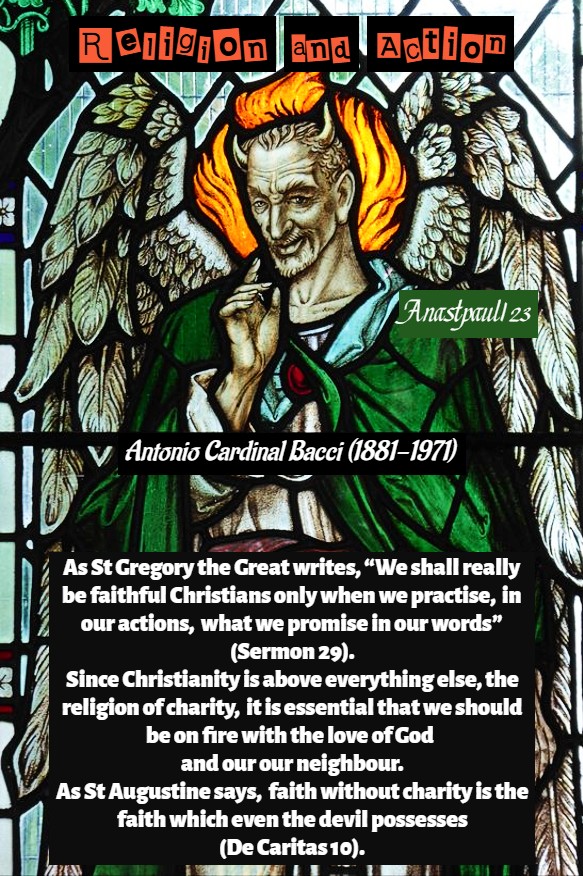
Thought for the Day – 7 February – Meditations with Antonio Cardinal Bacci (1881-1971)
Religion and Action
“If we wish to be true and sincere Christians, it is not enough to believe, nor is it enough to attend the ceremonies of religion, We must act like true Christians. As St Gregory the Great writes, “We shall really be faithful Christians only when we practise, in our actions, what we promise in our words” (Sermon 29). Since Christianity is above everything else, the religion of charity, it is essential that we should be on fire with the love of God and our our neighbour. As St Augustine says, faith without charity is the faith which even the devil possesses (De Caritas 10).”
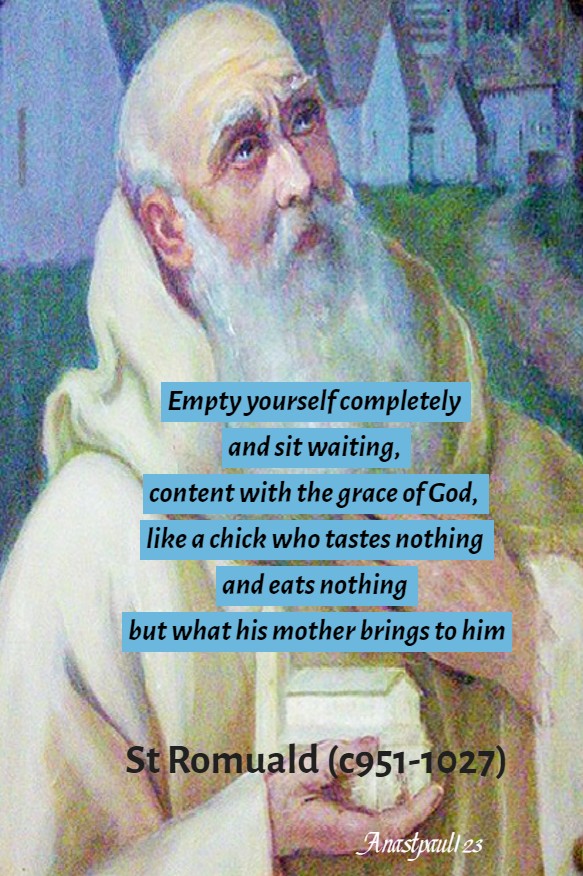
Quote of the Day – 7 February – St Romuald, Abbot (c951-1027)
“Empty yourself completely and sit waiting, content with the grace of God, like a chick who tastes nothing and eats nothing but what his mother brings to him.”
One Minute Reflection – 7 February – St Romuald (c951-1027) Abbo – Ecclesiasticus 45:1-6, Matthew 19:27-29 – Scripture search here: https://www.drbo.org/
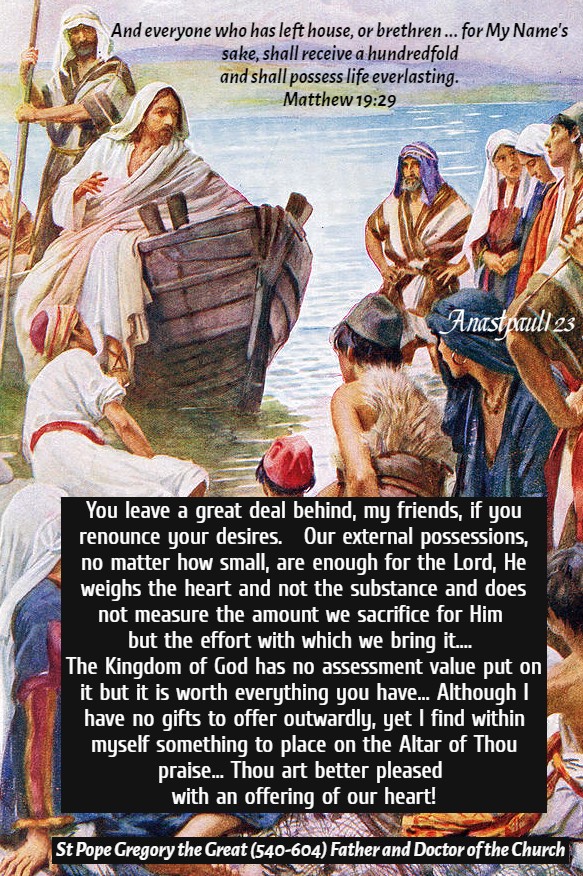
“And everyone who has left house, or brethren, or sisters, or father, or mother, or wife, or children, or lands, for My Name’s sake, shall receive a hundredfold and shall possess life everlasting.” – Matthew 19:29
REFLECTION – “No-one should say to himself, even when he regards others who have left a great deal behind: “I want to imitate those who despise this world but I have nothing to leave behind.” You leave a great deal behind, my friends, if you renounce your desires. Our external possessions, no matter how small, are enough for the Lord, He weighs the heart and not the substance and does not measure the amount we sacrifice for Him but the effort with which we bring it…. The Kingdom of God has no assessment value put on it but it is worth everything you have… To Peter and Andrew it was worth the nets and boat they gave up; to the widow it was worth two small coins (Lk 21:2); to another person it was worth a cup of cold water (Mt 10:42). The Kingdom of God, as I said, is worth everything you have. Think about it, my friends, what has less value when you purchase it, what is more precious when you possess it?
But perhaps a cup of cold water offered to someone who needs it, is not enough, even then the Word of God gives us assurance…: “Peace on earth to men of goodwill!” (Lk 2:4). In the sight of God, no hand is ever empty of a gift, if the deep places of the heart are filled with goodwill… Although I have no gifts to offer outwardly, yet I find within myself something to place on the Altar of Thou praise…: Thou art better pleased with an offering of our heart! (cf. Ps 55:13).” – St Gregory the Great (540-604) Pope, Father and Doctor of the Church (Sermons on the Gospel no 5).
PRAYER – May the intercession of the Blessed Abbot Romuald, commend us, we beseech Thee, O Lord, so that what we do not deserve by any merits of our own, we may obtain by his patronage. Through Jesus Christ, Thy Son our Lord, Who lives and reigns with Thee, in the unity of the Holy Ghost, God, world without end. Amen (Collect).
Our Morning Offering – 7 February – Tuesday of Septuagesima Week – Preparing to prepare, making a plan of action, seeking the best means for ourselves.
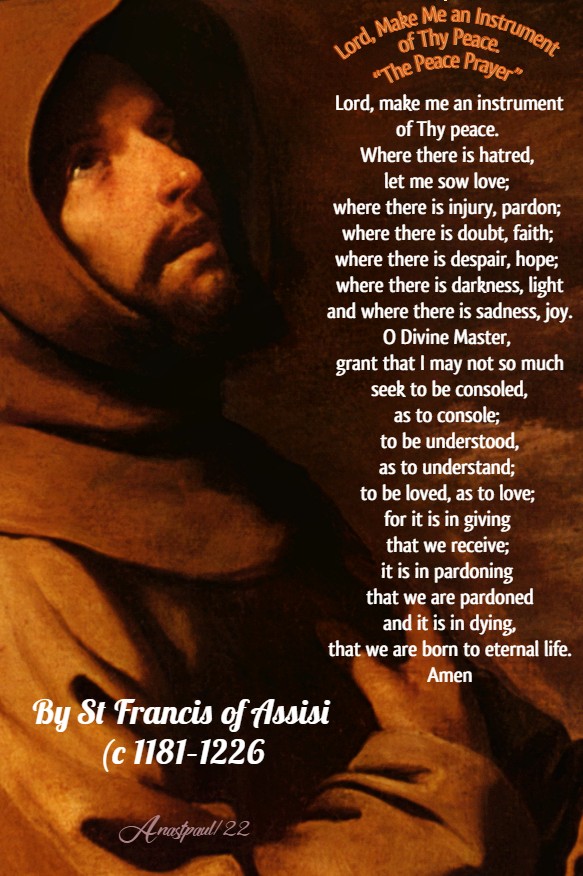
Lord, Make Me an Instrument of Thy Peace. “The Peace Prayer” By St Francis of Assisi (c 1181–1226
Lord, make me an instrument of Thy peace. Where there is hatred, let me sow love; where there is injury, pardon; where there is doubt, faith; where there is despair, hope; where there is darkness, light and where there is sadness, joy. O Divine Master, grant that I may not so much seek to be consoled, as to console; to be understood, as to understand; to be loved, as to love; for it is in giving that we receive; it is in pardoning that we are pardoned and it is in dying, that we are born to eternal life. Amen
You must be logged in to post a comment.