St Conrad of Parzham OFM Cap (1818-1894) Franciscan Religious Lay Friar, Devotee of Blessed Sacrament and Marian, Apostle of Charity, Miracle worker with the charism of prophecy. His heroic virtues and the miracles he performed won for him the distinction to be ranked among the Blessed by Pope Pius XI in 1930. Four years later, the same pope, approving additional miracles which had been performed, solemnly inscribed his name in the list of Saints. Biography: https://anastpaul.com/2018/04/21/saint-of-the-day-21-april-st-conrad-of-parzham-ofm-cap-1818-1894/
St Crotates of Nicomedia St Cyprian of Brescia St Felix of Alexandria St Fortunatus of Alexandria St Frodulphus St Isacius of Nicomedia St Maelrubba of Applecross
St Silvius of Alexandria St Simeon of Ctesiphon St Vitalis of Alexandria Bl Vitaliy Bayrak Bl Wolbodó of Liège
Thought for the Day – 20 April – Meditations with Antonio Cardinal Bacci (1881-1971)
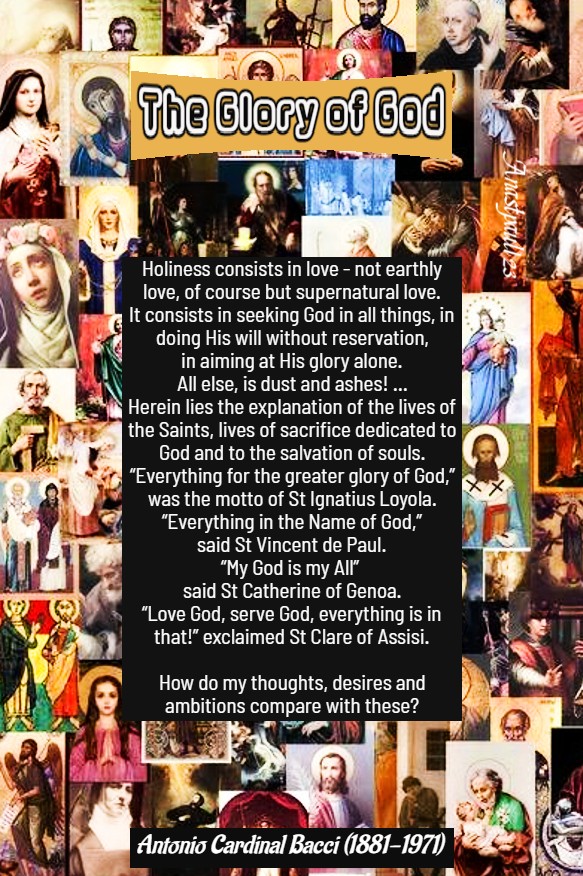
The Glory of God
“Holiness consists in love – not earthly love, of course but supernatural love. It consists in seeking God in all things, in doing His will without reservation, in aiming at His glory alone. All else, is dust and ashes!
So it will appear to us at the end of life when we shall be able to view ourselves and the world around us, in the light of eternity. Herein lies the explanation of the lives of the Saints, lives of sacrifice dedicated to God and to the salvation of souls. “Everything for the greater glory of God,” was the motto of St Ignatius Loyola. “Everything in the Name of God,” said St Vincent de Paul. “My God is my All” said St Catherine of Genoa. “Love God, serve God, everything is in that!” exclaimed St Clare of Assisi.
How do my thoughts, desires and ambitions compare with these? Are they sincerely directed towards God and towards His glory?”
Quote/s of the Day – 20 April – “The Month of the Resurrection” – Feria Day, Thursday in the Second Week of Easter – 1 John 5:4-10, John 20:19-31 – Scripture search here: https://www.drbo.org/
“Who is he who overcomes the world? but he who believes that Jesus is the Son of God.”
1 John 5:5
“This people honours Me with their lips but their heart is far from Me.”
Matthew 15:8
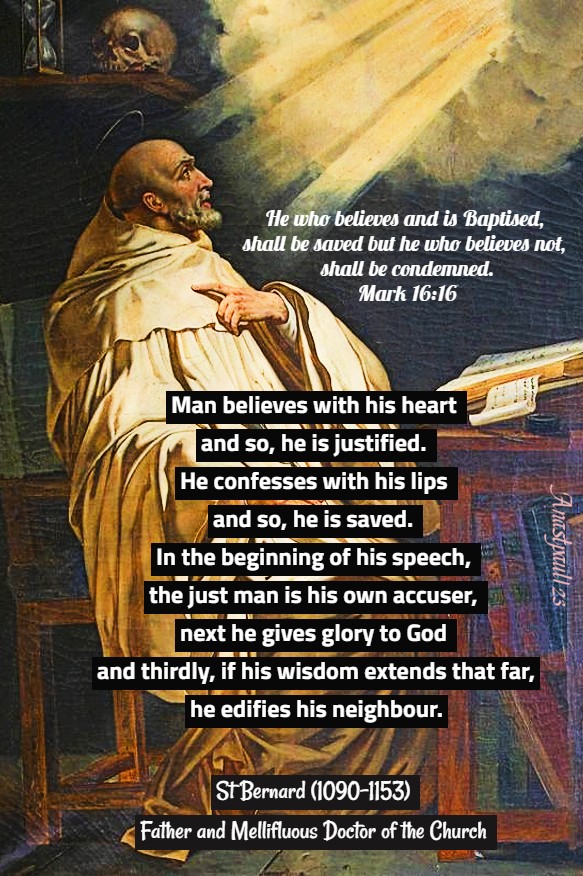
“He who believes and is Baptised, shall be saved but he who believes not, shall be condemned.”
Mark 16:16
“Man believes with his heart and so, he is justified. He confesses with his lips and so, he is saved. In the beginning of his speech, the just man is his own accuser, next he gives glory to God and thirdly, if his wisdom extends that far, he edifies his neighbour.”
St Bernard (1090-1153) The “Last Father” and Mellifluous Doctor of the Church
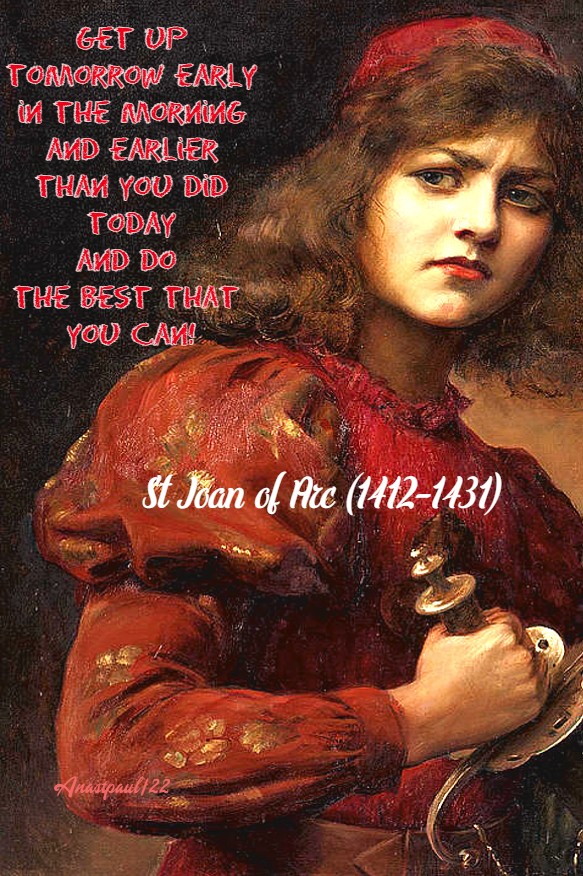
“Get up tomorrow early in the morning and earlier than you did today and do the best that you can!”
St Joan of Arc (1412-1431)
“The very prince of the universe, is man; the crowning point of man, is his heart; of the heart, is love and the perfection of love, is charity. That is why the love of God is the goal, the crowning point, the be-all and end-all of the universe.”
(Treatise on the Love of God, Book 10, Chapter 1)
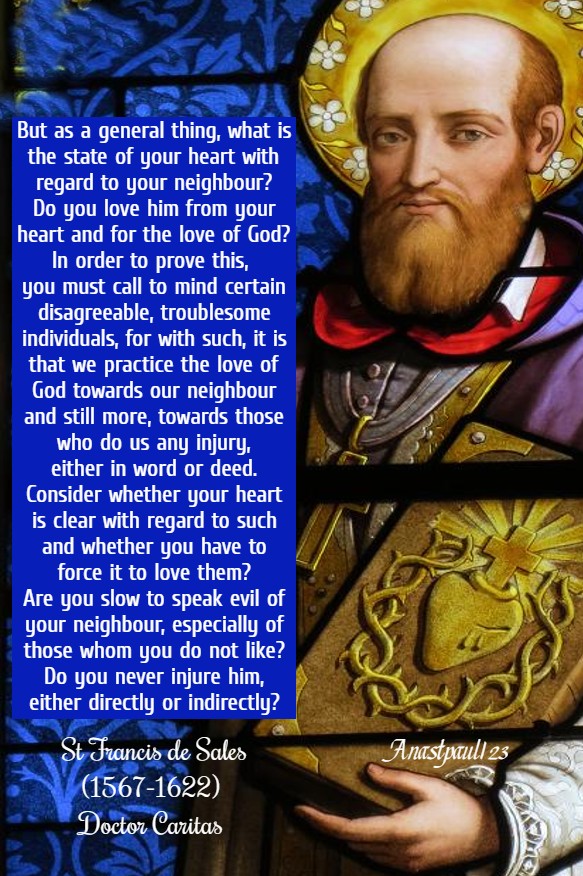
“But as a general thing, what is the state of your heart with regard to your neighbour? Do you love him from your heart and for the love of God? In order to prove this, you must call to mind certain disagreeable, troublesome individuals, for with such, it is that we practice the love of God towards our neighbour and still more, towards those who do us any injury, either in word or deed. Consider whether your heart is clear with regard to such and whether you have to force it to love them? Are you slow to speak evil of your neighbour, especially of those whom you do not like?” Do you never injure him, either directly or indirectly?”
(Introduction to the Devout Life).
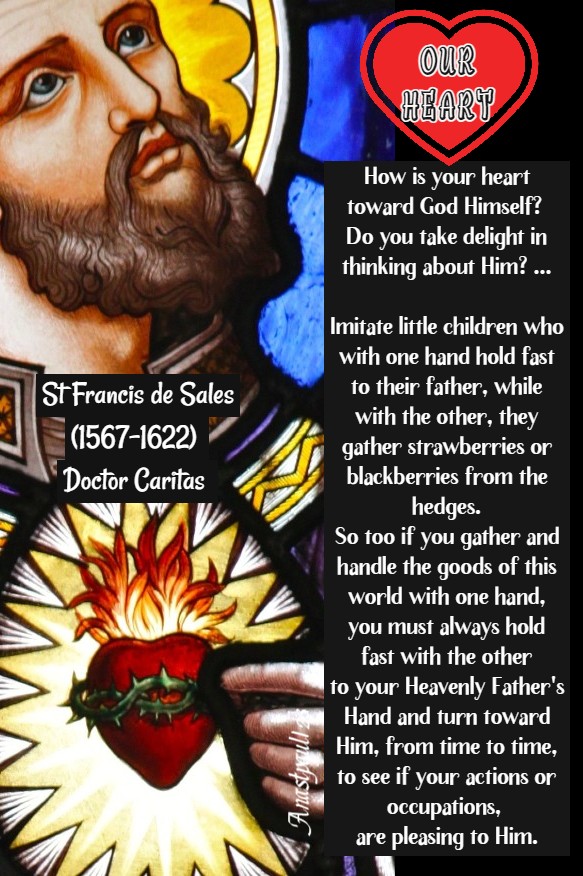
“HOW IS YOUR HEART TOWARDS GOD HIMSELF? Do you take delight in thinking about Him? … Imitate little children who, with one hand hold fast to their father, while with the other, they gather strawberries or blackberries from the hedges. So too if you gather and handle the goods of this world with one hand, you must always hold fast with the other to your Heavenly Father’s Hand and turn toward Him, from time to time, to see if your actions or occupations, are pleasing to Him.”
(Introduction to the Devout Life, Part 3, Chapter 10)
One Minute Reflection – 20 April – “The Month of the Resurrection” –Feria Day, Thursday in the Second Week of Easter – 1 John 5:4-10, John 20:19-31 – Scripture search here: https://www.drbo.org/
“My Lord and my God.” – John 20:28
REFLECTION – “Thomas said: “Unless I see the mark of the nails in His Hands and put my finger into the nailmarks and put my hand into His Side, I will not believe.” What an astonishing hardness of heart on this disciple’s part: not even the witness of so many of the brethren, nor even the sight of their joy, were enough to give him faith. Yet, the Lord appeared to take care of him. The good Shepherd does not allow the loss of His sheep (Mt 18:12) having said to His Father: “Thou gave them to me and none of them was lost” (Jn 17:6.12). Let the shepherds learn, then, what care they should show towards their sheep, since the Lord came for a single one. Any care and labour are a small thing, compared with the importance of one soul…
“Put your finger here and see My Hands, and bring your hand and put it into My Side, and do not be unbelieving but believe.” O blessed hand that penetrated the secrets of the Heart of Christ! What riches did they not find in it? It was while resting on this Heart that John drew out the Mysteries of Heaven (Jn 13:25), while penetrating It that Thomas found great treasures – what a wonderful school which forms such disciples! Thanks to this Heart, the former expressed marvellous things, higher than the stars, concerning the Divinity when he said: “In the beginning was the Word and the Word was with God and the Word was God” (Jn 1:1). And the latter, touched by the Light of Truth, cried out this sublime cry: “My Lord and my God!” – St Thomas of Villanova OSA (1486-1555) Hermit of Saint Augustine, Bishop (Sermon for Low Sunday (in Homiliarius Breviarii Romani).
PRAYER – Grant, we beseech Thee, O Lord God, unto all Thy servants that they may remain continually in the enjoyment of soundness, both of mind and body and, by the glorious intercession of the Blessed Mary, always a Virgin, may be delivered from present sadness and enter into the joy of Thine eternal gladness. Through Jesus Christ, Thy Son our Lord, Who lives and reigns with Thee, in the unity of the Holy Ghost, God, world without end. Amen (Collect).
Saint of the Day – 20 April – Blessed Hildegun of Schönau O.Cist. (Died 1188) Virgin, Cistercian Monk – yes! she was disguised as a boy as a child, for her own safety and after many frightening trials, decided to retain the identity in order to enter the Cistercian Monastery as Brother Joseph. Her true identity remained a secret until her death. Born in the Rhineland, Germany and died in 1188 in Schönau, Germany of natural causes. Also known as – Joseph, Brother Joseph, Hildegun of Neuss, Hildegunda of…. Hildegunde of…. Hildegund of…. (Hildegund should not be confused with Saint Hildegund (c1130–1178), whose Feast day is 6 February.)
Born to a noble family, her father Harper, took her on a pilgrimage to the Holy Land in 1182, when she was 12 years old. However, after landing at Tyre, Lebanon, Harper took ill and knew he would die. He entrusted her to the care of his manservant and, realising the dangers that could meet the girl on her return journey, her father dressed her as a boy.
No sooner was Harper buried, however, than the servant absconded with the money given him for expenses and abandoned Hildegun. Still dressed as a boy, she took the name Joseph for the patron of families and children. Left to beg on the streets, a well-connected German pilgrim saw her and offered to return her to her home but failed to fulfil his plans.
By 1187, Hildegun was moved by a call to the religious life. Thus she entered the Cistercian Monastery at Schönau — without mentioning that she was a young woman.
After a year’s novitiate and three days before she was to take her monastic vows, she took ill, dying on 20 April 1188. Only while preparing her for burial did the Monks discover her actual sex.
St Caedwalla of Wessex Bl Catwallon St Domninus of Digne Bl Gerald of Salles Bl Harduin Blessed Hildegun of Schönau (Died 1188) Virgin St Hugh of Anzy-le-Duc Bl John of Grace-Dieu
St Marcian of Auxerre St Margaret of Amelia Bl Maurice MacKenraghty St Michel Coquelet Bl Oda of Rivreulle St Sara of Antioch St Secundinus of Córdoba St Servilian
Blessed Simon Rinalducci OSA (Died 1322) Priest, Friar of the Order of the Hermits of St Augustine, noted for his theological studies, Prior of several houses, renowned Preader, Miracle-worker. Blessed Simon was a model of humility and obedience, even in the face of great trials and obvious injustices. Simon was Beatified on 19 March 1833 by Pope Gregory XVI (cultus confirmed). His Life: https://anastpaul.com/2021/04/20/saint-of-the-day-blessed-simon-rinalducci-osa-died-1322/
St Sulpicius St Theodore Trichinas St Theotimus of Tomi St Vincent of Digne St Wiho of Osnabrück
Thought for the Day – 19 April – Meditations with Antonio Cardinal Bacci (1881-1971)
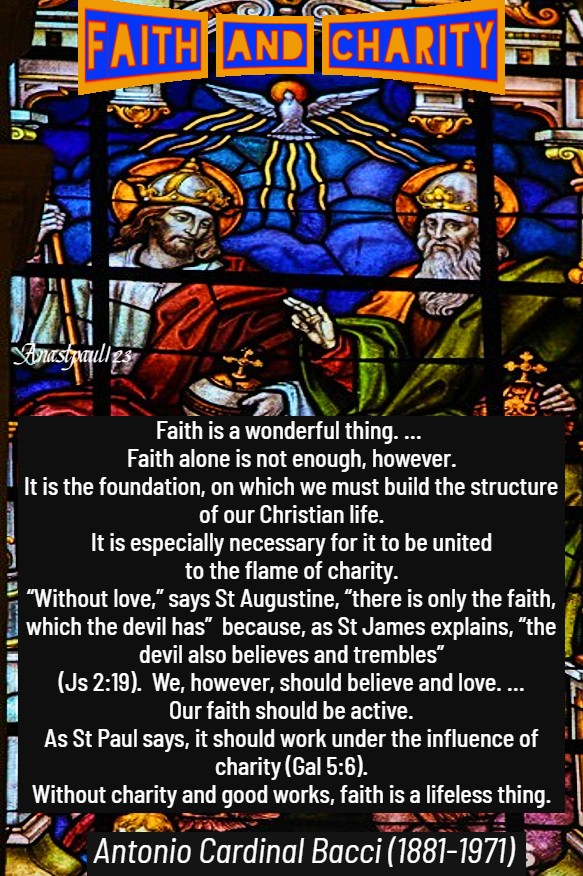
Faith and Charity
“Faith is a wonderful thing. As has been said, it is a supernatural gift from God, which we should keep alive by prayer. Faith alone is not enough, however. It is the foundation, on which we must build the structure of our Christian life. It is especially necessary for it to be united to the flame of charity. “Without love,” says St Augustine, “there is only the faith, which the devil has” (De Caritate 10) because, as St James explains, “the devil also believes and trembles” (Js 2:19). We, however, should believe and love. We must combine faith with charity towards God and towards our neighbour. Our faith should be active. As St Paul says, it should work under the influence of charity (Gal 5:6). Without charity and good works, faith is a lifeless thing.
If we really believe, we should love God above all things, even more than we love ourselves and, we should be ready to make any sacrifice for Him, even the sacrifice of our lives.
Faith should induce us to think constantly of God and charity should urge us to do everytig for His sake, rather than for any lesser purpose. If we lack this kind of charity, we cannot claim to be sincere Christians.”
Quote/s of the Day – 19 April – Feria Day, Wednesday in the Second Week of Easter – 1 John 5:4-10, John 20:19-31 – Scripture search here: https://www.drbo.org/
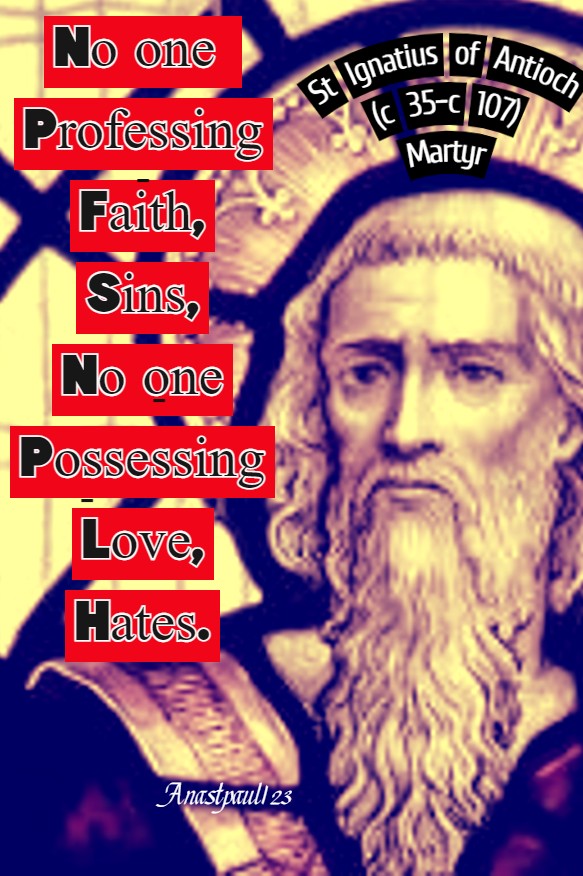
“Blessed are they who have not seen and have believed.”
St Ignatius of Antioch (c35–c107) Bishop, Martyr, Apostolic Father
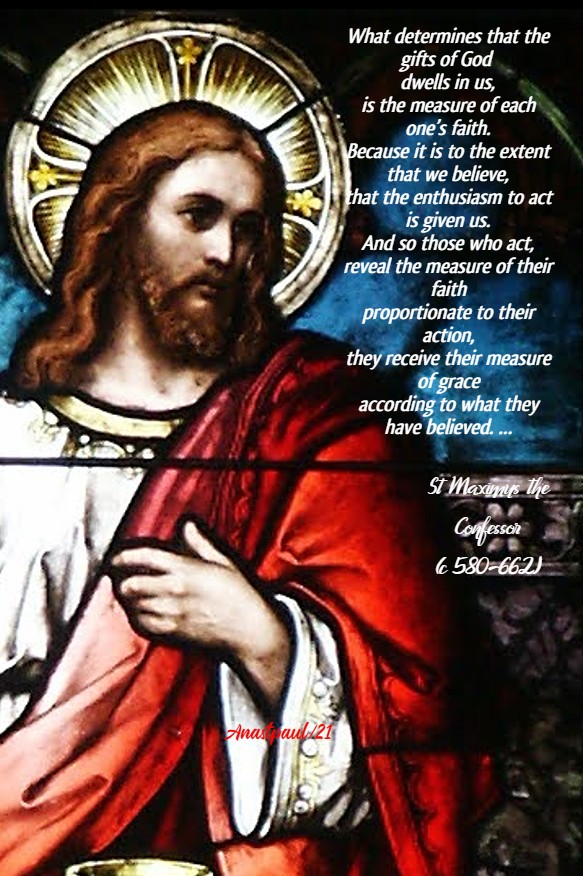
“What determines that the gifts of God dwells in us, is the measure of each one’s faith. Because it is to the extent that we believe that the enthusiasm to act is given us. And so those who act, reveal the measure of their faith proportionate to their action, they receive their measure of grace according to what they have believed. …”
St Maximus the Confessor (c 580-662) Monk and Theologian
“If we wish to make any progress in the service of God, we must begin everyday of our life, with new eagerness. We must keep ourselves, in the presence of God, as much as possible and have no other view or end, in all our actions but the Divine honour.”
St Charles Borromeo (1538-1584)
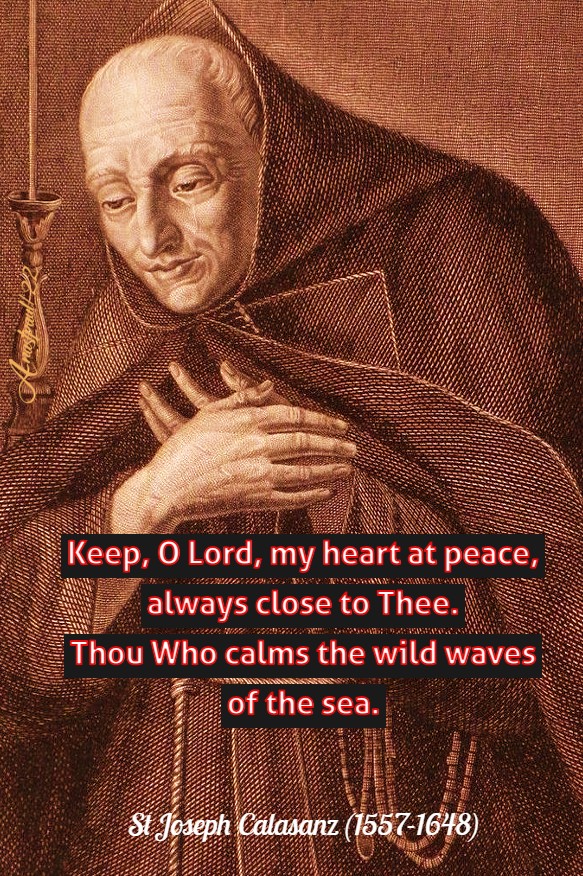
“Keep, O Lord, my heart at peace, always close to Thee. Thou Who calms the wild waves of the sea.”
One Minute Reflection – 19 April – “The Month of the Resurrection” – Feria Day, Wednesday in the Second Week of Easter – 1 John 5:4-10, John 20:19-31 – Scripture search here: https://www.drbo.org/
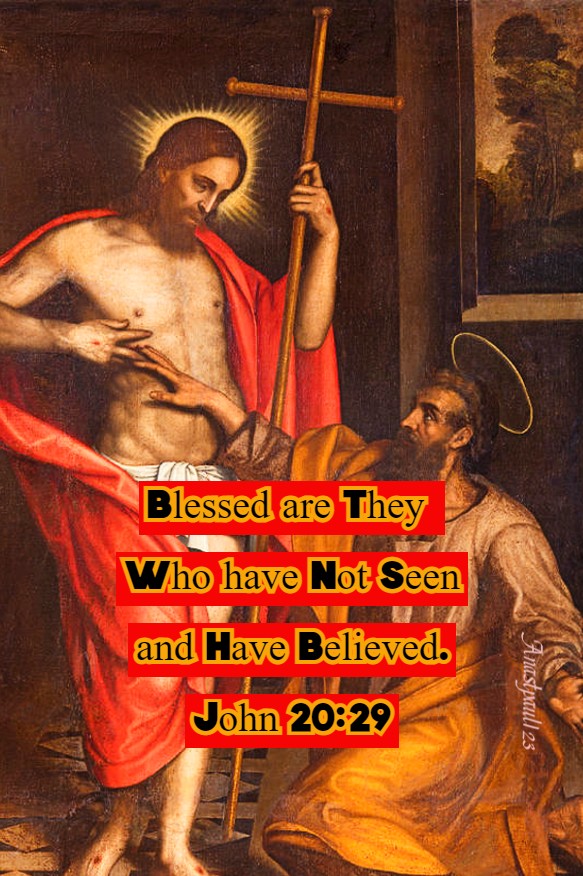
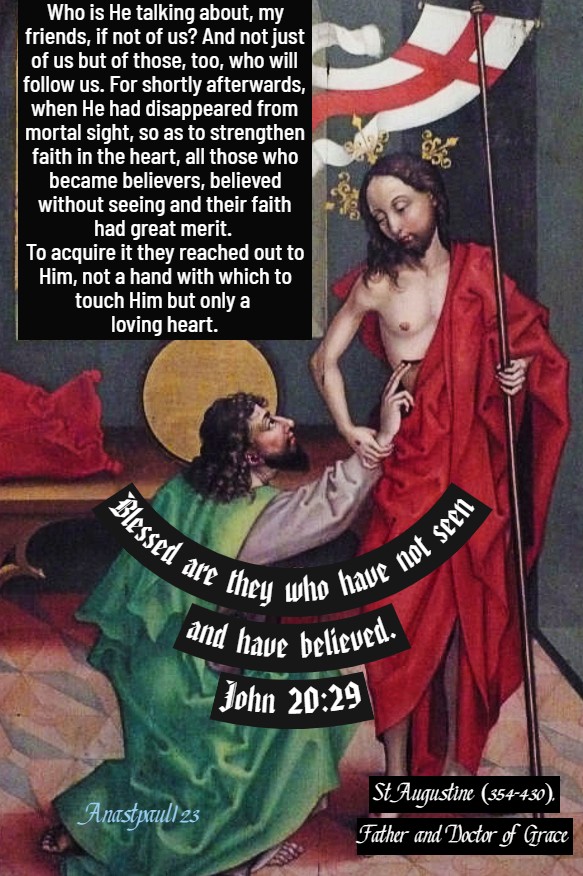
“Blessed are they who have not seen and have believed.” – John 20:29
REFLECTION – “The disciples’ weakness was so unsteady that, not content with seeing the Risen Lord, they still wanted to touch Him if they were to believe in Him. It was not enough for them to see Him with their eyes, they wanted to put out their hands to His limbs and touch the marks of His recent Wounds. It was after he had touched and acknowledged his scars that the unbelieving disciple cried out: “My Lord and my God!” Those scars revealed the One Who, where other people were concerned, healed every wound. Could the Lord not have Risen without scars? Yet He saw, within His disciples’ hearts, wounds which those scars He had preserved in His Body ,would heal.
And what does the Lord answer that confession of faith of His disciple, who says: “My Lord and my God”? “Have you come to believe because you have seen me? Blessed are those who have not seen and have believed.” Who is He talking about, my friends, if not of us? And not just of us but of those, too, who will follow us. For shortly afterwards, when He had disappeared from mortal sight, so as to strengthen faith in the heart, all those who became believers, believed without seeing and their faith had great merit. To acquire it they reached out to Him, not a hand with which to touch Him but only a loving heart.” – St Augustine (354-430), Bishop of Hippo, Father and Doctor of Grace (Sermon 88).
PRAYER – Grant, we beseech Thee, O Lord God, unto all Thy servants that they may remain continually in the enjoyment of soundness, both of mind and body and, by the glorious intercession of the Blessed Mary, always a Virgin, may be delivered from present sadness and enter into the joy of Thine eternal gladness. Through Jesus Christ, Thy Son our Lord, Who lives and reigns with Thee, in the unity of the Holy Ghost, God, world without end. Amen (Collect).
Our Morning Offering – 19 April – Feria Day, Wednesday in the Second Week of Easter
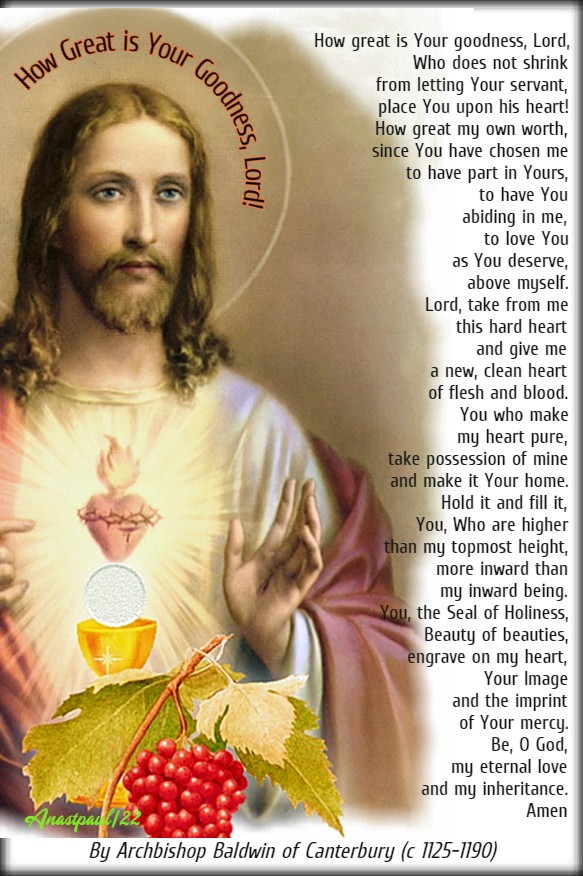
How Great is Your Goodness, Lord! By Archbishop Baldwin of Canterbury (c 1125-1190)
How great is Your goodness, Lord, Who does not shrink from letting Your servant, place You upon his heart! How great my own worth, since You have chosen me to have part in Yours, to have You abiding in me, to love You as You deserve, above myself. Lord, take from me this hard heart and give me a new, clean heart of flesh and blood. You Who make my heart pure, take possession of mine and make it Your home. Hold it and fill it, You, Who are higher than my topmost height, more inward than my inward being. You, the Seal of Holiness, Beauty of beauties, engrave on my heart, Your Image and the imprint of Your mercy. Be, O God, my eternal love and my inheritance. Amen
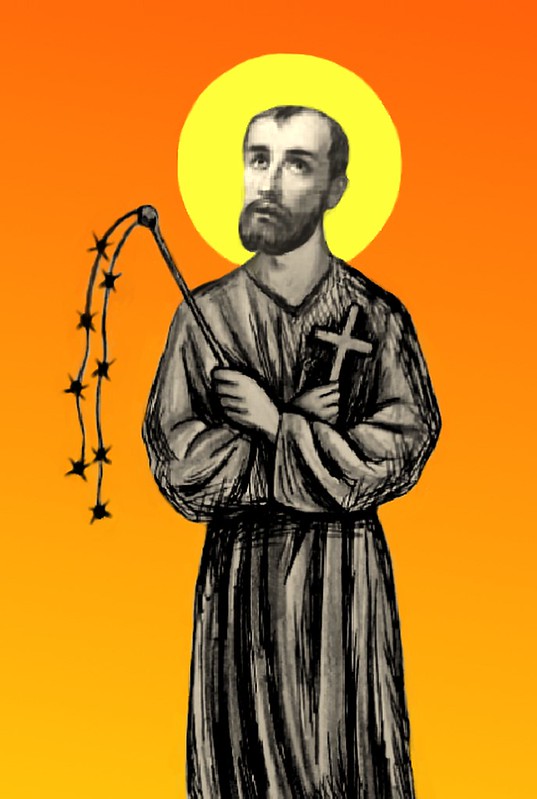
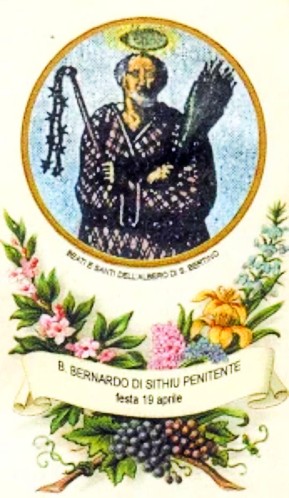
Saint of the Day – 19 April – Blessed Bernard of Sithiu (Died 1182) Layman Penitent, Pilgrim, Hermit Died on 19 April 1182 in the Monastery of Saint-Bertin, Thérouanne region, France of natural causes. Patronages – of sinners, convicts, prisoners, penitents, pilgrims. Also known as – Bernard of Maguellone, Bernard the Penitent, Bernard the Pilgrim.
The Roman Martyrology: “At the Monastery of Saint-Bertin in the territory of France in Thérouanne, lies the tomb of Blessed Bernard, penitent, who, eager to atone for the sins of his youth with an austere penitence, voluntarily chose exile and, barefooted, wearing rough garments, was a tireless pilgrim to the holy places.”
Like St Nicholas of Trani, St Benedict Joseph Labre, St Rocco and several others this Saint lived as an itinerant pilgrim to the Shrines of Europe.
The few reports received about the life of Blessed Bernard of Sithiu are those handed down in the writings of John of Sithiu, Abbot in 1187, a source of extraordinary interest. There is also the Office composed in his honour and in 1465, an inventory of his remains are cited, “relics of St Bernard, Penitent. “
From such documents and testimonies, we discover that Bernard, following a murder, was ordered to make a pilgrimage of atonement.
After wandering far and wide for a long time, he finally settled near the former town of Sithiu, where, for four years he lived in poverty and deprivation. He prayed and fasted incessantly and endured the elements, as well as many other trials and sufferings. He became a very saintly man in love with God and self-renunciation. Finally dying on 19 April 1182.
The fame for holiness which was gained in life, was later confirmed after death, by many miracles occurring at his tomb.
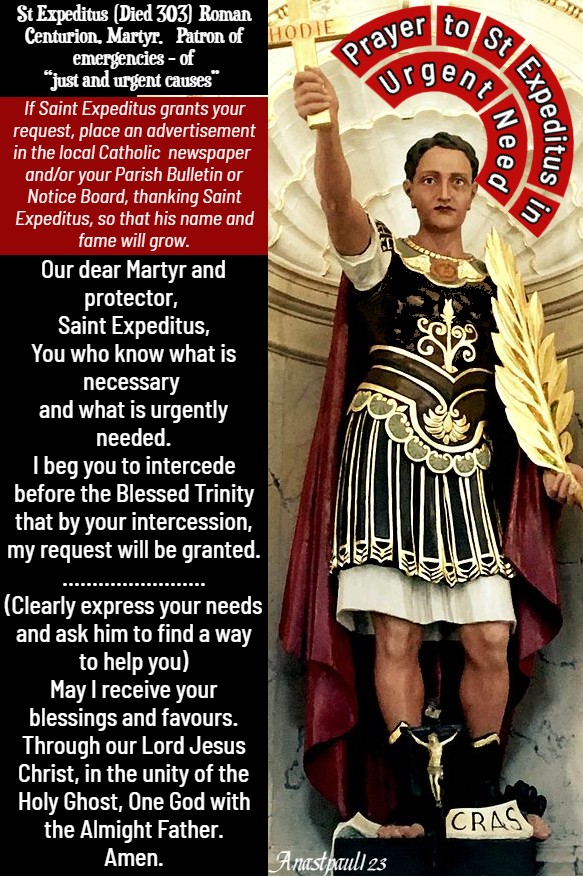
Our dear Martyr and protector, Saint Expeditus, You who know what is necessary and what is urgently needed. I beg you to intercede before the Blessed Trinity that by your intercession, my request will be granted. …………………… (Clearly express your needs and ask him to find a way to help you.) May I receive your blessings and favours. Through our Lord Jesus Christ, in the unity of the Holy Ghost, One God with the Almighty Father. Amen.
If Saint Expeditus grants your request, place an advertisement in the local Catholic newspaper and/or your Parish Bulletin or Notice Board, thanking Saint Expeditus, so that his name and fame will grow.
St Gaius of Melitene St Galata of Melitene St George of Antioch St Gerold of Saxony
St Pope Leo IX (1002-1054) known as “Apostolic Pilgrim” When the German Pope Damasus II died in 1048, Bishop Bruno was selected by the Emperor, Henry III, to succeed him. Bruno agreed to go to Rome and to accept the Papacy if freely elected thereto by the Roman people. He wished, at least, to rescue the See of Peter from its servitude to the German Emperors. When, in company with Hildebrand he reached Rome and presented himself to its people clad in pilgrim’s guise and barefooted but still tall and fair to look upon, they cried out with one voice that him and no other would they have as Pope. Assuming the name of Leo, he was solemnly enthronedon 12 February, 1049. Biography: https://anastpaul.wordpress.com/2018/04/19/saint-of-the-day-19-april-st-pope-leo-ix-1002-1954/
St Martha of Persia St Rufus of Melitene St Vincent of Collioure
Martyrs of Carthage – 17 Saints: A group of Christians Martyred in the persecutions of Decius. We know little more than the names – Aristo, Basso, Credula, Donato, Ereda, Eremio, Fermo, Fortunata, Fortunio, Frutto, Julia, Mappalicus, Martial, Paul, Venusto, Victorinus and Victor. Died in the year 250 in prison in Carthage, North Africa (modern Tunis, Tunisia).
Thought for the Day – 18 April – Meditations with Antonio Cardinal Bacci (1881-1971)
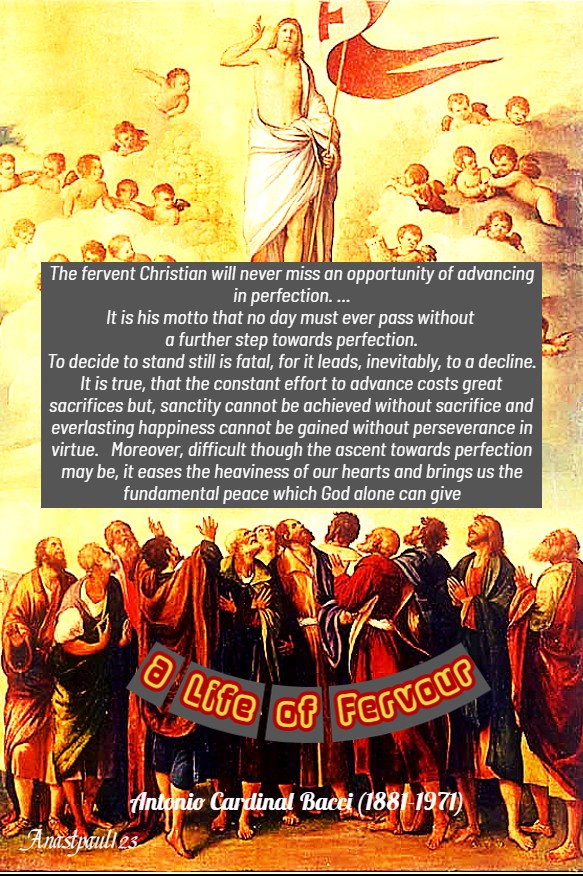
A Life of Fervour
“The fervent Christian will never miss an opportunity of advancing in perfection. When he feels that he is growing negligent, he combats the signs of spiritual retrogression and makes a new beginning, by telling God that he wishes to belong entirely to Him. It is his motto that no day must ever pass without a further step towards perfection. To decide to stand still is fatal, for it leads, inevitably, to a decline. It is true, that the constant effort to advance costs great sacrifices but, sanctity cannot be achieved without sacrifice and everlasting happiness cannot be gained without perseverance in virtue. Moreover, difficult though the ascent towards perfection may be, it eases the heaviness of our hearts and brings us the fundamental peace which God alone can give.”
Quote/s of the Day – 18 April – “The Month of the Resurrection” – Tuesday in the Second Week of Easter – 1 John 5:4-10, John 20. 19-31 – Scripture search here: https://www.drbo.org/
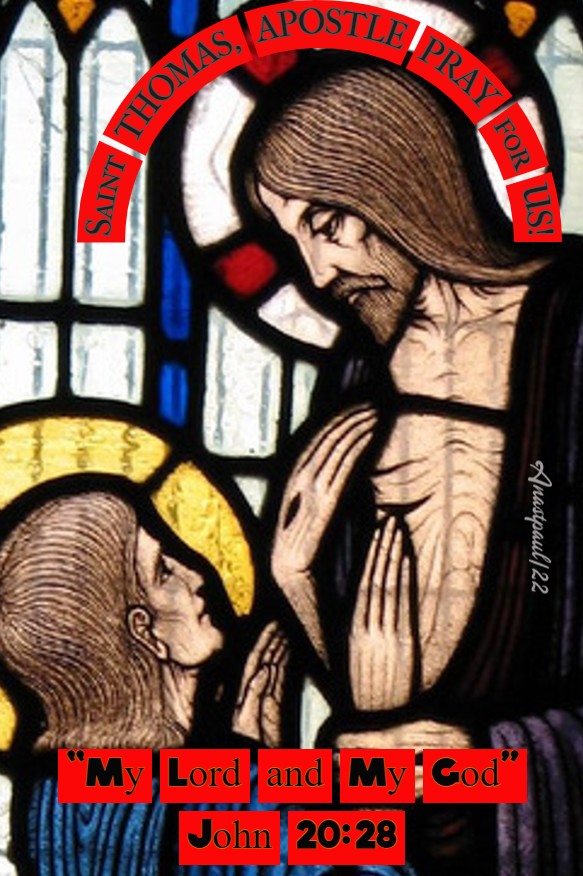
“My Lord and my God.”
John 20:28
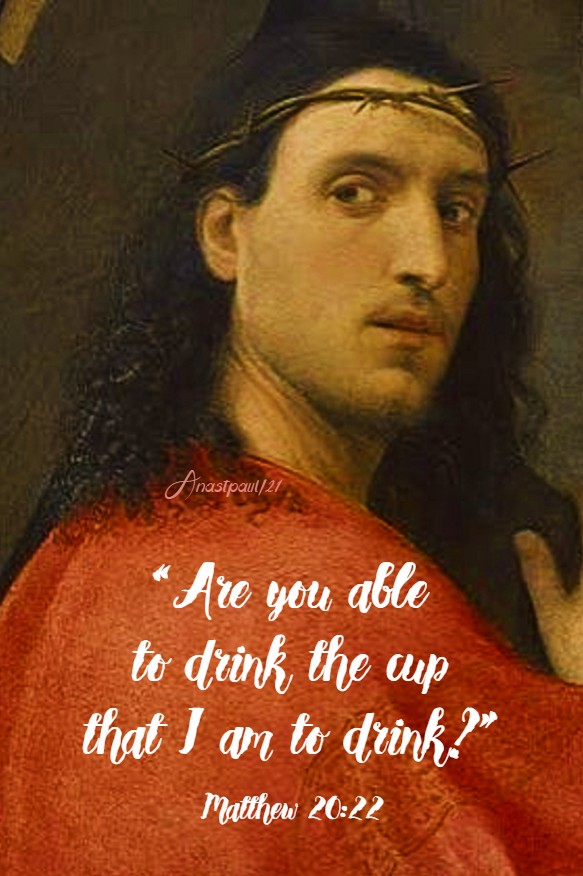
“Are you able to drink the cup that I am to drink?”
Matthew 20:22
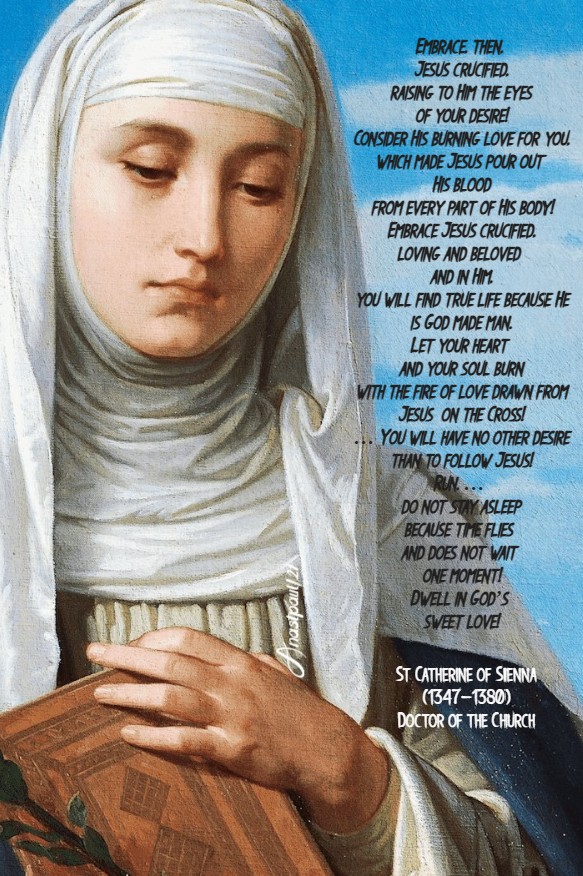
“Embrace, then, Jesus Crucified, raising to Him the eyes of your desire! Consider His burning love for you which made Jesus pour out His Blood from every part of His body! Embrace Jesus Crucified, loving and beloved and in Him, you will find true life because He is God made Man. Let your heart and your soul burn with the fire of love drawn from Jesus on the Cross! … You will have no other desire than to follow Jesus! Run, … do not stay asleep because time flies and does not wait one moment! Dwell in God’s sweet love!”
St Catherine of Sienna (1347-1380) Doctor of the Church
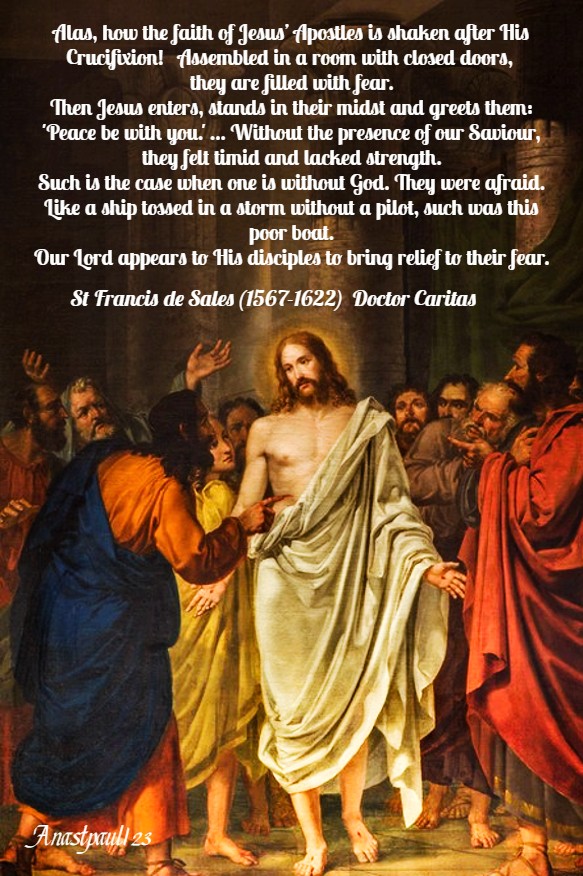
“Alas, how the faith of Jesus’ Apostles is shaken after His Crucifixion! Assembled in a room with closed doors, they are filled with fear. Then Jesus enters, stands in their midst and greets them: ‘Peace be with you.’ … Without the presence of our Saviour, they felt timid and lacked strength. Such is the case when one is without God. They were afraid. Like a ship tossed in a storm without a pilot, such was this poor boat. Our Lord appears to His disciples to bring relief to their fear.”
One Minute Reflection – 18 April – “The Month of the Resurrection” – Tuesday in the Second Week of Easter – 1 John 5:4-10, John 20. 19-31 – Scripture search here: https://www.drbo.org/
“Thomas answered and said to Him: My Lord and my God.” – John 20:28
REFLECTION – “ Why did Thomas seek proof for his faith in this way? … Your love, my brethren, would have preferred it, if lack of faith had left no-one in doubt after the Resurrection. But Thomas bore the uncertainty, not only of his own heart but of all people. And since he was to preach the Resurrection to the gentiles, he sought out, like a good workman, what he would base a Mystery on which demands so much faith. And the Lord showed all the Apostles what Thomas had sought so late. “Jesus came … and showed them His Hands and His Side” (Jn 20:19-20). Indeed, the Person Who entered when the doors were shut, might have been taken for a spirit, by the disciples, if he had not been able to show them that it was none other than He, the Wounds being the mark of His Passion.
Then He came to Thomas and said to him: ”Put your hand in My Side and do not be unbelieving but believe. May the Wounds you are opening make faith flow into the whole world once more, those Wounds which have already poured out the water of Baptism and the Blood of Redemption.” (Jn 19:34). Thomas replied: “My Lord and my God!” Let unbelievers come and hear and, as our Lord said, let them no longer be doubters but believers. Thomas makes known and declares that this is not just a human Body but that, by the Passion of His Body of Flesh, Christ is God and Lord. He Who comes out alive from death and Who rises out of His woundedness is God indeed!” – St Peter Chrysologus (406-450) Bishop of Ravenna, Father and Doctor of the Church (Sermon 84).
PRAYER – Grant, we beseech Thee, Almighty God that we, who have celebrated the Paschal Feast, may, by Thy bounty, retain its fruits in our daily habits and behaviour. Through Jesus Christ, Thy Son our Lord, Who lives and reigns with Thee, in the unity of the Holy Ghost, God, world without end. Amen (Collect).
Our Morning Offering – 18 April – Tuesday in the Second Week of Easter
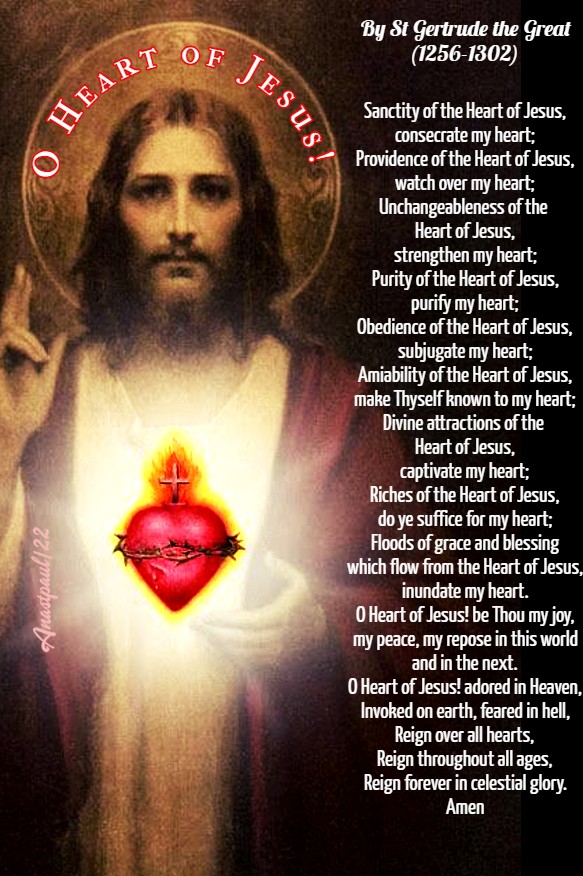
O Heart of Jesus! By St Gertrude the Great (1256-1302)
Sanctity of the Heart of Jesus, consecrate my heart; Providence of the Heart of Jesus, watch over my heart; Unchangeableness of the Heart of Jesus, strengthen my heart; Purity of the Heart of Jesus, purify my heart; Obedience of the Heart of Jesus, subjugate my heart; Amiability of the Heart of Jesus, make Thyself known to my heart; Divine attractions of the Heart of Jesus, captivate my heart; Riches of the Heart of Jesus, do ye suffice for my heart; Floods of grace and blessing which flow from the Heart of Jesus, inundate my heart. O Heart of Jesus! be Thou my joy, my peace, my repose in this world and in the next. O Heart of Jesus! adored in Heaven, Invoked on earth, feared in hell, Reign over all hearts, Reign throughout all ages, Reign forever in celestial glory. Amen
Saint of the Day – 18 April – Blessed Barbara Aurillot / Marie of the Incarnation OCD (1566-1618) Widow, Third Order Lay Discalced Carmelite Sister, Apostle of Charity, Mystic. Barbara is considered the Foundress of the French branch of Carmel. She was known for receiving visions and ecstasies and for supernatural gifts. Born on 1 February 1566 at Paris, France as Barbe Aurillot and died on 18 April 1618 at Pontoise, France of natural causes. Patronages – against impoverishment, against loss of parents, against poverty, parents separated from children, the poor, widows. Also known as – Le belle Acarie (the beautiful Acarie), as she was known in Paris, Barbara Aurillot, Barbara Avrillot, Barbe Acarie, Barbe Aurillot, Barbe Avrillot, Madame Acarie, Marie Acarie Marie or Mary of the Incarnation.
Barbara was the daughter of a French Government Official named Nicholas Aurillot,the Accountant General in the Paris Chamber and Chancellor of Marguerite of Navarre, first wife of Henri IV. Her mother, Marie Lhuillier. was a descendant of Etienne Marcel, the famous prévôt des marchands (Chief municipal Magistrate). She was educated at her Aunt’s Convent at Longchamps, the Minor Sisters of Humility of Our Lady.
Although Barbara was attracted to the religious life, at the age of 16 in 1684, through obedience, she was married to Pierre Acarie, the Viscount of Villemoran, a wealthy young man of high standing, who was a fervent Catholic and Government Treasury Official. She became the Mother of six children, three of whom became Carmelites Nuns and one a Priest.
Her husband, Pierre, supported the Catholic League, of which he was a staunch member, against Henry IV. Pierre was one of the sixteen who organised the resistance in Paris. When Henry became King, he seized the Acarie estates, impoverished the family and exiled Pierre from Paris, separated husband and father from his family. Barbara had to contend with creditors and irate businessmen. Although she had been severely injured due to a fall from her horse and medical treatment which had only made matters worse and left her an invalid for the rest of her life. Barbara still, legally challenged the matter and went to Court to fight and she won. The family was able to reclaim part of the their property and fortune.
Barbara was devoted to the writings of Saint Teresa of Avila. Her good works eventually won her the admiration and support of the same King Henry! who assisted her later when she was the greatest protagonist in bringing the reformed Carmelites of St Teresa to France. At this time, she received a vision of St Teresa who informed her that God wished Barbara to do this work.
At the beginning of the Seventeenth Century Madame Acarie was widely known for her virtue, her supernatural gifts and especially, for her charity towards the poor and the sick in the hospitals. To her residence came all the distinguished and devout people of the day. Among them was St Vincent de Paul and St Francis de Sales, the latter of whom became her Spiritual Counsellor.
Barbara was instrumental in bringing the Discalced Carmelites of Saint Teresa to France, founding five houses between 1604 and 1609. The Carmel spread rapidly and profoundly influenced the French religious and secular society of the day. In 1618, the year of Barbara’s death, Carmel numbered fourteen houses.
She also shared in two foundations of the day, that of the Oratory and of the Ursulines. She urged De Bérulle to refuse the tutorship of Louis XIII and on 11 November 1611, she, with St Vincent de Paul, assisted at the Mass of the installation of the Oratory of France.
Among the many postulants whom Mme Acarie received for the Carmel, there were some who had no vocation and she conceived the idea of getting them to undertake the education of young girls and broached her plan to her holy cousin, Mme. de Sainte-Beuve. To establish the new order they brought Ursulines to Paris and adopted their rule and name.
When Pierre died in 1613, his widow settled her affairs and begged leave to enter the Carmel, asking as a favour to be received as a lay sister in the poorest community. In 1614 she withdrew to the Monastery of Amiens, taking the name of Marie of the Incarnation. Her three daughters had preceded her into the cloister and one of them was Sub-prioress at Amiens. In 1616, by order of her Superiors for health reasons, she went to the Carmelite Convent at Pontoise, where she died at the aged of 52/53. St Francis de Sales considered her death in spiritual poverty as laudable as that of St Francis Xavier’s, who died in utter physical poverty.
Her cause was introduced at Rome in 1627 and she was Beatified on 24 April 1791 by Pope Pius VI – her Feast is widely celebrated in Paris on 18 April. Her mortal remains are in the Chapel of the Carmelites of Pontoise.
It has been said that the vigorous and saintly Madame Acarie, provided the first definite impulse towards that interior growth which made the exquisite and urbane St Francis de Sales, a fit guide for the soul of St Jane Frances de Chantal.
St Agia of Hainault St Anthia of Illyria St Antusa of Constantinople Saint Apollonius the Apologist
St Athanasia of Aegina
Blessed Barbara Aurillot / Marie of the Incarnation O.Carm (1566-1618) Widow, Lay Carmelite Sister St Bitheus St Calocerus of Brescia St Cogitosus St Corebus St Eleuterius of Illyria St Elpidius of Melitene St Eusebius of Fano St Galdinus of Milan St Gebuinus of Lyons St Genocus St Hermogenes of Melitene
Blessed Idesbald of Dunes O.Cist (c1095-1167) Cistercian Priest and Abbot of Ten Duinen Abbey, Our Lady of the Dunes. The Roman Martyrology states: “In Bruges in Flanders, in today’s Belgium, Blessed Idesbaldo, Abbot, who, soon became a widower and exercised for another thirty years, duties in the palace of the Counts, entered the Monastery of Dune at a mature age, which he held holy, as the third Abbot for twelve years.” Biography: https://anastpaul.com/2021/04/18/saint-of-the-day-18-april-blessed-idesbald-of-dunes-o-cist-c-1095-1167/
Thought for the Day – 17 April – Meditations with Antonio Cardinal Bacci (1881-1971)
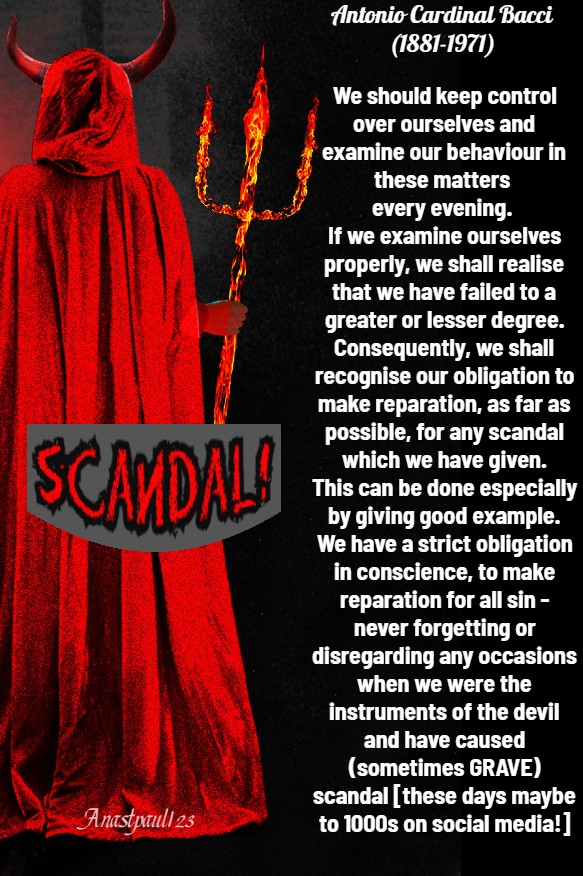
SCANDAL!
“Some people are careful to avoid giving grave scandal but do not give it a thought in matters which they regard as trivial. They have no scruples about imprudent gestures, malicious innuendoes, double-meaning conversations, acts of impatience, lack of understanding or constant grumbling. Such things may seem trivial in themselves but can cause a great deal of harm in certain circumstances and in certain types of company.
We should keep control over ourselves and examine our behaviour in these matters every evening. If we examine ourselves properly, we shall realise that we have failed to a greater or lesser degree. Consequently, we shall recognise our obligation to make reparation, as far as possible, for any scandal which we have given. This can be done especially by giving good example. We have a strict obligation in conscience, to make reparation for all sin – never forgetting or disregarding any occasions when we were the instruments of the devil and have caused (sometimes GRAVE) scandal [these days maybe to 1000s on social media!].”
Quote/s of the Day – 17 April – 1 Peter 5:1-4; 5:10-11, Matthew 16:13-19 – Scripture search here: https://www.drbo.org/
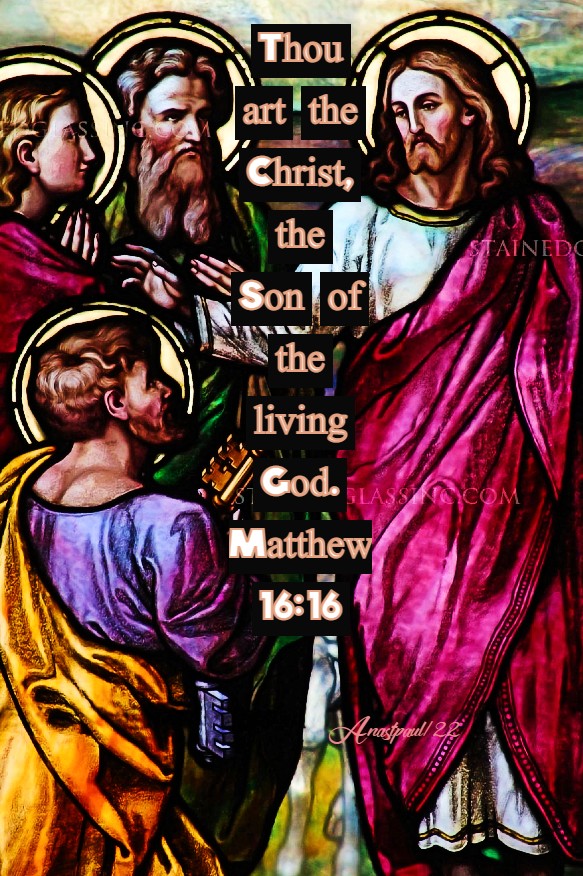
“Simon Peter answered and said: Thou art Christ, the Son of the living God.”
Matthew 16:16
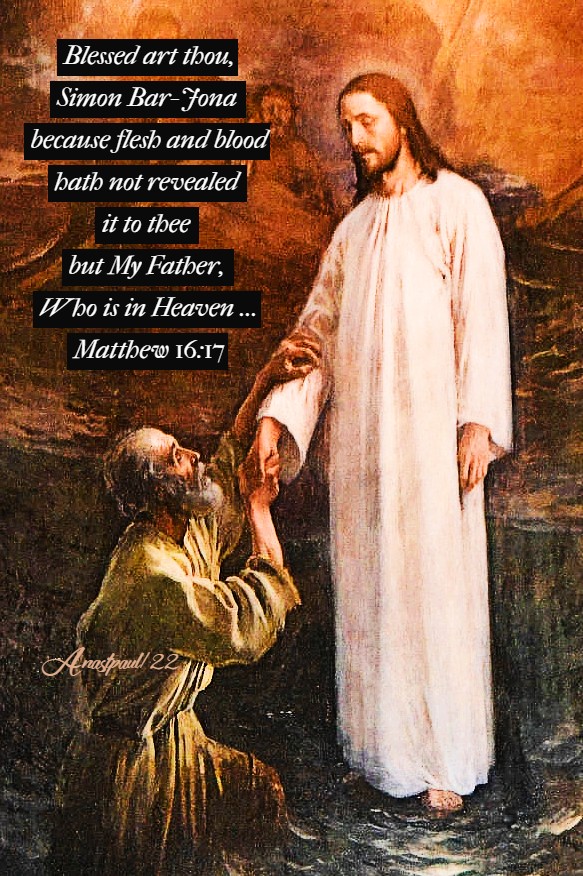
“Blessed art thou, Simon Bar-Jona because flesh and blood hath not revealed it to thee but My Father Who is in Heaven.”
Matthew 16:17
“If I only touch his garment, I will be made well.” Jesus turned and seeing her he said, “Take heart, daughter, your faith has made you well.” And instantly the woman was made well.”
Matthew 9:21-22
“… A tree is known by its fruit. So those who profess to belong to Christ will be known, by what they do. For the work we are about, is not a matter of words, here and now but depends on the power of faith and on being found faithful, to the end!”
St Ignatius of Antioch (c35–c107) Bishop, Martyr, Apostolic Father
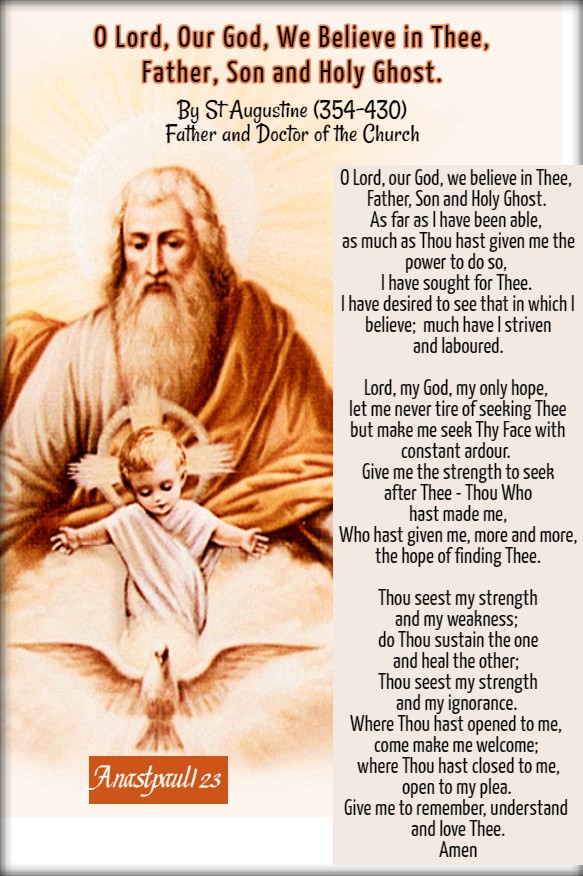
O Lord, Our God, We Believe in Thee, Father, Son and Holy Ghost. By St Augustine (354-430) Father and Doctor of the Church
O Lord, our God, we believe in Thee, Father, Son and Holy Ghost. As far as I have been able, as much as Thou hast given me the power to do so, I have sought for Thee. I have desired to see that in which I believe; much have I striven and laboured.
Lord, my God, my only hope, let me never tire of seeking Thee but make me seek Thy Face with constant ardour. Give me the strength to seek after Thee – Thou Who hast made me, Who hast given me, more and more, the hope of finding Thee.
Thou seest my strength and my weakness; do Thou sustain the one and heal the other; Thou seest my strength and my ignorance. Where Thou hast opened to me, come make me welcome; where Thou hast closed to me, open to my plea. Give me to remember, understand and love Thee. Amen
“May Christ be heard in our language, may Christ be seen in our life, may He be perceived in our hearts”
St Peter Damian (1007-1072) Doctor of the Church
“Faith is like a bright ray of sun light. It enables us to see God in all things, as well as all things in God.”
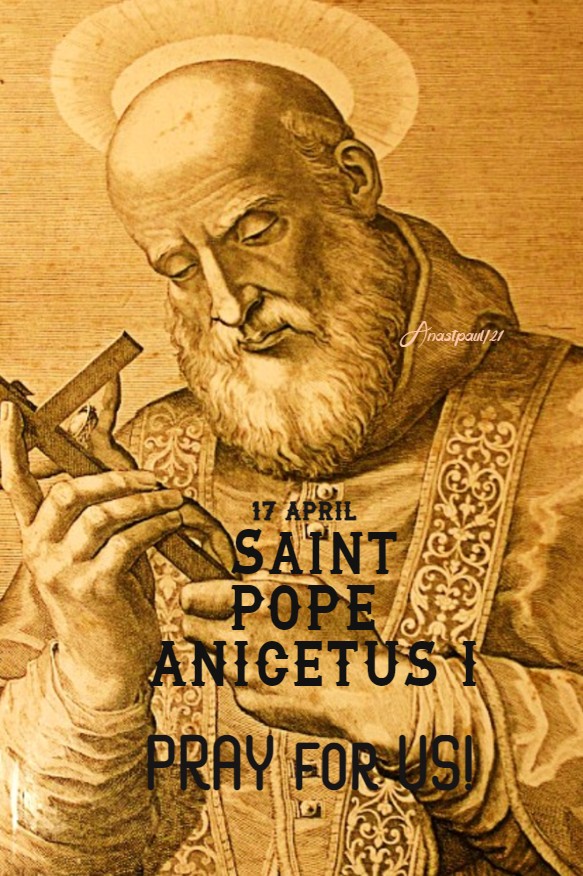
One Minute Reflection – 17 April – St Pope Anicetus (Died 168) 12th Bishop of Rome and Martyr – 1 Peter 5:1-4; 5:10-11, Matthew 16:13-19 – Scripture search here: https://www.drbo.org/
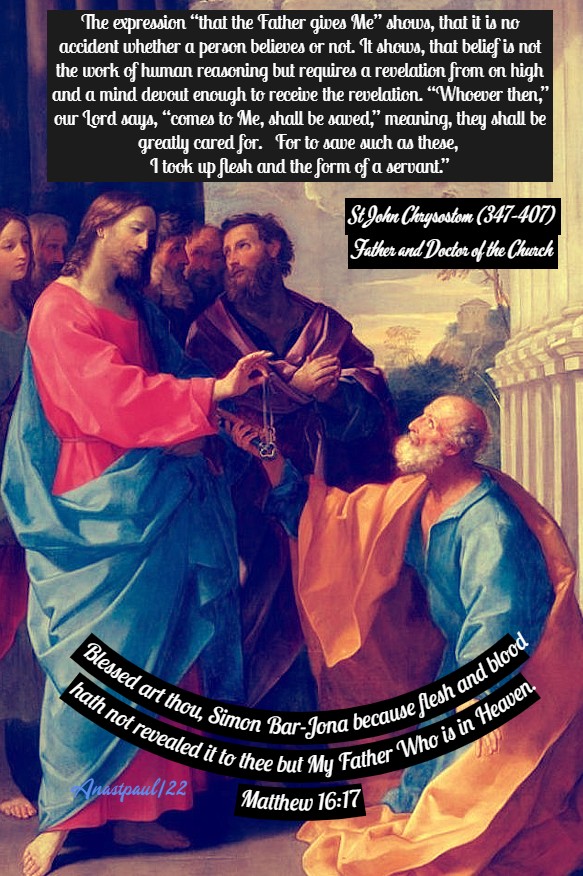
“Blessed art thou, Simon Bar-Jona because flesh and blood hath not revealed it to thee but My Father Who is in Heaven.” – Matthew 16:17
REFLECTION – “Faith in Me, He intimates here, is no ordinary thing or one that comes from human reason but [it] needs a revelation from above. And this He establishes throughout His discourses, showing, that this faith requires a noble sort of soul and one drawn on by God. The expression “that the Father gives Me” shows, that it is no accident whether a person believes or not. It shows, that belief is not the work of human reasoning but requires a revelation from on high and a mind devout enough to receive the revelation. “Whoever then,” our Lord says, “comes to Me, shall be saved,” meaning, they shall be greatly cared for. For to save such as these, I took up flesh and the form of a servant.” – St John Chrysostom (347-407) Archbishop of Constantinople, Father and Doctor of the Church (Homilies on the Gospel of John 45)”
PRAYER – Look forgivingly on Thy flock, Eternal Shepherd and keep it in Thy constant protection, by the intercession of blessed Anicetus, Thy Martyr and Sovereign Pontiff, whom Thou didst constitute Shepherd of the whole Church.Through Jesus Christ, Thy Son our Lord, Who lives and reigns with Thee, in the unity of the Holy Ghost, God, world without end. Amen (Collect).
Our Morning Offering – 17 April – “The Month of the Resurrection” –Monday in the Second Week of Easter
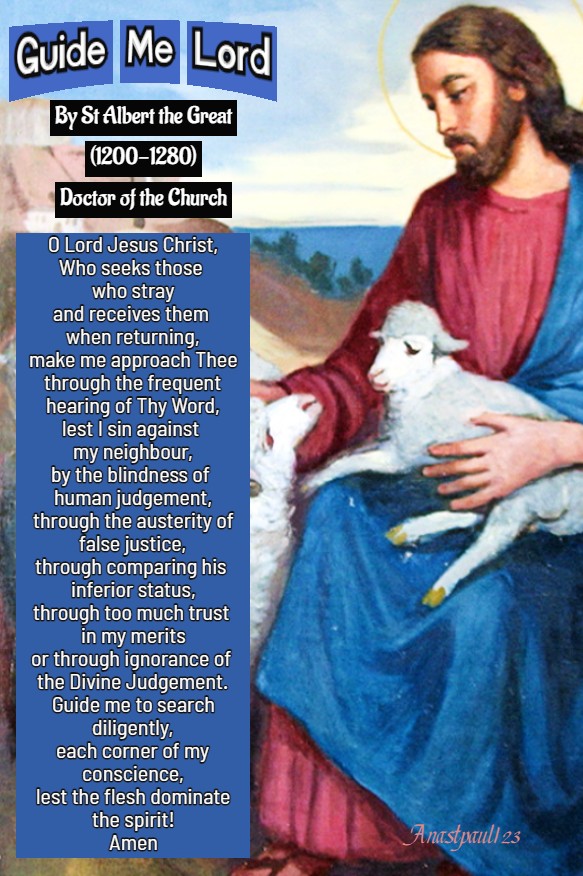
Guide Me Lord By St Albert the Great (1200-1280) Doctor of the Church
O Lord Jesus Christ, Who seeks those who stray and receives them when returning, make me approach Thee through the frequent hearing of Thy Word, lest I sin against my neighbour, by the blindness of human judgement, through the austerity of false justice, through comparing his inferior status, through too much trust in my merits or through ignorance of the Divine Judgement. Guide me to search diligently, each corner of my conscience, lest the flesh dominate the spirit! Amen
Saint of the Day – 17 April – St Landericus (c637-c720) Bishop, Abbot Born in c637 at Hainaut, Belgium and died on 17 Apr c720 (aged 82–83) at in Soignies, France of natural causes. Patron Saint of the House of Habsburg. Also known as – Landericus of Meaux (Metz), Landericus of Soignies, Landry, Landricus, Landrich, Landerico.
That he was a Bishop in the Seventh Century is generally agreed upon but exactly where and when is unclear. Some accounts show him as Bishop of Metz, while others say he was Bishop of Meaux, both in France.
Either way, it is said he resigned his Episcopal responsibilities so as to become a Benedictine DMonk at the Monastery of Hautmont, in France and later at Soignies, in Belgium, both of which were founded by his father.
He succeeded his father as Abbot of Soignies when the elder died around the year 677. Abbot Landericus also died at Soignies somewhere between the years 700 and 730, depending on which account of his life is used and his relics are held at the Collegiale S. Vincent, the Church named for his father.
His feast day is 17 April. Locally, that is in France and Belgium, he is known as St Landry, while most compilations of Saints use the Latin name St Landericus.
In the truly unique and renowned Church known as the Hofkirche in Innsbruck resides a large Statue of our Saint. This is most interesting and leads us to believe that he must have been a much more illustrious figure than we can find information regarding his life. and there is also the fact that he is the Patron Saint of the Royal House of Habsburg. This beautiful Church was built to house the tomb of Emperor Maximilian I who died in 1519. The Church is also known as “Schwarzmanderkirche“ (literally “Black Men Church”) famous for its namesake “Black Men” – 28 over-life-sized Renaissance bronze Statues of important historical figures and Saints which flank the marble Tomb of Emperor Maximilian I. See below.
Bl essed Andrés Hibernón Real OFM (1534-1602) Religious Friar, Apostle of the Holy Eucharist, the Blessed Virgin and the Holy Rosary, Apostle of the poor. He predicted the date of his death four years before the fact, which was 18 April 1602 in Gandia, Valencia, Spain of natural causes immediately after having prayed a rosary. He was Beatified on 22 May 1791 by Pope Pius VI. His body is incorrupt. Biography: https://anastpaul.wordpress.com/2018/04/17/saint-of-the-day-17-april-blessed-andres-hibernon-real-o-f-m-1534-1602/
St Agia of Hainault St Anthia of Illyria St Athanasia of Aegina St Bitheus St Calocerus of Brescia St Cogitosus St Corebus
St Eleuterius of Illyria St Elpidius of Melitene St Eusebius of Fano St Galdinus of Milan St Gebuinus of Lyons St Genocus St Hermogenes of Melitene Bl Idesbald of Dunes Blessed James of Cerqueto Bl James Oldo Bl Joseph Moreau St Landericus (c637-c730) Bishop, Abbot St Laserian of Leighlin Bl Louis Leroy Bl Luca Passi St Pantagathus of Vienne St Perfecto of Córdoba St Pusicio
St Robert de Turlande/Chaise-Dieu OSB (c 1000-1067) Priest, professed religious of the Order of St Benedict, Monk, Abbot, Apostle of Charity, Marian devotee. He was of noble stock, was related to Saint Gerald of Aurillac (c855–c909) and was a descendant of St Caesarius of Arles (470-543). He is best known for the establishment of the Benedictine Convent of La Chaise-Dieu (‘Home of God’) and for his total commitment to the poor. He became a spiritual inspiration for Pope Clement VI (1291–1352) – whose own origin,s in the religious life were based at that Convent – and it was Pope Clement who confirmed the Canonisation of the Benedictine Abbot on 19 September 1351 in Avignon. His Life: https://anastpaul.com/2019/04/17/saint-of-the-day-17-april-st-robert-de-chaise-dieu-osb-c-1000-1067/
Thought for the Day – 16 April – Meditations with Antonio Cardinal Bacci (1881-1971)
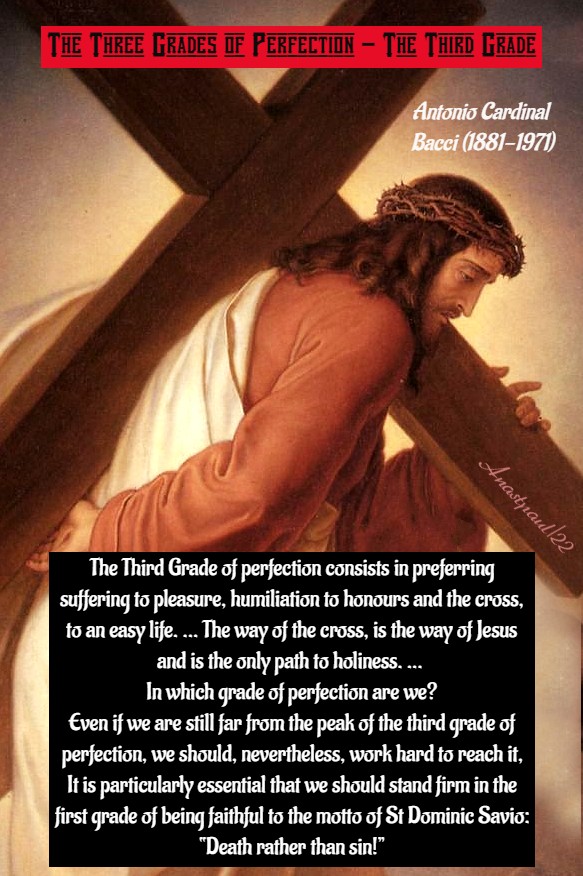
The Three Grades of Perfection – The Third Grade
“The Third Grade of perfection consists in preferring suffering to pleasure, humiliation to honours and the cross, to an easy life. By these means, we imitate Christ better and show our love for Him. The way of the cross, is the way of Jesus and is the only path to holiness. It is easier for those who walk this path to be detached from sin and from the world and to remain close to Jesus. This is the way which the Saints chose.
In which grade of perfection are we? Even if we are still far from the peak of the third grade of perfection, we should, nevertheless, work hard to reach it, It is particularly essential that we should stand firm in the first grade of being faithful to the motto of St Dominic Savio: “Death rather than sin!”
Quote/s of the Day –16 April – “The Month of the Resurrection” – Low Sunday, The Octave Day of Easter – 1 John 5:4-10, John 20. 19-31 – Scripture search here: https://www.drbo.org/
“ Blessed are they who have not seen and have believed.”
John 20:29
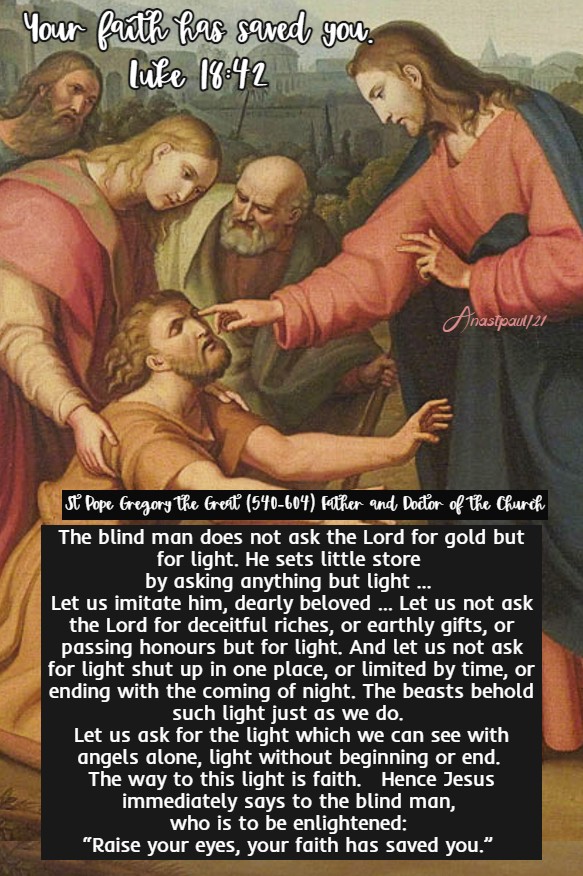
“Your faith has saved you.”
Luke 18:42
“The blind man does not ask the Lord for gold but for Light. He sets little store by asking anything but Light … Let us imitate him, dearly beloved … Let us not ask the Lord for deceitful riches, or earthly gifts, or passing honours but for Light. And let us not ask for light shut up in one place, or limited by time, or ending with the coming of night. The beasts behold such light just as we do. Let us ask for the Light which we can see with Angels alone, Light without beginning or end. The way to this Light is faith. Hence Jesus immediately says to the blind man, who is to be enlightened: “Raise your eyes, your faith has saved you!”
“Stand erect and raise your heads because your redemption is at hand.”
Luke 21:28
“Truth is exhorting His elect by saying: “When the disasters of the world become more frequent… let your hearts exult! While the world, which is not your friend, is coming to an end, the redemption you have sought ,is coming near.!” Those who love God are ordered to rejoice and be merry at the world’s end. They will soon find Him Whom they love, while what they have not loved is passing away. It should be far from the hearts of all the faithful who long to see God, to grieve over the disasters of a world, for they know, these very disasters, are soon to end. It is written that: “Whoever wishes to be a friend of this world, makes himself an enemy of God” (Jas 4,4).”
St Gregory the Great (540-604) Pope, Confessor, Father and Doctor “Father of the Fathers”
One Minute Reflection – 16 April – “The Month of the Resurrection” – Low Sunday, The Octave Day of Easter – 1 John 5:4-10, John 20. 19-31 – Scripture search here: https://www.drbo.org/
“We have seen the Lord.” – John 20:25
REFLECTION – “While hiding in a house, the Apostles see Christ; He entered, all the doors being shut. But Thomas, who was absent at that time… shuts his ears and wants to open his eyes… He bursts out with his incredulity, hoping, in this way, his desire will be answered. “My doubts are not going to disappear until I see Him,” he says. “I shall put my finger in the marks of the nails and embrace this Lord of mine Whom I long for so much. Let Him reproach my lack of faith but let Him satisfy me with sight of Him. For now, I am unbelieving but, when I see Him, I shall believe. I shall believe when I clasp Him in my arms and gaze on Him. I wish to see the holes in those Hands which have healed the hands of Adam’s wrongdoing. I wish to see the Side which cast out death from mankind’s side. I wish, be my own witness, to see the Lord and another’s testimony is not enough for me. Your tales aggravate my impatience. The joyful news you bring does nothing but stir up my turmoil. I shall not be cured of this sickness, unless I touch its medicine with my own hands.”
The Lord appeared again and dispelled both the sadness and the doubt of His disciple. What am I saying? He did not dispel his doubts, he fulfilled his expectation! He entered, all the doors being shut!” – Basil of Seleucia (Died c468) Archbishop (Sermon for the Resurrection).
PRAYER – Grant, we beseech Thee, Almighty God, that we, who have celebrated the Paschal Feast, may, by Thy bounty, retain its fruits in our daily habits and behaviour. Through Jesus Christ, Thy Son our Lord, Who lives and reigns with Thee, in the unity of the Holy Ghost, God, world without end. Amen (Collect).
Our Morning Offering – 16 April – Low Sunday, The Octave Day of Easter – “The Month of the Resurrection”
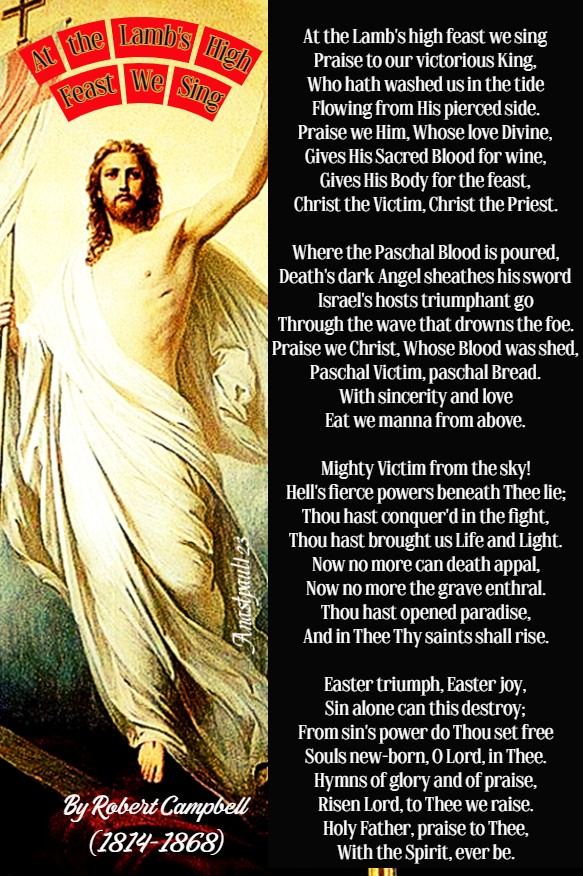
At the Lamb’s High Feast We Sing By Robert Campbell (1814-1868) Scottish Catholic Convert, Hymnist
At the Lamb’s high feast we sing Praise to our victorious King, Who hath washed us in the tide Flowing from His pierced side. Praise we Him, Whose love Divine, Gives His Sacred Blood for wine, Gives His Body for the feast, Christ the Victim, Christ the Priest.
Where the Paschal Blood is poured, Death’s dark Angel sheathes his sword Israel’s hosts triumphant go Through the wave that drowns the foe. Praise we Christ, Whose Blood was shed, Paschal Victim, paschal Bread. With sincerity and love Eat we manna from above.
Mighty Victim from the sky! Hell’s fierce powers beneath Thee lie; Thou hast conquer’d in the fight, Thou hast brought us Life and Light. Now no more can death appal, Now no more the grave enthral. Thou hast opened paradise, And in Thee Thy saints shall rise.
Easter triumph, Easter joy, Sin alone can this destroy; From sin’s power do Thou set free Souls new-born, O Lord, in Thee. Hymns of glory and of praise, Risen Lord, to Thee we raise. Holy Father, praise to Thee, With the Spirit, ever be.
Saint of the Day – 16 April – Blessed Arcangelo Canetoli CRSSB (1460-1513) Priest.and Canon of the Canons Regular of the Congregation of the Most Holy Saviour at Bologna, Mystic gifted with the charism of prophecy and of many visions of the Blessed Virgin, Born in 1460 in Bologna, Italy and died on 16 April 1513 (aged 53) in Gubbio, Italy of natural causes. His body is incorrupt. Arcangelo was Beatified on 2 October 1748 by Pope Benedict XIV.
Blessed Arcangelo Canetoli between St Nicholas and St Leonard painted by GB Piazzetta and Domenico Maggiotto for the Church of San Salvatore, Venice.
Arcangelo Canetoli, born in Bologna in 1460, suffered the bitter vicissitudes of the rivalry between the Canetoli and the Bentivoglio families. When still a young child, he providentially survived the extermination of the entire family. As a young man he entered the Canons Regular of Santa Maria di Reno, known as “Renani.” Due to his extreme humility and love of solitude he refused, for a long time, any Ecclesiastical dignity and only out of obedience, did he accept Priestly Ordination. From 1498 he lived in the convent of Sant’Ambrogio di Gubbio, loved and venerated by the humble and the powerful, including the Acquisti of Arezzo and the Medici of Florence. He consistently refused the appointment as Archbishop of the Medici City proposed to him by Pope Leo X. He died on 16 April 1513 and his incorrupt body is still venerated in his Monastery in Gubbio.
Arcangelo was born to one of the noblest families of Bologna – the Canetoli. The entire family was massacred being held esponsible for the death of member of an opposing family member. Only Arcangelo, still a child, managed to save himself thanks to fortuitous circumstances.
On 29 September 1484 he took the Habit of the Congregation of the Canons Regular of Santa Maria di Reno, called “Renani”, in the Convent of the Santissimo Salvatore in Venice. Here he was entrustd with the task of welcoming pilgrims and in some of them he sometimes happened to recognise the murderers of his family members! However, he always knew how to heroically dominate his desire for revenge.
Extremely humble and a lover of solitude, for a long time he refused, any Ecclesiastical dignity and finally, in 1498, accepted Priestly Ordination only out of a sense of obedience to his Superioirs. Shortly after his Ordination he was sent, by his own request, to the Hermitage of St Ambrose, a mountainside Monastery in Gubbio. Here he would remain for the remainder of his life, although he operated as the Provincial Vicar of his Order for 4 years, still retaining his base at Gubbio.
The St Ambrose Monastery in Gubbio
Arcamgelo predicted that Cardinal Giovanni de’ Medici would be elected as pope sometime soon and when this Cardinal became Pope Leo X in 1513, the Leo’s brother Giuliano de’ Medici summoned Canetoli to Florence in an attempt to persuade him to become the new Archbishop of Florence. But again Arangelo refused and returned to his Convent.
Blessed Arcangelo refusing the Honour of becoming the Archbishop of Florence painted by Giuseppe Reposati.
Arcangelo died in 1513 after a period of illness and high temperatures. He was interred in his Monastery of St Anbrose at Gubbio, where his incorrupt body remains enshrined for the veneration of pilgrims.





























 AnaStpaul
You must be logged in to post a comment.