Thought for the Day – 30 June – “The Last Day of Month of the Sacred Heart” – Meditations with Antonio Cardinal Bacci (1881-1971)
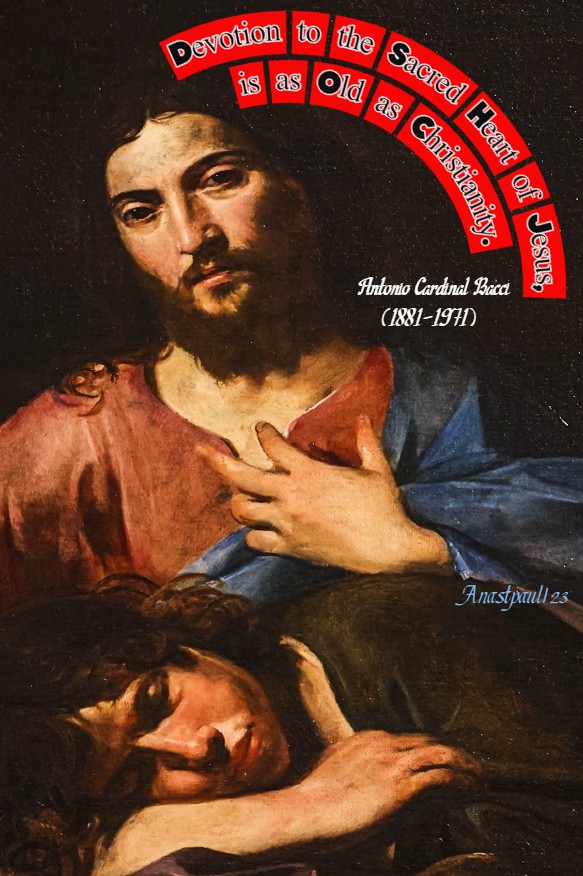
Devotion to the Sacred Heart
“When we consider it under it’s fundamental aspect as the cult of the love of God, rather than of the Incarnate Word, devotion to the Sacred Heart of Jesus, is as old as Christianity, even though it is only in recent centuries, that it has assumed it’s present symbolism. “He who does not love, does not know God,” says St John, “for God is love” (1 Jn 4:8). “And we have come to know,” he continues “and have believed, the love that God has in our behalf. God is love and he who abides in love, abides in God and God in him” (1 Jn 4:16). This cult of the love of God, particularly of the love of God made man, vibrates throughout the pages of the Gospel and of the writings of the Apostles, especially of St John and of St Paul.
In the works of the Fathers, there are references to the Heart of Jesus, pierced with a lance, from which flowed all the infinite graces of the Church for our redemption. We are reminded of this in the Encylical, Haurietis Aquas, published by Pope Pius XII in the year 1956. But the specific cult of the love of God, as symbolised by the Heart of Jesus, was explicitly approved by the Church after Jesus Himself appeared in the year 1674 to St Margaret Mary Alacoque and showed her His Heart on fire with love for men.”
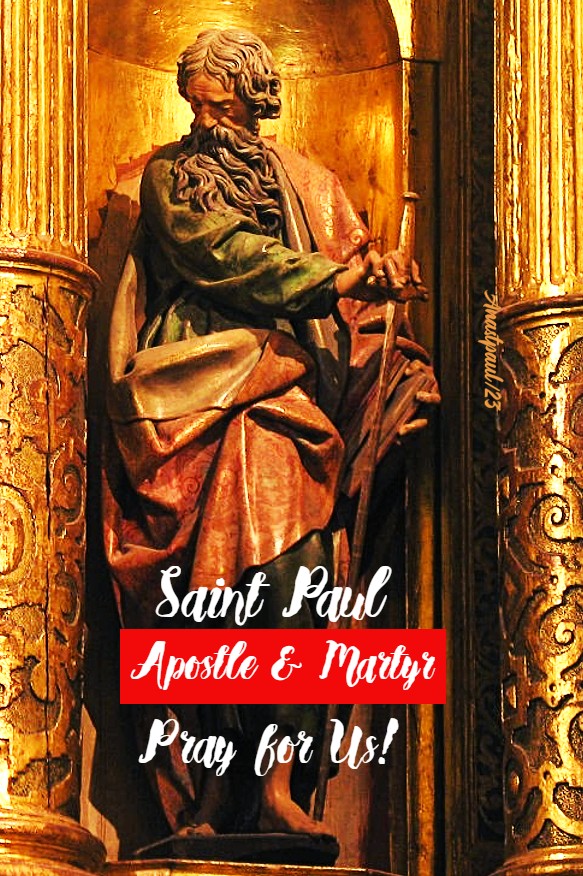
Quote of the Day – 30 June – The Commemoration of St Paul, Apostle and Martyr
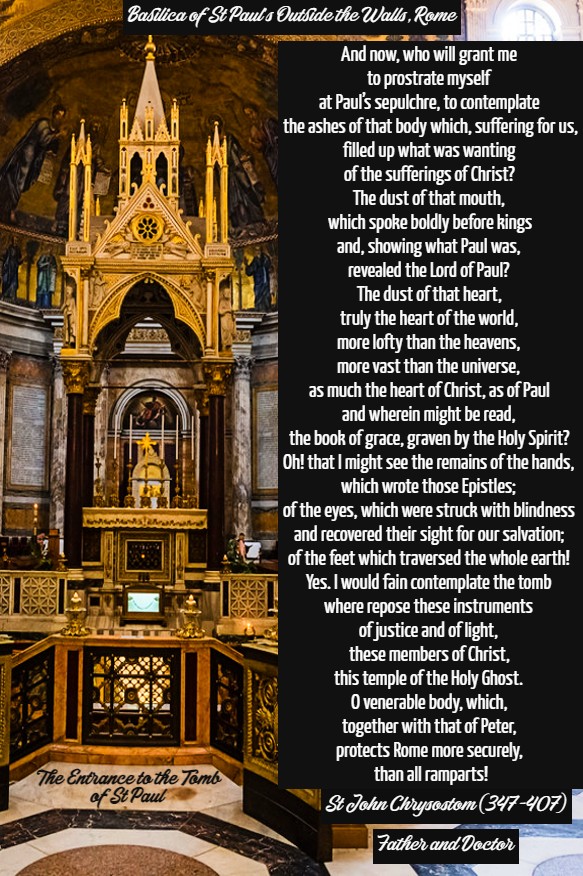
“And now, who will grant me to prostrate myself at Paul’s sepulchre, to contemplate the ashes of that body which, suffering for us, filled up what was wanting of the sufferings of Christ? The dust of that mouth, which spoke boldly before kings and, showing what Paul was, revealed the Lord of Paul? The dust of that heart, truly the heart of the world, more lofty than the heavens, more vast than the universe, as much the heart of Christ, as of Paul and wherein might be read, the book of grace, graven by the Holy Spirit? Oh! that I might see the remains of the hands, which wrote those Epistles; of the eyes, which were struck with blindness and recovered their sight for our salvation; of the feet which traversed the whole earth! Yes. I would fain contemplate the tomb where repose these instruments of justice and of light, these members of Christ, this temple of the Holy Ghost. O venerable body, which, together with that of Peter, protects Rome more securely, than all ramparts!”
One Minute Reflection – 30 June – “The Month of the Sacred Heart of Jesus” – The Commemoration of St Paul, Apostle and Martyr – Galatians 1:11-20, Matthew 10:16-22 – Scripture search here: https://www.drbo.org/
“Behold, I send you as sheep in the midst of wolves, therefore, wise as serpents and simple as doves.” – Matthew 10:16
REFLECTION – “According to the people here,, we run two dangers. The first is that, after taking our money, our guide may leave us on some deserted island or throw us into the sea, so as to escape the Governor of Canton. The second is that, supposing he leads us to Canton and we come into the Governor’s presence, the latter will treat us badly or throw us into prison. For our proceeding is unheard of. Numerous decrees prevent anyone at all from gaining access to China and, it is strictly forbidden, for foreigners to make their way in, without the King’s authorisation. Besides these two dangers, there are many other, even greater ones – that the locals know nothing about. It would take a good deal of time to describe them all, however, I will not pass by without citing some of them.
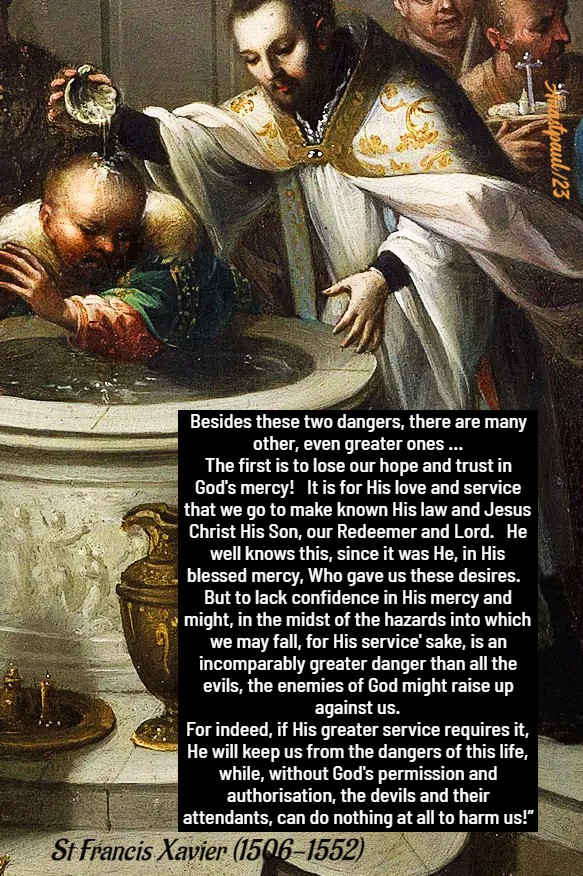
The first is to lose our hope and trust in God’s mercy! It is for His love and service that we go to make known His law and Jesus Christ His Son, our Redeemer and Lord. He well knows this, since it was He, in His blessed mercy, Who gave us these desires. But to lack confidence in His mercy and might, in the midst of the hazards into which we may fall, for His service’ sake, is an incomparably greater danger than all the evils, the enemies of God might raise up against us. For indeed, if His greater service requires it, He will keep us from the dangers of this life, while, without God’s permission and authorisation, the devils and their attendants, can do nothing at all to harm us!” – St Francis Xavier (1506-1552) Jesuit Missionary (Letter 131:22 October 1552).
PRAYER – O God, Who taught vast numbers of the Gentiles by the preaching of the blessed Apostle Paul, grant we beseech Thee that, by honouring his memory, we may enjoy the benefit of his patronal intercession. Through Jesus Christ, Thy Son our Lord, Who lives and reigns with Thee, in the unity of the Holy Ghost, God, world without end. Amen (Collect).
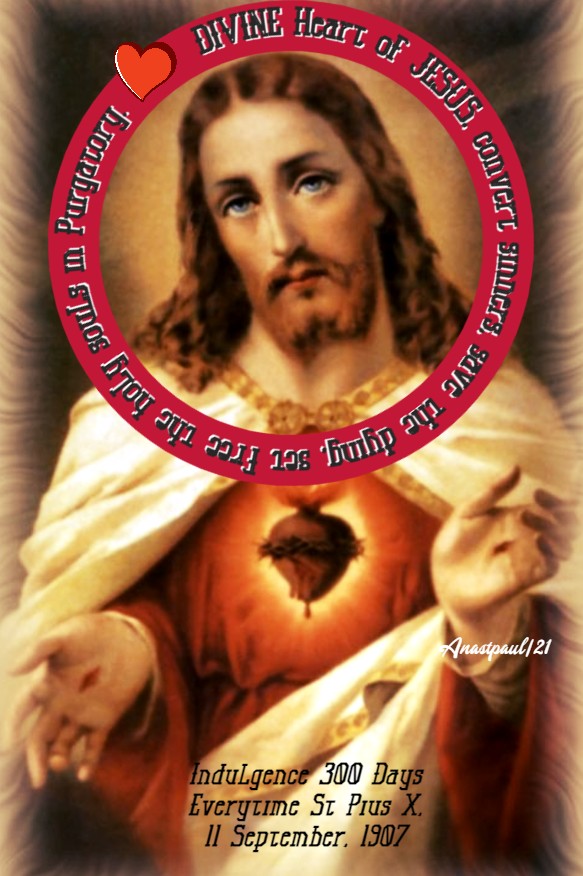
DIVINE Heart of JESUS, convert sinners, save the dying, set free the holy souls in Purgatory. Indulgence 300 Days Everytime – St Pius X, 11 September, 1907.
Our Morning Offering – 30 June – The last day of “The Month of the Sacred Heart of Jesus”
Act of Love to the Sacred Heart of Jesus By Servant of God Cardinal Rafael Merry del Val (1865-1930)
Reveal Thy Sacred Heart to me, O Jesus and show me Its attractions. Unite me to It forever. Grant that all my aspirations and all the beats of my heart, which cease, not even while I sleep, may be a testimonial to Thee, of my love for Thee and may it say to Thee – “Yes, Lord, I am all Thine” the pledge of my allegiance to Thee, rests forever in my heart and will never cease to be there. May Thou accept, the slight amount of good that I do and be graciously pleased, to repair all my wrong-doing – so that I may be able, to bless Thee, in time and in eternity. Amen
Saint of the Day – 30 June – The Commemoration of St Paul. Apostle and Martyr.
The joint commemoration of the Apostles, Peter and Paul, is one of the most ancient customs of the Roman Church, attested already in the oldest surviving Roman Liturgical Calendar, the Depositio Martyrum, written in 336. A verse of the Hymn, Apostolorum Passio, an authentic work of St Ambrose († 397) and still used in the Ambrosian liturgy, says that “the thick crowds make their way through the circuit of so great a city; the feast of the sacred Martyrs is celebrated on three streets.” These “three streets” are the via Cornelia, the main street running up to and over the Vatican hill; the via Ostiensis, where the burial and Church of St Paul are and the via Appia, on which resides the Cemetery “in Catacumbas.”
This last is the ancient Christian Cemetery now called the Catacomb of St Sebastian, The word “catacomb” was in fact originally the name of the site of this ‘Cemetery’ specifically and only later came to be used as a generic term for ancient subterranean Christian burial grounds. The Basilica over the Cemetery, now also entitled to St Sebastian, was originally known as the “Basilica Apostolorum” in memory of a tradition that the bones of Peter and Paul were kept there for a time, probably to save them from destruction in the era of persecutions. This is referred to in various ancient sources, including the Depositio Martyrum and confirmed by modern archeological research. The celebration of the feast “on three streets” would refer then to a procession to visit the site of St Peter’s burial at the Vatican that of St Paul, on the via Ostiensis and the Cemetery where their remains were once kept.
The building of which this wall is a part was constructed over the Catacomb of St Sebastian about 250 and is covered with dozens of devotional graffiti like the one seen here. “Paule ed (et) Petre, petite pro Victore – Paul and Peter, pray (lit. ‘ask’) for Victor.”
The poet Prudentius, writing in the very early 5h Century, calls the day “bifestum – a double Feast” and attests that on that day, the Pope would say a Mass at the Basilica of St Peter and then hasten to say another at St Paul’s. …
It should not be surprising, then, that at a certain point, the double Feast was divided and kept in a more manageable way as two separate Feasts. In the Gelasian Sacramentary, we find three Masses of Sts Peter and Paul assigned to 29 June – the oldest copy of the Gelasianum dates to roughly 750 but much of the material is considerably older, some of it reaching even to the days of St Leo the Great 300 years earlier. In some manuscripts, however, one of the three, “the proper Mass of St Paul” has already been assigned to 30 June. In the Gregorian Sacramentary, written roughly a Century later, we find the Feast of St Peter on 29 June and that of St Paul on the 30th – each Mass containing references to the other Apostle but they are, nevertheless, clearly distinct. Thus, by the time of Charlemagne, the “bifestum” of Prudentius had already been separated into a two day Feast.
At the traditional Mass of 29 June, the majority of the texts refer either to St Peter alone (Introit, Epistle, Alleluia, Gospel, Communion) or to Apostles generically, as in the Gradual “Thou shalt make them princes over all the earth.” The sole reference to St Paul is in the Collect, “O God, who hast consecrated this day by the martyrdom of Thy Apostles Peter and Paul, grant Thy Church to follow in all things the teaching of those through whom she first received the faith.” The Office is likewise dedicated almost entirely to St Peter.
The following day, therefore, the whole of the Liturgy is dedicated to St Paul and is not called a day within the Octave of the Apostles but rather “the Commemoration of St Paul.” The variable texts of the Mass all refer to him but a commemoration of St Peter is added to the Feast, in accordance with the tradition that the two, are never entirely separated, in the veneration paid them, by the Church. (The same is done on the Feast of St Paul’s Conversion and commemorations of Paul, are added to the Feasts of St Peter’s Chairs and Chains.) The Office is likewise dedicated entirely to St Paul; both the Mass and Office, however, make use of St Paul’s own testimony in Galatians, to the mission of the two Apostles: “For He who worked in Peter for the apostleship of the circumcision, worked in me too, among the gentiles and they knew the grace of God that was given to me.”
he Apostles Paul and Barnabas at Lystra (Acts 14, 5-18), by Jacob Jordaens, 1645
In the 1130s, a Canon of St Peter’s Basilica named Benedict, writes that it was still the custom in his time, for the Pope to keep the Feast of St Peter at the Vatican but then celebrate Vespers at the Tomb of St Paul in the great Basilica on the Ostian Way, “with all the choirs” of the City! Amen. (Liturgical Notes on the Commemoration of St Paul – GREGORY DIPIPPO).
The Preaching of St Paul at Ephesus – Eustache Le Sueur, 1649
St Adolphus of Osnabrück St Alpinian of Limoges St Alrick the Hermit Bl Ambrose de Feis Bl Anthony de Tremoulières Bl Arnulf of Villers St Austriclinian of Limoges St Basilides of Alexandria St Bertrand of Le Mans St Clotsindis of Marchiennes
Bl Elisabeth Heimburg St Emiliana of Rome St Erentrude St Eurgain St Gaius Bl Jacob Clou St Leo the Deacon St Lucina of Rome St Lucina of the Callistus Catacombs St Marcian of Pampeluna St Martial of Limoges St Ostianus St Otto of Bamberg St Peter of Asti St Petrus Li Quanhui
Blessed Raymond Lull TOSF (c 1232 – c 1315) Martyr – known as “Doctor Illuminatus,” Raymond was a Philosopher, Logician, Writer, Poet, Pioneer in computation theory, Franciscan tertiary. Within the Franciscan Order he is honoured as a Martyr. He was Beatified on 25 February 1750 by Pope Benedict XIV (cultus confirmed) and reaffirmed in 1847 by Pope Pius IX. His Life: https://anastpaul.com/2018/06/30/saint-of-the-day-30-june-blessed-raymond-lull-t-o-s-f-c-1232-c1315-martyr/
St Vihn Son Ðo Yen
Martyrs of Africa – 7 Saints: Seven Christians Martyred together. No detail about them have surived but the names – Cursicus, Gelatus, Italica, Leo, Timotheus, Zoilus, and Zoticus. Date and precise location in Africa unknown.






 AnaStpaul
You must be logged in to post a comment.