Thought for the Day – 13 July – Meditations with Antonio Cardinal Bacci (1881-1971)
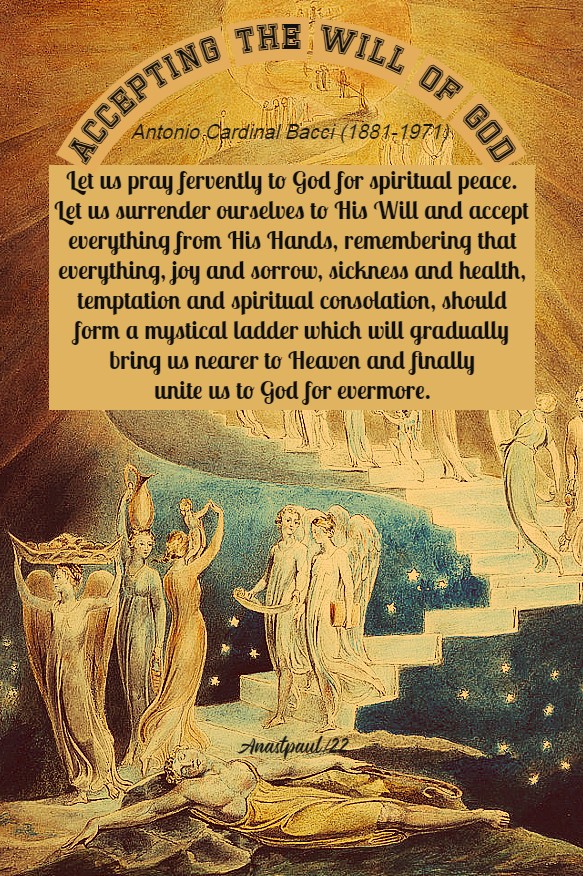
Accepting the Will of God
“Let us pray fervently to God for spiritual peace. Let us surrender ourselves to His Will and accept everything from His Hands, remembering that everything, joy and sorrow, sickness and health, temptation and spiritual consolation, should form a mystical ladder which will gradually bring us nearer to Heaven and finally unite us to God for evermore. Everything passes but God is unchangeable.
Sufferings have to end but the merits we gain remain, if we have offered our afflictions to God. Let us surrender ourselves completely into the hands of God, Who in His goodness, gives us some happiness on earth for our consolation and causes us to suffer, so that we may be purified and made holy.”
Quote/s of the Day – 13 July – “The Month of the Most Precious Blood of Jesus” – 1 Petet 5:1-4; 5:10-11, Matthew 16:13-19 – Scripture search here: https://www.drbo.org/
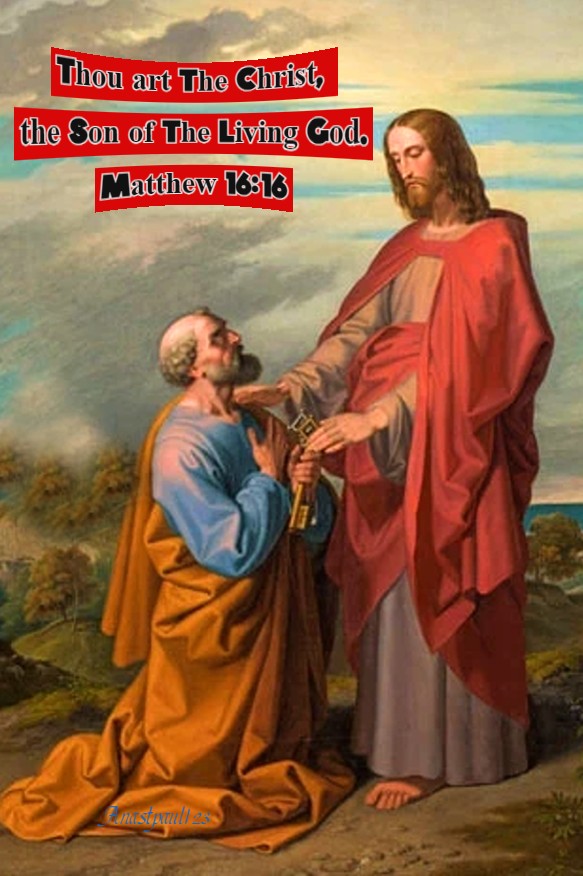
“Thou art the Christ, the Son of the living God.”
Matthew 16:16
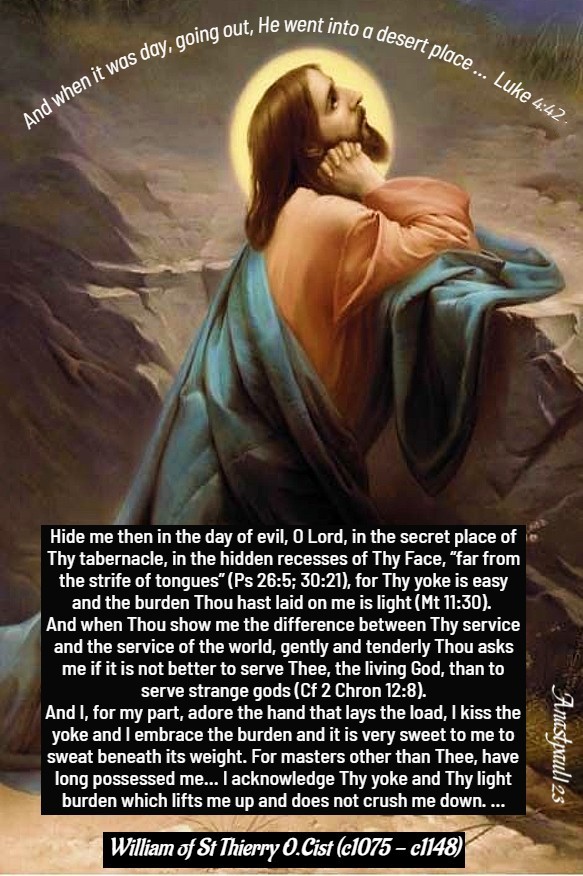
“Hide me then in the day of evil, O Lord, in the secret place of Thy tabernacle, in the hidden recesses of Thy Face, “far from the strife of tongues” (Ps 26:5; 30:21), for Thy yoke is easy and the burden Thou hast laid on me is light (Mt 11:30). And when Thou show me the difference between Thy service and the service of the world, gently and tenderly Thou asks me if it is not better to serve Thee, the living God, than to serve strange gods (Cf 2 Chron 12:8). And I, for my part, adore the hand that lays the load, I kiss the yoke and I embrace the burden and it is very sweet to me to sweat beneath its weight. For masters other than Thee, have long possessed me… I acknowledge Thy yoke and Thy light burden which lifts me up and does not crush me down. …”
William of St Thierry O.Cist (c1075 – c1148)
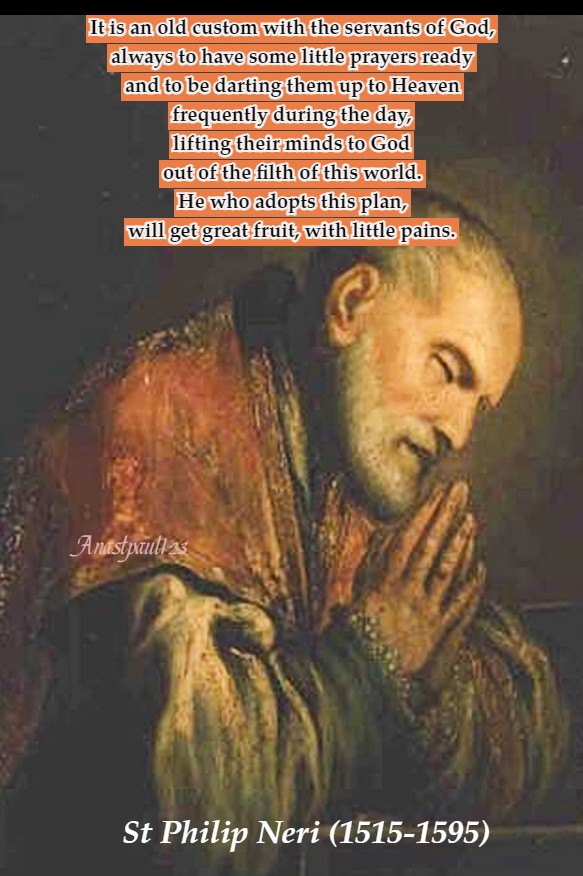
“It is an old custom with the servants of God, always to have some little prayers ready and to be darting them up to Heaven frequently during the day, lifting their minds to God out of the filth of this world. He who adopts this plan, will get great fruit, with little pains.”
St Philip Neri (1515-1595)
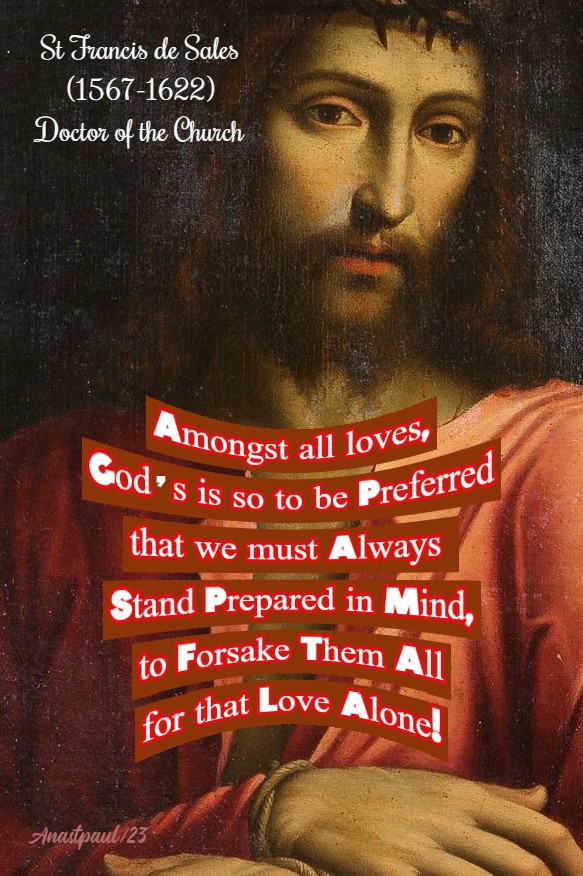
“Amongst all loves, God’s is so to be preferred that we must always stand prepared in mind, to forsake them all for that alone!”
(Treatise on the Love of God, Book 10, Chapter 7)
“Let us always belong to God, unreservedly and without interruption. May He ever live and reign in our hearts.”
(Letter to Madame de Chantal)
“He who most loves, will be most loved.”
St Francis de Sales (1567-1622) Doctor of the Church
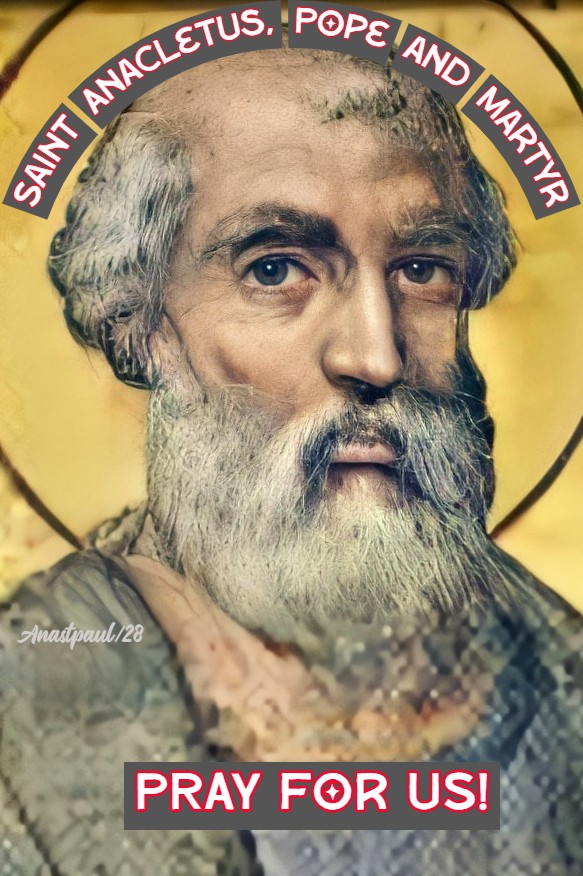
One Minute Reflection – 13 July – “The Month of the Most Precious Blood of Jesus” – St Anacletus (c25-c89) 3rd Bishop of Rome and Martyr – 1 Petet 5:1-4; 5:10-11, Matthew 16:13-19 – Scripture search here: https://www.drbo.org/
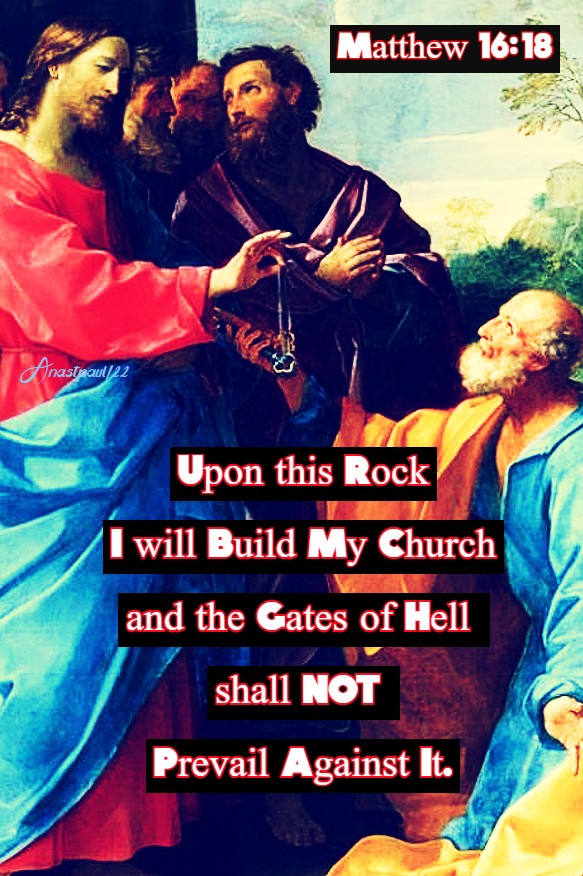
“Upon this rock I will build My Church and the gates of hell shall not prevail against it. I will give you the keys of the Kingdom of Heaven and whatever you bind on earth shall be bound in Heaven and, whatever you loose on earth, shall be loosed in Heaven.” … Matthew 16:18-19
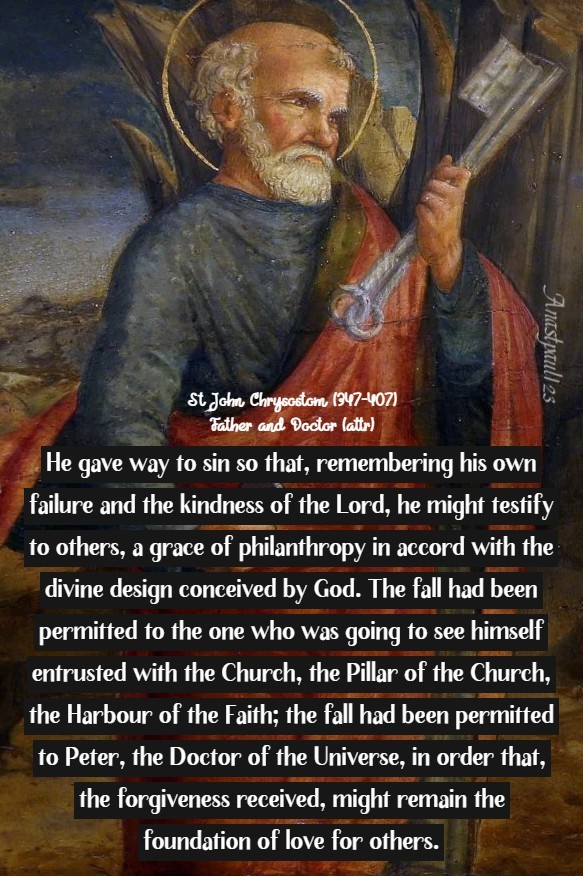
REFLECTION – “Peter was to receive on deposit, the keys of the Church, or rather the keys of Heaven and, he should see himself entrusted with the numerous people. What did the Lord actually say to him? “Whatever you bind on earth shall be bound in Heaven and whatever you loose on earth shall be loosed in Heaven” (Mt 16:19). For Peter had a somewhat abrupt character; if he had been without sin what sort of forgiveness would the disciples have received from him? This is why Divine Grace allowed him to fall into a certain fault, in order that his own trial should make him benevolent towards others. Do you see how God can let someone fall into sin; this Peter, the leader of the Apostles, the unshakable foundation, indestructible rock, first in the Church, impregnable harbour, unshakable tower — this same Peter, who had said to Christ: “Even though I should have to die with Thee, I will not deny Thee” (Mt 26:35), Peter who, by a divine revelation, had confessed the truth: “Thou are the Christ, the Son of the Living God” (Mt 16:16). … But as I said, God arranged it in this way and allowed Peter to sin because He had it in mind, to confer numerous people upon him and He feared, that his roughness, joined to his impeccability, might make him unsympathetic towards his brothers. He gave way to sin so that, remembering his own failure and the kindness of the Lord, he might testify to others, a grace of philanthropy in accord with the divine design conceived by God. The fall had been permitted to the one who was going to see himself entrusted with the Church, the Pillar of the Church, the Harbour of the Faith; the fall had been permitted to Peter, the Doctor of the Universe, in order that, the forgiveness received, might remain the foundation of love for others.” – (Attr) St John Chrysostom (347-407) Bishop of Constantinople, Father and Doctor of the Church (On the Apostle Peter and the Prophet Elijah).
PRAYER – Look forgivingly on thy flock, Eternal Shepherd, and keep it in thy constant protection, by the intercession of blessed Anacletus thy Martyr and Sovereign Pontiff, whom thou didst constitute Shepherd of the whole Church.Through the same Jesus Christ, Thy Son our Lord, Who lives and reigns with Thee, in the unity of the Holy Ghost, God, world without end. Amen (Collect).
Our Morning Offering – 13 July – “The Month of the Most Precious Blood of Jesus”
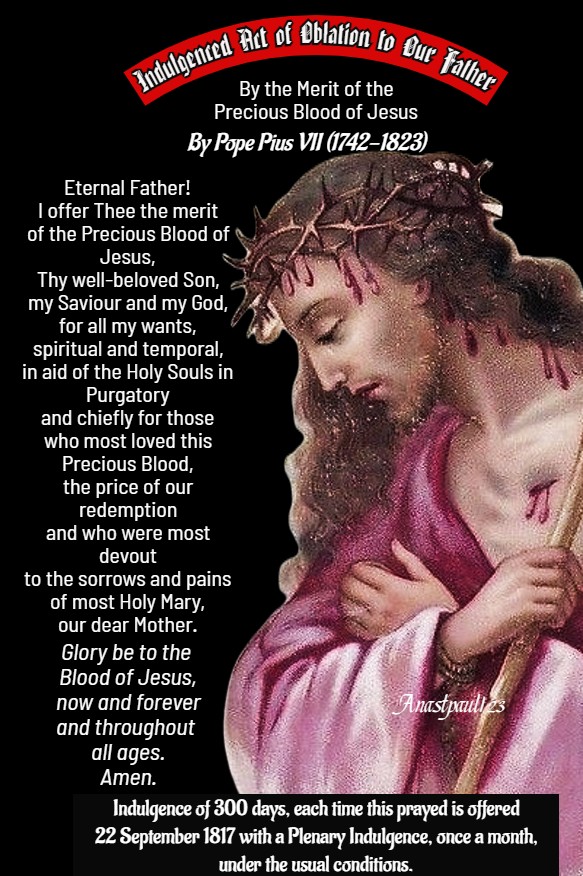
By the Merit of the Precious Blood of Jesus By Pope Pius VII (1742-1823) Papacy from 1800 to 1823 Indulgenced Act of Oblation to Our Father
Eternal Father! I offer Thee the merit of the Precious Blood of Jesus, Thy well-beloved Son, my Saviour and my God, for all my wants, spiritual and temporal, in aid of the Holy Souls in Purgatory and chiefly for those who most loved this Precious Blood, the price of our redemption and who were most devout to the sorrows and pains of most Holy Mary, our dear Mother.
Glory be to the Blood of Jesus, now and forever and throughout all ages. Amen.
Indulgence of 300 days, each time this prayed is offered 22 September 1817 with a Plenary Indulgence, once a month, under the usual conditions.
Note: On 15 August 1811 – the Feast of the Assumption – it is recorded that the Pope. Pius VII, celebrated Mass and was said to have entered a trance and began to levitate in a manner which drew him to the aAtar. This particular episode aroused great wonder and awe among participants which included the French Soldiers guarding him, who were ingreat wonder and awestruck disbelief, at the miraculous incident which had occurred. There is a Cause in progress and Pope Pius VII has since been elected as the Patron of the Diocese of Savona and the Patron of prisoners.
Saint of the Day – 13 July – Saint Turian (Died c750) French Abbot and Confessor, Bishop of Dol, Born in Brittany, France and died in c750 of natural causes. Also known as – Turiaf, Thivisiau, Tuien, Turiav, Turiave, Turiavus, Turien, Turiano, Turiavo, Turian of Dol.
The Roman Martyrology reads today: “In Bretagne, St Turian, Bishop and Confessor, a man of admirable simplicity and innocence.”
Turian was born in Brittany to French nobility in the Diocess of Vannes, in the neighbourhood of the Abbey of Ballon.
At a young age, Turian entered the Monastery at Dol where he was instructed in piety and learning and promoted to Holy Orders by Saint Thiarmail.
The then Bishop of Dol, St Samson, appointed him his vicar and and at his death, probably in 733, our Saint was placed in that Episcopal Seat.
Admirable was the austerity of his life, his zeal, his charity, his watchfulness, his fervour in prayer and his firmness in maintaining discipline.
A powerful lord named Rivallon having committed many acts of violence, the Bishop went to his castle at Lanncafrut and by his strong remonstrances made him sensible of the enormity of his crimes. By the Bishop’s injunction, Rivallon underwent a canonical penance for seven years and repaired all injustices and oppressions by a sevenfold satisfaction.
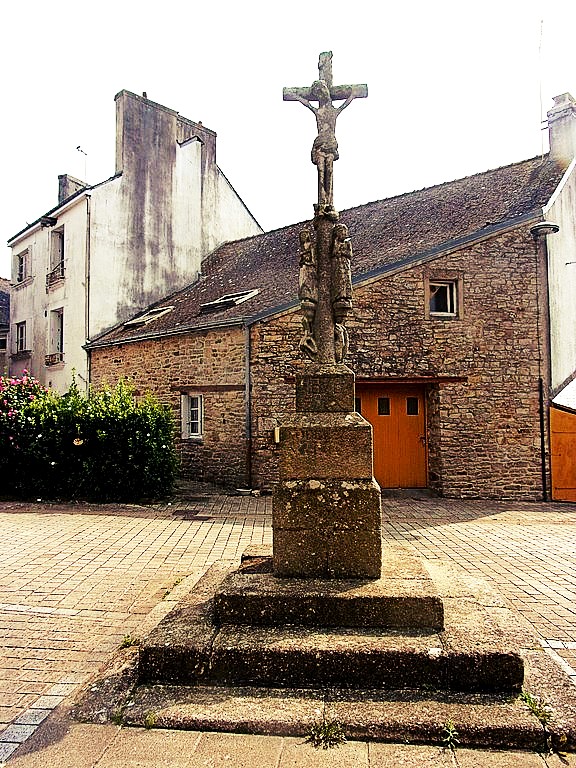
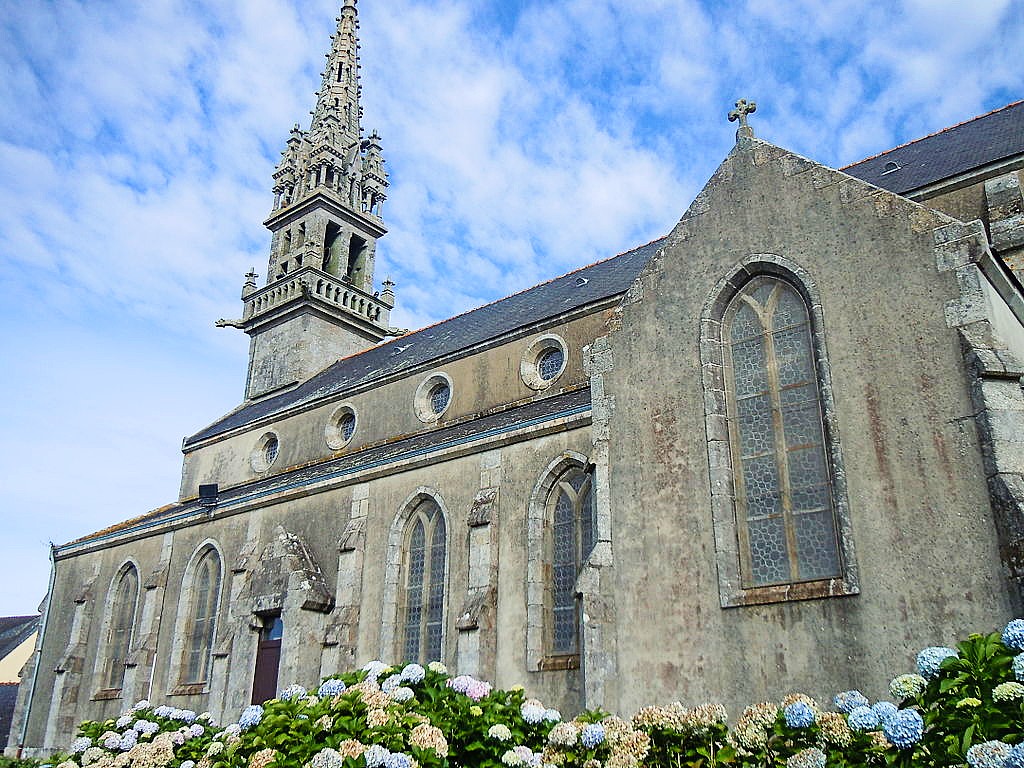
The Crucifix in the St Turian’s Church Square
Saint Turian died on the 13th of July, probably about the year 750, although even the year is not certain. In the wars of the Normans, Turian’s Relics were brought to Paris and are still kept in the Abbey of Saint Germain-des-Prez. The new Paris Breviary mentions that dreadful fires have been sometimes miraculously extinguished by our Saints intercession wrought by prayer at the Shrine of his Relics.
There is a Town name for him wherein the Parish Church of St Turian resides.
Bl Anne-Andrée Minutte St Arno of Würzburg Bl Berthold of Scheide St Dogfan Bl Élisabeth Verchière St Esdras the Prophet St Eugene of Carthage St Giustina of Arzano
St Iosephus Wang Kuiju
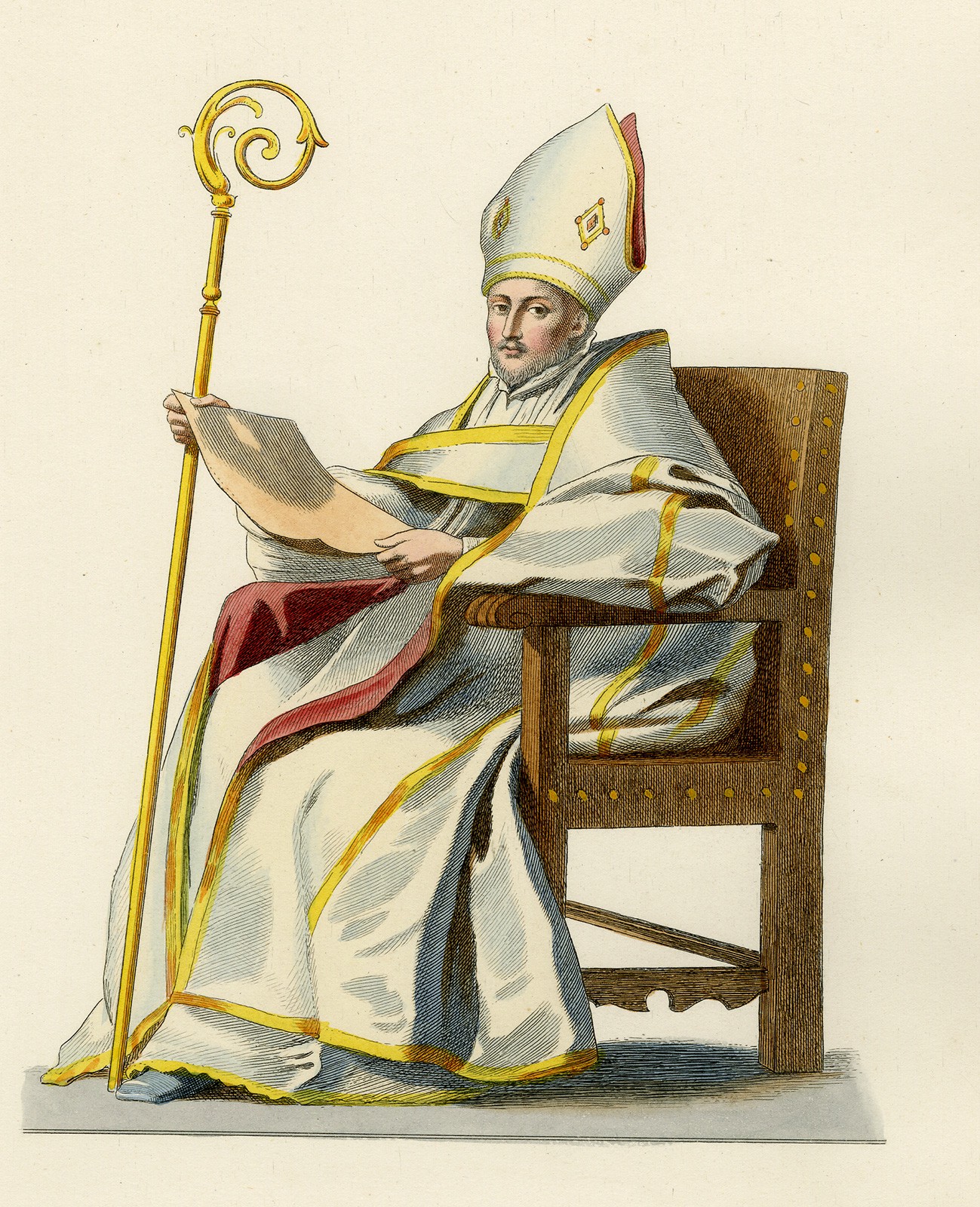
Blessed James of Voragine OP (c1226 – 3 or 16 July 1298) Italian Archbishop of Genoa, Author of the ‘Golden Legend’ (a collection of lives of Saints and treatises on Christian festivals, one of the most popular religious works of the Middle Ages and is still published and referred to today – completed 1265), Priest and Friar of the Order of Preachers of St Dominic, Writer, Scholar of great genius, Prior and Provincial General of the Order. Blessed James was Beatified on 11 May 1816 by Pope Pius VII. Biography: https://anastpaul.com/2021/07/13/saint-of-the-day-13-july-blessed-james-of-voragine-op-c-1226-1298-author-of-the-golden-legend/
Bl Jean of France St Joel the Prophet Bl Marie-Anastasie de Roquard Bl Marie-Anne Depeyre Bl Marie-Anne Lambert
St Muritta of Carthage St Myrope St Salutaris of Carthage St Sarra of Egypt St Serapion of Alexandria Serapion of Macedonia St Silas (1st Century) Disciple of Sts Paul and Barnabas Bl Thérèse-Henriette Faurie Bl Thomas Tunstal St Turian (Died c750) French Abbot and Bishop
Martyrs of Cyprus – 300 Saints: 300 Christians who retired to Cyprus to live as cave Hermits, devoting themselves to prayer and an ascetic life devoted to God. Tortured and Martyred for their faith and their bodies thrown into the various caves in which they had lived. We know the names of five of them but no other details even about them – Ammon, Choulélaios, Epaphroditus, Eusthénios and Héliophotos. They were beheaded in the 12th century on Cyprus and their bodies dumped in the cave where they had lived and only rediscovered long afterwards.
Martyrs of Philomelio – 31 Saints: 31 soldiers Martyred for their faith in the persecutions of prefect Magno, date unknown. The only name that has come down to us is Alexander. In Philomelio, Phrygia (in modern Turkey).






 AnaStpaul
You must be logged in to post a comment.