Oh Immaculate Heart of Mary, Virgin most pure, have compassion on those who are prone to the allurements of impurity. Give us, we beseech thee, strength to overcome our weaknesses and courage in the struggle against sin. We know it is thy ardent wish that we renew our pledge of holy purity. Oh, Immaculate Heart of Mary, we consecrate to thee here and now, without reserve, our eyes, ears, tongues, hearts– our whole beings. We promise that, with thy help, we shall be steady in our purpose to serve thee, with undefiled chastity. Give us the courage to resist all temptations and to avoid all things which may be the occasion of sin. Amen.
Our Lady of Fatima, Virgin most pure, enflame our hearts with the love of Purity and Reparation for sin.
We pray our Daily Rosary now with the same Intention: “Purity of Body and Soul”
Thought for the Day – 3 October – Meditations with Antonio Cardinal Bacci (1881-1971)
“Month of the Holy Rosary” The First Joyful Mystery The Annunciation
“The Rosary is both a vocal and a mental prayer. When reciting the first five decades, we should meditate on the principal joyful mysteries of our faith, beginning with the Annunciation to the Blessed Virgin. In other words, during the first decade, we should visualise the scene described in the Gospel.
“The Angel Gabriel was sent from God to a town of Galilee called Nazareth, to a virgin betrothed to a man named Joseph, of the house of David and the Virgin’s name was Mary. And, when the Angel had come to her, he said “Hail, full of grace, the Lord is with thee. Blessed art thou among women” (Lk 1:26-28).
Note the manner in which the Angel greets Mary. He proclaims that she is full of grace, pleasing and acceptable to God. He bows before her and says that she is blessed among women. On previous occasions Angels had appeared to Patriarchs, Kings and Prophets but always, as superior beings bearing a command from Almighty God. Why, then, does an Angel bow before this maiden and salute her with such reverence? The reason is twofold. Mary is the purest of creatures, immaculate from the moment of her conception; she is also destined to become the Mother of God, a destiny of quasi-infinite dignity. Let we, poor sinners, bow before her also and beg her to obtain for us from God, the graces of forgiveness and of sanctification. It is in this spirit, of loving humility that we should recite the First Decade of the Holy Rosary.”
Quote/s of the Day – 3 October – St Thérèse of the Child Jesus (1873–1897)
“A soul, in a state of grace, has nothing to fear from demons – who are cowards.”
“Trust and trust alone, should lead us to love.”
“Love alone, have I ever given to the good God; with love, He will repay me.”
“Then, overcome by joy, I cried: ‘Jesus, my love.’ At last I have found my vocation. My vocation is love. In the heart of the Church, my mother, I will be love and then I will be all things!”
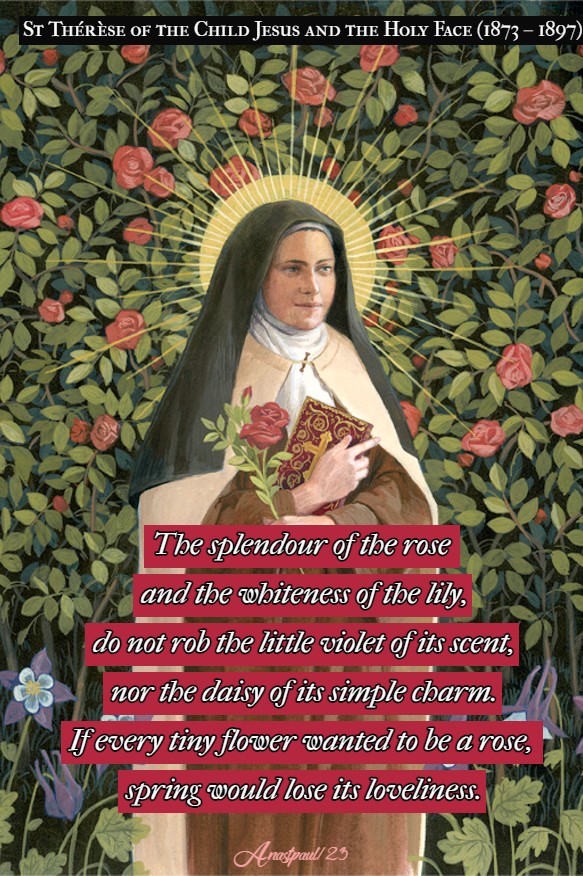
“The splendour of the rose and the whiteness of the lily, do not rob the little violet of its scent, nor the daisy of its simple charm. If every tiny flower wanted to be a rose, spring would lose its loveliness.”
One Minute Reflection – 3 October – “The Month of the Most Holy Rosary and of the Angels” – St Thérèse of the Child Jesus (1873–1897) – Isaias 66:12-14, Matthew 18:1-4 Scripture search here: https://www.drbo.org/
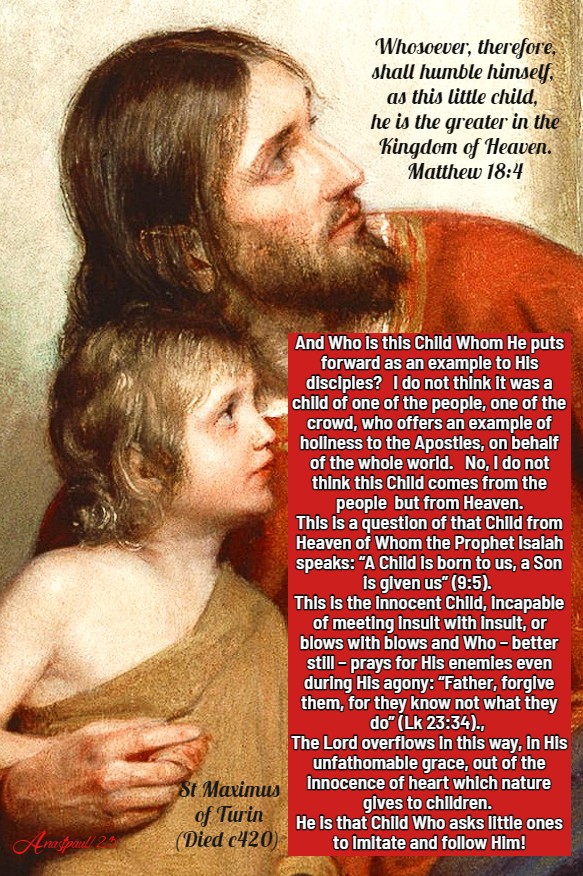
“Whosoever, therefore, shall humble himself, as this little child, he is the greater in the Kingdom of heaven.”- Matthew 18:4
REFLECTION – “The Lord said to His Apostles, who were already adult and mature: “Unless you turn and become like this little child, you shall not enter the Kingdom of Heaven” (Mt 18:3&4)… He urges them to rediscover their childhood… in order that they might be born again to innocence of heart: “No-one can enter the Kingdom of God without being born of water and spirit” (Jn 3:5).
“Unless you turn and become like this little child” – He does not say “these children” but “this child”- He only chooses one, only suggests one. And Who is this Child Whom He puts forward as an example to His disciples? I do not think it was a child of one of the people, one of the crowd, who offers an example of holiness to the Apostles, on behalf of the whole world. No, I do not think this Child comes from the people but from Heaven. This is a question of that Child from Heaven of Whom the Prophet Isaiah speaks: “A Child is born to us, a Son is given us” (9:5). This is the innocent Child, incapable of meeting insult with insult, or blows with blows and Who – better still – prays for His enemies even during His agony: “Father, forgive them, for they know not what they do” (Lk 23:34)., The Lord overflows in this way, in His unfathomable grace, out of the innocence of heart which nature gives to children. He is that Child Who asks little ones to imitate and follow Him!” – St Maximus of Turin (Died c420) Bisho, Father (Homily 58).
PRAYER – O Lord, Who said: Unless you become as little children, you shall not enter into the Kingdom of Heaven, grant us, we beseech Thee, so to follow the footsteps of blessed Thérèse the Virgin, in humility and simplicity of heart that we may obtain everlasting rewards.Through Jesus Christ, Thy Son our Lord, Who lives and reigns with Thee, in the unity of the Holy Ghost, God, world without end. Amen (Collect).
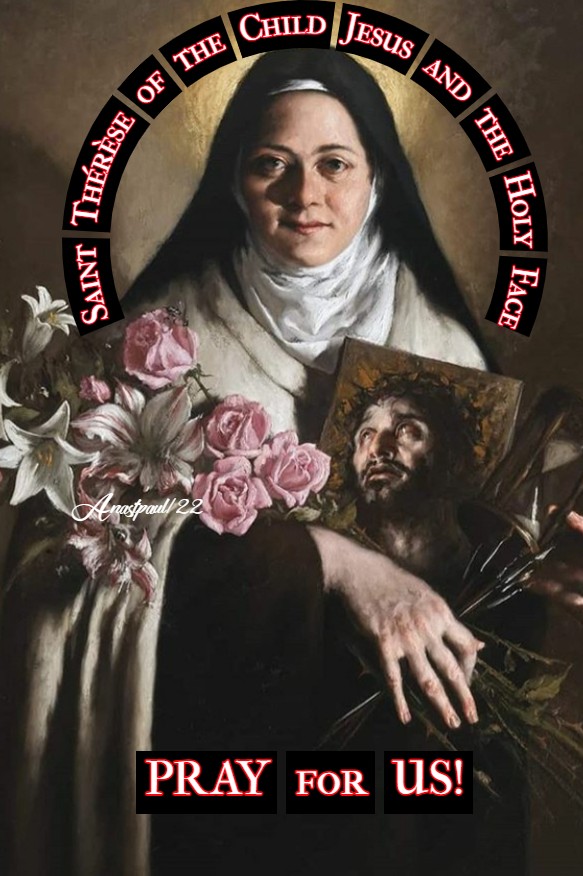
Our Morning Offering – 3 October – St Thérèse of the Child Jesus and the Holy Face (1873 – 1897)
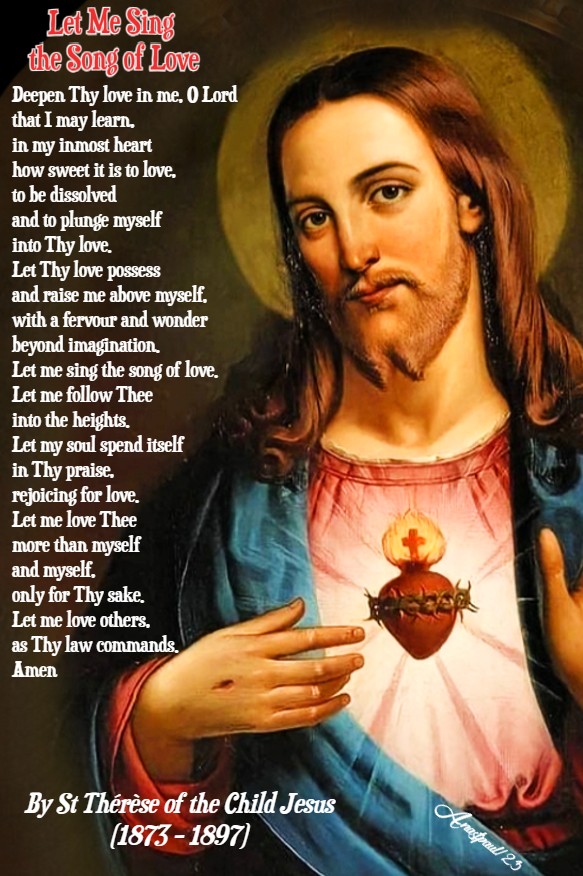
Let Me Sing the Song of Love By St Thérèse of the Child Jesus and the Holy Face (1873 – 1897)
Deepen Thy love in me, O Lord that I may learn, in my inmost heart how sweet it is to love, to be dissolved and to plunge myself into Thy love. Let Thy love possess and raise me above myself, with a fervour and wonder beyond imagination. Let me sing the song of love. Let me follow Thee into the heights. Let my soul spend itself in Thy praise, rejoicing for love. Let me love Thee more than myself and myself, only for Thy sake. Let me love others, as Thy law commands. Amen
Saint of the Day – 3 October – Saint Adalgott of Chur O.Cist. (Died 1160) Bishop, Monk in Citeaux, then disciple of Saint Bernard at Clairvaux,, Abbot at Disentis in Switzerland and then Bishop of Chur, Reformer of monastic life and of the Clergy, Apostle of the sick and founder of a Hospital in his Diocese. Date and place of birth unknown – died on 3 October 1160 at Chur of natural causes. Also known as – Adalgott of Discentis, Adalgotto, Algott, Adelgorio.
The Roman Martyrology reads: “In Chur in Switzerland, blessed Adalgotto, Bishop, who, disciple of Saint Bernard in Clairvaux, was a great lover of monastic discipline.”
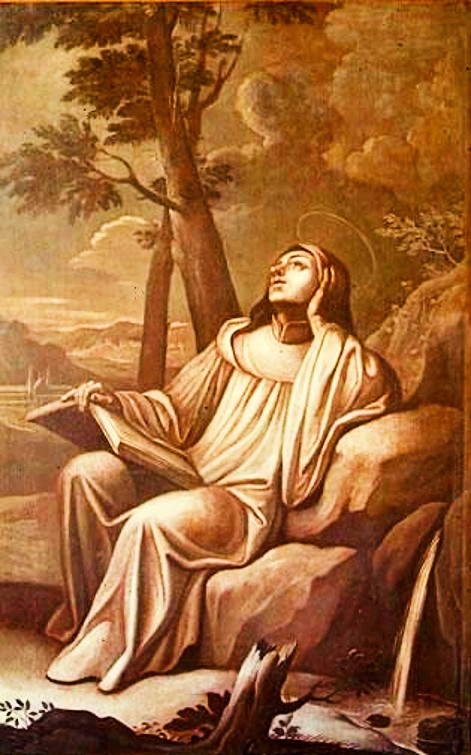
St Adalgott in his Cistercian Habit
In 1150, Adalgott was requested to become the Bishop of Chur by the faithful and Clergy of the Diocese. Some believe that this request was engendered because he was probably originally from that area. He was consecrated there in 1151 by the Archbishop of Mainz.
Adalgott gave his private life and his Episcopate an imprint of austerity – he reformed the Clergy, returned the Monasteries under his jurisdiction to a more rigid observance of the Rule, monitored the good morals of the population.
He was in political relations with Pope Stephen III and Emperor Frederick I but never compromised on anything concerning the rights of the Church. He restored Churches and Monasteries, including Cazis, Schännis, Munster, Müstail. Adalgott particularly supported the Premonstratensian Monastery of St Lucius in Chur which was founded in 1140/42 by the Cistercian Pope Eugene III.
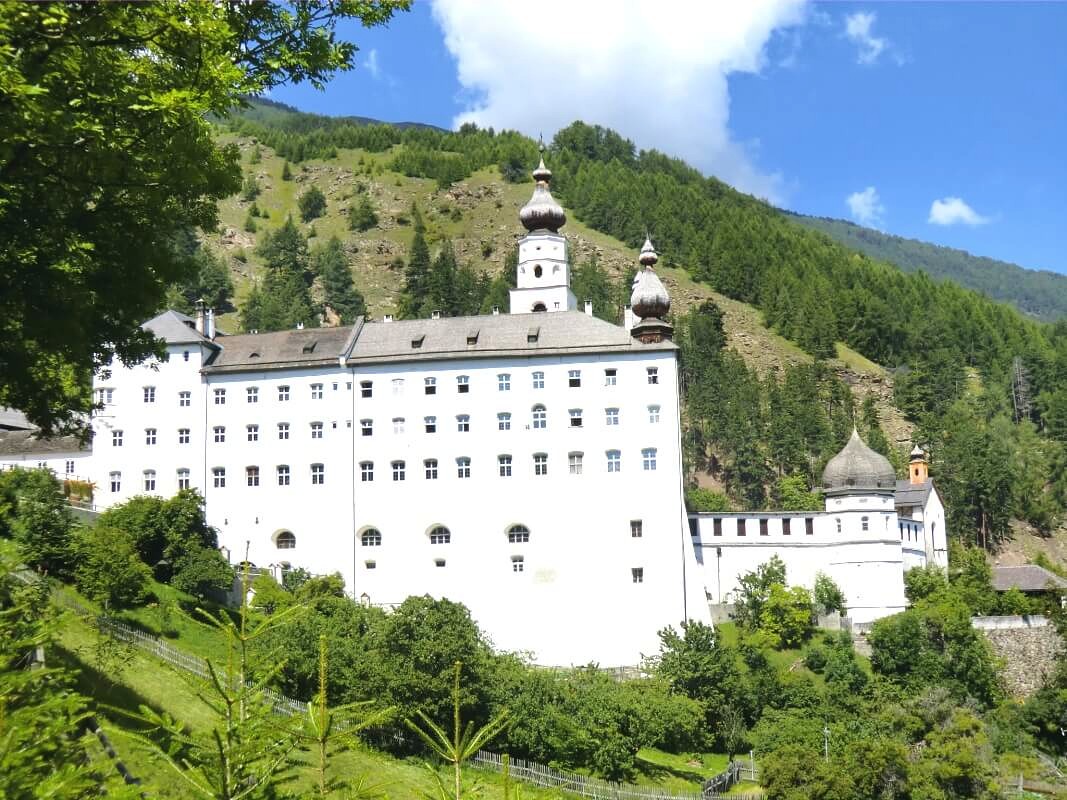
Marienberg Monastery near Mals in South Tyrol
Adalgott was known throughout his life for his concern for and ministry to the sick and his use of position and title to assist them however possible. When Adalgott was named Bishop of Chur, he conducted an apostolate for the suffering of the region and, in the same year, he founded a Hospital at Chur specifically to attend to needs of the poor.
On 11 June 1160 Adalgott Consecrated the Marianberg Crypt, as evidenced by an inscription and it was probably he who promoted the construction of the beautiful Cathedral of Chur which is now dedicated to him.
He died at an advanced age on 3 October 1160. His Relics which soon became an object of veneration and the prayers at his tomb resulted in many miracles. In 1492, Adalgott’s name was included in the Catalogue of Cistercian Saints and Blesseds, compiled by the Abbot of Citeaux, John of Cirey, where some variants of his name are also recorded: Algott, Adelgorio.
On 4 May 1881 the Congregation of Rites approved Adalgott’s cult ab immemorial. The Cistercian Congregations of Mehrerau and San Bernardo in Italy remember him on 3 October.
Statue of St Adalgott in the Monastery Church of Eschenbach in Lucerne
St Adalgott of Chur O.Cist. (Died 1160) Bishop Bl Agostina of the Assumption St Candidus the Martyr St Cyprian of Toulon Bl Damian de Portu St Dionysius the Aeropagite Bl Dominic Spadafora Bl Edmund of Scotland St Ewald the Black St Ewald the Fair St Froilan
Martyrs of Alexandria – 9 Saints: A number of Christian Martyrs remembered together. We know the names Caius, Cheremone, Dionysius, Eusebio, Fausto, Lucio, Maximus, Paul, Peter and that there were at least two more whose names have not come down to us, and that’s about all we know.







 AnaStpaul
You must be logged in to post a comment.