Thought for the Day – 10 October – Meditations with Antonio Cardinal Bacci (1881-1971)
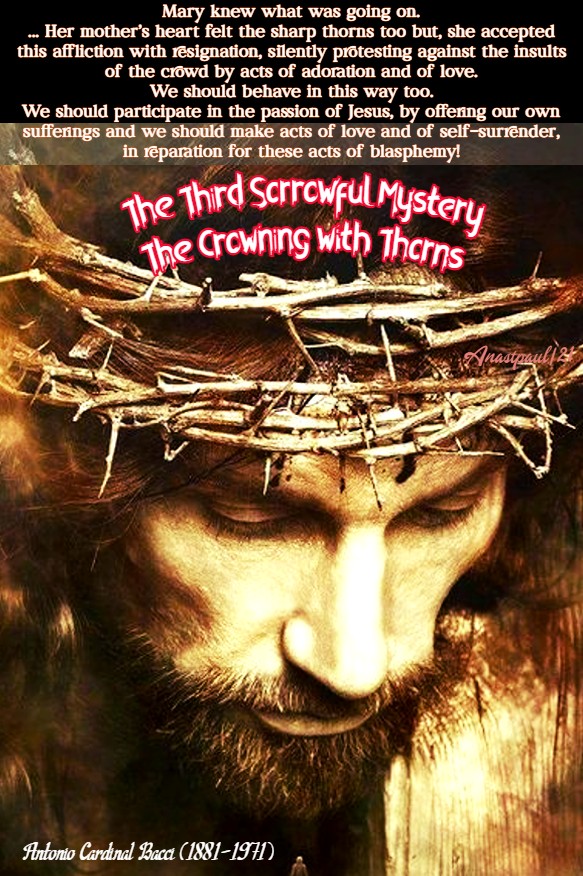
“Month of the Holy Rosary” The Third Sorrowful Mystery The Crowning with Thorns
“This new torture was a diabolical invention decreed by no law or authority. Purely for their own savage entertainment, the soldiers procured a bundle of thorned reeds, which they wound into the shape of a crown and pressed into Jesus’ head.
Mary knew what was going on. She was there with the holy women when Pilate brought her bloodstained Son before the people and, their blasphemous yells pierced her tender heart. Her mother’s heart felt the sharp thorns too but, she accepted this affliction with resignation, silently protesting against the insults of the crowd by acts of adoration and of love. We should behave in this way also. We should participate in the passion of Jesus, by offering our own sufferings and we should make acts of love and of self-surrender, in reparation for these acts of blasphemy!”
Quote/s of the Day – 10 October – St Francis Borgia SJ (1510-1572) Confessor
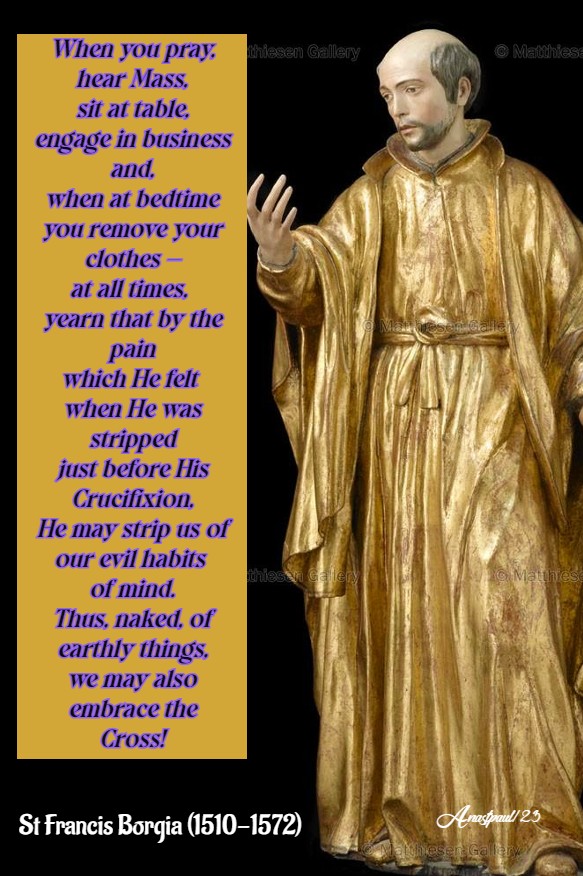
“When you pray, hear Mass, sit at table, engage in business and, when at bedtime you remove your clothes— at all times, yearn that by the pain which He felt when He was stripped just before His Crucifixion, He may strip us of our evil habits of mind. Thus, naked, of earthly things, we may also embrace the Cross!”
“What is it, my soul, that I seek in the world? How long shall I pursue and grasp at shadows? What is she already become, who was lately so beautiful, so great, so much revered? This death which has thus treated the imperial diadem, has already levelled his bow to strike me. Is it not prudent, to prevent its stroke, by dying now to the world that, at my death. I may live to God?”
One Minute Reflection – 10 October – “The Month of the Most Holy Rosary and of the Angels” – St Francis Borgia SJ (1510-1572) Confessor, Priest of the Society of Jesus, – Ecclesiasticus 45:1-6, Matthew 19:27-29 – Scripture search here: https://www.drbo.org/
“And everyone who has left house, or brethren, or sisters, or father, or mother, or wife, or children, or lands, for My Name’s sake, shall receive a hundredfold and shall possess life everlasting.” – Matthew 19:29
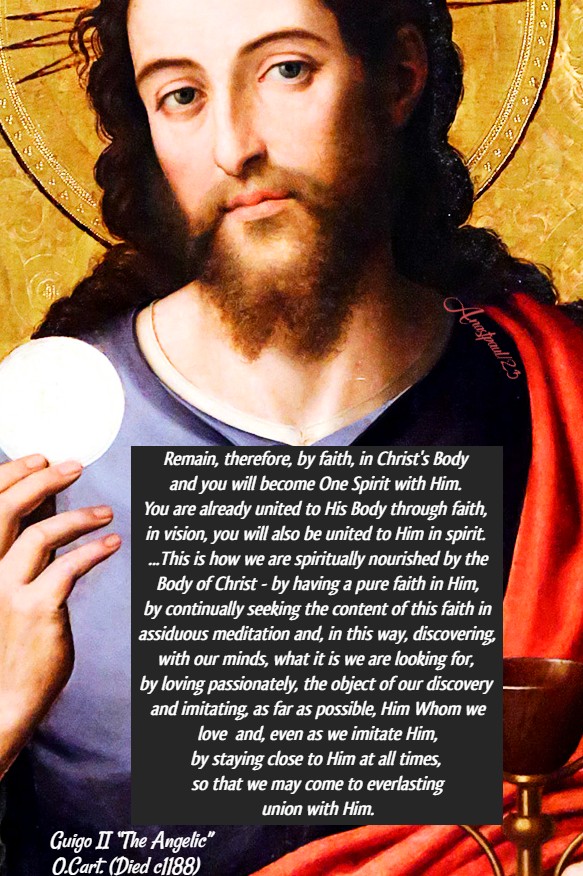
REFLECTION – “We must follow Christ, cleaving to Him, nor should we forsake Him until we die. As Elisha said to his master: “ As the Lord lives and as you yourself live, I will not leave you ” (2 Kgs 2:2) … So, let us follow Christ and stay close to Him! “To be near God is my good” says the Psalmist (72:28). “ My soul clings fast to Thee; Thy right hand upholds me ” (Ps 62:9). And Saint Paul adds : “ Whoever is joined to the Lord becomes One Spirit with Him ” (1 Cor 6:17). Not just One Body but One Spirit. His whole body lives from the Spirit of Christ through the Body of Christ, we attain to the Spirit of Christ. Remain, therefore, by faith, in Christ’s Body and you will become One Spirit with Him. You are already united to His Body through faith, in vision, you will also be united to Him in spirit. Not that we shall see without a body when we are above but our bodies will be spiritual (1 Cor 15:44).
“Father,” Christ said : “I pray that they may all be one, as Thou, art in Me and I in Thee, that the world may believe” this is what union through faith is. And later He asks: “” this is union through vision.
This is how we are spiritually nourished by the Body of Christ – by having a pure faith in Him, by continually seeking the content of this faith in assiduous meditation and, in this way, discovering, with our minds, what it is we are looking for, by loving passionately, the object of our discovery and imitating, as far as possible, Him Whom we love and, even as we imitate Him, by staying close to Him at all times, so that we may come to everlasting union with Him.” – Guigo II “The Angelic” O.Cart. (Died c1188) The 9th Prior of Grande Chartreuse, from 1174 to 1180 (Meditation 10).
PRAYER – O Lord Jesus Christ, model of true humility and its reward, we beseech Thee, that as Thou made blessed Francis one of Thy glorious imitators, by his contempt for earthly honours, grant us to follow his example and to share in his glory.Through the same Jesus Christ, Thy Son our Lord, Who lives and reigns with Thee, in the unity of the Holy Ghost, God, world without end. Amen (Collect).
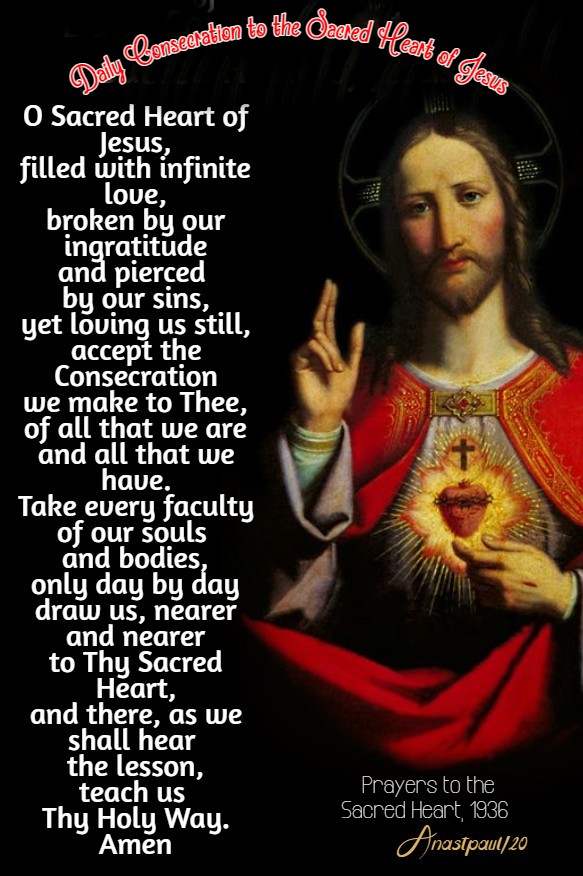
Daily Consecration to the Sacred Heart of Jesus Prayers to the Sacred Heart 1936 – 15th Edition, Dublin
O Sacred Heart of Jesus, filled with infinite love, broken by our ingratitude and pierced by our sins, yet loving us still, accept the Consecration we make to Thee, of all that we are and all that we have. Take every faculty of our souls and bodies, only day by day draw us, nearer and nearer to Thy Sacred Heart, and there, as we shall hear the lesson, teach us Thy Holy Way. Amen
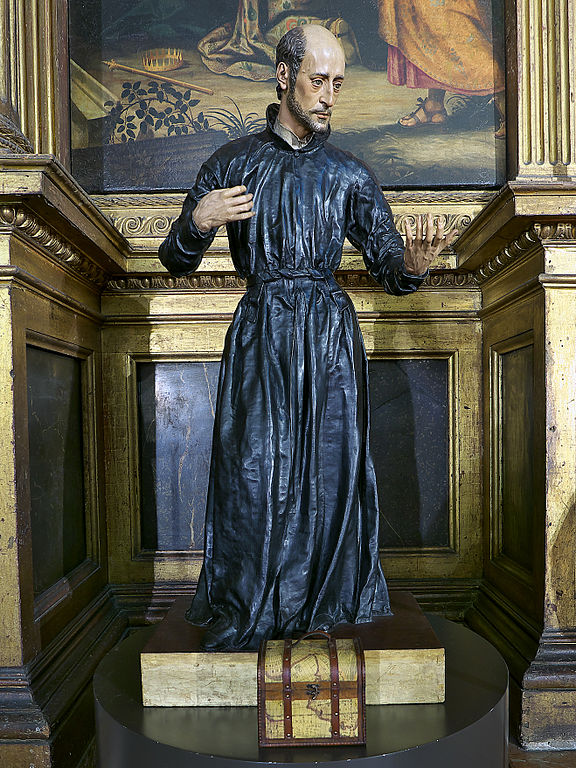
Saint of the Day – 10 October – St Francis Borgia SJ (1510-1572) Confessor, Priest of the Society of Jesus, Advisor, Missionary, Evangelist, Administrator par excelleance. Francisco de Borja y Aragon was the 4th Duke of Gandía, was a Grandee of Spain, a Spanish Jesuit and third Superior General of the Society of Jesus
A continuation of the life of St Francis Borgia – an entire year has slipped by, for which I should apologise, however, each day brings its own duties to the Saints being venerated on that particular day. Time runs away … Let us continue with a little more from Fr Alban Butler (1711-1773) who wrote his portrayal of our Saint from:
“The life, compiled by Fr Ribadeneira, who was for nine years, his Confessor, is the master-piece of that pious author, who, by his acquaintance with the holy man and his own experience in an interior life, was excellently qualified to animate, in his expression, the narrative of the actions of the Saint with that spirit with which they were performed.”
We continue – ST FRANCIS at COURT and his MARRIAGE until the DEATH of the EMPRESS – his “DAMASCUS MOMENT”:
Francis, although he delighted chiefly in the company of the most virtuous, was courteous and obliging to all, never spoke ill of anyone, nor ever suffered others to do it in his presence.
He was a stranger to envy, ambition, gallantry, luxury and gaming – vices which are often too fashionable in Courts and against which he armed himself with the utmost precaution. He not only never played but would never see others playing, saying that a man commonly loses by it four things – his money, his time, the devotion of his heart to God and his conscience.
One of his servants discovered, that on the days on which he was obliged to visit company in which ladies made a part, he wore a hair-shirt. In him it appeared, that there is no readier way to gain the esteem of men, though without seeking it, than by the heroic practice of Christian virtue. Nothing is so contemptible even amongst men of the world, as insolence, pride, injustice, or anger; nothing so hateful as one who loves nobody but himself, refers everything to himself and makes himself the centre of all his desires and actions.
Nor is there anything more amiable than a man who seeks not himself but refers himself to God and seeks and does all things for God, and the service of others; in which Christian piety consists. The wicked themselves, find no more solid comfort or protection in affliction, than the friendship of such a person; even those who persecute him,because his virtue is a censure of their irregularities, nevertheless admire in their breasts that sincere piety which condemns them. This is more conspicuous when such a virtue shines forth in an exalted station. It is not, therefore, to be wondered that Francis was honoured and beloved by all the Court, particularly by the Emperor, who called him the miracle of Princes!
… The Empress had so great an esteem for him and so high an idea of his merit, that she fixed her eye on him to marry Eleanor de Castro, a Portuguese lady of the first rank, a person of great piety and accomplishments, her principal favourite, who had been educated with her and whom, she had brought with her out of Portugal. The marriage was solemnised in the most Christian manner, to which state the Saint brought the best preparation – innocence of life with unsullied purity and an ardent spirit of religion and devotion. The Emperor on that occasion created him Marquis of Lombay and Master of the Horse to the Empress and having had experience of his wisdom, secrecy and fidelity, not only admitted him into his Privy-Council but took great delight in conferring, often privately, with him upon his most difficult undertakings and communicated to him his most important designs. …
Cristobal de Villalpando, Portrait of St. Francis Borgia , c1690
In 1537, being at the Court, which was then at Segovia, he fell ill of a dangerous quinsy, in which he never ceased praying in his heart, though he was not able to pronounce the words. These accidents were Divine graces which weaned Francis, daily more and more, from the world; although, whilst it smiled upon him, he saw the treachery, the shortness and the dangers of its flattering enjoyments, through that gaudy flash, in which it danced before his eyes.
… God blessed his marriage with a numerous and happy offspring – five boys and three girls: Charles, the eldest, who was Duke of Gandia, when Ribadeneira wrote the life of ourSaint; Isabel, John, Alvarez, Johanna, Fernandez, Dorothy and Alphonsus. Dorothy died young as a Poor Clare at Gandia; the rest all married, enjoyed different titles and posts of honour,and left families behind them.
St Francis was much affected, in 1537, by the death of his intimate friend, the famous poet, Garcilas de Vega, who was killed at the siege of a castle in Provence. The death of the pious Empress Isabel, happened two years after, on the 1st of May, 1539, whilst the Emperor was holding the states of Castile at Toledo, with the utmost pomp and magnificence. His majesty was much afflicted by the loss of so virtuous a consort. The Marquis and Marchioness of Lombay, were commissioned, by him, to attend her corpse to Granada, where she was to be buried. When the funeral convoy arrived at Granada and the Marquis delivered the corpse into the hands of the Magistrates of that City, they were on both sides, to make oath that it was the body of the late Empress. The coffin of lead was, therefore, opened and her face was uncovered but appeared so hideous and so much disfigured that no-one knew it and the stench was so noisome that everyone made, what haste he could away. Francis not knowing the face, would only swear it was the body of the Empress because, from the care he had taken, he was sure no-one could have changed it upon the road.
Being exceedingly struck at this spectacle, he repeated to himself:
“What is now become of those eyes, once so sparkling? Where is now the beauty and graceful air of that countenance which we so lately beheld? Are you her sacred majesty, Donna Isabel? Are you my Empress and my lady, my mistress?”
The impression which this spectacle made on his soul remained strong and lively during the thirty-three years by which he survived it, to his last breath!
Returning that evening from the Royal Chapel to his lodgings, Francis locked himself in his chamber and passed the whole night without a wink of sleep. Prostrate on the floor, shedding a torrent of tears, he said to himself,
“What is it, my soul, that I seek in the world? How long shall I pursue and grasp at shadows? What is she already become, who was lately so beautiful, so great, so much revered? This death which has thus treated the imperial diadem, has already levelled his bow to strike me. Is it not prudent, to prevent its stroke, by dying now to the world that at my death. I may live to God?”
St Aldericus St Cassius St Cerbonius of Populonia St Cerbonius of Verona St Clarus of Nantes Bl Demestrius of Albania Bl Edward Detkens St Eulampia St Eulampius St Florentius the Martyr St Fulk of Fontenelle St Gereon St Gundisalvus Bl Hugh of Macon
Bl Pedro de Alcantara de Forton de Cascajares St Pinytus of Crete Bl Pontius de Barellis St Tanca St Teodechilde St Victor of Xanten
Martyrs of Ceuta – 7 Beati: A group of seven Franciscan Friars Minor missionaries to Muslims in the Ceuta area of modern Morocco. Initially treated as madmen, within three weeks they were ordered to convert to Islam and when they would not they were first abused in the streets, then arrested, tortured and executed. Angelo, Daniele di Calabria, Donnolo, Hugolinus, Leone, Nicola, Samuele. They were beheaded in 1227 in Mauritania Tingitana (Ceuta, Morocco). Local Christians secreted the bodies away and gave them proper burial in Ceuta. They were Beatified in 1516 by Pope Leo X.











You must be logged in to post a comment.