
Saint of the Day – 8 October – Saint Ragenfrida Virgin, Abbess (Died 9th Century). Daughter of Adalbert, Count of Ostrevant and Regina, who is also remembered as a Saint. Patronage – of Denain, Northern France, where her Monastery was. Also known as – Ragenfréde, Ragenfreda, Rainfroy, Refroy, Reginfreda, Renfrida, Renfroie.
The Roman Martyrology: “In Denain in Hainault, in today’s France, Saint Ragenfrida, Abbess, who built a Monastery in this place with her assets, of which she was a worthy guide.”
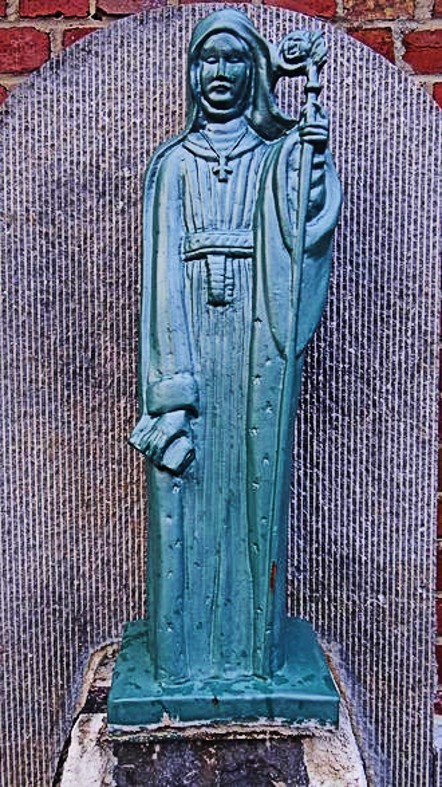
Ragenfrida was the Founder and Abbess of the Monastery of Denain, in the Diocese of Cambrai, as expressly recalled in a record from Charles the Bald (Charles II (823-877), King) dated 13 August 877. Even the Author of the Gesta Episcoporum Cameracemium, in 1041-1042, says that the blessed Ragenfrida had founded a Monastery in her region, located on the banks of the Escaut, in Denain and had become the Abbess of it. A little later, contrary to ancient documents, the Life of Saint Regina (our Saint’s mother), written on behalf of Abbess Fredessenda, declares that the Founders had been Adalbert, Count of Ostrevant and his wife, Regina.
Their marriage had been blessed with the birth of ten daughters (including Ragenfrida) and, in agreement with them, the two spouses had founded a Monastery in Denain, whose Church was dedicated to Our Lady. The ten virgins, however, to satisfy a greater desire for perfection, set out on a pilgrimage – five went to Jerusalem and died there, the other five reached Rome where they too were to find eternal rest, except for Ragenfrida who returned to Denain. During the absence of the pilgrims, Regina, their mother, had retreated to the Monastery because Adalbert had died (or, as a later version would say, with his consent) and she governed it until her death. She was succeeded by Ragenfrida.
The Monastery of Denain was founded, towards the end of the 8th Century but this date appears too late because the cult of Ragenfrida was already attested in the 9th Century. It seems that, at the beginning its inhabitants were Nuns who followed the Benedictine rule, although it has been wondered whether Denain was not instead a Monastery of Canonesses, as established in 816 by the Council of Aachen. However, later the community was made up of Canonesses and not Nuns. Canonesses, uUnlike Nuns, took no permanent vows and were not committed to a life of poverty, or to a common life for eating and sleeping. These ladies were usually Aritocrats of noble birth.
The elevation of the body of the holy Abbess took place already in 845, at the time of the blessed Ava, who, blind, had recovered her sight by praying on Ragenfrida’s tomb; after which, she gave all her goods to St Ragemfroda’s Monastery and consecrated herself to the Lor. Ava, having become Abbess, promoted the cult of our Saint. At the time of the destruction of the Monastery by the Normans, Ragenfrida’s Relics, sold by clerics greedy for money, were then recovered,, thanks to the cunning of a Nun and remained in Denain until 1793.
From the 9th Century St Ragenfrida had a celebration in calendars and sacramentaries and her name is found in the litanies of the same period on 8 October, in the Diocese of Cambrai and Tournai, as well as in the Abbey of St-Amand. She is venerated on the same date in Honnepel, a Town near Xanten, where the Monastery of Denain had properties and the same was true for Xanten. After the 13th Century, in Cologne, she had her Feast day, on 20 November. In Denain, of which the Saint was the main Patron, she was celebrated on 2 September and with a relatio corporis on 11 June. Ragenfrida’s memory is found in the Benedictine Martyrologies on 8 October.


 AnaStpaul