Thought for the Day – 11 October – Meditations with Antonio Cardinal Bacci (1881-1971)
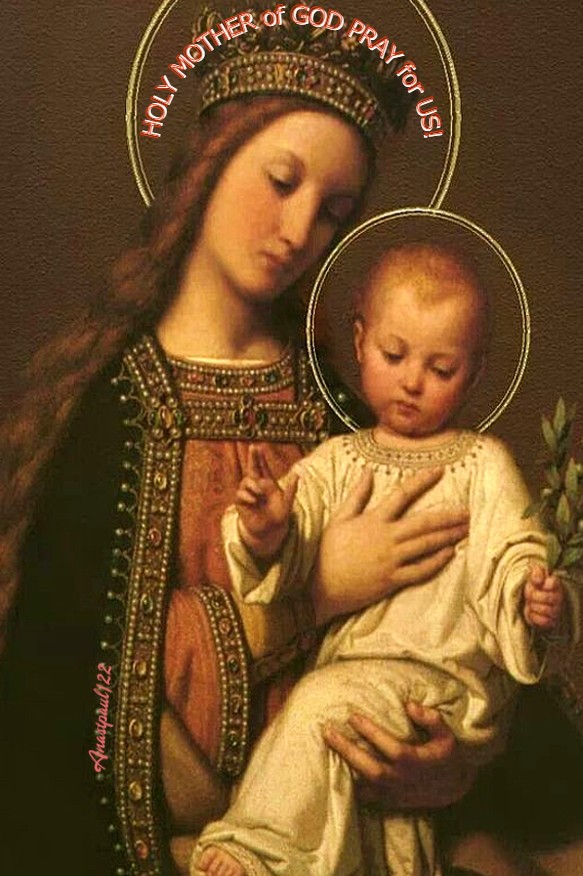
Mary, the Mother of God
“Most Holy Mary, not only were you raised to the dignity of Mother of God but, you carried out His holy Will, heroically on all occasions. Obtain for me, from your divine Son, Jesus, the grace to co-operate always and at all costs, with His designs for me, both in life and in death, amen.”
Quote/s of the Day – 11 October – Feast of the Divine Maternity
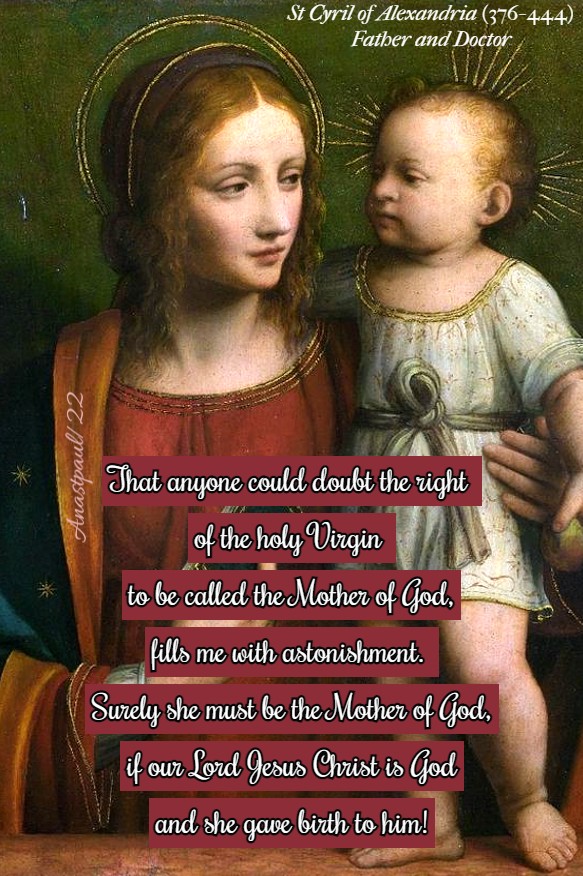
“That anyone could doubt the right of the holy Virgin to be called the Mother of God, fills me with astonishment. Surely she must be the Mother of God, if our Lord Jesus Christ is God and she gave birth to Him!”
St Cyril of Alexandria (376-444) Father and Doctor of the Church
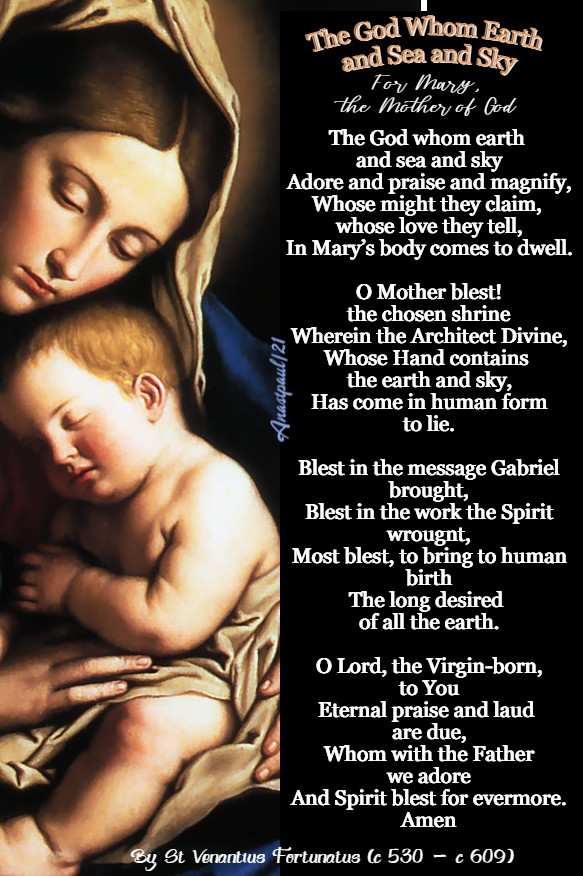
The God Whom Earth and Sea and Sky For Mary, The Mother of God For the Annunciation, Advent and Christmas By St Venantius Fortunatus (c 530 – c 609)
The God whom earth and sea and sky Adore and praise and magnify, Whose might they claim, whose love they tell, In Mary’s body comes to dwell.
O Mother blest! the chosen shrine Wherein the Architect Divine, Whose Hand contains the earth and sky, Has come in human form to lie.
Blest in the message Gabriel brought, Blest in the work the Spirit wrought, Most blest, to bring to human birth The long desired of all the earth.
O Lord, the Virgin-born, to You Eternal praise and laud are due, Whom with the Father we adore And Spirit blest for evermore.
“Having confidence in you, O Mother of God, I shall be saved. Being under you protection, I shall fear nothing. With your help, I shall give battle to my enemies and put them to flight, for devotion to you, is an arm of Salvation.”
St John Damascene (676-749) Father and Doctor of the Church
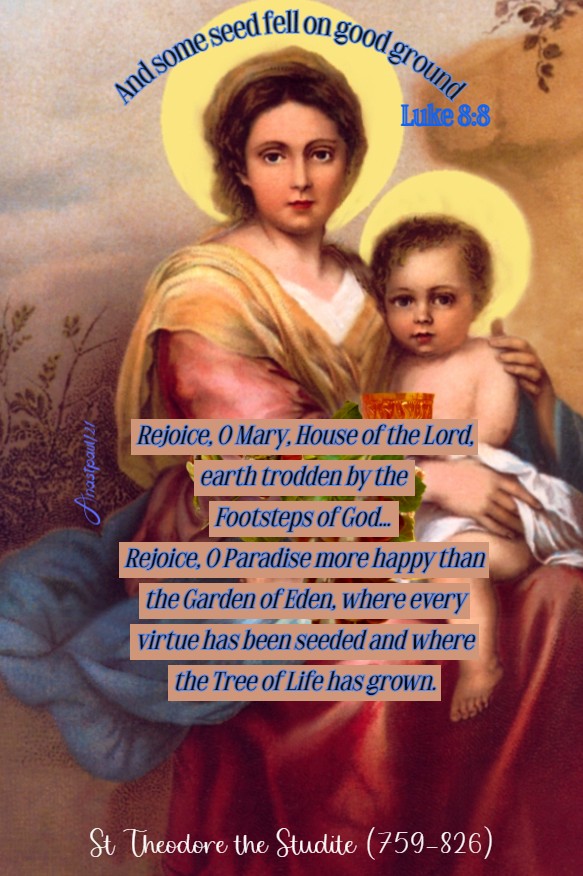
“And some seed fell on good ground” Luke 8:8
“Rejoice, O Mary, House of the Lord, earth trodden by the Footsteps of God… Rejoice, O Paradise more happy than the Garden of Eden, where every virtue has been seeded and where the Tree of Life has grown.”
St Theodore the Studite (750-826) Father, Abbot, Theologian, Writer
One Minute Reflection – 11 October – Feast of the Divine Maternity – Apocalypse 21:2-5, Luke 19:1-10 – Scripture search here: https://www.drbo.org/
“ … He climbed up into a sycamore tree that he might see Him …” – Luke 19:2
REFLECTION – “I’m writing with the desire to see you, a bold and good shepherd, pasturing and guiding the sheep entrusted to you with perfect zeal and thus, imitating the sweet Master of Truth, Who gave His life for us who are His sheep, who have strayed away from the path of grace. True…, we cannot do this without God and we cannot possess God while remaining on earth. But here is a sweet remedy – when our hearts are reduced to nothing and feeling small, we must do as Zacchaeus did. He was not tall and he climbed a tree to see God. This zeal of his, allowed him to hear these sweet words: “Zacchaeus, go home, for I must dine with you today.”
We must do this too, when we are feeling low, when our hearts are constricted and lacking in charity. We must climb the tree of the most holy Cross and there, we shall see, we shall touch God. There we shall find the fire of His inexpressible charity, the love that propelled Him, even to the humiliation of the Cross that raised Him up and made Him desire His Father’s honour and our salvation, with the craving of hunger and thirst… If this is what we want, if our carelessness does not get in the way, we can, in mounting the tree of the Cross, fulfill in ourselves, this word issuing from the mouth of Truth: “When I am lifted up from the earth, I shall draw all things to Myself” (Jn 12,32 Vg). Indeed, when the soul is thus raised up, it sees the blessings of the Father’s goodness and power…, it sees the mercy and lavishness of the Holy Spirit, that is to say, the inexpressible love holding Jesus bound to the wood of the Cross. Nails and bonds cannot hold Him there, only charity… O climb this most holy tree where hang, the ripe fruits of all the virtues that the body of the Son of God bears, ardently hasten. Dwell within the holy and sweet love of God. O sweet Jesus, Jesus love.” – St Catherine of Siena (1347-1380) Doctor of the Church (Letter 119, to the prior of the Olivetan Monks).
PRAYER – O God, Who, by the message of an Angel, willed to take flesh in the womb of the Blessed Virgin Mary, grant that we, Thy suppliants, who believe her to be truly the Mother of God, maybe assisted by her intercession with Thee.Through the same Jesus Christ, Thy Son our Lord, Who lives and reigns with Thee, in the unity of the Holy Ghost, God, world without end. Amen (Collect).
Our Morning Offering – 11 October – Feast of the Divine Maternity
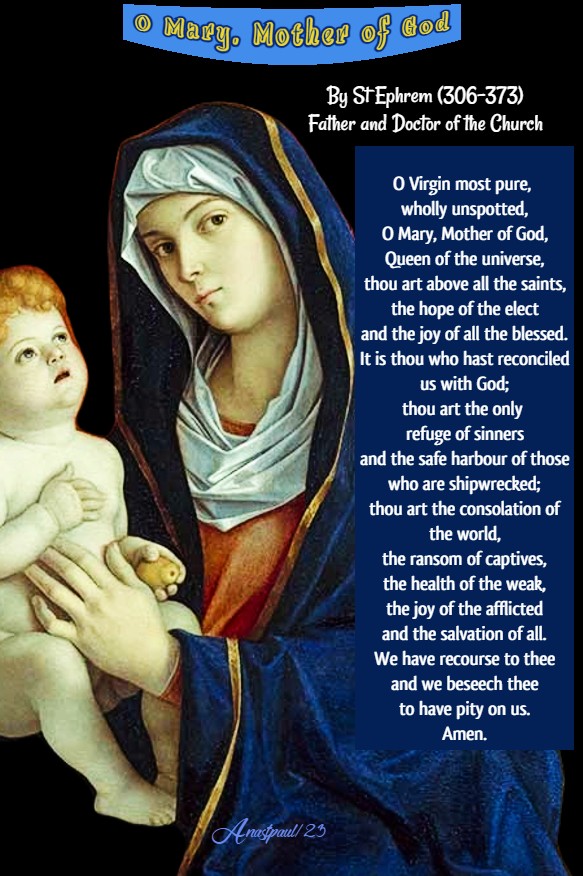
O Mary, Mother of God By St Ephrem (306-373) Father and Doctor of the Church
O Virgin most pure, wholly unspotted, O Mary, Mother of God, Queen of the universe, thou art above all the saints, the hope of the elect and the joy of all the blessed. It is thou who hast reconciled us with God; thou art the only refuge of sinners and the safe harbour of those who are shipwrecked; thou art the consolation of the world, the ransom of captives, the health of the weak, the joy of the afflicted and the salvation of all. We have recourse to thee and we beseech thee to have pity on us. Amen.
Saint of the Day – 11 October – Saint Ethelburga of Barking (Died c782) Virgin, First Abbess of the double Monastery (for men and women) at Barking, in Essex, England, founded by her brother, Miracle-worker. Sister of St Erconwald of London (Died c 693, Bishop of London and known as “The Light of London.” Ethelburga is one of a significant number of female religious leaders who played an important role in the first Century of the Anglo-Saxon Church. Also known as – Adilburga, Æthelburh, Edilburge, Etelburg, Ethelburgh. Ethelburge. Additional Memorial – 12 October in the Diocese of Brentwood of which Barking forms a part
Not much is known about the family origin of these two saintly siblings but their names suggest they might have been connected to the Kentish Royal family. The main source for Ethelburga’s life is St Bede’s Historia Ecclesiastica Gentis Anglorum which recounts the foundation of Barking Monastery, early miracles there and Ethelburga’s death. St Bede describes Ethelburga as “upright in life and constantly planning for the needs of her community.”
Some time before he became the Bishop of London in 675, Erconwald founded a double Monastery at Barking for his sister and a Monastery at Chertsey for himself. Barking appears to have already been established by the time of the plague in 664.
Around the same year, 675, Ethelburga founded the Church of All Hallows Berkyngechirche (now known as All Hallows Barking or All Hallows by the Tower) in the City of London on land given to her by her brother.
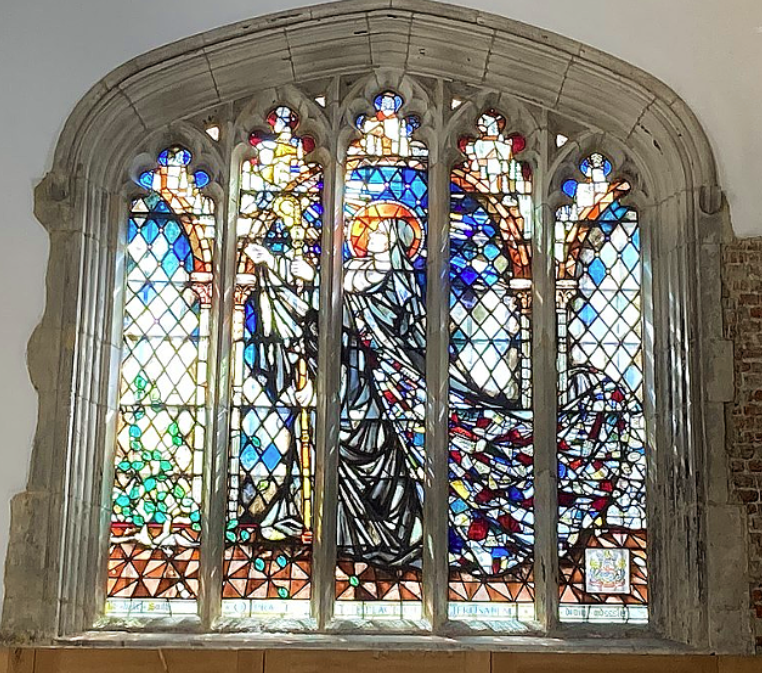
St Ethelburga at the All Hallows Church
St Bede writes:
“In this Convent many proofs of holiness were effected which many people have recorded, from the testimony of eyewitnesses, in order that the memory of them might edify future generations. I have, therefore, been careful to include some in this history of the Church …
When Ethelburga, the devout Mother of this God-fearing community, was herself about to be taken out of this world, one of the sisters, whose name was Tortgyth, saw a wonderful vision. This nun had lived for many years in the Convent, humbly and sincerely striving to serve God and had helped the Mother to maintain the regular observances, by instructing and correcting the younger sisters.
In order that Ethelburga’s strength might be ‘made perfect in weakness’ as the Apostle says, she was suddenly attacked by a serious disease. Under the good Providence of our Redeemer, this caused her great distress for nine years, in order that any traces of sin which remained among her virtues, through ignorance, or neglec,t might be burned away, in the fires of prolonged suffering. Leaving her cell one night at first light of dawn, this Sister saw distinctly, what appeared to be a human body wrapped in a shroud and shining more brightly than the sun. This was raised up and carried out of the house where the Sisters used to sleep. She observed closely to see how this appearance of a shining body was being raised and saw, what appeared to be cords, brighter than gold which drew it upwards until it entered the open heavens and she could see it no longer. When she thought about this vision, there remained no doubt in her mind that some member of the Community was shortly to die and that her soul would be drawn up to Heaven by her good deeds as though by golden cords. And so it proved not many days later, when God’s beloved Ethelburga, the Mother of the Community, was set free from her bodily prison. And none, who knew her holy life, can doubt that when she departed this life, the gates of our heavenly home opened at her coming.
In the same convent there was also a Nun of noble family in the world, who was yet more noble in her love for the world to come. For many years she had been so crippled that she could not move a single limb and hearing that the venerable Abbess’ body had been carried into the Church until its burial, she asked to be carried there, and to be bowed towards it, in an attitude of prayer. Then she spoke to Ethelburga as though she were still alive and begged her to pray to God on her behalf and ask Him of His mercy to release her from her continual pain. Her request received a swift reply; for twelve days later she was set free from the body and exchanged her earthly troubles for a heavenly reward.
Three years after the death of the Abbess, Christ’s servant Tortgyth, was so wasted away by disease … that her bones scarcely held together, until finally, as death drew near, she lost the use of her limbs and even of her tongue. After three days and nights in this condition, she was suddenly refreshed by a vision from Heaven, opened her eyes and spoke. Looking up to Heaven, she began to address the vision …: “I am so glad that you have come; you are most welcome.” She then remained silent for a while, as if awaiting an answer from the person whom she saw and spoke to; then, seeming a little displeased, she said, “This is not happy news.” After another interval of silence, she spoke a third time: “If it cannot be today, I beg that it may not be long delayed.” Then she kept silent a little while as before and ended: “If this decision is final and unalterable, I implore that it may not be delayed beyond the coming night.” When she had finished, those around her asked her to whom she had spoken. “To my dearest Mother Ethelburga,” she replied and, from this they understood that she had come to announce the hour of her passing was near. So after a day and a night her prayers were answered and she was delivered from the burden of the body and entered the joys of eternal salvation.”
Several more miracles are also recorded, relating to an outbreak of plague in the community. In Ethelburga’s time, Barking Abbey was a double Monastery as was common in the earlier Anglo-Saxon period but it’s the bonds of community and affection between Ethelburga and her Nuns which emerge most memorably from St Bede’s account – ‘golden cords’ of another kind than those Tortgyth saw in her vision.
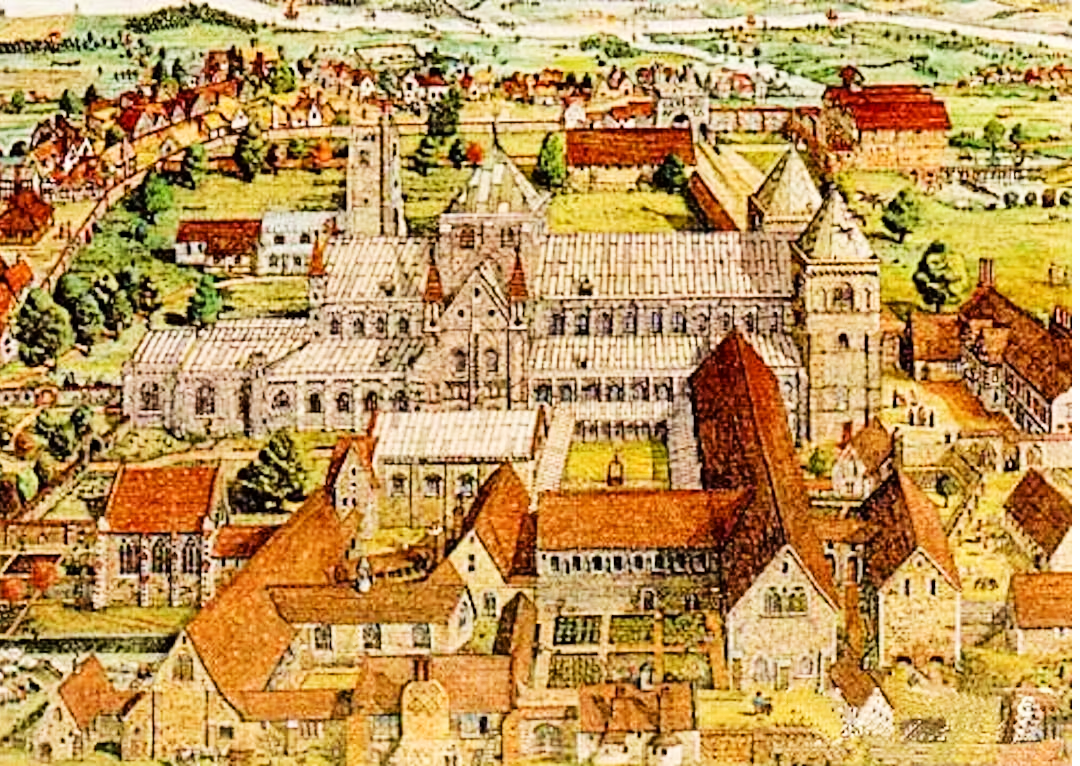
Barking Abbey
Barking Abbey grew to be one of the most important Monasteries in the country and, at the time of the Dissolution, it was the third richest in England. It was closely associated with a number of powerful Royal and noble women, including the wives and sisters of Kings – and, even St Thomas à Becket’s sister. The Abbess of Barking was not only an important landowner but a baroness in her own right, required to supply the king with soldiers in wartime like any secular lord. Barking also had a strong literary and educational tradition which continued throughout the medieval period- learned authors such as St Aldhelm (in the 8th Century) and Goscelin (in the 11th) wrote Latin works for the Nuns of Barking and several Nuns composed their own poetry and prose. Perhaps the first female author from England whom we can name was Clemence of Barking Abbey, who wrote a Life of St Catherine in Anglo-Norman, in the twelfth Century; a Nun of Barking (either Clemence or someone else) also wrote a Life of St Edward the Confessor, around the same time. Barking Abbey has been described as “perhaps the longest-lived, albeit not continuously recorded, institutional centre of literary culture for women in British history.” And it all began with our Saint Ethelburga.
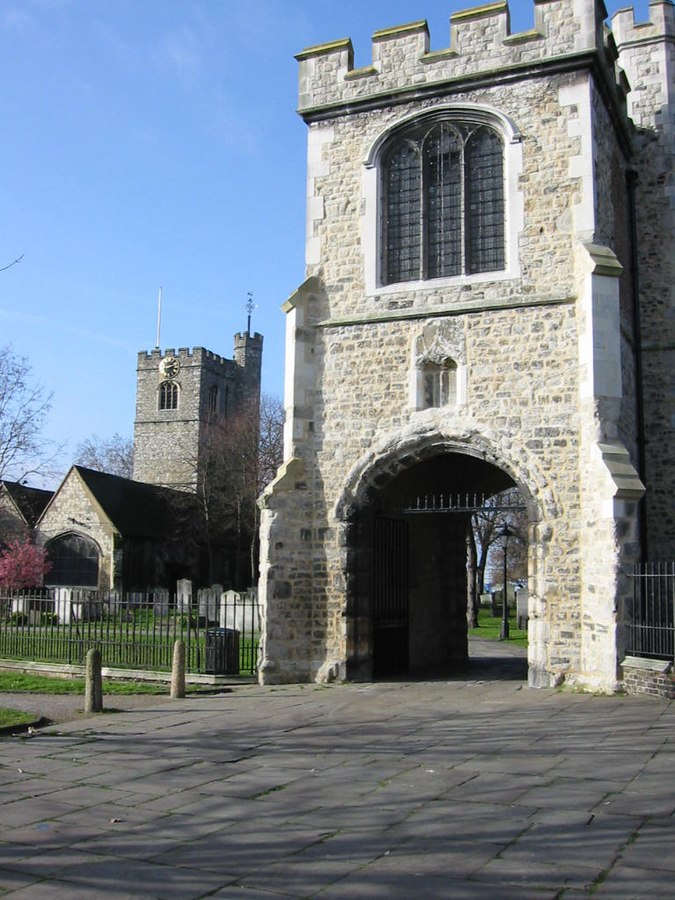
Barking Abbey – Curfew Tower with St Margaret’s Church in background
Ethelburga was buried at Barking Abbey. The Old English Martyrology records her Feast day as 11 October. There are many Churches across England dedicated to St Ethelburga and many regions, streets, estates, schools and institutions too.
Feast of the Divine Maternity – Second Sunday in October or 11 October: The object of this Feast is to commemorate the dignity of the Mary as Mother of God. Mary is truly the Mother of Christ, who in One Person unites the Human and Divine Nature. This title was solemnly ratified by the Council of Ephesus on 22 June 431. It was first granted to Portugal, Brazil and Algeria in 1751; it is now of almost universal observance. Under this title Poland celebrates the Feast of the Blessed Virgin Mary, Queen of Poland. At present the Feast is not found in the Universal Calendar of the Church but nearly all Diocesan calendars have adopted it. Patronage – Trinitarian. HERE: https://anastpaul.com/2022/10/11/feast-of-the-divine-maternity-and-memorials-of-the-saints-11-october/
St Agilbert of Paris
St Alexander Sauli CRSP (1534-1592) Bishop “The Apostle of Corsica,” Clerk Regular of the Congregation of Saint Paul (The Barnabites) – St Alexander is referred to as “The Second Founder,” Missionary, Writer, Teacher of philosophy and theology at the University of Pavia, Reformer, Evangeliser, Confessor, Superior-General of the Barnabites in 1565. In addition, St Alexander Sauli was both friend, advisor and spiritual comfort to St Charles Borromeo, who held him in very high esteem. His Life: https://anastpaul.com/2020/10/11/saint-of-the-day-11-october-saint-alexander-sauli-crsp-1534-1592/
St Anastasius V St Anastasius the Apocrisarius St Andronicus of Ephesus St Andronicus the Soldier St Ansilio St Canice St Digna of Sicily St Dionisio de Santarem St Emilian of Rennes St Ethelburga of Barking (Died c782) Virgin, Abbess St Eufridus St Firminus of Uzes St Germanus of Besancon St Gratus of Oloron St Guiadenzio of Gniezno
St Juliana of Pavilly St Nectarius of Constantinople St Philip the Deacon St Philonilla St Placidia St Probus of Side St Santino of Verdun St Sarmata St Taracus of Cladiopolis St Zenaides
Martyrs of Vilcassin – 4 Saints: Four Christians who were Martyred together. We know little more than the names – Nicasius, Pienza, Quirinus and Scubicolus. Their martyrdom occurred in Vexin Lugdunense territory of Gaul (modern Vilcassin, France), date unknown.
Martyrs of Sicily: A group of eight Christians who were Martyred together. We know little more than the names – • Ampodus, • Anastasius, • Faustus, • Januarius, • Jovinian, • Marcellus, • Martialis and • Placidus. They died in Sicily, Italy,
Martyrs of Vilcassin: Four Christians who were Martyred together. We know little more than the names – Nicasius, Pienza, Quirinus and Scubicolus. They died in the Vexin Lugdunense territory of Gaul (modern Vilcassin, France).











 AnaStpaul
You must be logged in to post a comment.