Thought for the Day – 13 October – Meditations with Antonio Cardinal Bacci (1881-1971)
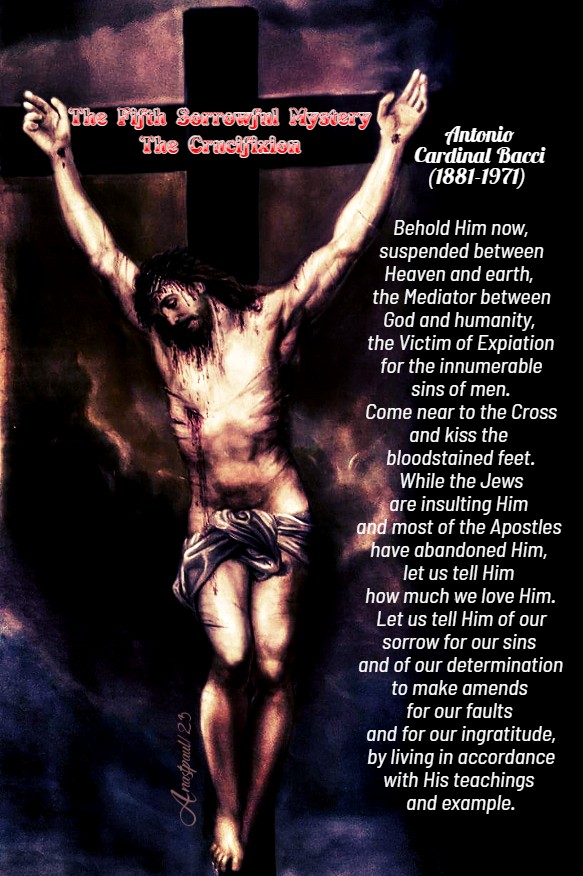
“Month of the Holy Rosary” The Fifth Sorrowful Mystery The Crucifixion
“At last, Jesus reaches Calvary, breathless and reduced to utter exhaustion. The instrument of torture is taken from Him and laid upon the ground. Our divine Redeemer suffers acute pain as Her is again stripped of His garments, which have stuck to His wounds. Now, He is stretched, an innocent victim, on the altar of sacrifice, the Cross. One of the executioners grasps His hand, pierces it with a large nail and attaches it to the wood. Then, he does the same with the other hand and with the two feet. His Mother is close at hand. She feels in her heart the blows of the hammer which lacerate the living flesh of Jesus. Jesus remains silent “as a meek lamb that is carried to be a victim” (Jer 11:19).
Now, the executioners raise up the Cross and fix it in the hold already prepared for it. The shock of this impact sends a shudder of terrible pain through the Victim’s members and entire frame. Behold Him now, suspended between Heaven and earth, the Mediator between God and humanity, the Victim of Expiation for the innumerable sins of men.
Come near to the Cross and kiss the bloodstained feet. While the Jews are insulting Him and most of the Apostles have abandoned Him, let us tell Him how much we love Him. Let us tell Him of our sorrow for our sins and of our determination to make amends for our faults and for our ingratitude, by living in accordance with His teachings and example.”
Quote/s of the Day – 13 October – “The Month of the Most Holy Rosary and of the Angels” – Our Lady of Fatima: The Sixth & Final Apparition – Our Lady of the Holy Rosary (the name she gave herself when Lucia asked her name).
“The Rosary is the most excellent form of prayer and the most efficacious means of attaining eternal life. It is the remedy for all our evils, the root of all our blessings. There is no more excellent way of praying.”
Pope Leo XIII (1810-1903)
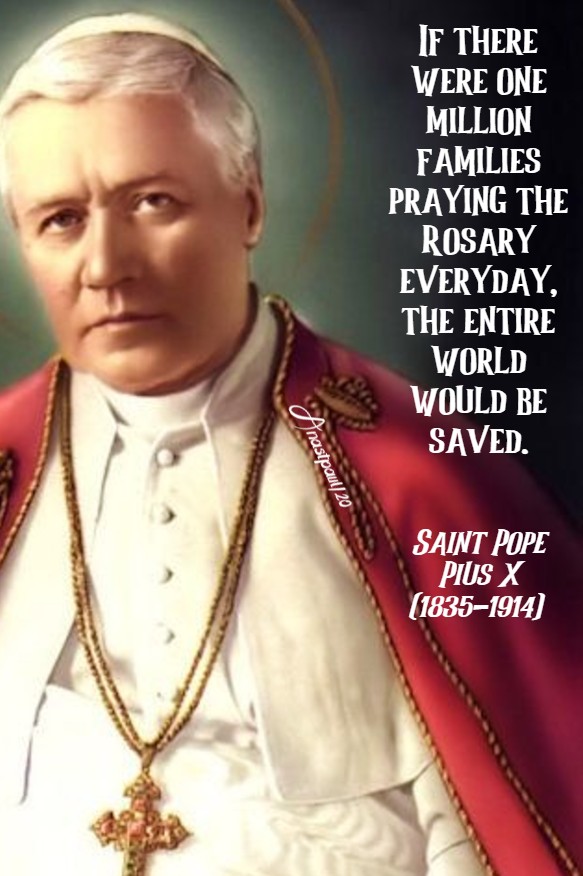
“If there were one million families praying the Rosary everyday, the entire world would be saved.”
St Pope Pius X (1835-1914)
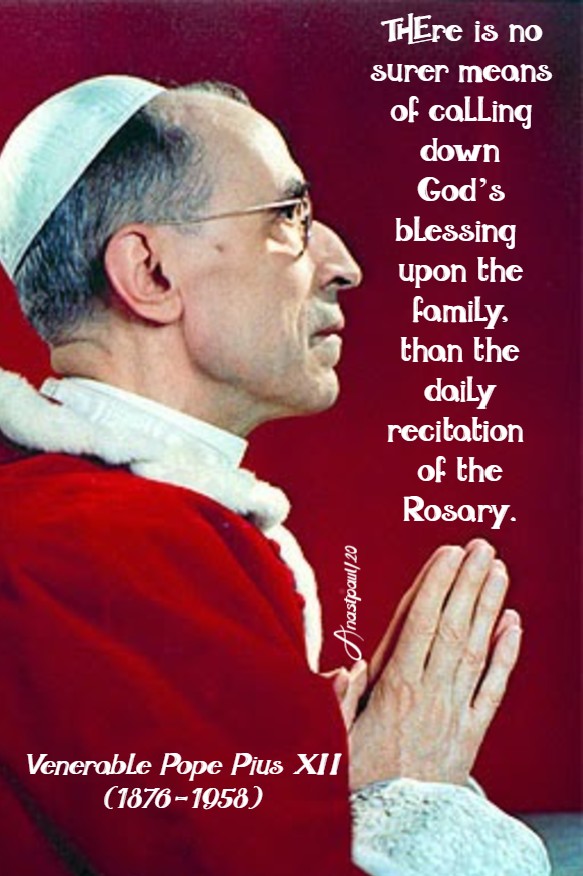
“There is no surer means of calling down God’s blessing upon the family, than the daily recitation of the Rosary.”
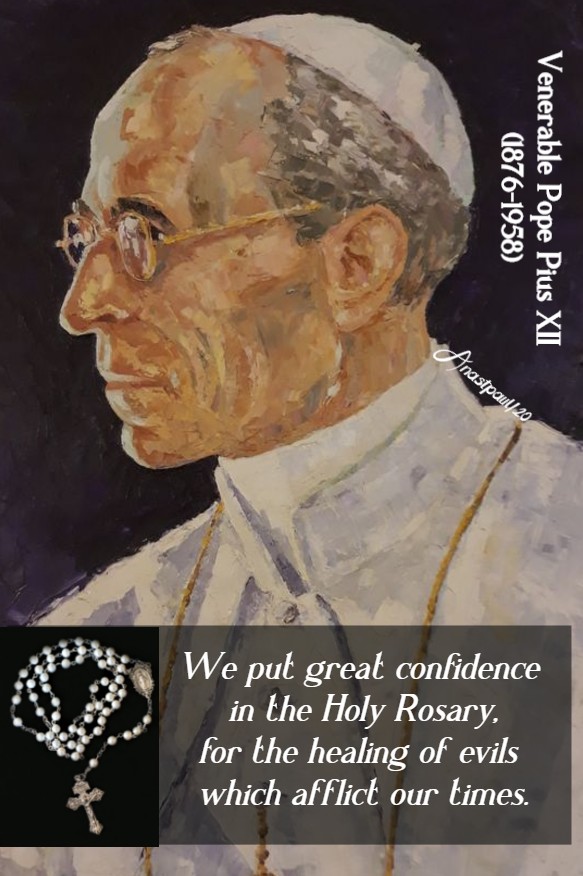
“We put great confidence in the Holy Rosary, for the healing of evils which afflict our times.”
Pope Pius XII (1876-1958)
Act of Consecration and Reparation to the Immaculate Heart of Mary
O Immaculate Heart of Mary, Queen of Heaven and Earth and tender Mother of men, in accordance with thy ardent wish made known at Fatima, I consecrate to thee, myself, my brethren, my country and the whole human race. Reign over us and teach us how to make the Heart of Jesus reign and triumph in us and around us, as It has reigned and triumphed in thee. We wish to atone for the many crimes committed against Jesus and thee. We wish to call down upon our country and the whole world, the peace of God in justice and charity. We promise to imitate thy virtues, by the practice of a Christian life without regard to human respect. We resolve to receive Holy Communion on the first Saturday of every month and to offer thee five decades of the Rosary on this day, together with our sacrifices in the spirit of reparation and penance. Amen.
One Minute Reflection – 13 October – “The Month of the Most Holy Rosary and of the Angels” – Our Lady of Fatima: The Sixth & Final Apparition – St Edward King and Confessor (c1003-1066) – Sirach 31:8-11, Luke 12:35-40 – Scripture search here: https://www.drbo.org/
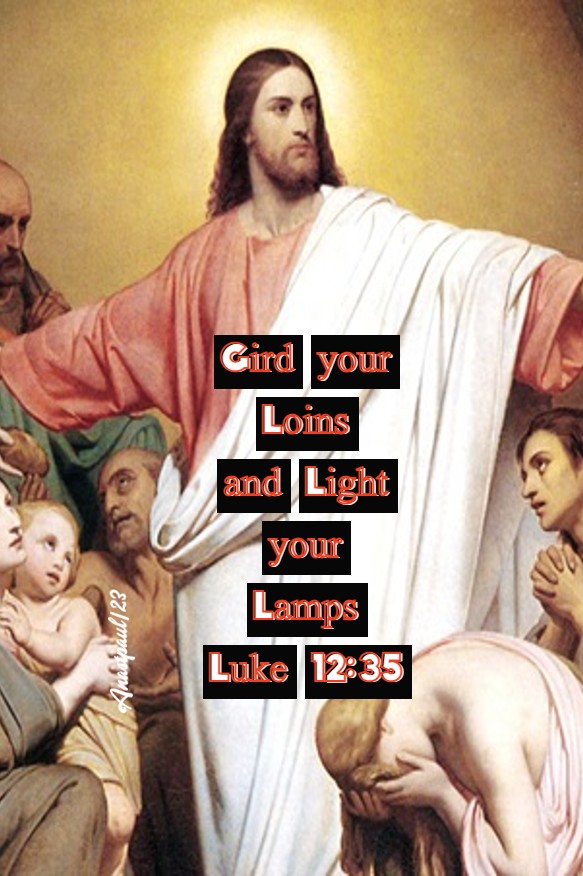
“Let your loins be girt about and your lamps burning …” – Luke 12:35
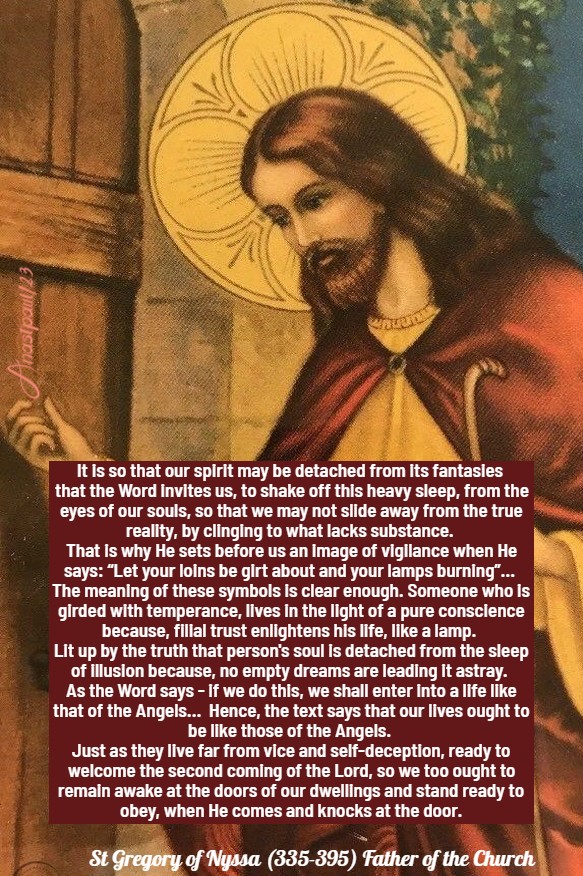
REFLECTION – “It is so that our spirit may be detached from its fantasies that the Word invites us, to shake off this heavy sleep, from the eyes of our souls, so that we may not slide away from the true reality, by clinging to what lacks substance. That is why He sets before us an image of vigilance when He says: “Let your loins be girt about and your lamps burning”… The meaning of these symbols is clear enough. Someone who is girded with temperance, lives in the light of a pure conscience because, filial trust enlightens his life, like a lamp. Lit up by the truth that person’s soul is detached from the sleep of illusion because, no empty dreams are leading it astray. As the Word says – if we do this, we shall enter into a life like that of the Angels…
Indeed, these are they who wait for the Lord at His return from the wedding and who are seated by the heavenly gates, with watchful eyes, so that the King of Glory (Ps 23:7) might once more pass through, when he returns from the marriage feast and enters again into the beatitude above the heavens. “Coming forth like the groom from his bridal chamber” (Ps 18:6)…, He united to Himself like a virgin, the nature we had prostituted to idols, once He had restored its virginal integrity, through sacramental regeneration. The nuptials, having now been accomplished, since the Church has been espoused by the Word… and brought into the chamber of His Mysteries, the Angels awaited the return of the King of Glory to the blessedness which matches His nature.
Hence, the text says that our lives ought to be like those of the Angels. Just as they live far from vice and self-deception, ready to welcome the second coming of the Lord, so we too ought to remain awake at the doors of our dwellings and stand ready to obey, when He comes and knocks at the door.” – St Gregory of Nyssa(335-395) Bishop, Father of the Church, Brother of St Basil the Great (Sermons on the Song of Songs No 11).
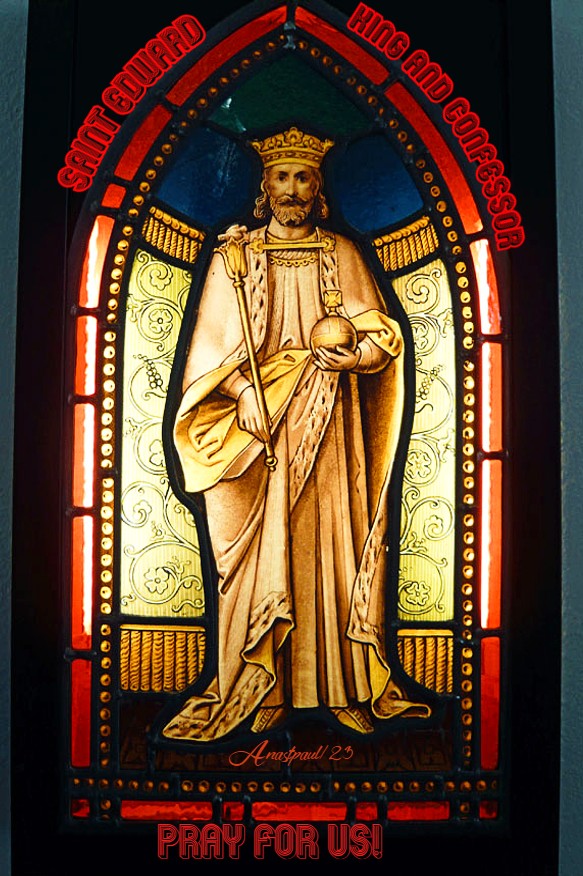
PRAYER – O God, Who crowned blessed King Edward with the glory of eternity, grant us, we beseech Thee, so to venerate him on earth that we may be worthy to reign with him in heaven. Through Jesus Christ, Thy Son our Lord, Who lives and reigns with Thee, in the unity of the Holy Ghost, God, world without end. Amen (Collect).
Our Morning Offering – 13 October – “The Month of the Most Holy Rosary and of the Angels” – Our Lady of Fatima: The Sixth & Final Apparition
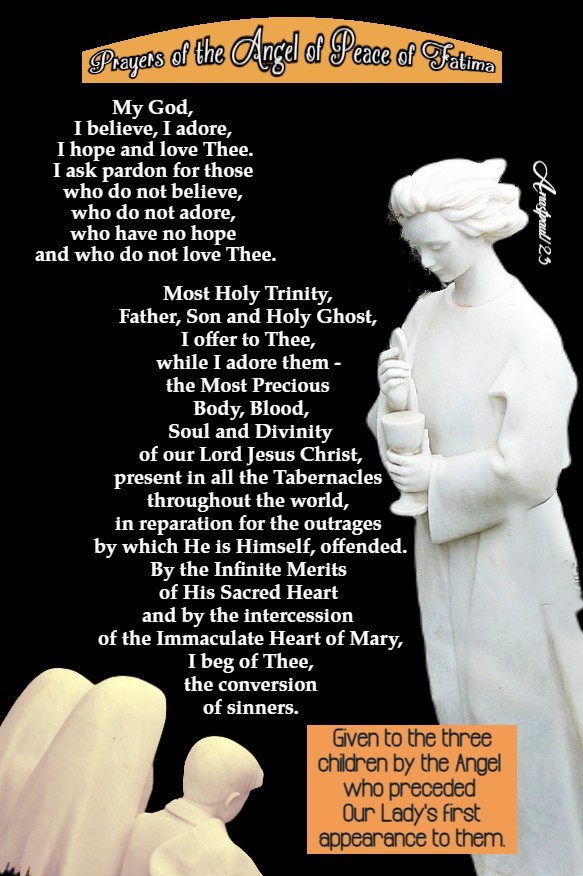
Prayers of the Angel of Peace of Fatima (Given to the three children by the Angel who preceded Our Lady’s first appearance to them.)
I. My God, I believe, I adore, I hope and love Thee. I ask pardon for those who do not believe, who do not adore, who have no hope and who do not love Thee.
II. Most Holy Trinity, Father, Son and Holy Ghost, I offer to Thee, while I adore them – the Most Precious Body, Blood, Soul and Divinity of our Lord Jesus Christ, present in all the Tabernacles throughout the world, in reparation for the outrages by which He is Himself, offended. By the Infinite Merits of His Sacred Heart and by the intercession of the Immaculate Heart of Mary, I beg of Thee, the conversion of sinners.
The Angel of Peace
One day in the spring of 1916, when three little children, Lucia dos Santos, aged ten and her little cousins, Francisco Marto, aged nine,and his little sister Jacinta, only seven years old, were tending sheep near the village of Fatima, Portugal, the appearance of an oval of light, of unusual brilliance, startled them. The dazzling light seemed to advance, from the end of the field toward the cave, in which the young shepherds had sought shelter. In the midst of this light they beheld a young man who announced himself as the Angel of Peace. He taught the little seers a new prayer and then vanished.
A few months later, the Angel of Peace made his second appearance and urged the children to offer up sacrifices and prayers at all times. Upon asking what was meant by “sacrifice,” they were told to offer everything in reparation to God, for the sins by which He is offended and, as a petition for the conversion of sinners. “Thus you will bring peace to our country,” was the Angel’s promise. At this last saying, the children were baffled. Reading their thoughts, the Angel revealed that he was the Guardian Angel of Portugal.
In the Autumn of the same year, the Angel appeared a third time. He carried a host in his right hand extended over a Ciborium which he held with the left hand. Again the Angel taught the children a beautiful prayer and before parting distributed Holy Communion to the three little ones.
Saint of the Day – 13 October – Saint Theophilus of Antioch (Died c184) Confessor, Bishop of Antioch from 169 until 182, Scolar and Writer, Theologian, Apologist, Defender of the Faith against heresy. His writings (the only remaining extant being his apology to Autolycus) indicate that he was born a pagan, not far from the Tigris and Euphrates Rivers in Mesopotamia (modern Middle East) and was led to embrace Christianity by studying the Sacred Scriptures. Also known as – Teofilo.
The Roman Martyrology reads today: “At Antioch, the holy Bishop, Theophilus, who held the pontificate in that Church and City, the sixth after the blessed Apostle, Peter.”
Theophilus, Bishop of Antioch, was the Author of many works, one of which has survived, while we only know the titles of others. From the pages of this work, we can once again hear the words of the Saint, in defence of Christian doctrine and faith, even then the subject of accusations by unbelievers and the vicious.
“But, if you tell me” – wrote the ancient Bishop – “Show me your God,” I will say to you: “Show me your man and I will show you my God. Show me, therefore, that they see clearly, the eyes of your soul and that the ears of your heart hear well… God shows Himself to those who can see Him, when they have opened the eyes of the soul. Everyone has their good eyes but someone has veiled them, incapable of seeing the light of the sun. However, the fact that the blind do not see, does not show at all, how the light of the sun does not appear. The blind blame themselves and their eyes. In the same way, my son, if you have the eyes of your soul veiled by your faults and your bad habits, you will not be able to see the light. Like a clear mirror – this is how man must keep his soul pure. If the mirror is rusty, the face of man does not appear on its surface. In the same way, if man is a sinner, this man cannot contemplate God.”
The Author of these phrases, which St Augustine himself would later take up, was born in a region of the East, near the Tigris and the Euphrates. He was a pagan and received a Greek education. He converted by observing the customs of Christians, clearly superior to those of pagans and, by reading the Sacred Scriptures. He would then skilfully use his experiences as a convert and his knowledge of profane culture, in his polemics against unbelievers and philosophers.
He was elected Bishop of Antioch in 169 and still held the pastoral care of the great City, where Saint Peter himself had had his first Chair at the death of Marcus Aurelius, in 180. His apostolic care, in the midst of one of the most populous and most agitated communities of the early Christian world, did not distract him from his studies and intellectual activity.
Eusebius of Caesarea, the Historia (Died 339), speaks of the zeal which he and the other chief Shepherds displayed in driving away the heretics who were attacking Christ’s flock, with special mention of his work against Marcion.
He made contributions to Christian literature, writing polemical works against the heretics of the time, works of catechesis, commenting on the Scriptures, works of history, to clear away pagan myths. In short, he was a Bishop who left a strong imprint of his intelligence and culture in the history of his time, just as he left traces of his charity and mercy in the souls entrusted to him.
St Jerome and Eusebius mention numerous works of St Theophilus existing in their time. They are:
the existing Apologia addressed to Autolycus;
a work against the heresy of Hermogenes;
against that of Marcion;
some catechetical writings;
St Jerome also mentions having read some commentaries on the Gospels and on Proverbs, which bore Theophilus’ name but which he regarded as inconsistent with the elegance and style of his other works.
The one undoubted extant work of St Theophilus, the 7th Bishop of Antioch, is his Apology to Autolycus (Apologia ad Autolycum), a series of books defending Christianity written to a pagan acquaintance.
St Benedict of Cupra St Berthoald of Cambrai St Carpus of Troas St Chelidonia St Comgan the Monk St Florence of Thessalonica St Fyncana St Fyndoca Bl Gebrand of Klaarkamp
St Theophilus of Antioch (Died c184) Bishop St Venantius
Three Crowns of Cordoba – (3 Saints): Three Christian men Martyred in the persecutions of Diocletian – Faustus, Januarius and Martial. They were burned to death in 304 in Cordoba, Spain.










 AnaStpaul
You must be logged in to post a comment.