Thought for the Day – 14 October – Meditations with Antonio Cardinal Bacci (1881-1971)
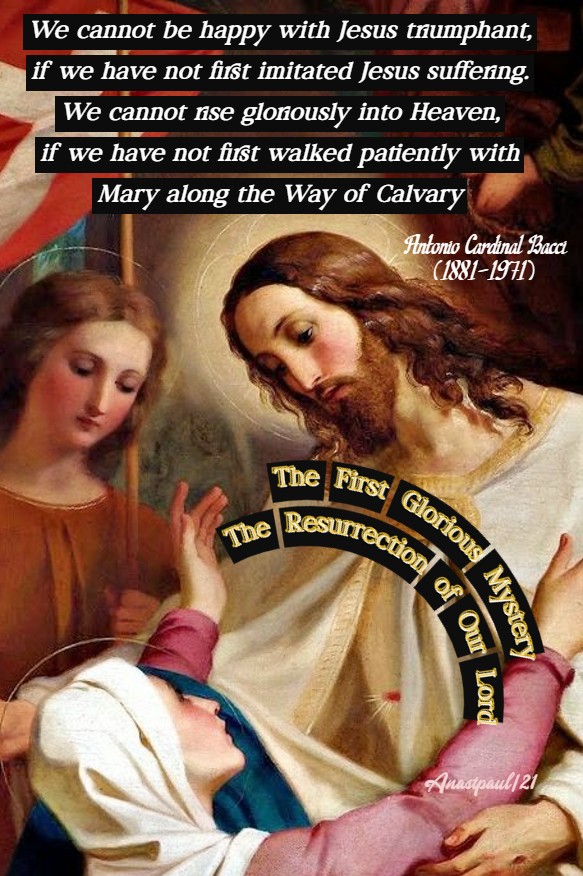
“Month of the Holy Rosary” The First Glorious Mystery The Resurrection of Our Lord
“Do we wish to share also in the joy of the Resurrection of Jesus Christ? Let us imitate Mary. First of all, we must participate as she did in the sufferings of Christ. By meditating frequently on the Passion and Death of Christ, we can nourish in our hearts, an intense love for Him Who suffered so much for our salvation. Let us learn to carry our cross, as He carried His, with resignation and with conformity to God’s Will. Spiritual joy is always the fruit of renunciation and love.
We cannot be happy with Jesus triumphant ,if we have not first imitated Jesus suffering. We cannot rise gloriously into Heaven, if we have not first walked patiently with Mary along the Way of Calvary!”
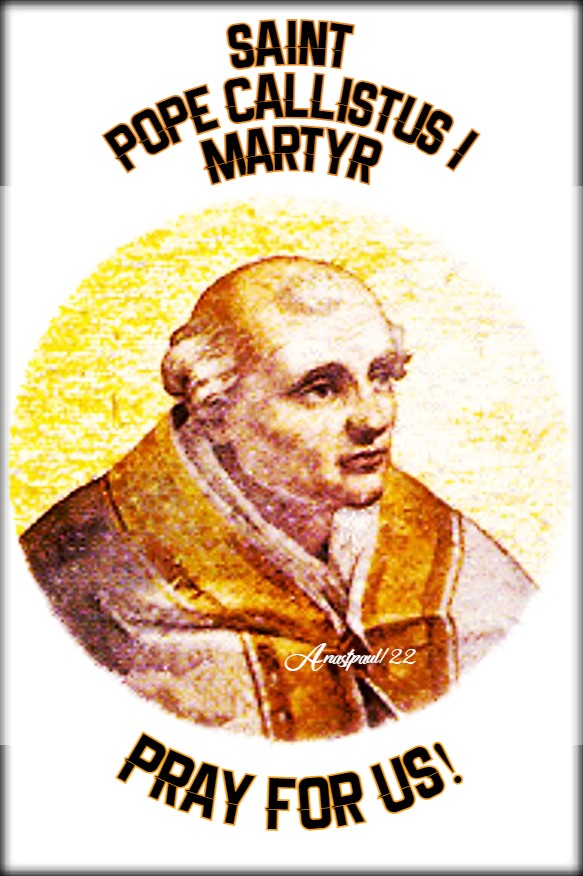
Quote/s of the Day – 14 October – “The Month of the Most Holy Rosary and of the Angels” – St Callistus I (c218- c223) Confessor, Pope, Martyr (and remembering St Bernard our Pilgrim today) – 1 Peter 5:1-4; 5:10-11, Matthew 16:13-19 – Scripture search here: https://www.drbo.org/
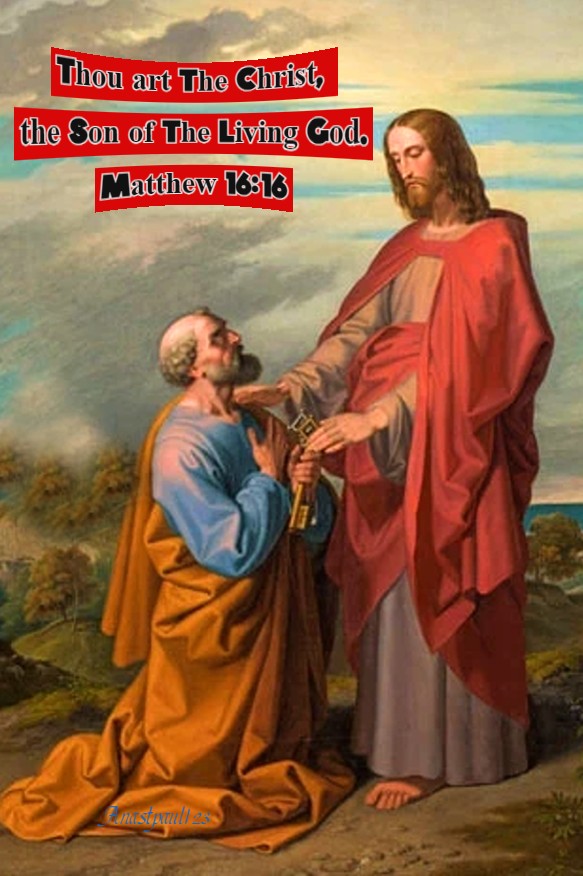
“Simon Peter answered and said: Thou art Christ, the Son of the living God. ”
Matthew 16:16
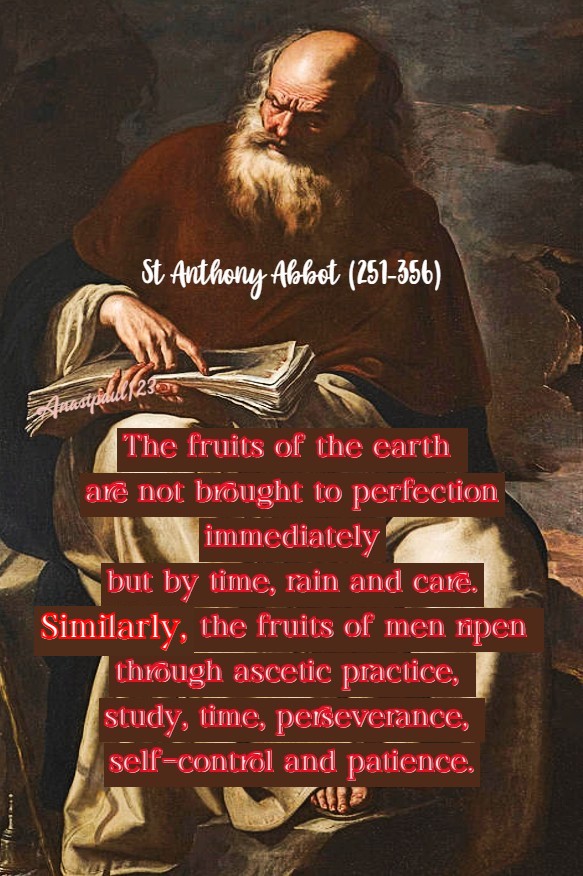
“The fruits of the earth are not brought to perfection immediately but by time, rain and care. Similarly, the fruits of men ripen through ascetic practice, study, time, perseverance, self-control and patience.”
St Anthony Abbot (251-356)
“No-one should fear to suffer for the sake of justice, no-one should lose confidence in the reward that has been promised. The way to rest is through toil, the way to life is through death. Christ has taken on Himself the whole weakness of our lowly human nature. If then, we are steadfast in our faith in Him and in our love for Him, we win the victory that He has won, we receive what He has promised.”
St Pope Leo the Great (400-461) Father and Doctor of the Church
“Now, you must always persevere in firmly placing all your trust in our Lord, in the troublesome business you have in hand. It will give you a fine opportunity of laying a good foundation of submission to God’s will and peace of soul.”
St Francis de Sales (1567-1622) Doctor Caritatis
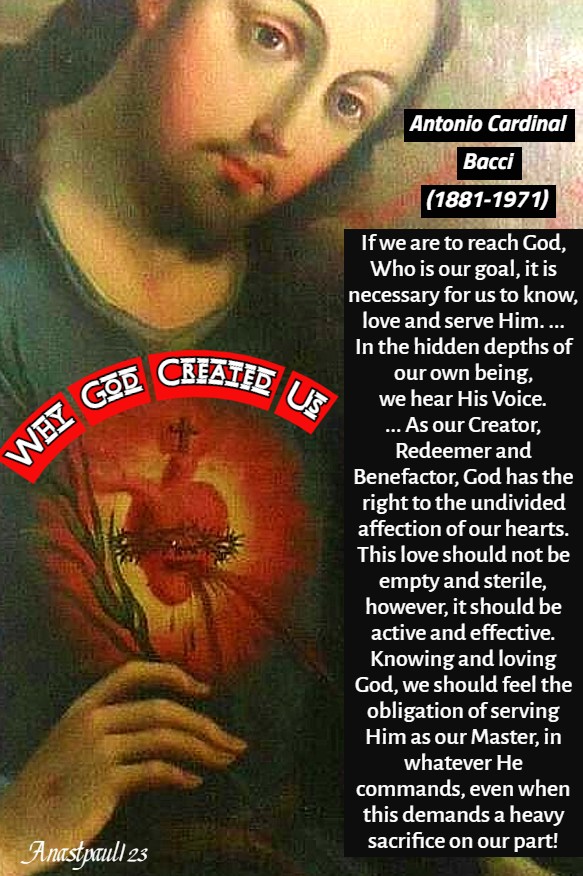
“If we are to reach God, Who is our goal, it is necessary for us to know, love and serve Him. In the hidden depths of our own being, we hear His Voice. As our Creator, Redeemer and Benefactor, God has the right to the undivided affection of our hearts. This love should not be empty and sterile, however, it should be active and effective. Knowing and loving God, we should feel the obligation of serving Him as our Master, in whatever He commands, even when this demands a heavy sacrifice on our part!”
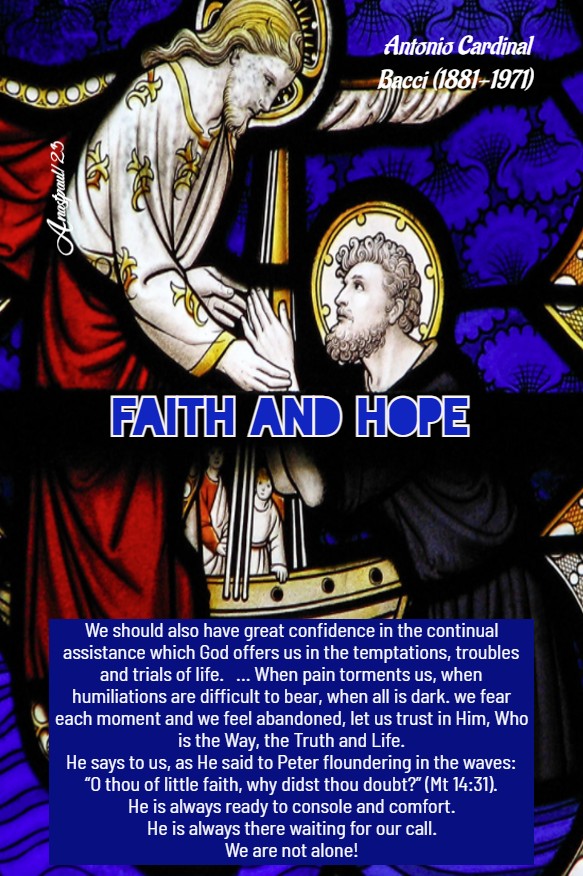
“We should also have great confidence in the continual assistance which God offers us in the temptations, troubles and trials of life. When pain torments us, when humiliations are difficult to bear, when all is dark. we fear each moment and we feel abandoned, let us trust in Him, Who is the Way, the Truth and Life. He says to us, as He said to Peter floundering in the waves: “O thou of little faith, why didst thou doubt?” (Mt 14:31). He is always ready to console and comfort. He is always there waiting for our call. We are not alone!”
One Minute Reflection – 14 October – “The Month of the Most Holy Rosary and of the Angels” – – St Callistus I (c218- c223) Confessor, Pope, Martyr – 1 Peter 5:1-4; 5:10-11, Matthew 16:13-19 – Scripture search here: https://www.drbo.org/
“Upon this rock I will build My Church” – Matthew 16:18
REFLECTION – “Brothers, when it comes to fulfilling my duties as Bishop, I discover that I am weak and slack, weighed down by the weakness of my own condition, while at the same time, I want to act generously and courageously. However, I draw my strength from the untiring intercession of the almighty and eternal Priest, Who, like us but equal to the Father, lowered His divinity to the level of man and raised humankind to the level of God. The decisions He made, give me a just and holy joy. For, when He delegated many shepherds to care for His flock, He did not abandon watching over His beloved sheep. Thanks to that fundamental and eternal assistance, I in turn, have received the protection and support of the Apostle Peter, who also does not abandon his function. This solid foundation, on which the whole of the Church is built, never grows tired of carrying the whole weight, of the building which rests on it.
The firmness of faith, for which the first of the Apostles was praised, never fails. Just as everything which Peter professed in Christ remains, so that which Christ established in Peter, remains… The order willed by God’s Truth remains. Saint Peter perseveres in the solidity which he received; he has not abandoned the governance of the Church which was placed in his hands. That, my brothers, is what that profession of faith, inspired by God the Father, obtained in the heart of the Apostle. He received the solidity of a rock which no assault can shake. In the entire Church, Peter says everyday: “Thou art the Messiah, the Son of the living God.” – St Leo the Great (400-461) Pope, Father and Doctor of the Church (Sermon on the anniversary of his Consecration as Bishop).
PRAYER – O God, Who behold how we fail in our weakness, mercifully restore us to Thy love, through the examples of Thy Saints. Through Jesus Christ, Thy Son our Lord, Who lives and reigns with Thee, in the unity of the Holy Ghost, God, world without end. Amen (Collect).
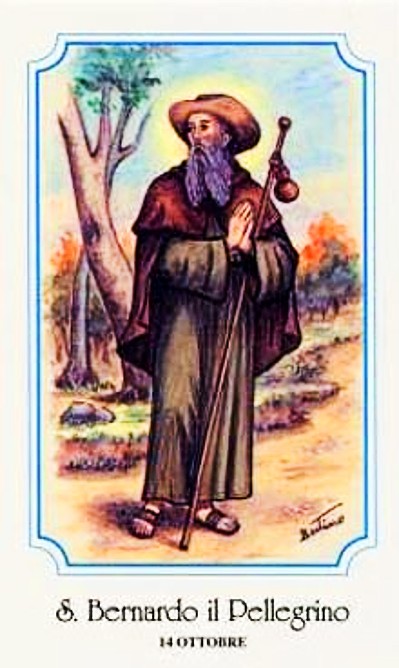
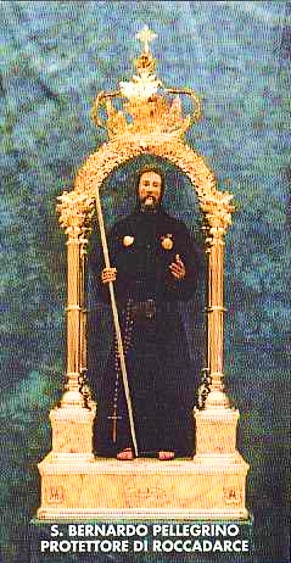
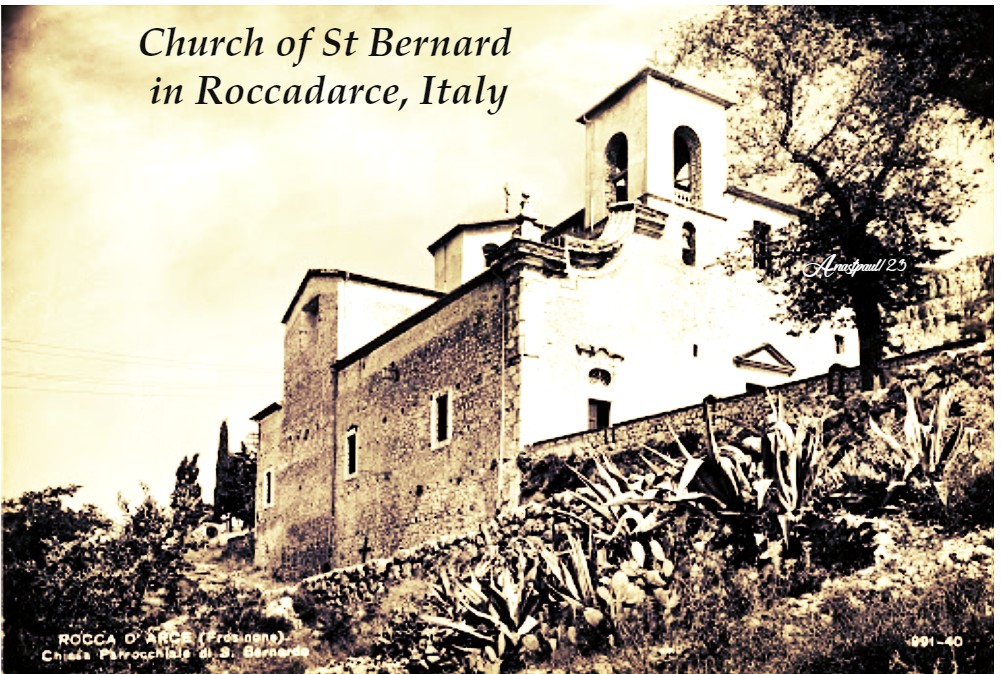
Saint of the Day – 14 October – Saint Bernard of Roccadarce (Died 8th Century) Pilgrim. Born in England (or France) in the 8th Century and died of natural causes in Roccadarce in Campagna in Italy. Also known as – Berhard of Arce, Bernardo. Additional Memorial – 26 June (recovery of the Relics), 13 September (translation of his Relics). Patronage – Roccadarce, Italy.
The details of the “Life of Saint Bernard” are deduced from the “Inventarium Originalis Ecclesiae Parochialis Sanctae Mariae Roccae Arcis” of 1698, by the hands of the Archpriest of the same Parish, Don Antonio Nardone of Arce (Roccadarce today).
Bernard, from the City of Silloth (sometimes known as Silloth-on-Solway, in Cumberland, Cumbria) in England, decided to walk the world, together with Saint Gerard, Saint Fulk and Saint Arduin, brothers in Christ and to visit the holy places of Jerusalem and the Holy Land, the Grotto of Saint Mary Magdalene in Marseilles, of St James in Galicia, of St Nicholas in Bari, of St Michael the Archangel in Puglia on Mount Gargano and the holy places of Rome, as in fact, they did.
These saintly pilgrims were moved too, by a very great need to escape from their land, from the Kingdom of England, unable to tolerate the tyranny and heresies spread there. Since those Saints were similar to four candlesticks of Holy Church, they could not shine in the darkness and the light of their good works did not shine in that place darkened by the thick darkness of sins.
The four Saints, therefore, walked through all the aforementioned places, until, coming from the Sanctuary of the Archangel in Puglia, they arrived in the City of Atina. Here, Saint Gerard, one of these four, fell ill and died on 11 August . Then, when St Bernard in Arpino, St Fulk in Santopadre and St Arduin in Ceprano, fell ill, they all died in a short space of time, one after the other, in the aforementioned places. To this day, their bodies rest in each of those Towns and where they are exposed to devotion, with great veneration, by all of the faithful.
Only Bernhard would not lie still. According to tradition, he appeared in a dream to a man and asked that he be moved from his tomb in Arpino to Rocca d’Arce (now Roccadarce). Then his remains were exhumed from the tomb in the Chapel of San Giovanni in Arpino and transferred to the Parish Church of Santa Maria Assunta in Roccadarce, where he still rests, surrounded by miracles.
These events are commemorated on14 October. In the current year 1698, on 26 June, the works for the construction of a new Chapel having begun, by order of Monsignor Giovanni Ferrari, Bishop of Aquino, the Holy Body was found there, which the aforementioned Bishop showed to the people, Consecrating and dedicating the Chapel and celebrating the Saint’s Mass there. Then he placed the body of the Saint again in a lead coffin, donated by the Duke, Antonio Boncompagni. ,The Archpriest of the aforementioned Church, Don Antonio Nardone of Arce, filled the lead coffin with a lining of cottonwool, on which the body would rest and placed the whole inside another wooden coffin . Meanwhile, the new Altar was completed and the coffin was placed in its centre, which was surrounded by iron on all sides and the construction of the entire Chapel was completed in the aforementioned year 1698, in the month of August, with an expense of 886 ducats.
In Roccadarce, they have several celebrations of their Patron Saint. On 13 September, the translation of Bernhard’s Relics is celebrated and this is the Town’s main festival. His Relics have been identified several times – in 1585 (assumed) and in 1698 and in 1901 (documented). The last time the Relics were identified was in 2001, when they were placed in a new casket with reinforced glass and laid to rest under the Altar in the Chapel of St Bernard.
On 14 October, Bernhard’s death is celebrated in Arpino on the border of Roccadarce and there is a religious festival combined with a market for goods and cattle. On 26 June, the recovery of the Relics in 1698, is celebrated with a new religious festival.
Saint Fortunatus of Todi (Died 537) Bishop, Confessor, miracle-worker. An entry in the Roman Martyrology under 14 October records: “At Todi in Umbria, St Fortunatus, Bishop, who, as is mentioned by blessed Gregory, was endowed with an extraordinary gift for casting out unclean spirits.” About St Fortunatus: https://anastpaul.com/2020/10/14/saint-of-the-day-14-october-saint-fortunatus-of-todi-died-537/
St Gaudentius of Rimini St Gundisalvus of Lagos St Lupulo of Capua St Lupus of Caesarea St Manacca St Manehildis St Modesto of Capua St Rusticus of Trier St Saturninus of Caesarea St Venanzio of Luni
Martyrs of Caesarea – 4 Saints: Three brothers and a sister Martyred together in the persecutions of Diocletian – Carponius, Evaristus, Fortunata and Priscian. In 303 in Caesarea, Cappadocia (in modern Turkey) – their relics enshrined in Naples, Italy.









 AnaStpaul
You must be logged in to post a comment.