Thought for the Day – 24 October – Meditations with Antonio Cardinal Bacci (1881-1971)
“Month of the Holy Rosary” “As We Also Forgive Our Debtors”
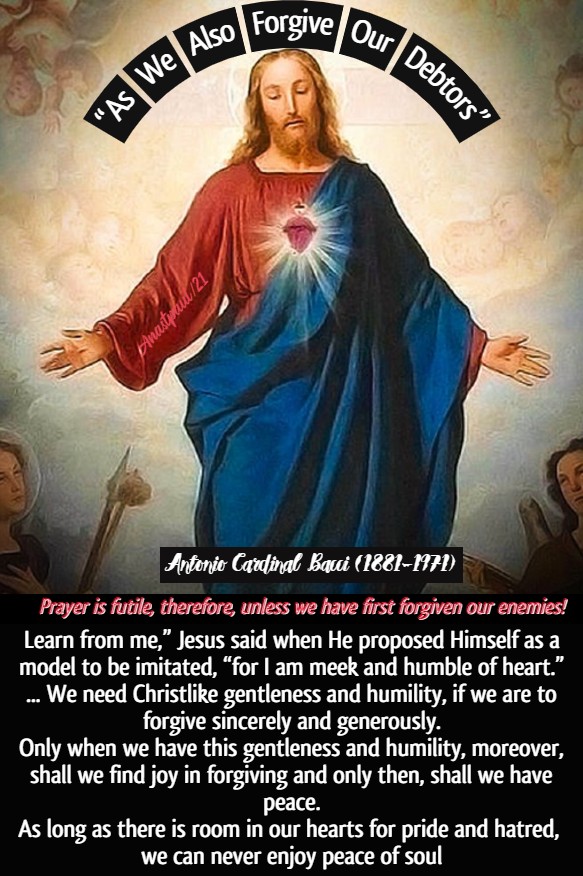
“If thou art offering thy gift at the altar,” Jesus tells us “and thou remember that thy brother has anything against thee, leave thy gift before the altar and go first to be reconciled to thy brother and then come and offer thy gift” (Mt 5:23-24). Prayer is futile, therefore, unless we have first forgiven our enemies!
“Learn from me,” Jesus said when He proposed Himself as a model to be imitated, “for I am meek and humble of heart.” Then He added, “you will find rest for your souls” (Cf Mt 11:29). The foundation of our hatred, anger and resentment, is always our wounded pride. We need Christlike gentleness and humility, if we are to forgive sincerely and generously. Only when we have this gentleness and humility, moreover, shall we find joy in forgiving and only then, shall we have peace. As long as there is room in our hearts for pride and hatred, we can never enjoy peace of soul!”
Quote/s of the Day – 24 October – “The Month of the Most Holy Rosary and of the Angels” – Feast of St Raphael the Archangel – Tobit 12:7-15, John 5:1-4 – Scripture search here: https://www.drbo.org/
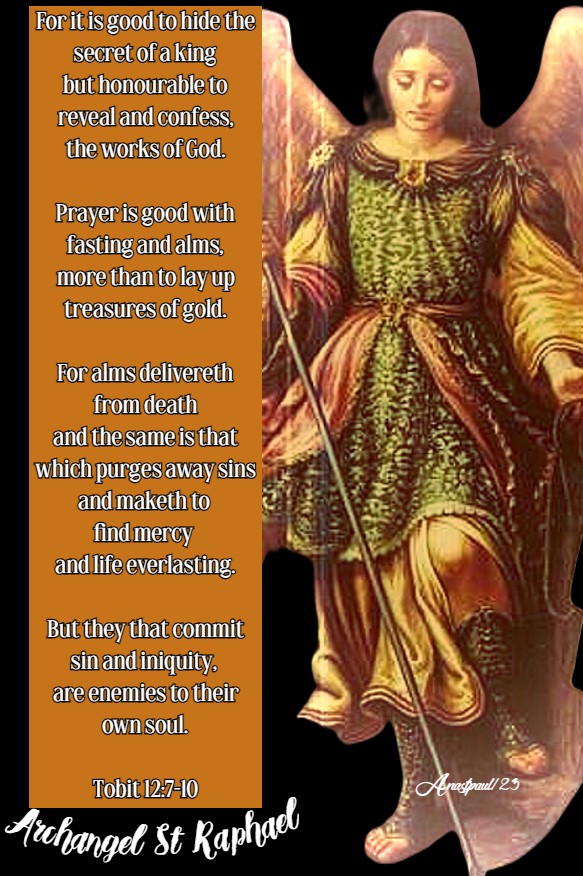
“For it is good to hide the secret of a king but honourable to reveal and confess, the works of God.
Prayer is good with fasting and alms, more than to lay up treasures of gold.
For alms delivereth from death and the same is that which purges away sins and maketh to find mercy and life everlasting.
But they that commit sin and iniquity, are enemies to their own soul.”
Tobit 12:7-10
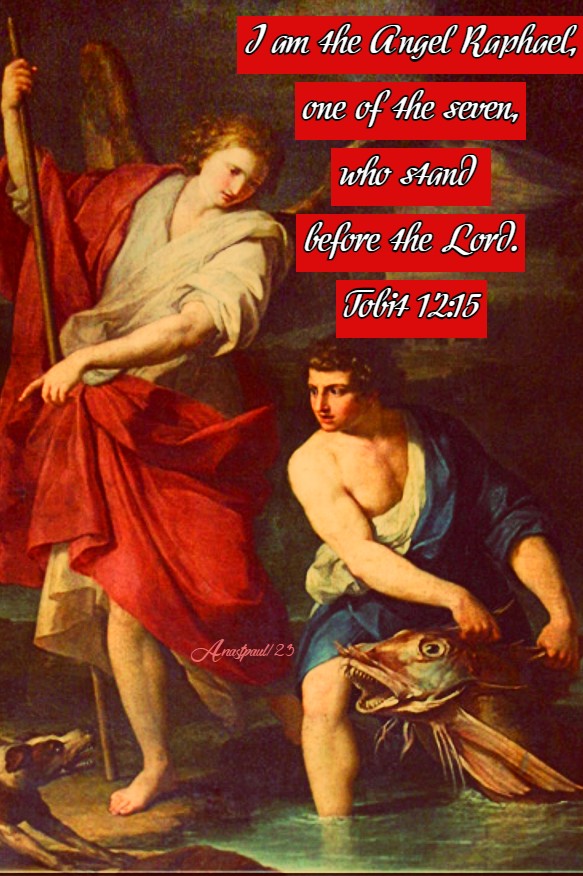
“I am the Angel Raphael, one of the seven, who stand before the Lord.”
One Minute Reflection – 24 October – “The Month of the Most Holy Rosary and of the Angels” – Feast of St Raphael the Archangel – Tobias 12:7-15, John 5:1-4 – Scripture search here: https://www.drbo.org/
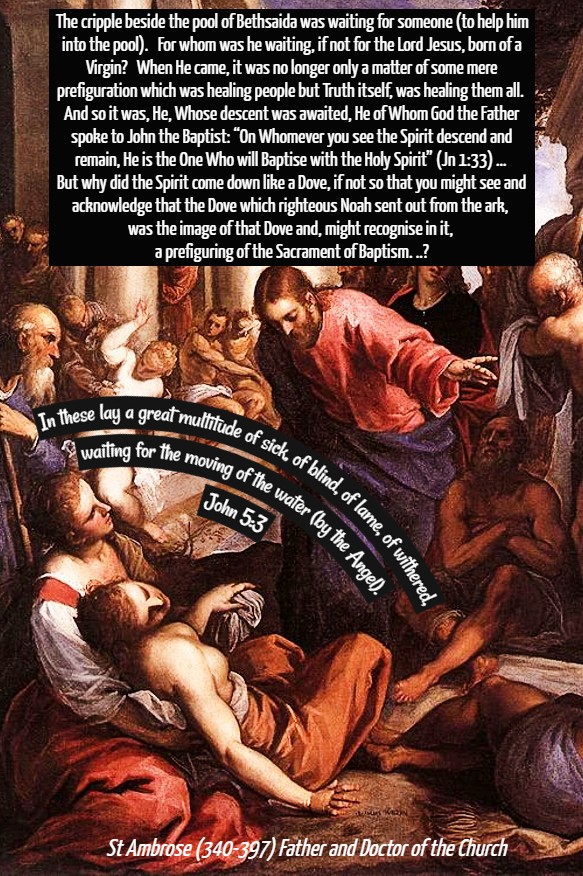
“In these lay a great multitude of sick, of blind, of lame, of withered, waiting for the moving of the water (by the Angel). ” – John 5:3
REFLECTION – “The cripple beside the pool of Bethsaida was waiting for someone (to help him into the pool). For whom was he waiting, if not for the Lord Jesus, born of a Virgin? When He came, it was no longer only a matter of some mere prefiguration which was healing people but Truth itself, was healing them all. And so it was, He, Whose descent was awaited, He of Whom God the Father spoke to John the Baptist: “On Whomever you see the Spirit descend and remain, He is the One Who will Baptise with the Holy Spirit” (Jn 1:33) … But why did the Spirit come down like a Dove, if not so that you might see and acknowledge that the Dove which righteous Noah sent out from the ark, was the image of that Dove and, might recognise in it, a prefiguring of the Sacrament of Baptism. ..?
Can you still waver, when the Father is unquestionably proclaiming to you in the Gospel: “This is My beloved Son, with whom I am well pleased” (Mt 3:17); when the Son, over Whom the Holy Spirit was manifested, in the form of a Dove, is proclaiming it too; when the Holy Spirit, Who descended in the form of a Dove, is also proclaiming it; when David proclaims: “The voice of the Lord is over the waters, the God of glory thunders, the Lord, over vast waters” (Ps 28:3)? Scripture also affirms that Fire came down from Heaven at Gideon’s prayers and again, that Fire was sent to consecrate the sacrifice at the prayer of Elijah. (Jgs 6:21; 1Kgs 18:38).
Do not attend to a Priest’s personal worth but to his office … Believe that our Lord Jesus is present, when invoked at the prayer of the Priest, He Who said: “Where two or three are gathered together, there Am I in the midst of them” (Mt 18:0). How much more, then, does He deign to grant us His presence where the Church is, where the Mysteries are celebrated. And so, you have gone down to the Baptistery. Remember what you have said – that you believe in the Father, you believe in the Son, you believe in the Holy Ghost … With similar words of commitment. you asserted your belief in the Son, as you believe in the Father, your belief in the Holy Spirit as you believe in the Son, with this sole difference – that you profess the need to believe in the Cross of our only Lord Jesus.” – St Ambrose (340-397) Bishop of Milan, Father and Doctor of the Church (On the Mysteries 24).
PRAYER – O God, Who gave blessed Raphael the Archangel as a traveling companion to Your servant Tobias, grant us, Your servants, ever to be protected by his guardianship and by his help.Through the same Jesus Christ, Thy Son our Lord, Who lives and reigns with Thee, in the unity of the Holy Ghost, God, world without end. Amen (Collect).
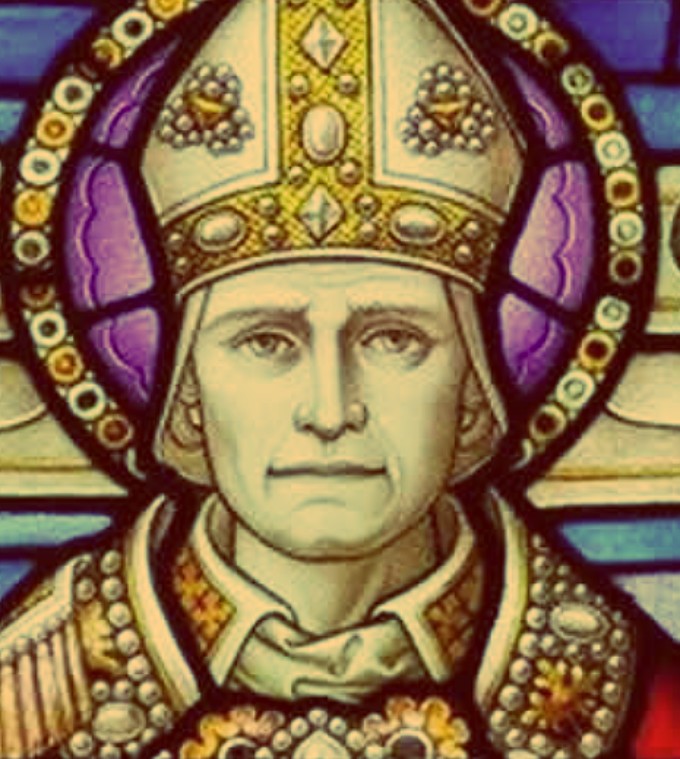
Saint of the Day – 24 October – Saint Maglorius of Wales (Died 575) Bishop of Dol and Solitaire in France, Confessor, Monk, Missionary, Abbot, Miracle-worker, “Apostle to Guernsey and Sark” (Sark, French “Sercq” one of the Channel Islands, a dependency of Guernsey, located in the English Channel, south of England’s coast. Sark lies 11 km east of Guernsey and about 40 km west of the Cherbourg Peninsula of France). Maglorius was born in southern Wales and died in 575 at the Monastery he had founded on the Island of Sark. Patronage – of Sark. Also known as – Maglorious,, Maglorius of Dol, Maglorius of Maelor, Maghorus… Magloire… Maelor… Maglorio…
The Roman Martyrology states: “In Bretagne, the departure from this life of St Maglorious, Bishop, whose body rests in Paris.”
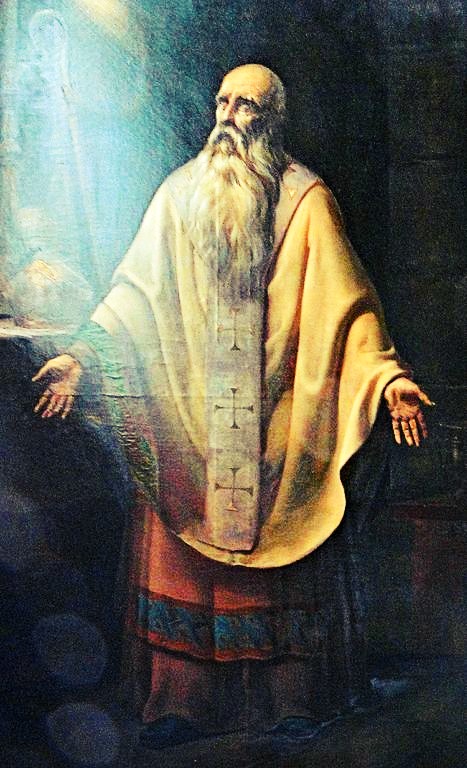
St Maglorius – oil painting by Eugène Goyet (1798–1846), Church Saint-Maglorius-du-Haut-Pas in Paris where his Relics are enshrined.
Saint Maglorius was born inWales at the end of the 5th Century. He was first cousin of Saint Samson (c490–565). They were both placed under the guidance of Abbot Iltut, disciple of Saint Germanus of Auxerre, who took particular care to train them in science and piety. When they were old enough to decide on the choice of a state of life, Samson retired to a Monastery. Maglorius returned to his parents and continued to practice all Christian virtues at home.
Amon, Samson’s father, was attacked by a dangerous illness some time later. He sent for his son and humbled himself before God, from whom he implored mercy. When his health was restored, he renounced his possessions to devote himself solely to the Lord, with his entire family.
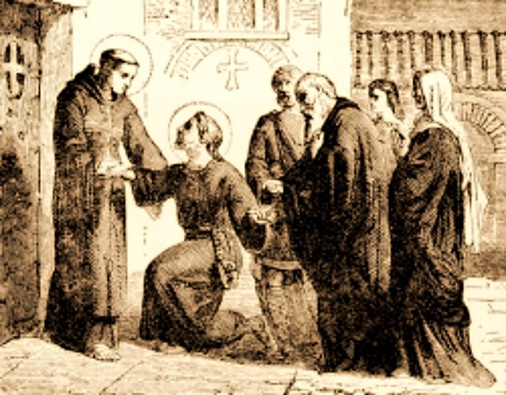
St Maglorius and his family entreat St Samson to receive them into the Monastery
This example had very happy consequences for Maglorius for, he was so touched that he came to Samson with Umbrafel his own father, Afrèle his mother and his two brothers. They all resolved to leave the world and immediately distributed their goods to the poor and to the Churches. Maglorius and his father became particularly attached to Samson, adopting the position of disciples and they obtained permission from him, to take the monastic Habit in the same house. Umbrafel was subsequently sent to Ireland and charged with the government of the Monasteries of that country.
When St Samson was consecrated regional Bishop, he associated himself with Maglorius , who had been elevated to the Diaconate. He took him with him to Armorica, to help him in his Apostolic work and to contribute with his zeal, to the propagation of the Gospel. King Childebert supported the holy missionaries, who were soon able to found Monasteries. Samson made his residence in that of Dol and gave the leadership of that of Kerfunt, or Kerfuntée, to Maglorius, whom he Ordained Priest, so that he could succeed him in the exercise of Episcopal functions.
Maglorius, following the example of his predecessor, preached the Gospel to the Breton,s who lived on the coasts. These peoples were Christians, at least for the most part but the misfortune of wars and the scourges which followed, had weakened the knowledge of Jesus Christ in them and had almost entirely erased it in many. The Saint continued to live with his Monks, as in the past. Under his clothing, he wore a hair shirt. He only ate barley bread and vegetables and a little fish on Sundays and holidays. His zeal and his charity left him almost no moment of rest and he was sometimes without being able to stop to eat for an entire day.
After three years of Episcopate, he formed the plan of going to live in solitude. This project was inspired by the divisions which reigned between the Counts of Brittany. He also believed that God desired of him, this complete separation from the world. After having obtained the consent of the people but without having consulted the neighbouring Bishops. Maglorius, was replaced by Bishop Budoc, whose zeal, enlightenment and virtues were well known by Maglorius. But the Bishops of France disapproved of such conduct and the Second Council of Tours forbade the Bretons from following it in the future.
Maglorius redoubled his austerities and burning with the desire to be united with God in the most intimate way, he avoided, as much as possible, conversing with men. But the reputation of holiness which he enjoyed soon led to the discovery of the place of his retirement. People went there from all sides to find relief from the needs of the soul and the body. If he found himself obliged to accept a few small gifts, it was to distribute them to the poor. Finally, no longer able to bear this influx of people who came to visit him, he resolved to retire into some solitude, where he could be entirely unknown to the world. But Bishop Budoc, whom he consulted, reassured him by making him understand that the good works he was carrying out, should make him sacrifice his particular taste for retirement. He, therefore, remained in the state in which he was and his miracles made his name more famous day-by-day.
The Count of Loiescon, whom he had cured of leprosy, having given him land on the Island of Geurnsey, he built a Church there and founded a Monastery where he gathered more than sixty Monks. During the famine which followed the death of King Chilperic, the monastery provided for countless people who were in need. Although the Monastery’s provisions were exhausted, Maglorius did not reduce the number of his Monks, as was advised. He placed his trust in God and he soon reaped the fruits – a ship loaded with provisions landed on the Island and broughtall the relief needed by all!
It was on Easter night, of the following year that the Maglorius was warned by Heaven, of the proximity of the day of his death. He no longer left the Church, unless he was forced to do so by necessity or by the utility of his neighbour. He often repeated these words of the Psalmist: “I ask only one thing of the Lord and that is, to dwell in His house all the days of my life.”
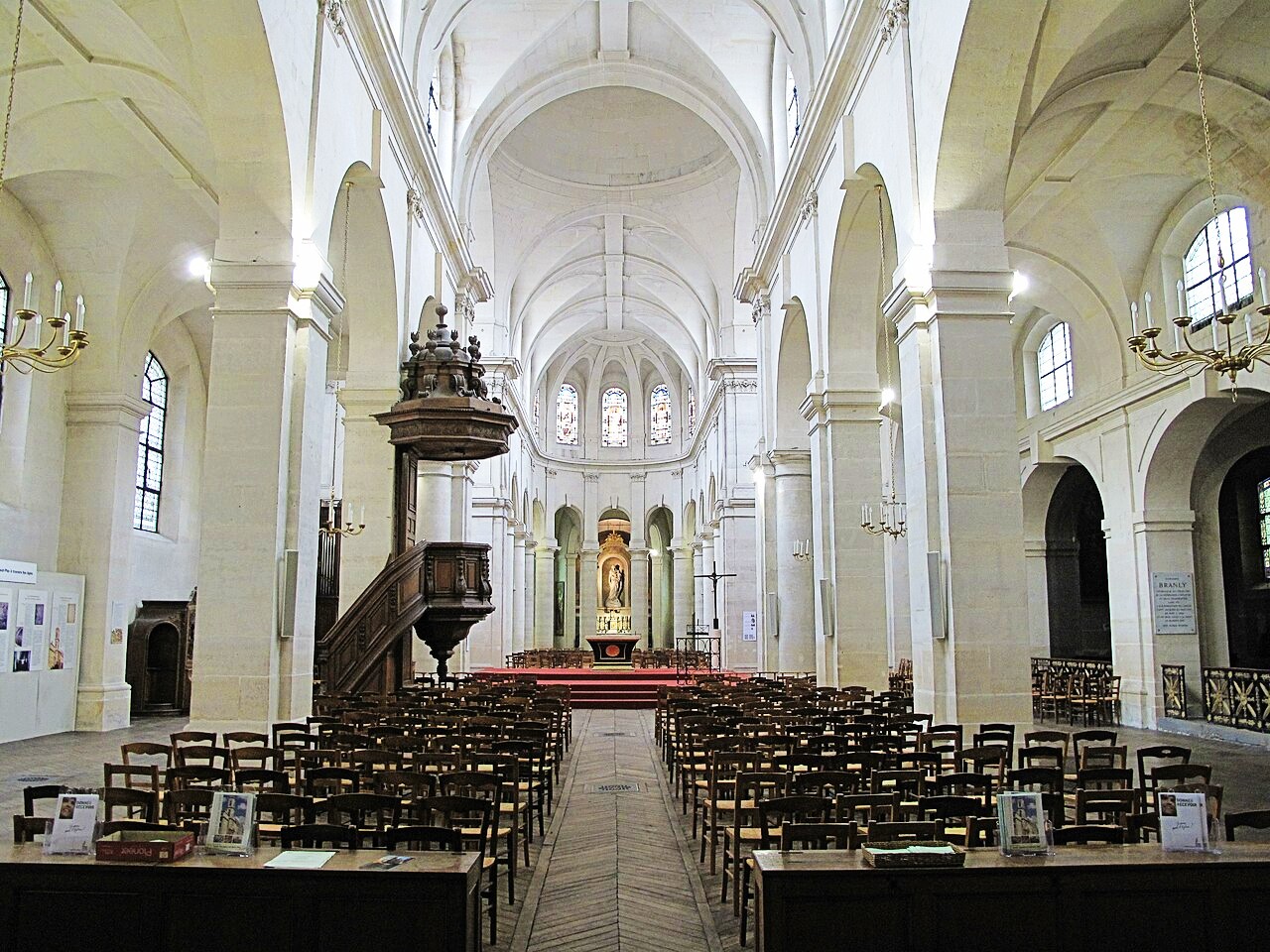
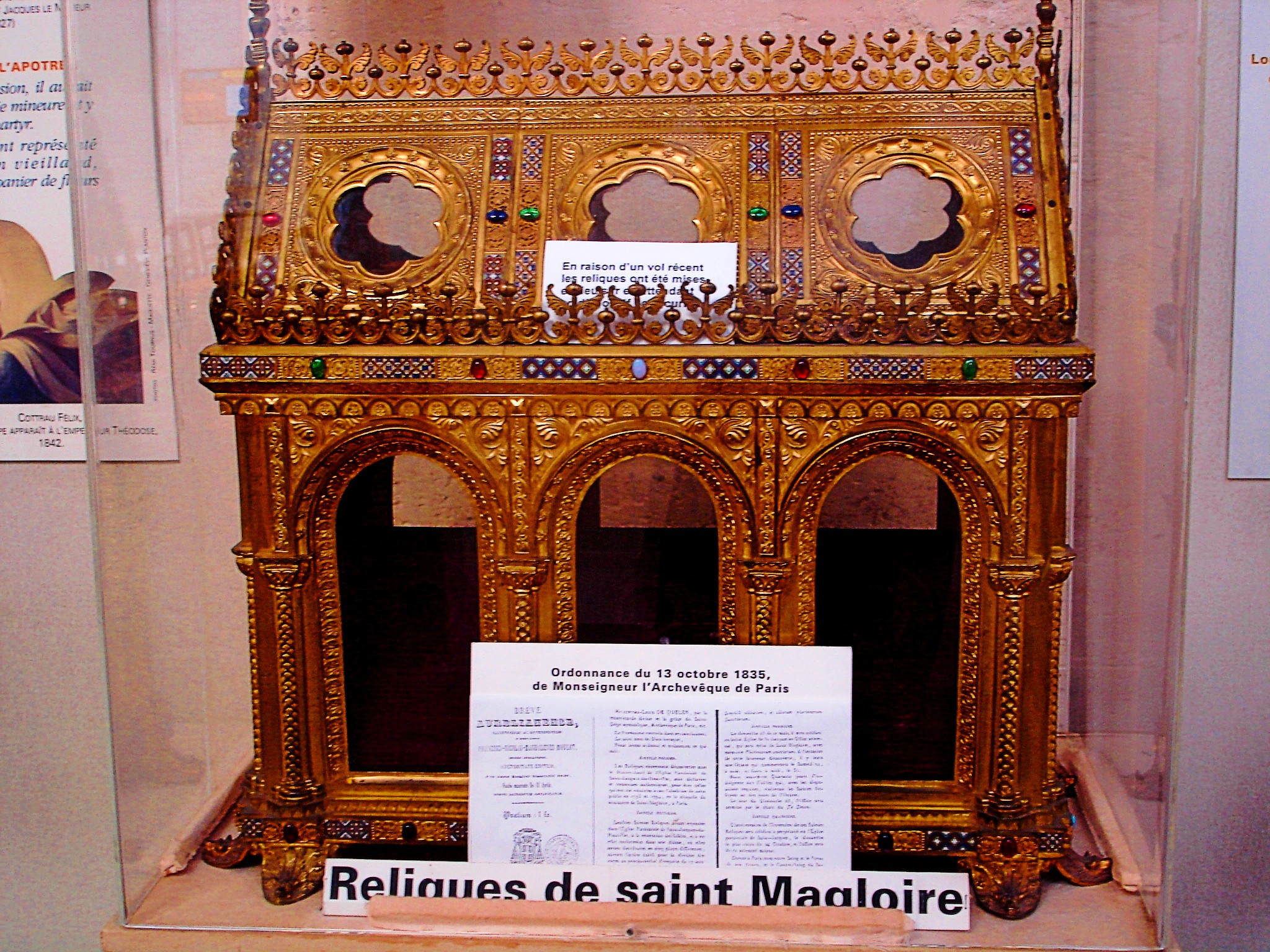
He died six months later, on 24 October 575. He was around eighty years old. During the Norman wars, his Relics and those of several other Saints, were brought to Paris for safety and deposited in the Church of Saint- Barthélemy, then in the Chapel of Saint-Georges, located outside the City walls. They were then transferred to the Church of Saint-Jacques, since called Saint-Maglorius. In the same place, also rested the Relics of Saints Samson and Louthiern, Bishops and of Saints Guinganthon and Escuiphle, Abbots.
The Church of St Maglorius in Paris which contains his Relics and those of St Samson and others
One of the most well-known and detailed Miracles of St Maglorius concerns his rescue of a group of children. The children were playing in an abandoned wreck on the beach below the Monastery in Sark, when a sudden violent storm swept them out to sea. Maglorius swam out to sea when he heard their cries and saved them and the wreched boat, steering it to the safety of the shore, before vanishing.
Other miracles include – the destruction of a dragon on the Island of Jersey; the resurrected a drowned fisherman of Sark and that the putting to flight a fleet of Vikings.
Posthumous miracles of St. Maglorius are also included in the surviving texts. After his death, Sark was attacked again by Vikings, who sacked the Monastery and killed the Monks. When seven of the Vikings attempted to open St Magllorius’ tomb, they were blinded and many of the others turned and began to kill each other!
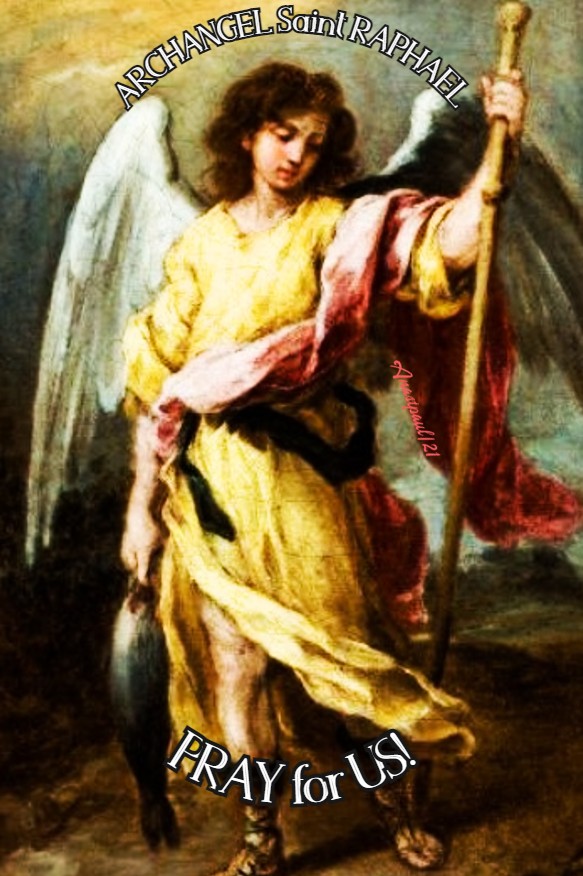
Saint Raphael the Archangel The Feast day of Saint Raphael was included for the first time in the General Roman Calendar in 1921, for celebration on 24 October. With the 1969 revision of the General Roman Calendar, the Feast was transferred to 29 September for celebration together with Archangels Saints Michael and Gabriel. St Raphael: https://anastpaul.com/2021/10/24/saint-of-the-day-24-october-st-raphael-the-archangel/
Bl Amado García Sánchez St Audactus of Thibiuca St Cadfarch St Ciriacus of Hierapolis St Claudian of Hierapolis St Ebregislus of Cologne St Felix of Thibiuca St Fortunatus of Thibiuca St Fromundus of Coutances St Maglorius of Wales (Died 575) Bishop
St Marcius of Monte Cassino St Mark of Campania Hermit
St Senoch St Senócus of Tours St Septimus of Thibiuca
Martyrs of Ephesus – 3 Saints: Three Christians Martyred together. All we know about them are the names Mark, Sotericus and Valentina. They were stoned to death near Ephesus, Asia Minor (in modern Turkey). Their relics are enshrined on the island of Tasos.





 AnaStpaul
You must be logged in to post a comment.