Thought for the Day – 4 January – The Spiritual Combat (1589) – Dom Lorenzo Scupoli OSM (c1530-1610)
“None shall be crowned who has not fought well.” – 2 Tim 2: 5
Introduction I: Of the Essence of Christian Perfection – Of the Struggle Requisite for its Attainment – And of the Four Things Needful in this Conflict
Of the Essence of Christian Perfection, Part One:
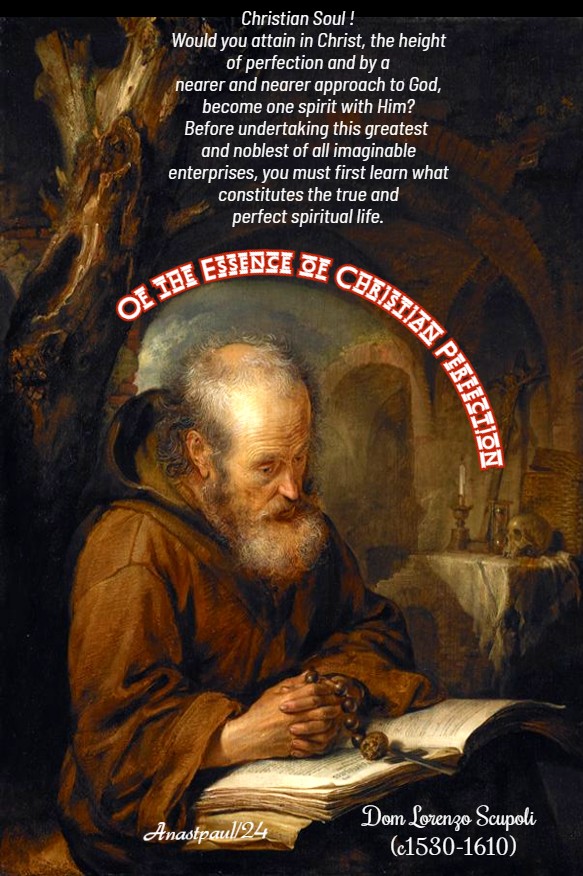
“Christian Soul ! Would you attain in Christ, the height of perfection and by a nearer and nearer approach to God, become one spirit with Him? Before undertaking this greatest and noblest of all imaginable enterprises, you must first learn what constitutes the true and perfect spiritual life. For many have made it to consist exclusively in austerities, maceration of the flesh, hair-shirts, disciplines, long vigils and fasts and other like bodily hardships and penances. Others, especially women, fancy they have made great progress therein, if they say many vocal prayers, hear many Masses and long Offices, frequent many Churches, receive many Communions. Others (and those sometimes among cloistered religious) are persuaded that perfection depends wholly upon punctual attendance in choir, upon silence, solitude and regularity. …
But it is not so indeed; for as some of these are means to acquire grace, others, fruits of grace, they cannot be held to constitute Christian perfection and the true life of grace. They are unquestionably most powerful means, in the hands of those who use them well and discreetly, of acquiring grace in order to gain strength and vigour against their own sinfulness and weakness, to defend themselves against our common enemies, to supply all those spiritual aids so necessary to all the servants of God and especially to beginners in the spiritual life.
But these external works, although all most holy in themselves, may yet, by the fault of those who use them, as the foundation of their spiritual building, prove a more fatal occasion of ruin than open sins!”
Quote/s of the Day – 4 January – “The Month of the Most Holy Name of Jesus and of the Holy Family” – Octave of the Holy Innocents
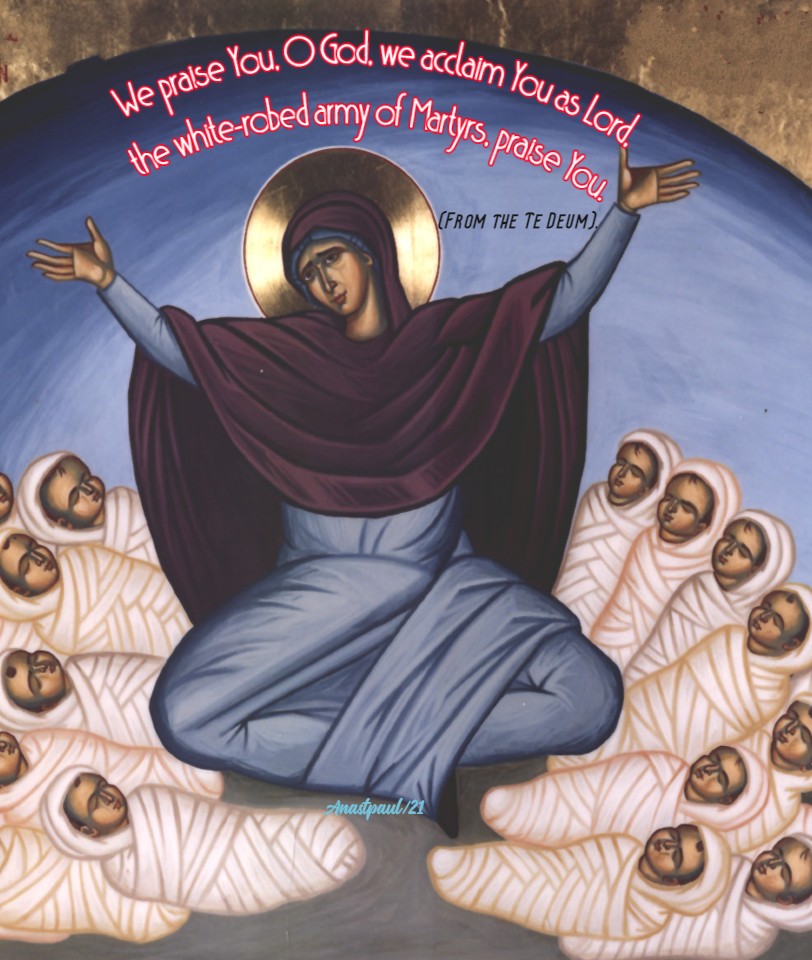
“They could not yet speak but already, they are confessing Christ. Their little bodies are, as yet, unable to engage in combat but already, they are carrying off the Palm of Victory.”
St Quodvultdeus (Died c 453) Bishop at Carthage
“These then, whom Herod’s cruelty tore as sucklings from their mothers’ bosom, are justly hailed as “Infant Martyr Flowers”- they were the Church’s first blossoms, matured by the frost of persecution, during the cold winter of unbelief.”
St Augustine (354-430) Father & Doctor of the Church
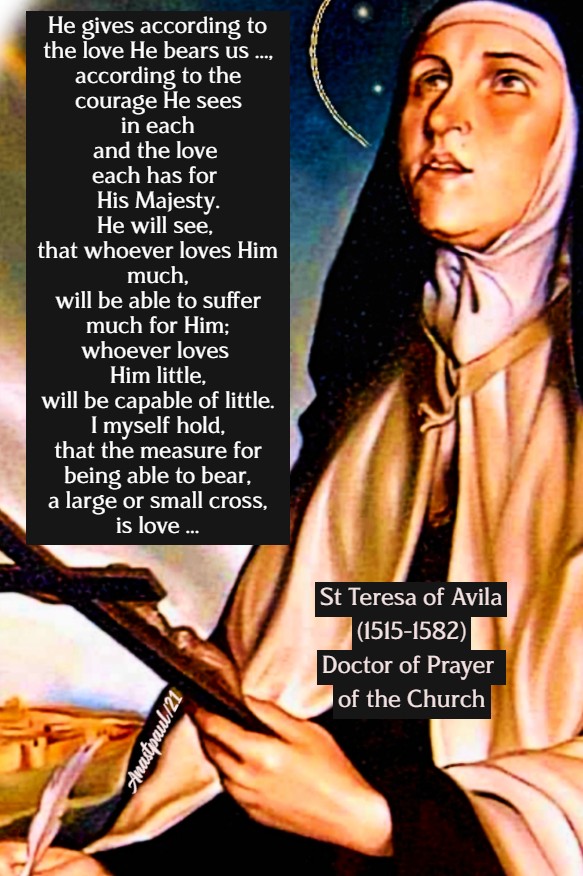
“He gives according to the love He bears us …, according to the courage He sees in each and the love each has for His Majesty. He will see, that whoever loves Him much, will be able to suffer much for Him; whoever loves Him little, will be capable of little. I myself hold, that the measure for being able to bear, a large or small cross, is love …”
St Teresa of Avila (1515-1582) Doctor of Prayer of the Church
One Minute Reflection – 4 January – “The Month of the Most Holy Name of Jesus and of the Holy Family”– Octave of the Holy Innocents – Apocalypse 14:1-5; Matthew 2:13-18 – Scripture search here: https://www.drbo.org/
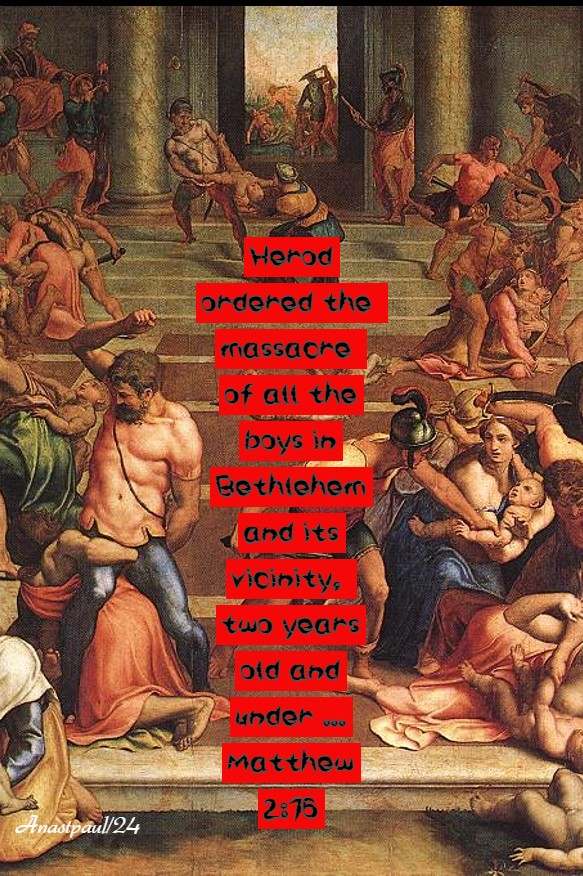
“When Herod realised that he had been deceived by the Magi, he became furious. He ordered the massacre of all the boys in Bethlehem and its vicinity, two years old and under, in accordance with the time he had ascertained from the Magi.” – Matthew 2:16
REFLECTION – “Where does this jealousy lead?… The crime committed today shows us. Fear of a rival to his earthly kingdom fills Herod with anxiety, he plots to suppress “the newborn King” (Mt 2:2), the Eternal King; he fights against his Creator and puts innocent children to death … As for those children, what fault had they committed? Their tongues were dumb, their eyes had seen nothing, their ears heard nothing, their hands done nothing. They accepted death who had not known life! … Christ reads the future and knows the secrets of the heart, He weighs our thoughts and probes our intentions (cf. Ps 138[139]): why did He forsake them? … Why did the newborn heavenly King abandon these companions in innocence, forget the sentinels watching around His crib, to such an extent that the foe, who wanted to get at the King, ravaged His whole army?
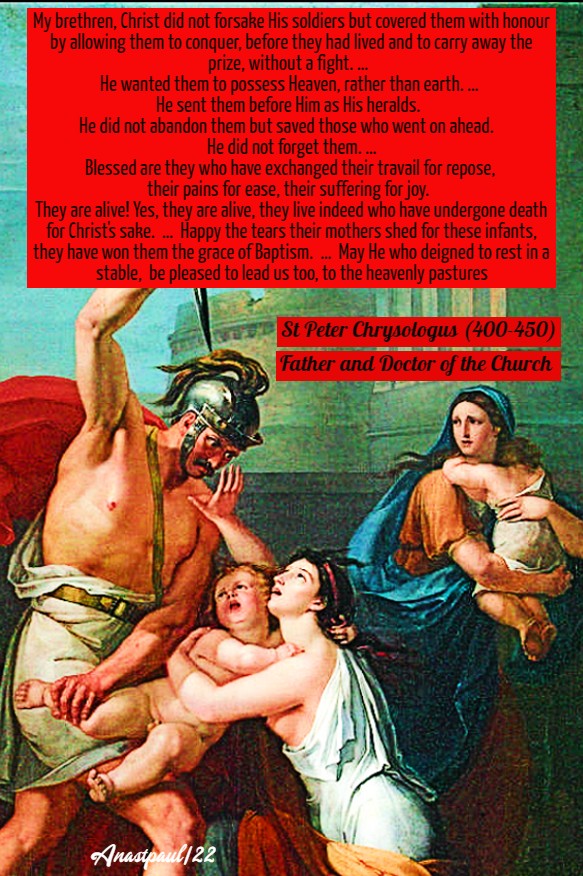
My brethren, Christ did not forsake His soldiers but covered them with honour, by allowing them to conquer, before they had lived and to carry away the prize, without a fight. … He wanted them to possess Heaven, rather than earth. … He sent them before Him as His heralds. He did not abandon them but saved those who went on ahead. He did not forget them. …
Blessed are they who have exchanged their travail for repose, their pains for ease, their suffering for joy. They are alive! Yes, they are alive, they live indeed who have undergone death for Christ’s sake. … Happy the tears their mothers shed for these infants, they have won them the grace of Baptism. … May He who deigned to rest in a stable, be pleased to lead us too, to the heavenly pastures.”– St Peter Chrysologus (400-450) Bishop of Ravenna, Father and Doctor of the Church (Sermon 152 PL 52, 604).
PRAYER – O God, Whose praise the Innocents, Thy Martyrs, this day proclaimed, not by speaking but by dying, put to death in us all the wickedness of sin, so that Thy faith which our tongue professes, may be proclaimed also by our life.Through Jesus Christ, Thy Son our Lord, Who lives and reigns with Thee, in the unity of the Holy Ghost, God, world without end. Amen (Collect).
Our Morning Offering – 4 January – “The Month of the Most Holy Name of Jesus and of the Holy Family” –
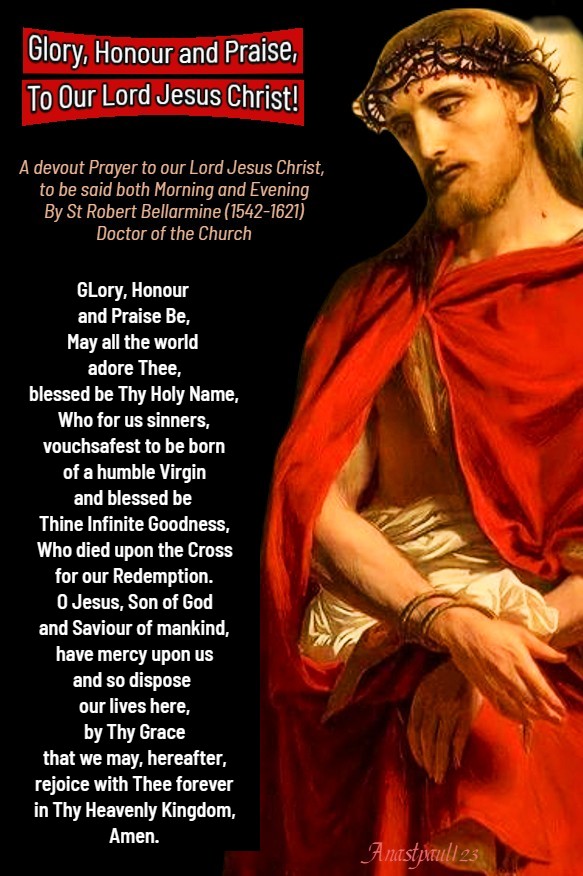
Glory, Honour and Praise, To Our Lord Jesus Christ! A devout Prayer to our Lord Jesus Christ, to be said both Morning and Evening By St Robert Bellarmine (1542-1621) Doctor of the Church (From His “A Brief Christian Doctrine”)
GLory, Honour and Praise Be, May all the world adore Thee, blessed be Thy Holy Name, Who for us sinners, vouchsafest to be born of a humble Virgin and blessed be Thine Infinite Goodness, Who died upon the Cross for our Redemption. O Jesus, Son of God and Saviour of mankind, have mercy upon us and so dispose our lives here, by Thy Grace that we may, hereafter, rejoice with Thee forever in Thy Heavenly Kingdom, Amen.
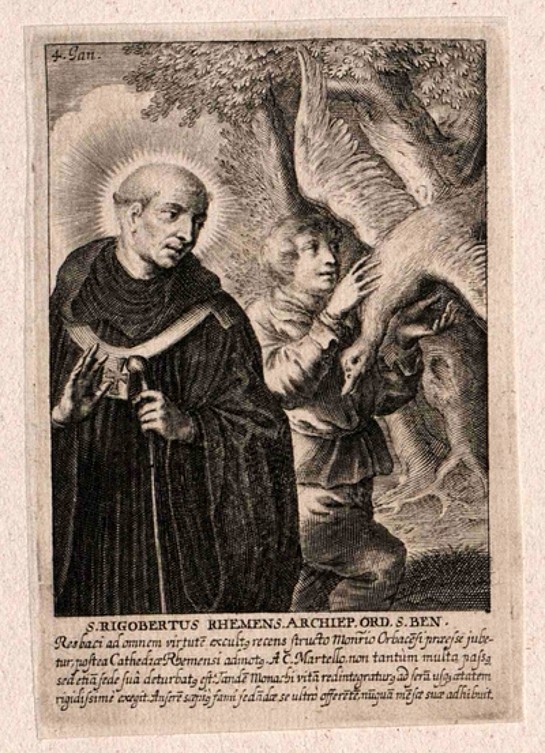
Saint of the Day – 4 January – Saint Rigobert of Rheims (Died c743) Archbishop of Rheims, a Benedictine Monk and later Abbot of the Abbaye Saint-Pierre d’Orbais who subsequently succeeded Saint Rieul as the Bishop of Rheims in 695. Born in the late 6th Century in Ribemont southeast of Saint-Quentin and north of Rheims, in the present-day Aisne in Picardy, in northern France and died on 4 January c743 in Gernicourt, in the Aisne in France. Patronage – against toothache. Also known as – Gobert, Rigobertus, Robert. Additional Memorial – 14 June (translation of Relics). the name Rigobert – means: “the rich, shiny one” (From Old High German).
Rigobert was the son of Constantine of an old Ripuarian family, the first Lord (Châtelain) of Ribemont and of the House of Portian. We do not know his mother’s name, only that she was a Frank from the territory of Porçain at the mouth of the river Somme. Noticing that their son had a strong inclination towards piety, the parents sent him to the Monastery of Orbais in the Champagne-Ardenne region of northeastern France which had been founded in 680 by their nephew, Saint Bishop Regulus of Rheims . There, Rigobert received his first education in the Monastery school.
It was in this academy that he learned the science of the Saints and he was formed for the exercise of the most heroic virtues. When he reached the prescribed age, he took his vows as a Benedictine Monk. He observed the Rule of Saint Benedict so accurately that he, still very young, could be an example even to older Monks. He prayed incessantly and never spoke unnecessarily and he combined an extraordinary prudence and wisdom with great kindness, so that he easily won the hearts of those with whom he conversed. During this time he was Ordained to the Priesthood and his good qualities led to him being entrusted with ever greater tasks and he eventually ascended to the leadership of the Monastery of Orbais as the Abbot, an Office he retained until 695.
He was very close to the head of the Royal House, Pipin of Herstal and under his protection, the young Priest quickly made a career. Rigobert Baptised Pipin’s illegitimate son with his concubine Alpaida, Charles Martell (689-741), the later powerful Frankish Chancellor (716 -741), the actual ruler of the Franks (other sources say that he was Charles Martell’s Godfather at Baptism).
In 695, Rigobert was named the 27th Bishop of Rheims after Saint Regulus, who was his cousin. By virtue of his Office as the Bishop of Rheims, he anointed the Kings. Through wise decrees and strict justice, he brought the Diocese into a very good condition.
Pipin of Herstal ruled the Frankish Kingdom as Chancellor in the Palace during the reigns of Clovis IV, Kildebert III and Dagobert III, all of whom were Kings of the entire Frankish Kingdom. He was a close friend of the Bishop. One day he came to a country house in the village of Gernicourt near Rheims, to go hunting. With his usual courtesy, Rigobert sent him some refreshments and he came to greet the Bishop.
Pipin, wishing to repay this generosity with a substantial donation, so he urged the Bishop to tell him what he desired for himself and for his Church, assuring him that it would be the most significant proof of friendship he could give him. To satisfy the Duke, the Bishop asked about the house where he was then which was not of great value but entirely to his taste. Pipin gave him the house and said that besides this he gave him as much land as he could walk about during his afternoon rest. The Bishop accepted the gift and immediately drew up the boundaries by walking around this house. Everyone soon saw that in asking for this place, the Bishop had no intention of getting rich because as soon as he became the owner of the property, he gave it to his Church to be part of Diocesan assets and income used for the Bishop’s maintenance.
Rigobert’s most important program was to reform the Clergy. To this end he re-established the rules of his predecessors as regards the discipline of the Clergy and he restored the Chapter of the Cathedral, one of the best ordered then in the Frankish Kingdom.
Little is otherwise known about Rigobert’s time as Bishop but he is said to have lived in a room above the City gate. When he was in his room, he used to pray by a window overlooking the City’s Basilica Saint-Remi. But wanting access to a closer Church to pray, he had a passage excavated through the tower of a Church that was next to the City gate, thus gaining easy access via a ladder.
Once he had been given a live goose to take home and make dinner out of. Rigobert placed the bird in the arms of a servant who followed him. Along the way, while Rigobert was reciting the Office prayers, the bird tore itself free and flew away. The boy, grieved deeply over this accident but Rigobert comforted him and exhorted him to trust in God. When Rigobert resumed his prayers, the goose flew back to them. Thereafter, the Bishop kept the bird as a pet. The goose used to go with him to the Church, where it patiently waited outside while Rigobert celebrated Mass at an Altar dedicated to the Virgin Mary. – which Altar, he received in his exile after requesting it from the usurper bishop.
Rigobert’s zeal for the temporal part of God’s house was nothing compared to that which he had for the spiritual part. He was another Paul, who in his extensive charity cared for all believers. He was everything to them all and this conduct was admired by all and it was one of the chief reasons why Pipin was so strongly convinced of the extraordinary merits of this great man. He wanted his son Charles Martell to become a child of God through his service and he entrusted his son to him for education, in the hope that one day he would succeed in gaining the same respect and devotion for the Bishop which he himself had. But the father’s good intentions were not fulfilled by the son and he, whom the father had honoured was later persecuted by the son.
When Pipin died the King replaced him with a man named Raginfrid causing Charles Martell to arm himself in anger believing the position of Chancellor should have been his as son of Pipin. In the decisive phase, Rigobert hesitated to side with Charles Martell and wanted to remain neutral. He remained faithful to the King as his legitimate senior and although he had very great obligations to Pipin, as he had Baptised and raised his son, he preferred to heed his conscience.
When KCharles Martell appeared at the gates of Rheims under the pretence of saying his prayers in the Church of Notre-Dame, Rigobert refused him entry, telling him that since he and his steward were fighting the government of Austrasia, he would not open the City’s gates for other than the one whom heaven declared victorious. Charles Martell was so offended that he decided to get rid of the troublesome Bishop.
After a victorious battle in the power struggle, Charles Martell deposed the King and Rigobert as Bishop of Rheims without any Ecclesiastical judgment and on his own authority appointed his replacement. Rigobert was exiled to Gascony – there he spent the first part of his exile, waiting for the storm to subside, or whether his banishment would last for life. But later he went to the Monastery at Orbais not far from Rheims, where he resumed the monastic life.
To Rigobert it was a great suffering to see that his people had to endure a wolf instead of a true shepherd but apart from that, he found great joy in being relieved of a burden which had always seemed formidable. After various machinations of the usurper bishop Milo to attract Rigobert back to Rheims by uncanonical means, Rigobert refusing his offers finally returned to live on his country estate at Gernicourt which he had received from Pipin. There he lived poor, lonely and hated by the state’s leadership but highly respected by his people. He often visited the Blessed Virgin in her holy house and confided his troubles to her and he asked her for the grace to suffer without complaint until he died. From there, he entered the Churches of Saint-Maurice and Saint-Remy and other places of devotion in the City, especially where the Relics of holy Martyrs were kept.
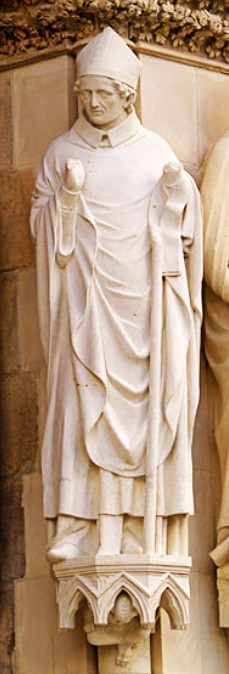
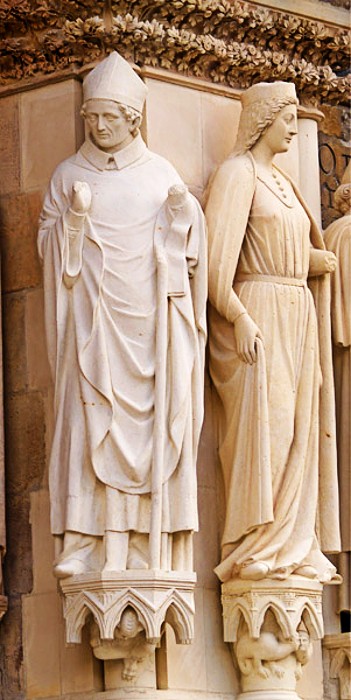
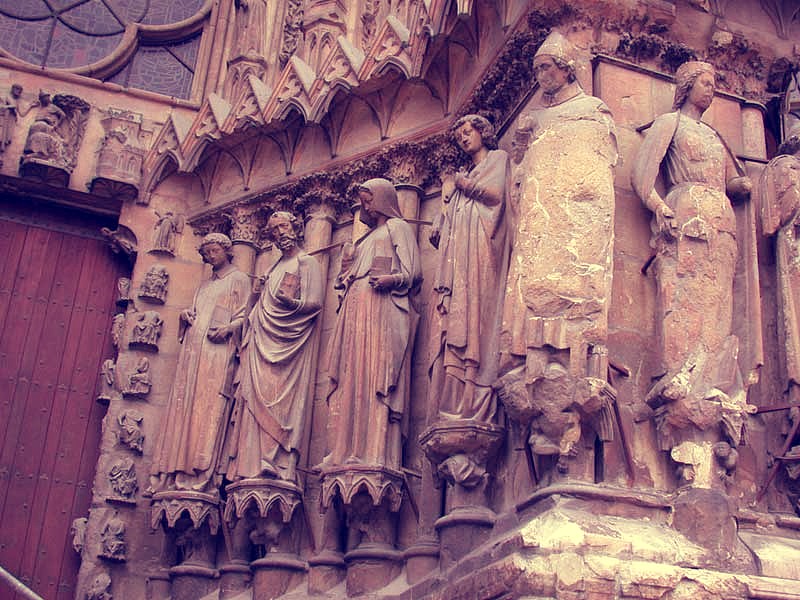
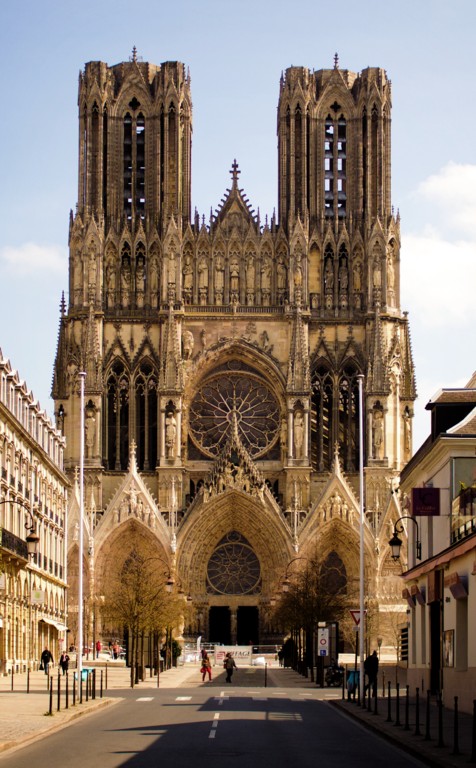
St Rigobert on the corner on the facade of Rheims Cathedral
Rigobert spent the day in these exercises of piety before returning in the evening to his solitude, until our Lord, who had purified him through a long series of trials, drew him home to crown his patience. The various sources do not agree on what year he died, one says 773, others 749 or 745 but a larger number say, with greater probability that he died on 4 January 743. The Episcopal list in Rheims says that he died in 733.
Bishop Rigobert was given a grand funeral with great honours. All the Priests and people of Rheims were present at the funeral, and his remains were buried in the Church of Saint-Pierre at Gernicourt which he himself had founded, to the right of the High Altar. Many miracles soon happened there, such as three lame people being healed, a blind woman regaining her sight there and several other sick people coming home in perfect health. Several times during the night a light was seen on his grave and at the same time, singing could be heard, so magnificent that it was easy to understand that they were performed by the Angels. An Monk who had an inflammation in his cheek, sent a candle to burn before the holy Bishop’s Relics and he immediately recovered and found himself able to go and pay his respects to the mighty physician. Our Saint is especially invoked against toothache.
In 896, after many translations, St Rigobert’s Relics finally were sent to the new Church of Saint-Denis outside the City, where they were kept and venerated until The French Revolution. Parts of the Relics later came to Paris.
St Angela of Foligno TOSF (1248-1309) known as the “Mistress of Theologians” – Wife, Mother, Widow, Religious, Mystic, Writer, Third Order Franciscan, Foundress of a religious community, which refused to become an enclosed religious order, so that it might continue her vision of caring for those in need. It is still active today. About St Angela: https://anastpaul.com/2020/01/04/saint-of-the-day-4-january-saint-angela-of-foligno-tosf-1248-1309/
St Celsus of Trier Bl Chiara de Ugarte St Chroman St Dafrosa of Acquapendente
St Ferreolus of Uzès St Gaius of Moesia
St Gregory of Langres (Died 539) Bishop of Langres and Dijon, Count and Governor, Father of 2 Sons and Widower, before being appointed as the Bishop of Langres, Ascetic, Miracle-worker. Great-grandfather of St Gregory of Tours. He ordered the translation of the Relics of Saint Benignus and built the Church and the Abbey of Saint-Benignus of Dijon. Biography: https://anastpaul.com/2023/01/04/saint-of-the-day-4-january-saint-gregory-of-langres-died-539-bishop/
St Hermes of Moesia St Libentius of Hamburg Bl Louis de Halles St Mavilus of Adrumetum St Neophytos St Neopista of Rome St Oringa of the Cross Bl Palumbus of Subiaco
Martyrs of Africa – 7 Saints: A group of Christians Martyred together in the persecutions of the Arian Vandal king Hunneric. Saint Bede wrote about them. – Aquilinus, Eugene, Geminus, Marcian, Quintus, Theodotus and Tryphon. In 484 in North Africa.
Martyrs of Rome – 3 Saints: Three Christians Martyred together in the persecutions of Julian the Apostate for refusing to renounce Christianity as ordered. – Benedicta, Priscillianus and Priscus. In 362 in Rome, Italy.








 AnaStpaul
You must be logged in to post a comment.