Thought for the Day – 15 June – Meditations with Fr Richard Frederick Clarke SJ (1839-1900)
PATIENCE Meditations for a Month
Patience under Temptations
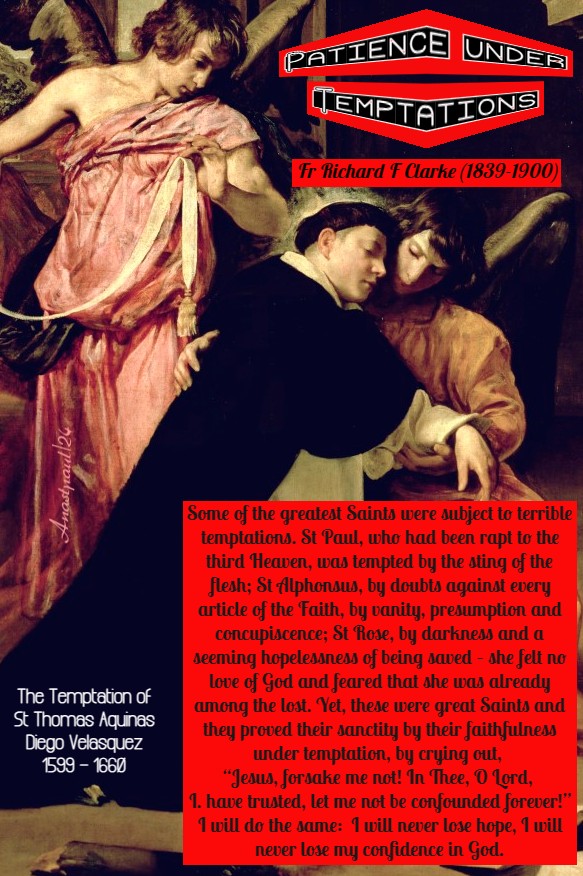
If we all have to endure temptations, we must try to endure them well. Temptations are not sins. We may be surrounded by temptations. They may be present to us for hours. We may have a sort of guilty feeling as if we had offended God. Yet, if we are not conscious of having in any way consented to them, if throughout, we have wished them away, then our conscience is free from any stain of sin, even though they may have caused satisfaction to our lower nature and to our baser inclinations. To remember this will help us, not a little, in bearing them patiently.
But there is another consoling consideration with respect to temptation. We may do much for the honour of God and for our own progress in virtue, by our resistance to the tempter. We lay up a store of merit in Heaven. We are purified as in the fire and the dross of venial sins and imperfections is taken away. We must, therefore, be not only patient but cheerful under temptations and thank God for them.
Some of the greatest Saints were subject to terrible temptations. St Paul, who had been rapt to the third Heaven, was tempted by the sting of the flesh; St Alphonsus, by doubts against every article of the Faith, by vanity, presumption and concupiscence; St Rose, by darkness and a seeming hopelessness of being saved – she felt no love of God and feared that she was already among the lost. Yet, these were great Saints and they proved their sanctity by their faithfulness under temptation, by crying out, “Jesus, forsake me not! In Thee, O Lord, I. have trusted, let me not be confounded forever!” I will do the same: I will never lose hope, I will never lose my confidence in God.

Quote/s of the Day – 15 June – “The Month of the Sacred Heart of Jesus” – Our Lady’s Saturday
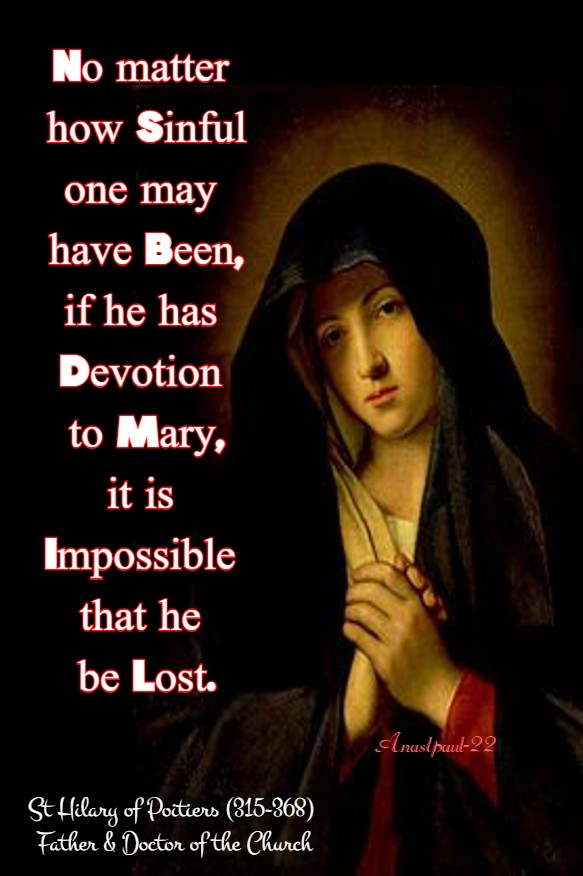
“No matter how sinful one may have been, if he has devotion to Mary, it is impossible that he be lost.”
St Hilary of Poitiers (315-368) Father & Doctor of the Church
“O, that the soul of Mary were in us, to glorify the Lord! That the spirit of Mary were in us, to rejoice in God. May the life of Blessed Mary be ever present to our awareness. In her, as in a mirror, the form of virtue and beauty of chastity, shine forth. She was Virgin, not only in body but in mind and spirit. She never sullied the pure affection of her heart by unworthy feelings. She was humble of heart. She was serious in her conversations. She was prudent in her counsels. She preferred to pray rather than to speak. She united in her heart the prayers of the poor, and avoided the uncertainty of worldly riches. She was ever faithful to her daily duties, reserved in her conversations and always accustomed to recognise God as the witness of her thoughts. Blessed be the Name of Jesus!”
(On Virginity II 2.7)
St Ambrose (340-397) Father and Doctor of the Church
“ … For His brothers His relatives according to the flesh who did not believe in Him, of what advantage was that relationship? … Even her maternal relationship would have done Mary no good, unless she had borne Christ more happily in her heart, than in her flesh.”
St Augustine (354-430) Father & Doctor of Grace
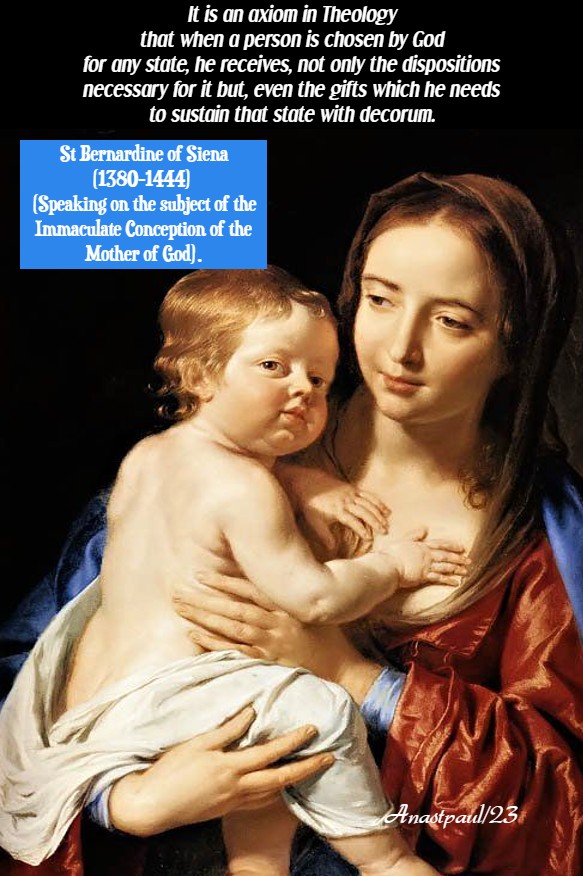
“It is an axiom in Theology that when a person is chosen by God for any state, he receives, not only the dispositions necessary for it but, even the gifts which he needs to sustain that state with decorum.” (Speaking on the subject of the Immaculate Conception of the Mother of God).
St Bernardine of Siena (1380-1444)
“No-one who shall invoke this Mother of Grace, with devotion and perseverance, can possibly perish forever.”
St John Eudes (1601-1680) “The Apostle of Two Hearts”
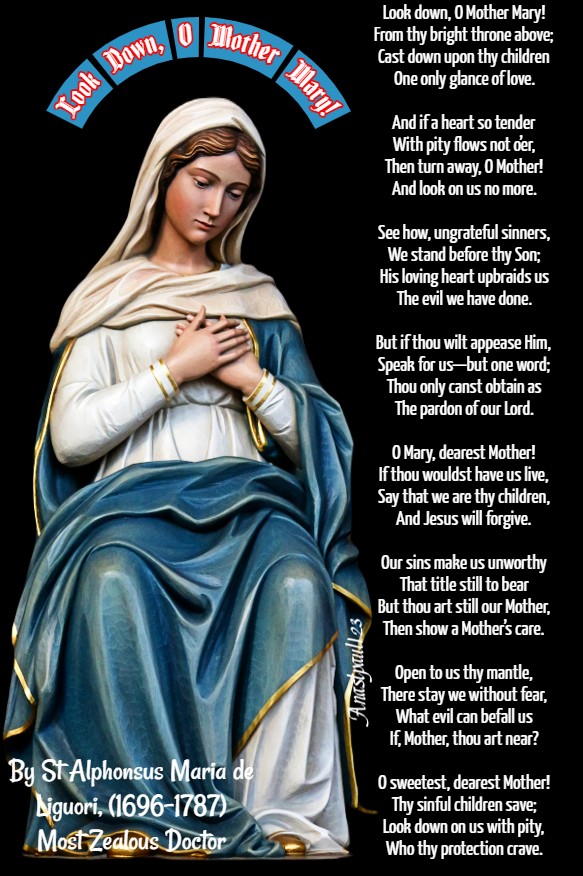
Look Down, O Mother Mary! By St Alphonsus Maria de Liguori, (1696-1787) Most Zealous Doctor Transl, Fr Edmund Vaughan, CSSR in 1863
Look down, O Mother Mary! From thy bright throne above; Cast down upon thy children One only glance of love.
And if a heart so tender With pity flows not o’er, Then turn away, O Mother! And look on us no more.
See how, ungrateful sinners, We stand before thy Son; His loving Heart upbraids us The evil we have done.
But if thou wilt appease Him, Speak for us—but one word; Thou only canst obtain as The pardon of our Lord.
O Mary, dearest Mother! If thou wouldst have us live, Say that we are thy children, And Jesus will forgive.
Our sins make us unworthy That title still to bear But thou art still our Mother, Then show a Mother’s care.
Open to us thy mantle, There stay we without fear, What evil can befall us If, Mother, thou art near?
O sweetest, dearest Mother! Thy sinful children save; Look down on us with pity, Who thy protection crave.
One Minute Reflection – 15 June – “The Month of the Sacred Heart of Jesus” – Our Lady’s Saturday – Ecclesiasticus 24:14-16; Luke 11:27-28 – Scripture search here: https://www.drbo.org/
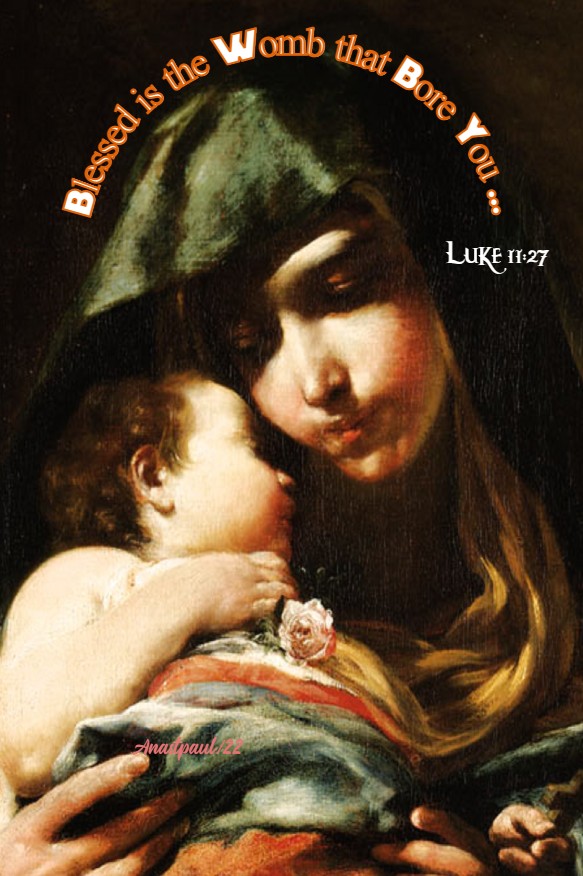
“Blessed is the womb that bore you ’” – Luke 11:27
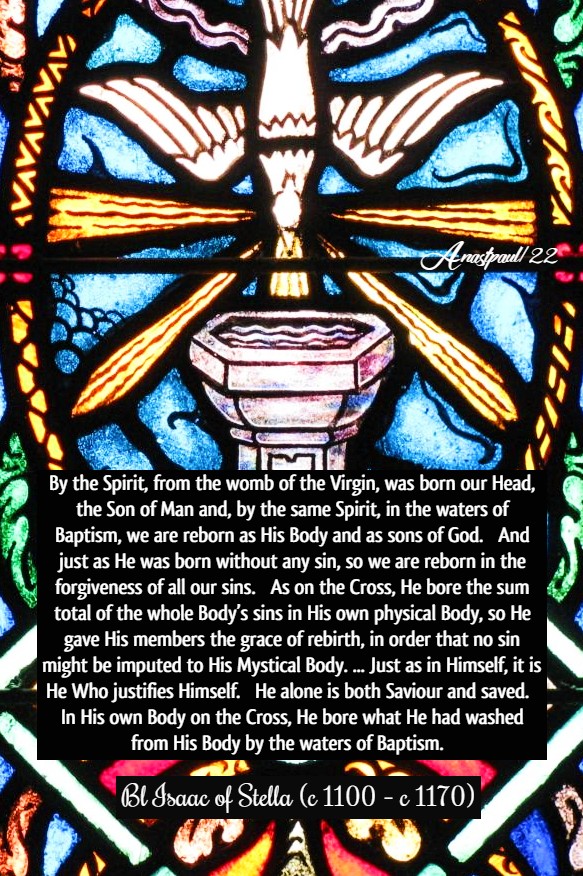
REFLECTION – “By the Spirit, from the womb of the Virgin, was born our Head, the Son of Man and, by the same Spirit, in the waters of Baptism, we are reborn as His Body and as sons of God. And just as He was born without any sin, so we are reborn in the forgiveness of all our sins. As on the Cross, He bore the sum total of the whole Body’s sins in His own physical Body, so He gave His members the grace of rebirth, in order that no sin might be imputed to His Mystical Body. It is written: Blessed is the man to whom the Lord imputes no sin. The blessed man of this text is undoubtedly Christ, Who forgives sins, insofar as God, is His Head. Insofar as this Man is the Head of the Body, no sin is forgiven Him. But, insofar as the Body that belongs to this Head, consists of many members, sin is not imputed to it.
Just as in Himself, it is He Who justifies Himself. He alone is both Saviour and saved. In His own Body on the Cross, He bore what He had washed from His Body by the waters of Baptism. Bringing salvation through wood and through water, He is the Lamb of God Who takes away the sins of the world which He took upon Himself. Himself a Priest, He offers Himself as Sacrifice to God and He Himself, is God. Thus, through His own Self, the Son is reconciled to Himself as God, as well as to the Father and to the Holy Ghost.” – Blessed Isaac of Stella O.Cist. (c 1100 – c 1170) Cistercian Monk, Abbot, Theologian, Philosopher (An excerpt from his Sermon 42),
PRAYER – Grant us, Thy servants, O Lord God, we beseech Thee, to enjoy lasting health of mind and body and by the intercession of glorious and blessed Mary, ever Virgin, may we be delivered from present sorrow and partake to the full of eternal appiness.Through Jesus Christ, Thy Son our Lord, Who lives and reigns with Thee, in the unity of the Holy Ghost, God, world without end. Amen (Collect).
OUR Lady of the Sacred Heart, Pray for Us! – Indulgence 100 Days. Everytime – Raccolta 174 St Pius X, 9 July 1904.
Our Morning Offering – 15 June – “The Month of the Sacred Heart of Jesus” – Our Lady’s Saturday
Memorare to Our Lady of the Sacred Heart of Jesus By the Missionaries of the Sacred Heart (MSC) Patronag: Of Difficult and Impossible Causes.
Remember, Our Lady of the Sacred Heart, what ineffable power thy Divine Son hath given thee over His own adorable Heart. Full of trust in thy merits, we come before thee and beg thy protection. O heavenly Treasurer of the Heart of Jesus that Heart which is the inexhaustible source of all graces which thou mayest open to us at thy good pleasure, in order that, from it may flow forth upon mankind the riches of love and mercy, light and salvation which are contained therein; grant unto us, we beseech thee, the favours which we seek. We can never, never be refused by thee and since thou art our Mother, O our Lady of the Sacred Heart, graciously hear our prayers and grant our request. Amen
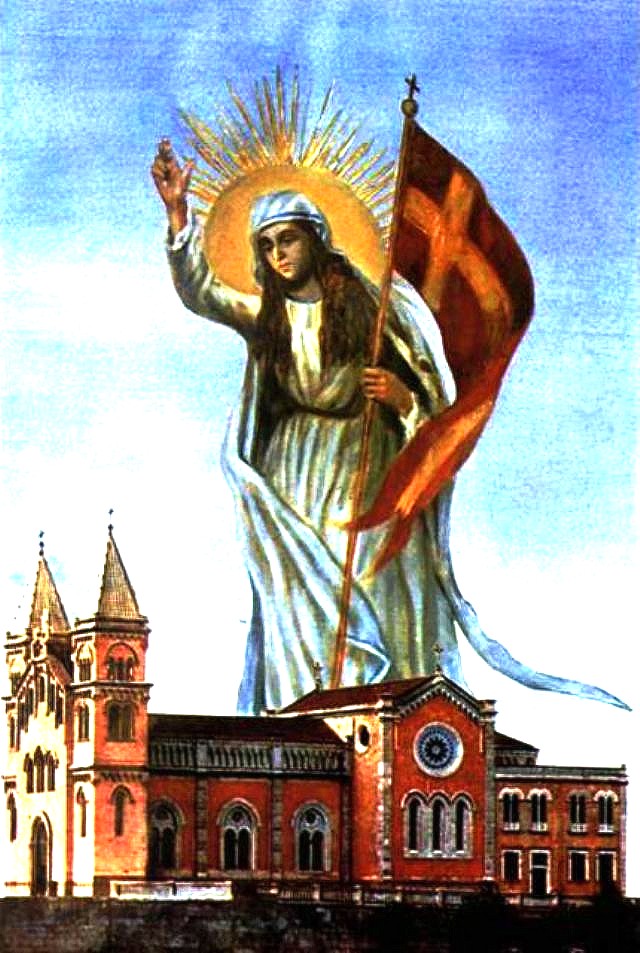
Our Lady of the Sacred Heart is a title which originated with the Missionaries of the Sacred Heart, founded by Fr J Chevalier (1824-1907) at Issoudun/France. This religious Congregation was founded to revive and regenerate the Christian faith, thanks to a special devotion to the Sacred Heart and to Our Lady. Their spirituality is based on a strong faith in the love of God the Father which revealed itself in the Heart of Jesus. This Christocentric orientation is linked with a lively devotion to Mary under the title of Our Lady of the Sacred Heart. It is said in the Rule of Life of the Missionaries of the Sacred Heart, “Since Mary was so intimately related to the Mystery of her Son’s Heart, we pray to her as did Fr Chevalier and we invoke her under the title of Our Lady of the Most Sacred Heart of Jesus. She knew of the inexhaustible riches of Christ; she was totally filled with His Love. She leads us to Him and directs us to His Heart which is the Source of Love …” ( #18)
Saint of the Day – 15 June – Saint Constantine of Beauvais (Died c706) Bishop, the 17th Bishop of Beauvais in France. He died in c706 of natural causes probably in Jumiègeswhere he was buried.
Located in the 17th place in the chronology of the Diocese of Beauvais, between Bishops Clement and Radingus, Saint Constantine takes on a role of primary importance in the religious history of the region. Despite his position, information about him is fragmentary and often contradictory.
Ancient French Bishop found in an Antique shop is probably NOT our Saint but could also, just as well, be him.
Tradition attributes the foundation of the Diocese of Beauvais, located in the French region of Oise, to the evangelising work of Saint Lucian, a Roman Priest Martyred in the 3rd Century. However, in 632, the first historically documented Bishop is Maurinus (or Marinius), who signed an act of foundation of the Monastery of Solignac. The name of Constantine also appears in these documents but his figure remains shrouded in obscurity.
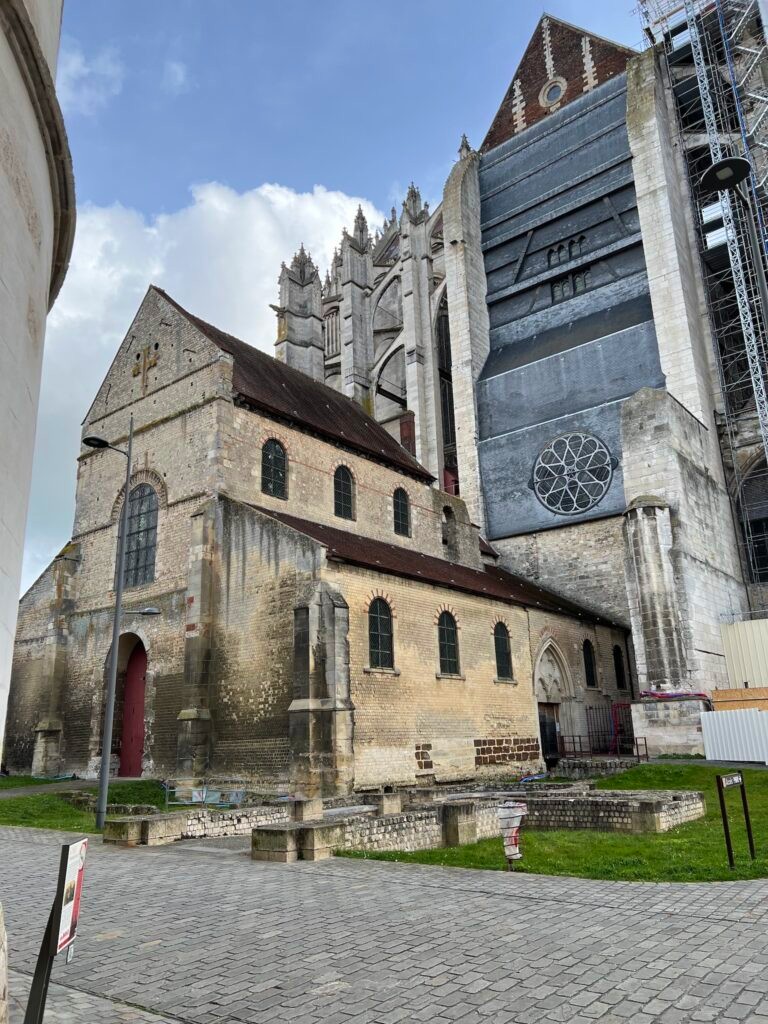
The 1st Cathedral of Beauvais, the 10th Century Basse-Oeuvre, a rare Carolingian structure and as you can see, it was successfully incorporated into the new Cathedral
The little information which has come down to us, tells of a Monk from Jumièges, who, having ascended to the role of the Bishop of Beauvais, led the Diocese in an unspecified period between 692 and 706. After his death which presumably occurred in Jumièges, where he was buried, his memory was honoured with the Liturgical Feast set for 15 June.
The New Cathedral
Despite the lack of precise details about his life and Episcopate, Saint Constantine of Beauvais remains a significant figure in the religious landscape of medieval France. His story, although fragmentary, testifies to the spread of Christianity in Gaul and the importance of the Episcopal role in the consolidation of Christian communities.
St Vitus (c 290-c 303) – Martyr, One of the Fourteen Holy Helpers. Died aged 12-13 years of age. Patronages – against animal attacks, against dog bites, against epilepsy; epileptics, against lightning, against over-sleeping, against rheumatic chorea or Saint Vitus Dance, against snake bites, against storms, against wild beasts, of actors, comedians, dancers, dogs, Bohemia, Czech Republic, Serbia, 17 cities. His very short life: https://anastpaul.com/2017/06/15/saint-of-the-day-15-june-st-vitus/
St Abraham of Saint-Cyriacus St Achaicus of Corinth St Barbara Cui Lianshi St Benildis of Córdoba
St Bernard of Montjoux/Menthon CRSA (c 1020-1081) “Apostle of the Alps” Priest, Founder of a patrol that cleared robbers from the mountains and he established hospices for travellers and pilgrims. The large dogs, trained to search for lost victims in the mountains, are named for him. Patronages – Alpinists, Alps (proclaimed by Pope Pius XI on 20 August 1923), Campiglia Cervo, Italy, mountain climbers (proclaimed by Pope Pius XI on 20 August 1923), mountaineers, skiers, travellers in the mountains (proclaimed by Pope Pius XI on 20 August 1923). Biography: https://anastpaul.com/2018/06/15/saint-of-the-day-15-june-st-bernard-of-menthon-c-r-s-a-c-1020-1081-apostle-of-the-alps/
St Constantine of Beauvais (Died c706) Bishop St Domitian of Lobbes St Edburgh of Winchester St Eigil St Eutropia of Palmyra St Fortunatus of Corinth
St Hadelinus of Lobbes St Hesychius of Durostorum St Hilarion of Espalion
St Isfrid of Ratzeburg O.Praem (c 1115-1204) Bishop of Ratzeburg, Confessor, Spiritual advisor, Missionary, Mediator and Peacemaker, a renowned Administrator and gentle corrector of his flock, whom he protected against political abuses, Defender of the Pope and the Holy See. Istfrid also built and restored Churches and Monasteries and established many new Parishes. A Holy and Untiring Shepherd: https://anastpaul.com/2022/06/15/saint-of-the-day-15-june-saint-isfrid-of-ratzeburg-o-praem-c-1115-1204/
Bl Juan Rodriguez St Julius of Durostorum St Landelin of Crespin St Leonides of Palmyra St Libya of Palmyra St Lotharius of Séez St Melan of Viviers St Orsisius Bl Pedro da Teruel Bl Peter Snow St Pierre de Cervis
St Tatian of Cilicia Bl Thomas Scryven St Trillo of Wales St Vaughen of Ireland
St Vouga of Lesneven
Martyr of Lucania – 11 Saints: Eleven Christians Martyred together. We known nothing else about them but the names – Anteon, Candidus, Cantianilla, Cantianus, Chrysogonus, Jocundus, Nivitus, Protus, Quintianus, Silvius, Theodolus in Lucania (modern Basilicata), Italy, date unknown.
Thought for the Day – 14 June – Meditations with Fr Richard Frederick Clarke SJ (1839-1900)
PATIENCE Meditations for a Month
The Endurance of Temptation
Temptations are a necessary element in the career of all the servants of God. ‘Because thou wast acceptable to God‘, says the Angel to Tobias, ‘it was necessary that temptation should try thee.‘ (Tobias 12 : 13.) Temptations, therefore, far from being any mark of God’s anger or displeasure, are a sign of His love and favour. This ought to be our consolation when we are harassed by temptations. St James tells us: ‘My brethren, count it all joy, when you fall into divers temptations. (St James 1 : 2.) I must take a more cheerful view of temptation than I have hitherto done. I must take it as a mark of God’s favour and then, I shall meet it more bravely.
How is temptation a sign of God’s love? It is an excellent instrument for engendering humility. If we are inclined to think too much of ourselves, nothing brings us to our senses, like some humiliating temptation. It shows us our own weakness and the necessity of continual reliance on God. It produces in us, a spirit of dependence upon God. This is the only way to pass through temptation safely. God has promised that He will always make a way to escape from every temptation.
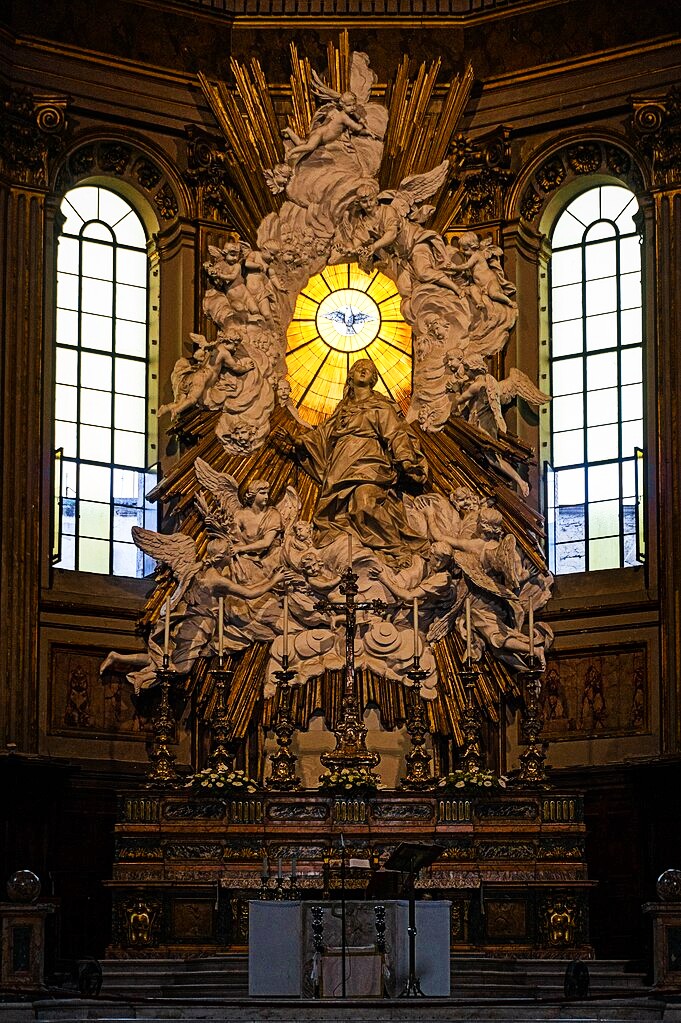
Temptation is also necessary to enable us to feel for others under their temptations. Even our Lord, the Apostle tells us, suffered being tempted that He may be able to succour those who are tempted. (Hebrews 2 : 18.) He knew indeed, from the beginning, all that His servants suffer but, by enduring temptation, He learned it by His own experience, so as to feel their sufferings. We do not even know the sufferings of others, much less can we sympathise with them thoroughly. Am I gentle towards those who are tempted, or am I hard and unsympathetic?
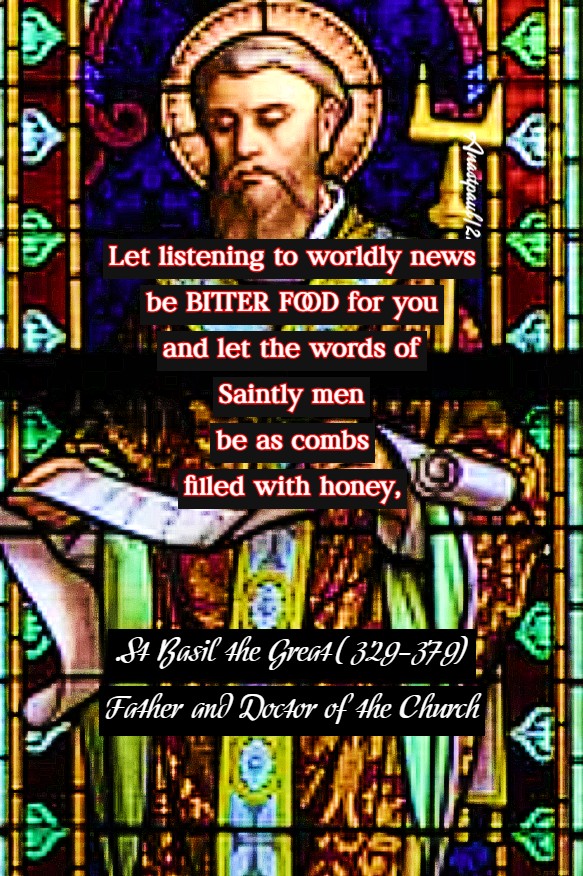
Quote/s of the Day – 14 June – St Basil the Great (329-379) Bishop of Caesarea, Confessor, Father and Doctor of the Church.
“Let listening to worldly news be BITTER FOOD for you and let the words of Saintly men be as combs filled with honey.”
“He seems to demand of us the most entire renunciation … So, if we keep back for ourselves, any earthly goods or any perishable supplies, our minds will remain sunk in them, as though in mud. Then, inevitably, our souls will become unable to contemplate God and will be unmoved by desire for the splendours of Heaven and for the good things promised us. We shall only be able to acquire those good things, if we ask for them unceasingly, with a burning desire that will, besides, make easy the effort needed to gain them.”
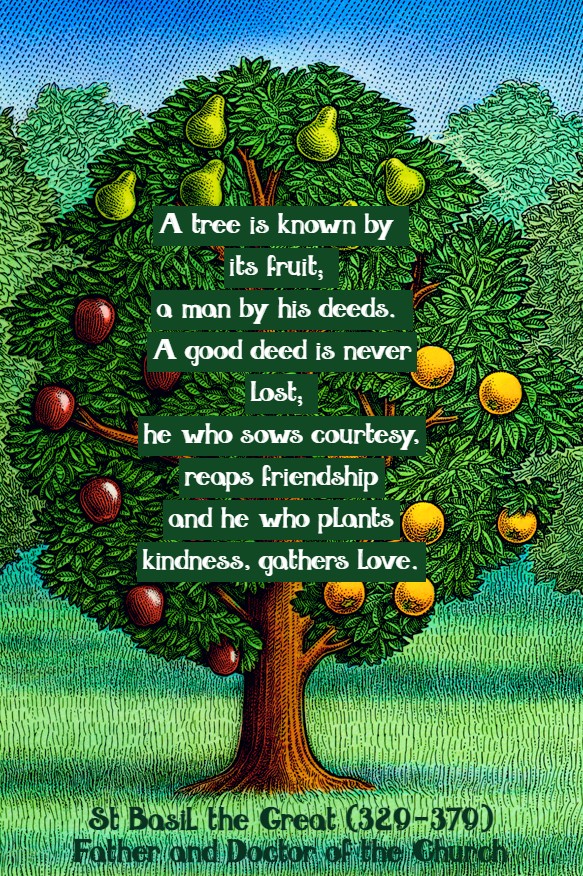
“A tree is known by its fruit, a man by his deeds. A good deed is never lost, he who sows courtesy, reaps friendship and he who plants kindness, gathers love.”
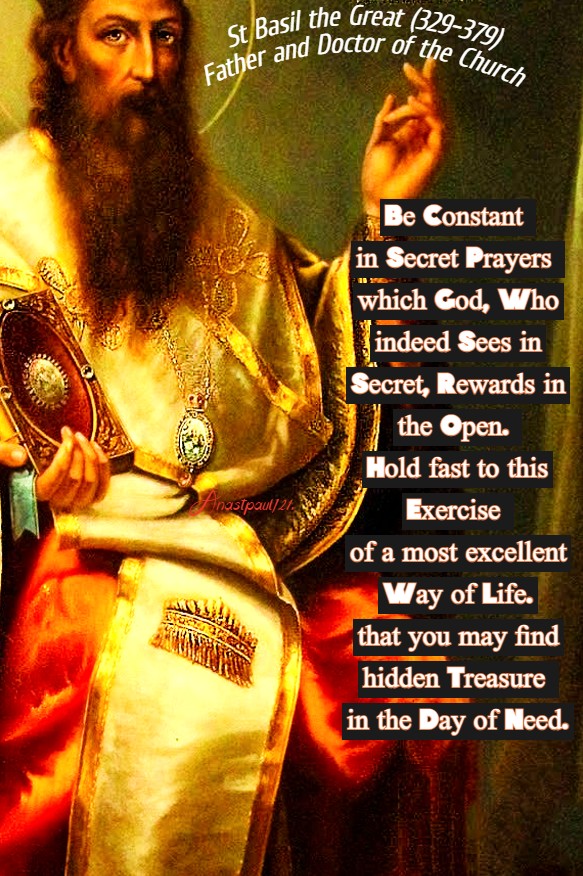
“Be constant in secret prayers which God, Who indeed sees in secret, rewards in the open. Hold fast to this exercise of a most excellent way of life. that you may find hidden treasure in the day of need.”
Lord, I Know that I Am Not Worthy Prayer before Holy Communion By St Basil the Great (329-379) Father and Doctor of the Church
Lord, I know that I am not worthy to receive Thy Holy Body and Precious Blood; I know that I am guilty and that I eat and drink condemnation to myself, not discerning the Body and Blood of Christ, my God. But trusting in Thy loving kindness, I come to Thee, Who hast said – ‘Whoever eats My Body and drinks My Blood, will dwell in Me and I in him’; Therefore, Lord, have compassion on me and do not put to shame Thy sinful servant But deal with me according to Thy great mercy And grant that these Holy Gifts, may be for me, healing, cleansing, enlightenment, protection, salvation and sanctification of soul and body. May they cast out from me every dark delusion, sinful deed or work of the evil one. May they move me to trust and love Thee always, to amendment of life, increase of virtue, obedience to Thy commandments, communion of the Holy Spirit, provision for my final journey and a good defence before the dreadful seat of judgement. Amen.
One Minute Reflection – 14 June – “The Month of the Sacred Heart of Jesus” and the Octave Day of the Sacred Heart – Ephesians 3:8-12, 14-19, John 19:31-37 – – Scripture search here: https://www.drbo.org/
“… One of the soldiers opened His side with a lance and immediately there came forth blood and water. ” – John 19:34
REFLECTION – “Let us draw near to the Heart of our most sweet Lord Jesus and we shall be glad and rejoice in it. How good and how sweet it is to dwell in this Heart! This is the hidden treasure, the pearl of great price which we discover, O Jesus, when we dig in the field of Thy Body (cf Mt 13:44). Who, then, would cast aside this Pearl? Far from it! For It, I will give away all my goods and offer in exchange, all my concerns and affections. I will lay down all my cares in the Heart of Jesus, it is He Who will suffice for me and Who will, without fail, supply all I need to live on!
It is within this temple, this Holy of holies, this Ark of the Covenant, that I shall come to offer worship and praise to the Lord’s Name. “I have found a heart with which to pray to my God” said David (1 Ch 17:25). And I too have found the Heart of my Lord and King, my Brother and Friend. Shall I not pray to Him, then? Indeed I shall pray, for, I dare to say it – His Heart is all mine…
O Jesus, deign to receive and answer my prayer. Draw me wholly into Thine Heart. Although the deformity of my sins prevents me from entering in, yet, Thou can receive and purify me from my impurities since, through an incomprehensible Love, this Heart has expanded and opened wide. O most pure Jesus, wash me from my iniquities so that, purified by Thee, I may dwell in Thy Heart all the days of my life, to see and do Thy will. If Thine Side has been pierced, then it is so that our entrance there should be opened. If Thine Heart has been wounded, then it is so that, sheltered from outward distress, we can make our home within it. And, too, it is so that in this visible wound, we might see the invisible wound of Love.” – [Attrib] St Bonaventure (1221-1274) Franciscan, Doctor of the Church (editations on the Lord’s Passion 3).
PRAYER – We beseech Thee, O Lord, hear our prayers which we offer on the festival of blessed Basil, Thy Confessor and Bishop and through his intercessory merits, who had the grace to serve Thee worthily, absolve us from all our sins. Through Jesus Christ, Thy Son our Lord, Who lives and reigns with Thee, in the unity of the Holy Ghost, God, world without end. Amen (Collect).
MAY the Heart of JESUS in the most Blessed Sacrament be praised, adored and loved with grateful affection, at every moment, in all the Tabernacles of the world, even to the end of time. – Indulgence 100 Days, Once a Day. Raccolta 161 Pius IX, 29 February 1868.
Our Morning Offering – 14 June – “The Month of the Sacred Heart of Jesus” and the Octave Day of the Sacred Heart
O Sacred Heart of Jesus, I Place my Trust in Thee Attr to Sr Mary Gisela of Notre Dame Convent (USA 1957)
O Sacred Heart of Jesus, I place my trust in Thee, Whatever may befall me, Lord, though dark the hour may be; In all my woes, in all my joys, though nought but grief I see, O Sacred Heart of Jesus, I place my trust in Thee.
When those I love have passed away and I am sore distressed, O Sacred Heart of Jesus, I fly to Thee for rest. And when the cross is heavy, my confidence shall be Unshaken as I cry, dear Lord, “I place my trust in Thee.”
This is my one sweet prayer, dear Lord, my faith, my trust, my love But most of all in that last hour, when death points up above, O Sweet Saviour, may Thy Face smile on my soul all free. Oh may I cry with rapturous love, “I’ve placed my trust in Thee!”
The above been set as a Hymn to the tune PASSION CHORALE by Hans Leo Hassler (1601) – the tune which is commonly used for a “O Sacred Head now Wounded”
Saint of the Day – 14 June – Saint Fortunatus of Naples (4th Century) Bishop Confessor, a fierce Defender of the Faith against Arianism. He is the first historically-attested Bishop of Naples, as one of the recipients of a letter written by those who took part in the Arian Council of Philippopolis in the 340s -he was a fierce opponent of Arianism. His term as the Bishop is held to be 347 to 359. Also known as – Fortunato. Additional Memorial – 8 November, the day when it celebrates the memory of all the “Bishop Saints of the Church of Naples.”
St Fortunatus top row right
The date of Fortunatus Episcopate is not totally precise, but is believed to have been towards the middle of the 4th Century, at the time that the Arian heresy was raging.
The heresy arose from the heretic Arius of Alexandria (280-336), who stated that the Word, Incarnated in Jesus Christ, is not of the same substance as the Father but represents the first of His creatures.
The heresy unleashed, a sometimes violent struggle, between the two positions existing in the Church. The Bishop of Naples, Fortunato did everything to preserve his Diocese from the Arian heresy, despite the attempt of the favourable eastern Bishops, who, having fled from the Council of Sardica (now Sofia in Bulgaria), wanted to draw him to their side.
It is known that he had a cemetery Basilica built which took his name, in the Sanità valley, not far from the Catacombs of St Gaudiosus and, which took on primary importance. In this Basilica Fortunato waslater buried and the mortal remains of the Bishops of Naples were also interred there. St Maximus,ae 10th Bishop of Naples, who was a victim of the Arian struggle, had died in exile in the East and which fact, his successor, St Severius, had reported to Naples.
Naples Cathedral High Altar
Under the Episcopate of Bishop John the Scribe (Died 849), the Relics of St Fortunatus and St Maxomus were moved to the ancient Cathedral of Naples.
And from that same period is the famous “Marble Calendar ” of Naples, sculpted in the 9th Century and still preserved in the rooms of the current Cathedral which bears the name of our Saint Fortunatus on 14 June and which, on the same date, is then reported in other Neapolitan Calendars and in the Roman Martyrology.
Even today, many Neapolitans bear his name, this testifies to the long and incessant cult enjoyed over the centuries by the holy Bishop Fortunatus, about whom, unfortunately, only little information has been passed to us.
St Anastasius of Córdoba St Burchard of Meissen St Caomhán of Inisheer St Castora Gabrielli St Cearan the Devout Bl Constance de Castro St Cyprien St Cyriacus of Zeganea St Davnet St Digna of Córdoba St Dogmael of Wales St Elgar of Bardsey
St Etherius of Vienne St Felix of Córdoba St Fortunatus of Naples (4th Century) Bishop Confessor St Gerold of Evreux Bl Hartwig of Salzburg St Joseph the Hymnographer
St Nennus of Arran Bl Peter de Bustamante St Protus of Aquileia St Quintian St Richard of Saint Vannes
St Rufinus of Soissons * (Died 4th Century) Layman, Martyr. AND St Valerius of Soissons * (Died 4th Century) Layman, Martyr The Roman Martyrology reads: “At Soissons in Belgic Gaul, today in France, the Holy Martyrs – Saints Valerius and Rufinus, who after enduring many torments, were condemned to be beheaded by the Governor, Rictiovarus, in the persecution of Diocletian.” Their Lives and Deaths: https://anastpaul.com/2023/06/14/saints-of-the-day-14-june-st-valerius-and-st-rufinus-of-soissons-died-4th-century-laymen-martyrs/
Thought for the Day – 13 June – Meditations with Fr Richard Frederick Clarke SJ (1839-1900)
PATIENCE Meditations for a Month
On Complaining
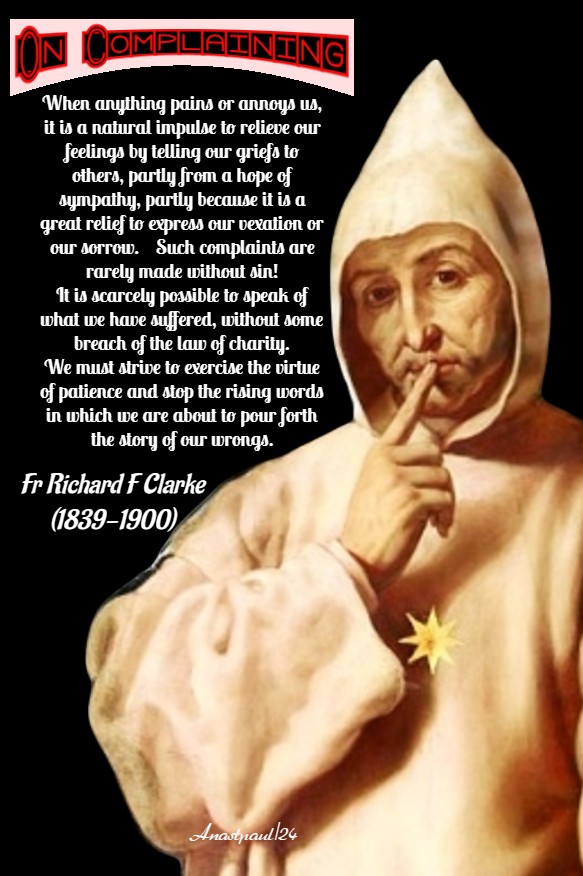
When anything pains or annoys us, it is a natural impulse to relieve our feelings by telling our griefs to others, partly from a hope of sympathy, partly because it is a great relief to express our vexation or our sorrow. Such complaints are rarely made without sin! It is scarcely possible to speak of what we have suffered, without some breach of the law of charity. We must strive to exercise the virtue of patience and stop the rising words in which we are about to pour forth the story of our wrongs.
The effort of keeping silent in such a case soon brings its reward. The pain after a time diminishes, whereas to have expanded upon it, would have made us feel more bitterly than before. Those who know that we have suffered are edified by our silence. Our wrong-doer is often won over by our meekness. Peace comes into our heart. Do I suppress for Christ’s sake and to imitate His patience, unkind words rising to my lips? When I have done so, do I not find that patience brings its own reward?
Yet, this does not mean that I am always to bury my griefs in my own heart. Sometimes I cannot do so; out they will come in spite of my efforts. Sometimes it is almost a duty to tell our story to some kind and sympathetic friend; half of our troubles disappear or are sensibly diminished in the mere act of telling. But, we must choose one, whom we can trust and respect. We must be careful not to speak bitterly or to abuse others by way of airing our feelings. We must try to excuse others and must tell our story simply and with all charity. Do I observe this rule when I am pouring my troubles into the ear of some friend or adviser?
Quote/s (and Prayers) of the Day – 13 June – St Anthony of Padua (1195-1231) Cpmfessor, Evangelical Doctor of the Church
“But the Apostles “spoke as the Spirit gave them the gift of speech.” Happy the man whose words issue from the Holy Ghost and not from himself!”
“At Thy Word I will lower the nets.” Whenever I lowered them on my own, I wanted to keep what belongs to Thee for myself. It was myself I was preaching and not Thee; my words, not Thine. That is why I caught nothing. Or, if I did catch something, it was not fish but frogs, only good for croaking my own praise! …”
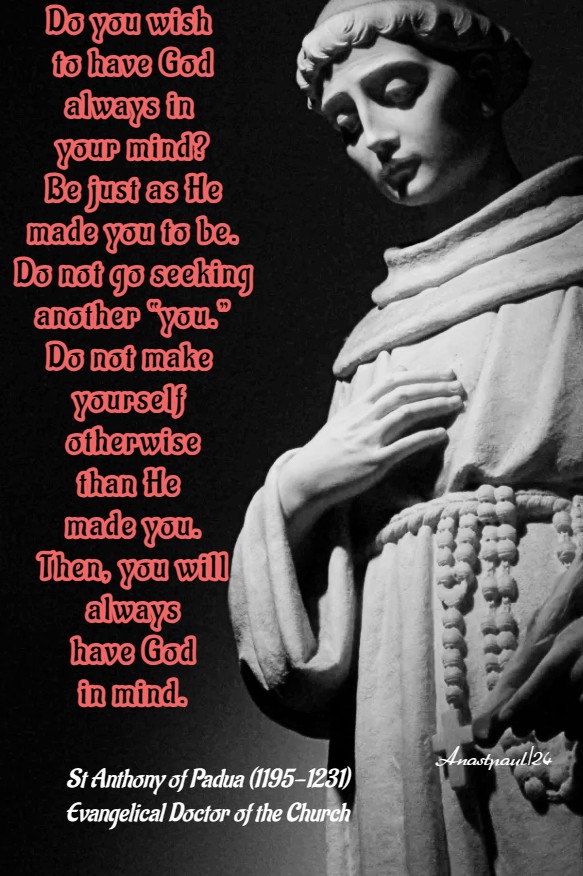
“ Do you wish to have God always in your mind? Be just as He made you to be. Do not go seeking another “you.” Do not make yourself otherwise than He made you. Then you will always have God in mind.”
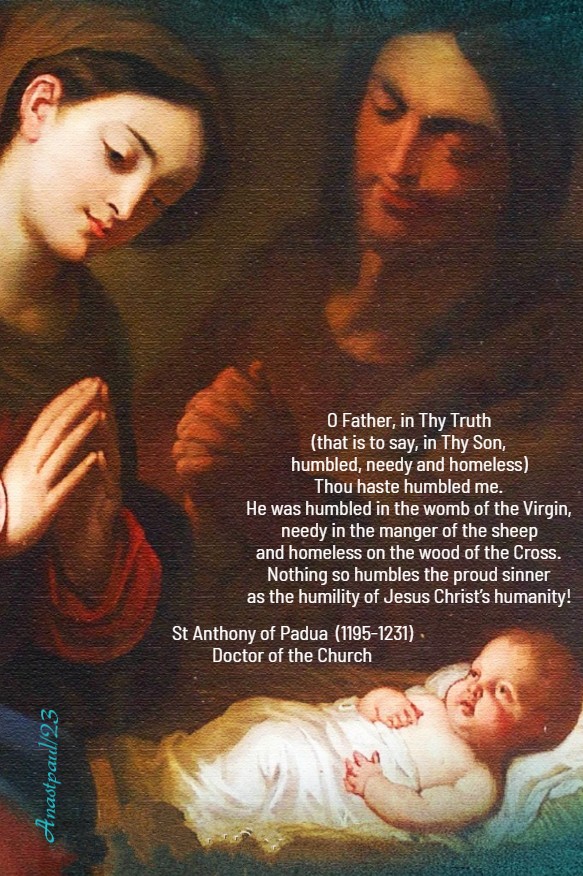
“O Father, in Thy Truth (that is to say, in Thy Son, humbled, needy and homeless) Thou haste humbled me. He was humbled in the womb of the Virgin, needy in the manger of the sheep and homeless on the wood of the Cross. Nothing so humbles the proud sinner as the humility of Jesus Christ’s humanity!”
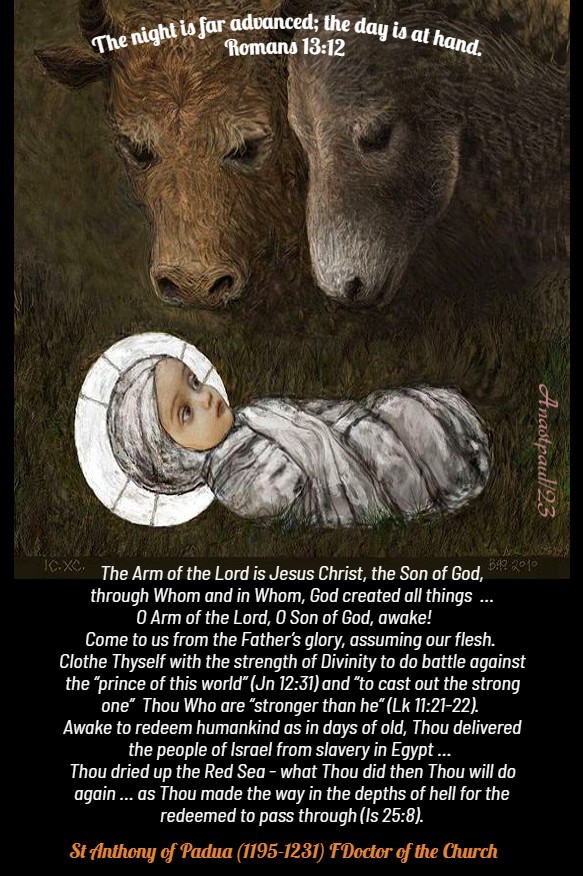
“The Arm of the Lord is Jesus Christ, the Son of God, through Whom and in Whom God created all things … O Arm of the Lord, O Son of God, awake! Come to us from the Father’s glory, assuming our flesh. Clothe Thyself with the strength of Divinity to do battle against the “prince of this world” (Jn 12:31) and “to cast out the strong one” Thou Who are “stronger than he” (Lk 11:21-22). Awake to redeem humankind as in days of old, Thou delivered the people of Israel from slavery in Egypt … Thou dried up the Red Sea – what Thou did then Thou will do again … as Thou made the way in the depths of hell for the redeemed to pass through (Is 25:8).”
One Minute Reflection – 13 June – “The Month of the Sacred Heart of Jesus” – St Anthony of Padua (1195-1231) Cpmfessor, Evangelical Doctor of the Church – Timothy 4:1-8; Matthew 5:13-19 – Scripture search here: https://www.drbo.org/
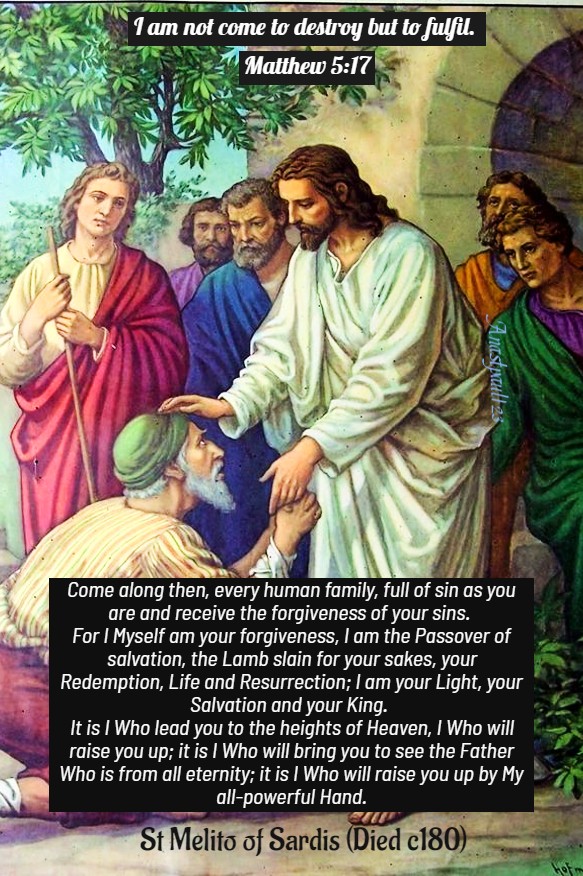
“I am not come to destroy but to fulfil.” – Matthew 5:17
REFLECTION – “The sacrifice of the lamb, the Passover rite and the letter of the Law have reached their term in Jesus Christ, in view of Whom, everything in the ancient Law took place – and, even more so, in the new dispensation. For the Law became the Word; from being old it became new … the commandments have been transformed into grace and the foreshadowing into Truth; the lamb has become the Son, the sheep has become man and man has become God. …
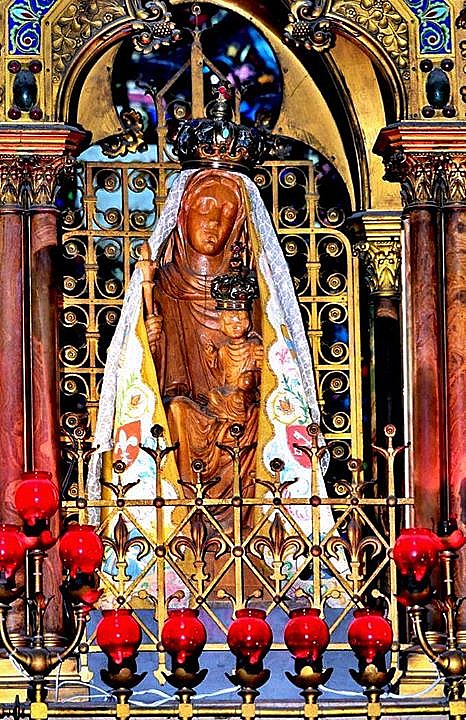
God, although He was the Lord, put on our humanity; He suffered for him, who was suffering, was bound for him, who was captive, was judged for the guilty, was buried for him, who was buried. He was raised from the dead and cried out in a loud voice: “If anyone wishes to oppose Me, let us appear together” (Is 50:8). It is I Who delivered the condemned man; I Who restored life to the dead; I Who raised up those in the grave. “Who disputes My right?” It is I, He says, I Who am the Christ, I Who destroyed death, Who triumphed over the enemy, Who bound the mighty enemy and carried off man to the heights of heaven; it is I, He says, Who am the Christ.

Come along then, every human family, full of sin as you are and receive the forgiveness of your sins. For I Myself Am your forgiveness, I am the Passover of salvation, the Lamb slain for your sakes, your Redemption, Life and Resurrection; I am your Light, your Salvation and your King. It is I Who lead you to the heights of Heaven, I Who will raise you up; it is I Who will bring you to see the Father Who is from all eternity; it is I Who will raise you up by My all-powerful Hand.” – St Melito of Sardis (Died c180) Bishop of Sardis in Smyrna and Father of the Church [Paschal Homily (Passim)]
PRAYER – May the solemn feast of blessed Anthony, Thy Confessor and Doctor, make Thy Church rejoice, O God, so that, ever sustained by spiritual help, she may deserve to reap everlasting joy. Through Jesus Christ, Thy Son our Lord, Who lives and reigns with Thee, in the unity of the Holy Ghost, God, world without end. Amen (Collect).
Sweet Heart of my JESUS, make me love Thee ever more and more! 300 Days Once a Day. ii. Plenary, Once a month.Raccolta – 162. Blessed Pope Pius IX, 26 November 1876.
Our Morning Offering – 13 June – “The Month of the Sacred Heart of Jesus” and the Feast of the Eucharistic Heart of Jesus instituted by Pope Benedict XV
O Most Sacred Heart of Jesus! By Pope Benedict XV (1854-1922)
O Most Sacred Heart of Jesus! O Fount of every good! I adore Thee, I love Thee and sincerely repenting of my sins, I present to Thee my poor heart. Give it back to me humble, patient, pure and in everything, conformed to Thy wishes. Make me, O good Jesus, live in Thee and for Thee. Protect me in dangers, comfort me in afflictions, grant me health of body, succour in my temporal needs, Thy blessing in all my works and the grace of a holy death. Amen
Indulgence – 100 days Once a day Pope Benedict XV 4 December 1916
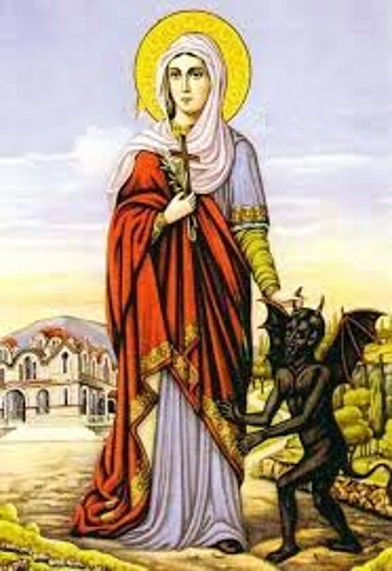
Saint of the Day – 13 June – Saint Aquilina of Syria (281–293) Virgin Child Martyr. Born in 281 in Byblos, Phoenicia (in modern Lebanon) and died by torture in 293 in Byblos during the reign of Diocletian. Also known as – Aquilina of Byblos, Aquilina of Biblus, Aquilina of Lebanon..
The Roman Martyrology reads today: “At Byblos, in Palestine, St Aquilina, Virgin and Martyr, at the age of 12 years, under the Emperor Diocletian and the Judge Volusian. For the confession of the Faith, she was buffeted, scourged, pierced with red-hot bodkins and, being struck with the sword, consecrated her virginity by Martyrdom.”
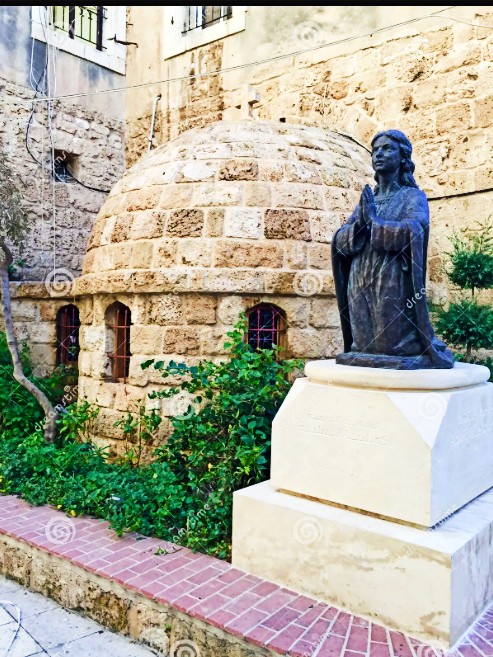
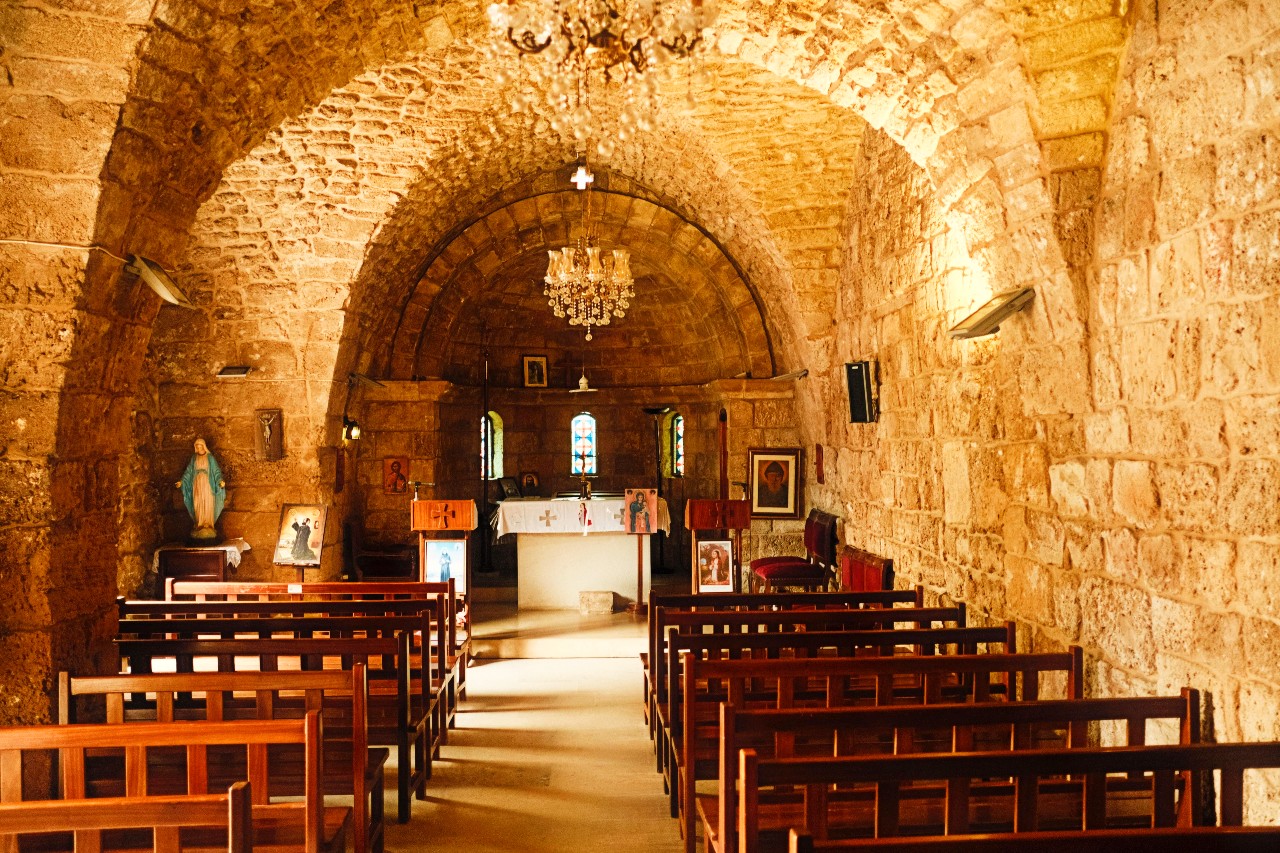
Statue of St Aquilina outside the Church dedicated to her in Lebanon
Between 63 and 330 Byblo in modern Lebanon was under Roman rule and, although Christianity existed there from the time of the Apostles, Christians were a minority among the majority pagans. During their rule, the Romans not only strengthened the worship of idols but some of their governors actively persecuted the Christians. When Aquilina was condemned to death in 293, Volusian was the Magistrate of Byblos.
Aquilina, a native of the Phoenician (now Lebanon) City of Byblos, suffered under Emperor Diocletian in the 3rd Century. Her father’s name was Eutolmius. She was raised in Christian piety by her parents. She received her catechism from Evthalios, the Bishop of Byblos.
When she was only twelve years old, she persuaded a pagan friend to convert to Christ through her example and teachings. One of the servants of Governor Volusian accused her of teaching others to reject paganism. She was taken before the Governor where she firmly confessed her belief in Christ and said that she would not renounce Him. Volusian tried to influence her through persuasion and flattery but, seeing her confidence, he ordered her to be tortured.
She was struck upon the face, then stripped and flogged. Heated metal rods were then drilled through her ears and Aquilina fell down as if dead. The torturers thought that she had actually died and gave orders that her body be thrown outside the City to be eaten by dogs. However, later that night, an Angel appeared to Aquilina, roused her and said, “Arise and be healed. Go and denounce Volusian, so that he and his plans may come to nothing.”
Aquilina regained consciousness and went before Volasian, who sentenced her to be decapitated in the morning, saying that she was a sorceress who refused his imperial decrees. Before the executioner could carry out the sentence, the Martyr gave up her spirit. The Christians buried her body outside the City where her Tomb became a site for pilgrimage and cures.
Later her holy Relics were transported to Constantinople where a great Basilica was built in her honour near the Forum of Constantine in the Philoxene quarter. This Basilica was later destroyed in a fire.
St Fandilas of Penamelaria St Felicula of Rome St Fortunatus of North Africa
Blessed Gerard of Clairvaux (Died 1138) – was the elder brother of Saint Bernard of Clairvaux. He was a Soldier. When he was wounded in combat at the siege of Grancy, Gerard resolved to become a Monk. He became a Benedictine Cistercian Monk at Citeaux. He worked with Saint Bernard at Clairvaux and became his closest confidant. He died in 1138 of natural causes.
St Lucian of North Africa St Mac Nissi of Clonmacno St Maximus of Cravagliana St Nicolas Bùi Ðuc The St Peregrinus of Amiterno St Rambert St Salmodio Bl Servatius Scharff St Thecla
Thought for the Day – 12 June – Meditations with Fr Richard Frederick Clarke SJ (1839-1900)
PATIENCE Meditations for a Month
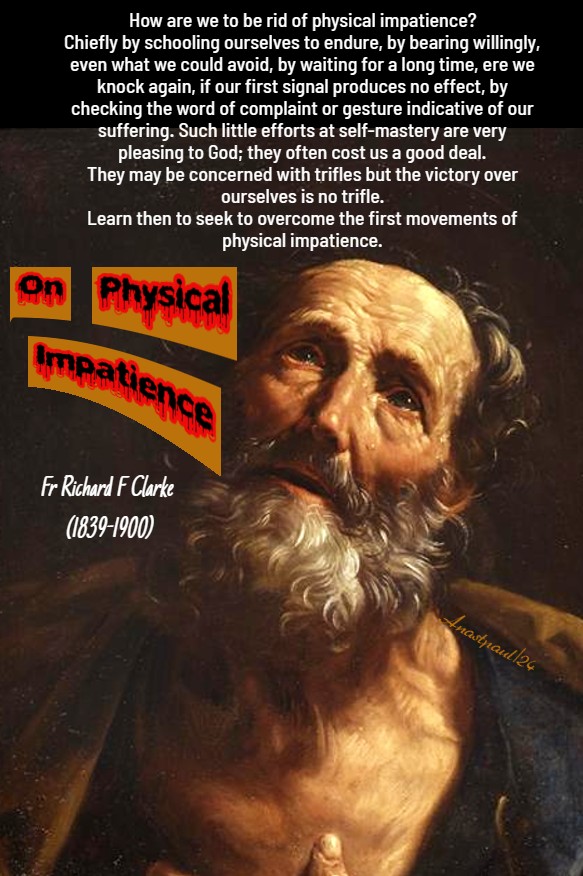
On Physical Impatience
Physical impatience is that involuntary feeling of irritation which is aroused in us by some external and physical cause. We are looking for something and cannot find it. We are trying to focus our thoughts and some distracting noise renders it impossible. We are trying to compose ourselves to sleep and some troublesome neighbour wakes us just as slumber was creeping over us. On account of all such impatience, we should humble ourselves, as being a sign of faults indulged in the past, not of present sin.
2. This sort of physical impatience, anticipating our reason, is very often the result of impatience, pride, self-will long indulged. The ghost of past sins reappearing to remind us of what we have forgotten and, to keep us humble. Not always, for St Teresa tells us that owing to ill-health and desolation, she had the greatest difficulty in remaining calm and gentle and in resisting the impulse to speak sharply and disagreeably. But as a general rule, such physical impatience may be taken, at all events, while we are in good health, as a mark of pride not completely subdued and of self-will, which has not fully learned to submit.
3. How are we to be rid of physical impatience? Chiefly by schooling ourselves to endure, by bearing willingly, even what we could avoid, by waiting for a long time, ere we knock again, if our first signal produces no effect, by checking the word of complaint or gesture indicative of our suffering. Such little efforts at self-mastery are very pleasing to God; they often cost us a good deal. They may be concerned with trifles but the victory over ourselves is no trifle. Learn then to seek to overcome the first movements of physical impatience.
Quote/s of the Day – 12 June – Ecclesiasticus i 31:8-11; Luke 12:35-40– Scripture search here: https://www.drbo.org
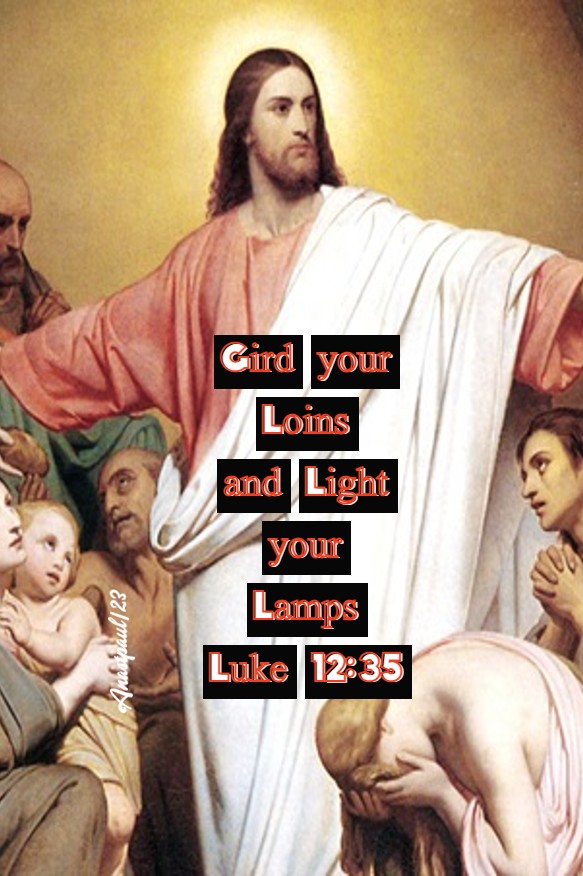
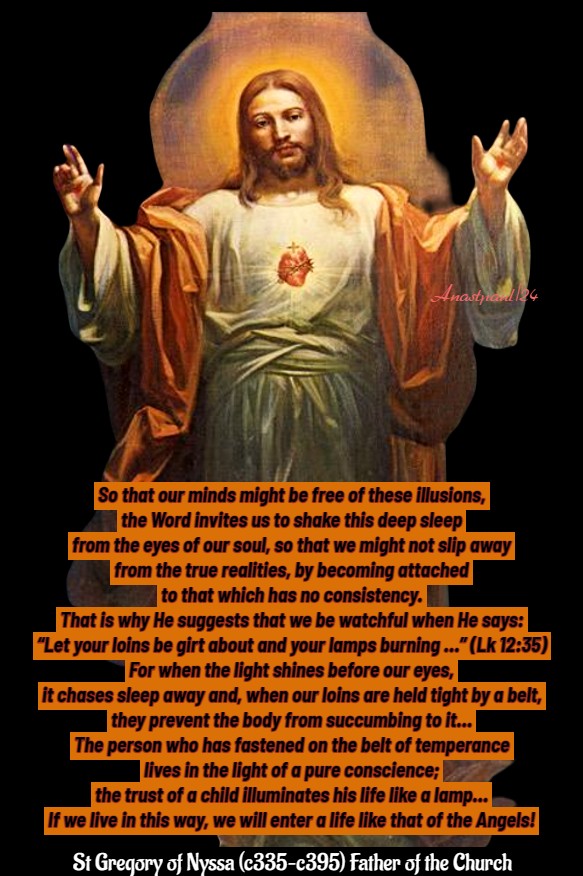
“Let your loins be girt about and your lamps burning …”
Luke 12:35
“So that our minds might be free of these illusions, the Word invites us to shake this deep sleep from the eyes of our soul, so that we might not slip away from the true realities, by becoming attached to that which has no consistency. That is why He suggests that we be watchful when He says: “Let your loins be girt about and your lamps burning …” (Lk 12:35) For when the light shines before our eyes, it chases sleep away and, when our loins are held tight by a belt, they prevent the body from succumbing to it… The person who has fastened on the belt of temperance lives in the light of a pure conscience; the trust of a child illuminates his life like a lamp… If we live in this way, we will enter a life like that of the Angels!”
St Gregory of Nyssa (c335–c395) Father of the Church (Brother of St Basil the Great)
“ The fire of the Lord is Light Eternal; the lamps of believers are lit at this fire: “Gird your loins and light your lamps,” (Lk 12:35). It is because the days of our life are still night that a lamp is necessary. This is the fire which, according to the testimony of the disciples at Emmaus, the Lord Himself set within them: “Were not our hearts burning within us while He spoke to us on the way and opened the scriptures to us?” (Lk 24:32). He gives us evident proof of this fire’s action, enlightening man’s inmost heart. That is why the Lord will come in fire (Is 66,15) so as to devour our faults at the resurrection, fulfil each one’s desires with His Presence and cast His Light over their merits and mysteries.”
St Ambrose (340-397) Father and Doctor of the Church
“It is time now for us to rise from sleep!”
St Benedict (c 480-547)
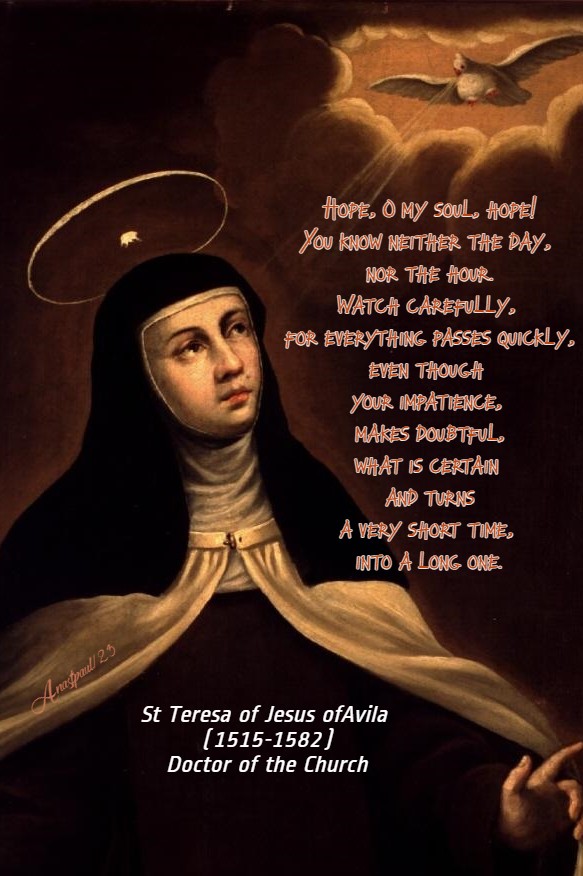
“Hope, O my soul, hope! You know neither the day, nor the hour. Watch carefully, for everything passes quickly, even though your impatience, makes doubtful, what is certain and turns a very short time, into a long one.”
St Teresa of Jesus of Avila (1515-1582) Doctor of the Church
One Minute Reflection – 12 June – “The Month of the Sacred Heart of Jesus” – Within the Octave of the Sacred Heart – St Juan de Sahagun (1419-1479) Confessor, Priest and Friar of the Order of the Augustinians – – Ecclesiasticus i 31:8-11; Luke 12:35-40– Scripture search here: https://www.drbo.org/
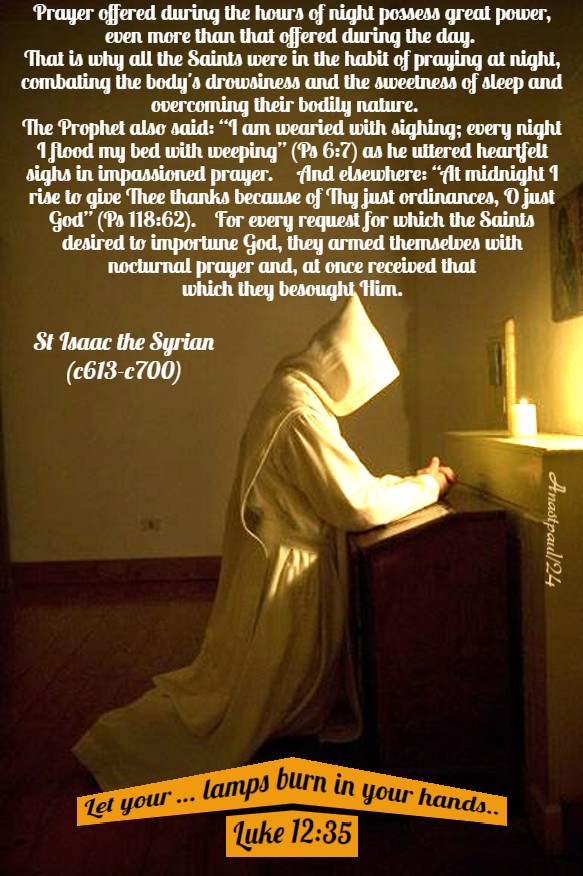
“Jesus said to His disciples: Let your … lamps burn in your hands.” – Luke 12:35
REFLECTION – “Prayer offered during the hours of night possess great power, even more than that offered during the day. That is why all the Saints were in the habit of praying at night, combating the body’s drowsiness and the sweetness of sleep and overcoming their bodily nature. The Prophet also said: “I am wearied with sighing; every night I flood my bed with weeping” (Ps 6:7) as he uttered heartfelt sighs in impassioned prayer. And elsewhere: “At midnight I rise to give Thee thanks because of Thy just ordinances, O just God” (Ps 118:62). For every request for which the Saints desired to importune God, they armed themselves with nocturnal prayer and, at once received that which they besought Him.
Satan himself fears nothing as much as prayer offered during the night watches. Even if they are accompanied by distractions, it does not return fruitless, as long as something inappropriate is not being asked for. That is why Satan engages in severe combat against those who keep watch at night, so as to deter them from this practice if he can, especially if they show themselves to be persevering. But those who are in any way defended against his pernicious wiles and have tasted the gifts God grants, at these times of vigil and, have had personal experience, of the greatness of the help God gives them, wholly despise him, he and all his craftiness.” – St Isaac the Syrian of Nineveh (c613-c700) Bishop of Nineveh, Monk at Mosul, Father of the Church (Ascetical Discourses)
PRAYER – O God, Author of peace and lover of charity, Who endowed blessed John, Your Confessor, with a wondrous grace for reconciling enemies; grant by his merits and intercession that, being ourselves firmly rooted in Thy charity, we may not be separated from Thee by any temptations.Through Jesus Christ, Thy Son our Lord, Who lives and reigns with Thee, in the unity of the Holy Ghost, God, world without end. Amen (Collect).
Jesus, meek and humble of heart, make my heart like unto Thine. – 300 Days, EVERYTIME. (Unless otherwise stated, e.g., “once a day,” a partial Indulgence may be gained any number of times in succession.) St Pope Pius X, 15 September 1905.
Our Morning Offering – 12 June – “The Month of the Sacred Heart of Jesus”
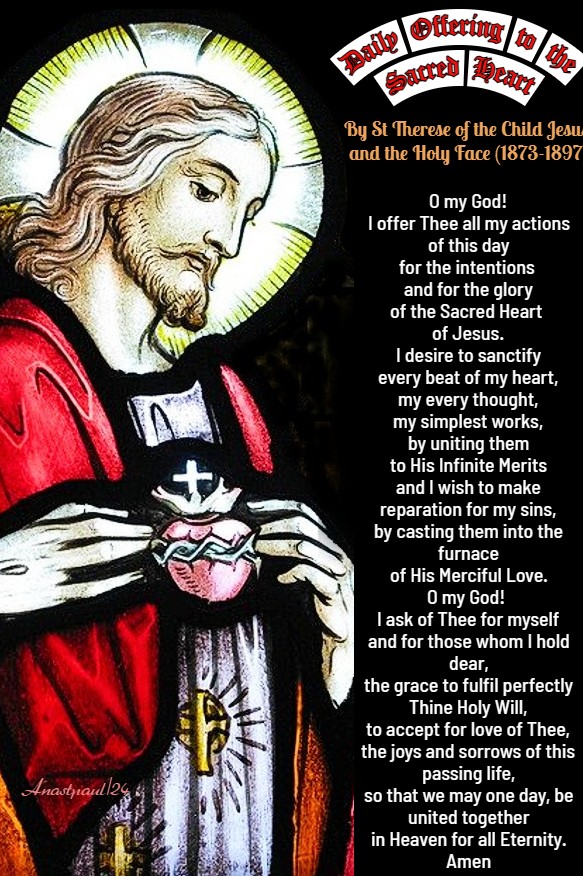
Daily Offering to the Sacred Heart By St Thérèse of the Child Jesus and the Holy Face (of Lisieux) OCD (1873-1897)
O my God! I offer Thee all my actions of this day for the intentions and for the glory of the Sacred Heart of Jesus. I desire to sanctify every beat of my heart, my every thought, my simplest works, by uniting them to His Infinite Merits and I wish to make reparation for my sins, by casting them into the furnace of His Merciful Love. O my God! I ask of Thee for myself and for those whom I hold dear, the grace to fulfil perfectly Thine Holy Will, to accept for love of Thee, the joys and sorrows of this passing life, so that we may one day, be united together in Heaven for all Eternity. Amen
Saint of the Day – 12 June – Saint Odulf of Utrecht (Died c865) Priest, Monk, Prior, zealous Missionary to the Frisians. Odulf was gifted with the charism of prophecy. Born in Brabant (in modern Belgium) and died in c865 of natural causes at his Monastery, Saint Martin of Utrecht. Patronages – Borgloon, Belgium, Evesham, England, Stavoren, Holland, Utrecht, Holland. Also known as – Odulph of Stavoren, Odulf of Evesham, Odolfo…Odulf…Odulfo…Odulphus… Additional Memorial – 18 July on some calendars.
According to a fairly reliable Vita from the 10th Century, Odulf, son of the Frankish Ludgis of Oorschoot, was educated at the school of Utrecht, where he excelled in his studies and attracted all by his piety and learning. Ordained a Priest, he was attracted by the monastic life of prayer and detachment from the world but his parents ardently desired him to exercise pastoral care in Oorschoot, since the local Church stood on their property and probably belonged to them.
After a few years, having distributed his goods among the poor, Odulf took on the monastic Habit in the Monastery of Saint Martin of Utrecht attached to the Cathedral. He became Prior there while St Frederick was the Bishop, who, havingby the aid of Odulf, completed the mission among the Frisians, asked him to dedicate himself to pastoral care in the recently erected Church of Pensoren. Odulf accepted, on condition that he could later return to the Monastery to retire and die there.
St Martin’s Abbey Monastery, Utrecht
After a very fruitful activity, he returned in an unspecified year to his Monastery. The Norman incursions of the following decades brought serious damage and suffering to Oorschoot, as Odulf had predicted if the community had strayed from the straight path of Christian truth. Odulf intervened decisively in the election of Bishop Ungaro.
He died around the year 865 and his cult soon spread around Holland and Belgium. His remains were later transferred from Utrecht, where however a Relic remained, to Pensoren and from there, in around 1034 to London and Evesham Abbey – it is told that St Odulf’s Relics were actually stolen and re-appeared in England, where our Saint became the Patron of Evesham. His Feast Day is on June 12th.
St Amphion of Nicomedia Bl Antonio de Pietra St Arsenius of Konev St Christian O’Morgair of Clogher St Chrodobald of Marchiennes St Cominus Bl Conrad of Maleville St Cunera St Cuniald St Cyrinus of Antwerp St Eskil St Galen of Armenia St Gerebald of Châlons-sur-Seine St Geslar
St Pope Leo III (c 750-816) Bishop of Rome and Ruler of the Papal States from 26 December 795 to his death. Defender of the City ad peoples of Rome and of the Church. Peacemaker and restorer of Churches and Monasteries, Patron of the Arts and Apostle of the poor. Know as “Charlemagne’s Pope” His Life: https://anastpaul.com/2021/06/12/saint-of-the-day-12-june-st-pope-leo-iii-c-750-816/
St Odulf of Utrecht (Died c865) Priest, Monk, Prior St Olympius of Aenos St Onuphrius of Egypt Bl Pelagia Leonti of Milazzo St Peter of Mount Athos St Placid of Val d’Ocre St Ternan of Culross St Valerius of Armenia
Martyrs of Bologna: Three Christians who were Martyred at different times and places, but whose relics have been collected and enshrined together – Celsus, Dionysius, and Marcellinus. Their relics were enshrined in churches in Bologna and Rome in Italy.
St Basilides and Companions / Martyrs of Rome: Four members of the Imperial Roman nobility. They were all soldiers, one or more may have been officers, and all were Martyred in the persecutions of Diocletian – Basilides, Cyrinus, Nabor and Nazarius. They were martyred in 304 outside Rome, Italy and buried along the Aurelian Way.
Three Holy Exiles: Three Christian men who became Benedictine Monks at the Saint James Abbey in Regensburg, Germany, then Hermits at Griestatten and whose lives and piety are celebrated together. – Marinus, Vimius and Zimius.
Thought for the Day – 11 June – Meditations with Fr Richard Frederick Clarke SJ (1839-1900)
HUMILITY Meditations for a Month
Humility and Criticism
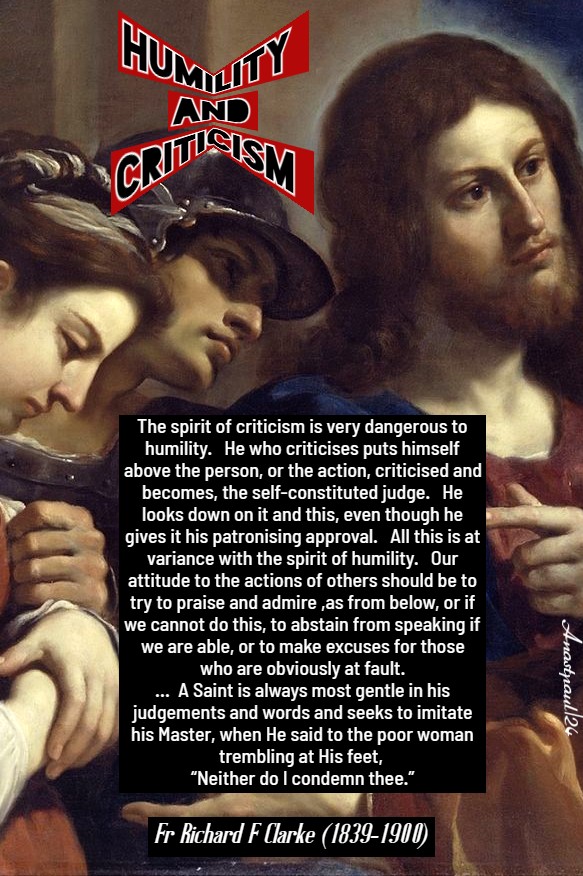
The spirit of criticism is very dangerous to humility. He who criticises puts himself above the person, or the action, criticised and becomes, the self-constituted judge. He looks down on it and this, even though he gives it his patronising approval. All this is at variance with the spirit of humility. Our attitude to the actions of others should be to try to praise and admire ,as from below, or if we cannot do this, to abstain from speaking if we are able, or to make excuses for those who are obviously at fault.
Unjust and bitter criticism is one of the marks of inveterate pride. The devil is the accuser of the brethren. Much that he urges against them is true but this is no excuse. Much is false and, in this, those who criticise rashly and uncharitably, are sure to imitate their model. They fall unconsciously into false and rash judgements and, even where they were quite certain that they were correct, they nevertheless, often do serious wrong to those whom they criticise. If they were more humble, they would have a clearer and truer view of the characters and actions, of those around them.
Yet how general is this habit of criticism? Many who are reputed good Catholics, run down their neighbours with a freedom which shows how little they have imbibed of the spirit of the Church and of her Saints. A Saint is always most gentle in his judgements and words and seeks to imitate his Master, when He said to the poor woman trembling at His feet, “Neither do I condemn thee.” Ask yourself whether you are free from fault in this respect and promise amendment.
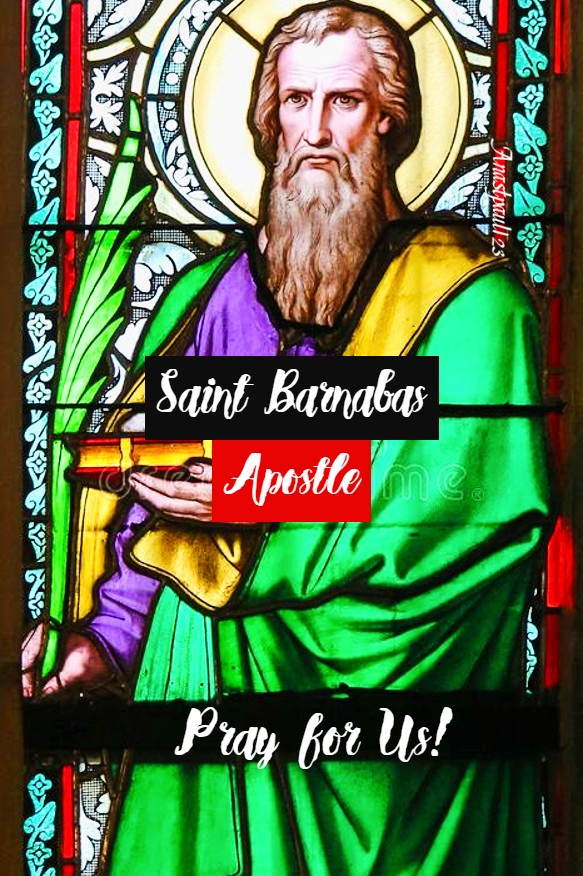
Quote/s of the Day – 11 June – “The Month of the Sacred Heart of Jesus” – Feast of St Barnabas the Apostle, Martyr, The “Son of Encouragement” – Acts 11:21-26; 13:1-3; Matthew 10:16-22.– Scripture search here: https://www.drbo.org/
“Behold I send you as sheep in the midst of wolves. Be, therefore, wise as serpents and simple as doves. ”
Matthew – 10:16
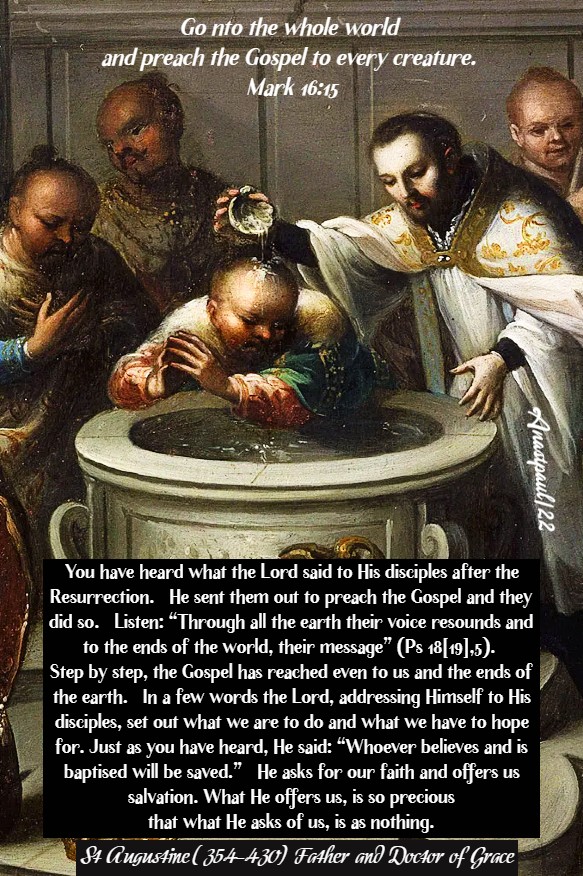
“Go into the whole world and preach the Gospel to every creature.” Mark 16:15
“You have heard what the Lord said to His disciples after the Resurrection. He sent them out to preach the Gospel and they did so. Listen: “Through all the earth their voice resounds and to the ends of the world, their message” (Ps 18[19],5). Step by step, the Gospel has reached even to us and the ends of the earth. In a few words the Lord, addressing Himself to His disciples, set out what we are to do and what we have to hope for. Just as you have heard, He said: “Whoever believes and is Baptised will be saved.” He asks for our faith and offers us salvation. What He offers us, is so precious that what He asks of us, is as nothing.”
St Augustine (354-430) Father and Doctor of Grace
“All the brothers should strive to follow the humility and the poverty of our Lord Jesus Christ … And they must rejoice when they live among people who are considered to be of little worth and who are looked down upon, among the poor and the powerless, the sick and the lepers and the beggars by the wayside. And when it may be necessary, let them go to seek alms. And they should not be ashamed but rather recall that our Lord Jesus Christ, the Son of the living and all-powerful God … was a poor man and a transient and lived on alms, He and the Blessed Virgin and His disciples.”
St Francis of Assisi (c1181-1226)
(Earlier Rule, #8-9).
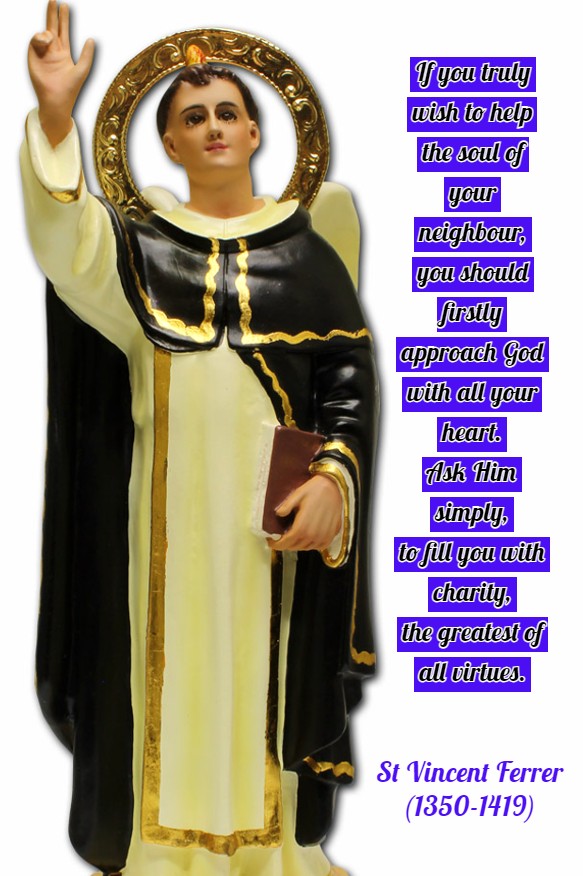
“If you truly wish to help the soul of your neighbour, you should firstly approach God with all your heart. Ask Him simply, to fill you with charity, the greatest of all virtues.”
St Vincent Ferrer OP (1350-1419)
“If you wish to enter into life, keep My commandments. If you will know the truth, believe in Me. If you will be perfect, sell all. If you will be My disciple, deny yourself. If you will possess the blessed life, despise this present life. If you will be exalted in Heaven, humble yourself on earth. If you wish to reign with Me, carry the Cross with Me. For only the servants of the Cross find the life of blessedness and of true Light.”
One Minute Reflection – 11 June – “The Month of the Sacred Heart of Jesus” – Feast of St Barnabas the Apostle, Martyr, The “Son of Encouragement” – Acts 11:21-26; 13:1-3; Matthew 10:16-22.– Scripture search here: https://www.drbo.org/
“Behold I send you as sheep in the midst of wolves. Be, therefore, wise as serpents and simple as doves. ” – Matthew – 10:16
REFLECTION – “Christ also suffered for you, leaving you an example that you should follow in His Footsteps,” (1Pt 2:21). Which of the Lord’s examples will we have to follow? Is it His raising of the dead? Is it to walk on the sea? Not in the least. But it is that of being meek and humble of heart (Mt 11:29) and of loving not only our friends but even our enemies (Mt 5:44).
“So that you might follow in His Footsteps,” writes St Peter. The blessed Evangelist John also says the same thing: “Whoever claims to abide in Christ ought to walk as He has walked,” (1 Jn 2:6). And how has Christ walked? He prayed for His enemies on the Cross, saying: “Father, forgive them, for they know not what they do,” (Lk 23:34). They have actually lost their senses and are possessed by an evil spirit and while they are persecuting us, they themselves are undergoing a far greater persecution from the devil. Hence, we should be praying more for their deliverance than for their condemnation.
That is indeed what Blessed Stephen did, he who was the first so gloriously to follow in the Footsteps of Christ. For, when he was struck by a hail of stones, he prayed standing for himself but, falling to his knees, he cried out with all his strength for his enemies: “Lord Jesus Christ, do not hold this sin against them,” (Ac 7:60). So even if we think we cannot imitate our Lord, let us at least imitate him who was just as much His servant as we are.” – St Caesarius of Arles (470-543) Father of the Church, Bishop (Sermons to the people, No 37).
PRAYER – O God, Who gladden us by the merits and intercession of blessed Barnabas, Thy Apostle, mercifully grant that we, who ask of Thee favours through him, may obtain them by the gift of Thy grace.ThroughJesus Christ, Thy Son our Lord, Who lives and reigns with Thee, in the unity of the Holy Ghost, God, world without end. Amen (Collect).
SACRED Heart of JESUS, I trust in Thee. 300 Days Indulgence Once a Day – Plenary, Once a month. Raccolta 175 – St Pius X, 19 August 1905 and 27 June 1906.
Our Morning Offering – 11 June – Feast of St Barnabas the Apostle, Martyr, The “Son of Encouragement.”
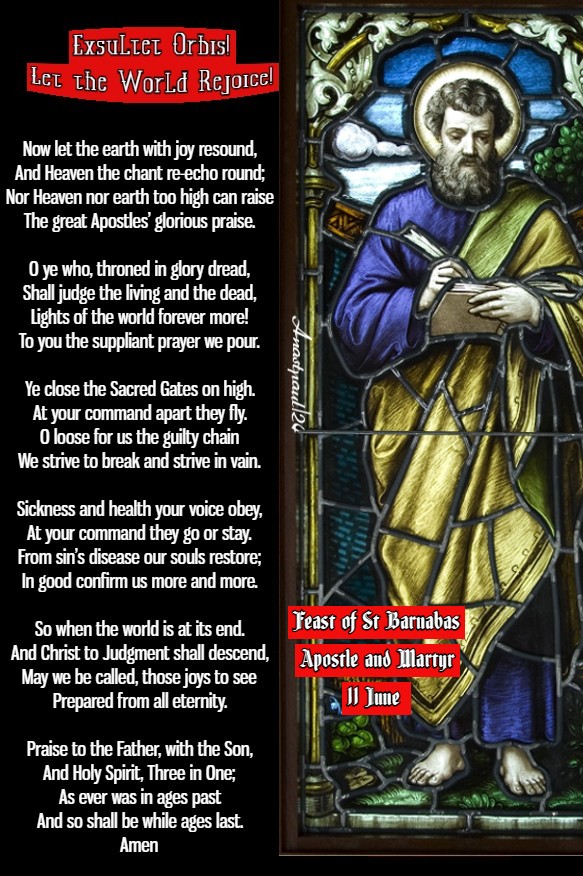
Exsultet Orbis! Let the World Rejoice! Unknown Author
Now let the earth with joy resound, And Heaven the chant re-echo round; Nor Heaven nor earth too high can raise The great Apostles’ glorious praise.
O ye who, throned in glory dread, Shall judge the living and the dead, Lights of the world forever more! To you the suppliant prayer we pour.
Ye close the Sacred Gates on high. At your command apart they fly. O loose for us the guilty chain We strive to break and strive in vain.
Sickness and health your voice obey, At your command they go or stay. From sin’s disease our souls restore; In good confirm us more and more.
So when the world is at its end. And Christ to Judgment shall descend, May we be called, those joys to see Prepared from all eternity.
Praise to the Father, with the Son, And Holy Spirit, Three in One; As ever was in ages past And so shall be while ages last. Amen
(Roman Breviary for the Common of Apostles) An Office Hymn that was traditionally prescribed for Vespers and Lauds on the Feasts of Apostles and Evangelists outside Easter time. The Hymn is found as early as the 10th Century in a Hymnal of Moissac Abbey.
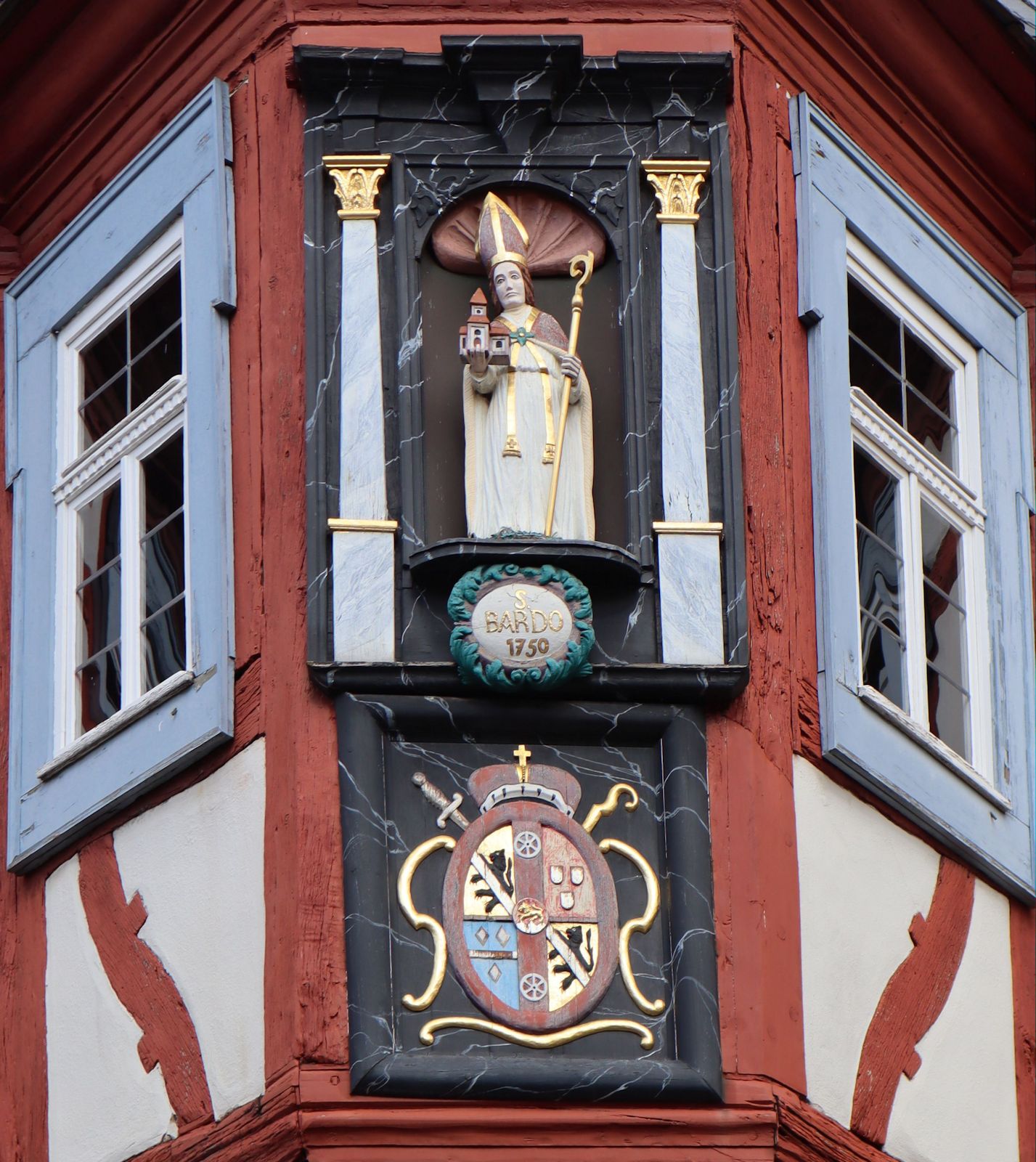
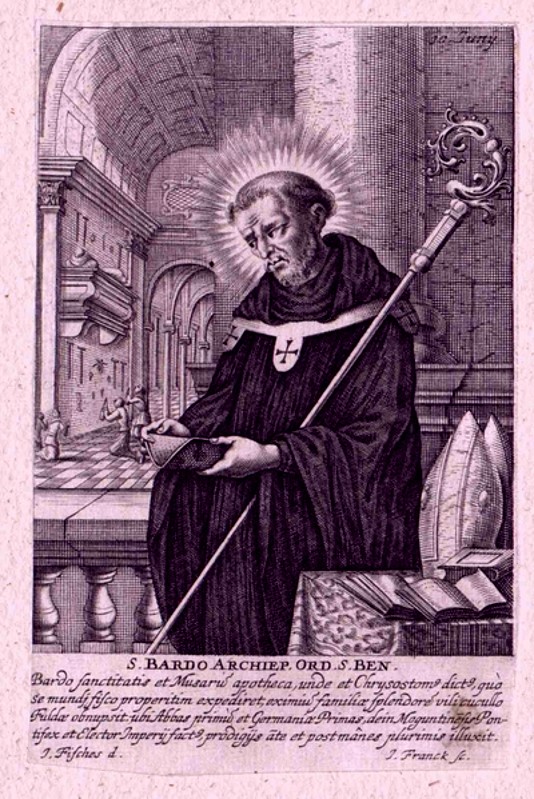
Saint of the Day – 11June – Saint Bardo of Mainz (c981-c1053) Archbishop of Mainz from 1031 until 1051, the Abbot of Werden from 1030 until 1031 and the Abbot of Hersfeld in 1031. Ascetic, renowned for his piety and devotion, for his care and love of the poor, renowned Preacher, called “The Chrysostom” of his time. Born in c981 in Oppershofen, Germany and died on 10 or 11 June in 1051 or 1053 (records vary) in Oberdorla near Mühlhausen in Thuringia, of natural causes. Patronage – of Oppershofen. Also known as – “The Chrysostom” of his time and area, Bardo of Magonza, Bardon, Bardone. Additional Memorial – 15 June (Cathedral of Mainz, Germany) and 10 June (depending on the date chosen for his death. Name means: battle axe and/or wolf [which our Saint was neither] (Old High German).
Statue at the town hall in St Bardo’s birthplace Oppershofen of which Town he is the Patron Saint
Bardo was the son of a noble family, related to Empress Gisela, the wife of Emperor Conrad II. He became a Benedictine Monk in the Monastery – on the site of the present Cathedral – in Fulda. There, in around 1018, Bardo was appointed as the Head of the Cathedral school and Provost of the new provostship at St Andreas in Fulda.
In 1029, Bardo was appointed as the Abbot in Werden – today the district of Essen-Werden and in 1031, as the Abbot also in Hersfeld – today’s Bad Hersfeld. From 1031 Bardo became the Archbishop of Mainz. Then, in 1036, Bardo Consecrated the new Cathedral dedicated to St Martin of Tours, the construction of which Bardo had been involved.
Statue of St Bardo in the Crypt of the Fulda Cathedral
Bardo lived so ascetically that Pope Leo IX admonished him to pay more attention to his health. His piety and charity became famous, especially towards the travelling people.
Bardo was also praised as a preacher and was called “The Chrysostom” of his time . Under Bardo, Mainz Cathedral was completed. he Consecrated it in 1036 in the presence of Emperor Conrad and Bardo founded the Cathedral and St John’s Foundation in Mainz, as well as the Monastery of St James. In 1041/42 he went to war against Bohemia with Emperor Henry III .
Bardo died during a journey and was buried in his new Cathedral in Mainz . His Tomb in the Cathedral in Mainz became a place of pilgrimage where numerous miracles occurred and still do.
The Cathedral built and Consecrated by St Bardo in Mainz
St Herebald of Bretagne Bl Hugh of Marchiennes Bl Jean de Bracq
Bl Kasper of Grimbergen St Maximus of Naples
St Parisius ECMC (c1160-1267) Priest and Monk of the Camaldolese Hermits of Mount Corona, Spiritual Director, Reformer, Miracle-worker during his life and after his death. A very long life of humble and loving service, for the glory of God!: The Roman Martyrology reads: “In Treviso, Saint Parisio, Priest of the Camaldolese Order, who for seventy-seven years took care of the spiritual direction of the Nuns with healthy advice, dying at the age of one hundred and eight.” https://anastpaul.com/2022/06/11/saint-of-the-day-11-june-st-parisius-ecmc-c-1160-1267-a-very-long-life-of-humble-and-loving-service-for-the-glory-of-god/
St Rembert of Hamburg (c830-888) Archbishop of Hamburg-Bremen, Missionary, Miracle-worker, Founder of Churches and Monasteries, Disciple of St Ansgar (801-865) “The Apostle of the North.” The Roman Martyrology reads : “In Bremen in Saxony, in today’s Germany, Saint Rembert, Bishop of Hamburg and Bremen, who, a faithful disciple of Saint Ansgar and his successor, extended his ministry to the regions of Denmark and Sweden and, at the time of the invasions of the Normans, he took care of the ransom of the Christian prisoners.” A True Shepherd: https://anastpaul.com/2023/06/11/saint-of-the-day-11-june-st-rembert-of-hamburg-c830-888-archbishop/
St Riagail of Bangor Bl Stephen Bandelli OP St Tochumra of Kilmore St Tochumra of Tuam
Martyrs of Tavira – 7 Beati: Members of the Knights of Santiago de Castilla. During the re-conquest of the Iberian peninsula from the Muslims by Christian forces, in a period of truce between the armies, the group was allowed to leave the Portuguese camp to hunt. Near Tavira, Portugal, he and his companions were ambushed and killed by a Muslim force. Making a reprisal attack, the Portuguese army took the city of Tavira. The murdered knights were considered to be martyrs as they died in an action defending the faith. They were – Blessed Alvarus Garcia, Blessed Beltrão de Caia, Blessed Damião Vaz, Blessed Estêvão Vasques, Blessed Garcia Roiz, Blessed Mendus Valle, Blessed Pedro Rodrigues’ They were Martyred in 1242 outside Tavira, Faro, Portugal. Their relics are enshrined under the altar of Saint Barnabas in the Church of Our Lady, Queen of the Angels (modern Santa Maria do Castelo) in Tavria, Portugal.
Mercedarian Martyrs of Damietta: Three Mercedarian Lay Knights who worked to ransom Christians enslaved by Muslims. During the 7th Crusade, a plague swept through the Christian army and these knights volunteered to work with the sick. During this work they were captured by Muslims and ordered to convert to Islam; they refused. They were tortured, taken to Damietta, Egypt where they were murdered for their faith. They were thrown from a tower in the mid-13th century in Damietta, Egypt.
You must be logged in to post a comment.