Thought for the Day – 8 July – Meditations with Fr Richard Frederick Clarke SJ (1839-1900)
PATIENCE Meditations for a Month
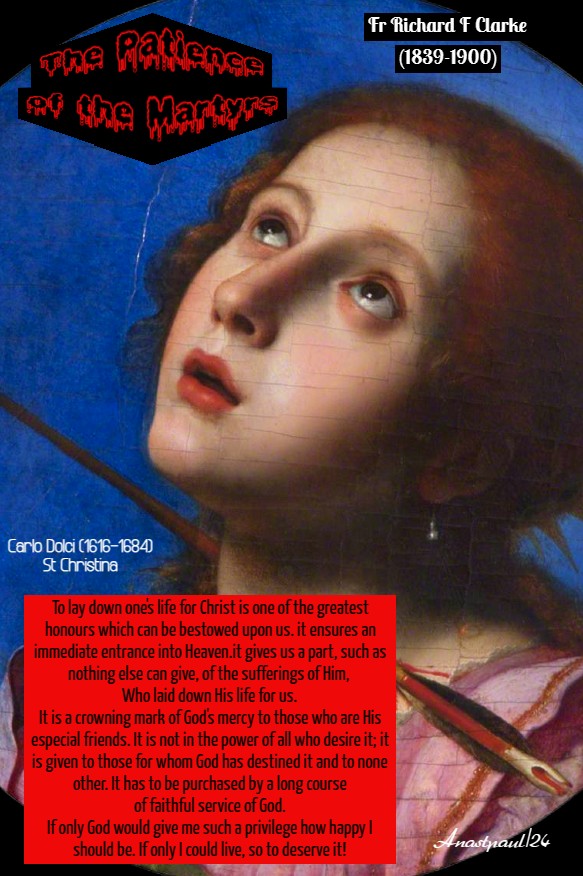
The Patience of the Martyrs
To lay down one’s life for Christ is one of the greatest honours which can be bestowed upon us. it ensures an immediate entrance into Heaven.it gives us a part, such as nothing else can give, of the sufferings of Him, Who laid down His life for us. It is a crowning mark of God’s mercy to those who are His especial friends. It is not in the power of all who desire it; it is given to those for whom God has destined it and to none other. It has to be purchased by a long course of faithful service of God. If only God would give me such a privilege how happy I should be. If only I could live, so to deserve it!
Even the weak, the timid, the sensitive, can, if God gives them the special grace of Martyrdom, face undismayed, the most cruel tortures. Sometimes they did not feel the pain, even when it was most agonising. The secret joy of their hearts, the thought that they were suffering for Christ – made it seem light to them and gave them fortitude to endure to the end. If God should, at a time, give me the happiness of dying for Him, He will take away all the fear and will give me a light, joyous heart even in the midst of the greatest physical sufferings!
3 If there is little or no prospect of my laying down my life for Christ, yet I can, at least, make the offering to Him – I can present myself to suffer anything which He has in store for me. It may be that I am destined for suffering, worse than death, the prolonged Martyrdom of physical or mental anguish. But one thing I know, that He will never lay upon me suffering beyond that which I am able to bear, and will, with the suffering, give the grace necessary, to endure it with resignation and perhaps even with joy!
Quote/s of the Day – 8 July– Proverbs 31:10-31, Matthew 13:44-52
“Jesus said in parables: The Kingdom of Heaven is like unto a treasure, hidden in a field.”
Matthew 13:44
“What is a man’s treasure but the heaping up of profits and the fruit of his toil? For, whatever a man sows, this too will he reap and each man’s gain, matches his toil and where delight and enjoyment are found, there the heart’s desire is attached. Now, there are many kinds of wealth and a variety of grounds for rejoicing – every man’s treasure is that, which he desires. If it is based on earthly ambitions, its acquisition makes men not blessed but wretched. … By distributing what might be superfluous to support the poor, they are amassing imperishable riches, so that what they have discreetly given, cannot be subject to loss. They have properly placed those riches, where their heart is – it is a most blessed thing, to work to increase such riches, rather than to fear that they may pass away.”
St Pope Leo the Great (400-461) Father and Doctor of the Church
“Look at the fig tree and all the trees, when they produce their fruit you know that summer is near. So too, when you see these things happening, know that the Kingdom of God is near.” Luke 21:29-31
“He means that just as the coming of summer is recognised by the fruit on the trees, so is the nearness of the Kingdom of God recognised by the destruction of the world. These words show that the fruit of the world is destruction – it increases only to fall, it produces, only to destroy by its disasters whatever it produces. The Kingdom of God is aptly compared to summer, because it is then that the clouds of our sorrow pass away and the days of life shine with the brightness of the Eternal Sun. … Therefore, my friends, do not love what you see cannot long exist. Keep in mind the Apostle John’s precept, in which he counsels us not “to love the world or the things in the world because, if anyone loves the world, the love of the Father is not in him” (1 Jn 2:15).”
St Gregory the Great (540-604) Pope, Father and Doctor of the Church
“But seek first the Kingdom of God and His righteousness and all these things shall be added to you.” Matthew 6:33
“But, [you will tell me], there is so much to do, so many household jobs, so much business in town, in the fields – work everywhere! Do we have to abandon it all, then, so as to think of nothing but God?” No – but these occupations have to be sanctified by seeking God in them and doing them to find Him in them, rather than, to see them done. What our Lord wants, is for us to seek His glory, His Kingdom, His righteousness, before all else and, for this, to make our foundation the interior life, faith, trust, love, religious exercises …, labours and sufferings, with God our Sovereign Lord in view… Once we are firmly set in the search for God’s glory, we can be assured that the rest will follow.”
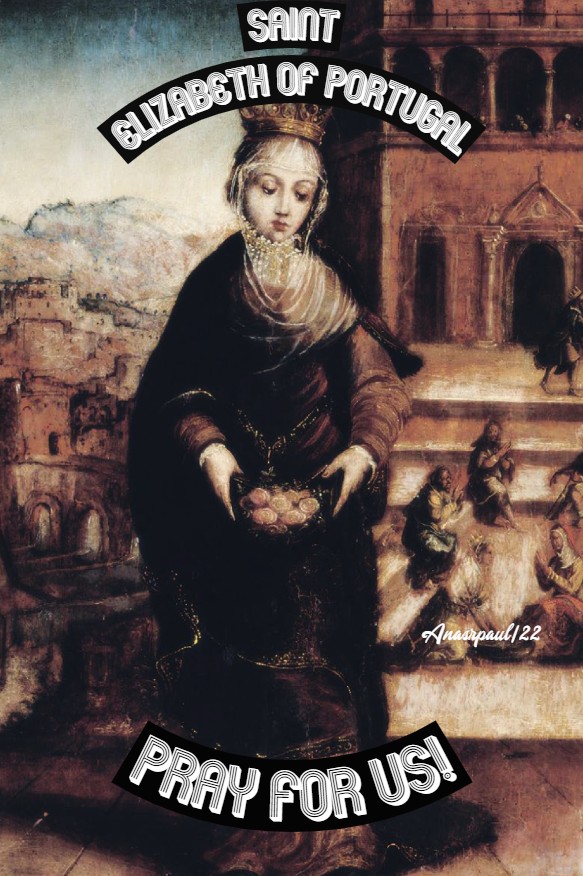
One Minute Reflection – 8 July– “The Month of the Most Precious Blood” – St Elizabeth of Portugal TOSF (1271-1336) Widow, Queen – Proverbs 31:10-31; Matthew 13:44-52 – – Scripture search here: https://www.drbo.org/
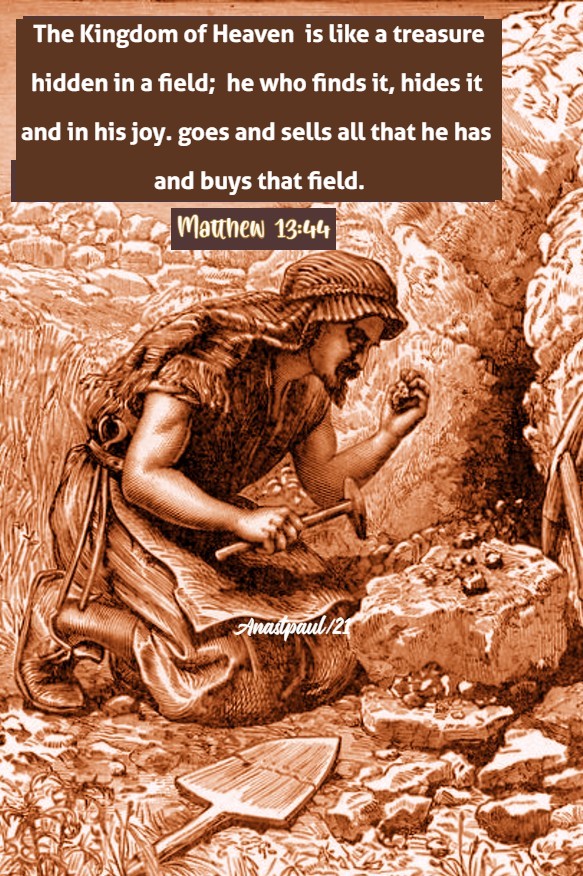
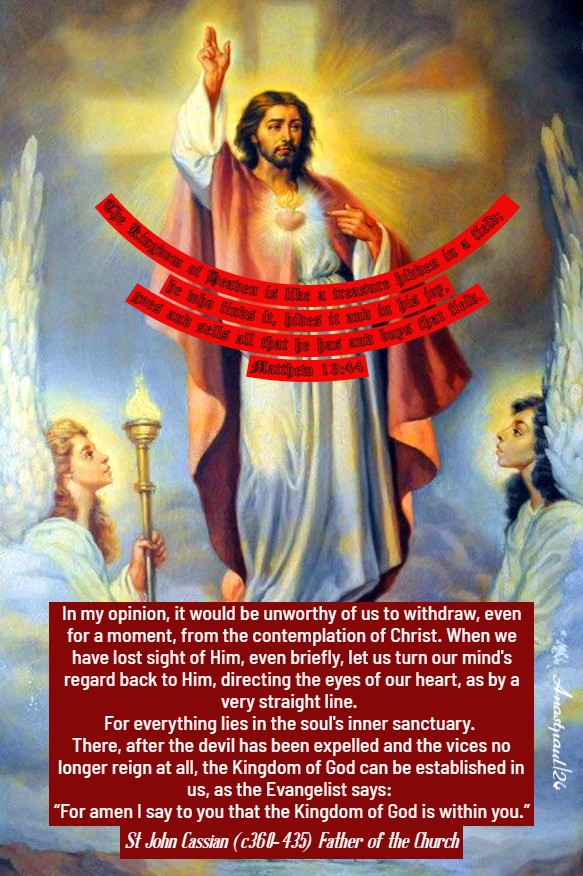
“The Kingdom of Heaven is like a treasure hidden in a field; he who finds it, hides it and in his joy, goes and sells all that he has and buys that field.” – Matthew 13:44
REFLECTION – “In my opinion, it would be unworthy of us to withdraw, even for a moment, from the contemplation of Christ. When we have lost sight of Him, even briefly, let us turn our mind’s regard back to Him, directing the eyes of our heart, as by a very straight line. For everything lies in the soul’s inner sanctuary. There, after the devil has been expelled and the vices no longer reign at all, the Kingdom of God can be established in us, as the Evangelist says: “For amen I say to you that the Kingdom of God is within you.”
But within us there can be nothing else than knowledge or ignorance of the truth and the love, of either the vices, or the virtues, by which we make ready a Kingdom in our hearts, either for the devil or for Christ.
The Apostle Paul also describes the characteristics of this Kingdom when he says: “For the Kingdom of God is not food and drink but righteousness and peace and joy in the Holy Ghost.” Thus, if the Kingdom of God is within us and the Kingdom of God is itself, righteousness and peace and joy, then, whoever abides in these things, is undoubtedly in the Kingdom of God … Let us lift up the eyes of our soul to that Kingdom which is endless joy!” – St John Cassian (c360-435) Monk, Theologian, Founder of Monasteries, Father of the Church, Disciple of St John Chrysostom (Conferences No 1).
PRAYER – Most merciful God, Who among other admirable gifts, endowed blessed Queen Elizabeth with the special grace of calming the tumult of war; grant by her intercession that, after the peace for which we humbly pray, we may attain everlasting happiness. Through the same Jesus Christ, Thy Son our Lord, Who lives and reigns with Thee, in the unity of the Holy Ghost, God, world without end. Amen (Collect).
Our Morning Offering – 8 July – Pentecost Thursday
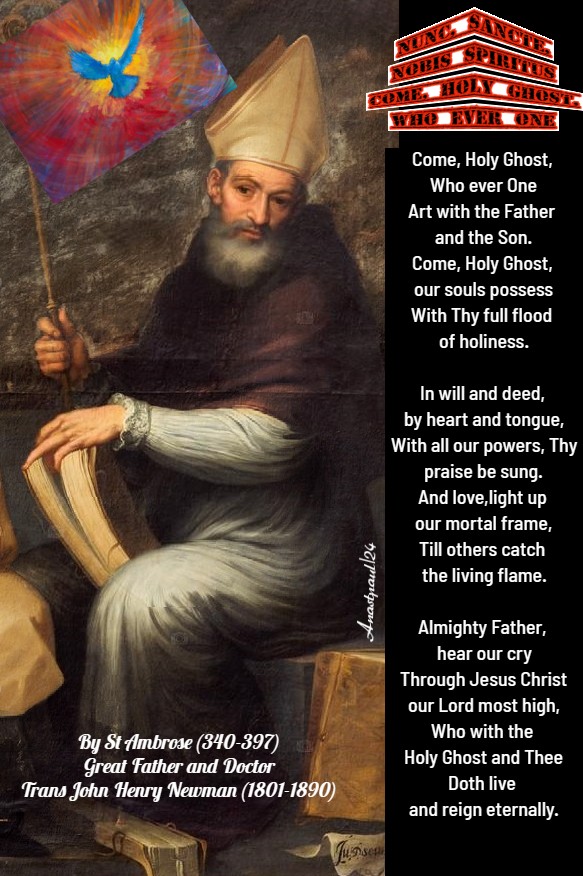
Nunc, Sancte, nobis Spiritus Come, Holy Ghost, Who ever One By St Ambrose (340-397) Trans John Henry Newman (1801-1890) Trans 1836
Come, Holy Ghost, Who ever One Art with the Father and the Son. Come, Holy Ghost, our souls possess With Thy full flood of holiness.
In will and deed, by heart and tongue, With all our powers, Thy praise be sung. And love, light up our mortal frame, Till others catch the living flame.
Almighty Father, hear our cry Through Jesus Christ our Lord most high, Who with the Holy Ghost and Thee Doth live and reign eternally.
Saint of the Day – 8 July – Saint Grimbald (c827-901) Abbot, Confessor, Overseer of the foundation of Newminster Monastery in England. Born in c827 at St Omer in Flanders, now Belgium (although this Town now lies within the French territories near the Belgiab border) and died on 8 July 901 of natural causes at jis new Monastery Newminster. Also known as – Grimwald, Grimbold.
Grimbald became a Monk at the Abbey of St Bertin near his home town of St Omer.
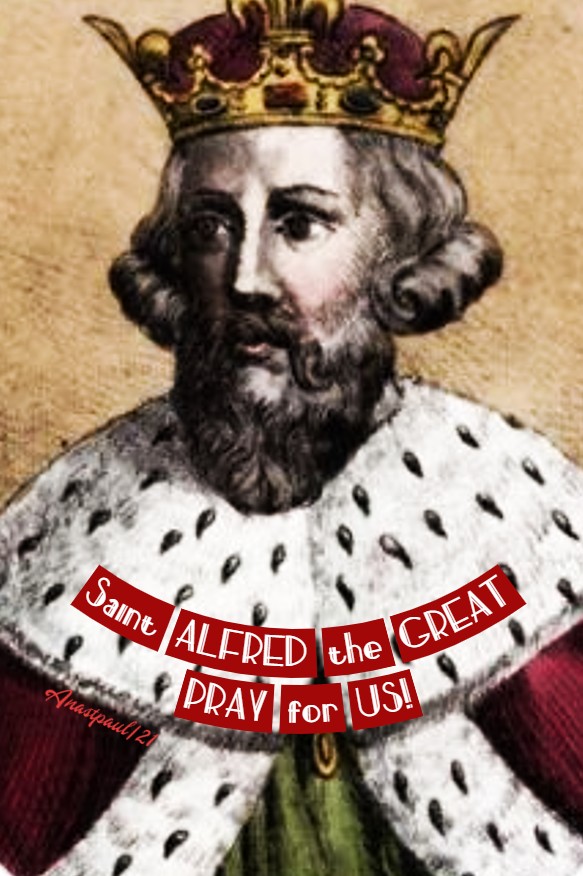
According to Grimbald’s ‘Vita Prima’ St Alfred the Great (849-899) King of Wessex (and effectively all of England) met Grimbald before his reign, at St Bertin’s Monastery whilst St Alfred was travelling to Rome. He was greatly impressed by our Saint and after his Coronation, in around 892, King Alfred, with the agreement and advice of St Eldred, the Archbishop of Canterbury, sent messengers to St Bertin’s to invite Grimbald to visit England.
Invited for his lpiety, devotion and scholarship, Grimbald was one of severallearned men who had been invited to the English Court to assist the King in his educational pursuits and was among the most prominent.
In fact, in the Introduction of his translation of St Gregory the Great’s Pastoral Care, KingAlfred mentions the assistance he had received from St Grimbald in the work and especially in translation of the Latin.
St Alfred is represented as the Founder of Oxford University together with our Saint and other learned and saintly men. It is believed that Grimbald was appointed as the first Professor of Divinity.
Grimbald refused King Alfred’s offer of the appointment to the See of Canterbury but after Alfred’s death, he accepted the appointment as the Abbot, to the yet unbuilt Monastery, Newminster, in Winchester by King Alfred’s son and successor as King, Edward the Elder.
After two decades in England, Grimbald became ill. He attended Holy Mass and sought the consolation of the reception of the Blessed Eucharist. He then spent several days in prayer and contemplation, gathered the Monks of the community to his cell for one last time of unity and died. It was 8 July 901. He was immediated venerated as a Saint and confessor and many Churches were dedicated to him. The Grimbald Gospels in the British Library are named after him.
St Elizabeth of Portugal TOSF (1271-1336) Widow, Queen Consort, Widow, Franciscan Tertiary, Apostle of Charity and Peace, Political Negotiator and Mediator. In the year 1694 Pope Innocent XII moved her Feast to 8 July, so that it would not conflict with the celebration of the Octave of Saints Peter and Paul, Apostles. Biography: https://anastpaul.com/2018/07/04/saint-of-the-day-4-july-st-elizabeth-of-portugal-t-o-s-f-1271-1336/
St Abraham the Martyr Bl Adolf IV of Schauenburg St Pope Adrian III
St Morwenna – No details about her have survived. She is reported to have appeared in visions in Morwenstow, Cornwall, England, where her Relics are apparently buried under the Church floor.
St Pancras of Taormina Bl Peter the Hermit St Procopius of Ceasarea St Sunniva of Bergen St Thibaud de Marly St Totnan of Thuringia
Abrahamite Monks/Martyrs of Constantinople: A group of Monks in a Monastery founded by Saint Abraham of Ephesus. Martyred in the iconoclast persecutions of Emperor Theophilus. In c 835 in Constantinople.
Martyrs of Shanxi – 7 Saints: In 1898 seven sisters of the Franciscan Missionaries of Mary were sent to the Shanxi Diocese in China to serve the poor in hospitals and care for the unwanted or other destitutes in orphanages. They were: Anne-Catherine Dierks, Anne-Francoise, Moreau, Clelia Nanetti, Irma Grivot, Jeanne-Marie Kuergin, Marianna Giuliani, Pauline Jeuris There they all died in one of the periodic persecutions against foreign missionaries. They were beheaded on 9 July 1900 at Taiyuanfu, China- Canonisedon 24 November 1946 by Pope Pius XII.
Martyrs of Syrmium – 5 Saints: Five Christians Martyred together for their faith. We know nothing else about them but the names – Cecilia, Eperentius, Eraclius, Sostratus and Spirus. They were martyred in the 4th century in Syrmium, Pannonia (modern Serbia).






 AnaStpaul
You must be logged in to post a comment.