Thought for the Day – 31 July – Meditations with Fr Richard Frederick Clarke SJ (1839-1900)
HUMILITY Meditations for a Month Today is the Last Meditation
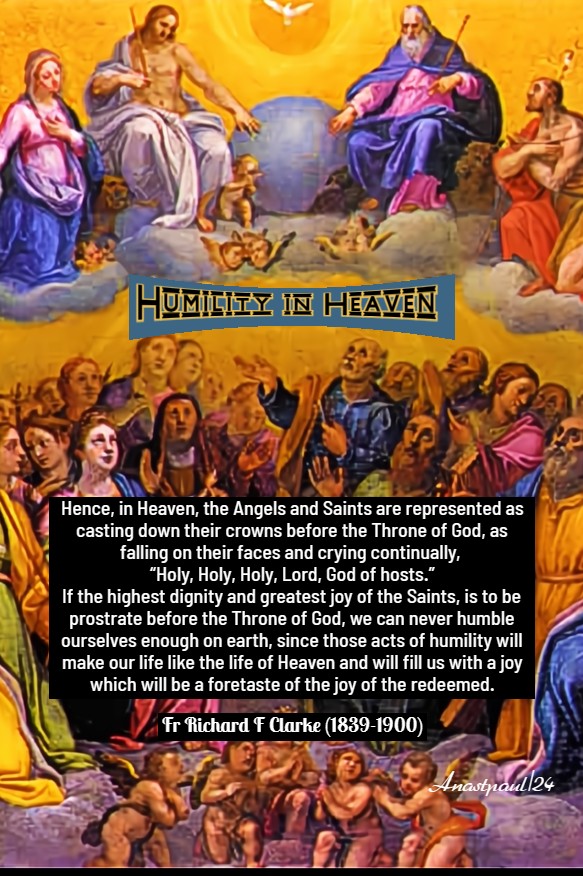
Humility in Heaven
Is there any place for humility among the Saints in Heaven? Or is it, like faith and hope, a virtue limited to this vale of tears? It might seem that in Heaven, there are no motives for humility – no sins, no imperfections, no defects of any kind, for which to humble ourselves. Yet, only in Heaven will our humility be perfected, for only in Heaven shall we have a thorough knowledge of God and a thorough knowledge of ourselves. This knowledge will make us recognise, even more than ever, our own nothingness and God’s Infinite Perfections. Our recognition of this, will make us forget ourselves, as we never can do on earth, therefore, God will be all in all to us.
Will this appreciation of our own nothingness be painful? No, it will be a source of eternal joy! For then we shall be able to rejoice in God. Our happiness will be unclouded by any interfering thought of self. Our admiration of His perfect Beauty will absorb all our faculties. Our absolute dependence upon Him, will be the truest independence. It will make us conformed to the Image of the Son of God, the chief glory, in Whose Sacred Humanity will be the result of its dependence on His Divine Nature.
Hence, in Heaven, the Angels and Saints are represented as casting down their crowns before the Throne of God, as falling on their faces and crying continually, “Holy, Holy, Holy, Lord, God of hosts.” If the highest dignity and greatest joy of the Saints, is to be prostrate before the Throne of God, we can never humble ourselves enough on earth, since those acts of humility will make our life like the life of Heaven and will fill us with a joy which will be a foretaste of the joy of the redeemed.
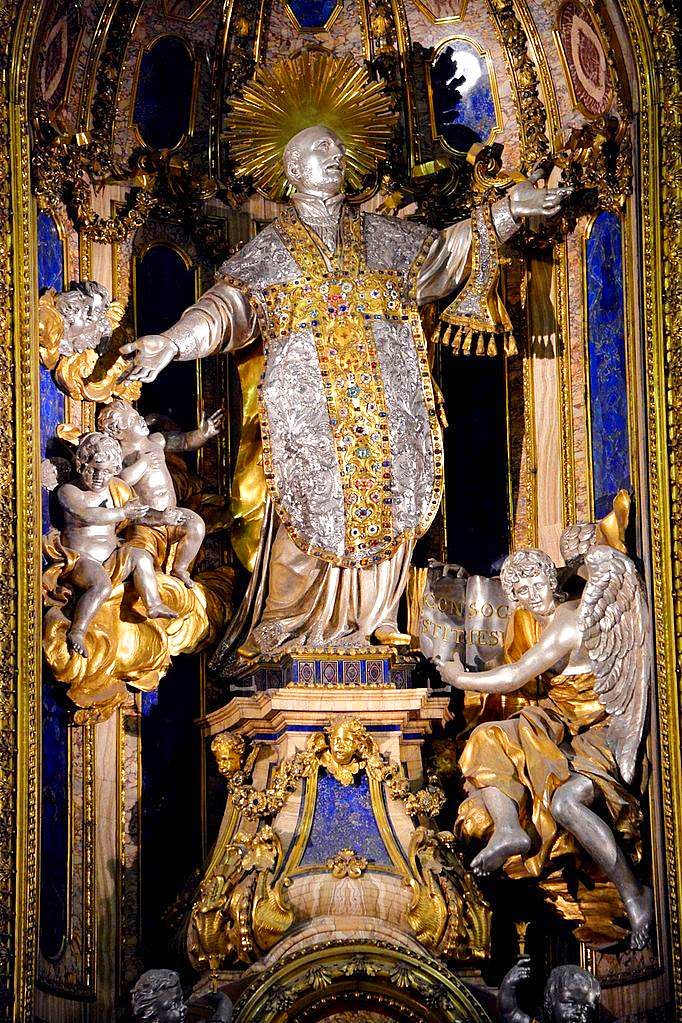
Quote/s of the Day – 31 July – St Ignatius Loyola SJ (1491-1556) Priest, Confessor, Founder, Theologian, Spiritual Writer, Mystic.
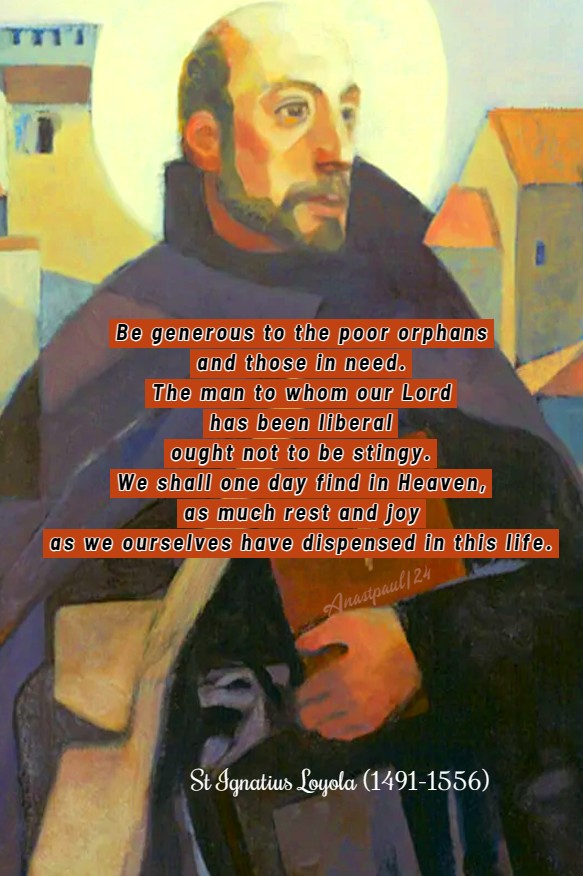
“Be generous to the poor orphans and those in need. The man to whom our Lord has been liberal ought not to be stingy. We shall one day find in Heaven, as much rest and joy as we ourselves have dispensed in this life.”
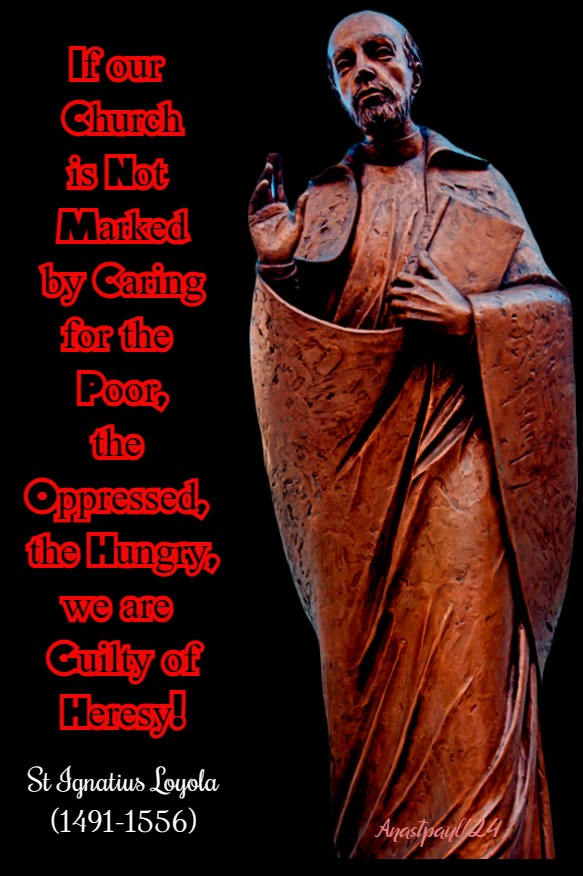
“If our Church is not marked by caring for the poor, the oppressed, the hungry, we are guilty of heresy!”
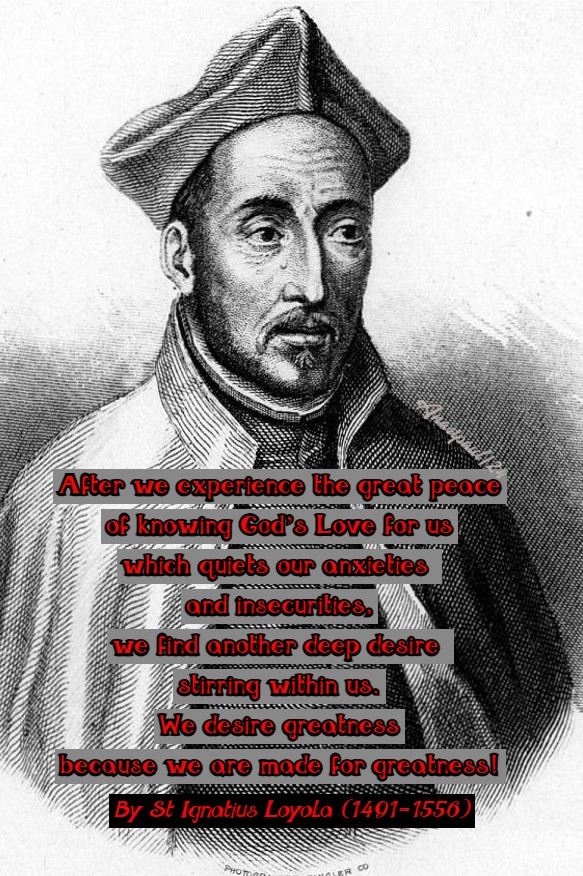
“After we experience the great peace of knowing God’s Love for us which quiets our anxieties and insecurities, we find another deep desire stirring within us. We desire greatness because we are made for greatness!”
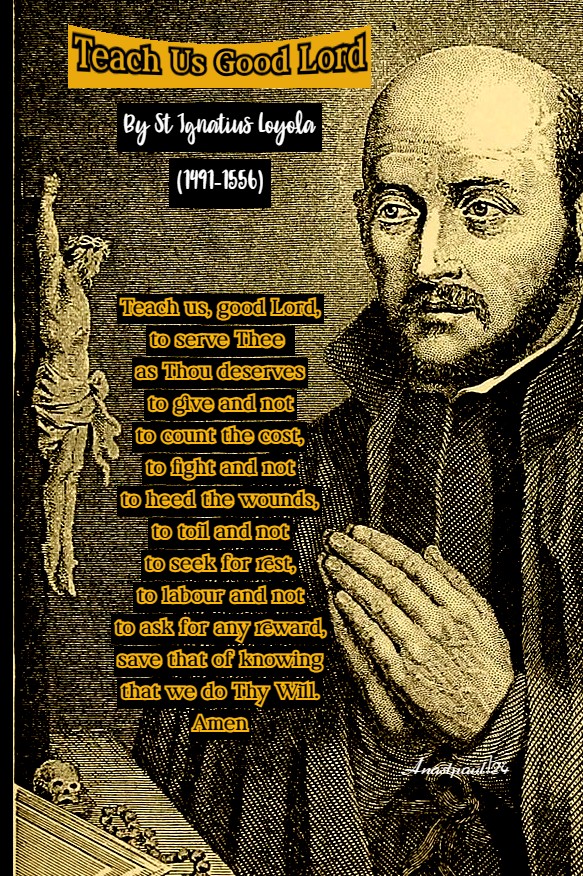
Teach Us Good Lord By St Ignatius Loyola (1491-1556)
Teach us, good Lord, to serve Thee as Thou deserves to give and not to count the cost, to fight and not to heed the wounds, to toil and not to seek for rest, to labour and not to ask for any reward, save that of knowing that we do Thy Will. Amen
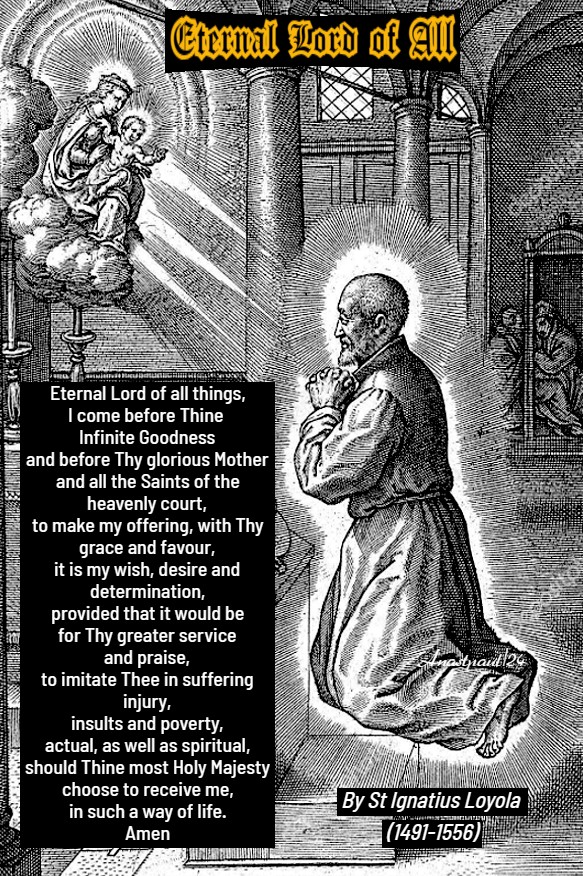
Eternal Lord of All By St Ignatius Loyola (1491-1556)
Eternal Lord of all things, I come before Thine Infinite Goodness and before Thy glorious Mother and all the Saints of the heavenly court, to make my offering, with Thy grace and favour, it is my wish, desire and determination, provided that it would be for Thy greater service and praise, to imitate Thee in suffering injury, insults and poverty, actual, as well as spiritual, should Thine most Holy Majesty choose to receive me, in such a way of life. Amen
One Minute Reflection – 31 July– “The Month of the Most Precious Blood” – St Ignatius Loyola (1491-1556) Confessor – 2 Timothy 2:8-10; 3:10-12; Luke 10:1-9. – Scripture search here: https://www.drbo.org/
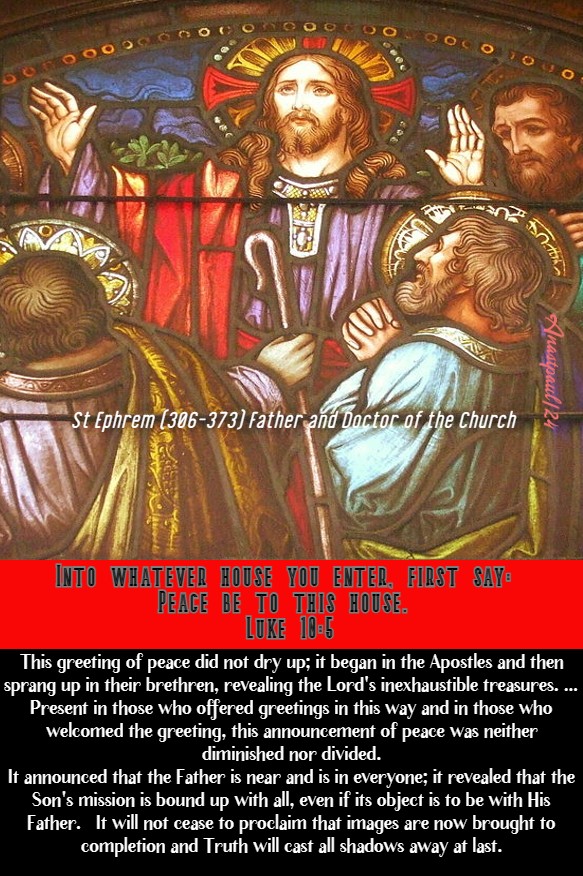
“Into whatever house you enter, first say: Peace be to this house. And, if the son of peace be there, your peace shall rest upon him but if not, it shall return to you.” – Luke 10:5-7
REFLECTION – “As you enter a house, first say, ‘Peace to this house,‘” (Lk 10:5) so that the Lord Himself might enter and remain there, as with Mary. … This greeting is the Mystery of Faith which shines forth in the world. Through it, enmity is stifled, war is ended and people acknowledge one another. The effect of that greeting was hidden by a veil in spite of the fact that it prefigures the Mystery of the Resurrection … when the light rises and dawn chases night away. From the moment Christ sent out His disciples, people began to give and receive this greeting, a source of healing and blessing. …
This greeting with its hidden power … is amply sufficient for us all. That is why Our Lord sent it out, together with His disciples, as forerunner, so that it might bring about peace and, carried by the voice of the Apostles whom He sent, prepare the way before them. It was sown in every dwelling … it entered into all who heard it, so as to separate and set apart, the children it recognised as its own. It remained in them but it denounced those who were alien to it, for they did not welcome it.
This greeting of peace did not dry up; it began in the Apostles and then sprang up in their brethren, revealing the Lord’s inexhaustible treasures. … Present in those who offered greetings in this way and in those who welcomed the greeting, this announcement of peace was neither diminished nor divided. It announced that the Father is near and is in everyone; it revealed that the Son’s mission is bound up with all, even if its object is to be with His Father. It will not cease to proclaim that images are now brought to completion and Truth will cast all shadows away at last.” – St Ephrem (306-373) Father and Doctor of the Church (Diatessaron 8: 3-4).
PRAYER – O God, Who, to spread abroad the greater glory of Thy Name through St Ignatius, strengthened the Church militant with new power; grant that we ,who are struggling on earth, may, by his help and after his example, be found worthy to be crowned with him in Heaven. Through Jesus Christ, Thy Son our Lord, Who lives and reigns with Thee, in the unity of the Holy Ghost, God, world without end. Amen (Collect).
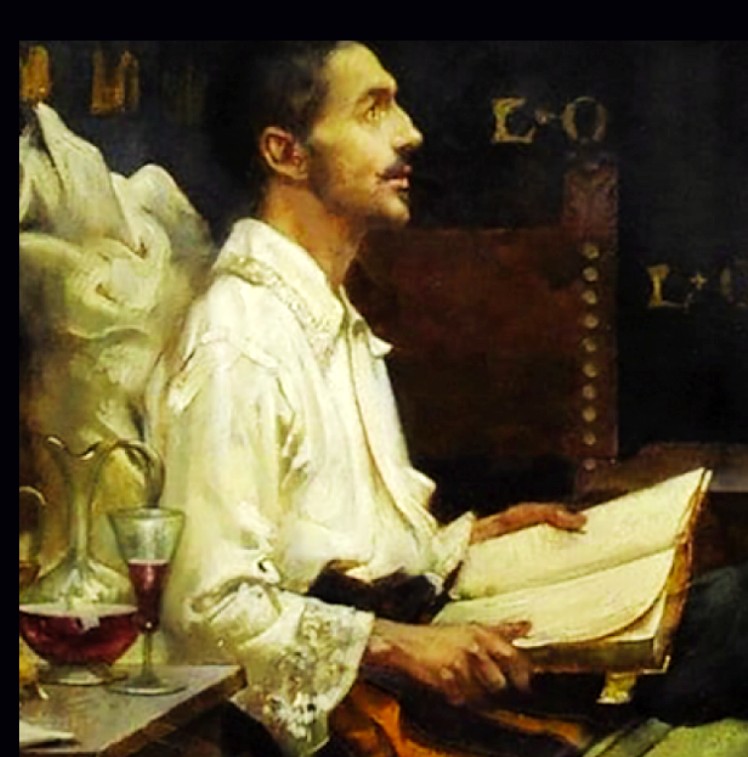
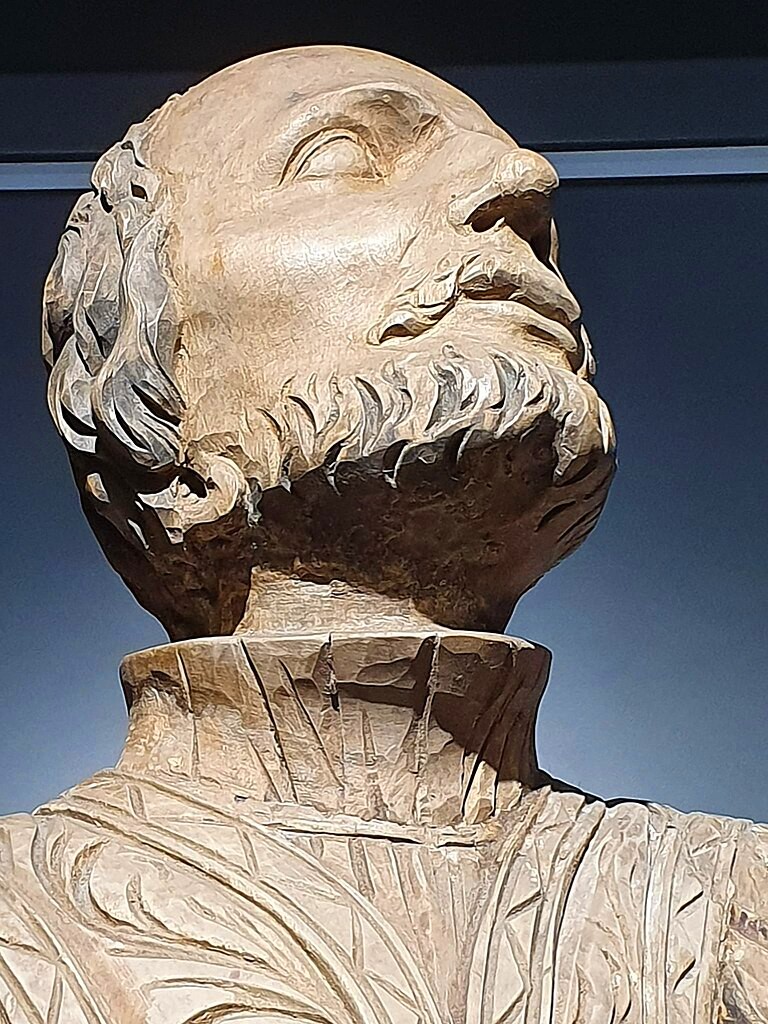
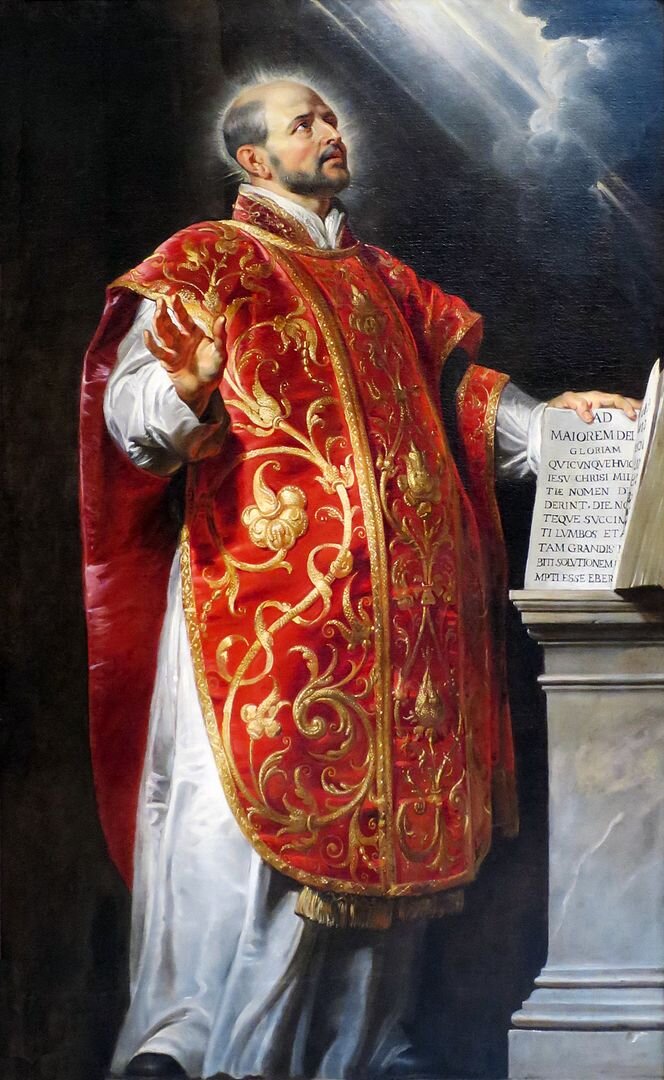
Saint of the Day – 31 July – Revisiting St Ignatius Loyola (1491-1556) Priest, Confessor, Founder, Theologian, Spiritual Writer, Mystic. Born in 1491 at Loyola, Guipuzcoa, Spain as Inigo Lopez de Loyola and died on 31 July 1556 at Rome, Italy of fever. Also known as- Inigo Lopez de Loyola. The name Ignatius = of fire, igneous, from the Latin
The Roman Martyrology reads: “At Rome, the birthday of St Ignatius Loyola, Confessor and Founder of the Society of Jesus, renowned for sanctity and miracles and most zealous in propagating the Catholic Religion in all parts of the world.”
The founder of the Jesuits was on his way to military fame and fortune, when a cannon ball shattered his leg. Because there were no books of romance on hand to assist in passing the time, during his convalescence, Ignatius spent the time reading The Golden Legend, a collection of biographies of the Saints and the Life of Christ by Ludolph the Carthusian. His conscience was deeply touched and a long, painful turning to Christ began.
Having seen the Mother of God in a vision, on his recovery he took a vow of chastity, hung his sword before the Altar of the Virgin of Montserrat and donned a pilgrim‘s robes. He remained for almost a year at nearby Manresa, sometimes with the Dominicans, sometimes in a pauper’s Hospice, often in a cave in the hills, praying. After a period of great peace of mind, he went through a harrowing trial of scruples. There was no comfort in anything—prayer, fasting, the Sacraments, penance. At length, his peace of mind returned by the grace of Gpd.
It was during this year of conversion that Ignatius began to write the material which would later become his greatest work, “The Spiritual Exercises.” In 1523, he finally achieved his desire of visiting the Holy Land but could not remain, as he planned because of the hostility of the Turks.
In 1528 he began studying Theology in Barcelona and Alcala in Spain, and Paris, France receiving his degree on 14 March 1534. Ignatius spent the next 11 years in various European Universities, studying with great difficulty, beginning almost as a child. Like many others, his orthodoxy was questioned; Ignatius was twice jailed for brief periods.
In 1534, at the age of 43, he and six others—one of whom was Saint Francis Xavier—vowed to live in poverty and chastity and to go to the Holy Land. If this became impossible, they vowed to offer themselves to the apostolic service of the Pope. The latter became the only choice. During this time he was also Ordained to the Priesthood. In 1537, Ignatius had one of the decisive experiences of his life. He related to his companions that on a certain day, while in prayer, he seemed to see Christ with the Cross on His shoulder and beside Him, the Eternal Father, Who said, “I wish Thee to take this man for Thy servant,” and Jesus took him and said, “My will is that you should serve Us.” On Christmas Day 1538 Ignatius said his first Holy Mass at the Church of St Mary Major in Rome.
Four years later Ignatius made the association permanent. The new Society of Jesus was approved by Pope Paul III and Ignatius was elected to serve as the first General. Ignatius himself, never used the term ‘Jesuit’ which was coined as an insult by his opponents. The Society today uses the term with pride.
When companions were sent on various missions by the Pope, Ignatius remained in Rome, consolidating the new Order, instructing new members but still finding time to found homes for orphans, catechumens and penitents. He founded the Roman College, intended to be the model of all other colleges of the Society.
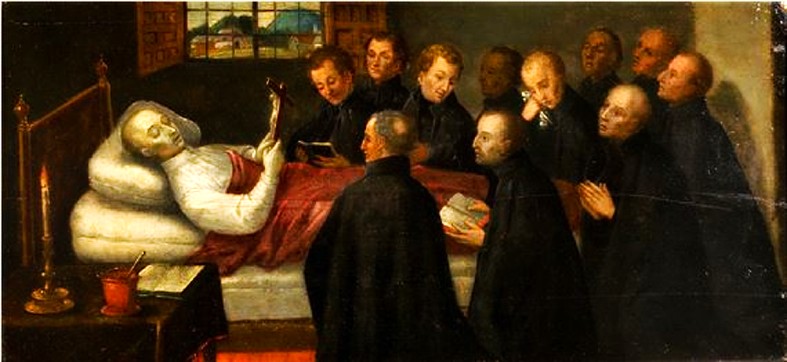
While General of the Order, Ignatius was frequently ill. In January 1551 he became so ill that he begged his associates, though to no purpose, to accept his resignation as Superior. Despite his condition, he continued to direct the Order until his death in July 1556. Since his days at Manresa, Ignatius had practiced a form of prayer which was later published in The Spiritual Exercises and appears to have rivaled that of the greatest Mystics. Before his death, aged 65, Saint Ignatius was nearly blind.
Ignatius Loyola was Beatified by Pope Paul V on 27 July 1609 and Canonised by Pope Gregory XV on 12 March 1622. His achievements and those of his followers form a Chapter in the history of the Roman Catholic Church that cannot be neglected by those who desire to understand this glorious Church of Christ..
Our Morning Offering – 31 July – “The Month of the Most Precious Blood” – St Ignatius Loyola (1491-1556) Confessor
Suscipe “Receive” By St Ignatius Loyola (1491-1556)
Receive, O Lord, all my liberty. Take my memory, understanding and entire will. Whatsoever I have or hold, Thou hast given it – I give all back to Thee and commit it wholly to be governed by Thy Will. Thy Love and Thy Grace give unto me and I am rich enough and ask for nothing more! Amen
Blessed Giovanni Colombini (1300-1367) Confessor, Layman, Husband and Father, Founder of the Apostolic Clerics of Saint Jerome (the Jesuati), Apostle of the poor and the sick, Penitent, Missionary, Miracle-worker. After many miracles had occurred at his tomb, Pope Gregory XIII inserted Giovanni Colombini’s name in the Roman Martyrology, fixing 31 July for the celebration of his feast His Life https://anastpaul.com/2021/07/31/saint-of-the-day-31-july-blessed-giovanni-colombini-1300-1367/
St Helen of Skofde St Neot
Martyrs of Syria – 350 Saints: 350 monks massacred by heretics for their adherence to orthodox Christianity and the decrees of the Council of Chalcedon. 517 in Syria.
Martyrs of Synnada: 3 Saints Democritus Dionysius the Martyr Secundus








 AnaStpaul
You must be logged in to post a comment.