Our Morning Offering – 10 August – St Lawrence (Died 258) “Keeper of the Treasures of he Church,” Martyr, Archdeacon.
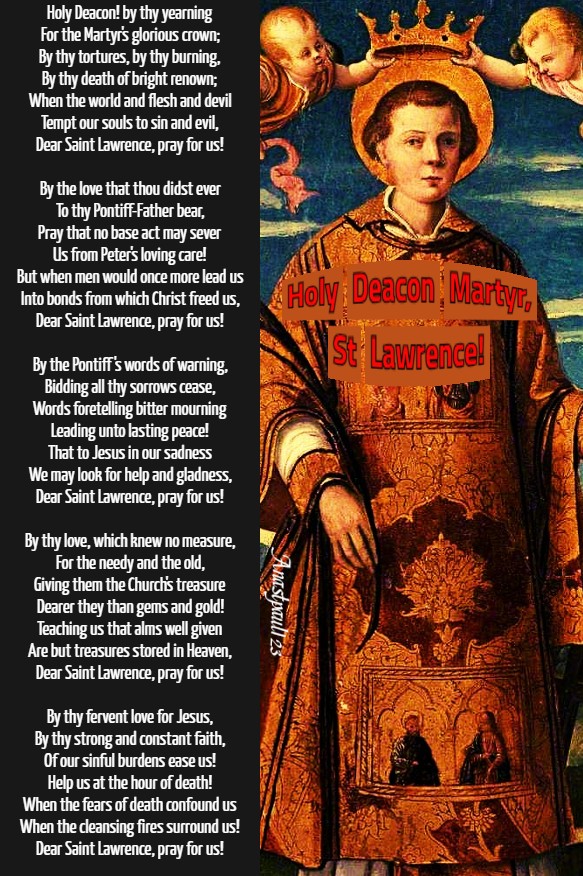
Holy Deacon Martyr, St Lawrence! Unknown Author
Holy Deacon! by thy yearning For the Martyr’s glorious crown; By thy tortures, by thy burning, By thy death of bright renown; When the world and flesh and devil Tempt our souls to sin and evil, Dear Saint Lawrence, pray for us!
By the love that thou didst ever To thy Pontiff-Father bear, Pray that no base act may sever Us from Peter’s loving care! But when men would once more lead us Into bonds from which Christ freed us, Dear Saint Lawrence, pray for us!
By the Pontiff’s words of warning, Bidding all thy sorrows cease, Words foretelling bitter mourning Leading unto lasting peace! That to Jesus in our sadness We may look for help and gladness, Dear Saint Lawrence, pray for us!
By thy love, which knew no measure, For the needy and the old, Giving them the Church’s treasure Dearer they than gems and gold! Teaching us that alms well given Are but treasures stored in Heaven, Dear Saint Lawrence, pray for us!
By thy fervent love for Jesus, By thy strong and constant faith, Of our sinful burdens ease us! Help us at the hour of death! When the fears of death confound us When the cleansing fires surround us! Dear Saint Lawrence, pray for us!
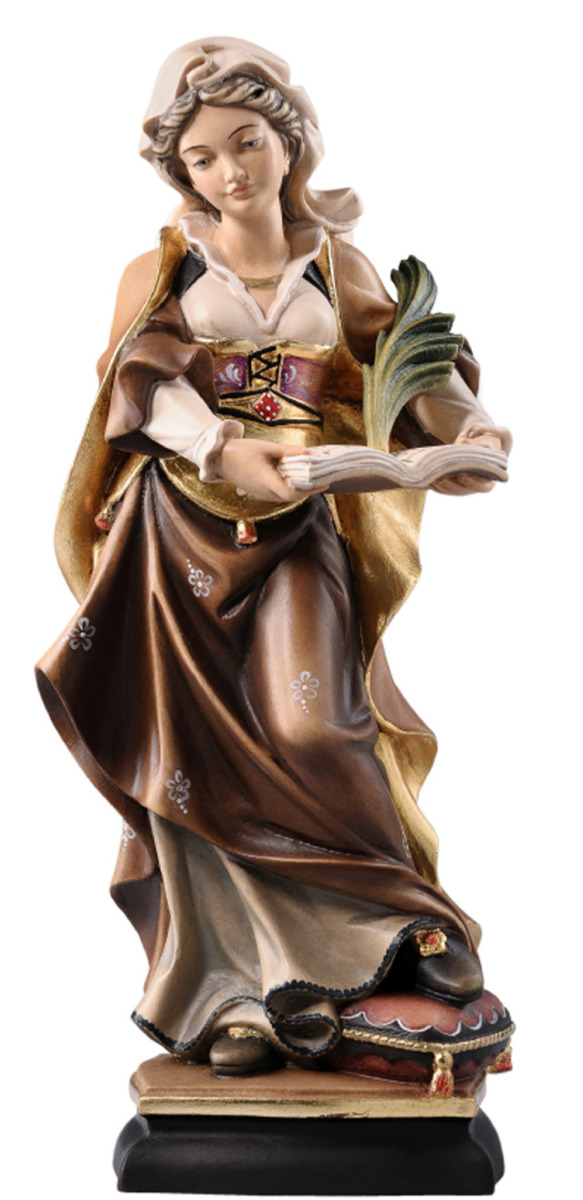
Saint of the Day – 10 August – Saint Asteria of Bergamo (Died c307) Virgin Martyr. Died by beheading. Asteria is the sister of St Grata of Bergamo, Martyr, who is celebrated on 4 September. The 2 sisters are Co-Patron Saints of Bergamo in Northern Italy. Also called – Hesteria.
The Roman Martyrology reads: “At Bergamo, St Asteria, Virgin and Martyr, in the persecutions of Diocletian and Maximian,”
Asteria and Grata, at the time of Diocletian and Maximian, buried Alexander of Rome. Grata was put to death; Asteria buried her and then she too was arrested, and tortured.
An ancient Epitaph describes her as having been beheaded as a Christian under Diocletian, when she had already reached her sixtieth year.
She was Martyred for refusing to worship the pagan god Jupiter and for constantly confessing Christ. She has been celebrated on 10 August, most especially in Bergamo for centuries.
St Deusdedit the Cobbler (6th Century)Confessor, Layman – Deusdedit was a poor layman shoemaker in 6th Century Rome, Italy. Patronages – shoemakers, of the poor. His name meaning, “dedicated to God.” The Roman Martyrology reads of him today: “At Rome, the holy Confessor Deusdedit, a working man, who gave to the poor, every Saturday, whatever he had earned during the week.” His Dedicated Life: https://anastpaul.com/2023/08/10/saint-of-the-day-10-august-st-deusdedit-the-cobbler-6th-century-confessor-layman/
St Gerontius St Paula of Carthage
Martyrs of Alexandria – 260+ Saints: A large number of Christians who were Martyred in Alexandria, Egypt between 260 and 267 in the persecutions of Decius and Valerian, whose names have not come down to us and who are commemorated together.
Martyrs of Rome – 165 Saints: Group of 165 Christians Martyred in the persecutions of Aurelian. 274 in Rome, Italy.
Thought for the Day – 9 August – Meditations with Fr Richard Frederick Clarke SJ (1839-1900)
CHARITY Meditations for a Month
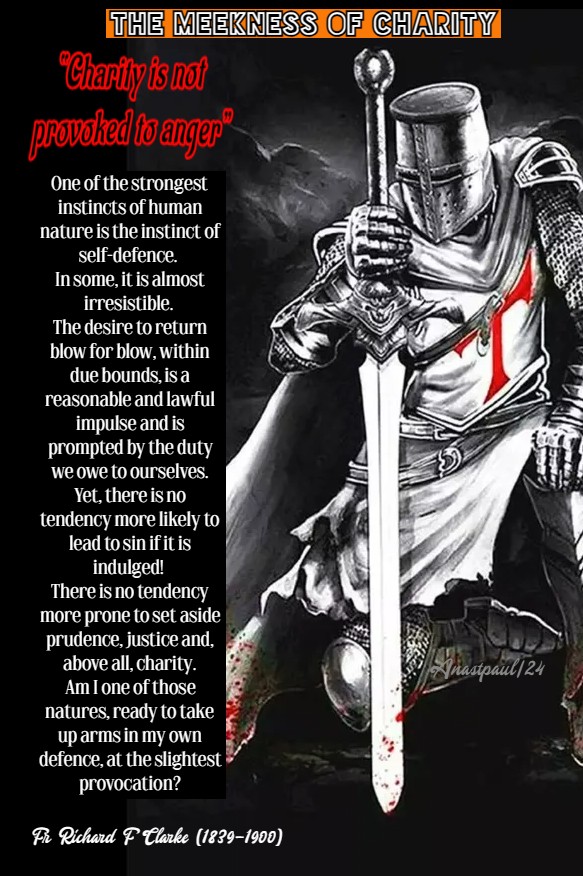
The Meekness of Charity “Charity is not provoked to anger”
One of the strongest instincts of human nature is the instinct of self-defence. In some, it is almost irresistible. The desire to return blow for blow, within due bounds, is a reasonable and lawful impulse and is prompted by the duty we owe to ourselves. Yet, there is no tendency more likely to lead to sin if it is indulged! There is no tendency more prone to set aside prudence, justice and, above all, charity. Am I one of those natures, ready to take up arms in my own defence, at the slightest provocation?
The instinct of self-defence is always prone to mislead us, due to our excessive self-love. We imagine we have been attacked, when in fact, nothing of the sort is the case. We see a slight or insult, when none was intended. We do not keep in mind how simple the true explanation may really be. We become angry, long for revenge and are carried beyond all bounds, by our wounded self-love. We say and do what we bitterly regret afterwards, alienating others from us and offending God by our angry words. How often, alas, I have done this!
How is this evil to be remedied? By charity and nothing else. If God were more prominent in our hearts, if we loved God more and ourselves less, if our ambition were to promote His honour and not our own, we should not indulge in these outbursts of intemperate or bitter words. Instead, we should not be easily provoked or become angry. We should take a gentle view of what has been done or we should accept the injury or unkindness done to us and offer it up for our sins in union with the supreme charity of Christ our Lord!
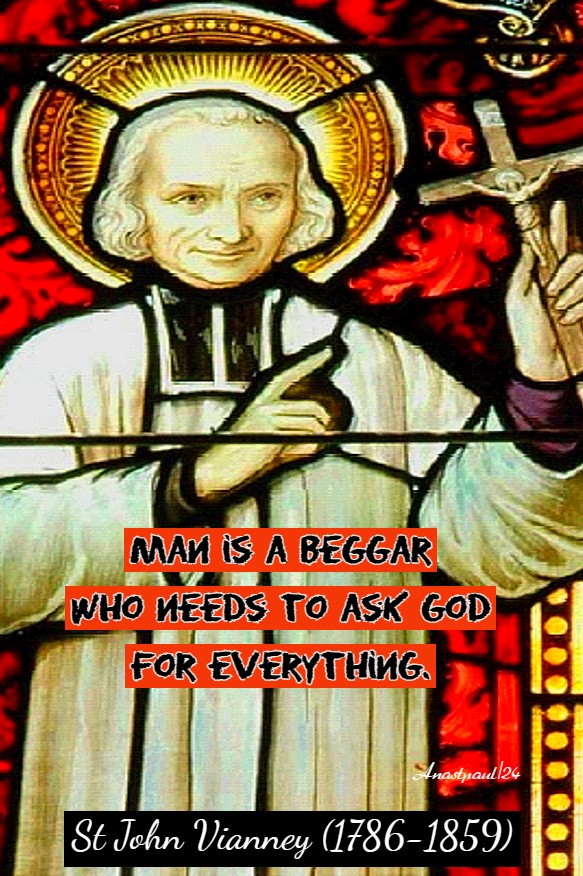
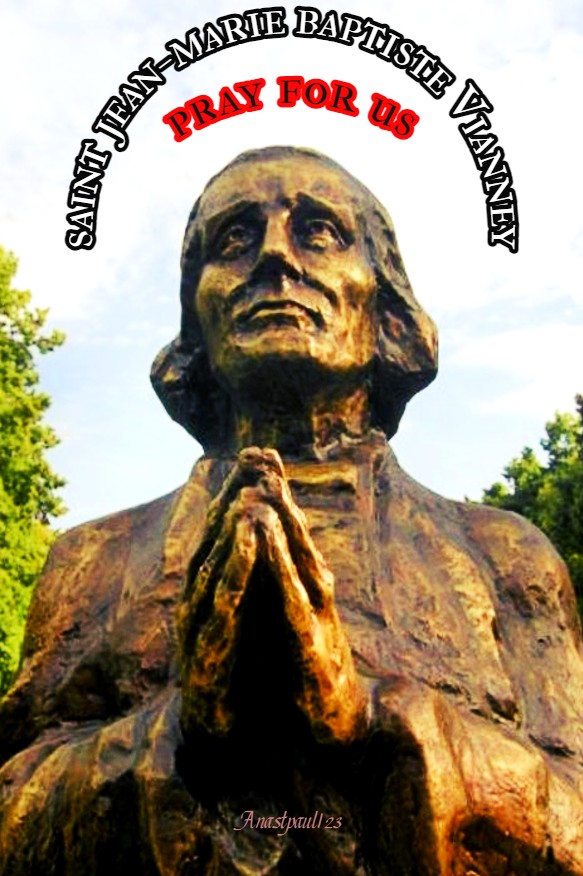
Quote/s of the Day – 9 August – St Jean-Marie-Baptiste Vianney (1786-1859) Confessor
“Man is a beggar who needs to ask God for everything.”
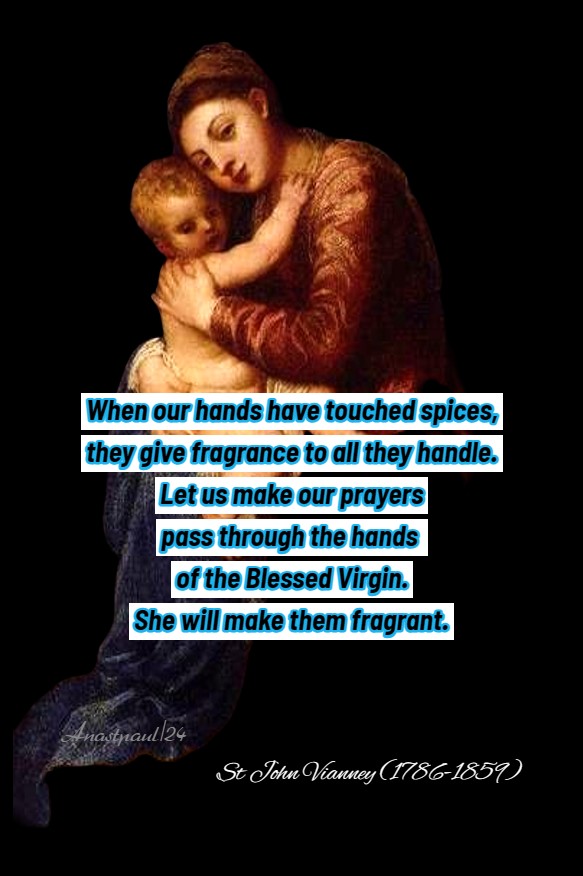
“When our hands have touched spices, they give fragrance to all they handle. Let us make our prayers pass through the hands of the Blessed Virgin. She will make them fragrant.”
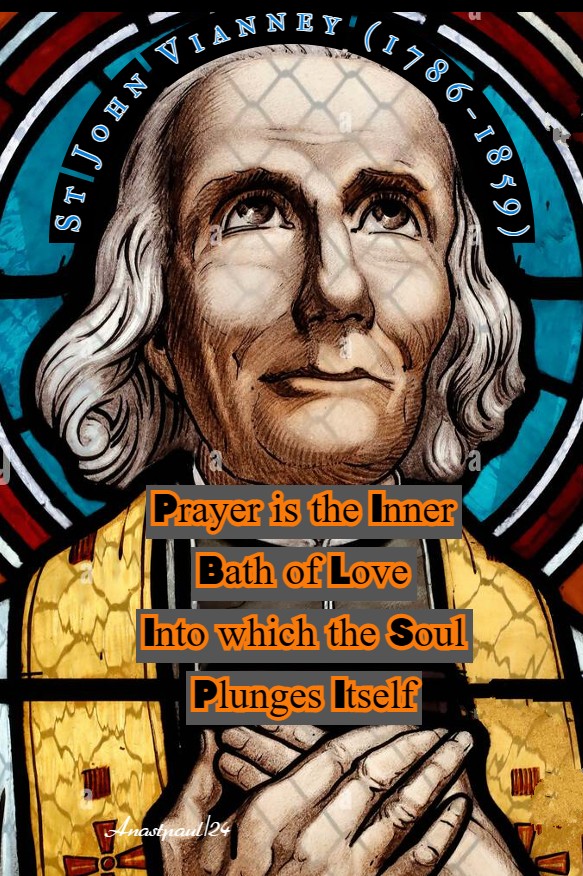
“Prayer is the inner bath of love into which the soul plunges itself.”
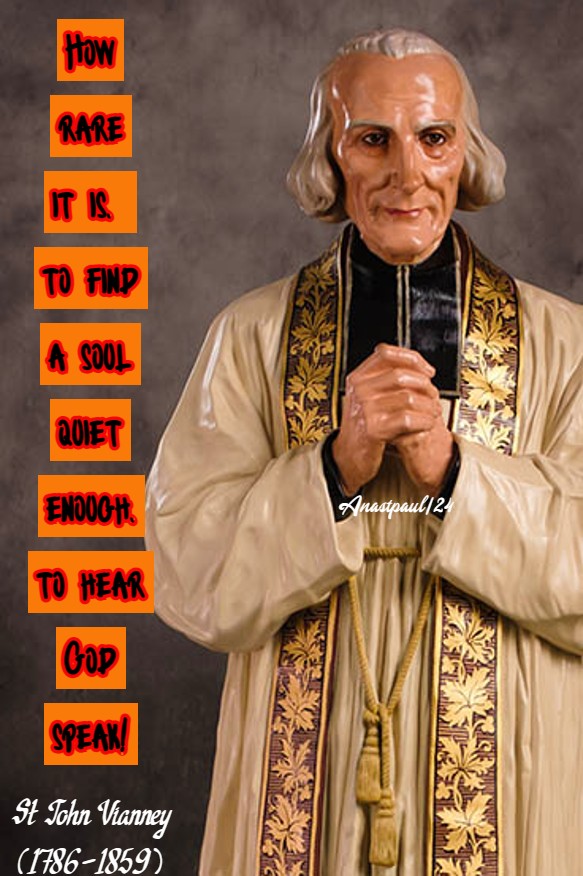
“How rare it is, to find a soul quiet enough, to hear God speak.”
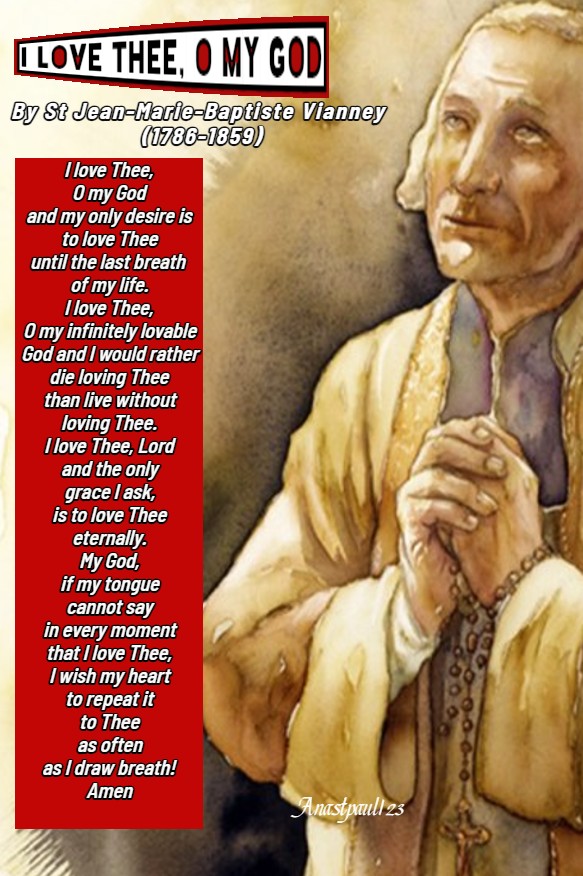
I Love Thee, O My God By St John Vianney (1786-1859)
I love Thee, O my God and my only desire is to love Thee until the last breath of my life. I love Thee, O my infinitely lovable God and I would rather die loving Thee than live without loving Thee. I love Thee, Lord and the only grace I ask, is to love Thee eternally. My God, if my tongue cannot say in every moment that I love Thee, I wish my heart to repeat it to Thee as often as I draw breath! Amen
One Minute Reflection – 9 August – “The Month of the Immaculate Heart of Mary” – St John Marie Vianney (1786-1859) Confessor – Sirach 31:8-11; Luke 12:35 – 40 – Scripture search here: https://www.drbo.org/
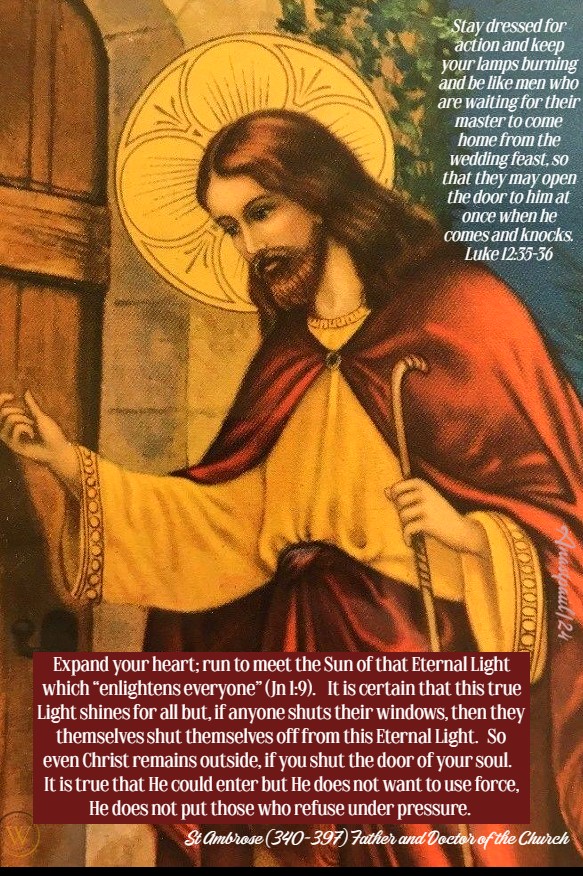
“Stay dressed for action and keep your lamps burning and be like men who are waiting for their master to come home from the wedding feast, so that they may open the door to him at once when he comes and knocks.” – Luke 12:35-36
REFLECTION – “God, the Word, stirs up the lazy and arouses the sleeper. For indeed, someone who comes knocking at the door is always wanting to come in. But it depends on us if He does not always enter or always remain. May your door be open to Him who comes; open your soul, enlarge your spiritual capacities that you may discover the riches of simplicity, the treasures of peace and sweetness of grace. Expand your heart; run to meet the Sun of that Eternal Light which “enlightens everyone” (Jn 1:9). It is certain that this true Light shines for all but, if anyone shuts their windows, then they themselves shut themselves off from this Eternal Light.
So even Christ remains outside, if you shut the door of your soul. It is true that He could enter but He does not want to use force, He does not put those who refuse under pressure. Descended from the Virgin, born from her womb, He shines throughout the universe to give Light to all. Those who long to receive the Light which shines with an everlasting brightness, open to Him. No night comes to intervene. Indeed, the sun we see each day gives way to night’s darkness but the Sun of Justice (Mal 3:20) knows no setting for Wisdom is not overcome by evil.” – St Ambrose (340-397) Bishop of Milan and Father and Doctor of the Church – 12th Sermon on Psalm 118
PRAYER – Almighty and merciful God, Who made St John-Marie glorious by priestly zeal and untiring fervoru in prayer and penance, grantP we beseech Thee that by his example and intercession, we may have strength to win for Christ, the souls of our brethren and, with them, attain everlasting glory.Through the same Jesus Christ, Thy Son our Lord, Who lives and reigns with Thee, in the unity of the Holy Ghost, God, world without end. Amen (Collect).
Our Morning Offering – 9 August – “The Month of the Immaculate Heart of Mary” – St Jean-Marie-Baptiste Vianney (1786-1859) Confessor
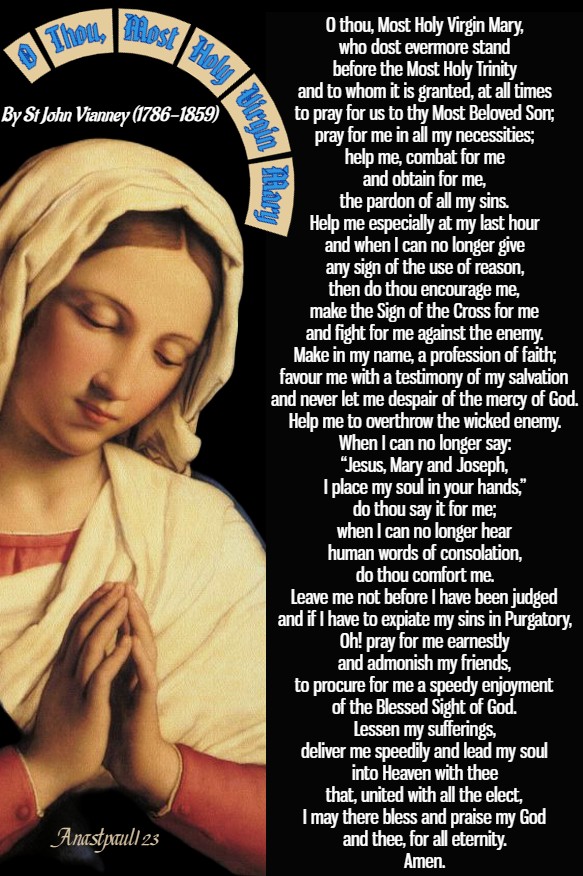
O Thou, Most Holy Virgin Mary (Pray for Me in All My Necessities) By St John Vianney (1786-1859)
O thou, Most Holy Virgin Mary, who dost evermore stand before the Most Holy Trinity and to whom it is granted, at all times to pray for us to thy Most Beloved Son; pray for me in all my necessities; help me, combat for me and obtain for me, the pardon of all my sins. Help me especially at my last hour and when I can no longer give any sign of the use of reason, then do thou encourage me, make the Sign of the Cross for me and fight for me against the enemy. Make in my name, a profession of faith; favour me with a testimony of my salvation and never let me despair of the mercy of God. Help me to overthrow the wicked enemy. When I can no longer say: “Jesus, Mary and Joseph, I place my soul in your hands,” do thou say it for me; when I can no longer hear human words of consolation, do thou comfort me. Leave me not before I have been judged and if I have to expiate my sins in Purgatory, Oh! pray for me earnestly and admonish my friends, to procure for me a speedy enjoyment of the Blessed Sight of God. Lessen my sufferings, deliver me speedily and lead my soul into Heaven with thee that, united with all the elect, I may there bless and praise my God and thee, for all eternity. Amen.
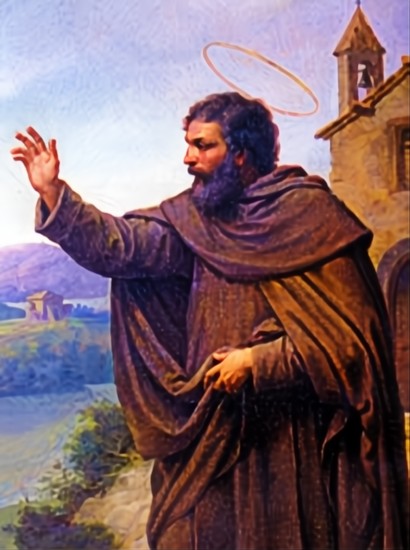
Saint of the Day – 9 August – Saint Falco of Palermo (Died mid 11th Century) Hermit, Monk, Miracle-worker. Born in the Calabria region of Italy and died ion 13 January of natural causes at Palermo, Italy. Also known as – Falcon, Falco the Hermit. Additional Memorias – 13 January in commemoration of his death and on the Sunday following 15 August 15 in memory of the translation of his Relics from the Church of St Egidius. St Falco was Canonised in 1893 by Pope Leo XIII.
Falco, born in Taverna in Calabria towards the middle of the tenth century, of the ancient and noble Poerio family, was, from a very young age, attracted by solitude andan eremetic life.
He soon decided to retire to the Monastery of Pesica near his hometown, among the Basilians, under the discipline of a holy Abbot named Ilarione. The community was already known throughout Calabria for the virtues and sanctity of all the brothers who formed it.
In 980 Calabria became the scene of ruin as a prey of the Saracens. From the Monastery of Taverna, the “seven brothers” (a long story of Falco’s friends who all entered religious life and were all Canonised with him) decided to leave for Abruzzo. Here they built some cells and a small Church, the ruins of which were visible until the end of the 19th Century. Here, they settled, living in poverty and sanctity, imposing rigid rules on themselves as true imitators of the ancient Monks of Egypt.
Under the guidance of their holy Abbot Hilarion, they led an austere life of fasting, eating mostly herbs, except on Sundays. Their conversation consisted of the practice of prayer and the recitation of praise. When the holy Abbot died, they elected as Superior, the youngest, Nicolò Greco, younger in age but not in merit. The new Abbot, to give thanks to God, asked his brothers to make a pilgrimage to Rome. During the journey, with their prayers, “the seven brothers” managed to free seven possessed people from evil spirits they had met near Lake Fucino. Once they set off again, one of them, weighed down by poor health, left his companions and, near Ortucchio, found shelter in the Church of the Santissima Vergine, in St Maria in Capo d’acqua.
The other companions, having completed the pilgrimage, returned to Prata to their monastic life. Nicolò was the Abbot for several years but at his death, the other brothers, unable to elect a successor, considered themselves free to follow their own path. Falco decided to return to Rome and set out but that same evening, having reached Palena, attempting to climb the mountain of Coccia, he felt his strength failing and was forced to rest in the nearby Church of St Egidius. At the unexpected arrival of this holy Friar, the district infested by evil spirits, was immediately purified and his presence was a reason for hope for the inhabitants of the place who immediately acclaimed him and showed him respect. He thus decided to remain in those mountains, continuing his life of rigours and prayers.
Out of extreme humility he never wished to embrace the Priesthood but to remain a very humble Friar, an example of virtue.
It was the morning of 13 January presumably of a year around the middle of the 11th Century, suddenly the small bell of the hermitage where Falco lived in retreat, was heard ringing. Many people rushed there, thinking that the Friar needed help and found him lifeless lying on a table with two lit candles. His body was transported to the Church of St Egidius Abate, where, after the funeral, he was buried.
A possessed man was passing by those parts when everyone with amazement, saw him break the ropes and run towards the Tomb of the Saint, where as soon as he arrived, he was freed from the devil. From that moment the fame of St Falco became even greater and confirmed by several other miracles, so much so that at the request of the people, the remains were exposed to public veneration.
If the archives of Sulmona and Palena had not been destroyed in a fire, we would today have countless descriptions of graces and miracles reported in the acts of his Canonisation.
In 1383, due to continuous raids and robberies, fearing for their fate, the Bishop of Sulmona decided to transfer the Relics and the Statue of St Falco to the Church of St Anthony Abbot in the centre of Palena. Since then, the Church and the Relics of St Falco became a destination for pilgrims, believers, devotees, the sick and the obsessed, even from far away.
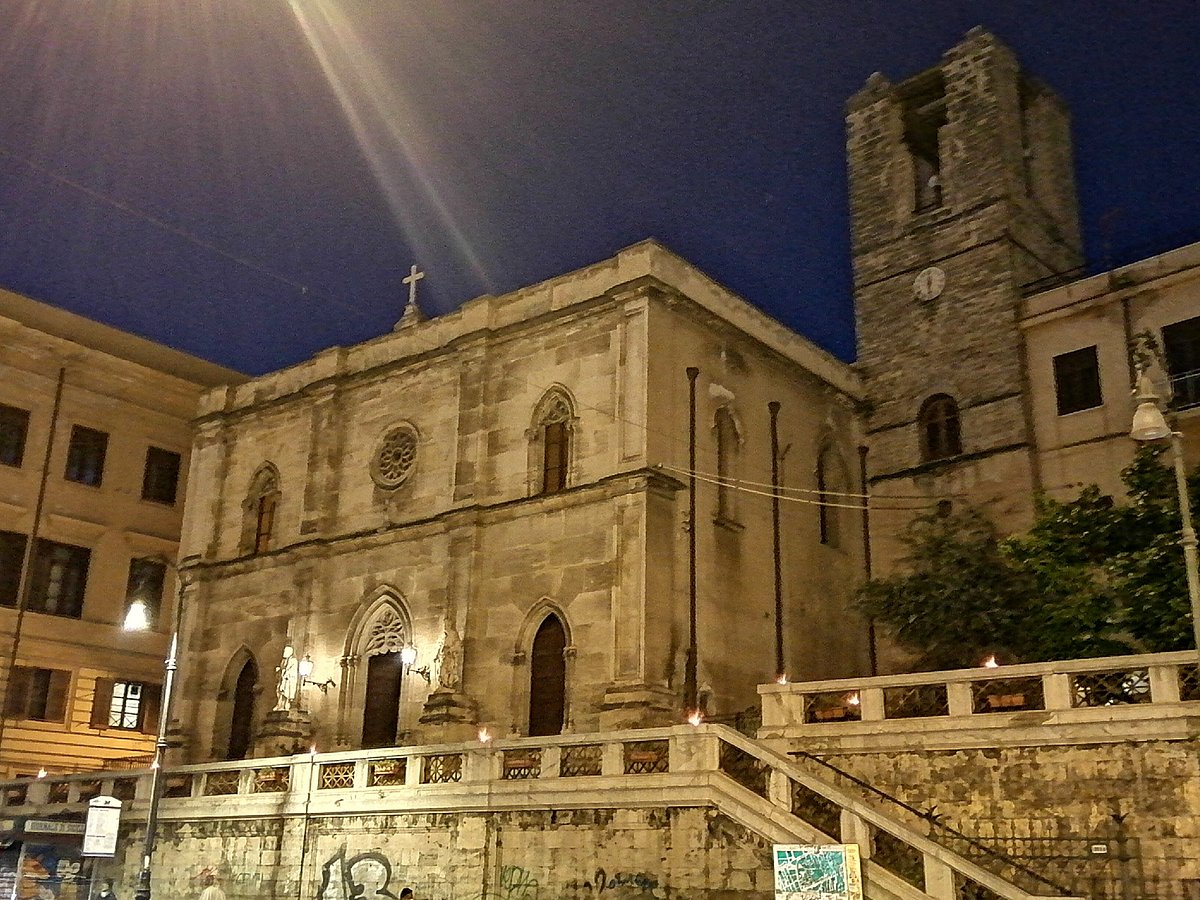
The Church of St Anthony Abbot in Palermo
In the earthquake of 1706, the Church was not exempt from disaster but was soon rebuilt with the help and devotion of the faithful. In 1841, fue to the growing devotion and the countless pilgrimages, it was decided to demolish the old Church to build a much larger and more spacious one and in 1842, thanks to the great devotion, a half-length silver Statue of the Saint was erected by the famous Domenico Capozzi.
The Shrine with his Relics, the Dalmatic tunic in the Greek style and the silver Statue containing his skull, are exposed twice a year for the devotion of the faithful, on 13 January in commemoration of his death and on the Sunday following 15 August 15 in memory of the translation of his Relics from the Church of St Egidius. St Falco was Canonised in 1893 by Pope Leo XIII.
Interior of the Church where St Falco is enshrined
St Nathy St Numidicus of Carthage St Phelim St Rusticus of Sirmium St Rusticus of Verona St Secundian of Civitavecchia St Stephen of Burgos St Verian of Civitavecchia
Martyrs of Civitavecchia: Three Christians Martyred together in the persecutions of Decius. We know little more than the names – Marcellian, Secundian and Verian. 250 near Civitavecchia, Italy.
Martyrs of Constantinople: 10 Saints: A group of ten Christians who were arrested, tortured and executed for defending an icon of Christ in defiance of orders from Emperor Leo the Isaurian. We know the names of three, but nothing else about them – Julian, Marcian and Mary. They were beheaded in Constantinople.
Thought for the Day – 8 August – Meditations with Fr Richard Frederick Clarke SJ (1839-1900)
CHARITY Meditations for a Month
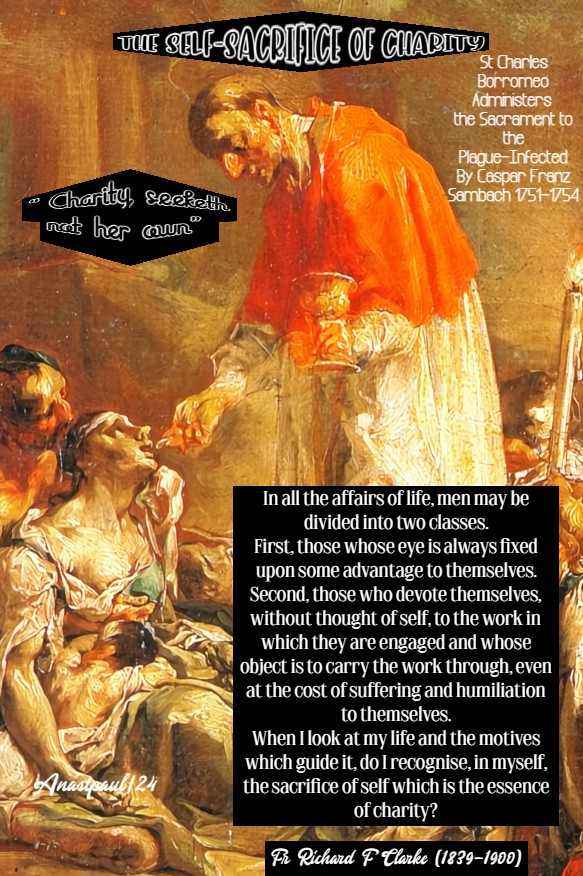
The Self-Sacrifice of Charity “Charity seeketh not her own”
In all the affairs of life, men may be divided into two classes. First, those whose eye is always fixed upon some advantage to themselves. Second, those who devote themselves, without thought of self, to the work in which they are engaged and whose object is to carry the work through, even at the cost of suffering and humiliation to themselves. When I look at my life and the motives which guide it, do I recognise, in myself, the sacrifice of self which is the essence of charity?
What reveals this spirit in my life? Not zeal, for there is a zeal which is nothing but a disguised form of self-seeking. Not activity, for an active nature rejoices in being employed. Not a strong interest in the work – perhaps the pious work in which I am engaged. All these maybe mere counterfeits. The real test is the willingness that the work should prosper independently of myself; a preference for its success, rather than my success, even though, I myself am thrust out of it; a readiness to disappear if by this, I am able do anything to help the good cause. Am I willing and true enough, to stand this first test?
Yet this is not enough. I must not be satisfied with a general willingness to obliterate myself, especially where this is, perhaps impossible. If my motives are pure, I must also be ready to be taken down, humbled, misjudged, or disparaged. I must be prepared to accept all the blame of failures and, to see others reap the praise of success and further, I must know this is done to me through God’s grace! Rather, I must rejoice in this as a good sign. Can I stand this second test?
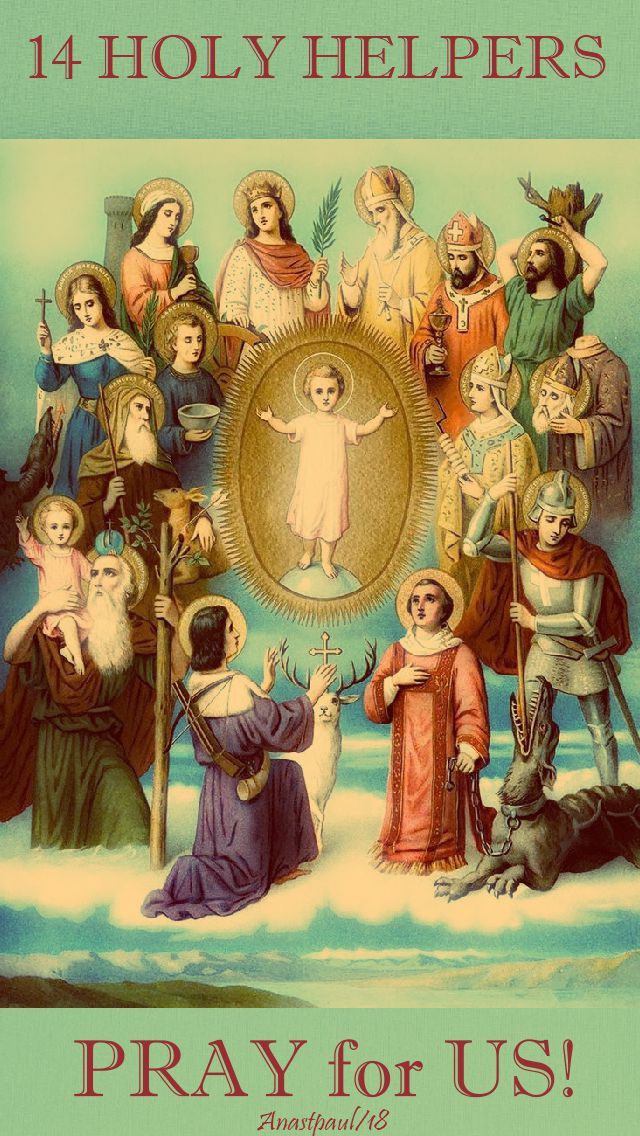
Quote/s of the Day – 8 August – The Fourteen Holy Helpers – 1 Thessalonians 2:13-16, Mark 16:15-18 – Scripture search here: https://www.drbo.org/
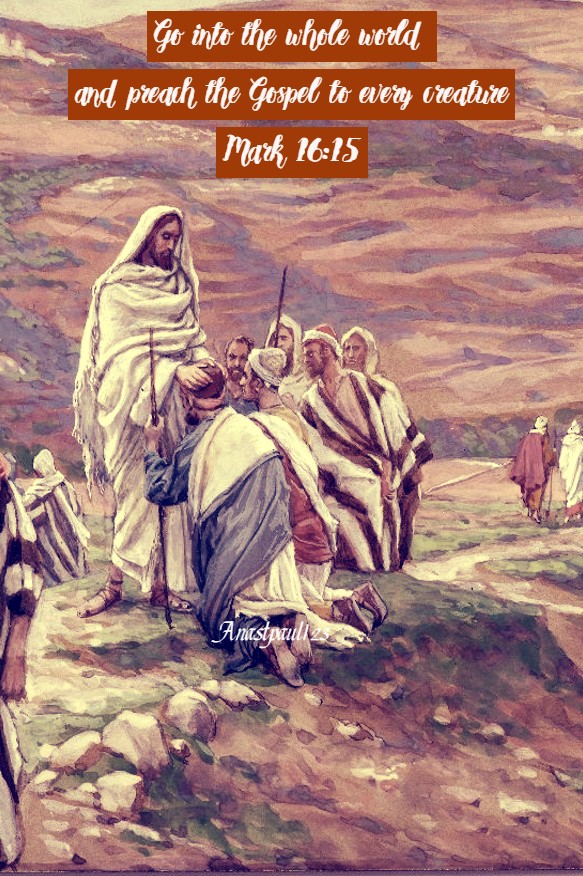
“Go into the whole world and preach the Gospel to every creature.”
Mark 16:15
“I have lit the light of your torch but it is up to you to see it is kept burning, not just to your personal advantage but also, in the interest of all who will see it and who, through it, will be led to the Truth. The worst wickedness would not put a shadow over your light, if you live with the vigilance of those who are called to bring the whole world to good. So, let your life correspond to the holiness of your mission, so that God’s grace may be proclaimed everywhere.”
St John Chrysostom (347-407) Father and Doctor of the Church
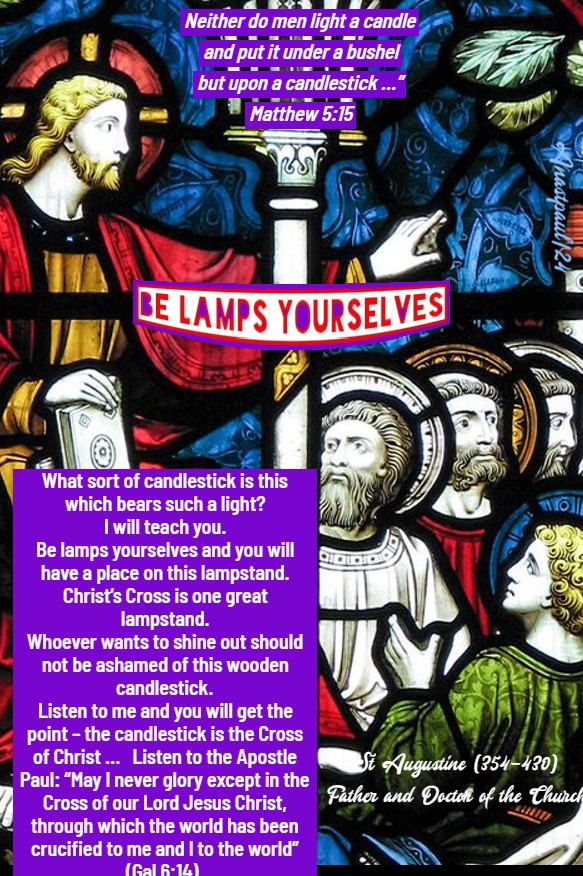
“What sort of candlestick is this which bears such a light? I will teach you. Be lamps yourselves and you will have a place on this lampstand. Christ’s Cross is one great lampstand. Whoever wants to shine out should not be ashamed of this wooden candlestick. Listen to me and you will get the point – the candlestick is the Cross of Christ … Listen to the Apostle Paul: “May I never glory except in the Cross of our Lord Jesus Christ, through which the world has been crucified to me and I to the world” (Gal 6:14).”
St Augustine (354-430) Father and Doctor of the Church
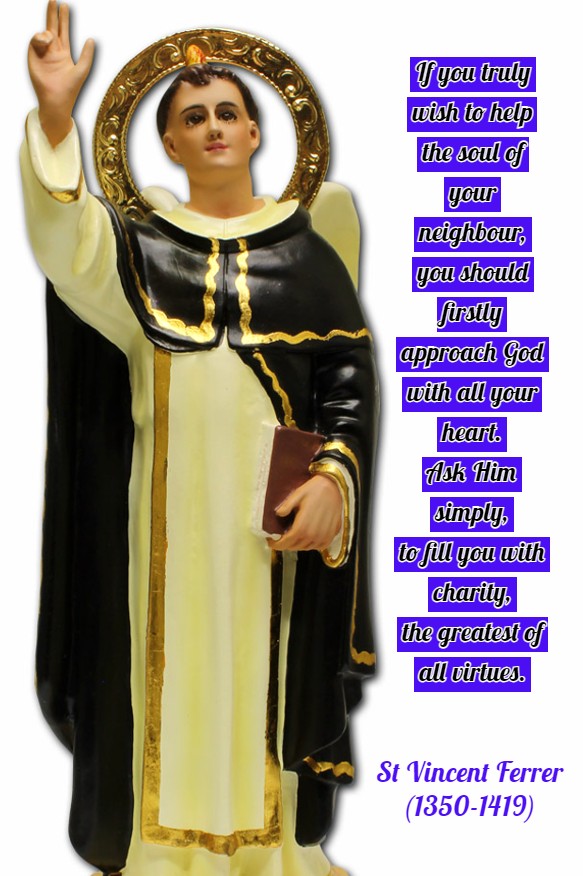
“If you truly wish to help the soul of your neighbour, you should firstly approach God with all your heart. Ask Him simply, to fill you with charity, the greatest of all virtues.”
One Minute Reflection – 8 August – “The Month of the Immaculate Heart of Mary” – The Fourteen Holy Helpers – 1 Thessalonians 2:13-16, Mark 16:15-18 – Scripture search here: https://www.drbo.org/
“He who believes and is baptised, shall be saved ...” – Mark 16:16
REFLECTION – “When He says, “All that the Father gives Me shall come to Me,” He touches on their unbelief, showing, that whoever does not believe in Him transgresses the Will of the Father. He covertly shows, that unbelievers are not only at variance with Him but also, with the Father. For if this is [the Son’s] Will and if this is the reason He came, that is, that He might save the entire world, then those who do not believe transgress His Will.
When, therefore, He says, the Father guides someone, there is nothing that hinders that person from coming to [Jesus]. And Paul says, that [the Son] delivers them up to the Father. Now, just as the Father, when He gives, does not take from Himself, so neither does the Son take from Himself when He gives up. The Son is said to give up to the Father because we are brought to the Father by Him. And at the same time, we read that it was the Father “by whom you were called to the fellowship of His Son,” that is, by the Will of the Father.
Faith in Me, He intimates here, is no ordinary thing or one which comes from human reason but [it] needs a revelation from above. And this He establishes throughout His discourses, showing, that this faith requires a noble sort of soul and one drawn on by God. The expression “that the Father gives Me” shows, that it is no accident whether a person believes or not. It shows, that belief is not the work of human reasoning but requires a revelation from on high and a mind devout enough to receive the revelation. “Whoever then,” our Lord says, “comes to Me, shall be saved,” meaning they shall be greatly cared for. For to save such as these, I took up flesh and the form of a servant.” – St John Chrysostom (347-407) Archbishop of Constantinople, Father and Doctor of the Church (Homilies on the Gospel of John 45)
PRAYER – PRAYER – O God, Who gladden us with the annual festival of Thy 14 holy Saints, mercifully grant, that we, who celebrate the anniversary of their death, may also strive to equal the courage of their Martyrdom. Through Jesus Christ, Thy Son our Lord, Who lives and reigns with Thee, in the unity of the Holy Ghost, God, world without end. Amen (Collect).
Our Morning Offering – 8 August – “The Month of the Immaculate Heart of Mary” – The Feast of the 14 Holy Helpers
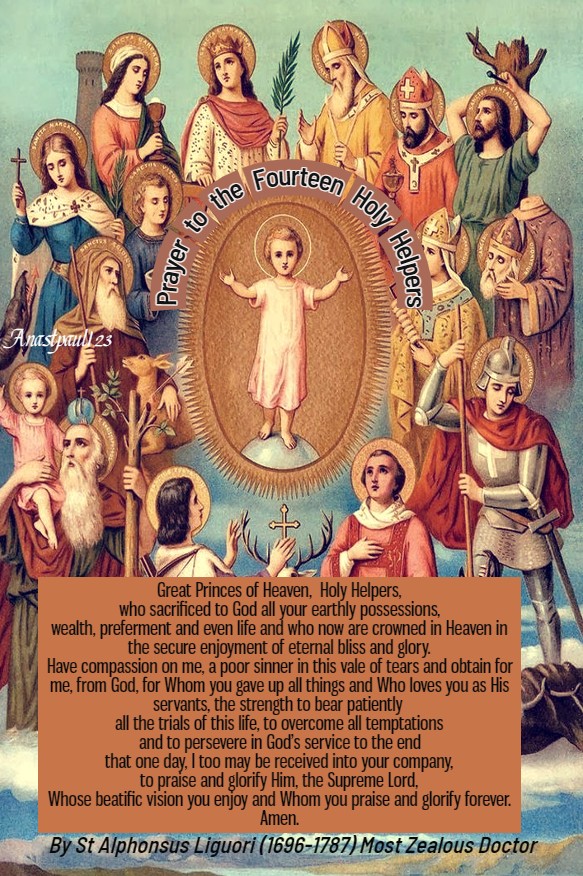
Prayer to the Fourteen Holy Helpers By St Alphonsus Liguori (1696-1787) Doctor of the Church
Great princes of Heaven, Holy Helpers, who sacrificed to God all your earthly possessions, wealth, preferment and even life and who now are crowned in Heaven in the secure enjoyment of eternal bliss and glory; have compassion on me, a poor sinner in this vale of tears and obtain for me from God, for Whom you gave up all things and Who loves you as His servants, the strength to bear patiently all the trials of this life, to overcome all temptations and to persevere in God’s service to the end, that one day I too may be received into your company, to praise and glorify Him, the supreme Lord, Whose Beatific Vision you enjoy and Whom you praise and glorify forever. Amen
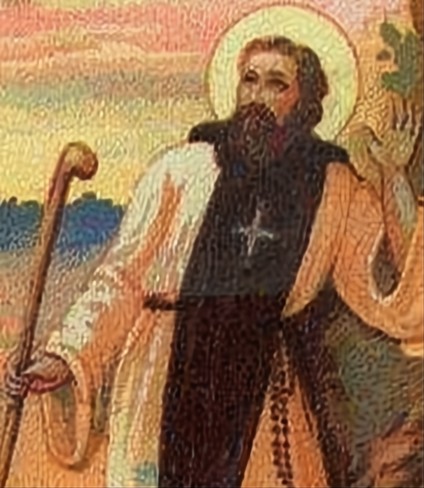
Saint of the Day – 8 August – Saint Famianus O.Cist. (1090-1150) Cistercian Monk, Hermit, Pilgrim, Miracle-worker. Born in 1090 in Cologne, Germany as Gerhard Quardus and died on 8 Augustn 1150, aged 59 or 60, in Gallese, Umbria, Italy of natural causes. St Famianus bears the great honour of being the first Cistercian to be Canonised which took place in 1154 by Pope Adrian IV. Patronage – of Gallese, Italy. Also known as – Gerhard, Wardo, Famian, Famiano, Famianus of Compostela, Famianus of Gallese. The name Famianud comes from Latin and means “who has acquired fame.”In Germany he is known as St Wardo Famianus.
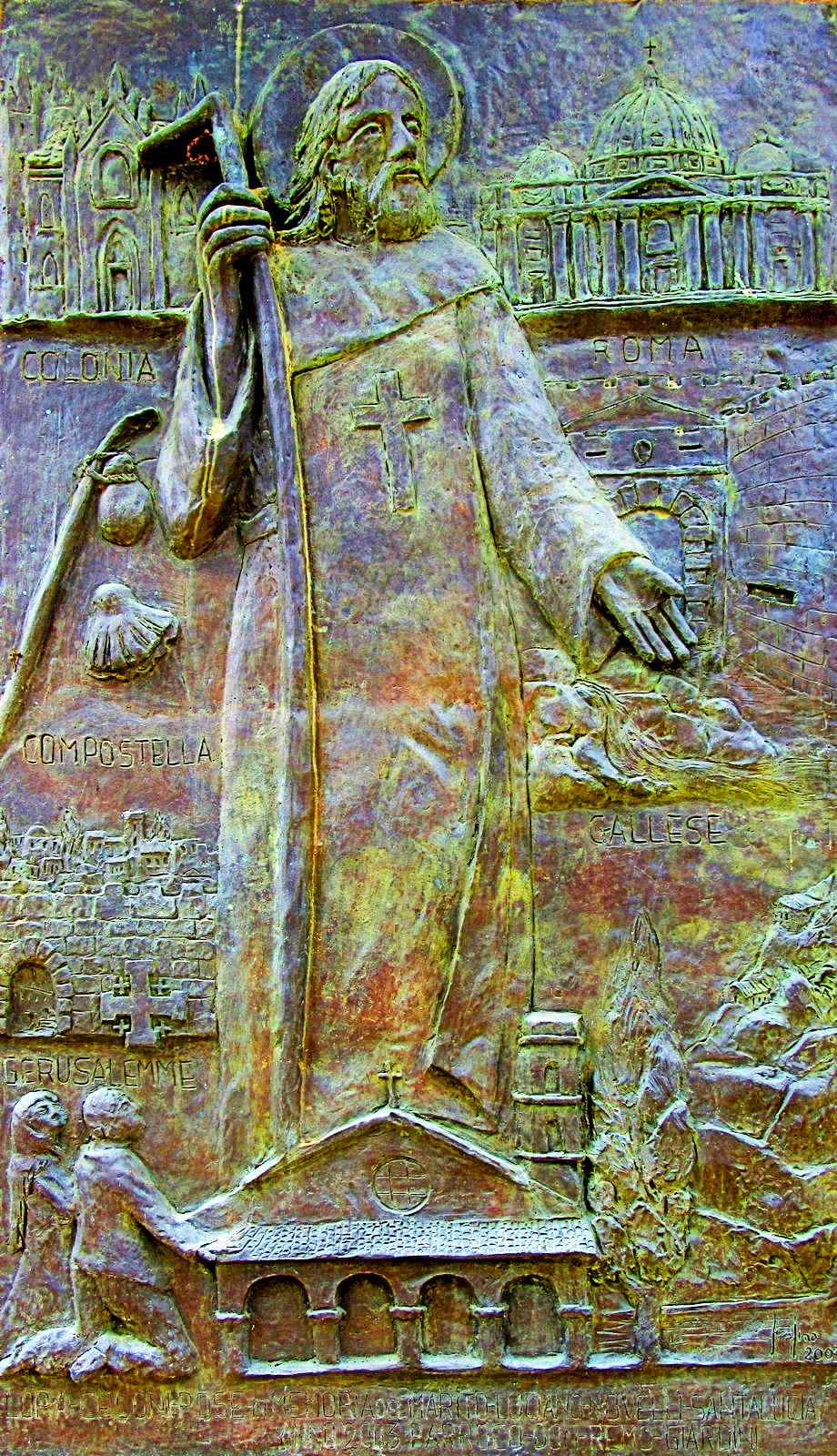
Bronze Relief (2003) at the Basilica of St Famianus in Gallese
Gerhard (called Ward – the name Wardo is derived from ‘the fourth’ probably being the fourth child) Quadrus, son of a prominent family, gave away his inheritance and in 1108 travelled as a pilgrim to the seven pilgrimage Churches in Rome , where he stayed for six years.
In 1114 he made a pilgrimage to Santiago de Compostela and then lived in a Monastery dedicated to the Sts Cosmas and Damian near Tui in Galicia. When the Cistercian Abbey of Osera was built nearby, he joined the Order. But after some time he went on a second pilgrimage to the Holy Land and on his return, via Italy, he visted the Town of Gallese, where he later died.
He is highly venerated in Gallese. This Town in the Viterbo area was the birthplace of 2 Popes Marinus I (Pope from 882 until his death in 884) and Romanus I (Pope from August to November 89).. The prestige which the Town acquired thanks to its religiosity called several pilgrims to Gallese, including out Saint Famianud. This Monk, known as “di Gallese – of Gallese” died in the Town in question on 8 August 1150.
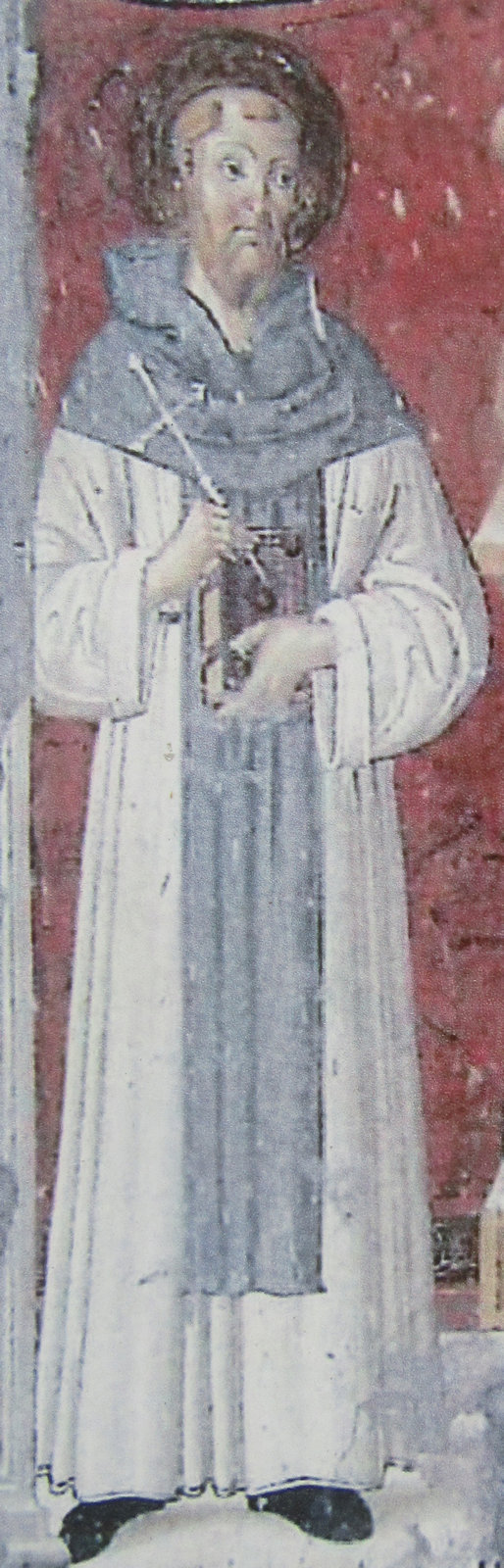
Fresco, 1516, in the Basilica of San Famiano in Gallese (School of Antonio del Massaro)
Famianus ws Canonised by Pope Adrian IV with the name of St Famianus in 1154 and his remains were placed in a cave, where in 1155, the Basilica which bears his name, was erected. Many miracles occurred at Wardo’s grave in Gallese which is why he was given the name Famianus. In 1244, a Basilica dedicated to him was built over his grave which included a pilgrims’ hostel and a small Monastery. Wardo’s body is still incorrupt to this day.
In the place of worship, the Incorrupt Body of St Famianus, the Patron Saint of Gallese, is preserved, guarded in a precious Sarcophagus placed in the crypt. The Church, located outside the urban perimeter, incorporates the cave, transformed into a crypt, where the Saint wanted to be buried. About three kilometers from the historic centre of Gallese, in the countryside, is another Church dedicated to St Famianus, the Chapel of St Famianus at Lungo.
In this Chapel, is preserved the spring which on 17 July 1150, the Saint, made flow by striking the ground with his walking stick. This had occurred at the end of his pilgrimage, which had taken him to Spain (where he is still highly venerated), to the Holy Land and to Rome Even today, on 17 July of each year, the place is the destination of a pilgrimage which travels from very early in the morning to reach the Chapel in time for Holy Mass.
The cult of the Saint and the custody of the two Churches are entrusted to the ancient Confraternity of St Famianus, reconstituted in 1990.
Basilica of St Famianus with Wardo’s Tomb in Gallese
St Eleutherius of Constantinople St Famianus O.Cist. (1090-1150) Cistercian Monk. His Body remains Inoccrupt in Gallese, Umbria, Italy. St Gedeon of Besancon St Hormisdas of Persia St Largus St Leobald of Fleury St Leonidas of Constantinople St Marinus of Anzarba St Mummolus of Fleury St Myron the Wonder Worker St Rathard of Diessen St Severus of Vienne St Sigrada St Smaragdus St Ternatius of Besançon St Ultan of Crayke
Martyrs of Albano – 4 Saints: Four Christians who were Martyred together, and about we today know little more than their names – Carpóforo, Secondo, Severiano and Vittorino. They were martyred in Albano, Italy – their remains are interred in the San Senator cemetery, on the Appian Way, 15 miles from Rome, Italy.
Martyrs of Rome – 5 Saints: Five Christians Martyred together; we know nothing else about them but the names – Ciriaco, Crescenziano, Giuliana, Memmia and Smaragdus. They were martyred at the 7 mile marker, on the Via Ostia, Rome, Italy.
Thought for the Day – 7 August – Meditations with Fr Richard Frederick Clarke SJ (1839-1900)
CHARITY Meditations for a Month
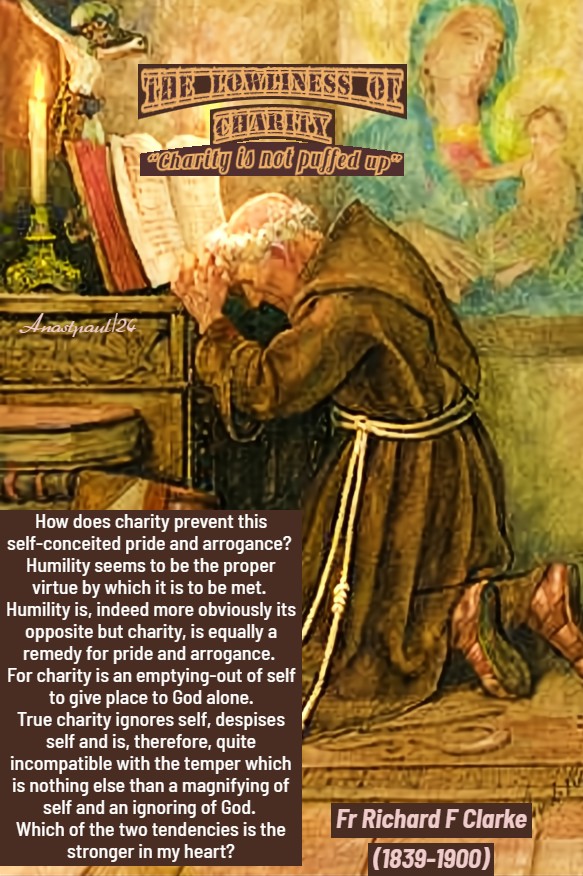
The Lowliness of Charity “Charity is not puffed up”
One of the great dangers of prosperity is that it so often produces a fatal exaltation of self. We are flattered by others and we begin to think that we are persons of importance. Those around give way to us, listen to us when we speak, respect our opinion. From this, in our folly, we fancy ourselves distinguished and eminent and expect to be treated accordingly. This temper, if it exists in us, shows that we are very deficient in true charity, for charity is never puffed up with a high estimate of self.
How does charity prevent this self-conceited pride and arrogance? Humility seems to be the proper virtue by which it is to be met. Humility is, indeed more obviously its opposite but charity, is equally a remedy for pride and arrogance. For charity is an emptying-out of self to give place to God alone. True charity ignores self, despises self and is, therefore, quite incompatible with the temper which is nothing else than a magnifying of self and an ignoring of God. Which of the two tendencies is the stronger in my heart?
We are not likely to arrive at a true estimate of ourselves, unless others treat us as we deserve. How are we to know what our deserts may be? Our idea of our own deserts will be regulated by the degree of our charity. Those who esteem God the most and esteem themselves the least, consider themselves worthy only to be trampled underfoot and spat upon. How should I appreciate such treatment? Would my charity enable me to rejoice in it, as suitable indeed for one like myself?
Quote/s of the Day – 7 August – St Cajetan (1480-1547) Confessor
“Do not receive Christ in the Blessed Sacrament so that you may use Him as you judge best but give yourself to Him and let Him receive you in this Sacrament, so that He Himself, God your Saviour, may do to you and through you whatever he wills!”
One Minute Reflection – 7 August – “The Month of the Immaculate Heart of Mary” – St Cajetan (1480-1547) Confessor – Ecclesiasticus 31:8-11, Matthew 6:24-33 – – Scripture search here: https://www.drbo.org/
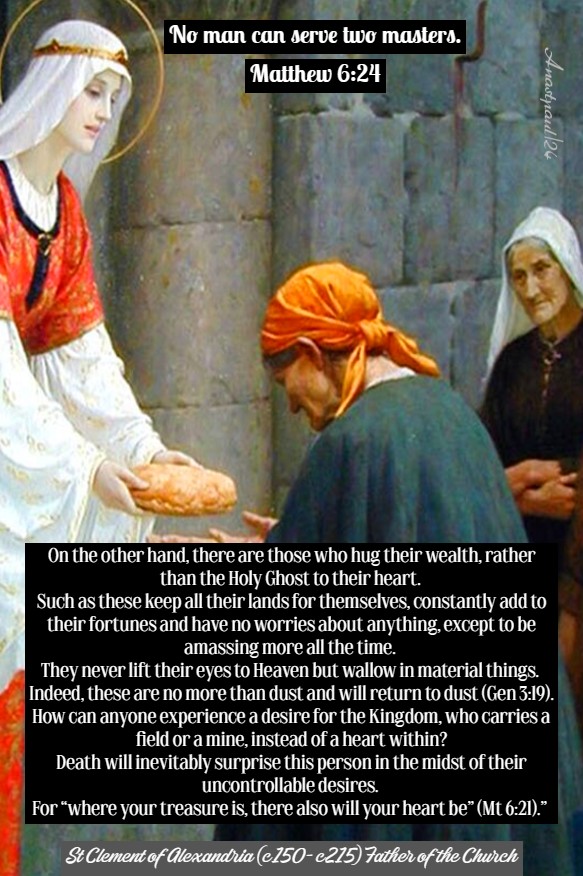
“No man can serve two masters.” – Matthew 6:24
REFLECTION – “There is a kind of riches which sows death wherever it holds sway – free yourselves from it and you will be saved. Purify your soul, make it poo,r so that you may be able to hear the Saviour’s call repeating – “Come, follow Me” (Mk 10:21). He is the Way on which the pure in heart walk; God’s grace does not penetrate the soul who is burdened and pulled apart by a great number of possessions.
People who look upon their fortune, their gold and silver and houses, as God’s gifts, witness to their gratitude to God by assisting the poor with their goods. They know they possess them, more on account of their brethren, than on their own. They remain in control of their riches, rather than becoming its slave. Such as these, do not shut the riches up within their soul, any more than they place their lives in them but, they untiringly pursue a wholly divine life. And, if it should happen that their fortune vanishes, they accept their ruin with a free heart. God calls “blessed” such as these and calls them “poor in spirit” certain heirs, to the Kingdom of Heaven (Mt 5:3). …
On the other hand, there are those who hug their wealth, rather than the Holy Ghost to their heart. Such as these keep all their lands for themselves, constantly add to their fortunes and have no worries about anything, except to be amassing more all the time. They never lift their eyes to Heaven but wallow in material things. Indeed, these are no more than dust and will return to dust (Gen 3:19). How can anyone experience a desire for the Kingdom, who carries a field or a mine, instead of a heart within? Death will inevitably surprise this person in the midst of their uncontrollable desires. For “where your treasure is, there also will your heart be” (Mt 6:21).” – St Clement of Alexandria (c150- c215) Theologian, Philosopher, Professor who taught at the Catechetical School of Alexandria, Father of the Church (Who is the rich man who can be saved?).
PRAYER – O God, Who bestowed upon St Cajetan, Thy Confessor, the grace to follow the apostolic way of life; grant us we beseech Thee, by his intercession and example, ever to trust in Thee and to long only for the things of Heaven.Through the same Jesus Christ, Thy Son our Lord, Who lives and reigns with Thee, in the unity of the Holy Ghost, God, world without end. Amen (Collect).
Our Morning Offering – 7 August – “The Month of the Immaculate Heart of Mary”
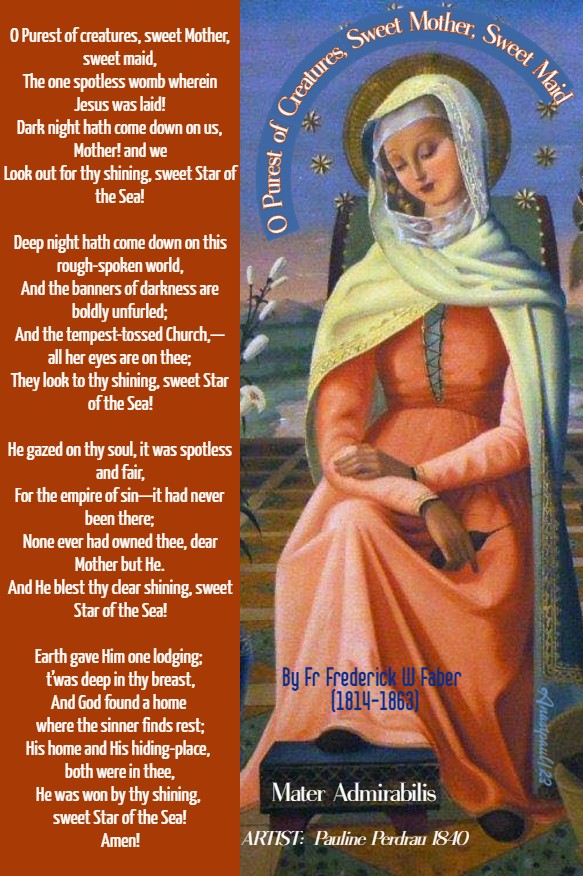
O Purest of Creatures, Sweet Mother, Sweet Maid By Fr Frederick W Faber C.Orat. (1814-1863)
O Purest of creatures, sweet Mother, sweet maid, The one spotless womb wherein Jesus was laid! Dark night hath come down on us, Mother! and we Look out for thy shining, sweet Star of the Sea!
Deep night hath come down on this rough-spoken world, And the banners of darkness are boldly unfurled; And the tempest-tossed Church,— all her eyes are on thee; They look to thy shining, sweet Star of the Sea!
He gazed on thy soul, it was spotless and fair, For the empire of sin—it had never been there; None ever had owned thee, dear Mother but He. And He blest thy clear shining, sweet Star of the Sea!
Earth gave Him one lodging; t’was deep in thy breast, And God found a home where the sinner finds rest; His home and His hiding-place, both were in thee, He was won by thy shining, sweet Star of the Sea!
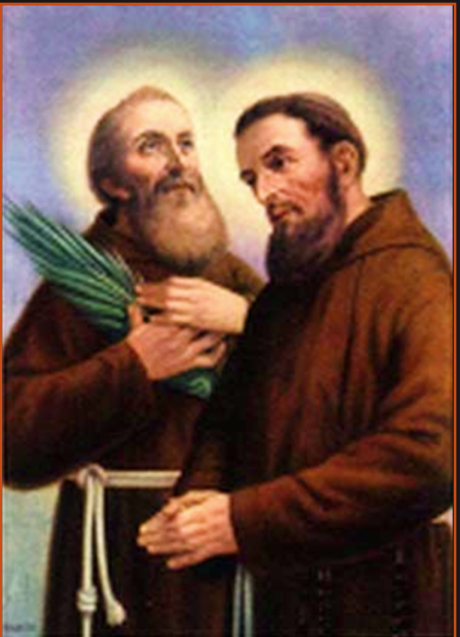
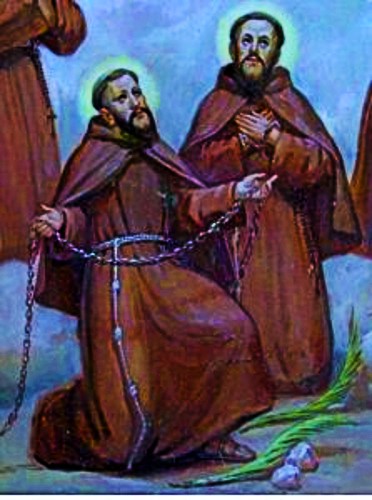
Saint/s of the Day – 7 August – Blessed Agathangelus Nourry OFM.Cap (1598-1638) and Blessed Cassian Vaz Lopez-Neto OFM Cap (1605-1638) Martyrs, Friars of the Capuchin branch of the Friar’s Minor, Missionaries. Agathangelus was born on 31 July 1598 near Vendome, France and died by being stoned to death or hanged with the cords of his own Habit (records vary) on 7 August 1638 at Dibauria, Abyssinia. Also known as – Agathangelo Noury, Agathangelus of Vendome, Agathangelus Noury, Agathange Noury of Vendôme.
Agathangelus Noury joined the Capuchin Friars in 1619. He worked as a Missionary from 1629 until his death.
As Superior of the mission in Cairo, Egypt, he worked zealously to bring the Copts back to the unity of the Church.
When, in 1637, he was sent as Superior to the new mission in Ethiopia, he summoned Cassian Lopez-Netto to assist him.
Cassian was born in Nantes in 1607 and made profession in the Capuchin Order in 1623. In 1637, he joined his Superior in the new Mission in Ethiopia to spread the Gospel and evangelise the natives.
After a few months of missionary activity both were seized by the Abyssinians. As a reward for their apostolate both were crowned with Martyrdom in the City of Gondar in the year 1638.
They were Beatified on 1 January 1905 by St Pius X.
St Albert of Trapani O.Carm. (c1240-1307) Carmelite Priest, Confessor, Preacher, Evangeliser, apostle of prayer and a devout servant of the Blessed Virgin and the Passion of Christ. St Teresa of Jesus (1515-1582) and St Mary Magdalene de Pazzi (1566-1607) were especially devoted to him, the Bl Baptist Spagnoli (1447–1516) composed a sapphic ode in his honour. His Life: https://anastpaul.com/2019/08/07/saint-of-the-day-7-august-saint-albert-of-trapani-o-carm-c-1240-1307/
+Blessed Cassian Vaz Lopez-Neto OFM Cap (1605-1638) Martyr St Claudia of Rome St Donat St Donatian of Chalons-sur-Marne St Donatus of Besancon St Faustus of Milan St Hyperechios Bl Jordan Forzatei St Julian of Rome St Peter of Rome
Martyred Deacons of Rome – 6 Saints: A group of Deacons who were Martyred with Pope Saint Sixtus II. We know nothing about them but their names and their deaths – Agapitus, Felicissimus, Januarius, Magnus, Stephen and Vincent. They were beheaded on 6 August 258 in a cemetery on the Appian Way, Rome, Italy.
Martyrs of Como – 6 Saints: A group of Christian soldiers in the imperial Roman army. Martyred in the persecutions of Maximian. We know little else but the names – Carpophorus, Cassius, Exanthus, Licinius, Secundus and Severinus. c.295 on the north side of Lake Como, near Samolaco, Italy. Their relics in the church of San Carpoforo, Como, Italy.
Thought for the Day – 6 August – Meditations with Fr Richard Frederick Clarke SJ (1839-1900)
CHARITY Meditations for a Month
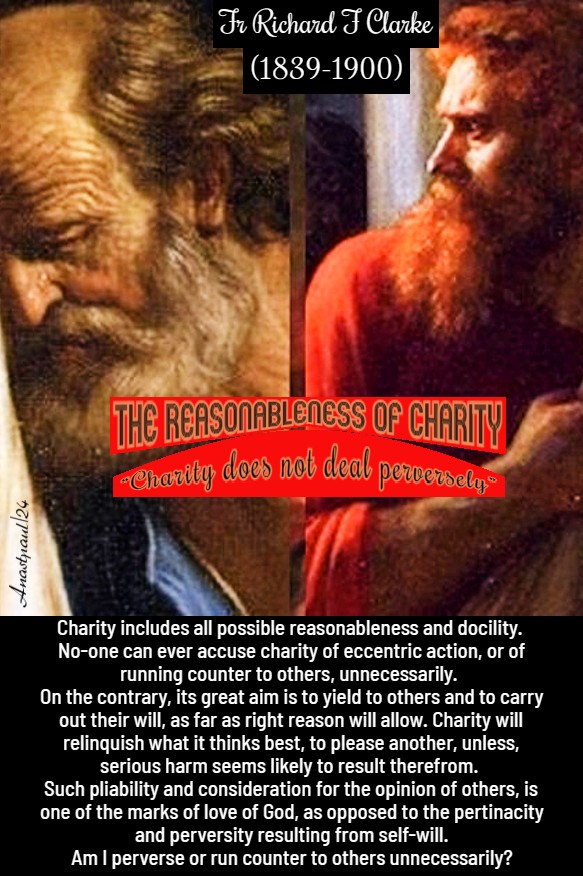
The Reasonableness of Charity “Charity does not deal perversely”
Perversity generally results from an overwhelming self-love. We all dislike children who seem to take pleasure, in doing a thing, just because it is opposed to the wishes or orders of those set over them. Those who are perverse, may have clear motives set before them and may know that, a certain course of action is their duty and in their interest, yet, they set that course of action aside ,for some folly of their own. In their hearts, they perceive the folly more clearly and would see it to be folly, if they were not blinded by the deceptive mist of their own self-will. Is perversity an element which enters into my actions, from time to time?
Opposed to perversity, is docility in those who obey and reasonable conduct, in those who have to act for themselves. How we love the docile! Even if we are not docile ourselves, others are dear to us, if they can be easily guided. We also love reasonable men who take a common sense view of things and we renounce crotchety and misguided theories, invented by unreasonable people. Even in the natural order, such reasonable men win our regard and esteem. We esteem them even more, when they are influenced to it by the love of God.
Charity includes all possible reasonableness and docility. No-one can ever accuse charity of eccentric action, or of running counter to others, unnecessarily. On the contrary, its great aim is to yield to others and to carry out their will, as far as right reason will allow. Charity will relinquish what it thinks best, to please another, unless, serious harm seems likely to result therefrom. Such pliability and consideration for the opinion of others, is one of the marks of love of God, as opposed to the pertinacity and perversity resulting from self-will. Am I perverse or run counter to others unnecessarily?
Quote/s of the Day – 6 August – The Transfiguration of the Lord – Scripture search here: https://www.drbo.org/
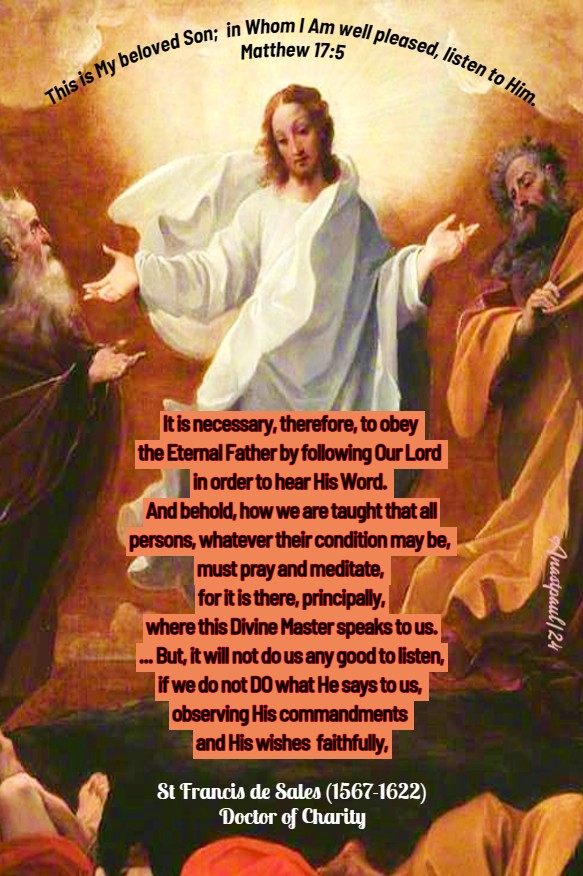
“This is My beloved Son; in Whom I Am well pleased, listen to Him.”
Matthew 17:5
“I Am the Light of the world. Whoever follows Me will never walk in darkness but will have the Light of Life.”
John 8:12
“Let us listen to the holy Voice of God which summons us from on high, from the holy mountain top. There, we must hasten – I make bold to say – like Jesus, Who is our leader and has gone before us into Heaven. There, with Him, may the eyes of our mind shine with His light and the features of our soul be made new; may we be transfigured with Him and moulded to His image, ever becoming divine, being transformed in an ever greater degree of glory.”
St Anastasius Sinaita (Died 6th Century) Priest and Abbot
“At His Transfiguration Christ showed His disciples, the splendour of His Beauty, to which He will shape and colour, those who are His : ‘He will reform our lowness configured to the Body of His Glory.”
St Thomas Aquinas (1225-1274) Doctor of the Church
“ It is necessary, therefore, to obey the Eternal Father by following Our Lord in order to hear His Word. And behold, how we are taught that all persons, whatever their condition may be, must pray and meditate, for it is there, principally, where this Divine Master speaks to us. … But, it will not do us any good to listen, if we do not DO what He says to us, observing His commandments and His wishes faithfully,”
One Minute Reflection – 6 August – “The Month of the Immaculate Heart of Mary” – The Transfiguration of Our Lord – 2 Peter 1:16-19; Matthew 17:1-9 – Scripture search here: https://www.drbo.org/
“His Face shone like the sunand His garments became white as snow.” – Matthew 17:2
REFLECTION – “The Lord displays His glory before chosen witnesses and makes illustrious that bodily shape which He shared with others, with such splendour that His Countenance shone like the sun and His garments became as white as snow. In this Transfiguration, the chief object was to remove the scandal of the Cross from the hearts of the disciples and, to prevent their faith being disturbed, at the humiliation of His voluntary Passion, by revealing the excellence of His hidden dignity. But, with no less foresight, the foundation was laid, of the hope of holy Church, that the whole Body of Christ, might realise, with what a change it was to be endowed and that the members, might promise themselves, a share in that honour which had shone forth in their Head.
But to confirm the Apostles and to lead them onto all knowledge, still further, instruction was conveyed by this miracle. For Moses and Elias, that is, the law and the prophets, appeared talking with the Lord, so that, in the presence of these five men, might most truly be fulfilled, what was said – In two or three witnesses every word stands. What more stable, what more steadfast, than the Word, in the proclamation of which, the trumpet of the Old and of the New Testaments, sounds forth and the records of ancient witnesses, agree with the teaching of the Gospel? For the pages of both Covenants corroborate each other and He, Whom, under the veil of Mysteries, the types that went before, had promised, is displayed clearly and manifestly by the splendour of His present glory.
The Apostle Peter, therefore, being stirred by the revelation of these Mysteries, despising things worldly and scorning things earthly, was carried away by a certain excess of mind, to the desire of things eternal and, being filled with rapture at the whole vision, longed to make his abode with Jesus, in the place where he was gladdened by the sight of His glory. And so also he says: Lord, it is good for us to be here: if Thou wilt, let us set up here, three tents, one for Thee and one for Moses and one for Elias. But to this proposal the Lord made no reply, signifying that what he asked was not indeed wicked, but irregular, since the world could not be saved, except by Christ’s Death and by the Lord’s example in this, the faithful were called upon to believe that, although there ought not to be any doubt about the promises of happiness, yet, we should understand that, amid the trials of this life, we must ask for power to endure, rather than for glory.” – St Leo the Great (400-461) Pope, Father and Doctor (Sermon on the Transfiguration – excerpt).
PRAYER – O God, Who in the glorious Transfiguration of Thy Only-begotten Son strengthened the Mysteries of faith, by the testimony of the fathers and, by the Voice coming down in a shining cloud, miraculously betokened the complete adoption of Thy children, mercifully grant that we, be made co-heirs with that King of glory and sharers in that same glory. Through the same Jesus Christ, Thy Son our Lord, Who lives and reigns with Thee, in the unity of the Holy Ghost, God, world without end. Amen (Collect).
Our Morning Offering – 6 August – The Transfiguration of Our Lord
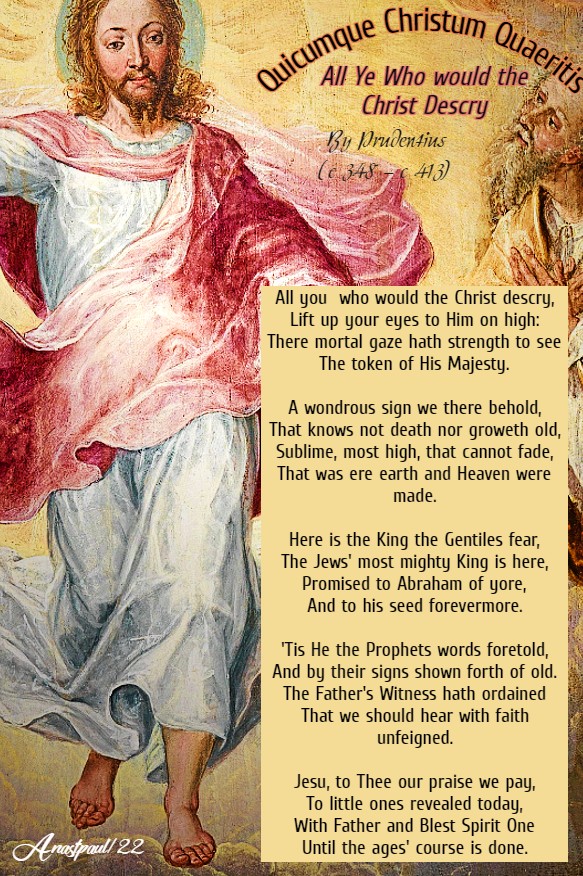
Quicumque Christum Quaeritis All Ye Who would the Christ Descry By Prudentius (c 348 – c 413) (Aurelius Prudentius Clemens) The Renowned Poet
All you who would the Christ descry, Lift up your eyes to Him on high: There mortal gaze hath strength to see The token of His Majesty.
A wondrous sign we there behold, That knows not death nor groweth old, Sublime, most high, that cannot fade, That was ere earth and Heaven were made.
Here is the King the Gentiles fear, The Jews’ most mighty King is here, Promised to Abraham of yore, And to his seed forevermore.
‘Tis He the Prophets words foretold, And by their signs shown forth of old. The Father’s Witness hath ordained That we should hear with faith unfeigned.
Jesu, to Thee our praise we pay, To little ones revealed today, With Father and Blest Spirit One Until the ages’ course is done.
The Hymn Quicumque Christum quaeritis is the twelfth and last poem in the Cathemerino of Prudentius, originally written in honour of the Epiphany. Its 208 lines has furnished four hymns to the Roman Breviary, Latin below the image. On the Feast of the Transfiguration the verses above are used. There is a short biography of Prudentius here: https://anastpaul.com/2020/01/08/quote-s-of-the-day-8-january-take-courage-it-is-i-and-bl-titus-zeman/
Quicumque Christum quaeritis, Uculos in altum tollite: Illic licebit visere Signum perennis glorias.
Illustre quiddam cernimus, Quod nesciat finem pati, Sublime, celsum, interminum, Antiquius ccelo et chao.
Hic ille Rex est Gentium, Populique Rex Judaici, Promissus Abraha patri, Ejusque in aevum semini.
Hunc et Prophetis testibus, Iisdemque signatoribus Testator et Pater jubet Audire nos, et credere.
Jesu, tibi sit gloria, Qui te revelas parvulis, Cum Patre et almo Spiritu In sempiterna saecula.
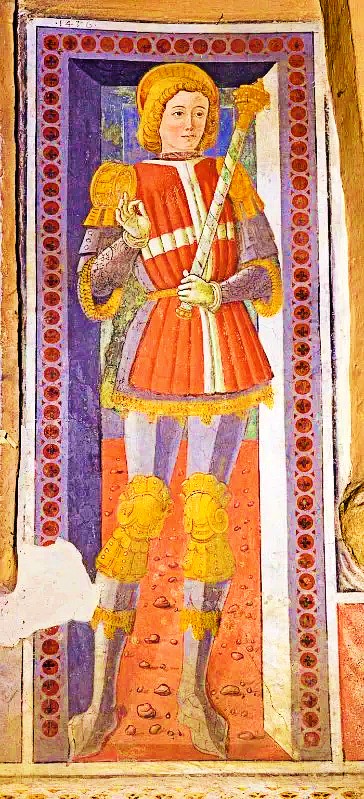
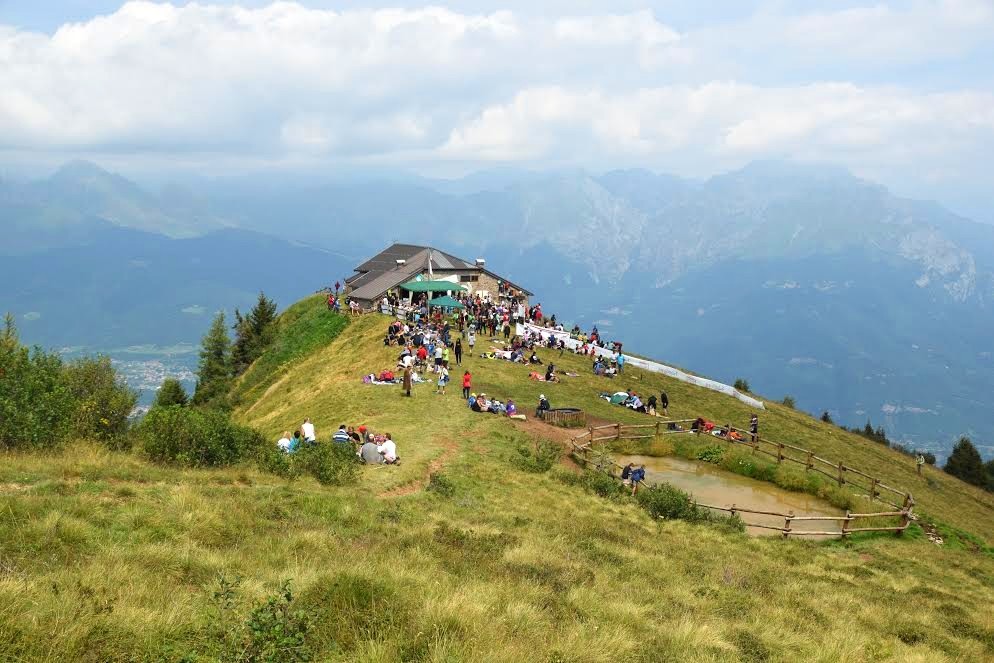
Saint of the Day – 6 August – Saint Glisente (Died 796) Hermit, Soldier known in the region as “The Warrior on the Mountain.” Died on 7 August 796 on Mount Berzo near Berzo Inferiore, Italy of natural causes. Also known as – Glisente of Brescia, Glisento of Berzo, … of Valcamonica, … of Valle Comonica. Additional Memorial – 26 July (commemorates the theft and return of his Relics).
Glisente was a valiant Commander of Charlemagne’s Army, until, after the defeat of the Lombards in Val Camonica on the slopes of Mortirolo, he asked his Sovereign to be released from his military duties in order to dedicate himself to the service of the Almighty in a life of prayer, penance and solitude.
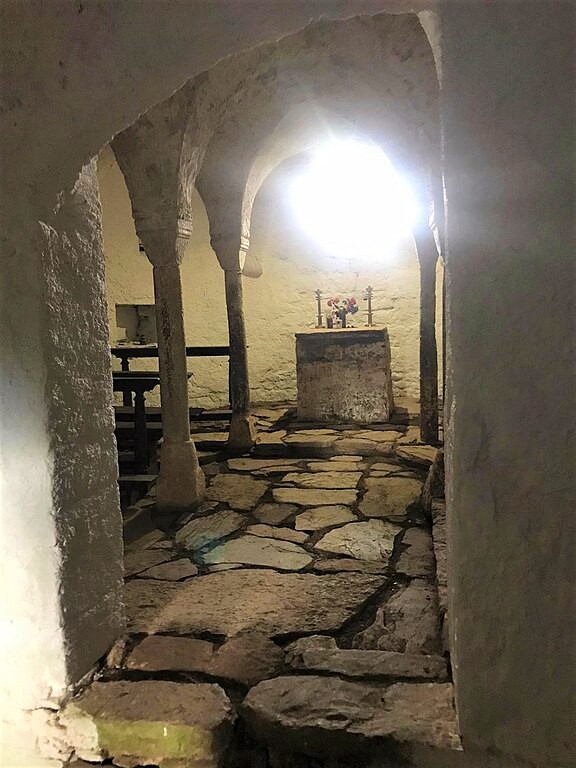
He settled in a underground cave dug in the hillside above Berzo Inferiore where he died on 7 August 796.
The next day some shepherds following a dove which was carrying twigs and leaves presumed to be building a nest, found the body of the holy Hermit. They then took some Relics and brought them to the Church of San Lorenzo in the Village of Berzo below.
Festivities on St Glisente’s Feast Day
But the inhabitants of Collio, led by the Knight of Christ, D Ardemagni (a well-known Templar of the time, as well as a Court musician of undoubted prestige), envious of the sacred remains, attempted to steal the body of Glisente and transfer it to their Town. But God punished them with blindness and only when they brought the body of the Saint back to his Tomb did they regain their sight.
Today, above the cave in lower Berzo, stands the Church of the St Glisente and the Hermit’s Cave can still be visited below the Church through a tunnel. St Charles Borromeo visited both during his pastoral visit to Valle Camonica in 1580.
The cult of Glisente has been attested since at least the 13th Century. In 1200, in fact, there was an Altar dedicated to him in the Church of Bovegno and a small Church was consecrated to him to the north-west of the same location.
Episodes from Glisente’s life are depicted in the frescoes of the Parish Church of San Lorenzo (16th Century), in the Parish Church of San Maria in Berzo and in the one dedicated to him on the mountain hich divides the territory of Berzo from Bovegno and Collio in Valle Trompia (15th Century).
In the current Parish Church of Berzo (17th Century) another Altar is dedicated to him. In the 17th Century St Gl;isente was included in the Calendar of Brescian Saints and his Feast day was established on 25 July because the inhabitants of Collio returned the Relics of the Saint which they had previously stolen, on that day. Today, however, they have disappeared again and it is not known where they are.
St Pope Sixtus II/ Xystus (Died 258) Pope and Martyr, Philosopher. 25th Pope from St Peter. Papal Ascension 30 August 257. He was Martyred along with seven deacons, (St Lawrence of Rome a few days later) during the persecutions of Christianity by Emperor Valerian. This is the St Sixtus who is commemorated in the Roman Canon Eucharistic Prayer. His Life and Death: https://anastpaul.com/2021/08/06/saint-of-the-day-6-august-saint-sixtus-ii-died-258-pope-and-martyr/
Bl Octavian of Savona St Stephen of Cardeña Bl William of Altavilla
Martyrs of Cardeña: Two hundred Benedictine Monks at the Saint Peter of Cardegna monastery, Burgos, Spain who were Martyred in the 8th century by invading Saracens. They were buried by local Christians in a nearby churchyard in Burgos, Spain and Beatified in 1603 by Pope Clement VIII (cultus confirmed).
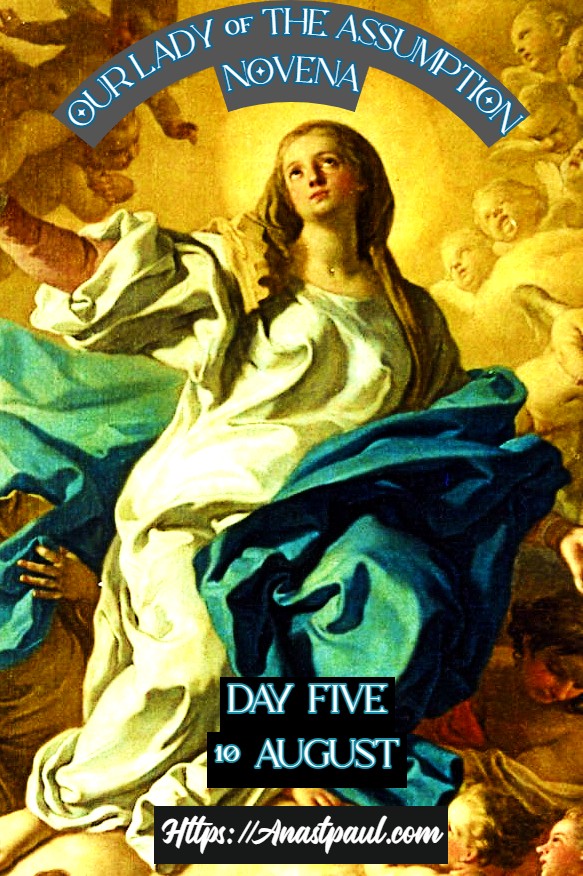
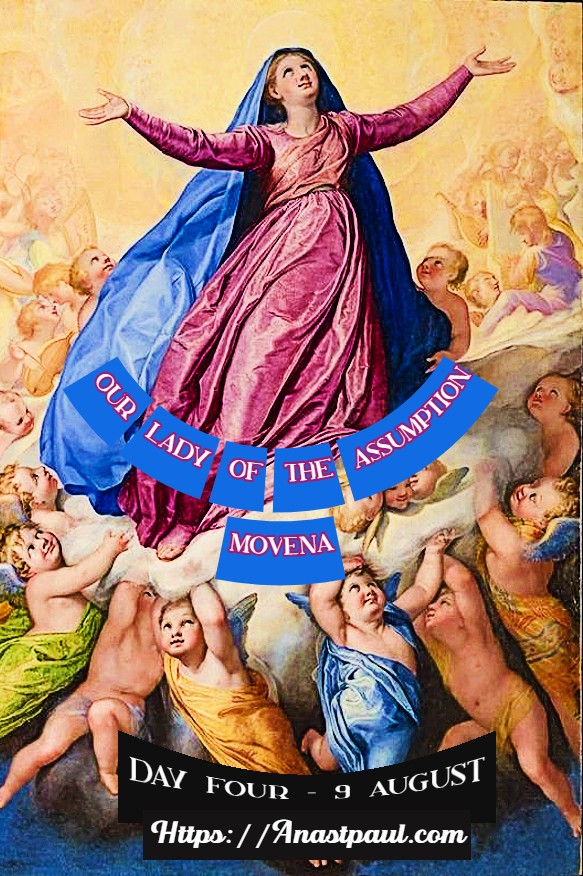
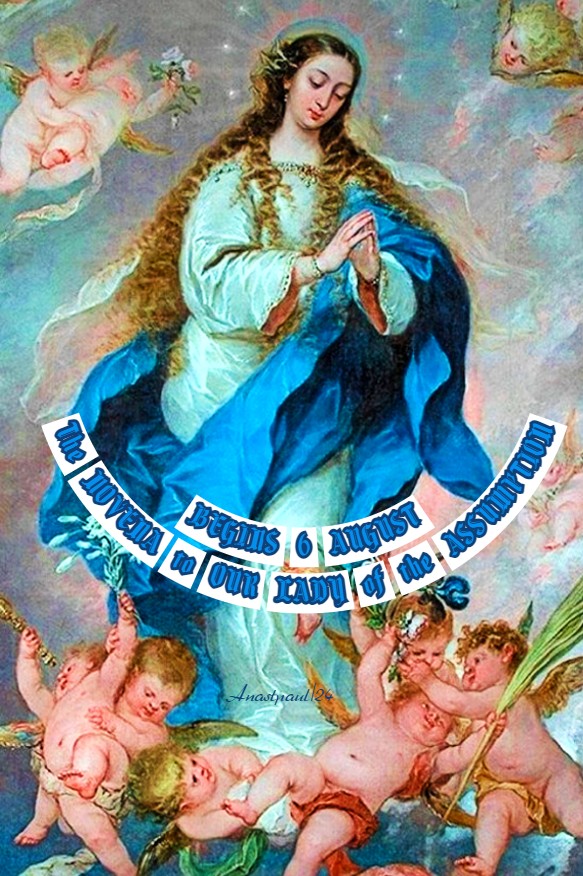
The Novena to Our Lady of the Assumption Begins 6 August in preparation for the Feast on 15 August – a Holy Day.
“We never give more honour to Jesus than when we honour His Mother, and we honour her, simply and solely, to honour Him all the more perfectly. We go to her only as a way leading to the goal we seek – Jesus, her Son.” s
St Louis Marie Grignion de Montfort (1673-1716)
Please join us as we pray a Novena in reverence and filial devotion to Our Lady, the Blessed Virgin Mary, Assumed into Heaven, our Queen and our Mother Mary.
We pray in preparation for the great Feast of the Assumption of Our Lady, Body and Soul as defined and declared as Dogma on 1 November 1950, by Pope Pius XII. Thus he solemnly proclaimed that the belief whereby, the Blessed Virgin Mary, at the close of her earthly life, was taken up, body and soul, into the Glory of Heaven, definitively forms part of the deposit of faith, received from the Apostles.
Our Novena will include a brief Meditation with practical reflection, a preparatory prayer by St Alphonsus Liguori and the daily prayer each morning for nine days. See you here!
Thought for the Day – 5 August – Meditations with Fr Richard Frederick Clarke SJ (1839-1900)
CHARITY Meditations for a Month
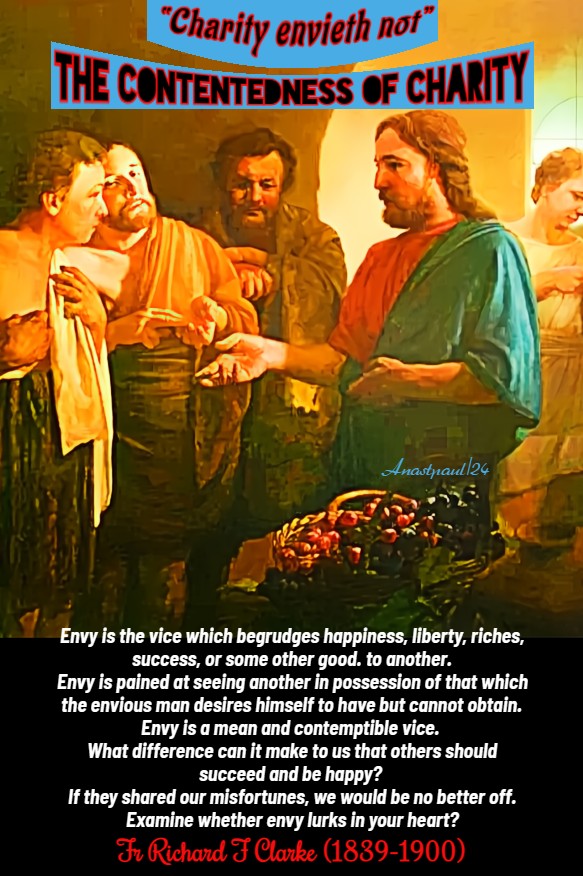
The Contentedness of Charity “Charity envieth not”
Envy is the vice which begrudges happiness, liberty, riches, success, or some other good. to another. Envy is pained at seeing another in possession of that which the envious man desires himself to have but cannot obtain. Envy is a mean and contemptible vice. What difference can it make to us that others should succeed and be happy? If they shared our misfortunes, we would be no better off. Examine whether envy lurks in your heart?
Envy is a vice which utterly destroys the peace of he who harbours it. He is always uneasy and unites the longing for that which he cannot have, with a hatred of those who are enjoying it. This double worm gnaws unceasingly at his heart. In our own interest, there is scarcely any vice which is such folly to harbour. Envy is also especially displeasing to God and hateful in His sight because, it challenges His goodness and rebels against, a state of things, which He has ordained or permitted.
How different is the spirit of charity! It takes pleasure in the pleasure of others, it rejoices in their success and is happy in seeing them happy. It wishes for nothing which others have and which is out of its own reach, for it recognises the wise Providence of God in all happenings and, therefore, is perfectly satisfied with everything and has no wish to see itself exalted and others depressed, as envy does. In view of the greater successes of others, is my spirit one of envy or one of charity? Do I rejoice in them or do I feel vexed and annoyed?
Quote/s of the Day – 5 August – “The Month of the Immaculate Heart of Mary” –Dedication of the Basilica of Our Lady of the Snows – Dedication of the Basilica of Our Lady of the Snows – Sirach 24:14-16: Luke 11:27-28 – Scripture search here:
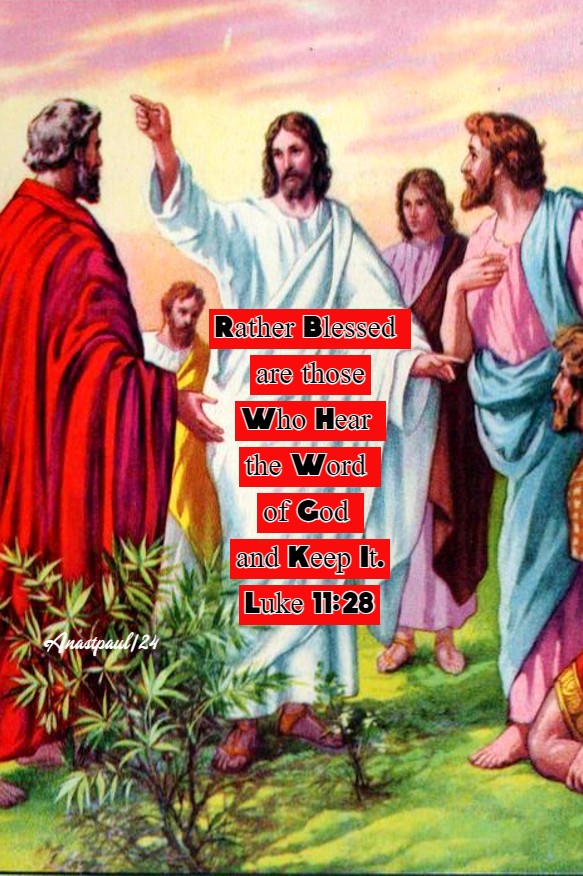
“Rather blessed are those who hear the Word of God and keep it.’”
Luke 11:28
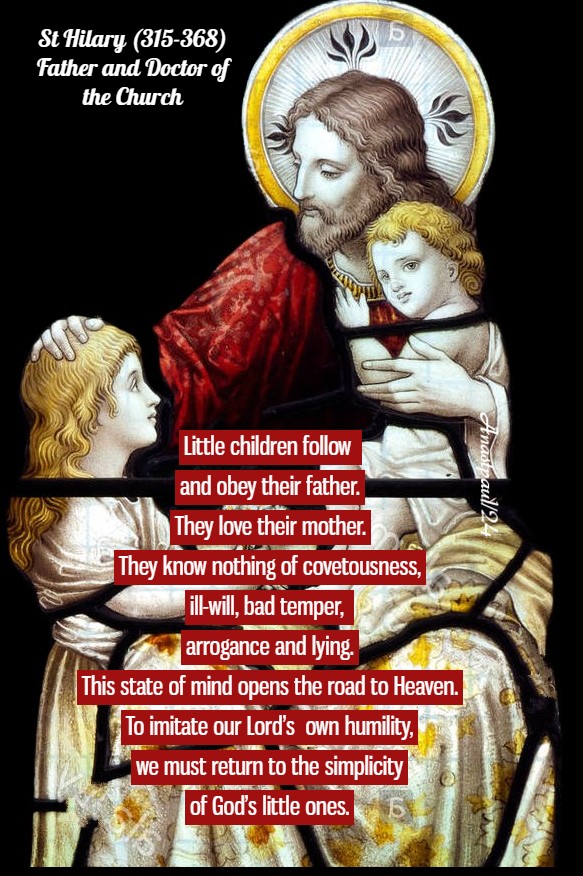
“Little children follow and obey their father. They love their mother. They know nothing of covetousness, ill-will, bad temper, arrogance and lying. This state of mind opens the road to Heaven. To imitate our Lord’s own humility, we must return to the simplicity of God’s little ones.”
St Hilary (315-368) Father and Doctor of the Church
“If anyone comes to Me without hating his father and mother, wife and children, brothers and sisters and even his own life, he cannot be My disciple.”
Luke 14:26
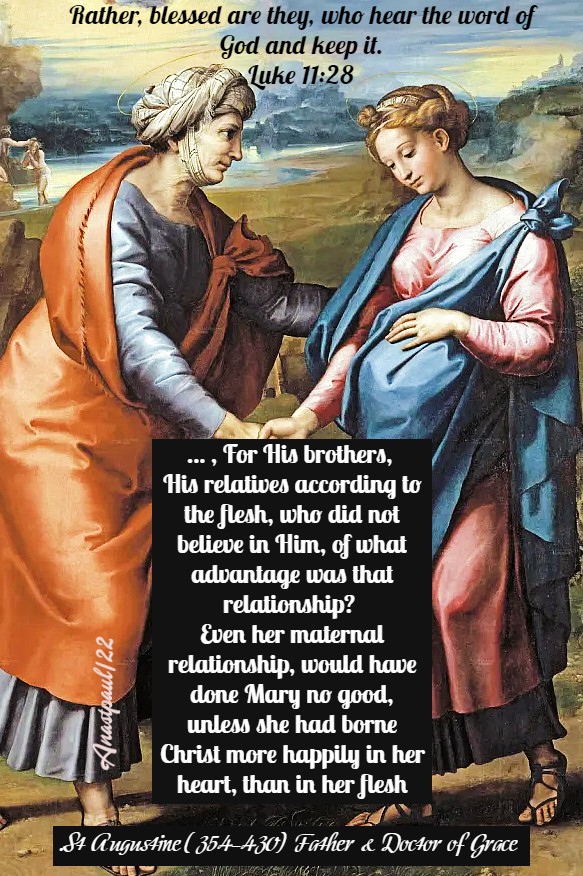
“ … For his brothers His relatives according to the flesh who did not believe in Him, of what advantage was that relationship? … Even her maternal relationship would have done Mary no good, unless she had borne Christ more happily in her heart, than in her flesh.”
St Augustine (354-430) Father & Doctor of Grace
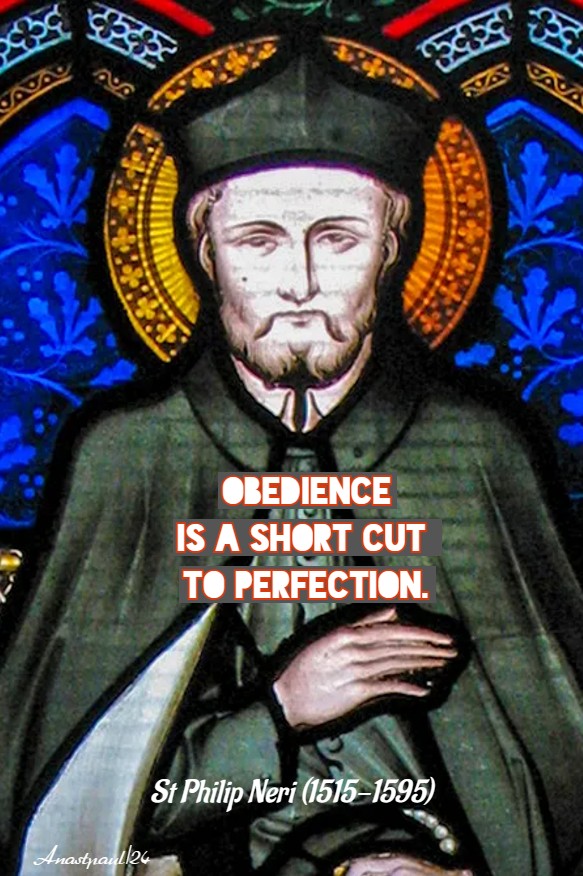
“Obedience is a short cut to perfection.”
St Philip Neri (1515-1595)
“Let us then depart, let us depart from Egypt, let us approach Our Lord, let us make provision of good works; let the feet of our affections be bare, let us clothe ourselves with innocence, let us not be satisfied with crying for mercy, let us go forth from Egypt, let us delay no longer. The hour is come to arise from sleep, since we know that He receives sinners; the Angels await our repentance, the Saints pray for it!”
St Francis de Sales 91567-1622) Doctor of the Church


























 AnaStpaul
You must be logged in to post a comment.