
Thought for the Day – 23 October – Meditations with Saint Alphonsus Maria de Liguori (1696-1787) Bishop, Confessor, Most Zealous Doctor of the Church
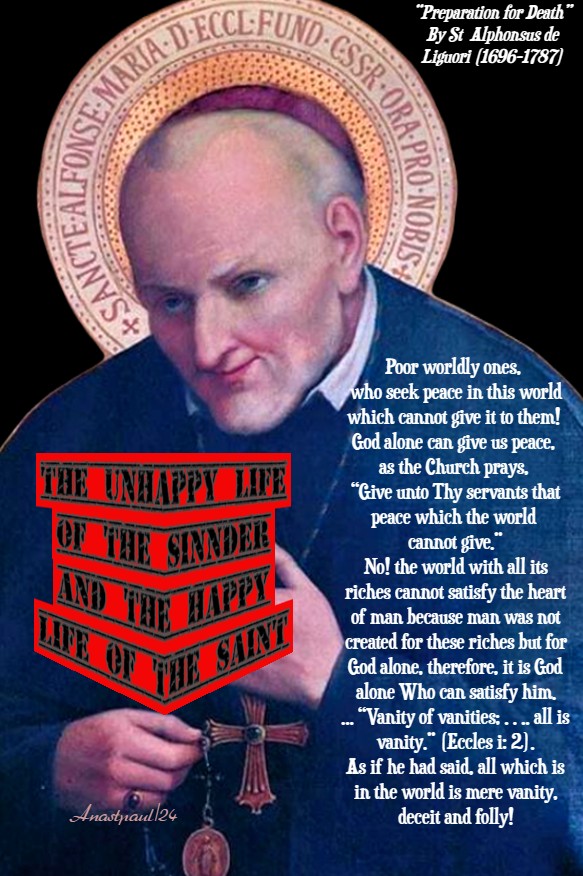
“Preparation for Death”
By St Alphonsus Maria de Liguori (1696-1787)
CONSIDERATION XXI
The Unhappy Life of the Sinnder
and the Happy Life of the Saint
“There is no peace, saith the Lord, unto the wicked.”
(Ps cxix: 165)
FIRST POINT:
ALL men in this life weary themselves to find peace – the
merchant, the soldier and he who has a lawsuit –;they all
try to find peace, thinking, by winning that gain, obtaining
that post, gaining that lawsuit, to make a fortune and thus, to find peace.
Poor worldly ones, who seek peace in this world which cannot give it to them! God alone can give us peace, as the Church prays, “Give unto Thy servants that peace which the world cannot give.”
No! the world with all its riches cannot satisfy the heart of man because man was not created for these riches but for God alone, therefore, it is God alone Who can satisfy him.
Animals are created for the delights of sense only; these find their happiness in earthly things. Give a horse a bundle of grass; give a dog a bone; they are both content and desire nothing more. But the soul which is created to love and to be united to God alone, will never be able to find peace in all the pleasures which sense can give. God alone can render it truly happy.
That rich man whom St Luke records, whose ground brought forth plentifully, said within himself: “Soul, thou hast much goods laid up for many years, take thine ease, eat, drink and be merry.” (Luke xii: 19). But this unhappy one was called a fool and with reason, as St Bernard observes. “Hast thou the soul of a hog? Ah, wretched one,” exclaims the Saint, “perhaps thou art like a beast, so that thou canst be satisfied with eating, with drinking, with sensual pleasures?”
He observes, that a man may be filled with the good things of this world but not satisfied. “Ye eat but ye have not enough.” (Hag i: 6). And for this reason, the more the avaricious man acquires, the more does he seek to acquire. St Augustine observes, increased riches do not close but rather extend, the jaws of avarice!
When Alexander the Great had acquired many kingdoms, he wept because he could conquer no more.
If the riches of this world could satisfy a man, the rich and
those who govern, would be fully happy but experience teaches us the contrary. Solomon observes the same thing, even he asserts that he never denied his senses one thing.
“And whatsoever mine eyes desired, I kept not from them.” (Eccles ii: 10). But notwithstanding, what does he say? “Vanity of vanities; …. all is vanity.” (Eccles i: 2).
As if he had said, all which is in the world is mere vanity, deceit and folly!
Affections and Prayers
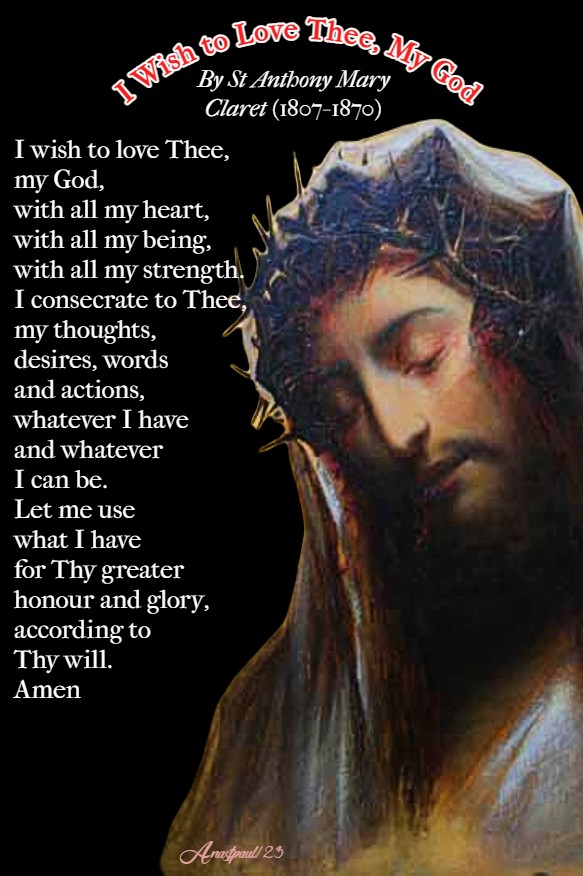
Ah, my God! what is there remaining to me of all the offences I have committed against Thee but trouble, bitterness and the horror that I deserve hell!? The bitterness which I feel does not displease me; nay, it rather consoles me, for it is the gift of Thy grace and causes me to hope, since Thou dost give it to me that Thou art willing to pardon me.
That which does displease me, is the bitterness I have caused Thee, my Redeemer, Thou Who hast loved me so much. My Lord, I deserved to be abandoned by Thee then but, instead of leaving me, Thou dost offer me pardon; nay, Thou art the first to ask for peace.
Yes, my Jesus, I would be at peace with Thee and I desire Thy grace more than any other good. I repent, O Thou Infinite Goodness, for having offended Thee. I would die of grief.
Ah, through that love which Thou didst bear for me when dying on the Cross, pardon me and take me to Thinr Heart and change my heart in such a way that I may please Thee in the time to come, as much as I have displeased Thee in the time that is past. …
Grant me Lord, Thine grace and help and then do with me what Thy wilt.











 AnaStpaul
You must be logged in to post a comment.