Thought for the Day – 17 November – Meditations with Saint Alphonsus Maria de Liguori (1696-1787) Bishop, Confessor, Most Zealous Doctor of the Church
“How to Pray at All Times” By St Alphonsus Maria de Liguori (1696-1787)
How God Answers the Soul Excerpt from Chapter Four
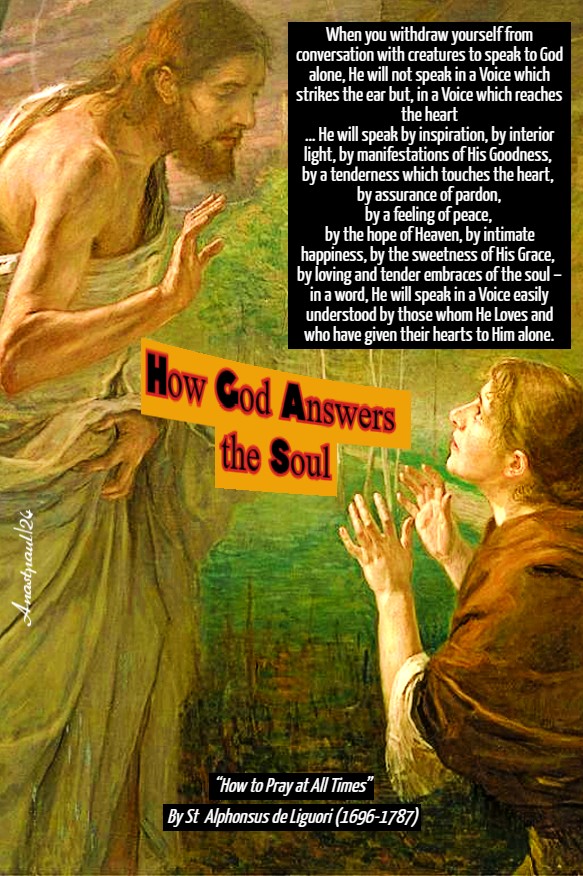
In a word, if you wish to please the loving Heart of God, endeavour to speak to Him as often as you can and, with the fullest confidence which He will answer and speak to you in return. When you withdraw yourself from conversation with creatures to speak to God alone, He will not speak in a Voice which strikes the ear but, in a Voice which reaches the heart
… He will speak by inspiration, by interior light, by manifestations of His Goodness, by a tenderness which touches the heart, by assurance of pardon, by a feeling of peace, by the hope of Heaven, by intimate happiness, by the sweetness of His Grace, by loving and tender embraces of the soul – in a word, He will speak in a Voice easily understood by those whom He Loves and who have given their hearts to Himalone.”
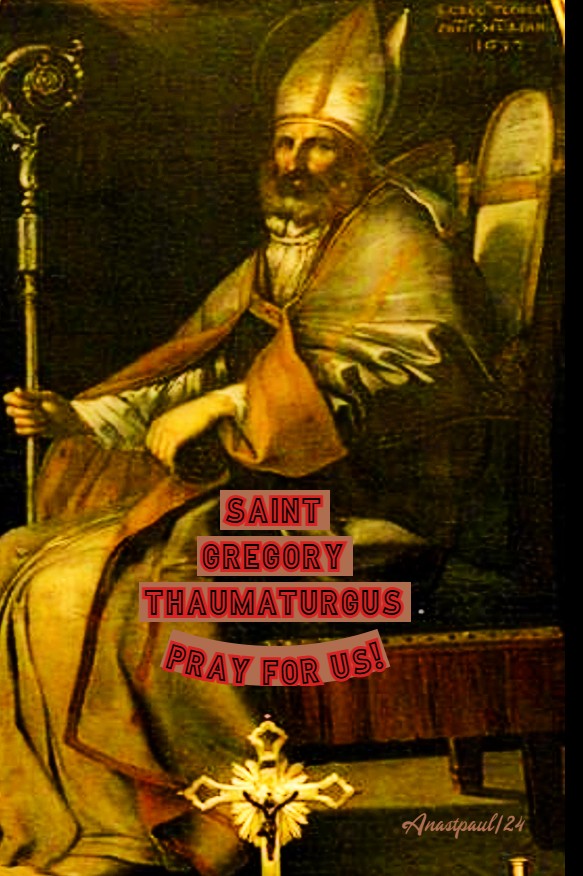
One Minute Reflection – 17 November – “The Month of the Holy Souls in Purgatory” – St Gregory Thaumaturgus (c 213-c 270) “the Wonder-Worker,” Bishop, Confessor – 1 Thessalonians 1:2-10; Matthew 13:31-35 – Scripture search here: https://www.drbo.org/
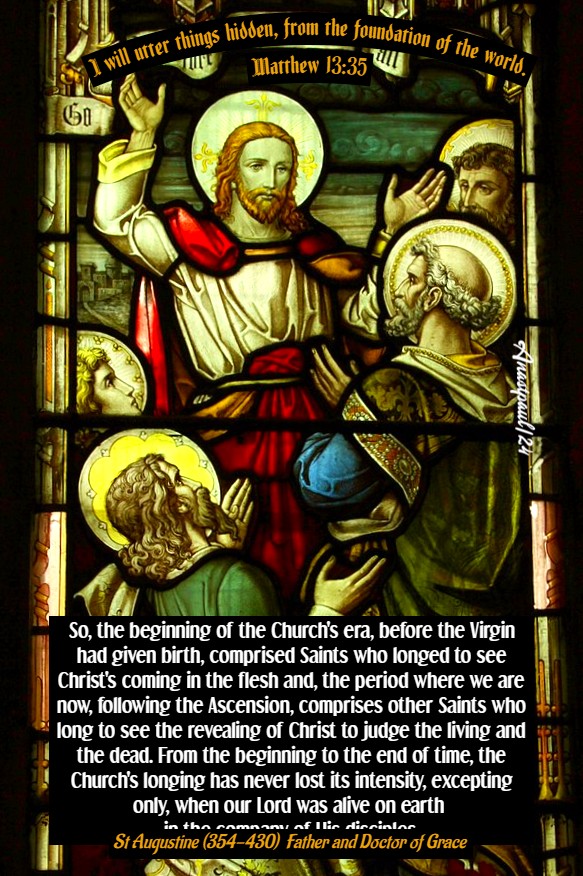
“I will utter things hidden, from the foundation of the world.” – Matthew 13:35
REFLECTION – “In one of the Psalms the Prophet says: “My soul pines for Thy salvation; I hope in Thy Word” (118:1) … Who is expressing this ardent desire if not “the chosen race, the royal priesthood, the people set apart for God” (1 Pt 2:9) each in their own day, in each one of those, who have lived, are living or will live, from humanity’s first beginning until the end of the world? … This is why our Lord Himself, says to His disciples: “Many Prophets and righteous men have wished to see that which you see.” It is their voice, then, we must recognise in this Psalm … Their longing has never come to an end in the Saints, nor does it end even now in “the Body of Christ, the Church” (Col 1:18) until “the Desired of all nations” comes (Hag 2:8) …
So, the beginning of the Church’s era, before the Virgin had given birth, comprised Saints who longed to see Christ’s coming in the flesh and, the period where we are now, following the Ascension, comprises other Saints who long to see the revealing of Christ to judge the living and the dead. From the beginning to the end of time, the Church’s longing has never lost its intensity, excepting only, when our Lord was alive on earth in the company of His disciples.” – St Augustine (354-430) Bishop of Hippo, Father and Doctor of Grace (Discourses on the Psalms Ps 118 No 20).
PRAYER – Grant, we beseech Thee, Almighty God that the venerable feast of Thy blessed Gregory Confessor and Bishop may increase our devotion and promote our salvation. Through Jesus Christ, Thy Son our Lord, Who lives and reigns with Thee, in the unity of the Holy Ghost, God, world without end. Amen (Collect).
Our Morning Offering – 17 November – Pentecost XXVI
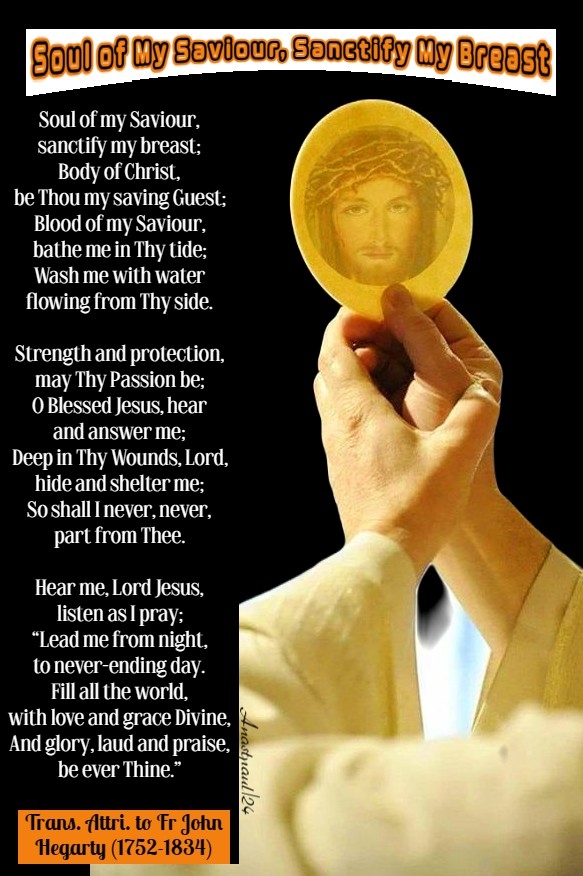
Soul of My Saviour, Sanctify My Breast Trans. Attri. to Fr John Hegarty (1752-1834)
Soul of my Saviour, sanctify my breast; Body of Christ, be Thou my saving Guest; Blood of my Saviour, bathe me in Thy tide; Wash me with water flowing from Thy side.
Strength and protection, may Thy Passion be; O Blessed Jesus, hear and answer me; Deep in Thy Wounds, Lord, hide and shelter me; So shall I never, never, part from Thee.
Hear me, Lord Jesus, listen as I pray; “Lead me from night, to never-ending day. Fill all the world, with love and grace Divine, And glory, laud and praise, be ever Thine.”
This Hymn is based on the original Latin text of the Anima Christi. Fr Hegarty is attributed with its translation and/or arrangement. He was born in County Derry, Ireland, educated at Dublin University and was Ordained in June 1890 and spent most of active apostolic years in Brisbane, Australia. He died aged 82 years.
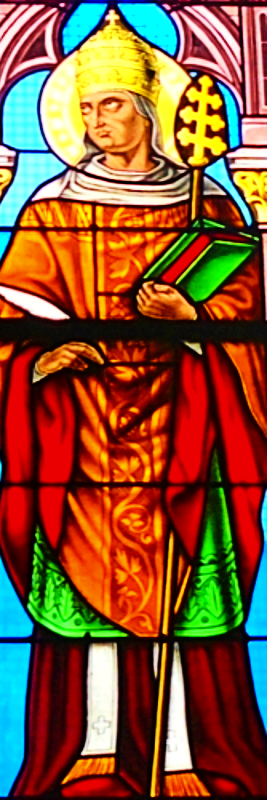
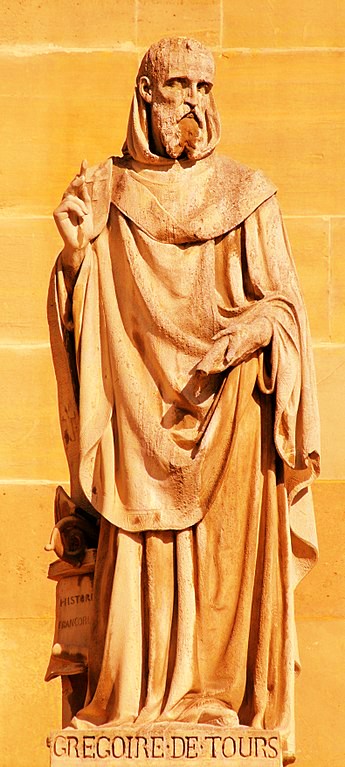
Saint of the Day – 17 November – St Gregory of Tours (c538-594) Bishop Confessor, Writer, Historian, Miracle-worker, Born in Auvergne, in Clermont-Ferrand, France on 30 November 538 as George Florentius and died at Tours on 17 November 594. Patronages – Tours and Auvergne, France. Also known as – George Florentius, “The Father of French History.” Saint Gregory of Tours wrote a great deal but his main work, is his Historia Francorum, without which the history and customs of the second half of the 6th Century would be almost unknown to us. He can be considered “The Father of French History.”
George Florentine, who took the name Gregory on the occasion of his Episcopal Consecration, in memory of a great-grandfather who was the Bishop of Langres, was born in Auvergne, in Clermont, on 30 November 538. The year of his birth is known to us from some references contained in his writings. However, historians of Gregory have interpreted these chronological data differently; the majority, however, agree on the date of 538 and it seems that this interpretation is definitive.
Gregory belonged to one of the most spirituallyand materially illustrious families of the Gallo-Roman nobility; it counted a Martyr, 5 Bishops later honoured as Saints and Senators. His father, in poor health, died young without ever having held public office, leaving his widow Armentaria to raise their three sons, George, Peter, who would become a Deacon and be murdered by an envious man and a daughter, whose name is unknown, who would marry a certain Justin.
After her husband’s death, Armentaria left Clermont and came to settle in the kingdom of Burgundy near Cavaillon, where she had a property. Little Gregory was then eight years old, One of his uncles, the future Bishop of Lyons, St Nicetius, took charge of his education. Another uncle, St Gall, had founded a school in Clermont, his Episcopal City, directed by St Avitus, also a future Bishop. Gregory attended this school and developed a great taste for study and a love of books, in fact, when he became the Bishop, one of his first aims was to gather and collect a well-stocked library in the Bishops Palace.
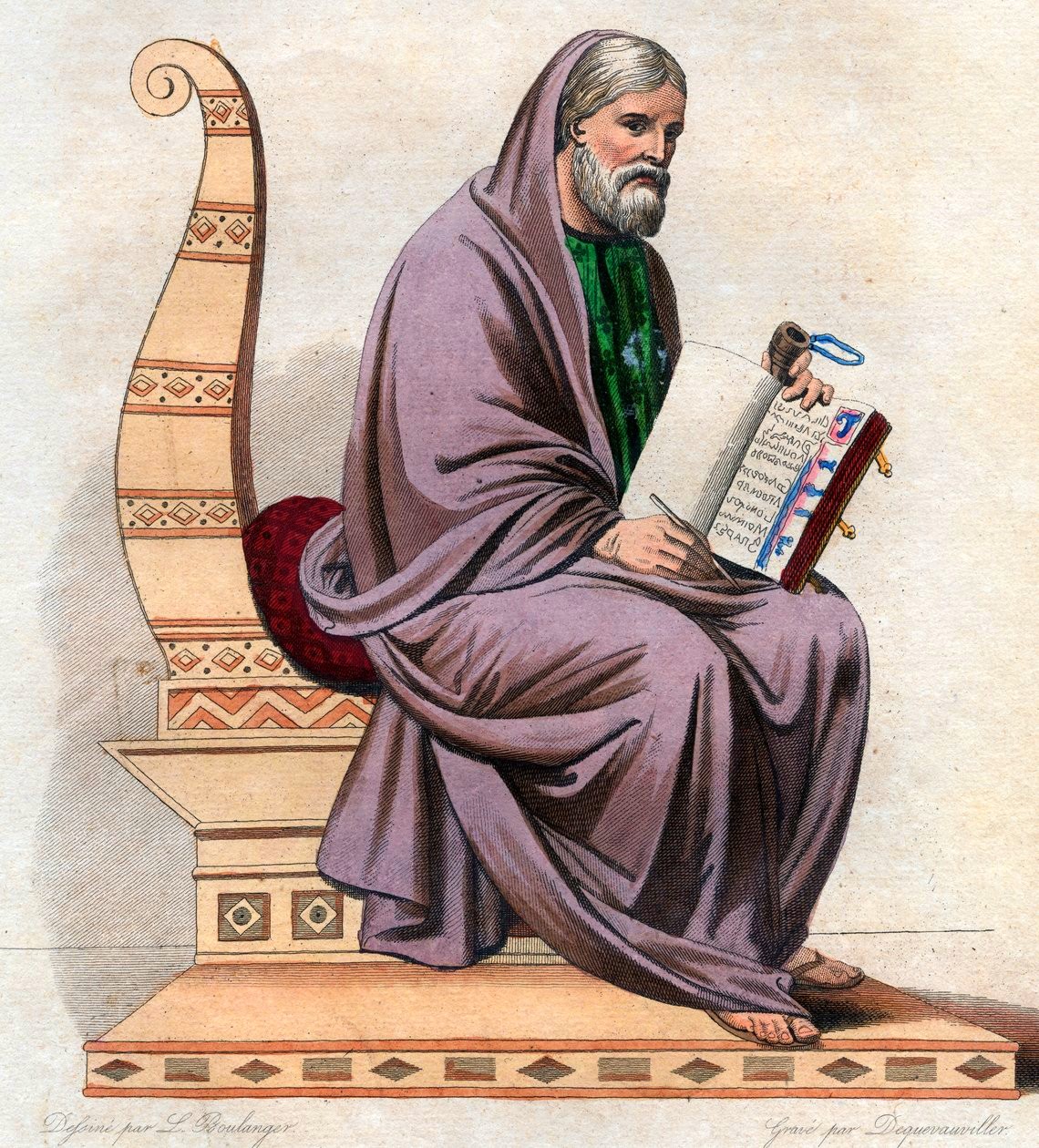
He read a great deal, especially historical volumes. From the quotations and reminiscences found among his own works, it is possible to affirm that he read the Chronicle of St Eusebius, translated by St Jerome and his Ecclesiastical History, translated by St Rufinu. He read many others especially the Passions of the Martyrs and Vitas of Saints, among them most loved, the books of St Sulpicius Severus on St Martin and he also read St Sidonius Apollinaris. He studied long fragments of Virgil’s works by heart allowing him to often quote the Aeneid. He also read Sallust and perhaps Aulus Gellius and Pliny but he did not know Cicero except through St Jerome. He was above all attracted by the Sacred Scriptures as he himself informs us.
At the age of twenty-five, Gregory was Ordained a Deacon of the Church of Auvergne; shortly afterward, he fell seriously ill but made a pilgrimage to the Tomb of St Martin, where he obtained a cure. He remained for some time at Tours with Bishop Euphronius, his cousin.
Gregory then visited Burgundy and then Lyons, where he served as Deacon for his uncle Nicetius. During his stay in Rheims in 578 he received news of the death of his cousin, the Bishop of Tours and of his own election to succeed him which took place eighteen days later. He received Episcopal Consecration in Rheims from the hands of Bishop Giles and then went to his residential City. Among the Bishops of Tours, only five were not from his own family, so it is not surprising that he succeeded his cousin and, in the Frankish Church, he had a reputation as a wise and holy man.
After the division of 567, Tours was in the kingdom of Sigebert, a kingdom which was actually composed of separate territories, with Rheims and Tours as its capitals. When Gregory acceded to the Episcopate, the Church was in a period of adaptation to a new situation. Gaul was losing its Roman aspect and entering the barbarian period. Politically, the country, reunited by Clotaire I, had been divided after his death in December 561 between his four sons, Charibert, Gunter, Sigebert and Chilperic. Charibert was king of the West, from Amiens to the Pyrenees with Paris as its capital (Tours was in this part). But Charibert having died in 567, his three brothers divided the territory again.
Given the instability caused by these frequent divisions, civil war was a constant threat and often a sad reality. Furthermore, the rough customs of the time meant that, even without wars and raids, assassinations and sieges of Cities were frequent. The Church suffered in its clergy, in its lands and possessions and especially, in its buildings, often ruined or burned.
The City of Tours was then of great importance, its geographical position, its wealth made it enviable. It was also a spiritual centre of Gaul. Our Gregory, the Bishop of Tours, was in fact, the successor of the beloved St Martin and guardian of his Tomb, making him one of the great figures of the Frankish Church.
In 594 he went on a pilgrimage to Rome to venerate the Tombs of the holy Apostles. Saint Gregory the Great, who had been newly elected as the Pope, received him with great honours, however, seeing him of very small stature, he admired that God had enclosed such a beautiful soul and so many graces in so small a body. The Bishop knew this thought by revelation and said to him: “The Lord has created us and we have not made ourselves but He is the same in the small, as in the great.” The Pope was astonished to see that he had penetrated the secret of his heart and from then, he honoured him as a Saint, gave him a gold chain, to put in his Church of Tours and, granted in his favour, beautiful privileges to the same Church
Saint Gregory of Tours, during his life, performed a very great number of miracles but, as he was extremely humble, to hide the grace of the cures with which God had favoured him, he always applied to the sick the Relics he carried with him. He also received from the goodness of God, quite extraordinary favours and assistance. Thieves having come to mistreat him, they were forced to flee by a terror which seized them. A storm, accompanied by lightning and thunder, having arisen suddenlywhile he was travelling, he only opposed his Reliquary to it and it dissipated in a moment. On the same occasion, this miracle having given him some vain joy and a sort of complacency, he immediately fell from his horse and learned thereby to stifle in his heart, the smallest feelings of pride. One Christmas Day, in the morning, in a deep sleep after having watched all night, a person appeared to him in a dream and woke him, three times,, saying to him the third time, by allusion to his name, Gregory which means vigilant – ‘Will you always sleep, you who must awaken others?’ Finally, his life was filled with so many wonders, it would take a whole volume to relate them.
Since his return from Rome, he applied himself more than ever to the visitation of his Diocese, to the correction and sanctification of the souls committed to his care, to the preaching of the word of God and to all the other functions of a good Bishop. It was in these exercises that he completed the course of his life, being only fifty-six years old, on 17 November in the year 594 which was the twenty-first of his Episcopate. The humility which he had practiced during his life appeared again after his death, by the choice he made of his burial.
His Clergy could not consent to his Tomb being established on the ground where one could walk, as he had requested, so he was buried next to the Tomb of Saint Martin. He was Canonised a few years after his death.
St Gregory of Tours, 19th Century statue by Jean Marcellin, in the Louvre in Paris, France








 AnaStpaul
You must be logged in to post a comment.