Thought for the Day – 6 January – Meditations with Fr Richard Frederick Clarke SJ (1839-1900)
Meditations for Christmastide – “The Holy Infancy” From “The Devout Year” By Fr Richard Frederick Clarke SJ (1839-1900)
“The Epiphany”
+1. The Sun of Justice Who rose on Christmas morn did not shine on the Jews only. The Light Who shone upon the rejoicing earth was a Light Who was to enlighten the Gentiles as well as to be the glory of the people of Israel. The Feast of the Epiphany was the declaration of the world-wide dominion of the new-born King. It proclaimed that the kingdoms of this world were to be the Kingdoms of the Lord and of His Christ. Rejoice with the Infant King in His universal Sovereignty , and pray that His Kingdom may speedily be acknowledged by all His subjects.
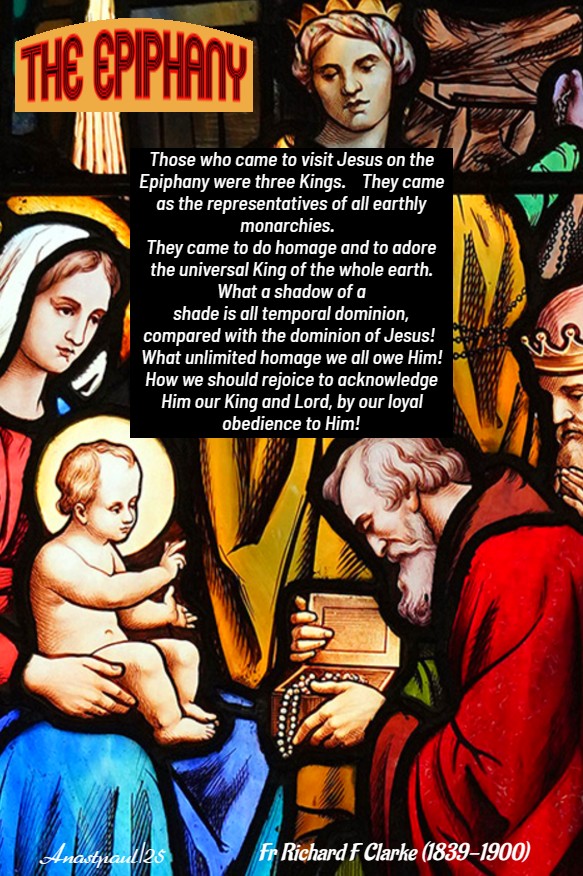
+2. Those who came to visit Jesus on the Epiphany were three Kings. They came as the representatives of all earthly monarchies. They came to do homage and to adore the universal King of the whole earth. What a shadow of a shade is all temporal dominion, compared with the dominion of Jesus! What unlimited homage we all owe Him! How we should rejoice to acknowledge Him our King and Lord, by our loyal obedience to Him!
+3. This festival is especially the festival of converts. Our ancestors were once pagans until the Vicar of Christ sent to our beloved country, the apostle who proclaimed to us the Faith of Christ This Faith in many lands, has faded now and mockery sits on Juda’s throne. Alas, to think that those who had the inheritance of the Faith have lost it How can I ever be grateful enough for the Light Who shines on me!
Quote/s of the Day – 6 January – The Epiphany of the Lord
“We have seen His Star in the east and are come to adore Him.”
Matthew 2:2
“The obedience of the Star calls us to imitate its humble service: to be servants, as best we can, of the grace which invites all men to find Christ.”
St Pope Leo the Great (400-461) Father and Doctor of the Church
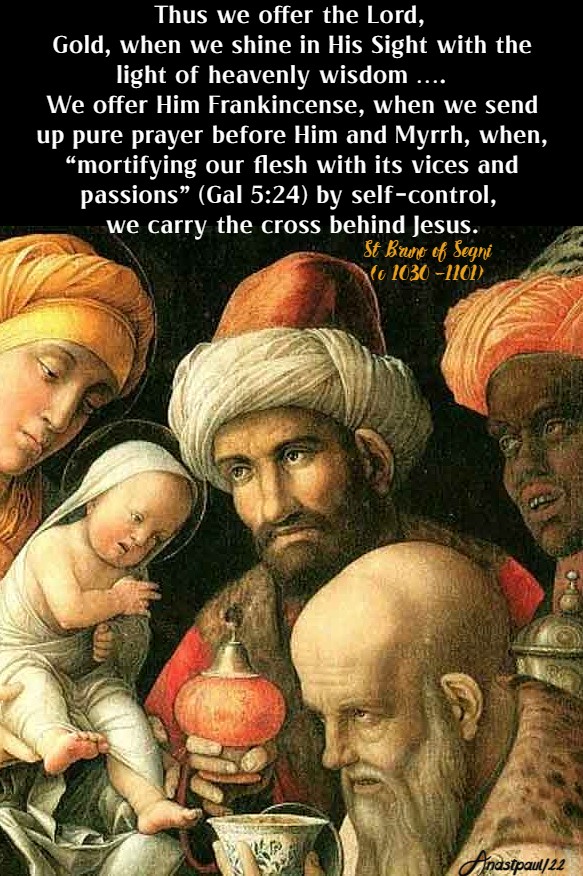
“Thus we offer the Lord, Gold, when we shine in His Sight with the Light of heavenly wisdom …. We offer Him Frankincense, when we send up pure prayer before Him and Myrrh, when, “mortifying our flesh with its vices and passions” (Gal 5:24) by self-control, we carry the cross behind Jesus.”
St Bruno of Segni O.Cart. (c 1030 -1101)
Bishop (1st Sermon on the Epiphany PL 165, 863).
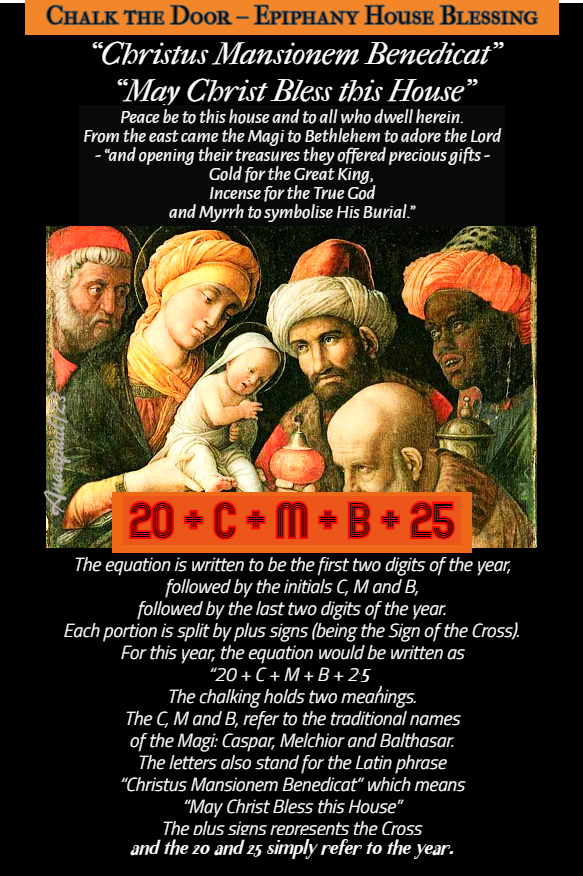
Chalk the Door – Epiphany House Blessing 20 C+M+B 25
“Christus mansionem benedicat” Peace be to this house and to all who dwell herein. From the east came the Magi to Bethlehem to adore the Lord – “and opening their treasures they offered precious gifts – Gold for the Great King, Incense for the True God and Myrrh to symbolise His Burial.”
The equation is written to be the first two digits of the year, followed by the initials C, M and B, followed by the last two digits of the year. Each portion is split by plus signs (being the Sign of the Cross). For this year, the equation would be written as “20 + C + M + B + 25” The chalking holds two meanings. The C, M and B, refer to the traditional names of the Magi: Caspar, Melchior and Balthasar. The letters also stand for the Latin phrase “Christus Mansionem Benedicat” which means “May Christ Bless this House” The plus signs represents the Cross and the 20 and 25 simply refer to the year.
One Minute Reflection – 6 January – “The Month of the Holy Name of Jesus and the Holy Family” – The Epiphany of the Lord – Isaias 60:1-6, Matthew 2:1-12 – Scripture search here: https://www.drbo.org/
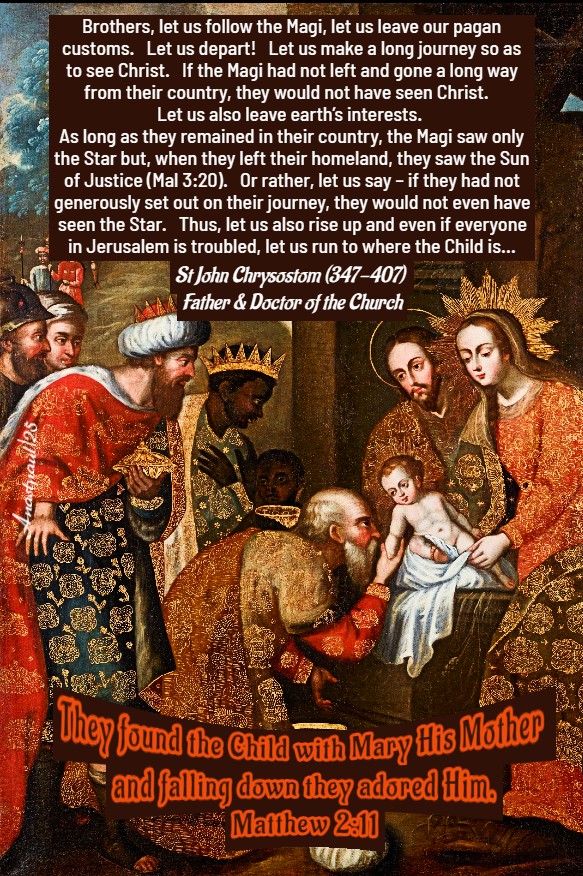
“They found the Child with Mary His Mother and falling down they adored Him.” – Matthew 2:11
REFLECTION – “Brothers, let us follow the Magi, let us leave our pagan customs. Let us depart! Let us make a long journey so as to see Christ. If the Magi had not left and gone a long way from their country, they would not have seen Christ. Let us also leave earth’s interests. As long as they remained in their country, the Magi saw only the Star but, when they left their homeland, they saw the Sun of Justice (Mal 3:20). Or rather, let us say – if they had not generously set out on their journey, they would not even have seen the Star. Thus, let us also rise up and even if everyone in Jerusalem is troubled, let us run to where the Child is…
“On entering the house, they found the Child with Mary His Mother. They prostrated themselves and did Him homage. Then they opened their coffers and presented him with gifts.” What motivated them to prostrate themselves before this Child? There was nothing remarkable in the Virgin or in the house, no object could have struck their eye and attracted them. And yet, not content with prostrating themselves, they opened their treasure, gifts which are not given to a human being but only to God – Frankincense and Myrrh symbolise Divinity. What was their reason for acting in this way? The same as that which made them decide to leave their homeland, to depart on this long journey. It was the Star, that is to say, the Light with which God had filled their heart and which led them, little by little, to a more perfect knowledge. If there had not been that Light, how could they have given such homage, when what they saw was so poor and humble? If there is not material grandeur but only a crib, a stable, a mother who is lacking in everything, it is so that you might see the Magi’s wisdom more clearly, so that you understand – they came not to a human being but to a God, to their Benefactor.” – St John Chrysostom (347-407) Bishop of Constantinople, Father & Doctor of the Church (Sermons on St Matthew 7-8).
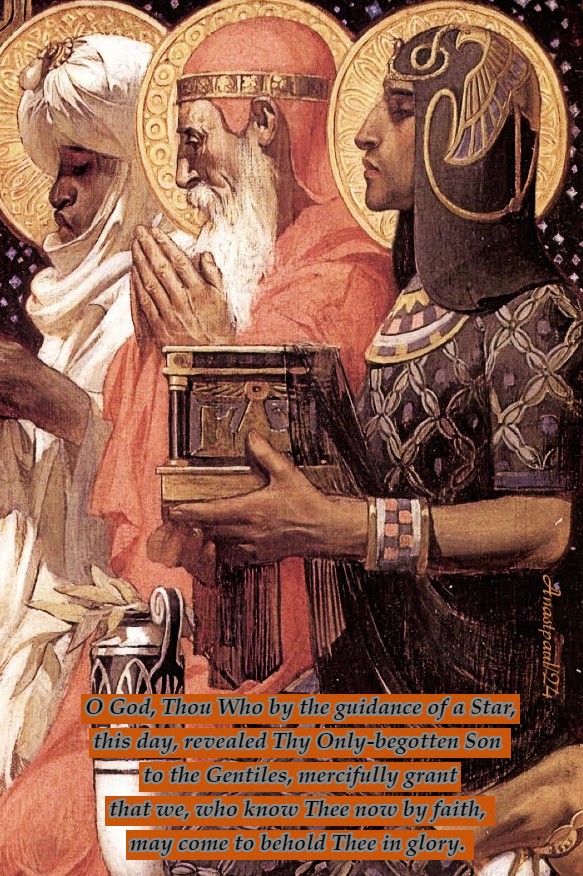
PRAYER – O God, Thou Who by the guidance of a star this day revealed Thy Only-begotten Son to the Gentiles, mercifully grant that we, who know Thee now by faith, may come to behold Thee in glory. Through the same Jesus Christ, Thy Son our Lord, Who lives and reigns with Thee, in the unity of the Holy Ghost, God, world without end. Amen (Collect).
Our Morning Offering – 6 January – “The Month of the Holy Name of Jesus and the Holy Family” – The Feast of The Epiphany of the Lord
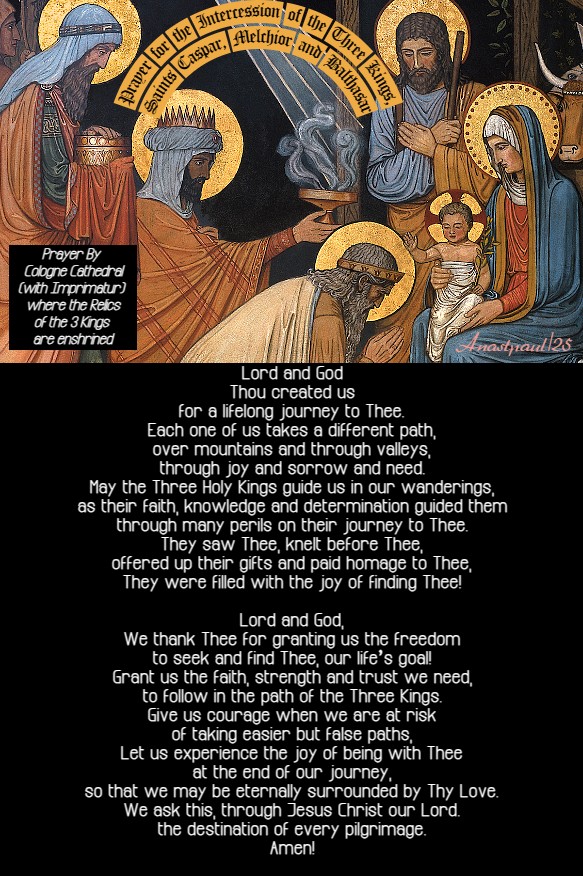
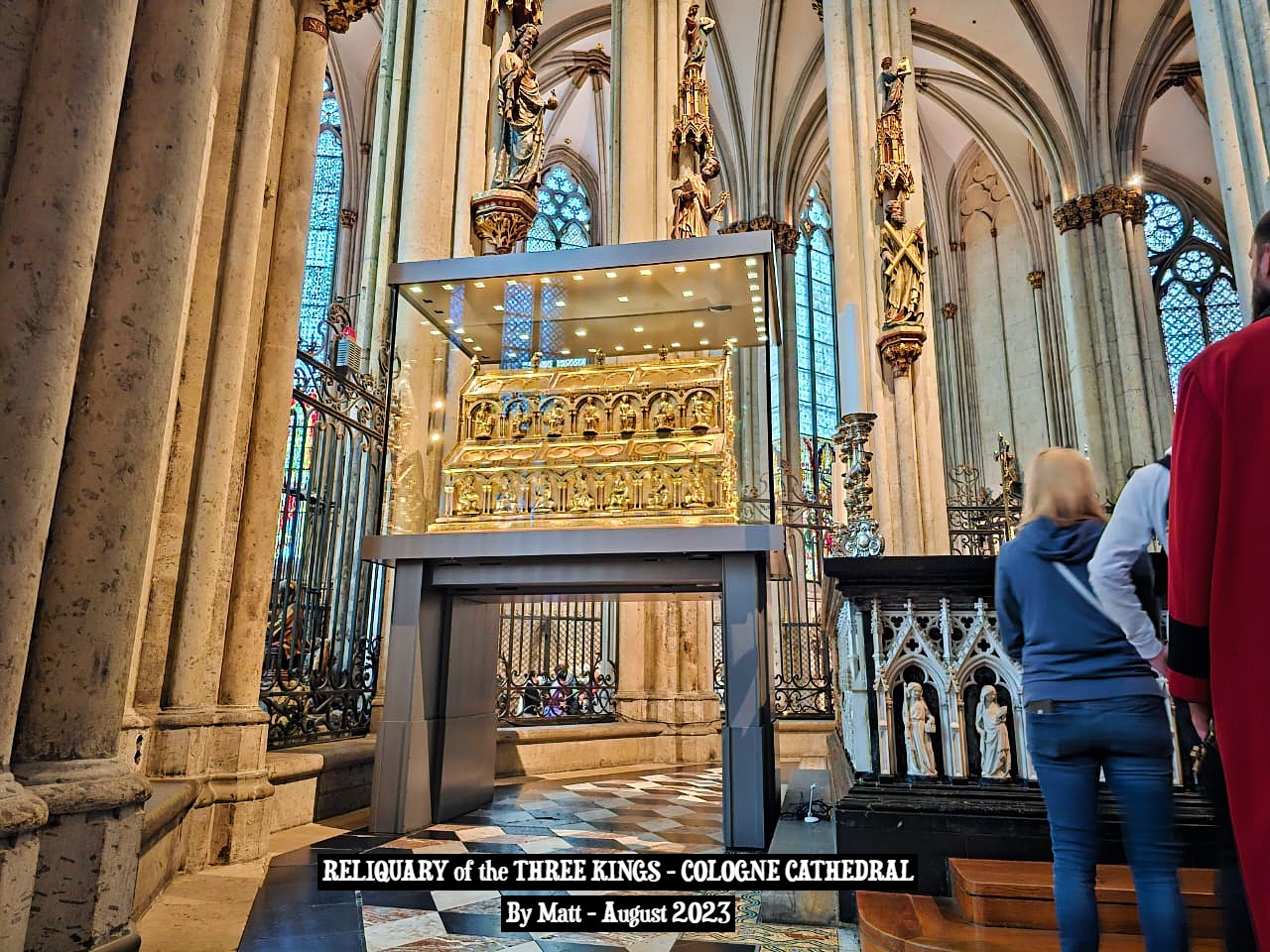
Prayer for the Intercession of the Three Kings, Saint Caspar, Saint Melchior and Saint Balthasar By Cologne Cathedral (An Imprimatur has been granted for this publication – Cologne Cathedral)
Lord and God Thou created us for a lifelong journey to Thee. Each one of us takes a different path, over mountains and through valleys, through joy and sorrow and need. May the Three Holy Kings guide us in our wanderings, as their faith, knowledge and determination guided them through many perils on their journey to Thee. They saw Thee, knelt before Thee, offered up their gifts and paid homage to Thee, They were filled with the joy of finding Thee!
Lord and God, We thank Thee for granting us the freedom to seek and find Thee, our life’s goal! Grant us the faith, strength and trust we need, to follow in the path of the Three Kings. Give us courage when we are at risk of taking easier but false paths, Let us experience the joy of being with Thee at the end of our journey, so that we may be eternally surrounded by Thy Love. We ask this, through Jesus Christ our Lord. the destination of every pilgrimage. Amen!
Saint of the Day – 6 January – Saint Nilammon of Geris (Died c404) Hermit. Born in Egypt in the 4th Century and died in the early 5th, c404 in Geris of natural but miraculous causes. Also known as – Nilammone, Nilamon, Nillammon. His name means: “the son of my people from the Nile” (Hebrew)
The Roman Martyrology reads today: “At Geris in Egypt, St Nilammon, Anchoret, who, whilst he was carried to a Bishopric againsat his will, gave up his soul to God in prayer.”
Nillammon lived as a recluse in a small stone-walled house near Geris (Gerrum) in Egypt. The people and the Patriarch Theophilos I of Alexandria – who was known for his passionate hostility to St John Chrysostom – wanted to Consecrate him as the Bishop of the City.
But he could not be persuaded to leave his little house near this Town which he had barricaded with stones and to accept the Episcopal dignity. He then locked himself in and would die praying, with scores of people pleading with him to reconsider his decision, standing outside. While he was still praying fevently to be released from this great honour but imposing Office, Nillammon died naturally.
The information about Nilammon comes from the Church Historian Sozomenus (c400-c450), who lived and worked shortly after Nilammon’s life.
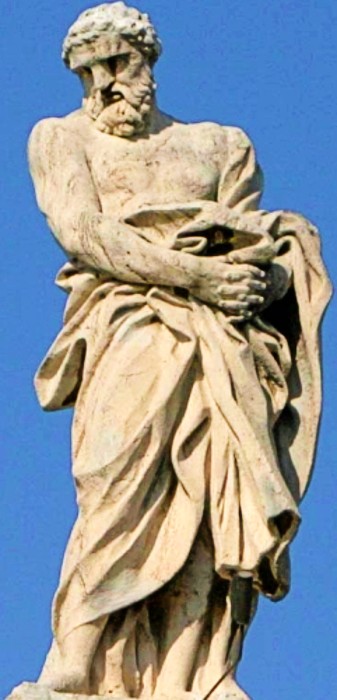
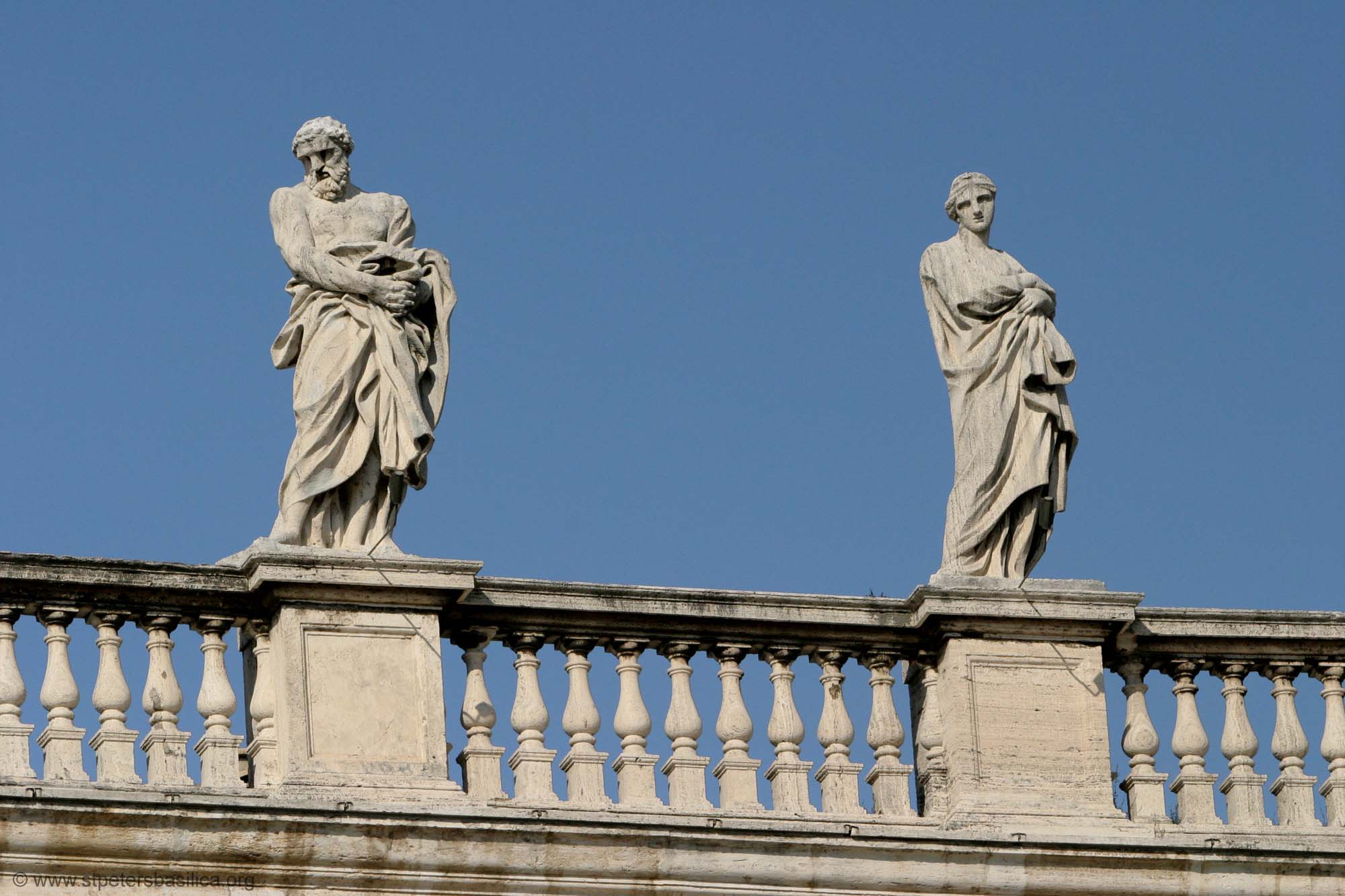
St Nilammon is one of the 140 Colonnade saints which adorn St Peter’s Basilica and surround the Square, below St Nilammon is on the left with St Fabiola on the right – this is the North Colonnade.
The Epiphany of the Lord Epiphany celebrates the visit of the three Kings or Magi (Wise Men) to the Christ Child, signifying the extension of salvation to the Gentiles. The date of Epiphany, one of the oldest Christian Feasts, is 6 January, the 12th day after Christmas. However, in some countries, the celebration of Epiphany is transferred to the Sunday which falls between 2 January and 8 January (inclusive). Greece, Ireland, Italy and Poland continue to observe Epiphany on 6 January as do traditional Catholics throughout the world. Because Epiphany is one of the most important Feasts, it is a Holy Day of Obligation.
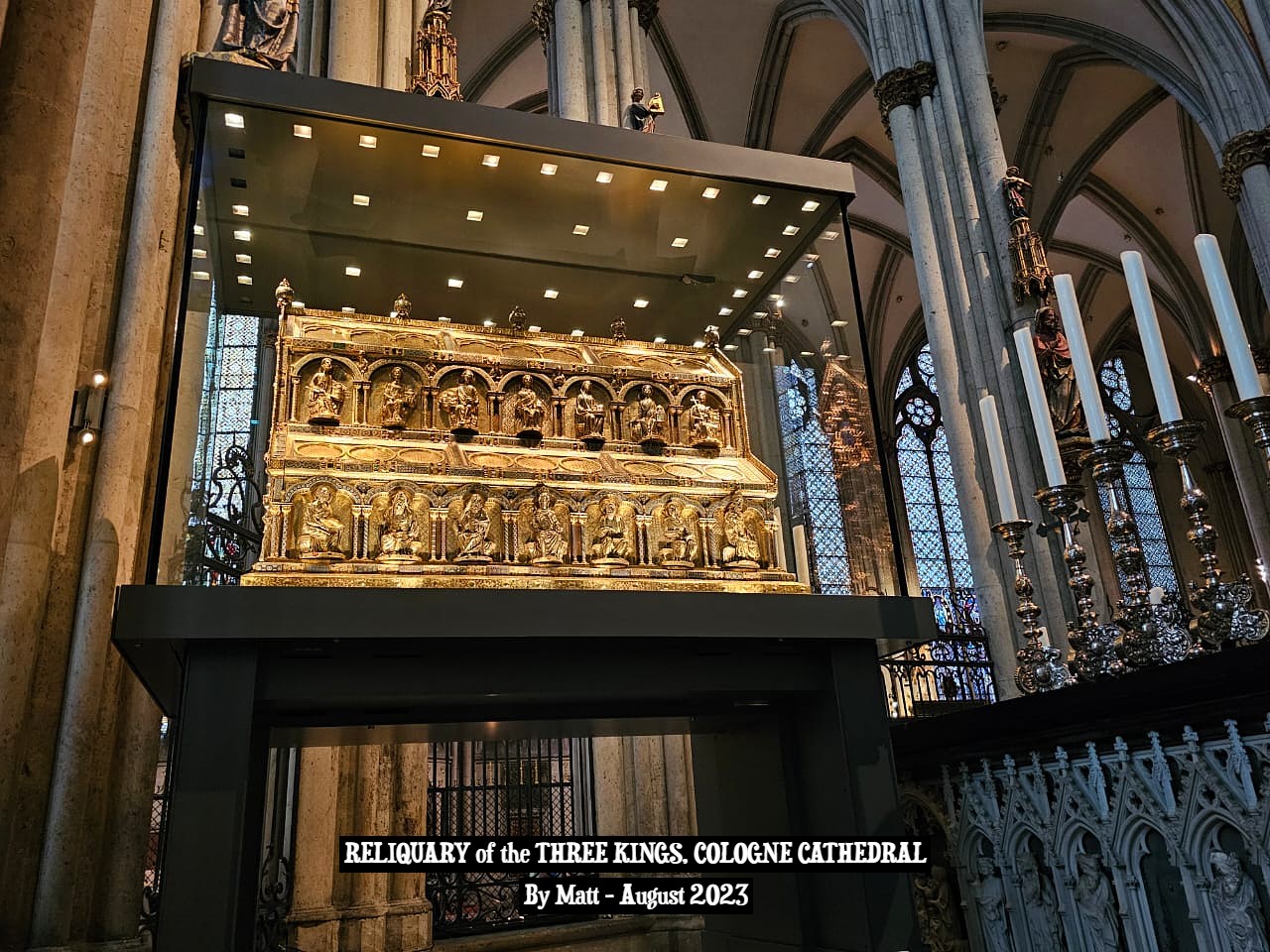
Saint Caspar, Saint Melchior and Saint Balthasar (1st Century) otherwise known as the Three Wise Men/Kings or the Magi – they are all Martyrs. Patronages – against epilepsy/of epileptics, against thunder, furriers, motorists, pilgrims, playing card manufacturers, sawmill workers, travellers, travelling merchants, Cologne, Germany, Saxony. Additional Memorials – 23 July (translation of Relics); 24 July (Cologne, Germany where their Relics lie). Their Lives and Deaths: https://anastpaul.com/2024/01/06/saints-of-the-day-6-january-saint-caspar-saint-melchior-and-saint-balthasar-1st-century-martyrs/
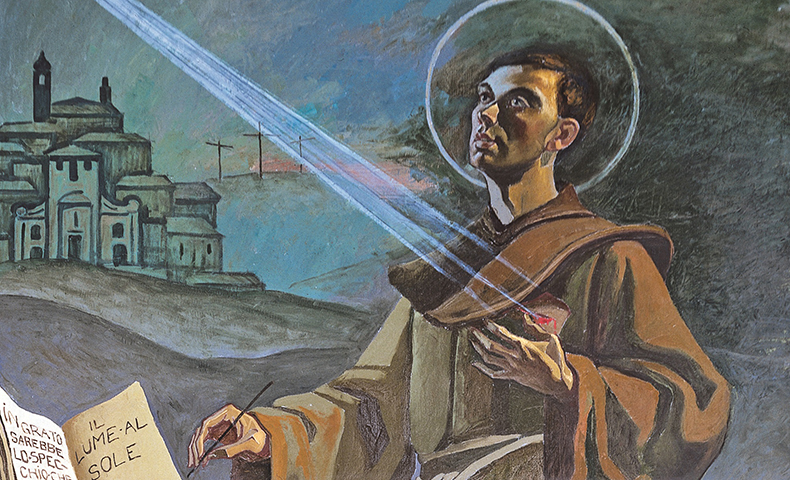
St Charles of Sezze OFM (1613-1670) Stigmatist, Friar, of the Friars Minor, Mystic, Writer, Advisor. His Beatification was celebrated in 1882 while Pope Pius XII approved his Canonisation in 1958 but the Pope died before he could Canonise the Friar so his successor, Pope John XXIII did so on 12 April 1959. His body is incorrupt. About St Charles: https://anastpaul.wordpress.com/2018/01/06/saint-of-the-day-6-january-st-charles-of-sezze-o-f-m-1613-1670/
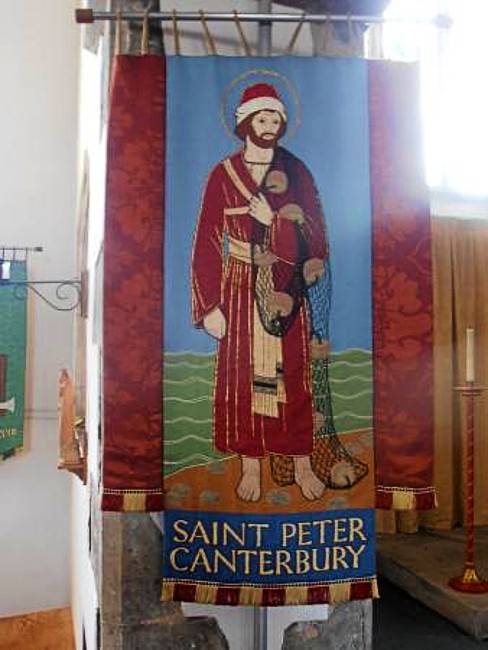
St Demetrius of Philadelphia St Diman Dubh of Connor St Edeyrn St Eigrad St Erminold of Prüfening
St Julian of Antinoë St Julius Bl Luc of Roucy Bl Macarius the Scot St Macra of Rheims St Merinus
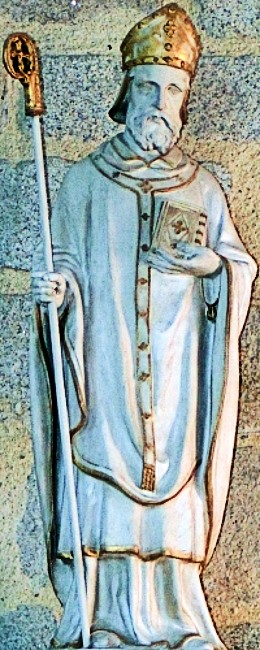
St Melaine of Rennes (Died 530) Bishop of Rennes in Brittany, France, Confessor, previously a Monk and Abbot, Royal Advisor, Miracle-worker. The Roman Martyrology reds: “At Rennes, in France, St Melanius, Bishop and Confessor, who displayed innumerable virtues and with his thoughts ever fixed on Heaven, passed from the world in glory.” Another Feast Day which should be today but was moved in 1969. His Holy Life: https://anastpaul.com/2023/11/06/saint-of-the-day-6-november-saint-melaine-of-rennes-died-c535-bishop-confessor/
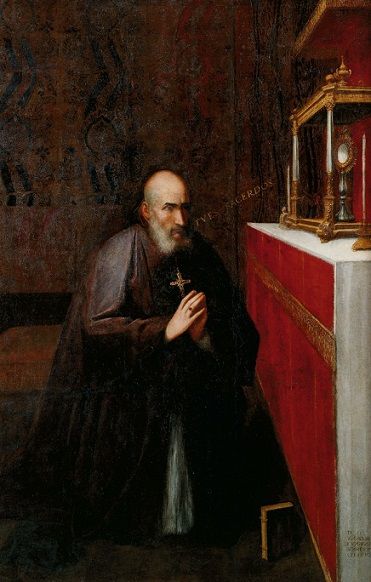
St Nilammon of Geris (Died c404) Hermit St Petran of Landévennec
St Pia of Quedlinburg St Pompejanus Bl Raymond de Blanes St Schotin St Wiltrudis of Bergen
Martyrs in Africa: Unknown number of Christian men and women who were Martyred in the persecutions of Septimus Severus. They were burned to death c 210.
Martyrs of Sirmium – 8 Saints: A group of Christians Martyred together for their faith. The only surviving details are the names of eight of them – Anastasius VIII, Florianus, Florus, Jucundus, Peter, Ratites, Tatia and Tilis. They were martyred in the 4th century at Syrmium, Pannonia (modern Sremska Mitrovica, Vojvodina, Serbia).
Twelve Apostles – Saints of Ireland: Twelve 6th Century Irish Monks who studied under Saint Finian at Clonard Abbey and then spread the Faith throughout Ireland. Each has his own commemoration but on this day, they and their good works are considered and celebrated together. Although Saint Finian is sometimes included, most ancient writers list them as –



 AnaStpaul
You must be logged in to post a comment.