Thought for the Day – 8 February – Meditations with Fr Richard Frederick Clarke SJ (1839-1900)
Meditations on “The Great Truths” From “The Devout Year” By Fr Richard Frederick Clarke SJ (1839-1900)
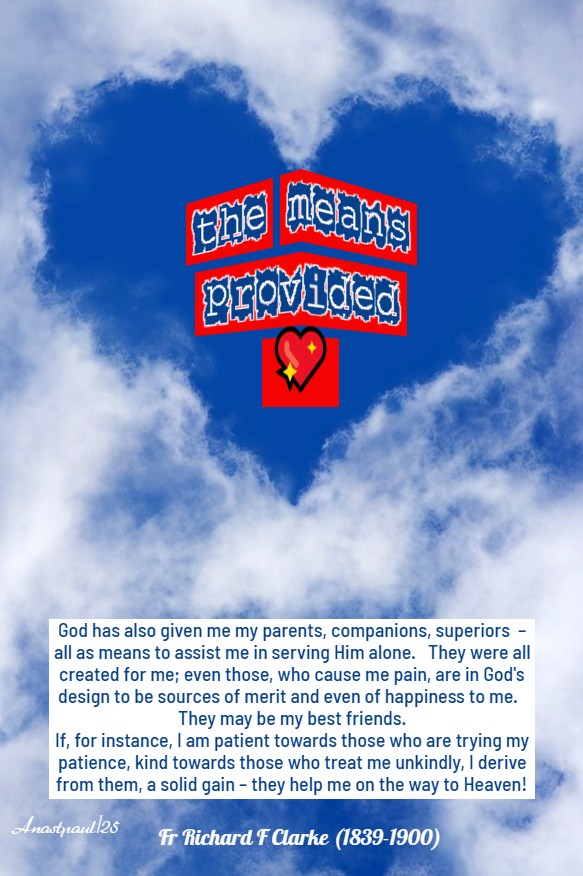
8th Day – The Means Provided
Thou hast subjected all things. under His feet. (Ps viii:8)
We are all inclined to overlook our own importance in God’s sight. So dearly does He love us, so anxious is He that we should attain our End, that we should succeed in life, that He has heaped around us all kinds of means and aids thereto.
+1. All which is lovely and beautiful in the world, is intended by Almighty God ,to assist me on my road to Heaven, to remind me of Himself and of His Infinite Beauty. God cares more for me than all the material universe together, all irrational creatures. I can give Him more glory by one act of love, than by all their natural perfections!
+2. God has also given me my parents, companions, superiors – all as means to assist me in serving Him alone. They were all created for me; even those, who cause me pain, are in God’s design to be sources of merit and even of happiness to me. They may be my best friends. If, for instance, I am patient towards those who are trying my patience, kind towards those who treat me unkindly, I derive from them, a solid gain – they help me on the way to Heaven.
+3. All the various circumstances of my life are, moreover, ordained by Almighty God to aid me in serving and praising Him as He wishes. If they are pleasant, they must teach me gratitude; if painful, resignation. Even if they are a source of temptation to me, by fighting bravely against them, I can gain great merit before God. Pray for the grace to carry out God’s intentions, by correctly using all the circumstances around you.
Quote/s of the Day – 8 February – Sirach 31:8-11; Luke 12:35-40 – Scripture search here: https://www.drbo.org/
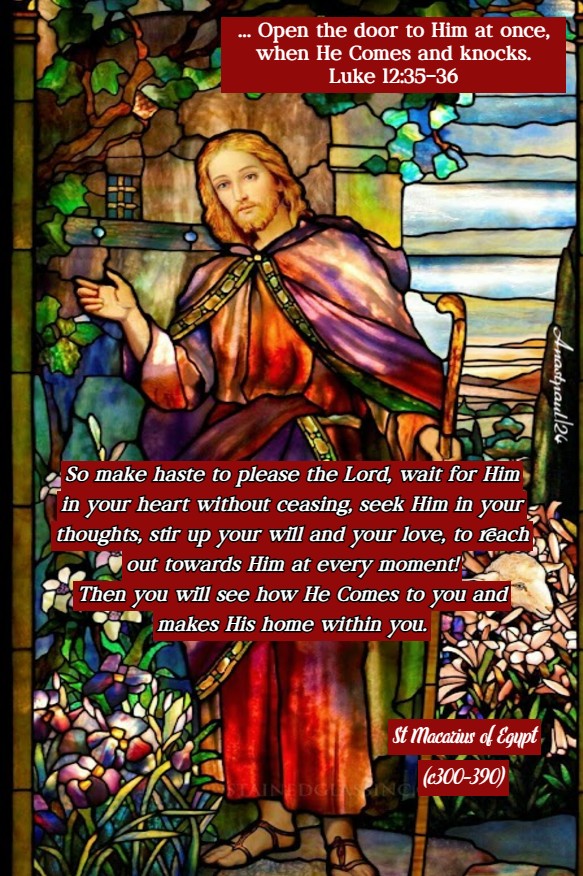
“ … Open the door to Him at once, when He Comes and knocks.” Luke 12:35
“So make haste to please the Lord, wait for Him in your heart without ceasing, seek Him in your thoughts, stir up your will and your love, to reach out towards Him at every moment! Then you will see how He Comes to you and makes His home within you.”
St Macarius of Egypt (c300-390) Monk, Father (Attrib)
“The fire of the Lord is Light Eternal; the lamps of believers are lit at this fire: “Gird your loins and light your lamps,” (Lk 12:35). It is because the days of our life are still night that a lamp is necessary. This is the fire which, according to the testimony of the disciples at Emmaus, the Lord Himself set within them: “Were not our hearts burning within us while He spoke to us on the way and opened the scriptures to us?” (Lk 24:32). He gives us evident proof of this fire’s action, enlightening man’s inmost heart. That is why the Lord will Come in fire (Is 66,15) so as to devour our faults at the resurrection, fulfil each one’s desires with His Presence and cast His Light over their merits and mysteries.”
St Ambrose (340-397) Father and Doctor of the Church
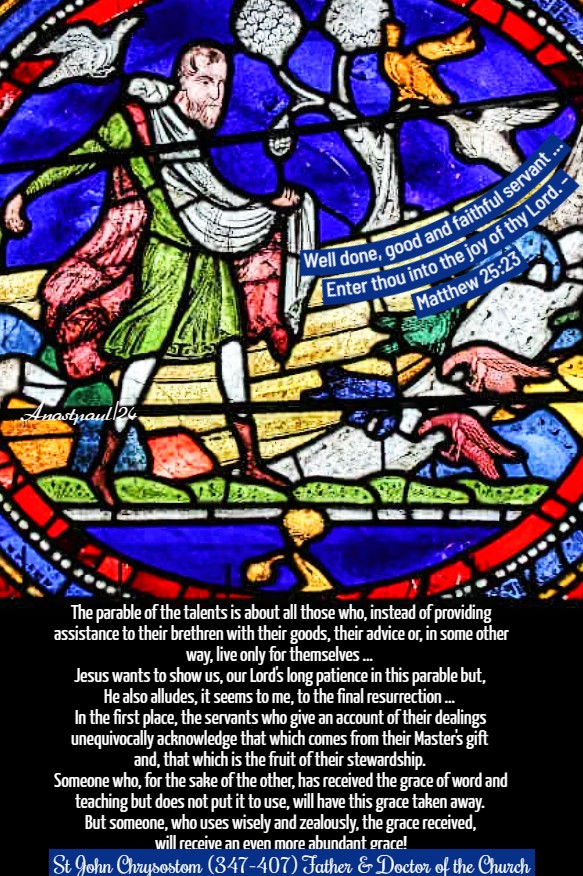
“ Well done, good and faithful servant because thou hast been faithful over a few things, I will place thee over many things. Enter thou into the joy of thy Lord.” Matthew 25:23
“The parable of the talents is about all those who, instead of providing assistance to their brethren with their goods, their advice or, in some other way, live only for themselves … Jesus wants to show us, our Lord’s long patience in this parable but, He also alludes, it seems to me, to the final resurrection … In the first place, the servants who give an account of their dealings unequivocally acknowledge that which comes from their Master’s gift and, that which is the fruit of their stewardship. … Someone who, for the sake of the other, has received the grace of word and teaching but does not put it to use, will have this grace taken away. But someone, who uses wisely and zealously, the grace received, will receive an even more abundant grace!”
St John Chrysostom (347-407) Father & Doctor of the Church
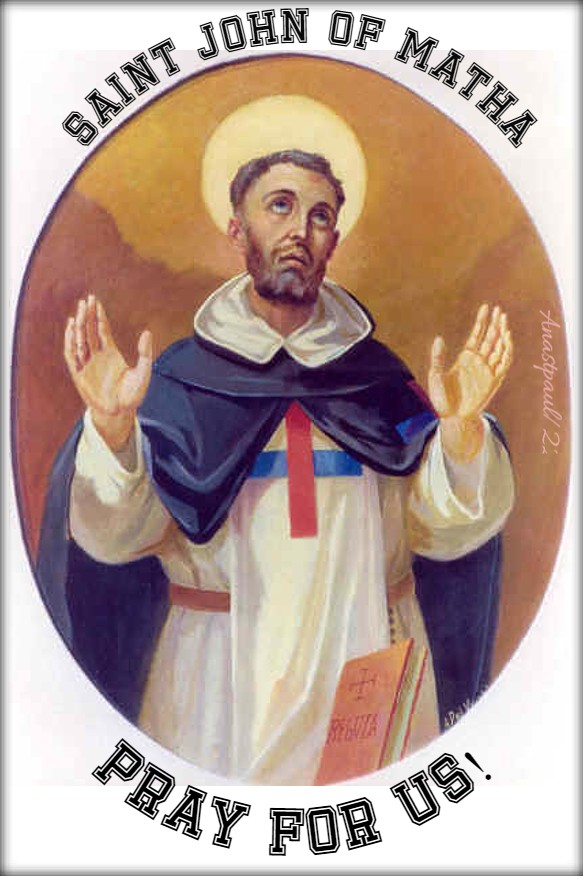
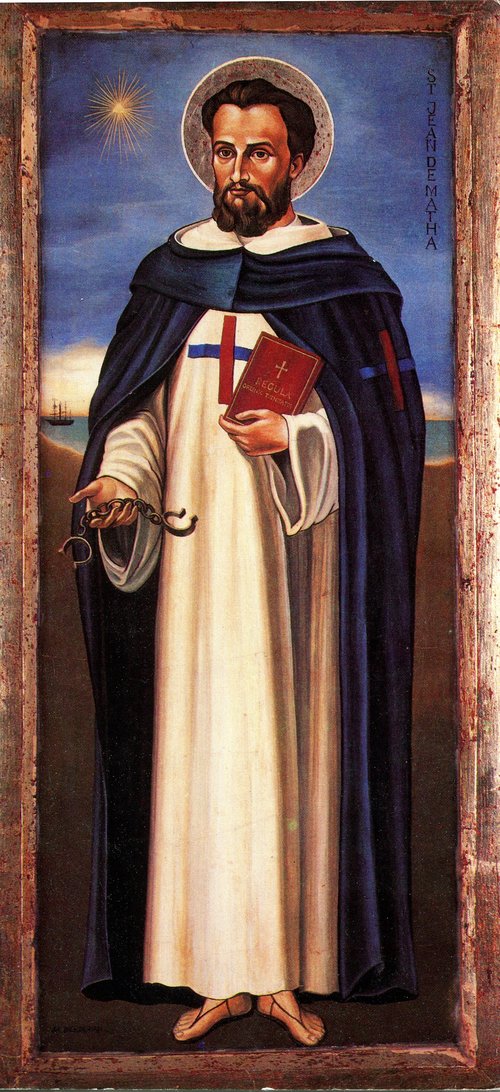
One Minute Reflection – 8 February – “The Month of the Blessed Trinity” –St John of Matha (1160-1213) Confessor, Priest, Founder – Sirach 31:8-11; Luke 12:35-40 – Scripture search here: https://www.drbo.org/
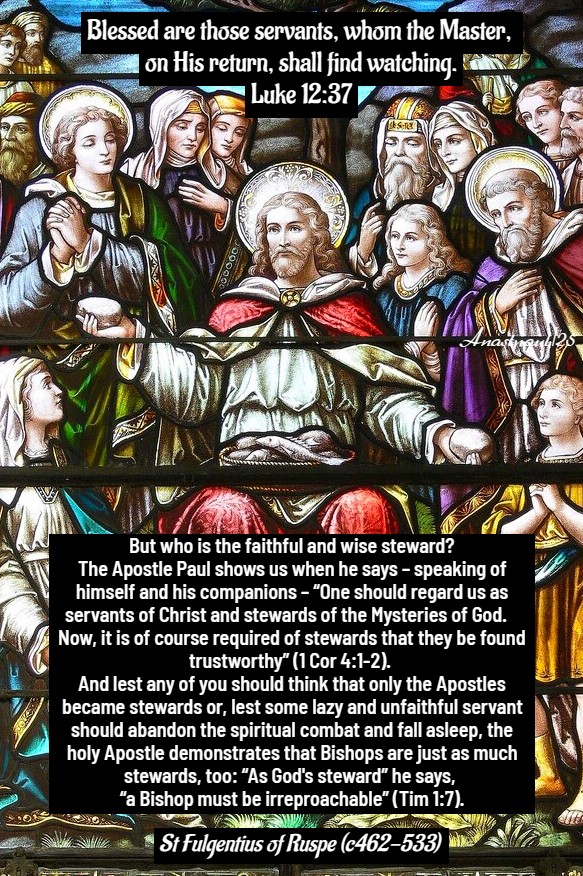
“Blessed are those servants, whom the Master, on His return, shall find watching.” – Luke 12:37
REFLECTION – “Our Lord spoke these words, recorded by the Gospel, to clarify the function of the servants, He had set at the head of His people: “Who is the faithful and prudent Steward Whom the Master will put in charge of His servants, to distribute the food allowance, at the proper time? Blessed is that servant, whom his Master, on arrival, finds doing so” Who is that Steward, my friends? Undoubtedly, it is Christ, Who said to His disciples: “You call me ‘teacher’ and ‘master’ and rightly so, for indeed I Am” (Jn 13:13). And what is that Master’s Household? Surely the one which our Lord Himself Redeemed from the hands of the enemy and took to Himself. This Household is the Holy and Universal Church, spreading with remarkable fecundity throughout the world and priding itself on having been redeemed at the price of His Blood…
But who is the faithful and wise steward? The Apostle Paul shows us when he says – speaking of himself and his companions – “One should regard us as servants of Christ and stewards of the Mysteries of God. Now, it is of course required of stewards that they be found trustworthy” (1 Cor 4:1-2). And lest any of you should think that only the Apostles became stewards or, lest some lazy and unfaithful servant should abandon the spiritual combat and fall asleep, the holy Apostle demonstrates that Bishops are just as much stewards, too: “As God’s steward” he says, “a Bishop must be irreproachable” (Tim 1:7). Therefore, we are servants of the Householder, stewards of our Lord and, it is we, who have received the measure of wheat, to be distributed among you.” – St Fulgentius of Ruspe (c462-533) Bishop and Father of the Church (Sermon 1)
PRAYER – O God, Who graciously and by Divine means founded, through blessed John, the Order of the Most Holy Trinity to ransom captives from the hands of the Saracens, grant, we beseech Thee that through Thy help and the merits of his prayers, we may be freed body and soul from captivity. Through Jesus Christ, Thy Son our Lord, Who lives and reigns with Thee, in the unity of the Holy Ghost, God, world without end. Amen (Collect).
Our Morning Offering – 8 February – “The Month of the Most Holy and Blessed Trinity”
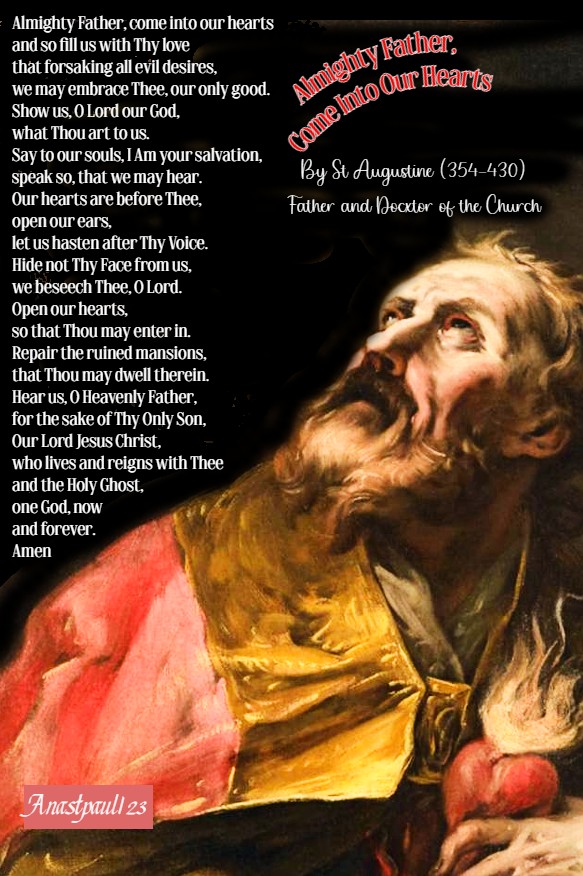
Almighty Father, Come Into Our Hearts By St Augustine (354-430)
Almighty Father, come into our hearts and so fill us with Thy love that forsaking all evil desires, we may embrace Thee, our only good. Show us, O Lord our God, what Thou art to us. Say to our souls, I Am your salvation, speak so, that we may hear. Our hearts are before Thee, open our ears, let us hasten after Thy Voice. Hide not Thy Face from us, we beseech Thee, O Lord. Open our hearts, so that Thou may enter in. Repair the ruined mansions, that Thou may dwell therein. Hear us, O Heavenly Father, for the sake of Thy Only Son, Our Lord Jesus Christ, who lives and reigns with Thee and the Holy Ghost, one God, now and forever. Amen
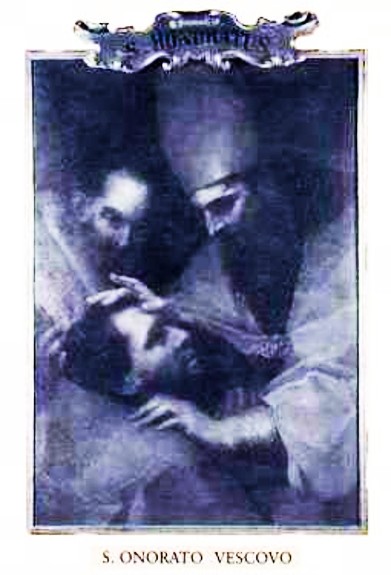
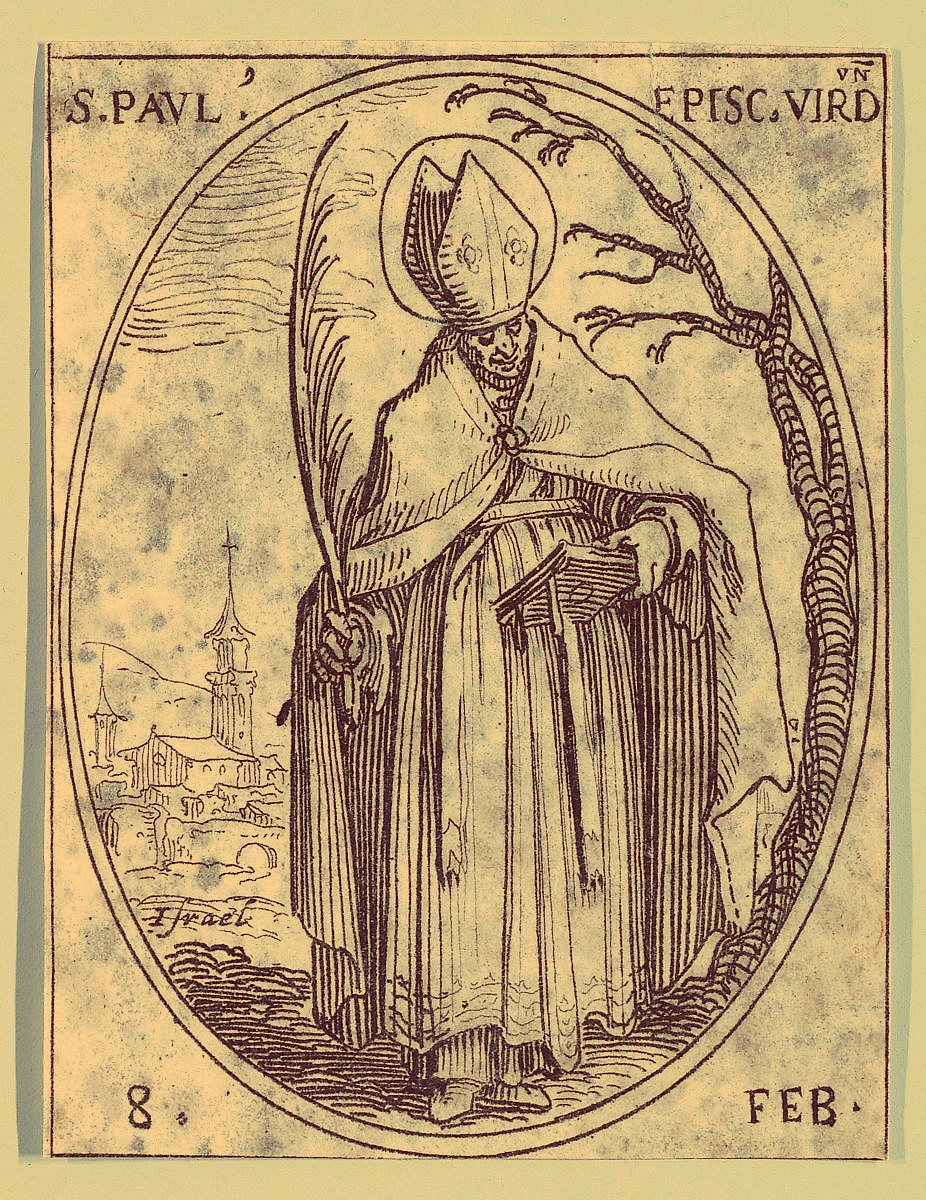
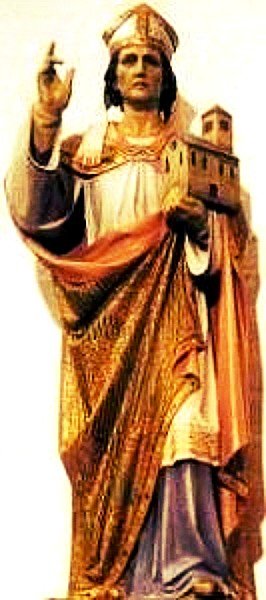
Saint of the Day – 8 February – St Honoratus (Died c571) Bishop and Confessor of Milan. Honoratus was of Milanese origin but he died in exile in Genoa in c571. He was the 29th Bishop of Milan from 560 to 571. Also known as – Onorato, Honoratus of Milan, Honoratius …
The Roman Martyrology reads today: “At Milan, the demise of St Honoratus, Bishop and Confessor.”
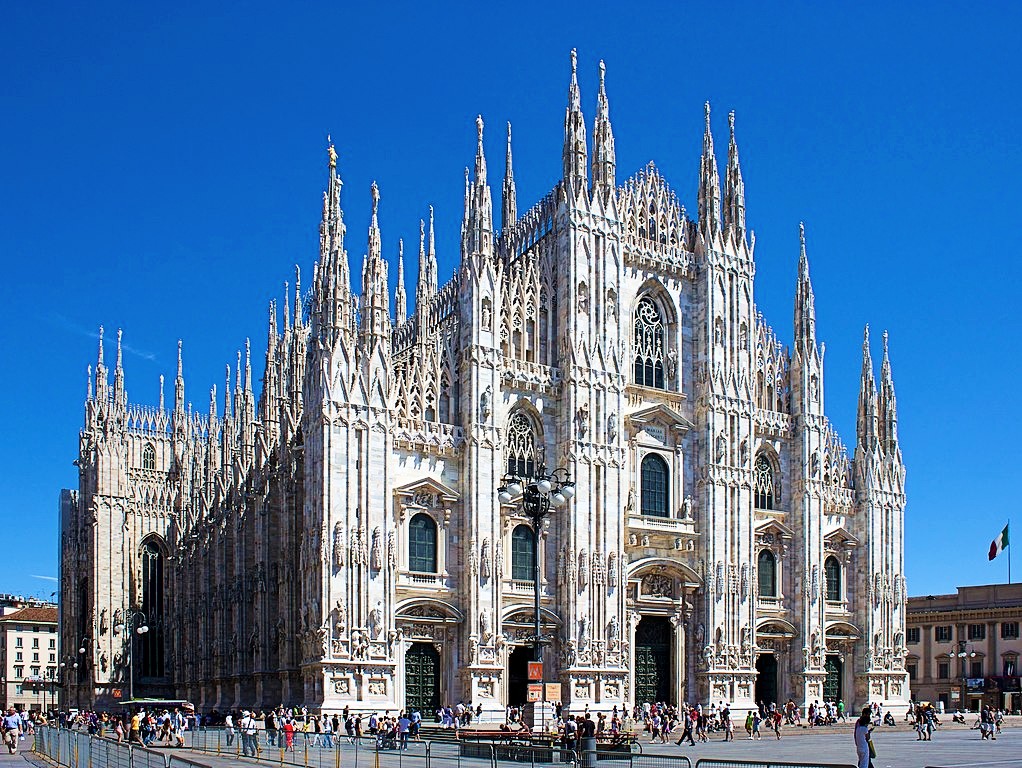
Honoratus loved his Diocese and rejoiced when, accompanying his guests to visit the Basilica of St Laurence, they exclaimed: “It surpasses in beauty almost all the Churches in Italy.”
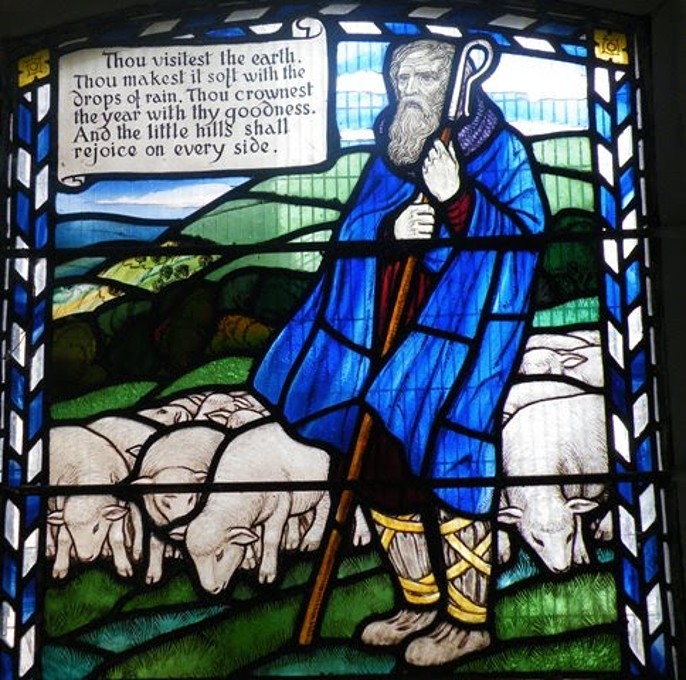
He desired peace and, when the Lombards entered Milan on 3 September 569, he moved with part of the Clergy to Genoa. He hoped and prayed the Barbarian would not be cruel to the population, to the poor people, who were entrusted to him as their shepherd. Perhaps he was inspired by the Bishops who had preceded him: especially St Eusebius, a hundred years earlier, who had left Milan upon the arrival of Attila, to return immediately to support the victims and reassure them.
Unfortunately, Honoratus died after a few months in Genoa and the Lombard danger continued for decades. He now rests in the Basilica of Sat Eusebius, from where he repeats to us the words of Saint Ambrose: “How can you expect to overcome the test, if, in the Name of Christ, you do not know how to face adversities and dangers? For this reason, hope is the only thing which does not disappoint our hearts.”
According to the Liber Notitiae Sanctorum Mediolani (14th Century) Saint Honoratus’ Feast was celebrated on 8 January, later set on 8 February.
St Cyriacus of Rome St Dionysus of Armenia St Elfleda of Whitby St Emilian of Armenia St Giacuto St Gisela St Honoratus (Died c571) Bishop and Confessor of Milan St Inventius of Pavia Bl Jacoba de Settesoli St Kigwe St Laureatus of Rome St Lucius of Rome St Meingold St Mlada of Prague St Nicetius of Besançon St Oncho of Clonmore St Paul of Rome
St Stephen of Muret (c1046-1124) Abbot, Founder of the Abbey of Grandmont (the Mother House) and the Order of Grandmont. The Roman Martyrology reads: “At Muret, near Limoges, the birthday of the Abbot, St Stephen, Founder of the Order of Grandmont, celebrated for his virtues and miracles.” A Grace-filled Life: https://anastpaul.com/2024/02/08/saint-of-the-day-8-february-saint-stephen-of-muret-c1046-1124-abbot/
Martyrs of Constantinople: Community of 5th Century Monks at the Monastery of Saint Dius at Constantinople. Imprisoned and Martyred for loyalty to the Vatican during the Acacian Schism. 485 in Constantinople.
Martyrs of Persia: An unknown number of Christians murdered in early 6th-century Persia. Legend says that so many miracles occurred through the intercession of these Martyrs that the King decreed an end to the persecution of Christians.
Thought for the Day – 7 February – Meditations with Fr Richard Frederick Clarke SJ (1839-1900)
Meditations on “The Great Truths” From “The Devout Year” By Fr Richard Frederick Clarke SJ (1839-1900)
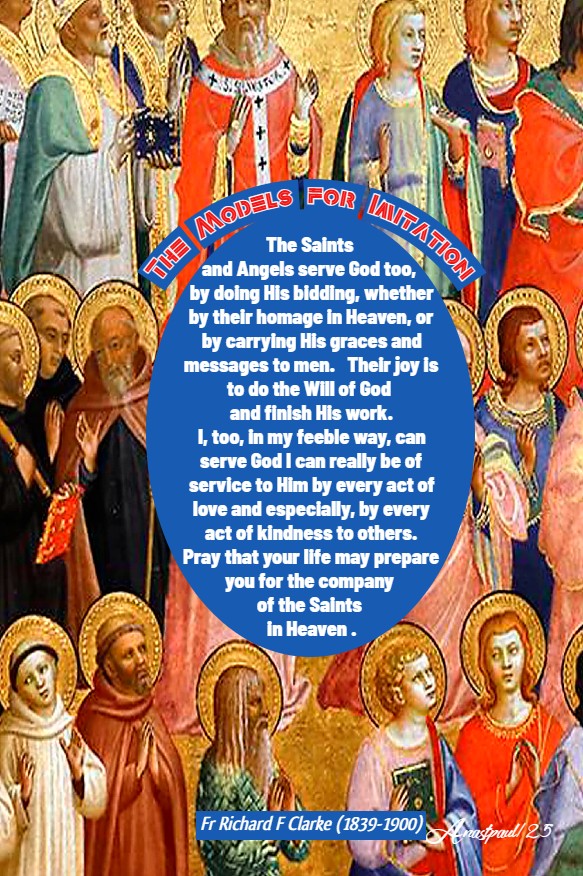
7th Day – The Models for Imitation
They are before the throne of God and they serve Him, day and night in His temple. (Apoc vii:15)
Example is better than precept and, we shall often learn more from watching those, who perfectly achieve, that which we are attempting to acquire, than by any set of rules. Let us watch the Saints in Heaven in order that we may learn from them.
+1. Their continual occupation is the praise of God, the tranquil delight of basking in the Light of God. This satisfies every longing of their hearts, this fills them with perfect and unfading joy. This is the highest praise they can render to God. How can I imitate them? By a continual remembrance of God, by visiting the Blessed Sacrament, by a frequent raising of my heart to Heaven.
+2. The Saints find a constant joy too, in showing reverence to God, in falling down in prostrate homage before the throne, in recognising their dependence upon Him and their indebtedness to Him, for all their joy. This , too, I can copy by great reverence, both of body and soul; reverence before the Altar, reverence in my prayers, reverence and resignation to the Will of God in my thoughts.
+3. The Saints and Angels serve God too, by doing His bidding, whether by their homage in Heaven, or by carrying His graces and messages to men. Their joy is to do the Will of God and finish His work. I, too, in my feeble way, can serve God I can really be of service to Him by every act of love and especially, by every act of kindness to others. Pray that your life may prepare you for the company of the Saints in Heaven .
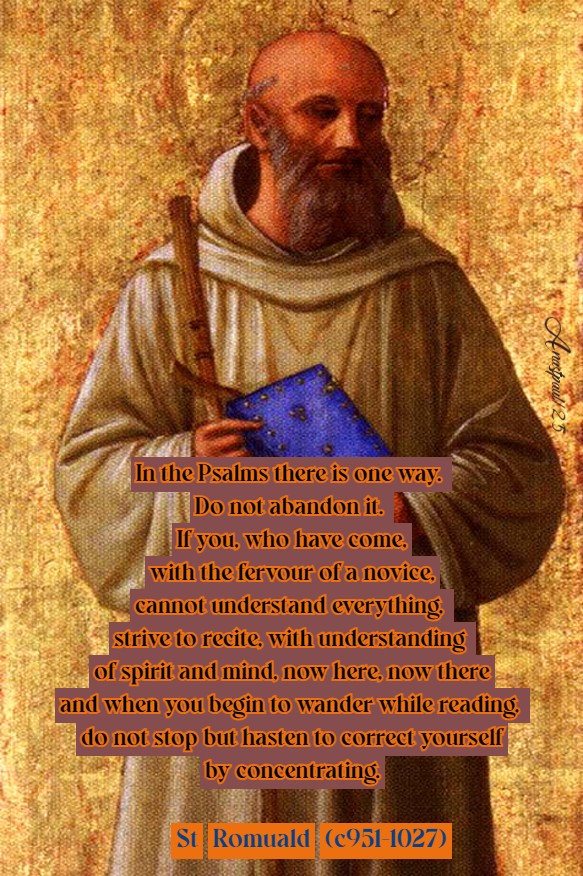
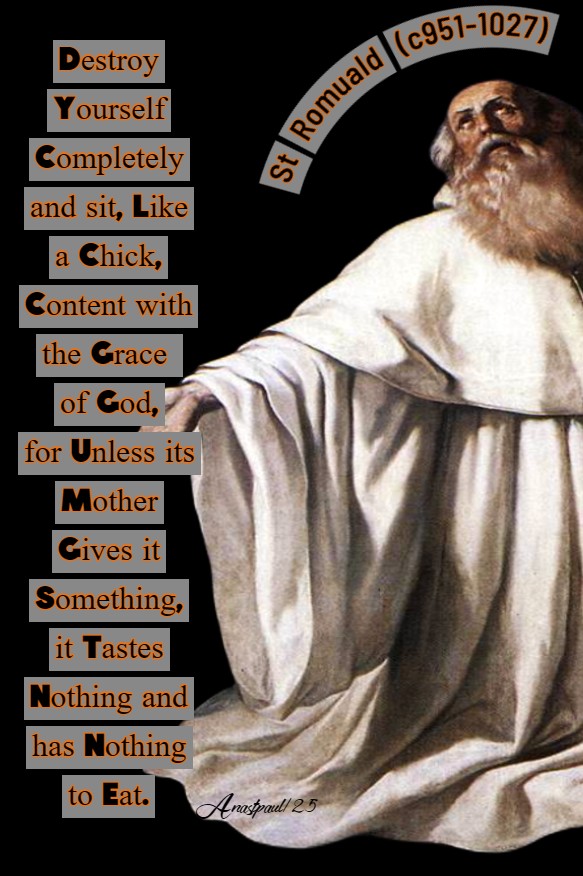
Quote/s of the Day – 7 February – St Romuald (c951-1027) Abbot
“In the Psalms there is one way. Do not abandon it. If you, who have come, with the fervour of a novice, cannot understand everything, strive to recite, with understanding of spirit and mind, now here, now there and when you begin to wander while reading, do not stop but hasten to correct yourself by concentrating.”
“Destroy yourself completely and sit, like a chick, content with the grace of God, for unless its mother gives it something, it tastes nothing and has nothing to eat.”
One Minute Reflection – 7 February – “The Month of the Blessed Trinity” – St Romuald (c951-1027) Abbot – Ecclesiasticus 45:1-6; – Matthew 19:27-29 – Scripture search here: https://www.drbo.org/
“And everyone who has left house, or brethren, or sisters, or father, or mother, or wife, or children, or lands for My Name’s sake, shall receive a hundredfold and shall possess life everlasting.” – Matthew 19:29
REFLECTION – “Jesus said to them, ‘Come after Me; I will make you fishers of men.’” Happy transformation of fishing! Simon and Andrew are what Jesus caught fishing … These men are made similar to fish, caught by Christ, before going themselves to catch other people. “They immediately abandoned their nets and became His followers.” True faith knows no delay. As soon as they heard Him, they believed, they followed Him and they became fishers. “They immediately abandoned their nets.” I think that with those nets, they abandoned all the vices of the life of this world …
“Proceeding a little farther along, He caught sight of James, Zebedee’s son and his brother, John … He summoned them on the spot. They abandoned their father Zebedee, who was in the boat with the hired men and went off in His company.” You will tell me — faith is daring. What indication did they have, what sublime characteristic had they noted which made them follow Him, as soon as He called them? We realise that evidently something Divine came forth from Jesus’ gaze, from the expression on His Face which incited those who looked at Jesus to turn towards Him … Why am I saying all this? It is to show you that the Lord’s Word was active and, that through the least of His Words, He was working on His task: “He commanded and they were made.” (Ps 148:5) With the same simplicity, He called and they followed … “Hear, O daughter and see; turn your ear, forget your people and your father’s house. So shall the king desire your beauty.” (Ps 45:11-12)
Listen well, brother and follow the path of the Apostles; listen to the Saviour’s Voice, ignore your father according to the flesh and see the true Father of your soul and your mind … The Apostles left their father, left their boat, left all their riches of that time; they abandoned the world and its countless riches; they renounced all that they owned. However, God does not consider the mass of riches but rather, the soul of the person who renounces them. Those people who left only a few things would also have renounced a large fortune, if the need had arisen.” – St Jerome (347-420) Father and Doctor of the Church (Homilies on the Gospel of Mark).
RAYER – May the intercession of the Blessed Abbot Romuald, commend us, we beseech Thee, O Lord, so that what we do not deserve by any merits of our own, we may obtain by his patronage. Through Jesus Christ, Thy Son our Lord, Who lives and reigns with Thee, in the unity of the Holy Ghost, God, world without end. Amen (Collect).
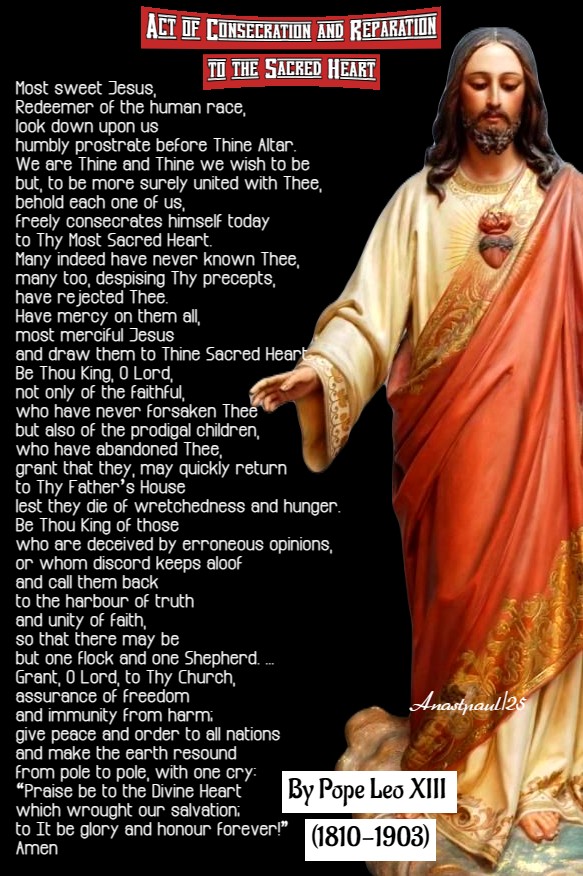
Act of Consecration and Reparation to the Sacred Heart By Pope Leo XIII (1810-1903) Pope from 1878-19031903 (Excerpt on the image)
Most sweet Jesus, Redeemer of the human race, look down upon us humbly prostrate before Thine Altar. We are Thine and Thine we wish to be but, to be more surely united with Thee, behold each one of us, freely consecrates himself today to Thy Most Sacred Heart. Many indeed have never known Thee, many too, despising Thy precepts, have rejected Thee. Have mercy on them all, most merciful Jesus and draw them to Thine Sacred Heart. Be Thou King, O Lord, not only of the faithful, who have never forsaken Thee but also of the prodigal children, who have abandoned Thee, grant that they, may quickly return to Thy Father’s House lest they die of wretchedness and hunger. Be Thou King of those who are deceived by erroneous opinions, or whom discord keeps aloof and call them back to the harbour of truth and unity of faith, so that there may be but one flock and one Shepherd. Be Thou, King of all those. who are still involved in the darkness of idolatry or of Islamism and refuse not, to draw them into the Light and Kingdom of God. Turn Thine Eyes of Mercy towards the children of the race, once Thy chosen people – of old they called down upon themselves the Blood of the Saviour; may it now descend upon them, a laver of redemption and of life. Grant, O Lord, to Thy Church, assurance of freedom and immunity from harm; give peace and order to all nations and make the earth resound from pole to pole, with one cry: “Praise be to the Divine Heart which wrought our salvation; to It be glory and honour forever!” Amen
The above prayer, composed by Pope Leo XIII was included in the 1899 Encyclical, Annum Sacrum, issued by Leo XIII as he Consecrated the entire world to the Sacred Heart of Jesus. The Consecration was influenced by two letters written to the Holy Father by Blessed Sister Mary of the Divine Heart, who stated that in visions of Jesus Christ, she had been told to request the Consecration.
Saint of the Day – 7 February – St Moses the Hermit (Died c389) Bishop and Apostle of the Saracens, Hermit in the desert and then Bishop, Missionary, Peace-maker. Moses had no fixed See after his Consecration as Bishop, journeying instead with his nomadic flock, converting many and keeping peace between the different tribes and the Roman imperial authorities. Born in Arabia and died there in c389 of natural causes. Also known as – Moses of the Saracens, Venerable Moses the Bishop. (Not to be confused with Moses the Black (330-405), another Saint of the region who is celebrated on 28 August.)
The Roman Martyrology reads today: “In Egypt, St Moses, a venerable Bishop, who first led a solitary life in the desert and being afterwards made Bishop, at the request of Mauvia, the Queen of the Saracens, converted the great part of that barbarous oeiokes to the Faith and rich in merits, passed peacefully to his reward.”
It is not known when or precisely where Moses was born but for some time in the 4th Century, Moses, like his ancient namesake, spent many years travelling and preaching in the wilderness in the border regions between Egypt and Syria.
His life of preaching attracted a large following. This reputation was noted by Socrates of Constantinople, the Christian Historian, who describes him as “a Saracen by birth, who led a monastic life in the desert” and, who had become “exceedingly eminent for his piety, faith and miracles.”
Socrates’ description of Moses comes by way of his retelling of the exploits of Queen Mauvia, who promised to end her armed revolt against the Roman Empire, on the condition that Moses be “constituted Bishop over her nation.”
Valens, the Roman Emperor, had no choice but to accept. Mauvia’s forces, originating in southern Syria, had defeated those of Rome’s on multiple occasions, marching through Palestine and Phoenicia, to reach the border with Egypt. Moses, however, refused to be Ordained by the Arian patriarchal See at Alexandria, choosing to be Consecrated by an orthodox Bishop living in exile instead.
Pope Gregory III (Papal reign 731-741) recalled the example of Moses as a Hermit Monk then Bishop, in a dialogue with the nephew of St Boniface, when trying to convince him to join his uncle in the German mission. It is quoted of the author, Irfan Shahid: “Thus an Arab Monk Bishop was presented as a model for the English Saint.”
FIRST FRIDAY of the Month: Attend Holy Mass and Receive Holy Communion on each First Friday; The Nine Fridays must be consecutive; They must be made in honour and in reparation to His Sacred Heart.
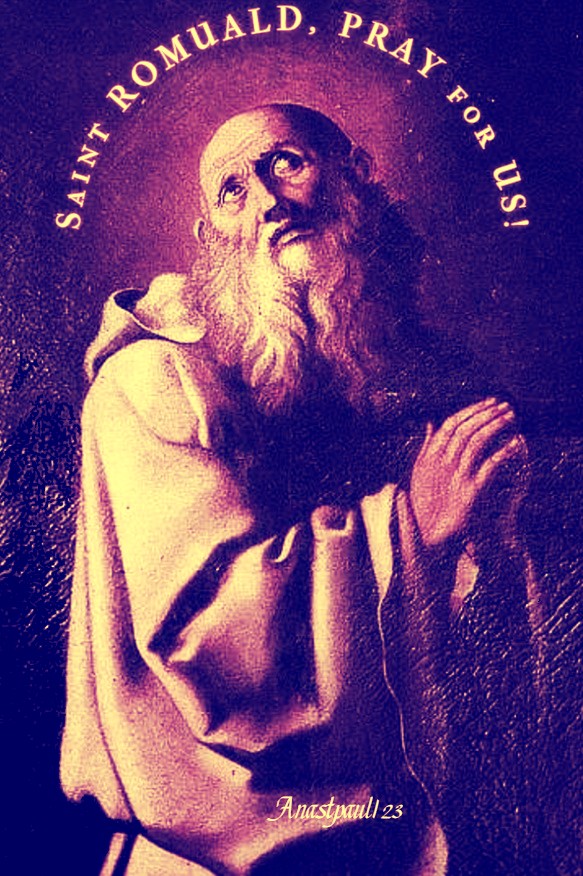
St Romuald (c 951-1027) Monk, Abbot, Ascetic, Founder of the Camaldolese Order and a major figure in the Eleventh-Century “Renaissance of eremitical asceticism.” His Feast Day is today and was thus from 1595. It was changed to 19 June in 1969 after Vatican II. St Romuald’s body is incorrupt. St Romuald’s Life: https://anastpaul.com/2018/06/19/saint-of-the-day-19-june-st-romuald-c-951-1027/
St Adaucus of Phrygia St Amulwinus of Lobbes St Anatolius of Cahors Bl Anselmo Polanco Bl Anthony of Stroncone
St Augulus St Chrysolius of Armenia St Fidelis of Merida
St Lorenzo Maiorano (Died 545) Bishop of Siponto, Italy, Miracle-worker gifted with Prophecy and visions. Collaborator with St Michael in the Apparition at Gargano, known as “The Defender of the People.” St Lorenzo is also called the “Patron Saint of Foreigners” by the citizens of Siponto, having been a foreigner himself. His Life: https://anastpaul.com/2023/02/07/saint-of-the-day-7-february-saint-lorenzo-maiorano-died-545-bishop/
St Luke the Younger
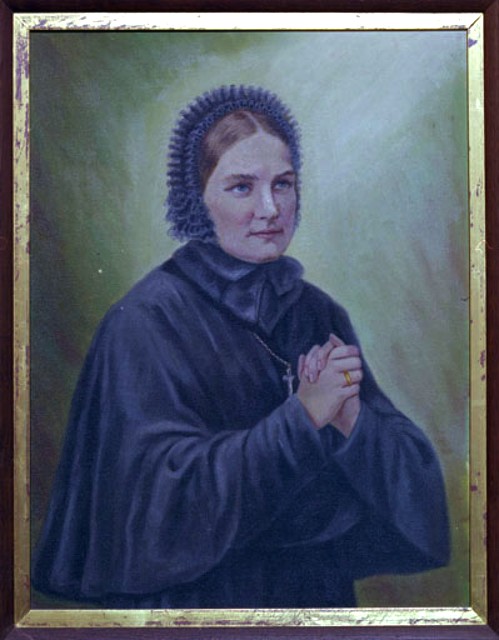
Blessed Mary of Providence/Eugénie Smet HHS (1825-1871) Nun and Founder of the Society of the Helpers of the Holy Souls. Her apostolate has spread throughout the world – now in 24 countries and continues to minister to the Souls in the Body of Christ — both those on earth and those who have departed this world. Beatified in Rome on 26 May 1957 by Pope Pius XII. Biography: https://anastpaul.com/2021/02/07/saint-of-the-day-7-february-blessed-mary-of-providence-hhs-1825-1871/
St Meldon of Péronne St Moses the Hermit (Died c389) Bishop St Parthenius of Lampsacus
Thought for the Day – 6 February – Meditations with Fr Richard Frederick Clarke SJ (1839-1900)
Meditations on “The Great Truths” From “The Devout Year” By Fr Richard Frederick Clarke SJ (1839-1900)
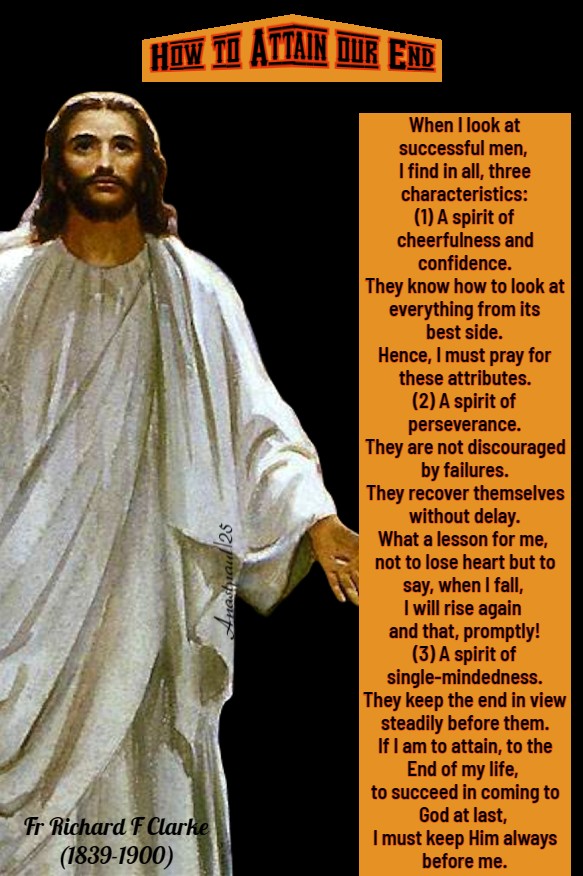
6th Day – How to Attain our End
One thing I do; forgetting the things which are behind and stretching forth myself to those which are before, I press towards the mark. (Philipp iii:1,3,14)
+1. Everyone desires to succeed in life. A man who desired ultimate failure would justly be regarded as a lunatic. If I am to carry out my desire, I must look around myself and see what sort of men succeed.
+2. When I look at successful men, I find in all, three characteristics: (1) A spirit of cheerfulness and confidence. They know how to look at everything from its best side. Hence, I must pray for these attributes. (2) A spirit of perseverance. They are not discouraged by failures. They recover themselves without delay. What a lesson for me, not to lose heart but to say, when I fall, I will rise again and that, promptly! (3) A spirit of single-mindedness. They keep the end in view steadily before them. If I am to attain, to the End of my life, to succeed in coming to God at last, I must keep Him always before me.
+3. What can make my life as happy as this, to know that I am drawing nearer to God? Yet, there will be dark times and days of despondency. Still, down at the bottom, beneath the surface, there will be hope and peace, even amid the darkness. Pray for cheerfulness and an earnest purpose to live for God alone!
Quote/s of the Day – 6 February – First Thursday Devotion – PRAY for PRIESTS
The Votive Mass of Our Lord Jesus Christ, Supreme and Eternal Priest, is often celebrated on First Thursdays of each month. By Decree of 24 December 1935, all Priests may offer this Votive Mass on said First Thursday. Those of us familiar with Catholic tradition will naturally realise that this is to commemorate the Institution of the Sacred Priesthood at the Last Supper.
O Holy Mother of God A Prayer for our Priests to the Most Blessed Virgin By St Charles Borromeo (1538-1584)
O Holy Mother of God, pray for the Priests thy Son has chosen to serve His Church. Help them by thy intercession, to be holy, zealous and chaste. Make them models of virtue, in the service of God’s people. Help them to be prayerful in meditations, effective in preaching and enthusiastic in the daily offering of the Holy Sacrifice of the Mass. Help them to administer the Sacraments with joy, O Holy Mother of God. Amen
Saint Charles Borromeo (1538-1584) He is known as the “Father of the Clergy” – Some of hisPatronages: Bishops, Priests, Seminarians • Catechists • Catechumens • Spiritual Directors • Spiritual leaders
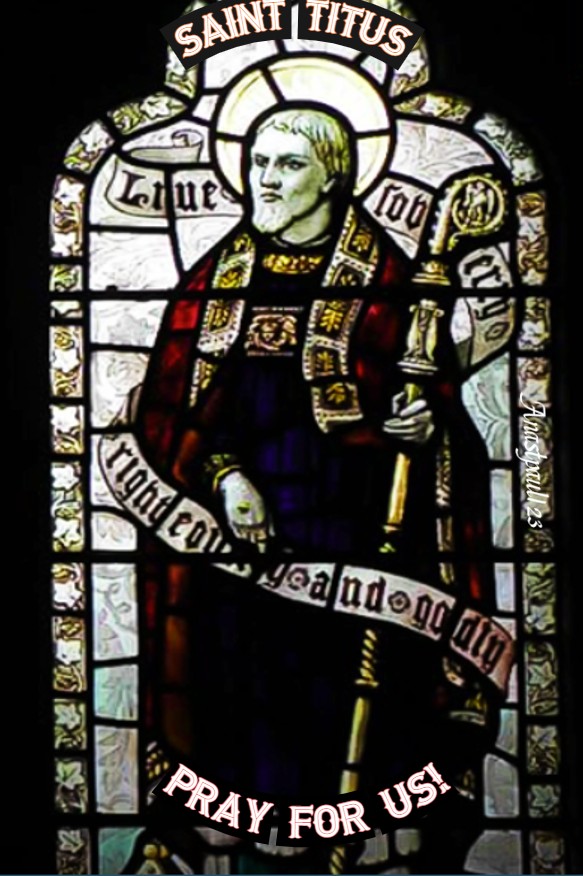
One Minute Reflection – 6 February – “The Month of the Blessed Trinity” – St Titus (Died c96) Bishop, Confessor – Ecclesiasticus 44:16-27; 45:3-20; Luke 10:1-9 – Scripture search here: https://www.drbo.org/
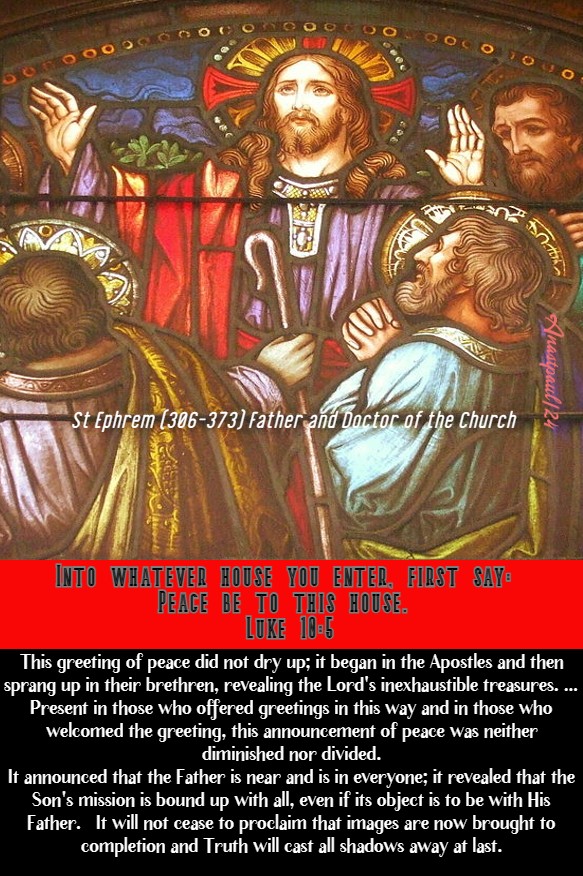
“Into whatever house you enter, first say: Peace be to this house. And, if the son of peace be there, your peace shall rest upon him but if not, it shall return to you.” – Luke 10:5-7
REFLECTION – “As you enter a house, first say, ‘Peace to this house,‘” (Lk 10:5) so that the Lord Himself might enter and remain there, as with Mary. … This greeting is the Mystery of Faith which shines forth in the world. Through it, enmity is stifled, war is ended and people acknowledge one another. The effect of that greeting was hidden by a veil in spite of the fact that it prefigures the Mystery of the Resurrection … when the light rises and dawn chases night away. From the moment Christ sent out His disciples, people began to give and receive this greeting, a source of healing and blessing. …
This greeting with its hidden power … is amply sufficient for us all. That is why Our Lord sent it out, together with His disciples, as forerunner, so that it might bring about peace and, carried by the voice of the Apostles whom He sent, prepare the way before them. It was sown in every dwelling … it entered into all who heard it, so as to separate and set apart, the children it recognised as its own. It remained in them but it denounced those who were alien to it, for they did not welcome it.
This greeting of peace did not dry up; it began in the Apostles and then sprang up in their brethren, revealing the Lord’s inexhaustible treasures. … Present in those who offered greetings in this way and in those who welcomed the greeting, this announcement of peace was neither diminished nor divided. It announced that the Father is near and is in everyone; it revealed that the Son’s mission is bound up with all, even if its object is to be with His Father. It will not cease to proclaim that images are now brought to completion and Truth will cast all shadows away at last.” – St Ephrem (306-373) Father and Doctor of the Church (Diatessaron 8: 3-4).
PRAYER – O God, Who adorned blessed Titus, Thy Confessor and Bishop, with the virtues of an apostle, grant, through his merits and intercession that by living justly and piously in this world, we may be found worthy to enter Heaven. Through Jesus Christ, Thy Son our Lord, Who lives and reigns with Thee, in the unity of the Holy Ghost, God, world without end. Amen (Collect).
Our Morning Offering – 6 February –“The Month of the Blessed Trinity” – St Titus (Died c96) Bishop, Confessor
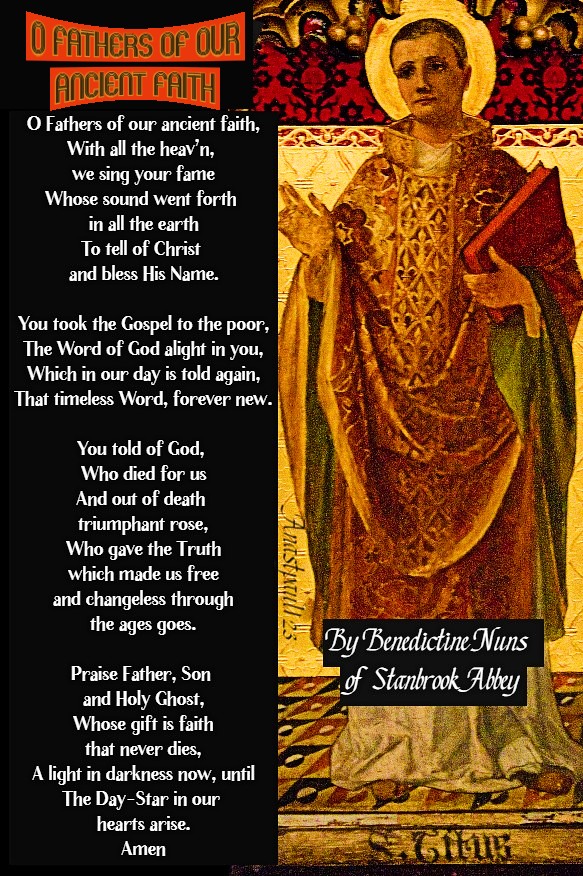
O Fathers of Our Ancient Faith
O Fathers of our ancient faith, With all the heav’n, we sing your fame Whose sound went forth in all the earth To tell of Christ and bless His Name.
You took the Gospel to the poor, The Word of God alight in you, Which in our day is told again, That timeless Word, forever new.
You told of God, Who died for us And out of death triumphant rose, Who gave the Truth which made us free and changeless through the ages goes.
Praise Father, Son and Holy Spirit, Whose gift is faith that never dies, A light in darkness now, until The Day-Star in our hearts arise.
O Fathers of Our Ancient Faith is written by the Benedictine Nuns of Stanbrook Abbey. In the Divine Office it is sung at Morning Prayer in the Common of Apostles. It is set to the anonymous tune associated with the 7th Century Latin Hymn, Creator Alme Siderum.
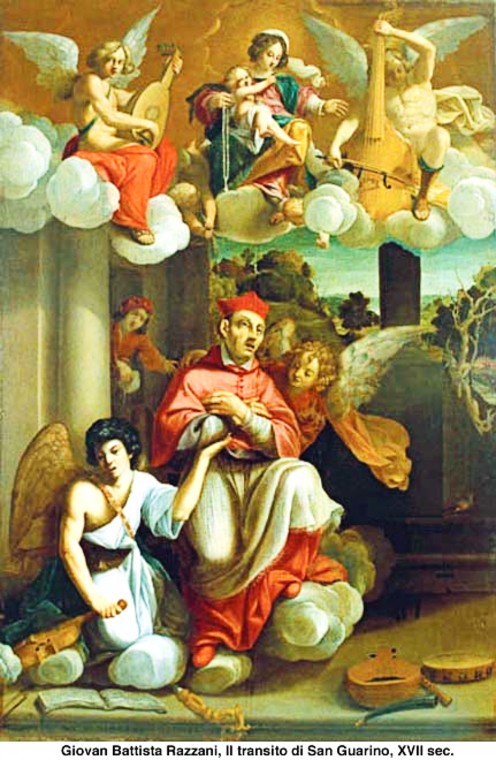
Saint of the Day – 6 February – St Guarinus Foscari CRSA (c1080-1158) Cardinal Bishop of Palestrina in Italy, from December 1144, Canon Regular of St Augustine, renowned for his great compassion and assistance to the poor of Palestrina. Born in c1080 in Bologna, Italy and died there of natural causes on 6 February 1158. He was Canonised by Pope Alexander III ia year after his death, in 1159. Also known as – Guarino, Guarinus of Palestrine, Guerin, Garin.
The Roman Martyrology states today: “At Bologna, St Guarinus, the Bishop of Palestrina and Cardinal, renowned for holiness of life.”
Guarinus Foscari was born in Bologna around 1080. He was a member of the noble Guarini household, while his mother was a Foscari. Guarinus Foscari was well educated and was quite fond of literature. Despite opposition from his parents, he was Ordained to the Priesthood at the age of 24. He was later named as the Canon of the Cathedral of Bologna. He was still at the Cathedral, when, in around 1104, he joined the Santa Croce Congregation of Canons at Mortara. Prior to his departure, he donated all of his goods to contribute towards the building of a hospital.
At the age of 59, Guarinus was elected to fill an opening which the death of the Bishop of Pavia created but evaded his Episcopal Consecration by escaping by clambering away, out of a window. Guarinus then went into hiding until another election was held.
During the Advent season of 1144, Pope Lucius II sent for him and he again attempted to avoid higher office. Lucius II had Guarinus arrested but he again escaped for a brief period. But again. Pope Lucius II had him appointed in December 1144 as the Cardinal-Bishop of Palestrina. He also bestowed on him a number of gifts suitable to a person of his new standing, including some fine horses which Guarinus immediately sold and distributing the funds to the poor.
Feeling unworthy of the position, Guarinus left his post twice. The first time, he was recalled from Subiaco due to the orders of Pope Eugene III. The second time he went to Ostia but, finding Saracens there,, he fled to Rome.
Guarinus was the Bishop for thirteen years and remained out of the troublesome Roman politics which so defined the time and temperament of Rome. As a Cardinal, he participated in three Conclaves which saw the elections of Pope Eugene III, Pope Anastasius IV and Pope Adrian IV.
Our Saint died at the age of 78 on 6 February 1158. He had been breatly loved for his humility and for his great generosity to the poor. He was Canonised by Pope Alexander III in 1159 just over a year after his death
Guarinus was buried in the Crypt of the Cathedral of Sant’Agapito. In 1473 Palestrina was looted and his remains were hidden for fear of desecration. Although a search was made in 1754, they were not located.
Saint Pedro Bautista Blásquez y Blásquez OFM (1542-1597) Priest Martyr and the 26 Martyrs of Japan – Died by Crucifixion on 5 February 1597. Canonised on 8 June 1862 by Pope Pius IX.
St Amand of Moissac St Amand of Nantes St Andrew of Elnone
St Antholian of Auvergne St Brinolfo Algotsson Cassius of Auvergne Bl Diego de Azevedo St Ethelburga of Wessex Bl Francesca of Gubbio St Gerald of Ostia St Gonsalo Garcia OFM St GuarinusFoscari CRSA (c1080-1158) Bishop St Guethenoc St Hildegund St Ina of Wessex St Jacut St Liminius of Auvergne St Maximus of Aurvergne St Mel of Ardagh St Melchu of Armagh St Mun of Lough Ree St Relindis of Eyck St Revocata St Saturninus St Tanco of Werden St Theophilus St Theophilus the Lawyer
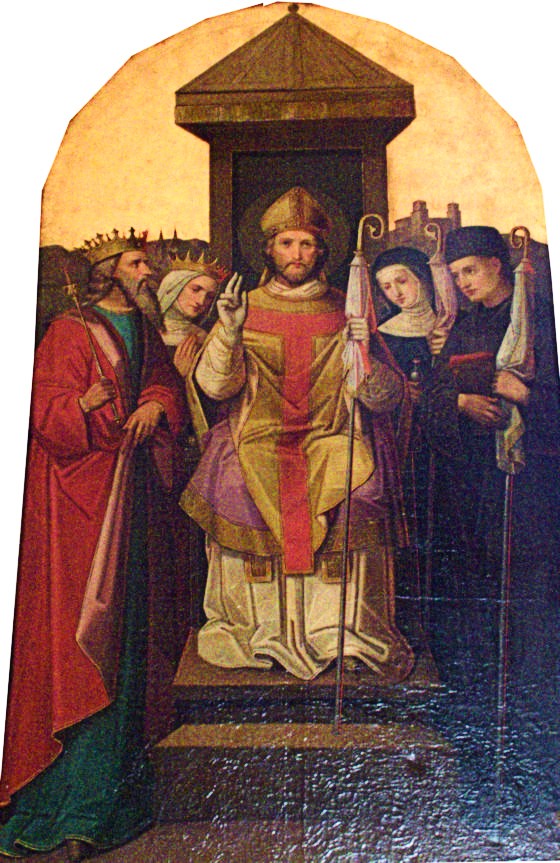
St Vaast of Arras (c 453-539 or 540) Bishop – The First Bishop of Arras, France , Hermit, Ascetic, Miracle-worker, Advisor to King Clovis. The Roman Martyrology reads: “In Arras in Belgian Gaul, today in France, Saint Vedastus, Bishop, who, sent by Saint Remigius Bishop of Rheims to the devastated City, catechised King Clovis, re-established the Church and held it for about forty years and brought to an end, the need of work for evangelisation among the previously still pagan peoples of the region.” St Vaast is another Patron of eye diseases, problems and blindness. Biography: https://anastpaul.com/2022/02/06/saint-of-the-day-6-february-saint-vaast-of-arras-c-453-539-or-540/
St Victorinus of Auvergne
Martyrs of Emesa: At Emesa in Phrenicia, in the time of the Emperor Maximian, St Silvanus, the Bishop, who after having governed that Church for forty years, was delivered to the beasts with two other Christians and, having his limbs all mangled, received the Palm of Martyrdom. The other two are recorded as St Luke the Deacon and St Mucius the Lector.
Thought for the Day – 5 February – Meditations with Fr Richard Frederick Clarke SJ (1839-1900)
Meditations on “The Great Truths” From “The Devout Year” By Fr Richard Frederick Clarke SJ (1839-1900)
5th Day – God the End of our Life
Seek ye, therefore. first the kingdom of God. (St Matthew vi:33)
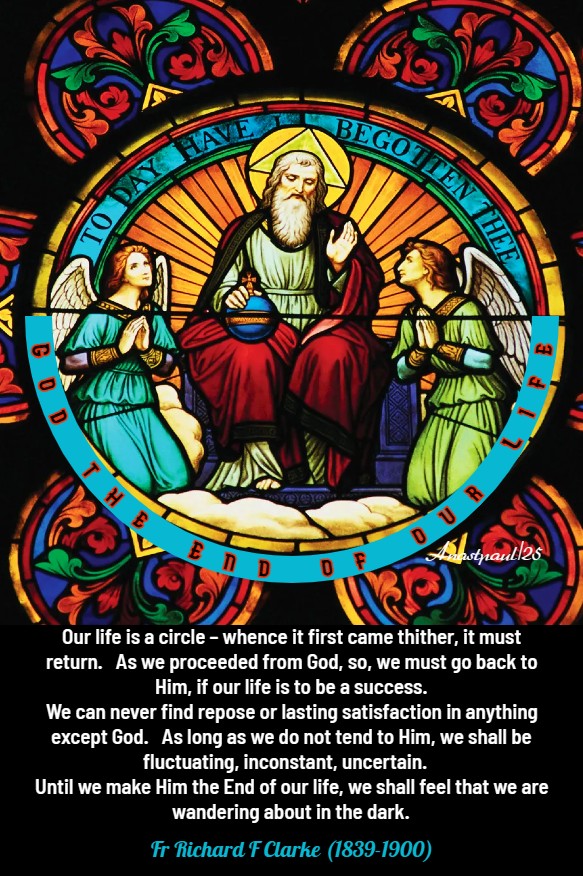
+1. Our life is a circle – whence it first came thither, it must return. As we proceeded from God, so, we must go back to Him, if our life is to be a success. We can never find repose or lasting satisfaction in anything except God. As long as we do not tend to Him, we shall be fluctuating, inconstant, uncertain. Until we make Him the End of our life, we shall feel that we are wandering about in the dark.
+2. What do we mean by making God the End of our life? We mean that to do His pleasure shall be the motive which shall be first and foremost and, when there is a choice between God’s pleasure and our own, when the two seem to be opposed, our general disposition shall be to do God’s Will and not our own. In spite of the pain involved in giving up his own will, the man who makes God the End of his life, will deny that own will, without hesitation and so, will draw nearer to God, his last End.
+3. Every time we do this, we break down a barrier between God and ourselves; we come nearer to the enjoyment of Him, we get a bit closer to Heaven. The self-willed man is never satisfied; the man whose will is perfectly subject to God, is always happy. The Angels are always happy because they have no will but God’s. If I want to find happiness in this world, or the next, the first thing is to learn to submit my will to God. Pray God to break your self-will at any cost.
Quote/s of the Day – 5 February – 1 Corinthians 1 Cor. 1:26-31; Matthew 19:3-12– Scripture search here: https://www.drbo.org/
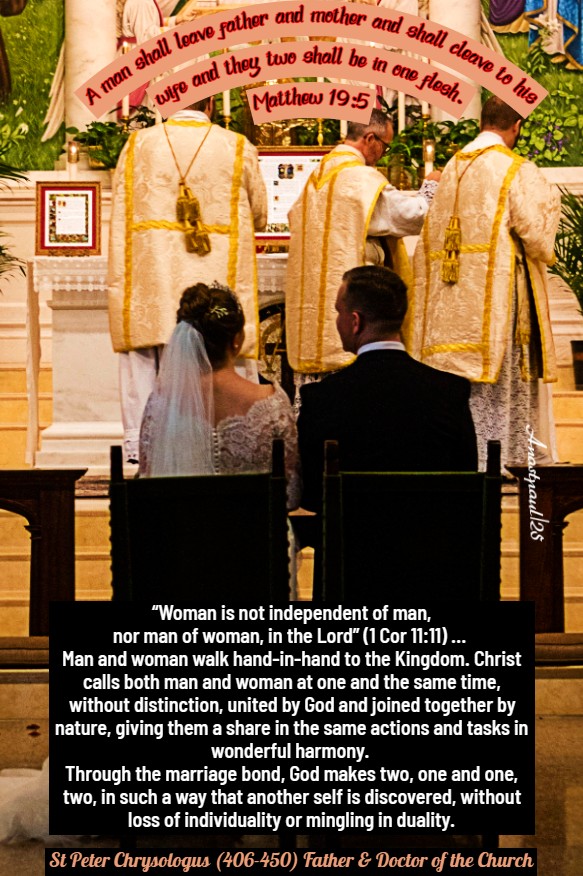
“… A man shall leave father and mother and shall cleave to his wife and they two shall be in one flesh.” Matthew 19:5
“Say your prayers together. Let each of you go to Church and, returning home, let the husband ask an account from his wife and the wife from her husband, concerning whatever was said or read … Learn the fear of God and all the rest will flow, as from a spring and your house will be filled with countless blessings. Let us aspire to those good things that are incorruptible and the rest will not pass us by. “Seek first the Kingdom of God and all the rest will be added to you” (Mt 6:33).”
St John Chrysostom (347-407) Father and Doctor of the Church
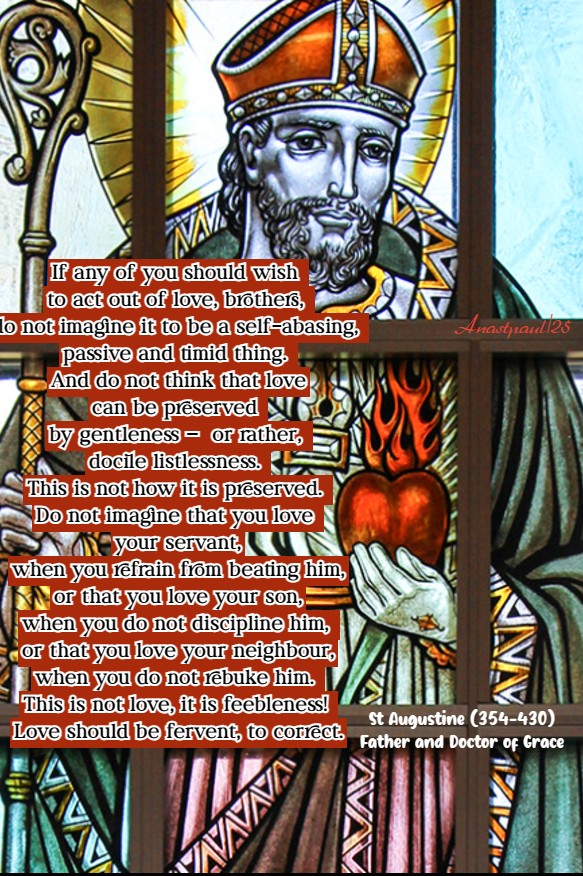
“If any of you should wish to act out of love, brothers, do not imagine it to be a self-abasing, passive and timid thing. And do not think that love can be preserved by gentleness – or rather, docile listlessness. This is not how it is preserved. Do not imagine that you love your servant, when you refrain from beating him, or that you love your son, when you do not discipline him, or that you love your neighbour, when you do not rebuke him. This is not love, it is feebleness! Love should be fervent, to correct.”
St Augustine (354-430) Father and Doctor of Grace
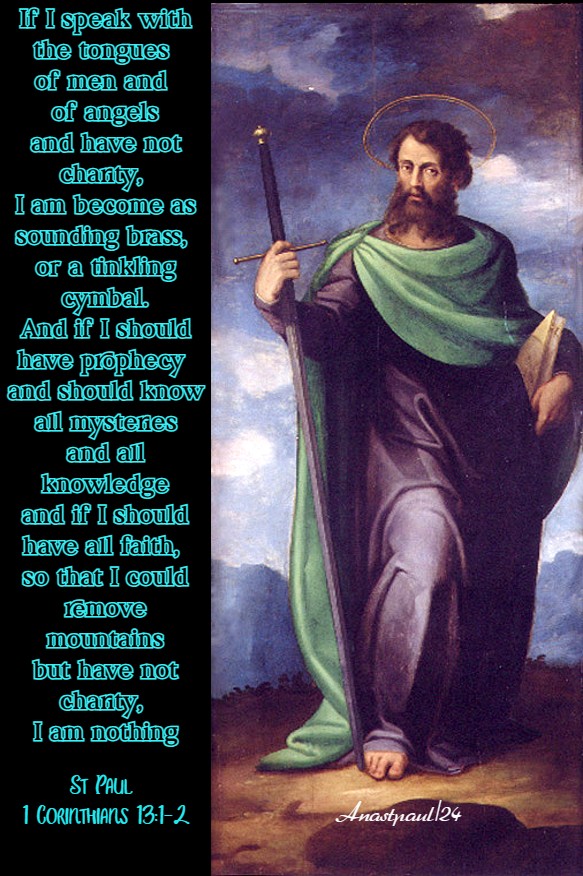
“If I speak with the tongues of men and of angels and have not charity, I am become as sounding brass, or a tinkling cymbal. And if I should have prophecy and should know all mysteries and all knowledge and if I should have all faith, so that I could remove mountains but have not charity, I am nothing!”
One Minute Reflection – 5 February – “The Month of the Blessed Trinity” – St Agatha (c231- c251) Virgin Martyr – 1 Corinthians 1 Cor. 1:26-31; Matthew 19:3-12– Scripture search here: https://www.drbo.org/
“… A man shall leave father and mother and shall cleave to his wife and they two shall be in one flesh.” – Matthew 19:5
REFLECTION – “Woman is not independent of man, nor man of woman, in the Lord” (1 Cor 11:11) … Man and woman walk hand-in-hand to the Kingdom. Christ calls both man and woman at one and the same time, without distinction, united by God and joined together by nature, giving them a share in the same actions and tasks in wonderful harmony. Through the marriage bond, God makes two, one and one, two, in such a way that another self is discovered, without loss of individuality or mingling in duality.
But why does God appeal thus to man and and to woman, through the images he gives of his Kingdom? (cf Lk 13:18-21). Why does He suggest such greatness by means of seemingly weak and inadequate examples? Oh my brethren! a priceless mystery is hidden under this poverty. As the Apostle Paul says: “This is a great mystery but I speak in reference to Christ and His Church” (Eph 5:32).
These parables suggest humanity’s greatest goal – man and woman have brought an end to the lawsuit against the world, a lawsuit which dragged on for centuries. The first man, Adam and first woman, Eve, are led from the tree of the knowledge of good and evil, to the fire … of the Gospel …. Mouths sickened by the fruit of the poisoned tree are healed, by the fiery taste of the tree of salvation, of that tree tasting of fire which, enflames consciences, frozen by the former tree. Here nakedness makes no difference and no longer inspires shame, for man and woman are fully clothed in forgiveness.” – St Peter Chrysologus (406-450) Bishop of Ravenna, Father and Doctor of the Church (Sermon 99).
PRAYER – O God, Who among other wonders of Thy power hast given the victory of mMrtyrdom even to the gentler sex, graciously grant that we, who commemorate the anniversary of the death of blessed Agatha, Thy Virgin and Martyr, may come to Thee, by following her example.Through esus Christ, Thy Son our Lord, Who lives and reigns with Thee, in the unity of the Holy Ghost, God, world without end. Amen (Collect).
Our Morning Offering – 5 February – “The Month of the Blessed Trinity” – On Wedmesdays, Catholics make a special devotion to St Joseph by going to Mass on the 1st Wednesdays of 9 consecutive months and offering their Communions in his honour and for the salvation of the dying.
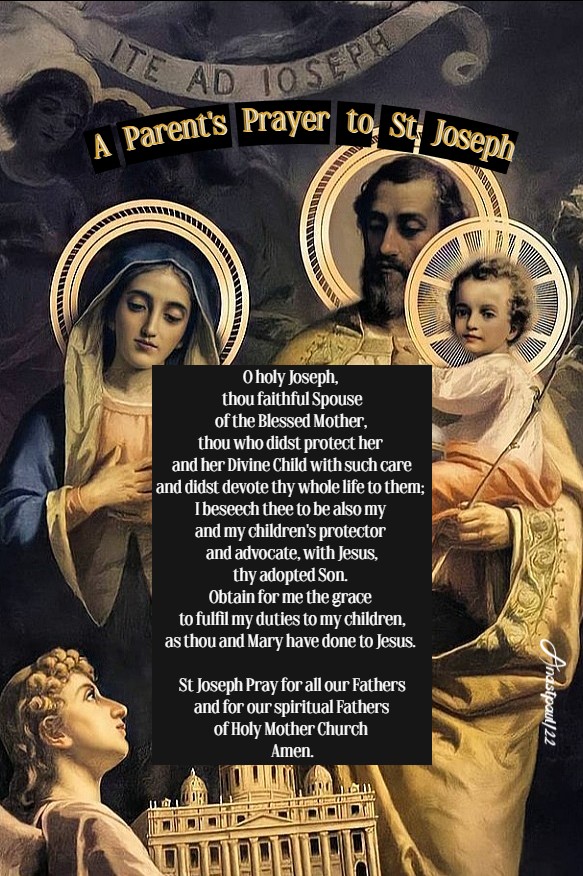
A Parent’s Prayer to St Joseph
O holy Joseph, thou faithful Spouse of the Blessed Mother, thou who didst protect her and her Divine Child with such care and didst devote thy whole life to them; I beseech thee to be also my and my children’s protector and advocate, with Jesus, thy adopted Son. Obtain for me the grace to fulfil my duties to my children, as thou and Mary have done to Jesus.
St Joseph Pray for all our Fathers and for our spiritual Fathers of Holy Mother Church Amen.
Saint of the Day – 5 February – St Luca di Demenna (Died 995) Founder Abbot of the Monastery of Sts Elia and Anastasius in Carbone, Potenza, Italy, Miracle-worker. Born in Sicily and died on 5 February 995 at his Monastery in in Carbone in the Province of Potenza, Italy, of natural causes.
Luca was born in Sicily, in Demenna and was initiated into the Basilian asceticism in the Monastery of St Philip of Agira, where other famous Greek Monks of the 10th Century were also trained.
To escape the harassment of the invading Saracens, who had conquered the Island, he crossed the strait and went to place himself under the discipline of St Elias Speleota of Reggio. But soon the City of Reggio Calabria in southern Italy also became the target of Saracen raids, so Luca took the road further north. Here he founded a Monastery in the territory of Noepoli, where he restored the crumbling Church of St Peter and lived with his disciples for seven years, practicing the most rigourous asceticism and dedicating himself to working in the fields, so as to change the desert into a garden.
Desiring greater solitude, Luca moved to the territory of Agromonte, near the river Agri, where he restored the Monastery of St Julian. He lent his work of Christian charity to the soldiers wounded in the conflict between the Saracens and the Germans of Otto II; he fortified the castle of Armento and the Church of the Mother of God, leaving their custody to his disciples.
From here, in around 971, the famous Monastery of Sts Elia and Anastasius in Carbone in the Province of Potenza. This Monastery became the headquarters of St Luca, both as a fortified bulwark against the incursions of the Saracens and as a training ground for the many miracles that he worked there.
Here Luca died assisted by St Saba of Collesano on 5 February 995 and was buried in the Monastery Church, where he was publicly venerated as a Saint.
St Indract St Isidore of Alexandria St Jesús Méndez-Montoya Bl John Morosini St Kichi Franciscus St Luca di Demenna (Died 995) Abbot
St Modestus of Carinthia
Bl Primo Andrés Lanas St Saba the Younger St Vodoaldus of Soissons
Martyrs of Pontus: An unknown number of Christians who were tortured and martyred in assorted painful ways in the region of Pontus (in modern Turkey) during the persecutions of Maximian.
The Twenty-Six Martyrs of Japan: 26 Saints – the First Martyrs of Japan. Martyred on 5 February 1597 by Crucifixion, also known as Pedro Bautista Blasquez y Blasquez and 22 companions, along with Paulus Miki and 2 companions, were Beatified on 14 September 1627 by Pope Urban VIII, and Canonised on 8 June 1862 by Pope Pius IX.
Thought for the Day – 4 February – Meditations with Fr Richard Frederick Clarke SJ (1839-1900)
Meditations on “The Great Truths” From “The Devout Year” By Fr Richard Frederick Clarke SJ (1839-1900)
4th Day – God our Best Friend
All are Thine , O Lord , Who lovest souls. (Wisdom xi:27)
+1. Friendship is one of the consolations of man upon earth. One faithful friend is worth a hundred acquaintances. A friend who values our friendship, for its own sake, is a treasure without price. Such a friend we have in God. He has nothing to gain from my friendship, His Infinite Happiness is not increased by it. Yet, His Infinite Goodness includes an intense desire to make me happy!
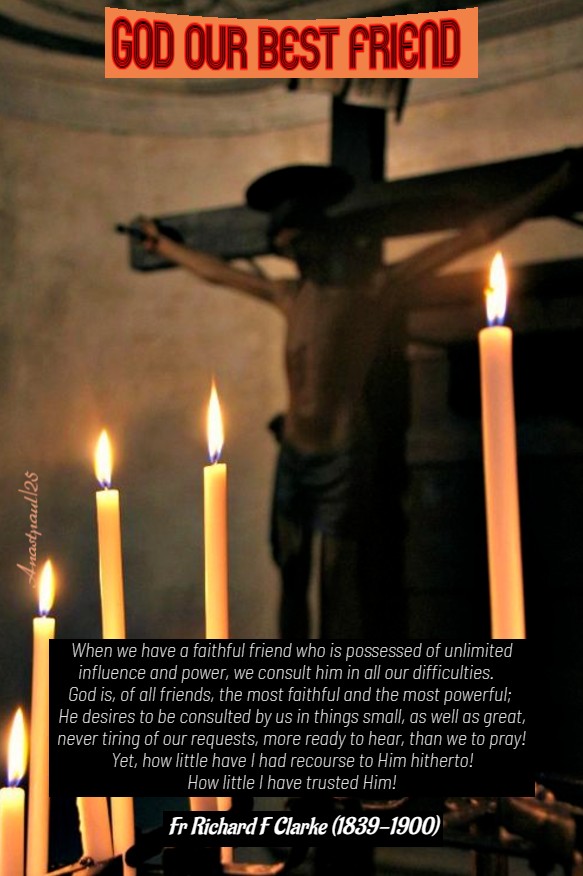
+2. When we have a faithful friend who is possessed of unlimited influence and power, we consult him in all our difficulties. God is, of all friends, the most faithful and the most powerful; He desires to be consulted by us in things small, as well as great, never tiring of our requests, more ready to hear, than we to pray! Yet, how little have I had recourse to Him hitherto! How little I have trusted Him!
+3. The best proof of a friend’s love, is a desire for our company. In this, what friend is like God? He asks us, begs us, commands us, to be always in His Presence – “Walk with God and be thou perfect .” His one object, in all His advice, is to secure our company forever in Heaven. Why am I so indifferent about His Presence, so soon weary of God? Pray that you may appreciate and relish the Divine Friendship of God.
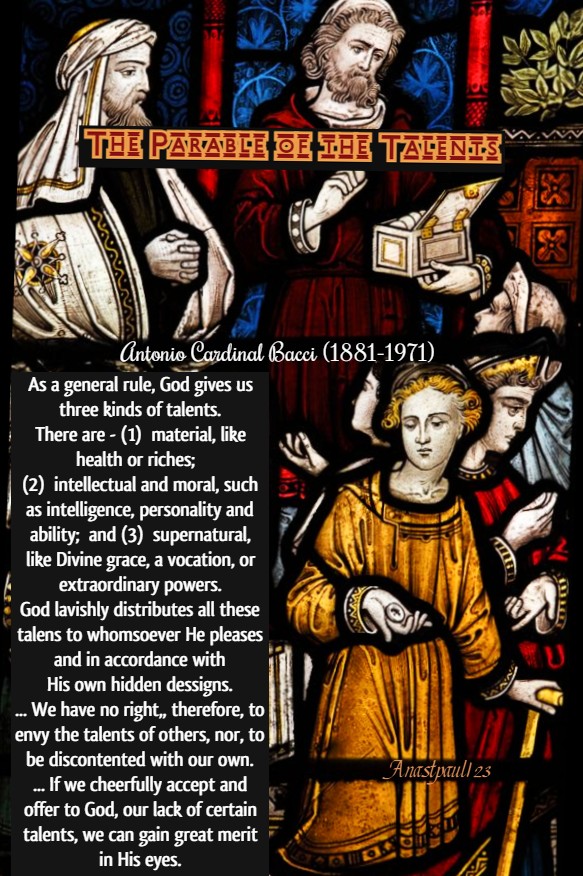
Quote/s of the Day – 4 February – The Parable of the Talents
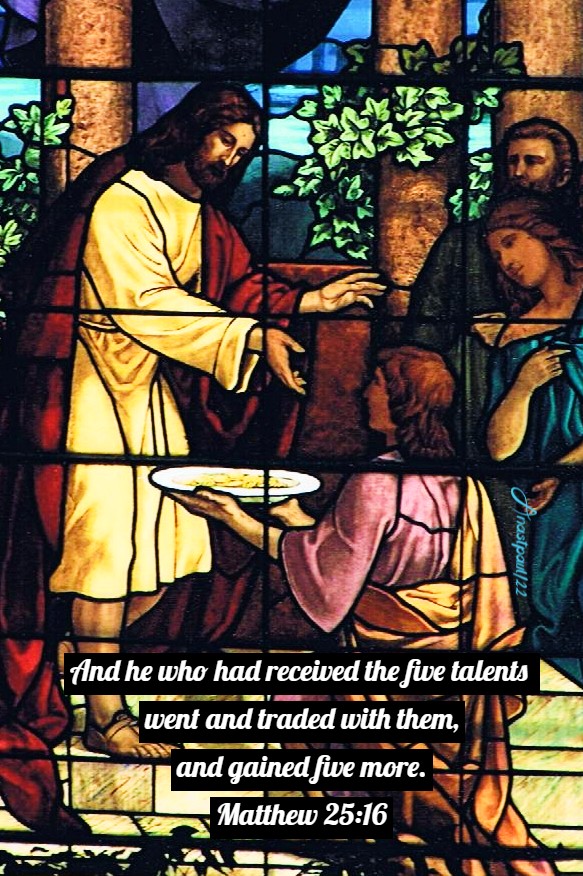
“And he who had received the five talents went and traded with them, and gained five more.
Matthew 25:16
“I have chosen you and have appointed you, that you should go and should bring forth fruit and your fruit should remain, says the Lord.”
John 15:16
“What dost thou have that thou hast not received?”
St Paul – 1 Corinthians 4:7
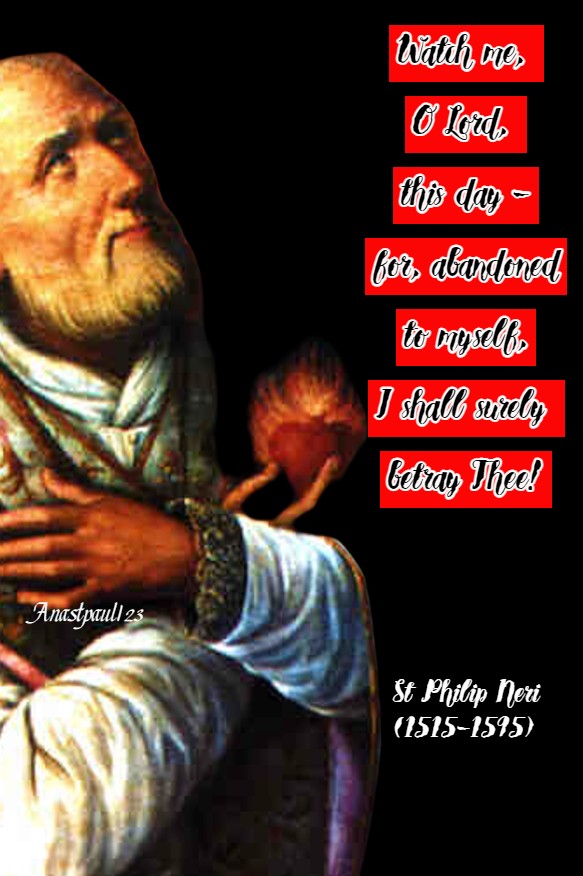
“Watch me, O Lord, this day – for, abandoned to myself, I shall surely betray Thee!”
St Philip Neri (1515-1595)
“As a general rule, God gives us three kinds of talents. There are – (1) material, like health or riches; (2) intellectual and moral, such as intelligence, personality and ability; and (3) supernatural, like Divine grace, a vocation, or extraordinary powers. God lavishly distributes all these talens to whomsoever He pleases and in accordance with His own hidden dessigns. We have no right,, therefore, to envy the talents of others, nor, to be discontented with our own. … If we cheerfully accept and offer to God, our lack of certain talents, we can gain great merit in His eyes.”
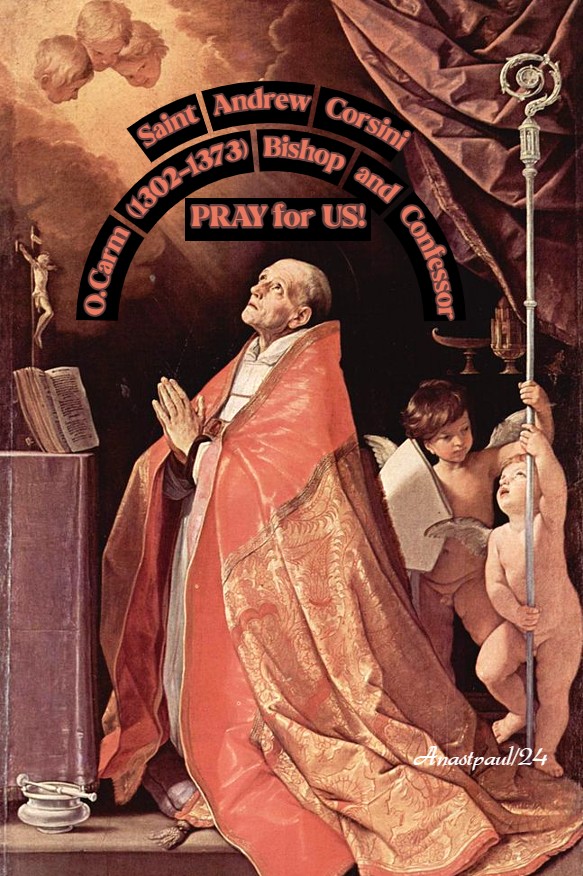
One Minute Reflection – 4 February – “The Month of the Blessed Trinity” – St Andrew Corsini O.Carm (1302-1373) Bishop of Fiesole from 1349 until his death,Confessor, known as the “Apostle of Florence” Carmelite Friar – Ecclesiasticus Sir 44:16-27; 45:3-20; Matthew 25:14-23– Scripture search here: https://www.drbo.org/
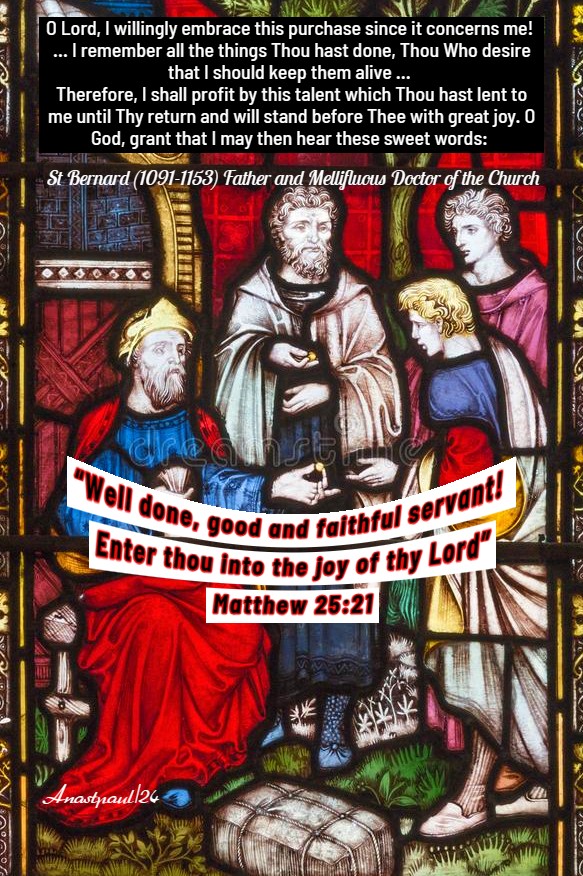
“Well done, good and faithful servant … Enter thou into the joy of thy Lord.”- Matthew 25:21
REFLECTION – “The Word of the Father, Only-begotten Son of God, Sun of Justice (Mal 3:20), is the great Merchant Who has brought us the price of our redemption. It is a truly precious exchange which we can never value sufficiently, when a King, Son of the King Most High, has become the Coin, the Gold has paid our dues, the Just Man is given for the sinner. Truly unmerited mercy, perfectly disinterested love, astonishing goodness…, it is a completely disproportionate purchase, in which the Son of God is delivered up for the servant, the Creator is put to death for the one He has created, the Lord is condemned for His slave.
O Christ, these are Thine Works, Thou Who descended from Heaven’s brightness into our hellish darkness, to bring Light to our gloomy prison. Thou came down from the Right Hand of the Divine Majesty, into our human misery, to redeem the human race, Thou Who descended from the Father’s glory to death on the Cross, to triumph over death and its author. Thou art the only One and there is no other but Thee, Who could have been drawn to redeem us through Thine Own Goodness…
Let all the merchants of Teman (Bar 3:23) withdraw from this place … it is not they but Israel [Thy] beloved whom [Thou hast] chosen, Thou Who hide these mysteries from the wise and prudent and have revealed them to those babes and humble servants of Thine (Lk 10:21) … O Lord, I willingly embrace this purchase since it concerns me! … I remember all the things Thou hast done, Thou Who desire that I should keep them alive … Therefore, I shall profit by this talent which Thou hast lent to me until Thy return and will stand before Thee with great joy. O God, grant that I may then hear these sweet words: “Well done, good and faithful servant! Enter thou into the joy of thy Lord” (Mt 25:21).” – St Bernard O.Cist. (1091-1153) Cistercian Monk, known as the Last Father and the Mellifluous Doctor of the Church (Selected sermons, no 42: The Five Purchases).
PRAYER – O God, Who establishes ever new examples of virtue in Thy Church, grant that Thy people may follow the footsteps of blessed Andrew, Thy Confessor and Bishop, so that they may also obtain his reward. Through Jesus Christ, Thy Son our Lord, Who lives and reigns with Thee, in the unity of the Holy Ghost, God, world without end. Amen (Collect).
Our Morning Offering – 4 February – “The Month of the Blessed Trinity”
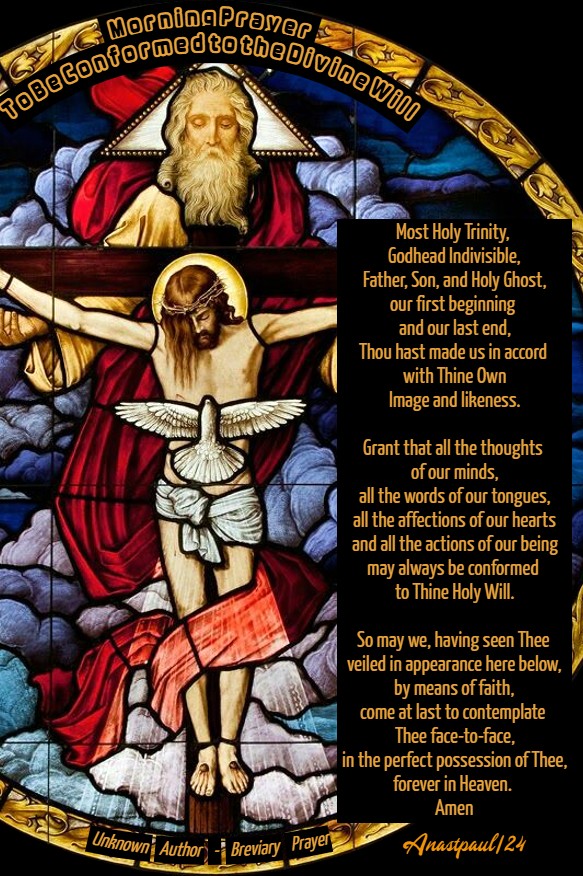
Morning Prayer To Be Conformed to the Divine Will Unknown Author Breviary Prayer
Most Holy Trinity, Godhead IndIvisible, Father, Son and Holy Ghost, our first beginning and our last end, Thou hast made us in accord with Thine Own Image and likeness.
Grant that all the thoughts of our minds, all the words of our tongues, all the affections of our hearts and all the actions of our being may always be conformed to Thine Holy Will.
So may we, having seen Thee veiled in appearance here below, by means of faith, come at last to contemplate Thee face-to-face, in the perfect possession of Thee, forever in Heaven. Amen
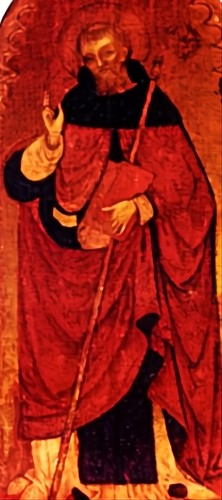
Saint of the Day – 4 February – St Fingen (Died c1005) Abbot, Missionary, builder/restorer of Monastery buildings and Reformer of the practices of the communities living therein. Born in Ireland in the 8th Century and died in c1005 in Metz, France. Also known as – Fingen of Metz.
An image of an ancient Abbot
Fingen, a celebrated Irish Monk and Abbot, migrated to the Kingdom of Lothaire as a Missionary, where he acquired a reputation for restoring old Monastery buildings. Lothaire was a medieval successor Kingdom of the Carolingian Empire. It comprised present-day Lorraine (France), Luxembourg, Saarland (Germany).
In around 991, one of the Monasteries restored by Fingen, Saint Symphorien’s, was placed under Fingen’s care as the Abbot by Bishop Saint Adalbero.
At the insistence of the dowager Empress Saint Adelaide Pope John XVII issued a charter which declared that only Irish Monks would administer the Abbey as long as they could be found. She obtained a similar charter from King Otto III in 992.
Fingen’s final work, with the help of seven of his Irish Monks, was the restoration of Saint-Vannes in Verdun. By 1001, Saint-Vannes was attracting distinguished applicants, such as Blessed Frederick of Arras, Count of Verdun and his friend Blessed Richard, the Vicar of the Diocese of Rheims, who later became the Abbot of Saint-Vannes.
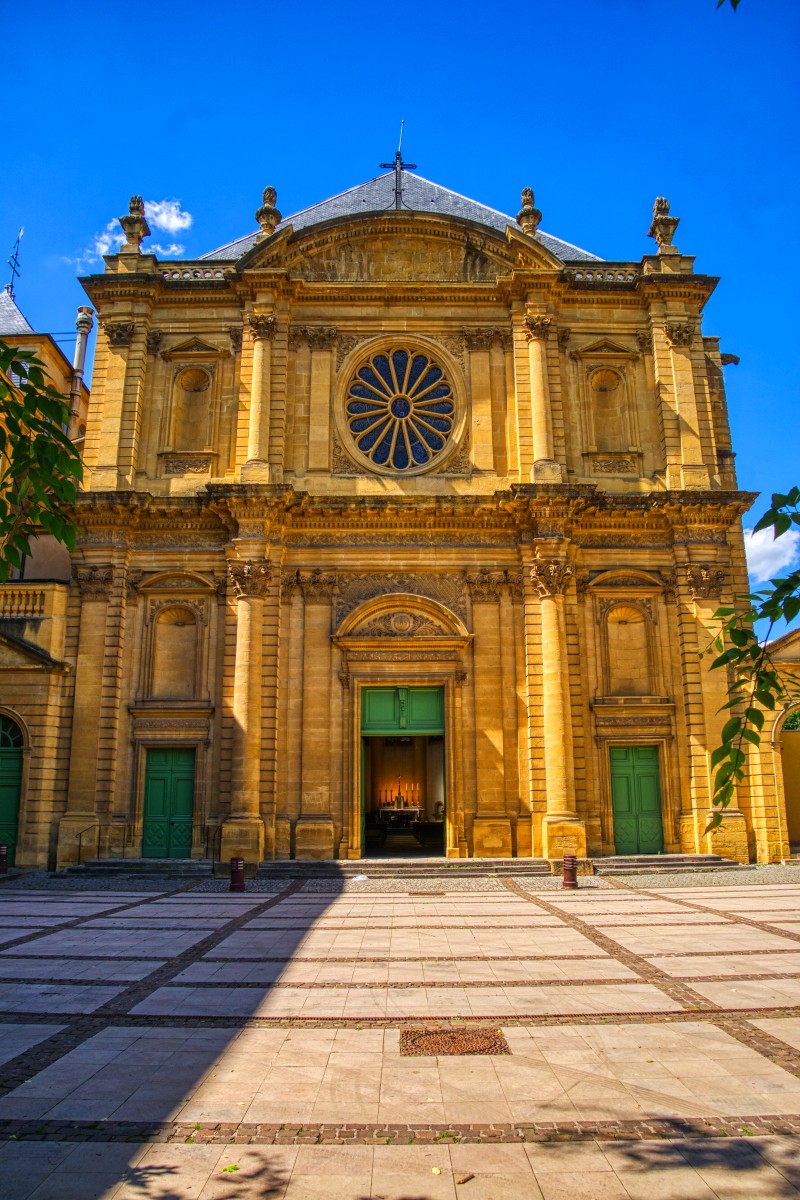
Fingen’s Relics can be found in Saint-Clement’s Church in Metz, (SEE BELOW) where the Epitah highly praises him.
St Isidore of Pelusium Martyr. No other information has survived.
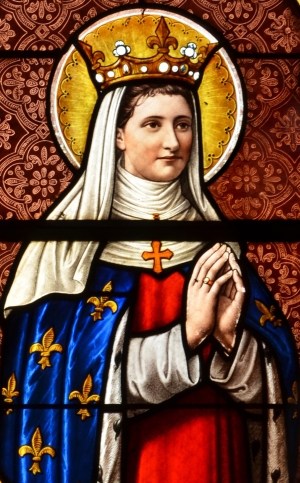
St Jane de Valois O.Ann.M and TOSF (1464-1505) Princess, Queen, Founder, Religious Sister, Mystic, Teacher. Founded the monastic Order of the Sisters of the Annunciation of Mary. From this Order later sprang the religious congregation of the Apostolic Sisters of the Annunciation, founded in 1787 to teach the children of the poor. She was Canonised on 28 May 1950 by Pope Pius XII. Biography: https://anastpaul.wordpress.com/2018/02/04/saint-of-the-day-4-february-saint-jane-of-valois-o-ann-m-1464-1505/
St Themoius St Theophilus the Penitent St Vincent of Troyes St Vulgis of Lobbes
Jesuit Martyrs of Japan: A collective memorial of all members of the Jesuits who have died as Martyrs for the faith in Japan.
Martyrs of Perga – 4 Saints: A group of shepherds Martyred in the persecutions of Decius. The only details we have about them are the names – Claudian, Conon, Diodorus and Papias. They were Martyred in c 250 in Perga, Asia Minor (in modern Turkey).


































 AnaStpaul
You must be logged in to post a comment.