Thought for the Day – 3 February – Meditations with Fr Richard Frederick Clarke SJ (1839-1900)
Meditations on “The Great Truths” From “The Devout Year” By Fr Richard Frederick Clarke SJ (1839-1900)
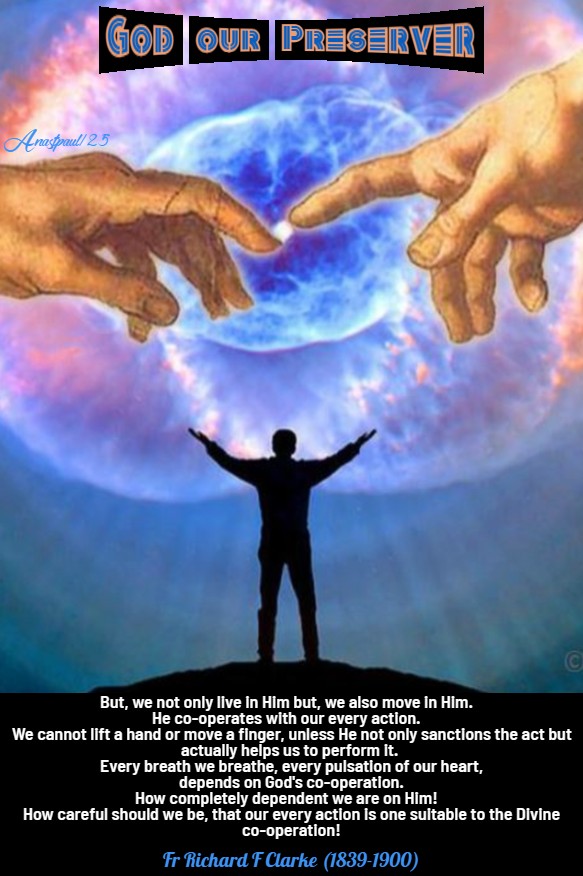
3rd Day – God our Preserver
In Him we live and move and are. (Acts xvii:28)
+1. If God had merely created us and then left us to ourselves, there would have been some excuse for our forgetting how completely we belong to Him. But, we are not like a picture which the artist finishes and then leaves to itself. God continues throughout our whole life the act of creation, in the shape of preservation. Without this, we should, at once, lapse into our previous nothingness. We depend upon Him for our being, as the rivulet depends on the spring, or the smoke on the fire.
+2. But, we not only live in Him but, we also move in Him. He co-operates with our every action. We cannot lift a hand or move a finger, unless He not only sanctions the act but actually helps us to perform it. Every breath we breathe, every pulsation of our heart, depends on God’s co-operation. How completely dependent we are on Him! How careful should we be, that our every action is one suitable to the Divine co-operation!
+3. God does more than this. He not only preserves us but tends us, with watchful care, delivers us from dangers warns us when we are going awry, shows a never-failing interest in us and an unceasing desire for our happiness. For all this, we are dependent on Him! What folly then, to neglect One to Whom we owe everything! Pray for a sense of continual dependenc and trust of God.
Quote of the Day – 3 February – St Blaise (Died c316) Martyr Bishop, Physician, Miracle-worker
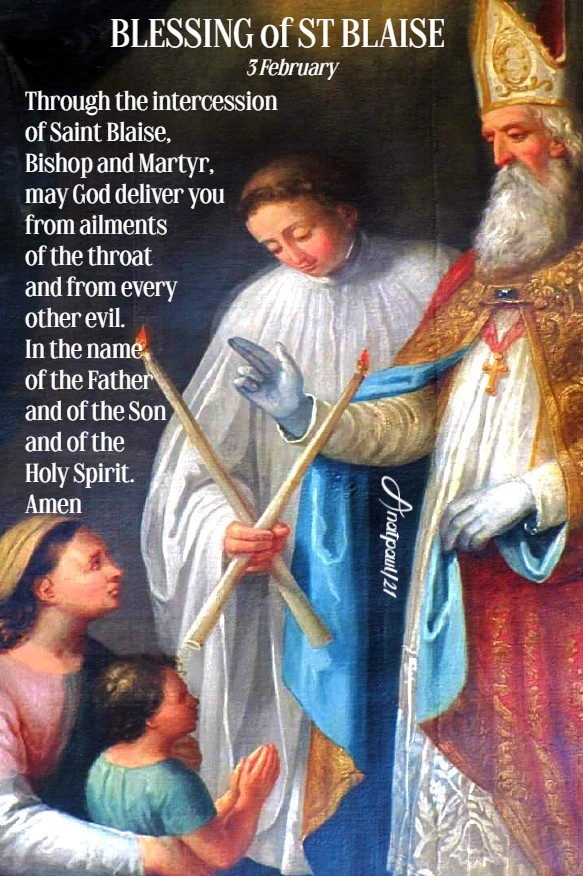
The Blessing of the Throats is a Sacramental of the Church, ordinarily celebrated today, the Feast day of Saint Blaise.
THE BLESSING of ST BLAISE Through the intercession of Saint Blaise, Bishop and Martyr, may God deliver you from ailments of the throat and from every other evil. In the name of the Father and of the Son and of the Holy Spirit. Amen
One Minute Reflection – 3 February – “The Month of the Blessed Trinity” – Resumed Mass of Sunday – Malachias 3:1-4; – Luke 2:22-32 – Scripture search here: https://www.drbo.org/
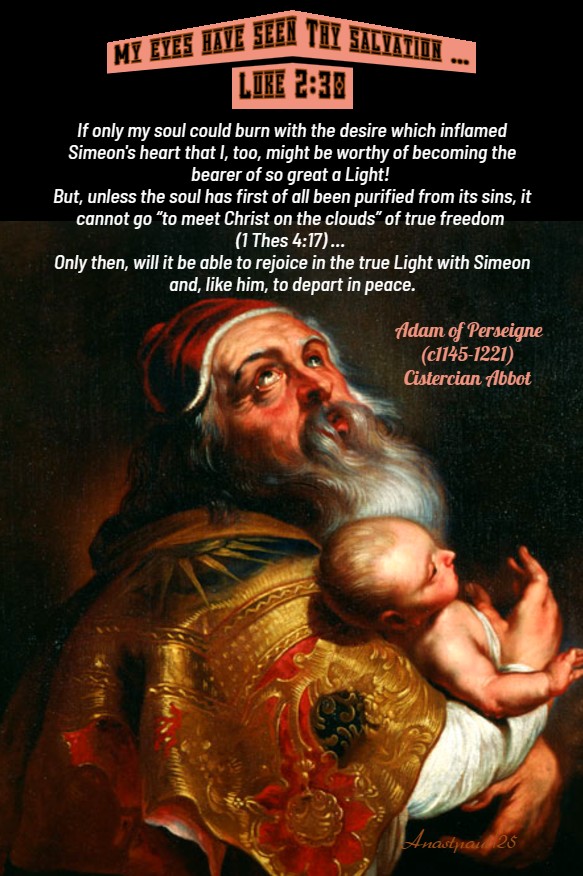
“My eyes have seen Thy salvation …” – Luke 2:30
REFLECTION – “The “Father of lights” (Jam 1:17) is inviting the children of Light (Lk 16:18) to celebrate the Feast of Light: “Look to Him that you may be radiant with joy” says the Psalm (33:6). In fact, He Who “dwells in unapproachable light” (1Tm 6:16) has condescended to become approachable. He has come down in the cloud of His Flesh that the weak and small might mount up to Him. What a descent of mercy! “He inclined the heavens,” that is to say, the heights of His Divinity, “and came down” by becoming present in the flesh, “with dark clouds under His Feet” (Ps 17:10) …
A necessary darkness to turn us to Light! The true Light was hidden beneath the cloud of His Flesh (cf. Ex 13:21) – a dark cloud by reason of its “likeness to sinful flesh” (Rm 8:3) … Since the true Light has made flesh His hiding place, let us, who are beings of flesh, draw near to the Word made Flesh … that we may learn to pass, by degrees to the spiritual flesh. Let us now draw near, for today a new Sun is shining even more than is its wont. Up until now, he was enclosed in the narrowness of a crib in Bethlehem and was known by hardly anyone but today, at Jerusalem, he is presented in front of a great number of people in the Temple of the Lord … Today, the Sun breaks out to shine over the whole world …
If only my soul could burn with the desire which inflamed Simeon’s heart that I, too, might be worthy of becoming the bearer of so great a Light! But, unless the soul has first of all been purified from its sins, it cannot go “to meet Christ on the clouds” of true freedom (1 Thes 4:17) … Only then, will it be able to rejoice in the true Light with Simeon and, like him, to depart in peace.” – Adam of Perseigne (c1145-1221) Cistercian Abbot (Sermon 4 for the Purification).
PRAYER – Almighty, eternal God, we humbly beseech Thy Majesty that, as Thy Only-begotten Son was this day presented in the temple in the nature of our flesh, so may Thou grant us to be presented to Thee with purified minds. Through Jesus Christ, Thy Son our Lord, Who lives and reigns with Thee, in the unity of the Holy Ghost, God, world without end. Amen (Collect).
Our Morning Offering – 3 February – Resumed Mass of Sunday
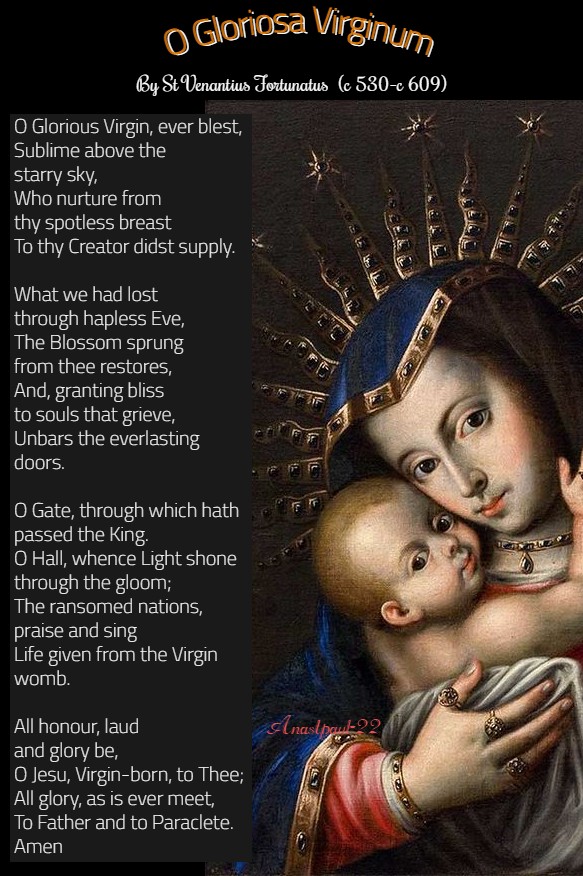
O Gloriosa Virginum By St Venantius Fortunatus (c530 – c609)
O Glorious Virgin, ever blest, Sublime above the starry sky, Who nurture from thy spotless breast To thy Creator didst supply.
What we had lost through hapless Eve, The Blossom sprung from these restores, And, granting bliss to souls that grieve, Unbars the everlasting doors.
O Gate, through which hath passed the King. O Hall, whence Light shone through the gloom; The ransomed nations, praise and sing Life given from the Virgin womb.
All honour, laud and glory be, O Jesu, Virgin-born, to Thee; All glory, as is ever meet, To Father and to Paraclete. Amen
O Gloriosa Domina is the second half of the Hymn: Quem Terra, Pontus, Aethera. It was composed by St Venantius Fortunatus (c530 – c609) the Bishop of Poitiers. In 1632, in accordance with revisions made to the hymns of the Divine Office by Pope Urban VIII (1568-1644), it was altered and changed to O Gloriósa Vírginum. It is sung in the Common of the Blessed Virgin Mary of the Roman Breviary. It is said that St Anthony of Padua (1195-1231) was always singing this Hymn. His mother sang it to him as a baby and even on his death bed, after receiving Extreme Unction, he intoned the Hymn.
Saint of the Day – 3 February – St Leonius (4th Century) Priest in Poitiers and a disciple of St Hilary. We believe Leonius was born in Poitiers in the 4th Century. He died in the latter part of this Century late 4th century in Poitiers, Aquitaine, France of natural causes. Also known as – Leonius of Luçon, Leonio… Léone… Lienne… Additional Memorial – 14 February (in the Archdiocese of Poitiers).
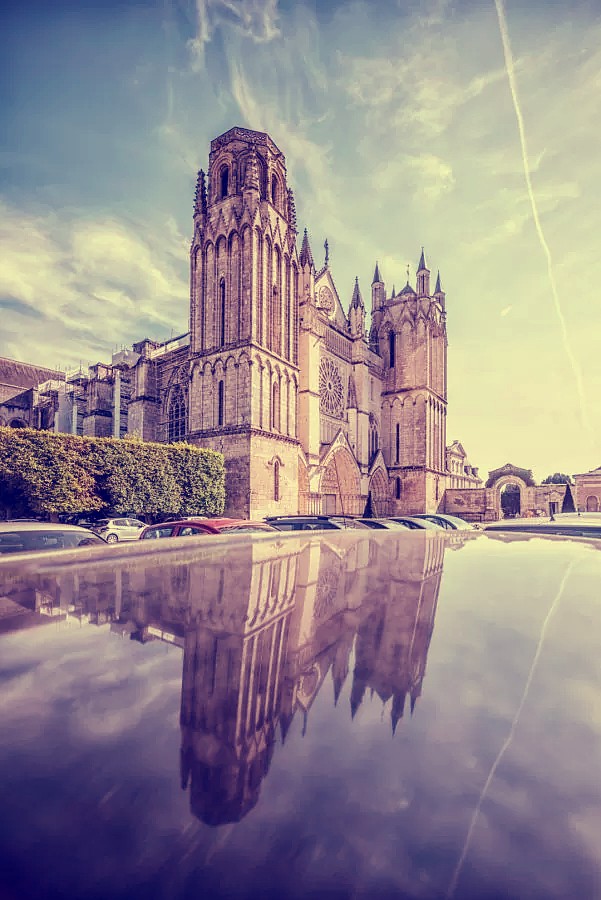
Poitiers Cathedral of St Peter
Leonius was born in Poitiers into a Christian family. He studied Scripture and theology and was Ordained a Priest by St Hilary. His teacher, St Hilary, was a prominent Theologian and the Bishop of Poitiers who supported the Doctrine of the Trinity against Arianism which held that Jesus Christ was not God.
He was a faithful disciple of St Hilary and followed him into exile when the Emperor Constantius II began persecuting Christians who held the Doctrine of the True Faith and did not subscribed to the heresy of the Arians.
Leonius and St Hilary spent several years in exile, during which they preached the Gospel and fought against Arianism.
Leonius assisted St Hilary on his deathbed and died himself at an advanced age towards the end of the 4th Century. His Relics were transferred to La-Roche-sur-Yon in 994 but were lost during the Hundred Years’ War. The Diocese of Lucon celebrates St Leonius today, on 3 February and that of Poitiers, on the 14th of this month.
St Anna the Prophetess St Berlinda of Meerbeke St Blasius of Armentarius St Blasius of Oreto St Caellainn St Celerinus of Carthage St Clerina of Carthage St Deodatus of Lagny St Eutichio St Evantius of Vienne St Felix of Africa St Felix of Lyons Bishop of Lyons, France. No other information has survived.
St Lawrence the Illuminator ) Died 576) Bishop, Peacemaker – graced with the charism of granting clarity of understanding to both sides of disagreeing parties, Founded the Farfa Monastery where he died. Born in Syria and died in 576 at the Monastery at Farfa, Italy, of natural causes. Patronages – against eye diseases and blindness, of the blind – both bodily and spiritual cases. His Life of Grace: https://anastpaul.com/2024/02/03/saint-of-the-day-3-february-saint-lawrence-the-illuminator-died-576-bishop/
St Leonius (4th Century) Priest St Liafdag St Lupicinus of Lyon St Margaret of England St Oliver of Ancona St Philip of Vienne St Remedius of Gap St Sempronius of Africa St Tigrides St Werburga of Bardney St Werburga of Chester
Benedictine Martyrs: A collective memorial of all members of the Benedictine Order who have died as Martyrs for the Faith.
Thought for the Day – 2 February – Meditations with Fr Richard Frederick Clarke SJ (1839-1900)
Meditations on “The Great Truths” From “The Devout Year” By Fr Richard Frederick Clarke SJ (1839-1900)
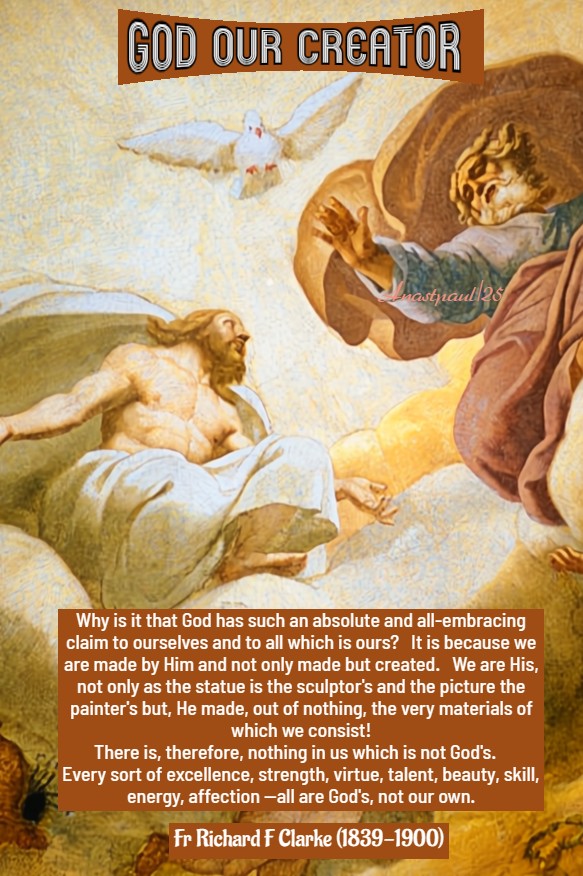
2nd Day – God our Creator
Thou art worthy, O Lord our God, to receive glory and honour and power because Thou hast created all things. (Apoc iv:II)
+1. Why is it that God has such an absolute and all-embracing claim to ourselves and to all which is ours? It is because we are made by Him and not only made but created. We are His, not only as the statue is the sculptor’s and the picture the painter’s but, He made, out of nothing, the very materials of which we consist! There is, therefore, nothing in us which is not God’s. Every sort of excellence, strength, virtue, talent, beauty, skill, energy, affection —all are God’s, not our own.
+2. God created everyone with certain gifts of his own which, He did not give to another and He gave him those gifts, to do a special work which God had appointed to him alone. He created me with a certain object, from all eternity He had been planning my soul and body and providing me with all that I needed – that both one and the other, might serve Him. Have I, on the whole, carried out God’s plan? Shall I be able to say, when I come to die: “I have completed the work Thou hast tasked me with?”
+3. What a serious thought this is – God had a plan for my life! He meant me to occupy a certain position in society and to have certain employments; to influence certain persons for good, to overcome certain temptations, to practice certain virtues beyond the rest, to attain a certain place in Heaven. Has my life been ordered by God’s holy inspirations? has not my own self-will too, often had a part in it? Pray that you may not fail in fulfilling God’s intentions concerning yourself and the works He requires of you!🙏
One Minute Reflection – 2 February – “The Month of the Blessed Trinity” – The Feast of the Purification of the Blessed Virgin, Candlemas – Malachias 3:1-4; Luke 2:22-32 – Scripture search here: https://www.drbo.org/
“The Lord, Whom you are seeking, will suddenly enter His Temple” – Malachias 3:1
REFLECTION – “Your lamps must be burning in your hands” (Lk 12:35). By this outward sign let us remind ourselves of the joy of Simeon, carrying the Light in his hands … We must be burning with love and radiant with good deeds and so, take up Christ in our hands with Simeon … Let us discuss this charming custom of the Church of bearing lights aloft on this Feast day … Could anyone hold up a lighted candle in his hands on this day, without at once remembering that old man, who on this same day, took up in his arms, Jesus, God’s Word, clothed in flesh like a candle-flame clothed in wax and affirmed Him to be “the Light which would be a beacon for the Gentiles.”Surely he was that “burning and radiant lamp” (Jn 5:35; 1,7) which bore witness to the Light. For this purpose he came in the Spirit, who had filled him, into the temple, that he might “receive, O God, your loving-kindness in the midst of your temple” (Ps 48[47]:10) and declare him to be loving-kindness indeed and the light of your own people.
Truly, O holy Simeon, in the quiet contentment of old age, you carried this Light not simply in your hands but in the very dispositions of your heart. You were like a lamp-standard, seeing so clearly how much the Gentiles would one day be lit up, while reflecting … the bright rays of our faith. Old, yet still sincere, you can now be happy, in that, you really see what once you but foresaw. Gone is the world’s gloom, “the Gentiles bask in this light of yours,” “the whole earth is full of his glory” (Is 60:3; 6:3).” … Blessed Guerric of Igny O.Cist. (c 1080-1157) Cistercian Abbot
PRAYER – Almighty, eternal God, we humbly beseech Thy Majesty that, as Thy Only-begotten Son was this day presented in the temple in the nature of our flesh, so may Thou grant us to be presented to Thee with purified minds. Through Jesus Christ, Thy Son our Lord, Who lives and reigns with Thee, in the unity of the Holy Ghost, God, world without end. Amen (Collect). Through Jesus Christ, Thy Son our Lord, Who lives and reigns with Thee, in the unity of the Holy Ghost, God, world without end. Amen (Collect).
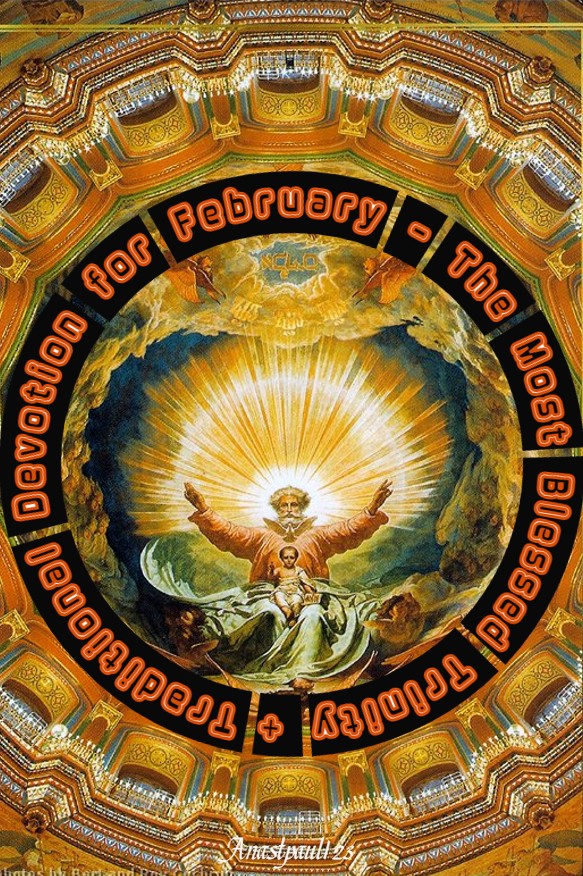
Our Morning Offering – 2 February – “The Month of the Blessed Trinity” – Feast of the Purification of the Blessed Virgin Mary and Epiphany IV
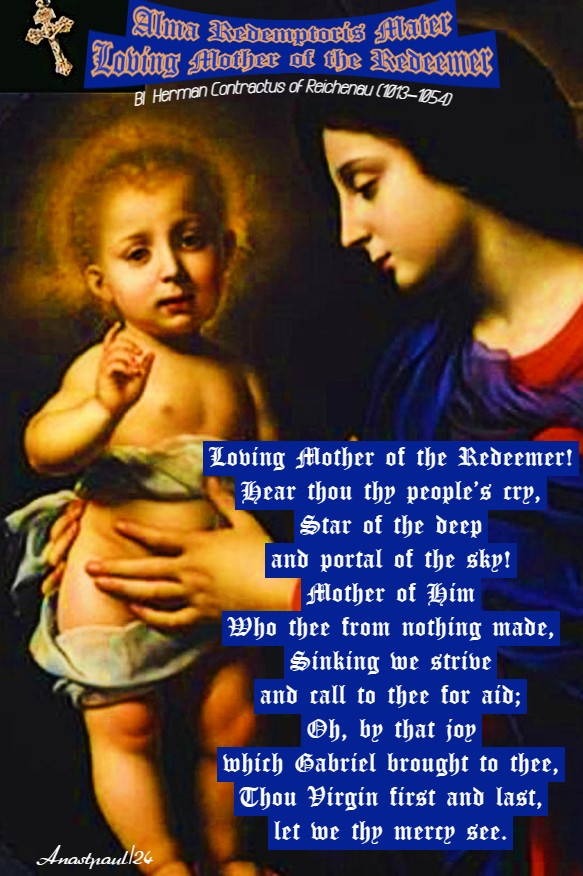
Alma Redemptoris Mater Loving Mother of the Redeemer By Blessed Herman Contractus of Reichenau OSB (1013–1054)
Loving Mother of the Redeemer! Hear thou thy people’s cry, Star of the deep and portal of the sky! Mother of Him Who thee from nothing made, Sinking we strive and call to thee for aid; Oh, by that joy which Gabriel brought to thee, Thou Virgin first and last, let we thy mercy see.
Alma Redemptóris Mater, quæ pérvia cæli Porta manes, et stella maris, succúrre cadénti, Súrgere qui curat pópulo: tu quæ genuísti, Natúra miránte, tuum sanctum Genitórem Virgo prius ac postérius, Gabriélis ab ore Sumens illud Ave, peccatórum miserére.
Marian Antiphon Traditionally said from Advent to the Purification of the Blessed Virgin. Blessed Herman is the Author of the Salve Regina, the Veni Sancte Spiritus and the Alma Redemptoris Mater amongst others.
Saint of the Day – 2 February – St Flosculus (5th-6th Century) the 11th Bishop of Orléans, in France, a beloved and zealous shepherd of the French Diocese of Orléans, a renowned and highly effective Preacher and a active and committed Apostle of charity and of the poor and needy. Patronages – of the City and Diocese of Orléans , of all Preachers and Priests. Also known as – Floscolo, Flosculus. Flou, Fulcolus, Furcolus, Fuscolus.
The Roman Martyrology simply states: “At Orléans, the holy Bishop Flosculus.”
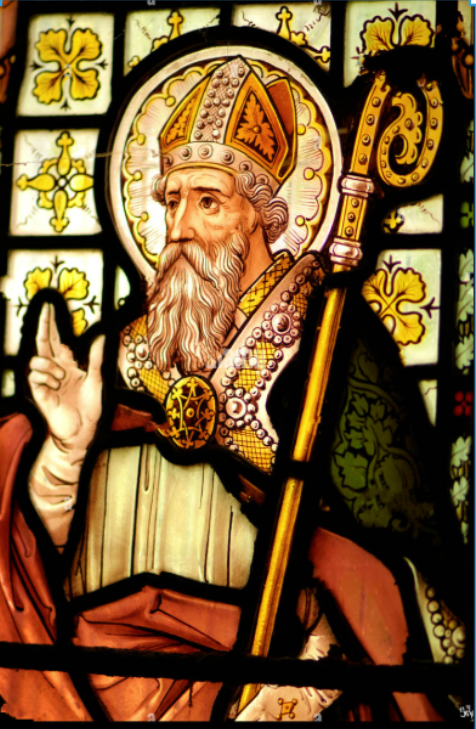
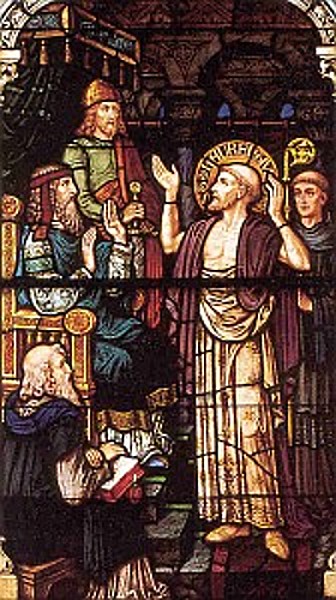
This Stained glass image is actually of an unknown Bishop
Very little is known about Flosculus but, it is certain that, he was a Bishop much loved by his people. His life is recorded by only one document, the Martyrology of St Jerome which reports his death on 2 February, unknown year.
The list of Bishops of Orléans, places him in eleventh place. From this latter record, we deduce that Flosculus was a very active Bishop in his Diocese. He was an eloquent preacher and a tireless worker for the spread of the Gospel. He also devoted himself to the poor and needy and was a great example of charity and compassion. His fame for sanctity, spread rapidly and he was soon venerated as a Saint by the people of Orléans. His cult was confirmed by Pope Pius IX in 1871.
In addition to the Martyrology of St Jerome, there are also some legends transmitted regarding Saint Flosculus. One of these relates that one day, while the saint was preaching in a square in Orléans, a man who had fallen from grace accused him of being an impostor. Flosculus, without batting an eye, looked him in the eye and said: “If what I say is false, may heaven strike me down!” At that moment, lightning struck the man, killing him instantly. This legend can also be seen as a metaphor for the strength of Saint Flosculus’ faith. His words, were so powerful, being the Word of his Master, that they could defeat evil!
On this date, St Flosculus’ Feast, 2 February, Holy Masses and Processions in his honour are held in many Churches in Orléans. The Saint is the Patron of the City and Diocese of Orléans and of all Preachers and Priests.
In Lombardy, Saint Flosculus is especially venerated in the Province of Mantua, Italy. In Castiglione delle Stiviere, in Mantua, there is a Church dedicated to the Saint. In this Church, on 2 February, a Procession and festivities are held in his honour.
Our Lady of the Candles – Nuestra Señora de la Purificación y la Candelaria, is a Marian title and image venerated by Filipino Catholics. The image, which is enshrined on the balcony of Jaro Cathedral, is known as the Patroness of Jaro District of Iloilo City and the whole of the Western Visayas. The Feast Day of Our Lady of the Candles is on Candlemas (2 February) and is celebrated in Iloilo City with a Solemn Pontifical Mass presided by the Archbishop of Jaro.
St Adalbald of Ostrevant St Adeloga of Kitzingen St Agathodoros of Tyana St Apronian the Executioner Bl Bernard of Corbara St Bruno of Ebsdorf St Candidus the Martyr St Columbanus of Ghent
St Cornelius the Centurion (1st Century) traditionally believed to have become the First Bishop of Caesarea, the Roman Centurion who is considered to be the one of first Gentile to convert to the Faith, (along with the conversion and Baptism of the Ethiopian eunuch – Acts 8). as related in Acts of the Apostles 10:1-49. The Baptism of Cornelius and his household, is an important event in the history of the early Church, for it points to the first century use of infant Baptism. His Feast was moved after 1969 but should be today. The Wonderful Faith of St Cornelius: https://anastpaul.com/2021/10/20/saint-of-the-day-20-october-saint-cornelius-the-centurion-1st-century/
St Cornelius’ dream
St Felician the Martyr St Feock St Firmus of Rome St Flosculus (5th-6th Century) Bishop of Orléans St Fortunatus the Martyr St Hilarus the Martyr
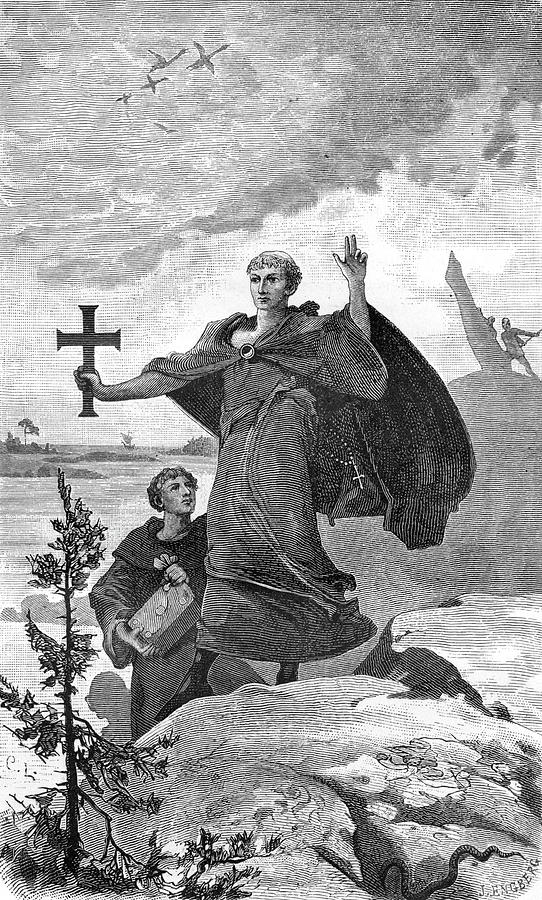
St Lawrence of Canterbury (Died 2 February 619) The Second Archbishop of Canterbury, the successor of St Augustine of Canterbury from 604 until his death in 619, but he was Consecrated as Archbishop by his predecessor, St Augustine, during Augustine’s lifetime, to ensure continuity in the office, Benedictine Monk, Missionary. He was a member of the Gregorian mission sent from Italy to England to Christianise the Anglo-Saxons. About St Lawrence: https://anastpaul.com/2022/02/02/saint-of-the-day-2-february-saint-lawrence-of-canterbury-died-619/
Thought for the Day – 1 February – Meditations with Fr Richard Frederick Clarke SJ (1839-1900)
Meditations on “The Great Truths” From “The Devout Year” By Fr Richard Frederick Clarke SJ (1839-1900)
Ist Day – God our Lord
The Lord hath made all things for Himself. (Prov xvi:4)
+I. We are all of us jealous of that which belongs to ourselves. We resent it if anyone interferes with it, or deprives us of any portion of it Yet, no-one owns anything by a title, so absolute as that by which God is the Lord and Owner of all creatures in the universe. My body and my soul are His; everything I possess is His; every action, every thought belongs to Him. He has given all these in charge to me to use for Him alone. Do I do so?
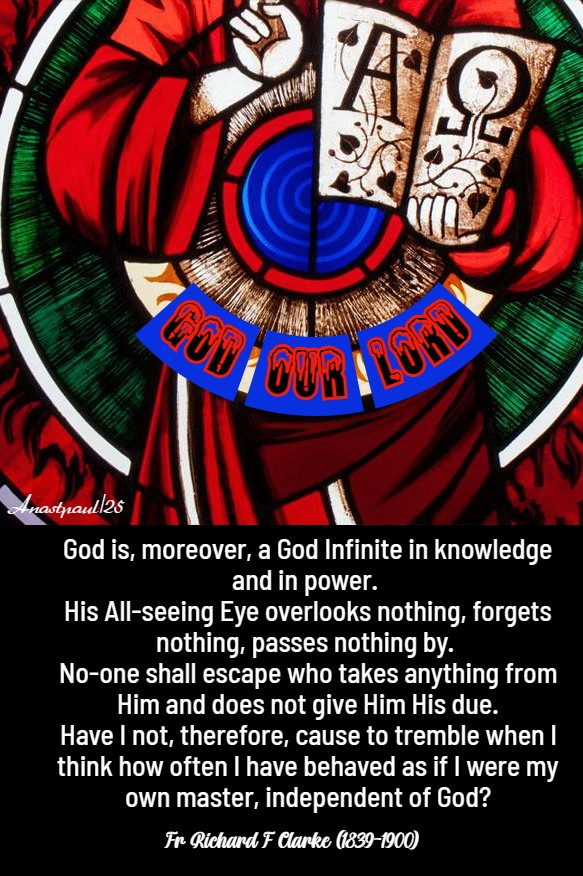
+2. God is, moreover, a God Infinite in knowledge and in power. His All-seeing Eye overlooks nothing, forgets nothing, passes nothing by. No-one shall escape who takes anything from Him and does not give Him His due. Have I not, therefore, cause to tremble when I think how often I have behaved as if I were my own master, independent of God?
+3. Yet, in the end, I must recognise God’s ownership; if I do not do so, willingly and with joyful loyalty, I shall have to do so unwillingly and in misery and pain. Everything I have taken from God and appropriated to myself will have to be given back to Him. I shall have to pay the penalty for each misuse of what was entrusted to me. How much wiser and happier to recognise Him now, in all things, as my Lord and Master! Offer yourself to God with loyal submission as your God and Lord!
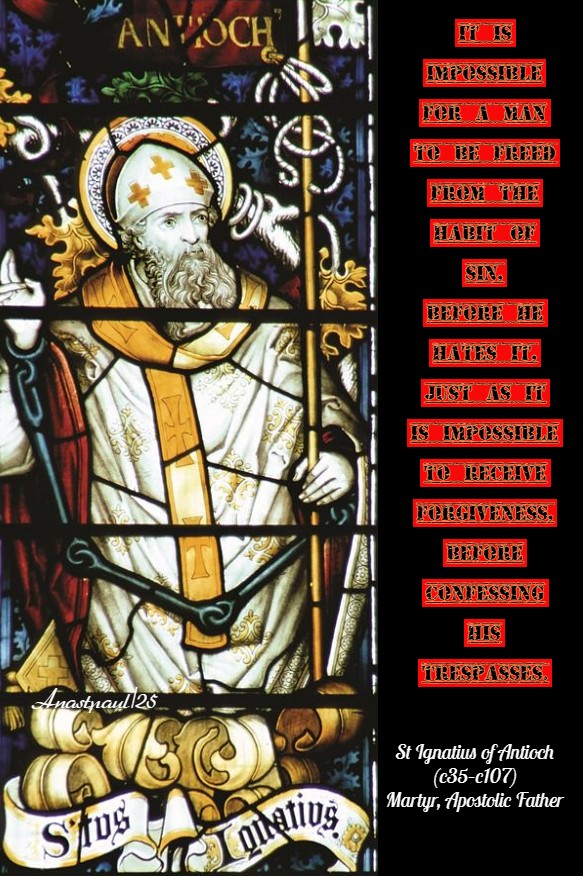
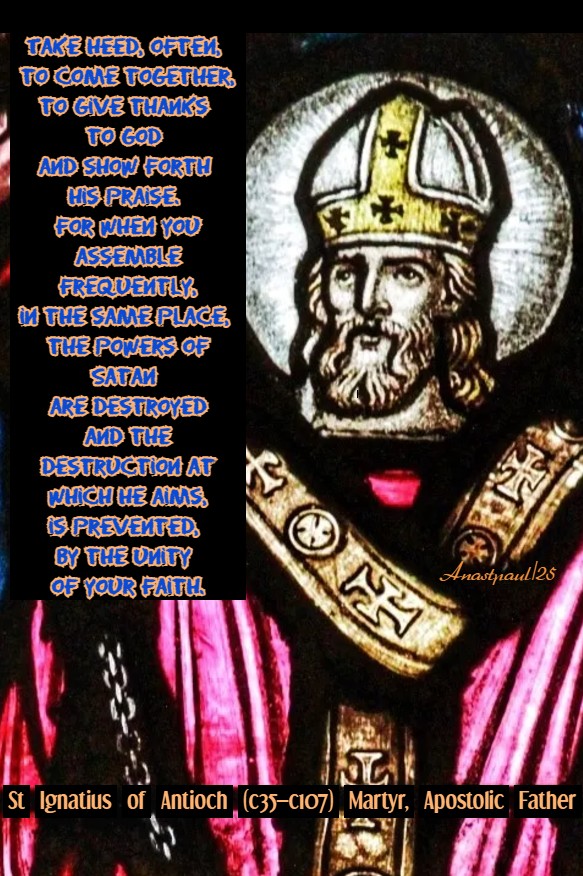
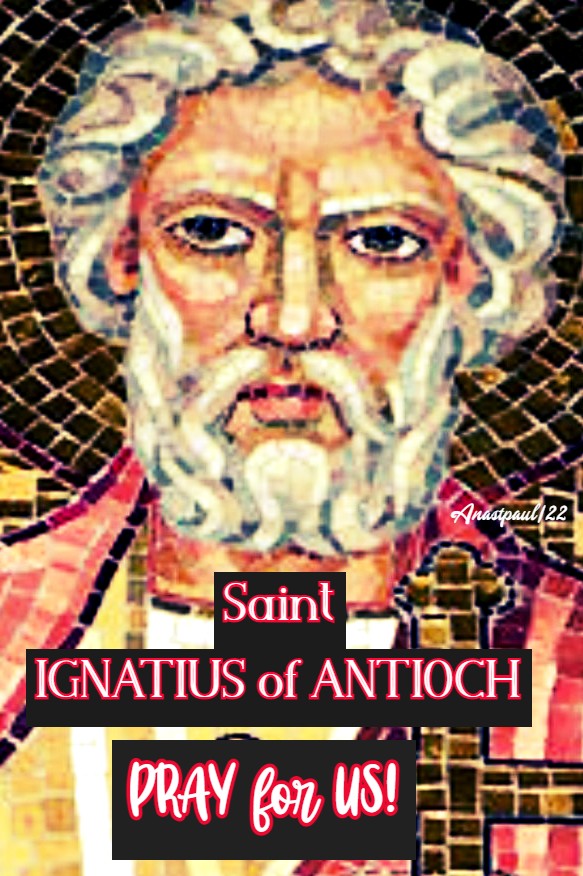
Quote/s of the Day – 1 February – – St Ignatius of Antioch (c35 – c107) Martyr, Bishop of Antioch, Apostolic Father of the Church
“It is impossible for a man to be freed from the habit of sin, before he hates it, just as it is impossible to receive forgiveness, before confessing his trespasses.”
“Take heed, often, to come together, to give thanks to God and show forth His praise. For when you assemble frequently, in the same place, the powers of Satan are destroyed and the destruction at which he aims, is prevented, by the unity of your faith.”
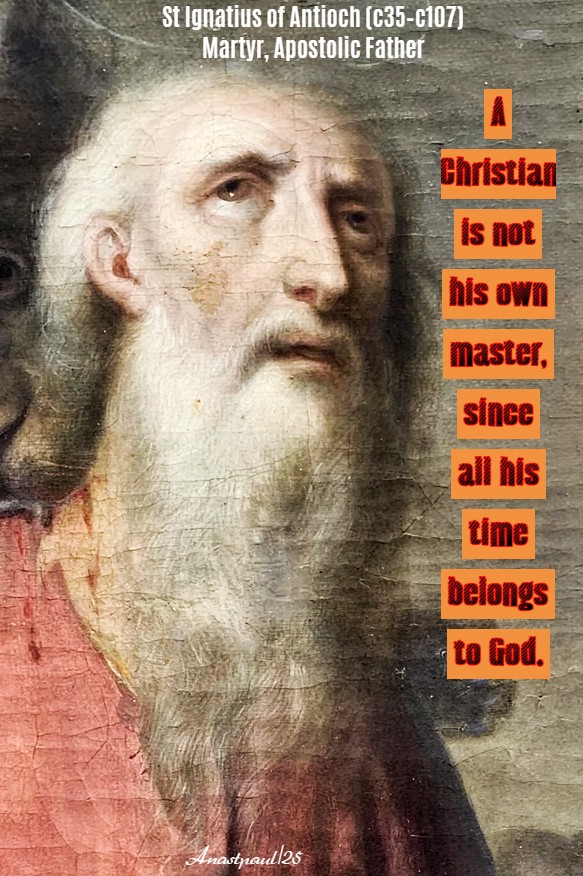
“A Christian is not his own master, since all his time belongs to God.”
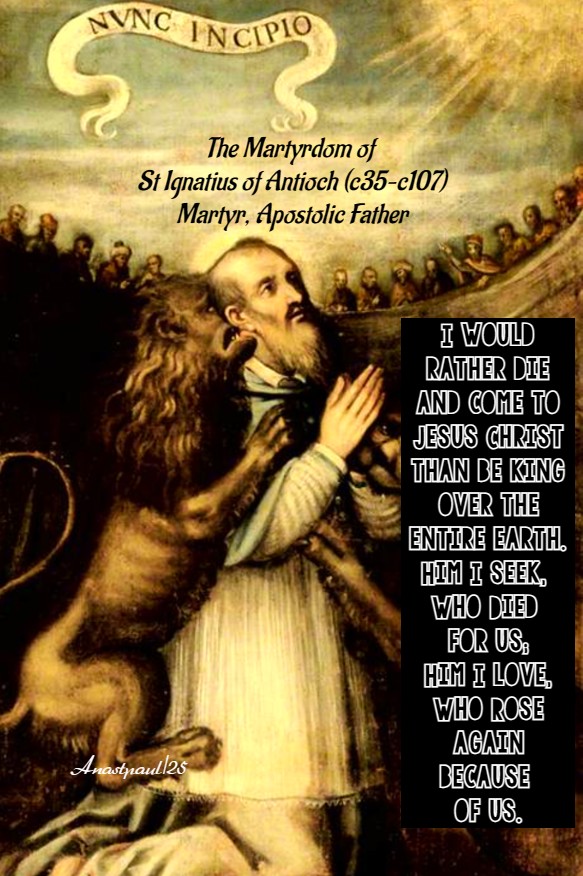
“I would rather die and come to Jesus Christ than be king over the entire earth. Him I seek, Who Died for us; Him I love, Who Rose again because of us.”
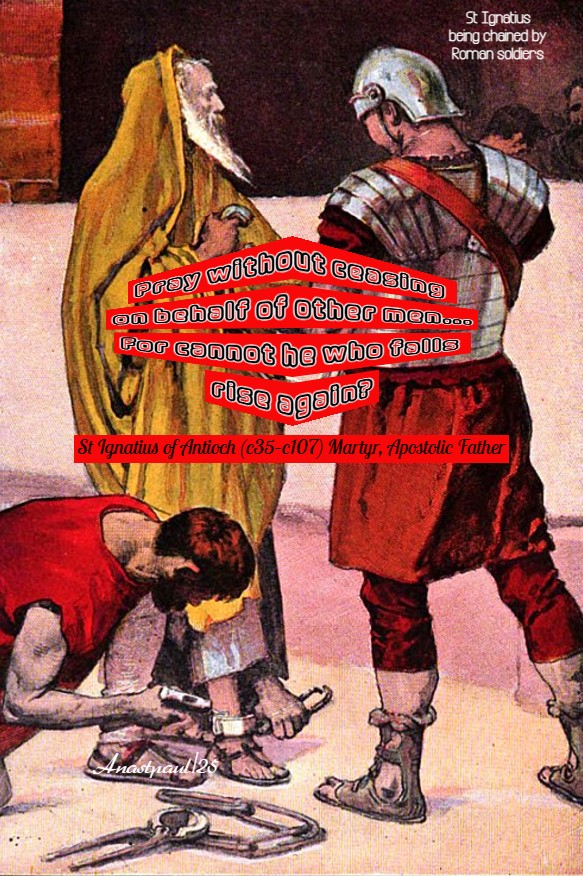
“Pray without ceasing on behalf of other men… For cannot he who falls rise again?”
One Minute Reflection – 1 February – “The Month of the Blessed Trinitys” – St Ignatius of Antioch (c35–107) Martyr, Bishop of Antioch, Apostolic Father of the Church. – Romans 8:35-39; John 12:24-26 – Scripture search here: https://www.drbo.org/
“He who loves his life, loses it and he who hates his life in this world, keeps it unto life everlasting. If anyone serves Me, let him follow Me and where I Am ,there also shall My servant be.” – John 12:25-26
REFLECTION – “… We are being towed along by a world which passes away, forgetting the world to come. We are greedy for present things but do not take into account the coming judgement. We will not run to meet the Lord as He Comes …
Let us turn back, brethren, let us turn back… By the very fact of His delay, of His still waiting, our Lord proves His desire to see us come back to Him, His desire that we should not perish. In His great goodness, He continues addressing these words to us: “I take no pleasure in the death of the wicked but would rather he would change his ways and live ”(Ez 33,11). So let us turn back to Him, brethren, not fearing that time is running short. The time that belongs to time’s Author cannot be shortened. The proof of it lies in the criminal in the Gospel, who, at the moment of dying on the cross, got away with his pardon, grabbed hold of life and, breaking into paradise like a burglar, managed to make his way into the Kingdom (cf. Lk 23,43)!” – St Peter Chrysologus (c 400-450) Bishop of Ravenna, Father and “Doctor of Sermons” of the Church (Excerpt from Sermon 167).
PRAYER – Be mindful of our weakness, O aAmighty God and since the burden of our deeds is grievous to us, grant that the glorious intercession of blessed Ignatius Thy Martyr and Bishop, may protect us. Through Jesus Christ, Thy Son our Lord, Who lives and reigns with Thee, in the unity of the Holy Ghost, God, world without end. Amen (Collect).
Our Morning Offering – 1 February – “The Month of the Blessed Trinity”
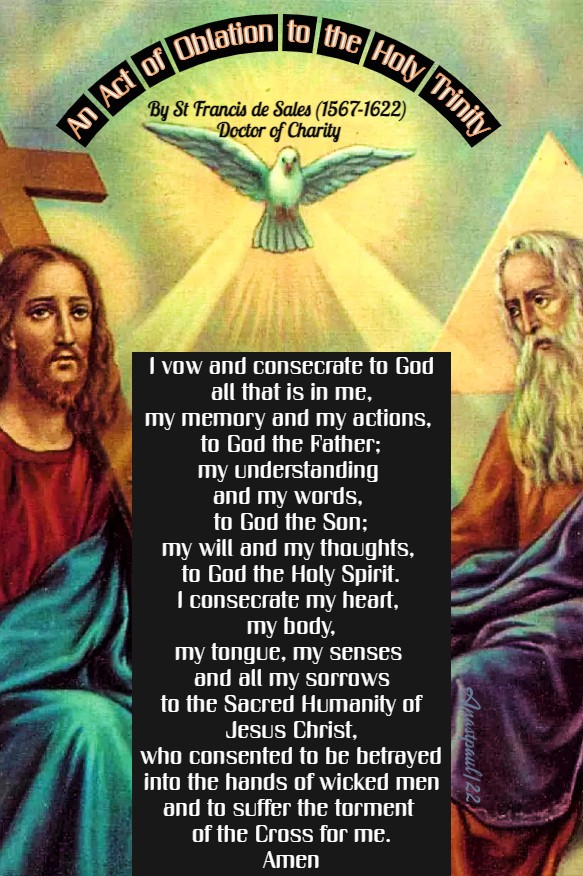
An Act of Oblation to the Most Blessed Trinity By St Francis de Sales (1567-1622) Doctor of Charity
I vow and consecrate to God all that is in me, my memory and my actions, to God the Father; my understanding and my words, to God the Son; my will and my thoughts, to God the Holy Spirit. I consecrate my heart, my body, my tongue, my senses and all my sorrows, to the Sacred Humanity of Jesus Christ, Who consented to be betrayed into the hands of wicked men and to suffer the torment of the Cross for me. Amen
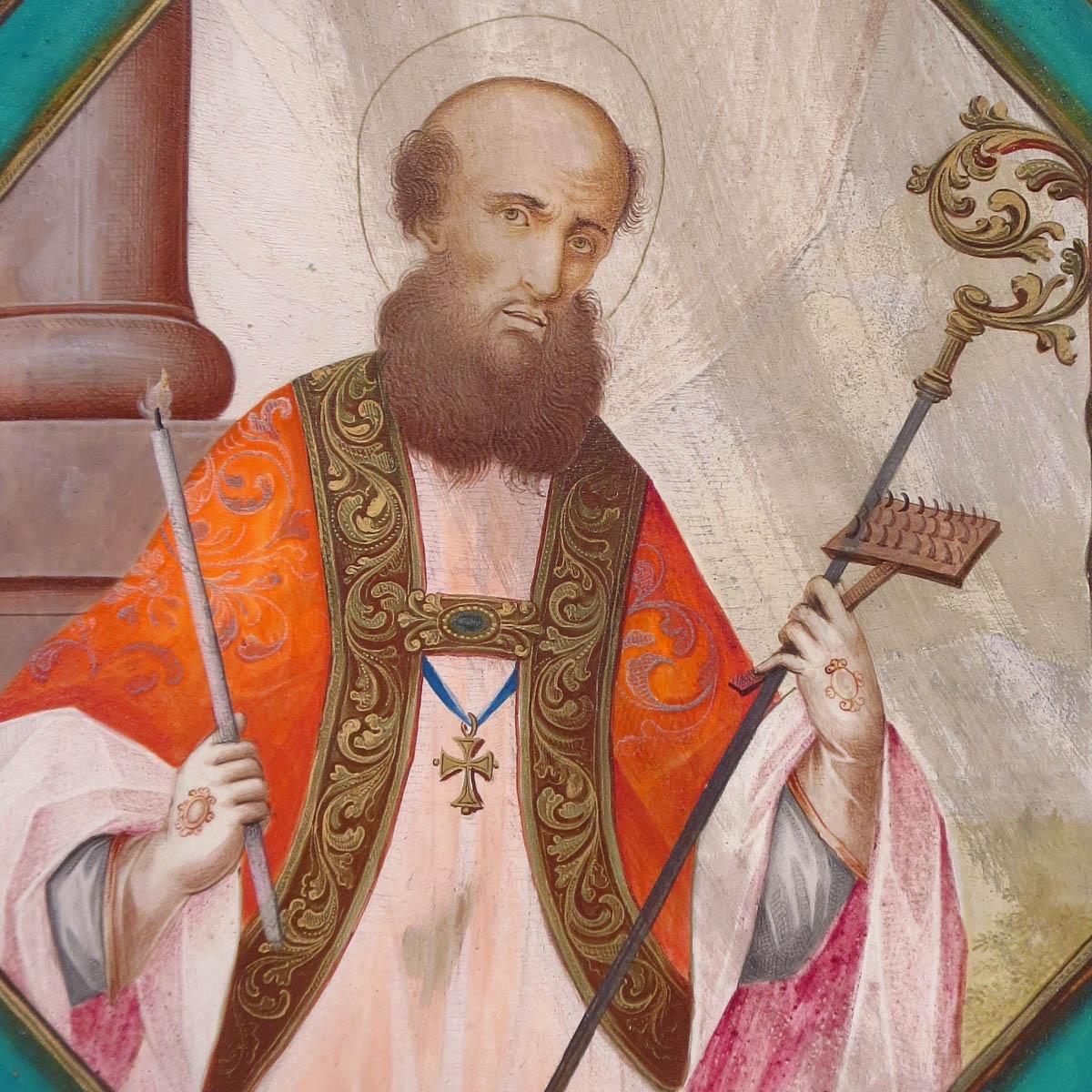
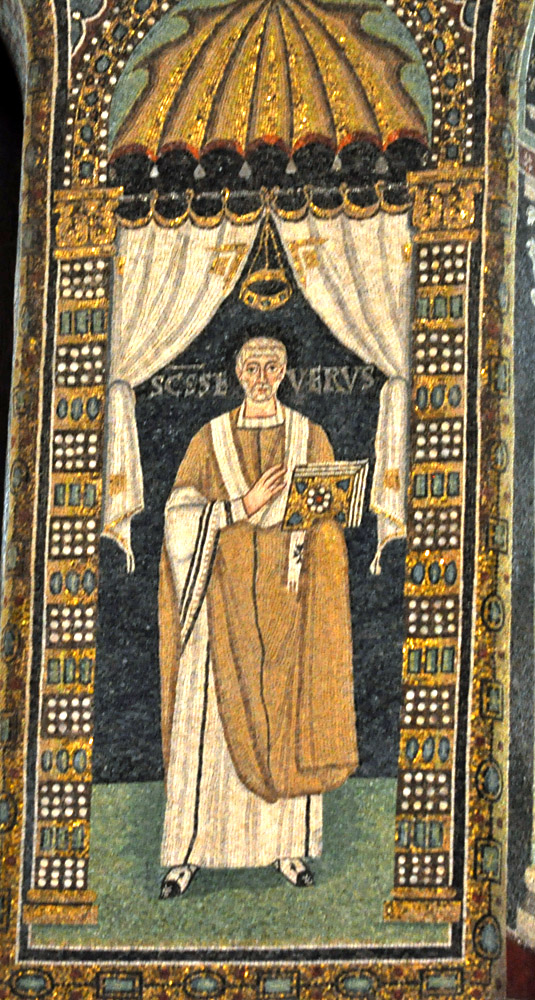
Saint of the Day – 1 February – Saint Severus (Died c344) the 12th Bishop of Ravenna, previously a married wool-merchant and father of 2 daughters. Severus had been miraculously elected as the Bishop by a Dove. Born in Ravenna and died there on 1 February in c344 of natural causes. Patronages – glove makers, hatters, weavers.
The Roman Martyrology states today: “At Ravenna, the holy Bishop Severus, whose great virtues deserved that he should be raised to the Episcopate by the sign of a Dove.”
Sant’Apollinare in Clase: St. Severus
From the ancient ‘Episcopal Catalogue’ we discover that St Severus was the 12th Bishop of Ravenna, after Marcellinus and before Liberius; unfortunately nothing is known about his life, except that his name appears among the participants in the Council of Sardica (ancient name of Sofia in Bulgaria), held in 342-343. He is among the signatories of the Decrees of this Council, of the letter to Pope St Julius I (337-352) and of that, to all the Bishops.
As reported by the medieval hagiographers Agnellus and Liutulf, Severus died on 1 February in a year after 342 and on this day, he was remembered in the ancient Italian Calendar, later inserted in the ‘Martyrology of St. Jerome.’ He was buried in the area of Classe near Ravenna, called the ‘Vicus Salutaris’ in a Chapel called “monasterium St Rophili” adjoining the south, of the 6th Century Basilica.
Testimonies of the ancient cult were reported in two translations ofthe Relics of our holy Bishop, St Severus, one cited on 27 November which took place in Milan, shortly after the Episcopate of St Ambrose (340-397), together with those of four other Saints and a second translation celebrated on 3 September in Aquileia, also with those of four other Saints, including St Andrew the Apostle.
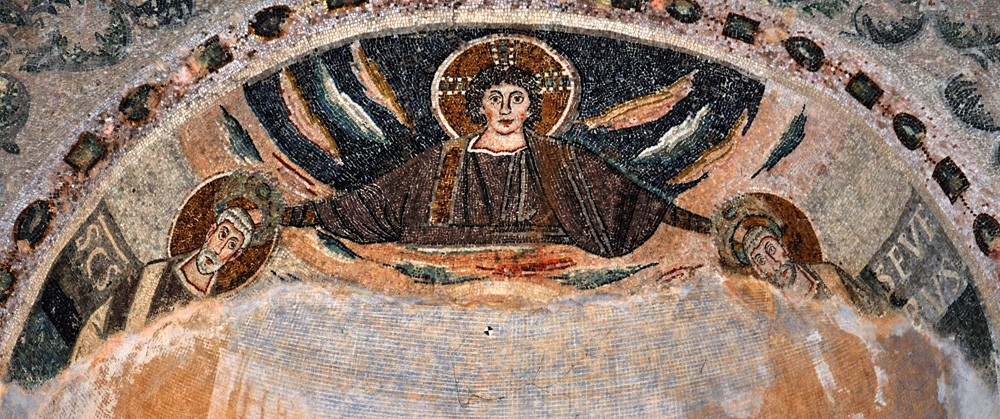
The great testimony of the cult paid to him in Ravenna are the mosaics of St Apollinare in Classe (consecrated in 549), located in the lower part of the apse, representing the Bishops St Severus, St Orsius, Ecclesius and Ursicinus, the first two bear the title “Sanctus” proof of this certain cult.
And then there is the great Basilica of St Severus, begun by Bishop Peter III in 575 and completed by Giovanni Romano (578-595) and Consecrated by him on 17 May 582, also placing the Sarcophagus of the Saint there. This Basilica, combined with a large Benedictine Monastery, remained intact until the 15th Century, then after various events, it was definitively abandoned and destroyed. It was a large Basilica with three naves divided by twelve columns on each side; it had a polygonal apse on the outside and a semi-circular one on the inside (Ravenna type).
As for the literary texts concerning St Severo, they are largely legendary, collected and transcribed by medieval hagiographers. But the two sermons by St Peter Damian (1007-1072) are of great value. The details drawn from these sermons, says that Severus had been a poor wool merchant from Ravenna and after attending Church after the death of Bishop Marcellinus, mistakenly attended at the election of his successor. There, a dove landed several times on his head, so that all the people recognised that he was the chosen one of God. St Peter Damian also reports that during the celebration of the Sacrifice of the Mass, Severus fell into ecstasy. And by a miracle of bilocation, St Severus was present at the death of his friend Saint Geminianus of Modena. Finally, feeling close to death, he opens the Tomb which he had prepared, lay down in it and gives up his soul to God.
In 842 a Frankish Monk named Felix stole St Severus’ Relics and transferred them first to Mainz and then to Erfurt, thus spreading the cult throughout Germany, with Churches being built in his honour. But much more numerous were the Churches dedicated to him throughout Ravenna and in the surrounding Italian districts.
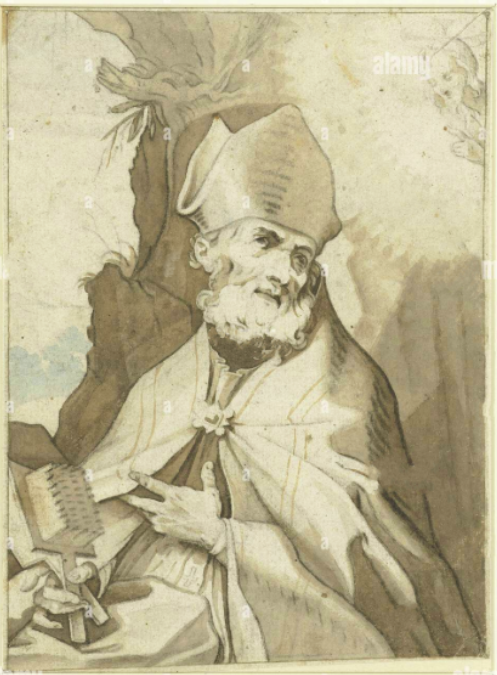
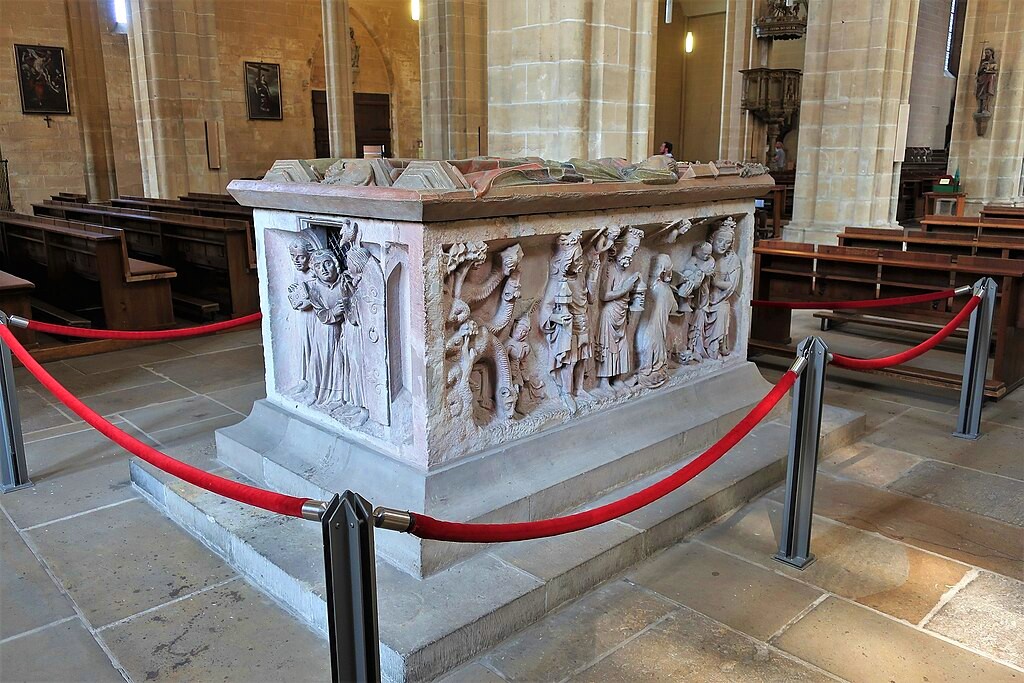
The marble bas-reliefs placed on the 14th Century Tomb in the Saint’s Church in Erfurt, depict him dressed in Bishop’s robes, surrounded by the figures of his wife and daughter, in a devout act of prayer.
Bl Anthony Manzoni St Asclepiades St Autbert of Landevenec St Brigid of Fiesole St Cecilius of Granada St Cinnia of Ulster St Clarus of Seligenstadt St Crewenna St Darlaugdach of Kildare St Henry Morse St Jarlath Bl John of the Grating St Kinnia St Paul of Trois-Châteaux St Raymond of Fitero




















 AnaStpaul
You must be logged in to post a comment.