Thought for the Day – 6 March – Meditations with Fr Richard Frederick Clarke SJ (1839-1900)
“Short Meditations for March, St Joseph” From “The Devout Year” By Fr Richard Frederick Clarke SJ (1839-1900)
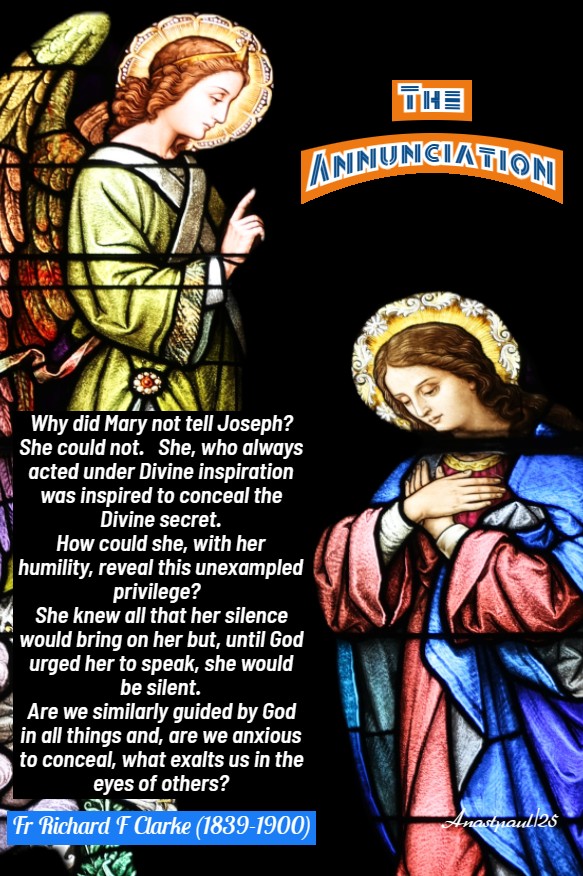
6th Day – The Annunciation
+1. Our Lady’s peaceful life at Nazareth with her chaste and holy spouse had continued for some weeks or months, when that wondrous message came to her – she was to be the Mother of God. The Son of God became Incarnate in her holy womb! How it must have transformed her whole life to know that her God dwelt within her! She was no longer Joseph’s spouse before all else; he had to give place to One holier than he, to One Who was not mere man but God! Now she was before all and above all, the sacred house in which the Eternal Wisdom of God dwelt under a veil of flesh!
+2. Did Joseph perceive any change in her? Yes – he was conscious of a dignity, of a grace, of a Divinity encircling Mary which ,with all her holiness, had not been there before. Mary’s sanctity was transformed. She, herself, who before had been like a beautiful crystal, was now like a crystal through which some brilliant Light continually darted its rays of splendour. So ought we to be when we receive Holy Communion . What a change it should make in us! How in our conversation the recent Presence of our God within us, should show its Divine effects in our lives!
+3. Why did Mary not tell Joseph? She could not. She, who always acted under Divine inspiration was inspired to conceal the Divine secret. How could she, with her humility, reveal this unexampled privilege? She knew all that her silence would bring on her but, until God urged her to speak, she would be silent. Are we similarly guided by God in all things and, are we anxious to conceal, what exalts us in the eyes of others?
Quote/s of the Day – 6 March – Ash Thursday – Isaias 38:1-6 – Matthew 8:5-13
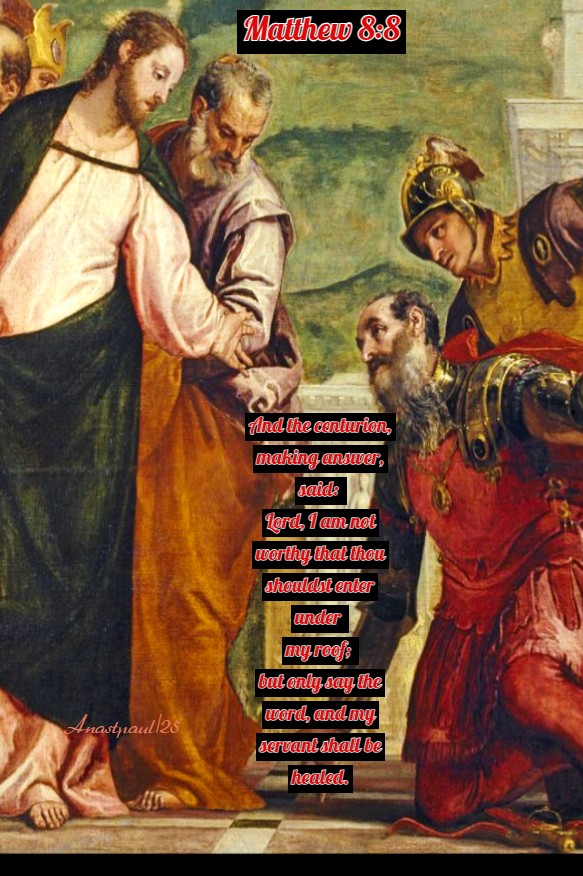
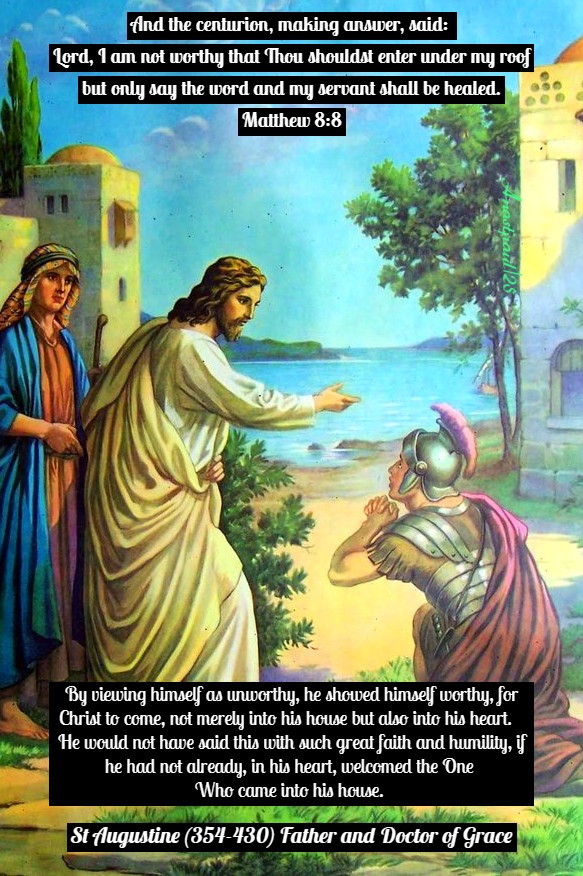
“And the centurion, making answer, said: Lord, I am not worthy that Thou shouldst enter under my roof but only say the word and my servant shall be healed.”
Matthew 8:8
“Whoever exalts himself will be humbled and whoever humbles himself will be exalted.”
Matthew 23:12
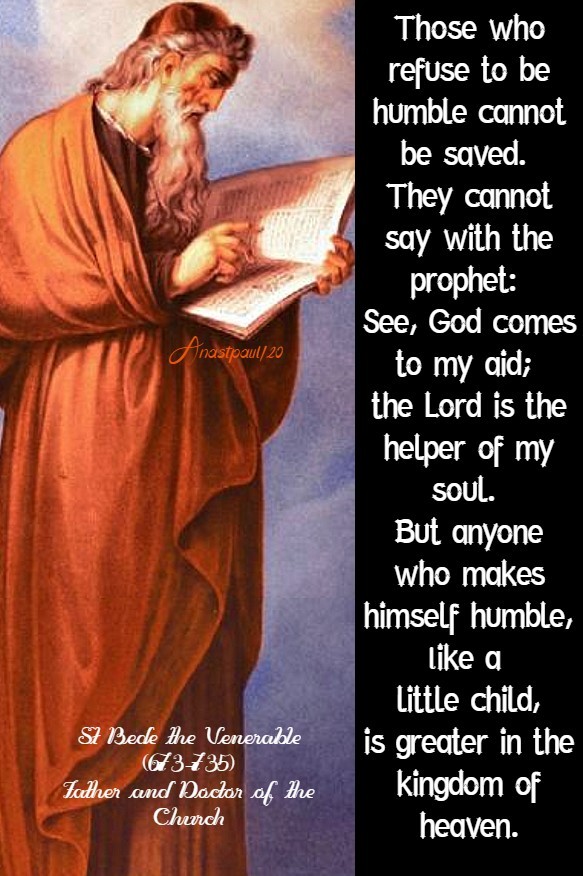
“Those who refuse to be humble cannot be saved. They cannot say with the prophet: See, God comes to my aid; the Lord is the helper of my soul. But anyone who makes himself humble, like a little child, is greater in the Kingdom of Heaven.”
St Bede the Venerable (673-735) Father and Doctor if the Church
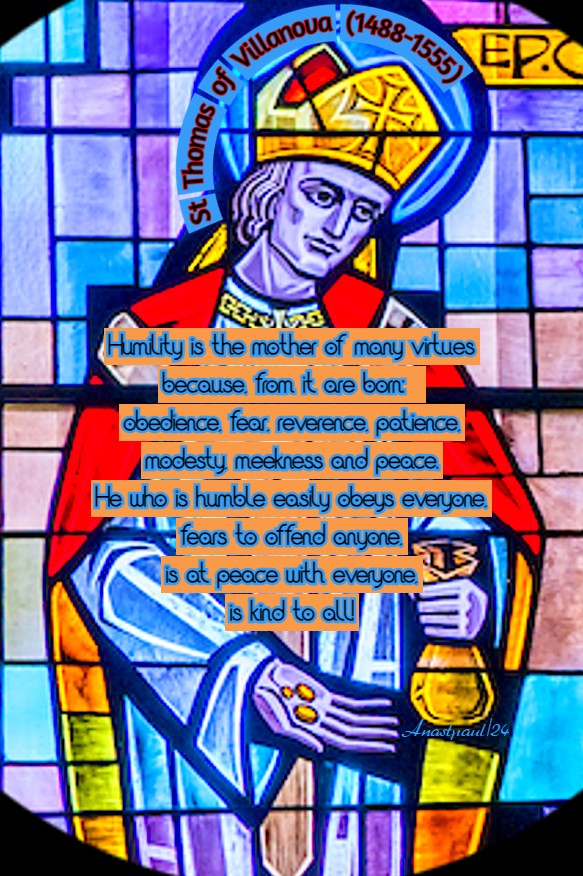
“Humility is the mother of many virtues because, from it are born: obedience, fear, reverence, patience, modesty, meekness and peace. He who is humble easily obeys everyone, fears to offend anyone, is at peace with everyone, is kind to all!”
St Thomas of Villanova OSA (1488-1555)
“Humility is not just about self-mistrust but about the entrusting of ourselves to God. Distrusting ourselves and our own strength produces trust in God and from that trust, generosity of soul is born.”
Lenten Meditations – 6 March – With Fr Richard Frederick Clarke SJ (1839-1900)
“The Sacred Passion of Our Lord Jesus Christ” “Short Meditations for Lent” From “The Devout Year” By Fr Richard Frederick Clarke SJ (1839-1900)”
Ash Thursday The Preliminaries of the Passion
Read St. Luke xxii:1-6
[1] Now the feast of unleavened bread, which is called the pasch, was at hand. [2] And the chief priests and the scribes sought how they might put Jesus to death but they feared the people. [3] And Satan entered into Judas, who was surnamed Iscariot, one of the twelve. [4] And he went, and discoursed with the chief priests and the magistrates, how he might betray Him to them. [5] And they were glad and covenanted to give him money. [6] And he promised. And he sought opportunity to betray Him in the absence of the multitude. [Luke 22:1-6]
+1. During the first days of the week in which He suffered, our Blessed Lord had been teaching all day in the Temple. The assembled crowd had cried ,“ Hosanna to the Son of David, Blessed is He Who cometh in the name of the Lord.” It seemed as if He were going to be acknowledged by the voice of the people as the King of Israel. How deceptive are appearances! How often, when all seems to be going well and the cause of Christ about to triumph, some grievous disappointment is at hand!
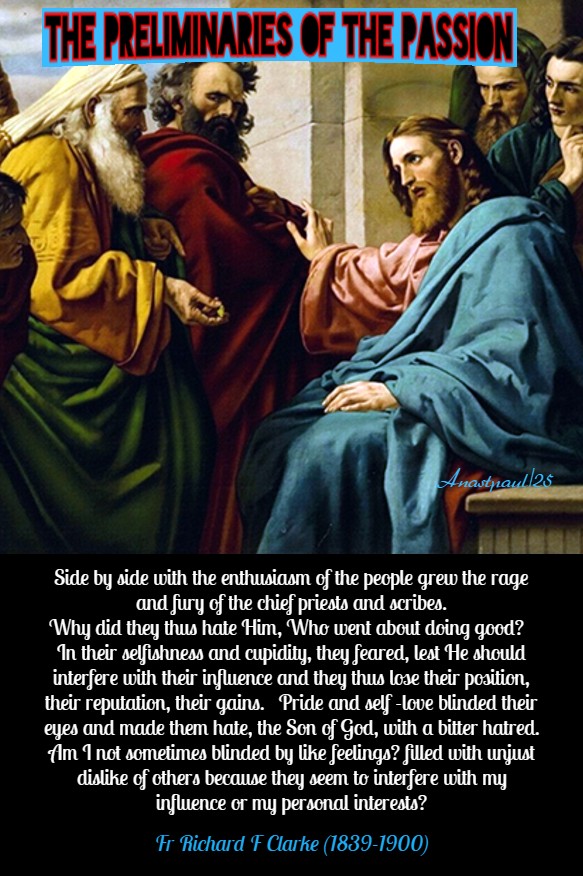
+2. Side by side with the enthusiasm of the people grew the rage and fury of the chief priests and scribes. Why did they thus hate Him, Who went about doing good? In their selfishness and cupidity, they feared, lest He should interfere with their influence and they thus lose their position, their reputation, their gains. Pride and self -love blinded their eyes and made them hate, the Son of God, with a bitter hatred. Am I not sometimes blinded by like feelings? filled with unjust dislike of others because they seem to interfere with my influence or my personal interests?
+3. The chief priests had a great advantage in the fact that, in the little company, which surrounded Jesus, there was a traitor. Judas impelled by avarice, had been first a thief and then, had made overtures to betray his Master. O fatal love of money, to harden the heart of man! How careful must I be not to set my heart on any earthly possessions, since nothing has a more deadly power than this, to separate me from the love of Jesus!
One Minute Reflection – 6 March – “The Month of Saint Joseph” – Ash Thursday – Isaias 38:1-6 – Matthew 8:5-13 – Scripture search here: https://www.drbo.org/
“And the centurion, making answer, said: Lord, I am not worthy that Thou shouldst enter under my roof but only say the word and my servant shall be healed.” – Matthew 8:8.
REFLECTION – “When the Lord promised to go to the Centurion’s house to heal his servant, the Centurion answered, “Lord, I am not worthy that Thou shouldst enter under my roof but only say the word and my servant shall be healed.” By viewing himself as unworthy, he showed himself worthy, for Christ to come, not merely into his house but also into his heart. He would not have said this with such great faith and humility, if he had not already, in his heart, welcomed the One Who came into his house. It would have been no great joy for the Lord Jesus to enter into his house and not to enter his heart. For the Master of humility, both by word and example, sat down also in the house of a certain proud Pharisee, Simon and, although he sat down in his house, there was no place in his heart. For in his heart the Son of Man could not lay his head.” – St Augustine (354-430) Father and Doctor of Grace (Sermon 62).
PRAYER – Grant, we beseech Thee, O Lord our God, that we may venerate with unceasing devotion Thy holy Martyrs Perpetua and Felicitas and, although we cannot pay them the honour that is their due, may we at least present to them, our humble homage. Through Jesus Christ, Thy Son our Lord, Who lives and reigns with Thee, in the unity of the Holy Ghost, God, world without end. Amen (Collect).
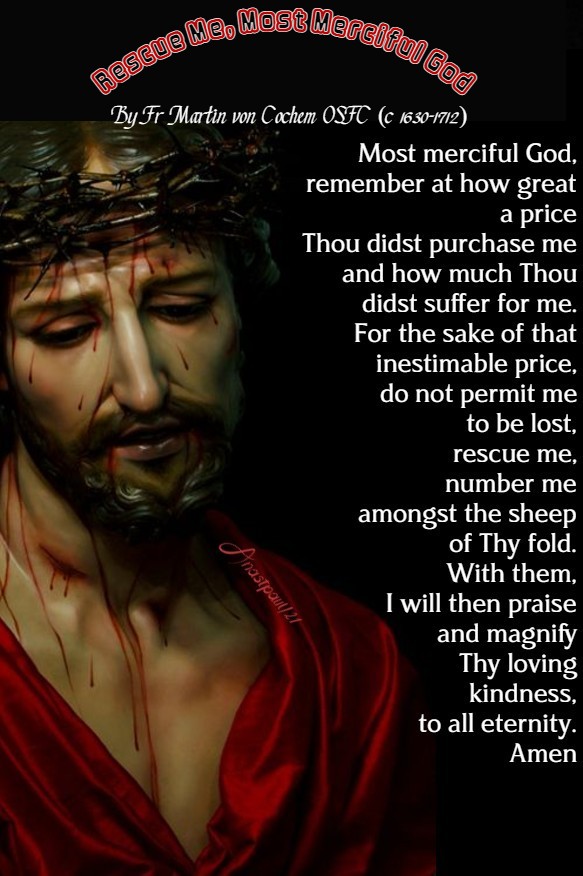
Rescue Me, Most Merciful God By Father Martin von Cochem OSFC (c 1630-1712)
Most merciful God, remember at how great a price Thou didst purchase me and how much Thou didst suffer for me. For the sake of that inestimable price, do not permit me to be lost, rescue me, number me amongst the sheep of Thy fold. With them, I will then praise and magnify Thy loving kindness, to all eternity. Amen
Fr Martin von Cochem was a German Capuchin theologian, preacher and prolific ascetic writer. Father Martin’s works embrace a great variety of subjects –a huge volume of apologetics against Protestantism, the life of Christ, lives of the Saints, edifying narratives, the setting forth of certain points in Christian asceticism, forms of prayer, methods to be followed for the worthy reception of the sacraments, etc. All with Imprimaturs. The prayer above is from the renowned “The Four Last Things.”
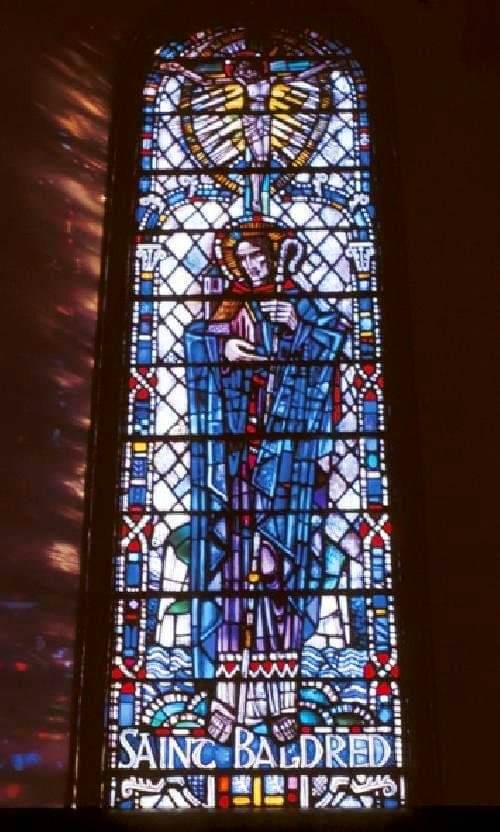
Saint of the Day – 6 March – Saint Baldred (Died c757) Abbot, Priest, Missionary, Founder of a monastic community, Hermit, Miracle-worker. Born in Northumbria, England and died on 6 March c757 in Tyninghame in the Lothian region of Scotland. Also known as – “the Apostle of the Lothians”Balthere, Baltherus, … the Hermit, … of Tyninghame.
Baldred seems to have come from Lindisfarne in Northumbria, England, to spread Christ to the Lothians. He founded a Monastery at Tyninghame and choose a life of seclusion. Simeon of Durham says that “the boundaries of his pastorate embraced the whole land which belongs to the monastery of Saint Balther which is called Tyninghame – from Lammermuir to Inveresk, or, as it was called, Eskmouthe.”
He lived in a cell on the Bass Rock and died there. Three communities vied for the right to bury him, Auldhame, Tyninghame and Prestonkirk. His cult was certainly centred on the four Churches of Auldhame, Whitekirk, Tyninghame and Prestonkirk, between East Linton and North Berwick in East Lothian.
Baldred founded a Monastery at Tyninghame. However, at times, he preferred to retire from the spiritual government of the Lothian Britons and he selected the Bass Rock as the spot to build himself a small hermitage and associated Chapel, although he also sometimes resided in ‘St Baldred’s Cave’ on Seacliff Beach.
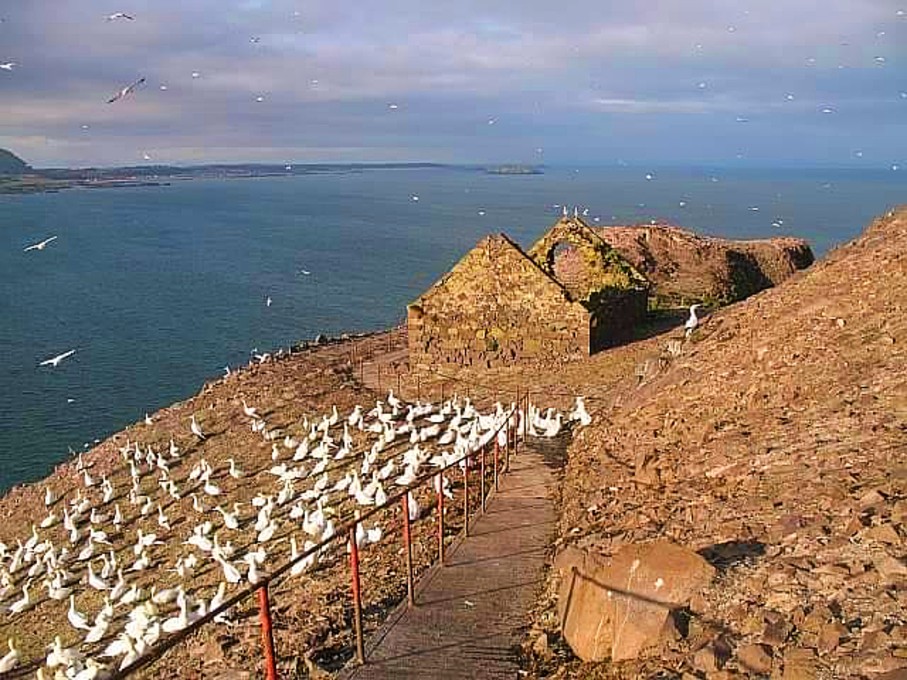
Ruins of the Base Rock Foundation
Following Baldred’s death on the site of this Chapel, there was a dispute between the people of Auldhame, Tyninghame and Prestonkirk, as to which should be chosen to venerate his life by a Shrine and bury his remains.“ By the advice of a holy man, they spent the night in prayer. In the morning three bodies were found, in all respects alike, each in its winding sheet, prepared for burial.”
St Baldred’s Cave
All three Churches established Shrines to Saint Baldred. Echoes of St Baldred occur throughout the area of East Lothian in which he lived and worked. In 941, St Baldred’s Monastery at Tyninghame was destroyed by the Danes and the following century the version of the remains of St Baldred buried at Tyninghame, were moved to Durham. In the 1100s St Baldred’s Church was built on the location of the monastery and this still stands today in the grounds of Tyninghame House.
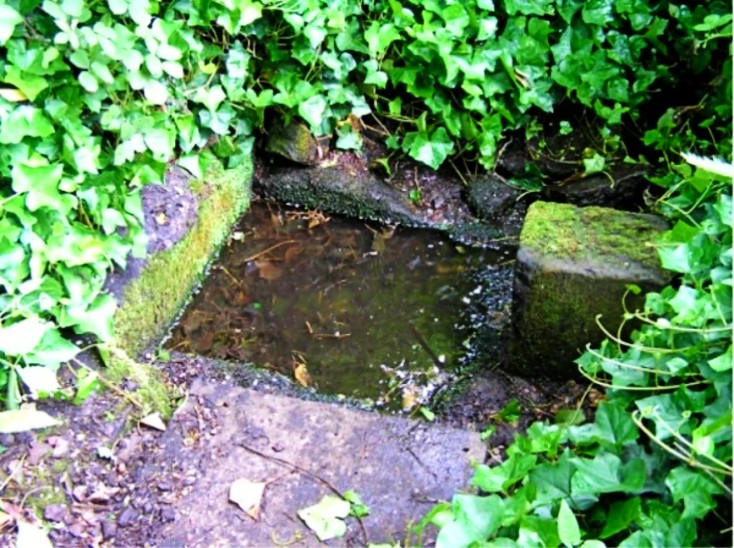
At the Prestonkirk Parish Church, there existed, until 1770, when it was damaged by a builder, a Statue of the Saint much venerated by the local population. St Baldred’s Well stands nearby which was “famed for its…healing qualities.” This Well was greatly celebrated as a place of pilgrimage, attracting 1000s of visitors and the area also lays claim to this Saint as the scene of his ministry,
St Baldred’s Well
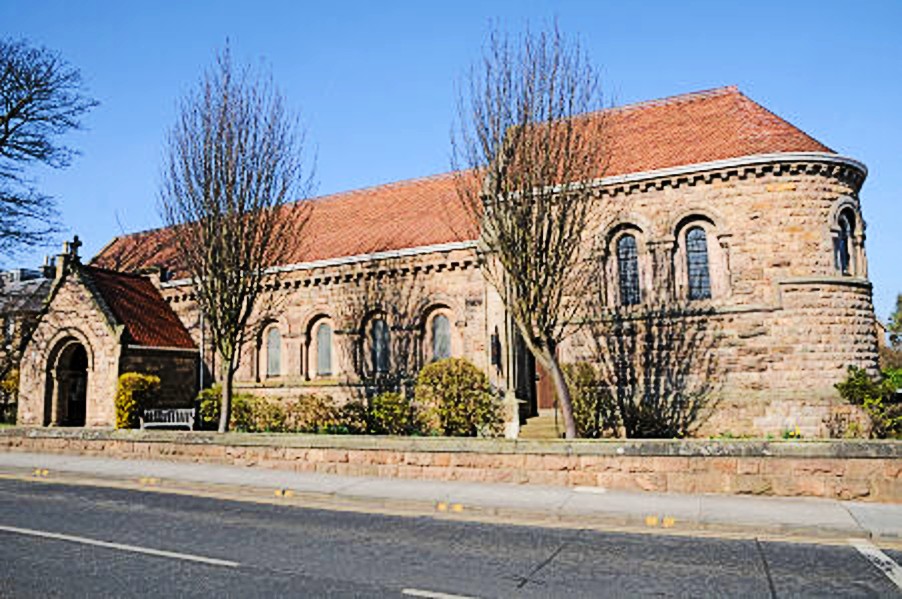
A Papal Bull of 1493 records the Pope’s consent to build a Chapel on the site of St Baldred’s own Chapel on Bass Rock – possibly this Church below.
St Aetius St Bairfhion St Baldred of Strathclyde St Baldred (Died c757) Abbot St Balther of Lindisfarne St Basil of Bologna St Cadroë
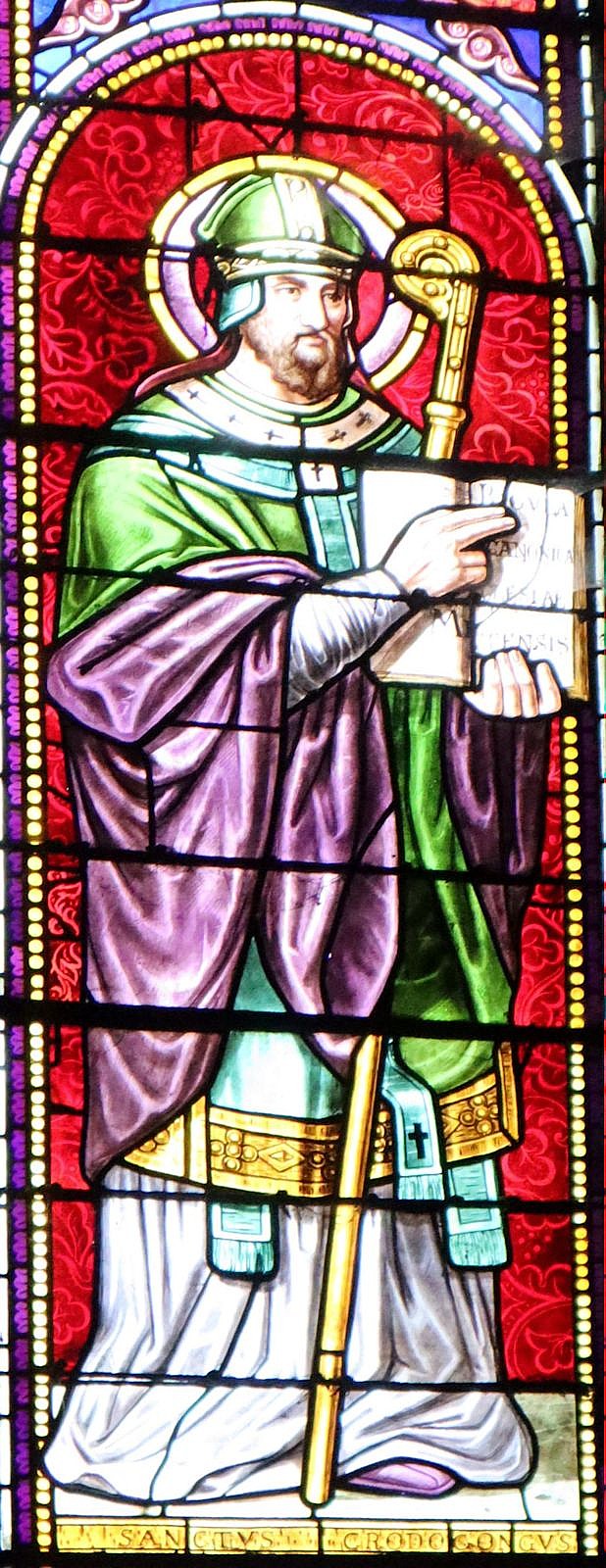
St Chrodegang of Metz (c714-776) The First Bishop of Metz, Protector and Father of the poor and orphans, Reformer of the Clergy, a relative of King Pepin and of Prince Charles Martel, both of whom he was Court Chancellor, Royal Diplomat, Saint Opportuna of Montreuil was his brother. The Roman Martyrology states: “In Metz in Austrasia, in today’s France, St Crodegango, Bishop, who arranged for the Clergy to live as if within the walls of a cloister under an exemplary rule of life and greatly promoted liturgical chant.” Biography: https://anastpaul.com/2022/03/06/saint-of-the-day-6-march-saint-chrodegang-of-metz/
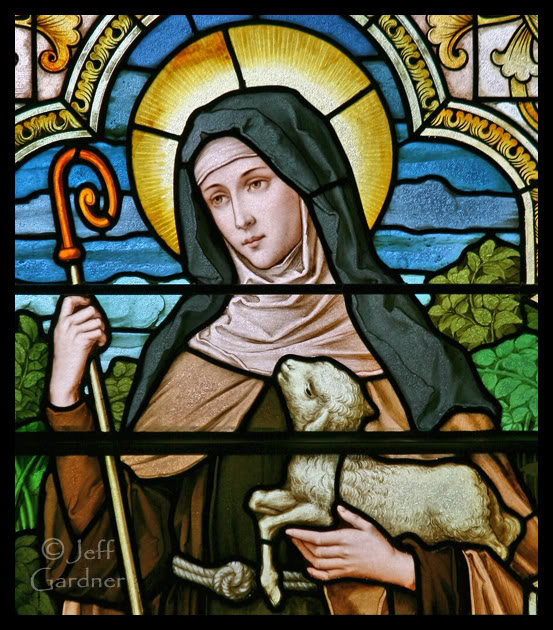
St Colette PCC (1381-1447) Abbess and Foundress of the Colettine Poor Clares, a reform branch of the Order of Saint Clare. Patronages – against eye disorders, against fever, against headaches, against infertility, against the death of parents, of women seeking to conceive, expectant mothers and sick children, craftsmen, Poor Clares, servants, Corbie, France, Ghent, Belgium. St Colette was Canonised on 24 May 1807 by Pope Pius VII. Lovely St Colette: https://anastpaul.com/2017/03/06/saint-of-the-day-6-march-st-colette/ AND: https://anastpaul.com/2019/03/06/saint-of-the-day-6-march-st-colette-2/
St Cyriacus of Trier St Cyril of Constantinople St Evagrius of Constantinople
Bl Guillermo Giraldi St Heliodorus the Martyr Bl Jordan of Pisa St Julian of Toledo St Kyneburga of Castor St Kyneswide of Castor St Marcian of Tortona
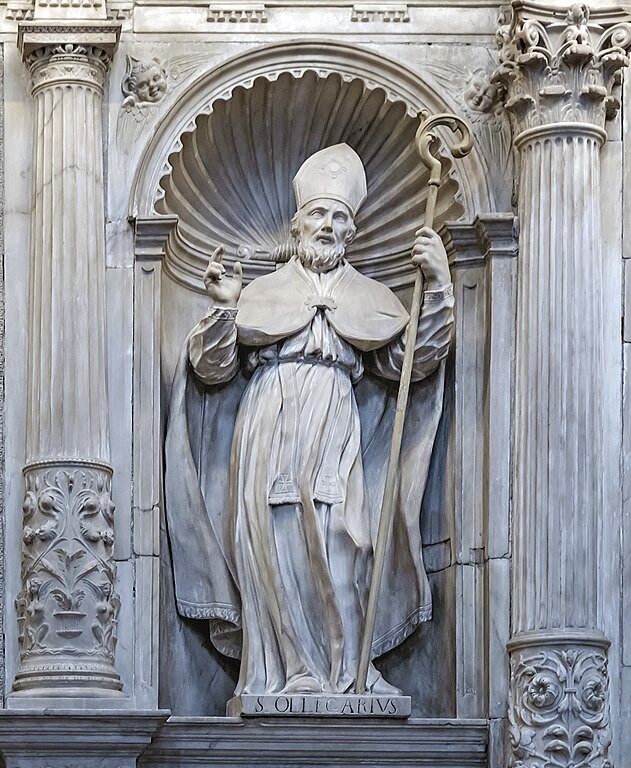
St Ollegarius Bonestruga OSA (1060-1137) Bishop, Canon Regular of the Augustinians, Reformer, in both the religious sphere and the social one, Abbot, Diplomat, Peacemaker and Proptector of his people from possible violent incursions. The Roman Martyrology reads: “At Barcelona in Spain, the blessed St Ollegarius, who was first a Canon and afterwards the Bishop of Barcelona and Archbishop of Tarragona.” A Very Busy Shepherd https://anastpaul.com/2024/03/06/saint-of-the-day-6-march-st-ollegarius-bonestruga-osa-1060-1137-bishop/
Martyrs of Amorium – 42 Saints – Also known as Martyrs of Syria and Martyrs of Samarra; A group of 42 Christian senior officials in the Byzantine Empire who were captured by forces of the Abbasid Caliphate when the Muslim forces overran the City of Amorium, Phrygia in 838 and massacred or enslaved its population. The men were imprisoned in Samarra, the seat of the Caliphate, for seven years. Initially thought to be held for ransom due to their high position in the empire, all attempts to buy their freedom were declined. The Caliph repeatedly ordered them to convert to Islam and sent Islamic scholars to the prison to convince them; they refused until the Muslims finally gave up and killed them. Martyrs. We know the names and a little about seven of them: Aetios Bassoes Constantine Constantine Baboutzikos Kallistos Theodore Krateros Theophilos but details about the rest have disappeared over time. However, a lack of information did not stop several legendary and increasingly over-blown “Acts” to be written for years afterward. One of the first biographers, a monk name Euodios, presented the entire affair as a judgement by God on the empire for its official policy of Iconoclasm. Deaths: beheaded on 6 March 845 in Samarra (in modern Iraq) on the banks of the Euphrates river by Ethiopian slaves the bodies were thrown into the river, but later recovered by local Christians and given proper burial.








 AnaStpaul
You must be logged in to post a comment.