Thought for the Day – 21 March – Meditations with Fr Richard Frederick Clarke SJ (1839-1900)
“Short Meditations for March, St Joseph” From “The Devout Year” By Fr Richard Frederick Clarke SJ (1839-1900)
21st Day – St Joseph’s Seventh Joy The Finding of Jesus Amongst the Doctors in the Temple
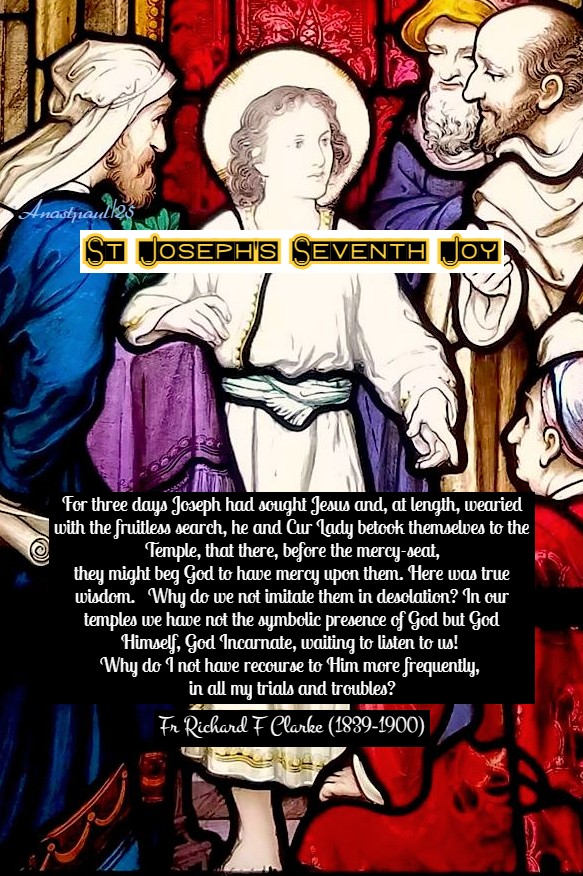
+1. For three days Joseph had sought Jesus and, at length, wearied with the fruitless search, he and Cur Lady betook themselves to the Temple, that there, before the mercy-seat, they might beg God to have mercy upon them. Here was true wisdom. Why do we not imitate them in desolation? In our temples we have not the symbolic presence of God but God Himself, God Incarnate, waiting to listen to us! Why do I not have recourse to Him more frequently, in all my trials and troubles?
+2. In one of the halls of the Temple, they espied a group of old men gathered around a Boy and absorbed in their conversation with Him. In an instant, Joseph recognised Him Whom they sought. Now all his anxiety was at an end; the darkness of night was turned into the dazzling brightness of the glorious day. So in an instant, Jesus can work the same merciful change for us and, by His Presence, can turn all our darkness into Light.
+3. What was Jesus doing? He was listening to what the rabbis had to say about the Messias, putting questions to them which set them a-thinking – whether the time had come for His appearance, answering their questions with such supernatural Wisdom, the old men sat there astonished and, as it were in a trance Jesus was anticipating His public ministry, beginning the Work which He had Come to accomplish, at that early age. So, from the first, He began His Work within my soul, suggesting holy thoughts, pouring heavenly wisdom into me. Alas, how little have I learned His Divine lessons!?
Lenten Meditations – 21 March – With Fr Richard Frederick Clarke SJ (1839-1900) Scripture search here: https://www.drbo.org/
“The Sacred Passion of Our Lord Jesus Christ” “Short Meditations for Lent” From “The Devout Year” By Fr Richard Frederick Clarke SJ (1839-1900)
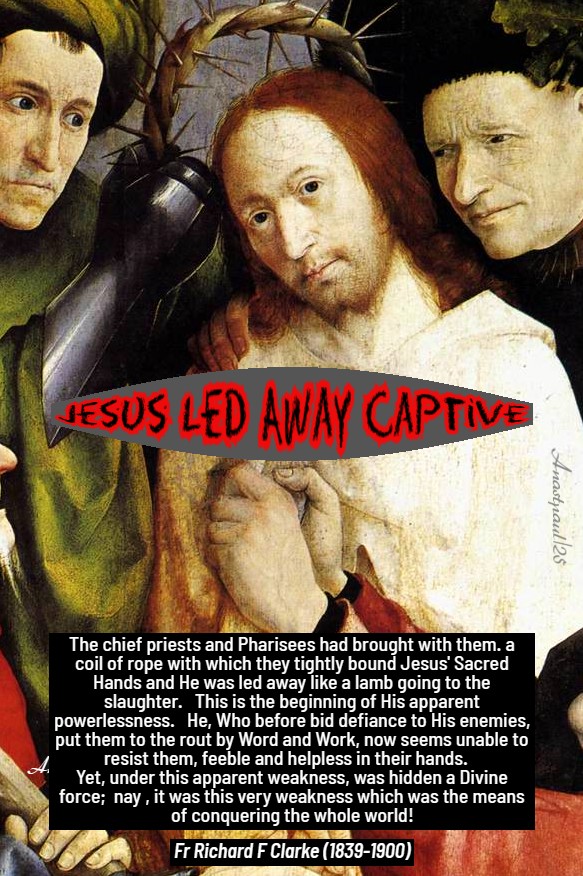
Friday after the Second Sunday in Lent Jesus Led Away Captive
Read St John xviii:12-13
[12] Then the band and the tribune and the servants of the Jews, took Jesus and bound Him[13] and they led him away to Annas firstly, for he was father in law to Caiphas, who was the high priest of that year. [John 18:12-13]
+1. The chief priests and Pharisees had brought with them. a coil of rope with which they tightly bound Jesus’ Sacred Hands and He was led away like a lamb going to the slaughter. This is the beginning of His apparent powerlessness. He, Who before bid defiance to His enemies, put them to the rout by Word and Work, now seems unable to resist them, feeble and helpless in their hands. Yet, under this apparent weakness, was hidden a Divine force; nay , it was this very weakness which was the means of conquering the whole world!
+2. The officers tied Jesus’ Hands, thus, He could no longer lay them upon the sick and the afflicted, to heal their diseases and their miseries. So we too tie the Jesus’ Hands by bands far more fatal, in hindering His power to heal the sickness of our soul. When we reject His graces and turn a deaf ear to His counsel, we render Him powerless to assist us. He cannot bestow the blessings He delights to impart upon us – our obstinacy has tied His Hands so that He cannot help us as He wishes.
+3. Often in our desire to work for others, we find our hands tied. Something hinders our charitable designs; some hostile influence renders us apparently powerless. Our prayers seem to avail nothing; our kind acts are rejected; we seem to do the incorrect thing when trying our best to do what is correct. Yet, we must not repine; we are only treading in our Master’s Steps. The very suffering entailed in this, is a sure means of earning the graces we desire.
One Minute Reflection – 21 March – “The Month of Saint Joseph” – Feast of the Holy Shroud – St Benedict OSB (c 480-547) Abbot, Patron of Europe and Founder of Western Monasticism.–Friday of the Second Week in Lent – Ecclesiasticus 45:1-6 – Matthew 19:27-29 – Scripture search here: https://www.drbo.org/
“… Shall receive a hundredfold and shall possess life everlasting.” – Matthew 19:29
REFLECTION – “The possessions which we have, are not our own –God has given them to us to cultivate and He wishes us to render them fruitful and profitable … Always deprive yourself, therefore, of some part of your means, giving them to the poor with a willing heart … It is true that God will return it to you, not only in the next world but also in this, for there is nothing which makes a person prosper, in temporal matters, so much, as almsgiving. But until such time as God shall repay it, you will always be impoverished to that extent. Oh! how holy and rich is the impoverishment which is caused by almsgiving!
Love the poor and poverty, for by this love you will become truly poor, since, as Scripture says: “We become like the things which we love” (cf Hos 9:10). Love makes those who love, equal to one another: “Who is weak and I am not weak?” says St Paul (2 Cor 11:29). He might have said: “Who is poor, with whom I am not poor?” For love made him become, such as those whom he loved. If, then, you love the poor, you will be truly participating in their poverty and poor like them. Now, if you love the poor, be often among them; be pleased to see them in your house and to visit them in theirs; associate willingly with them; be glad that they are near you in the Churches, in the streets and elsewhere. Be poor in speech with them, speaking to them as their equal but be rich in deed, giving them of your goods, as one who possesses more abundantly.
Will you do even more? … Become a servant of the poor; go to serve them … with your own hands … and at your own expense. This service has more glory in it than a throne!” – St Francis de Sales (1567-1622) Bishop of Geneva and Doctor of the Church (Introduction to the devout life, Part three Ch 15).
PRAYER – May the intercession of the blessed Abbot Benedict, commend us to Thee, O Lord, so that through his merits we may obtain that which we cannot accomplish by our own. T hrough Jesus Christ, thy Son our Lord, Who lives and reigns with Thee, in the unity of the Holy Ghost, God, world without end.. Amen (Collect).
Our Morning Offering – 21 March – The Feast of the Holy Shroud of Jesus
Faithful Cross! Above All Other By St Venantius Fortunatus (c 530 – c 609)
Faithful Cross! above all other, one and only noble tree! None in foliage, none in blossom, none in fruit thy peer may be; sweetest wood and sweetest iron, sweetest weight is hung on thee.
Bend thy boughs, O tree of glory! Thy relaxing sinews bend; for awhile the ancient rigour that thy birth bestowed, suspend and the King of heavenly beauty gently on thine arms extend.
Praise and honour to the Father, praise and honour to the Son, praise and honour to the Spirit, ever Three and ever One: One in might and One in glory while eternal ages run.
Saint of the Day – 21 March – Saint Birillus (Died c90) the 1st Bishop of Catania, Consecrated by St Peter, Missionary. Born in Antioch (in modern Turkey) and died in c90 in Catania, Italy of natural causes . Patronage – of the Archdiocese of Catania, Italy. Also known as – Berillo, Beryl, Beryllus, Brillus.
The Roman Martyrology reads today: “At Catania, St Brillus, who was Consecrated Bishop by St Peter. After converting many Gentiles to the Faith, he rested in peace in extremely old age.”
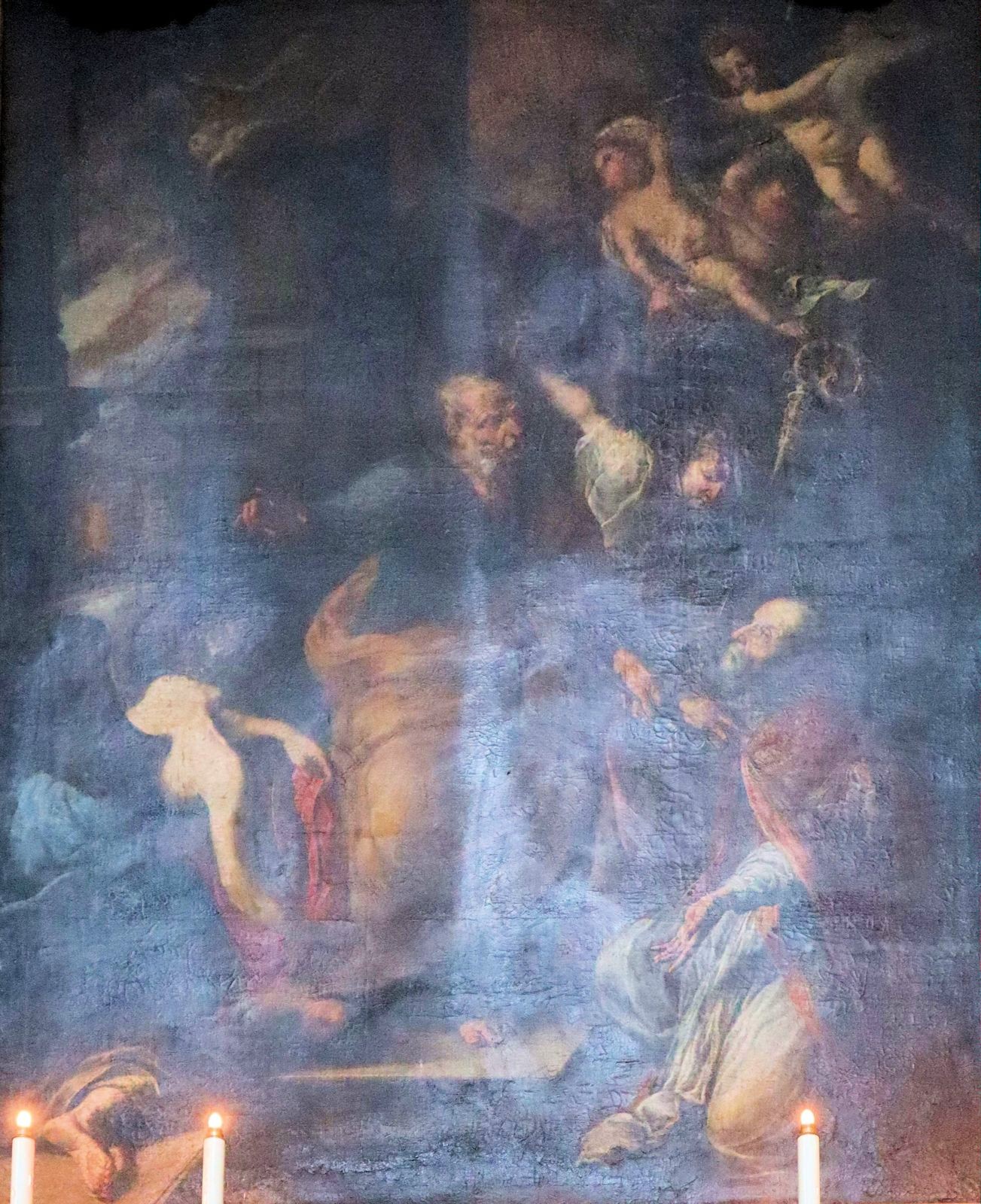
St Peter Consecrates St Birillus Bishop, 1693, in the Cathedral in Catania by Andrea Suppa
Birillus was Consecrated Bishop by St Peter in Antioch in 42 and sent to Catania as a Missionary. After a long service as the City’s 1st Bishop, he died at an advanced age.
St Peter sends St Birillus to preach the Gospel
Birillus was first mentioned in the 8th Century in the biography of Leo of Catania, then in that of Pancras of Taormina and in two liturgical texts of the 9th Century.
In fact, the City’s first Cathedral, from 380 onward, was the Church of Sant’Agata la Vetere —probably only appeared in the 3rd/4th Century.
The tradition concerning Birillus is, therefore, uncertain, nevertheless, he is highly revered in his City of Catania.
St John (Died 1146) Bishop of Valence , Founder of the Abbey of Bonnevaux, Monk, Abbot, Apostle of the poor, Social Reformer. The Roman Martyrology reads: “In Valence in the territory of Vienne in France, St John, Bishop, who, at first Abbot of Bonnevaux, suffered many adversities for the defence of justice and with charity took care of the peasants, the poor and the merchants ruined by debts.” Imitating the Lord: https://anastpaul.com/2022/03/21/saint-of-the-day-21-march-saint-john-of-valence-died-1146/
Bl Lucia of Verona (1514-1574) Laywoman, Apostle of the Sick
St Nicholas of Flue (1417-1487) Swiss Hermit and Ascetic who is the Patron Saint of Switzerland. He is sometimes invoked as Brother Klaus. A husband and father, a Mystic, a Writer, farmer, military leader, Member of the assembly, Councillor, Judge, he was respected as a man of complete moral integrity. He was Canonised on 15 May 1947 by Pope Pius XII. Holy St Nicholas: https://anastpaul.wordpress.com/2018/03/21/saint-of-the-day-21-march-st-nicholas-of-flue-1417-1487/St Nicholas of Flue (1417-1487)
St Serapion the Scolastic (Died c354-370) Bishop of Thmuis, near Diospolis in the Nile delta of Egypt, Monk and Hermit, Confessor, brilliant Scholar of great learning, Theologian, Writer, a companion to St Anthony, the Desert and a close friend of St Athanasius and gave support to him against the heretic Arians in Egypt, for which action he was exiled. St Serapion’s Life: https://anastpaul.com/2021/03/21/saint-of-the-day-21-march-saint-serapion-the-scolastic-died-c-354-370-bishop/
St Philemon of Rome Bl Santuccia Terrebotti
Martyrs of Alexandria: A large but unknown number of Catholics massacred in several Churches during Good Friday services in Alexandria, Egypt by Arian heretics during the persecutions of Constantius and Philagrio. They were Martyred on Good Friday in 342 in Alexandria, Egypt.












 AnaStpaul
You must be logged in to post a comment.