
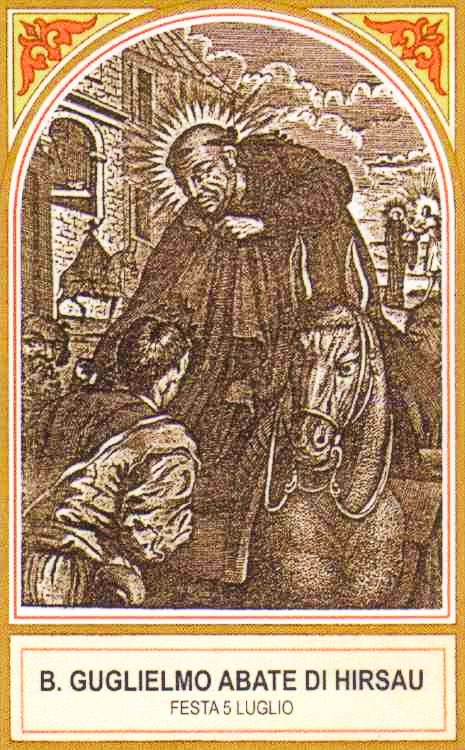
Saint of the Day – 4 July – St William (c1030- 1091) Abbot of Hirsau Monastery in Germany, Reformer. The date of his birth is unknown but it is known that he was born in the Bavarian City of Regensburg in Germany around the year 1030 and died on 4 or 5 July in 1091at the Monastery in Hirsau the Black Forest. His Body is Incorrupt.

William was soon entrusted, at a tender age, to the Monastery of St Emmeram to be educated .While still young, he took the Benedictine Habit, receiving a solid ascetic, literary, scientific and technical education.
Gifted with great prudence, William knew how to combine rigid personal asceticism with a charming kindness towards others. In 1069 he was called to govern the Monastery of Hirsau in the Black Forest, rebuilt shortly before by Count Adalbert with the help of the Monks of Einsiedeln. The small community numbered only fifteen Religious. William, however, did not want to receive the Abbatial blessing until after the death of Frederick (died in 1071), who had been illegally removed by CountAdalbert.
In order to obtain full exemption for the Monastery, in 1075, William went to Rome to Pope Gregory VII. In Hirsau, William first introduced the customs of St Emmeram, then, imitating those of Cluny, he drew up their rigid and detailed Rules.
The “Hirsau Reform” spread to numerous foundations and of already existing Monasteries throughout Europe, numbering more than one hundred Monasteries. The community of Hirsau itself, grew so vigorously that it soon numbered more than one hundred and fifty Monks, for whom a new building had to be built, dedicated to Sts Peter and Paul. From here, colonies of Monks were sent to elsewhere to encourage and spread the Hirsau Rule and custom of spiritual life.
William also organised the institute of Lay Brothers in the Benedictine monastic community which was then accepted everywhere and gathered around it men and women as ‘oblates.’
In the Investiture Controversy, William was one of the pillars of the Gregorian Reform in Germany which the Monks of Hirsau preached and propagated. He wrote dialogues on Music and Astronomy and had a copy of the Vulgate inscribed for his Monastery.
He died on 4 or 5 July 1091 and was buried in the Church of Saints Peter and Paul, which he himself had built. Around 1500 his Tomb was opened and it was found that both the body and the Abbot’s clothes were still perfectly well preserved. . Until the protestant suppression of Hirsau, he enjoyed public veneration.



 AnaStpaul