Thought for the Day – 7 July – “The Month of the Most Precious Blood” – From The Sacred Triduum
“Carry one another’s burdens.” Gal 6:2
“He loved them unto the end.” John 13:1
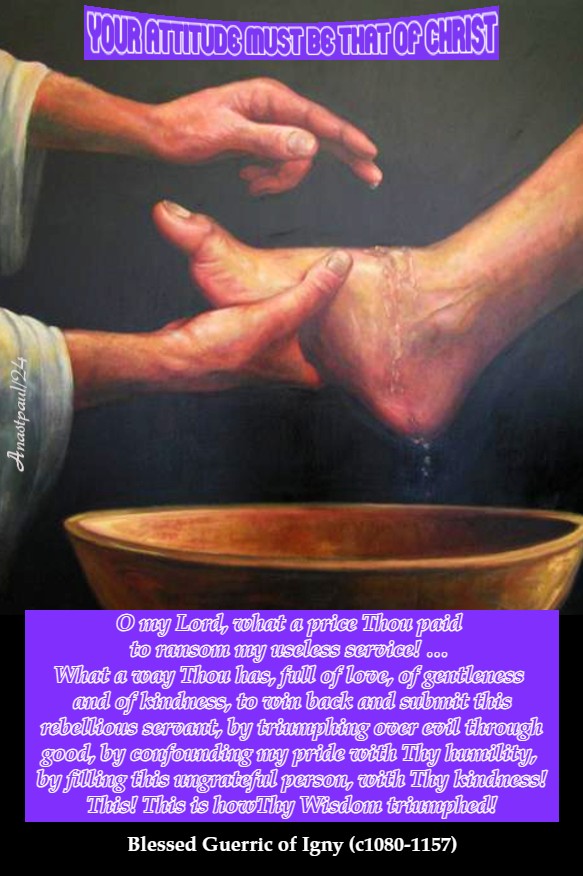
Your Attitude Must Be That of Christ
Blessed Guerric of Igny (c1080-1157) Cistercian Abbot
“He was in the form of God,” equal to God by nature, since He shared in God’s power, God’s eternity and God’s very being … He did the job of a servant “by humbling Himself, obeying His Father even to death, death on a Cross.” (cf Phil 2:5-8). One might consider it to be trivial that, as God’s Son and His equal, He served His Father as a servant. More than that, He served His own servant more than any other servant. For the human being had been created to serve His Creator. What could be more just for you, than to serve him who made you, without Whom you would not be? And what could be more blest, than to serve Him, since to serve Him is to reign? But the human being said to His Creator: “I will not serve.” (Jer 2:20)
Then the Creator said to the human being: “So I will serve you! Go sit down at the table; I will serve. I will wash your feet. Rest. I will take your pains upon myself; I will carry your weakness… If you grow tired or are burdened, I will carry you, you and your burden, so as to be the first to fulfil my law: ‘Carry one another’s burdens’ (Gal 6:2)… If you are hungry or thirsty… here I Am, ready to be sacrificed, so that you might eat My Flesh and drink My Blood… If you are taken into captivity or, if you are sold, here I Am… Redeem yourself by paying the ransom you will get from Me. I give Myself as ransom… If you are sick, if you fear death, I will die in your place, so that from My Blood you may make for yourself, a life-giving remedy!…”
O my Lord, what a price Thou paid to ransom my useless service! … What a way Thou has, full of love, of gentleness and of kindness, to win back and submit this rebellious servant, by triumphing over evil through good, by confounding my pride with Thy humility, by filling this ungrateful person, with Thy kindness! This! This is howThy Wisdom triumphed!” – (1st Sermon for Palm Sunday),
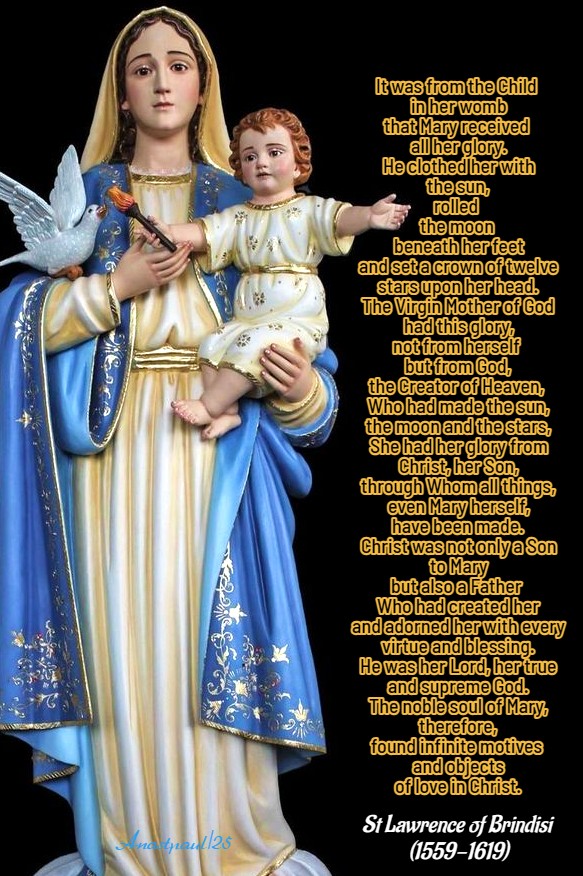
Quote/s of the Day – 7 July – St Lawrence of Brindisi OFM Cap (1559-1619) Confessor, The “Franciscan Renaissance Man” Priest
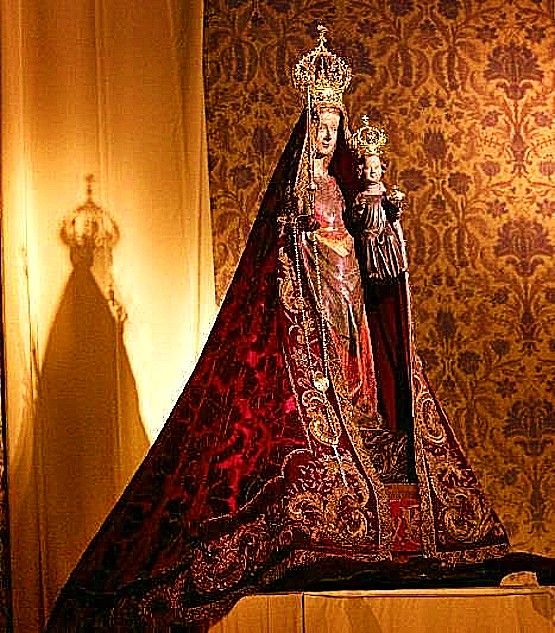
“It was from the Child in her womb that Mary received all her glory. He clothed her with the sun, rolled the moon beneath her feet and set a crown of twelve stars upon her head. The Virgin Mother of God had this glory, not from herself but from God, the Creator of Heaven, Who had made the sun, the moon and the stars, She had her glory from Christ, her Son, through Whom all things, even Mary herself, have been made. Christ was not only a Son to Mary but also a Father Who had created her and adorned her with every virtue and blessing. He was her Lord, her true and supreme God. The noble soul of Mary, therefore, found infinite motives and objects of love in Christ.”
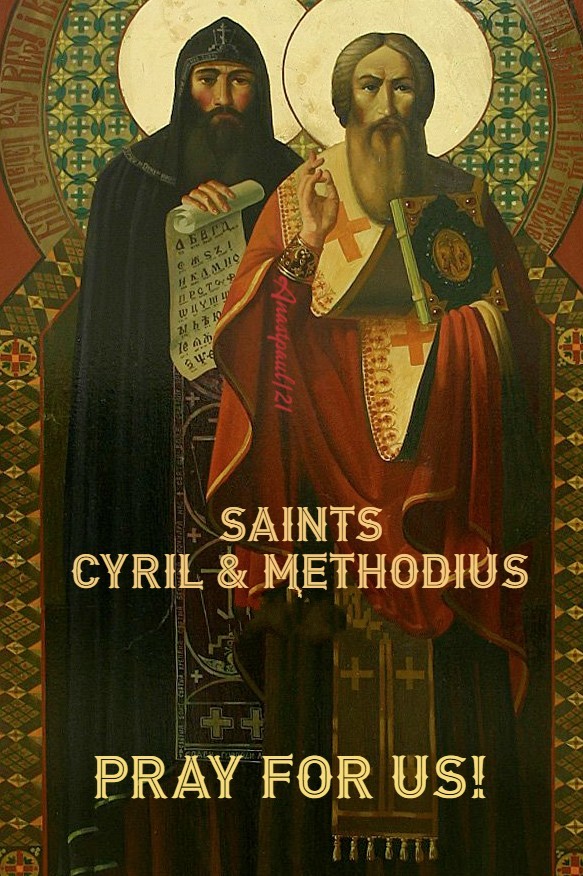
One Minute Reflection – 7 July – “The Month of the Most Precious Blood” – Saint Cyril (827-869) and Saint Methodius (826-885) “Apostles to the Slavs,” Sibling Brother Bishops, Confessors – St Lawrence of Brindisi OFM Cap (1559-1619) Confessor, The “Franciscan Renaissance Man,” Priest – Hebrews 7:23-27 – Luke 10:1-9 – Scripture search here: https://www.drbo.org/
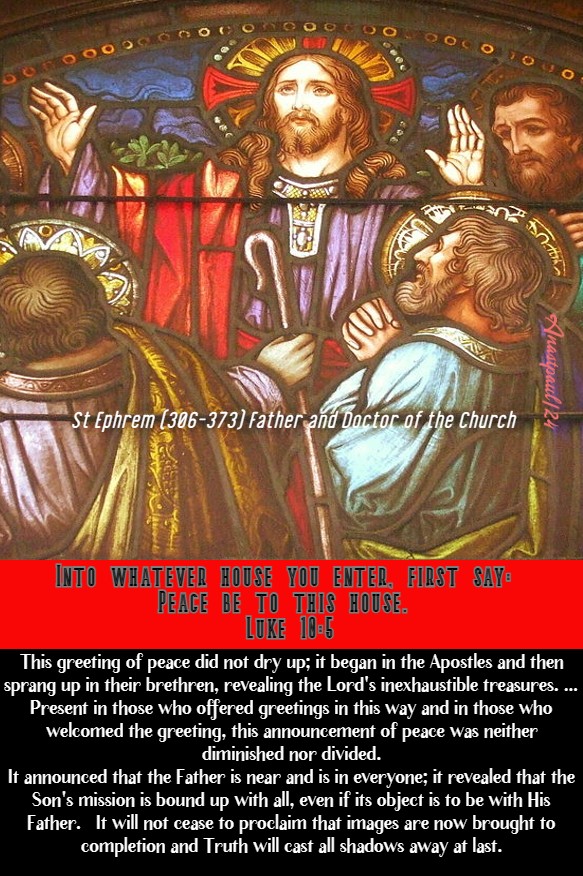
“Into whatever house you enter, first say: Peace be to this house. And, if the son of peace be there, your peace shall rest upon him but if not, it shall return to you.” – Luke 10:5-7
REFLECTION – “As you enter a house, first say, ‘Peace to this house,‘” (Lk 10:5) so that the Lord Himself might enter and remain there, as with Mary. … This greeting is the Mystery of Faith which shines forth in the world. Through it, enmity is stifled, war is ended and people acknowledge one another. The effect of that greeting was hidden by a veil in spite of the fact that it prefigures the Mystery of the Resurrection … when the light rises and dawn chases night away. From the moment Christ sent out His disciples, people began to give and receive this greeting, a source of healing and blessing. …
This greeting with its hidden power … is amply sufficient for us all. That is why Our Lord sent it out, together with His disciples, as forerunner, so that it might bring about peace and, carried by the voice of the Apostles whom He sent, prepare the way before them. It was sown in every dwelling … it entered into all who heard it, so as to separate and set apart, the children it recognised as its own. It remained in them but it denounced those who were alien to it, for they did not welcome it.
This greeting of peace did not dry up; it began in the Apostles and then sprang up in their brethren, revealing the Lord’s inexhaustible treasures. … Present in those who offered greetings in this way and in those who welcomed the greeting, this announcement of peace was neither diminished nor divided. It announced that the Father is near and is in everyone; it revealed that the Son’s mission is bound up with all, even if its object is to be with His Father. It will not cease to proclaim that images are now brought to completion and Truth will cast all shadows away at last.” – St Ephrem (306-373) Father and Doctor of the Church (Diatessaron 8: 3-4).
PRAYER – Look forgivingly on Thy flock, Eternal Shepherd and keep it in Thy constant protection, by the intercession of the blessed brothers, Cyril and Methodius, who, by the power of the Holy Ghost were moved to bring the light of the Gospel to a hostile and divided people. Through Jesus Christ, Thy Son our Lord, Who lives and reigns with Thee, in the unity of the Holy Ghost, God, world without end. Amen (Collect).
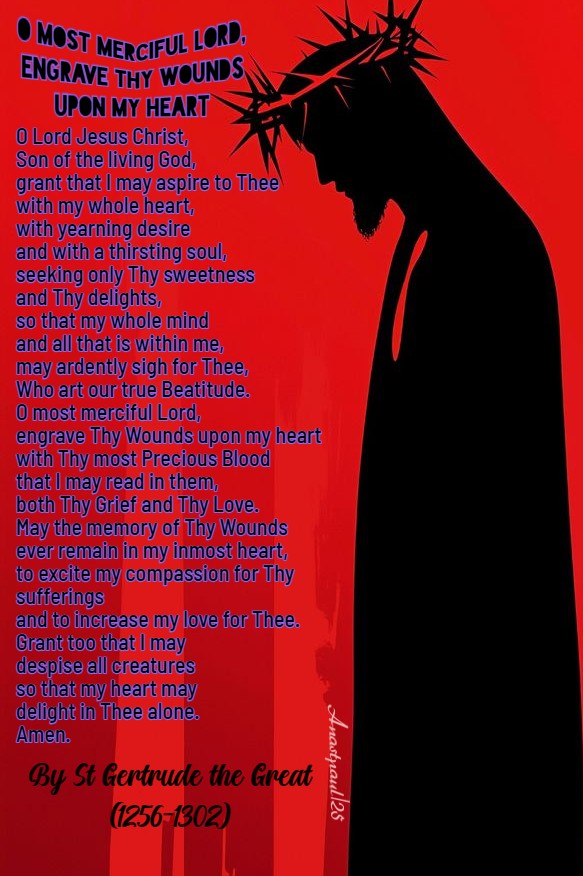
Our Morning Offering – 7 July – “The Month of the Most Precious Blood” – O Most Merciful Lord, Engrave Thy Wounds Upon My Heart By St Gertrude
O Most Merciful Lord, Engrave Thy Wounds Upon My Heart By St Gertrude the Great (1256-1302)
O Lord Jesus Christ, Son of the living God, grant that I may aspire to Thee with my whole heart, with yearning desire and with a thirsting soul, seeking only Thy sweetness and Thy delights, so that my whole mind and all that is within me, may ardently sigh for Thee, Who art our true Beatitude. O most merciful Lord, engrave Thy Wounds upon my heart with Thy most Precious Blood that I may read in them, both Thy Grief and Thy Love. May the memory of Thy Wounds ever remain in my inmost heart, to excite my compassion for Thy sufferings and to increase my love for Thee. Grant too that I may despise all creatures so that my heart may delight in Thee alone. Amen.
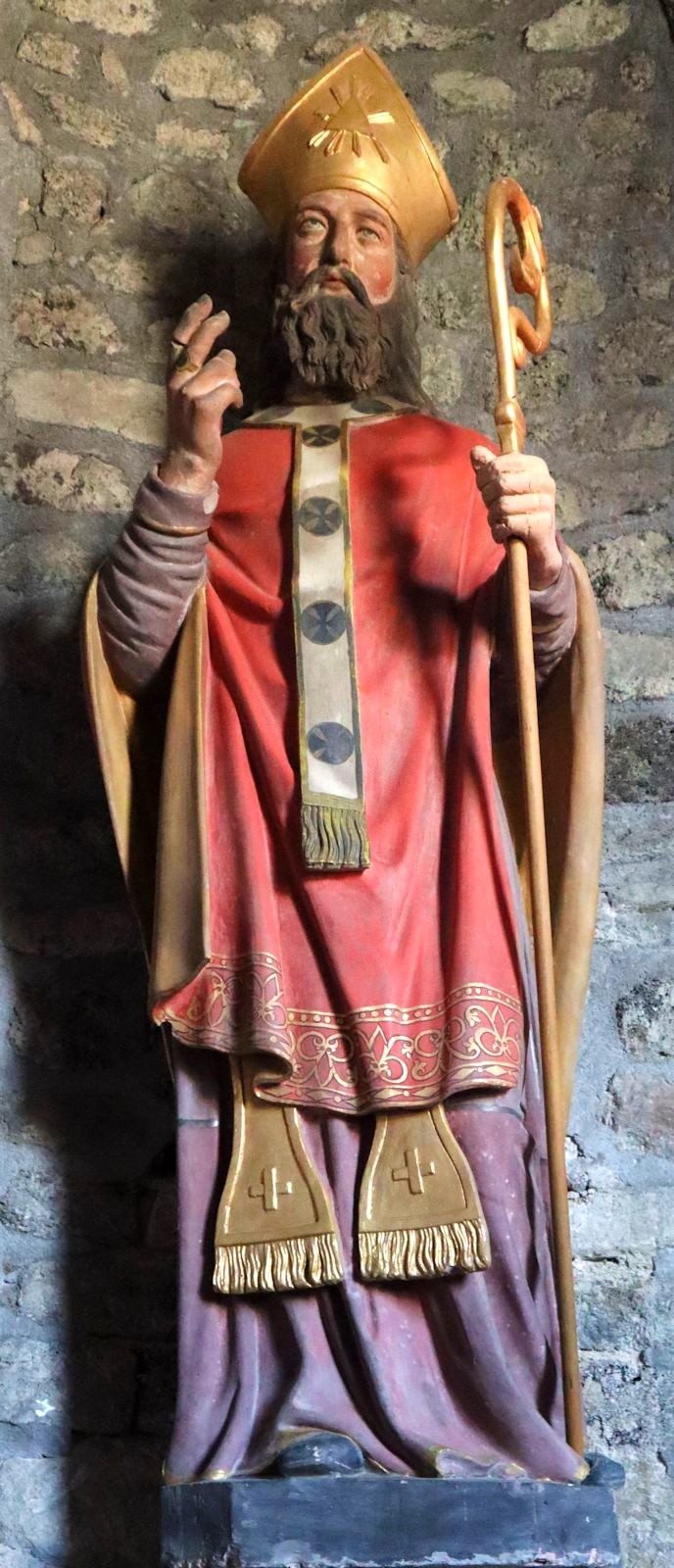
Saint of the Day – 7 July – Saint Hedda (Died 705) Bishop of Winchester, England, Monk, Abbot Believed to have been born in Headingley, Leeds and died on 7 July 705 in Winchester, after having served his huge Diocese as a faithful shepherd for around 30 years. He had been a man of love and justice, of knowledge and eloquence and great determination. Also known as – Hedda of Dorchester, Hedda of Wessex, Edda… Haeddi…
The Roman Martyrology reads today: “In England, St Hedda, Bishop of the West -Saxons.”
Almost nothing is known of the early life of Hedda, who, according to the historian, William of Malmesbury (1080-1143), was first a Monk and then an Abbot, possibly of a Monastery in Wessex.
His signature on a document, suggests that Hedda was the Abbot of a Monastery in Wessex, perhaps Glastonbury. Moreover, this hypothesis seems confirmed by the fact that his name was found among those of Abbots and illustrious men on one of the ancient and almost illegible records engraved on stone “pyramids” at Glastonbury.
According to other sources, Hedda was a Monk at St Hilda’s Monastery at Whitby but, the fame of Whitby as a centre of learning, taken together with the statements of the Venerable St Bede about Hedda’s less comprehensive education, make this thesis seem unlikely. St Bede states further, that Hedda was “a just and good man”and that he governed his Diocese with love being “more inspired by a love of virtue, than by lessons … ” However, William of Malmesbury insists that after having read much of Hedda’s correspondence, he found our Saint to be a man of great knowledge and profound eloquence.
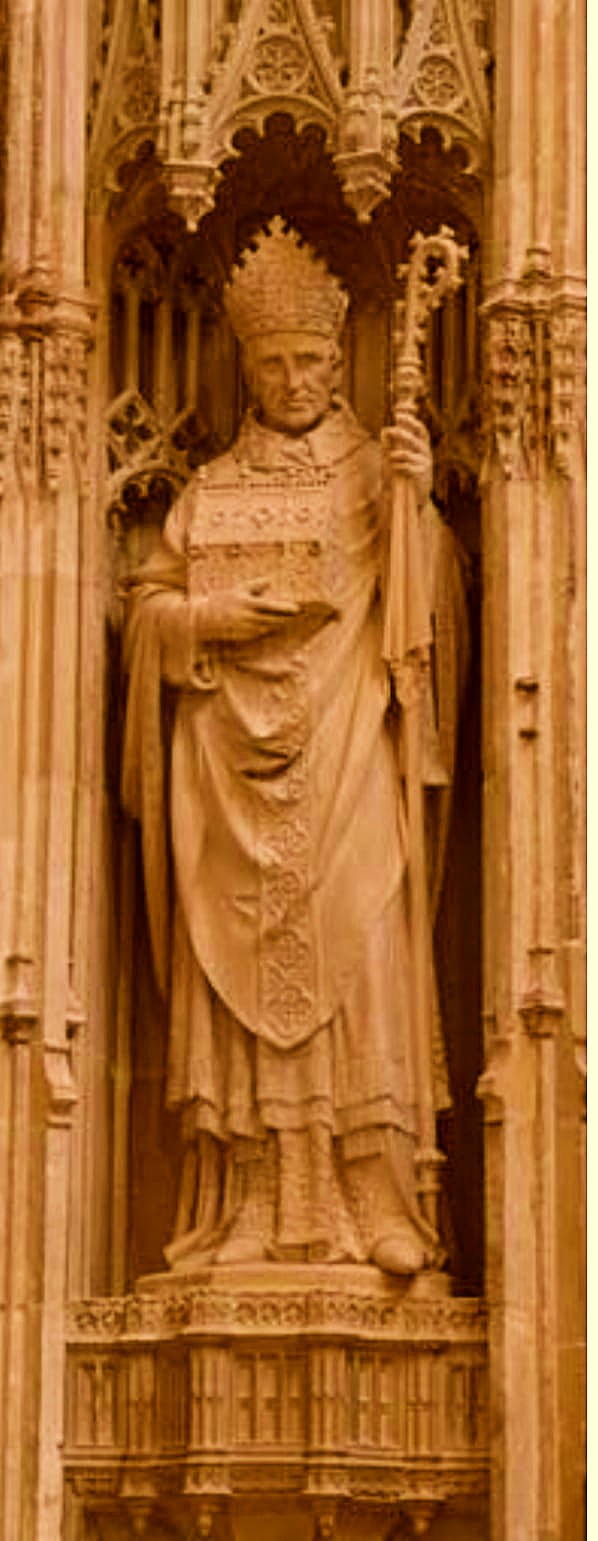
Hedda settled in Winchester, as the Episcopal Seat of the Diocese of the West-Saxons, (formerly in Dorchester) making this move permanent and then proceeding to transfer the Relics of St Birinus from Dorchester to Winchester . These Relics he had placed in the Church of Sts Peter and Paul.
St Hedda holding the Relics of St Birnus
It was Hedda who brought King Cenwalh to the Faith, who, despite the conversion of his father, Cynogils, had long remained a pagan. Hedda was also a valued advisor to King St Ina (689-726) in whose law code of Wessex, the Bishop is mentioned as contributing to the laws and thus, was not a stranger to the wise laws issued by King Ina. He also visited the Hermit St Gutlach, on the Island of Croyland, Ordained him a Priest and Consecrated his Church. The Bishop Hedda, was one of the first benefactors, (probably affirming his deep connections to it) of Glastonbury Abbey, to which he made a gift of lands and on which he directed the favours of the sovereigns.
Throughout his Episcopate, Hedda strenuously opposed any attempt to divide his Diocese and this seems also in consideration of the precarious and difficult political situation of the Kingdom of Wessex, whose unity would have been favoured by that of the Diocese. Archbishop Theodore of Canterbury, had divided numerous Diocese, left that of Wessex intact until the death of Hedda, perhaps because of the friendship which bound him to the latter.
In 704 the question was again raised, as is evident from a letter written by Wealdheri, the Bishop of London, to Archbishop Britwald to inform him that a Synod of Bishops held that year, had decided to exclude the West-Saxons from communion, unless they conformed to the disposition of the same Archbishop which seems to have referred to the question of the division of the Diocese. Hedda, however, persisted in his position.
Hedda died in Winchester in 705. The faithful of his Diocese, whom he had governed for about thirty years, soon venerated him as a Saint. So many were the miracles and cures at his tomb, St Bede says even the dust from his grave had the power to perform miraculous cures.
His memory is celebrated on 7 July and on that day Hedda is also commemorated in the Roman Martyrology. His Feast is still celebrated Liturgically today in the Archdiocese of Birmingham which governs Winchester.
Saint Cyril (827-869) Saint Methodius (826-885) “Apostles to the Slavs,” Sibling Brother Bishops, Confessors, Theologians, Missionaries, Writers, Preachers, Patrons of Europe. Creators of the Glagolitic alphabet, the first alphabet used to transcribe Old Church Slavonic and Cyrillac Alphabet, which was developed from it. Their Feast Day is 7 July (moved in 1969). The great Saints Cyril & Methodius: https://anastpaul.wordpress.com/2018/02/14/saints-of-the-day-14-february-sts-cyril-827-869-methodius-826-885/
St Lawrence of Brindisi OFM Cap (1559-1619) Confessor, The “Franciscan Renaissance Man,” Priest and Friar of the Friars Minor Capuchin, Theologian, Vicar General of the Franciscans, Language scholar, Humanist, Philosopher, Biblicist, Preacher, Missionary, Professor, International Administrator, Confidant of Popes, Emperors, Kings and Princes, Diplomatic envoy, Army Chaplain, Military Strategist and Morale builder, Polemicist, Prolific writer. He was Beatified on 1 June 1783 by Pope Pius VI and Canonised on 8 December 1881 by Pope Leo XIII. His Zealous Life: https://anastpaul.com/2017/07/21/saint-of-the-day-21-july-st-lawrence-of-brindisi-o-f-m-cap-doctor-of-the-church/
St Alexander St Angelelmus of Auxerre St Apollonius of Brescia
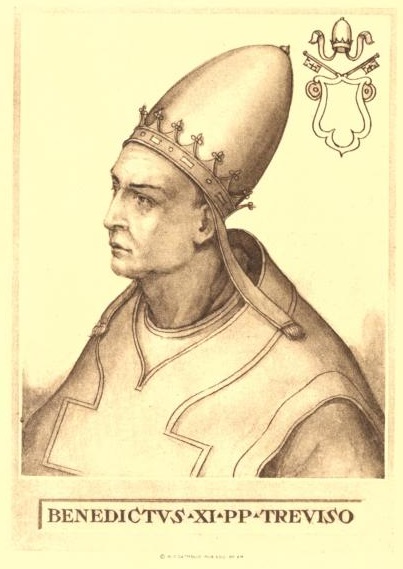
Blessed Pope Benedict XI OP (1240-1303) Cardinal-Priest of St Sabina, Bishop of Ostia then of Rome, Dominican Friar, Prior Provincial of Lombardy prior to becoming the Master of the Order in 1296, Apostolic Papal Legate to Hungary and France, Teacher, Preacher, Writer and renowned Scholar with special emphasis on Scriptural commentary. His Papacy began on 22 Ocober 1303 and ended at his death on 7 July 1304. His Life pf Grace: https://anastpaul.com/2020/07/07/saint-of-the-day-7-july-blessed-pope-benedict-xi-1240-1303/
Bl Bodard of Poitiers St Bonitus of Monte Cassino St Carissima of Rauzeille St Eoaldus of Vienne
St Hedda (Died 705) Bishop of Winchester, England St Maelruan St Medran St Merryn Bl Oddino Barrotti
St Odo (c1063-1122) Bishopof Urgella zealous Defender of the rights of his See, builder and restorer of numerous Churches but most of all, Bishop Odo is remembered as a most gentle and generous benefactor of the poor, the needy and the ill. Patronage – of La Seu d’Urgell, Spain. A Holy and Zealous Bishop: https://anastpaul.com/2024/07/07/saint-of-the-day-7-july-saint-odo-of-urgell-c1063-1122-bishop/
St Odran St Palladius of Ireland
St Pantænus (Died c216) Father of the Church, Theologian, Philosopher, Teacher, Confessor and Defender of the Faith, Writer and interpreter of the Sacred Scriptures, the Trinity and Christology, Missionary. Convert of the disciples of the Apostles. Head of the Alexandrian School of Learning – a famous pupil was St Clement of Alexandria. A Life of Love: https://anastpaul.com/2019/07/07/saint-of-the-day-7-july-st-pantaenus-father-of-the-church-died-c-216/
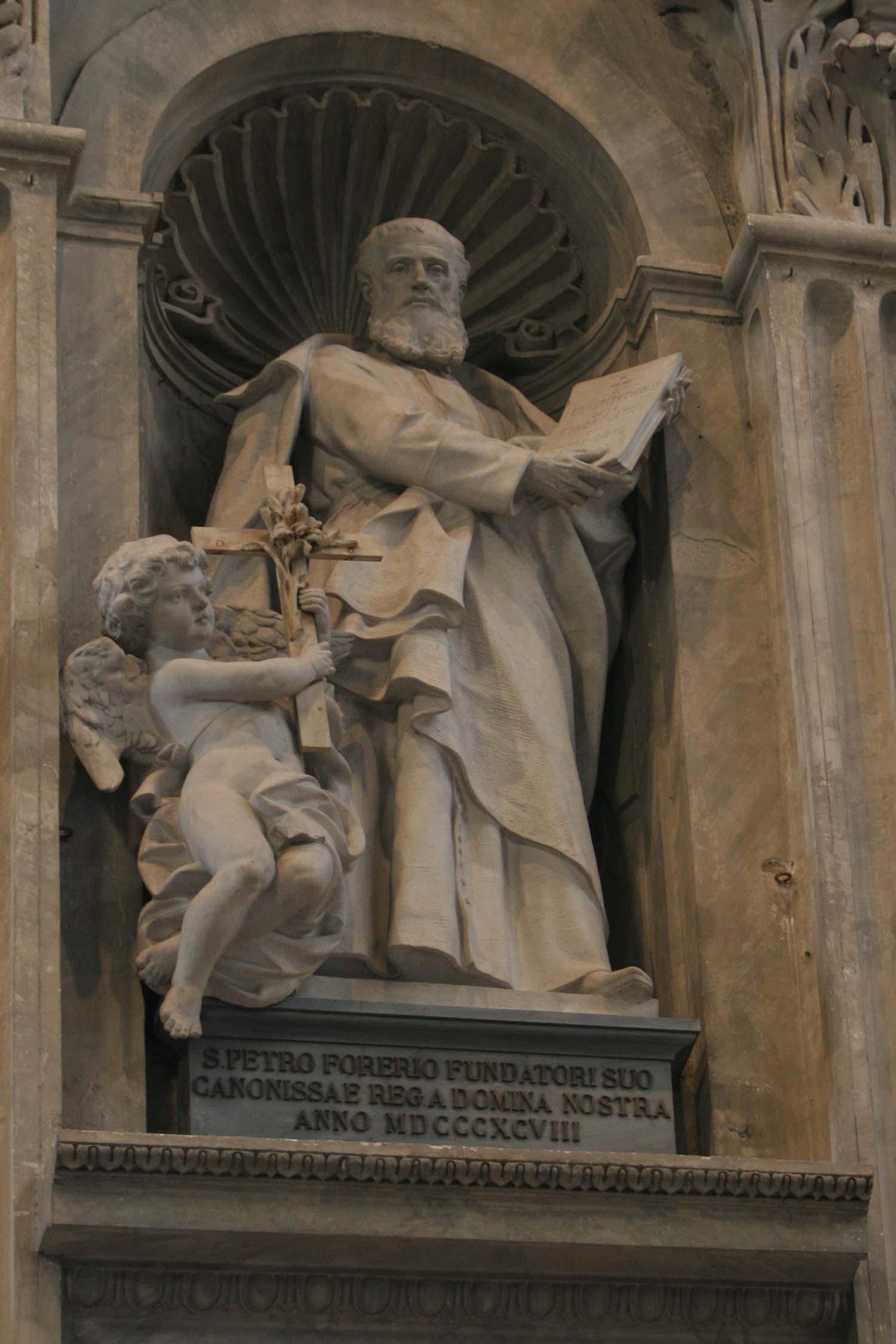
St Peter Fourier CRSA (1565-1640) Priest, Founder, Reformer, Confessor, Theologian, Teacher, Preacher, Apostle of Prayer, Penance and Charity, Marian devotee – “the Good Father of Mattaincourt” “le bon pere de Mattaincourt”. Although he died on 9 December his Feast Day is celebrated today, 7 July, possibly the date of the translation of part of his Relics. St Peter spread everywhere devotion to the Immaculate Conception of the Blessed Virgin. More than two centuries before the Miraculous Medal in 1830 and the proclamation of the dogma in 1854, he saw to the distribution of large quantities of a medal he had struck, on which were engraved the words – “Mary was conceived without sin.” He was Beatified by Pope Benedict XIII in 1730 and Canonised by Pope Leo XIII in 1897. St Peter Fourier is honoured by a statue in St Peter’s Basilica among the Founders of religious orders. His Zealous Life: https://anastpaul.com/2018/12/09/saint-of-the-day-9-december-st-peter-fourier-c-r-s-a-1565-1640/
Martyrs of Durres – 7 Saints: Also known as – Martyrs of Dyrrachium/Martyrs of Durazzo. A group of seven Italian Christians who fled Italy to escape the persecutions of Emperor Hadrian. Arrived in Dyrrachium, Macedonia to find Saint Astius tied to a cross, covered in honey, laid in the sun and left to be tortured by biting and stinging insects. When they expressed sympathy for Astius, they were accused of being Christians, arrested, chained, weighted down, taken off shore and drowned. We know little more about each of them than their names – Germaus, Hesychius, Lucian, Papius, Peregrinus, Pompeius and Saturninus. They were born in Italy and were Martyred at sea c117 off the coast of Dyrrachium (Durazzo), Macedonia (modern Durres, Albania).
DISCLAIMER: Please note: I cannot control the content of the Advertisements on this Site, or of pop-ups which may appear, The revenue from the Advertisements, however, does provide a little assistance in the support of the Site. I do apologise for any inappropriate content.









You must be logged in to post a comment.