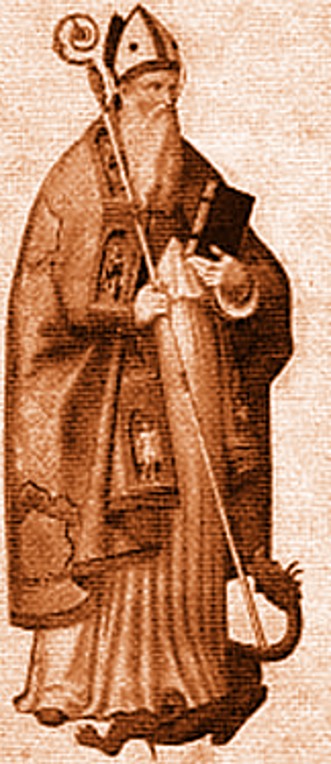
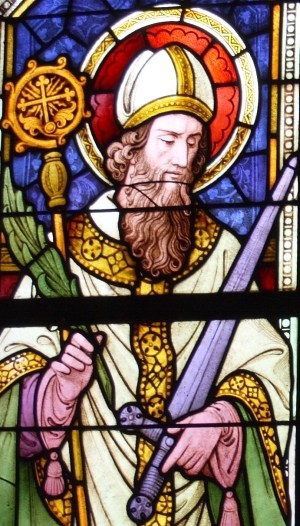
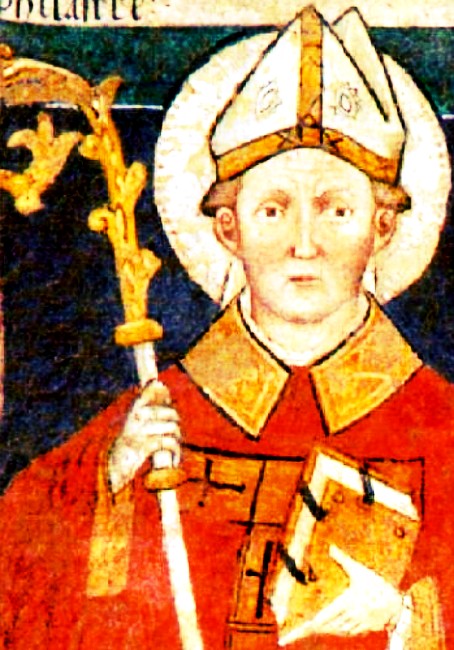
Saint of the Day – 18 July – St Rufillus (5th Century) the 1st Bishop of Forlimpopoli, in the Province of Forli, Italy, Defender of the Faith, as zealous and faithful shepherd and protector of his people. a “dragon-slayer” symbolising the slaying of paganism and idolatry. Patronages – of the City of Forlimpopoli and of the Diocese of Forli-Bertinoro.
The Roman Martyrology reads today: “At Forlimpopoli, Emilia, Italy, St Rufillus, the Bishop of that City.”
The information we have about the 1st Bishop of Forlimpopoli in Forlì, Saint Rufillus, comes from late literary sources. However the evidence of his cult throughout Emilia-Romagna indicates his existence and the great veneration he received over the centuries.
Medieval sources cite 13 Churches dedicated to him in the region: one in Bologna, near the San Rufillus Bridge, one in Casola Valsenio (Diocese of Imola), one in Vitignano di Meldola (Forlì), one in Ravenna, three in the Diocese of Faenza, three in the Diocese of Forlimpopoli, one in Florence and finally, the Saint’s Sepulchral basilica (Collegiate Church of Saint Rufillus) which existed in the City of Forlimpopoli but was located outside the City walls at the time of its Construction.
Recent excavations have dated the Apse to the 5th Century, while the rest of the ancient religious building underwent various destructions, reconstructions and renovations, culminating in the current Basilica dating to 1378. It is the only early Basilica in the City, and eminent scholars believed it to be the original Cathedral of Forlimpopoli.
Around 971, the Basilica was ceded to the Benedictines and became an Abbey, while the Cathedral sSat was transferred to another Church within the defensive walls, likely to the Basilica discovered beneath the foundations of the famous 14th Century fortress, now home to an Archaeological Museum.
All this to reiterate that, beyond the hagiographical
uncertainties surrounding St Rufillus, the existence of such a widespread cult makes him a highly venerated Saint and, therefore, one of a holy life and zealous apostolic work among the population.
An ancient 11th Century sermon, recited on the Saint’s Feastday and written in excellent Latin, provides us with some information about Rufillus, endowed with the virtues proper to a Bishop.
The document dates the Feast to 18 July and recounts the episode of the victory over the dragon; between Forlimpopoli and Forlì, 8 km away where a monstrous dragon lurked, its breath polluting the air, causing the deaths of several people.
Bishop Rufillus urged the faithful of the Diocese to fast and pray, so that the area would be freed from the pestilential monster. At the same time, he invited the Bishop of Forlì, St Mercuriale (30 April), to participate in the appeals to Heaven and to the dragon.
They both went to the dragon’s lair, where they wrapped their stoles around its throat and threw it into a deep well, blocking the mouth with a ‘memorial’ (a monument or an inscription). This episode is also recounted in the Vita of St Mercuriale and in that of Saints Gratus and Marcellus; the dragon represented the symbol of idolatry which was still quite widespread snf, therefore, saw the struggle of the 1st Bishop of Forlimpopoli committed to eradicating it, together with the work of other saintly Bishops of the region.
And with them he was also committed to combating the Arian heresy, whose driving force was in Rimini; from the documents relating to the aforementioned Bishops and to St.Peter Chrysologus, the Bishop of Ravenna, also his contemporary, the period of his Episcopate can be dated to the first half of the 5th Century.
According to some sources, he died at the age of ninety in Forlimpopoli. In 1362, after the destruction of the City, his Relics were transported to Forlì to the Church of St James. In May 1964, they returned to the Collegiate Basilica of Forlimpopoli, where they are now still highly venerated.








 AnaStpaul
You must be logged in to post a comment.