Thought for the Day – 12 September – Meditations with Antonio Cardinal Bacci (1881-1971)
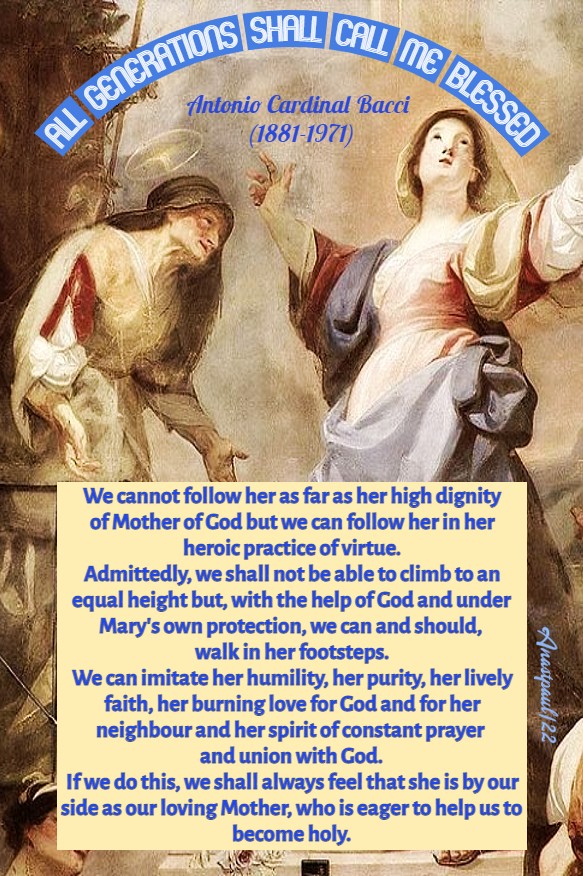
“All Generations Shall Call Me Blessed”
“It is related in the Gospel, that once a certain occasion, a woman in the crowd, was roused by the preaching and miracles of Jesus and cried out: “Blessed is the womb that bore thee and the breasts that nursed thee.” But Jesus replied: “Rather blessed are they who hear the word of God and keep it” (Lk 11:27-28). These words take nothing from the glory of the Mother of God. They were not intended for her but, for us. She was great and holy, not only because she was chosen to be the Mother of the Word Incarnate but also because she perfected herself in virtue by carrying out, in everything, the teaching of her Divine Son, Jesus.
We cannot follow her as far as her high dignity of Mother of God but we can follow her in her heroic practice of virtue. Admittedly, we shall not be able to climb to an equal height but, with the help of God and under Mary’s own protection, we can and should, walk in her footsteps.
We can imitate her humility, her purity, her lively faith, her burning love for God and for her neighbour and her spirit of constant prayer and union with God. If we do this, we shall always feel that she is by our side as our loving Mother, who is eager to help us to become holy.”
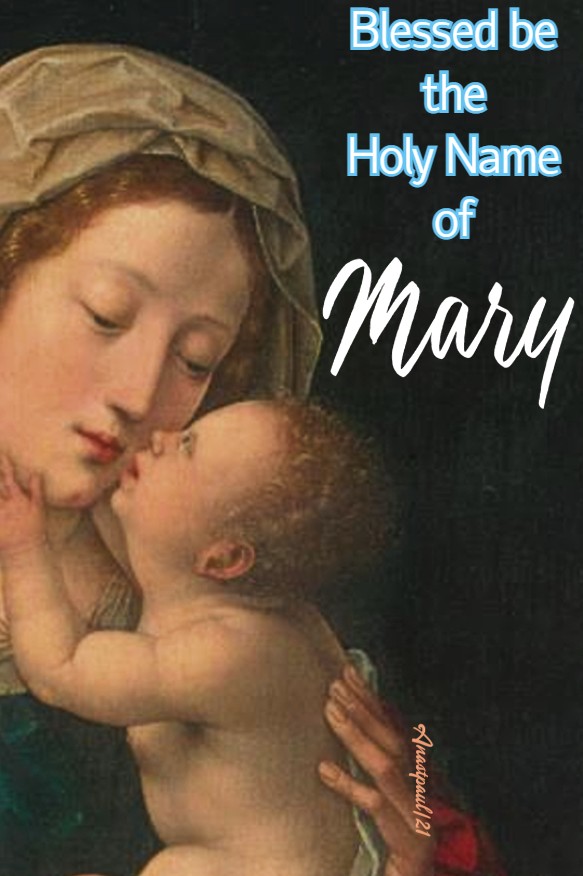
Quote/s of the Day – 12 September – The Feast of the Most Holy Name of Mary
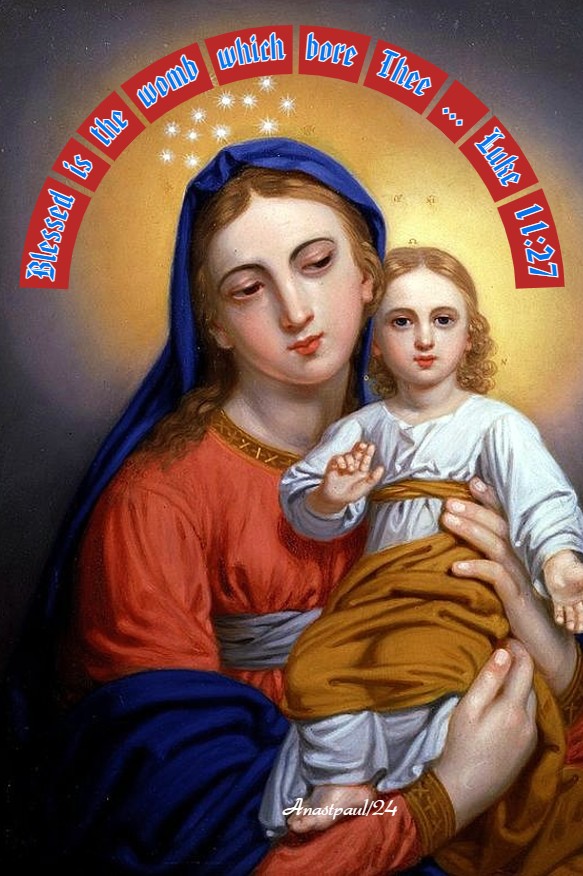
“Blessed is the womb which bore thee”
Luke 11:27
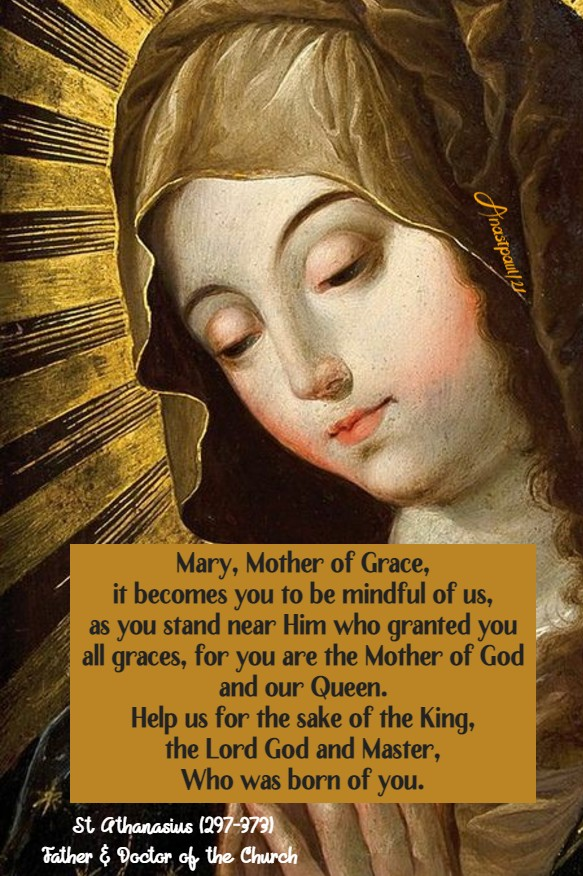
“Mary, Mother of Grace, it becomes you to be mindful of us, as you stand near Him who granted you all graces, for you are the Mother of God and our Queen. Help us for the sake of the King, the Lord God and Master, Who was born of you.”
St Athanasius (297-373) Father & Doctor of the Church
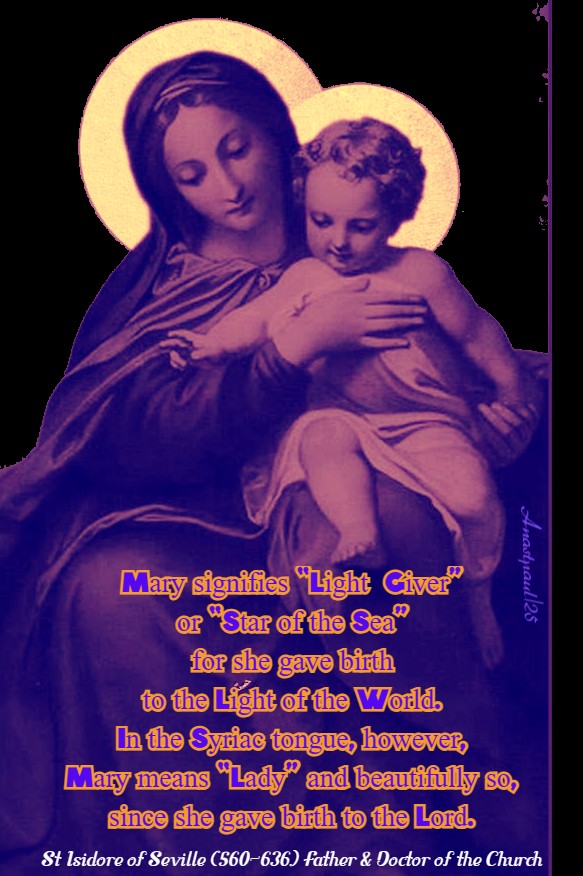
“Mary signifies “Light-Giver” or “Star of the Sea” for she gave birth to the Light of the World. In the Syriac tongue, however, Mary means “Lady” and beautifully so, since she gave birth to the Lord.”
St Isidore of Seville (c560-636) Father & Doctor of the Church
One Minute Reflection – 12 September – “The Month of The Seven Sorrows of the Blessed Virgin Mary and The Holy Cross” – The Feast of the Most Holy Name of Mary – Ecclesiasticus 24:23-31 – Luke 1:26-38 – Scripture search here: https://www.drbo.org/
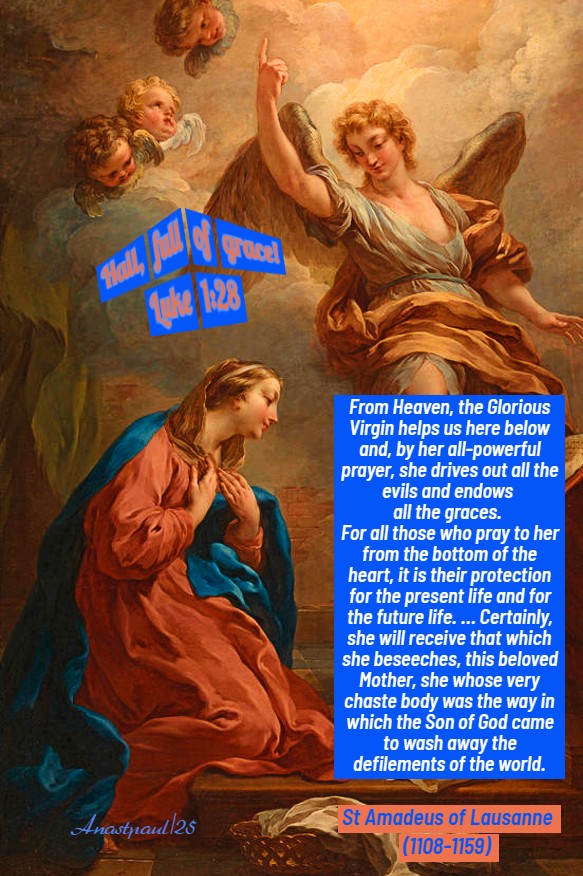
“Hail, full of grace!” – Luke 1:28
REFLECTION – “So when the Virgin of Virgins was led by her God and Son, the King of Kings, in the joy of the Angels, the joy of the Archangels, among the acclactions of Heaven, then was accomplished the prophecy of David saying to the Lord: “The Queen stands on Thy Right, in a gilded clothing and various ornaments.” (Cf PS 44:10) Then, according to the Word of Solomon, The young girls arose and proclaimed Him blessed and the Queens in turn sang His praise (cf Pr 31:28 Vulg ). … She could not stop praising, she who saw the Son of God, born of her, sit to the Right of the Majesty of the Father and with Him in glory. “Thou held,” she said, “my right hand and Thou led me, according to Thy Will and in glory Thou received me.” (Cf PS 72:24) … raised in the midst of cheers of joy and praise, therefore, placed, first after God, on a throne of glory, above all the inhabitants of Heaven. …
Then, lowering towards the human race with an unspeakable charity and turning towards us, these merciful eyes which are the Light of the sky, it fosters an universal prayer for the clergy and the people , alive and dead. From Heaven, the Glorious Virgin helps us here below and, by her all-powerful prayer, she drives out all the evils and endows all the graces. For all those who pray to her from the bottom of the heart, it is their protection for the present life and for the future life. … Certainly, she will receive that which she beseeches, this beloved Mother, she whose very chaste body was the way in which the Son of God came to wash away the defilements of the world. Jesus Christ, our Lord, Who lives and reigns with God the Father in the unity of the Holy Ghost, God in all centuries of centuries. Amen” – St Amadeus of Lausanne O.Cist. (1108-1159) Cistercian Bishop (Marion Sermon VII).
PRAYER – Grant, we beseech Thee, Almighty God, through the protection of the most holy Virgin Mary, Thy faithful people, who delight in her name may, by her loving intercession, be delivered from all evils on earth and be found worthy to attain everlasting happiness in Heaven. Through Jesus Christ, Thy Son our Lord, Who lives and reigns with Thee, in the unity of the Holy Ghost, God, world without end. Amen (Collect).
Our Morning Offering – 12 September – “The Month of The Seven Sorrows of the Blessed Virgin Mary and The Holy Cross” – The Feast of the Most Holy Name of Mary
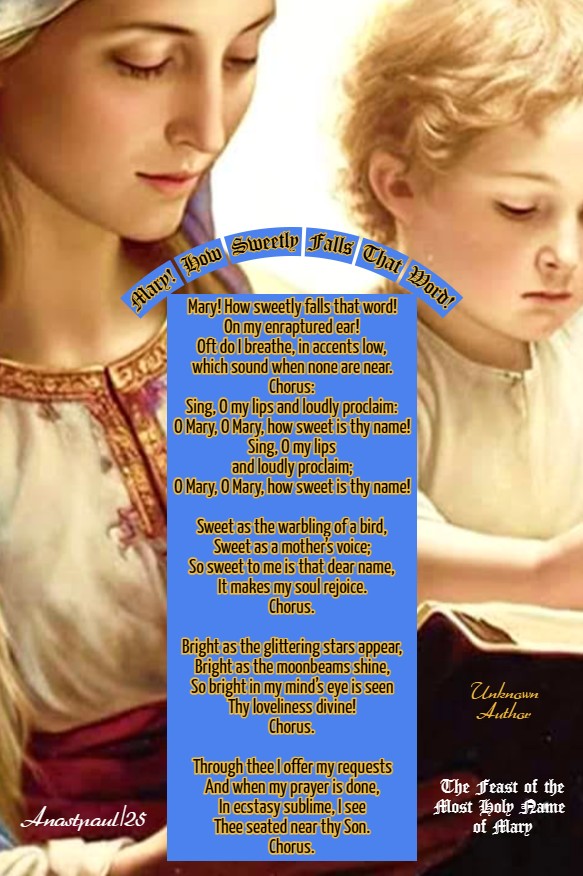
Mary! How Sweetly Falls That Word! Anonymous Author 19th Century Tune (St Basil’s Hymnal 1903) Unnamed Tune.
Mary! How sweetly falls that word! On my enraptured ear! Oft do I breathe, in accents low, which sound when none are near. Chorus: Sing, O my lips and loudly proclaim: O Mary, O Mary, how sweet is thy name! Sing, O my lips and loudly proclaim; O Mary, O Mary, how sweet is thy name!
Sweet as the warbling of a bird, Sweet as a mother’s voice; So sweet to me is that dear name, It makes my soul rejoice. Chorus.
Bright as the glittering stars appear, Bright as the moonbeams shine, So bright in my mind’s eye is seen Thy loveliness divine! Chorus.
Through thee I offer my requests And when my prayer is done, In ecstasy sublime, I see Thee seated near thy Son. Chorus.
Saint of the Day – 12 September – Saint Sacerdos/Saint Priest (487-552) Bishop of Lyon – the 27th encumbent of this high Office in Lyon, our Saint Priest (the meaning of Sacerdos) was highly visible at the Councils and in the construction and renovation of Churches, Monasteriest and was highly favoured by the King. In fact, as the Advisor to King Childebert, it is believed that he influenced the King to found a Hospital, between the Saint-Paul Church and the first Pont du Change. Born in 487 in Burgundy, France and died on 11 September 552 in Paris, where he had arrived for a the meeting of a Council. Also known as – Saint Priest, Sardot, Sacerdote, Serdon.
The Roman Martyrology reads today: “At Lyon, the decease of St Sacerdos, Bishop.”
Sacerdos belonged to a noble family of the Kingdom of Burgundy. Tradition tells us he was married and had a son. , Aurelien who became the Sainted Archbishop of Arles. A specific Epitaph also states that he was buried in the tomb alongside his son.
His Episcopate, temporally speaking, was entirely under the reign of Childebert, the 1st King of the Franks, who reigned in Lyon between 534 and 558.
Sacerdos did not participate in the Council of Orléans in 541 but presided over the Council held on 28 October 540, in the same City. The 24 Canos of that Council addressed various topics, including the condemnation of Monophysitism and Nestorianism; the limitation of the use of excommunication; the requirement of the master’s consent for the Ordination of a slave and the care of prisoners and lepers. This Ccouncil also ratified, with a specific and detailed Canon, the foundation of the hospice erected by the King in Lyon.
During his Episcopate, the construction of the Church of Saint Paul and that of Saint Eulalia, originally connected to a Monastery of Nuns, which later became the Church of Saint George. Toward the end of hisreign, he ordered major renovations to be carried out at the Monastery of Saint Peter.
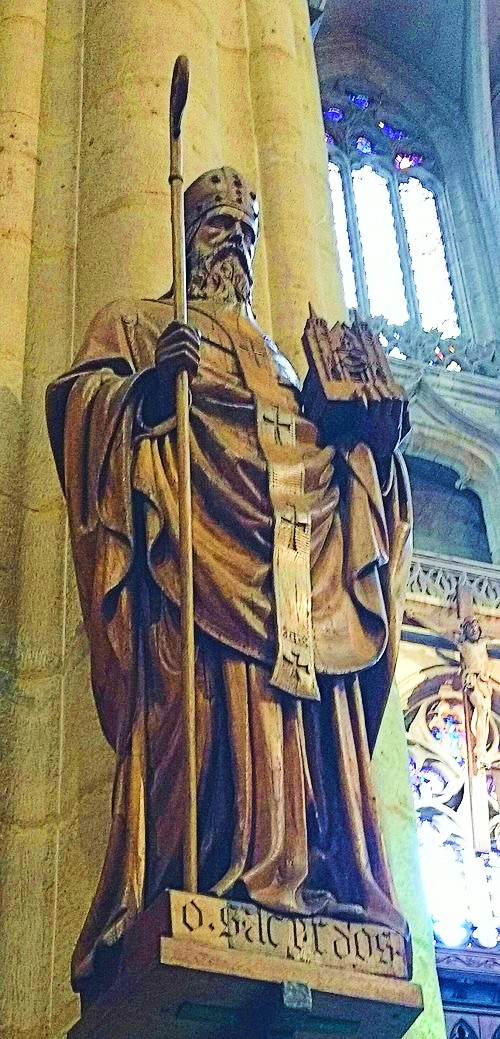
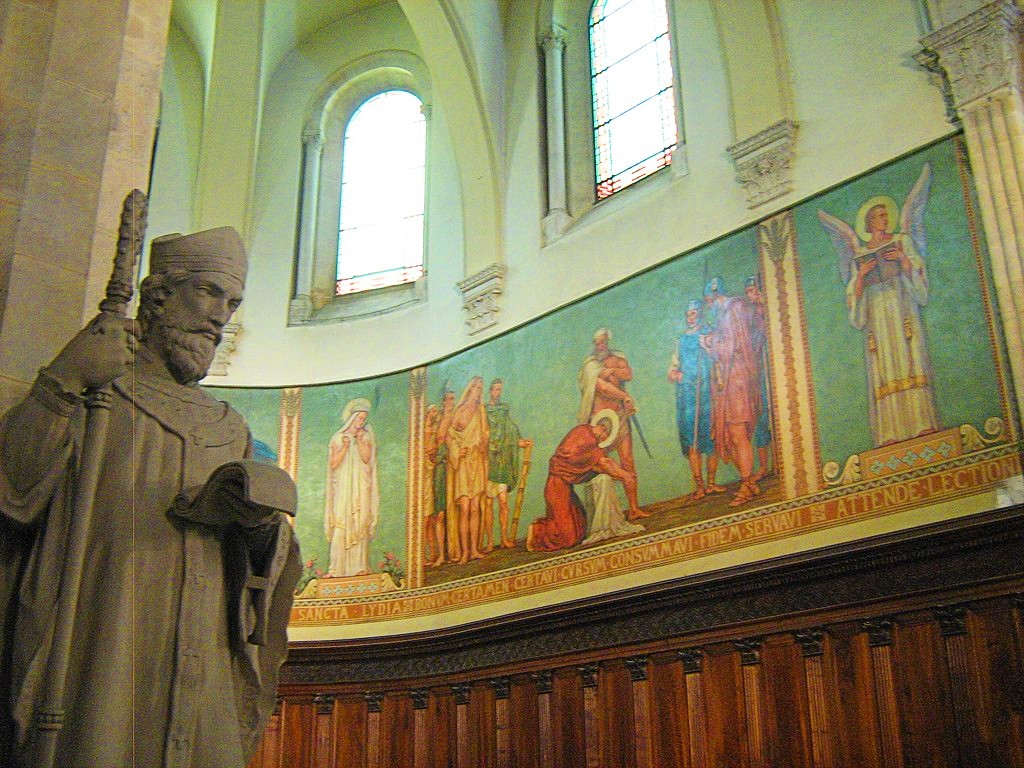
St Sacerdos Statue in the Church which he built, St Paul’s
A detailed account by St Gregory of Tours of his death in Paris has survived. Sacerdos was in Paris to participate in the Council convened by the King after the deposition of Bishop Saffaracus of Paris. St Gregory tells us that the King, having a special affection for Bishop Sacerdote, who had fallen ill in Paris, visited him during his illness. At that meeting, the Bishop requested the King to appoint his nephew, Nicetius (sT),as his successor to govern the Diocese of Lyon.
Sacerdote died at the age of 65, on 11 September 552. His body was transported to Lyon and buried in the Church of the Holy Apostles, a Church which, in later centuries, would be named after Saint Nicetius, our Saint’s son.
Numerous miracles flourished at his Tomb. An Epitaph on Saint Sacerdos remains, known from a 1308 transcription, carved in the Crypt of Saint Nicetius and rediscovered in 1883.
Feast of the Holy Name of Mary (1683 ) – 12 September: This Feast was first observed at Cuenca, Spain in 1513, then extended to the Universal Church and assigned to its present place and rank by Pope Innocent XI in 1683, in thanksgiving to God and the Blessed Virgin, for the liberation of Vienna, France and the signal victory over the Turks on 12 September 1683. It is the Titular Feast of the Society of Mary (Marianists) and of the Congregation of the Oblates of Mary Immaculate.
St Mancius of Saint Thomas St Paul of Saint Clare St Sacerdos/Saint Priest (487-552) Bishop of Lyon St Silvinus of Verona St Tomás de Zumárraga Lazcano
Martyrs of Alexandria – 6 Saints: A group of Christians Martyred in the persecutions of Diocletian. We know little more than their names – Hieronides, Leontius, Sarapion, Seleusius, Straton and Valerian. They were drowned c 300 at Alexandria, Egypt.
Martyrs of Phrygia – 3 Saints: Three Christians who were Martyred for destroying pagan idols. We know little more than their names – Macedonius, Tatian and Theodolus. They were burned to death in 362 in Phrygia (modern Turkey).




 AnaStpaul
You must be logged in to post a comment.