Thought for the Day – 9 October – Meditations with Antonio Cardinal Bacci (1881-1971)
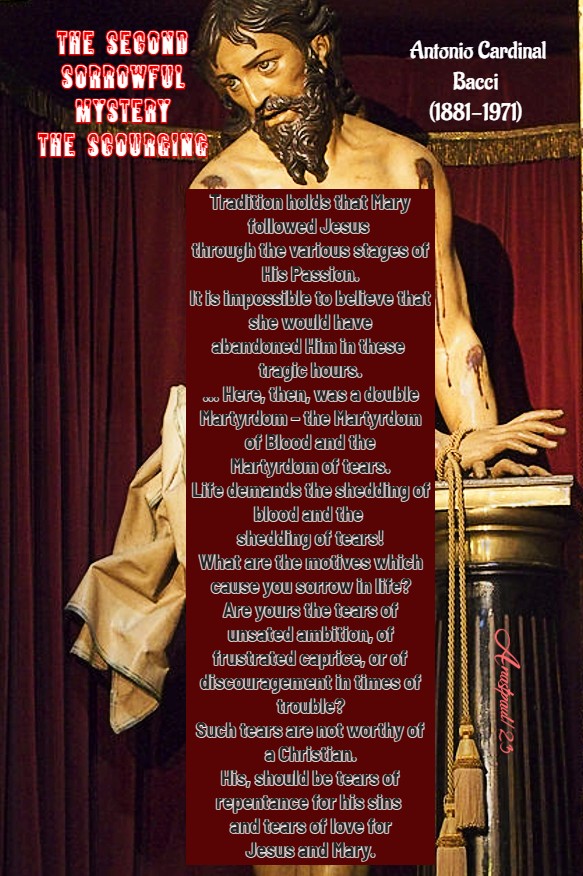
“Month of the Holy Rosary” The Second Sorrowful Mystery The Scourging
“Tradition holds that Mary followed Jesus through the various stages of His Passion. It is impossible to believe that she would have abandoned Him in these tragic hours. She must, at least, have known of the cruel flogging which He endured and, while His body was being torn by lashes, she was most probably not far away, participating, by her maternal sorrow, in her Son’s torment. Here, then, was a double Martyrdom – the Martyrdom of Blood and the Martyrdom of tears.
Life demands the shedding of blood and the shedding of tears! What are the motives which cause you sorrow in life? Are yours the tears of unsated ambition, of frustrated caprice, or of discouragement in times of trouble? Such tears are not worthy of a Christian. His, should be tears of repentance for his sins and tears of love for Jesus and Mary.”
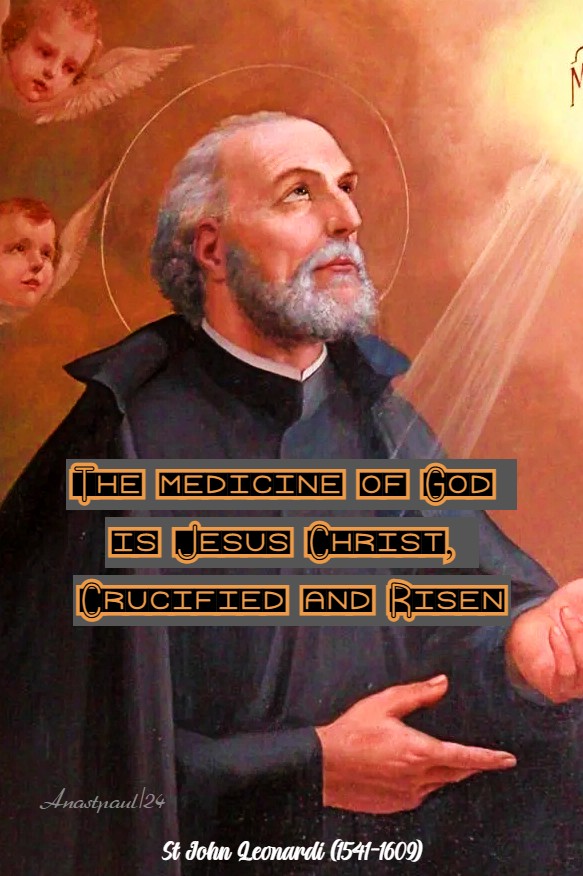
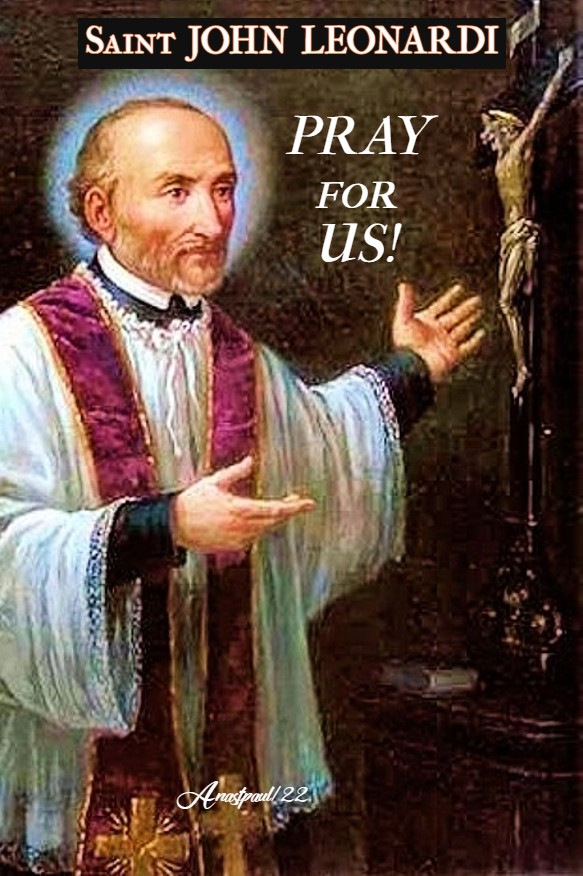
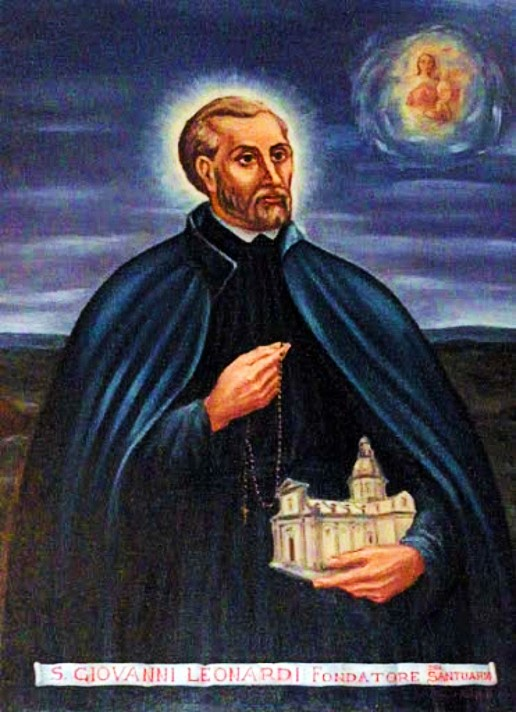
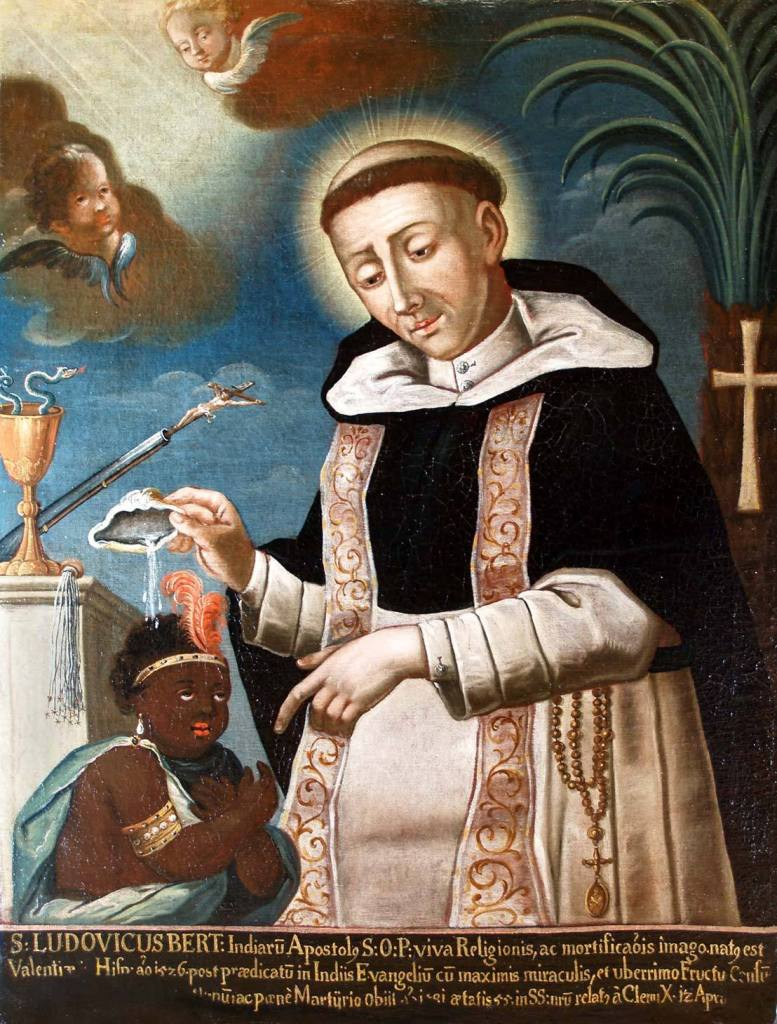
Quote/s of the Day – 9 October – St John Leonardi (1541-1609) Confessor, Priest, Founder and St Louis Bertrand (1526-1581) Confessor, Missionary, “Apostle of South America”
“The medicine of God is Jesus Christ, Crucified and Risen.”
One Minute Reflection – 9 October – “The Month of The Most Holy Rosary and The Holy Angels” – St John Leonardi (1541-1609) Confessor, Priest, Founder – 2 Corinthians 4:1-6; 4:15-18 –,Luke 10:1-9 – Scripture search here: https://www.drbo.org/
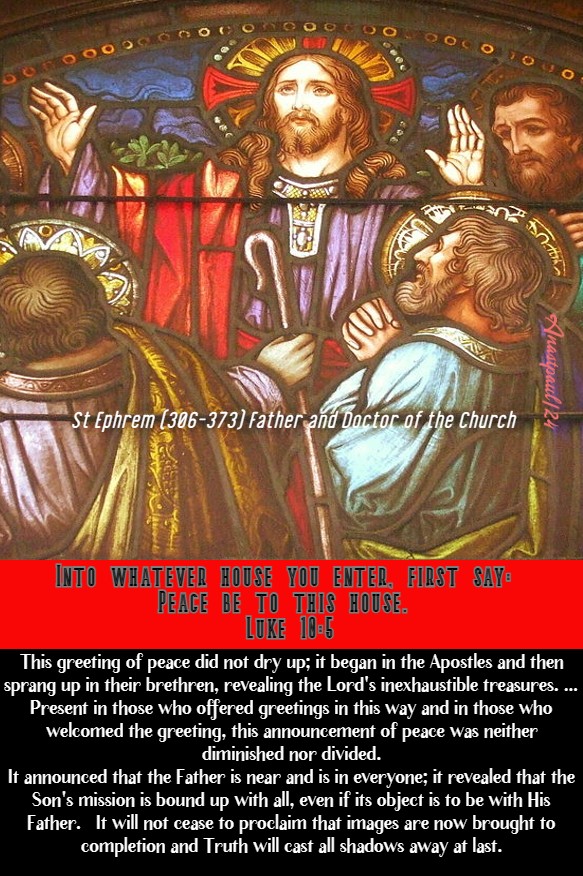
“Into whatever house you enter, first say: Peace be to this house. And, if the son of peace be there, your peace shall rest upon him but if not, it shall return to you.” – Luke 10:5-7
REFLECTION – “As you enter a house, first say, ‘Peace to this house,‘” (Lk 10:5) so that the Lord Himself might enter and remain there, as with Mary. … This greeting is the Mystery of Faith which shines forth in the world. Through it, enmity is stifled, war is ended and people acknowledge one another. The effect of that greeting was hidden by a veil in spite of the fact that it prefigures the Mystery of the Resurrection … when the light rises and dawn chases night away. From the moment Christ sent out His disciples, people began to give and receive this greeting, a source of healing and blessing. …
This greeting with its hidden power … is amply sufficient for us all. That is why Our Lord sent it out, together with His disciples, as forerunner, so that it might bring about peace and, carried by the voice of the Apostles whom He sent, prepare the way before them. It was sown in every dwelling … it entered into all who heard it, so as to separate and set apart, the children it recognised as its own. It remained in them but it denounced those who were alien to it, for they did not welcome it.
This greeting of peace did not dry up; it began in the Apostles and then sprang up in their brethren, revealing the Lord’s inexhaustible treasures. … Present in those who offered greetings in this way and in those who welcomed the greeting, this announcement of peace was neither diminished nor divided. It announced that the Father is near and is in everyone; it revealed that the Son’s mission is bound up with all, even if its object is to be with His Father. It will not cease to proclaim that images are now brought to completion and Truth will cast all shadows away at last.” – St Ephrem (306-373) Father and Doctor of the Church (Diatessaron 8: 3-4).
PRAYER – O God, Who in a wondrous way graciously urged blessed John, Thy Confessor, to propagate Thy faith among the pagans and through him brought together a new religious family in Thy Church for the education of the faithful, grant Thy servants, so to profit by his teaching that we may reach everlasting rewards.Through Jesus Christ, Thy Son our Lord, Who lives and reigns with Thee, in the unity of the Holy Ghost, God, world without end. Amen (Collect).
Our Morning Offering – 9 October – “The Month of The Most Holy Rosary and The Holy Angels”
Through Thee, to Us, Our Saviour Came Sweet Lady of the Rosary By St Amadeus of Lausanne O.Cist (1108-1159)
Through thee, to us, our Saviour came, Through thee, to Him, we fain would go. Our lives are marred by wrong and shame, Yet, confidence in thee we know. The friendship thou dost give to all Who love thy name, shall ever be Assurance thou wilt hear our call, Sweet Lady of the Rosary!
Thou art our Strength upon the way, Our Morning Star, to cheer and guide; Our Beacon Light to show the day, And lead us to the Saviour’s Side; A Comforter in ev’ry pain We find, O Mother blest, in thee, And seek we, never, thee in vain, Fair Lady of the Rosary!
Thy praises, Mary, we would sing, And all our faculties employ, That unto thee our hearts might bring A glory-crown of love and joy. Bless thou each humble effort made In thy regard and grant that we, May by thy influence be swayed, Our Lady of the Rosary!
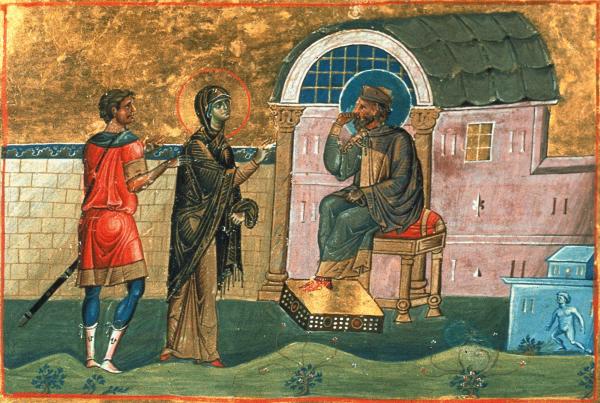
Saint of the Day – 9 October – Saint Publia (4th Century) Widow, Abbess in Antioch.
The Roman Martyrology reads today: “At Antioch, St Publia, Abbess, who while Julian the Apostate was passing by, sang with her Religious, these words of David: “The idols of the Gentiles are silver and gold” and: “Let them who make them, become like unto them.” By the command of the Emperor, she was struck on the face and severely rebuked.”
Theodoret, (393-457) Bishop, Theologian, Historian, Schriptural Exegesist, in his Ecclesiastical History, reports an act of Christian resistance in Antioch, during the coercive measures exercised there by Julian the Apostate (361-363), who resided In Antioch from June 362 to March 363, to direct military operations against the Persians.
Publia was a pious woman of Antioch, widowed at an early age with only one son, named John, who became a Priest. Some have tried to identify him as John Chrysostom, for no apparent reason, especially since the text which speaks of him explicitly states that Publia’s son refused to be elevated to the Episcopate.
Publia had entered a Nunnery in the City, of which she became Abbess and Deaconess. As the Emperor passed by, she had her Nuns sing specially chosen Psalms condemning idolatry (Psalm 108) and shaming God’s enemies (Psalm 67). Julian could not silence the choir, for every time he intervened, Publia encouraged her Nuns to continue their singing. Once, Julian, more irritated than usual by the Nuns’ rebellious attitude, summoned Publia and had her severely slapped. This humiliating measure had no effect and everything continued as before.
Publia did not die a Martyr but ended her days in peace at an unspecified time.
St Aron of Kracow St Abraham the Patriarch St Alfanus of Salerno St Andronicus of Antioch St Athanasia of Antioch Bl Bernard of Rodez St Demetrius of Alexandria St Deusdedit of Montecassino St Domninus St Dorotheus of Alexandria
St Goswin Bl Gunther St Lambert St Publia (4th Century) Widow, Abbess St Sabinus of the Lavedan St Valerius
Martyrs of Laodicea – Three Christians Martyred together in Laodicea but no other information about them has survived but their names – Didymus, Diodorus and Diomedes. They Died in Laodicea, Syria.






 AnaStpaul
You must be logged in to post a comment.