Thought for the Day – 10 October – Meditations with Antonio Cardinal Bacci (1881-1971)
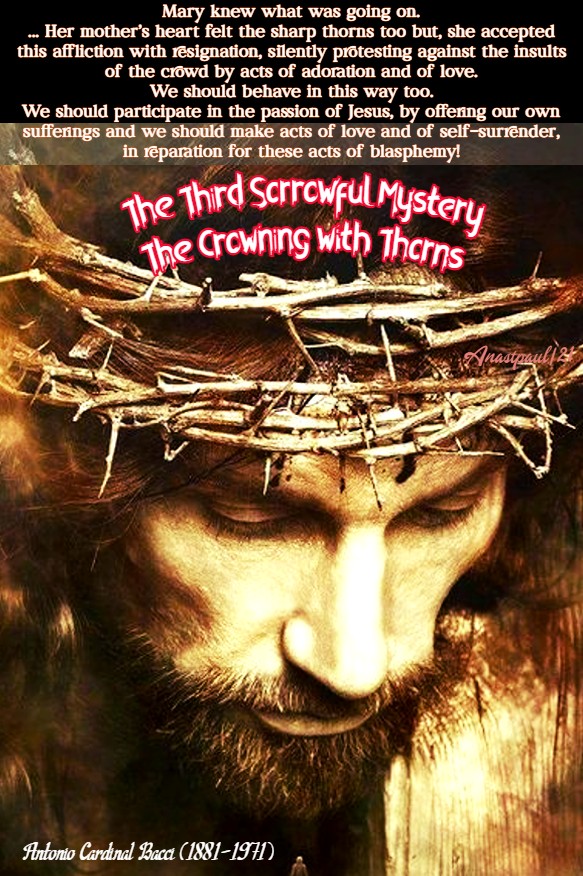
“Month of the Holy Rosary” The Third Sorrowful Mystery The Crowning with Thorns
“This new torture was a diabolical invention decreed by no law or authority. Purely for their own savage entertainment, the soldiers procured a bundle of thorned reeds, which they wound into the shape of a crown and pressed into Jesus’ head.
Mary knew what was going on. She was there with the holy women when Pilate brought her bloodstained Son before the people and, their blasphemous yells pierced her tender heart. Her mother’s heart felt the sharp thorns too but, she accepted this affliction with resignation, silently protesting against the insults of the crowd by acts of adoration and of love. We should behave in this way also. We should participate in the passion of Jesus, by offering our own sufferings and we should make acts of love and of self-surrender, in reparation for these acts of blasphemy!”
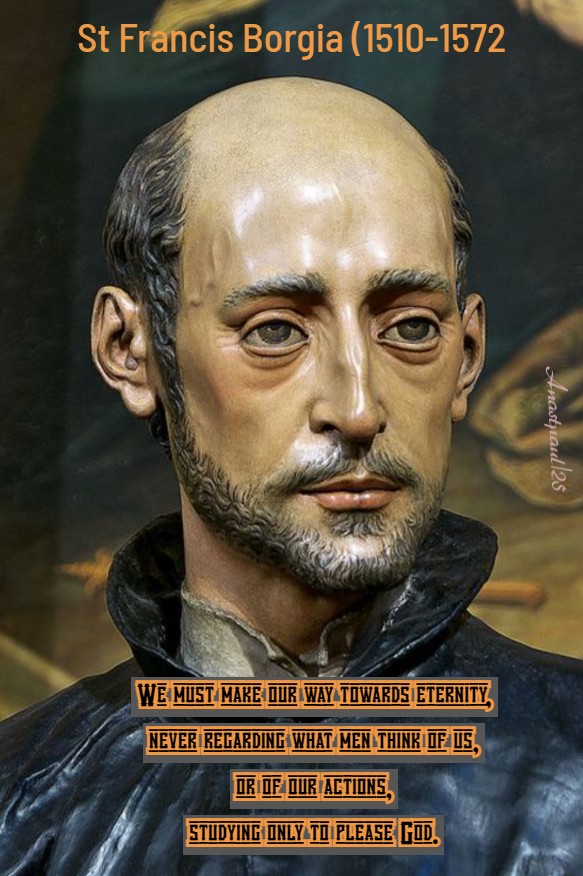
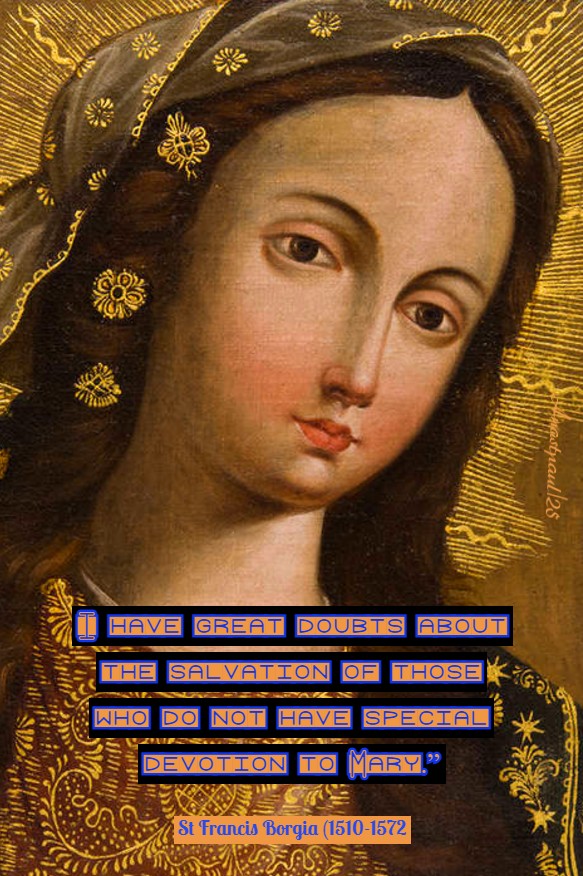
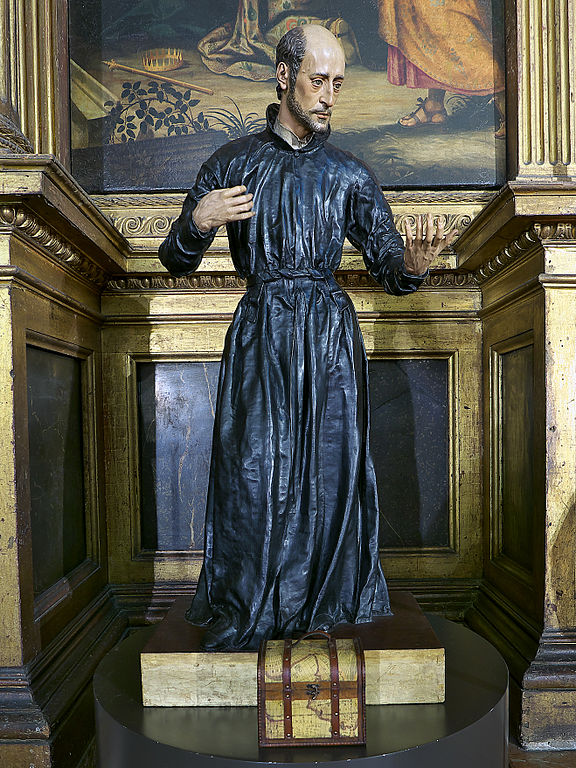
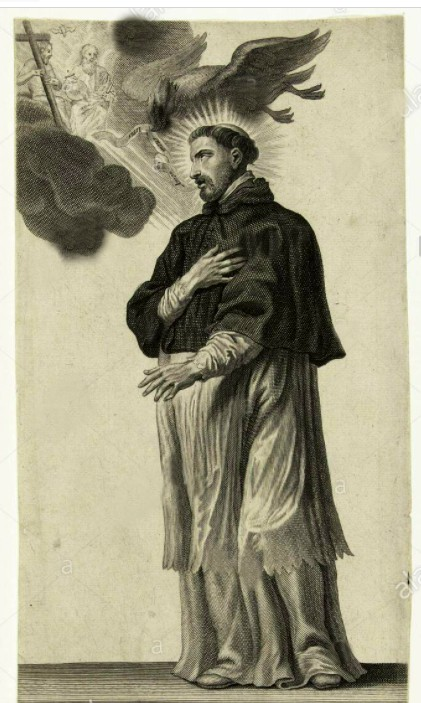
One Minute Reflection – 10 October – “The Month of The Most Holy Rosary and The Holy Angels” – St Francis Borgia SJ (1510-1572) Confessor, Priest of the Society of Jesus, – Ecclesiasticus 45:1-6 – Matthew 19:27-29 – Scripture search here: https://www.drbo.org/
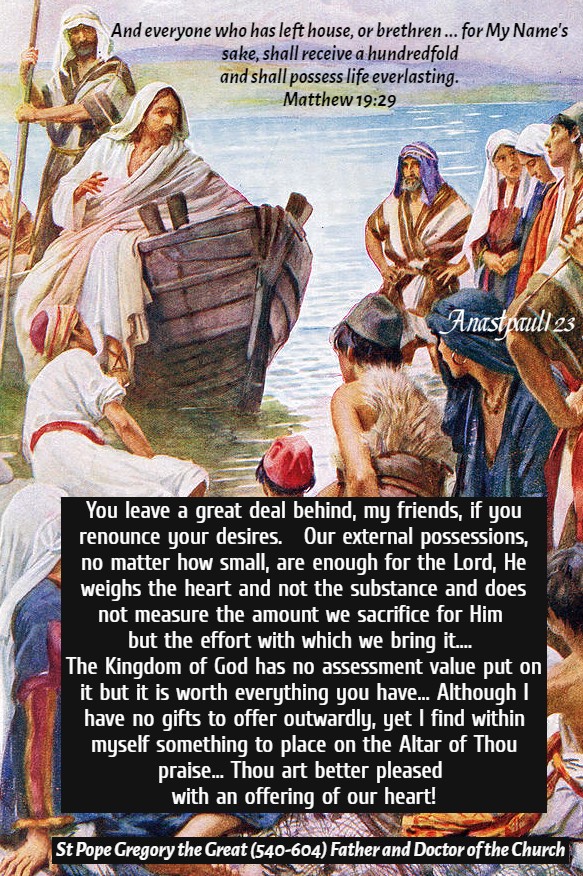
“And everyone who has left house, or brethren, or sisters, or father, or mother, or wife, or children, or lands, for My Name’s sake, shall receive a hundredfold and shall possess life everlasting.” – Matthew 19:29
REFLECTION – “No-one should say to himself, even when he regards others who have left a great deal behind: “I want to imitate those who despise this world but I have nothing to leave behind.” You leave a great deal behind, my friends, if you renounce your desires. Our external possessions, no matter how small, are enough for the Lord, He weighs the heart and not the substance and does not measure the amount we sacrifice for Him but the effort with which we bring it…. The Kingdom of God has no assessment value put on it but it is worth everything you have… To Peter and Andrew it was worth the nets and boat they gave up; to the widow it was worth two small coins (Lk 21:2); to another person it was worth a cup of cold water (Mt 10:42). The Kingdom of God, as I said, is worth everything you have. Think about it, my friends, what has less value when you purchase it, what is more precious when you possess it?
But perhaps a cup of cold water offered to someone who needs it, is not enough, even then the Word of God gives us assurance…: “Peace on earth to men of goodwill!” (Lk 2:4). In the sight of God, no hand is ever empty of a gift, if the deep places of the heart are filled with goodwill… Although I have no gifts to offer outwardly, yet I find within myself something to place on the Altar of Thou praise… Thou art better pleased with an offering of our heart! (cf. Ps 55:13).” – St Gregory the Great (540-604) Pope, Father and Doctor of the Church (Sermons on the Gospel no 5).
PRAYER – O Lord Jesus Christ, model of true humility and its reward, we beseech Thee, that as Thou made blessed Francis one of Thy glorious imitators, by his contempt for earthly honours, grant us to follow his example and to share in his glory.Through the same Jesus Christ, Thy Son our Lord, Who lives and reigns with Thee, in the unity of the Holy Ghost, God, world without end. Amen (Collect).
Our Morning Offering – 10 October – Friday Devotion: The Passion – This day should always be a day of repentance and a day in which we recall Christ’s complete self-sacrifice to save us from our sins.
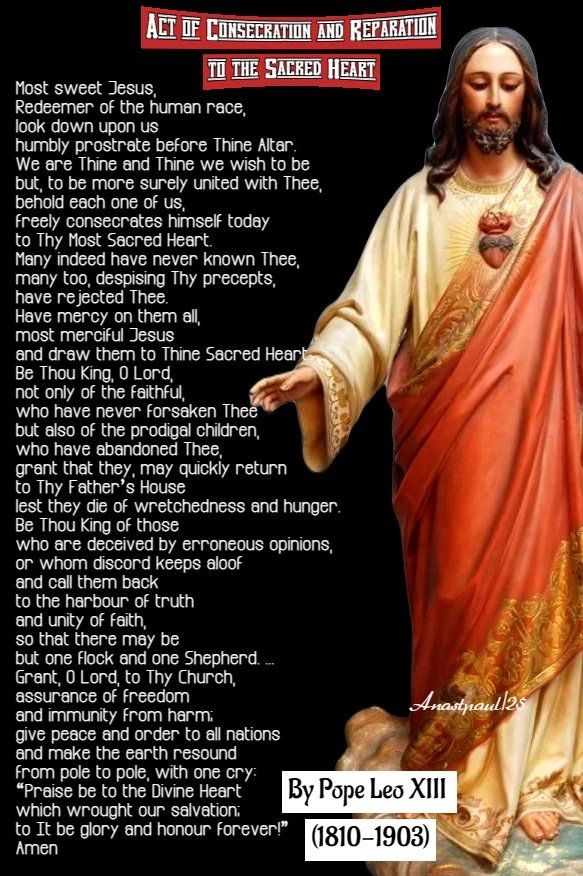
Act of Consecration and Reparation to the Sacred Heart By Pope Leo XIII (1810-1903)
Most sweet Jesus, Redeemer of the human race, look down upon us humbly prostrate before Thine Altar. We are Thine and Thine we wish to be but, to be more surely united with Thee, behold each one of us, freely consecrates himself today to Thy Most Sacred Heart. Many indeed have never known Thee, many too, despising Thy precepts, have rejected Thee. Have mercy on them all, most merciful Jesus and draw them to Thine Sacred Heart. Be Thou King, O Lord, not only of the faithful, who have never forsaken Thee but also of the prodigal children, who have abandoned Thee, grant that they, may quickly return to Thy Father’s House lest they die of wretchedness and hunger. Be Thou King of those who are deceived by erroneous opinions, or whom discord keeps aloof and call them back to the harbour of truth and unity of faith, so that there may be but one flock and one Shepherd. Be Thou, King of all those. who are still involved in the darkness of idolatry or of Islamism and refuse not, to draw them into the Light and Kingdom of God. Turn Thine Eyes of Mercy towards the children of the race, once Thy chosen people – of old they called down upon themselves the Blood of the Saviour; may it now descend upon them, a laver of redemption and of life. Grant, O Lord, to Thy Church, assurance of freedom and immunity from harm; give peace and order to all nations and make the earth resound from pole to pole, with one cry: “Praise be to the Divine Heart which wrought our salvation; to It be glory and honour forever!” Amen
The above prayer, composed by Pope Leo XIII was included in the 1899 Encyclical, Annum Sacrum, issued by Leo XIII as he Consecrated the entire world to the Sacred Heart of Jesus. The Consecration was influenced by two letters written to the Holy Father by Blessed Sister Mary of the Divine Heart, who stated that in visions of Jesus Christ, she had been told to request the Consecration.
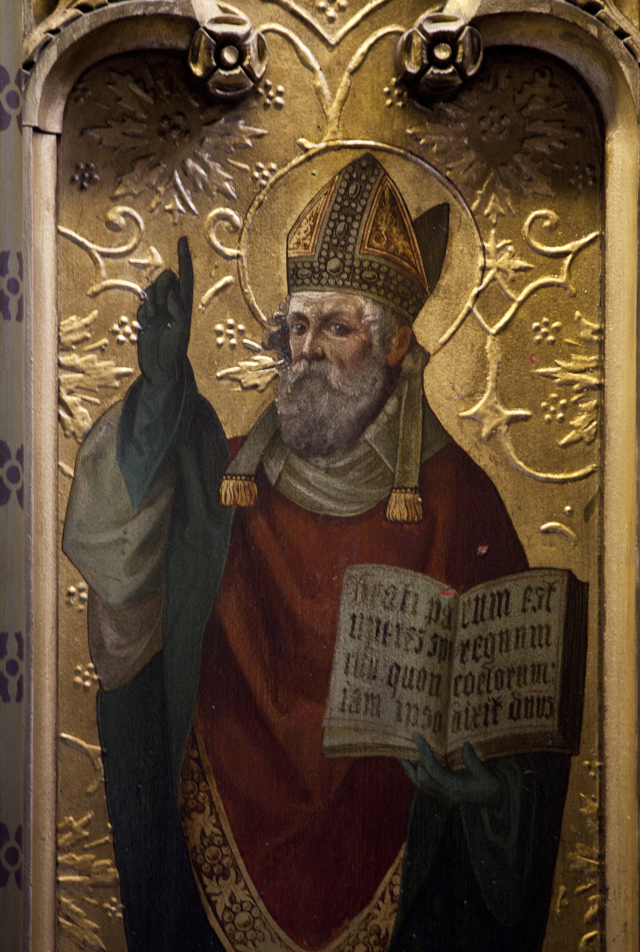
Saint of the Day – 10 October – St Cerbonius (c493-575) Bishop and Confessor of Populonia, Miracle-worker. He was the Bishop during the Barbarian invasions. St Pope Gregory I the Great, praises him in Book XI of his Dialogues. Born in c493 in North Africa and died in 575 in Elba, Italy. Patronages – of Baratti, Piombino, Massa Marittima, the Diocese of Massa Marittima-Piombino, the Diocese of Piombino. Also known as – Cerbonius of Piombino, … of Populonia, Cerbonius of Massa Marittima, Cerbo…Cerbone…Cerbonio…
The Roman Martyrology reads today: “At Piombino in Tiscany, St Cerbonius, Bishop and Confessor, who, as St Gregory relates, was renowned for miracles, both during life and after death.”
Stained glass – Saint Cerbonius of Populonia
Cerboneius was born in North Africa to a Christian family. When he became a Priest, to escape the persecution of Christians by the Vandals, he fled to Italy. The ship landed on the Maremma coast, in Tuscany, in the Gulf of Baratti.
In Populonia, Cerbonius was proclaimed as the Bishop. The locals were unhappy with him because he had the habit of saying Mass at dawn—too early for those who lived in the countryside far from Town. Their complaints reached the Pope.
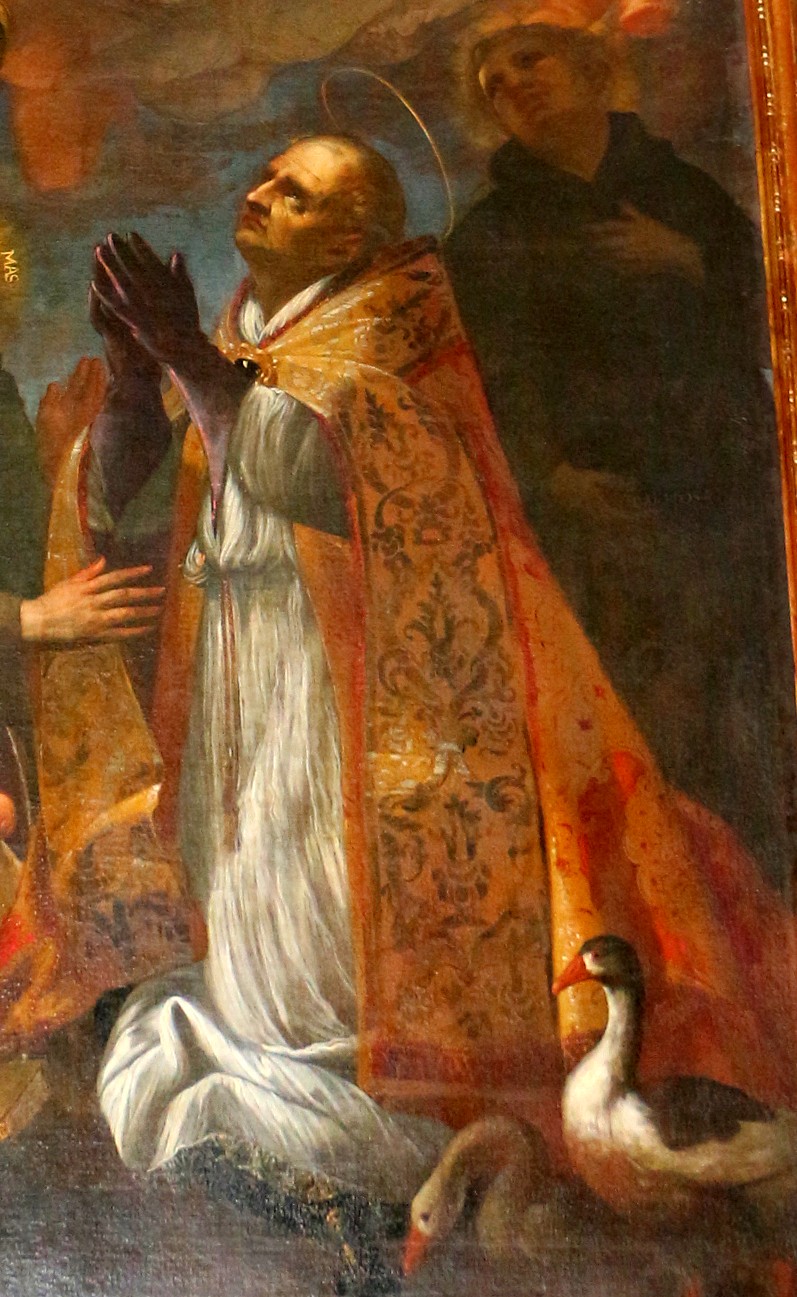
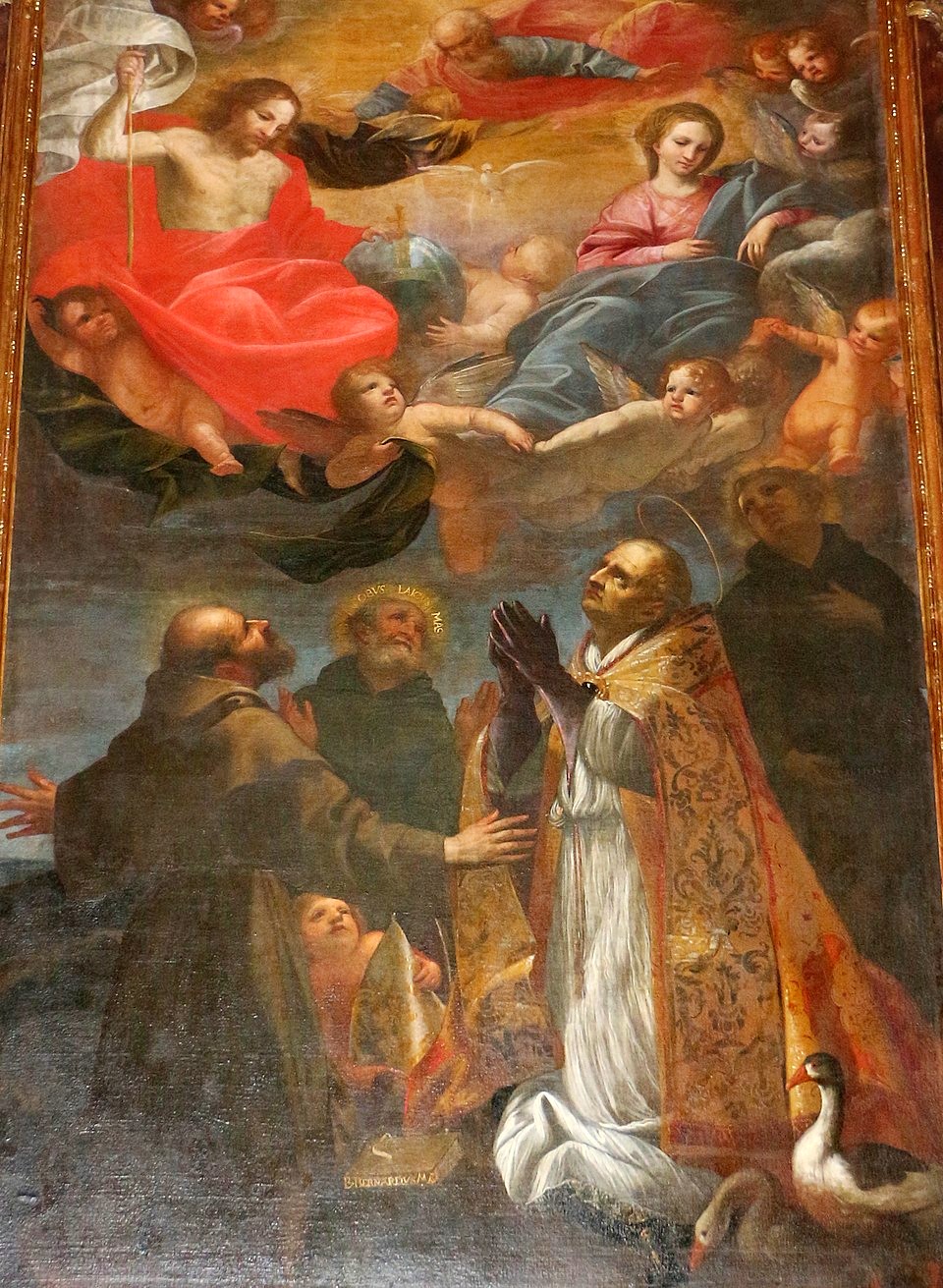
Two Clerics were sent to Populonia to accompany the Bishop to the Pontiff. During the journey, Cerbonius performed miracles – the companions were thirsty and exhausted from the journey and Cerbonius approached two doe, who tamely let themselves be milked for good milk. When the bBshop then encountered a flock of geese, he invited them to follow him to Rome. And so it happened. The geese, docile and obedient, follow Cerbonius and only took flight when he arrives before the Pope.
Saint Cerbonius of Populonia – Raffaello Vanni
The Pope, for his part, wishes to personally attend Cerboniud’ famous Dawn Mass. The Pontiff thus realises that he was in the company of a Saint. Indeed, during the Mass, a sublime melody was heard emanating from a Choir of Angels. From that day on, Cerbonois was happily supported by the people in celebrating his Dawn Mass.
Upon their return to Maremma, the battle between the Goths and the Byzantines rages. Cerbonius was imprisoned by the cruel Gothic King, Totila, accused of having favoured the enemy. The punishment must demonstrate an example – to be torn to pieces by a ferocious bear but the beast, instead of attacking Cerboneius, crouches beside him like a lamb, licking his feet. The King was astonished and decides to release the prisoner.
Saint Cerbonius of Populonia – Raffaello Vanni
During the Lombard invasion, Cerbonius escapes to the Island of Elba, defended by the Byzantines. There the Bishop lived a Hermit’s life and, when in 575, he felt his death approaching, he asked to be buried on dry land.
Thanks to a miraculous storm which kept the Lombards at bay, the ship carried the Bishop’s body to the Town of Baratti (Piombino), where he was buried in a small Church. In this spot, the famous San Cerbonius Spring still flows today, giving rise to the saying: “He who does not drink at San Cerbonius is a thief or a scoundrel.” Today, San Cerbonius rests in the Cathedral of Massa Marittima (Grosseto).
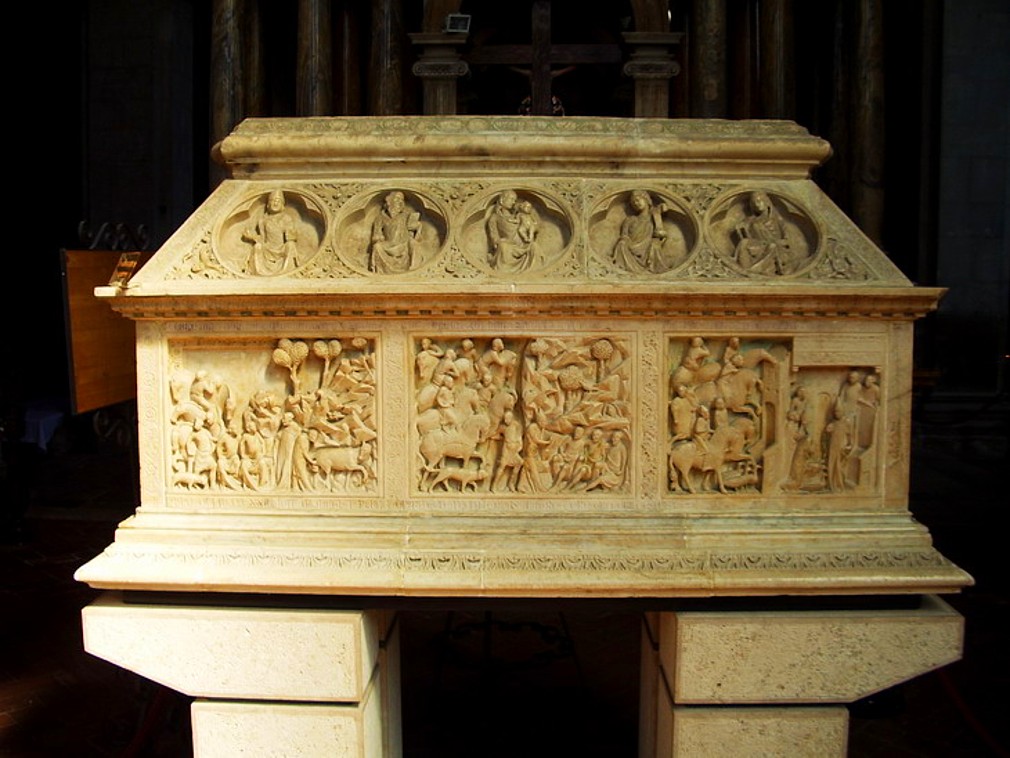
Sarcofago San Cerbone Duomo di Massa
St Cerbonius Statue in the Cathedral in Massa Marittima
St Aldericus St Cassius St Cerbonius (c493-575) Bishop and Confessor of Populonia in Tuscany, Italy St Cerbonius of Verona St Clarus of Nantes Bl Demestrius of Albania Bl Edward Detkens St Eulampia St Eulampius St Florentius the Martyr St Fulk of Fontenelle St Gereon St Gundisalvus Bl Hugh of Macon
Bl Pedro de Alcantara de Forton de Cascajares St Pinytus of Crete Bl Pontius de Barellis St Tanca St Teodechilde St Victor of Xanten
Martyrs of Ceuta – 7 Beati: A group of seven Franciscan Friars Minor missionaries to Muslims in the Ceuta area of modern Morocco. Initially treated as madmen, within three weeks they were ordered to convert to Islam and when they would not they were first abused in the streets, then arrested, tortured and executed. Angelo, Daniele di Calabria, Donnolo, Hugolinus, Leone, Nicola, Samuele. They were beheaded in 1227 in Mauritania Tingitana (Ceuta, Morocco). Local Christians secreted the bodies away and gave them proper burial in Ceuta. They were Beatified in 1516 by Pope Leo X.









You must be logged in to post a comment.