Thought for the Day – 22 October – Meditations with Antonio Cardinal Bacci (1881-1971)
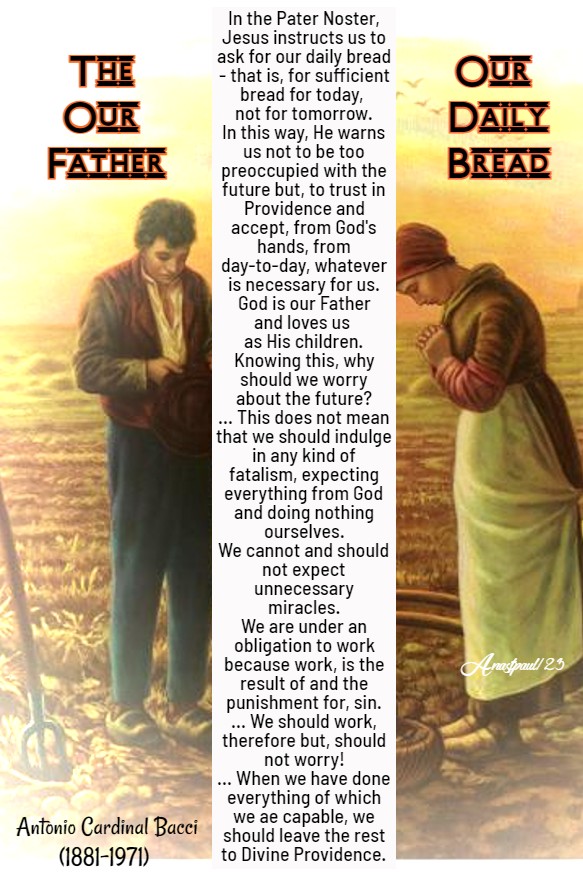
“Month of the Holy Rosary” The Our Father Our Daily Bread
“In the Pater Noster, Jesus instructs us to ask for our daily bread – that is, for sufficient bread for today, not for tomorrow. In this way, He warns us not to be too preoccupied with the future but, to trust in Providence and accept, from God’s hands, from day to day, whatever is necessary for us. God is our Father and loves us as His children. Knowing this, why should we worry about the future?
We are in the hands of God, Who looks after all His children. Let us entrust ourselves completely to His care. This does not mean that we should indulge in any kind of fatalism, expecting everything from God and doing nothing ourselves. We cannot and should not expect unnecessary miracles. We are under an obligation to work because work, is the result of and the punishment for, sin. It enable us to co-operate with God in His work of creation and has ben ennobled and sanctified by Jesus Christ, Who chose to be “the carpenter’s son,” (Mt 13:55) and a carpenter Himself (Cf Mk 6:3). We should work, therefore but, should not worry!
When we have done everything of which we ae capable, we should leave the rest to Divine Providence.”
Quote/s of the Day – 22 October – Ferial Day – Ephesians 4:23-28 – Matthew22:1-14 – Scripture search here: https://www.drbo.org/
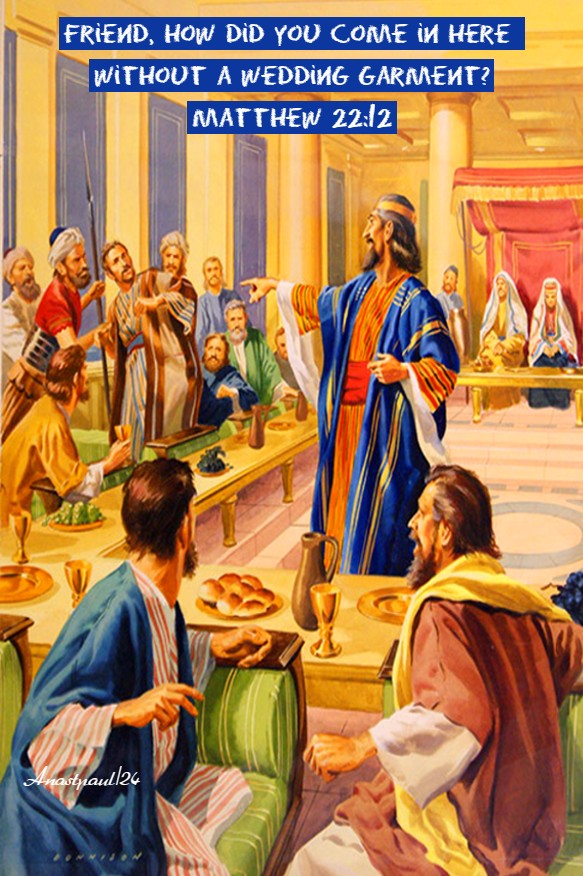
“ Friend how did you come in here without a wedding garment?”
Matthew 22:12
“So then, have faith with love. This is the “wedding garment!”
St Augustine (354-430) Father & Doctor of the Church
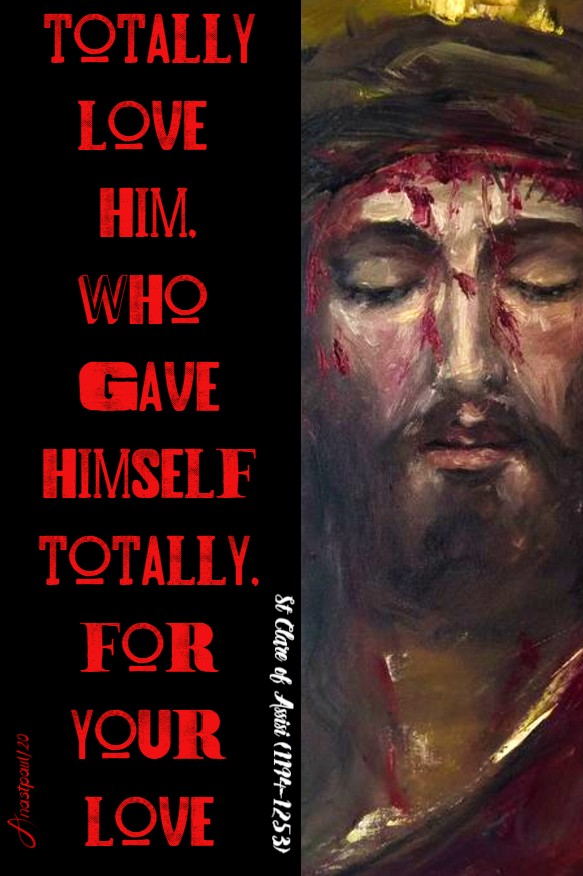
“Totally love Him, Who gave Himself totally, for your love.”
St Clare (1194-1253)
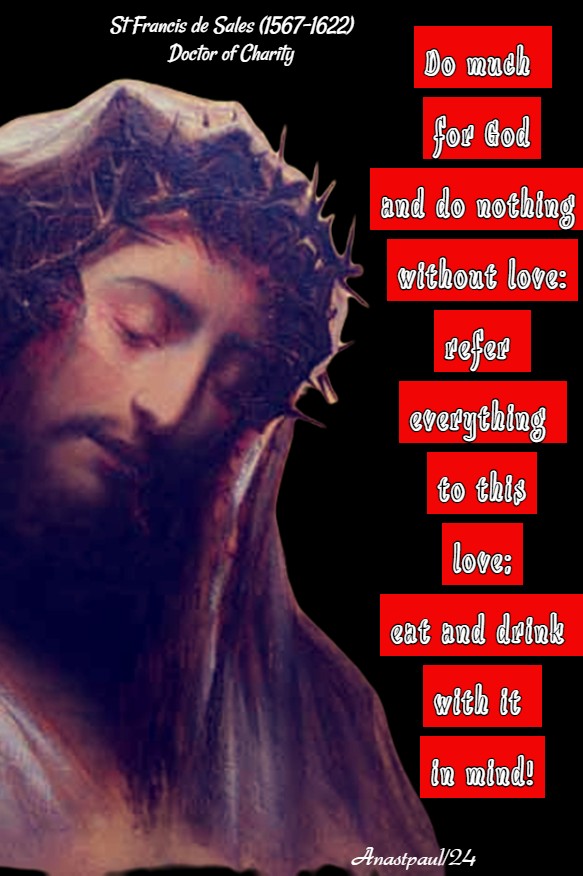
“Do much for God and do nothing without love: refer everything to this love; eat and drink with it in mind!”
(Letter to Madame de Chantal)
St Francis de Sales (1567-1622) Doctor of Charity
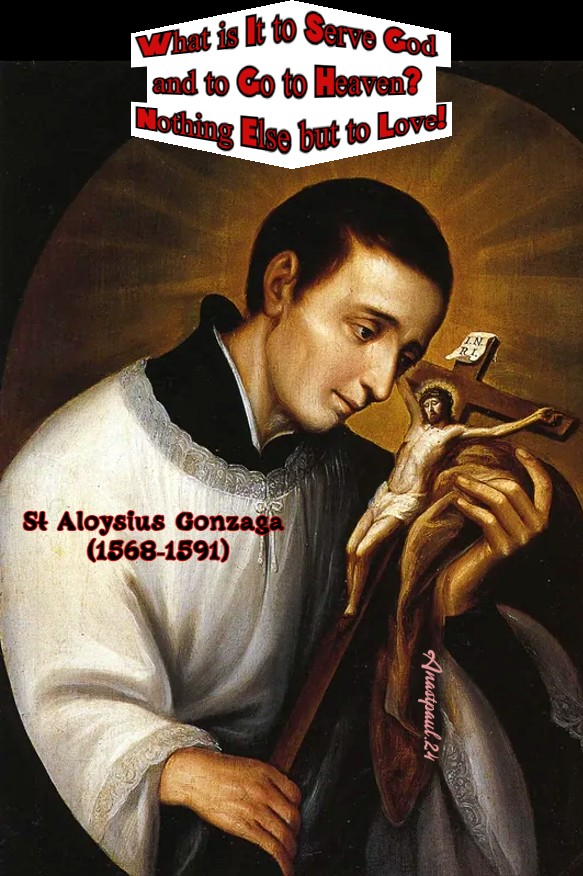
“What is it to serve God and to go to Heaven? Nothing else but to love!”
St Aloysius Gonzaga (1568-1591)
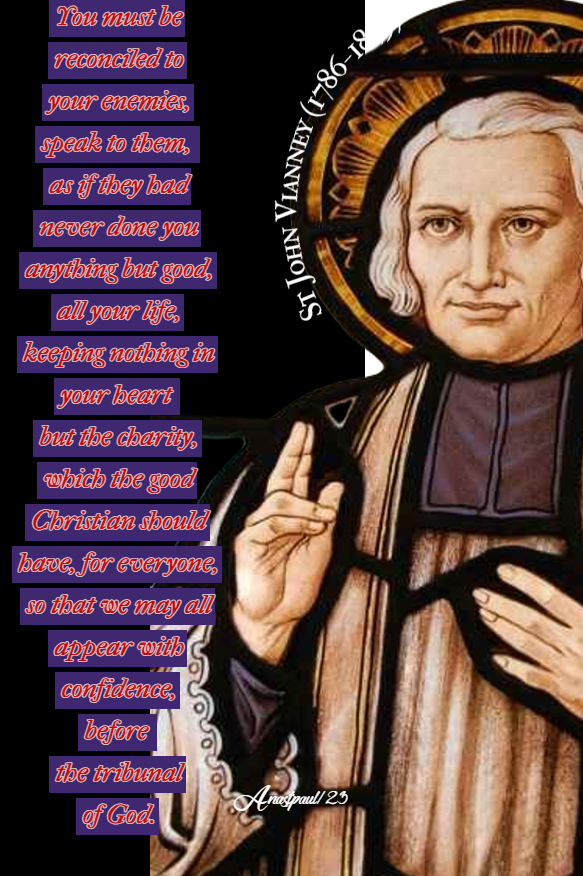
“You must be reconciled to your enemies, speak to them, as if they had never done you anything but good, all your life, keeping nothing in your heart but the charity, which the good Christian should have, for everyone, so that we may all appear with confidence, before the tribunal of God.”
St John Vianney (1786-1859)
Daily Consecration to the Sacred Heart of Jesus Prayers to the Sacred Heart 1936 – 15th Edition, Dublin
O Sacred Heart of Jesus, filled with infinite love, broken by our ingratitude and pierced by our sins, yet loving us still, accept the Consecration we make to Thee, of all that we are and all that we have. Take every faculty of our souls and bodies, only day by day draw us, nearer and nearer to Thy Sacred Heart, and there, as we shall hear the lesson, teach us Thy Holy Way. Amen
One Minute Reflection – 22 October – “The Month of The Most Holy Rosary and The Holy Angels” – Ferial Day – Ephesians 4:23-28 – Matthew22:1-14 – Scripture search here: https://www.drbo.org/
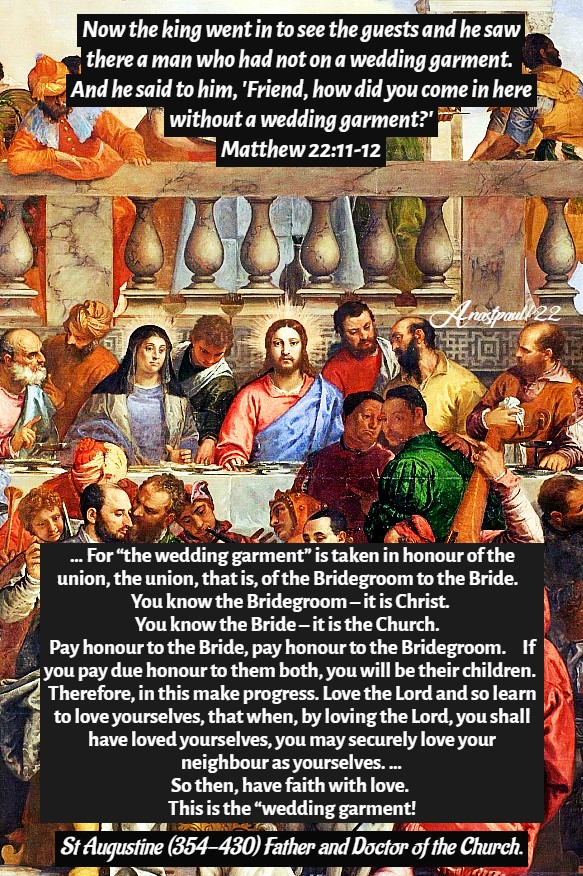
Now the king went in to see the guests and he saw there a man who had not on a wedding garment. And he said to him, ‘Friend, how did you come in here without a wedding garment?‘” – Matthew 22:11-12
REFLECTION – “What is that “wedding garment” then? … The wedding garment” is such charity as this. “Although I speak with the tongues of men and of Angels and have not charity, I am become as sounding brass and a tinkling cymbal.” Tongues have come in alone and it is said to them, “Friend, how did you come in here without a wedding garment? “I have the gift of prophecy and understand all mysteries and all knowledge and although I have all faith, so that I could remove mountains and have not charity, I am nothing.”
See, these are the miracles of men who very often have not “the wedding garment.” “Although,” he says,” I have all these and have not Christ, I am nothing.” … If then I have not charity, although I bestow alms freely upon the poor, although I have come to the confession of Christ’s Name even unto blood and fire, these things may be done even through the love of glory and so are vain. … For “the wedding garment” is taken in honour of the union, the union, that is, of the Bridegroom to the Bride. You know the Bridegroom – it is Christ. You know the Bride – it is the Church. Pay honour to the Bride, pay honour to the Bridegroom. If you pay due honour to them both, you will be their children. Therefore, in this make progress. Love the Lord and so learn to love yourselves, that when, by loving the Lord, you shall have loved yourselves, you may securely love your neighbour as yourselves. …So then, have faith with love. This is the “wedding garment!” … St Augustine (354-430) Father and Doctor of Grace.
PRAYER – Grant us, Thou servants, O Lord God, we beseech Thee, to enjoy lasting health of mind and body and, by the intercession of glorious and blessed Mary, ever Virgin, may we be delivered from present sorrow and partake to the full of eternal happiness. Through Jesus Christ, Thy Son our Lord, Who lives and reigns with Thee, in the unity of the Holy Ghost, God, world without end. Amen (Collect).
Our Morning Offering – 22 October – Wednesday is devoted to Saint Joseph who is known as the prince and most efficacious Patron of the Church, the Mystical Body of Christ. As the earthly Father of Jesus, he had a special role in protecting, providing for and instructing Jesus during His earthly life. Now that Christ is ascended into Heaven, St Joseph continues his fatherly guardianship of Christ’s Body, the Church. He is a very powerful friend and aid to all of us.
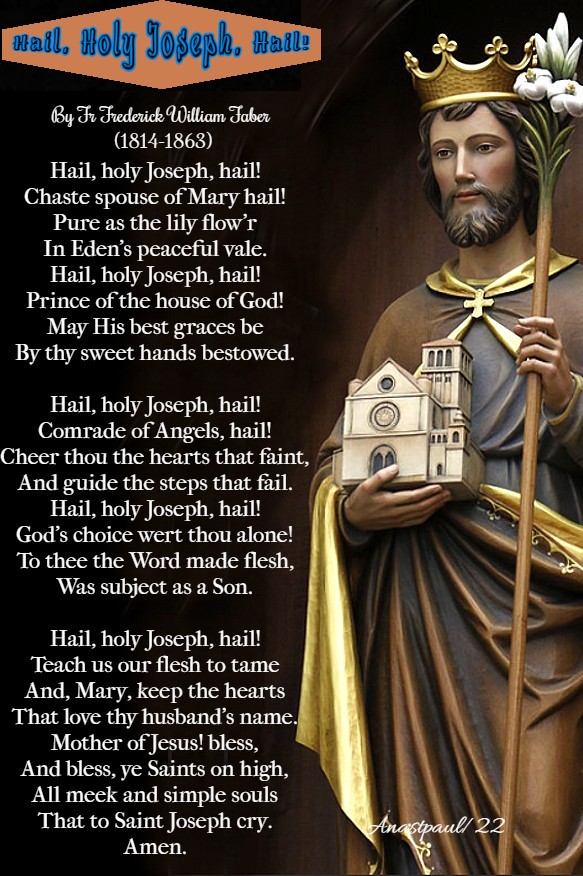
Hail, Holy Joseph, Hail! By Father Frederick W Faber CO (1814-1863)
Hail, holy Joseph, hail! Chaste spouse of Mary hail! Pure as the lily flow’r In Eden’s peaceful vale. Hail, holy Joseph, hail! Prince of the House of God! May His best graces be By thy sweet hands bestowed.
Hail, holy Joseph, hail! Comrade of Angels, hail! Cheer thou the hearts that faint, And guide the steps that fail. Hail, holy Joseph, hail! God’s choice wert thou alone! To thee the Word made flesh, Was subject as a Son. Hail, holy Joseph, hail! Teach us our flesh to tame And, Mary, keep the hearts That love thy husband’s name. Mother of Jesus! bless, And bless, ye Saints on high, All meek and simple souls That to Saint Joseph cry. Amen
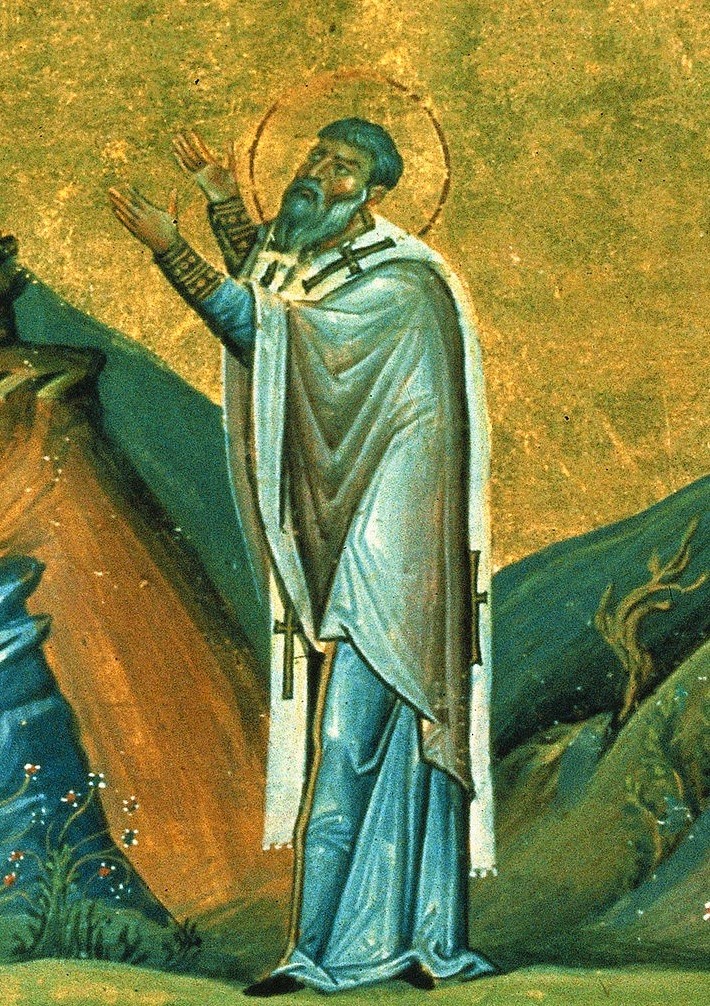
Saint of the Day – 22 October – Saint Abericus (Died 2nd Century) Bishop of Hierapolis in Phrygia. Also known as – Abercius of Geropoli, Abercius of Hieropolis, Abercio…
The Roman Martyrology reads today: “At Hierapolis, in Phrygia, St Abericus, Bishop, who flourished under the Emperor Marcus Antonius.”
The life of Saint Abericus was written in the 4th Century, two centuries after his death. Naturally, elements were added to the actual events, about which perhaps, little was known. This rendered certain harsh responses from secular historians, considering Abericus a figure little more than fictional.
But Abericus would be vindicated when in 1882, in Kelendre, near ancient Hierapolis, the Capital of Salutari Phrygia, the Archaeologist William Ramsay, discovered a Greek inscription embedded in a pillar. They were precisely the beginning and end of the Epitaph of Bishop Abericus which had been preserved from his lifetime.
The following year, 1883, Ramsay himself discovered two more fragments of the central part of the Epitaph which was thus fully confirmed. The prestigious Relic was donated to Pope Leo XIII in 1892, on the occasion of his Jubilee and is, therefore, now preserved in the Lapidary Gallery of the Lateran Museum in Rome. The text of this Epitaph is one of the most precious documents for the history of Christianity, as it attests to its diffusion and, certain dogmatic and liturgical characteristics, at a time which is certainly not later than 216.
Here is this important Relic: “Citizen of a chosen city, I have made this monument to myself while alive, to have here a worthy burial for my body. I am called Abericus, disciple of the Chaste Shepherd Who feeds flocks of sheep on mountains and plains; He has large eyes which look down on everything. He taught me the Scriptures, worthy of faith; He sent me to Rome to contemplate the palace and see a Queen with golden robes and shoes; I saw there, a people who wear a shining seal. I also visited the plain of Syria and all its cities and, beyond the Euphrates, Nisibis and, everywhere I found brothers … having Paul with me and faith guided me everywhere and He gave for food the very large, pure fish from the stream, which the chaste Virgin Mother is accustomed to catch and offer to her faithful friends everyday for eating, having an excellent wine which she is accustomed to give with the bread. I, Abercius, have had these things written here, in my presence, being seventy-two years old. Whoever understands what I say and thinks as I do, let him pray for Abericus. Let no-one place another in my Tomb, otherwise he will pay two thousand gold coins to the Roman treasury and one thousand to my beloved country.”
St Abericus (Died 2nd Century) Bishop St Alodia of Huesca St Apollo of Bawit St Benedict of Macerac St Bertharius of Monte Cassino St Cordula
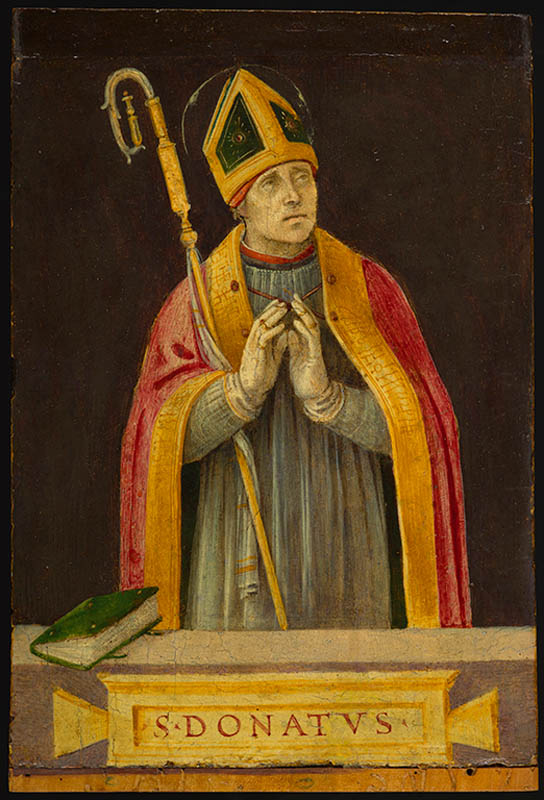
St Donatus (Died 874) Bishop of Fiesole, Confessor, Irish Nobleman, Monk, Priest, Poet, Writer, Scholar, Professor, Adviser to Emperors Louis the Pious and Lothair I, Founder of San Martino a Mensola Abbey and leader of two military expeditions against the Saracens. His Life: https://anastpaul.com/2020/10/22/saint-of-the-day-22-october-st-donatus-of-fiesole-died-874/
Bl Esclaramunda of Majorca St Hermes of Adrianople St Ingbert St Leothade of Auch
St Moderan of Rennes St Nepotian of Clermont (Died c388) Bishop St Nunctus of Mérida St Nunilo of Huesca St Philip of Adrianople St Philip of Fermo St Rufus of Egypt
St Verecundus Bishop and Confessor of Verona. The details of his labors are lost but the Goths ruled Verona at the time. St. Valens succeeded him.
Martyrs of Heraclea – 4 Saints: A group of four clerics in Heraclea (modern Marmara Ereglisi, Turkey) who were arrested in the persecutions of Diocletian. They were imprisoned, abused and ordered to turn over all the Scriptures they had hidden from authorities; they refused and were executed together. Martyrs. – Eusebius, Hermes, Philip and Severus. They were burned at the stake in 304 in Adrianople (modern Edirne, Turkey).










 AnaStpaul
You must be logged in to post a comment.