Posted in The MOST PRECIOUS BLOOD, The PASSION, The REDEMPTION, Thomas Aquinas

Friday of the 4th Week of Lent – 20 March – Our Lenten Journey With St Thomas Aquinas – The Precious Blood

Friday of the 4th Week of Lent –20 March – Our Lenten Journey With St Thomas Aquinas (1225-1274) Doctor of the Church

Friday of the Fourth Week
The Precious Blood

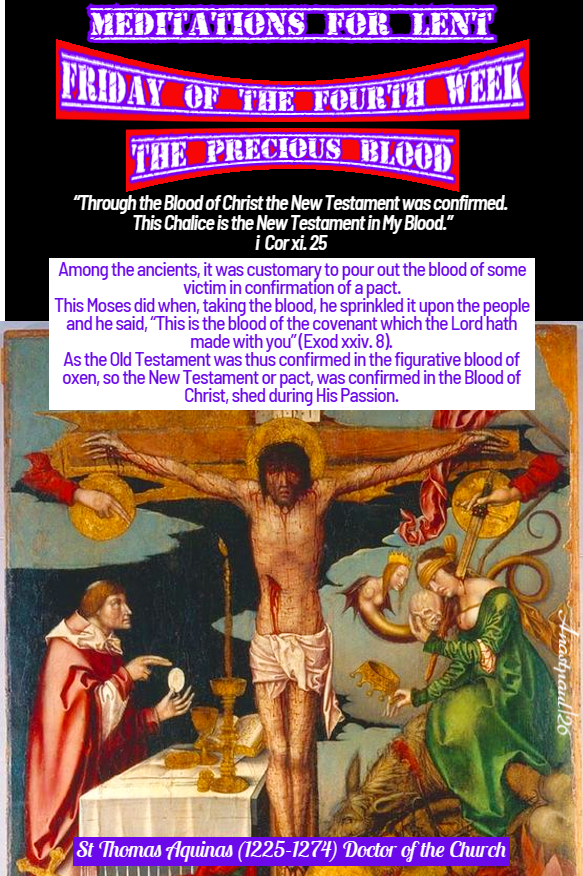
Through the Blood of Christ the New Testament was confirmed. This Chalice is the New Testament in My Blood.”
i Cor xi. 25
Testament has a double meaning.
(1) It may mean any kind of agreement or pact.
Now God has twice made an agreement with mankind.
In one pact, God promised man temporal prosperity and deliverance from temporal losses and, this pact is called the Old Testament.
In another pact, God promised man spiritual blessings and deliverance from spiritual losses and this is called the New Testament, “I will make a new covenant, saith the Lord, with the house of Israel and with the house of ]uda, not according to the covenant which I made with their fathers, in the day I took them by the hand to bring them out of the land of Egypt but this shall be the covenant: I will give My Law in their bosoms and I shall write it in their hearts and I shal be their God and they shall be My people” (]er xxxi. 31-33).
Among the ancients, it was customary to pour out the blood of some victim in confirmation of a pact.
This Moses did when, taking the blood, he sprinkled it upon the people and he said, “This is the blood of the covenant which the Lord hath made with you” (Exod xxiv. 8).
As the Old Testament was thus confirmed in the figurative blood of oxen, so the New Testament or pact, was confirmed in the Blood of Christ, shed during His Passion.

(2) Testament has another more restricted meaning when it signifies the arrangement of an inheritance among the different heirs, i.e. a will.
Testaments, in this sense, are only confirmed by the death of the testator.
As St Paul says, “For a testament is of force, after men are dead, otherwise, it is as yet of no strength, whilst the testator liveth” (Heb ix. 17).
God, in the beginning, made an arrangement of the eternal inheritance we were to receive but, under the figure of temporal goods.
This is the Old Testament.
But afterwards He made the New Testament, explicitly promising the eternal inheritance which indeed, was confirmed by the Blood of the Death of Christ.
And, therefore, Our Lord, speaking of this, says, “This Chalice is the new testament in My Blood” (i Cor xi. 25) as though to say, “By that which is contained in this Chalice, the new testament, confirmed in the Blood of Christ, is commemorated.” (In 1 Cor xii.)

  1. There are other features which make the Blood of Christ Precious.
    It is:
    (i) A cleansing of our sins and uncleanness.
    “Jesus Christ hath loved us and washed us from our sins in His Own Blood” (Apoc. i. 5).
    (ii) Our Redemption, “Thou hast Redeemed us in Thy
    Blood” (ibid. v. 9).
    (iii) The Peacemaker between us and God and His Angels, “making peace through the Blood of His Cross, both as to the things which are on earth and the things which are in the heavens” (Coloss. i. 20).
    (iv) A draught of life to all who receive it.
    “Drink ye all of this”(Matt xxvi. 27).
    ”That they might drink the purest blood of the grape ”(Deut xxxii. 14).
    (v) The opening of the Gate of Heaven.
    “Having, therefore brethren, a confidence in the entering into the holies by the Blood of Christ” (Heb x. 19) that is to say, a continuous prayer for us to God.
    “For His Blood daily cries for us to the Father, as again we are told, You are come to the sprinkling of Blood which speaketh better than that of Abel” (ibid xii. 22-24).
    The blood of Abel called for punishment.
    The Blood of Christ calls for pardon.
    (vi) Deliverance of the saints from hell.
    “ Thou also, by the blood of thy testament, hast sent forth thy prisoners out of the pit, wherein is no wate” (Zach ix. 11).

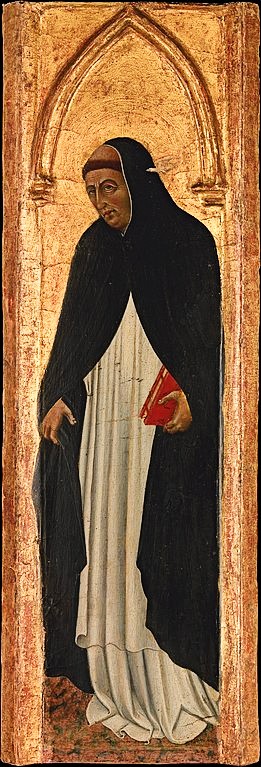
ST THOMAS AQUINAS (1225-1274)
Priest, Theologian, Dominican
Doctor Angelicus (Angelic Doctor)
Doctor Communis (Common Doctor)
Added by Pope Saint Pius V in 1568

Posted in "Follow Me", CARMELITES, CHRIST, the WAY,TRUTH,LIFE, DOCTORS of the Church, FATHERS of the Church, GOD is LOVE, JULY - The MOST PRECIOUS BLOOD, QUOTES on DEATH, QUOTES on LOVE of GOD, Quotes on SALVATION, QUOTES on the CROSS of CHRIST, SEPTEMBER-The SEVEN SORROWS of MARY and The HOLY CROSS, The MOST PRECIOUS BLOOD, The PASSION

Quote/s of the Day – 20 March – Life for those who die.

Quote/s of the Day – 20 March – The Lenten FEAST of the MOST PRECIOUS BLOOD of JESUS is a Feast for the Fridays of Lent

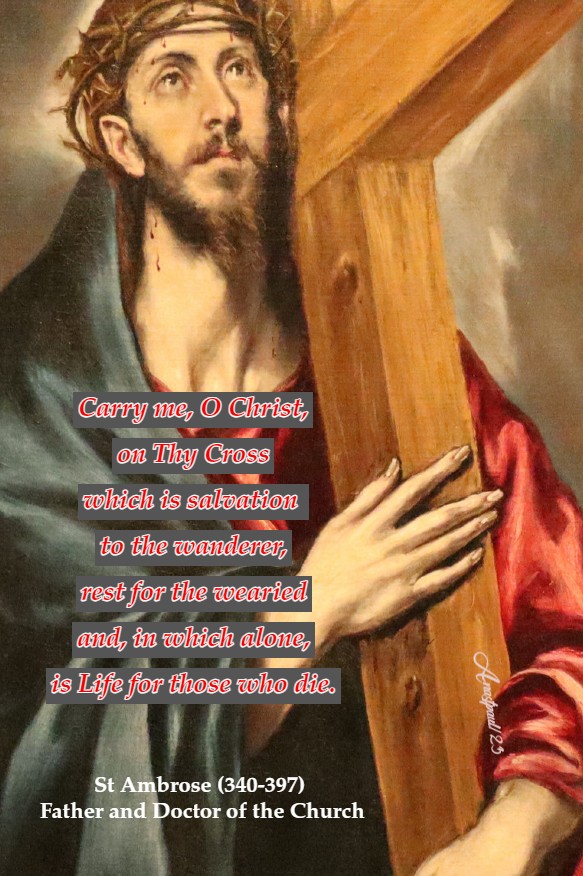
Carry me, O Christ,
on Thy Cross
which is salvation to the wanderer,
rest for the wearied
and, in which alone,
is Life for those who die.”

St Ambrose (340-397)
Father and Doctor of the Church

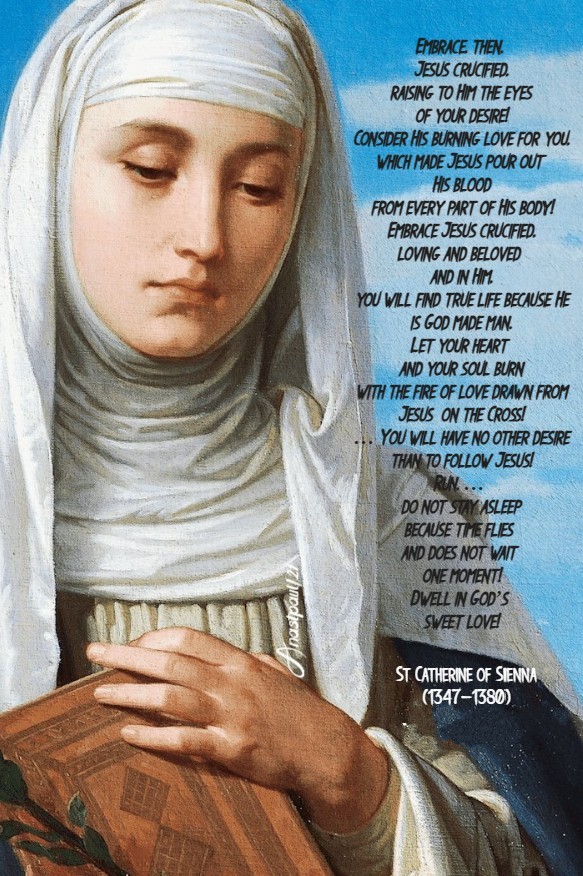
Embrace, then, Jesus Crucified,
raising to Him the eyes of your desire!
Consider His burning love for you
which made Jesus pour out His Blood
from every part of His Body!
Embrace Jesus Crucified,
loving and beloved and in Him,
you will find true life because He is God made Man.
Let your heart and your soul burn
with the fire of love drawn from Jesus on the Cross!
… You will have no other desire than to follow Jesus!
Run, … do not stay asleep
because time flies and does not wait one moment!
Dwell in God’s sweet love!

St Catherine of Sienna (1347-1380)

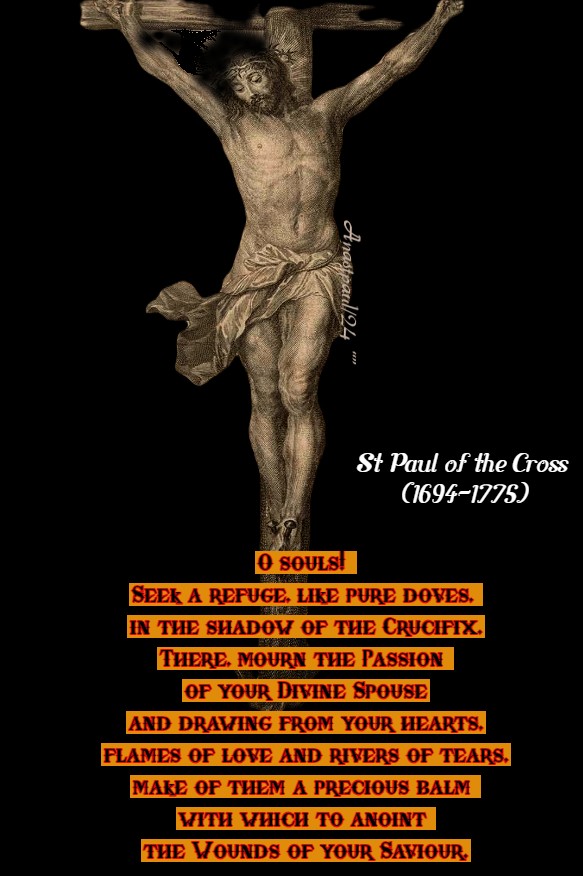
O souls!
Seek a refuge, like pure doves,
in the shadow of the Crucifix.
There, mourn the Passion
of your Divine Spouse
and drawing from your hearts,
flames of love and rivers of tears,
make of them a precious balm
with which to anoint
the Wounds of your Saviour.

St Paul of the Cross CP (1694-1775)

Posted in INDULGENCES, JULY - The MOST PRECIOUS BLOOD, Our MORNING Offering, PAPAL PRAYERS, PRECIOUS BLOOD PRAYERS, The MOST PRECIOUS BLOOD

Our Morning Offering – 20 March – By the Merits of the Precious Blood of Jesus

Our Morning Offering – 20 March – The Lenten FEAST of the MOST PRECIOUS BLOOD of JESUS is a Feast for the Fridays of Lent,

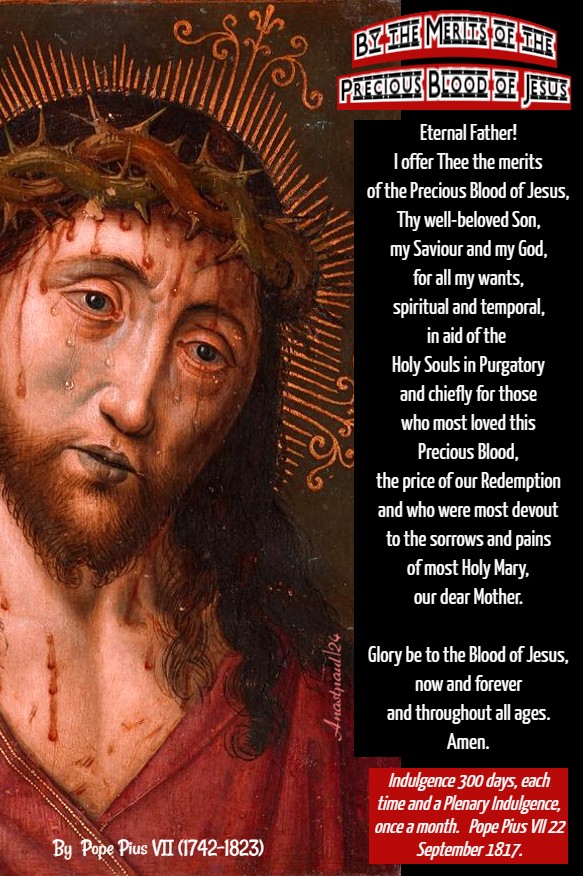
By the Merits of the
Precious Blood of Jesus
By Servant of God Pope Pius VII (1742-1823)

Papacy from 1800 to 1823
Indulgenced Act of Oblation to Our Father

Eternal Father!
I offer Thee the merits
of the Precious Blood of Jesus,
Thy well-beloved Son,
my Saviour and my God,
for all my wants,
spiritual and temporal,
in aid of the Holy Souls in Purgatory
and chiefly for those
who most loved this Precious Blood,
the price of our redemption
and who were most devout
to the sorrows and pains
of most Holy Mary,
our dear Mother.

Glory be to the Blood of Jesus,
now and forever
and throughout all ages.
Amen.

Indulgence of 300 days, each time this prayed is offered,
22 September 1817 with a Plenary Indulgence, once a month,
under the usual conditions.

Posted in SAINT of the DAY

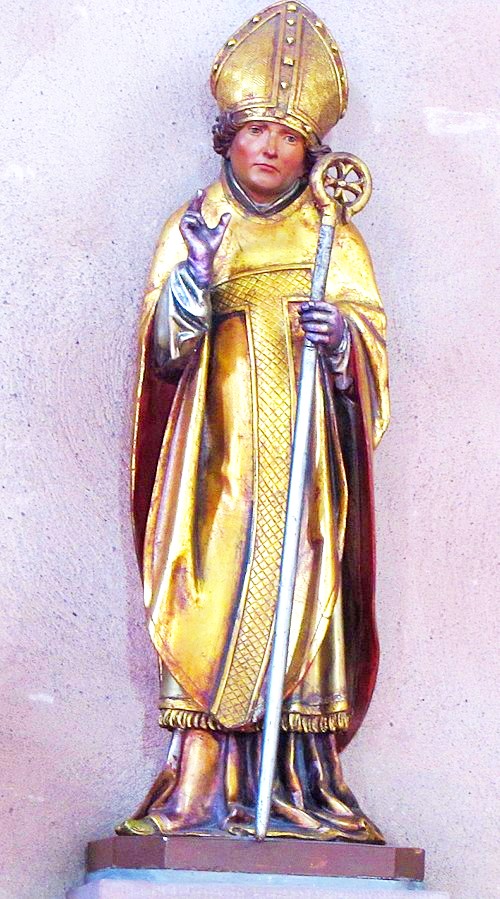
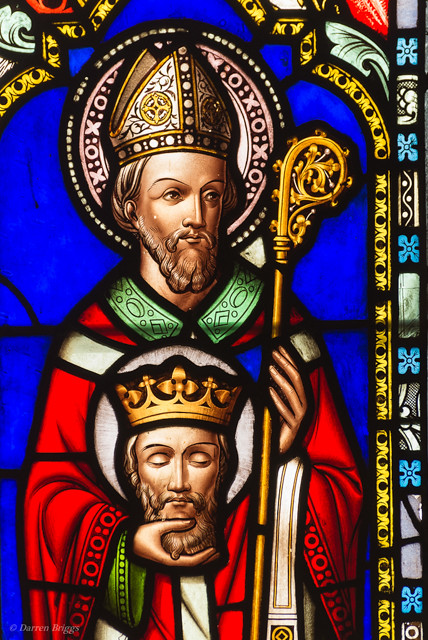
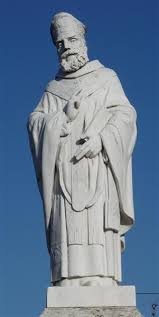
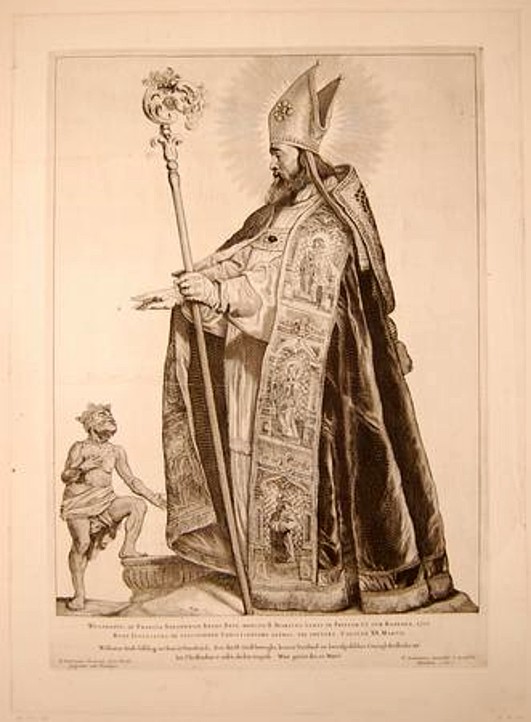
Saint of the Day – 20 March – Saint Remigius (Died c783) Bishop of Strasbourg

Saint of the Day – 20 March – Saint Remigius (Died c783) Bishop of Strasbourg and the first Abbot of Münster Gregorienthal, in modern Switzerland, of which City he is the Patron. Remigius was born to the nobility, the son of Hugh of Alsace; cousin of Saint Odilia of Hohenburg.
Also known as – Remi, Remidius.

He founded the Monasteries of Aschau and Schönenwerth in Switzerland and shone as a holy guide throughout Alsace and as a preacher of the Gospel, through word and deed.

A particular feature of his piety was his zeal in acquiring holy Relics, for which after being appointed as the Bishop, he made a pilgrimage to Rome, where he was received favourably by Pope Adrian I.

It is unclear when he became the Bishop and who he succeeded in that role. It may have been from 765 onwards. His Will is definitively dated in 778, falling during his Episcopate, co-signed by many other Bishops and forming the main source of his work in Strasbourg – it survives only in a 12th Century copy but is one of the most important documents of its type.

He is said to have died in 803, or according to others as early as 783. He was buried in Aschau but only received Ecclesiastical veneration under Pope Leo IX. In portraits, he is seen carrying Relics into the Church in procession.

Posted in MARIAN TITLES, SAINT of the DAY

Friday of the Fourth Week of Lent – FAST AND ABSTINENC, FEAST OF THE MOST PRECIOUS BLOOD OF JESUS, Our Lady of Calevourt, Belgium (1454), St Photina & Companions, St Cuthbert of Lindisfarne and the Saints for 20 March

FRIDAY of the 4th WEEK of LENT – FAST AND ABSTINENC

FERIAL DAY

Our Lady of Calevourt, near Brussels, Belgium (1454) – 20 March:
HERE:

https://anastpaul.com/2021/03/20/our-lady-of-calevourt-near-brussels-belgium-1454-and-memorials-of-the-saints-20-march/

St Photina & Companions / Martyrs of Rome – 9+ Saints: A group of Christians Martyred together in the persecutions of Nero. We know nothing else about them but the names Photina, Sebastian and Victor, Anatolius, Cyriaca, Joseph, Parasceve, Photis.

St Cuthbert of Lindisfarne (c634-687) “The Wonder-Worker of England,” Bishop of Lindisfarne, Monk, Hermit, Miracle-worker.
St Cuthbert’s Zealous Life:

https://anastpaul.com/2022/03/20/saint-of-the-day-20-march-saint-cuthbert-of-lindisfarne-c-634-687-the-wonder-worker-of-england/

Blessed Ambrose Sansedoni OP (1220-1287) Priest and Friar of the Order of Preachers, Preachers, Confessor, Mystic, a powerful and convincing Preacher employed by various Popes as a Diplomatic Peacemaker and that which seems opposed, as a Preacher of the Crusades, Peacemaker. A fellow student with St Thomas Aquinas under St Albert Magnus.
His Life:

https://anastpaul.com/2023/03/20/saint-of-the-day-19march-blessed-ambrose-sansedoni-of-siena-op-1220-1287-priest/

Anastasius XVI
Archippus of Colossi
St Benignus of Flay
St Cathcan of Rath-derthaighe
St Clement of Ireland

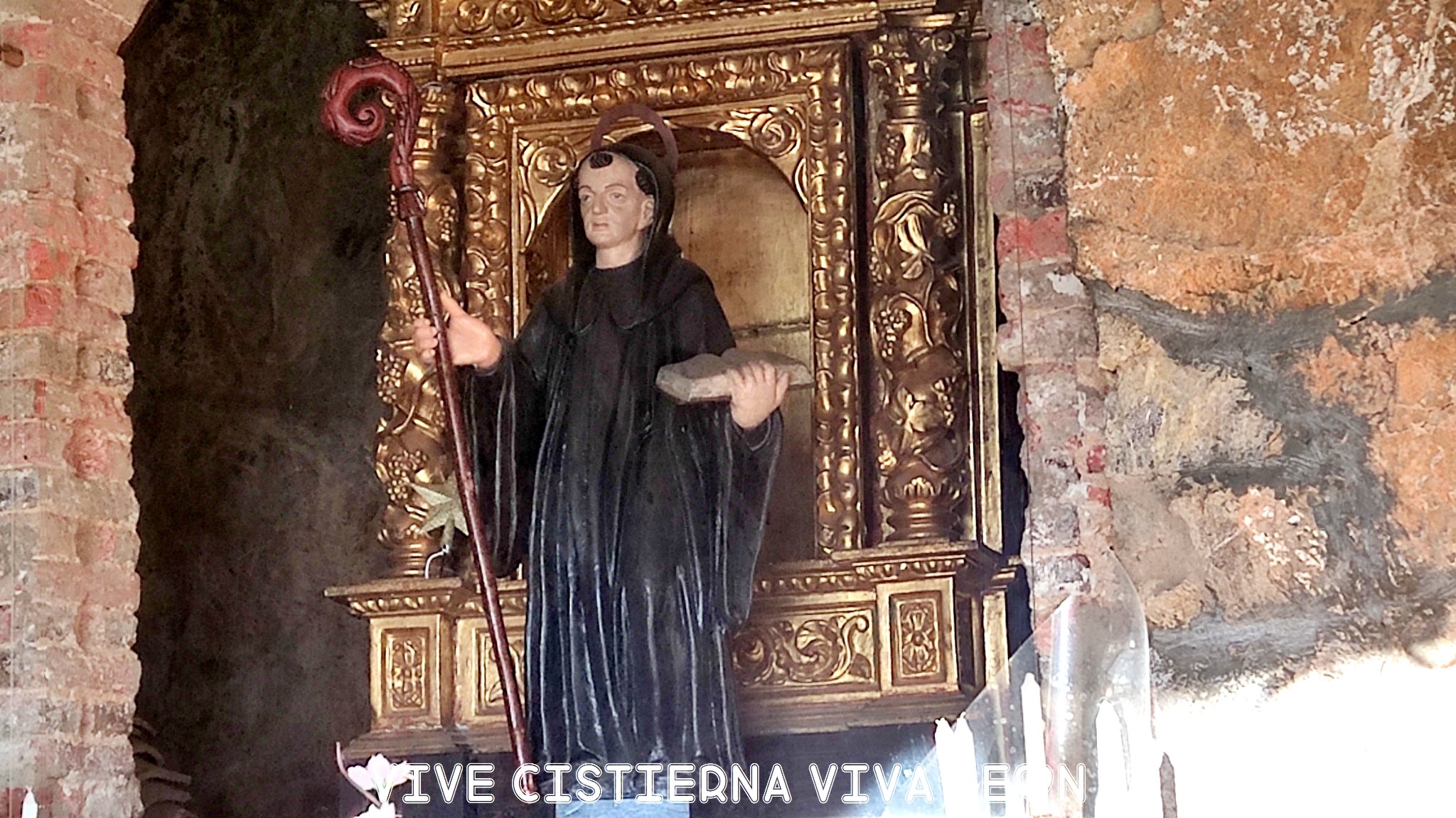
St Guillermo de Peñacorada (Died c1042) Abbot, Miracle-worker. Patronage – Cistierna, Spain and he is invoked for rain in times of drought and he regularly proves his worth, bringing rain whenever needed.
The Rain-Maker:

https://anastpaul.com/2024/03/20/saint-of-the-day-20-march-st-guillermo-de-penacorada-died-c1042-abbot/

St Herbert of Derwenwater
Bl Hippolytus Galantini
Bl Jeanne Veron
Bl John Baptist Spagnuolo
St John Nepomucene
St John Sergius

St Martin (c520–580) Archbishop of Braga, Monk, Missionary, Monastic Founder, prolific Ecclesiastical Writer.
Biography:

https://anastpaul.wordpress.com/2018/03/20/saint-of-the-day-20-march-st-martin-of-braga-c-520-580/

St Nicetas (Died c733) Bishop of Apollonias in Bithynia, a region of Asia Minor, Defender of the veneration of holy images. We have no history of his birthplace but he died in exile in c733, presumably of natural causes, although some refer to him as a Martyr.
The Roman Martyrology reads today: “At Apollonia, the Bishop, St Nicetas, who breathed his last in exile, where he had been sent for upholding the veneration of holy images.”
What We Know of St Nicetas:

https://anastpaul.com/2025/03/20/saint-of-the-day-20-march-saint-nicetas-died-c733-bishop-of-apollonias/

St Remigius (Died c783) Bishop of Strasbourg
St Tertricus of Langres
St Urbitius of Metz

St Wulfram (c640-c 703) Archbishop of Sens, France and Confessor, Missionary, Miracle-worker.
Patronages – Abbeville, France, against the dangers of the sea/of sailors, childbirth and young children.
His Life of Love:

https://anastpaul.com/2021/03/20/saint-of-the-day-20-march-saint-wulfram-of-sens-c-640-c-703/

Martyrs of Amisus – 8 Saints: A group of Christian women Martyred together in the persecutions of Diocletian. The only details we have are eight of their names – Alexandra, Caldia, Derphuta, Euphemia, Euphrasia, Juliana, Matrona and Theodosia. They were burned to death c 300 in Amisus, Paphlagonia (modern Samsun, Turkey).

Martyrs of San Saba – 20 Saints: Twenty monks who were Martyred together in their monastery by invading Saracens. They were Martyred in 797 when they were burned inside the San Sabas monastery in Palestine.

Martyrs of Syria – 3+ Saints: A group of Christians who were Martyred together in Syria. We know nothing else about them but the names Cyril, Eugene and Paul.