Posted in GOD is LOVE, LENT 2026, Thomas Aquinas

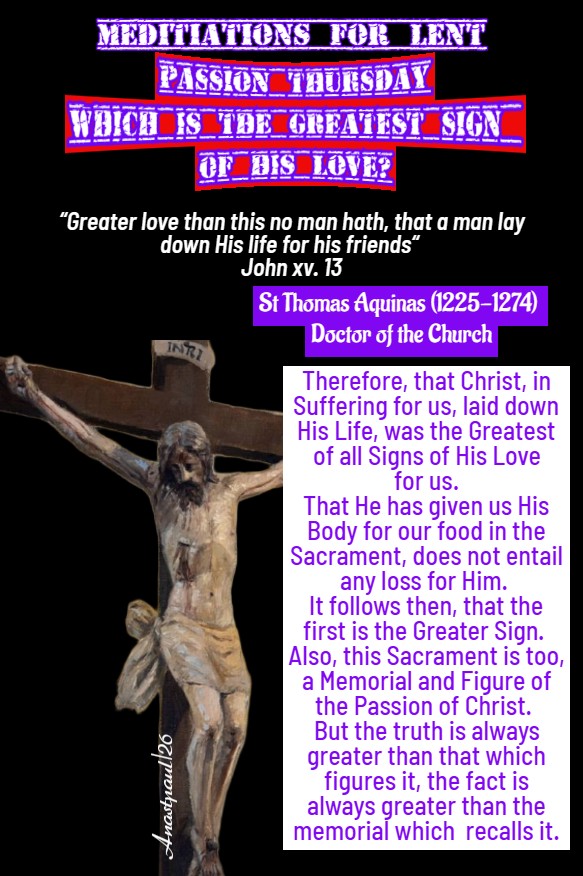
Passion Thursday – 26 March – Our Lenten Journey With St Thomas Aquinas – Which is the Greatest Sign of His Love?

Passion Thursday – 26 March – Our Lenten Journey With St Thomas Aquinas (1225-1274) Doctor of the Church

Passion Thursday
Which is the Greatest Sign of His Love?

Greater love than this no man hath, that a man lay down His life for his friends“
John xv. 13
It would seem Christ gave us a greater Sign of His Love by giving us His Body as our food, than by Suffering for us.
For the Love which will be in the life to come, is a more perfect element than the Love which is in this life.
And the benefit which Christ bestows upon us by giving us His Body as food, is more like to the Love of the life to come in which we shall fully enjoy God.
The Passion which Christ underwent for us is, on the other hand, more like to the Love which is of this life, in which we, too, are to suffer for Christ.
Therefore, it is a greater Sign of Christ’s Love that He delivered His Body to us as our food, than that He Suffered for us.

Nevertheless, it is an argument against this that in St John’s Gospel, Our Lord Himself says, “Greater love than this no man hath, that a man lay down His life for his friends“ (John xv. 13).

The strongest of human loves is the love with which a man loves himself.
Therefore, this love must be the measure, by comparison with which we estimate the love by which a man loves others than himself.
Now, the extent of a man’s love for another, is shown by the extent of good desired for himself which he forgoes for his friend.
As Holy Scripture says, “He who neglecteth a loss for the sake of a friend, is just” (Prov xii. 26).

Now, a man wishes well to himself as to three things, namely, his soul, his body and external items outside himself.
It is then already a sign of love that, for another, a man is willing to suffer loss of things outside himself.

It is a greater sign if he is also willing to suffer loss in his body for another, that is, by bearing the burden of work or undergoing punishment.
It is the greatest of all signs of love, if a man is willing, by dying for his friend, to lay down his very life.

Therefore, that Christ, in Suffering for us, laid down His Life, was the Greatest of all Signs of His Love for us.
That He has given us His Body for our food in the Sacrament, does not entail any loss for Him.
It follows then, that the first is the Greater Sign.
Also, this Sacrament is too, a Memorial and Figure of the Passion of Christ.
But the truth is always greater than that which figures it, the fact is always greater than the memorial which recalls it.

The showing forth of the Body of Christ in the Sacrament has about it, it is true, a certain Figure of the Love with which God Loves us in the life to come.
But Christ’s Passion is associated with that Love itself, by which God calls us from perdition to the life to come.
The Love of God, however, is not greater in the life to come than it is in this present life.

ST THOMAS AQUINAS (1225-1274)
Priest, Theologian, Dominican
Doctor Angelicus (Angelic Doctor)
Doctor Communis (Common Doctor)

Added by Pope Saint Pius V in 1568

Posted in CHRIST the WORD and WISDOM, FATHERS of the Church, GOD ALONE!, GOD is LOVE, In the PRESENCE of GOD, QUOTES on CHARITY, QUOTES on FORGIVENESS, QUOTES on HEAVEN, QUOTES on LOVE, QUOTES on LOVE of GOD, QUOTES on PRAYER, QUOTES on SIN, The WORD

Quote/s of the Day – 26 March – ‘Forgiven … Because she has loved much …’ Luke 7:47

Quote/s of the Day – 26 March – Thursday in Passion Week –Ferial Day – Daniel 3:25, 34-45 – Luke 7:36-50 – Scripture search here: https://www.drbo.org/

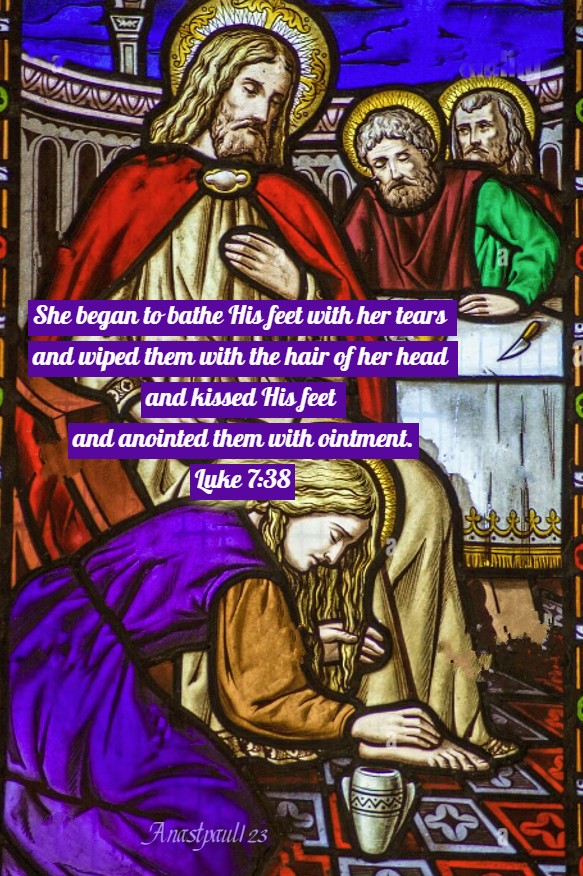
She began to bathe His feet with her tears
and wiped them with the hair of her head
and kissed His feet
and anointed them with ointment.

Luke 7:38

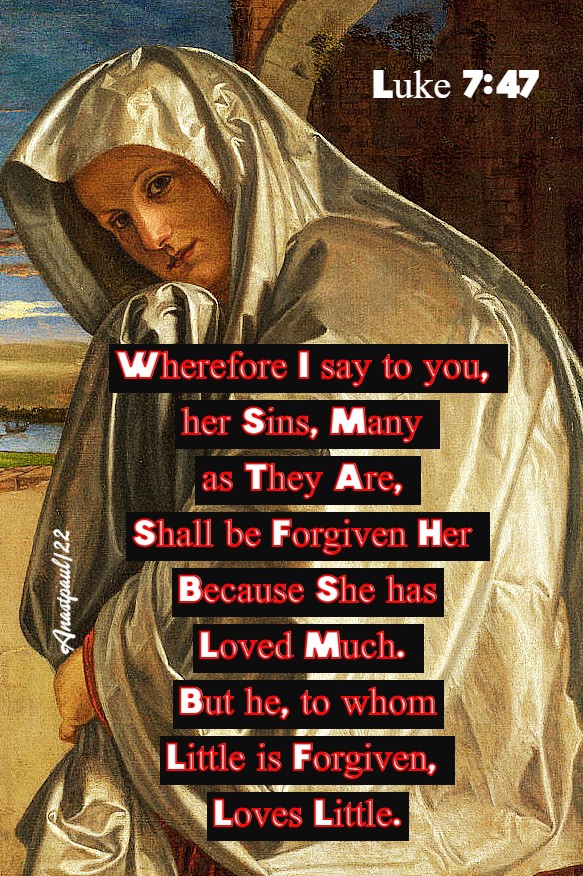
Wherefore I say to you,
her sins, many as they are,
shall be forgiven her
because she has loved much.
But he, to whom little is forgiven,
loves little.

Luke 7:47

A servant of the Lord
stands bodily before men
but mentally,
he is knocking at the Gates of Heaven.
with prayer.”

St John Climacus (c 525-606)
Father of the Church

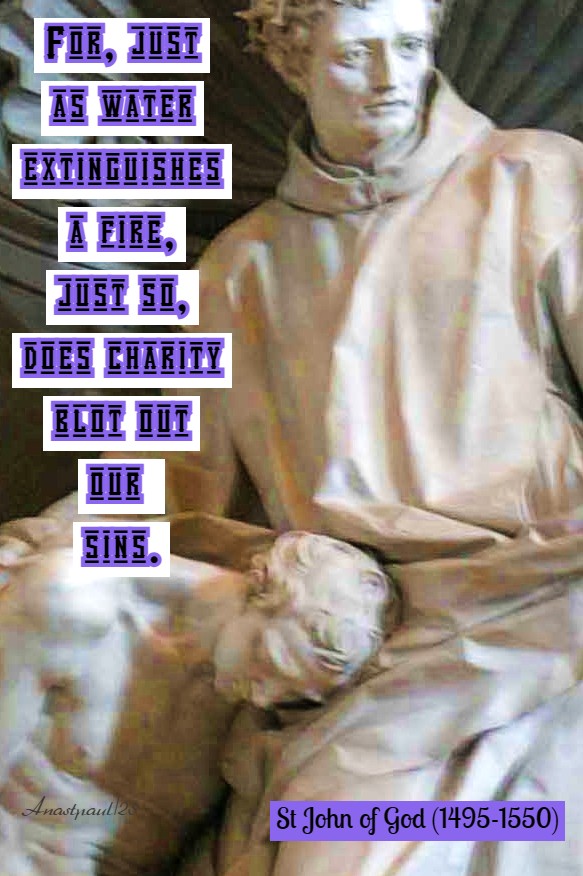
For, just as water extinguishes a fire,
just so, does charity blot out our sins.

St John of God (1495-1550)

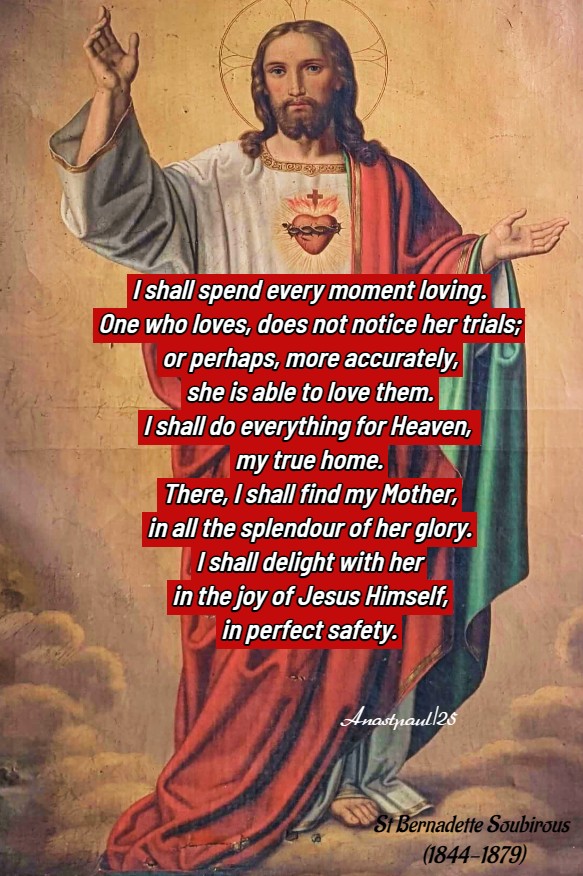
 I shall spend every moment loving.
One who loves, does not notice her trials;
or perhaps, more accurately,
she is able to love them.
I shall do everything for Heaven, my true home.
There, I shall find my Mother,
in all the splendour of her glory.
I shall delight with her
in the joy of Jesus Himself,
in perfect safety.

St Bernadette Soubirous (1844-1879)

Posted in DOCTORS of the Church, franciscan OFM, GOD ALONE!, Our MORNING Offering, PRAYERS of the SAINTS, The PASSION

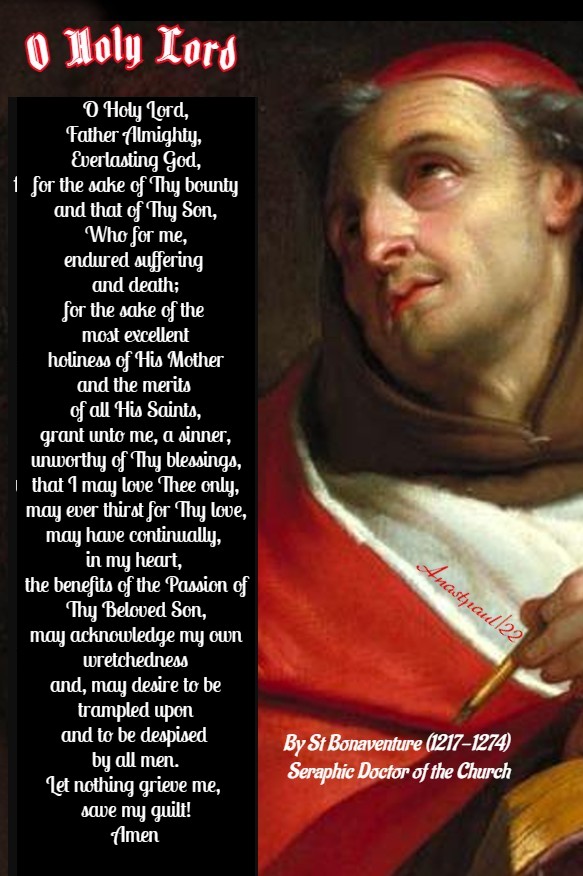
Our Morning Offering – 26 March – O Holy Lord!

Our Morning Offering – 26 March – Thursday of Passion Week

O Holy Lord!
By St Bonaventure (1217-1274)
Seraphic Doctor of the Church

O Holy Lord,
Father Almighty, Everlasting God,
for the sake of Thy bounty
and that of Thy Son,
Who for me,
endured Suffering and Death;
for the sake of the most excellent
holiness of His Mother
and the merits of all His Saints,
grant unto me, a sinner,
unworthy of Thy blessings,
that I may love Thee only,
may ever thirst for Thy Love,
may have continually, in my heart,
the benefits of the Passion of Thy Beloved Son,
may acknowledge my own wretchedness
and, may desire to be trampled upon
and to be despised by all men.
Let nothing grieve me,
save my guilt!
Amen

Posted in SAINT of the DAY

Saint of the Day – 26 March – Saint Felicitas (9th Century) Virgin of Padua

Saint of the Day – 26 March – Saint Felicitas (9th Century) Virgin of Padua.

Felicitas was a virgin and a Religious Nun in Padua, probably at the Convent of Saints Cosmas and Damian.

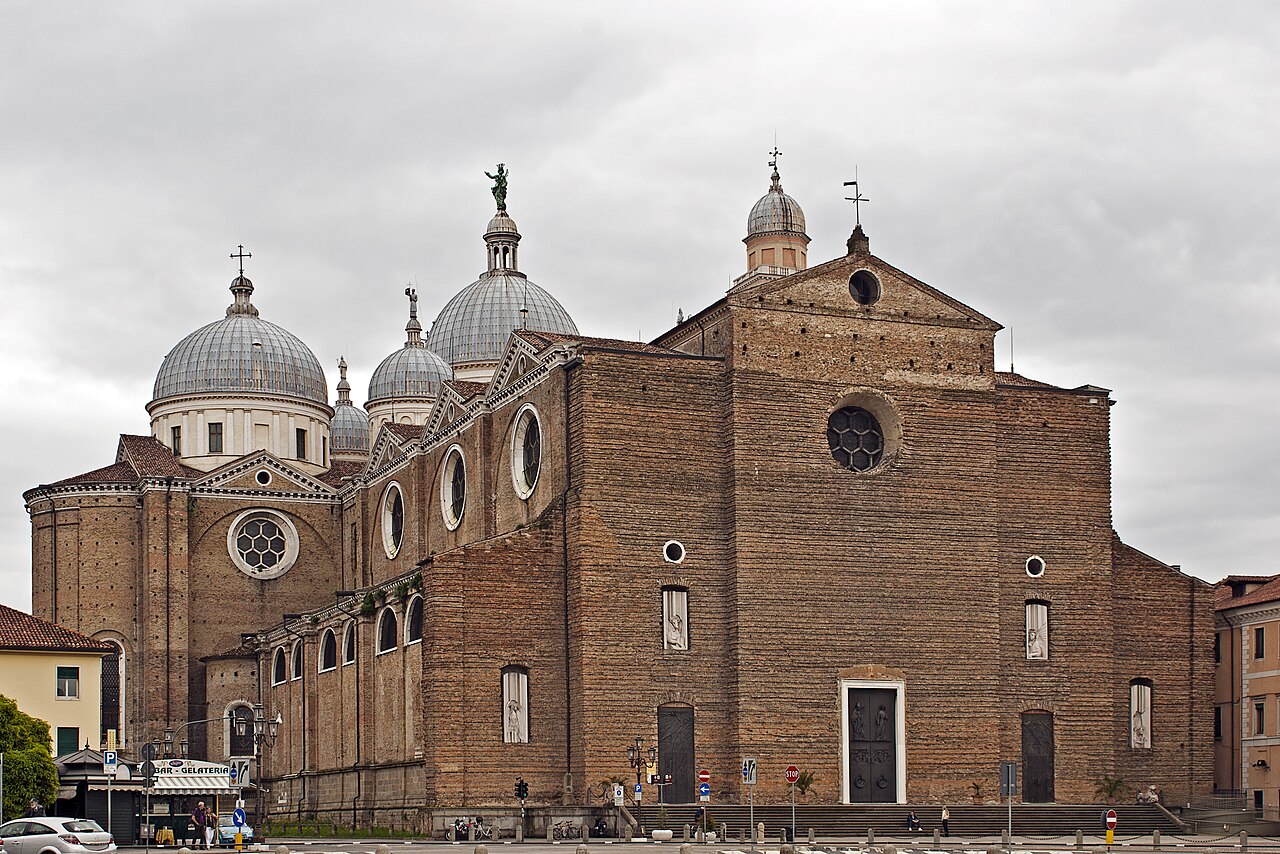
The Basilica of Saint Justina, Padua, where Saint Felicitas’ relics now reside.

Sadly we have little information of her life but she remains greatly venerated in Padua where her Relics are kept in the Basilica of Saint Justina, Padua.

Posted in MARIAN TITLES, SAINT of the DAY

Thursday in Passion Week, Notre-Dame de Soissons / Our Lady of Soissons, France (1128) One of Our Lady’s Slippers was kept in this Abbey and the Saints for 26 March

PASSION THURSDAY

Notre-Dame de Soissons / Our Lady of Soissons, France (1128) One of Our Lady’s Slippers was kept in this Abbey Church – 26 March:
HERE:

https://anastpaul.com/2021/03/26/our-lady-of-soissons-france-1128-and-memorials-of-the-saints-26-march/

St Barontius (Died c725) Monk, Hermit, gifted with visions.
His Life of Grace:

https://anastpaul.com/2023/03/26/saint-of-the-day-26-march-st-barontius-of-pistoia-died-c725-monk-hermit/

St Basil the Younger (Died c952) Confessor, Hermit, Mystic, Miracle-worker.
His Holy Life:

https://anastpaul.com/2022/03/26/saint-of-the-day-26-march-saint-basil-the-younger-died-c-952/

St Bathus
St Bercharius

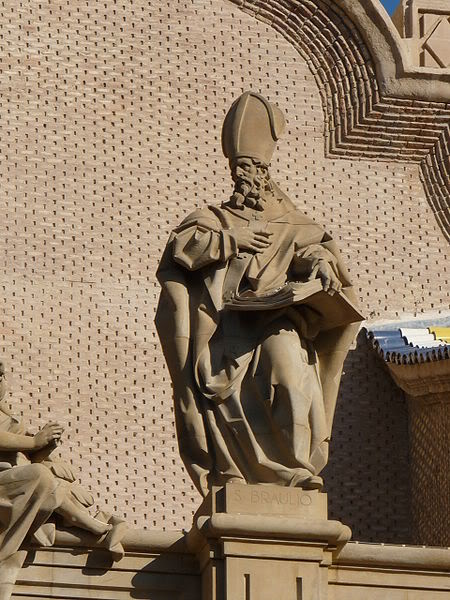
St Braulio (590-651) Bishop of Saragossa, Spain, Monk, Confessor, Reformer, Scholar, Advisor, Writer, eloquent Preacher, Apostle of Charity. Saint Braulio was friend and disciple to Saint Isidore of Seville (560-636) Doctor of the Church ) and a prolific writer of letters, hymns, martyrologies, hagiographies and history. He fought against heresy and provided both strength and encouragement in the Faith to his congregation.
A Most Ardent Shepherd:

https://anastpaul.wordpress.com/2018/03/26/saint-of-the-day-26-march-braulio-590-651/

St Castulus (Died c288) Martyr, Layman, married to Saint Irene of Rome (the woman who assisted St Sebastian after he had been wounded by the Imperial archers), Military Officer and he was the Chamberlain (or officer, valet) of Emperor Diocletian.
His Life and Death:

https://anastpaul.com/2021/03/26/saint-of-the-day-26-march-saint-castulus-of-rome-died-c-288-martyr/

St Desiderius of Pistoia

St Eutychius (Died 356) Sub-Deacon, Martyr of Alexandria. Died during Lent in 356, from his wounds and exhaustion, while on the road to the mines in Egypt.
The Roman Martyrology reads today: “At Alexandria, the holy Martyrs, Eutychius and others, who died by the sword for the Catholic Faith, in the time of Constantius, uinder the Arian bishop, George.
His Life and Death:

https://anastpaul.com/2024/03/26/saint-of-the-day-26-march-st-eutychius-of-alexandria-died-356-sub-deacon-martyr/

St Felicitas (9th Century) Virgin of Padua.

St Felix (Died c400) Bishop of Trier, Germany. Consecrated by St Martin of Tours. We know that St Felix brought the Relics of St Paulinus of Trier back from Phrygia, where he had died in exile and built a Church to house them. The Roman Martyrology reads today: “At Treves, the Bishop St Felix.
Good St Felix:

https://anastpaul.com/2025/03/26/saint-of-the-day-26-march-st-felix-died-c400-bishop-of-trier-germany/

St Garbhan
St Govan

St Ludger (c742-809) Bishop, Missionary, Founder, Abbot, Writer. Following in the footsteps of the English Missionary St Boniface, St Ludger, who was a native Netherlander, brought the faith to the people of Frisia in Holland and the Saxons of north-west Germany. He founded the Werden Abbey and was the first Bishop of Münster in Westphalia, Germany.
Fervent St Ludger:

https://anastpaul.com/2019/03/26/saint-of-the-day-26-march-st-ludger-c-742-809/

St Maxima the Martyr
St Mochelloc (Died c639) Abbot at Kilmallock, Ireland. No other information has survived. Also known as – Celloch, Cellog, Motalogus, Mottelog.
St Montanus the Martyr
St Sabino of Anatolia

St Sincheall the Elder (5th-6th Century) On 25 June is the commemoration of a County Offaly Saint, Sincheall of Killeigh. There is a Saint of this name associated with the household of Saint Patrick who is commemorated today. He is distinguished as Sincheall the Elder and may have been related to the St Sincheall of Killeigh. The Irish Calendars preserve this distinction and the two separate Feast DaysWe have no further information of today’s St Sincheall the Elder.

St Wereka (Died c370) Martyr – Part of a Congregation burned to death in their Church, somewhere in the Balkans in south-eastern Europe. No other information has survived.

Martyrs of Rome – 5 Saints: A group of Christians Martyred together. The only details to survive are the names – Cassian, Jovinus, Marcian, Peter and Thecla. Rome, Italy, date unknown.