Passionate Catholic.
Being a Catholic is a way of life - a love affair "Religion must be like the air we breathe..."- St John Bosco
Prayer is what the world needs combined with the example of our lives which testify to the Light of Christ.
This site, which is now using the Traditional Calendar, will mainly concentrate on Daily Prayers, Novenas and the Memorials and Feast Days of our friends in Heaven, the Saints who went before us and the great blessings the Church provides in our Catholic Monthly Devotions.
This Site is placed under the Patronage of my many favourite Saints and especially, St Paul.
"For the Saints are sent to us by God
as so many sermons.
We do not use them, it is they who move us
and lead us, to where we had not expected to go.”
Charles Cardinal Journet (1891-1975)
This site adheres to the pre-Vatican II Catholic Church and all her teachings. .
PLEASE ADVISE ME OF ANY GLARING TYPOS etc - In June 2021 I lost 100% sight in my left eye and sometimes miss errors. Thank you and I pray all those who visit here will be abundantly blessed. Pax et bonum! 🙏
Thought for the Day – 12 September – Meditations with Antonio Cardinal Bacci (1881-1971)
“All Generations Shall Call Me Blessed”
“It is related in the Gospel, that once a certain occasion, a woman in the crowd, was roused by the preaching and miracles of Jesus and cried out: “Blessed is the womb that bore thee and the breasts that nursed thee.” But Jesus replied: “Rather blessed are they who hear the word of God and keep it” (Lk 11:27-28). These words take nothing from the glory of the Mother of God. They were not intended for her but, for us. She was great and holy, not only because she was chosen to be the Mother of the Word Incarnate but also because she perfected herself in virtue by carrying out, in everything, the teaching of her Divine Son, Jesus.
We cannot follow her as far as her high dignity of Mother of God but we can follow her in her heroic practice of virtue. Admittedly, we shall not be able to climb to an equal height but, with the help of God and under Mary’s own protection, we can and should, walk in her footsteps.
We can imitate her humility, her purity, her lively faith, her burning love for God and for her neighbour and her spirit of constant prayer and union with God. If we do this, we shall always feel that she is by our side as our loving Mother, who is eager to help us to become holy.”
Quote/s of the Day – 12 September – The Feast of the Most Holy Name of Mary
“Blessed is the womb which bore thee”
Luke 11:27
“Mary, Mother of Grace, it becomes you to be mindful of us, as you stand near Him who granted you all graces, for you are the Mother of God and our Queen. Help us for the sake of the King, the Lord God and Master, Who was born of you.”
St Athanasius (297-373) Father & Doctor of the Church
“Mary signifies “Light-Giver” or “Star of the Sea” for she gave birth to the Light of the World. In the Syriac tongue, however, Mary means “Lady” and beautifully so, since she gave birth to the Lord.”
St Isidore of Seville (c560-636) Father & Doctor of the Church
One Minute Reflection – 12 September – “The Month of The Seven Sorrows of the Blessed Virgin Mary and The Holy Cross” – The Feast of the Most Holy Name of Mary – Ecclesiasticus 24:23-31 – Luke 1:26-38 – Scripture search here: https://www.drbo.org/
“Hail, full of grace!” – Luke 1:28
REFLECTION – “So when the Virgin of Virgins was led by her God and Son, the King of Kings, in the joy of the Angels, the joy of the Archangels, among the acclactions of Heaven, then was accomplished the prophecy of David saying to the Lord: “The Queen stands on Thy Right, in a gilded clothing and various ornaments.” (Cf PS 44:10) Then, according to the Word of Solomon, The young girls arose and proclaimed Him blessed and the Queens in turn sang His praise (cf Pr 31:28 Vulg ). … She could not stop praising, she who saw the Son of God, born of her, sit to the Right of the Majesty of the Father and with Him in glory. “Thou held,” she said, “my right hand and Thou led me, according to Thy Will and in glory Thou received me.” (Cf PS 72:24) … raised in the midst of cheers of joy and praise, therefore, placed, first after God, on a throne of glory, above all the inhabitants of Heaven. …
Then, lowering towards the human race with an unspeakable charity and turning towards us, these merciful eyes which are the Light of the sky, it fosters an universal prayer for the clergy and the people , alive and dead. From Heaven, the Glorious Virgin helps us here below and, by her all-powerful prayer, she drives out all the evils and endows all the graces. For all those who pray to her from the bottom of the heart, it is their protection for the present life and for the future life. … Certainly, she will receive that which she beseeches, this beloved Mother, she whose very chaste body was the way in which the Son of God came to wash away the defilements of the world. Jesus Christ, our Lord, Who lives and reigns with God the Father in the unity of the Holy Ghost, God in all centuries of centuries. Amen” – St Amadeus of Lausanne O.Cist. (1108-1159) Cistercian Bishop (Marion Sermon VII).
PRAYER – Grant, we beseech Thee, Almighty God, through the protection of the most holy Virgin Mary, Thy faithful people, who delight in her name may, by her loving intercession, be delivered from all evils on earth and be found worthy to attain everlasting happiness in Heaven. Through Jesus Christ, Thy Son our Lord, Who lives and reigns with Thee, in the unity of the Holy Ghost, God, world without end. Amen (Collect).
Our Morning Offering – 12 September – “The Month of The Seven Sorrows of the Blessed Virgin Mary and The Holy Cross” – The Feast of the Most Holy Name of Mary
Mary! How Sweetly Falls That Word! Anonymous Author 19th Century Tune (St Basil’s Hymnal 1903) Unnamed Tune.
Mary! How sweetly falls that word! On my enraptured ear! Oft do I breathe, in accents low, which sound when none are near. Chorus: Sing, O my lips and loudly proclaim: O Mary, O Mary, how sweet is thy name! Sing, O my lips and loudly proclaim; O Mary, O Mary, how sweet is thy name!
Sweet as the warbling of a bird, Sweet as a mother’s voice; So sweet to me is that dear name, It makes my soul rejoice. Chorus.
Bright as the glittering stars appear, Bright as the moonbeams shine, So bright in my mind’s eye is seen Thy loveliness divine! Chorus.
Through thee I offer my requests And when my prayer is done, In ecstasy sublime, I see Thee seated near thy Son. Chorus.
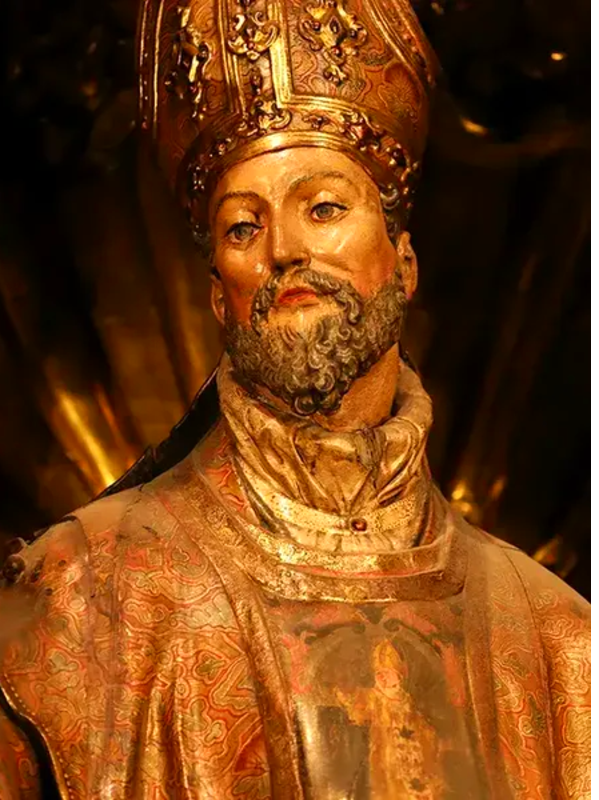
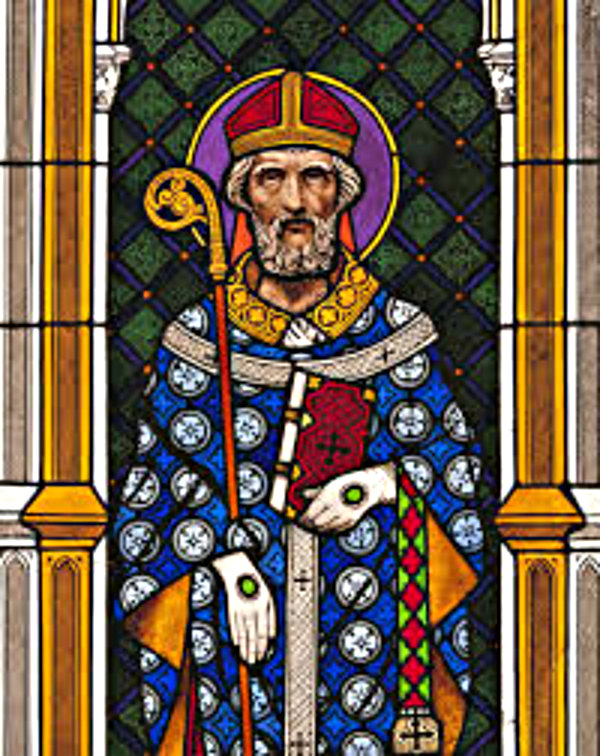
Saint of the Day – 12 September – Saint Sacerdos/Saint Priest (487-552) Bishop of Lyon – the 27th encumbent of this high Office in Lyon, our Saint Priest (the meaning of Sacerdos) was highly visible at the Councils and in the construction and renovation of Churches, Monasteriest and was highly favoured by the King. In fact, as the Advisor to King Childebert, it is believed that he influenced the King to found a Hospital, between the Saint-Paul Church and the first Pont du Change. Born in 487 in Burgundy, France and died on 11 September 552 in Paris, where he had arrived for a the meeting of a Council. Also known as – Saint Priest, Sardot, Sacerdote, Serdon.
The Roman Martyrology reads today: “At Lyon, the decease of St Sacerdos, Bishop.”
Sacerdos belonged to a noble family of the Kingdom of Burgundy. Tradition tells us he was married and had a son. , Aurelien who became the Sainted Archbishop of Arles. A specific Epitaph also states that he was buried in the tomb alongside his son.
His Episcopate, temporally speaking, was entirely under the reign of Childebert, the 1st King of the Franks, who reigned in Lyon between 534 and 558.
Sacerdos did not participate in the Council of Orléans in 541 but presided over the Council held on 28 October 540, in the same City. The 24 Canos of that Council addressed various topics, including the condemnation of Monophysitism and Nestorianism; the limitation of the use of excommunication; the requirement of the master’s consent for the Ordination of a slave and the care of prisoners and lepers. This Ccouncil also ratified, with a specific and detailed Canon, the foundation of the hospice erected by the King in Lyon.
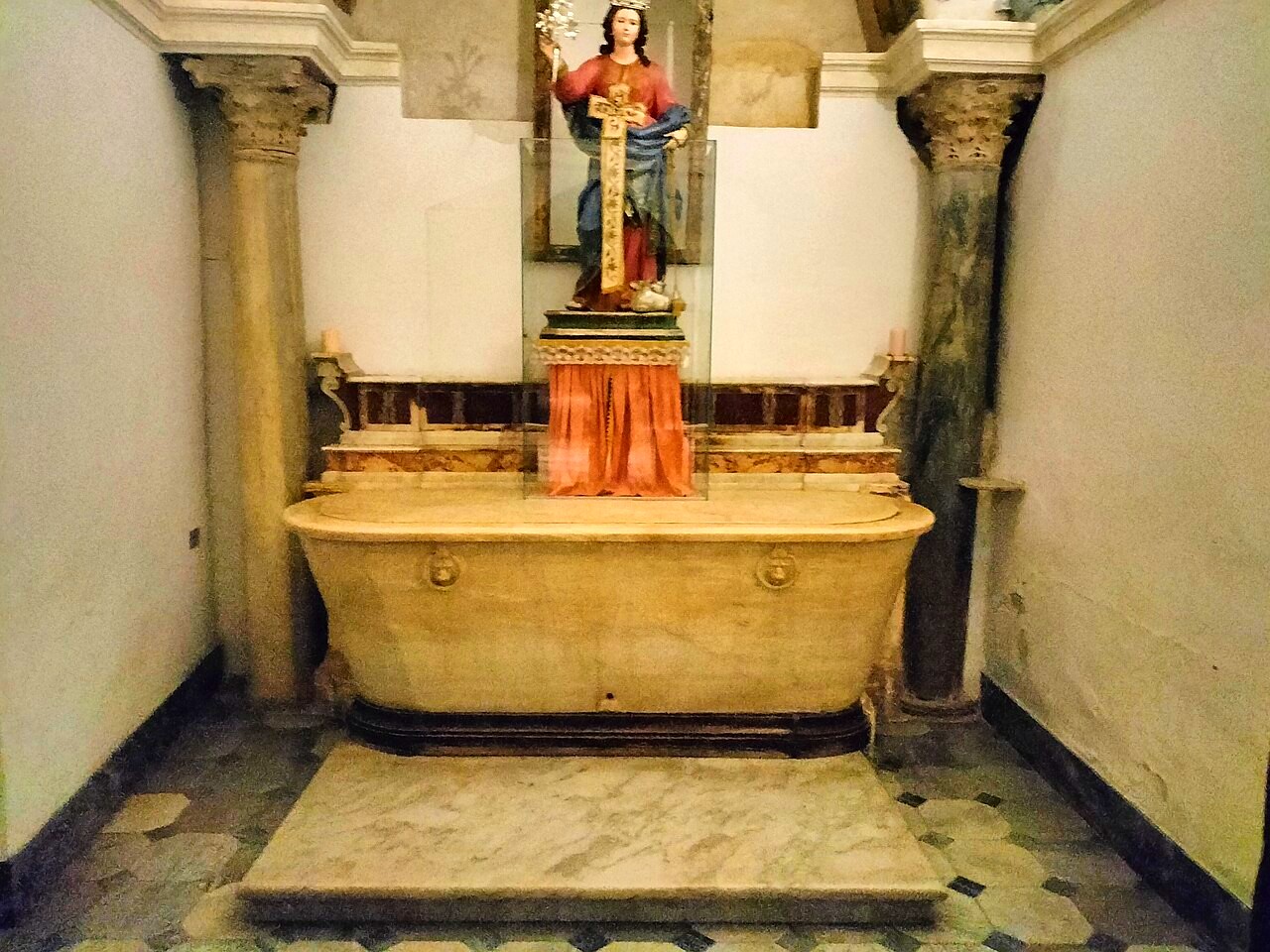
During his Episcopate, the construction of the Church of Saint Paul and that of Saint Eulalia, originally connected to a Monastery of Nuns, which later became the Church of Saint George. Toward the end of hisreign, he ordered major renovations to be carried out at the Monastery of Saint Peter.
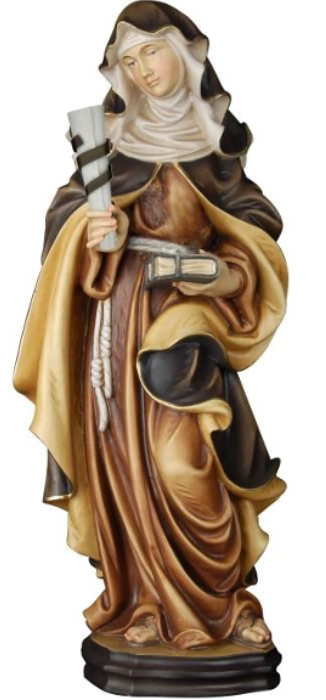
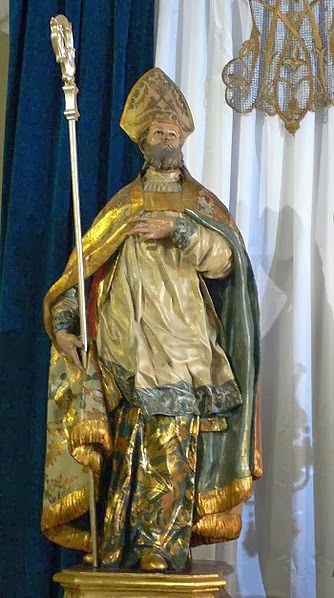
St Sacerdos Statue in the Church which he built, St Paul’s
A detailed account by St Gregory of Tours of his death in Paris has survived. Sacerdos was in Paris to participate in the Council convened by the King after the deposition of Bishop Saffaracus of Paris. St Gregory tells us that the King, having a special affection for Bishop Sacerdote, who had fallen ill in Paris, visited him during his illness. At that meeting, the Bishop requested the King to appoint his nephew, Nicetius (sT),as his successor to govern the Diocese of Lyon.
Sacerdote died at the age of 65, on 11 September 552. His body was transported to Lyon and buried in the Church of the Holy Apostles, a Church which, in later centuries, would be named after Saint Nicetius, our Saint’s son.
Numerous miracles flourished at his Tomb. An Epitaph on Saint Sacerdos remains, known from a 1308 transcription, carved in the Crypt of Saint Nicetius and rediscovered in 1883.
Feast of the Holy Name of Mary (1683 ) – 12 September: This Feast was first observed at Cuenca, Spain in 1513, then extended to the Universal Church and assigned to its present place and rank by Pope Innocent XI in 1683, in thanksgiving to God and the Blessed Virgin, for the liberation of Vienna, France and the signal victory over the Turks on 12 September 1683. It is the Titular Feast of the Society of Mary (Marianists) and of the Congregation of the Oblates of Mary Immaculate.
St Mancius of Saint Thomas St Paul of Saint Clare St Sacerdos/Saint Priest (487-552) Bishop of Lyon St Silvinus of Verona St Tomás de Zumárraga Lazcano
Martyrs of Alexandria – 6 Saints: A group of Christians Martyred in the persecutions of Diocletian. We know little more than their names – Hieronides, Leontius, Sarapion, Seleusius, Straton and Valerian. They were drowned c 300 at Alexandria, Egypt.
Martyrs of Phrygia – 3 Saints: Three Christians who were Martyred for destroying pagan idols. We know little more than their names – Macedonius, Tatian and Theodolus. They were burned to death in 362 in Phrygia (modern Turkey).
Thought for the Day – 11 September – Meditations with Antonio Cardinal Bacci (1881-1971)
Following Jesus, the Divine Model
“Jesus is the Divine Model, Whom we ought to follow and imitate. In Him, the virtues possess both the Infinite splendour of the Divinity and the gentle appeal of glorified Humanity. Jesus does not dazzle us with His brightness but kindly invites us to love and follow Him. “Learn from me” He says, “for I am meek and humble of heart and you will find rest for your souls” (Mt 11:29). After He has indicated humility, meekness and interior peace, as the foundations of the spiritual life, He invites us to take up the yoke of His law and assures us, that we shall find it light (Mt 11).
If we follow Jesus, even though we are bowed with Him, beneath the weight of the Cross, we shall experience, even in this life, a reflection of the peace and joy which will be our reward in Heaven.”
Quote/s of the Day – 11 September – St Protus and St Hyacinth (Died c257) Brother Martyrs – Hebrews 10:32-38 – Luke 12:1-8 – Scripture search here: https://www.drbo.org/
“Yes, the very hairs of your head are all numbered. Therefore, do not be afraid, you are of more value than many sparrows.”
Luke 12:6-7”
“Do not be afraid of those who kill the body and after that have nothing more they can do. … be afraid of him who, after he has killed, has power to cast into hell. ”
Luke 12:4
“Take courage: It is I, do not be afraid. And He got into the boat with them and the wind fell”
Mark 6:50-51
“Fear is a greater evil than the evil itself.”
(Letters to Persons in the World, VI, 12)
“The good Angels are around you, like a company of Sentinels on guard!”
One Minute Reflection – 11 September – “The Month of The Seven Sorrows of the Blessed Virgin Mary and The Holy Cross” – St Protus and St Hyacinth (Died c257) Brother Martyrs – Hebrews 10:32-38 – Luke 12:1-8 – Scripture search here: https://www.drbo.org/
“Are not five sparrows sold for two farthings? And yet not one of them is forgotten before God. Yes, the very hairs of your head are all numbered. Therefore, do not be afraid, you are of more value than many sparrows.” – Luke 12:6-7
REFLECTION – “It seems to me you ought to resolve to carry out peacefully what you can. Do not worry about all the rest but entrust to Divine Providence that which you are unable to accomplish on your own. What is pleasing to God, is the reasonable care and attention we give, to accomplishing well, whatever business we must undertake through duty. What is not pleasing to God, is anxiety and disquiet of mind. The Lord wants our limitations and weaknesses, to find their support in His Strength; He wants us to hope that His Goodness will complete and perfect the imperfectness of our means.
Those who take on numerous responsibilities, even with an upright and pure intention, must resolve to do simply what lies within their power … If it is necessary to set certain things aside, arm yourselves with patience and do not think that God expects of us what we are unable to do. He does not want a man to distress himself on account of his limitations … there is no need to tire ourselves out excessively. More, if we have laboured to do our best, we can abandon all the rest to Him ,Who has the power to accomplish whatever He will.
May the Divine Goodness always be pleased to communicate His Light of Wisdom to us, so that we may clearly see and firmly accomplish, His good pleasure, for ourselves and for others … so that we may accept from His Hand, whatever He sends us, taking due note of what is the most important – patience, humility, obedience and charity!” – St Ignatius Loyola (1491-1556) Priest, Founder of the Society of Jesus (Letter of 17 November 1555)
PRAYER – May the precious witness of Thy blessed Martyrs, Protus and Hyacinth, comfort us, O Lord and may their kind intercession, continually protect us. Through Jesus Christ, Thy Son our Lord, Who lives and reigns with Thee, in the unity of the Holy Ghost, God, world without end. Amen (Collect).
Our Morning Offering – 11 September – “The Month of The Seven Sorrows of the Blessed Virgin Mary and The Holy Cross”
O Mother of Sorrows, Stand by Me in My Last Agony By St Gabriel Francis Possenti of Our Lady of Sorrows (1838-1862)
O Mother of Sorrows, by the anguish and love with which thou didst stand at the Cross of Jesus, stand by me in my last agony. To thy maternal heart I commend the last three hours of my life. Offer these hours to the Eternal Father in union with the agony of our dearest Lord, in atonement for my sins. Offer to the Eternal Father the Most Precious Blood of Jesus, mingled with your tears on Calvary, that I may obtain the grace of receiving Holy Communion with the most perfect love and contrition, before my death and that I may breathe forth my soul in the adorable Presence of Jesus. Dearest Mother, when the moment of my death has at last come, present me as your child to Jesus. Ask Him to forgive me for having offended Him, for I knew not what I did! Beg Him to receive me into His Kingdom of Glory to be united with Him forever. Amen
Saint of the Day – 11 September – St Patiens (Died c491) Bishop of Lyon, a most zealous and devoted shepherd of his flock for around 40 years and at the same time, the lover and caregiver of the needy and poor regardless of where they lived and to which Diocese they belonged – as we should, he did not ask whether they were pagans or Christians. Also known as – Patrient, Patient, Patriens, Paziente.
The Roman Martyrology reads today: “At Lyon, the decease of St Patiens, Bishop.”
In the official chronology, Patiens is listed in20th place. He succeeds Saint Eucherius and precedes Saint Lupicinus.
The name of Saint Patiens is recorded in the oldest Episcopal records, contained in a Litergical Gospel book from the mid-9th Century. The catalogue was compiled around 799-814 duringthe reign of Bishop Leidradus and is based on the original of the Lyonnais Church.
The name of Saint Patiens is also mentioned in a second Episcopal catalogue, reported by Hugues of Flavigny in his Chronica Universalis.
Patriens governed the Diocese for forty years, between 451 and 491. Considering this lengthy period of service, we know very little about his personal history.
But it was Bishop Patiens who commissioned St Constantius of Lyon to write theVita of St Germanud (Life of Germanus). Patiens also built a new Cathedral, dedicated to Saint Stephen. Later, in the 7th Century, a baptistery dedicated to Saint John was constructed as an accessory to the Church. This later became the site of the Cathédrale Saint-Jean-Baptiste de Lyon.
Patient, moved by great charity to help the people oppresssd by hunger, distributed free grain from the stores located in his See. He is also membered as a Bishop who devoted himself to a continuous apostolate, caring for his flock especially for the needy. He was deeply committed to the conversion of heretics.
His contemporary, the remarkable St Sidonius Apollinaris (c 30 – 489), admired Patiens and said that, despite the austerity of his life, he made himself “all things to all men.” He played his part zealously in repressing the heresies of his time but is especially remembered for his great dedication to the poor, not only of his own Diocese but of other parts of Gaul. He devoted all his resources to their relief. During a famine, he arrived in Lyon with wheat, to feed the entire population.
St Protus and St Hyacinth (Died c257) Brother MartyrsBrother Martyrs during the persecution of Emperor Valerian (257–259), they served as household Officials to St Eugenia. The Roman Martyrology states today: “At Rome, in the Cemetery of Basilla, on the old Salarian Way, the birthday of the Holy Martyrs, Protus and Hyacinth, brothers and eunuchs in the service of the blessed Eugenia, who were arrested in the time of the Emperor Gallienus, on the charge of being Christians and urged to offer sacrifice to the gods. But as they refused, both were most severely scourged and finally, beheaded.” Their Life and Death: https://anastpaul.com/2023/09/11/saint-s-of-the-day-11-september-st-protus-and-st-hyacinth-died-c257-brother-martyrs/
St Adelphus of Remiremont St Almirus Bl Baldassarre Velasquez
St Essuperanzio of Zurich St Felix of Zurich Bl Franciscus Takeya Bl François Mayaudon Bl Gaspar Koteda St Gusmeo of Gravedona sul Lario St Leudinus of Toul St Matthew of Gravedona sul Lario St Paphnutius of Thebes St Patiens (Died c491) Bishop of Lyon Bl Peter Taaffe Bl Petrus Kawano St Regula of Zurich St Sperandea
Thought for the Day – 10 September – Meditations with Antonio Cardinal Bacci (1881-1971)
Accepting the Will of God
“Why are we so often dissatisfied and so easily unsettled by ordinary events? Why does a small measure of success, pleasure, or human praise go to our heads and disturb our peace of soul? Why does suffering failure, or humiliation, makes us sad and dispirited? It is because we forget that everything comes to us from God.
The inscrutable designs of Divine Providence have ordained that our mortal lives should be interwoven with joyful and sorrowful events. There is joy, so that we may realise, that God is Infinitely Good and may experience on earth, the reflection of His beauty. There is sorrow, so that we may remember, that “here we have no permanent city but we seek for the city that is to come” (Heb 13:14). We should not be too elated by worldly pleasure and success but, should be grateful to God, for giving them to us. On the other hand, we should not lose heart, nor rebel, when we experience suffering or humiliation. These also come from God and He has a reason for sending them to us. Even if we do not know the reason, we should retain our confidence, that the Providence of God, arranges everything for our true welfare.
Quote/s of the Day – 10 September – St Nicholas of Tolentino OSA (1245-1305)
A Prayer for the Intercession of St Nicholas of Tolentino OSA (1245-1305)
O brightly shining star of sanctity! splendour and boast of the Augustinian Order; our powerful protector, St Nicholas, hear from Heaven the prayers of your devoted clients. Teach us to imitate the example you gave here below of heroic virtue, to curb our passions and restrain our unruly appetites that we may ever live in the Light of Divine Grace and escape the foul contagion of habitual sin. Procure for us a love of Jesus like that which filled your own sinless heart and a tender devotion to the Blessed Virgin Mary, His Mother that we may be more like you in childlike love of her. Fortify us in efforts to reach Heaven that we may be ever faithful to Jesus and Mary and strengthen us by your prayers, to merit a share in the bright and endless joys you now enjoy for all eternity. Amen.
One Minute Reflection – 10 September – “The Month of The Seven Sorrows of the Blessed Virgin Mary and The Holy Cross” – St Nicholas of Tolentino OSA (1245-1305) Confessor – 1 Corinthians 4:9-14 – Luke 12:32-34 – – Scripture search here: https://www.drbo.org/
“Sell what you possess and give alms. Make for yourselves purses which do not grow old, a treasure unfailing in Heaven, where neither thief draws near, nor moth destroys.” – Luke 12:33
REFLECTION – “Blessed are the poor in spirit, for theirs is the Kingdom of Heaven” (Mt 5:3) … Of this generous poverty, the Apostles first, after the Lord, have given us example. Unhesitatingly leaving all they had, at the Voice of the Heavenly Master, they were joyfully converted and abandoned the catching of fish, to become fishers of men (Mt 4:18). Among the latter, many became like themselves, by imitating their faith; for with those first children of the Church, “the community of believers was of one heart and mind” (Acts 4:32). Stripped of all their possessions, they were enriched with eternal goods, thanks to holy poverty. Welcoming the Apostles’ preaching, they rejoiced to have nothing in this world and yet, possess all things in Christ. (2 Cor 6:10).
Hence, the blessed Apostle Peter, when he was going up to the temple and was asked for alms by a lame man, said, “I have neither silver nor gold but what I do have I give you; in the Name of Jesus Christ the Nazorean, rise and walk” (Acts 3:6)… Peter healed him with a word and he, who did not have a coin with Cæsar’s image upon it, restored upon the man, the Image of Christ. And by the riches of this treasure, not only was that one person aided, whose power of walking was restored but too, the five thousand men who then believed the Apostle’s preaching because of this miracle (Acts 4:4). And Peter, that poor man, who did not have anything to give him, who asked for alms, bestowed so great a gift of Divine Grace that, not content with setting one man upright on his feet, he healed, those many thousands of believers in their hearts, by giving them faith.” – St Leo the Great (400-461) Pope, Father and Doctor of the Church (Sermon 95 2-3).
PRAYER – Be mindful, O Lord, of our humble prayers in this commemoration of Thy Saint Nicholas, so that we, who have no confidence in our own righteousness, may be assisted by the merits of those, who have been pleasing to Thee. Through Jesus Christ, Thy Son our Lord, Who lives and reigns with Thee, in the unity of the Holy Ghost, God, world without end. Amen (Collect).
Our Morning Offering – 10 September – “The Month of The Seven Sorrows of the Blessed Virgin Mary and The Holy Cross”
Mother of Love, of Sorrow and of Mercy By St Bridget of Sweden (1303-1373)
O Blessed Virgin Mary, Immaculate Mother of God, who endured a Martyrdom of love and grief, beholding the sufferings and sorrows of Jesus! Thou didst co-operate in the benefit of my redemption by thy innumerable afflictions and by offering to the Eternal Father, His only-begotten Son, as a holocaust and victim of propitiation for my sins. I thank thee for the unspeakable love which led thee to deprive thyself of the Fruit of thy womb, Jesus, true God and true Man, to save me, a sinner. Oh! make use of the unfailing intercession of thy sorrows with the Father and the Son, that I may steadfastly amend my life and never again crucify my loving Redeemer by my sins and that, persevering till death in His grace, I may obtain eternal life through the merits of His Cross and Passion. Amen Mother of love, of sorrow and of mercy, pray for us!
Saint of the Day – 10 September – St Theodard (c618-670) Bishop and Martyr of Maastricht, formerly the Abbot of of the Double Monastery of Stavelot-Malmedy, Defender and protector of his flock and the Church. Born in c618 in Speyer, Germany and died by being mrdered in Rülzheim, Germany, while journeying to obtain protestion of his Diocese from the plunderings of Frankish nobles. Patronage – of drovers, cattle dealers and the City of Maastricht. Also known as – Theodard of Maastricht, Theodard of Tongres, Teodard, Teodardo…Diethardt or Dodart.
The Roman Martyrology reads today: “At Liege, in Belgium, St Theodard, Bishop and Martyr, who laid down his life for his flock and after his death, was renowned for the gift of miracles.”
Theodard was born around 618 in the area of Speyer in Germany. He is thought to have been a disciple of St Remaclus , the Abbot, at the Monastery of Stavelot in Belgium. When St Remaclus became Bishop of Tongeren-Maastricht in around 653, Theodard succeeded him as the Abbot of the Double Monastery of Stavelot-Malmedy. When Remaclus retired to Stavelot in 663, Theodard again succeeded him and became the Bishop of Maastricht.
His biographers describe him as a cheerful and likeable man who performed his role as the Bishop, with great energy and pastoral care. As Bishop, he built and restored Churches, founded Monasteries, promoted evangelisation, charityand the care of the poor, the ill, orphans and widows.
He was murdered, in around 670, while on a journey through the forests of Bienwald south of Speyer, close to the Village of Rülzheim, on his way to seek justice from Childeric II of Austrasia in a legal dispute against Frankish nobles plundering the property of his Diocese. It is generally suspected that the murder was carried out on behalf of the nobles.
At first buried at the scene in Rülzheim, his body was later translated to Liege by his nephew and successor, St Lambert of Maastricht.
Because he was murdered on his way to defend the rights of the Church, he was honoured as a Martyr. A Chapel was built at his place of death and original burial in Rülzheim, called the ‘Dieterskirchel.’ The place became an important pilgrimage site and is one of the oldest in the Diocese of Speyer. Baronius added his name to the Roman Martyrology when it was revised in the late 1500s. Theodard is venerated as the Patron Saint of Drovers, cattle dealers and the City of Maastrict.
The Dieterskirchel Chapel, below, was built on the eastern edge of the vast forest south of the Town of Rülzheim and attracted pilgrimages and processions from Rülzheim, Rheinzabern and elsewhere. St Anselm (1033-1109) mentions a Church built in honour of St Theodard. A larger Church replaced it the 14th Century but was demolished in the 19th Century. The current Chapel, built in 1957, replaced its predecessor.
St Salvius of Albi St Sosthenes of Chalcedon St Theodard (c618-670) Bishop and Martyr of Maastricht St Victor of Chalcedon
Martyrs of Bithynia – 3 Sister Saints: Three young Christian sisters Martyred in the persecutions of Emperor Maximian and governor Fronto: Menodora, Metrodora, Nymphodora. They were Martyred in 306 in Bithynia, Asia Minor (in modern Turkey).
Martyrs of Japan – 205 Beati: A unified feast to memorialise 205 Missionaries and native Japanese known to have been murdered for their Faith between 1617 and 1637.
Martyrs of Sigum – 8 Saints: A group of Nicomedian Martyrs, condemned for their faith to be worked to death in the marble quarries of Sigum. There were Priests, Bishops and Laity in the group but only a few names have come down to us: Dativus, Felix, Jader, Litteus, Lucius, Nemesian, Polyanus, Victor. They were worked to death c 257 in Sigum.
Thought for the Day –9 September – Meditations with Antonio Cardinal Bacci (1881-1971)
Carrying our Cross
“We also read in the Imitation of Christ: “No man has so heartfelt a sense of the Passion of Christ, as he whose lot it has been, to suffer like things.” (Imitation of Christ, Bk II, Ch 12) If you carry your cross willingly, it will lead you to your longed for destination, where suffering ends and everlasting joy begins. If you carry it unwillingly, the weight will become unbearable and you will have to bear it in any case! If you fling away the cross which you are carrying, immediately, an even heavier one will be laid upon you! Look upon them as wonderful consolations because, the sufferings of this life cannot be regarded as the measure of that glory which will be ours in Heaven … (Rom 8:18). We are fortunate and greatly blessed, if we deserve to suffer a little, for the Name of Jesus … Only when we begin to die ourselves, can we begin to live in God. Nothing is more acceptable to God and more helpful for us in this world, than to suffer willingly for love of Christ.”
Quote/s of the Day – 9 September – St Peter Claver SJ (1581-1654) Confessor, “Slave of the slaves”
“To love God as He ought to be loved, we must be detached from all temporal love. We must love nothing but Him, or if we love anything else, we must love it, only for His sake.”
“Seek God in all things and you shall find God by your side!”
“Man’s salvation and perfection consists in doing the Will of God which he must have in view in all things and, at every moment of his life.”
One Minute Reflection – 9 September – “The Month of The Seven Sorrows of the Blessed Virgin Mary and The Holy Cross” – St Peter Claver SJ (1581-1654) Confessor, Priest of the Society of Jesus, Missionary – 2 Timothy 2:8-10; 3:10-12 – Matthew 10:26-32 – Scripture search here: https://www.drbo.org/
“And do not be afraid of those who kill the body but cannot kill the soul. But rather, be afraid of him, who is able to destroy both soul and body in hell.” – Matthew 10:28
REFLECTION – “The Gospel is life. Impiety and infidelity are the death of the soul. So then, if the soul can die, how then is it yet immortal? Because, there is always a dimension of life in the soul which can never be extinguished. And how does it die? Not in ceasing to be life but by losing its proper life. For the soul is both life to something else and it has it own proper life. Consider the order of the creatures. The soul is the life of the body. God is the life of the soul. As the life which is the soul, is present with the body, that the body may not die, so the life of the soul (God), ought to be with the soul that it may not die.
How does the body die? By the departure of the soul. I say, by the departure of the soul, the body dies and it lies there as a mere carcass, what was a little before, a lively, not a contemptible object. There are in it still, its several members, the eyes and ears. But these are merely the windows of the house – its inhabitant is gone. Those who bewail the dead, cry in vain at the windows of the house. There is no-one there within it to hear. Why is the body dead? Because the soul, its life, is gone . But at what point is the soul itself dead? When God, its life, has forsaken it! This then we can know and hold for certain – the body is dead without the soul and the soul is dead without God. Everyone without God has a dead soul. You who bewail the dead rather, should bewail sin! Bewail ungodliness! Bewail disbelief! – St Augustine (354-430) Bishop of Hippo, Father and Doctor of the Church (Sermon 65).
PRAYER – God of mercy and love, Thou offer all peoples the dignity of sharing in Thy Light and Life. By the example and prayers of St Peter Claver, strengthen us to love each other as brothers. Through Jesus Christ, Thy Son our Lord, Who lives and reigns with Thee, in the unity of the Holy Ghost, God, world without end. Amen
Saint of the Day – 9 September – Saint Omer (c595-670) Bishop, a most zealous shepherd, founder of Monasteries and Churches, renowned scholar of Sacred Scripture, powerful preacher and evangeliser, converting his entire region to Christ. Born in France in c595 in near Constance and died in 670 in Thérouanne i France. Patronages – Luxeuil-les-Bains, Saint-Omer, Thérouanne. Also known as – Audomaro, Audomarus.
The Roman Martyrology reads today: “In the territory of Thérouanne St Omer, Bishop.”
Omer was born of a distinguished noble family of Coutances, then under the Frankish realm of Neustria, towards the close of the 6th or the beginning of the 7th Century. His parents paid great attention to his education, in particular, they strove to inspire him with a love for God and for virtue.
Upon the death of his mother Omer entered the Monastery of Luxeuil in the Diocese of Besançon and persuaded his father to accompany him. They sold their worldly goods and distributed the proceeds among the poor. The father and son made their religious profession together.
Under the direction of St Eustachius, Omer studied the Scriptures, in which he acquired remathe Abbot, rkable proficiency. The humility, obedience, mildness and devotion, together with the admirable purity of intention which shone forth in every action of Saint Omer, distinguished him even among his saintly brethren.
When, in 639, King Dagobert requested the appointment of a new Bishop for the important City of Thérouanne, the capital of the ancient territory of the Morini in Neustria, he was appointed and Consecrated.
The greater number of the inhabitants of the region were still pagans and even the few Christians, through a scarcity of Priests, had lapsed. The holy Bishop applied himself to his task with such efficacious zeal that, in a short time, his Diocese became one of the most flourishing in France. Even a pagan overlord, who had persecuted the Christians could not resist his exhortations and after his Baptism gave large grants to the Church. On one of those properties, Bishop Omer built a Monastery in honour of the Blessed Virgin.
In 654, Bishop Omer founded the Abbey of Saint Peter (now the Abbey of Saint Bertin) in Sithiu, soon to rival the old Monastery of Luxeuil for the number of learned and zealous men educated there. Several years later, Omer erected the Church of Our Lady of Sithiu, with a small Monastery adjoining it which he granted to the administration and care of the Monks of Saint Bertin.
The exact date of his death is unknown but he is believed to have died in 670. The place of his burial is uncertain but he was probably laid to rest in the Church of Our Lady which is now the Cathedral of Saint Omer, where there is a 13th Century Cenotaph dedicated to him and where his Feast is celebrated today, 9 September.
St Peter Claver SJ (1581-1654) Confessor, Priest of the Society of Jesus, Missionary, Confessor, Patron of the missions to African peoples and Human Rights Defender, Apostle of Charity. Also known as “The Apostle of Cartagena” and “The Slave of the Slaves.” Wonderful St Peter: https://anastpaul.com/2017/09/09/saint-of-the-day-9-september-st-peter-claver-s-j/
St Gorgonius of Nicomedia (Died c303) Martyr, Confessor, Soldier, Imperial Court Official and companions, St Dorotheus. After many horrific tortures these two were finally strangled to death in 303 in Nicomedia, Bithynia (modern Izmit, Turkey). The Roman Martyrology reads today: “At Nicomedia, the holy Martyrs, Gorgontius, Dorotheus and others. The greatest honours had been conferred on them by the Emperor Diocletian but, as they detested the cruelty which he exercised against the Christians, they were, by his orders, suspended in his presence and lacerated with whips; then their skin being torn from their bodies and vinegar and salt poured over them, they were burned on a gridiron and finally, strangled. After some time, the body of the blessed Gorgonius was brought to Rome and deposited on the Latin Way. Thence, it was transferred to the Basilica of St Peter and later some Relics went to France.” His Life and Death: https://anastpaul.com/2023/09/09/saint-of-the-day-9-september-st-gorgonius-of-nicomedia-died-c303-confessor-martyr/
St Alexander of Sabine St Basura of Masil St Bettelin St Dorotheus of Nicomedia (Died c303) Martyr, Soldier St Gorgonio of Rome St Gorgonius of Nicomedia(Died c303) Martyr, Soldier St Isaac the Great St Joseph of Volokolamsk (c1439-1515) Abbot, Founder
Thought for the Day – 8 September – Meditations with Antonio Cardinal Bacci (1881-1971)
Mary, the Mother of God
“St Matthew (Cf Mt 12:46-50) and St Mark (Cf Mk 3:31-35), relate how Jesus was preaching one day in Galilee, surrounded by His Apostles and by a large crowd, when a man approached and said: “Behold, thy mother and thy brethren are standing outside, seeking thee.” “Who is my mother,” He answered, “and who are my brethren?” Then He extended His hand towards His disciples and said: “Behold, my mother and my brethren! For whoever does the will of my Father in Heaven, he is my brother and sister and mother.”
These words were directed at us, not at Our Lady. Not only was she the Immaculate Mother of Jesus Christ but, she performed lovingly, on all occasions, the Will of the heavenly Father. She did His Will, in poverty and obedience, in exile and on Mount Calvary. Therefore, she was God’s Mother in the spiritual, as well as, in the physical sense of the word, insofar, as she was constantly united to Him by a bond of love and of conformity with His desires.
Christ’s words indicate, that Mary’s perfect and continuous acceptance of God’s Will, was even more pleasing to God, than the dignity of the Divine Motherhood.
We cannot equal her in dignity but, we can imitate her in this other respect. Jesus will look on us as His brothers and as worthy sons of Mary, if we carry out His Will in all things. It is not always easy to do this. It is not easy, when we are strongly tempted to commit sins of pride, anger or impurity. It is not easy, when we are overcome by sorrow or by sickness, when we are let down or misunderstood by others, when we are in want and, when we feel that we are collapsing beneath the weight of our cross. At times like these, we should pray for Mary’s spirit of complete acceptance of the Will of God.”
Quote/s of the Day – 8 September – The Feast of the Nativity of the Blessed Virgin Mary, Mother of God
“You are more to be valued than the entire creation, for from you alone the Creator received a share in the first-fruits of our humanity. His Flesh was made of your flesh, His Blood of your blood; God was nourished by your milk and your lips kissed the lips of God. … In His foreknowledge of your dignity, the God of all the world, has loved you and, in accordance with His love for you, He predestined you and called you into being ”
St John Damascene (675-749) Father and Doctor of the Church
“She was called Mary that is, star of the sea, in the foreseeing purpose of God, that she might declare by her name, that which she manifests more clearly in reality.” … For those who sail upon the sea of the present age and call on her with complete faith, she rescues from the breath of the storm and the raging of the winds and brings them, rejoicing with her, to the shore of their happy country.”
One Minute Reflection – 8 September – The Feast of theN ativity of the Blessed Virgin Mary, Mother of God – Pentecost XVI – Proverbs 8:22-35 – Matthew 1:1-16 – Scripture search here: https://www.drbo.org/
“And Jacob begot Joseph, the husband of Mary and of her was born Jesus , Who is called Christ.” – Matthew 1:16
REFLECTION – “In the beginning man had been formed out of pure and stainless earth (Gn 2:7) but his nature had been deprived of its innate dignity, when it was stripped of grace by the fall of disobedience and, was cast out of the land of life. In place of a Paradise of delight, it had nothing but a corruptible life, to hand on as its hereditary patrimony, a life from which death would follow, together with its consequence – the corruption of the race. We had,all of us, preferred the world here below to that on high. No hope of salvation remained; the state of our nature cried to Heaven for aid. There was no law which could cure our infirmity… In the end, according to His good pleasure, the Divine shaper of the universe decided to bring a new world, another world into being – a world of harmony and youth – from which the overwhelming contagion of sin and of its companion, death, would be cast out. A wholly new life, free and unencumbered, would be held out to us, who would find in Baptism a new and wholly Divine birth…
But how to bring this plan to fruition? Was it not fitting that a most pure and stainless virgin should first of all place herself at the service of this mysterious plan and should bear within her womb, the Infinite Being in a manner transcending the natural law?… Therefore, just as in Paradise, He had drawn from the virgin stainless earth, a little clay with which to fashion the first Adam, so He made use of another kind of earth, so to speak, when He brought about His Own Incarnation, namely that pure and immaculate Virgin, chosen from among all creatures. In her He remade us anew, using our own substance and He, Adam’s Creator, became a new Adam, so that the old might be saved by the New and Eternal.” – St Andrew of Crete (650-740) Bishop, Father of the Church (Sermon 1 for the Nativity of the Mother of God).
PRAYER – Bestow upon Thy servants, we beseech Thee, O Lord, the gift of heavenly grace, that, as the child-bearing of the Blessed Virgin stood for the beginning of our salvation, so may the solemn Feast of her Nativity, bring about an increase of peace. Through Christ, Thy Son our Lord, Who lives and reigns with Thee, in the unity of the Holy Ghost, God, world without end. Amen (Collect).
Our Morning Offering – 8 September – “The Month of The Seven Sorrows of the Blessed Virgin Mary and The Holy Cross” – The Nativity of the Most Blessed Virgin Mary
The Angels’ Birthday Hymn to Mary Unknown Author
Hail to the Flower of grace divine! Heiress, hail of David’s line! Hail Redemption’s heroine! Hail to the Virgin pre-elect! Hail to the work without defect Of the supernal Architect!
Hail to her ordained of old Deep in enmities untold, Ere the blue waves of ocean rolled, Ere the primordial founts had sprung, Ere in ether the globe was hung, Ere the morning stars had sung!
Welcome the beatific morn When the mother of life was born, Whom all lovely gifts adorn! What a thrill of ecstatic mirth Danced along through heaven and earth. At the tidings of Mary’s birth!
How was hell to its centre stirred! How sang Hades when it heard Of her coming, so long deferred! Happy, happy, the Angel band Chosen by Mary’s side to stand As her defence on either hand!
Safe beneath their viewless wings Mother-elect of the King of kings, Fear no harm from hurtful things! What though Eden vanished be, More than Eden we find in thee! Thou our joy and jubilee!
Saint of the Day – 8 September – BlessedAlanus de Rupe OP (c1428-1475) Priest and friar of the Order of Preachers, “Apostle of the Holy Rosary” Theologian, Professor, renowned Preacher, Missionary and Mystic. Born in c1428 in Sizun, Brittany, France and died on 8 September in 1475, in Zwolle, Netherlands. Patronage – of Zwolle, Netherlands. Also known as – Alain de la Roche, Alan de Rupe, Alan de la Roche, Alan the Breton, Alano de la Roca, Alanus Rupe
Some writers claim him as a native of Germany, others of Belgium but his disciple, Fr Cornelius Sneek OP (1455–1534), says he was born in Brittany. He is especially notable for his contributions to devotion to the Holy Rosary. According to tradition, the devotion to the Holy Rosary had been neglected and forgotten in most of Europe in the centuries after Saint Dominic established it and Alan is credited with re-establishing, increasing and spreading this most loved of all our devotions.
Alanus entered the Dominican Order in 1459 at age thirty-one. While pursuing his studies at Saint Jacques, in Paris, he distinguished himself in philosophy and theology.
From 1459 to 1475 he taught almost uninterruptedly at Paris, Lille, Douay, Ghent and Rostock in Germany, where, in 1473, he was made Master of Sacred Theology. During his sixteen years of teaching, he became a most renowned preacher.
He was indefatigable in what he regarded as his special mission, the preaching, spreading and re-establishment of the Holy Rosary which he did with tremendous success throughout northern France, Flanders and the Netherlands. In around 1470, A;amus established a Confraternity of the Psalter of the Glorious Virgin Mary which was instrumental in disseminating the Holy Rosary throughout Europe.
binary comment
Alanus published nothing during his lifetime,but immediately after his death, the brethren of his Province were commanded to collect his writings for publication. In 1859, a list of his writings was compiled.
“It was Blessed Alanus de Rupr, one of the first disciples of Saint Dominic, who co-ordinated the Rosary and enriched it by adding meditations, as well as the life of Jesus and Mary. He called it the Holy Rosary because it resembled a bouquet of roses placed at the feet of the Virgin.” (website of the Diocese of Meaux).
St Adrian (Died 306) Confessor, Lay Martyr, Royal Court Guard in Roman Imperial Court at Nicomedia in Asia-Minor during the time of Emperor Maximian in the early 4th Century. Patronages – against the plague/epidemics, against epilepsy, arms dealers, butchers, guards, soldiers. The Roman Martyrology reads this day: “At Nicomedia, St Adrian, with twenty three other Martyrs, who ended their Martyrdom on the 4th day of March by having their limbs crushed, after enduring many torments, under the Emperors Diocletian and Maximian. Their remains were carried to Byzantium by the Christians and buried with due honours. Afterwards, the body of St Adrian was taken to Rome on this day, on which his festival is celebrated.” His Life and Death: https://anastpaul.com/2023/09/08/saint-of-the-day-8-september-st-adrian-died-306-confessor-martyr/
BlessedAlanus de Rupe OP (c1428-1475) Priest, “Apostle of the Holy Rosary”
Martyrs of Alexandria – 5 Saints: A group of Christians Martyred together in the persecutions of Diocletian – Ammon, Dio, Faustus, Neoterius and Theophilus. Martyred in Alexandria, Egypt.
Martyrs of Japan – (21 Beati: A group of 21 Missionaries and Converts, who were executed together for their faith. They were: Antonio of Saint Bonaventure, Antonio of Saint Dominic, Dominicus Nihachi, Dominicus of Saint Francis, Dominicus Tomach, Francisco Castellet Vinale, Franciscus Nihachi, Ioannes Imamura, Ioannes Tomachi, Laurentius Yamada, Leo Aibara, Lucia Ludovica, Ludovicus Nihachi, Matthaeus Alvarez Anji, Michaël Tomachi, Michaël Yamada Kasahashi, Paulus Aibara Sandayu, Paulus Tomachi, Romanus Aibar, Thomas of Saint Hyacinth, Thomas Tomachi Died on 8 September 1628 in Nagasaki, Japan Beatified on 7 May 1867 by Pope Pius XI.
DISCLAIMER: Please note: I cannot control the content of the Advertisements on this Site, or of pop-ups which may appear, The revenue from the Advertisements, however, does provide a little assistance in the support of the Site. I do apologise for any inappropriate content.
You must be logged in to post a comment.