Passionate Catholic.
Being a Catholic is a way of life - a love affair "Religion must be like the air we breathe..."- St John Bosco
Prayer is what the world needs combined with the example of our lives which testify to the Light of Christ.
This site, which is now using the Traditional Calendar, will mainly concentrate on Daily Prayers, Novenas and the Memorials and Feast Days of our friends in Heaven, the Saints who went before us and the great blessings the Church provides in our Catholic Monthly Devotions.
This Site is placed under the Patronage of my many favourite Saints and especially, St Paul.
"For the Saints are sent to us by God
as so many sermons.
We do not use them, it is they who move us
and lead us, to where we had not expected to go.”
Charles Cardinal Journet (1891-1975)
This site adheres to the pre-Vatican II Catholic Church and all her teachings. .
PLEASE ADVISE ME OF ANY GLARING TYPOS etc - In June 2021 I lost 100% sight in my left eye and sometimes miss errors. Thank you and I pray all those who visit here will be abundantly blessed. Pax et bonum! 🙏
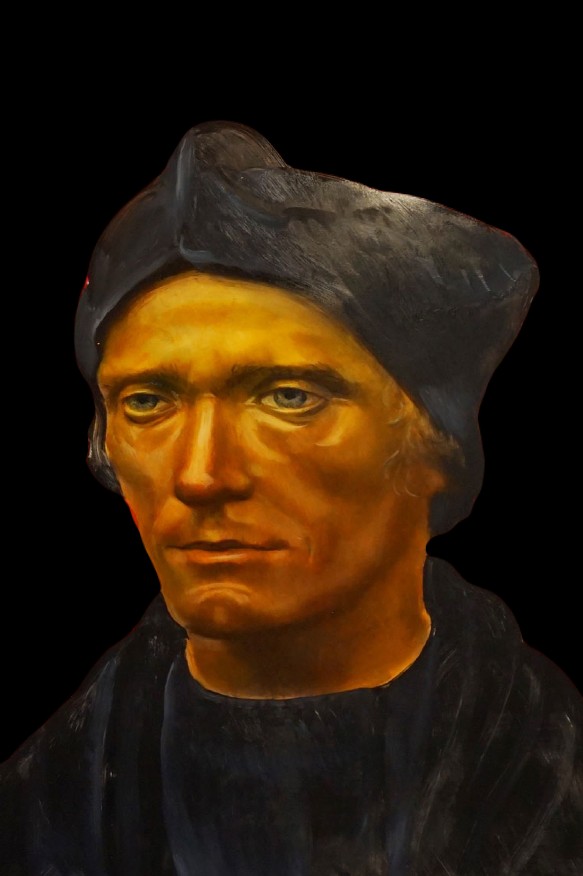
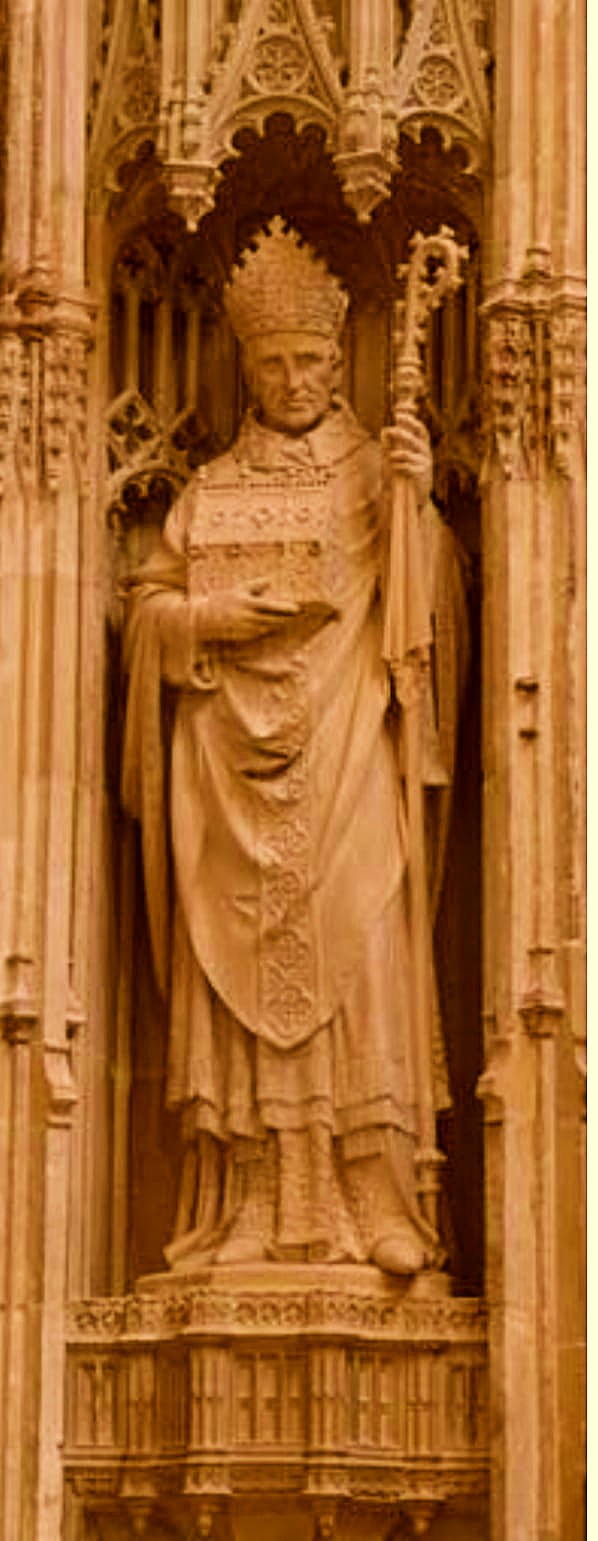
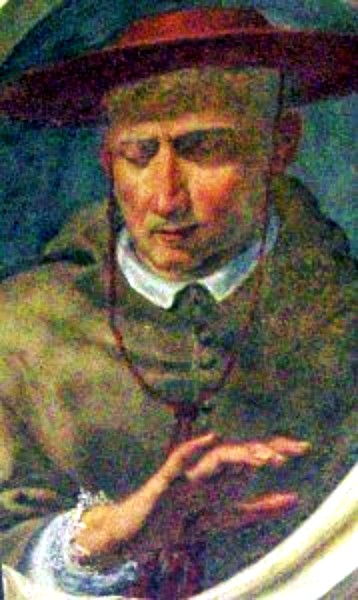
Our Morning Offering – 9 July – “The Month of the Most Precious Blood” – Feast of St John Fisher (1469-1535) Bishop, Martyr, Confessor, Cardinal
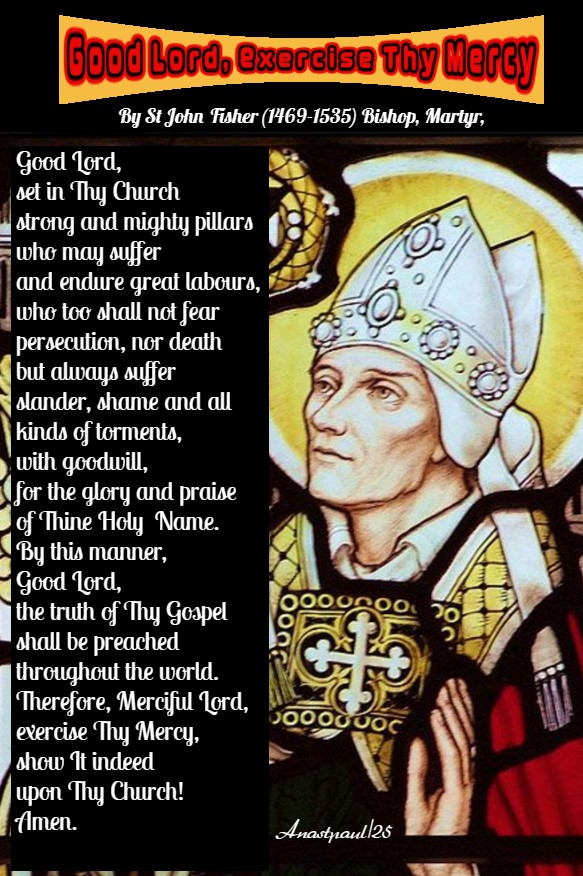
Good Lord, Exercise Thy Mercy By St John Fisher (1469-1535) Bishop, Martyr
Good Lord, set in Thy Church strong and mighty pillars who may suffer and endure great labours, who too shall not fear persecution, nor death but always suffer slander, shame and all kinds of torments, with goodwill, for the glory and praise of Thine Holy Name. By this manner, Good Lord, the truth of Thy Gospel shall be preached throughout the world. Therefore, Merciful Lord, exercise Thy Mercy, show It indeed upon Thy Church! Amen
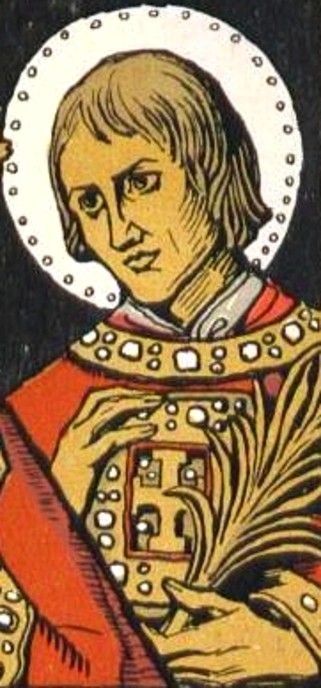
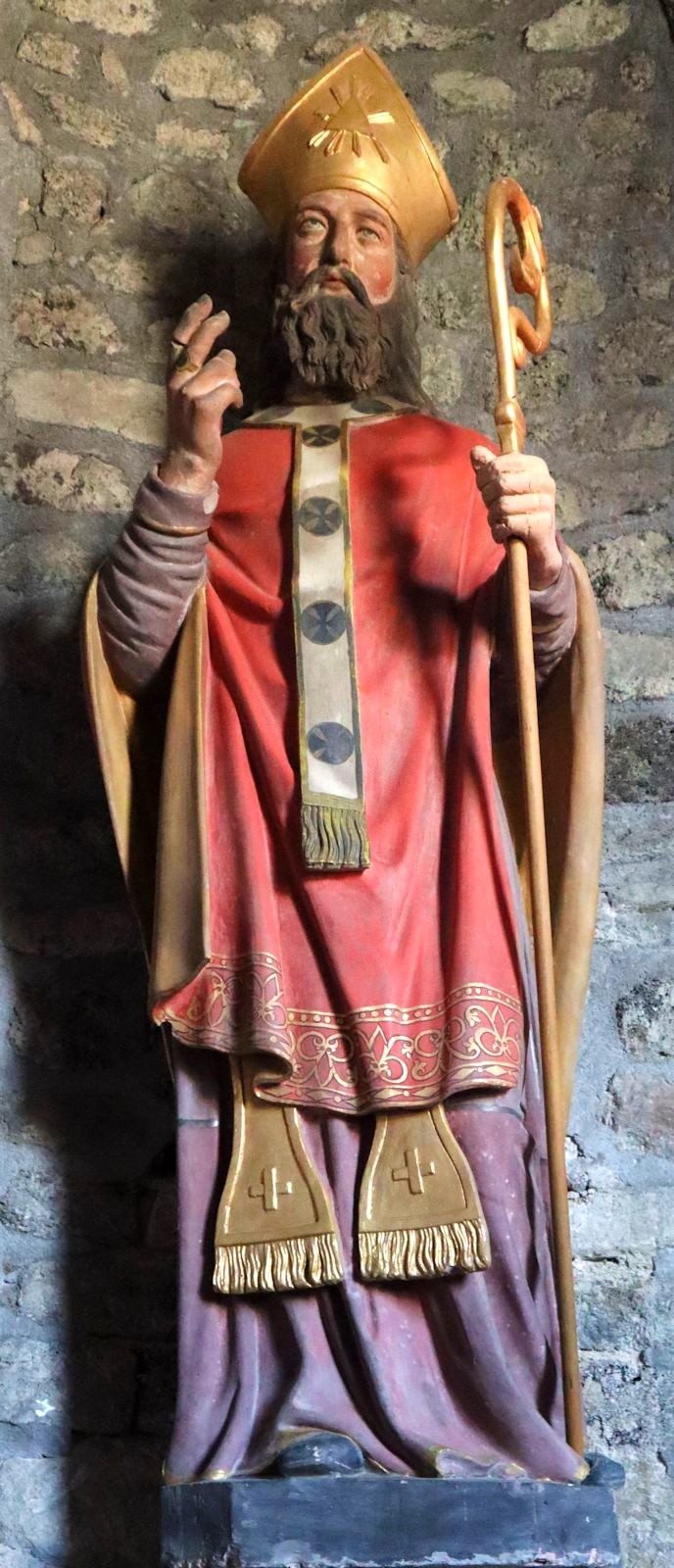
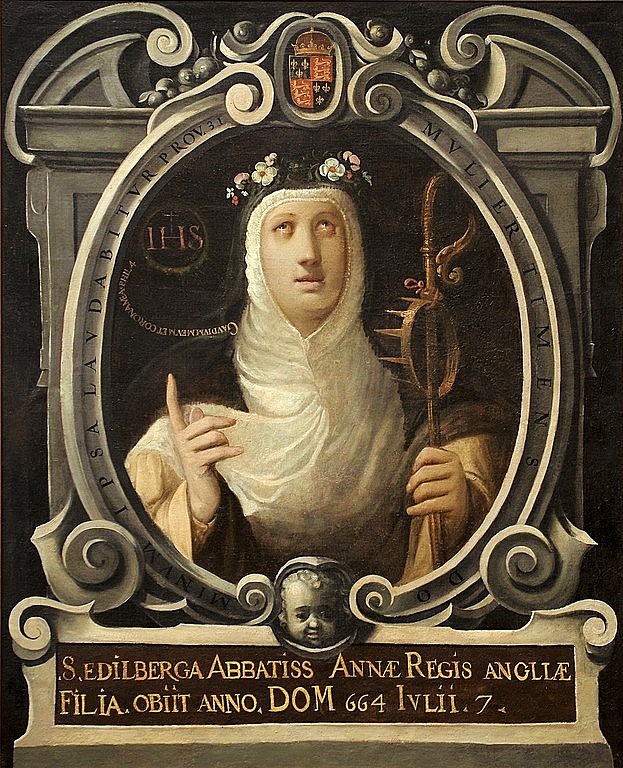
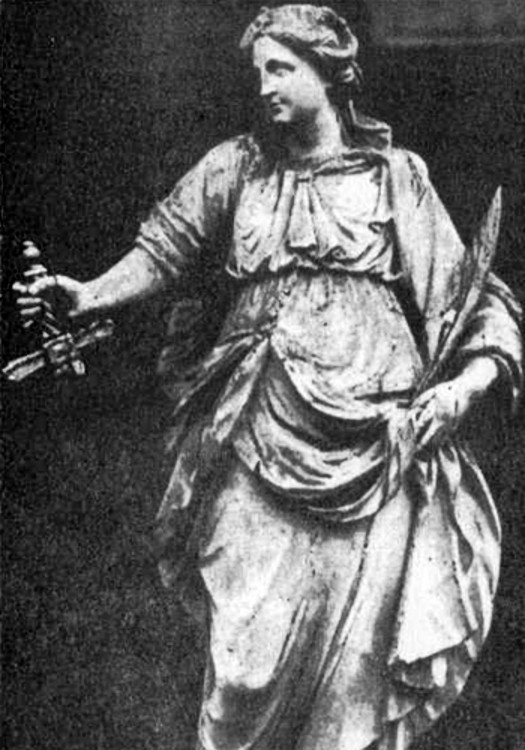
Saint of the Day – 9 July – St Everilda (7th Century) Abbess in Everingham, England. Everilda was the Founder of a Convent at Everingham, in the English County of Yorkshire in the East Riding All we know of her comes from the York Breviary. She died in c700. Also known as – Averil, Everildis.
Everilda was converted to Christianity by Saint Birinus, along with King Cynegils of Wessex, in 635. Her legend in the York Breviary states that she was of the Wessex nobility.
She fled from home to avoid arranged marriage and to dedicate herself to God. She consecrated herself to God and became a Nun, joined by Saints Bega and St Wuldreda.
Saint Wilfrid of York officiated at their Consecration at a place called the Bishop’s Farm, later known as Everildisham. This place has been identified with present-day Everingham. The Monastery quickly became a very important centre of spirituality, around the Abbess, our Saint Everilda a large community of about 80 Nuns formed.
Tradition has it that the Abbess “formed many virgins to the perfection of divine love, the pinnacle of Christian virtue, animating them with the true spirit and continually encouraging them in the most fervent and faithful fulfillment of all the duties, and application to all the exercises of their holy profession.”
Everilda died peacefully when her mission was accomplished.
Her name appears in the Martyrology of Usuard, as well as in the Church calendars of York and Northumbria.
There are two Churches dedicated to St Everilda – St Everilda’s Church, Nether Poppleton and Sts Mary & Everilda, Everingham.
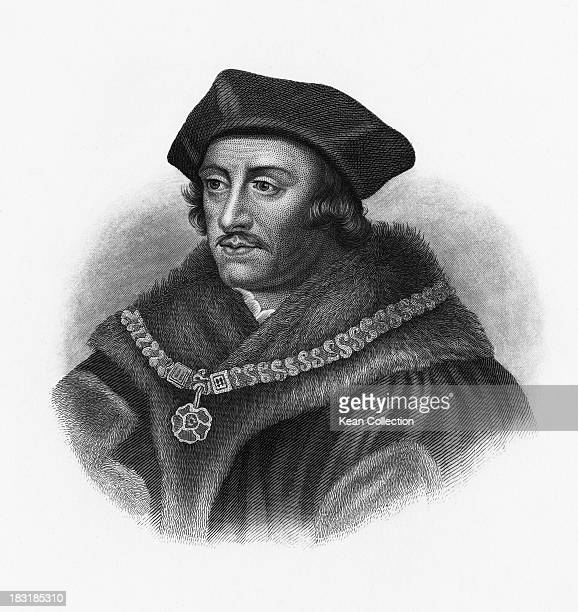
English lawyer, writer and statesman Sir Thomas More (1478 – 1535). Engraving by W. Wellstood & Co. (Photo by Kean Collection/Getty Images)
St Maria Goretti (1890-1902) Virgin and Martyr, known as “Saint Agnes of the 20th Century.” She was Canonised on 24 June 1950 by Pope Pius XII The ceremony was attended by 250,000 including her mother, the only time a parent has witnessed her child’s Canonisation. Her Life and Death: https://anastpaul.com/2017/07/06/saint-of-the-day-6-july-st-maria-goretti/
Blessed Adrian Fortescue TOSD (1476-1539) Martyr,. A husband and father, a Justice of the Peace, a Knight of the Realm, a Knight of Malta and a Dominican Tertiary (Lay Dominican), he was at once a loyal servant of the Crown so far as he could be but still more, he was a man of unshakeable faith and love of the One True Faith. He was Beatified on 13 May 1895 by Pope Leo XIII. His Life and Death: https://anastpaul.com/2018/07/09/saint-of-the-day-blessed-adrian-fortescue-1476-1539-martyr/
St Agrippinus of Autun St Alexander of Egypt St Audax of Thora
St Copra of Egypt St Cyril of Gortyna St Everilda (7th Century) Abbess in Everingham, England St Faustina of Rome St Felician of Sicily
Blessed Giovanna Scopelli O.Carm (1428 – 1491) Virgin, Mystic, Italian Religious of the Carmelites and established her own Convent as its first Prioress. She was known, during her lifetime as a Miracle-worker with many coming to her to ask for her assistance and prayers. Her body is incorrupt. About Blessed Giovanna: https://anastpaul.com/2021/07/09/saint-of-the-day-9-july-blessed-giovanna-scopelli-o-carm-1428-1491/
St Floriana of Rome St Hérombert of Minden Bl Joachim HoBl Luigi Caburlotto St Patermutius of Egypt St Paulina do Coração Agonizante de Jesus
Four Holy Polish Brothers – 4 Saints: Four brothers who became Hermits, Benedictine Monks and Saints – Andrew, Barnabas, Benedict and Justus. They were born in Poland and died in 1008 of natural causes.
Martyrs of the Baths – 10,204 Saints: A group of Christians enslaved by Diocletian to build the gigantic Baths in Imperial Rome, Italy. The end of their labours coincided with the beginning of the great persecutions of Diocletian and they were all executed. Ancient records indicated there were 10,204 of them; Zeno of Rome is the only one whose name has come down to us and we know nothing else about any of their individual lives.
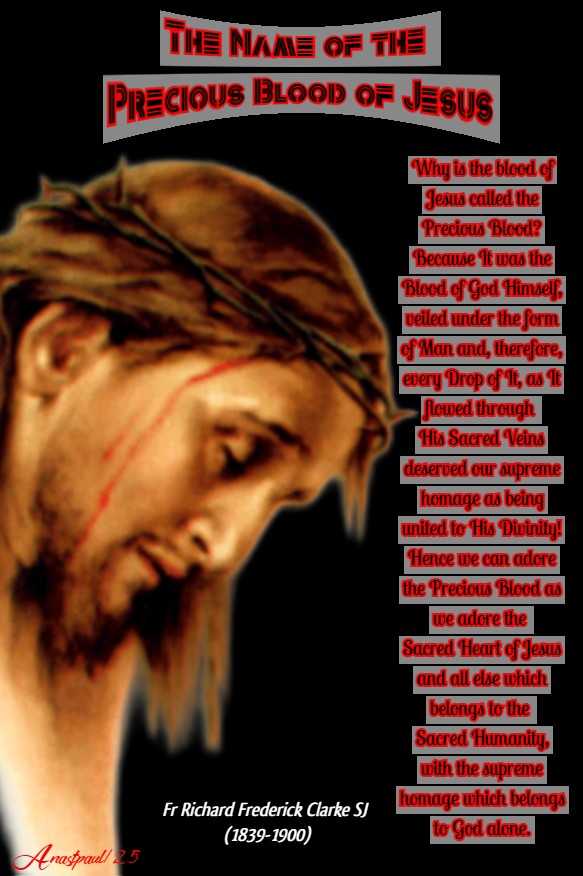
Thought for the Day – 8 July – Meditations with Fr Richard Frederick Clarke SJ (1839-1900)
From “The Devout Year” By Fr Richard Frederick Clarke SJ (1839-1900)
The Name of the Precious Blood of Jesus
+1. Why is the blood of Jesus called the Precious Blood? Because It was the Blood of God Himself, veiled under the form of Man and, therefore, every Drop of It, as It flowed through His Sacred Veins deserved our supreme homage as being united to His Divinity! Hence we can adore the Precious Blood as we adore the Sacred Heart of Jesus and all else which belongs to the Sacred Humanity, with the supreme homage which belongs to God alone.
+2. We also term It, the Precious Blood, inasmuch as It was the Blood of One Who was not only full of grace but was Himself the Source of all grace, so the grace which dwelt with Him was Infinite and the grace which manifested itself through the veil of Flesh, had no bounds or limits, save those which the mere fact of His Human Nature carried with It. If, therefore, the blood of the Saints is counted as most precious, if we treasure a piece of cloth stained with their blood, how much more precious, beyond all price,is the Blood of the King of Saints!
+3. The Precious Blood is also precious on account of Its effects. One Drop of It was sufficient, not only to cleanse the world from sin but, to earn all possible graces for all the millions who have ever lived on earth. How Infinite then must be its Preciousness! What has it not done for man! What has it not done for me! It has washed me clean and made me pure, in spite of all my sins. O Jesus! give me an ever -increasing devotion to the Precious Blood!
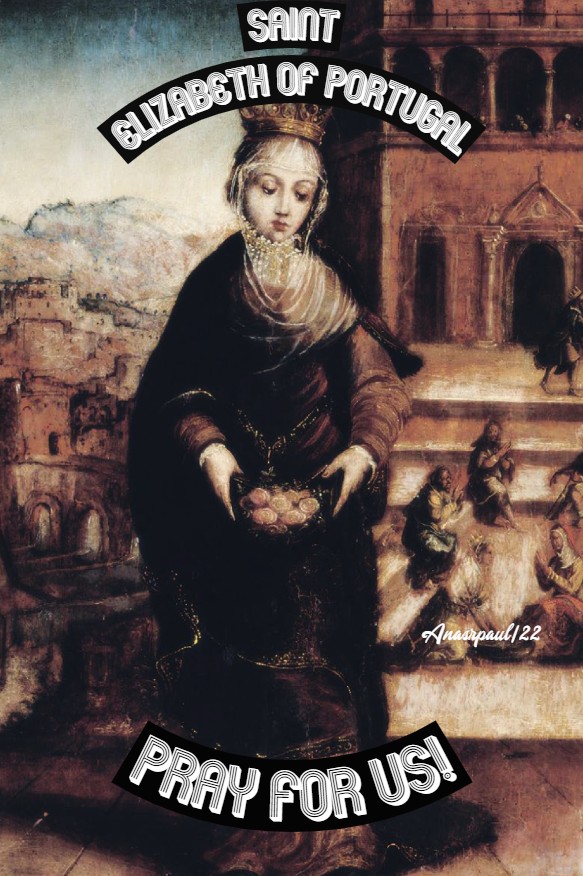
Quote/s of the Day – 8 July – “The Month of the Most Precious Blood” – St Elizabeth of Portugal TOSF (1271-1336) Widow, Queen – Proverbs 31:10-31 – Matthew 13:44-52 – Scripture search here: https://www.drbo.org/
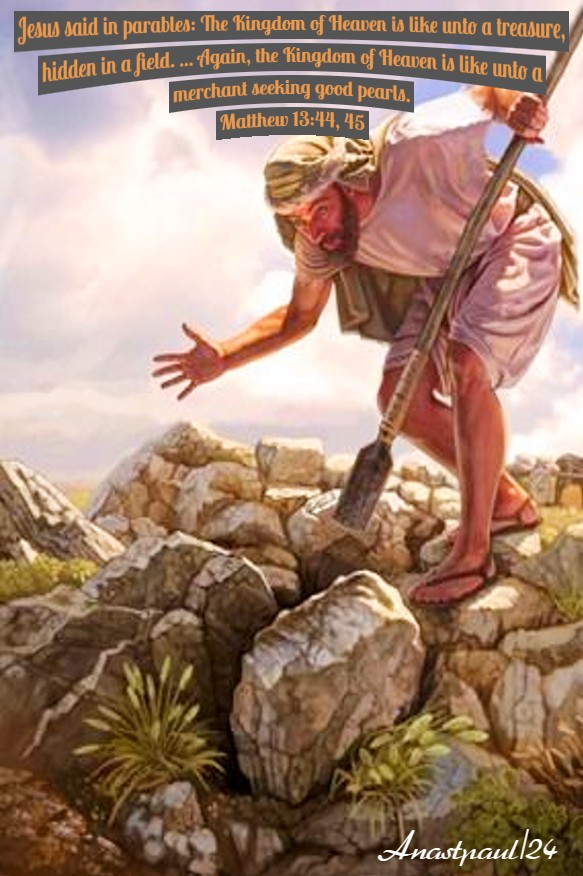
“Jesus said in parables: The Kingdom of Heaven is like unto a treasure, hidden in a field. … Again, the Kingdom of Heaven is like unto a merchant seeking good pearls. ”
Matthew 13:44, 45
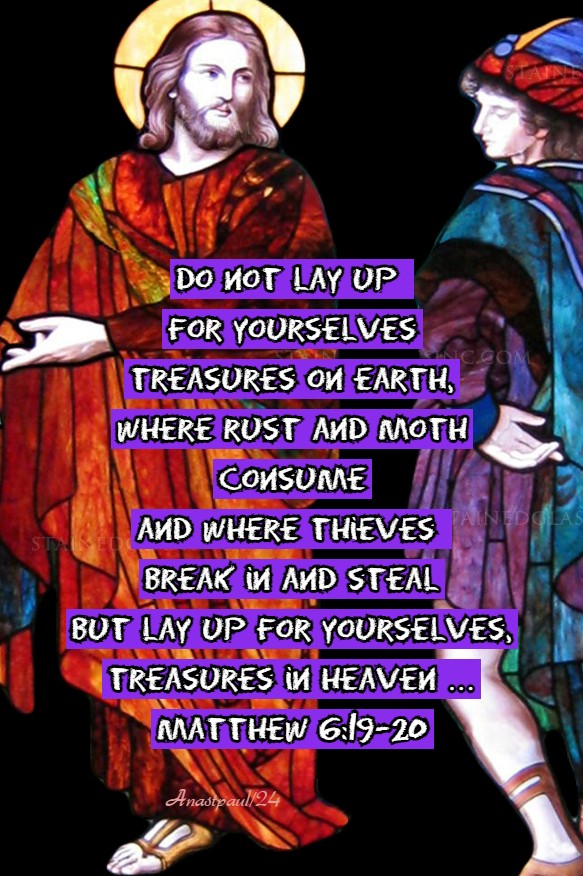
“Do not lay up for yourselves treasures on earth, where rust and moth consume and where thieves break in and steal but lay up for yourselves, treasures in Heaven …”
Matthew 6:19-20
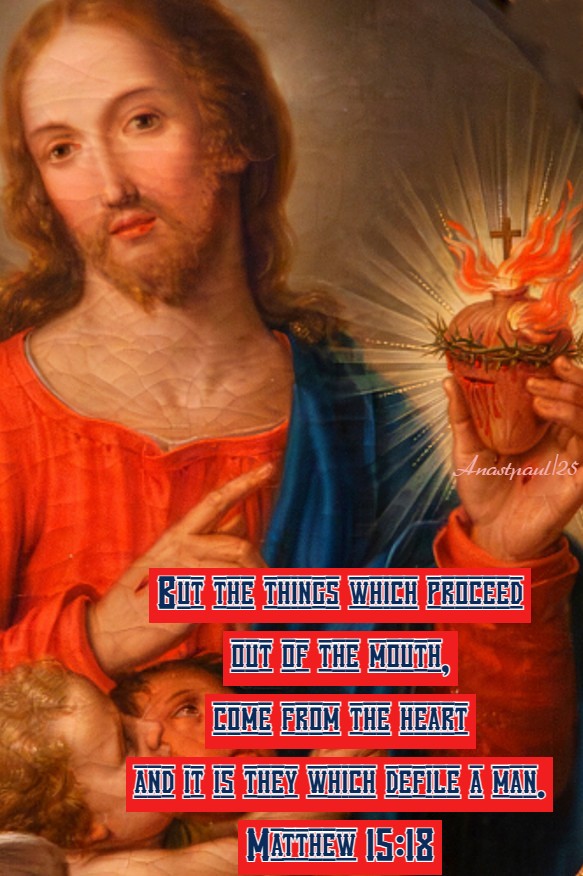
“But the things which proceed out of the mouth, come from the heart and it is they which defile a man.”
Matthew 15:18
“Our hearts were made for Thee, O God And restless must they be Until, O God, this grace accord, Until they rest in Thee!”
St Augustine (354-430) Father and Doctor of the Church
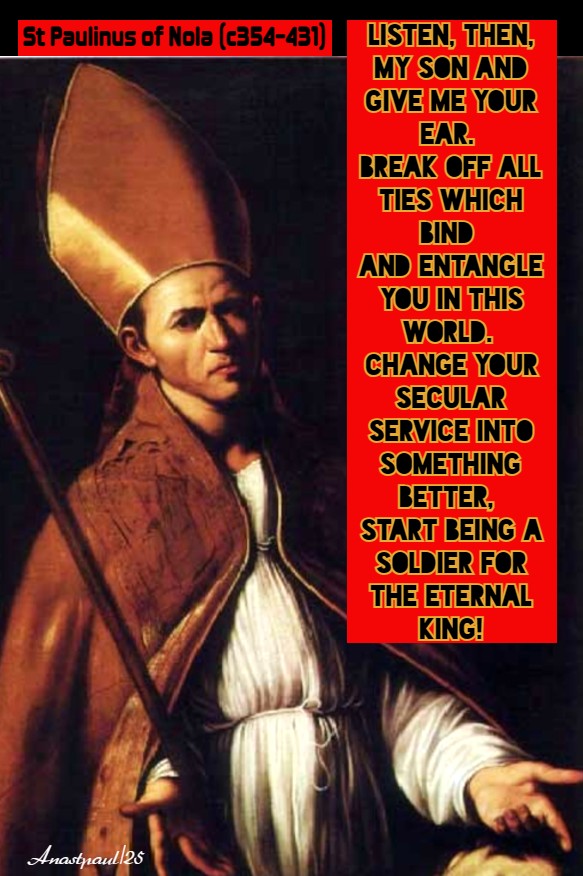
“Listen, then, my son and give me your ear. Break off all ties which bind and entangle you in this world. Change your secular service into something better, start being a soldier for the eternal King!”
St Paulinus of Nola (c354-431)
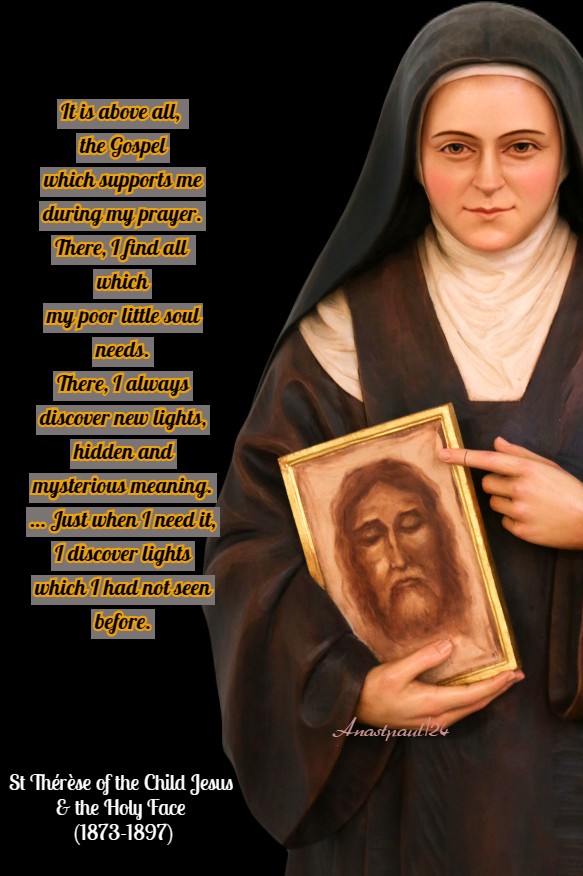
“It is above all, the Gospel which supports me during my prayer. There, I find all which my poor little soul needs. There, I always discover new lights, hidden and mysterious meaning. … Just when I need it, I discover lights which I had not seen before.”
One Minute Reflection – 8 July – “The Month of the Most Precious Blood” – St Elizabeth of Portugal TOSF (1271-1336) Widow, Queen – Proverbs 31:10-31 – Matthew 13:44-52 – Scripture search here: https://www.drbo.org/
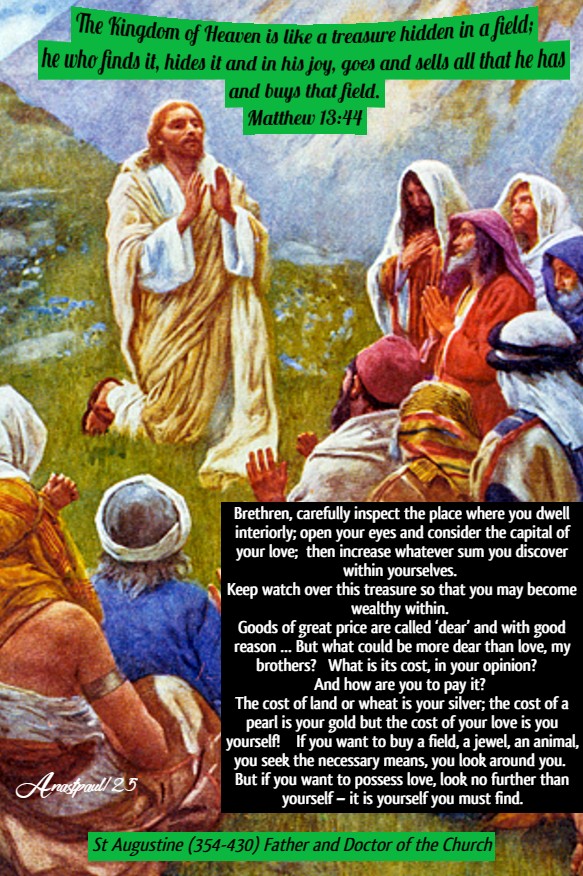
“The Kingdom of Heaven is like a treasure hidden in a field; he who finds it, hides it and in his joy, goes and sells all that he has and buys that field.” – Matthew 13:44
REFLECTION – “Brethren, carefully inspect the place where you dwell interiorly; open your eyes and consider the capital of your love; then increase whatever sum you discover within yourselves. Keep watch over this treasure so that you may become wealthy within. Goods of great price are called ‘dear’ and with good reason … But what could be more dear than love, my brothers? What is its cost, in your opinion? And how are you to pay it? The cost of land or wheat is your silver; the cost of a pearl is your gold but the cost of your love is you, yourself! If you want to buy a field, a jewel, an animal, you seek the necessary means, you look around you. But if you want to possess love, look no further than yourself – it is yourself you must find.
What are you afraid of in giving yourself? Of losing yourself? To the contrary, it is by refusing to give yourself that you lose yourself! Love itself speaks through the mouth of Wisdom and with one word, calms the confusion into which this saying threw you: “Give of your own self!” If someone had wanted to sell you a piece of land, he would say to you: “Give me your silver” or, for some other thing: “Give me your cash.” Now listen to what Love says to you through the Mouth of Wisdom: “My child, give me your heart” (Pr 3:26). Your heart was in a bad way when it was your own, when it was in your own hands. You were a prey to emptiness, not to speak of evil passions. Remove it from all such things! Where will you take it? Where offer it? “My son, give Me your heart!” says Wisdom. Let it only come to Me and you will not lose it…
“You shall love the Lord your God with all your heart, with all your soul and with all your mind,” (Mt 22:37) … He Who created you, desires the whole of you!” – St Augustine (354-430) Father and Doctor of the Church (Sermon 34 on Ps 149).
PRAYER – Most merciful God, Who among other admirable gifts, endowed blessed Queen Elizabeth with the special grace of calming the tumult of war; grant by her intercession that, after the peace for which we humbly pray, we may attain everlasting happiness. Through the same Jesus Christ, Thy Son our Lord, Who lives and reigns with Thee, in the unity of the Holy Ghost, God, world without end. Amen (Collect).
Our Morning Offering – 8 July – “The Month of the Most Precious Blood”
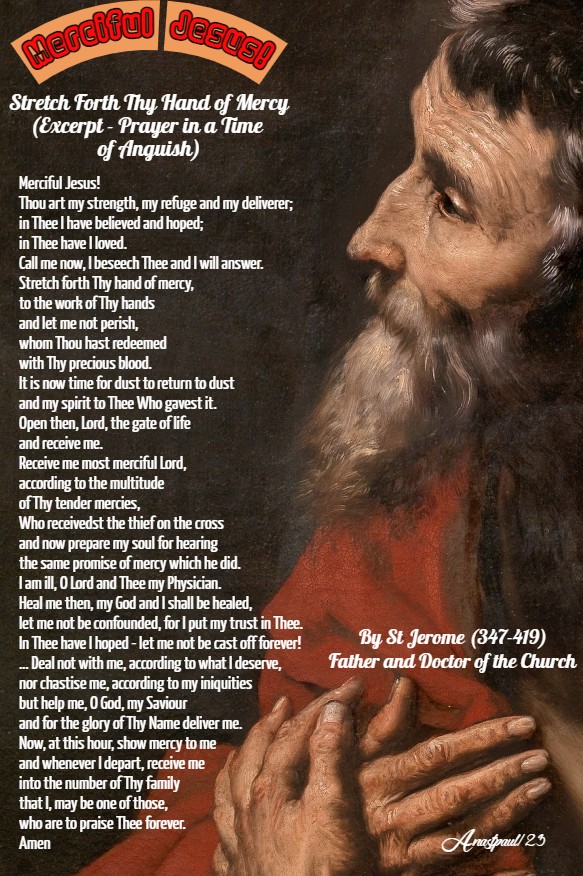
Merciful Jesus! Stretch Forth Thy Hand of Mercy (Excerpt – Prayer in a Time of Anguish) By St Jerome (347-419) Father and Doctor of the Church
Merciful Jesus! Thou art my strength, my refuge and my deliverer; in Thee I have believed and hoped; in Thee have I loved. Call me now, I beseech Thee and I will answer. Stretch forth Thy Hand of mercy, to the work of Thy Hands and let me not perish, whom Thou hast redeemed with Thy Precious Blood. It is now time for dust to return to dust and my spirit to Thee Who gavest it. Open then, Lord, the Gate of Life and receive me. Receive me most merciful Lord, according to the multitude of Thy tender mercies, Who receivedst the thief on the cross and now prepare my soul for hearing the same promise of mercy which he did. I am ill, O Lord and Thee my Physician. Heal me then, my God and I shall be healed, let me not be confounded, for I put my trust in Thee. In Thee have I hoped – let me not be cast off forever! … Deal not with me, according to what I deserve, nor chastise me, according to my iniquities but help me, O God, my Saviour and for the glory of Thy Name deliver me. Now, at this hour, show mercy to me and whenever I depart, receive me into the number of Thy family that I, may be one of those, who are to praise Thee forever. Amen
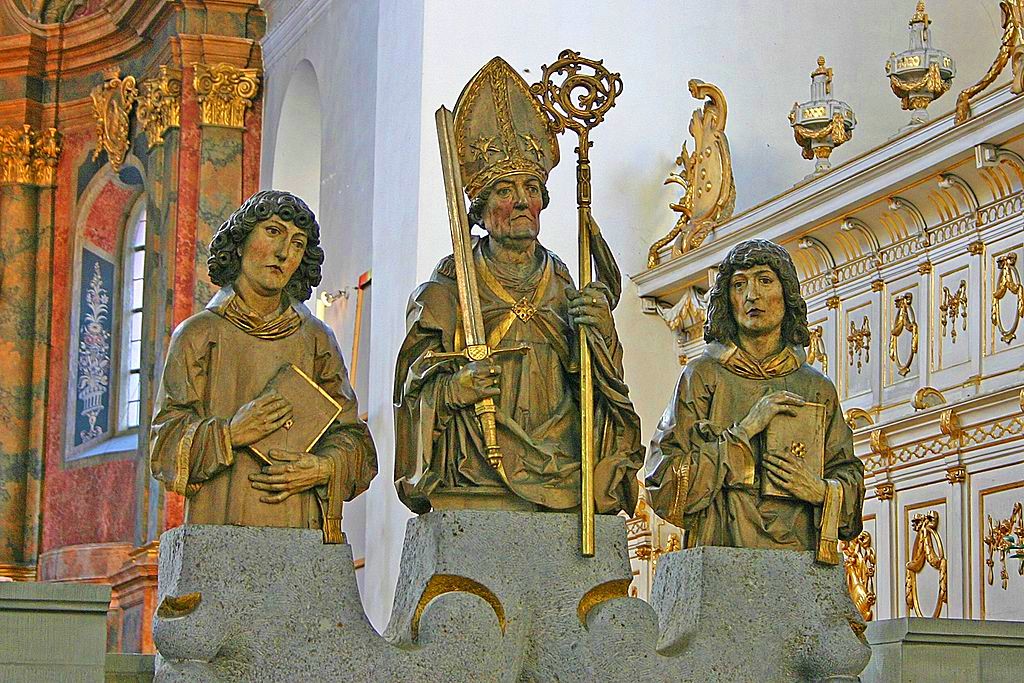
Saint/s of the Day – 8 July – St Colman (Died 689) Martyr Priest, Missionary in Thuringia, Germany, together with his master, the Bishop St Killian “Apostle of Franconia”(nowadays the northern part of Bavaria) and the Martyr Deacon St Totnan. Born in Ireland and died on 8 July 689 in Wurzburg. Patronages against gout and rheumatism, against deception, in Germany – of the Diocese of Aschaffenburg and Würzburg. Also known as – Colomann, Kolonat..
The Roman Martyrology reads today: “At Wurzburg in Germany, St Killian, a Bishop, who was commissioned by the Roman Pontiff to preach the Gospel. After having converted many to Christ, he was put to death with his companions, Colman, a Priest and Totnan, a Deacon.”
In 686 Pope Conon Ordained St Killian as a Missionary Bishop. St Kilian then returned to Würzburg in 687 with Saint Colman and Saint Totnan, as an assistant Priest and Deacon respectively.
The trio evangelised East Franconia and East Thuringia, areas in modern Bavaria, Germany, converted Duke Gozbert and a large part of Gozbert’s subjects.
St Colman
Like most Irish missionaries, they spoke fearlessly against any breach of faith or morals. In this case St Kilian openly rebuked the Duke for his irregular marriage to his brother’s widow. According to legend, while Gosbert was away on a military expedition, Geilan, his irregular wife, had the three missionaries beheaded when she found that Gosbert was going to leave her because their marriage was forbidden by the Church.
A strong cultus was immediately established in Germany and spread as far as Vienna, Austria and Ireland. Even today, the Kilianfest is one of the better known festivals of the German faithful which celebrates the lives of all tbree of these brave Missionary Saints.
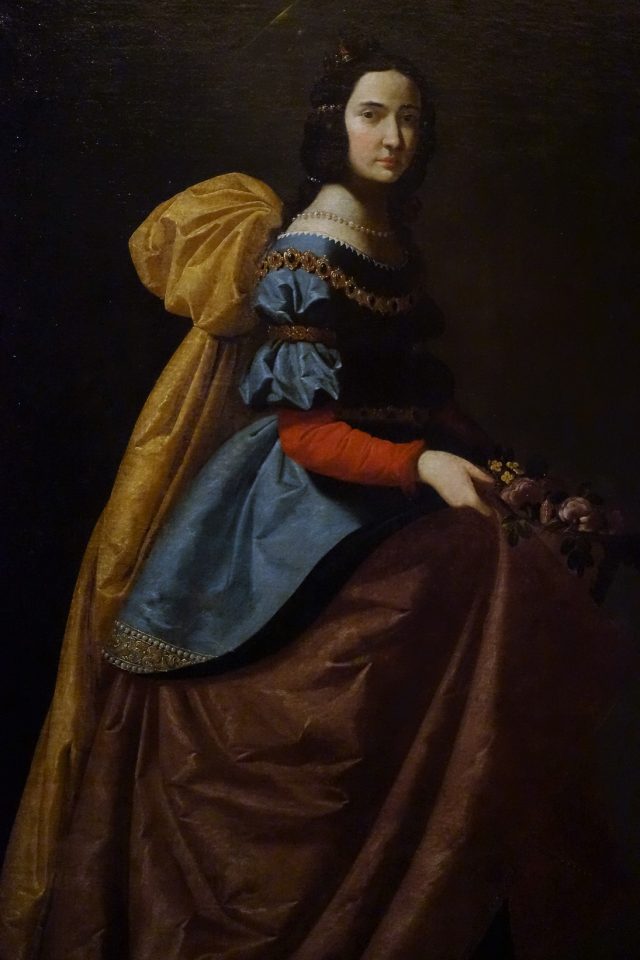
St Elizabeth of Portugal TOSF (1271-1336) Widow, Queen Consort, Franciscan Tertiary, Apostle of Charity and Peace, Political Negotiator and Mediator. In the year 1694 Pope Innocent XII moved her Feast to 8 July, so that it would not conflict with the celebration of the Octave of Saints Peter and Paul, Apostles. The Devoted Love of St Elizabeth: https://anastpaul.com/2018/07/04/saint-of-the-day-4-july-st-elizabeth-of-portugal-t-o-s-f-1271-1336/
St Abraham the Martyr Bl Adolf IV of Schauenburg St Pope Adrian III
St Arnold St Auspicius of Toul St Auspicius of Trier St Brogan of Mothil +St Colman (Died 689) Martyred Priest Missionary in Thuringia, Germany St Doucelin
St Morwenna – No details about her have survived. She is reported to have appeared in visions in Morwenstow, Cornwall, England, where her Relics are apparently buried under the Church floor.
St Pancras of Taormina Bl Peter the Hermit St Procopius of Ceasarea St Sunniva of Bergen St Thibaud de Marly +St Totnan (Died 689) Martyred Deacon Missionary in Thuringia, Germany
Abrahamite Monks/Martyrs of Constantinople: A group of Monks in a Monastery founded by Saint Abraham of Ephesus. Martyred in the iconoclast persecutions of Emperor Theophilus. In c 835 in Constantinople.
Martyrs of Shanxi – 7 Saints: In 1898 seven sisters of the Franciscan Missionaries of Mary were sent to the Shanxi Diocese in China to serve the poor in hospitals and care for the unwanted or other destitutes in orphanages. They were: Anne-Catherine Dierks, Anne-Francoise, Moreau, Clelia Nanetti, Irma Grivot, Jeanne-Marie Kuergin, Marianna Giuliani, Pauline Jeuris There they all died in one of the periodic persecutions against foreign missionaries. They were beheaded on 9 July 1900 at Taiyuanfu, China- Canonisedon 24 November 1946 by Pope Pius XII.
Martyrs of Syrmium – 5 Saints: Five Christians Martyred together for their faith. We know nothing else about them but the names – Cecilia, Eperentius, Eraclius, Sostratus and Spirus. They were martyred in the 4th century in Syrmium, Pannonia (modern Serbia).
Thought for the Day – 7 July – “The Month of the Most Precious Blood” – From The Sacred Triduum
“Carry one another’s burdens.” Gal 6:2
“He loved them unto the end.” John 13:1
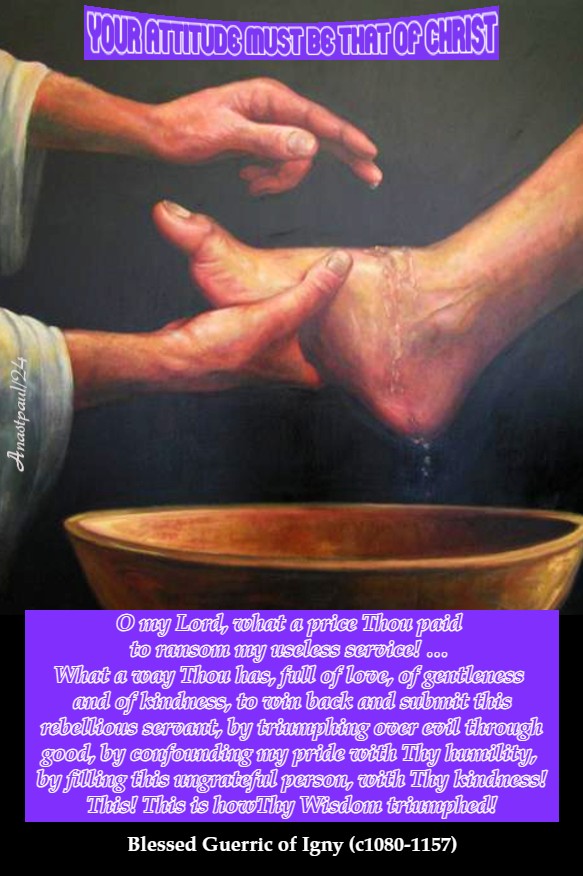
Your Attitude Must Be That of Christ
Blessed Guerric of Igny (c1080-1157) Cistercian Abbot
“He was in the form of God,” equal to God by nature, since He shared in God’s power, God’s eternity and God’s very being … He did the job of a servant “by humbling Himself, obeying His Father even to death, death on a Cross.” (cf Phil 2:5-8). One might consider it to be trivial that, as God’s Son and His equal, He served His Father as a servant. More than that, He served His own servant more than any other servant. For the human being had been created to serve His Creator. What could be more just for you, than to serve him who made you, without Whom you would not be? And what could be more blest, than to serve Him, since to serve Him is to reign? But the human being said to His Creator: “I will not serve.” (Jer 2:20)
Then the Creator said to the human being: “So I will serve you! Go sit down at the table; I will serve. I will wash your feet. Rest. I will take your pains upon myself; I will carry your weakness… If you grow tired or are burdened, I will carry you, you and your burden, so as to be the first to fulfil my law: ‘Carry one another’s burdens’ (Gal 6:2)… If you are hungry or thirsty… here I Am, ready to be sacrificed, so that you might eat My Flesh and drink My Blood… If you are taken into captivity or, if you are sold, here I Am… Redeem yourself by paying the ransom you will get from Me. I give Myself as ransom… If you are sick, if you fear death, I will die in your place, so that from My Blood you may make for yourself, a life-giving remedy!…”
O my Lord, what a price Thou paid to ransom my useless service! … What a way Thou has, full of love, of gentleness and of kindness, to win back and submit this rebellious servant, by triumphing over evil through good, by confounding my pride with Thy humility, by filling this ungrateful person, with Thy kindness! This! This is howThy Wisdom triumphed!” – (1st Sermon for Palm Sunday),
Quote/s of the Day – 7 July – St Lawrence of Brindisi OFM Cap (1559-1619) Confessor, The “Franciscan Renaissance Man” Priest
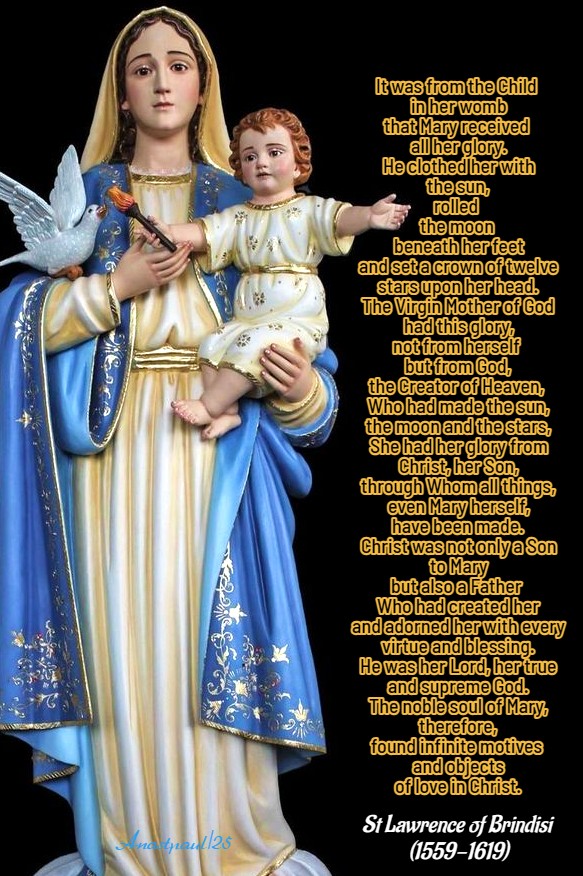
“It was from the Child in her womb that Mary received all her glory. He clothed her with the sun, rolled the moon beneath her feet and set a crown of twelve stars upon her head. The Virgin Mother of God had this glory, not from herself but from God, the Creator of Heaven, Who had made the sun, the moon and the stars, She had her glory from Christ, her Son, through Whom all things, even Mary herself, have been made. Christ was not only a Son to Mary but also a Father Who had created her and adorned her with every virtue and blessing. He was her Lord, her true and supreme God. The noble soul of Mary, therefore, found infinite motives and objects of love in Christ.”
One Minute Reflection – 7 July – “The Month of the Most Precious Blood” – Saint Cyril (827-869) and Saint Methodius (826-885) “Apostles to the Slavs,” Sibling Brother Bishops, Confessors – St Lawrence of Brindisi OFM Cap (1559-1619) Confessor, The “Franciscan Renaissance Man,” Priest – Hebrews 7:23-27 – Luke 10:1-9 – Scripture search here: https://www.drbo.org/
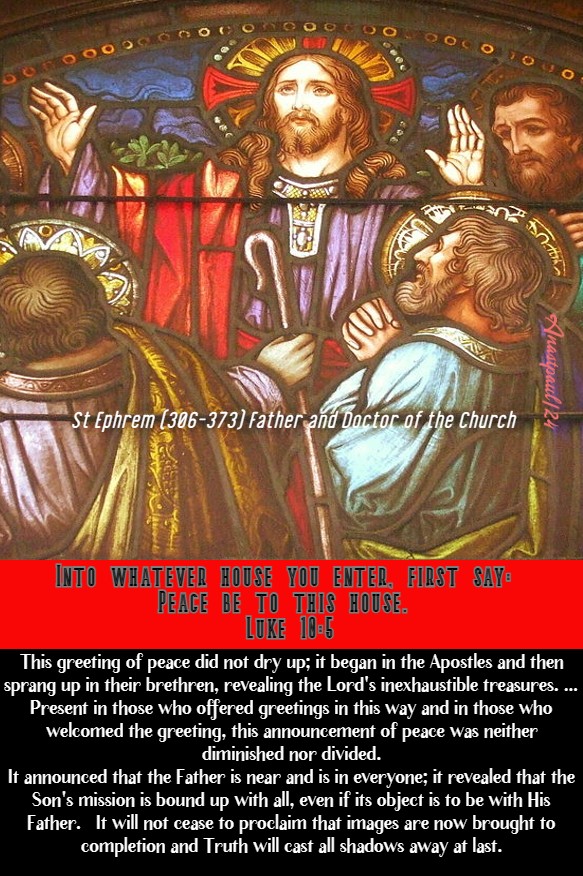
“Into whatever house you enter, first say: Peace be to this house. And, if the son of peace be there, your peace shall rest upon him but if not, it shall return to you.” – Luke 10:5-7
REFLECTION – “As you enter a house, first say, ‘Peace to this house,‘” (Lk 10:5) so that the Lord Himself might enter and remain there, as with Mary. … This greeting is the Mystery of Faith which shines forth in the world. Through it, enmity is stifled, war is ended and people acknowledge one another. The effect of that greeting was hidden by a veil in spite of the fact that it prefigures the Mystery of the Resurrection … when the light rises and dawn chases night away. From the moment Christ sent out His disciples, people began to give and receive this greeting, a source of healing and blessing. …
This greeting with its hidden power … is amply sufficient for us all. That is why Our Lord sent it out, together with His disciples, as forerunner, so that it might bring about peace and, carried by the voice of the Apostles whom He sent, prepare the way before them. It was sown in every dwelling … it entered into all who heard it, so as to separate and set apart, the children it recognised as its own. It remained in them but it denounced those who were alien to it, for they did not welcome it.
This greeting of peace did not dry up; it began in the Apostles and then sprang up in their brethren, revealing the Lord’s inexhaustible treasures. … Present in those who offered greetings in this way and in those who welcomed the greeting, this announcement of peace was neither diminished nor divided. It announced that the Father is near and is in everyone; it revealed that the Son’s mission is bound up with all, even if its object is to be with His Father. It will not cease to proclaim that images are now brought to completion and Truth will cast all shadows away at last.” – St Ephrem (306-373) Father and Doctor of the Church (Diatessaron 8: 3-4).
PRAYER – Look forgivingly on Thy flock, Eternal Shepherd and keep it in Thy constant protection, by the intercession of the blessed brothers, Cyril and Methodius, who, by the power of the Holy Ghost were moved to bring the light of the Gospel to a hostile and divided people. Through Jesus Christ, Thy Son our Lord, Who lives and reigns with Thee, in the unity of the Holy Ghost, God, world without end. Amen (Collect).
Our Morning Offering – 7 July – “The Month of the Most Precious Blood” – O Most Merciful Lord, Engrave Thy Wounds Upon My Heart By St Gertrude
O Most Merciful Lord, Engrave Thy Wounds Upon My Heart By St Gertrude the Great (1256-1302)
O Lord Jesus Christ, Son of the living God, grant that I may aspire to Thee with my whole heart, with yearning desire and with a thirsting soul, seeking only Thy sweetness and Thy delights, so that my whole mind and all that is within me, may ardently sigh for Thee, Who art our true Beatitude. O most merciful Lord, engrave Thy Wounds upon my heart with Thy most Precious Blood that I may read in them, both Thy Grief and Thy Love. May the memory of Thy Wounds ever remain in my inmost heart, to excite my compassion for Thy sufferings and to increase my love for Thee. Grant too that I may despise all creatures so that my heart may delight in Thee alone. Amen.
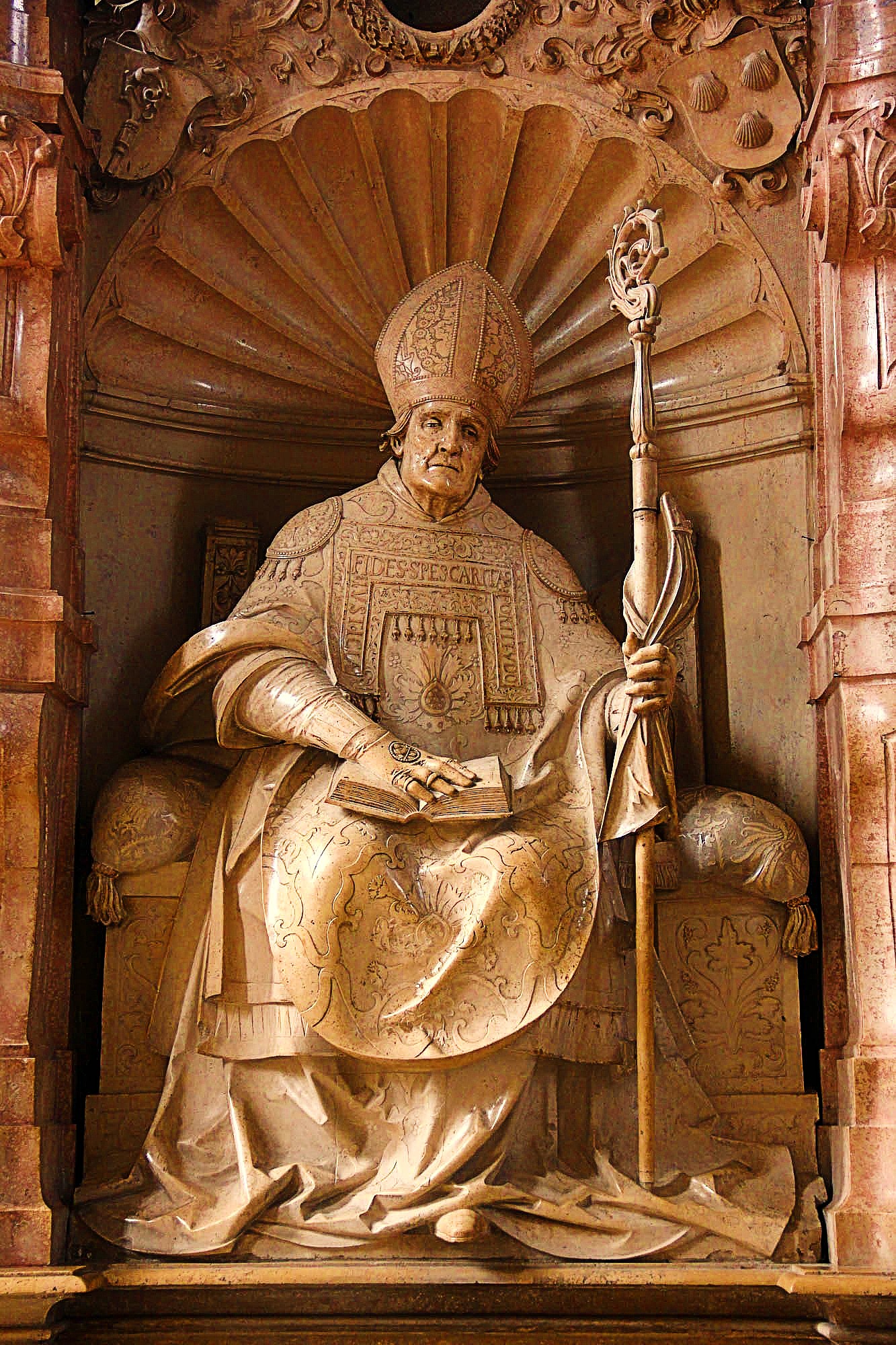
Saint of the Day – 7 July – Saint Hedda (Died 705) Bishop of Winchester, England, Monk, Abbot Believed to have been born in Headingley, Leeds and died on 7 July 705 in Winchester, after having served his huge Diocese as a faithful shepherd for around 30 years. He had been a man of love and justice, of knowledge and eloquence and great determination. Also known as – Hedda of Dorchester, Hedda of Wessex, Edda… Haeddi…
The Roman Martyrology reads today: “In England, St Hedda, Bishop of the West -Saxons.”
Almost nothing is known of the early life of Hedda, who, according to the historian, William of Malmesbury (1080-1143), was first a Monk and then an Abbot, possibly of a Monastery in Wessex.
His signature on a document, suggests that Hedda was the Abbot of a Monastery in Wessex, perhaps Glastonbury. Moreover, this hypothesis seems confirmed by the fact that his name was found among those of Abbots and illustrious men on one of the ancient and almost illegible records engraved on stone “pyramids” at Glastonbury.
According to other sources, Hedda was a Monk at St Hilda’s Monastery at Whitby but, the fame of Whitby as a centre of learning, taken together with the statements of the Venerable St Bede about Hedda’s less comprehensive education, make this thesis seem unlikely. St Bede states further, that Hedda was “a just and good man”and that he governed his Diocese with love being “more inspired by a love of virtue, than by lessons … ” However, William of Malmesbury insists that after having read much of Hedda’s correspondence, he found our Saint to be a man of great knowledge and profound eloquence.
Hedda settled in Winchester, as the Episcopal Seat of the Diocese of the West-Saxons, (formerly in Dorchester) making this move permanent and then proceeding to transfer the Relics of St Birinus from Dorchester to Winchester . These Relics he had placed in the Church of Sts Peter and Paul.
St Hedda holding the Relics of St Birnus
It was Hedda who brought King Cenwalh to the Faith, who, despite the conversion of his father, Cynogils, had long remained a pagan. Hedda was also a valued advisor to King St Ina (689-726) in whose law code of Wessex, the Bishop is mentioned as contributing to the laws and thus, was not a stranger to the wise laws issued by King Ina. He also visited the Hermit St Gutlach, on the Island of Croyland, Ordained him a Priest and Consecrated his Church. The Bishop Hedda, was one of the first benefactors, (probably affirming his deep connections to it) of Glastonbury Abbey, to which he made a gift of lands and on which he directed the favours of the sovereigns.
Throughout his Episcopate, Hedda strenuously opposed any attempt to divide his Diocese and this seems also in consideration of the precarious and difficult political situation of the Kingdom of Wessex, whose unity would have been favoured by that of the Diocese. Archbishop Theodore of Canterbury, had divided numerous Diocese, left that of Wessex intact until the death of Hedda, perhaps because of the friendship which bound him to the latter.
In 704 the question was again raised, as is evident from a letter written by Wealdheri, the Bishop of London, to Archbishop Britwald to inform him that a Synod of Bishops held that year, had decided to exclude the West-Saxons from communion, unless they conformed to the disposition of the same Archbishop which seems to have referred to the question of the division of the Diocese. Hedda, however, persisted in his position.
Hedda died in Winchester in 705. The faithful of his Diocese, whom he had governed for about thirty years, soon venerated him as a Saint. So many were the miracles and cures at his tomb, St Bede says even the dust from his grave had the power to perform miraculous cures.
His memory is celebrated on 7 July and on that day Hedda is also commemorated in the Roman Martyrology. His Feast is still celebrated Liturgically today in the Archdiocese of Birmingham which governs Winchester.
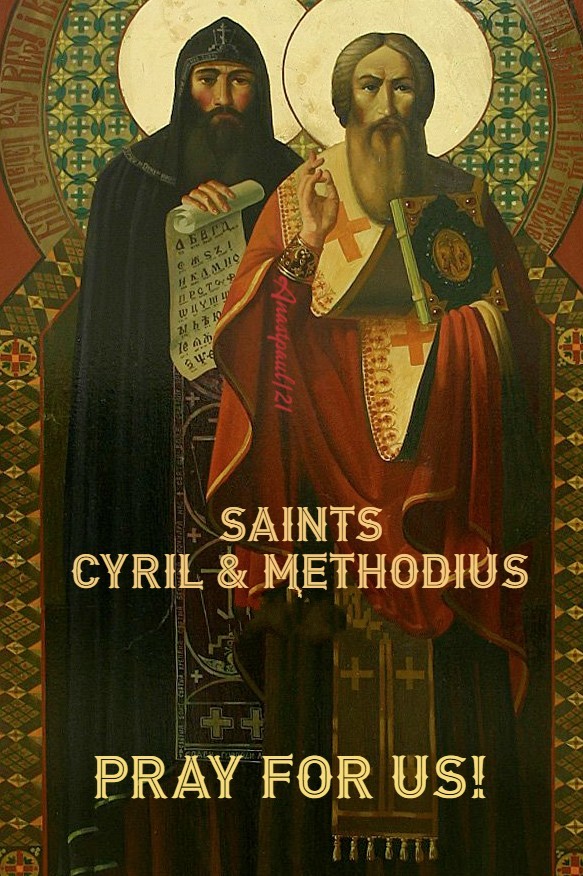
Saint Cyril (827-869) Saint Methodius (826-885) “Apostles to the Slavs,” Sibling Brother Bishops, Confessors, Theologians, Missionaries, Writers, Preachers, Patrons of Europe. Creators of the Glagolitic alphabet, the first alphabet used to transcribe Old Church Slavonic and Cyrillac Alphabet, which was developed from it. Their Feast Day is 7 July (moved in 1969). The great Saints Cyril & Methodius: https://anastpaul.wordpress.com/2018/02/14/saints-of-the-day-14-february-sts-cyril-827-869-methodius-826-885/
St Lawrence of Brindisi OFM Cap (1559-1619) Confessor, The “Franciscan Renaissance Man,” Priest and Friar of the Friars Minor Capuchin, Theologian, Vicar General of the Franciscans, Language scholar, Humanist, Philosopher, Biblicist, Preacher, Missionary, Professor, International Administrator, Confidant of Popes, Emperors, Kings and Princes, Diplomatic envoy, Army Chaplain, Military Strategist and Morale builder, Polemicist, Prolific writer. He was Beatified on 1 June 1783 by Pope Pius VI and Canonised on 8 December 1881 by Pope Leo XIII. His Zealous Life: https://anastpaul.com/2017/07/21/saint-of-the-day-21-july-st-lawrence-of-brindisi-o-f-m-cap-doctor-of-the-church/
St Alexander St Angelelmus of Auxerre St Apollonius of Brescia
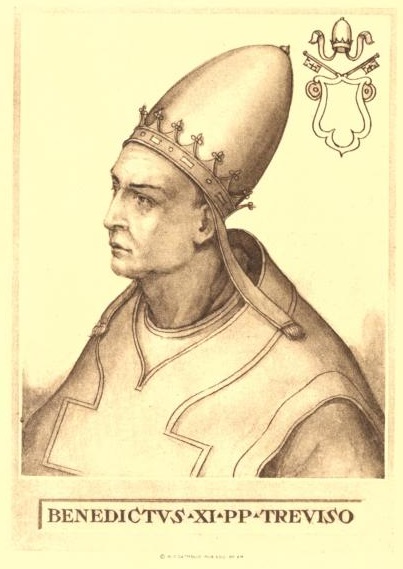
Blessed Pope Benedict XI OP (1240-1303) Cardinal-Priest of St Sabina, Bishop of Ostia then of Rome, Dominican Friar, Prior Provincial of Lombardy prior to becoming the Master of the Order in 1296, Apostolic Papal Legate to Hungary and France, Teacher, Preacher, Writer and renowned Scholar with special emphasis on Scriptural commentary. His Papacy began on 22 Ocober 1303 and ended at his death on 7 July 1304. His Life pf Grace: https://anastpaul.com/2020/07/07/saint-of-the-day-7-july-blessed-pope-benedict-xi-1240-1303/
Bl Bodard of Poitiers St Bonitus of Monte Cassino St Carissima of Rauzeille St Eoaldus of Vienne
St Hedda (Died 705) Bishop of Winchester, England St Maelruan St Medran St Merryn Bl Oddino Barrotti
St Odo (c1063-1122) Bishopof Urgella zealous Defender of the rights of his See, builder and restorer of numerous Churches but most of all, Bishop Odo is remembered as a most gentle and generous benefactor of the poor, the needy and the ill. Patronage – of La Seu d’Urgell, Spain. A Holy and Zealous Bishop: https://anastpaul.com/2024/07/07/saint-of-the-day-7-july-saint-odo-of-urgell-c1063-1122-bishop/
St Odran St Palladius of Ireland
St Pantænus (Died c216) Father of the Church, Theologian, Philosopher, Teacher, Confessor and Defender of the Faith, Writer and interpreter of the Sacred Scriptures, the Trinity and Christology, Missionary. Convert of the disciples of the Apostles. Head of the Alexandrian School of Learning – a famous pupil was St Clement of Alexandria. A Life of Love: https://anastpaul.com/2019/07/07/saint-of-the-day-7-july-st-pantaenus-father-of-the-church-died-c-216/
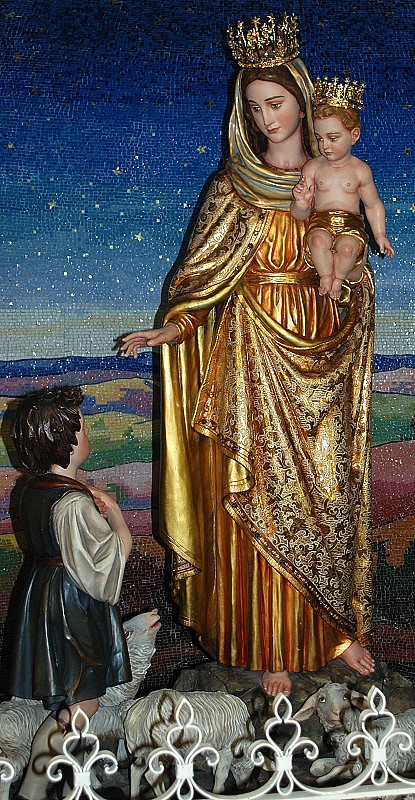
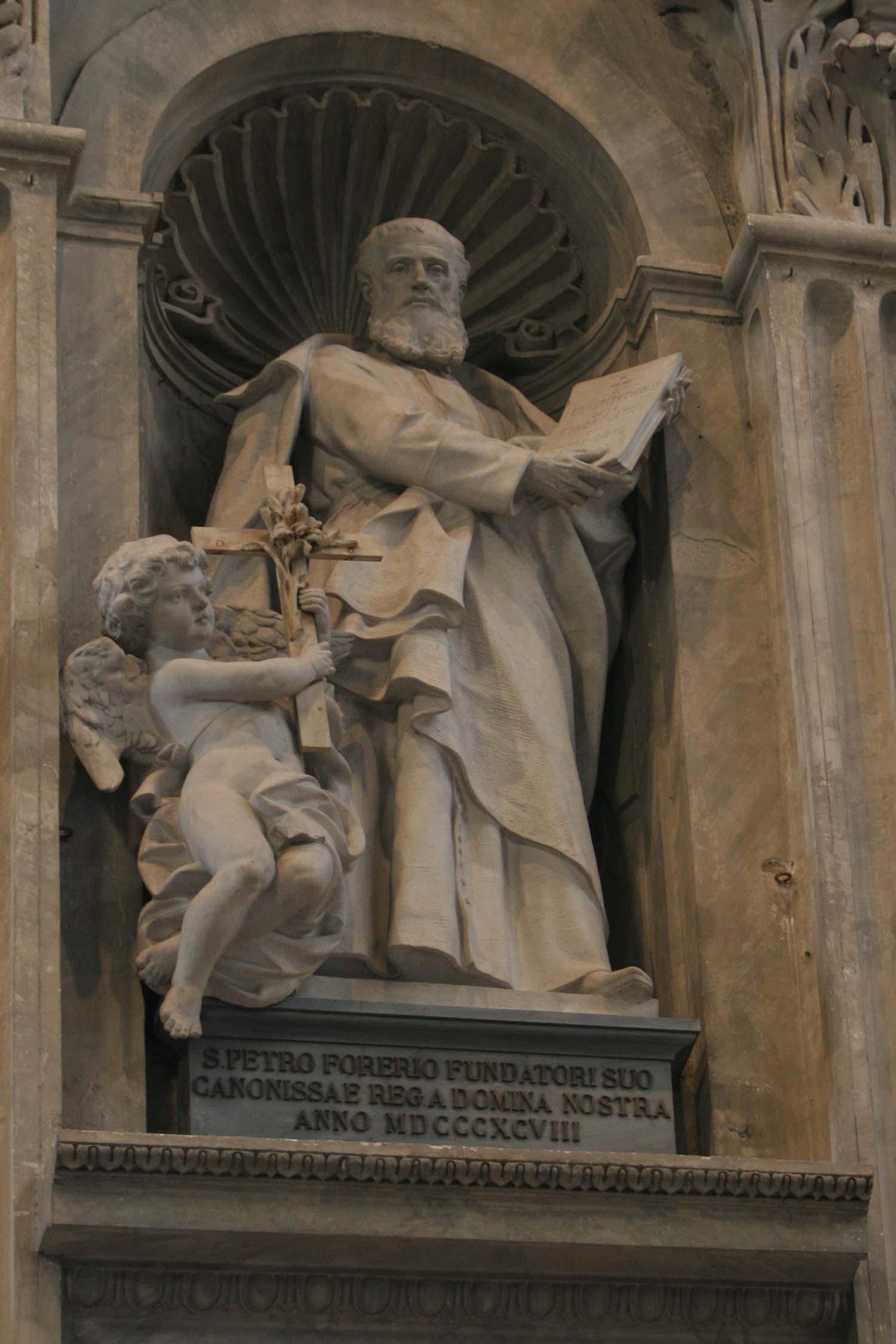
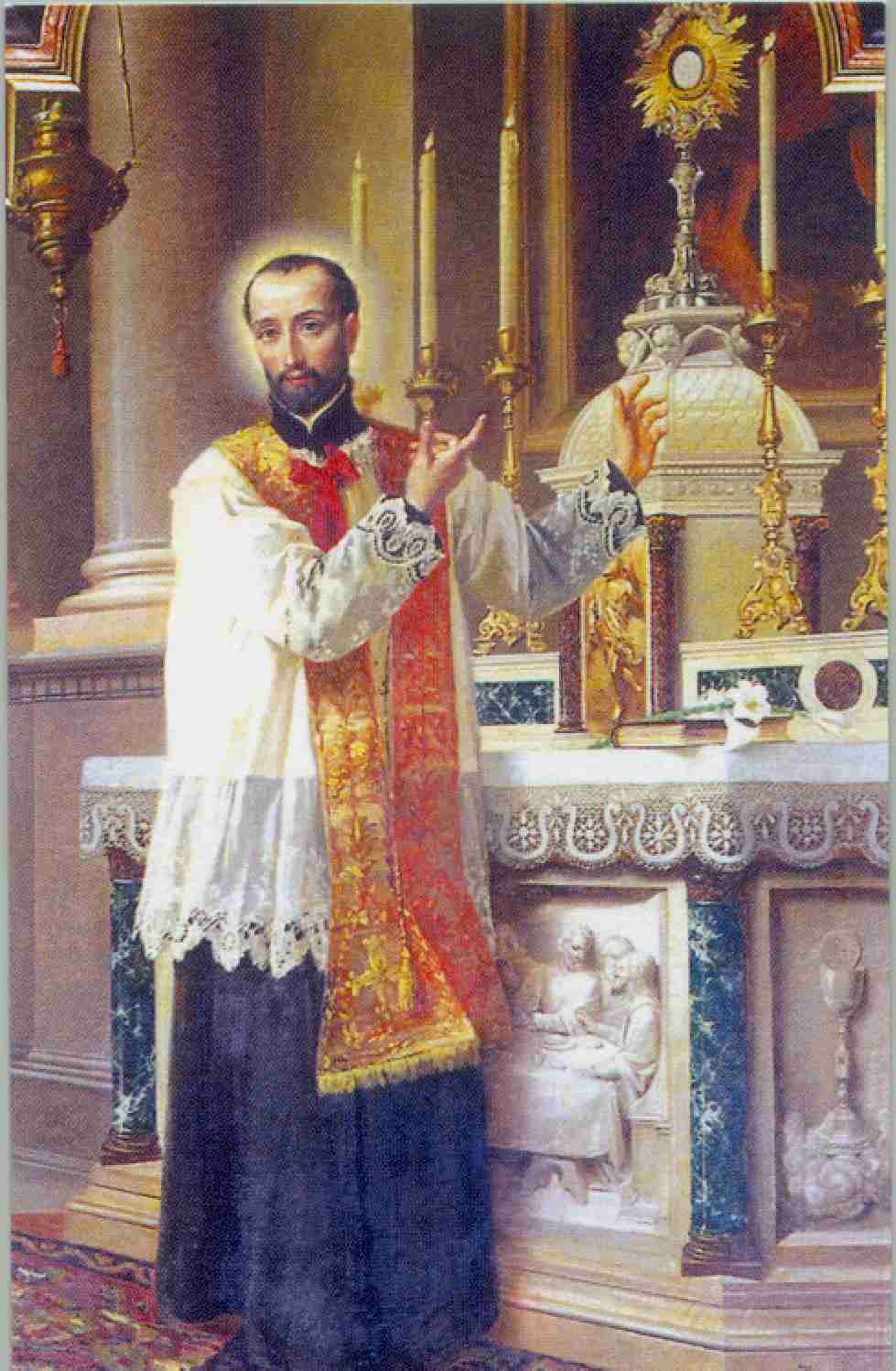
St Peter Fourier CRSA (1565-1640) Priest, Founder, Reformer, Confessor, Theologian, Teacher, Preacher, Apostle of Prayer, Penance and Charity, Marian devotee – “the Good Father of Mattaincourt” “le bon pere de Mattaincourt”. Although he died on 9 December his Feast Day is celebrated today, 7 July, possibly the date of the translation of part of his Relics. St Peter spread everywhere devotion to the Immaculate Conception of the Blessed Virgin. More than two centuries before the Miraculous Medal in 1830 and the proclamation of the dogma in 1854, he saw to the distribution of large quantities of a medal he had struck, on which were engraved the words – “Mary was conceived without sin.” He was Beatified by Pope Benedict XIII in 1730 and Canonised by Pope Leo XIII in 1897. St Peter Fourier is honoured by a statue in St Peter’s Basilica among the Founders of religious orders. His Zealous Life: https://anastpaul.com/2018/12/09/saint-of-the-day-9-december-st-peter-fourier-c-r-s-a-1565-1640/
Martyrs of Durres – 7 Saints: Also known as – Martyrs of Dyrrachium/Martyrs of Durazzo. A group of seven Italian Christians who fled Italy to escape the persecutions of Emperor Hadrian. Arrived in Dyrrachium, Macedonia to find Saint Astius tied to a cross, covered in honey, laid in the sun and left to be tortured by biting and stinging insects. When they expressed sympathy for Astius, they were accused of being Christians, arrested, chained, weighted down, taken off shore and drowned. We know little more about each of them than their names – Germaus, Hesychius, Lucian, Papius, Peregrinus, Pompeius and Saturninus. They were born in Italy and were Martyred at sea c117 off the coast of Dyrrachium (Durazzo), Macedonia (modern Durres, Albania).
DISCLAIMER: Please note: I cannot control the content of the Advertisements on this Site, or of pop-ups which may appear, The revenue from the Advertisements, however, does provide a little assistance in the support of the Site. I do apologise for any inappropriate content.
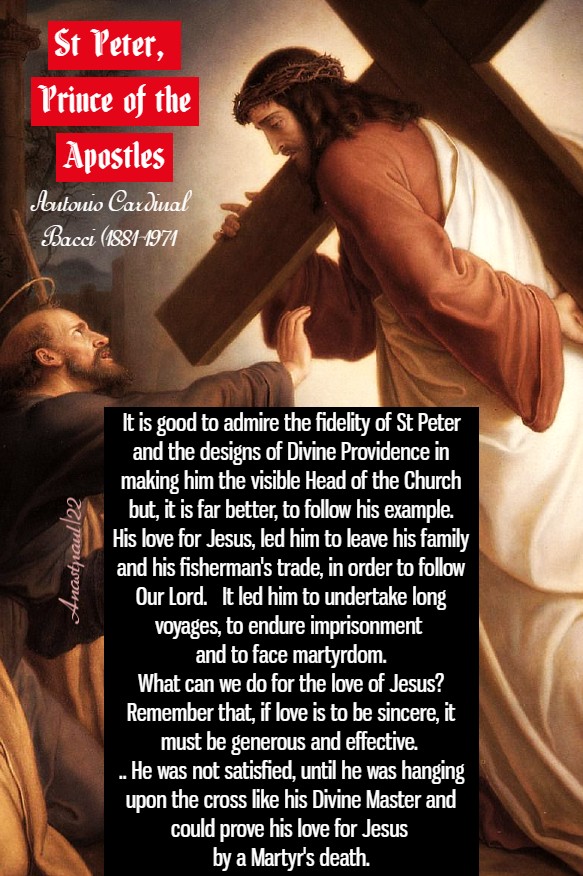
Thought for the Day – 6 July – Meditations with Antonio Cardinal Bacci (1881-1971) – The Octave Day of Sts Peter and Paul
St Peter, Prince of the Apostles St Paul, the Apostle to the Gentiles
“It is good to admire the fidelity of St Peter and the designs of Divine Providence in making him the visible Head of the Church but, it is far better, to follow his example. His love for Jesus, led him to leave his family and his fisherman’s trade, in order to follow Our Lord. It led him to undertake long voyages, to endure imprisonment and to face Martyrdom. What can we do for the love of Jesus? Remember that, if love is to be sincere, it must be generous and effective.
Secondly, let us meditate on and imitate, the ardent and fearless faith of St Peter. He was not afraid to preach the teaching of Christ before the Sanhedrin. He was not afraid of Herod, who cast him into prison.
He was not afraid of the Roman Emperor, who caused him to be crucified. Our faith should be steadfast and lively, like his!
Finally, let us imitate Peter in his repentance. Although he loved Jesus very much and had such great faith in Him, in a moment of weakness and of imprudence, he denied Him three times. All his life, however, be wept bitterly for this sin. Whenever he heard a cock crowing, it was as if an arrow had pierced his heart. He was not satisfied, until he was hanging upon the cross like his Divine Master and could prove his love for Jesus by a Martyr’s death.”
St Paul, the Apostle to the Gentiles
We can learn many other virtues from St Paul, besides his zealous love for God and for his fellowmen. We can also learn from him, the virtues of humility and of apostolic fervour. The Apostle of the Gentiles reached such heights of sanctity, as to feel himself transformed into Christ Himself and to deserve to be taken up into the third Heaven, where he enjoyed a foretaste of eternal happiness. Nevertheless, he considered himself unworthy to be called an Apostle and he realised, that all his gifts came to him from God. “Not that we are sufficient of ourselves, to think anything as from ourselves but our sufficiency, is from God” (2 Cor 3:5). Whenever we succeed in any project, we should think on the same lines because, it is only when we are humble and depend on the grace of God, that the success of our actions will redound to the glory of our Creator. If the cancer of ambition or of self-love, should corrupt our purity of intention, our work would not be blessed by God and would not make us worthy of everlasting life. Let us repeat often: “All for You, with You and in You, my God.”
Quote/s of the Day – 6 July – The Octave Day of Sts Peter and Paul
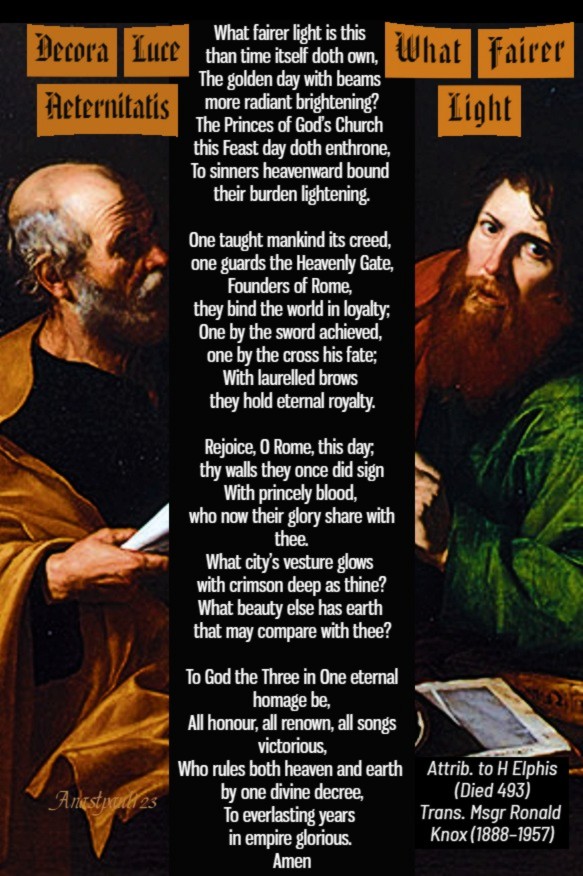
Decora Luce Aeternitatis What Fairer Light? Attrib. to H Elphis (Died 493) Wife of BL Severinus Boethius c 477– 524) Trans. Msgr Ronald Knox (1888–1957)
What fairer light is this than time itself doth own, The golden day with beams more radiant brightening? The Princes of God’s Church this Feast day doth enthrone, To sinners heavenward bound their burden lightening.
One taught mankind its creed, one guards the Heavenly Gate, Founders of Rome, they bind the world in loyalty; One by the sword achieved, one by the cross his fate; With laurelled brows they hold eternal royalty.
Rejoice, O Rome, this day; thy walls they once did sign With princely blood, who now their glory share with thee. What city’s vesture glows with crimson deep as thine? What beauty else has earth that may compare with thee?
To God the Three in One eternal homage be, All honour, all renown, all songs victorious, Who rules both heaven and earth by one divine decree, To everlasting years in empire glorious. Amen
5th cCntury Latin Hymn “Aurea Luce” attributed to H Elphis (Died 493), first wife of the Roman philosopher-poet Boethius (c475–c525). He would eventually be Martyred for his defence of the Faith against the Arian ruler, Theodoric. Msgr Knox, a convert from Anglicanism, was a noted Scholar, Author, Hymnist and Translator, becoming the Secretary to St Pius X. Under direction of his religious superiors, he re-translated the Latin Vulgate Bible into English from Hebrew and Greek sources. What Fairer Light is set to the tune, Decora Lux by the English Catholic Composer, Samuel Webbe (1740–1816).
In 1632, in accord with changes called for by the Council of Trent, Pope Urban VIII (1568-1644) revised the original text of Aurea Luce and divided it into two new Hymns for Lauds and Vespers: Decora Lux and Beate Pastor Petre. In the Liturgy of the Hours, What Fairer Light is used on 29 June, the Solemnity of Sts Peter and Paul, Apostles. The above is the Older version.
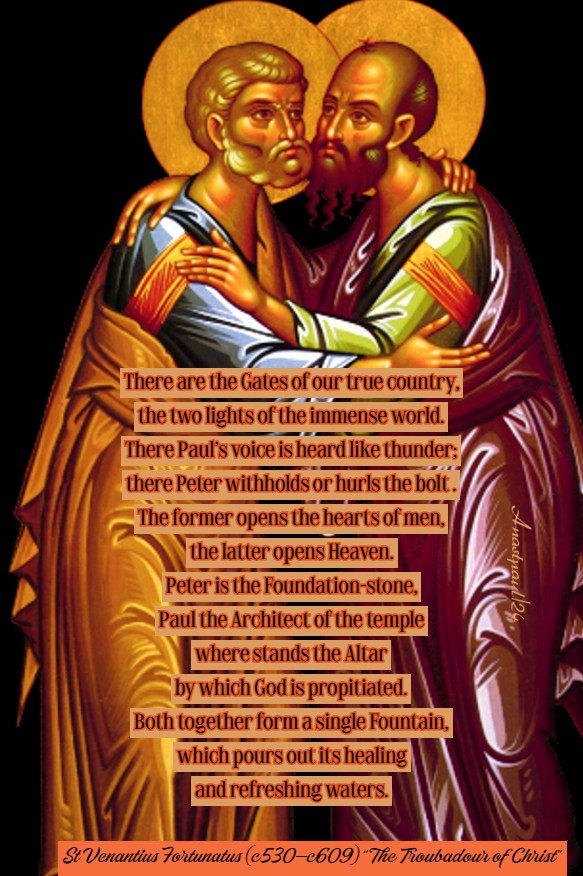
“There are the Gates of our true country, the two lights of the immense world. There Paul’s voice is heard like thunder; there Peter withholds or hurls the bolt . The former opens the hearts of men, the latter opens Heaven. Peter is the Foundation-stone, Paul the Architect of the temple where stands the Altar by which God is propitiated. Both together form a single Fountain, which pours out its healing and refreshing waters.”
St Venantius Fortunatus (c 530 – c 609) “The Troubadour of Christ”
One Minute Reflection – 6 July – “The Solemnity Month of the Most Precious Blood” – Pentecost IV – The Octave Day of Sts Peter and Paul – Romans 8:18-23 – Luke 5:1-11 – Scripture search here: https://www.drbo.org/
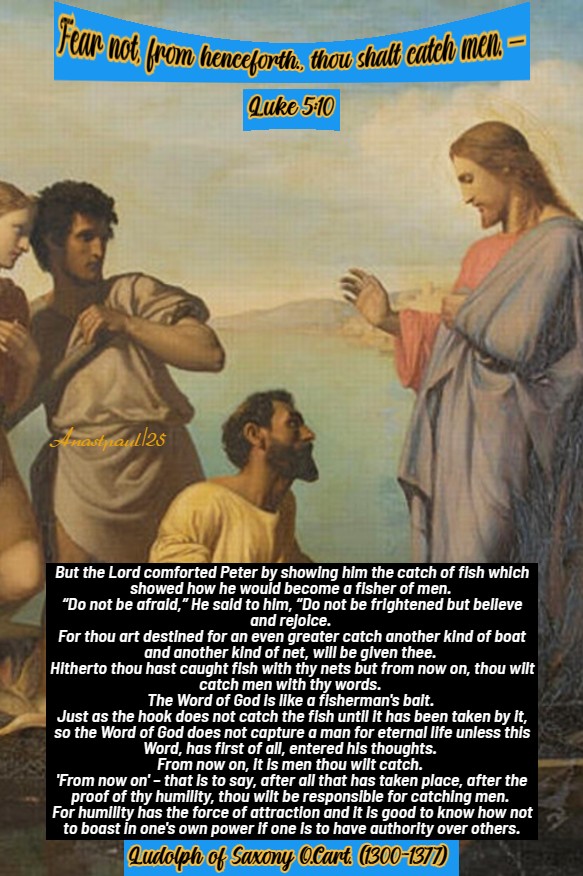
“ And Jesus saith to Simon – Fear not, from henceforth. thou shalt catch men. ”– Luke 5:10
REFLECTION – “Peter threw himself humbly at Jesus’ feet. Recognising his Lord in Him, he said: “Depart from me, Lord, for I am a sinful man and am not worthy to stay with Thee. Depart from me, for I am only a man and Thou art the God-man; I am sinful and Thou art holy; I am a servant, Thou the Master. Let distance separate Thee from me, who am distanced from Thee by the weakness of my nature, the ugliness of my sins and the weakness of my strength..”
But the Lord comforted Peter by showing him the catch of fish which showed how he would become a fisher of men. “Do not be afraid,” He said to him, “Do not be frightened but believe and rejoice. For thou art destined for an even greater catch another kind of boat and another kind of net, will be given thee. Hitherto thou hast caught fish with thy nets but from now on, thou wilt catch men with thy words. The Word of God is like a fisherman’s bait. Just as the hook does not catch the fish until it has been taken by it, so the Word of God does not capture a man for eternal life unless this Word, has first of all, entered his thoughts. From now on, it is men thou wilt catch. ‘From now on’ – that is to say, after all that has taken place, after the proof of thy humility, thou wilt be responsible for catching men. For humility has the force of attraction and it is good to know how not to boast in one’s own power if one is to have authority over others.” – Ludolph of Saxony (1300-1377) Carthusian Monk, Theologian, Writer (The life of Jesus Christ 1 Ch 29:9-11)
PRAYER – O God, Who made this day holy by the Martyrdom of Your Apostles Peter and Paul, grant Thy Church to follow in all things, the teaching of those, from whom she first received the faith. Through Jesus Christ, Thy Son our Lord, Who lives and reigns with Thee, in the unity of the Holy Ghost, God, world without end. Amen (Collect).
Saint of the Day – 6 July – Saint Justus (6th Century?) Monk of Condat, Jura, in the valley of Bienne, France. Also known as – Giusto.
In the heart of the Jura mountains, in France, the name of Saint Justus of Condat resonates, a Monk shrouded in mystery and veneration. His figure, although outlined by hagiographic fragments, emerges as a beacon of faith and devotion, illuminating the centuries with the light of his sanctity.
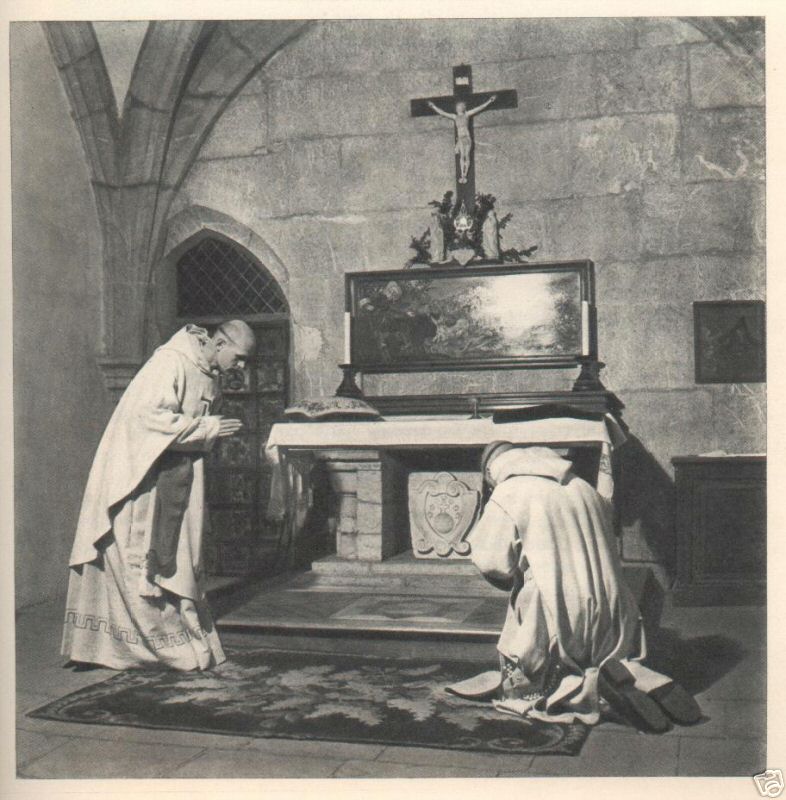
Unknown Monks kneeling in prayer
The ancient papers and records of the Monastery of Condat, today known as Saint-Claude, preserve his name, awarded the title of Saint. Since the most remote times, his memory was celebrated on 6 July fueling the cult of a pious man dedicated to monastic life.
However, the biographical information on Saint Justus is fragmentary, almost evanescent like the mists which envelop his mountains. History gives us only echoes of his existence, whispers of a Monk who dedicated his life to prayer and contemplation in that territory of Condat.
The choirstalls at Condat, illustrated by Eugène Viollet-le-Duc, 1856
Despite the scarcity of details, devotion to Saint Justus has not been affected. Indeed, over the centuries his fame has spread, so much so that, in the 9th Century some of his Relics were transferred to Salaise in France, where they still rest today.
In 1903, St Pius X, officially confirmed the cult of Saint Justus, elevating him to an illustrious witness of the Christian Faith. His figure, although shrouded in mystery, continues to inspire and call the faithful to contemplate the Divine and to devote themselves to the spiritual life.
Martyrs of Campania – 23 Saints: A group of 23 Christians arrested, tortured and then beheaded together in the later 3rd century by order Gf Governor Rictiovarus during the persecutions of Diocletian. The names that have come down to us are – Antoninus, Arnosus, Capicus, Cutonius, Diodorus, Dion, Isidore, Lucia, Lucian, Rexius, Satyrus and Severinus.
Martyrs of Fiesole – 5 Saints: Five Christians Martyred together during the persecutions of Emperor Domitian – Carissimus, Crescentius, Dulcissimus, Marchisianus and Romulus. c 90 near Fiesole, Italy.
Thought for the Day – 5 July – Meditations with Antonio Cardinal Bacci (1881-1971)
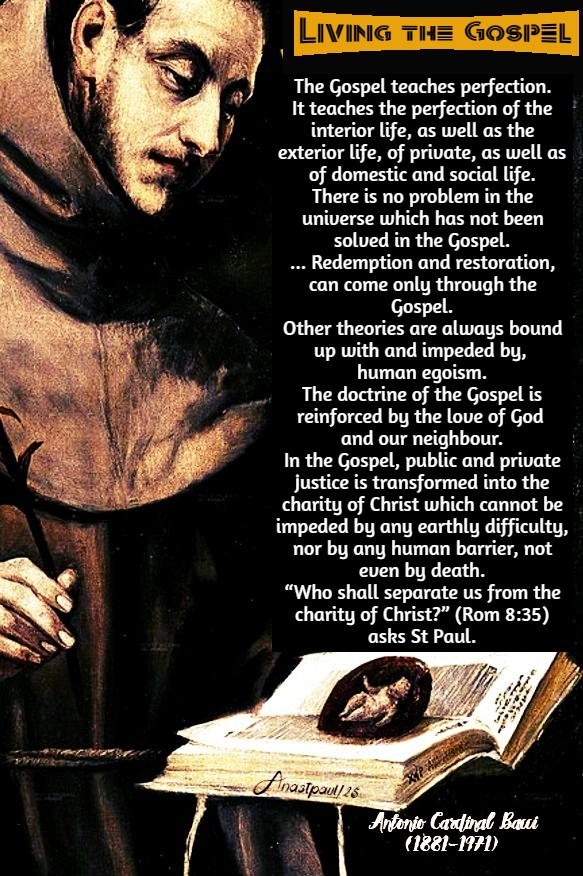
Living the Gospel
“The Gospel teaches perfection. It teaches the perfection of the interior life, as well as the exterior life, of private, as well as of domestic and social life. There is no problem in the universe which has not been solved in the Gospel. In regard to the spiritual life, its command is clear. “You are to be perfect, even as your heavenly Father is perfect” (Mt 5:48). “Thou shalt love the Lord thy God with thy whole heart and with thy whole soul and with they whole mind … Thou shalt love thy neighbour as thyself” (Mt 22:37, Mk 12:30, Lk 10:27). “This is My commandment, that you love one another, as I have loved you” (Jn 15:12). “If anyone wishes to come after me, let him deny himself and take up his cross daily and follow Me” (Lk 9:23). “Blessed are the poor in spirit … the clean of heart … the peacemakers …” (Mt 5:3-10). “If thou wilt be perfect, go, sell what thou hast and give to the poor and thou shall have treasure in Heaven” (Mt 19:21). “Our Father who art in heaven … thy will be done on earth as it is in Heaven” (Mt 6:10). “Father … not My will but Thine be done” (Lk 22:42). Anyone who identifies himself with these maxims, rises above the level of a man, to that of an Angel. His interior life soars to such a peak, that he seems to be leading a heavenly, rather than an earthly existence. If he is living the Gospel, moreover, his external behaviour will be a faithful mirror of his interior life, for it is not enough to say “Lord, Lord” but a man must also do the will of the Father (Cf Mt 7:21). A man’s domestic and social life, will follow the pattern of his private life.
When he has reached the summit of perfection, an invisible force will emanate from him, the force of good example. This force will transform everything, within him and around him. Like Mary and the Saints, he will become the loyal and powerful co-worker with Christ in the redemption of the human race and in the Christian transformation of society. Redemption and restoration, can come only through the Gospel. Other theories are always bound up with and impeded by, human egoism. The doctrine of the Gospel is reinforced by the love of God and our neighbour. In the Gospel, public and private justice is transformed into the charity of Christ which cannot be impeded by any earthly difficulty, nor by any human barrier, not even by death! “Who shall separate us from the charity of Christ?” (Rom 8:35) asks St Paul. Let us meditate on this.”
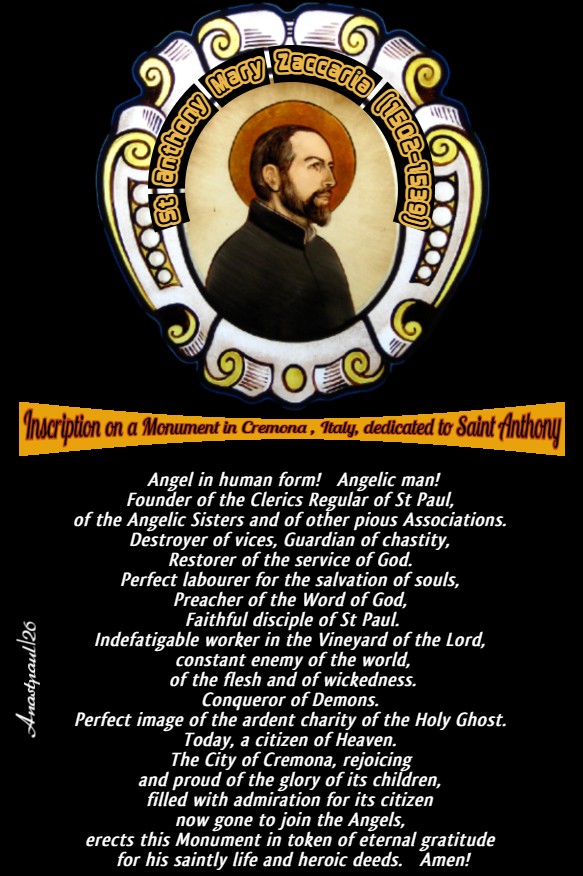
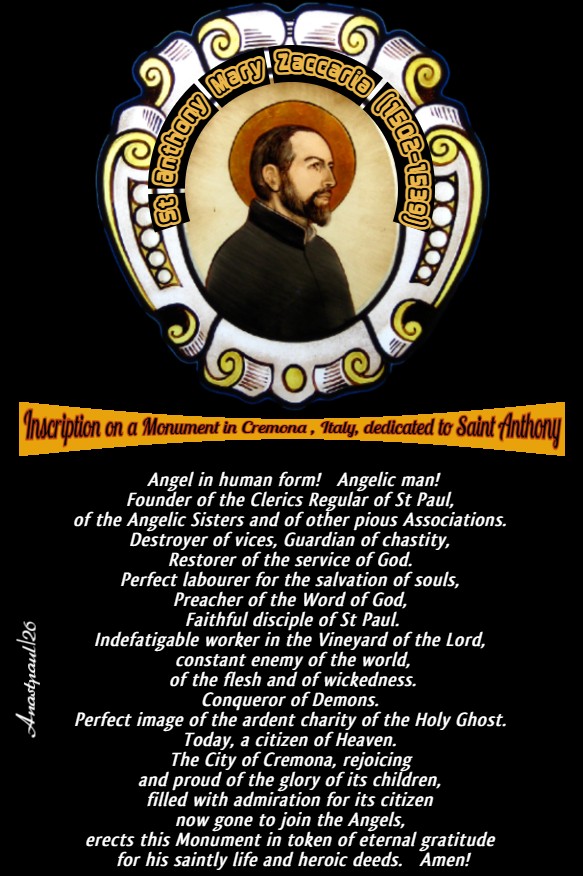
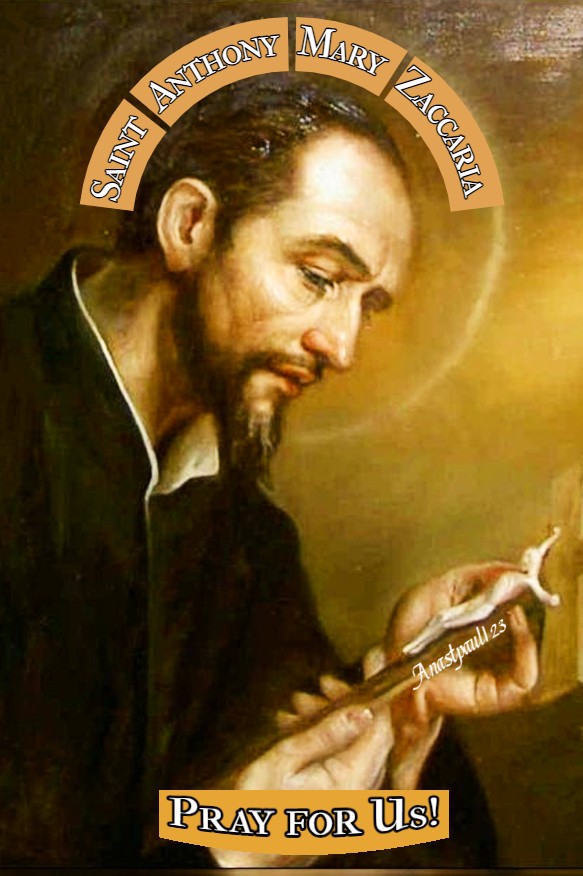
Quote/s of the Day – 5 July – St Anthony Mary Zaccaria (1502-1539) Confessor, Priest, Founder of the Barnabits – The First Religious Order Named after St Paul The Apostle – Canonised by Pope Leo XIII on 27 May 1897.
“Angel in human form! Angelic man! Founder of the Clerics Regular of St Paul, of the Angelic Sisters and of other pious Associations. Destroyer of vices, Guardian of chastity, Restorer of the service of God. Perfect labourer for the salvation of souls, Preacher of the Word of God, Faithful disciple of St Paul. Indefatigable worker in the Vineyard of the Lord, constant enemy of the world, of the flesh and of wickedness. Conqueror of Demons. Perfect image of the ardent charity of the Holy Ghost. Today, a citizen of Heaven. The City of Cremona, rejoicing and proud of the glory of its children, filled with admiration for its citizen now gone to join the Angels, erects this Monument in token of eternal gratitude for his saintly life and heroic deeds. Amen!”
Inscription on a Monument in Cremona, Italy dedicated to Saint Anthony
One Minute Reflection – 5 July – “The Month of the Most Precious Blood” – Pentecost IV – Within the Octave of Sts Peter and Paul – St Anthony Mary Zaccaria (1502-1539) Confessor, Priest, Founder of the Barnabits – The First Religious Order Named after St Paul The Apostle – 1 Timothy 4:8-16 – Mark 10:15-21 – Scripture search here: https://www.drbo.org/
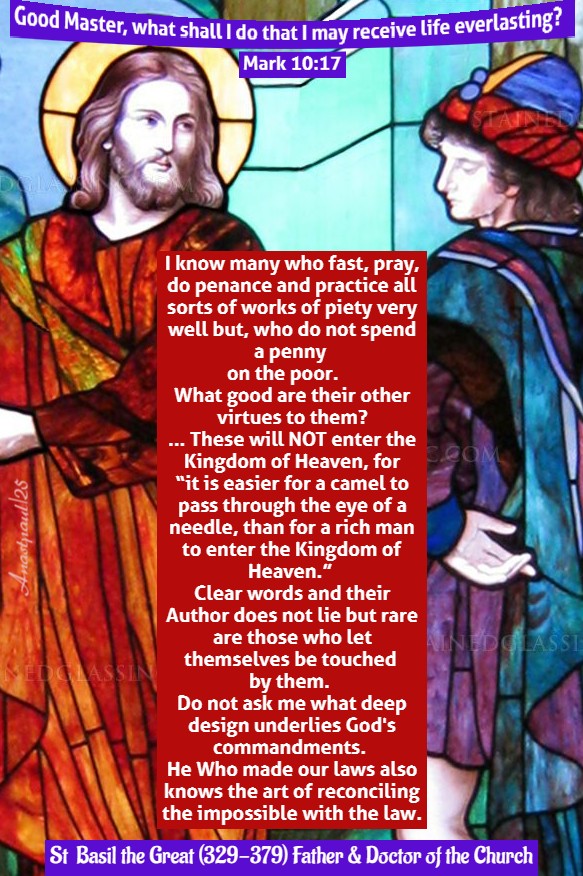
“Good Master, what shall I do that I may receive life everlasting?” – Mark 10:17
REFLECTION – “The incident of the rich young man and those like him, makes me think of a traveller who, wanting to visit a certain town, arrives at the foot of the walls, finds an inn there, goes down to it and, discouraged by the short distance still to do, loses all the benefit of the difficulties of his journey and prevents himself from visiting the beauties of the town. Such are those who keep the commandments but cannot bear the idea of losing their goods. I know many who fast, pray, do penance and practice all sorts of works of piety very well but, who do not spend a penny on the poor. What good are their other virtues to them?
These will not enter the Kingdom of Heaven, for “it is easier for a camel to pass through the eye of a needle, than for a rich man to enter the Kingdom of Heaven.” Clear words and their Author does not lie but rare are those who let themselves be touched by them. “How will we live when we are stripped of everything?” is what they exclaim. “What sort of life will we lead when everything has been sold and there is no longer any property?” Do not ask me what deep design underlies God’s commandments. He Who made our laws also knows the art of reconciling the impossible with the law.” – St Basil the Great (329-379) Bishop of Caesarea in Cappadocia, Father & Doctor of the Church (Sermon 7 on Wealth).
PRAYER – Grant, O Lord God that in the spirit of Paul the Apostle, we may learn the knowledge of Jesus Christ which surpasses all understanding, wherein the blessed Anthony Mary was marvelously learned, who gathered together in Thy Church new households of Clerics and of Virgins. Through our Lord, Jesus Christ, Thy Son, Who liveth and reigneth with Thee in the unity of the Holy Spirit, God world without end. Amen (Collect).
Our Morning Offering – 5 July – “The Month of the Most Precious Blood” – First Saturday
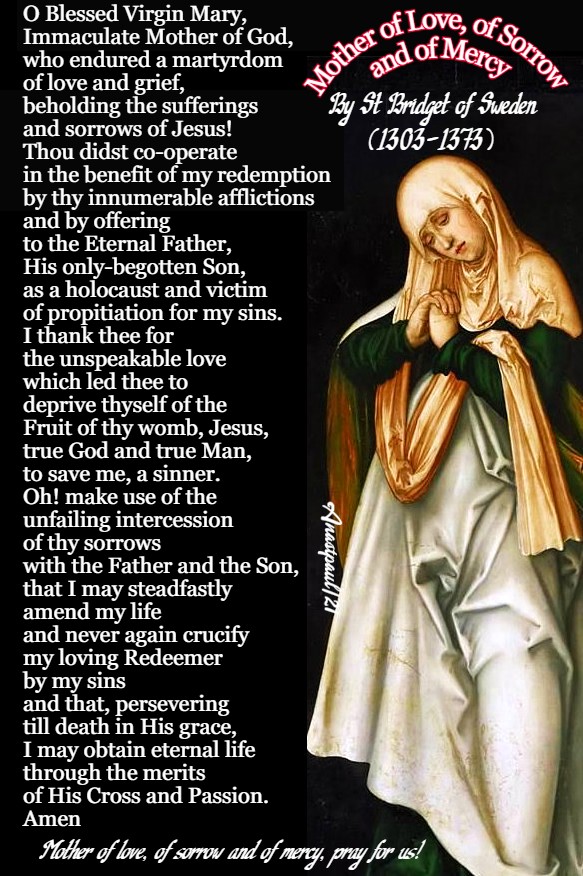
Mother of Love, of Sorrow and of Mercy By St Bridget of Sweden (1303-1373)
O Blessed Virgin Mary, Immaculate Mother of God, who endured a martyrdom of love and grief, beholding the sufferings and sorrows of Jesus! Thou didst co-operate in the benefit of my redemption by thy innumerable afflictions and by offering to the Eternal Father, His only-begotten Son, as a holocaust and victim of propitiation for my sins. I thank thee for the unspeakable love which led thee to deprive thyself of the Fruit of thy womb, Jesus, true God and true Man, to save me, a sinner. Oh! make use of the unfailing intercession of thy sorrows with the Father and the Son, that I may steadfastly amend my life and never again crucify my loving Redeemer by my sins and that, persevering till death in His grace, I may obtain eternal life through the merits of His Cross and Passion. Amen
Mother of love, of sorrow and of mercy, pray for us!
Saint of the Day – 5 July – Saint Philomena (Died c500) Virgin of San Severino in Italy. Patronage of San Severino, Centola, Italy. Also known as – Filomena. Additional Feastday – the 1st Sunday in July in Sab Severino.
The Roman Martyrology reads today: “At San Severino in the Marche of Ancona, St Philomena, Virgin.”
The figure of Saint Philomena, venerated in various Italian locations, presents complex and fascinating aspects, intertwining elements of popular devotion with historical and hagiographic records.
In particular, the Saint discovered in San Severino Marche in 1527 raises questions about her real identity and the cult associated with her.
In 1527, during excavations under the High Altar of the Church of San Lorenzo in Doliolo in San Severino Marche, a female body came to light accompanied by a epithet which attributed the body belonging to Saint Philomena of the Chiavelli lineage. According to the inscription, the Saint was transferred to that place by San Severino the Bishop during the era of the Gothic Kings. In the same year, Cardinal Ciocchi del Monte arranged for the body to be placed under an Altar dedicated to the Saint.
Initially, the Feast in honour of Saint Philomena was celebrated on 5 July, a date present in the Roman Martyrology. Subsequently, the anniversary was moved to the first Sunday of the same month in San Severino.
Despite popular devotion, a rigourous analysis from a historical point of view leads to the conclusion that the body found is not actually that of a holy Martyr. In fact, before the 16th Century, there is no mention in San Severino of the name, cult or relics of Saint Philomena. Furthermore, the content of the inscription which accompanied the body, attributing its deposition to San Severino, does not present historically valid elements.
Therefore, the most likely hypothesis is that it is a ‘holy body’ similar to that of the more famous Roman Saint Philomena, a figure around whom a wide and widespread cult developed.
St Agatho of Sicily St Athanasius the Athonite St Athanasius of Jerusalem St Cast St Cyprille of Libya St Cyrilla of Cyrene St Domèce St Domitius of Phrygia St Edana of West Ireland
St Numerian of Treves St Philomena (Died c500) Virgin of San Severino St Probus of Cornwall St Rosa Chen Aijieh St Sedolpha of Tomi St Stephen of Reggio St Teresia Chen Qingjieh St Theodotus of Tomi St Thomas of Terreti St Triphina of Brittany St Triphina of Sicily
St Zoe of Rome (Died c286) Married laywoman, Martyr. The Roman Martyrology reads today: “At Rome, St Zoe, Martyr, wife of the blessed Martyr Nicostratus. Whilst praying at the tomb of the Apostle, St Peter, during the time of Diocletian, she was seized by the persecutors and cast into a dark dungeon, then, being suspended on a tree by her neck and hair and suffocated by loathsome smoke, she yielded up her soul in the confession of the Lord.” Her Life and Death: https://anastpaul.com/2024/07/05/saint-of-the-day-5-july-saint-zoe-of-rome-died-c286-married-laywoman-martyr/
Thought for the Day – 4 July – Meditations with Fr Richard Frederick Clarke SJ (1839-1900) – “The Month of the Most Precious Blood” – Octave Day of the Sacred Heart of Jesus and the First Friday of July
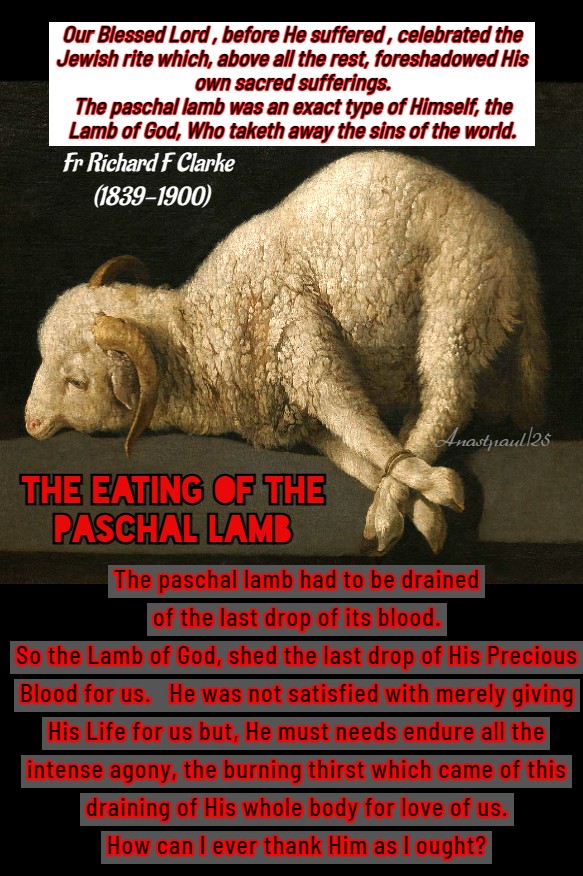
From “The Devout Year” By Fr Richard Frederick Clarke SJ (1839-1900) The Eating of the Paschal Lamb
Our Blessed Lord , before He suffered , celebrated the Jewish rite which, above all the rest, foreshadowed His own sacred sufferings. The paschal lamb was an exact type of Himself, the Lamb of God, Who taketh away the sins of the world.
+1. The paschal lamb was the means employed by Almighty God to deliver His people from Egypt. It was the sprinkling of its blood on the door-posts which caused the avenging Angel to pass by and leave the inmates unharmed. So the Blood of Jesus Christ sprinkled on our souls, in the Sacraments and when we make an Act of Contrition, saves us from the vengeance which would otherwise fall upon us. O Jesus! sprinkle me with One Drop of Thy Precious Blood and I shall be free from sin.
+2. The paschal lamb had to be drained of the last drop of its blood. So the Lamb of God, shed the last drop of His Precious Blood for us. He was not satisfied with merely giving His Life for us but, He must needs endure all the intense agony, the burning thirst which came of this draining of His whole body for love of us. How can I ever thank Him as I ought?
+3. The lamb suffers uncomplainingly. It never murmurs against its lot, or struggles against those who lead it here and there; unlike the filthy swine which grunt and grumbles at every attempt to control them. None was ever so submissive as the Lamb of God. “Lo, I come to do Thy Will, O my God. I am content to do it.” Can I echo these words?
Quote/s of the Day – 4 July – The Feast of St Andrew of Crete (c660-c740) Bishop, Father of the Church
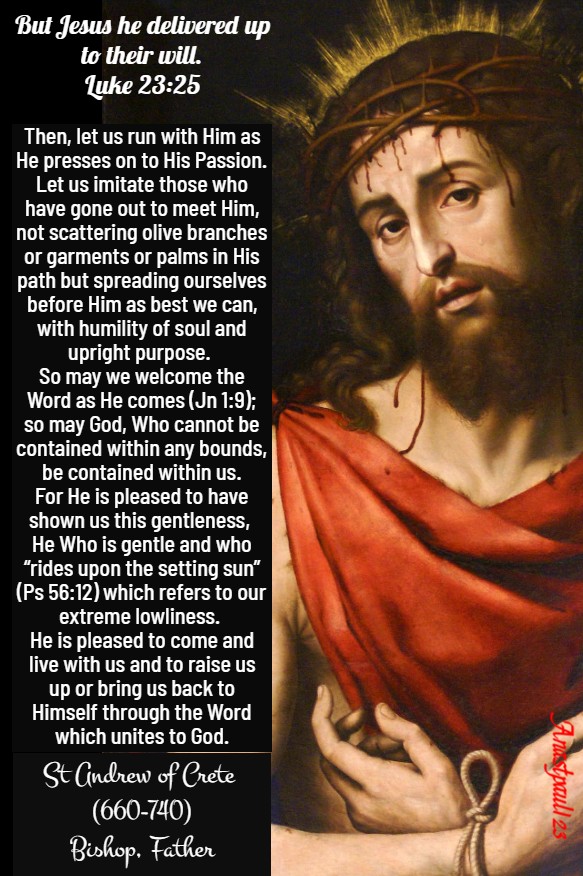
“Then, let us run with Him as He presses on to His Passion. Let us imitate those who have gone out to meet Him, not scattering olive branches or garments or palms in His path but spreading ourselves before Him as best we can, with humility of soul and upright purpose. So may we welcome the Word as He comes (Jn 1:9); so may God, Who cannot be contained within any bounds, be contained within us. For He is pleased to have shown us this gentleness, He, Who is gentle and who “rides upon the setting sun” (Ps 56:12) which refers to our extreme lowliness. He is pleased to come and live with us and to raise us up or bring us back to Himself.”
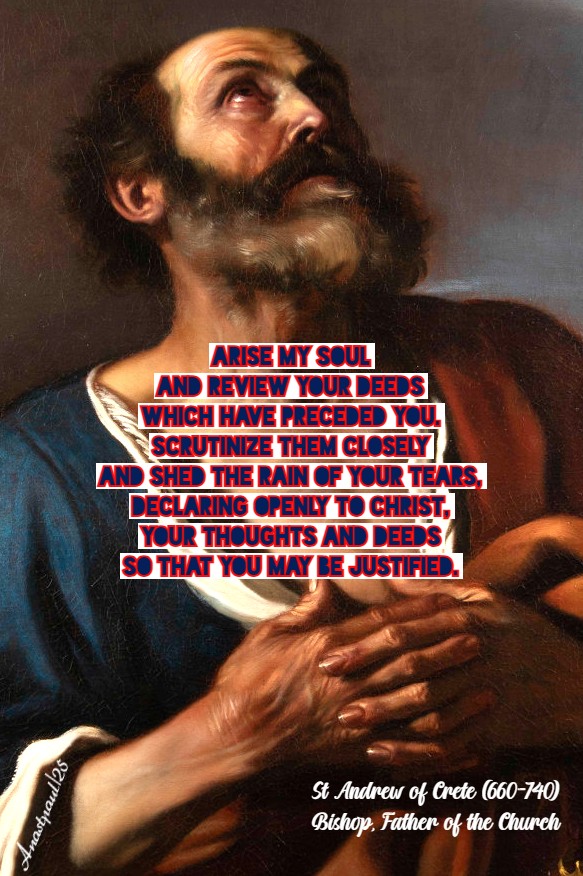
“Arise my soul and review your deeds which have preceded you. Scrutinize them closely and shed the rain of your tears, declaring openly to Christ, our thoughts and deeds so that you may be justified.”
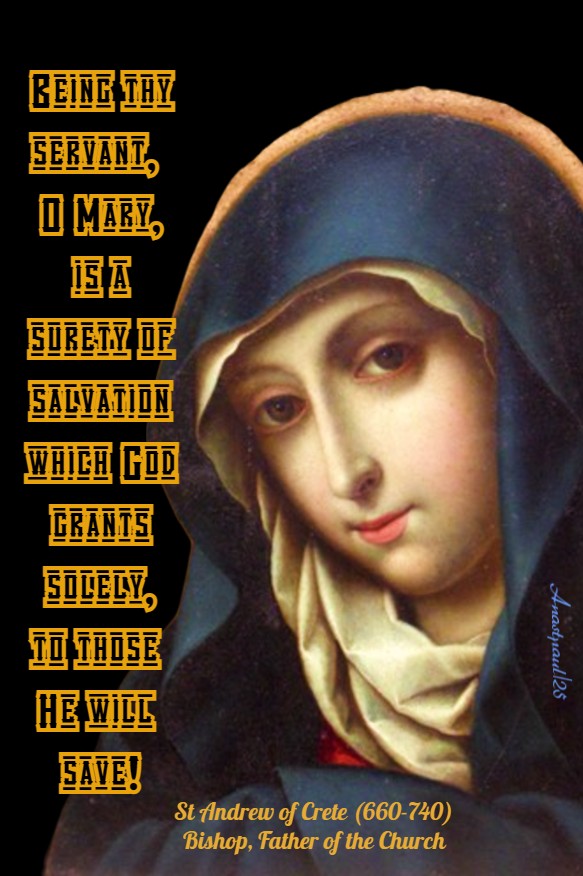
“Being thy servant, O Mary, is a surety of salvation which God grants solely, to those He will save!”
One Minute Reflection – 4 July – “The Month of the Most Precious Blood” – Octave Day of the Sacred Heart of Jesus and the First Friday of July – Within the Octave of Sts Peter and Paul – Ephesians 3:8-12, 14-19 – John 19:31-37 – Scripture search here: https://www.drbo.org/
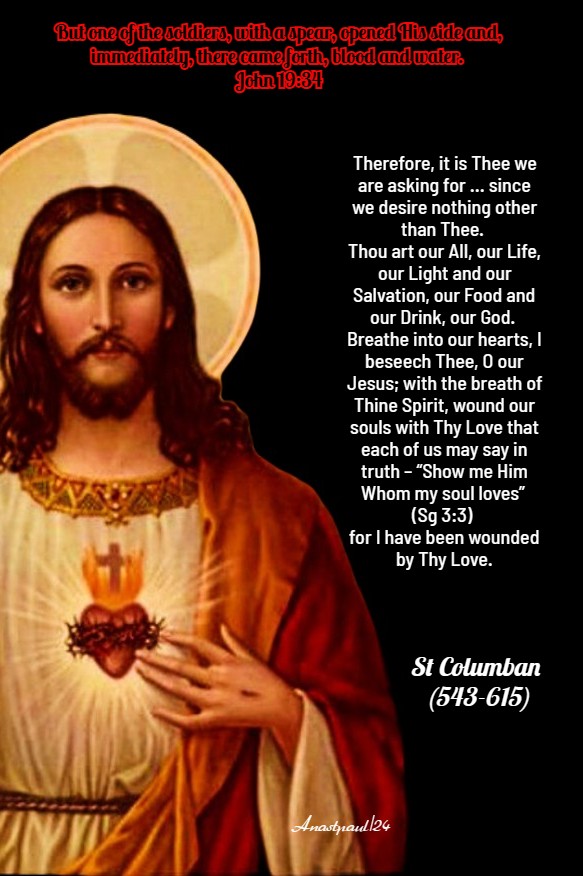
“But one of the soldiers, with a spear, opened His side and, immediately, there came forth, blood and water. ” – John 19:34
REFLECTION – “Brethren, let us pursue our calling – we are called by Life to the Source of Life and this Source is a source, not just of ‘living water’ (Jn 4:10) but of eternal life, Source of Light and illumination. Indeed, all things flow from it, wisdom, life and eternal light… O Lord, Thou are Thineself this Source Who always exists and is always to be desired and, at where it is always permitted and always necessary for us to draw. ‘Lord Jesus, give us this water always’ that it may also become within us, a spring of water \welling up to eternal life’ (Jn 4:15.14). It is true that I am asking Thee for a great deal, who could deny it? But Thou, O King of glory, know well how to give great things and Thou hast promised them. There is nothing greater than Thou art and, it is Thee Thyself Who give to us, it is Thee Who gave Thyself for us.
Therefore, it is Thee we are asking for … since we desire nothing other than Thee. Thou art our All, our Life, our Light and our Salvation, our Food and our Drink, our God. Breathe into our hearts, I beseech Thee, O our Jesus; with the breath of Thine Spirit, wound our souls with Thy Love that each of us may say in truth – “Show me Him Whom my soul loves” (Sg 3:3) for I have been wounded by Thy Love.
I desire these wounds to be in me, O Lord. Happy the soul who loves wounds in this way – the soul who seeks the Source, who drinks and who, nevertheless, never ceases to thirst even as it drinks, nor to draw continually by desire, nor to continue drinking in its thirst. Thus, it always seeks in loving, for in its wound, it finds healing.” – St Columban (543-615) Father of the Church, Monk, Missionary, Founder of many Monasteries (Spiritual Instructions No 13: 2-3).
PRAYER – God, Who hast consecrated this day to the Martyrdom of Thy Apostles Peter and Paul, give Thy Church a precept to follow them in all things. Through Jesus Christ, Thy Son our Lord, Who lives and reigns with Thee, in the unity of the Holy Ghost, God, world without end. Amen (Collect).
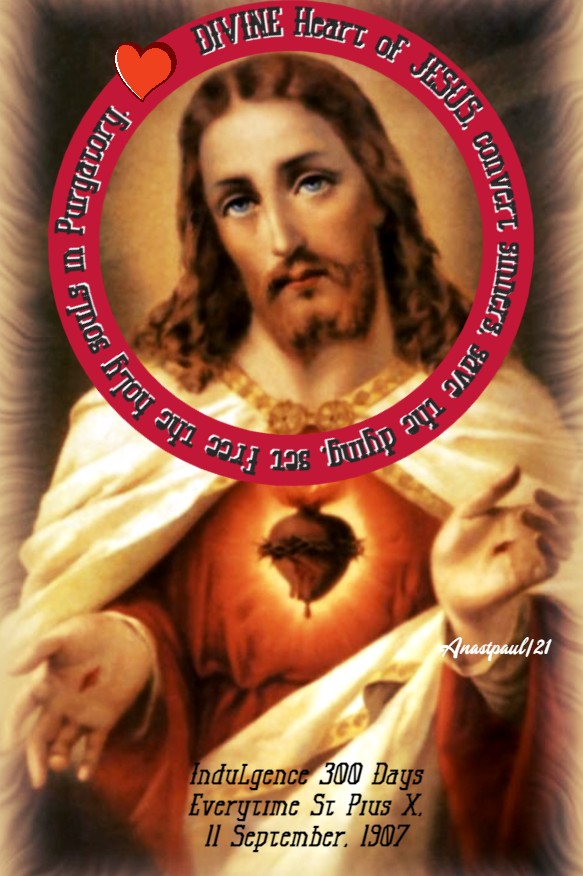
DIVINE Heart of JESUS, convert sinners, save the dying, set free the holy souls in Purgatory.Indulgence 300 Days Everytime – St Pius X, 11 September, 1907.





























 AnaStpaul
You must be logged in to post a comment.