Passionate Catholic.
Being a Catholic is a way of life - a love affair "Religion must be like the air we breathe..."- St John Bosco
Prayer is what the world needs combined with the example of our lives which testify to the Light of Christ.
This site, which is now using the Traditional Calendar, will mainly concentrate on Daily Prayers, Novenas and the Memorials and Feast Days of our friends in Heaven, the Saints who went before us and the great blessings the Church provides in our Catholic Monthly Devotions.
This Site is placed under the Patronage of my many favourite Saints and especially, St Paul.
"For the Saints are sent to us by God
as so many sermons.
We do not use them, it is they who move us
and lead us, to where we had not expected to go.”
Charles Cardinal Journet (1891-1975)
This site adheres to the pre-Vatican II Catholic Church and all her teachings. .
PLEASE ADVISE ME OF ANY GLARING TYPOS etc - In June 2021 I lost 100% sight in my left eye and sometimes miss errors. Thank you and I pray all those who visit here will be abundantly blessed. Pax et bonum! 🙏
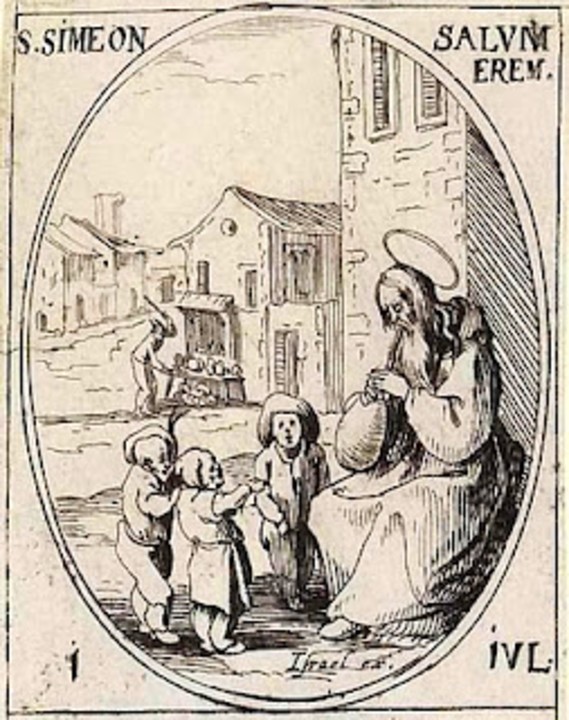
Saint of the Day – 1 July – St Simeon Salus (Died c570) Confessor, Monk, Hermit, Apostle of the poor and needy, Miracle-worker known as “The Holy Fool”
The Roman Martyrology reads today: “At Emesa, St Simeon, surnamed Salus, Confessor, who feigned to be an idiot for Christ but God manifested His high Wisdom by great miracles,”
Born in Syria, at the age of 30 Simeon entered the Monastery of Abbot Gerasimus in Syria. He spent the next 29 years in a desert near the Dead Sea. He felt inspired to move to Emesa to help the poor of that City without any formal recognition.
He came to learn that the best way to be humble was to love humiliation, so he took it upon himself to act foolishly. Only the truly wise could see Simeon’s sanctity.
By simulating simplicity, he saved many souls and brought them to Christ. He was also able to heal many possessed people by his prayer, fed the hungry, preached the Gospel,and helped the poor and needy of the Town. Most of Simeon’s good deeds were done secretly.
Simeon did not play a fool with his friend John, Deacon of the Church in Emesa. Simeon once saved John from being executed when he was falsely accused. Shortly before his death, Simeon told John:
“I beg you, never disregard a single soul, especially when it happens to be a Monk or a beggar. For your charity knows that His place is among the beggars, especially among the blind, people made as pure as the sun through their patience and distress …Show love of your neighbour through almsgiving. For this virtue, above all,, will help us on the Day of Judgment.”
Simeon died in c570 and was buried by the City’s poor in a potter’s field. While the Saint’s body was carried there, people heard a choir singing though none could be found anywhere.
St Aaron of Caerleon St Aaron the Patriarch St Arnulf of Mainz St Calais of Anisole St Carilephus St Castus of Sinuessa St Cewydd St Concordius of Toledo St Cuimmein of Nendrum
St Domitian (c347-440) Abbot, who had been the first Hermit of the surrounding region in France, Founder of a Monastery which became the foundation of the spiritual, cultural and social teachings of its region and day. Born in c347 in Rome and died in 440 at the Saint Rambert de Joux Abbey in the Diocese of Lyons in France. The Roman Martyrology reads: “In the Diocese of Lyons, the decease of St Domitian, Abbot, who was the first to lead there, an eremitical life. After having assembled, in that place, many servants of God and gained great renown for virtues and miracles, he was gathered to his fathers at an advanced age.” His Devoted Life: https://anastpaul.com/2024/07/01/saint-of-the-day-1-july-st-domitian-c347-440-abbot/
Bl Elisabeth de Vans St Eparchius of Perigord St Eutychius of Umbria St Esther the Queen
St Gall of Clermont St Golvinus of Leon St Gwenyth of Cornwall Bl Huailu Zhang St Julius of Caerleon St Justino Orona Madrigal St Juthware St Leonorious of Brittany St Leontius of Autun St Martin of Vienne St Nicasius of Jerusalem
St Secundinus of Sinuessa St Servan of Culross St Simeon Salus (Died c570) Confessor, Monk, Hermit known as “The Holy Fool”
St Theobald of Vicenza St Theodoric of Mont d’Or St Veep
Martyrs of Rome – 6 Saints: Six Christians who were Martyred together. No details have survived except their names – Esicius, Antonius, Processus, Marina, Serenus and Victor. They were martyred i
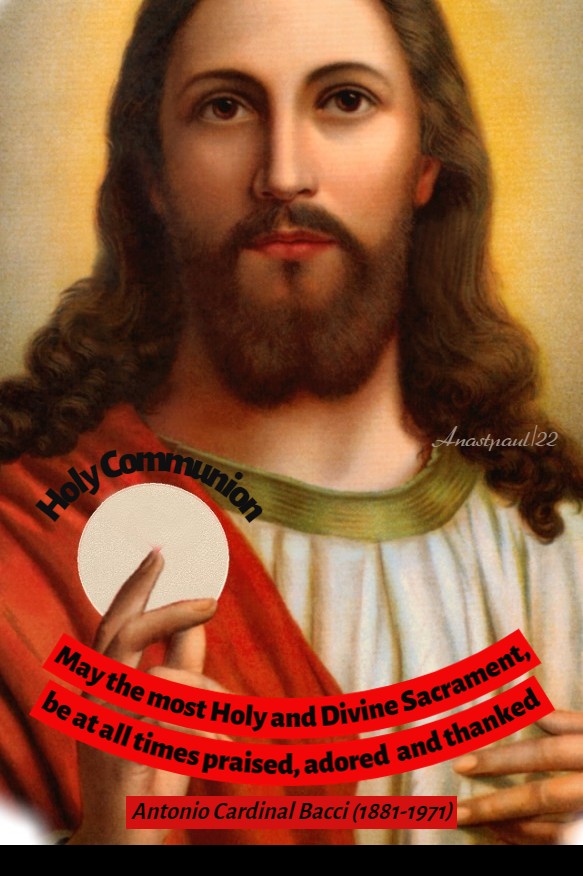
Thought for the Day – 30 June – Meditations with Antonio Cardinal Bacci (1881-1971)
The Worship of the Sacred Heart in Relation to the Love of God and of Our Neighbour
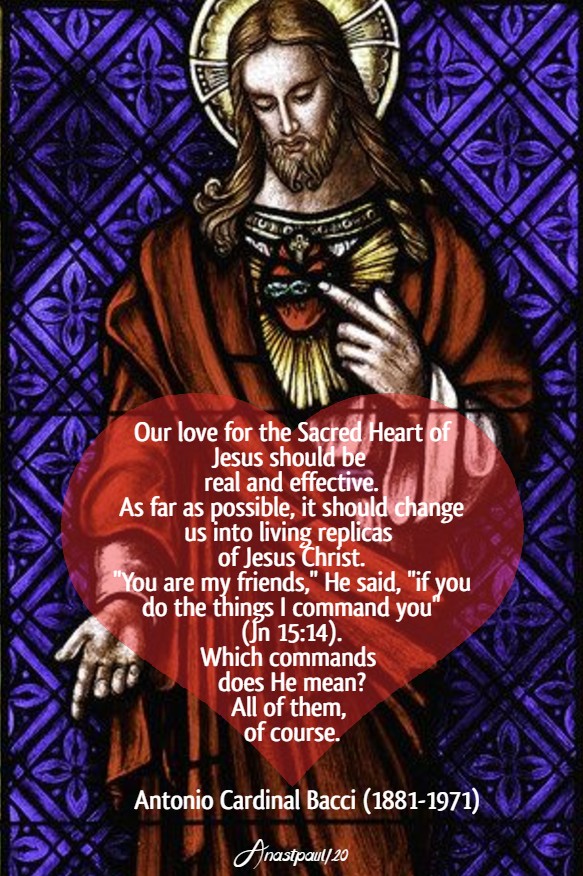
“There is nothing sentimental about having devotion to the Sacred Heart of Jesus. Neither does this devotion consist only in prayers and pious practices. It is much deeper than this. It should flood our whole being, enkindle the fire of divine love in our hearts and transform our lives in accordance with the commands of Jesus. A love which is not active cannot be genuine, it is only a passing emotion.
Our love for the Sacred Heart of Jesus should be real and effective. As far as possible, it should change us into living replicas of Jesus Christ.
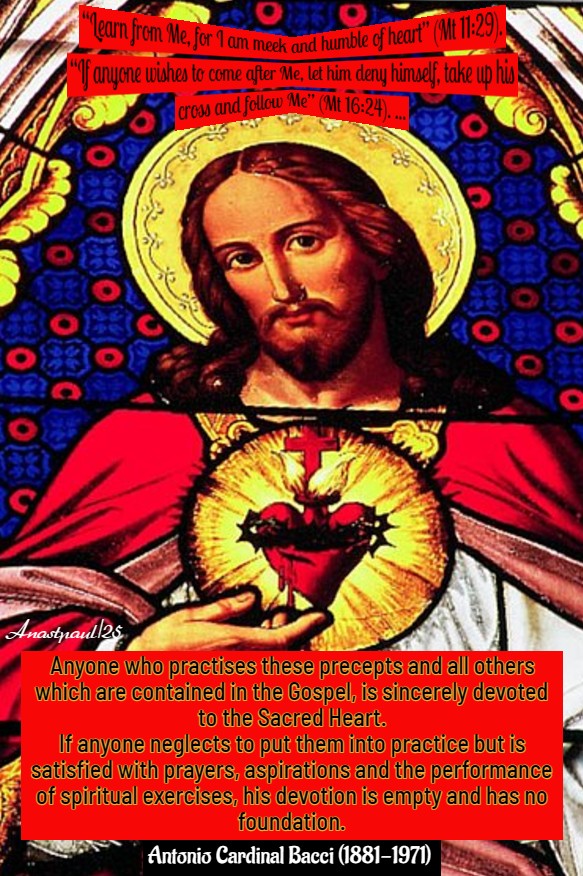
“You are My friends,” He said, “if you do the things I command you” (Jn 15:14). Which commands does He mean? All of them, of course. “Learn from Me, for I am meek and humble of heart” (Mt 11:29). “If anyone wishes to come after Me, let him deny himself, take up his cross and follow Me” (Mt 16:24). “Thy shalt love the Lord thy God, with they whole heart and with they whole soul” (Mt 22:37).
Anyone who practises these precepts and all others which are contained in the Gospel, is sincerely devoted to the Sacred Heart. If anyone neglects to put them into practice but is satisfied with prayers, aspirations and the performance of spiritual exercises, his devotion is empty and has no foundation.
These prayers, aspirations and pious practices have their value, insofar, as they can attract God’s grace. But, we must co-operate with God’s grace by our good actions. Then our devotion to the Sacred Heart of Jesus, will be sincere and effective.”
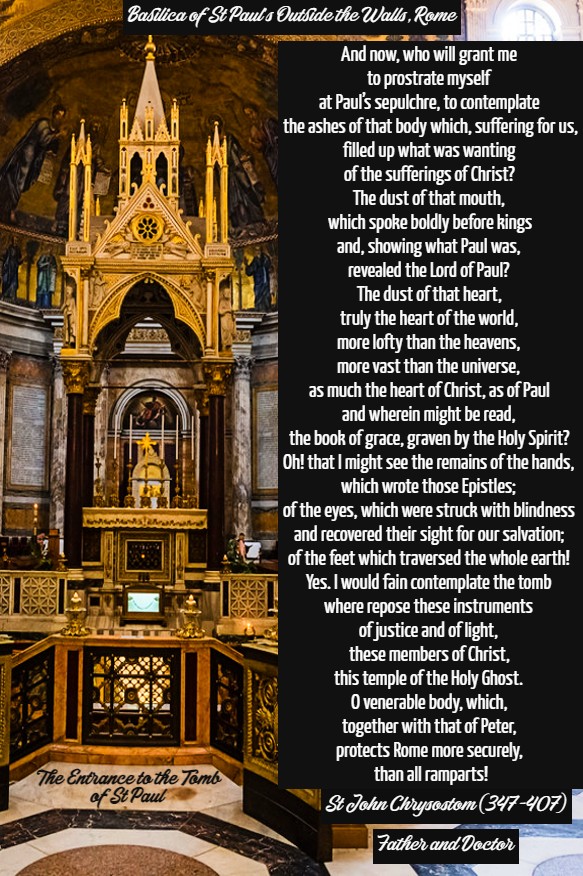
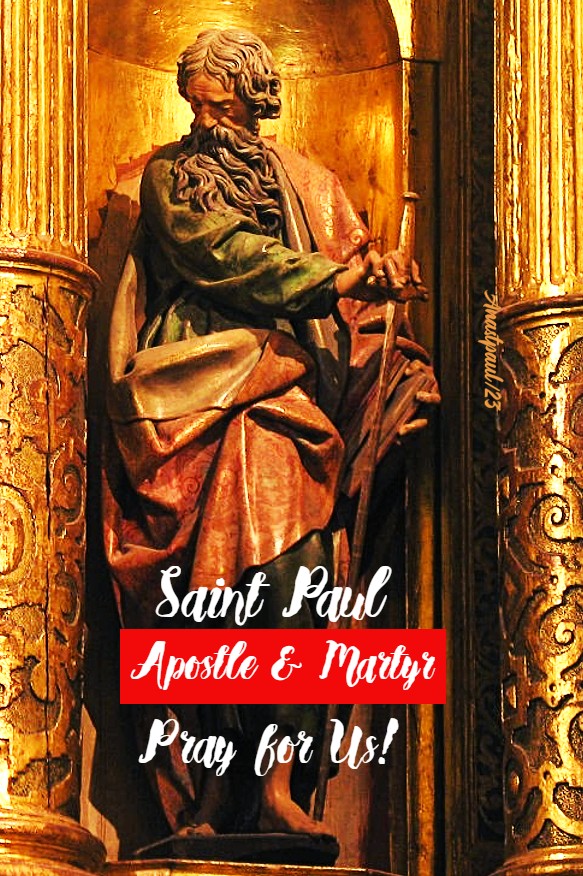
Quote of the Day – 30 June – The Commemoration of St Paul, Apostle and Martyr
“And now, who will grant me to prostrate myself at Paul’s sepulchre, to contemplate the ashes of that body which, suffering for us, filled up what was wanting of the sufferings of Christ? The dust of that mouth which spoke boldly before kings and, showing what Paul was, revealed the Lord of Paul? The dust of that heart, truly the heart of the world, more lofty than the heavens, more vast than the universe, as much the heart of Christ, as of Paul and wherein might be read, the book of grace, graven by the Holy Spirit? Oh! that I might see the remains of the hands, which wrote those Epistles; of the eyes, which were struck with blindness and recovered their sight for our salvation; of the feet which traversed the whole earth! Yes. I would fain contemplate the tomb where repose these instruments of justice and of light, these members of Christ, this temple of the Holy Ghost. O venerable body, which, together with that of Peter, protects Rome more securely, than all ramparts!”
One Minute Reflection – 30 June – “The Month of the Most Sacred Heart of Jesus” – The Commemoration of St Paul, Apostle and Martyr – Galatians 1:11-20 – Matthew 10:16-22 – Scripture search here: https://www.drbo.org/
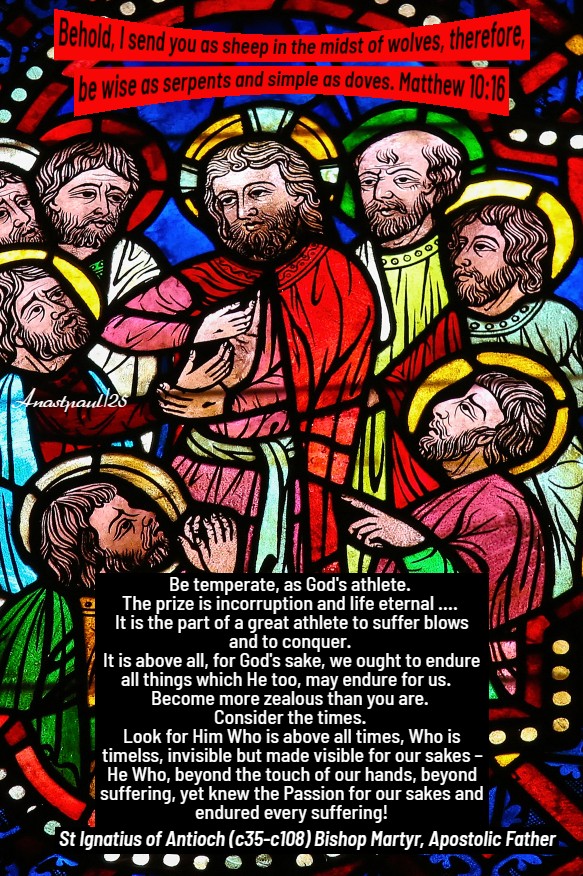
“Behold, I send you as sheep in the midst of wolves, therefore, be wise as serpents and simple as doves.” – Matthew 10:16
REFLECTION – “I urge you, in the grace in which you are clothed, to press on in your race and urge everyone to be saved. Assert your office with all the diligence of flesh and spirit. Give your attention to unity, for there is nothing better. Carry your brethren as the Lord also carries you. Patiently bear with them all in love, as indeed you do bear with them. Devote yourself to unceasing prayer. Ask for greater understanding than you have. Be watchful, possessing a wakeful spirit. Speak to each one individually concerning God’s way. “Bear the infirmities” (cf. Mt 8:17) of each as a perfect athlete. Where there is more toil, there is greater gain.
If you only love the good disciples, this wins you no advantage. Rather, subdue by meekness, the more annoying. Not every wound is cured by the same salve. Ease sharp pains with a hot compress. In everything “be wise as serpents” and always “harmless as doves”. You who are of flesh and spirit, humour those things visibly present before you but pray, too, that what is invisible may be manifested to you, so that you may lack nothing and may abound in every spiritual gift.
As pilots invoke the winds and tempest-tossed mariners, call for haven, this season invites you to return to God. Be temperate, as God’s athlete. The prize is incorruption and life eternal …. It is the part of a great athlete to suffer blows and to conquer. It is above all, for God’s sake, we ought to endure all things which He too, may endure for us. Become more zealous than you are. Consider the times. Look for Him Who is above all times, Who is timelss, invisible but made visible for our sakes – He Who, beyond the touch of our hands, beyond suffering, yet knew the Passion for our sakes and endured every suffering!” – St Ignatius of Antioch (c35-c108) Bishop Martyr, Apostolic Father of the Church [Letter to Saint Polycarp (69-155)]
PRAYER – O God, Who taught vast numbers of the Gentiles by the preaching of the blessed Apostle Paul, grant we beseech Thee that, by honouring his memory, we may enjoy the benefit of his patronal intercession. Through Jesus Christ, Thy Son our Lord, Who lives and reigns with Thee, in the unity of the Holy Ghost, God, world without end. Amen (Collect).
SACRED Heart of JESUS, I trust in Thee. 300 Days Indulgence Once a Day – Plenary, Once a month. Raccolta 175 – St Pius X, 19 August 1905 and 27 June 1906.
Our Morning Offering – 30 June – The Last Day of the Month of the Sacred Heart of Jesus
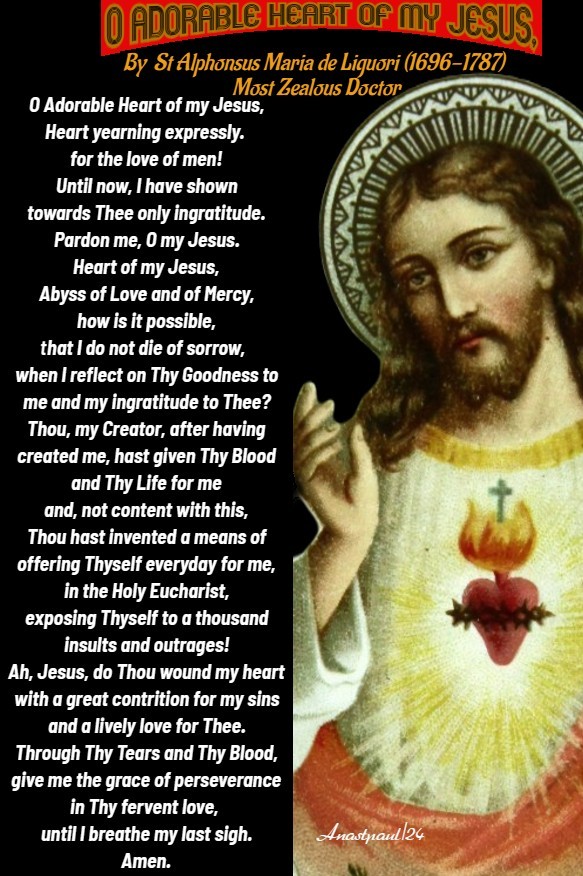
O Adorable Heart of my Jesus! By St Alphonsus Maria de Liguori (1696-1787) Most Zealous Doctor
O Adorable Heart of my Jesus, Heart yearning expressly. for the love of men! Until now, I have shown towards Thee only ingratitude. Pardon me, O my Jesus. Heart of my Jesus, Abyss of Love and of Mercy, how is it possible, hat I do not die of sorrow, when I reflect on Thy Goodness to me and my ingratitude to Thee? Thou, my Creator, after having created me, hast given Thy Blood and Thy Life for me and, not content with this, Thou hast invented a means of offering Thyself everyday for me, in the Holy Eucharist, exposing Thyself to a thousand insults and outrages! Ah, Jesus, do Thou wound my heart with a great contrition for my sins and a lively love for Thee. Through Thy Tears and Thy Blood, give me the grace of perseverance in Thy fervent love, until I breathe my last sigh. Amen.
Saint of the Day – 30 June – Saint Ostian (6th Century) Priest, Confessor and Hermit in Viviers, France, Miracle-worker. Patronages – Viviers, France, for rain (most especially in Viviers). Also known as – Ostianus, Ostiane, Ostiano, Hostien.
The Roman Martyrology reads today: “In the territory of Viviers, St Ostian, Priest and Confessor.”
“Living in the 6th Century, Ostian first evangelised the Dioceses of Viviers and Le Puy. He was then a Hermit near Viviers. The 16th Century handwritten Martyrology mentions him in these terms: ‘in the territory of Viviers, in the Church of St Martin of the Couspié valley, one mile north of the City, at the foot of the mountain of the Tour St Martin, the body of the blessed Ostian, Priest, rests to this day.’ His Relics were solemnly brought to the Cathedral on 19 August 1880. He is the Patron of the City of Viviers.” ( Diocese of Viviers: Consecrated life. He is celebrated on 30 June in the Calendar of the Diocese of Viviers).
We have very limited information of our Saint Ostian. He is believed to have been a relative of Sigismund, the King of Burgundy.
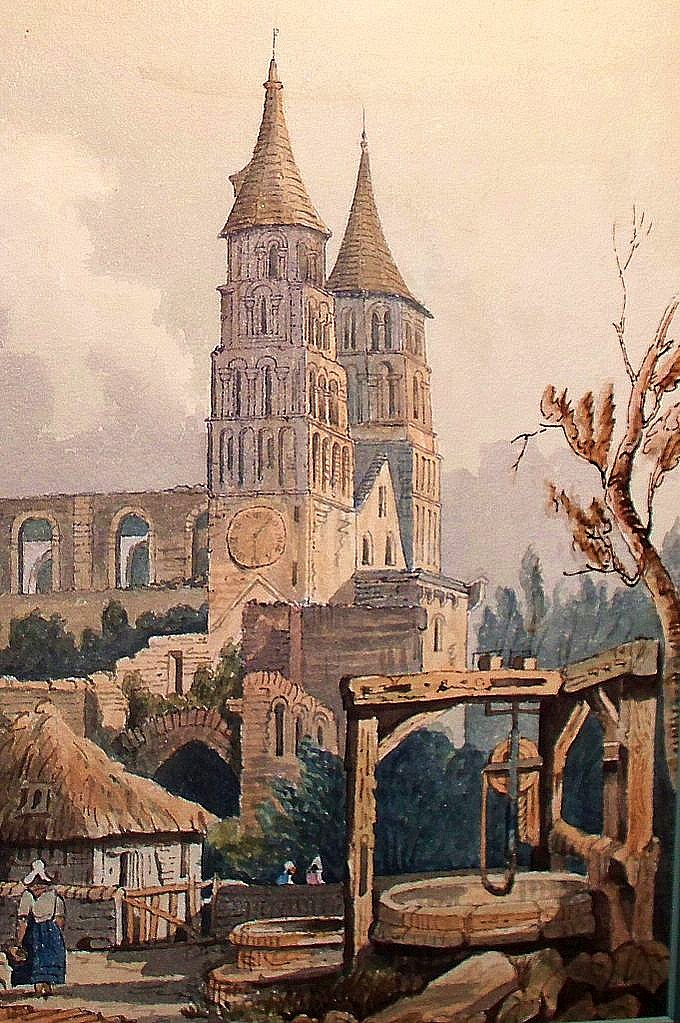
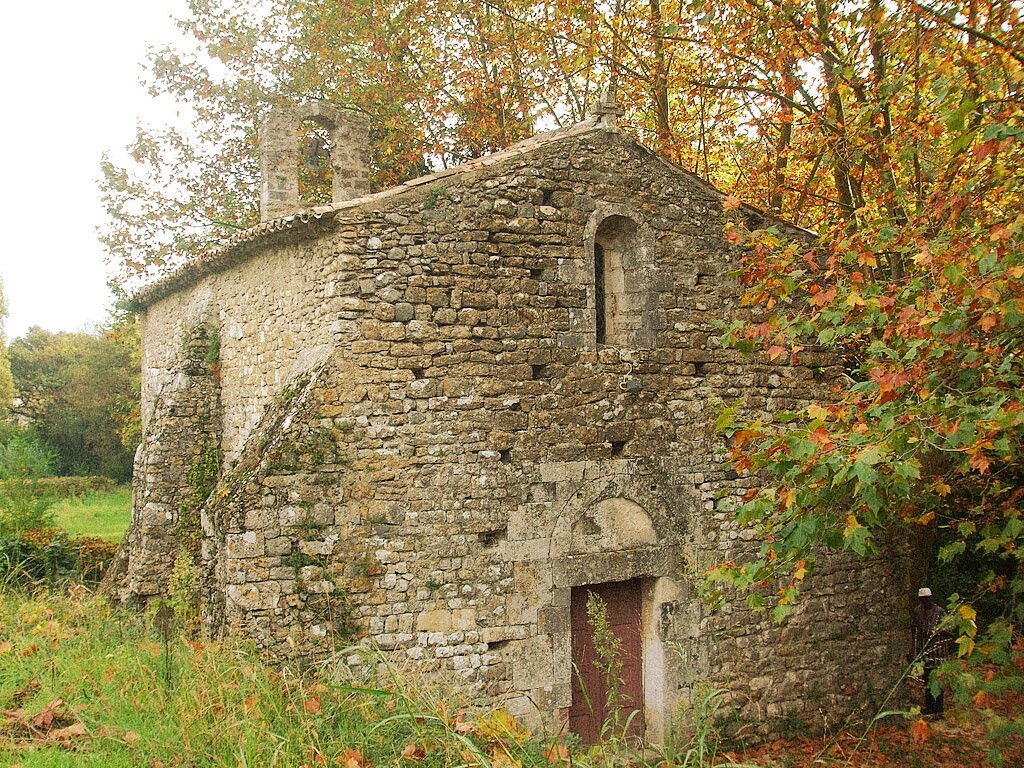
After distributing all his possessions, Ostian is said to have followed the King’s son, Saint Venantius, who was the Bishop of Viviers. The Bishop, wanting to fulfill Ostian’s wish, is said to have granted him ownership of a piece of land in the Couspier valley, at the foot of Mount Bayna, where the Saint lived for 15 years. During these 15 years, it is believed he performed various miracles, including the cures of some blind people. Below is his little stone Chapel where he lived and preached and spread the Gospel, evangelising the region and confessing Christ to all who had ears to hear.
In the 9th Century, Bishop Bernoin (851-874) made a first survey of the Relics of Saint Ostian. And, in the 18th Century, it was believed that his body was in the Church of St Martin di Couspiè. In 1711, in the annotations of the resolutions of the City Council, was presented that the “request for a Procession and Solemn Mass at the Church of Saint-Martin to put an end to the drought, in honour of Sant’Ostian.”
The stone Sarcophagus containing his bones was found in 1869. After these Relics were declared authentic, on 19 August 1880, some bones were transferred to the Cathedral of Viviers and deposited in the Chapel of the Holy Relics. The rest of the Relics had been left in the original restored crypt of the Chapel of Saint-Ostian in San Martin.
The inhabitants of Viviers traditionally invoke Saint Ostian to obtain rain in times of drought. Although the first to introduce the name of this saint in a martyrology was Usvardo, while in Vivers, in some Liturgical records of the 14th and 15th Centuries, his memory was remembered. Currently, Saint Ostian, Priest and Confessor, is remembered and celebrated today, 30 June.
The Town called Saint-Hostien (Sant Ostian in Occitan) is part of the Saint Régis en Mézenc-Meygal Parish complex of the Diocese of Puy.
St Adolphus of Osnabrück O.Cist. (1185-1224) Bishop St Alpinian of Limoges St Alrick the Hermit Bl Ambrose de Feis Bl Anthony de Tremoulières Bl Arnulf of Villers St Austriclinian of Limoges St Basilides of Alexandria St Bertrand of Le Mans St Clotsindis of Marchiennes
Bl Elisabeth Heimburg St Emiliana of Rome St Erentrude St Eurgain St Gaius Bl Jacob Clou St Leo the Deacon St Lucina of Rome St Lucina of the Callistus Catacombs St Marcian of Pampeluna St Martial of Limoges St Ostian (6th Century) Priest, Confessor St Otto of Bamberg St Peter of Asti St Petrus Li Quanhui
Blessed Raymond Lull TOSF (c1232 – c 1315) Martyr – known as “Doctor Illuminatus,” Raymond was a Philosopher, Logician, Writer, Poet, Pioneer in computation theory, Franciscan tertiary. Within the Franciscan Order he is honoured as a Martyr. He was Beatified on 25 February 1750 by Pope Benedict XIV (cultus confirmed) and reaffirmed in 1847 by Pope Pius IX. His Life and Death: https://anastpaul.com/2018/06/30/saint-of-the-day-30-june-blessed-raymond-lull-t-o-s-f-c-1232-c1315-martyr/
St Vihn Son Ðo Yen
Martyrs of Africa – 7 Saints: Seven Christians Martyred together. No detail about them have surived but the names – Cursicus, Gelatus, Italica, Leo, Timotheus, Zoilus, and Zoticus. Date and precise location in Africa unknown.
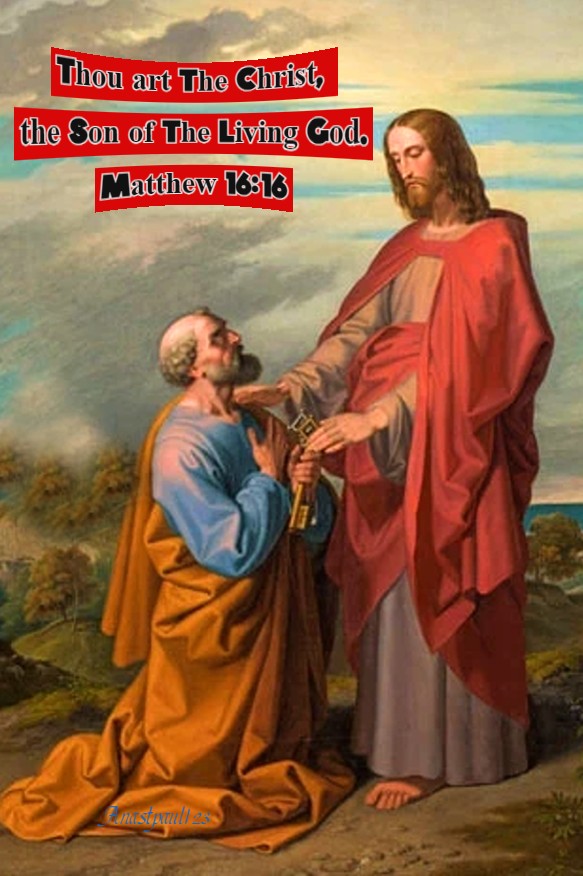
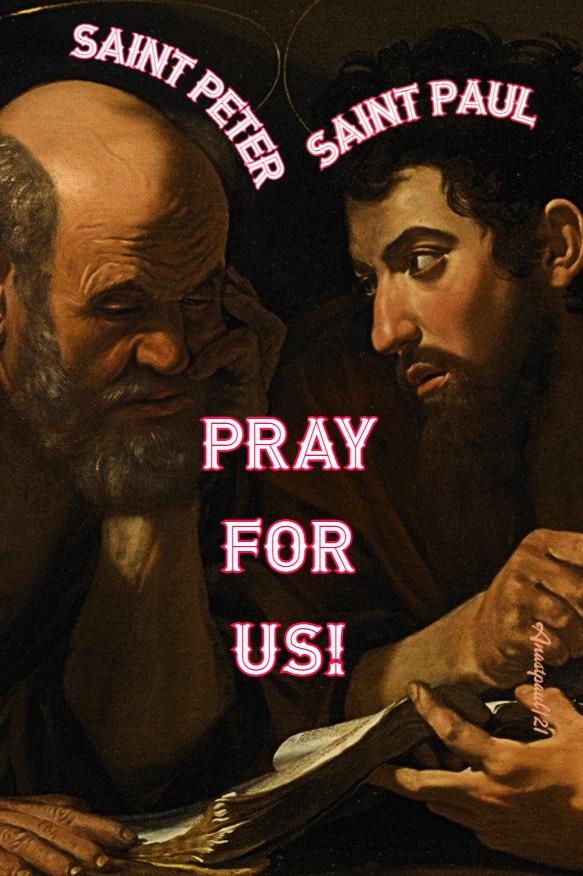
Quote/s of the Day – 29 June – Saints Peter and Paul, Apostles – Acts 12:1-11; Matthew 16:13-19 – – Scripture search here: https://www.drbo.org/
“Thou art the Christ, the Son of the living God.”
Matthew 16:16
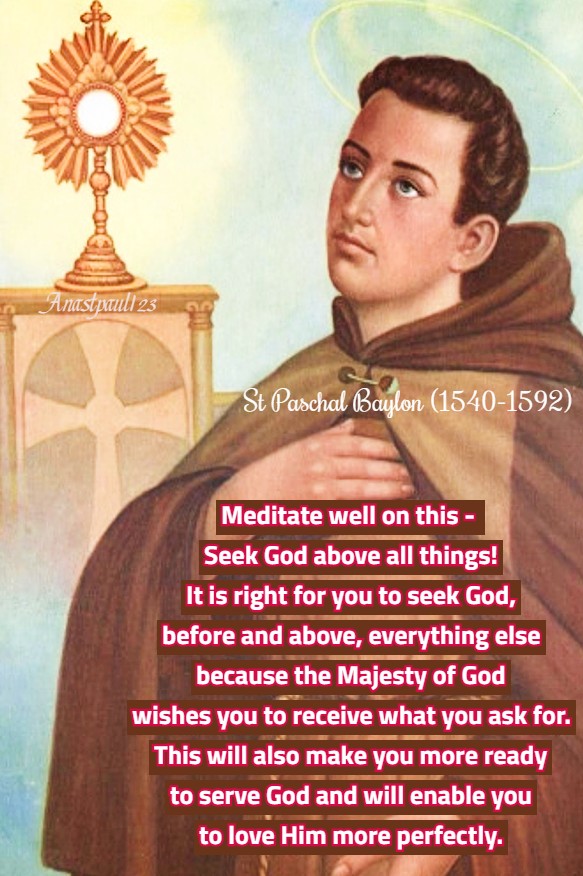
“Meditate well on this – Seek God above all things! It is right for you to seek God, before and above, everything else because the Majesty of God wishes you to receive what you ask for. This will also make you more ready to serve God and will enable you to love Him more perfectly.”
St Paschal Baylon (1540-1592)
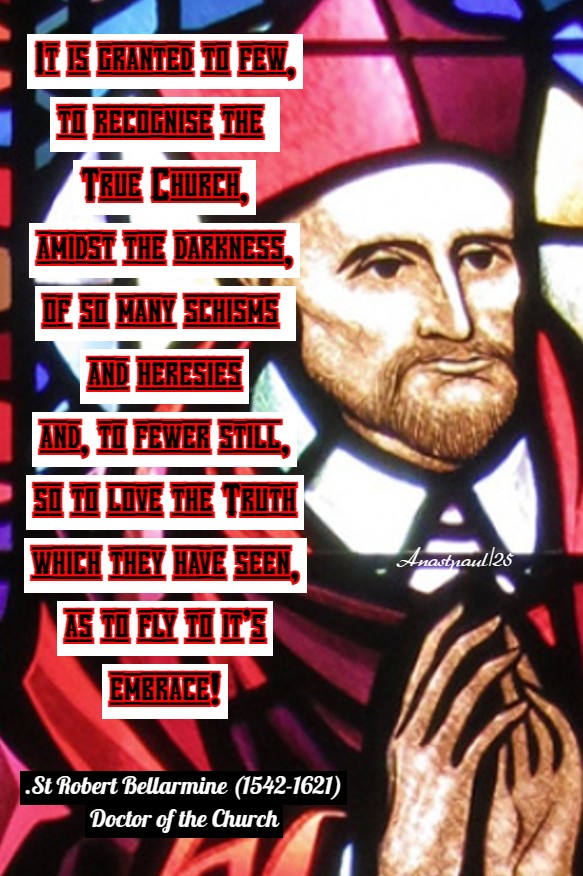
“It is granted to few, to recognise the True Church, amidst the darkness, of so many schisms and heresies and, to fewer still, so to love the Truth which they have seen, as to fly to it’s embrace!”
St Robert Bellarmine (1542-1621) Doctor of the Church
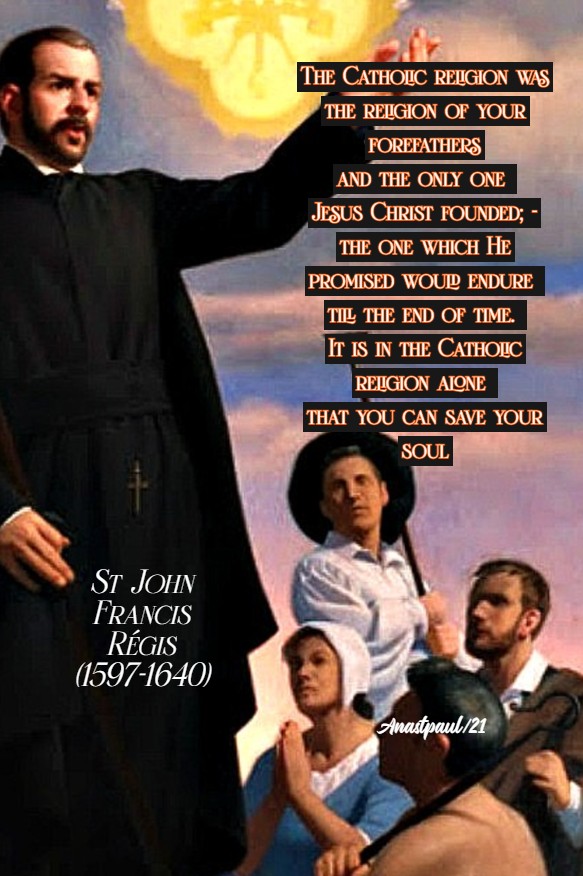
“The Catholic religion was the religion of your forefathers and the only one Jesus Christ founded; – the one which He promised would endure till the end of time. It is in the Catholic religion alone that you can save your soul.”
St John Francis Régis (1597-1640)
“He who most loves, will be most loved.”
St Francis de Sales (1567-1622) Doctor of the Church
One Minute Reflection – 29 June – “The Month of the Most Sacred Heart of Jesus” – Saints Peter and Paul, Apostles – Within the Octave of the Sacred Heart – Pentecost III – Acts 12:1-11 – Matthew 16:13-19 – Scripture search here: https://www.drbo.org/
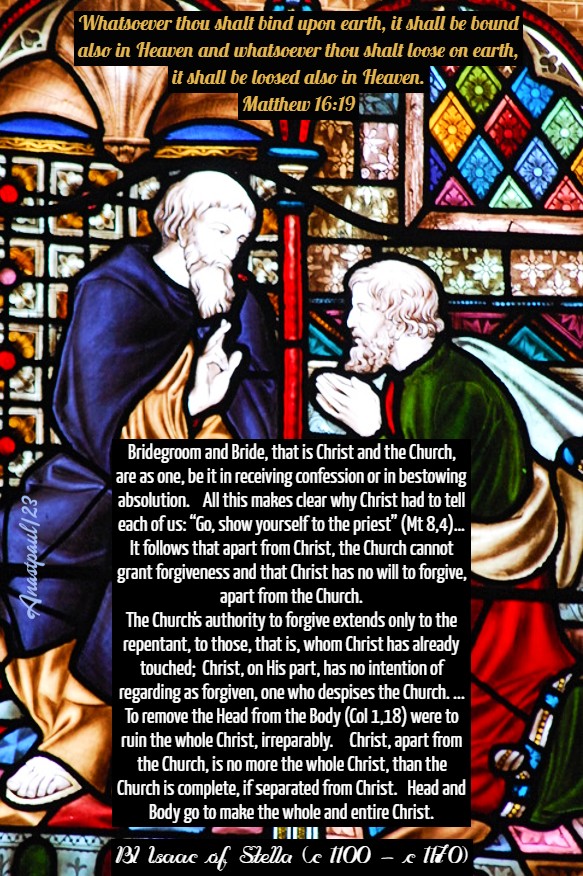
“Whatsoever thou shalt bind upon earth, it shall be bound also in Heaven and whatsoever thou shalt loose on earth, it shall be loosed also in Heaven.” – Matthew 16:19
REFLECTION – “Bridegroom and Bride, that is Christ and the Church, are as one, be it in receiving confession or in bestowing absolution. All this makes clear why Christ had to tell each of us: “Go, show yourself to the priest” (Mt 8,4)… It follows that apart from Christ, the Church cannot grant forgiveness and that Christ has no will to forgive, apart from the Church. The Church’s authority to forgive extends only to the repentant, to those, that is, whom Christ has already touched; Christ, on His part, has no intention of regarding as forgiven, one who despises the Church.
Doubtless, Christ need accept no restraints to His power of Baptising, Consecrating the Eucharist, Ordaining Priests, forgiving sins and the like but, the humble and faithful Bridegroom, prefers to confer such blessings, with the co-operation of His Bride. “What God,” then, “has joined, let no man put asunder” (Mt 19,6). “I say this is a great mystery and refers to Christ and the Church” (Eph 5,32)… To remove the Head from the Body (Col 1,18) were to ruin the whole Christ, irreparably. Christ, apart from the Church, is no more the whole Christ, than the Church is complete, if separated from Christ. Head and Body go to make the whole and entire Christ.” – Bl Isaac of Stella (c 1100 – c 1170) Cistercian Monk, Abbot, Theologian, Philosopher (Sermon 11, §11-814).
PRAYER – O God, Who made this day holy by the Martyrdom of Thy Apostles Peter and Paul, grant Thy Church to follow in all things the teaching of those from whom she first received the faith. Through Jesus Christ, Thy Son our Lord, Who lives and reigns with Thee, in the unity of the Holy Ghost, God, world without end. Amen (Collect).
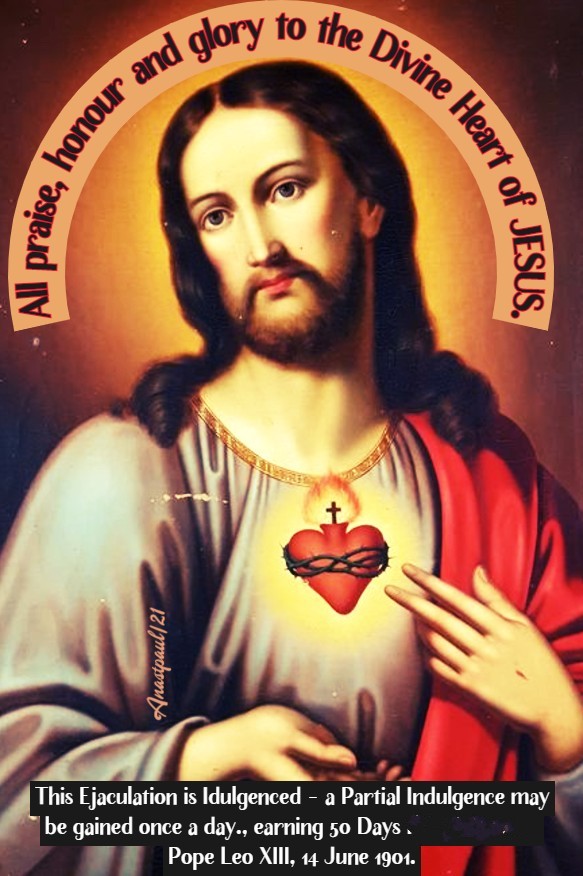
ALL PRAISE, honour and glory to the Divine Heart of JESUS.Indulgenced– 50 Days, once a day. 168 Pope Leo XIII, 14 June 1901.
Our Morning Offering – 29 June – “The Month of the Most Sacred Heart of Jesus”
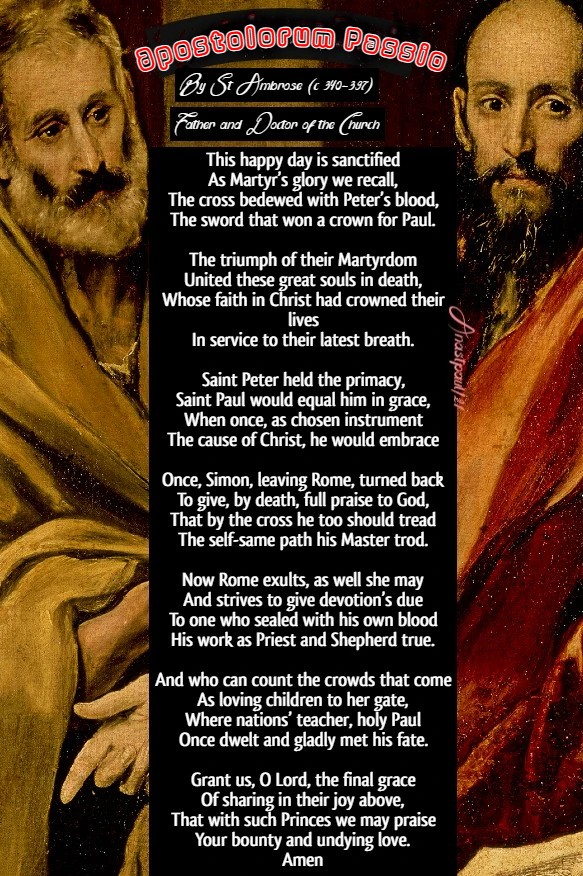
Apostolorum Passio By St Ambrose (c340-397) Father and Doctor of the Church
This happy day is sanctified As Martyr’s glory we recall, The cross bedewed with Peter’s blood, The sword that won a crown for Paul.
The triumph of their Martyrdom United these great souls in death, Whose faith in Christ had crowned their lives In service to their latest breath.
Saint Peter held the primacy, Saint Paul would equal him in grace, When once, as chosen instrument The cause of Christ, he would embrace
Once, Simon, leaving Rome, turned back To give, by death, full praise to God, That by the cross he too should tread The self-same path his Master trod.
Now Rome exults, as well she may And strives to give devotion’s due To one who sealed with his own blood His work as Priest and Shepherd true.
And who can count the crowds that come As loving children to her gate, Where nations’ teacher, holy Paul Once dwelt and gladly met his fate.
Grant us, O Lord, the final grace Of sharing in their joy above, That with such Princes we may praise Your bounty and undying love. Amen
Translation: The Benedictines of Saint Cecilia’s Abbey, Ryde, UK
Saint/s of the Day – 29 June – Saint Judith Widow, Recluse and St Salome (9th Century) Recluse both of Niederaltaich in Bavaria.
There is considerable debate regarding the identity of Judith and her companion, St Salome. They may have been cousins (or Judith the aunt of Salome) of Anglo-Saxon Royal lineage, who lived for a considerable period as Recluses under Abbot Walther (or Walker) in Oberaltaich-am-Donau. A later tradition identifies Salome as St Edburga, daughter of King Offa of Mercia, who was exiled for accidentally poisoning her husband. She was then befriended by the Bavarian widow, Judith.
Relics of both were later disinterred and buried near the Altar of St Giles. It is thought that their bodies came to Niederaltaich on the occasion of the destruction of Oberaltaich by the Hungarians.
Another source states that the two Recluses lived in Niederaltaich in about 1100. According to this version, while in the neighbourhood of Regensburg in Germany, after a pilgrimage to the Holy Land, Salome became blind, in answer to prayer, asking for this affliction to escape from sinful proposals.
St Salome
She lived by begging. Once she fell into the Danube and was rescued by a passing boat which took her to Passau. She was recommended to the Abbot of Niederaltaich, who had a Recluse’s cell built for her beside the Monastery Church. Here she was found by her blood relative and childhood playmate, Judith, who having been widowed young and having likewise gone to Jerusalem, had searched for Salome. With permission of the Abbot and the Chapter, Judith was then also given a cell by the Church of Niederaltaich. Both women worked as servants in the Monastery. Both died before the end of the 11th Century, Salome first. This Vita dates from the 13th or 14th Century.
It claims that both bodies were interred in a common Shrine before the Altar of St Giles although they have since been lost.
Judith and Salome were venerated in monastic martyrologies and in art but had no liturgical cult.
Sts Peter and Paul, Apostles: The joint commemoration of the Apostles, Peter and Paul, is one of the most ancient customs of the Roman Church, attested already in the oldest surviving Roman Liturgical Calendar, the Depositio Martyrum, written in 336. A verse of the Hymn, Apostolorum Passio, an authentic work of St Ambrose († 397) and still used in the Ambrosian liturgy, says that “the thick crowds make their way through the circuit of so great a city; the feast of the sacred Martyrs is celebrated on three streets.” These “three streets” are the via Cornelia, the main street running up to and over the Vatican hill; the via Ostiensis, where the burial and Church of St Paul are and the via Appia, on which resides the Cemetery “in Catacumbas.”
St Anastasius of Bourges (Died c274) Soldier. Martyr. Scourged to death in c274, no other information has survived.
St Benedicta of Sens
St Cassius (Died 558) Bishop of Narni, Italy from 537 to 558, the date of his deat, Miracle-worker. He was praised by St Gregory the Great and was noted for his charity. Died on 30 June 558 in Narni, Italy of natural causes. Relics enshrined in the Cathedral of Narni, Italy. The Roman Martyrology reads: “At Narni, St Cassius, Bishop of that City of whom St Gregory the Great relates, in writing and in sermons, that Cassius permitted scarely any day of his life to pass without offering the Victim of propitiation to Almight God and he was well worthy to do so, for he distributed in alms, all he possessed and his devotion was such that abundant tears flowed from his eyes during the Holy Sacrifice.At Last, he came to Rome on the birthday of the Apostles, as was his yearly custom and after having solemnly celebrated Mass and given the Lord’s Body and the Kiss of Peace to all, he departed for Heaven, the next day at Narni” This Holy man of God: https://anastpaul.com/2023/06/29/saint-of-the-day-29-june-st-cassius-died-558-bishop-of-narni/
St Ciwg ap Arawn St Cocha St Ilud Ferch Brychan St Judith (9th Century) Widow and Recluse AND St Salome (9th Century) Recluse of Niederaltaich
St Marcellus of Bourges (Died c274) Soldier. Martyr. Beheaded in c274, no other information has survived.
Thought for the Day – 28 June – Meditations with Antonio Cardinal Bacci (1881-1971)
The Promises Made to Those Who Practise Devotion to the Sacred Heart
“The promises made by Jesus to those who are truly devoted to His Sacred Heart, are a new proof of His Infinite Love and Mercy. However, if anyone were to cultivate devotion to the Sacred Heart, merely to gain His benefits and to think more of his own spiritual and temporal advantage than of Jesus, he would display a niggardly spirit, quite unworthy of the Lord’s favour.
The worship of the Sacred Heart could degenerate into a kind of utilitarian egoism, undeserving of the name of devotion at all! Pious practices, could become cold and formal and degenerate into sentimentality tinged with superstition. There is nothing to prevent us asking the Sacred Heart for graces and favours which we need. In fact, we should do so, for it is He Who has made these promises to us and is eager to fulfil them because He loves us. But, we should be generous with Jesus in return for His Infinite Generosity towards us. We should love Him because He is so worthy of our love. Our love should be expressed, not only in prayers and outward forms but, in a deep personal transformation, which will make us more like Jesus.
True love transforms and unites two hearts. Let us love Jesus and we shall live with Jesus, through Jesus and in Jesus. His love will effect in us, the miracle which it produces in St Paul. “To me to live is Christ!” (1 Phil 1:21).”
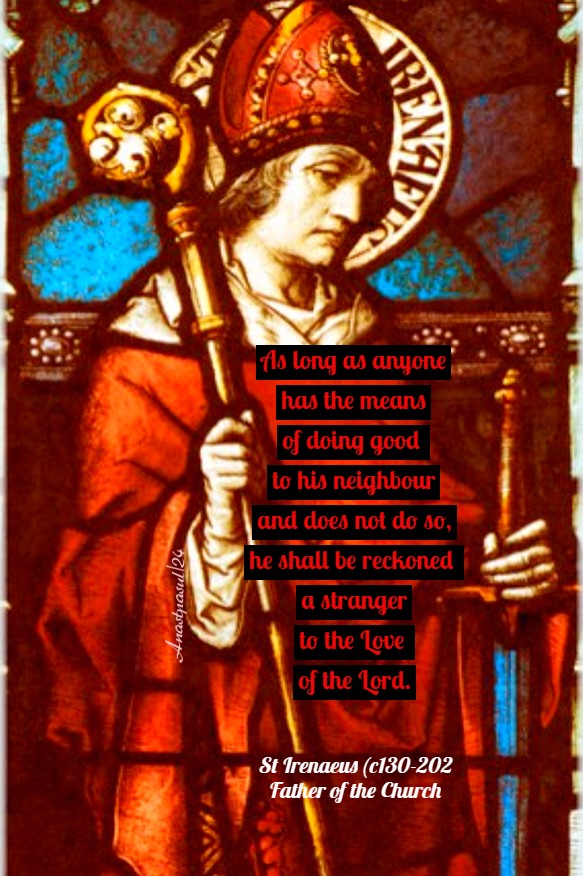
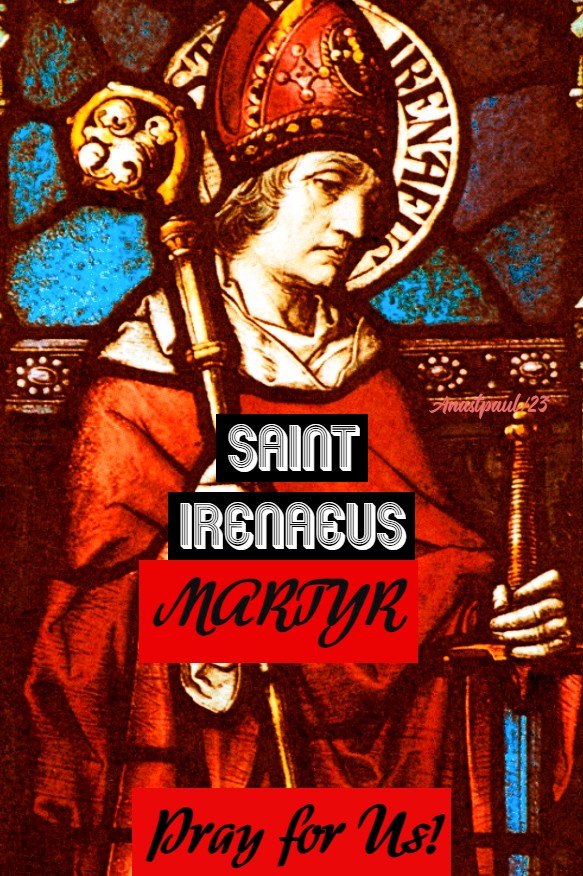
Quote/s of the Day – 28 June – St Irenaeus (c130–c202) Bishop, Martyr, Father of the Church
“As long as anyone has the means of doing good to his neighbour and does not do so, he shall be reckoned a stranger to the Love of the Lord.”
“For, as Scripture says, “The first living creature was like a lion,” (Rev 4:7) symbolising His effectual working, His leadership and Royal Power; “the second was like a calf,” signifying His Sacrificial and Priestly order but, “the third had, as it were, the face as of a man,” – an evident description of His coming as a human being; “the fourth was like a flying eagle,” pointing out the gift of the Spirit hovering with its wings over the Church. And, therefore, the Gospels of Mark, Luke, Matthew and John are in accord with these living things, among which Christ Jesus is seated. …”
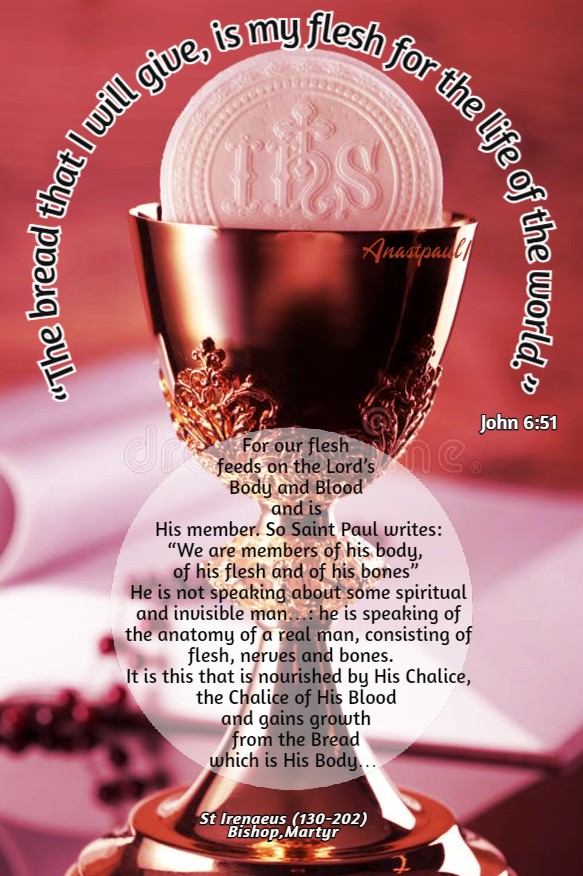
“For our flesh feeds on the Lord’s Body and Blood and is His member. So Saint Paul writes: “We are members of His Body, of His Flesh and of His Bones” (Eph 5:30; Gn 2:23). He is not speaking about some spiritual and invisible man… he is speaking of the anatomy of a real man, consisting of flesh, nerves and bones. It is this that is nourished by His Chalice, the Chalice of His Blood and gains growth from the Bread which is His Body… ”
One Minute Reflection – 28 June – “The Month of the Sacred Heart of Jesus” – St Irenaeus (c130–c202) Bishop, Martyr, Father of the Church – 2 Timothy 3:14-17, 4:1-5; Matthew 10:28-33 – Scripture search here: https://www.drbo.org/
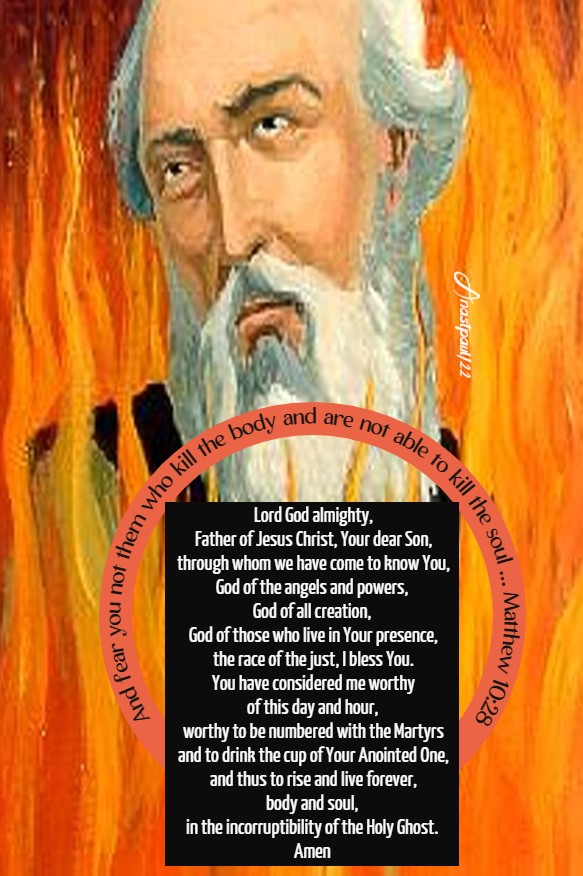
“And fear you not them who kill the body and are not able to kill the soul …” – Matthew 10:28
REFLECTION – “They did not nail Polycarp but only tied him up. And so, he was bound, putting his arms behind his back, like a noble ram taken from a large flock for sacrifice, a burnt offering acceptable to and made ready for God. Then he gazed up to Heaven and said: “O Lord God Almighty, Father of Your beloved and blessed Son Jesus Christ, through Whom we have received knowledge of You, God of the angels and the powers and of all creation, God of the whole race of the righteous who live in Your sight: I bless You, for You have thought me worthy of this day and hour, to share the cup of Your Christ, as one of Your Martyrs, to rise again to eternal life in body and soul in the immortality of the Holy Ghost. May I be taken up today into Your Presence among Your Martyrs, as a rich and acceptable sacrifice, in the manner You have prepared and have revealed and have now brought to fulfillment, for You are the God of truth… And so also I praise You for all things; I bless and glorify you through our Eternal High Priest in Heaven (Heb 4,14), in Your beloved Child, Jesus Christ, through Whom be glory to You and to Him and to the Holy Ghost, now and for the ages to come. Amen.” – Letter of the Church of Smyrna concerning the Martyrdom of Saint Polycarp (69-155) [Especially appropriate today, as St Irenaeus was a Student and Disciple of St Polycarp.]
PRAYER – O God, Who enabled blessed Irenaeus, Thy Martyr and Bishop, to overcome heresy with true doctrine and to establish peace happily in the Church, grant, we beseech Thee that Thy people may be steadfast in holy religion and give us Thy peace in our times. Through Jesus Christ, Thy Son our Lord, Who lives and reigns with Thee, in the unity of the Holy Ghost, God, world without end. Amen (Collect).
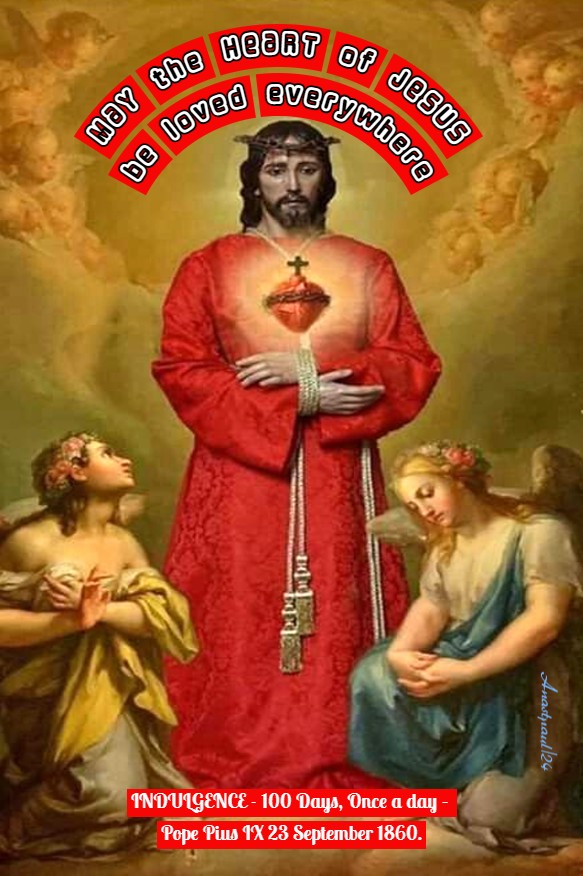
MAY the HEART of JESUS be loved everywhere. INDULGENCE – 100 Days, Once a day – Pope Pius IX 23 September 1860.
Our Morning Offering – 28 June – “The Month of the Most Sacred Heart of Jesus” – The Feastday of St Irenaeus (c130 – c202) Bishop & Martyr, Father of the Church
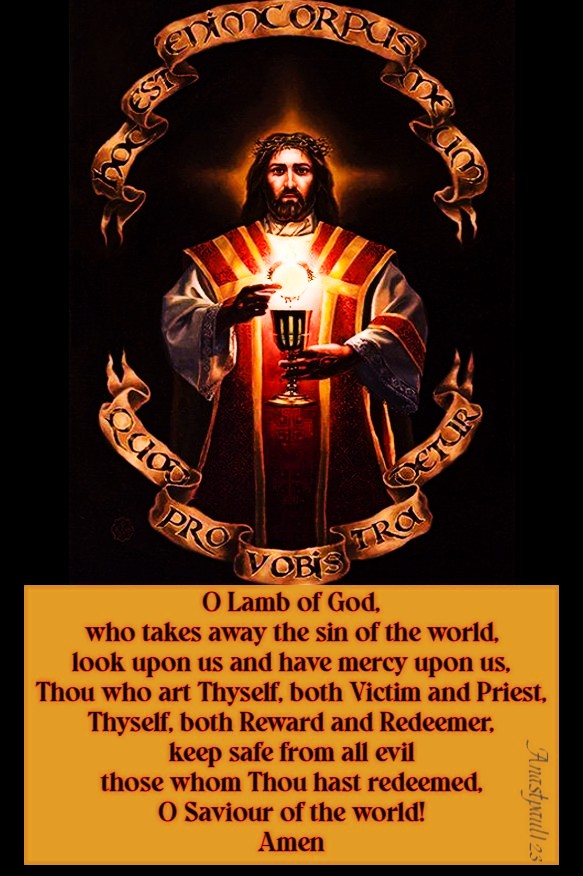
O Lamb of God By St Irenaeus (c130 – c202) Bishop & Martyr, Father of the Church
O Lamb of God, who takes away the sin of the world, look upon us and have mercy upon us, Thou who art Thyself, both Victim and Priest, Thyself, both Reward and Redeemer, keep safe from all evil those whom Thou hast redeemed, O Saviour of the world! Amen
Saint of the Day – 28 June – Saint Egilo (Died 871) Abbot of Prüm Abbey near Trier, Germany. Also known as – Egilon, Eigil.
We have no information of our Saint’s birth and life before becoming a Monk.
At Trier he founded the Abbey of Prüm and there he clothed St Humphrey in the Benedictine Habit.
In 860, he was directed by Emperor Charles the Bald, to restore Flavigny Abbey in Dijon, France which he successfully completed. Thereafter, Egilo founded the Abbey of Corbigny, in France.
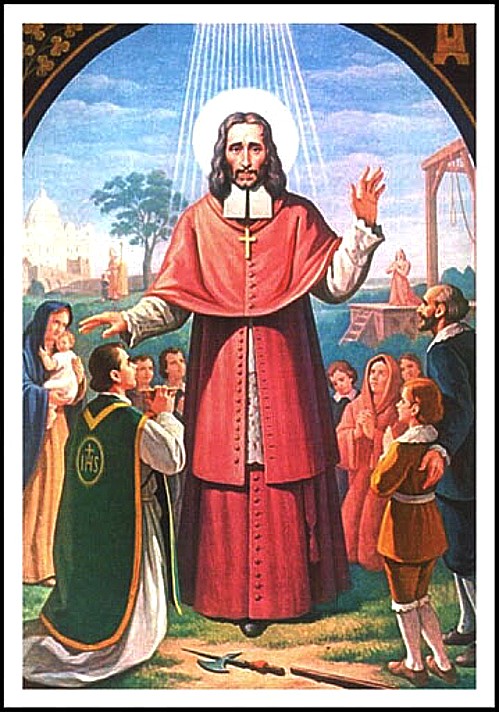
St John Southworth (1592-1654) Priest Martyr, Missionary. Known as ‘The Parish Priest of Westminster.’ Patronage – the Clergy of the Westminster Diocese. His remains were purchased by the Spanish Ambassador to England and were sent to the English College in Douai, France. There the Relics were hidden to prevent destruction during the French Revolution and were only rediscovered in 1927 and are now housed at Westminster Cathedral, London. His Life and Death: https://anastpaul.com/2024/06/28/saint-of-the-day-28-june-st-john-southworth-1592-1654-priest-martyr-the-parish-priest-of-westminster/
Martyrs of Africa – 27 Saints: 27 Christians Martyred together. The only details about them to survive are the names – Afesius, Alexander, Amfamon, Apollonius, Arion, Capitolinus, Capitulinus, Crescens, Dionusius, Dioscorus, Elafa, Eunuchus, Fabian, Felix, Fisocius, Gurdinus, Hinus, Meleus, Nica, Nisia, Pannus, Panubrius, Plebrius, Pleosus, Theoma, Tubonus and Venustus. Unknown location in Africa, date unknown.
Martyrs of Alexandria – 8 Saints: A group of spiritual students of Origen who were Martyred together in the persecutions of emperor Septimius Severus – Heraclides, Heron, Marcella, Plutarch, Potamiaena the Elder, Rhais, Serenus and Serenus. They were burned to death c206 in Alexandria, Egypt.
Thought for the Day – 27 June – “The Month and the Feast of the Most Sacred Heart of Jesus”
Consecrating the Family to the Sacred Heart
Excerpt – Enthronement of the Sacred Heart in the Home By Father Joseph Husslein SJ (1873-1952) Imprimatur 1917
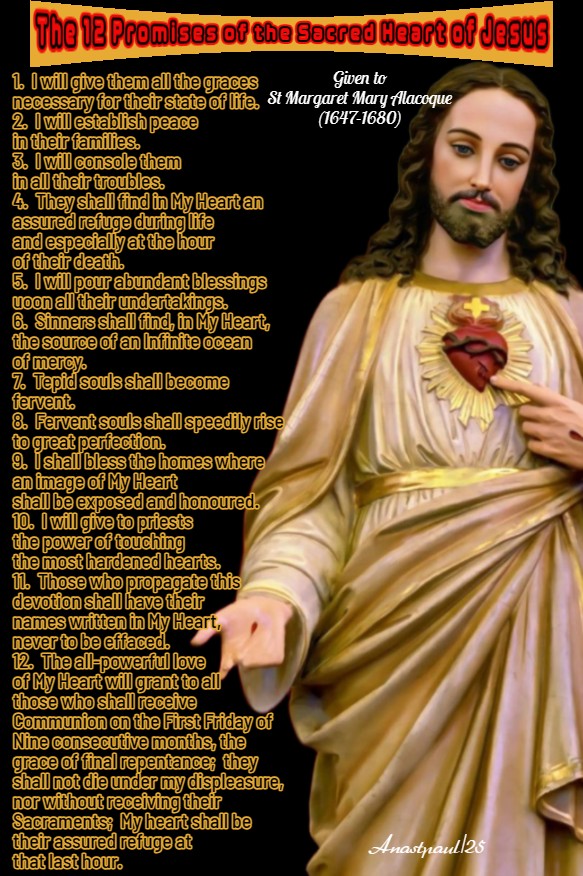
“My desire is to reign through My Heart,” our Divine Lord said to St Margaret Mary Alacoque (1647-1690), “I shall bestow abundant graces on the houses where the image of My Sacred Heart is exposed and especially honoured.”
These words are the foundation of a practice whose object is the solemn Consecration of the entire family to the Sacred Heart of Jesus, made before an image of that Divine Heart displayed in the home. It is a practice which should profoundly appeal to the laity and there should be no Catholic family which has not been dedicated to that Divine Source of Love and blessings.
“For the Christians living in the world,” wrote St Margaret Mary, “my Sovereign Master assured me that they would find, in the devotion to the Sacred Heart, all the help necessary for their state of life, peace in their families and consolation in their miseries.
That adorable Heart has likewise pledged Itself by means of this devotion, to reunite families who have been divided and to bring about peace among them, to protect those who shall be in any necessity and, to turn aside the punishments of the just wrath of God in restoring them to His grace, should they by sin, have fallen from it.
Finally, it is properly within the Divine Heart Itself, that these Christians shall find a place of refuge during life and especially at the hour of death.” These promises are translated from the authentic text of the revelations made to the great servant of the Sacred Heart, St Margaret Mary.
METHOD
The picture selected … [the image above was the only one ever used when I was a child] should be exposed in the room where all the members of the family usually meet, that it may always be conspicuously in their sight. Thus laying aside human respect, they will openly acknowledge Christ as the King of their home. Under His eyes the little ones will grow up into a noble manhood and womanhood, for His image will constantly serve to keep them in mind of His Love and to model their lives upon His. Before It, all the great family events will transpire, its joys and its sorrows and Christ will ever be in their midst, where parents and children are united in His Name.
The head of each family, the father, or, in his absence, the mother, or the oldest of the children, or whoever may hold the place of authority, should take the initiative in bringing about this Consecration. So likewise, Apostolates, schools, colleges, asylums, associations, convents and institutions of every kind, may wisely adopt this practice. Although the ceremony, according to the customary method, is for the first time performed by the Priest in the presence of the entire family and a ceremonial has even been prepared for the purpose, yet often this cannot readily be done and, therefore, the head of the family will suffice and he too must ensure that frequent renewals occur to make it living and effective.. A lovely practice is to renew on the annual Feast of the Sacred Heart AND during the Season of Christmas AND on each family member’s Birthday.
Solemnity and beauty should be given to the ceremony, by placing flowers and lit candles about the image of the Sacred Heart and, it is well that the picture of Mary’s Immaculate Heart and of St Joseph, should not be wanting to complete the religious beauty of that family room.
What greater joy for Christian mothers than frequently to repeat this Act and to know that their dear ones are safely hidden and protected in the Heart of Jesus, there to live and there to die?
ACT of CONSECRATION: The following is the Act of Consecration omitting the ceremonies in the absence of a Priest. Mere words alone do not, of course, suffice – the family should henceforth strive to live in the spirit of this Consecration:
Lord Jesus, vouchsafe to visit this home, in the company of Thy sweet Mother and confer on its inhabitants the graces promised to families, especially consecrated to Thy Divine Heart. Thou Thyself, O Saviour of the world, didst solicit, with merciful purposes, the solemn homage of universal love toward the Heart which has so loved men and by whom, such ungrateful returns are made to Thee, as Thou hast revealed to Thy servant Margaret Mary.
Therefore, this family hastens to Thy call and in reparation for the apostasy of so many souls, by whom Thou art forsaken, proclaims Thee, O Sacred Heart, their amiable Sovereign and Consecrates to Thee ,absolutely their joys, their troubles and their sadness, the present and the future of this their Home which is to be, henceforth and forever Thine. Bless, then, sweet Jesus, those present and absent and bless those who, by the will of Heaven, have been snatched away by death.
We beseech Thee, O Loving Heart, through the love of the Virgin Mary that Thou wouldst establish in this house of Thine, the empire of Thy charity; inspire all its inhabitants with Thy spirit of faith, of sanctity and of purity and win their souls for Thee, leading them away from the world and its foolish vanities. Open, O Lord, the radiant wound of Thy merciful Heart and keep therein, as in the Ark of Salvation, all those who belong to Thee for all eternity. May the conquering Heart of Jesus be always loved, blessed, and glorified amongst us! Amen.
Consecration to the Sacred Heart By Pope Leo XIII (1810-1903) Pope from 1878-1903
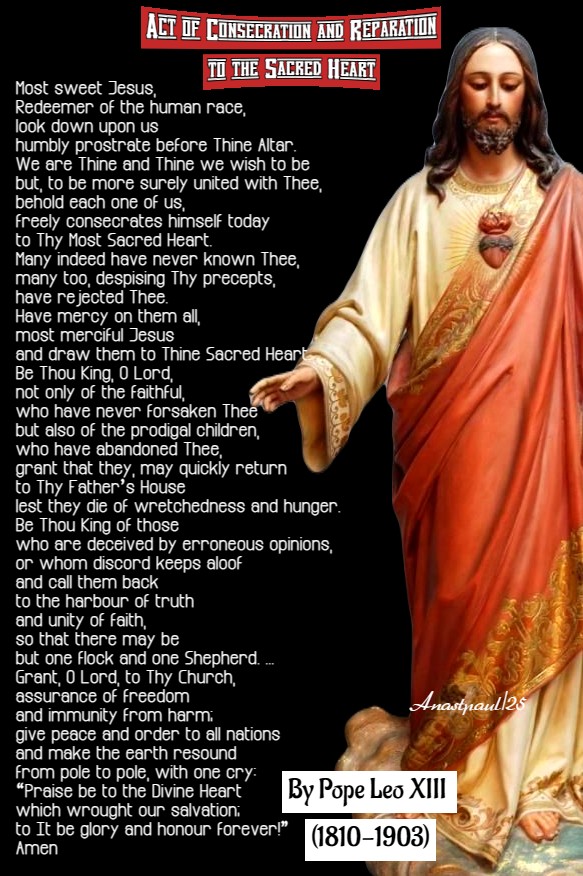
Most sweet Jesus, Redeemer of the human race, look down upon us humbly prostrate before Thine altar. We are Thine and Thine we wish to be but, to be more surely united with Thee, behold each one of us, freely consecrates himself today to Thy most Sacred Heart. Many indeed have never known Thee, many too, despising Thy precepts, have rejected Thee. Have mercy on them all, most merciful Jesus and draw them to Thy Sacred Heart. Be Thou King, O Lord, not only of the faithful, who have never forsaken Thee but also of the prodigal children, who have abandoned Thee, grant that they may quickly return to Thy Father’s house lest they die of wretchedness and hunger. Be Thou King of those who are deceived by erroneous opinions, or whom discord keeps aloof and call them back to the harbour of truth and unity of faith, so that there may be but one flock and one Shepherd. Be Thou, King of all those. who are still involved in the darkness of idolatry or of Islamism and refuse not, to draw them into the light and kingdom of God. Turn Thine eyes of mercy towards the children of the race, once Thy chosen people – of old they called down upon themselves the Blood of the Saviour; may it now descend upon them, a laver of redemption and of life. Grant, O Lord, to Thy Church, assurance of freedom and immunity from harm; give peace and order to all nations and make the earth resound from pole to pole, with one cry: “Praise be to the Divine Heart that wrought our salvation; to It be glory and honour forever.” Amen
Advertisement
The above prayer, composed by Pope Leo XIII was included in the 1899 Encyclical, Annum Sacrum, issued by Leo XIII as he Consecrated the entire world to the Sacred Heart of Jesus. The Consecration was influenced by two letters written to the Holy Father by Blessed Sister Mary of the Divine Heart, who stated that in visions of Jesus Christ, she had been told to request the Consecration.
Quote/s of the Day – 27 June – “The Month and the Feast of the Most Sacred Heart of Jesus”
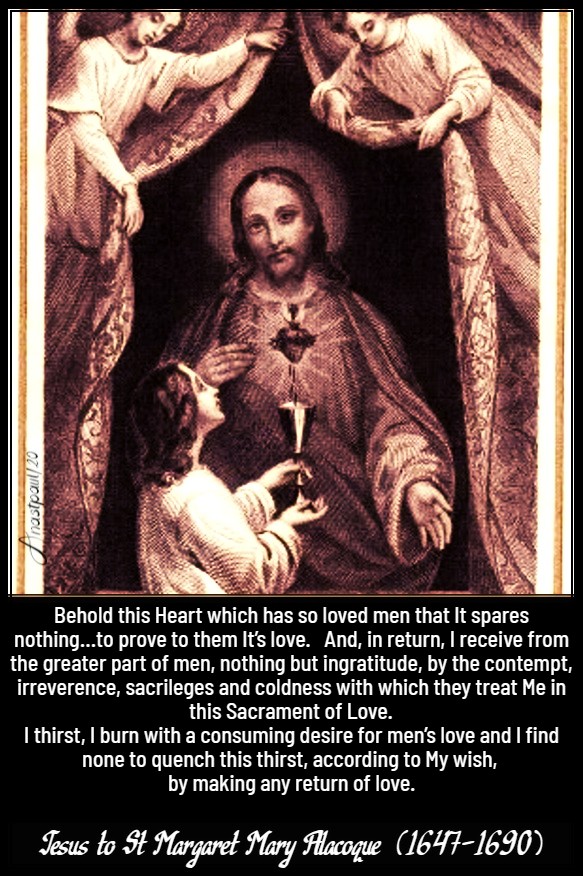
“Behold this Heart which has so loved men that It spares nothing…to prove to them It’s love. And, in return, I receive from the greater part of men, nothing but ingratitude, by the contempt, irreverence, sacrileges and coldness with which they treat Me in this Sacrament of Love.
I thirst, I burn with a consuming desire for men’s love and I find none to quench this thirst, according to My wish, by making any return of love.”
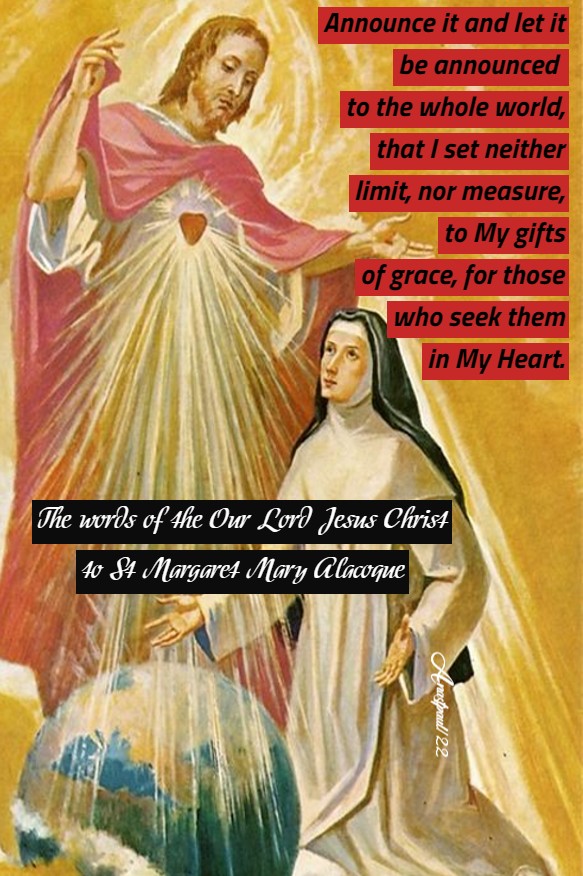
“Announce it and let it be announced to the whole world, that I set neither limit, nor measure, to My gifts of grace, for those who seek them in My Heart.”
The words of the Our Lord Jesus Christ to St Margaret Mary Alacoque
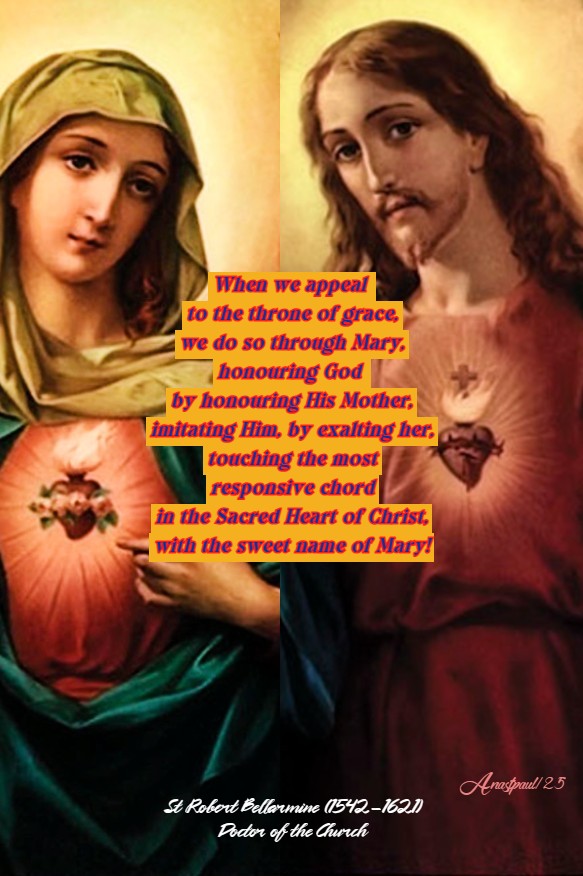
“When we appeal to the throne of grace, we do so through Mary, honouring God by honouring His Mother, imitating Him, by exalting her, touching the most responsive chord in the Sacred Heart of Christ, with the sweet name of Mary!”
St Robert Bellarmine (1542-1621) Doctor of the Church
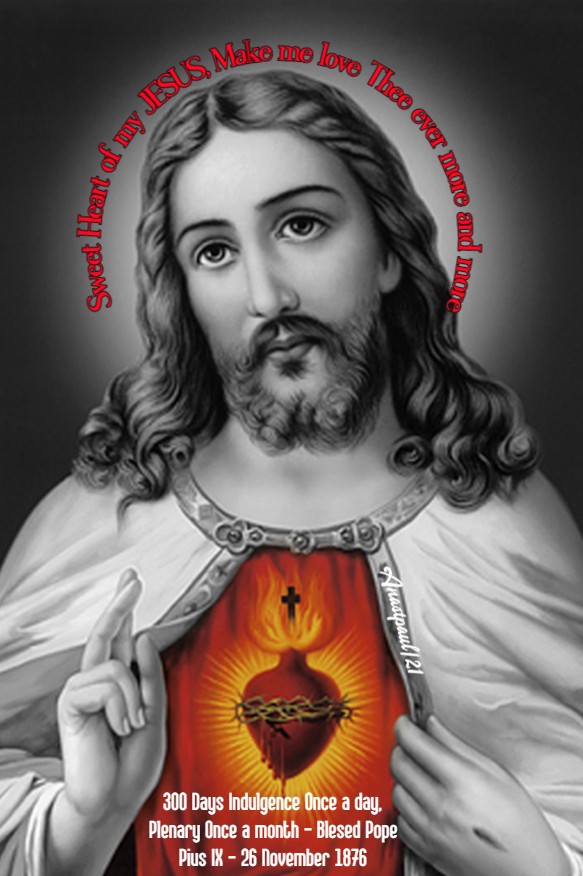
Sweet Heart of my JESUS, Make me love Thee ever more and more! –300 Days Indulgence Once a day, Plenary Once a month – Pope Pius IX – 26 November 1876
One Minute Reflection – 27 June – “The Month and the Feast of the Most Sacred Heart of Jesus” – Mother of Perpetual Succour – Within the Octave of St John the Baptist – Ephesians 3:8-12, 14-19 – John 19:31-37 – Scripture search here: https://www.drbo.org/
“… One of the soldiers opened His side with a lance and immediately there came forth blood and water. ” – John 19:34
REFLECTION – “Let us draw near to the Heart of our most sweet Lord Jesus and we shall be glad and rejoice in it. How good and how sweet it is to dwell in this Heart! This is the hidden treasure, the pearl of great price which we discover, O Jesus, when we dig in the field of Thy Body (cf Mt 13:44). Who, then, would cast aside this Pearl? Far from it! For It, I will give away all my goods and offer in exchange, all my concerns and affections. I will lay down all my cares in the Heart of Jesus, it is He Who will suffice for me and Who will, without fail, supply all I need to live on!
It is within this temple, this Holy of holies, this Ark of the Covenant, that I shall come to offer worship and praise to the Lord’s Name. “I have found a heart with which to pray to my God” said David (1 Ch 17:25). And I too have found the Heart of my Lord and King, my Brother and Friend. Shall I not pray to Him, then? Indeed I shall pray, for, I dare to say it – His Heart is all mine…
O Jesus, deign to receive and answer my prayer. Draw me wholly into Thine Heart. Although the deformity of my sins prevents me from entering in, yet, Thou can receive and purify me from my impurities since, through an incomprehensible Love, this Heart has expanded and opened wide. O most pure Jesus, wash me from my iniquities so that, purified by Thee, I may dwell in Thy Heart all the days of my life, to see and do Thy will. If Thine Side has been pierced, then it is so that our entrance there should be opened. If Thine Heart has been wounded, then it is so that, sheltered from outward distress, we can make our home within it. And, too, it is so that in this visible wound, we might see the invisible wound of Love.” – [Attrib] St Bonaventure (1221-1274) Franciscan, Doctor of the Church (editations on the Lord’s Passion 3).
PRAYER – God our Father, Thou opens the gates of the Kingdom of Heaven to those who are born again of water and the Holy Ghost. Increase the grace Thou hast given, so that the people who have been purified from all sin, may not forfeit the promised blessing of Thy love. Grant that we may ever keep Thy Son, the Lord Jesus Christ, before our eyes and do all in Him and through Him and for Him and may the prayers of our Mother of Perpetual Succour ever guide and bear us in her care! We make our pray through Christ, our Lord,who livest and reignest with Thee and the Holy Ghost, one God forever, amen. (Collect).
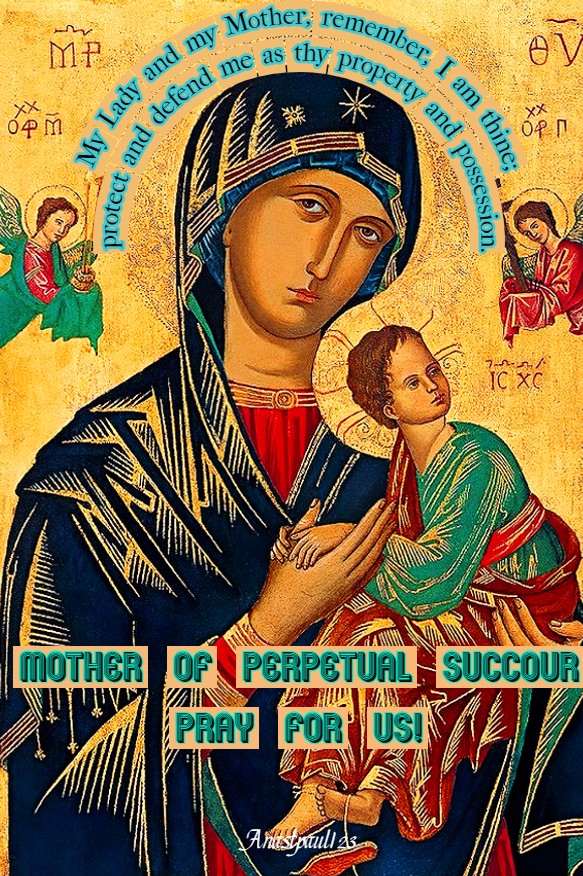
Ejaculation:My Lady and my Mother, remember, I am thine; protect and defend me as thy property and possession.
Our Morning Offering – 27 June – “The Month of the Most Sacred Heart of Jesus” and the Feast of the Sacred Heart
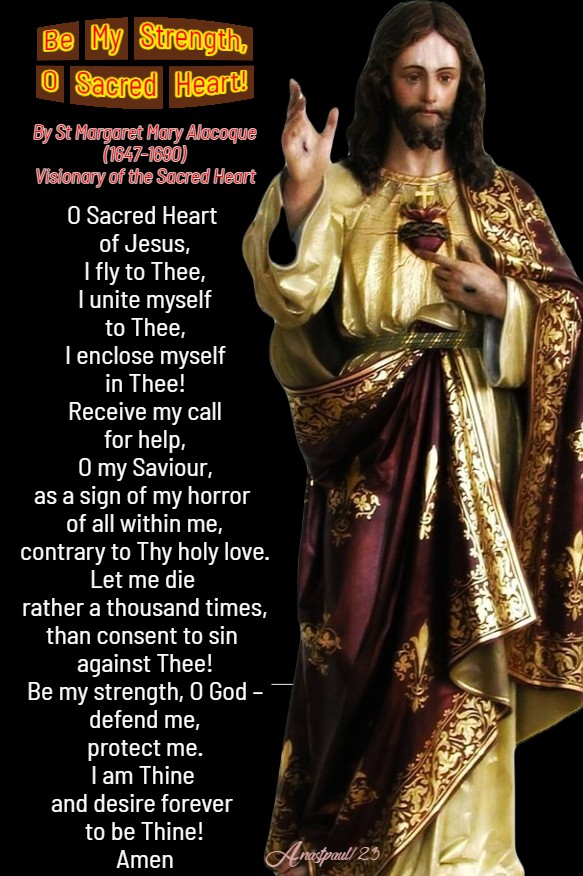
Be my Strength, O Sacred Heart! By St Margaret Mary Alacoque (1647-1690) Visionary of the Sacred Heart
O Sacred Heart of Jesus, I fly to Thee, I unite myself to Thee, I enclose myself in Thee! Receive my call for help, O my Saviour, as a sign of my horror of all within me, contrary to Thy holy love. Let me die rather a thousand times, than consent to sin against Thee! Be my strength, O God – defend me, protect me. I am Thine and desire forever to be Thine! Amen
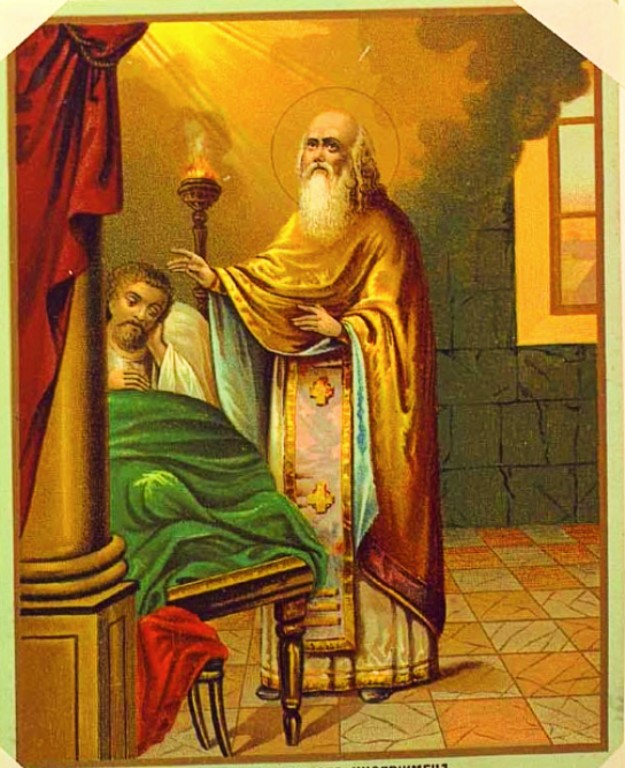
Saint of the Day – 27 June – St Desideratus (6th Century) Priest, Monk and Hermit in Gourdon, near Chalon-sur-Saône in Burgundy, Miracle-worker. Patronage – against toothache. Also known as – Désiré, Desert, Didier.
Unknown Hermit
Desideratus lived in the 6th Century in what is now France. The holy Pope St Gregory I the Great (590-604) wrote of him and considered him a man of admirable holiness.
The holy Bishop St Gregory of Tours relates that Desideratus was distinguished by his holiness and that he had seen him in the Monastery of Gourdon, where he restored many sick people to health through his prayers, especially those suffering from toothache.
Details of his life as a Hermit are not known but he was venerated in the Monastery of Mont-Saint-Vincent in Burgundy and in the entire region.
His Feastday is 27 June but 30 April is also mentioned.
In an old record of the Church of Chalon, printed in Lyon in 1520, one finds the Feast of the holy Priest Hermit, St Desideratus celebrated on 30 April.
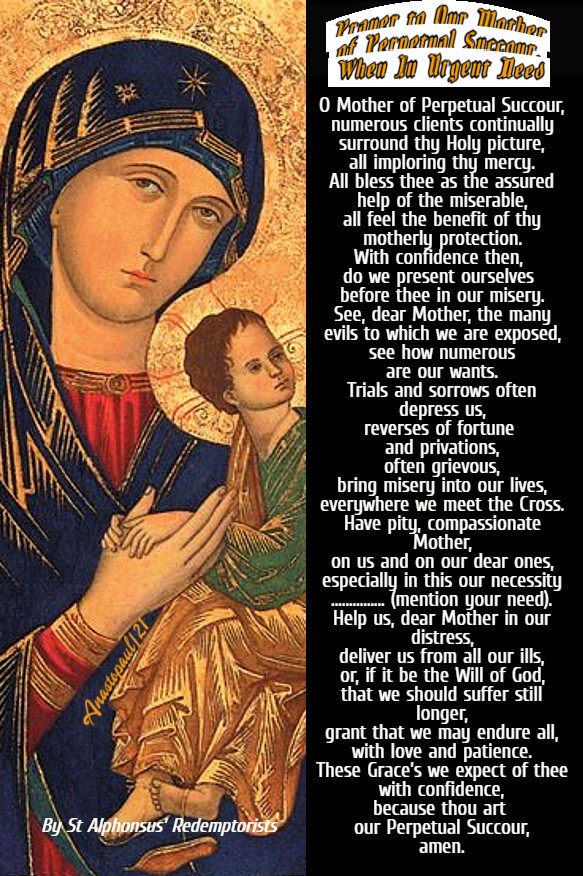
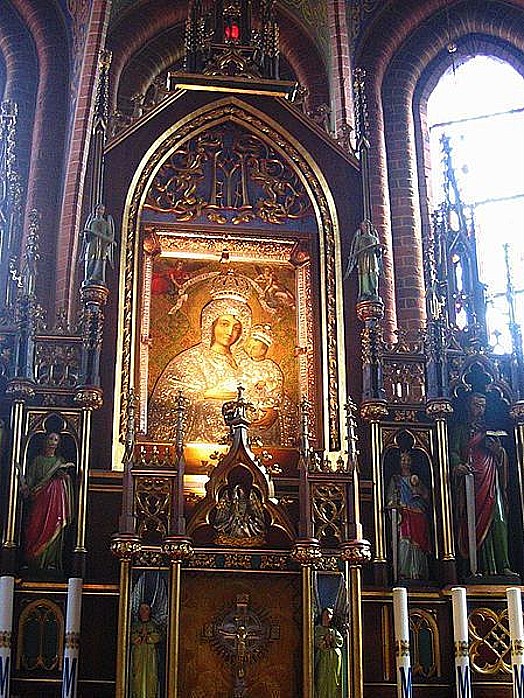
Madre del Perpetuo Soccorso / Mother of Perpetual Succour (Help) – Feast 27 June: Patronage: Porto Cesareo, Italy, Haiti, Labrador City, Labrador, Yorkton, Saskatchewan, 8 Diocese.
Prayer to Our Mother of Perpetual Succour, When In Urgent Need By St Alphonsus’ Redemptorists
O Mother of Perpetual Succour, numerous clients continually surround thy Holy picture, all imploring thy mercy. All bless thee as the assured help of the miserable, all feel the benefit of thy motherly protection. With confidence then, do we present ourselves before thee in our misery. See, dear Mother, the many evils to which we are exposed, see how numerous are our wants. Trials and sorrows often depress us, reverses of fortune and privations, often grievous, bring misery into our lives, everywhere we meet the Cross. Have pity, compassionate Mother, on us and on our dear ones, especially in this our necessity …………… (mention your need). Help us, dear Mother in our distress, deliver us from all our ills, or, if it be the Will of God, that we should suffer still longer, grant that we may endure all, with love and patience. These Grace’s we expect of thee with confidence, because thou art our Perpetual Succour, amen.
St Adeodato of Naples St Aedh McLugack St Anectus of Caesarea St Arialdus of Milan St Arianell of Wales
Blessed Benvenutus of Gubbio OFM ) (Died 1232) Lay brother of the Order of the Friars Minor of St Francis, ex-Soldier, Apostle of the sick and of lepers. Benvenutus was graced with an ardent and mystical devotion to the Blessed Eucharist and to the Mother of God. So ardent was his faith and contemplation that he was seen to hold the Divine Infant in his arms. Biography: https://anastpaul.com/2021/06/27/saint-of-the-day-27-june-blessed-benvenutus-of-gubbio-ofm-died-1232/
St Crescentius of Mainz Bl Daniel of Schönau Bl Davanzato of Poggibonsi OFM (c1200-1295) Priest St Desideratus (6th Century) Priest and Hermit in Gourdon, France St Dimman St Felix of Rome St Ferdinand of Aragon St Gudene of Carthage Bl Hemma of Gurk St Joanna the Myrrhbearer St John of Chinon
St Spinella of Rome St Tôma Toán St Zoilus of Cordoba
DISCLAIMER: Please note: I cannot control the content of the Advertisements on this Site, or of pop-ups which may appear, The revenue from the Advertisements, however, does provide a little assistance in the support of the Site. I do apologise for any inappropriate content.
Thought for the Day – 26 June – Meditations with Fr Richard Frederick Clarke SJ (1839-1900) – The Octave Day of Corpus Christi
The Adorable Heart of Jesus EXERCISES OF DEVOTION.
Act of Reparation to the Sacred Heart of Jesus to make amends for the outrages He suffers in the Blessed Sacrament
O Heart of Jesus, ever on fire with love for men and ever outraged by their ingratitude! Thou hast done everything on earth, during Thy mortal life, to show Thy Love to men, even so far, as to wear Thyself out and to consume Thyself for them. Thy Love was repaid then, by nothing but contempt and the most disgraceful insult. And now that Thou burnest with the self-same love in the Holy Eucharist, where Thou art still dwelling in Thy Sacrament of Love in the midst of us, Thou dost suffer at the hands of ungrateful men the most cruel outrages, although they have no longer the excuse of ignorance and know now, what Thou art.
I see Thee on our Altars expose, during the lapse of so many hundred years, to numberless irreverences, sacrileges and insults, the memory of which fills me with horror and which, are going on now, even amongst those who believe in the True Faith!
Moved by these outrages, I prostrate myself before Thee, O Adorable Heart and weep for Thine outraged Love. I beg Thy pardon for the ingratitude of which I myself am guilty. I detest the sins which I have committed in Thy Presence by irreverence, coldness, and negligence. I would make reparation for them, as also, for the abominations committed against Thee by so many heretics and bad Catholics.
Would that by my homage and my grief, I could make amends to Thy injured honour. Would that by my tears and my blood, I could wash out the insults I deplore. Would that by some new kind of homage, I could atone for so many irreverences, insults and sacrileges. My life would not be too much to sacrifice for so worthy an object. Grant me, O Sacred Heart, by Thine own sweetness and boundless mercy, the pardon which I ask for, and give me grace to keep the resolution, which I now make, to do all I can in the future , to pay Thee, in the Sacrament of Thy Love, the profound adoration which I owe Thee and to show Thee that gratitude and love which are justly due to Thee. I resolve to repair my past faults by the modesty of my deportment in Thy churches, by my constancy in visiting Thee, my devotion and fervo.r in receiving Thee and, in fulfilment of Thy desire, I impose upon myself the duty of often repeating Acts of Reparation in Thy Presence, as Thou hast deigned to direct, in order, as far as I can, to atone for the injuries done Thee by others and of which Thy very love makes Thee the Victim in this Divine Sacrament.
Bless, I beseech Thee, this resolve and give me grace to keep it faithfully. Amen.
Quote/s of the Day – 26 June – “The Month of the Most Sacred Heart of Jesus” – The Octave Day of Corpus Christi
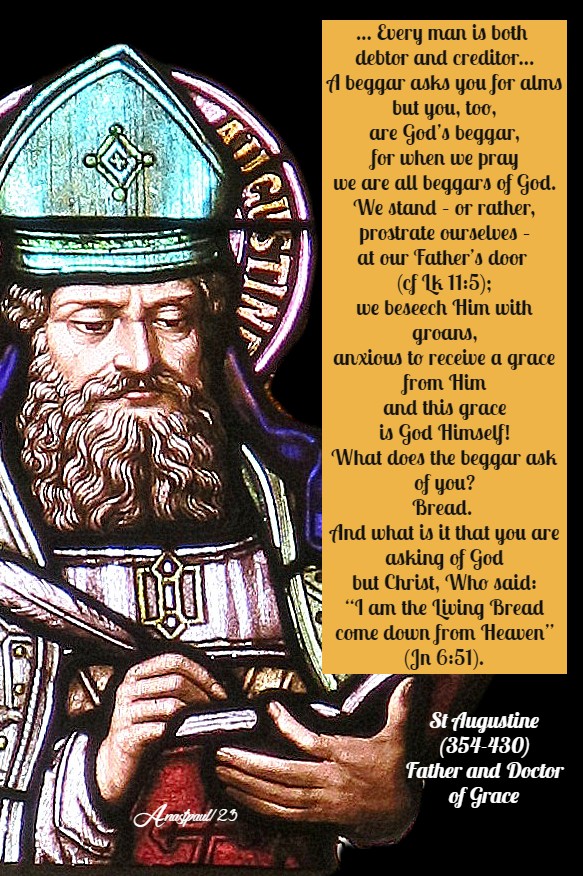
“… Every man is both debtor and creditor… A beggar asks you for alms but you, too, are God’s beggar, for when we pray we are all beggars of God. We stand – or rather, prostrate ourselves – at our Father’s door (cf Lk 11:5); we beseech Him with groans, anxious to receive a grace from Him and this grace is God Himself! What does the beggar ask of you? Bread. And what is it that you are asking of God but Christ, Who said: “I am the Living Bread come down from Heaven” (Jn 6:51).”
St Augustine (354-430) Father and Doctor of Grace
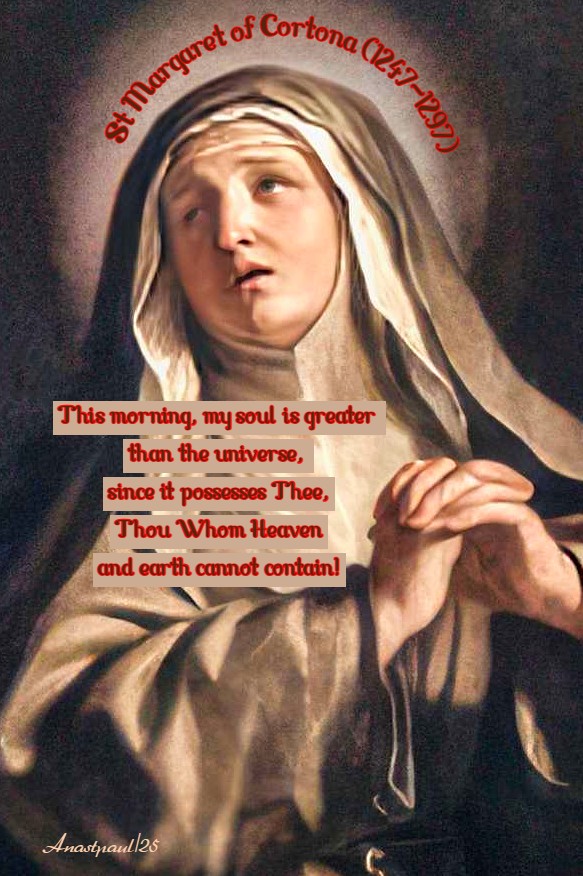
“This morning, my soul is greater than the universe, since it possesses Thee, Thou Whom Heaven and earth cannot contain!”
St Margaret of Cortona (1247–1297) Penitent
“What graces, gifts and virtues the Holy Mass calls down!”
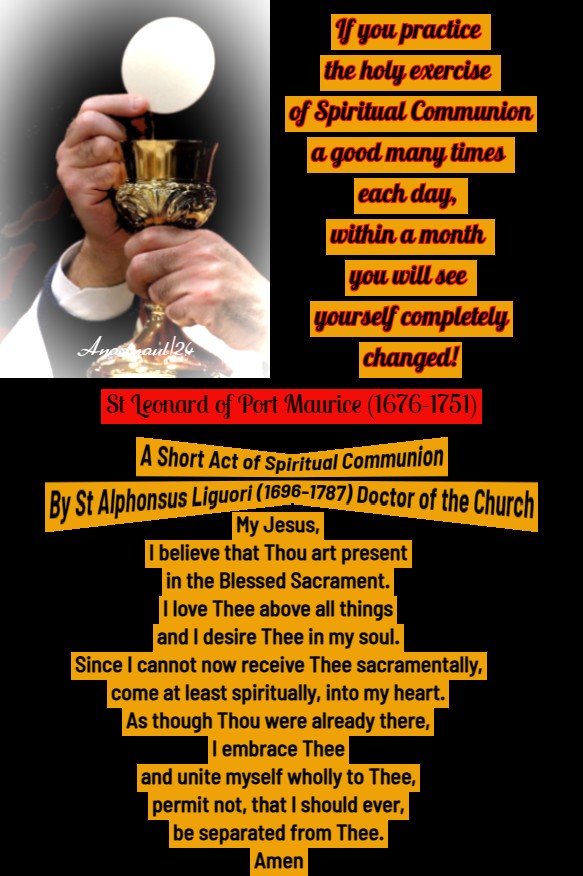
“If you practice the holy exercise of Spiritual Communion a good many times each day, within a month you will see yourself completely changed.”
A Short Act of Spiritual Communion By St Alphonsus Liguori (1696-1787) Doctor of the Church
My Jesus, I believe that Thou art present in the Blessed Sacrament. I love Thee above all things and I desire Thee in my soul. Since I cannot now receive Thee sacramentally, come at least spiritually, into my heart. As though Thou were already there, I embrace Thee and unite myself wholly to Thee, permit not, that I should ever, be separated from Thee. Amen
St Leonard of Port Maurice (1676-1751)
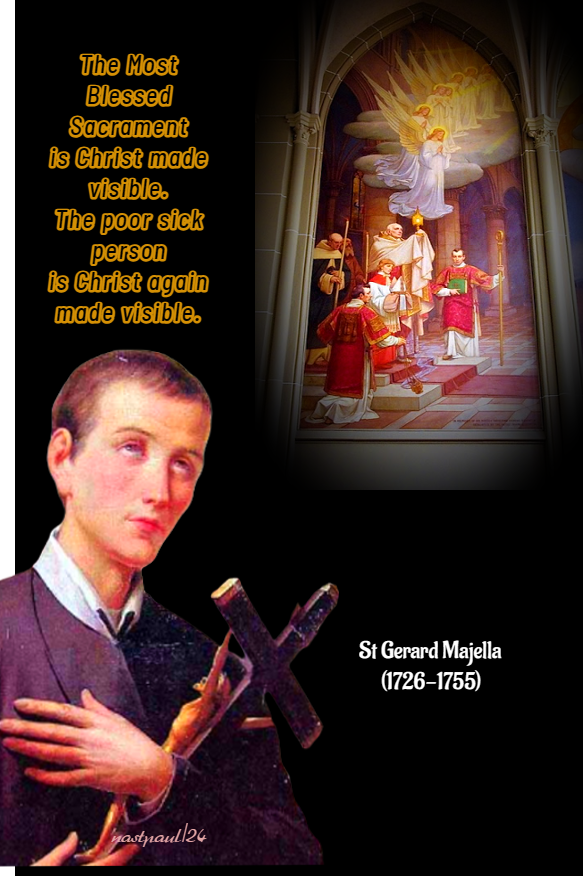
“The Most Blessed Sacrament is Christ made visible. The poor sick person is Christ again made visible.”
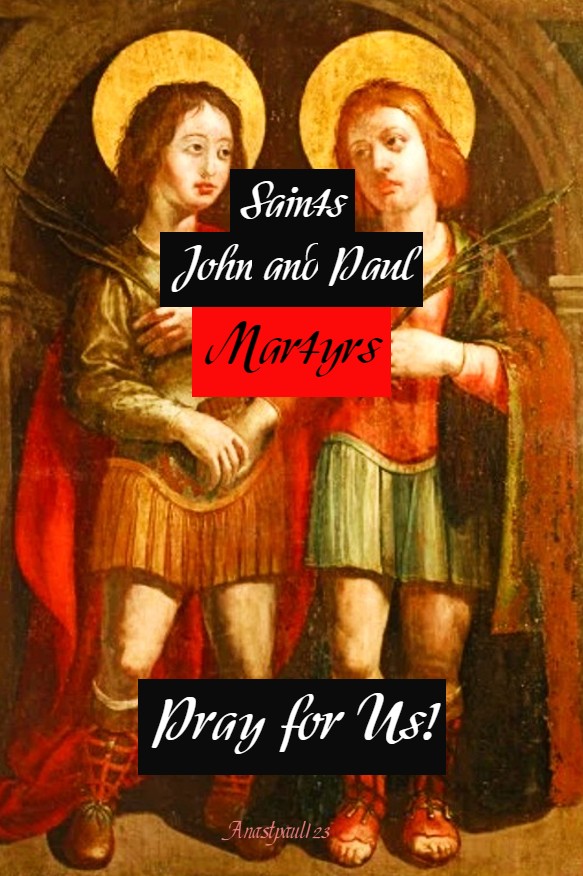
One Minute Reflection – 26 June – “The Month of the Most Sacred Heart of Jesus” – Saint John and Saint Paul of Rome (Died c362) Martyrs – The Octave Day of Corpus Christi – 1 Corinthians 23-29 – John 6:56-59 – Scripture search here: https://www.drbo.org/
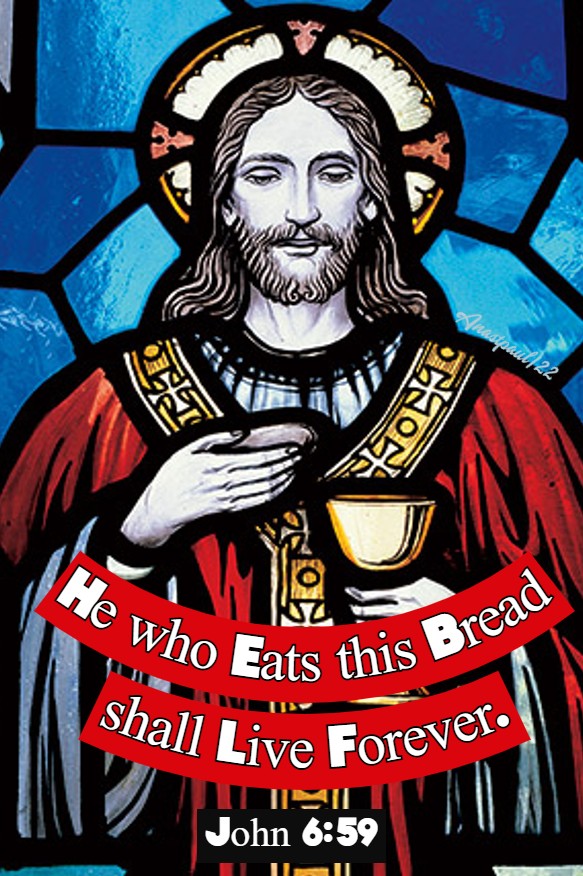
“He who eats this Bread shall live forever.” – John 6:59
REFLECTION – “Since it was the Will of God’s Only-Begotten Son that men should share in His Divinity, He assumed our nature in order that, by becoming Man. He might make men gods . Moreover, when He took our flesh. He dedicated the whole of its substance to our salvation. He offered His Body to God the Father, on the Altar of the Cross, as a sacrifice for our reconciliation. He shed His Blood for our ransom and purification, so that we might be redeemed, from our wretched state of bondage and cleansed from all sin. But to ensure that the memory of so great a gift would abide with us forever, He left His Body as food and His Blood as drink, for the faithful to consume in the form of bread and wine.
O precious and wonderful banquet which brings us salvation and contains all sweetness! Could anything be of more intrinsic value? Under the old law, it was the flesh of calves and goats, which was offered but here, Christ Himself, the True God, is set before us as our food! What could be more wonderful than this? No other Sacrament has greater healing power; through it, sins are purged away, virtues are increased and the soul is enriched with an abundance of every spiritual gift. It is offered in the Church for the living and the dead, so that what was instituted for the salvation of all, may be for the benefit of all. Yet, in the end, no-one can fully express the sweetness of this Sacrament, in which spiritual delight is tasted at its very source, and in which, we renew the memory, of that surpassing love for us, which Christ revealed in His Passion.
It was to impress the vastness of this Love, more firmly upon the hearts of the faithful, that our Lord instituted this Sacrament at the Last Supper. As He was on the point of leaving the world to go to the Father, after celebrating the Passover with His disciples, He left it as a perpetual memorial of His Passion. It was the fulfilment of ancient figures and the greatest of all His Miracles, while, for those who were to experience the sorrow of His departure, it was destined to be a unique and abiding consolation.” – St Thomas Aquinas (1225-1274) Dominican Priest and Theologian, Doctor of the Church (An excerpt from On the Feast of the Body of Christ).
PRAYER – We beseech Thee, Almighty God that on this feast-day, we may have the double joy of celebrating blessed John and Paul, true brothers ,who obtained eternal glory through one Faith and one Martyrdom. Through Jesus Christ, Thy Son our Lord, Who lives and reigns with Thee, in the unity of the Holy Ghost, God, world without end. Amen (Collect).
O HEART of love, I place all my trust in Thee; for though I fear all things from my weakness, I hope all things from Thy mercies. – Ejaculation of Saint Margaret Mary – Indulgence 300 Days, Everytime – Raccolta 180St Pius X, 3 June 1908.
Our Morning Offering – 26 June – “The Month of the Most Sacred Heart of Jesus” – The Octave Day of Corpus Christi
Lauda Sion Salvatorem Sion, Lift Up thy Voice and Sing (Excerpt) By St Thomas Aquinas OP (1225-1274) Doctor Angelicus / Doctor Communis
Sion, lift thy voice and sing, Praise thy Saviour and thy King, Praise with hymns thy Shepherd true, Dare thy most to praise Him well, For He doth all praise excel, None can ever reach His due.
Special theme of praise is Thine, That true living Bread divine, That life-giving flesh adored, Which the brethren twelve received, As most faithfully believed, At the Supper of the Lord.
Let the chant be loud and high, Sweet and tranquil be the joy Felt to-day in every breast; On this festival divine Which recounts the origin Of the glorious Eucharist.
St Thomas Aquinas wrote the Liturgy for Corpus Christi when Pope Urban IV added the Solemnity to the universal Church’s Liturgical Calendar in 1264. He provided a great Sequence, one of the great poems chanted or recited before the proclamation of the Gospel. Lauda Sion is one of only four medieval Sequences which were preserved in the Roman Missal published in 1570 following the Council of Trent (1545–1563)—the others being Victimae Paschali Laudes (Easter), Veni Sancte Spiritus (Pentecost) and Dies irae (requiem masses). (A fifth, Stabat Mater, would later be added in 1727.) Before Trent, many Feasts had their own Sequences. The existing versions were unified in the Roman Missal promulgated in 1570. The Lauda Sion is still sung today as solemn Eucharistic Hymn, although its use is optional in the post-Vatican II Ordinary form. As with St Thomas’s other three Eucharistic Hymns, the last few stanzas of the Lauda Sion are often used alone, in this case, to form the “Ecce Panis Angelorum.”































 AnaStpaul
You must be logged in to post a comment.