Passionate Catholic.
Being a Catholic is a way of life - a love affair "Religion must be like the air we breathe..."- St John Bosco
Prayer is what the world needs combined with the example of our lives which testify to the Light of Christ.
This site, which is now using the Traditional Calendar, will mainly concentrate on Daily Prayers, Novenas and the Memorials and Feast Days of our friends in Heaven, the Saints who went before us and the great blessings the Church provides in our Catholic Monthly Devotions.
This Site is placed under the Patronage of my many favourite Saints and especially, St Paul.
"For the Saints are sent to us by God
as so many sermons.
We do not use them, it is they who move us
and lead us, to where we had not expected to go.”
Charles Cardinal Journet (1891-1975)
This site adheres to the pre-Vatican II Catholic Church and all her teachings. .
PLEASE ADVISE ME OF ANY GLARING TYPOS etc - In June 2021 I lost 100% sight in my left eye and sometimes miss errors. Thank you and I pray all those who visit here will be abundantly blessed. Pax et bonum! 🙏
Quote/s of the Day – 6 March – Ash Thursday – Isaias 38:1-6 – Matthew 8:5-13
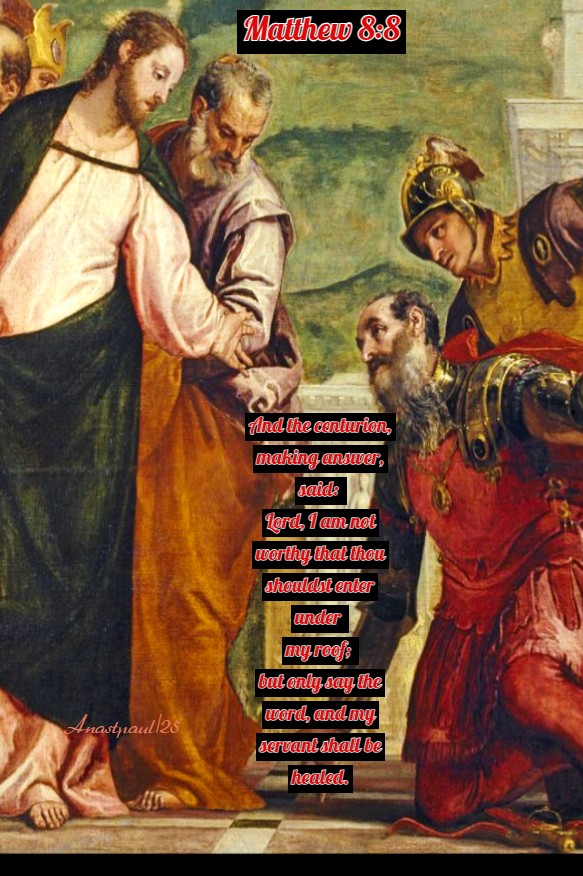
“And the centurion, making answer, said: Lord, I am not worthy that Thou shouldst enter under my roof but only say the word and my servant shall be healed.”
Matthew 8:8
“Whoever exalts himself will be humbled and whoever humbles himself will be exalted.”
Matthew 23:12
“Those who refuse to be humble cannot be saved. They cannot say with the prophet: See, God comes to my aid; the Lord is the helper of my soul. But anyone who makes himself humble, like a little child, is greater in the Kingdom of Heaven.”
St Bede the Venerable (673-735) Father and Doctor if the Church
“Humility is the mother of many virtues because, from it are born: obedience, fear, reverence, patience, modesty, meekness and peace. He who is humble easily obeys everyone, fears to offend anyone, is at peace with everyone, is kind to all!”
St Thomas of Villanova OSA (1488-1555)
“Humility is not just about self-mistrust but about the entrusting of ourselves to God. Distrusting ourselves and our own strength produces trust in God and from that trust, generosity of soul is born.”
Lenten Meditations – 6 March – With Fr Richard Frederick Clarke SJ (1839-1900)
“The Sacred Passion of Our Lord Jesus Christ” “Short Meditations for Lent” From “The Devout Year” By Fr Richard Frederick Clarke SJ (1839-1900)”
Ash Thursday The Preliminaries of the Passion
Read St. Luke xxii:1-6
[1] Now the feast of unleavened bread, which is called the pasch, was at hand. [2] And the chief priests and the scribes sought how they might put Jesus to death but they feared the people. [3] And Satan entered into Judas, who was surnamed Iscariot, one of the twelve. [4] And he went, and discoursed with the chief priests and the magistrates, how he might betray Him to them. [5] And they were glad and covenanted to give him money. [6] And he promised. And he sought opportunity to betray Him in the absence of the multitude. [Luke 22:1-6]
+1. During the first days of the week in which He suffered, our Blessed Lord had been teaching all day in the Temple. The assembled crowd had cried ,“ Hosanna to the Son of David, Blessed is He Who cometh in the name of the Lord.” It seemed as if He were going to be acknowledged by the voice of the people as the King of Israel. How deceptive are appearances! How often, when all seems to be going well and the cause of Christ about to triumph, some grievous disappointment is at hand!
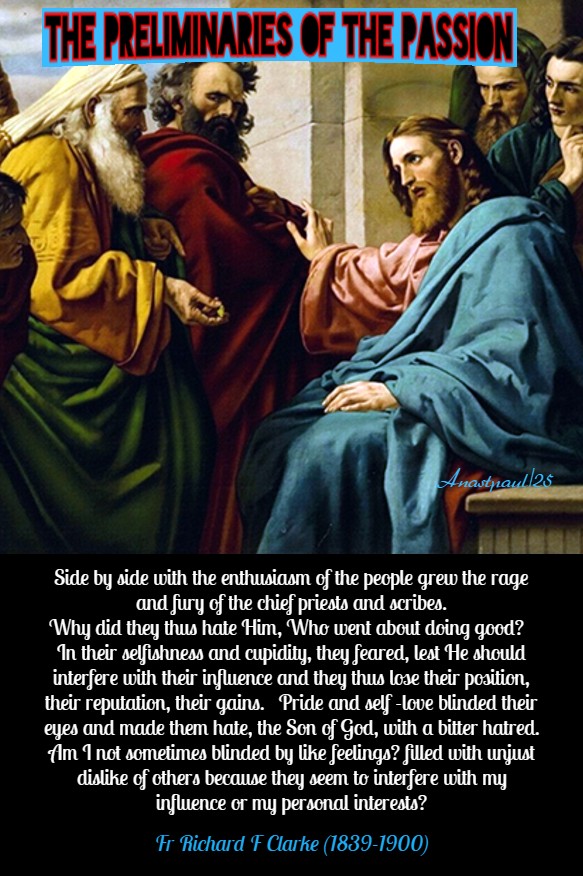
+2. Side by side with the enthusiasm of the people grew the rage and fury of the chief priests and scribes. Why did they thus hate Him, Who went about doing good? In their selfishness and cupidity, they feared, lest He should interfere with their influence and they thus lose their position, their reputation, their gains. Pride and self -love blinded their eyes and made them hate, the Son of God, with a bitter hatred. Am I not sometimes blinded by like feelings? filled with unjust dislike of others because they seem to interfere with my influence or my personal interests?
+3. The chief priests had a great advantage in the fact that, in the little company, which surrounded Jesus, there was a traitor. Judas impelled by avarice, had been first a thief and then, had made overtures to betray his Master. O fatal love of money, to harden the heart of man! How careful must I be not to set my heart on any earthly possessions, since nothing has a more deadly power than this, to separate me from the love of Jesus!
One Minute Reflection – 6 March – “The Month of Saint Joseph” – Ash Thursday – Isaias 38:1-6 – Matthew 8:5-13 – Scripture search here: https://www.drbo.org/
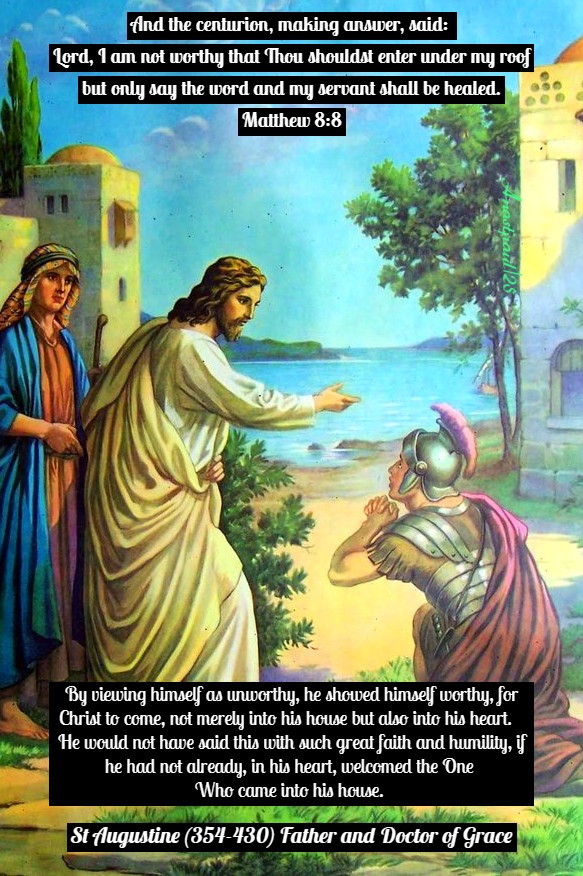
“And the centurion, making answer, said: Lord, I am not worthy that Thou shouldst enter under my roof but only say the word and my servant shall be healed.” – Matthew 8:8.
REFLECTION – “When the Lord promised to go to the Centurion’s house to heal his servant, the Centurion answered, “Lord, I am not worthy that Thou shouldst enter under my roof but only say the word and my servant shall be healed.” By viewing himself as unworthy, he showed himself worthy, for Christ to come, not merely into his house but also into his heart. He would not have said this with such great faith and humility, if he had not already, in his heart, welcomed the One Who came into his house. It would have been no great joy for the Lord Jesus to enter into his house and not to enter his heart. For the Master of humility, both by word and example, sat down also in the house of a certain proud Pharisee, Simon and, although he sat down in his house, there was no place in his heart. For in his heart the Son of Man could not lay his head.” – St Augustine (354-430) Father and Doctor of Grace (Sermon 62).
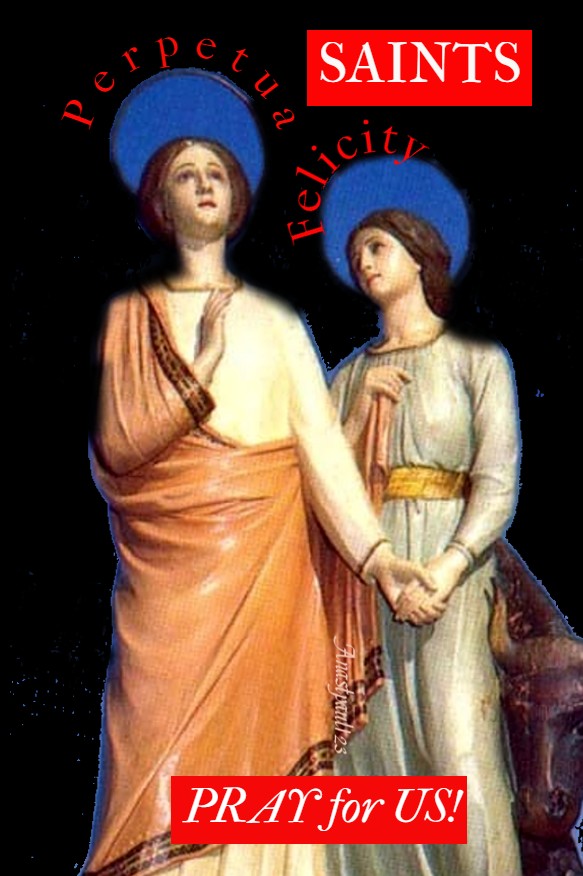
PRAYER – Grant, we beseech Thee, O Lord our God, that we may venerate with unceasing devotion Thy holy Martyrs Perpetua and Felicitas and, although we cannot pay them the honour that is their due, may we at least present to them, our humble homage. Through Jesus Christ, Thy Son our Lord, Who lives and reigns with Thee, in the unity of the Holy Ghost, God, world without end. Amen (Collect).
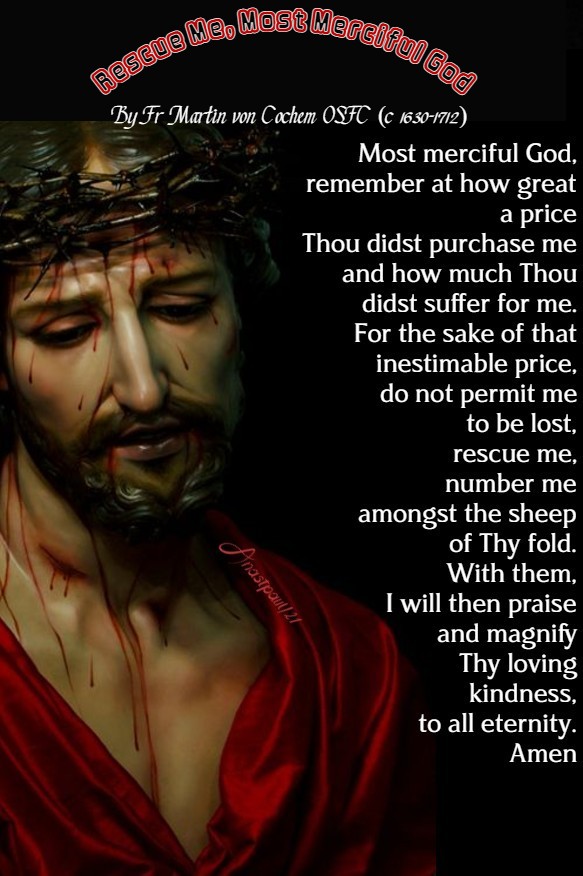
Rescue Me, Most Merciful God By Father Martin von Cochem OSFC (c 1630-1712)
Most merciful God, remember at how great a price Thou didst purchase me and how much Thou didst suffer for me. For the sake of that inestimable price, do not permit me to be lost, rescue me, number me amongst the sheep of Thy fold. With them, I will then praise and magnify Thy loving kindness, to all eternity. Amen
Fr Martin von Cochem was a German Capuchin theologian, preacher and prolific ascetic writer. Father Martin’s works embrace a great variety of subjects –a huge volume of apologetics against Protestantism, the life of Christ, lives of the Saints, edifying narratives, the setting forth of certain points in Christian asceticism, forms of prayer, methods to be followed for the worthy reception of the sacraments, etc. All with Imprimaturs. The prayer above is from the renowned “The Four Last Things.”
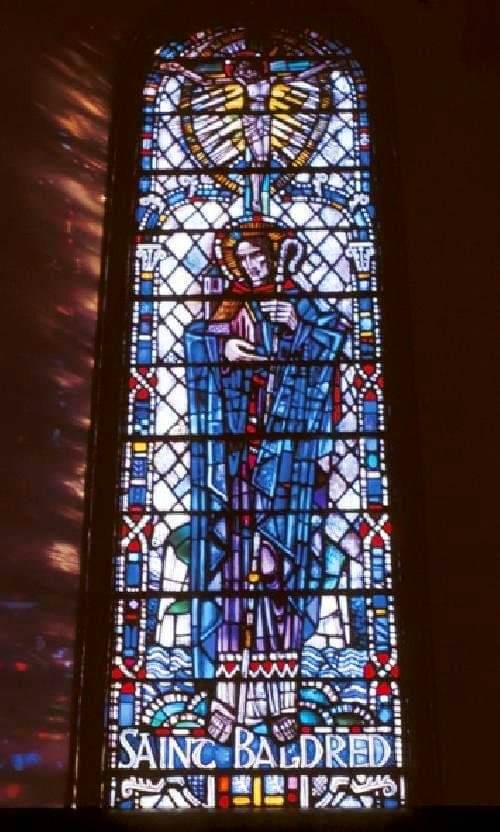
Saint of the Day – 6 March – Saint Baldred (Died c757) Abbot, Priest, Missionary, Founder of a monastic community, Hermit, Miracle-worker. Born in Northumbria, England and died on 6 March c757 in Tyninghame in the Lothian region of Scotland. Also known as – “the Apostle of the Lothians”Balthere, Baltherus, … the Hermit, … of Tyninghame.
Baldred seems to have come from Lindisfarne in Northumbria, England, to spread Christ to the Lothians. He founded a Monastery at Tyninghame and choose a life of seclusion. Simeon of Durham says that “the boundaries of his pastorate embraced the whole land which belongs to the monastery of Saint Balther which is called Tyninghame – from Lammermuir to Inveresk, or, as it was called, Eskmouthe.”
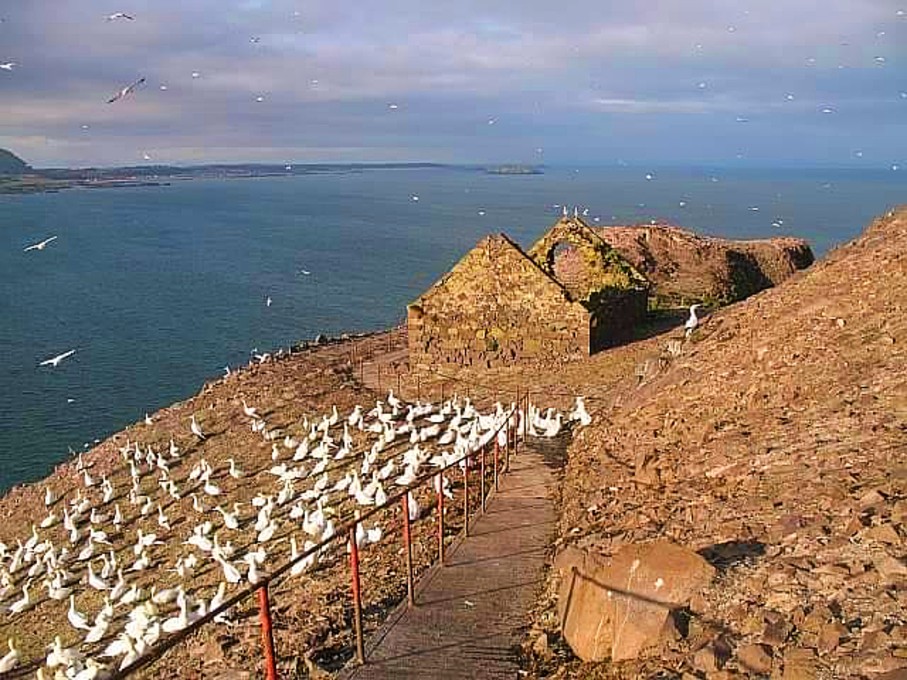
He lived in a cell on the Bass Rock and died there. Three communities vied for the right to bury him, Auldhame, Tyninghame and Prestonkirk. His cult was certainly centred on the four Churches of Auldhame, Whitekirk, Tyninghame and Prestonkirk, between East Linton and North Berwick in East Lothian.
Baldred founded a Monastery at Tyninghame. However, at times, he preferred to retire from the spiritual government of the Lothian Britons and he selected the Bass Rock as the spot to build himself a small hermitage and associated Chapel, although he also sometimes resided in ‘St Baldred’s Cave’ on Seacliff Beach.
Ruins of the Base Rock Foundation
Following Baldred’s death on the site of this Chapel, there was a dispute between the people of Auldhame, Tyninghame and Prestonkirk, as to which should be chosen to venerate his life by a Shrine and bury his remains.“ By the advice of a holy man, they spent the night in prayer. In the morning three bodies were found, in all respects alike, each in its winding sheet, prepared for burial.”
St Baldred’s Cave
All three Churches established Shrines to Saint Baldred. Echoes of St Baldred occur throughout the area of East Lothian in which he lived and worked. In 941, St Baldred’s Monastery at Tyninghame was destroyed by the Danes and the following century the version of the remains of St Baldred buried at Tyninghame, were moved to Durham. In the 1100s St Baldred’s Church was built on the location of the monastery and this still stands today in the grounds of Tyninghame House.
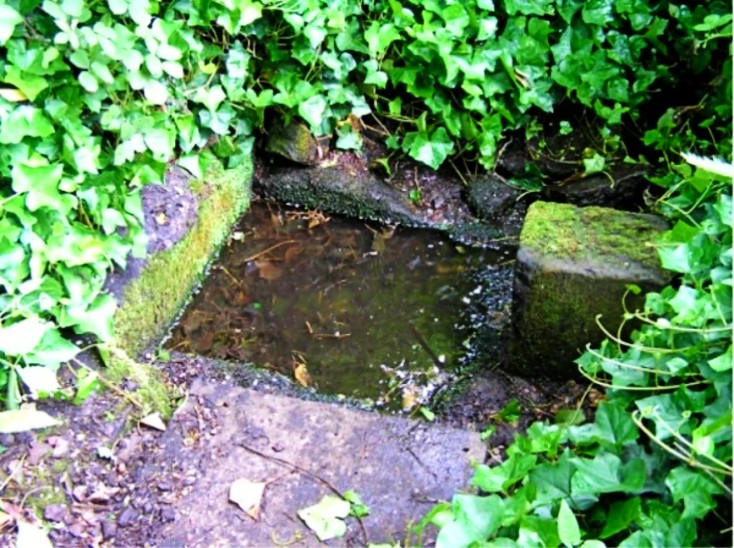
At the Prestonkirk Parish Church, there existed, until 1770, when it was damaged by a builder, a Statue of the Saint much venerated by the local population. St Baldred’s Well stands nearby which was “famed for its…healing qualities.” This Well was greatly celebrated as a place of pilgrimage, attracting 1000s of visitors and the area also lays claim to this Saint as the scene of his ministry,
St Baldred’s Well
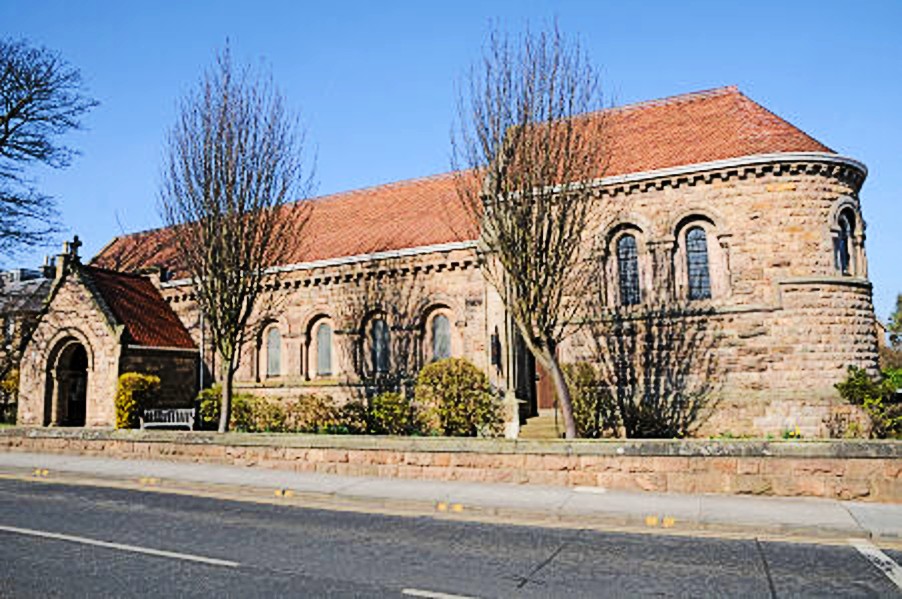
A Papal Bull of 1493 records the Pope’s consent to build a Chapel on the site of St Baldred’s own Chapel on Bass Rock – possibly this Church below.
St Aetius St Bairfhion St Baldred of Strathclyde St Baldred (Died c757) Abbot St Balther of Lindisfarne St Basil of Bologna St Cadroë
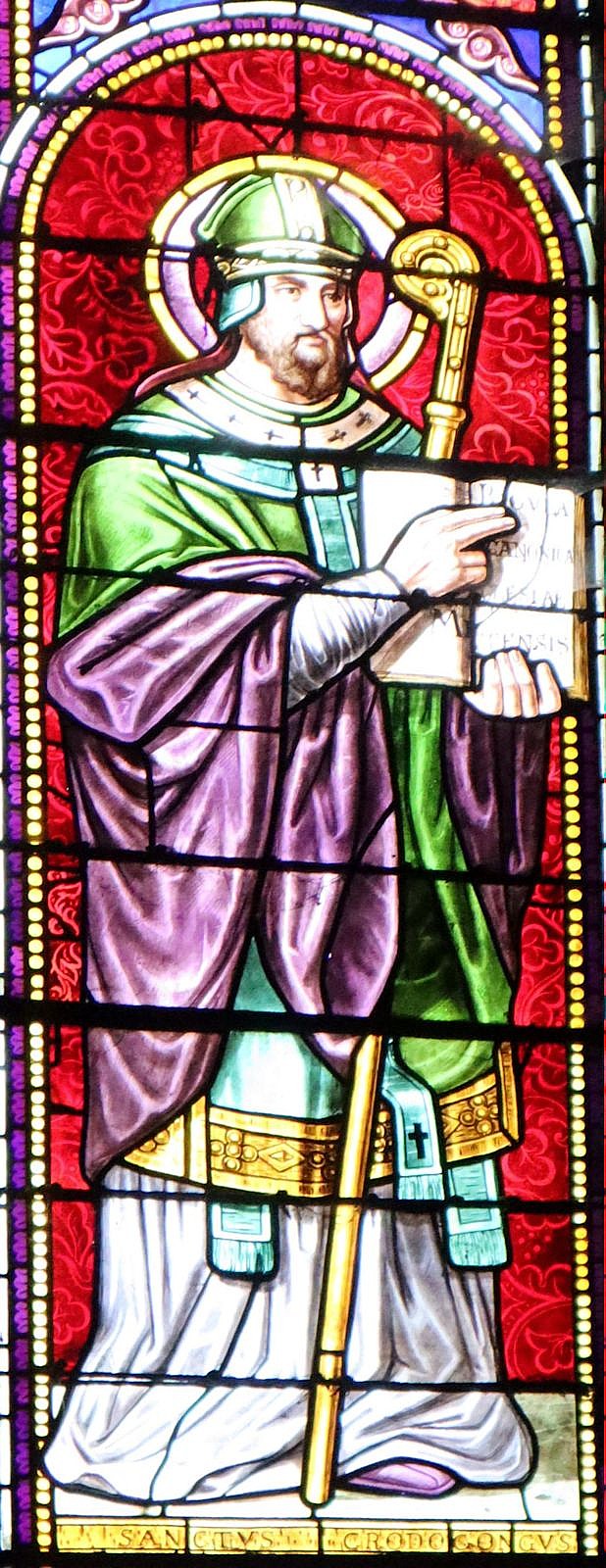
St Chrodegang of Metz (c714-776) The First Bishop of Metz, Protector and Father of the poor and orphans, Reformer of the Clergy, a relative of King Pepin and of Prince Charles Martel, both of whom he was Court Chancellor, Royal Diplomat, Saint Opportuna of Montreuil was his brother. The Roman Martyrology states: “In Metz in Austrasia, in today’s France, St Crodegango, Bishop, who arranged for the Clergy to live as if within the walls of a cloister under an exemplary rule of life and greatly promoted liturgical chant.” Biography: https://anastpaul.com/2022/03/06/saint-of-the-day-6-march-saint-chrodegang-of-metz/
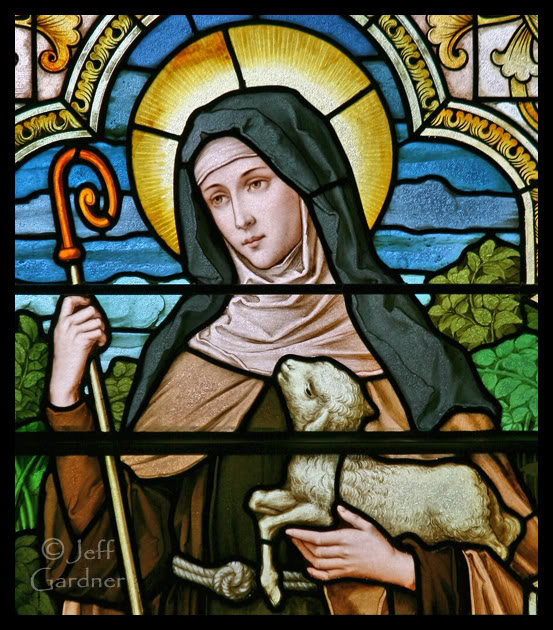
St Colette PCC (1381-1447) Abbess and Foundress of the Colettine Poor Clares, a reform branch of the Order of Saint Clare. Patronages – against eye disorders, against fever, against headaches, against infertility, against the death of parents, of women seeking to conceive, expectant mothers and sick children, craftsmen, Poor Clares, servants, Corbie, France, Ghent, Belgium. St Colette was Canonised on 24 May 1807 by Pope Pius VII. Lovely St Colette: https://anastpaul.com/2017/03/06/saint-of-the-day-6-march-st-colette/ AND: https://anastpaul.com/2019/03/06/saint-of-the-day-6-march-st-colette-2/
St Cyriacus of Trier St Cyril of Constantinople St Evagrius of Constantinople
Bl Guillermo Giraldi St Heliodorus the Martyr Bl Jordan of Pisa St Julian of Toledo St Kyneburga of Castor St Kyneswide of Castor St Marcian of Tortona
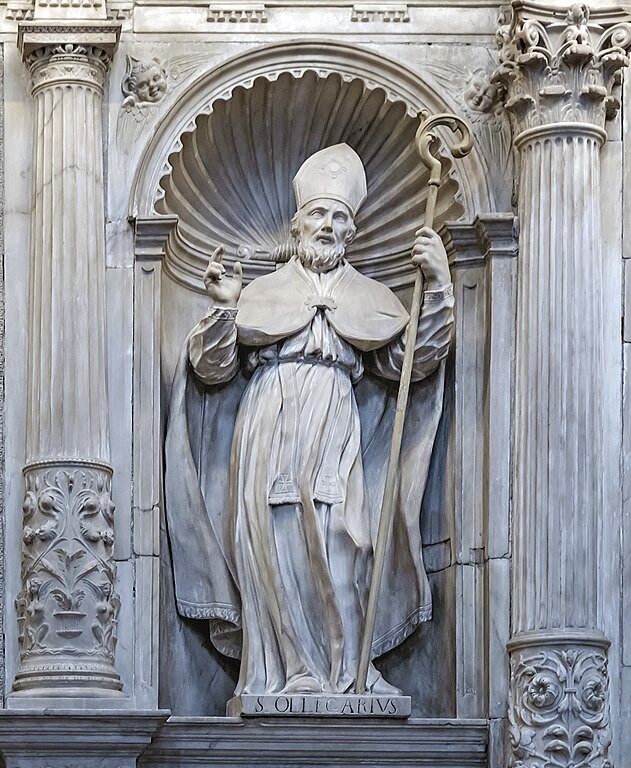
St Ollegarius Bonestruga OSA (1060-1137) Bishop, Canon Regular of the Augustinians, Reformer, in both the religious sphere and the social one, Abbot, Diplomat, Peacemaker and Proptector of his people from possible violent incursions. The Roman Martyrology reads: “At Barcelona in Spain, the blessed St Ollegarius, who was first a Canon and afterwards the Bishop of Barcelona and Archbishop of Tarragona.” A Very Busy Shepherd https://anastpaul.com/2024/03/06/saint-of-the-day-6-march-st-ollegarius-bonestruga-osa-1060-1137-bishop/
Martyrs of Amorium – 42 Saints – Also known as Martyrs of Syria and Martyrs of Samarra; A group of 42 Christian senior officials in the Byzantine Empire who were captured by forces of the Abbasid Caliphate when the Muslim forces overran the City of Amorium, Phrygia in 838 and massacred or enslaved its population. The men were imprisoned in Samarra, the seat of the Caliphate, for seven years. Initially thought to be held for ransom due to their high position in the empire, all attempts to buy their freedom were declined. The Caliph repeatedly ordered them to convert to Islam and sent Islamic scholars to the prison to convince them; they refused until the Muslims finally gave up and killed them. Martyrs. We know the names and a little about seven of them: Aetios Bassoes Constantine Constantine Baboutzikos Kallistos Theodore Krateros Theophilos but details about the rest have disappeared over time. However, a lack of information did not stop several legendary and increasingly over-blown “Acts” to be written for years afterward. One of the first biographers, a monk name Euodios, presented the entire affair as a judgement by God on the empire for its official policy of Iconoclasm. Deaths: beheaded on 6 March 845 in Samarra (in modern Iraq) on the banks of the Euphrates river by Ethiopian slaves the bodies were thrown into the river, but later recovered by local Christians and given proper burial.
Thought for the Day – 5 March – Meditations with Fr Richard Frederick Clarke SJ (1839-1900)
“Short Meditations for March, St Joseph” From “The Devout Year” By Fr Richard Frederick Clarke SJ (1839-1900)
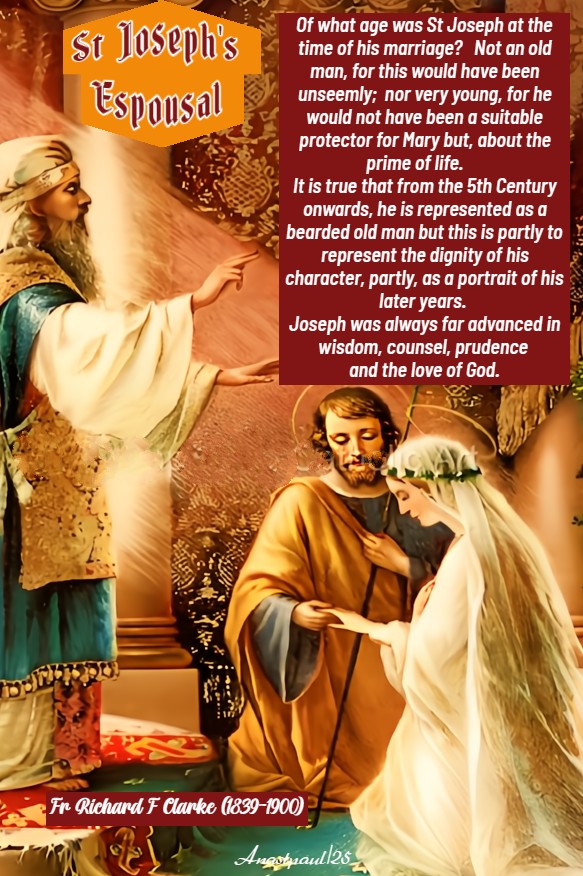
5th Day – St Joseph’s Espousal
+I. Never were husband and wife so eminently suited to each other, as Joseph and Mary. Never was there a union which so exactly symbolised the union between Christ and the Church. Happy indeed are those who meet with a congenial spouse! Happier still, are those who are content to live in a state of virginity and in the religious life to choose Jesus Christ Himself for their Divine Spouse. They it is, who most nearly approach to the life of Joseph with Mary.
+2. St Joseph and Our Lady lived in perpetual chastity and their union was a closer one than that of any other husband and wife in the whole world. Their ideas, opinions, hopes,wishes, likes and dislikes, were all the same; Joseph was Mary’s strong support, Mary loved to depend on Joseph. None was ever so obedient, gentle loving and sympathising a wife as Mary. None was ever such a thoughtful, kind, prudent, faithful husband as Joseph.
+3. Of what age was St Joseph at the time of his marriage? Not an old man, for this would have been unseemly; nor very young, for he would not have been a suitable protector for Mary but, about the prime of life. It is true that from the 5th Century onwards, he is represented as a bearded old man but this is partly to represent the dignity of his character, partly, as a portrait of his later years. Joseph was always far advanced in wisdom, counsel, prudence and the love of God. Would that I were more like him!
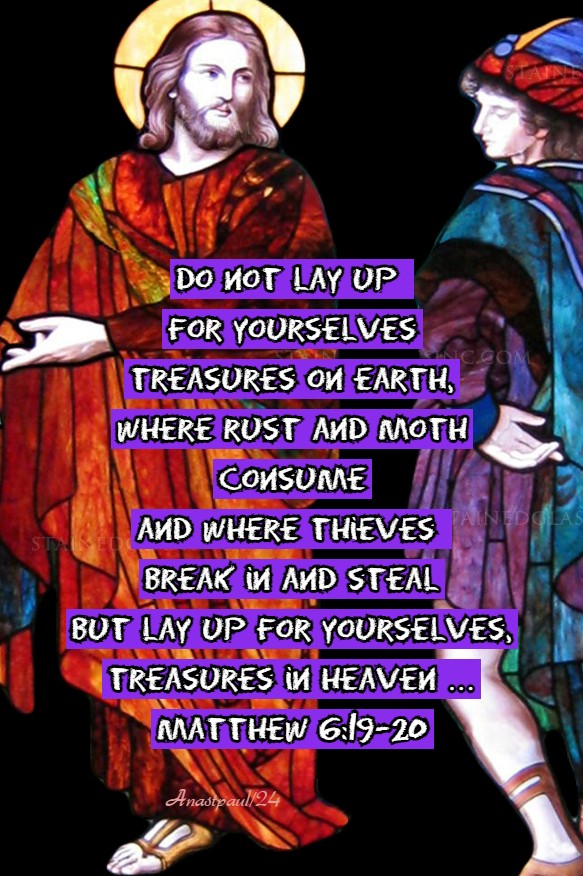
“Do not lay up for yourselves treasures on earth, where rust and moth consume and where thieves break in and steal but lay up for yourselves, treasures in Heaven …”
Matthew 6:19-20
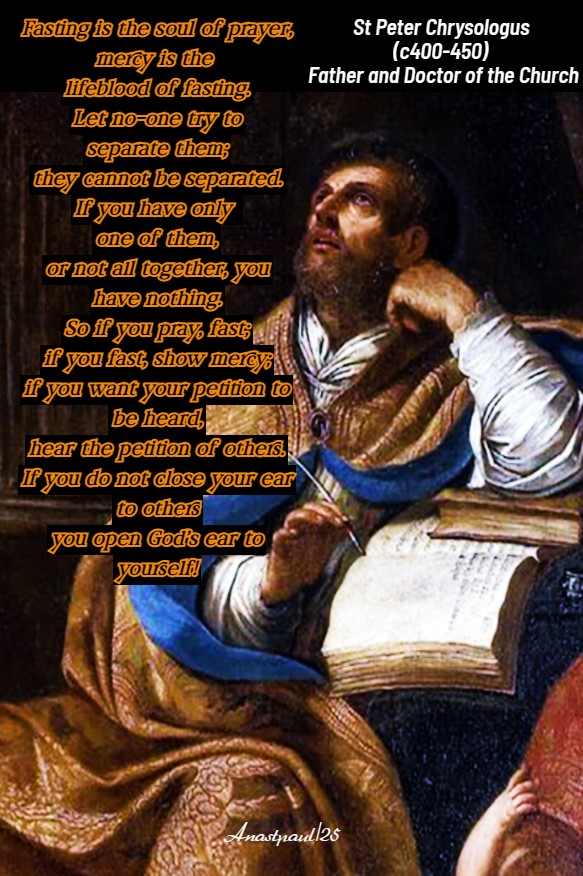
“Fasting is the soul of prayer, mercy is the lifeblood of fasting. Let no-one try to separate them; they cannot be separated. If you have only one of them, or not all together, you have nothing. So if you pray, fast; if you fast, show mercy; if you want your petition to be heard, hear the petition of others. If you do not close your ear to others you open God’s ear to yourself!”
St Peter Chrysologus (c400-450) Bishop of Ravenna “Doctor of Homilies” Father and Doctor of the Church
“Fasting is the death of sin, the destruction of our crimes and the remedy of our salvation.”
St Ambrose (340-397) Father & Doctor of the Church
“For the devil may tempt the good but he cannot find rest in them; for he is shaken violently and upset and driven out – now by their prayers, now by their tears of repentance and now. by their almsgiving and similar good works.”
St Bruno (c1030-1101)
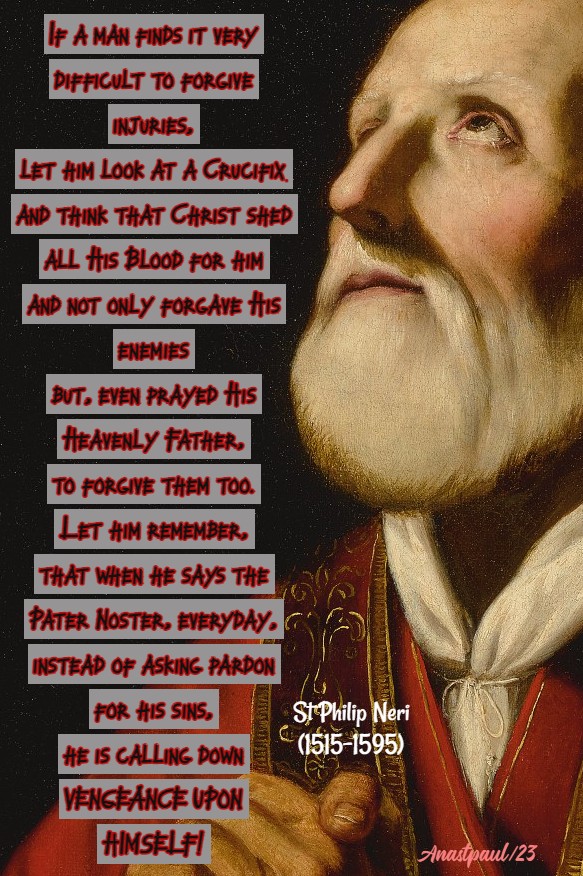
“If a man finds it very difficult to forgive injuries, let him look at a Crucifix and think that Christ shed all His Blood for him and not only forgave His enemies but, even prayed His Heavenly Father, to forgive them too. Let him remember, that when he says the Pater Noster, everyday, instead of asking pardon for his sins, he is calling down VENGEANCE UPON HIMSELF!”
St Philip Neri (1515-1595)
“The sacred gift of prayer is already in the Right Hand of the Saviour; as soon as ever you shall have emptied yourself of self, He will pour it into your heart!”
(Letters to Persons in Religion III 19)
St Francis de Sales (1567-1622) Doctor Caritatis
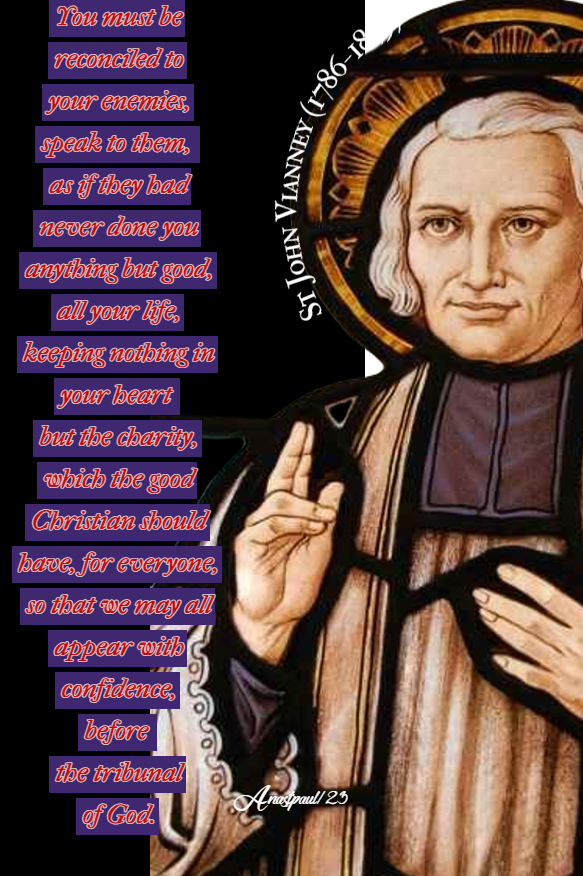
“You must be reconciled to your enemies, speak to them, as if they had never done you anything but good, all your life, keeping nothing in your heart but the charity, which the good Christian should have, for everyone, so that we may all appear with confidence, before the tribunal of God.”
Lenten Meditations – 5 March – With Fr Richard Frederick Clarke SJ (1839-1900)
“The Sacred Passion of Our Lord Jesus Christ” “Short Meditations for Lent” From “The Devout Year” By Fr Richard Frederick Clarke SJ (1839-1900)”
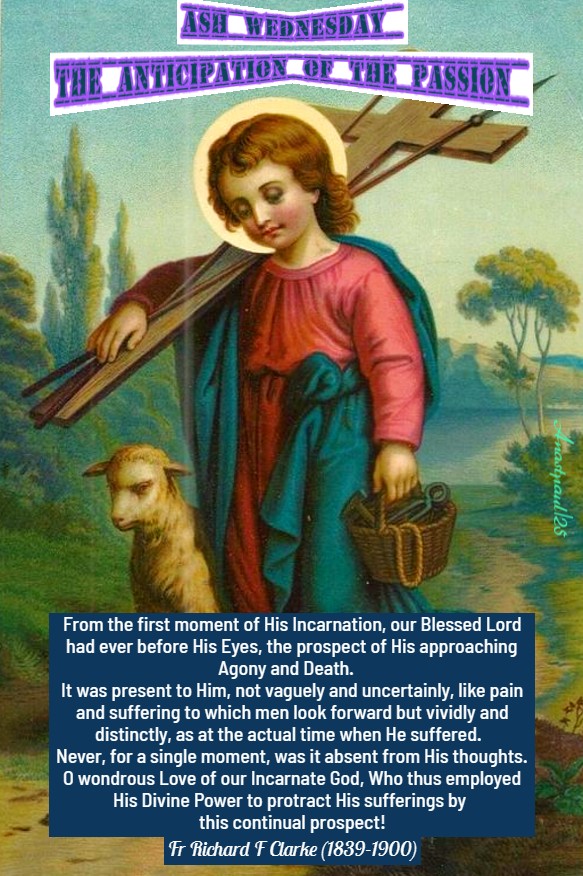
Ash Wednesday The Anticipation of the Passion
Read St Matthew xvi:21; xvii:21, 22 “From that time, Jesus began to show to His disciples,that He must go to Jerusalem and suffer many things from the ancients and scribes and chief priests and be put to death and the third day rise again.” [Matthew 16:21]
“And when they abode together in Galilee, Jesus said to them: ‘The Son of man shall be betrayed into the hands of men; [22] And they shall kill Him and the third day He shall rise again. And they were exceedingly troubled.” [Matthew 17:21-22]
+1. From the first moment of His Incarnation, our Blessed Lord had ever before His Eyes, the prospect of His approaching Agony and Death. It was present to Him, not vaguely and uncertainly, like pain and suffering to which men look forward but vividly and distinctly, as at the actual time when He suffered. Never, for a single moment, was it absent from His thoughts. O wondrous Love of our Incarnate God, Who thus employed His Divine Power to protract His sufferings by this continual prospect!
+2. Yet, in spite of this, He was always cheerful and full of brightness and joy of heart. His coming Agony did not weigh Him down or depress Him. In spite of the bitterness of the chalice, of the unspeakable agony ever present to Him, no cloud overcast His brow, no weakness or dread was manifest to His Apostles, no thought of Self, interfered with His perfect sympathy for others. He was a pattern of Divine unselfishness; the unselfish always forget their own troubles and so can comfort and help others.
+3. But our Blessed Lord, not only was not cast down by the approaching Passion, He actually longed for it. I have a baptism wherewith I am to be baptised and how am I straitened until it be accomplished? His Love for men was such that He rejoiced in the thought of suffering for us . How can I ever thank Him as I ought? How can I show my love for Him Who loved me with so great a Love?
Lenten Meditations – 5 March – With Fr Richard Frederick Clarke SJ (1839-1900)
“The Sacred Passion of Our Lord Jesus Christ” “Short Meditations for Lent” From “The Devout Year” By Fr Richard Frederick Clarke SJ (1839-1900)”
PREFACE
THERE is no subject of meditation more pleasing to God and more profitable to the soul, than the Passion of Jesus Christ. It containswithin itself, all sweetness It is the remedy for every evil; the food which nourishes the soul. It is continued still in the Blessed Eucharist and every Mass, is a representation and renewal of the Sacred Passion. It is a subject always in season but especially during the holy time of Lent. These Meditations deal with some of the main incidents of Our Lord’s Sacred Passion. They are intended to be begun on Ash Wednesday and to end on Holy Saturday. A few verses of Scripture are suggested to be read before each meditation, as furnishing the subject – matter of which it treats.
Introduction – How to Meditate on the Passion
St Bonaventure tells us, if we desire to meditate with fruit on the Passion of Jesus Christ, three conditions are necessary. Our meditation must be +1. HUMBLE – for the Passion is unlike anything else in the world, it is unfathomable to human reason; it is a bottomless ocean of mystery. Reason must bow its head and confess its inability to grasp the Mysteries which even Faith sees only darkly and through a glass. The story of Christ’s humiliation, is to the proud, a sealed book; they see nothing attractive in it. Christ suffering, has no beauty that they should admire Him. I must, therefore, begin by praying for humility.
+2. FULL of CONFIDENCE – since the Passion is the source of all our confidence. It is the proof of the exceeding Love wherewith Christ loved us. How can I fear, with the sight before me, of Christ suffering for love of me? It is, too , a medicine for every possible evil, for every temptation for every sin, whatever the malady of my soul –the Passion of Christ can cure it. At the Foot of the Cross, each mortal wound will be made whole!
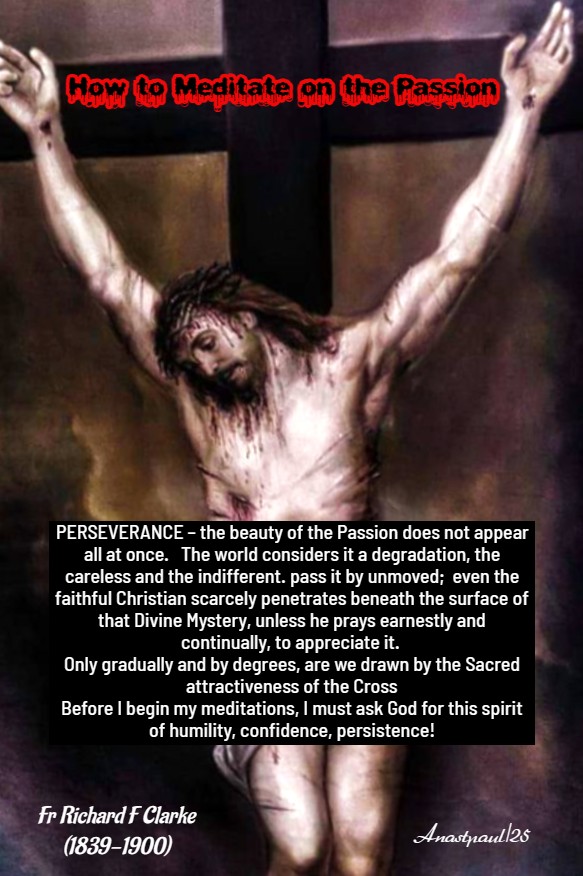
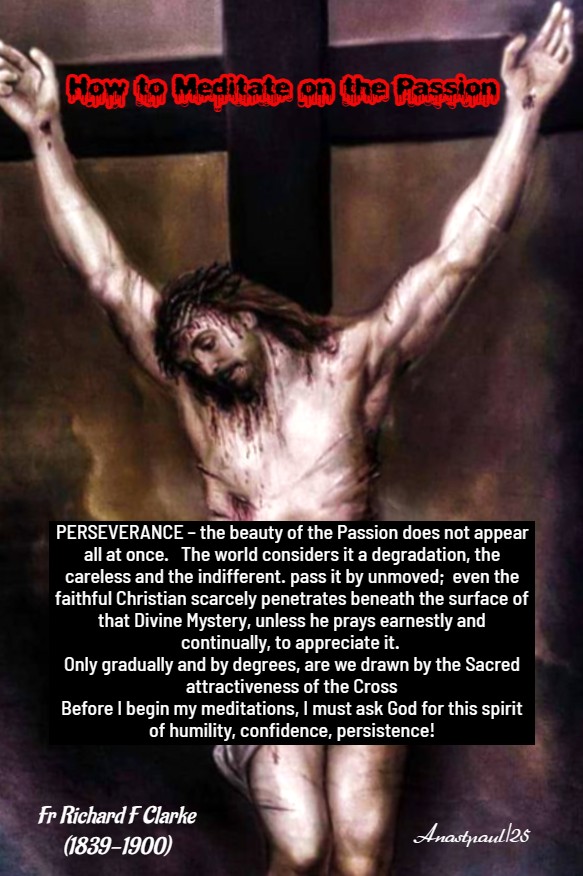
+3. PERSEVERANCE – the beauty of the Passion does not appear all at once. The world considers it a degradation, the careless and the indifferent. pass it by unmoved; even the faithful Christian scarcely penetrates beneath the surface of that Divine Mystery, unless he prays earnestly and continually, to appreciate it. Only gradually and by degrees, are we drawn by the Sacred attractiveness of the Cross Before I begin my meditations, I must ask God for this spirit of humility, confidence, persistence!
One Minute Reflection – 5 March – “The Month of Saint Joseph” – Ash Wednesday – Joel 2:12-19 – Matthew 6:16-21 – Scripture search here: https://www.drbo.org/
“But you, when you fast…” – Matthew 6:17..
REFLECTION – “My dear brethren, today we set out on the great Lenten journey. So, let us take our food and drink along in our boat, putting into the chest, the abundant mercy we shall need. For our fasting is a hungry one, our fasting is a thirsty one, if it is not sustained by goodness and refreshed by mercy. Our fasting will be cold, our fasting will flag, if the fleece of almsgiving does not clothe it, if the garment of compassion, does not wrap it around.
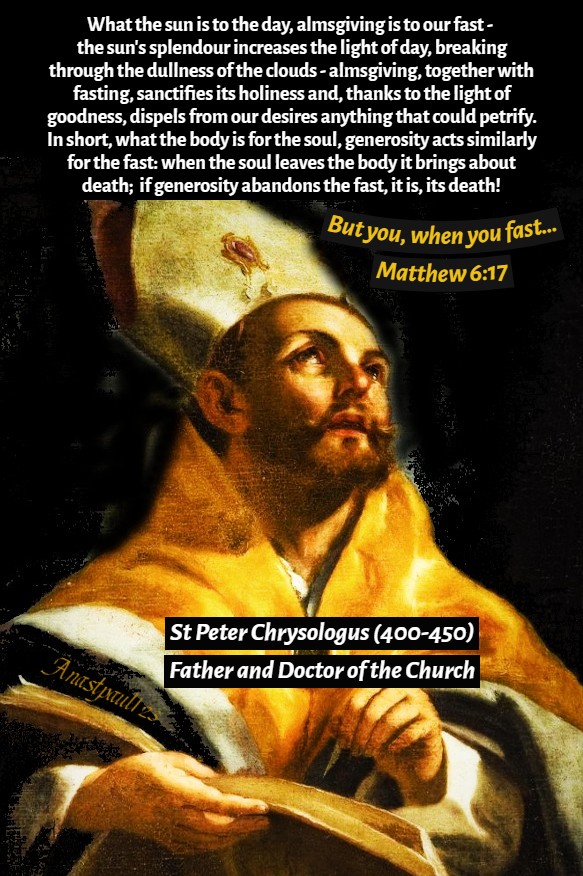
Brethren, what Spring is for the land, mercy is for fasting – the soft, Spring winds, cause all the buds on the plains to flower – the mercy of our fast causes all our seeds to grow until they blossom and bear fruit, for the heavenly harvest. What oil is to the lamp, goodness is to our fast. As the oily fat sets the lamp alight and, in spite of so little to feed it, keeps it burning, to our comfort, all night long, so goodness makes our fasting shine: it casts its beams until it reaches the full brightness of self-restraint. What the sun is to the day, almsgiving is to our fast – the sun’s splendour increases the light of day, breaking through the dullness of the clouds – almsgiving, together with fasting, sanctifies its holiness and, thanks to the light of goodness, dispels from our desires anything that could petrify.
In short, what the body is for the soul, generosity acts similarly for the fast, when the soul leaves the body it brings about death; if generosity abandons the fast, it is, its death!” – St Peter Chrysologus (400-450) Bishop of Ravenna, “Doctor of Sermons” Father and Doctor of the Church (From Sermon 8).
PRAYER – Grant, O Lord, that Thy faithful people may, with true piety, undertake the time-honoured custom of fasting and may carry it out with unwavering devotion. Through Jesus Christ, Thy Son our Lord, Who lives and reigns with Thee, in the unity of the Holy Ghost, God, world without end. Amen (Collect).
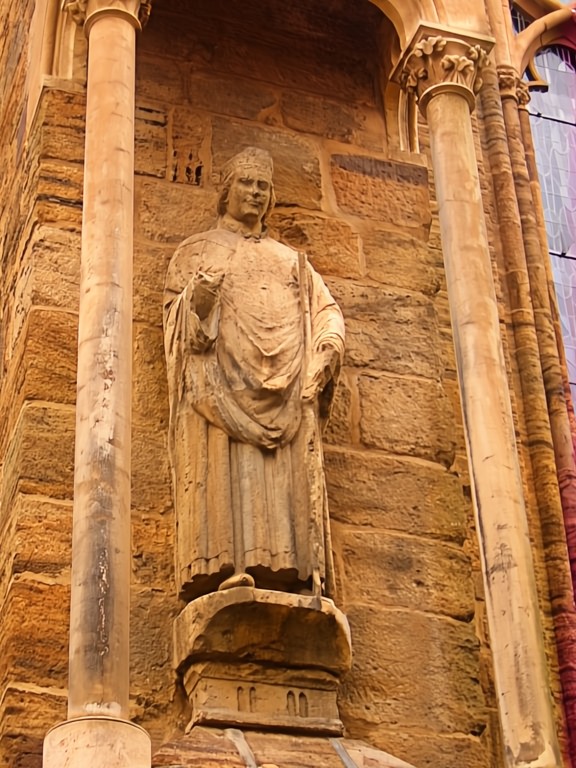
Saint of the Day – 5 March – Saint Dietmar (Died 1206) Bishop of Minden in Germany from c1185 until his death. Born in Bavaria, Germany and died on 5 March 1206. Also known as – Thietmar, Thiemo, Theodemarus.
Statue of St Dietmar at Minden Cathedral
Bishop Dietmar is said to have been moral and ascetic in personal matters and to have led the Church in Minden with prudence and wisdom. He is considered one of the greatest Bishops in Westphalia. In 1200 he Consecrated the Monastery of Marienwerder.
It is said of Dietmar that on Good Friday he would fast on water and bread as he was accustomed, even though he was very weak physically. However, the water which his servant had drawn from the well had turned into wine. Dietmar refused the drink and asked for water instead. But when he was again and again offered wine, he began to distrust his servant. Finally, he followed him to the well and watched carefully how he drew the water. When he himself saw how the water had been transformed into wine, he thanked God for having strengthened him with this miraculous drink, despite his unworthiness.
Dietmar died on 5 March 1206 in Minden and was succeeded as the Bishop by Henry II (1206-1209). He is venerated as a Saint with a memorial day on the day of his death but 6 March is also mentioned.
St Adrian of Caesarea St Caron St Carthach the Elder Bl Christopher Macassoli of Vigevano St Clement of Santa Lucia St Colman of Armagh St Conon of Pamphylia Bl Conrad Scheuber St Dietmar (Died 1206) Bishop of Minden St Eusebius of Cremona St Eusebius the Martyr St Gerasimus of Palestine (Died c475) Monk, Hermit Bl Giovanna Irrizaldi
St Theophilus (Died c217) Bishop of Caesarea , Theologian, Writer , Apologist and Defender of the Faith. Born in Caesarea, Palestine and died c195 of natural causes. The Roman Martyrology reads: “At Caesarea, in Palestine, in the time of the Emperor, Severus, St Theophilus, Bishop, who was conspicuous for his wisdom and the purity of his life.” Wise St Theophilus: https://anastpaul.com/2024/03/05/saint-of-the-day-5-march-saint-theophilus-of-caesarea-died-c217-bishop/
Martyrs of Africa – A group of 304 Christians Martyred together for their faith. We know nothing else about them but five of their names Eusebius, Evolus, Hadrian, Julian and Octavian. They Died in 254 in Africa, exact location and date unknown.
Thought for the Day – 4 March – Meditations with Fr Richard Frederick Clarke SJ (1839-1900)
“Short Meditations for March, St Joseph” From “The Devout Year” By Fr Richard Frederick Clarke SJ (1839-1900)
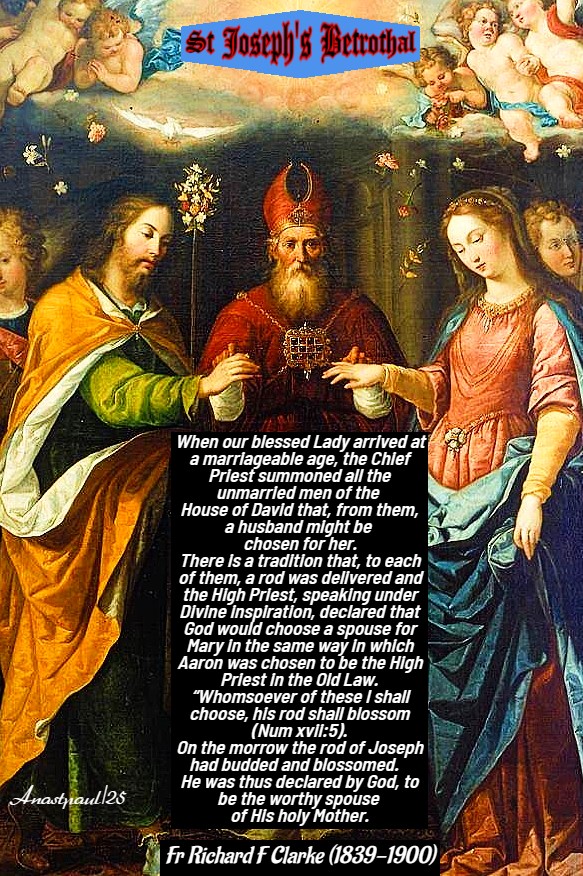
4th Day – St Joseph’s Betrothal
+1. When our blessed Lady arrived at a marriageable age, the Chief Priest summoned all the unmarried men of the House of David that, from them, a husband might be chosen for her. There is a tradition that, to each of them, a rod was delivered and the High Priest, speaking under Divine inspiration, declared that God would choose a spouse for Mary in the same way in which Aaron was chosen to be the High Priest in the Old Law. “Whomsoever of these I shall choose, his rod shall blossom (Num xvii:5). On the morrow the rod of Joseph had budded and blossomed. He was thus declared by God, to be the worthy spouse of His holy Mother.
+2. But Joseph had promised God, to remain ever a virgin.* How could he then consent to marriage? He knew by Divine revelation that Mary had made a similar vow and Mary knew the same of him O happy , O ideal union! where the sublime gift of virginity was united to the mutual love and dependence of husband on wife and wife on husband.
+3. But thus it is that God provides for His elect. He plans for them in a way which utterly sets at naught, the prudence of the world. He never disappoints those who leave themselves in His Hands but exercisesH a Divine ingenuity in fulfilling all the desires of their hearts, in most unexpected ways, in return for their submission and obedience to His holy Will. Thus it is, those who do God’s Will, always do their own will , for their will is His and His Will is theirs. (* St Thomas in Quæst Sent ii I).
Quote/s of the Day – 4 March – Feast of the Holy Face of Jesus
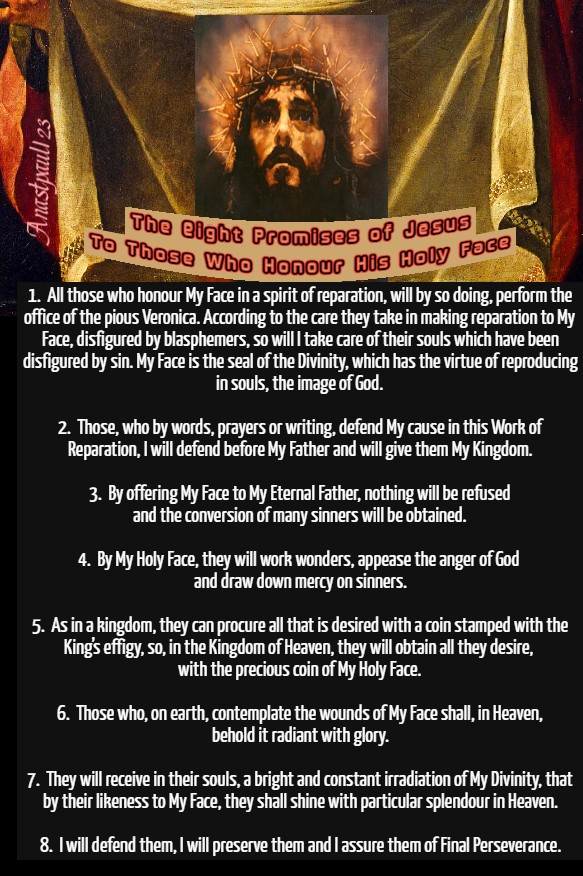
The Eight Promises of Jesus To Those Who Honour His Holy Face
All those who honour My Face in a spirit of reparation, will by so doing, perform the office of the pious Veronica. According to the care they take in making reparation to My Face, disfigured by blasphemers, so will I take care of their souls which have been disfigured by sin. My Face is the seal of the Divinity, which has the virtue of reproducing in souls, the image of God.
Those, who by words, prayers or writing, defend My cause in this Work of Reparation, I will defend before My Father and will give them My Kingdom.
By offering My Face to My Eternal Father, nothing will be refused and the conversion of many sinners will be obtained.
By My Holy Face, they will work wonders, appease the anger of God and draw down mercy on sinners.
As in a kingdom, they can procure all that is desired with a coin stamped with the King’s effigy, so, in the Kingdom of Heaven, they will obtain all they desire, with the precious coin of My Holy Face.
Those who, on earth, contemplate the wounds of My Face shall, in Heaven, behold it radiant with glory.
They will receive in their souls, a bright and constant irradiation of My Divinity, that by their likeness to My Face, they shall shine with particular splendour in Heaven.
I will defend them, I will preserve them and I assure them of Final Perseverance.
One Minute Reflection – 4 March – “The Month of Saint Joseph” – Feast of the Holy Face of Jesus – St Casimir (1458-1484) Confessor, Prince – Ecclesiasticus Sir 31:8-11 – Luke 12:35-40 – Scripture search here: https://www.drbo.org/
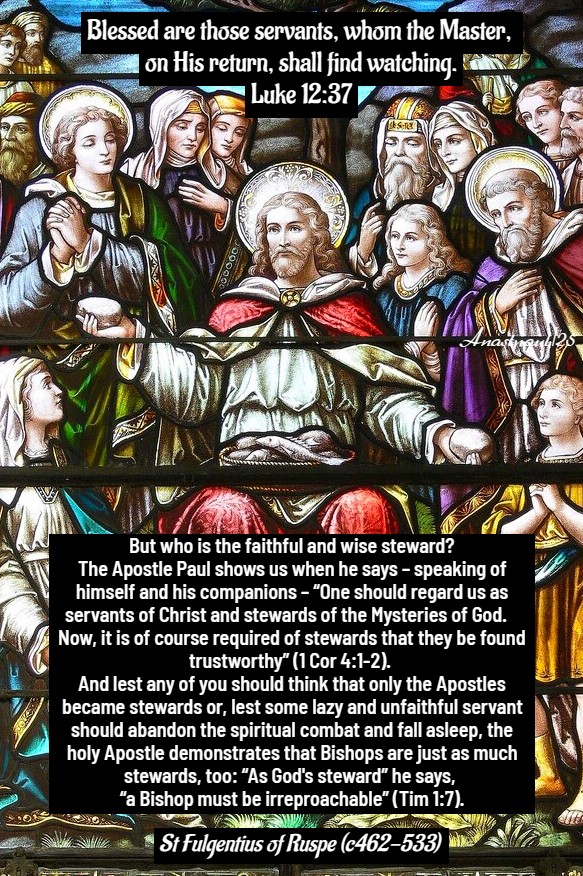
“Blessed are those servants, whom the Master, on His Return, shall find watching.” – Luke 12:37
REFLECTION – “Our Lord spoke these words, recorded by the Gospel, to clarify the function of the servants, He had set at the head of His people: “Who is the faithful and prudent Steward Whom the Master will put in charge of His servants, to distribute the food allowance, at the proper time? Blessed is that servant, whom his Master, on arrival, finds doing so” Who is that Steward, my friends? Undoubtedly, it is Christ, Who said to His disciples: “You call me ‘Teacher’ and ‘Master’ and rightly so, for indeed I Am” (Jn 13:13). And what is that Master’s Household? Surely the one which our Lord Himself Redeemed from the hands of the enemy and took to Himself. This Household is the Holy and Universal Church, spreading with remarkable fecundity throughout the world and priding itself on having been redeemed at the price of His Blood…
But who is the faithful and wise steward? The Apostle Paul shows us when he says – speaking of himself and his companions – “One should regard us as servants of Christ and stewards of the Mysteries of God. Now, it is of course required of stewards that they be found trustworthy” (1 Cor 4:1-2). And lest any of you should think that only the Apostles became stewards or, lest some lazy and unfaithful servant should abandon the spiritual combat and fall asleep, the holy Apostle demonstrates that Bishops are just as much stewards, too: “As God’s steward” he says, “a Bishop must be irreproachable” (Tim 1:7). Therefore, we are servants of the Householder, stewards of our Lord and, it is we, who have received the measure of wheat, to be distributed among you.” – St Fulgentius of Ruspe (c462-533) Bishop and Father of the Church (Sermon 1)
PRAYER – O Lord, we beseech Thee, mercifully hear our prayers; loose us from the chains of our sins and keep us from all adversity. Through Jesus Christ, Thy Son our Lord, Who lives and reigns with Thee, in the unity of the Holy Ghost, God, world without end. Amen (Collect).
An Aspiration to the Eternal Father to be Frequently Recited During the Day …
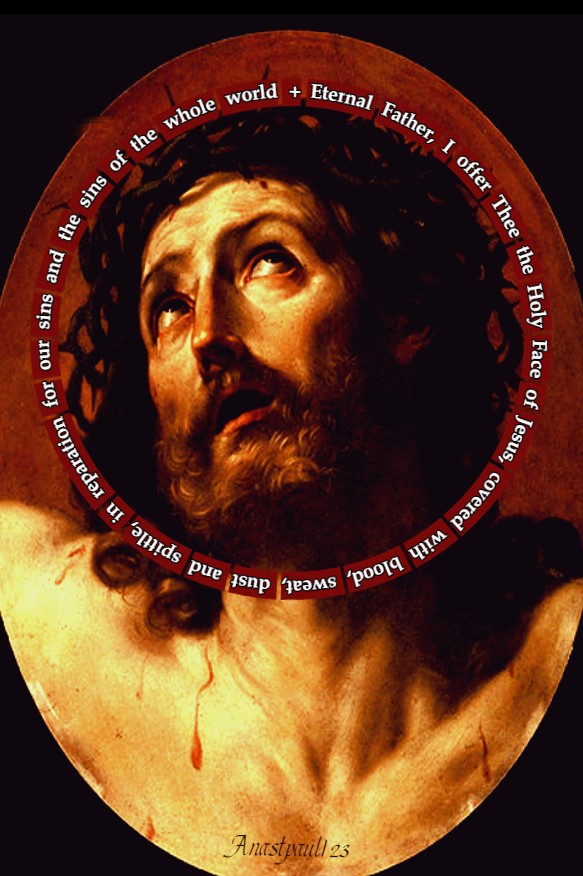
Eternal Father, I offer Thee the Holy Face of Jesus, covered with blood, sweat, dust and spittle, in reparation for our sins and the sins of the whole world.
Our Morning Offering – 4 March – Feast of the Holy Face of Jesus and Shrove Tuesday
As part of the preparations for Lent, it is appropriate to celebrate the Feast of the Holy Face by spending some time before the Blessed Sacrament and reciting the prayers of reparation. In addition, the repetition of this Devotion each Tuesday in Lent maybe a means of drawing closer to Our Lord during this time of more intense prayer and conversion.
TAKEN FROM THE AUTOBIOGRAPHY OF SR MARY OF ST PETER OCD (1816-1848).
“Do you see how I suffer? Yet, very few understand Me. Those who say they love Me are very ungrateful! I have given My Heart as the sensible object of My great love to men and I give My Face as the sensible object of My sorrow for all the sins of men. I wish that it be venerated by a special Feast on Tuesday, the day before Ash Wednesday. I wish that the Feast be preceded by a Novena in which the faithful make reparation with Me, joining together and sharing in My sorrow.” (Sadly I rem;embered the Novena too late this year, I hope you remembered.)
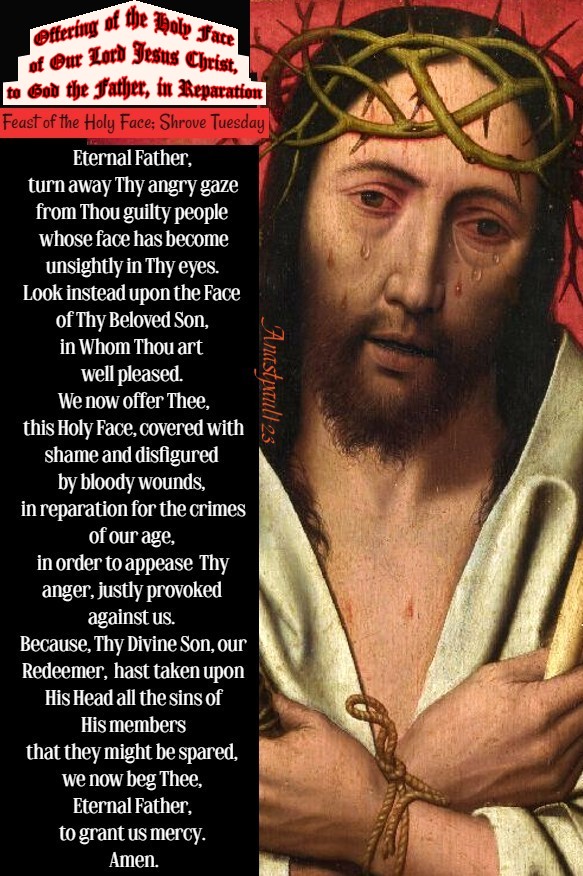
Offering of the Holy Face of Our Lord Jesus Christ, to God the Father, in Reparation
Eternal Father, turn away Thy angry gaze from Thou guilty people whose face has become unsightly in Thy eyes. Look instead upon the Face of Thy beloved Son, in Whom Thou art well pleased. We now offer Thee, this Holy Face, covered with shame and disfigured by bloody wounds, in reparation for the crimes of our age, in order to appease Thy anger, justly provoked against us. Because, Thy Divine Son, our Redeemer, hast taken upon His Head all the sins of His members that they might be spared, we now beg Thee, Eternal Father, to grant us mercy. Amen.
Saint of the Day – 4 March – St Felix (c970-1038) Abbot and restorer ofSt Gildas’ Abbey at Rhuys, Hermit. Born in c970 near Quimper, Brittany, France and died on 4 March 1038 of natural causes at the reconstructed Rhuys Abbey. Additional Memorial – 9 March 9 in the Liturgical Calendar of the Diocese of Vannes.
Tomb of Saint Felix (right) and Saint Rioc in the Saint-Gildas de Rhuys
Felix was born of wealthy parents in Quimper around 970. He had a great rdevotion for Saint Paul Aurelian who had built a Monastery at Lampoul and whose Relics, in 960, had been translated to Fleury Abbey.
Felix became a Hermit on Ushant but was forced to leave his hermitage during the Norman invasions to take refuge at Fleury in Saint-Benoît-sur-Loire, where he was welcomed by Abbo of Fleury.
Geoffrey I, the Duke of Brittany, asked the Abbot of Fleury to re-establish Rhuys Abbey which had been founded by Saint Gildas in the 6th Century on the Gulf of Morbihan and had been destroyed by the Normans. Father Abbot entrusted Felix with the task of rebuilding this renowned Monastery. The original Abbey had been built in wood on the remains of a Roman settlement.
But Felix now built in stone. Begun in 1008, the reconstruction ended in 1032 with the Consecration of the Church on 30 September, by Judicaël, the Bishop of Vannes and brother of the Duke. Felix was also consecrated as the Abbot, thus forcing him to remain there although his heart still desired to return to the Fleury. He opened a school too.
Félix died there on 4 March 1038 and was buried in his new Abbey. His tomb is now in the north transept of the Abbey Church. He is considered a Saint and his Feastday is set for 4 March ( 9 March 9 in the Liturgical Calendar of the Diocese of Vannes.)
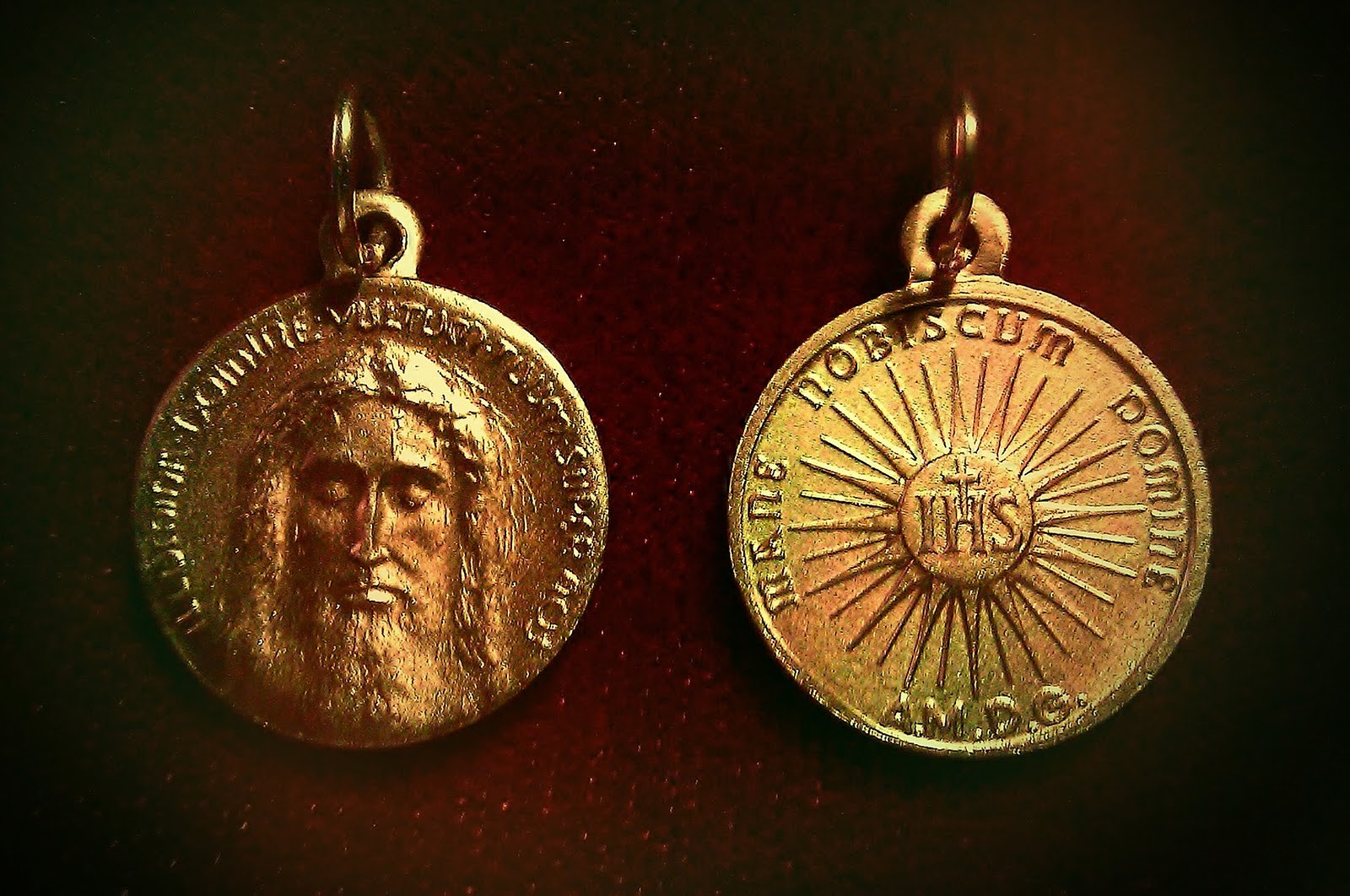
The Feast of the HOLY FACE of JESUS: In the 19th Century Jesus expressed His wishes to Sister Mary of St Peter (1816-1848), a Carmelite Nun in Tours, France, that there be an actual Devotion to his Holy Face. Our Lord wanted this in reparation for blasphemies against Himself and His Holy Name as well, as for the profanation of Sunday (when people engage unnecessarily in commerce and other such labours and chores on Sunday, a day meant for rest and reflection on God). In August of 1843 He dictated to her the well-known Golden Arrow Prayer. He also gave her Promises for those who would honour His Holy Face. The first Holy Medal of the Holy Face was given to Ven Pope Pius XII, who approved the Devotion and the Medal. In 1958 he formally declared the Feast of the Holy Face of Jesus as Shrove Tuesday for all Catholics in perpetuity. https://anastpaul.com/2022/03/01/feast-of-the-holy-face/
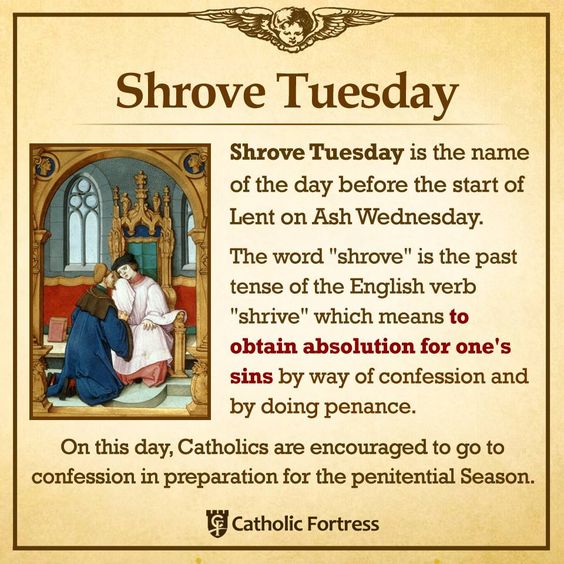
Shrove Tuesday: Shrove is the past tense of the word Shrive, which means “to hear a confession, assign penance and absolve from sin.” In the Middle Ages, especially in Northern Europe and England, it became the custom to confess one’s sins on the day before Lent began in order to enter the penitential season in a repentant spirit.
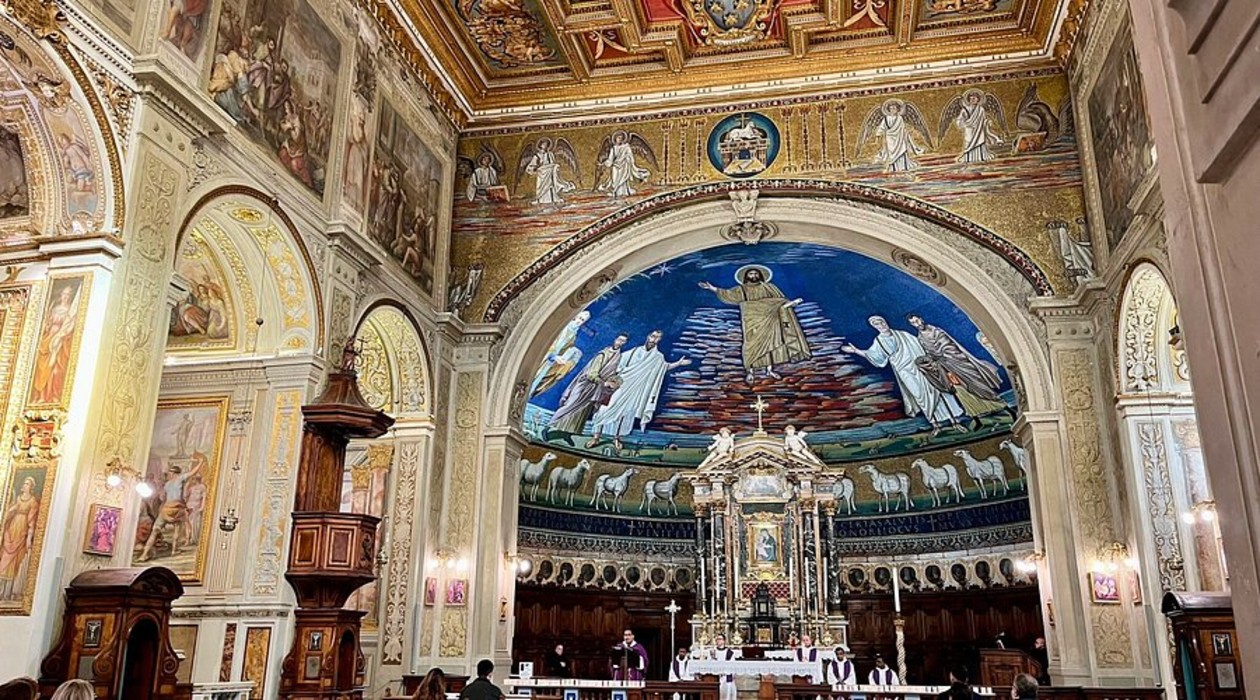
St Lucius I (Died 254) Pope and Martyr. The 22nd Bishop of Rome from 25 June 253 to his death on 5 March 254. He was banished soon after his consecration but gained permission to return. Patronage – Copenhagen, Denmark. Lucius I’s Tombstone is still extant in the Catacomb of Callixtus. His Relics were later brought to the Church of Santa Cecilia in Trastevere, along with the Relics of St Cecilia and others. His head is preserved in a reliquary in St. Ansgar’s Cathedral in Copenhagen, Denmark. This Relic was brought to Roskilde around the year 1100, after Lucius had been declared Patron Saint of the Danish region Zeeland. The Roman Martyrology reads today: “At Rome, on the Appian Way. during the persecution of Valerian, the birthday of St Lucius, Pope and Martyr, who was first exiled for the Faith of Christ but, being permitted by Divine Providence to return to his Church, he suffered Martyrdom by decapitation, after having combated the Novatians. His praises have been published by the blesseed Saint Cyprian, Bishop of Carthage(200-258).” His Life and Death: https://anastpaul.com/2023/03/04/saint-of-the-day-4-march-st-lucius-i-died-254-pope-and-martyr/
St Adrian of May St Adrian of Nicomedia Bl Alexander Blake St Appian of Comacchio St Arcadius of Cyprus St Basinus of Trier Bl Christopher Bales St Felix (c970-1038) Abbot of Rhuys Abbey St Gaius of Nicomedia
Blessed Humbert III Count of Savoy (1136–1189) Layman Prince. It is recorded of Humberto “who, forced to leave the cloister to deal with public affairs, practiced the monastic life with greater dedication, to which he later returned.” Born in 1136 in Avigliana, Italy and died on 4 March 1189 in Chambéry, France of natural causes. Beatified in 1838 by Pope Gregory XVI. Holy Humbert: https://anastpaul.com/2024/03/04/saint-of-the-day-4-march-blessed-humbert-iii-count-of-savoy-1136-1189/
St Leonard of Avranches Bl Nicholas Horner St Nestor the Martyr St Owen Bl Paolo of Brescia
Martyrs on the Appian Way – 900 Saints: Group of 900 Martyrs buried in the Catacombs of Saint Callixtus on the Appian Way, Rome.
Martyrs of Nicomedia – 20 Saints: A group of 20 Christians murdered together for their faith. The only details about them to survive are three of their names – Archelaus, Cyrillos and Photius. Nicomedia, Bithynia (in modern Turkey)
Martyrs of the Crimea – 7 Saints: A group of 4th century missionary Bishops who evangelised in the Crimea and southern Russia and were Martyred for their work. We know little else beyond the names – Aetherius, Agathodorus, Basil, Elpidius, Ephrem, Eugene and Gapito.
Thought for the Day – 3 March – Meditations with Fr Richard Frederick Clarke SJ (1839-1900)
“Short Meditations for March, St Joseph” From “The Devout Year” By Fr Richard Frederick Clarke SJ (1839-1900)
3rd Day – St Joseph’s Childhood and Youth
+1. The names of the servants of God often indicate some leading feature in their work or. in their character. When God Himself gives the name, this is always the case. Joseph signifies – adding or increasing – and was a forecast of his continuous increase , not only in grace and in favour with God but also, in glory and repute with men as long as the world shall last. Rejoice in the growing devotion to St Joseph and ask yourself whether your devotion to him grows more and more?
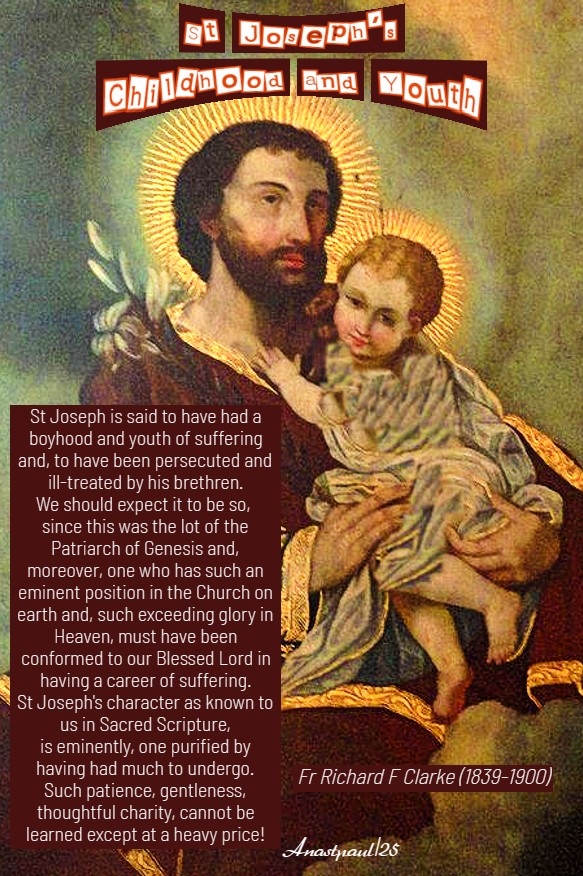
+2. St Joseph is said to have had a boyhood and youth of suffering and, to have been persecuted and ill-treated by his brethren. We should expect it to be so, since this was the lot of the Patriarch of Genesis and, moreover, one who has such an eminent position in the Church on earth and, such exceeding glory in Heaven, must have been conformed to our Blessed Lord in having a career of suffering. St Joseph’s character as known to us in Sacred Scripture, is eminently, one purified by having had much to undergo. Such patience, gentleness, thoughtful charity, cannot be learned except at a heavy price!
+3. Joseph’s trade was that of a carpenter. The thought of the great Patron of the Universal Church, the husband of Mary, having been a handicraftsman, ought to give us a great respect for manual labour. The idea that there is in it anything unsuitable to our dignity is a vulgar, unchristian, heathen notion. All the Saints had a love for manual labour. How much better such a life than that of self-satisfied ease and luxury! Thank God if you have to labour with your hands.
Quote/s of the Day – 3 March – Ferial Day – Quinquagesima Sunday –1 Corinthians 13:1-13 – Luke 18:31-43.– Scripture search here: https://www.drbo.org/
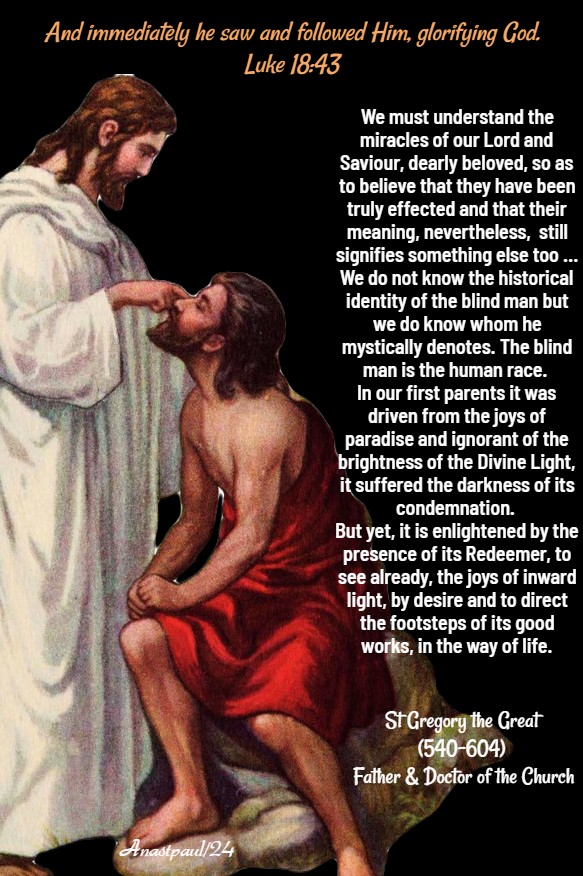
“And immediately he saw and followed Him, glorifying God.”
Luke 18:43
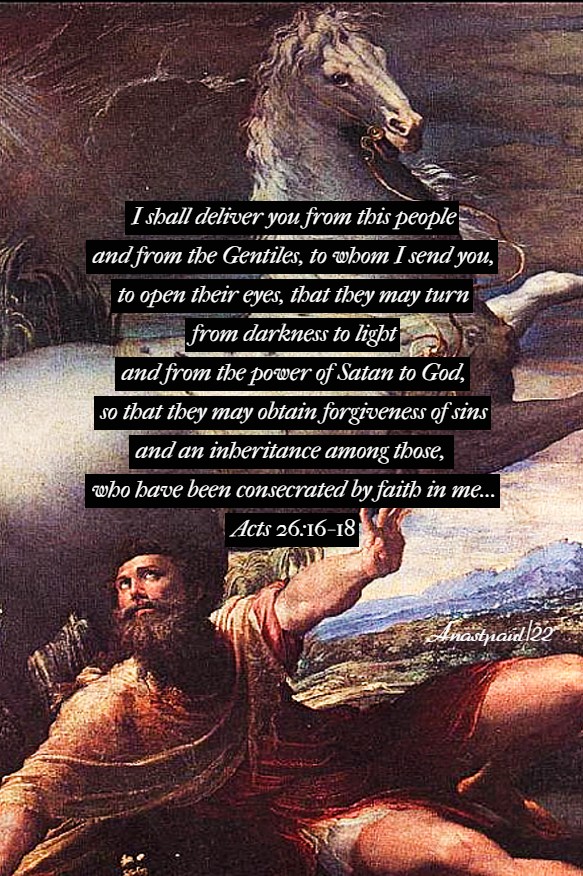
“I have appeared to you for this purpose, to appoint you as a servant and witness, of what you have seen and what you will be shown. I shall deliver you from this people and from the Gentiles, to whom I send you, to open their eyes, that they may turn from darkness to light and from the power of Satan to God, so that they may obtain forgiveness of sins and an inheritance among those, who have been consecrated by faith in me.”
Acts 26:16-18
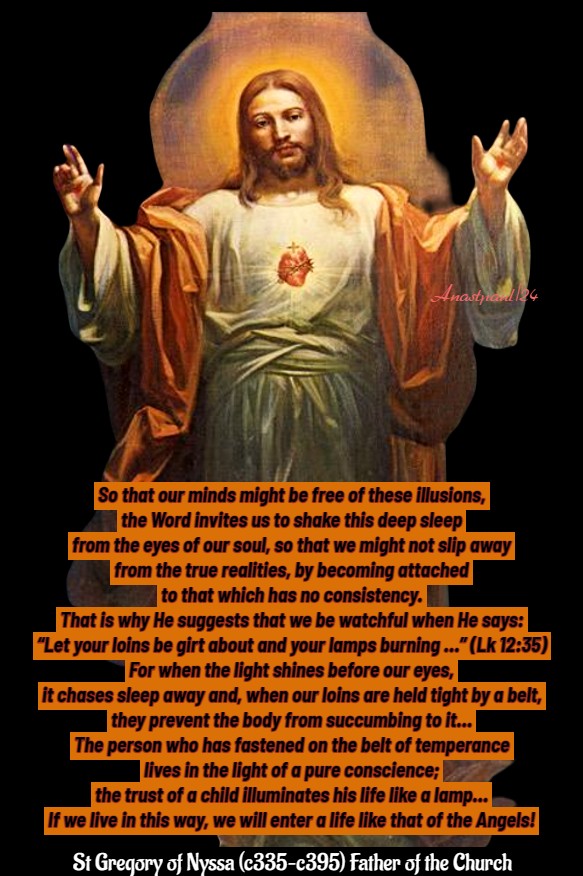
“So that our minds might be free of these illusions, the Word invites us to shake this deep sleep from the eyes of our soul, so that we might not slip away from the true realities, by becoming attached to that which has no consistency. That is why He suggests that we be watchful when He says: “Let your loins be girt about and your lamps burning …” (Lk 12:35) For when the light shines before our eyes, it chases sleep away and, when our loins are held tight by a belt, they prevent the body from succumbing to it… The person who has fastened on the belt of temperance lives in the light of a pure conscience; the trust of a child illuminates his life like a lamp… If we live in this way, we will enter a life like that of the Angels!”
St Gregory of Nyssa (c335–c395) Father of the Church (Brother of St Basil the Great)
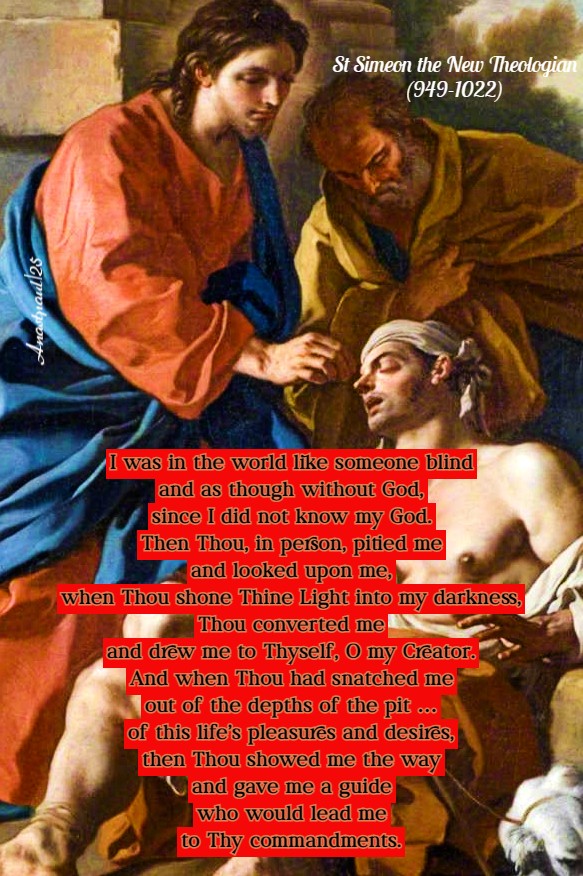
“I was in the world like someone blind and as though without God, since I did not know my God. Then Thou, in person, pitied me and looked upon me, when Thou shone Thine Light into my darkness, Thou converted me and drew me to Thyself, O my Creator. And when Thou had snatched me out of the depths of the pit … of this life’s pleasures and desires, then Thou showed me the way and gave me a guide who would lead me to Thy commandments.”
One Minute Reflection – 3 March – “The Month of Saint Joseph” – Ferial Day – Quinquagesima Sunday –1 Corinthians 13:1-13 – Luke 18:31-43.– Scripture search here: https://www.drbo.org/
“And immediately he saw and followed Him, glorifying God.” – Luke 18:43
REFLECTION – “Our Redeemer foresaw that the hearts of His disciples would be greatly disturbed by His Passion. He foretold to them, far ahead, of both the agony of His Passion and the glory of His Resurrection (Lk 18:31-33). Then, when they beheld Him dying, as had been foretold, they would not doubt that He was to rise again. But since the disciples, still worldly as they were, were entirely unable to grasp, the Words of the Mystery (v.34), there was need of a miracle! A blind man received the Light before their eyes, so that a heavenly deed might strengthen the faith of those, who failed to grasp the Words of the heavenly Mystery.
We must understand the miracles of our Lord and Saviour, dearly beloved, so as to believe that they have been truly effected and that their meaning, nevertheless, still signifies something else too … We do not know the historical identity of the blind man but we do know whom he mystically denotes. The blind man is the human race. In our first parents it was driven from the joys of paradise and ignorant of the brightness of the Divine Light, it suffered the darkness of its condemnation. But yet, it is enlightened by the presence of its Redeemer, to see already, the joys of inward light, by desire and to direct the footsteps of its good works, in the way of Life.” – St Gregory the Great (540-604) Pope, Father and Doctor of the Church (Sermons on the Gospels).
PRAYER – O Lord, we beseech Thee, mercifully hear our prayers; loose us from the chains of our sins and keep us from all adversity. Through Jesus Christ, Thy Son our Lord, Who lives and reigns with Thee, in the unity of the Holy Ghost, God, world without end. Amen (Collect).
Our Morning Offering – 3 March – Quinquagesima Week
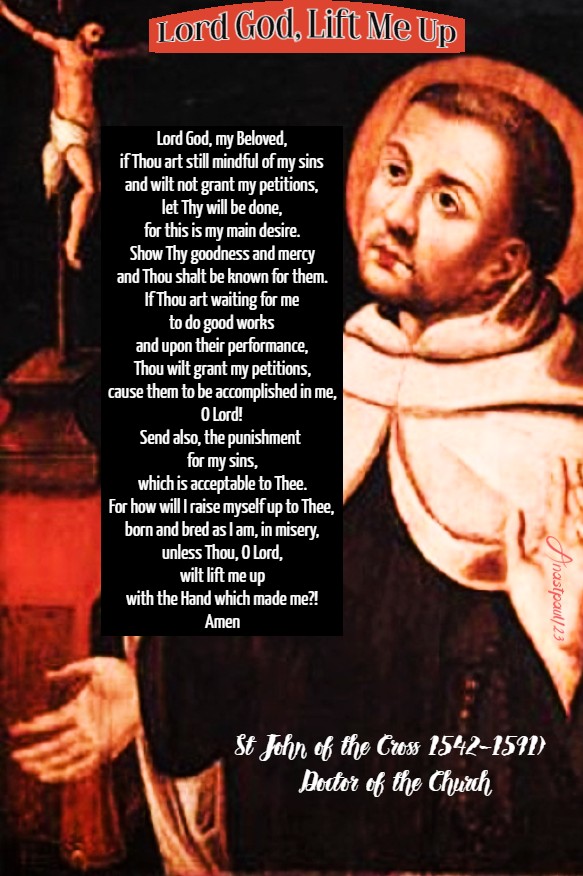
Lord God, Lift Me Up! By St John of the Cross (1542-1591) Doctor of the Church
Lord God, my Beloved, if Thou art still mindful of my sins and wilt not grant my petitions, let Thy Will be done, for this is my main desire. Show Thy goodness and mercy and Thou shalt be known for them. If Thou art waiting for me to do good works and upon their performance, Thou wilt grant my petitions, cause them to be accomplished in me, O Lord! Send also, the punishment for my sins, which is acceptable to Thee. For how will I raise myself up to Thee, born and bred as I am, in misery, unless Thou, O Lord, wilt lift me up with the Hand which made me?! Amen
Saint of the Day – 3 March – Saint Titian (Died c540) Bishop of Brescia, Italy. In the list of Bishops of Brescia, he is considered the 15th Bishop of Brescia, succeeding Vigilius and preceding Paul II. His Episcopate is believed to have occurred between 526 and 540. Also known as – Tiziano. Additional Memorial – 20 April together with all the Saints of Brescia.
Sadly, we know nothing of our Saints life. He was buried in the Church of Sts Cosma and Damiano, perhaps built by himself. Later a Monastery was annexed to this Church but in 1302, the entire complex was demolished by Bishop Berardo Maggi to make room for the Palazzo Broletto, currently in Piazza del Duomo.
The Church and Monastery, now a Basilica, were rebuilt to the west of the City, in the Campi Bassi area where they still are today. In 1505, St Titian’s Rrelics were translated by Bishop Paolo Zane and placed in a marble Reliquary erected on the Altar in the Chapel on the left of the nave of the new Basilica.
At the end of the 19th Century, his original marble Sarcophagus, after several moves, was placed as a fountain in a corner of Piazzetta Tito Speri, where it is currently located.
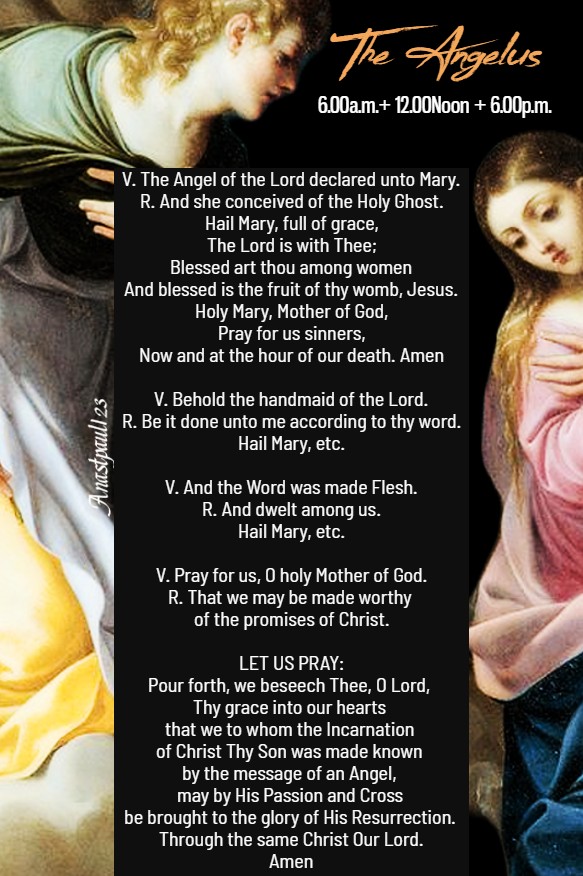
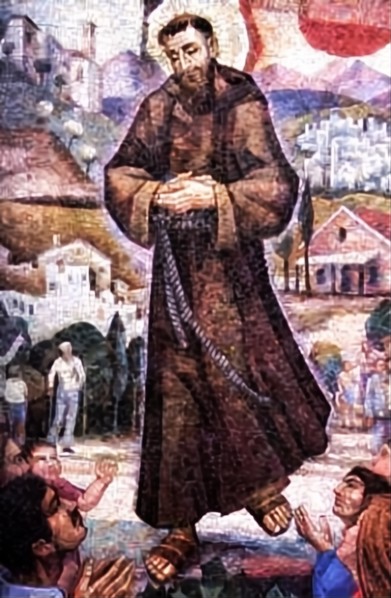
Blessed Benedetto Sinigardi da Arezzo OFM (1190-1282) Friar of the Order of Friars Minor, who received the Habit directly from St Francis of Assisi. Although rarely mentioned, Blessed Benedetto is the Author of the Angelus! Furthermore, the beautiful custom of reciting the Marian Antiphon “The Angelus Domini” is attributed to Blessed Benedetto, meditating on the saving Mystery of the Incarnation of the Son of God in Mary’s virginal womb. The Angelus Domini became a pious practice firstly to the entire Franciscan Order, then to the whole Church, as it still is today. Lovely Fr Benedetto!: https://anastpaul.com/2023/03/03/saint-of-the-day-3-march-blessed-benedetto-sinigardi-da-arezzo-ofm-c1190-1282-the-author-of-the-angelus/
St Anselm of Nonantola St Arthelais of Benevento St Calupan St Camilla St Cele-Christ
St Cunegundes (c975-1040) Empress of the Holy Roman Empire, Nun, she took a vow of Virginity before her marriage, which, after a miracle was upheld by her husband, the King (also a Saint). Founder of Monasteries and Churches, Nun in one of her Convents, Apostle of Charity. Born in c 975 and died in 1040 of natural causes. Biography: https://anastpaul.com/2022/03/03/saint-of-the-day-3-march-st-cunegundes-c-975-1040/
Bl Pierre-René Rogue St Sacer St Titian (Died c540) Bishop and Confessor St Winwallus of Landévennec
40 Martyrs in North Africa – A group of Christians Martyred together in North Africa, date unknown. No details have survived, but we know these names – Antonius, Artilaus, Asclipius, Astexius, Basil, Bosimus, Carissimus, Castus, Celedonius, Claudianus, Cyricus, Donata, Emeritus, Emeterius, Euticus, Felix, Fortunatus, Frunumius, Gajola, Georgius, Gorgonius, Hemeterus, Isicus, Janula, Julius, Luciola, Luciolus, Marcia, Marinus, Meterus, Nicephorus, Papias, Photius, Risinnius, Sabianus, Savinianus and Solus
Martyrs of Pontus – 3+ Saints – A large group of Christians Martyred together in the persecutions of Emperor Maximian Galerius and governor Ascleopiodato. We have some details on three of them – Basiliscus, Cleonicus and Eutropius. 308 in Pontus (in modern Turkey) Martyrs of Caesarea; Asterius Marinus
Martyrs of Calahorra: Cheledonius Emeterius
Martyrs of Gondar, Ethiopia: Bl Antonio Francesco Marzorati Bl Johannes Laurentius Weiss Bl Michele Pío Fasol
Thought for the Day – 2 March – Meditations with Fr Richard Frederick Clarke SJ (1839-1900)
“Short Meditations for March, St Joseph” From “The Devout Year” By Fr Richard Frederick Clarke SJ (1839-1900)
2nd Day – St Joseph’s Parentage and Birth
+1. Although St Joseph lived in poverty and contempt, he came of a noble ancestry. The blood of Kings and Saints ran in his veins and, what is more, he inherited, from them, the virtues of each but in a far higher degree, than that which their original possessor had enjoyed. How much the good in me is an inheritance from my parents and forefathers!? Yet how ill I have employed the virtues I received from them! Instead of being better than they, like St Joseph, I am the degenerate child of parents far better than myself.
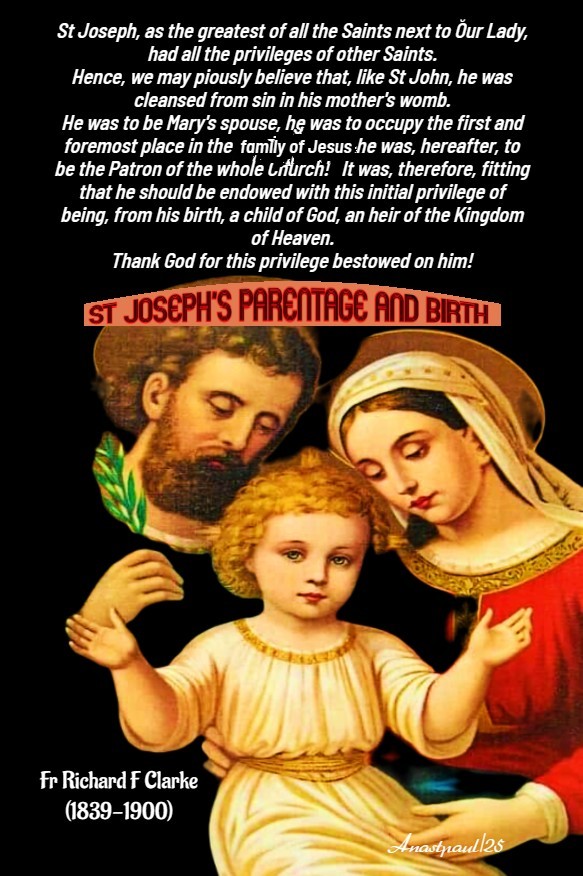
+2. St Joseph, as the greatest of all the Saints next to Our Lady, had all the privileges of other Saints. Hence, we may piously believe that, like St John, he was cleansed from sin in his mother’s womb. He was to be Mary’s spouse, he was to occupy the first and foremost place in the family of Jesus, he was, hereafter, to be the Patron of the whole Church! It was, therefore, fitting that he should be endowed with this initial privilege of being, from his birth, a child of God, an heir of the Kingdom of Heaven. Thank God for this privilege bestowed on him!
+3. St Joseph was the connecting link between the Old and the New Dispensation, the first dawn which announces the coming day. In his youth, he belonged to the Old Law, in his later life, to the New. As the dawn brightens into the glorious day, so St Joseph’s life, beautiful from the first, advanced in splendour continually. Is this the history of my life? Have I made steady progress in the love of God?
Quote/s of the Day – 2 March – Quinquagesima Sunday
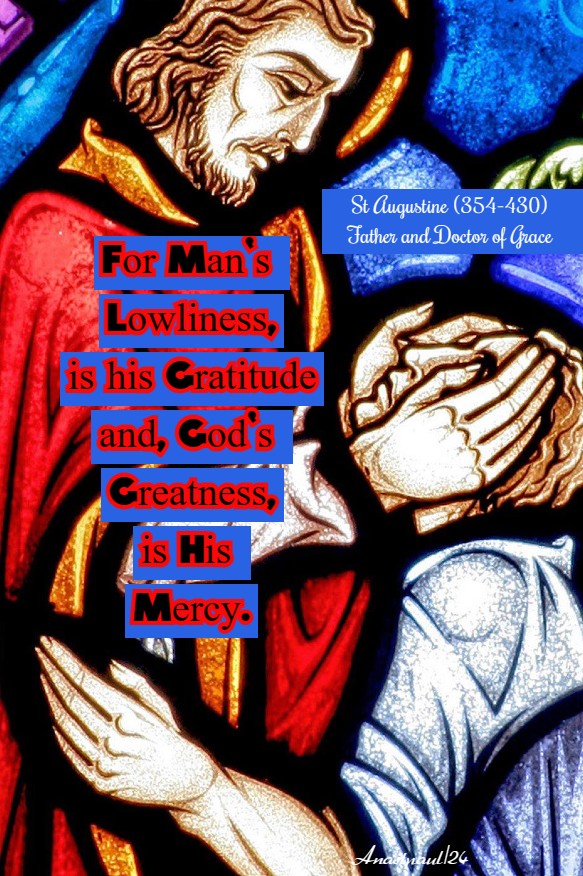
“ For man’s lowliness, is his gratitude and, God’s greatness, is His Mercy.”
St Augustine (354-430) Father and Doctor of Grace
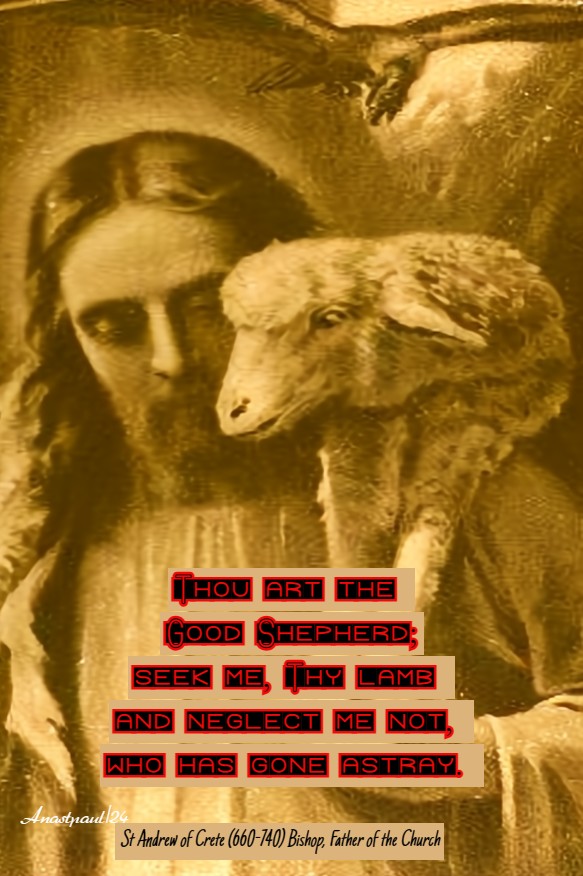
“Thou art the Good Shepherd; seek me, Thy lamb and neglect me not, who has gone astray. [John 10:11-14]”
St Andrew of Crete (660-740) Bishop, Father of the Church
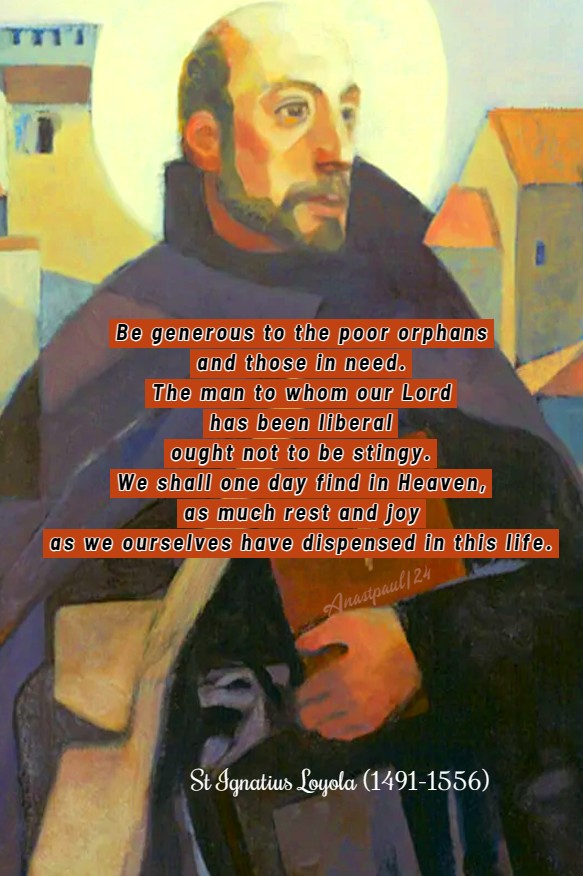
“Be generous to the poor orphans and those in need. The man to whom our Lord has been liberal ought not to be stingy. We shall one day find in Heaven, as much rest and joy as we ourselves have dispensed in this life.”
St Ignatius Loyola (1491-1556)
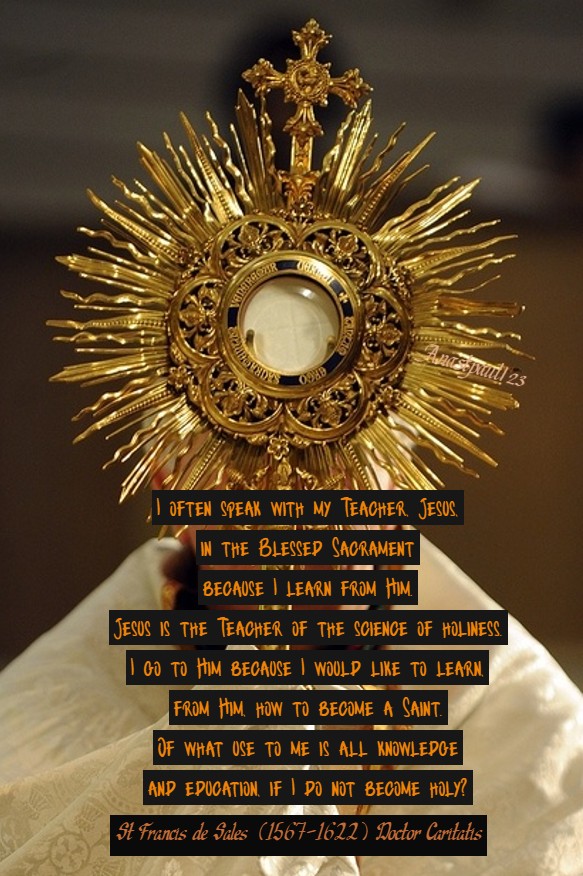
“I often speak with my Teacher, Jesus, in the Blessed Sacrament because I learn from Him. Jesus is the Teacher of the science of holiness. I go to Him because I would like to learn, from Him, how to become a Saint. Of what use to me is all knowledge and education, if I do not become holy?”
One Minute Reflection – 2 March – “The Month of Saint Joseph” – Quinquagesima Sunday –1 Corinthians 13:1-13 – Luke 18:31-43. – Scripture search here: https://www.drbo.org/
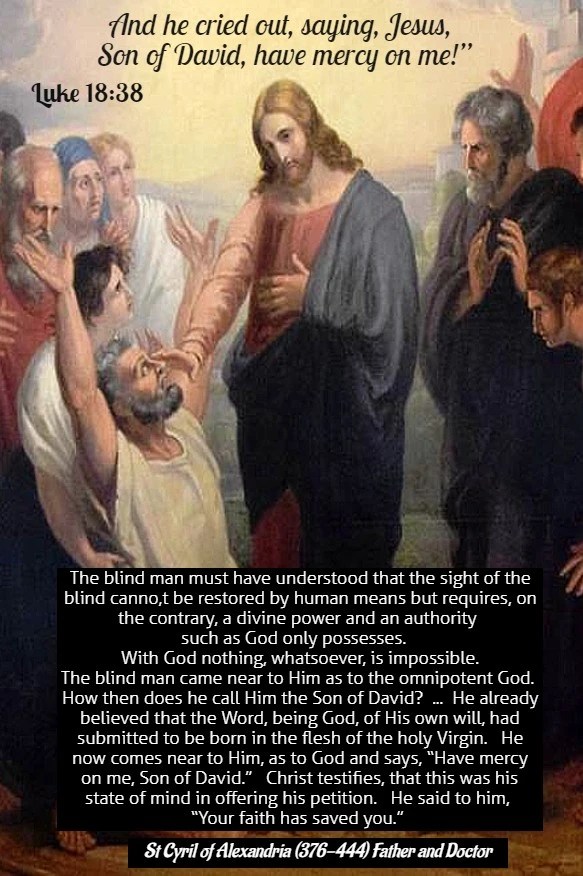
“And he cried out, saying, Jesus, Son of David, have mercy on me!” – Luke 18:38
REFLECTION – The blind man must have understood, that the sight of the blind cannot be restored by human means but requires, on the contrary, a divine power and an authority such as God only possesses. With God nothing, whatsoever, is impossible. The blind man came near to Him, as to the omnipotent God. How then does he call Him, the Son of David? What can one answer to this? The following is perhaps the explanation. Since He was born and raised in Judaism, of course, the predictions contained in the law and the holy Prophets, concerning Christ, had not escaped his knowledge. He heard them chant that passage in the book of the Psalms, “The Lord has sworn in truth to David and will not annul it, saying: ‘of the fruit of your loins I will set a king upon your throne.’” The blind man also knew that the blessed Prophet Isaiah said, “There will spring up a shoot from the root of Jesse and from his root a flower will grow up.” Isaiah also said, “Behold, a virgin will conceive and bring forth a son,and they will call his name Emmanuel, which, being interpreted is, God with us.” He already believed that the Word, being God, of His own will, had submitted to be born in the flesh of the holy Virgin. He now comes near to Him, as to God and says, “Have mercy on me, Son of David.” Christ testifies, that this was his state of mind in offering his petition. He said to him, “Your faith has saved you.” – St Cyril of Alexandria (376-444) Archbishop of Alexandria, Father and Doctor of the Incarnation (Commentary on Luke, Homily 126)
PRAYER – O Lord, we beseech Thee, mercifully hear our prayers; loose us from the chains of our sins and keep us from all adversity. Through Jesus Christ, Thy Son our Lord, Who lives and reigns with Thee, in the unity of the Holy Ghost, God, world without end. Amen (Collect).
Our Morning Offering – 2 March – Quinquagesima Sunday
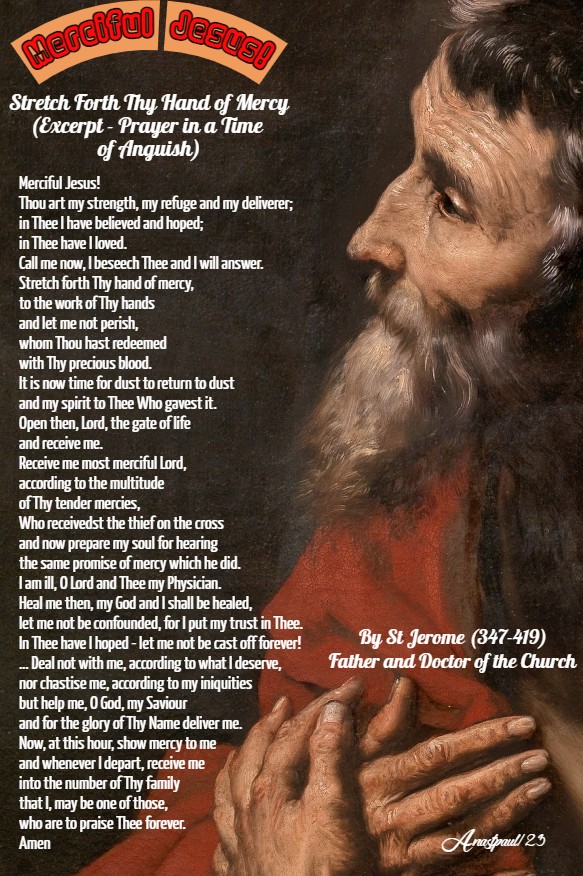
Merciful Jesus! Stretch Forth Thy Hand of Mercy (Excerpt – Prayer in a Time of Anguish) By St Jerome (347-419) Father and Doctor of the Church
Merciful Jesus! Thou art my strength, my refuge and my deliverer; in Thee I have believed and hoped; in Thee have I loved. Call me now, I beseech Thee and I will answer. Stretch forth Thy Hand of mercy, to the work of Thy Hands and let me not perish, whom Thou hast redeemed with Thy Precious Blood. It is now time for dust to return to dust and my spirit to Thee Who gavest it. Open then, Lord, the Gate of Life and receive me. Receive me most merciful Lord, according to the multitude of Thy tender mercies, Who receivedst the thief on the cross and now prepare my soul for hearing the same promise of mercy which he did. I am ill, O Lord and Thee my Physician. Heal me then, my God and I shall be healed, let me not be confounded, for I put my trust in Thee. In Thee have I hoped – let me not be cast off forever! … Deal not with me, according to what I deserve, nor chastise me, according to my iniquities but help me, O God, my Saviour and for the glory of Thy Name deliver me. Now, at this hour, show mercy to me and whenever I depart, receive me into the number of Thy family that I, may be one of those, who are to praise Thee forever. Amen
























 AnaStpaul
You must be logged in to post a comment.