Passionate Catholic.
Being a Catholic is a way of life - a love affair "Religion must be like the air we breathe..."- St John Bosco
Prayer is what the world needs combined with the example of our lives which testify to the Light of Christ.
This site, which is now using the Traditional Calendar, will mainly concentrate on Daily Prayers, Novenas and the Memorials and Feast Days of our friends in Heaven, the Saints who went before us and the great blessings the Church provides in our Catholic Monthly Devotions.
This Site is placed under the Patronage of my many favourite Saints and especially, St Paul.
"For the Saints are sent to us by God
as so many sermons.
We do not use them, it is they who move us
and lead us, to where we had not expected to go.”
Charles Cardinal Journet (1891-1975)
This site adheres to the pre-Vatican II Catholic Church and all her teachings. .
PLEASE ADVISE ME OF ANY GLARING TYPOS etc - In June 2021 I lost 100% sight in my left eye and sometimes miss errors. Thank you and I pray all those who visit here will be abundantly blessed. Pax et bonum! 🙏
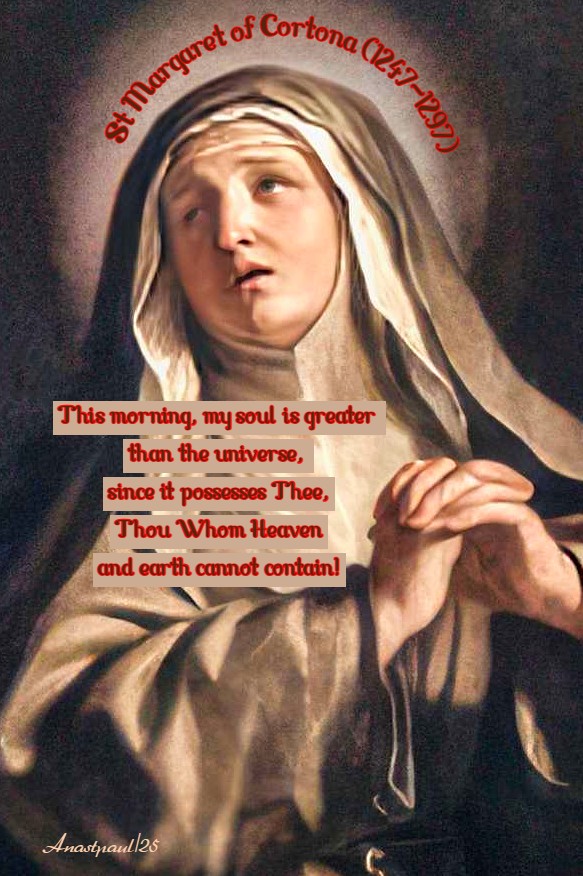
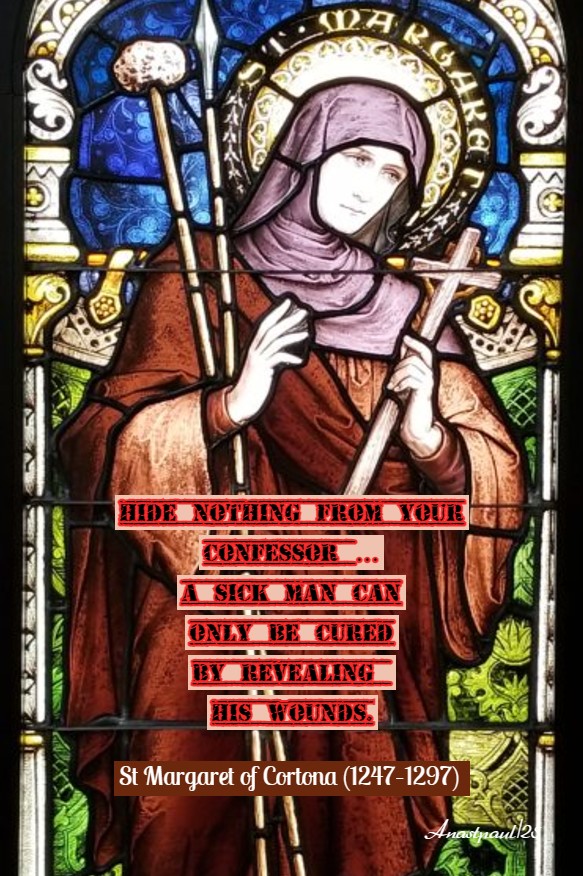
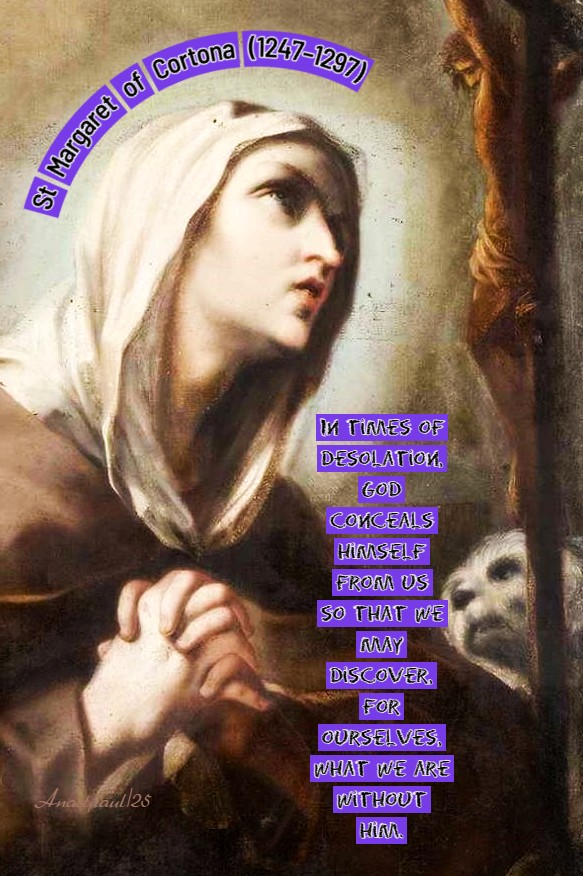
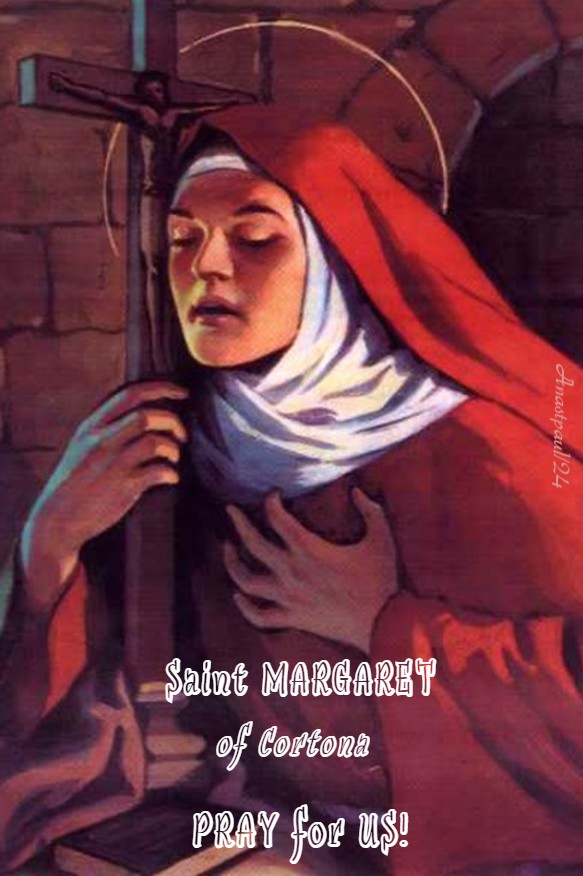
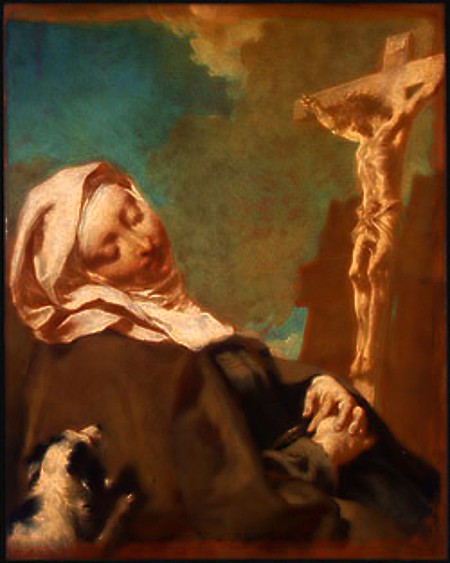
One Minute Reflection – 26 February – “The Month of the Blessed Trinity” – St Margaret of Cortona (1247–1297) Penitent – Ferial Day – Sexagesima Week – 2 Corinthians 11:19-33; 12:1-9 – Luke 8:4-15 – Scripture search here: https://www.drbo.org/
“But that upon good ground, these are they who, with a right and good heart, having heard the Word, hold it fast and bear fruit in patience.” – Luke 8:15
REFLECTION – “Note that Jesus does not say: The careless received some seed and lost it, the rich received other seed and choked it and the superficial received some seed and betrayed it. It is not His intention to rebuke them severely, lest He should cast them into despair. Christ leaves the reproof to the conscience of His hearers. Remember too, in the parable of the net, much was gathered in, which was unprofitable. But He speaks this parable as if to anoint His disciples and to teach them, not to be despondent even though those lost, may be more than those who receive the Word. It was with this same ease that the Lord Himself continued to sow, even He, Who fully foreknew the outcomes!
But why would it be reasonable to sow among thorns or on rocks or on the pathway? With regard to the seeds and the earth, it cannot sound very reasonable. But, in the case of human souls and their instructions, it is praiseworthy and greatly to be honoured. For the farmer might be laughed at for doing this, since it is impossible for a rock to bear fruit. It is not likely that the path will become anything but a path or the thorns anything but thorns. But with respect to the rational soul, this is not so predictable. For here, there is such a thing as the rock changing and becoming rich land. Here it is possible, that the wayside might no longer be trampled upon or lie open to all who pass by but that it may become a fertile field. In the case of the soul, the thorns may be destroyed and the seed enjoy full security. For had it been impossible, this Sower would not have sown. And if the reversal did not take place in all, this is no fault of the Sower but of the souls who are unwilling to be changed. He has done His part. If they betrayed what they received of Him, He is blameless, the Exhibitor of such Love to humanity.
But mark this carefully – there is more than one road to destruction! There are differing ones and wide apart from one another. For they who are like the wayside are the coarse-minded and indifferent and careless but those on the rock, such as fail, from willed weakness only.” – St John Chrysostom (347-407) Archbishop of Constantinople, Father and Doctor of the Church (The Gospel of Matthew: Homily 44).
PRAYER – Grant, we beseech Thee, O Lord our God, that we may imitate Thy holy Penitent Margaret, may we at least present to her, our humble homage. Through Jesus Christ, Thy Son our Lord, Who lives and reigns with Thee, in the unity of the Holy Ghost, God, world without end. Amen (Collect).
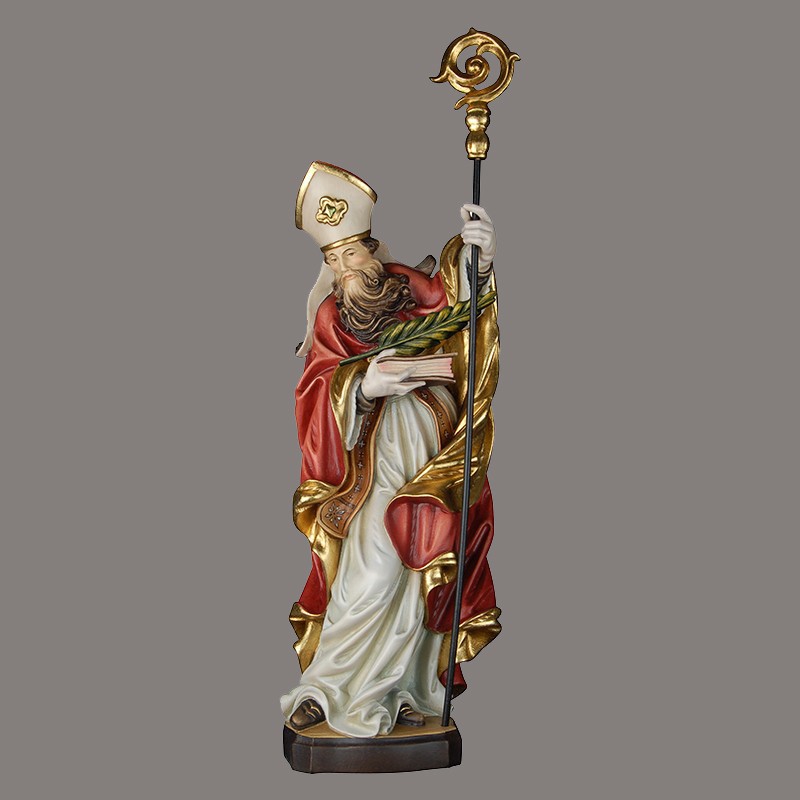
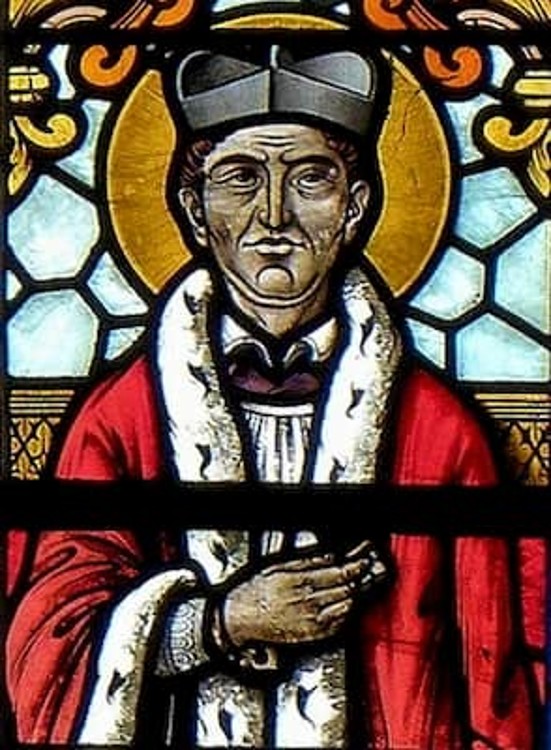
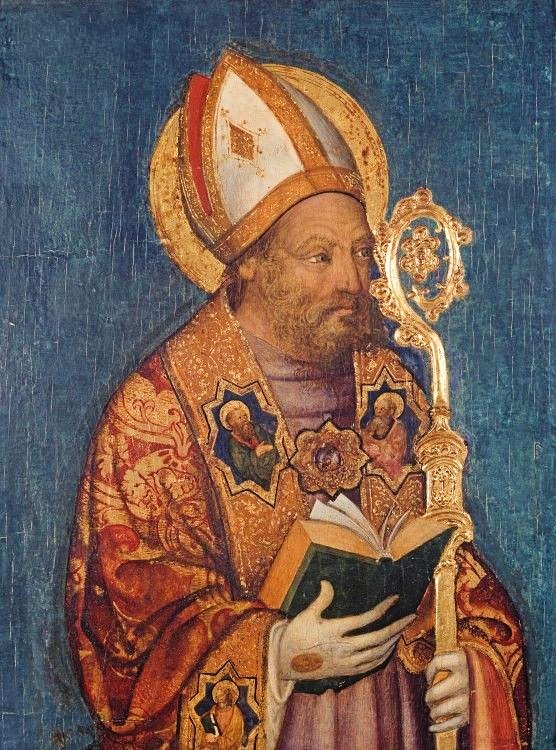
Saint of the Day – 26 February – St Faustinian (4th Century) the 2nd Bishop of Bologna, Italy. Also known as – Faustinianus, Faustinus, Faustiniano. Additional Memorial – 28 September as one of the Saintly Bishops of Bologna, Italy.
The Roman Martyrology reads today: “At Bologna, the Bishop St Faustinian, whose preaching strengthened and multiplied the faithful of that Church which had been much afflicted during the persecutions of Diocletian.”
Faustinian, according to the oldest list of Bishops of the Archdiocese of Bologna, that is the so-called “Rhine List” prior to the 14th Century, is placed in second place; this information is also supported by an inscription in Gothic characters, prior to 1494, where we read that St Zama was the 1st Bishop and St Faustinian the 2nd.
According to some scholars, he should be identified with the ‘Faustinus’ Bishop, cited by St Athanasius the Bishop of Alexandria, in his “Apologia contra Arianos”, in a list of Italian bishops participating in the Council of Sardica (ancient name of Sofia in Bulgaria), in 343.
If all this establishes that St Faustinian was in office in 343, it makes the ancient Bolognese tradition implausible which says that during the persecution of Diocletian, who died in 313, St. Faustiniano spread the faith in Bologna; the dates do not correspond, also because the Episcopal Seat of Bologna does not seem to have arisen before the 4th Century.
The cult of the holy Bishop began only after the 12th Century. In 1586, thanks to Cardinal Gabriele Paleotti, St Faustinian’s Relics were transferred to the Cathedral, thus establishing a continuous veneration of our Saint, who is celebrated twice a year in Bologna.
St Alexander of Alexandria (Died c326) Bishop of Alexandria, Confessor, Defender of the True Faith against heresies, in particular the Arians. The Roman Martyrology states of him today: “At Alexandria, the Bishop St Alexander, an aged man held in great honour who was a successor of the blessed Peter as Bishop of the City. He expelled from the Church, Arius, one of his Priests, tainted with heretical impiety and convicted by Divine Truth and, subsequently, was one of the three hundred and eighteen Fathers, who condemned him at the Council of Nicea.” Holy Father St Alexander: https://anastpaul.com/2022/02/26/saint-of-the-day-26-february-st-alexander-of-alexandria-died-c-326/
St Andrew of Florence St Dionysius of Augsburg St Faustinian (4th Century) Bishop of Bologna St Felix St Fortunatus St Irene Bl Ottokar of Tegernsee
Thought for the Day – 25 February – Meditations with Fr Richard Frederick Clarke SJ (1839-1900)
Meditations on “The Great Truths” From “The Devout Year” By Fr Richard Frederick Clarke SJ (1839-1900)
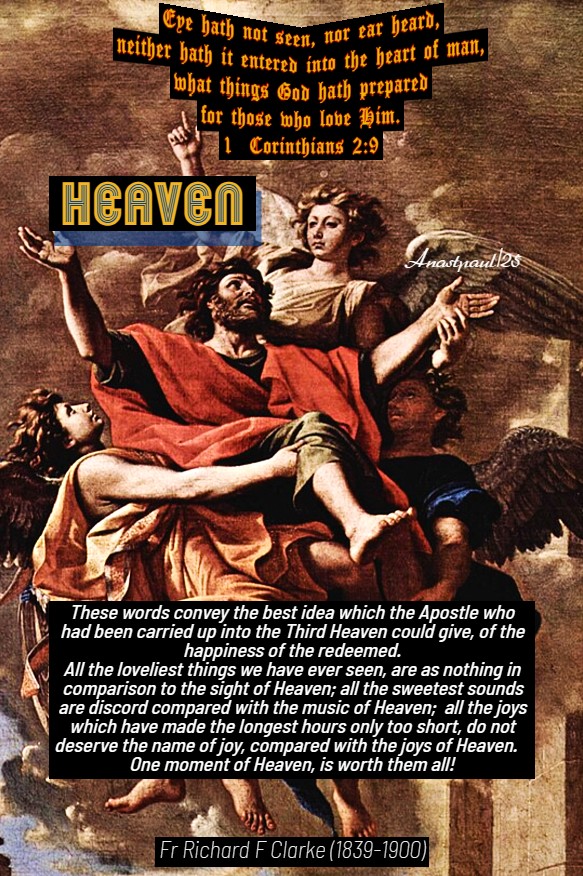
25th Day – Heaven .
Eye hath not seen, nor ear heard, neither hath it entered into the heart of man, what things God hath prepared for those who love Him. (1 Cor ii:9)
+1. These words convey the best idea which the Apostle who had been carried up into the Third Heaven could give, of the happiness of the redeemed. All the loveliest things we have ever seen, are as nothing in comparison to the sight of Heaven; all the sweetest sounds are discord compared with the music of Heaven; all the joys which have made the longest hours only too short, do not deserve the name of joy, compared with the joys of Heaven. One moment of Heaven, is worth them all!
+2. Whatever God does, He does on a scale worthy of Himself. The happiness of Heaven will be immeasurable, from the fact of its being, in union with the God of Infinite Love and Beauty. It will be a joy like the joy of Our Lord Himself, since He will say to each of the redeemed – “Enter thou into the joy of thy Lord.” Am I doing what I can to insure those words, being addressed to me?
+3. In Heaven, all will be perfectly happy. Even those who have the lowest places, will have all that their hearts desire. There will be no unsatisfied wish in Heaven, no craving after what we do not possess. Everyone will have an overflowing cup of pleasure. Oh, what fools we are not to do more to insure the joy of Heaven! Pray that you may often think of Heaven and its eternal joys.
Quote/s of the Day – 25 February – Ferial Day – Sexagesima Week – 2 Corinthians 11:19-33; 12:1-9; – Luke 8:4-15 – Scripture search here: https://www.drbo.org/
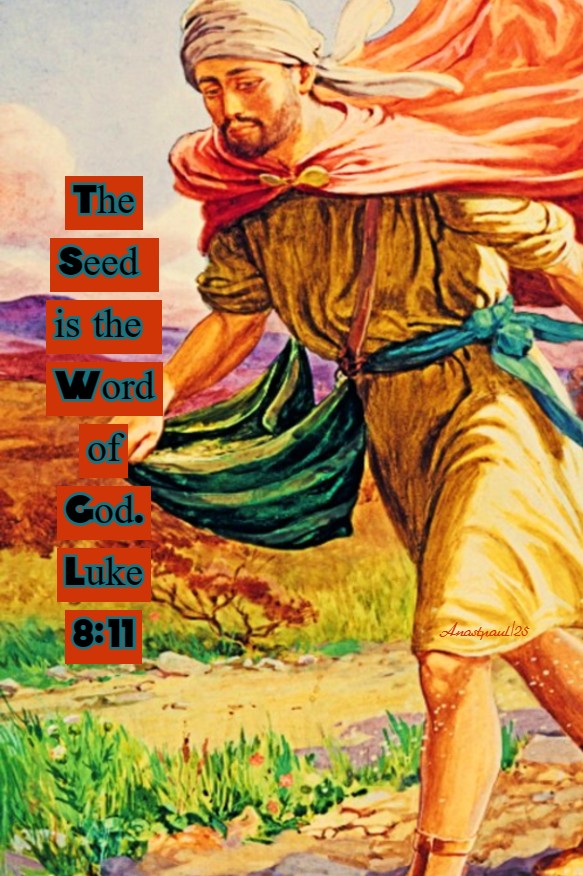
“The seed is the Word of God.”
Luke 8:11
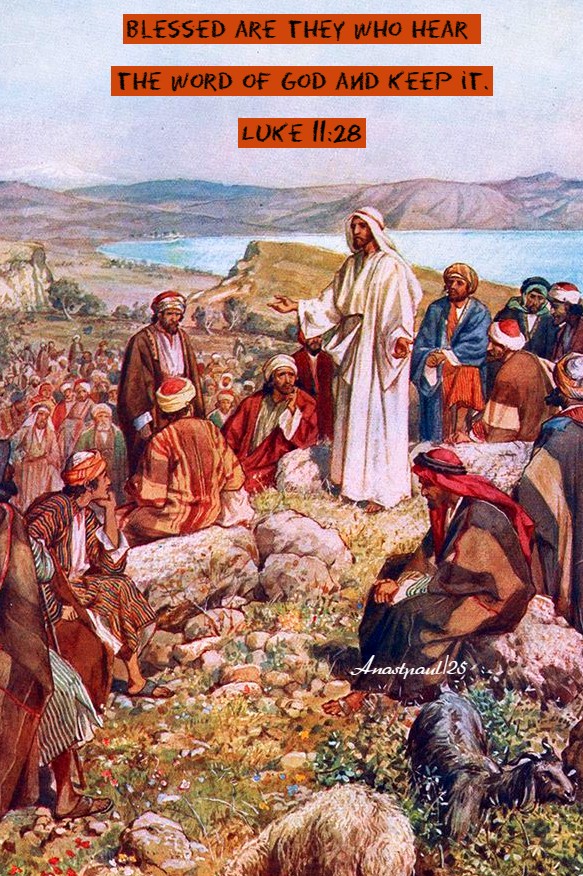
“… Blessed are they who hear the Word of God and keep it.”
Luke 11:28
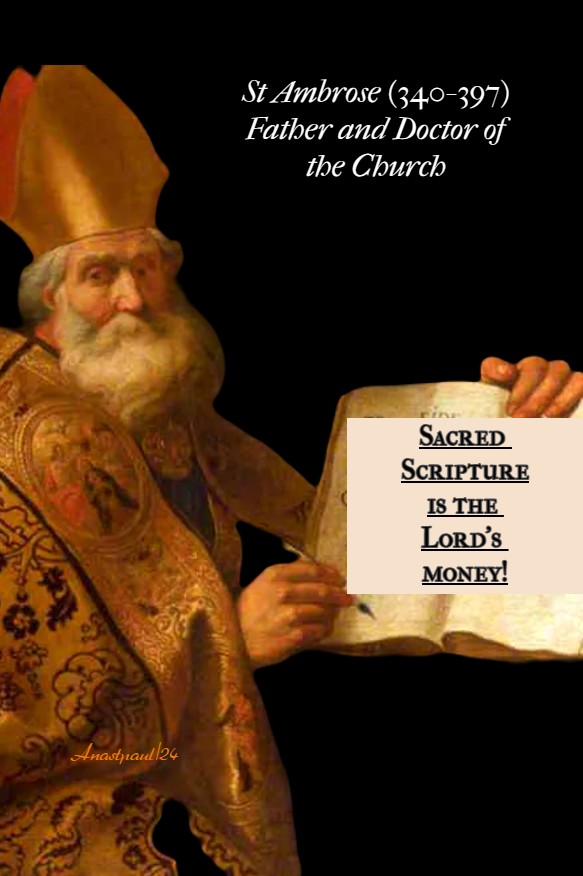
“Sacred Scripture is the Lord’s money!”
St Ambrose (340-397) Father and Doctor of the Church
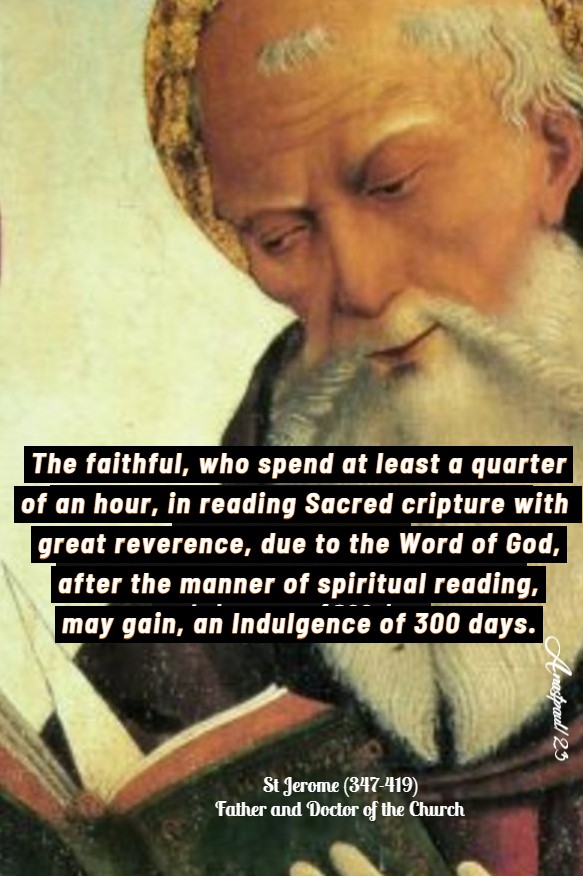
“The faithful, who spend at least a quarter of an hour, in reading Sacred Scripture with great reverence, due to the Word of God, after the manner of spiritual reading, may gain, an Indulgence of 300 days.”
St Jerome (347-419) Father and Doctor of the Church
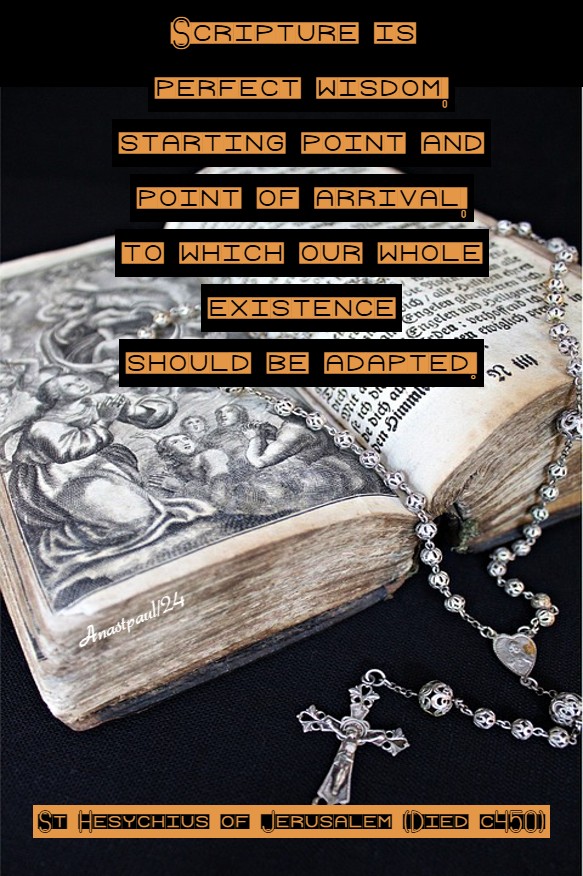
“Scripture is perfect wisdom, starting point and point of arrival, to which our whole existence should be adapted.”
St Hesychius of Jerusalem (Died c450) Priest, Exegete, Father
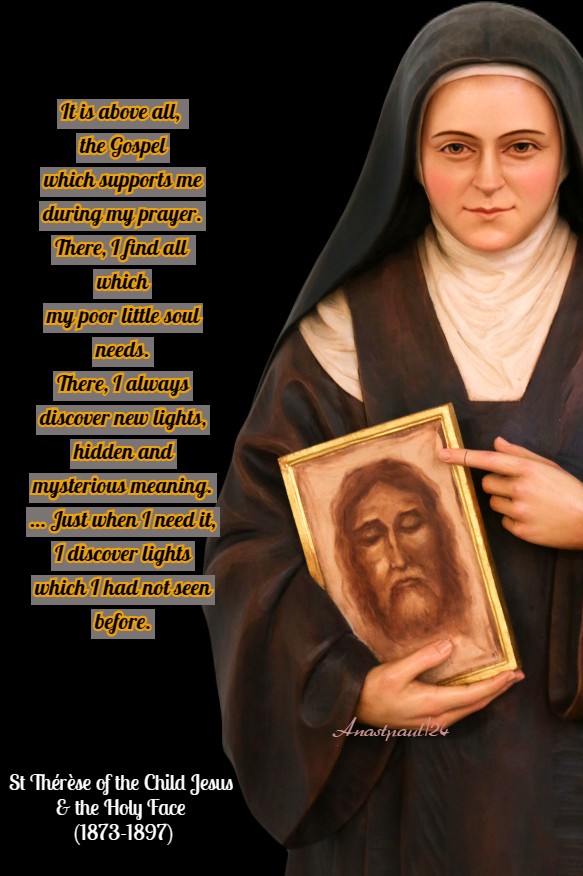
“It is above all, the Gospel which supports me during my prayer. There, I find all which my poor little soul needs. There, I always discover new lights, hidden and mysterious meaning. … Just when I need it, I discover lights which I had not seen before.”
One Minute Reflection – 25 February – “The Month of the Blessed Trinity” – Ferial Day – Sexagesima Week – 2 Corinthians 11:19-33; 12:1-9; – Luke 8:4-15 – Scripture search here: https://www.drbo.org/
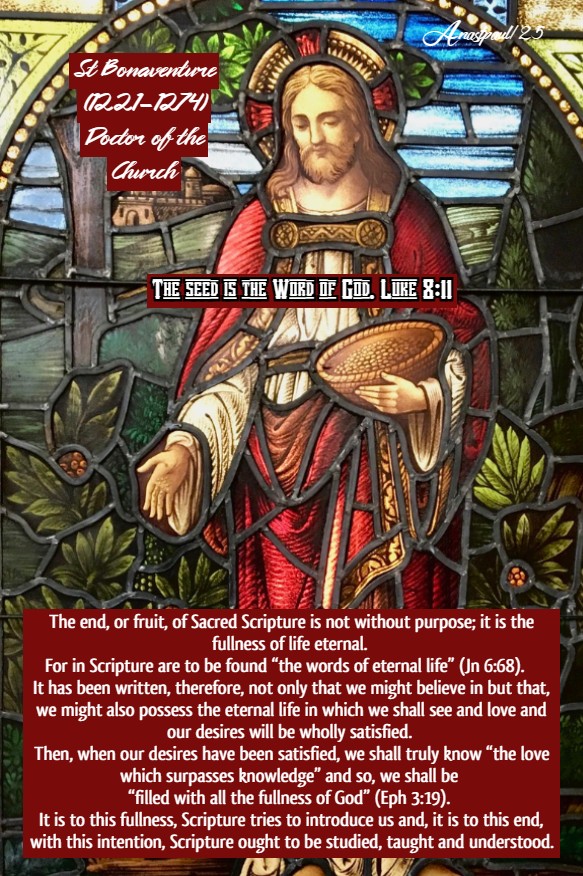
“The seed is the Word of God. ” – Luke 8:11
REFLECTION – “The origins of Scripture are not to be found through human research but, in the Divine Revelation coming from the “Father of Lights” “from whom every family in Heaven and on earth, is named” (Jas 1:17; Eph 3:15). From Him, through His Son Jesus Christ, the Holy Ghost is poured out upon us. Faith has been given to us through the Holy Ghost, sharing and distributing His gifts to each of us, according to His Will (Heb 2:4) and, “through faith, Christ dwells in our hearts” (Eph 3:17). From this, knowledge of Jesus Christ flows, as from its source, both strength and understanding of the whole of Sacred Scripture.It is impossible, therefore, to enter into a knowledge of Scripture without first of all, possessing an infused faith in Christ, as the Light, doorway and foundation of all Scripture …
The end, or fruit, of Sacred Scripture is not without purpose; it is the fullness of life eternal. For in Scripture are to be found “the Words of eternal life” (Jn 6:68). It has been written, therefore, not only that we might believe in but that, we might also possess the eternal life in which we shall see and love and our desires will be wholly satisfied. Then, when our desires have been satisfied, we shall truly know “the love which surpasses knowledge” and so, we shall be “filled with all the fullness of God” (Eph 3:19). It is to this fullness, Scripture tries to introduce us and, it is to this end, with this intention, Scripture ought to be studied, taught and understood.” – St Bonaventure (1221-1274) Franciscan, Doctor of the Church (Breviloquium, Prologue 2-5).
PRAYER – O God, Thou Who sees how we are deprived of all strength, guard us inwardly and outwardly that in body, we may be protected against all misfortunes and in mind, cleansed of evil thoughts and by the intercession of blessed and gloriosus ever Virgin Mary, Mother of God, be assisted on this earthly pilgrimage. Through Jesus Christ, Thy Son our Lord, Who lives and reigns with Thee, in the unity of the Holy Ghost, God, world without end. Amen (Collect).
Our Morning Offering – 25 February – Sexagesima Week
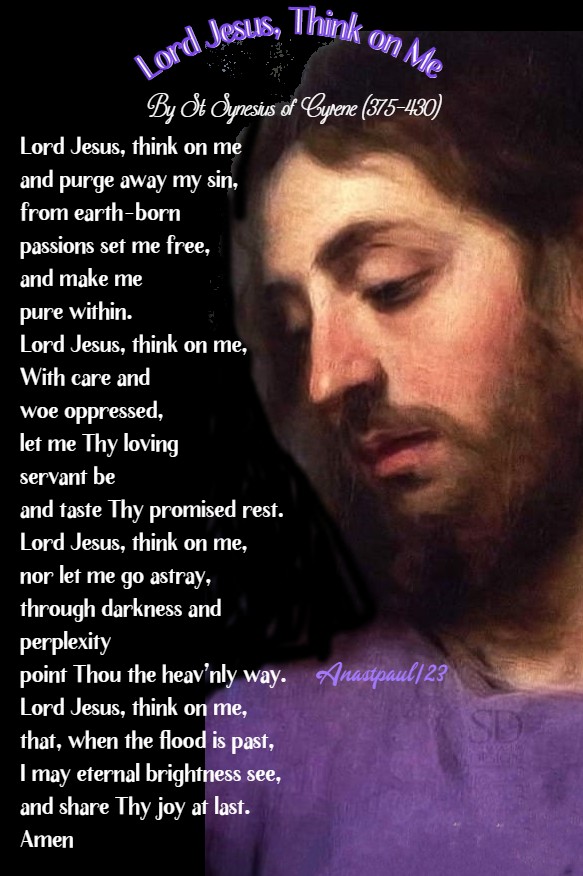
Lord Jesus, Think on Me By St Synesius of Cyrene (375-430) Bishop of Ptolemais, Father
Lord Jesus, think on me and purge away my sin, from earth-born passions set me free, and make me pure within. Lord Jesus, think on me, With care and woe oppressed, let me Thy loving servant be and taste Thy promised rest. Lord Jesus, think on me, nor let me go astray, through darkness and perplexity point Thou the heav’nly way. Lord Jesus, think on me, that, when the flood is past, I may eternal brightness see and share Thy joy at last. Amen
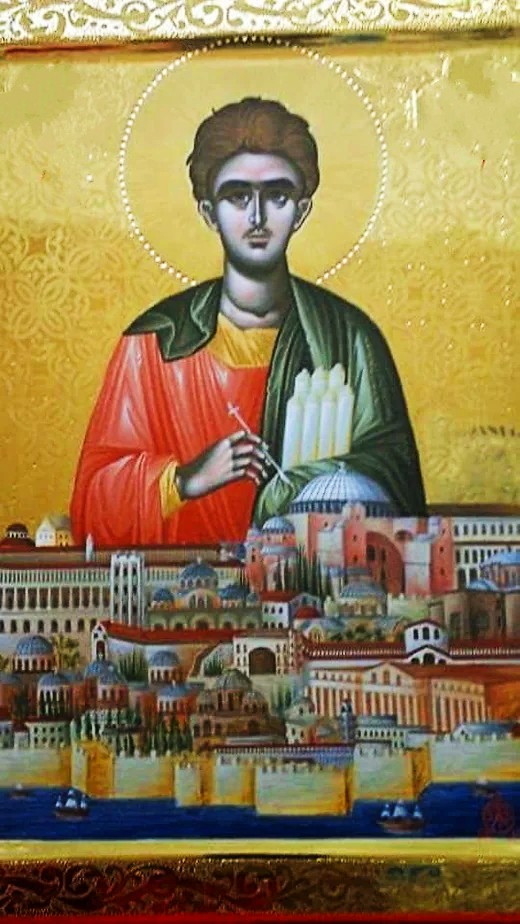
Saint of the Day – 25 February – Saint Tharasius (c730-806) Bishop of Constantinople from 25 December 784 until his death on 25 February 806, Defender of Sacred images and of the sanctity of marriage against the imperial powers. Born in c730 in Constantinople and died there in 806. Also known as – Tarasius, Tarasius of Constantinople.
The Roman Martyrology reads today: “At Constantinople, St Tharasius, the Bishop, a man of great erudition and piety, to whom is addressed an epistle of Pope Adrian I, in defence of holy images.”
Tharasius was was born and raised in the City of Constantinople. A son of a high-ranking Judge, Tharasius was related to important families, including that of St Photios. Tharasius was surrounded by earthly wealth and possessions, but lived a most austere and holy life. His virtue gained the esteem of the empire and he was made Bishop of Constantinople.
When, being elected as the Bishop of Constantinople, he consented to accept the dignity offered to him, only on condition that a General Council should be summoned, in particular to resolve the disputes concerning the veneration of Sacred images. Constantinople had been separated from the Holy See on account of the war between the Emperors. In 786, the Council was held in the Church of the Holy Apostles, in Constantinople. It met again the following year in Nice and its decrees were approved by the Pope.
The Emperor of the time, Constantine VI, became enamoured of Theodotah, a his wife’s maid and sought to divorce his wife and marry her maid. Wishing to convince Tharasius to marry him to Theodota, the Emperor sent a message to the holy man. Tharasius adamantly refused, replying to the Emperor’s Ambassador, “I would rather suffer death and all manner of torments, than consent to his design.” He continued to reject the Emperor’s requests resulting in great enmity and adversity.
Tharasius’ whole life in the Episcopacy was one of penance and prayer and of hard labour to reform his clergy and people. He occupied the See of Constantinople for 21 years and 2 months. His charity toward the poor was one of the characteristic virtues of his life. He visited in person, all the houses and hospitals in Constantinople, so that no indigent person might be overlooked in the distribution of alms.
Just before his death, Tharasius fell into a trance. As his biographer, who was an eyewitness, relates, he was heard arguing with a number of unseen accusers. Tharasius defended himself against the accusers and answered everything laid to his charge. Later, a great peacefulness came over him and Tharasius gave up his soul to God in 806.
St Caesarius of Nazianzen (c329-369) Celibate Layman, a prominent Physician and Politician, Son of Saint Gregory of Nazianzen the Elder and Saint Nonna, Brother of Saint Gorgonia and Saint Gregory of Nazianzen. Patronages – of Physicians and bachelors. His Holy Life: https://anastpaul.com/2024/02/25/131658/
St Donatus the Martyr St Felix III, Pope St Gerland the Bishop St Gothard the Hermit St Herena the Martyr St Justus the Martyr
St Tharasius (c730-806) Bishop St Victor of Saint Gall
Martyrs of Egypt – A group oSeven f Christian men who were exiled to Egypt for their faith and were eventually Martyred for their faith in the persecutions of Numerian. We know little more than their names: Claudianus, Dioscurus, Nicephorus, Papias, Serapion, Victor, Victorinus.
Thought for the Day – 24 February – Meditations with Fr Richard Frederick Clarke SJ (1839-1900)
Meditations on “The Great Truths” From “The Devout Year” By Fr Richard Frederick Clarke SJ (1839-1900)
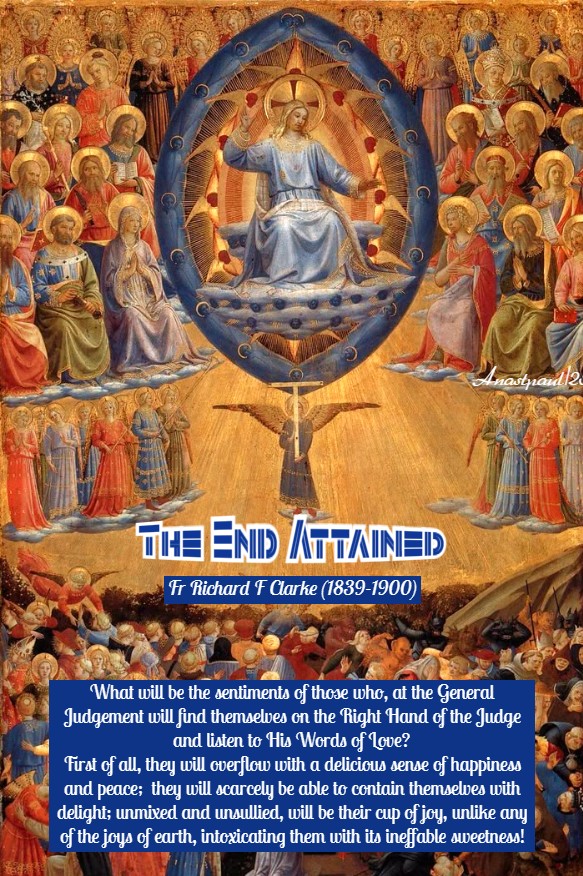
24th Day – The End Attained!
Then shall the King say to those who shall be on His Right Hand, Come you blessed of My Father, possess you the Kingdom, prepared for you from the foundation of the world. (St Matt xxv:34)
+1. What will be the sentiments of those who, at the General Judgement will find themselves on the Right Hand of the Judge and listen to His Words of Love? First of all, they will overflow with a delicious sense of happiness and peace; they will scarcely be able to contain themselves with delight; unmixed and unsullied, will be their cup of joy, unlike any of the joys of earth, intoxicating them with its ineffable sweetness!
+2. They will also be amazed and astonished at the reward given to them. What have I done, O Lord, to deserve all this? When did I minister to Thee as Thou sayest? When did I do anything to earn Thy Words of Gratitude? Who am I that, Thou shouldst thus exalt me? All the little which I did, came from Thee and now, Thou rewardest me, as if it was my own doing. We bless Thee, we praise Thee, for Thy great goodness, Thine unspeakable generosity!
+3. They will also look back with wonder on their earthly life. While it lasted it seemed so long, so tedious, perhaps so miserable and now, it is like a moment in the past, like a shadow which flitted by. How infinitesimal all its sorrows and pains will then seem, all compensated by that first moment of ineffable delight! Seek to bear that day in heart and mind, when earthly sorrows press heavily.
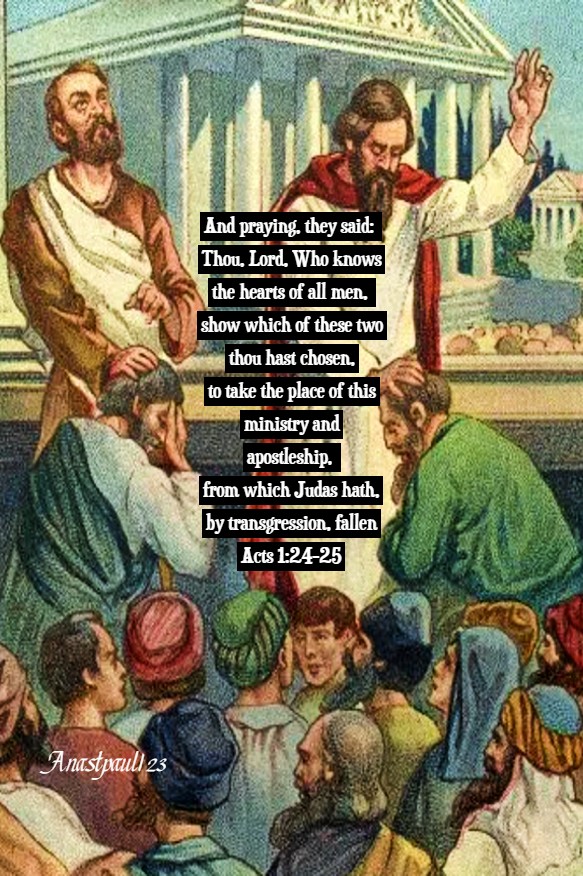
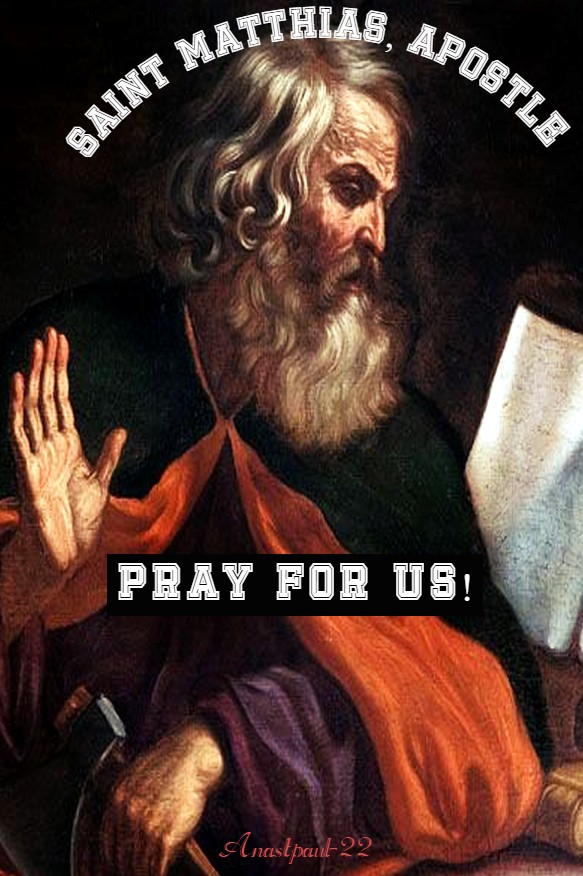
Quote/s of the Day – 24 February – Feast of St Matthias, Apostle – Acts 1:15-26, Matthew 11:25-30 – Scripture search here: https://www.drbo.org/
“And praying, they said: Thou, Lord, Who knows the hearts of all men, show which of these two Thou hast chosen, to take the place of this ministry and apostleship, from which Judas hath, by transgression, fallen …”
Acts 1:24-25
“When we stand in the light it is not we who illumine the light and cause it to shine but we are illuminated and made shining by the light… God grants His blessings on those who serve Him because they are serving Him and on those who follow Him because they are following Him but He receives no blessing from them because He is perfect and without need.”
St Irenaeus(c130-c208) Bishop, Father of the Church
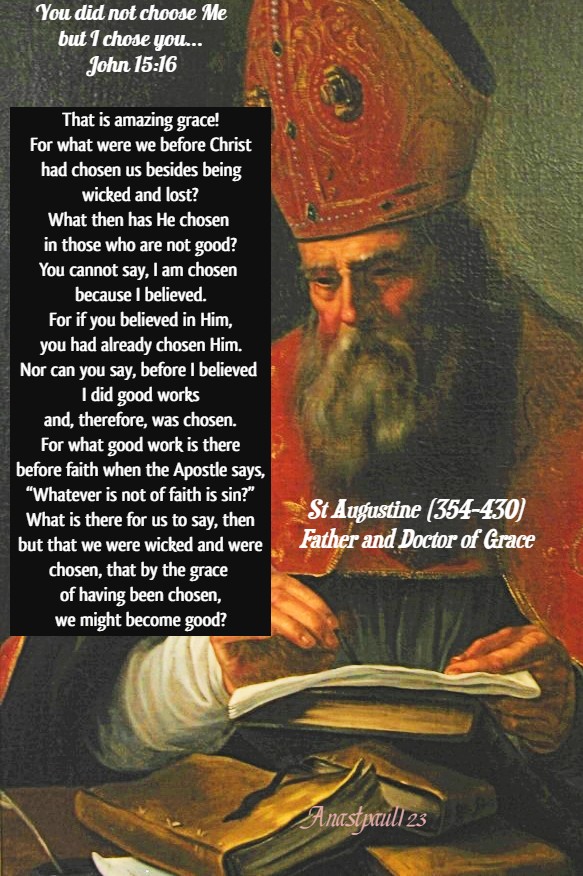
“You did not choose Me but I chose you…”
John 15:16
“That is amazing grace! For what were we before Christ had chosen us besides being wicked and lost? What then has He chosen in those who are not good? You cannot say, I am chosen because I believed. For if you believed in Him, you had already chosen Him. Nor can you say, before I believed I did good works and, therefore, was chosen. For what good work is there before faith when the Apostle says, “Whatever is not of faith is sin?” What is there for us to say, then but that we were wicked and were chosen, that by the grace of having been chosen, we might become good?”
St Augustine (354-430) Father and Doctor of Grace
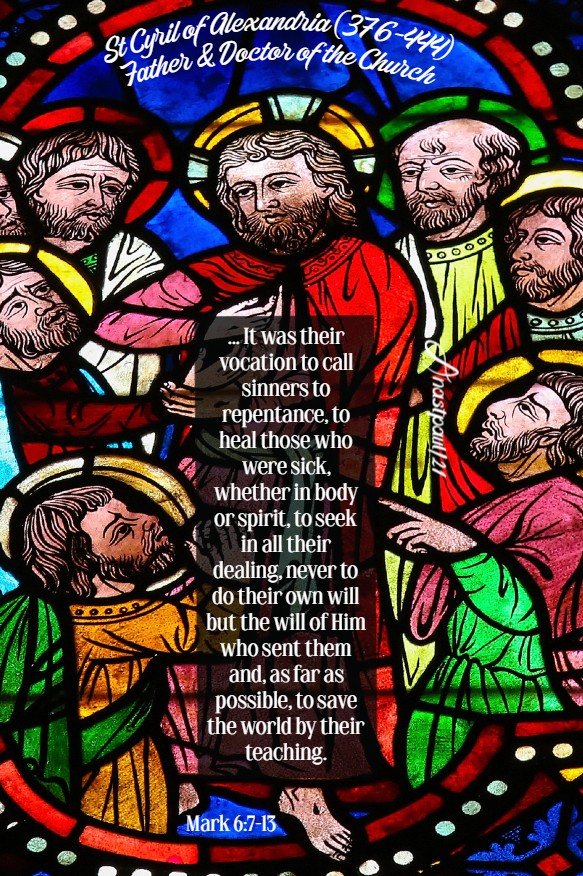
“… It was their vocation to call sinners to repentance, to heal those who were sick, whether in body or spirit, to seek in all their dealing, never to do their own will but the Will of Him who sent them and, as far as possible, to save the world by their teaching.”
St Cyril of Alexandria (376-444) Bishop, Father & Doctor of the Church
One Minute Reflection – 24 February – Feast of St Matthias, Apostle of Christ – Acts 1:15-26; – Matthew 11:25-30 – Scripture search here: https://www.drbo.org/
“Take My yoke upon you and learn from Me, for I Am meek and humble of heart … For My yoke is easy and My burden light.” – Matthew 11:29-30
REFLECTION – “The Third Coming of Christ our Bridegroom which is still in the future, is that which will occur at the Judgement or, at the hour of death …
The justice of the Judge lies, in the fact that, it is Christ to Whom the Judgement and the Verdict belong, for He is the Son of Man and the Wisdom of the Father, a Wisdom to Whom all Judgement belongs. To this Wisdom, all hearts are open and manifest, whether they are in Heaven, on earth or in hell … The means with which Christ, our Bridegroom and Judge, makes use, at this Judgement, consist in rewarding and punishing with justice, for He gives to all, according to their merits. On the good and for each good deed carried out in God, He bestows the measureless reward of Himself, unmerited by any creature. For indeed, since it is He Who collaborates in each of the creature’s works, it is all thanks to His Power that the creature merits Christ Himself as reward in all justice! …
The First Coming, namely, when God became a human being, lived humbly and died out of love for us, is one which we should imitate exteriorly through the perfect practice of the virtues and, interiorly, through, charity and genuine humility. The Second Coming which is in the present and which takes place when Christ comes, with His graces into every loving heart, is one which we should desire and pray for everyday, so that we might persevere and progress in new virtues. The Third Coming, at the Judgement or at the hour of our death, is one which we should await with longing, confidence and awe, so that we might be released from this present misery and enter the Palace of Glory!” – Blessed Jan van Ruysbroeck (1293-1381) Canon Regular (The Spiritual Espousals 1).
PRAYER – O God, Who added blessed Matthias to the company of Thy Apostles, grant, we beseech Thee, that by his intercession we may ever be aware of the depth of Thy love for us. Through Jesus Christ, Thy Son our Lord, Who lives and reigns with Thee, in the unity of the Holy Ghost, God, world without end. Amen (Collect).
Our Morning Offering – 24 February – Feast of St Matthias, Apostle and Martyr
Exsultet Orbis! Let the World Rejoice! Unknown Author
Now let the earth with joy resound, And Heaven the chant re-echo round; Nor Heaven nor earth too high can raise The great Apostles’ glorious praise.
O ye who, throned in glory dread, Shall judge the living and the dead, Lights of the world forever more! To you the suppliant prayer we pour.
Ye close the Sacred Gates on high. At your command apart they fly. O loose for us the guilty chain We strive to break and strive in vain.
Sickness and health your voice obey, At your command they go or stay. From sin’s disease our souls restore; In good confirm us more and more.
So when the world is at its end. And Christ to Judgment shall descend, May we be called, those joys to see Prepared from all eternity.
Praise to the Father, with the Son, And Holy Spirit, Three in One; As ever was in ages past And so shall be while ages last. Amen
(Roman Breviary for the Common of Apostles) An Office Hymn traditionally prescribed for Vespers and Lauds on the Feasts of Apostles and Evangelists outside Easter time. The Hymn is found as early as the 10th Century in a Hymnal of Moissac Abbey.
Saint of the Day – 24 February – Saint Modestus (Died c486) Bishop and Confessor. Modestus was the 19th Bishop of Trier. In the official records of Bishops, he succeeds Saint Miletus and precedes Maximian. Died in c486 in Trier of natural causes. Tradition remembers him as a tireless Preacher in the streets of the City. He was a man assiduous in prayer who systematically practiced fasting. Modestus fought against the discouragement and poverty of all his people. He was also tireless in the fight against the indiscipline of the Clergy and in the fight against all forms of corruption. Also known as – Modest, Modeste, Modesto.
The Roman Martyrology reads today: “At Treves, Sy Modestus, Bishop and Confessor.”
Statue of Saint Modestus, Bishop of Trier, in Notre-Dame-de-Bonsecours Church, L’Islet, Québec
Of his birth, youth and education nothing is known. That which we do know is but a few details of his Episcopate which are derived from brief mentions in various martyrologies from Germany and the Netherlands. From these sources, the information was later inserted into the Roman Martyrology.
As the Bishop, Modestus governed the Diocese of Trier in the last quarter of the 5th Century, that is, in the difficult times of the Frankish incursions and the devastation of the City and the Diocese.
Modestus died, according to the Florarium Sanctorum manuscript, in 489. Today, after historical investigations, 486 is considered rather the year of his death. He was buried in the church of Saint Eucharist which, since the 12th Century has borne the name of Saint Matthias, Apostle, whose Feastday we appropriately celebrate today too. St Matthias Tomb is enshrined here as are those of Sts Eucharius and Valerius and our St Modestus, although I can find no images of the latter.
St Modestus (Died c486) Bishop and Confessor St Peter the Librarian St Praetextatus of Rouen St Primitiva St Sergius of Caesarea Bl Simon of Saint Bertin
Thought for the Day – 23 February – Meditations with Fr Richard Frederick Clarke SJ (1839-1900)
Meditations on “The Great Truths” From “The Devout Year” By Fr Richard Frederick Clarke SJ (1839-1900)
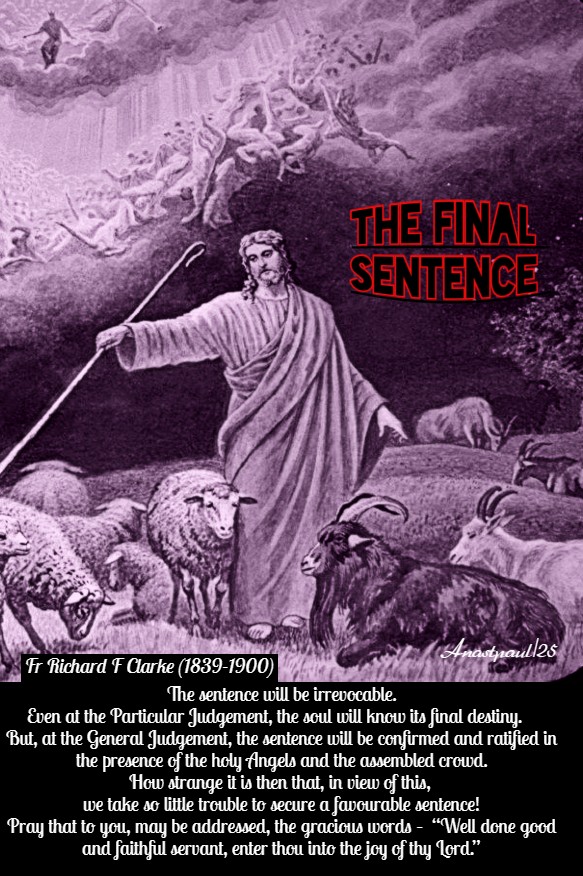
23d Day – The Final Sentence
The wicked shall go into everlasting punishment but the just into life everlasting, (St Matt xxv:46)
+1. The sentence pronounced at the Last Judgement, will be one of perfect justice. Every little circumstance will be taken into account – inherited character, natural disposition, fierce passions, favourable or unfavourable circumstances, early training, opportunities of grace sacraments, temptations, everything! All who are lost will confess that they have been treated with perfect justice that, it was their own fault that, it was they, who condemned themselves to eternal separation from God.
+2. The sentence will be, not only just but, merciful. All the lost will acknowledge that, their punishment is less than they deserved. They will recognise an element of mercy and will be forced amid their despair and hatred of God, amid their curses and blasphemies , to confess that they have been leniently dealt with in comparison with their sins!
+3. The sentence will be irrevocable. Even at the Particular Judgement, the soul will know its final destiny. But, at the General Judgement, the sentence will be confirmed and ratified in the presence of the holy Angels and the assembled crowd. How strange it is then that, in view of this, we take so little trouble to secure a favourable sentence! Pray that to you, may be addressed, the gracious words – “Well done good and faithful servant, enter thou into the joy of thy Lord.”
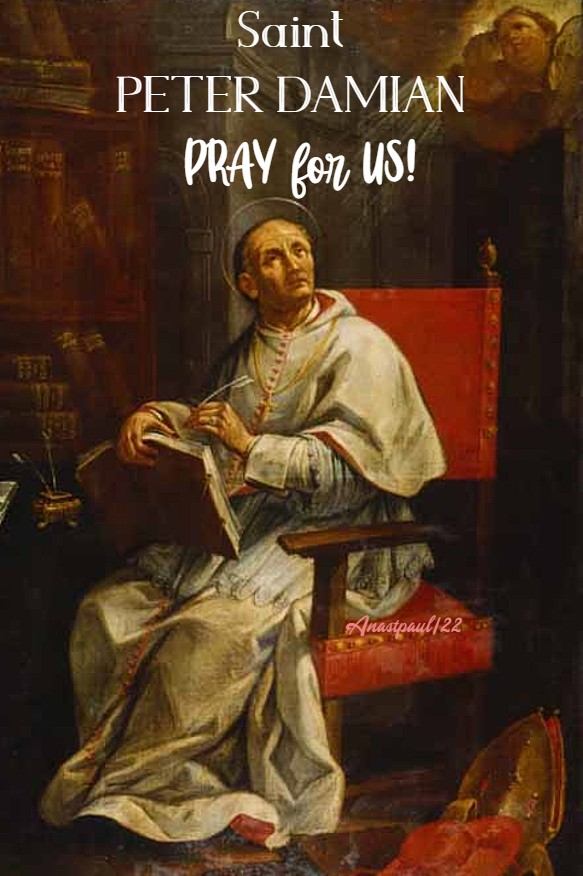
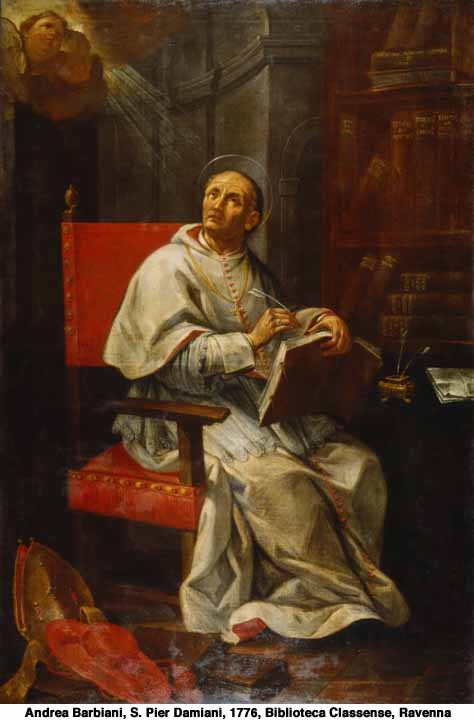
Quote/s of the Day – 23 February – St Peter Damian (1007-1072) Cardinal Bishop, Confessor, Father and Doctor of the Church
“Let us detach ourselves in spirit from all that we see and cling to that which we believe. This is the Cross which we must imprint on all our daily actions and behaviour.”
“He pours light into our minds, arouses our desire and gives us strength… As the soul is the life of the body, so the Holy Ghost is the life of our souls.”
“May Christ be heard in our language, may Christ be seen in our life, may He be perceived in our hearts”
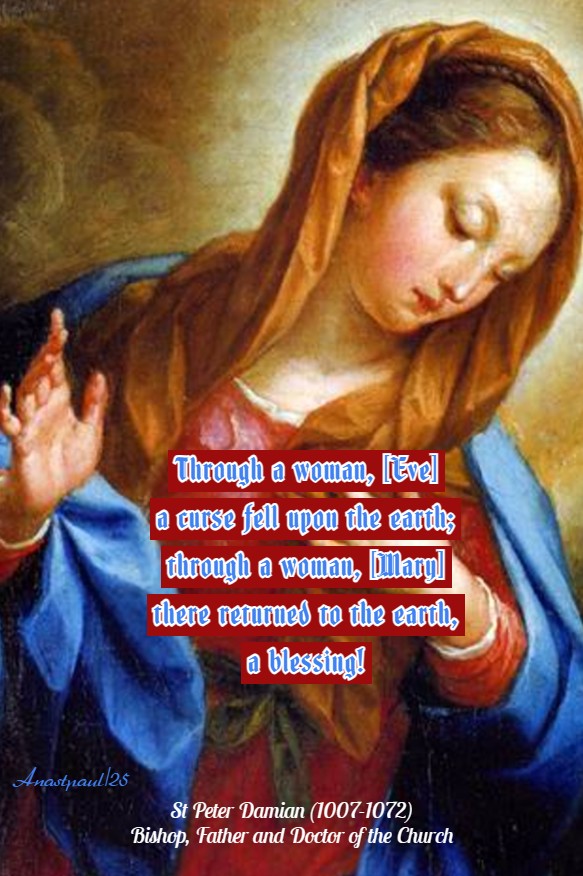
“Through a woman, [Eve] a curse fell upon the earth; through a woman, [Mary] there returned to the earth, a blessing!”
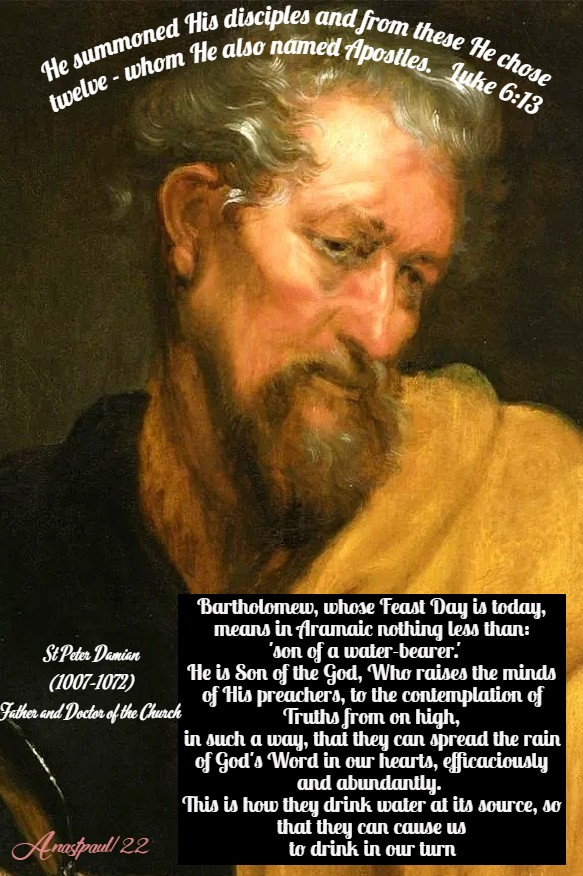
“And when day broke, He summoned His disciples and from these He chose twelve – whom He also named Apostles.” Luke 6:13
“Bartholomew, whose Feast Day is today, means in Aramaic, nothing less than: ‘son of a water-bearer.‘ He is Son of the God, Who raises the minds of His preachers, to the contemplation of Truths from on high, in such a way, that they can spread the rain of God’s Word in our hearts, efficaciously and abundantly . This is how they drink water at its source, so that they can cause us to drink in our turn.”
One Minute Reflection – 23 February – “The Month of the Blessed Trinity” – St Peter Damian (1007-1072) Cardinal Bishop, Confessor, Father and Doctor of the Church – 2 Corinthians 11,19-33; 12,1-9; – Luke 8:4-15 – Scripture search here: https://www.drbo.org/
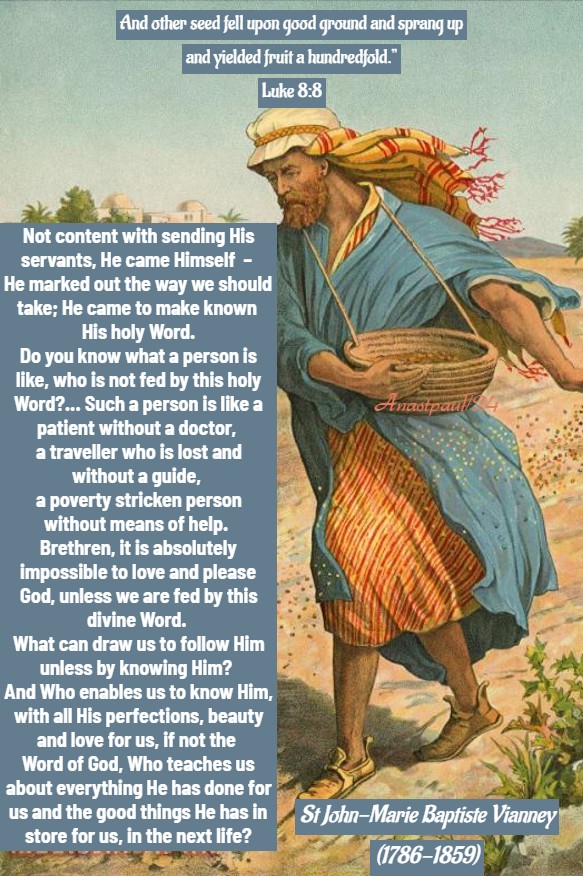
“And other seed fell upon good ground and sprang up and yielded fruit a hundredfold.” – Luke 8:8
REFLECTION – “If you ask me what Jesus Christ means by this Sower Who goes out early to cast his seed over his field then, my brethren, that Sower is the good God Himself, Who began the work of our salvation, from the beginning of the world, by sending us His Prophets, before the coming of Christ, to teach us what was needed, if we would be saved. Not content with sending His servants, He came Himself – He marked out the way we should take; He came to make known His holy Word.
Do you know what a person is like, who is not fed by this holy Word?… Such a person is like a patient without a doctor, a traveller who is lost and without a guide, a poverty stricken person without means of help. Brethren, it is absolutely impossible to love and please God, unless we are fed by this Divine Word. What can draw us to follow Him unless by knowing Him? And Who enables us to know Him, with all His perfections, beauty and love for us, if not the Word of God, Who teaches us about everything He has done for us and the good things He has in store for us, in the next life?” – St John-Marie Baptiste Vianney (1786-1859) The Curé of Ars (Sermons)
PRAYER – Grant us, we beseech Thee, Almighty God, to follow the counsel and examples of St Peter, Thy Confessor and Bishop, so that by setting earthly goods at naught we may attain everlasting happiness. Through Jesus Christ, Thy Son our Lord, Who lives and reigns with Thee, in the unity of the Holy Ghost, God, world without end. Amen (Collect).
Our Morning Offering – 23 February – Sexagesima Sunday and the Feast of St Peter Damian (1007-1072) Cardinal Bishop, Confessor, Father and Doctor of the Church
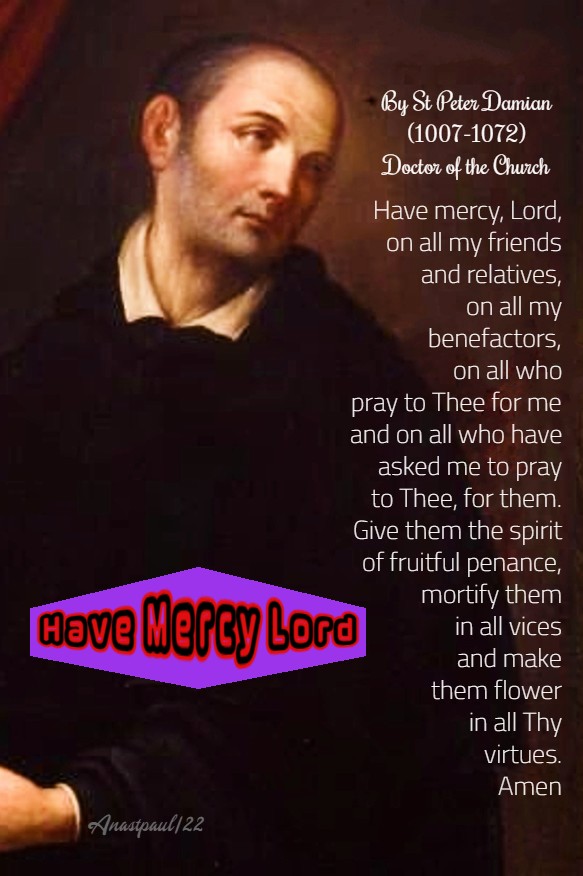
Have Mercy, Lord By St Peter Damian (1007-1072) Father & Doctor of the Church
Have mercy, Lord, on all my friends and relatives, on all my benefactors, on all who pray to Thee for me and on all who have asked me to pray to Thee, for them. Give them the spirit of fruitful penance, mortify them in all vices and make them flower in all Thy virtues. Amen
Saint of the Day – 23 February – Saint Romana (Died c324) Virgin, Recluse, Miracle-worker. Born in c308 and died in c324 in her cave in Todi, Umbria, Italy of natural causes.
The Roman Martyrology reads today: “At Todi, St Romana, Viurgin, who was Baptised by Pope St Sylvester. She led a heavenly life in caves and dens and wrought glorious miracles.”
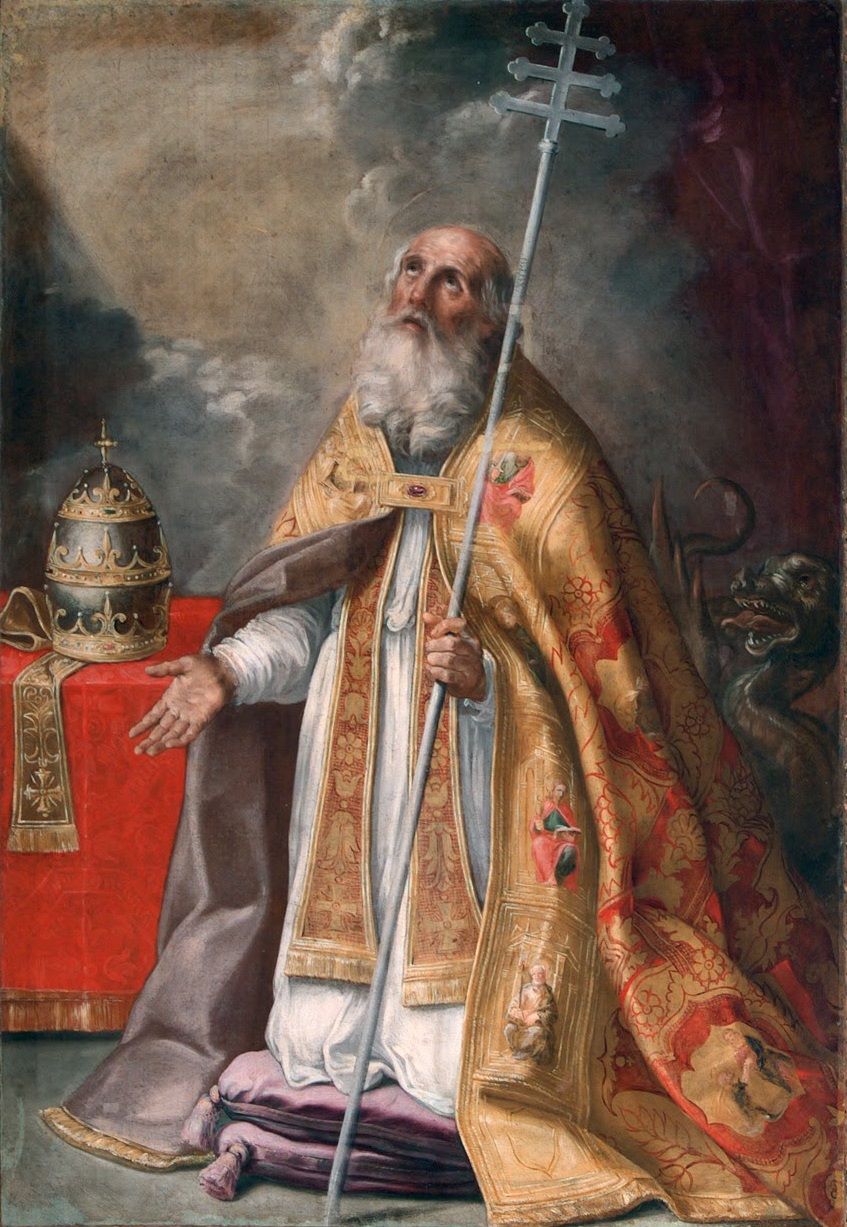
St Pope Sylvester
Romana was the daughter of Calfurnius, the Prefect of Rome. Having embraced the Christian Faith, she renounced all the comforts and conveniences which her rank would have allowed her.
Following her religious vocation, she ran away from home and, at the age of 10, she reached St Silvester on Mount Soratte, to be Baptised.
Inside the church of Santa Romana on Soratte (a mountain in Sabina) there is the following inscription: “23 FEBEUARII ^ TUDERTI ^ St ROMANE VIRGINIS QUE A S. SILVESTRO BAPTIZATA IN HANC ANTRI ET SPELUCIS CELESTE VITA DUXIT ET MIRACULORV.GLORIS CLARUIT.” (23 FEBRUARY ^ TUDERTI ^ ST ROMAN VIRGIN WHO WAS BAPTISED BY ST SILVESTER IN THIS CAVE. SHE LIVED A CELESTIAL LIFE AND WAS REPLETE WITH MIRACULOUS GLORY). Nowadays it is almost illegible.
Romana on Mount Soratte. lived in a hermitage, She wanted to live in that very cave, perhaps because she felt close to Pope Sylvester, whose sanctity she admired. And it is in these places that a legendary relationship was born, between the Saint and his devotee, who reached him at the top of the mountain, perhaps using some secret passage, wedging herself into the bowels of the mountain.
Silvester warned her each time and once said to her: “now you will return when the roses have bloomed.” It was the middle of winter which had often stained the steep climbs of the mountain with white, when one morning Romana returned to Silvester with a rose; it had bloomed.
The Saint then set out alone towards the City of Todi. In the gorges of Forello, she established her home inside a cave. Although she lived alone, her constant prayer and her faith, were such that many Christians approached her, praising her sanctity.
Romana died in prayer surrounded by the faithful, in the year c324. The body of the Saint was buried in the cave where she lived and in which an Altar was built, where masses were continuously celebrated.
In 1301 her body was transferred to St Fortunatus Church in Todi.
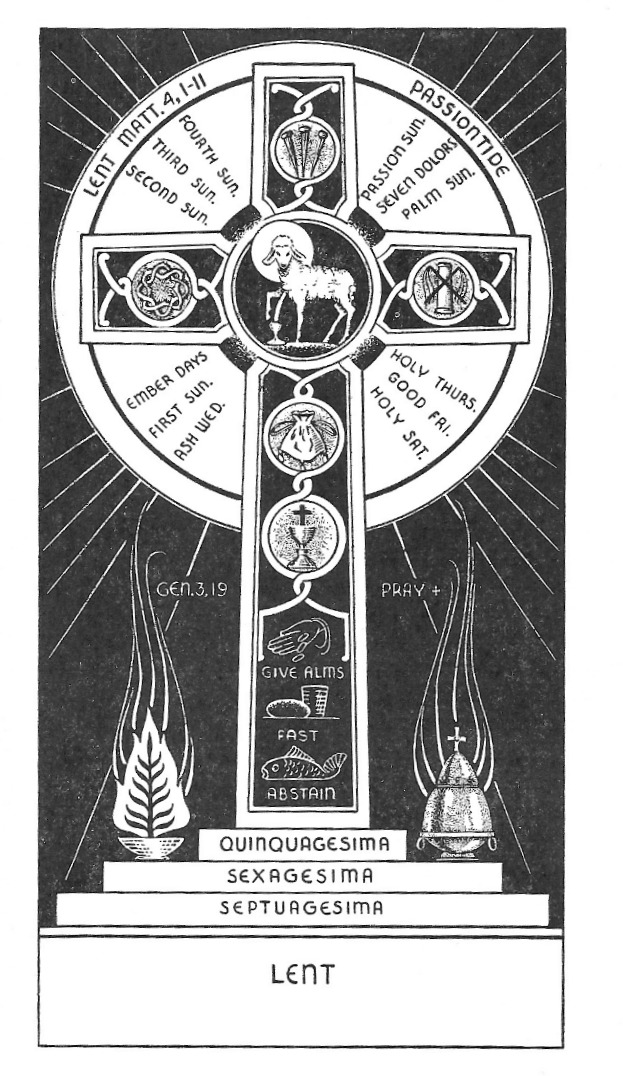
SEXAGESIMASUNDAY: (Latin – Sexagesima, sixieth) The name means “sixtieth” as it falls within the 50-60 day ranges before Easter and the second before Lent. The Ordo Romanus, St Alcuin and others, count the Sexagesima from this day to Wednesday after Easter. The name was already known to the Fourth Council of Orléans in 541. To the Latins it is also known as “Exsurge” from the beginning of the Introit. The Station was at Saint Paul’s Outside the Walls of Rome and hence, the oratio calls upon the Doctor of the Gentiles. The Epistle is from Paul, 2 Corinthians 11 and 12, describing his suffering and labours for the Church. The Gospel (Luke 8) relates the falling of the seed on good and on bad ground, while the Lessons of the first Nocturn continue the history of man’s iniquity and speak of Noah and of the Deluge.
St Alexander Akimetes St Boswell St Dositheus of Egypt St Felix of Brescia St Florentius of Seville St Giovanni Theristi (1049–1129) Monk Bl John of Hungary
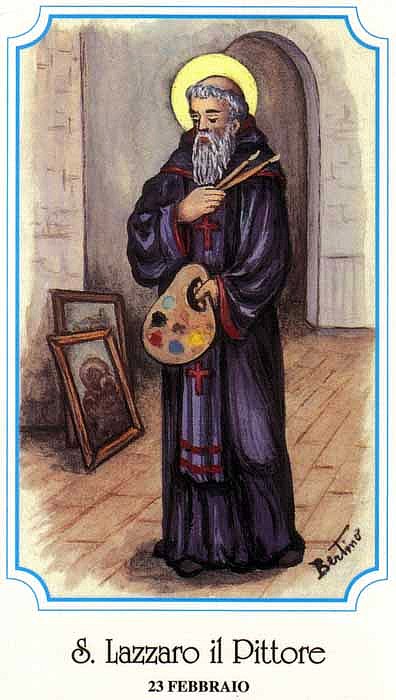
St Lazarus Zographos (c810-c 867) Priest, Monk known as “the Painter and the Iconographer.” Lazarus lived before and during the second period of Byzantine Iconoclasm. The Roman Martyrology states of him today: “St Lazarus, a Monk, whom the Iconoclast Emperor Theophilus ordered to be put to torture for having painted holy images. His hand was burned with a hot iron but, being healed by the power of God, he painted anew the holy images which had been defaced and finally rested in peace.” The Painter Saint: https://anastpaul.com/2022/02/23/saint-of-the-day-23-february-st-lazarus-zographos-810-865/
St Ordonius St Polycarp of Rome St Romana (Died c324) Virgin
St Serenus the Gardener (Died 307) Martyr. Serenus was by birth a Grecian. He left his family estate, friends and country to serve God in celibacy, penance and prayer. With this design he bought a garden in Sirmium in Pannonia, which he cultivated with his own hands and lived on the fruits and herbs it produced. His Life and Death: https://anastpaul.com/2019/02/23/saint-of-the-day-23-february-st-serenus-the-gardener-died-307-martyr/
Martyrs of Syrmium – 73 Christians who were Martyred together in the persecutions of Diocletian. We know no details about them, and only six of their names – Antigonus, Libius, Rogatianus, Rutilus, Senerotas and Syncrotas.
Thought for the Day – 22 February – Meditations with Fr Richard Frederick Clarke SJ (1839-1900)
Meditations on “The Great Truths” From “The Devout Year” By Fr Richard Frederick Clarke SJ (1839-1900)
22nd Day – The General Judgement .
Behold He cometh with the clouds and every eye shall see Him and they also who pierced Him . (Apoc i:7)
+1. At the General Judgement, Christ as Man, will be the Judge of men because He is at once God and Man. He will, therefore, have not only the most intimate knowledge of all our lives but a sympathy with us, an understanding of our nature from experience which will give Him, in the natural order, the highest qualifications for being our Judge.
+2. On that day, what a complete reverse there will be of all the world’s unjust verdicts! How many, now ridiculed, despised, condemned, will then be glorious and honoured before men and Angels! What will my sentiments be on that day, when the thoughts of all hearts will be revealed?
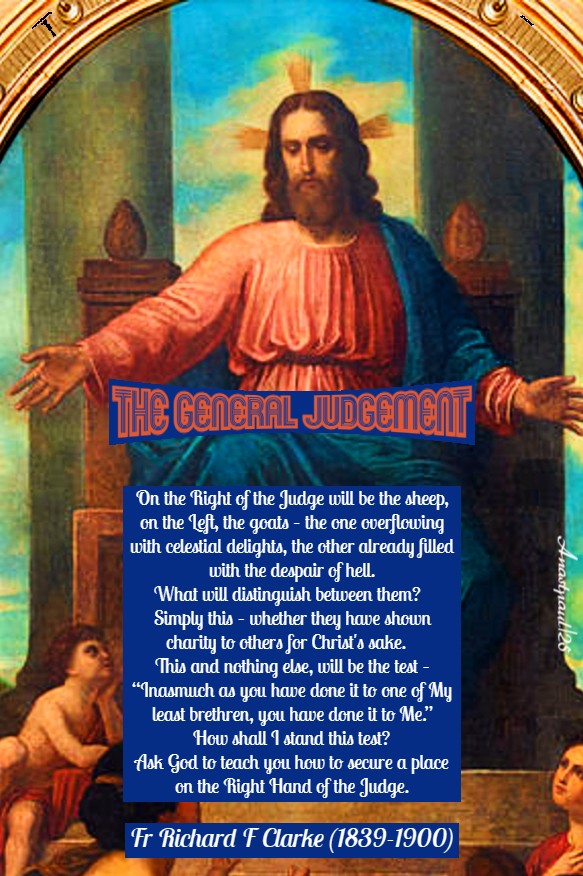
+3. On the Right of the Judge will be the sheep, on the Left, the goats – the one overflowing with celestial delights, the other already filled with the despair of hell. What will distinguish between them? Simply this – whether they have shown charity to others for Christ’s sake. This and nothing else, will be the test – “Inasmuch as you have done it to one of My least brethren, you have done it to Me.” How shall I stand this test? Ask God to teach you how to secure a place on the Right Hand of the Judge.
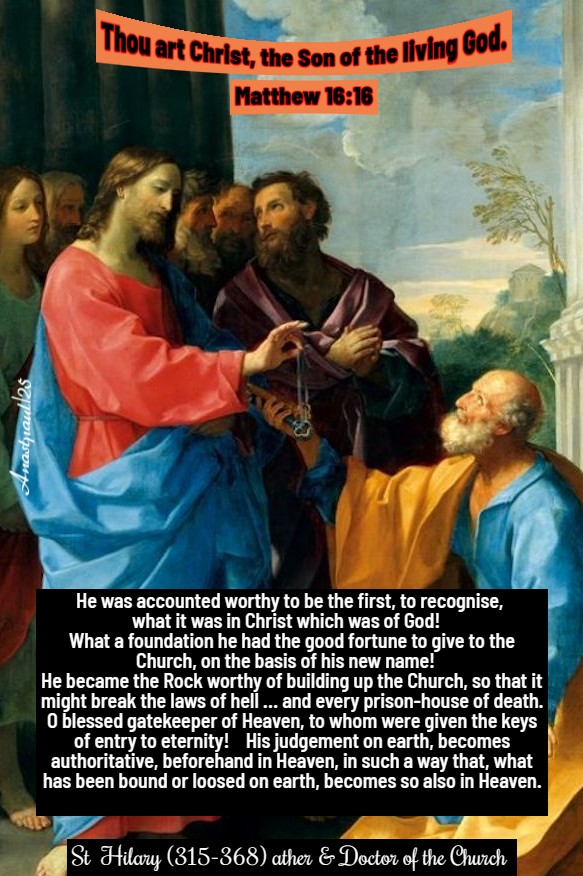
Quote/s of the Day – 22 February – The Feast of the Chair of St Peter at Antioch –1 Peter 1:1-7; Matthew 16:13-19 – Scripture search here: https://www.drbo.org/
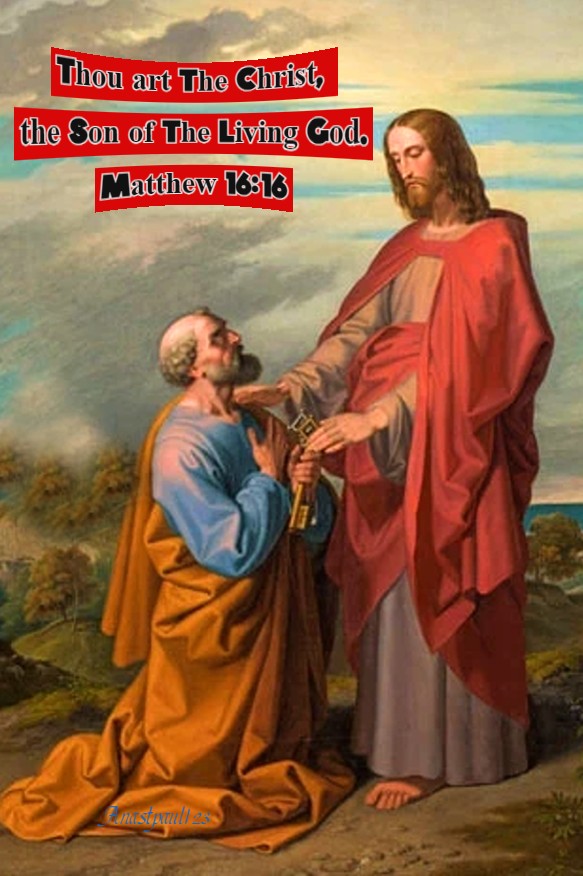
“Thou art Christ, the Son of the living God.”
Matthew 16:16
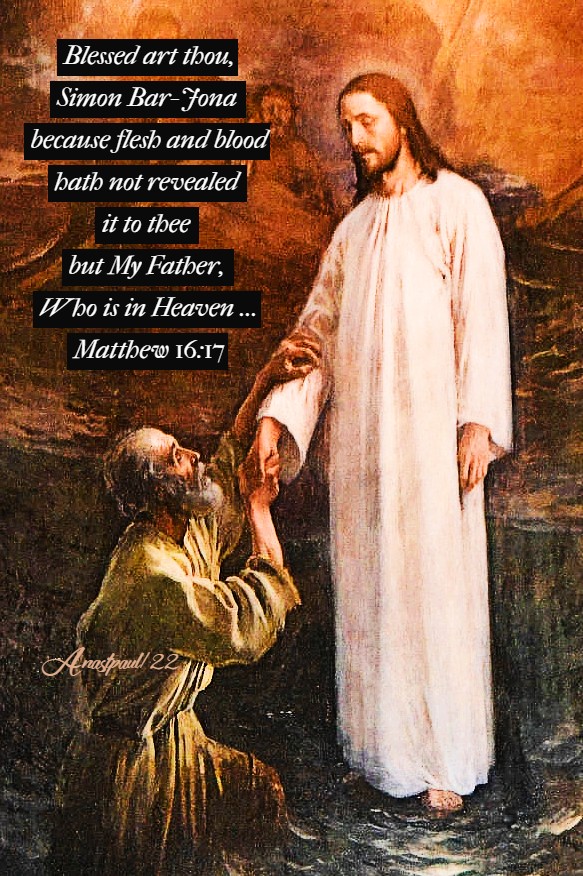
“Blessed art thou, Simon Bar-Jona because flesh and blood hath not revealed it to thee but My Father Who is in Heaven.”
Matthew 16:17
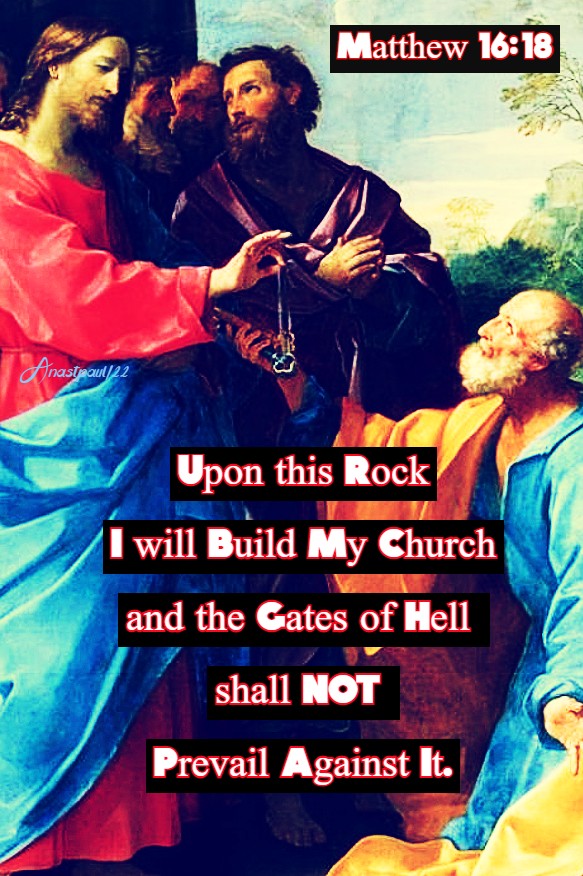
“Upon this Rock I will build My Church”
Matthew 16:18
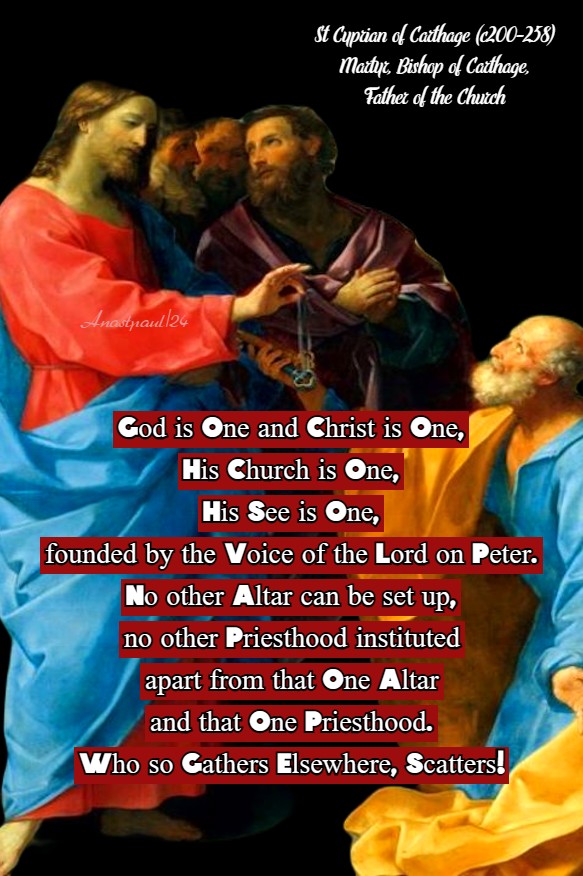
“God is One and Christ is One, His Church is One, His See is One, founded by the Voice of the Lord on Peter. No other Altar can be set up, no other Priesthood instituted apart from that One Altar and that One Priesthood. Who so gathers elsewhere, scatters!”
St Cyprian of Carthage (c 200-258) Martyr, Bishop of Carthage, Father of the Church
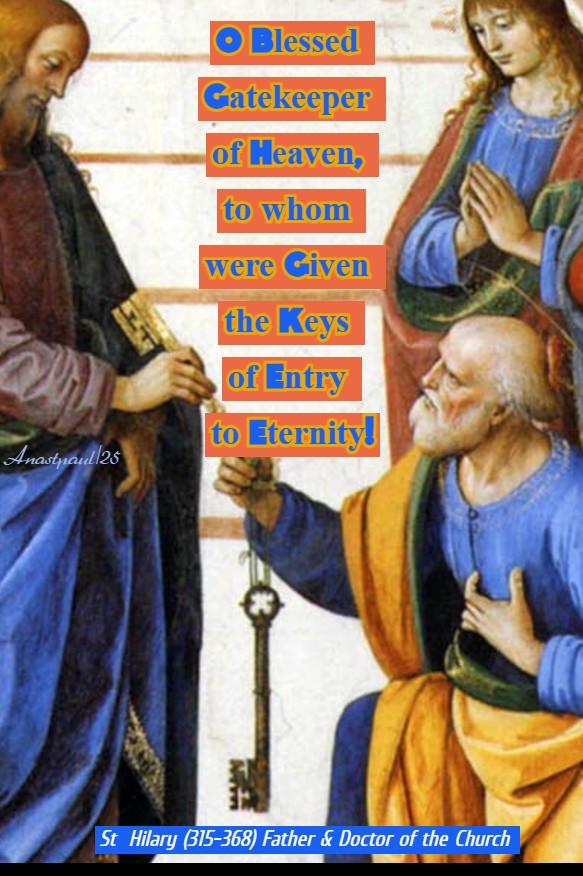
“ O blessed gatekeeper of Heaven, to whom were given the keys of entry to eternity! ”
St Hilary (315-368) Bishop of Poitiers, Father & Doctor of the Church
One Minute Reflection – 22 February – The Feast of the Chair of St Peter at Antioch –1 Peter 1:1-7; Matthew 16:13-19 – Scripture search here: https://www.drbo.org/
“Thou art Christ, the Son of the living God.” – Matthew 16:16
REFLECTION – “The Lord had asked: “Who do people say that the Son of Man is?” To be sure, His bodily appearance made known the Son of Man but, in putting this question, He led people to understand that, there was something else to be discerned, over and above what could be seen … The object of the question was, a mystery towards which the faith of the believer had to tend.
Peter’s confession was fully recompensed, as he deserved for having seen the Son of God within the Man. “Blessed” is he, indeed and praised, for having penetrated beyond merely human sight, not looking to that which comes of flesh and blood but, beholding the Son of God, revealed by His heavenly Father. He was accounted worthy to be the first, to recognise, what it was in Christ which was of God! What a foundation he had the good fortune to give to the Church, on the basis of his new name! He became the Rock worthy of building up the Church, so that it might break the laws of hell … and every prison-house of death. O blessed gatekeeper of Heaven, to whom were given the keys of entry to eternity! His judgement on earth, becomes authoritative, beforehand in Heaven, in such a way that, what has been bound or loosed on earth, becomes so also in Heaven.
Jesus also commands His disciples not to tell anyone He is the Christ, since others, namely the Law and the Prophets, must be the witnesses of His Spirit, while witness to the Resurrection belongs to the Apostles. And, just as the blessedness of those, who know Christ in the Spirit, was made known, so also, was made known, the danger of misunderstanding His humility and passion.” – St Hilary (315-368) Bishop of Poitiers, Father & Doctor of the Church (Commentary on St Matthew’s Gospel 16).
PRAYER – O God, Who when giving blessed Peter, Thine Apostle, the keys of the Heavenly Kingdom, bestowed on him the power of binding and loosing, grant that by the help of his intercession, we may be delivered from the bonds of our sins. Through Jesus Christ, Thy Son our Lord, Who lives and reigns with Thee, in the unity of the Holy Ghost, God, world without end. Amen (Collect).
Our Morning Offering – 22 February – The Chair of St Peter at Antioch
O Prince of the Apostolic Senate! Hymn to the Prince of the Apostles By St Peter Damian (1007-1072) Cardinal Bishop of Ostia Doctor of the Church
O Prince of the Apostolic Senate! Herald of our Lord! First Shepherd of the Faithful! watch over the Flock intrusted to thee.
Lead us through verdant pastures, feeding us with the nourishment of the Word and lead us, thus fed, into the heavenly fold, whither thou hast already gone.
To thee, Peter, have been delivered the Keys of heaven’s gate and all things, both in Heaven and on earth, acknowledge thy authority.
Tis thou that choosest the City where is to be established the Rock of the True Faith, the foundation of the building, on which the Catholic Church stands immoveable.
Thy shadow, as thou passest by, heals the sick and Tabitha, who made garments for the poor, was raised to life at thy bidding.
Bound with two chains, thou wast set free by an Angel’s power; he bids thee put on thy garments and thy sandals and lo! the prison door is opened.
To the Father unbegotten and to the Only-Begotten Son and to the co-equal Spirit of them both, be praise and kingly highest power. Amen.
Saint of the Day – 22 February – St Abilius (Died c98) the 2nd Bishop of Alexandria, Egypt. He was the 2nd Bishop of Alexandria. He was Ordained by Saint Mark the Evangelist and was also the first convert Mark won to Christianity in the region. Also known as – Abilio, Abitius, Abylius, Avilio, Avilius, Anamia, Melyos, Mielo, Milius, Sabellius’
The Roman Martyrology reads today: “At Alexandria, St Abilius, Bishop, who was the 2nd shepherd of the City after St Mark and administered his charge with eminent piety.”
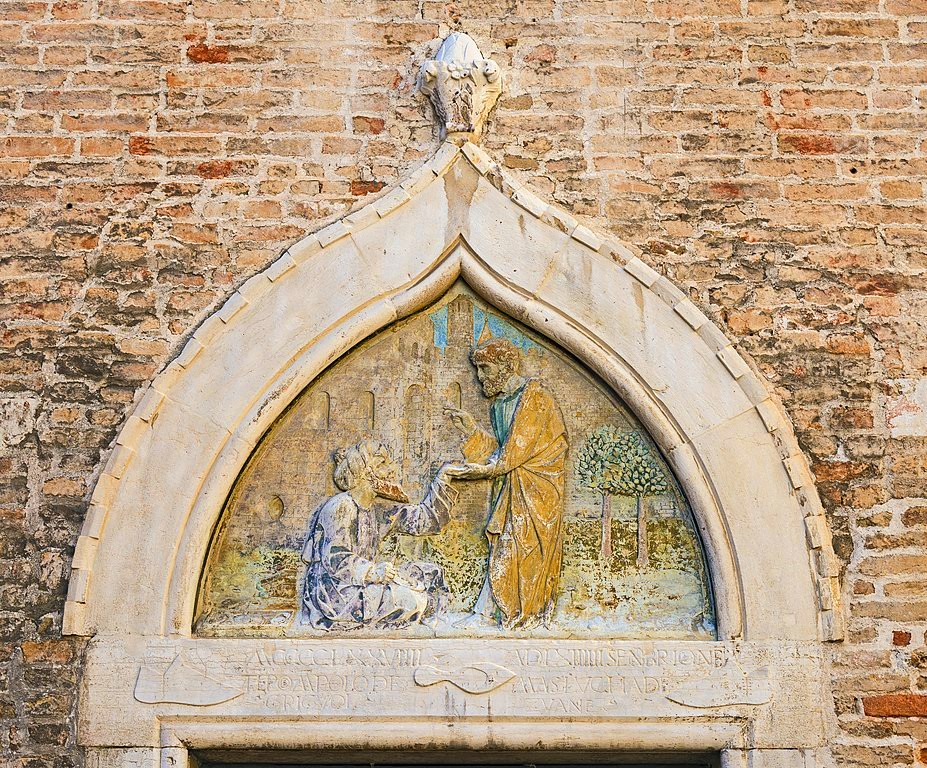
Relief of St Mark and St Abilius by Pietro Lombardo, 1478
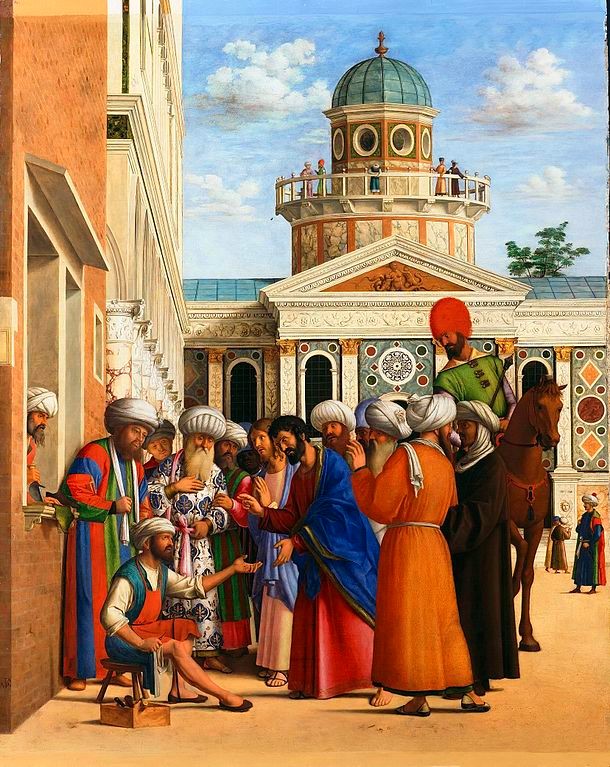
As St Mark was entering Rakotis, a suburb of Alexandria, after his travels from Cyrene, the strap of his sandal detached itself. He found a cobbler, Abilius, to repair it. While he was working on the sandal, the awl slipped in Abilius’ hand, piercing it. Anianus cried out “God is One – Heis ho Theos” in response to the pain. Mark took the opportunity to preach the Gospel to him, at the same time miraculously healing Abilius’ hand of its wound.
Mark was invited to Agilius’ house, where he taught him and his family the Gospel and, thereafter, Baptised them all. A large number of natives of the area were quickly converted by Mark too causing those pagans, who did not convert, to defend their local gods against the new Faith.
Mark, the outsider, decided it might be best if he were to leave the area for a while. He Ordained Abilius and Consecrated him as the Bishop in his absence. He also Ordained three Priests and seven Deacons, charging them with the care of the Church in his absence.
Mark was gone for a period of two years, during which time tradition believes that he attended St Peter in Rome. Abiliuss and his Priests, the meantime, spread the Gospel in the region, performing miracles and winning many to Christ. On Mark’s return, he found the Church in Alexandria had grown significantly and they were able to build a Church at Bucolia on the shore of the Alexandrian eastern harbour.
St Abilius repairing St Mark’s sandal by Cima da Conegliano
Following St Mark’s Martyrdom Abilius took his place in the Church in Alexandria. He would remain in that capacity for over seventeen years. During that time, the number of Christians in the area grew significantly and Abilius Ordained new Priests and Deacons for the growing Church. The extent of the evangelisation they performed is unknown, although it has been thought by some that it was done at least somewhat covertly, given the hostility the pagan population demonstrated to the new Faith.
Abilius died in bed and was buried next to St Mark at the Church in Baucalis. Later, as we know, St Mark’s Relics were translated to Venice.
The Chair of Saint Peter at Antioch – where the disciples were first entitled “Christians.” The Chair/Throne or Cathedra itself is a Relic conserved in St Peter’s Basilica although it seems not to be the original Chair. This Antioch is where the disciples were first called CHRISTIANS. https://anastpaul.com/2022/02/22/the-feast-of-the-chair-of-saint-peter-at-antioch-22-february/
St John the Saxon St Limnaes Bl Mohammed Abdalla St Papias of Heirapolis St Paschasius of Vienne St Raynerius of Beaulieu St Thalassius
Martyrs of Arabia – A memorial for all the unnamed Christians Martyred in the desert and mountainous areas south of the Dead Sea during the persecutions of Emperor Valerius Maximianus Galerius.
Thought for the Day – 21 February – Meditations with Fr Richard Frederick Clarke SJ (1839-1900)
Meditations on “The Great Truths” From “The Devout Year” By Fr Richard Frederick Clarke SJ (1839-1900)
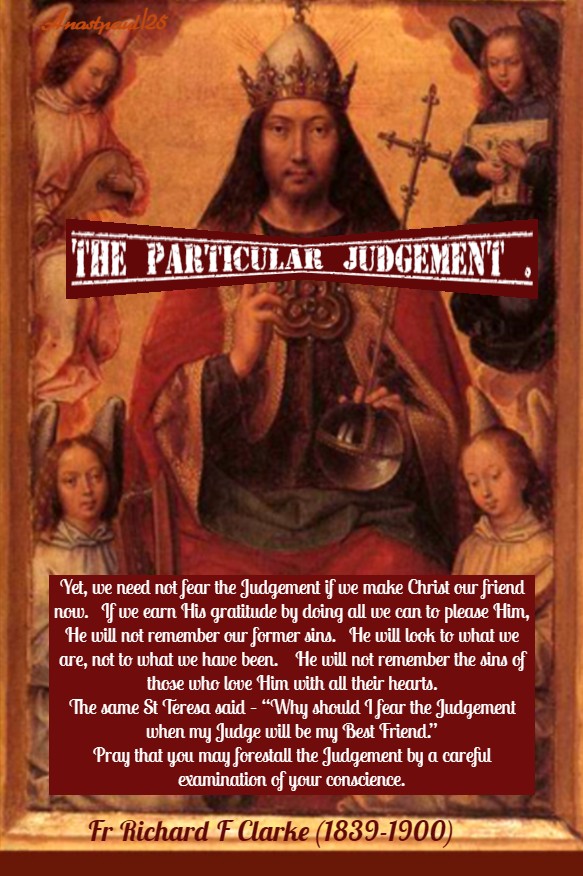
21st Day – The Particular Judgement .
We must all be manifested before the Judgement-seat of Christ. (2 Cor v:10)
+1. At the Particular Judgement, we shall see our lives as they never appeared to us before. In an instant, we shall live them over again. Each thought word, act, will be clear and distinct, with its true character no longer hidden by our own wilful blindness but, in all its foulness, baseness, ingratitude, revealed to us in the bright Light of God.
+2. We shall then stand face-to-face with Jesus Christ, no longer as our Advocate but, as our Judge; no longer pleading for us but dealing out strict justice, according to our deserts. He will be clothed with a Divine glory which will attract us and, at the same time, fill us with dismay, at the thought of having offended Him. St Teresa said that what struck her most forcibly in the vision she had of Him, was how awful would be the anger of One so full of Divine sweetness!
+3. Yet, we need not fear the Judgement if we make Christ our friend now. If we earn His gratitude by doing all we can to please Him, He will not remember our former sins. He will look to what we are, not to what we have been. He will not remember the sins of those who love Him with all their hearts. The same St Teresa said – “Why should I fear the Judgement when my Judge will be my Best Friend.” Pray that you may forestall the Judgement by a careful examination of your conscience.



















 AnaStpaul
You must be logged in to post a comment.