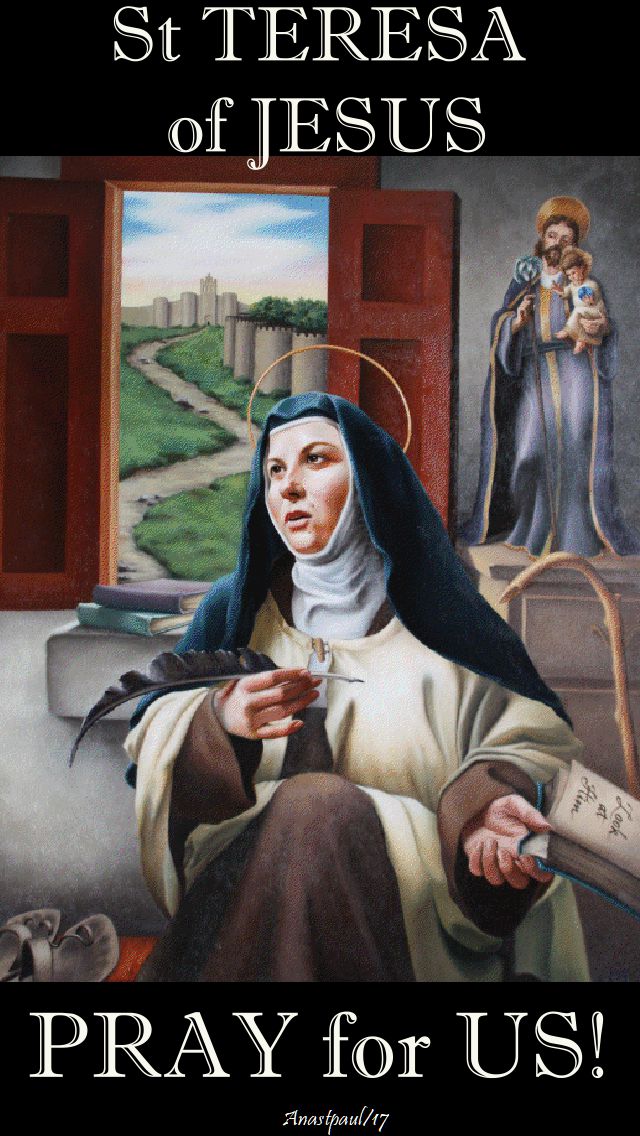
Thought for the Day – – 15 October – The Memorial of St Teresa of Jesus/Avila (1515-1582) Doctor of the Church
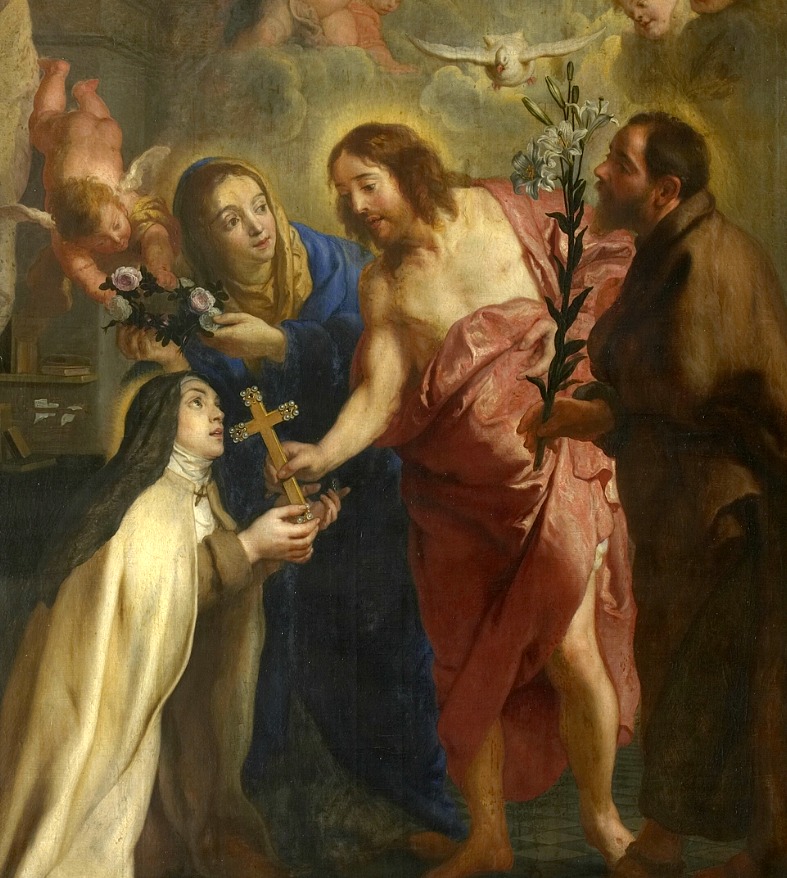
Since her encounter with Jesus, St Teresa lived “another life”; she become a tireless communicator of the Gospel (cf. Life, 23, 1). Eager to serve the Church and in the face of serious problems of her time, she did not limit herself to being a spectator of the reality around her. In her position as a woman and with her health difficulties, she decided, she said, “to do what little depended on me … that is to follow the evangelical counsels as perfectly as possible and to ensure that these few nuns who are here do the same” (The Way, 1, 2). Thus began the Teresian reform, in which she asked her sisters not to lose time negotiating with God “interests of little importance,” while “the world is in flames” (ibid., 1, 5). This missionary and ecclesial dimension has always marked the Carmelites and Discalced Carmelites.
As she did then, even today the saint opens new horizons for us, she calls us to a great undertaking, to see the world with the eyes of Christ, to seek what He seeks and to love what He loves. (Pope Francis in a letter to to Carmelite Father Xavier Cannistrà)
Ours is a time of turmoil, a time of reform, and a time of liberation. Modern women have in Teresa a challenging example. Promoters of renewal, promoters of prayer, all have in Teresa a woman to reckon with, one whom they can admire and imitate.
Quotes of the Day – 15 October – The Memorial of St Teresa of Jesus/Avila (1515-1582) Doctor of the Church
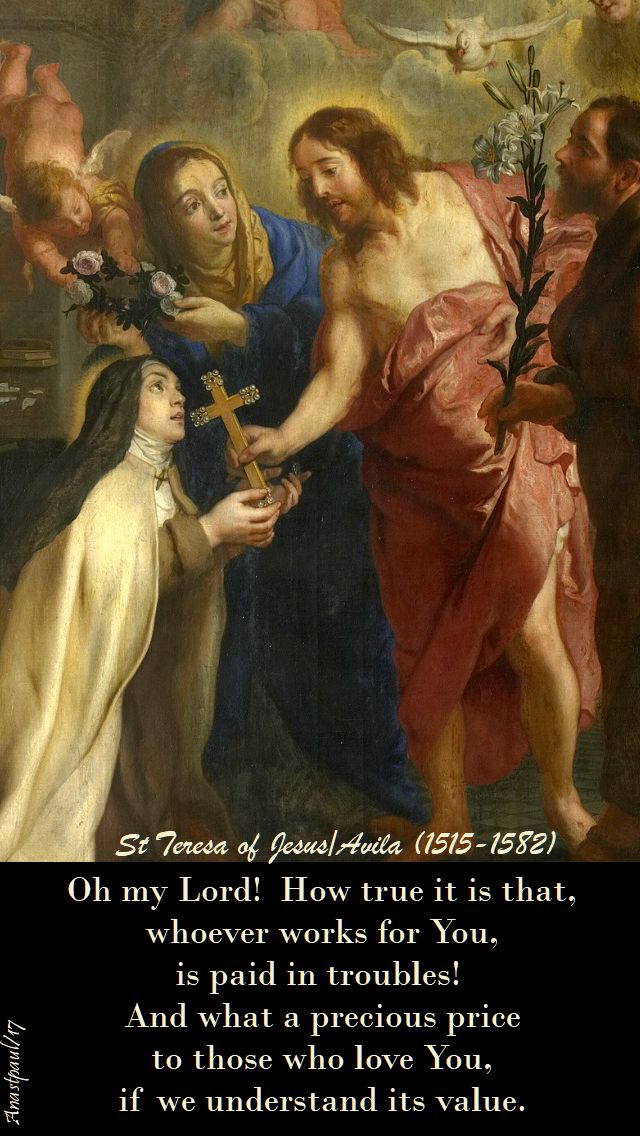
“Oh my Lord! How true it is that, whoever works for You, is paid in troubles! And what a precious price to those who love You, if we understand its value.”
“There is no such thing as bad weather. All weather is good because it is God’s.”
“There is more value in a little study of humility and in a single act of it, than in all the knowledge in the world.”
“We need no wings to go in search of Him but have only to look upon Him, present within us.”
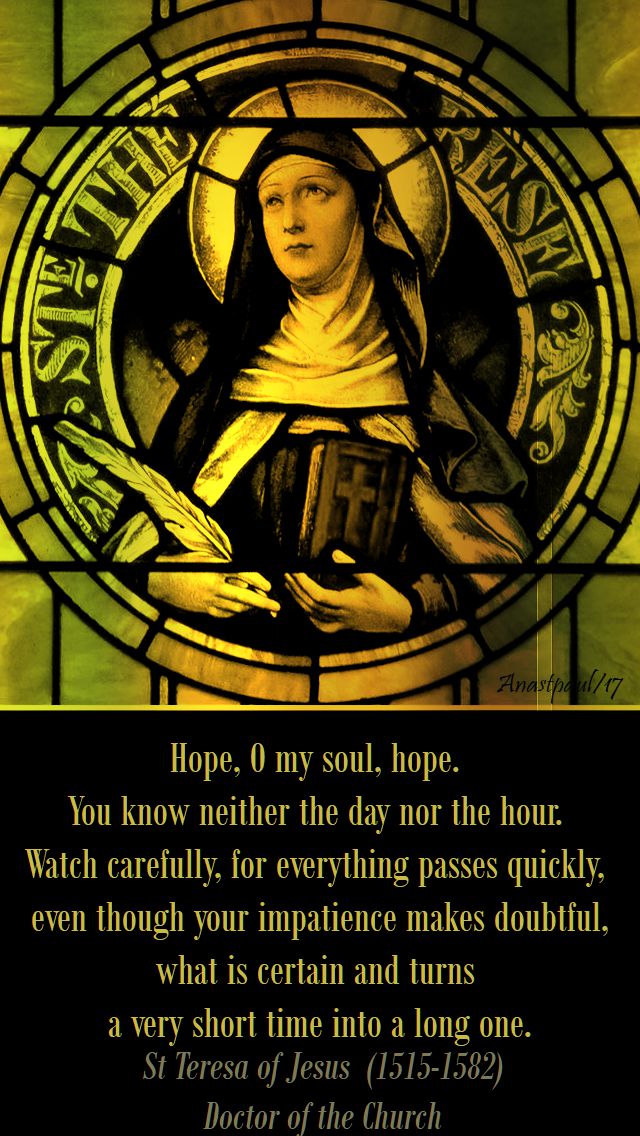
“Hope, O my soul, hope. You know neither the day nor the hour. Watch carefully, for everything passes quickly, even though your impatience makes doubtful, what is certain and turns a very short time into a long one.”
One Minute Reflection – 15 October – The Memorial of St Teresa of Jesus/Avila (1515-1582) Doctor of the Church
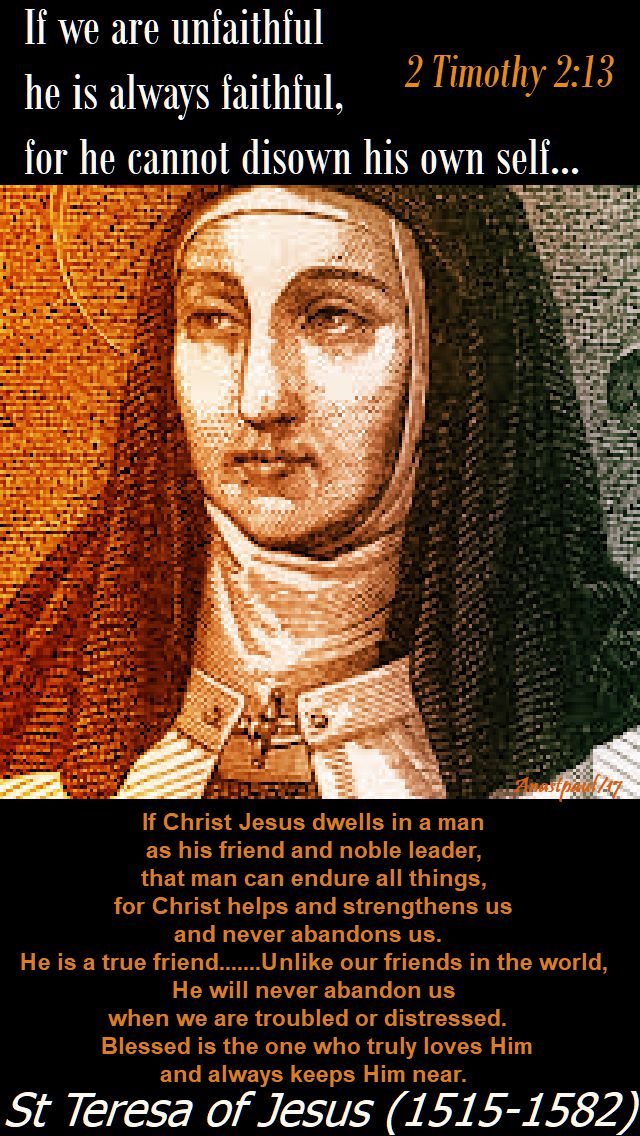
If we have died with him we shall also live with him; if we persevere we shall also reign with him. But if we deny him he will deny us. If we are unfaithful he is always faithful, for he cannot disown his own self..…2 Timothy 2:11-13
REFLECTION – “If Christ Jesus dwells in a man as his friend and noble leader, that man can endure all things, for Christ helps and strengthens us and never abandons us. He is a true friend. And I clearly see that is we expect to please Him and receive an abundance of His graces, God desires that these graces must come to us from the hands of Christ, through His most sacred humanity, in which God takes delight. All blessings come to us through our Lord. He will teach us, for in beholding His life we find that He is the best example. What more do we desire from such a good friend at our side? Unlike our friends in the world, He will never abandon us when we are troubled or distressed. Blessed is the one who truly loves Him and always keeps Him near. Whenever we think of Christ we should recall the love that led Him to bestow on us so many graces and favours and also the great love God showed in giving us in Christ a pledge of His love; for love calls for love in return. Let us strive to keep this always before our eyes and to rouse ourselves to love Him. For if at some time the Lord should grant us the grace of impressing His love on our hearts, all will become easy for us and we shall accomplish great things quickly and without effort.” – Saint Teresa of Jesus
PRAYER – Almighty God, our Father, You sent St Teresa of Jesus to be a witness in the Church to the way of perfection. Sustain us by her spiritual doctrine and kindle in us, the longing for true holiness. Through Christ, our Lord, in union with the Holy Spirit. St Teresa pray for us, amen
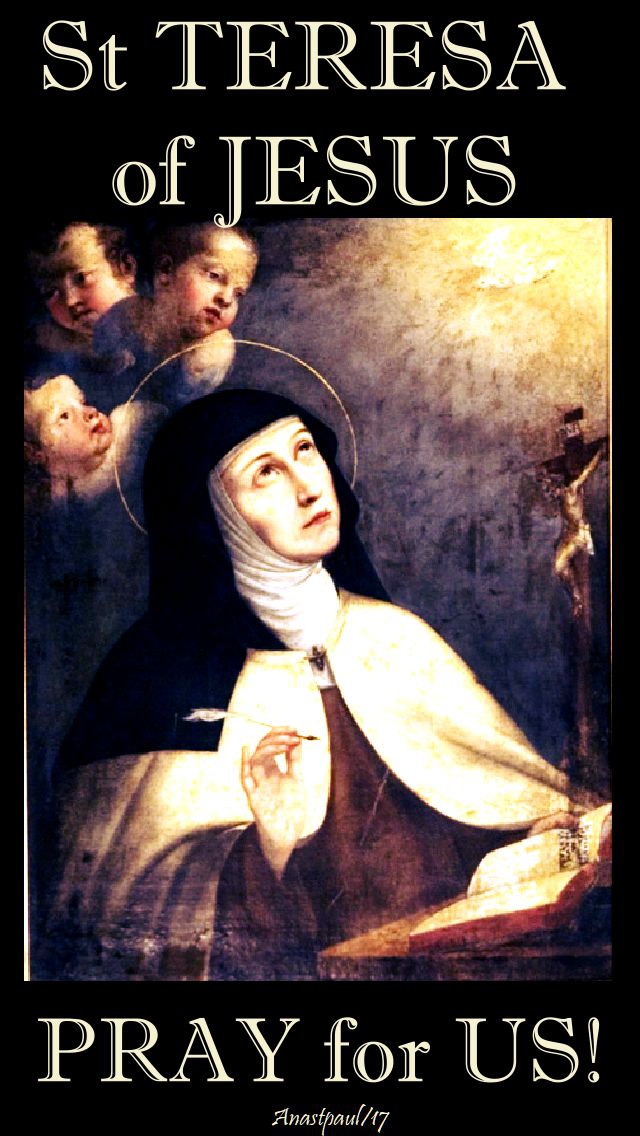
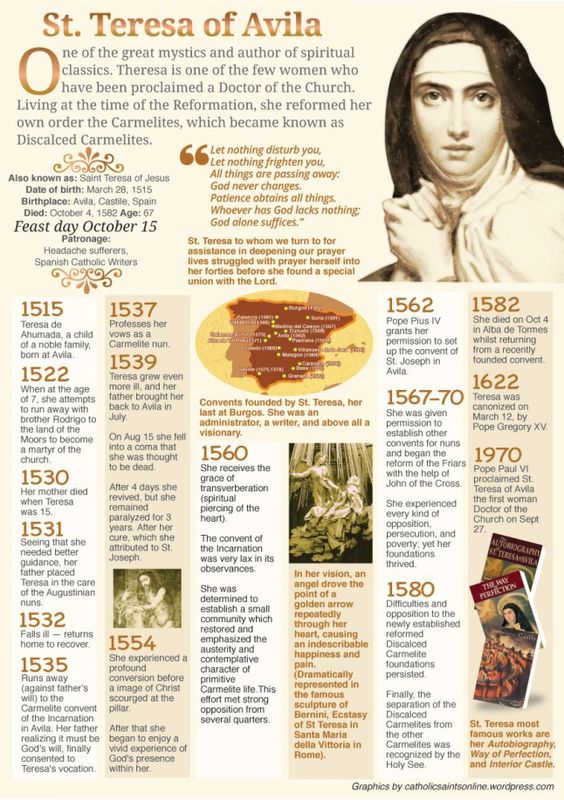
Saint of the Day – 15 October – St Teresa of Jesus/of Avila (1515-1582) Virgin, Mystic, Ecstatic, Reformer, Apostle of Prayer, Writer, Doctor of the Church. Born as Teresa Sanchez Cepeda Davila y Ahumada at Avila, Old Castile, on 28 March 1515 – died at Alba de Tormes, 4 October 1582 of natural causes in the arms of her secretary and close friend Blessed Anne of Saint Bartholomew. Her relics are preserved at Alba – her heart shows signs of Transverberation (piercing of the heart), and is displayed, too. Her Body is incorrupt. Patronages: • sick people; against bodily ills or sickness • against headaches • against the death of parents • lace makers or lace workers • people in need of grace • people in religious orders • people ridiculed for their piety • World Youth Day 2011 • Amos, Canada, diocese of • Avellaneda-Lanús, Argentina, diocese of • Berzano di Tortona, Italy • Pozega, Croatia • Spain. Attributes – Habit of the Discalced Carmelites, Book and Quill, arrow-pierced heart. St Teresa was Beatified on 24 April 1614 by Pope Paul V and Canonised on 12 March 1622, only forty years after her death, by Pope Gregory XV. Tradition associate Saint Teresa with the Infant Jesus of Prague with claims of former ownership and devotion. On 27 September 1970 St Teresa, was named a Doctor of the Church by Pope Paul VI. Her books, which include her autobiography (The Life of Teresa of Jesus) and her seminal work El Castillo Interior (trans.: The Interior Castle), are an integral part of Spanish Renaissance literature as well as Christian mysticism and Christian meditation practices. She also wrote Camino de Perfección (trans.: The Way of Perfection).
Original Portrait by Frei Jual de la Miseria in 1576
The third child of Don Alonso Sanchez de Cepeda by his second wife, Doña Beatriz Davila y Ahumada, who died when the Teresa was in her fourteenth year, Teresa was brought up by her saintly father, a lover of serious books and a tender and pious mother. After her death and the marriage of her eldest sister, Teresa was sent for her to the Augustinian nuns at Avila but owing to illness she left at the end of eighteen months and for some years remained with her father and occasionally with other relatives, notably an uncle who made her acquainted with the Letters of St Jerome, which determined her to adopt the religious life, not so much through any attraction towards it, as through a desire of choosing the safest course. Unable to obtain her father’s consent she left his house unknown to him to enter the Carmelite Convent of the Incarnation at Avila, which then counted 140 nuns. The wrench from her family caused her a pain which she ever afterwards compared to that of death. However, her father at once yielded and Teresa took the habit.
Teresa lived in an age of exploration as well as political, social and religious upheaval. It was the 16th century, a time of turmoil and reform. She was born before the Protestant Reformation and died almost 20 years after the closing of the Council of Trent.
The gift of God to Teresa in and through which she became holy and left her mark on the Church and the world is threefold: she was a woman; she was a contemplative; she was an active reformer.
As a woman, Teresa stood on her own two feet, even in the man’s world of her time. She was “her own woman,” entering the Carmelites despite strong opposition from her father. She is a person wrapped not so much in silence as in mystery. Beautiful, talented, outgoing, adaptable, affectionate, courageous, enthusiastic, she was totally human. Like Jesus, she was a mystery of paradoxes: wise, yet practical; intelligent, yet much in tune with her experience; a mystic, yet an energetic reformer; a holy woman, a womanly woman.
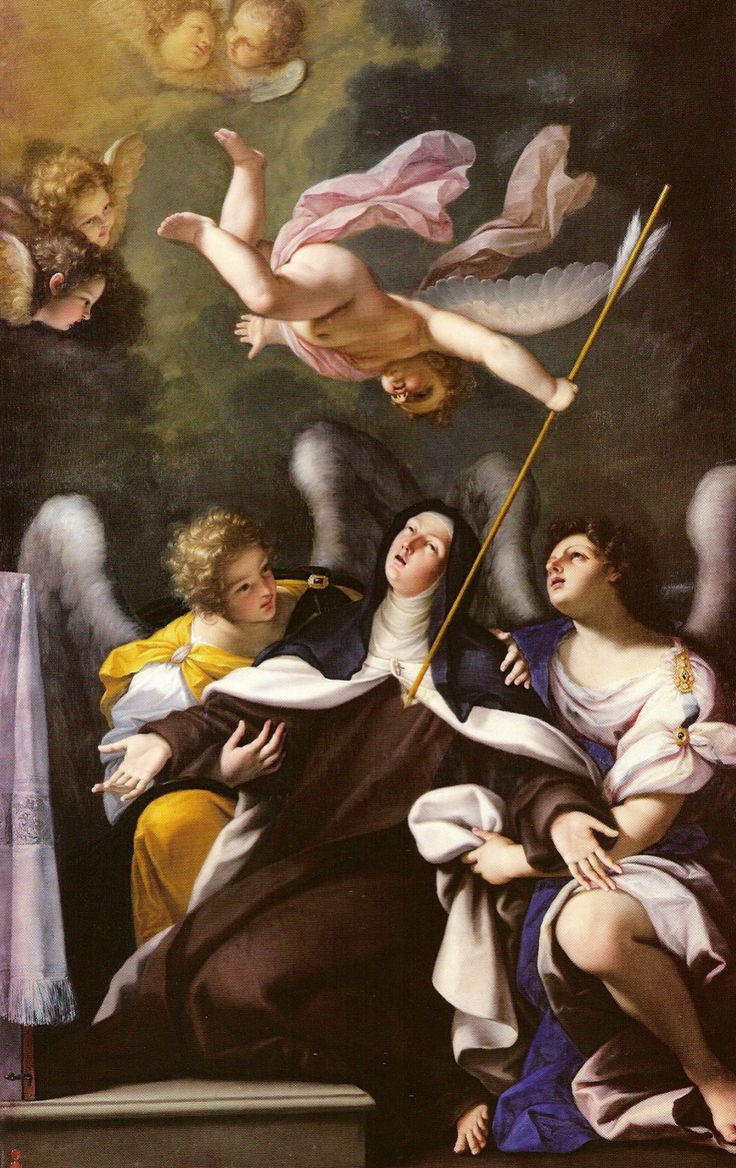
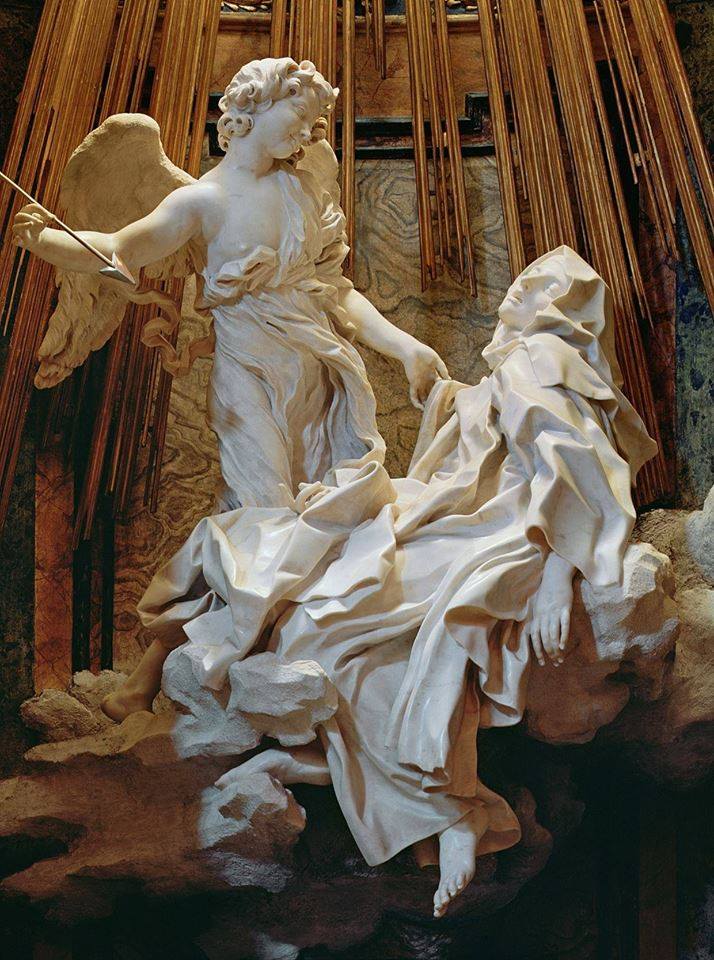
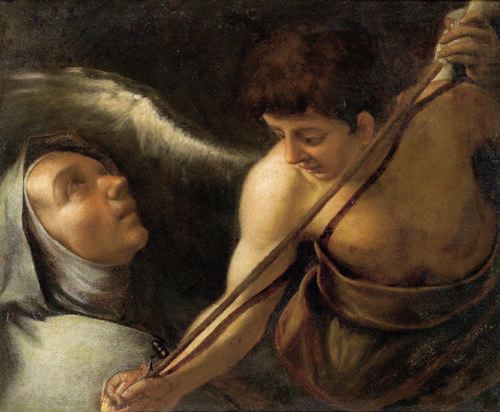
On St Peter’s Day in 1559, Teresa became firmly convinced that Jesus Christ presented Himself to her in bodily form, though invisible. These visions lasted almost uninterrupted for more than two years. In another vision, a seraph drove the fiery point of a golden lance repeatedly through her heart, causing an ineffable spiritual-bodily pain.
I saw in his hand a long spear of gold and at the point there seemed to be a little fire. He appeared to me to be thrusting it at times into my heart and to pierce my very entrails; when he drew it out, he seemed to draw them out also and to leave me all on fire with a great love of God. The pain was so great, that it made me moan; and yet so surpassing was the sweetness of this excessive pain, that I could not wish to be rid of it…
This vision was the inspiration for one of Bernini’s most famous works, the Ecstasy of Saint Teresa at Santa Maria della Vittoria in Rome.
The memory of this episode served as an inspiration throughout the rest of her life and motivated her lifelong imitation of the life and suffering of Jesus, epitomised in the motto usually associated with her: Lord, either let me suffer or let me die.
Teresa was a woman “for God,” a woman of prayer, discipline and compassion. Her heart belonged to God. Her ongoing conversion was an arduous lifelong struggle, involving ongoing purification and suffering. She was misunderstood, misjudged and opposed in her efforts at reform. Yet she struggled on, courageous and faithful; she struggled with her own mediocrity, her illness, her opposition. And in the midst of all this she clung to God in life and in prayer. Her writings on prayer and contemplation are drawn from her experience: powerful, practical and graceful. She was a woman of prayer; a woman for God.
Teresa was a woman “for others.” Though a contemplative, she spent much of her time and energy seeking to reform herself and the Carmelites, to lead them back to the full observance of the primitive Rule. She founded over a half-dozen new monasteries. She traveled, wrote, fought—always to renew, to reform. In her self, in her prayer, in her life, in her efforts to reform, in all the people she touched, she was a woman for others, a woman who inspired and gave life.
Her final illness overtook her on one of her journeys from Burgos to Alba de Tormes. She died in 1582, just as Catholic nations were making the switch from the Julian to the Gregorian calendar, which required the removal of 5–14 October from the calendar. She died either before midnight of 4 October or early in the morning of 15 October which is celebrated as her feast day. Her last words were: “My Lord, it is time to move on. Well then, may your will be done. O my Lord and my Spouse, the hour that I have longed for has come. It is time to meet one another.”
Her writings, especially the Way of Perfection and The Interior Castle, have helped generations of believers. She and St Catherine of Siena were the first women so honoured as Doctors of the Church.
Interesting fact – her Spiritual Director was St Francis Borgia whose Feast Day we celebrated on 10 October.
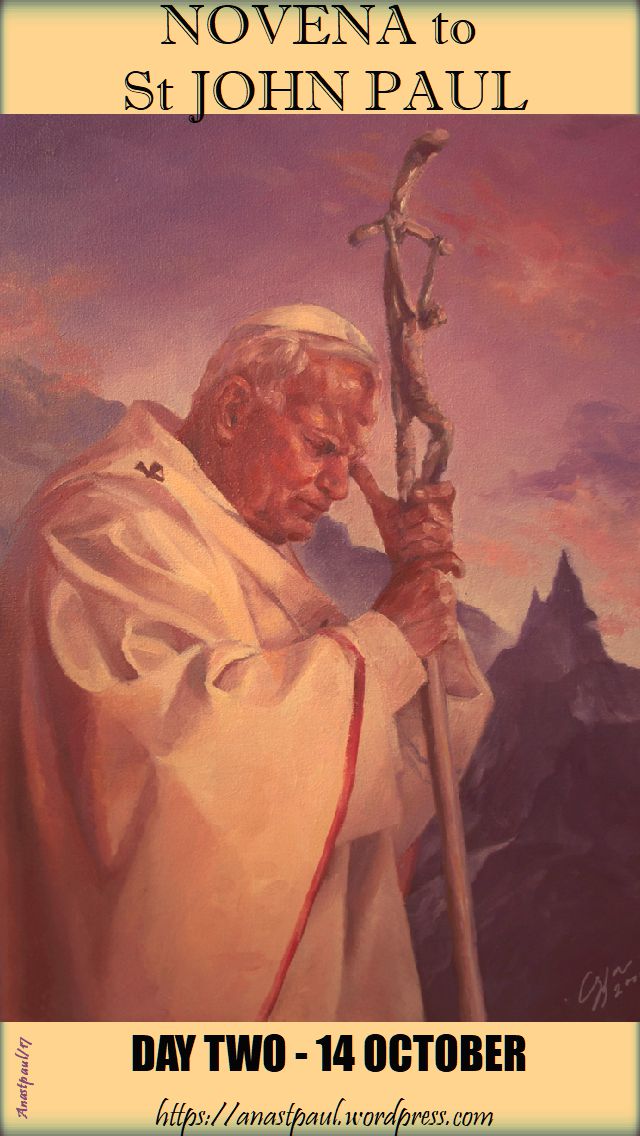
NOVENA to St John Paul the Great DAY TWO – 14 OCTOBER
Little Known Fact #2: While working in a factory during the Nazi Occupation of Poland, Karol Wojtyla heard that one of his co-workers was expecting a child. The man worked the night shift and found out that his wife gave birth to their child. After a full day of work during the day, Karol told his co-worker to go home to be with his family. Karol then worked the entire night shift in place of the new father. He continued to work the night shift after his own shift until his co-worker’s wife regained her strength and he could return to work.
REFLECTION: ”Follow me! In July 1958 the young priest Karol Wojtyla began a new stage in his journey with the Lord and in the footsteps of the Lord. Follow me – Karol Wojtyla accepted the appointment, for he heard in the Church’s call the voice of Christ. And then he realised how true are the Lord’s words: “Those who try to make their life secure will lose it but those who lose their life will keep it” (Lk 17:33). Our Pope – and we all know this – never wanted to make his own life secure, to keep it for himself; he wanted to give of himself unreservedly, to the very last moment, for Christ and thus also for us. And thus he came to experience how everything which he had given over into the Lord’s hands came back to him in a new way. His love of words, of poetry, of literature, became an essential part of his pastoral mission and gave new vitality, new urgency, new attractiveness to the preaching of the Gospel, even when it is a sign of contradiction.”…Pope Benedict
Let us Pray:
O Holy Trinity, we thank You for having given to the Church Pope John Paul II and for having made him shine with Your fatherly tenderness, the glory of the Cross of Christand the splendour of the Spirit of love.
He, trusting completely in Your infinite mercy and in the maternal intercession of Mary, has shown himself in the likeness of Jesus the Good Shepherd and has pointed out to us the way of holiness as the path to reach eternal communion with You Grant us, through his intercession, according to Your will, the grace that we implore,
………………….. [state your intention here].
Continue, beloved St John Paul, we implore you, to sustain from heaven the faith of God’s people. We praise and thank You Father that St John Paul has been numbered among Your saints and make our prayer through our Lord Jesus Christ with the Holy Spirit, one God forever.
Totus Tuus, Amen.
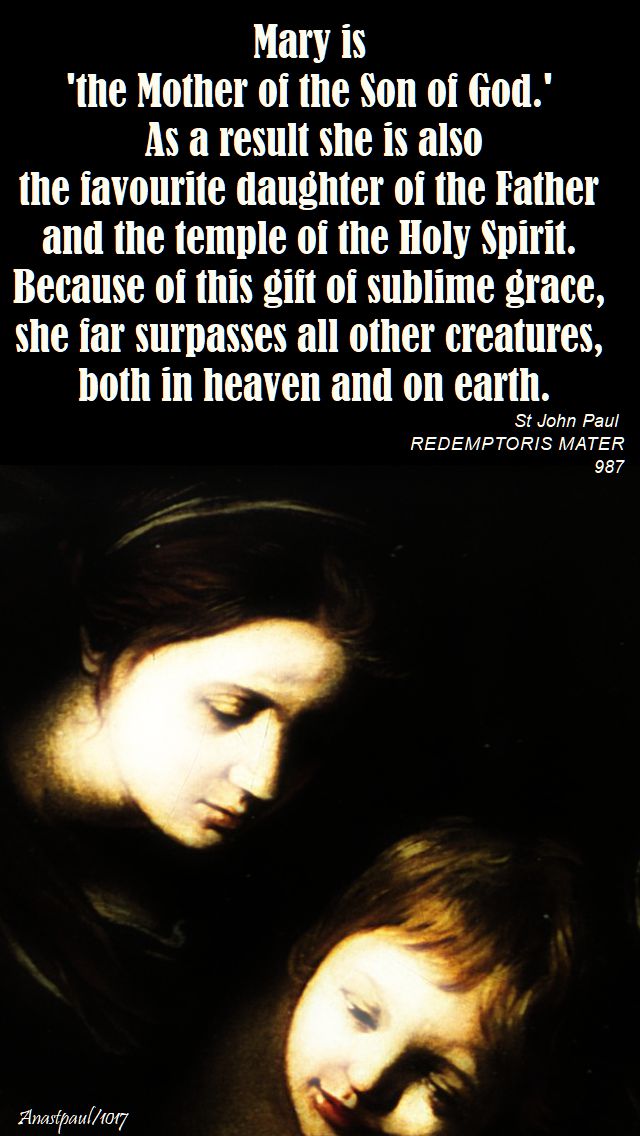
Quote Day Two: “Mary is ‘the Mother of the Son of God.
As a result she is also the favourite daughter of the Father
and the temple of the Holy Spirit.
Because of this gift of sublime grace,
she far surpasses all other creatures,
both in heaven and on earth.”
(REDEMPTORIS MATER – 1987)
“Mary’s grace has given: glory to heaven: a God to earth: and faith to the nations. She has conferred: death on vices; order to life; and a rule on morals.”
St Peter Chrysologus (406-450)
“Love for Christ pierced Mary’s heart in such a way that no part of it was left unkindled. Mary thus fulfilled the first commandment of love in all its fulness and without the slightest imperfection.”
St Bernard (1090-1153)
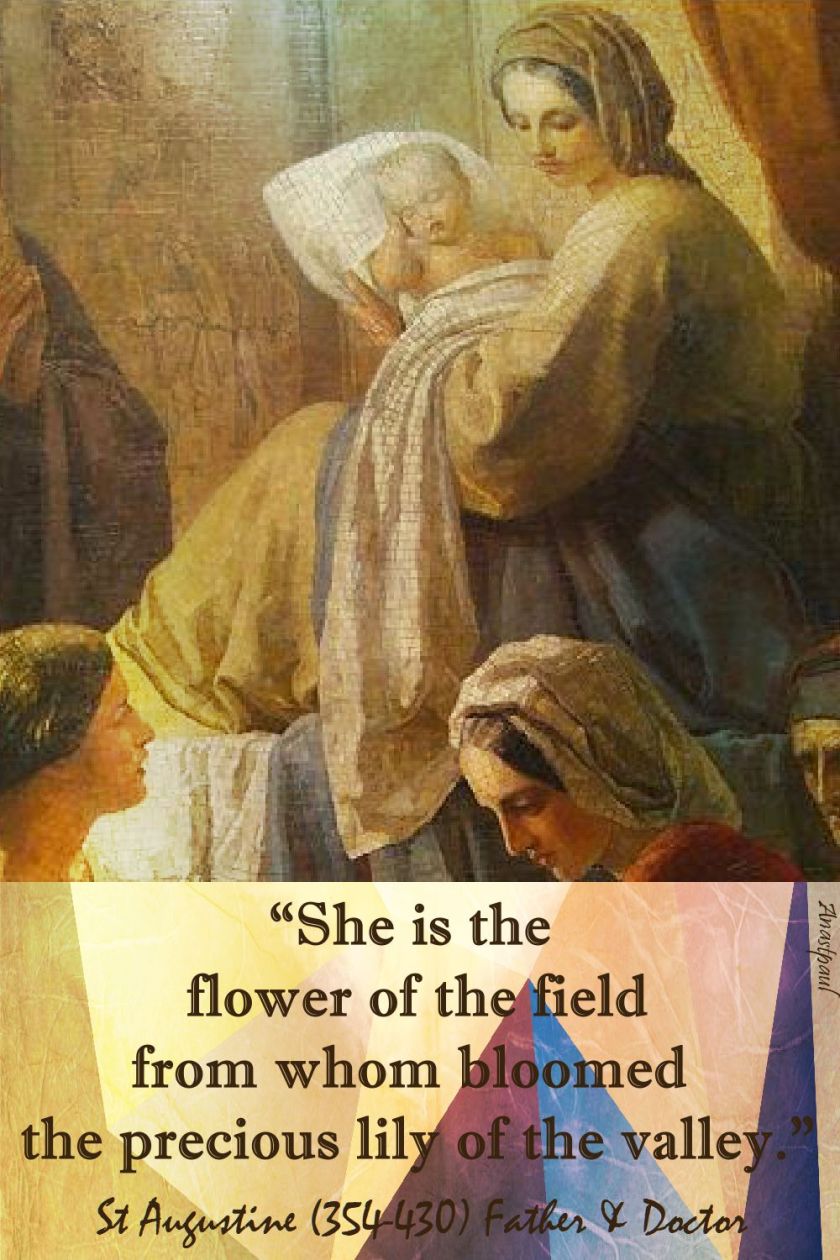
“She is flower of the field from whom bloomed the precious lily of the valley.”
Little Known Fact #1: During his Theological Studies in Seminary, Karol Wojtyla greatly desired to read the works of St John of the Cross in the original Spanish language. He mastered the language very quickly and was even asked by the Spanish instructor to assist him in translating a Spanish text that was to be read over the Polish new radio a few hours before it would be broadcast.
REFLECTION: “Follow me.” The Risen Lord says these words to Peter. They are His last words to this disciple, chosen to shepherd His flock. “Follow me” – this lapidary saying of Christ can be taken as the key to understanding the message which comes to us from the life of our late beloved Pope John Paul II. …” Pope Benedict
Let us Pray:
O Holy Trinity, we thank You for having given to the Church Pope John Paul II and for having made him shine with Your fatherly tenderness, the glory of the Cross of Christand the splendour of the Spirit of love.
He, trusting completely in Your infinite mercy and in the maternal intercession of Mary, has shown himself in the likeness of Jesus the Good Shepherd and has pointed out to us the way of holiness as the path to reach eternal communion with You Grant us, through his intercession, according to Your will, the grace that we implore,
………………….. [state your intention here].
Continue, beloved St John Paul, we implore you, to sustain from heaven the faith of God’s people. We praise and thank You Father that St John Paul has been numbered among Your saints and make our prayer through our Lord Jesus Christ with the Holy Spirit, one God forever.
Totus Tuus, Amen.
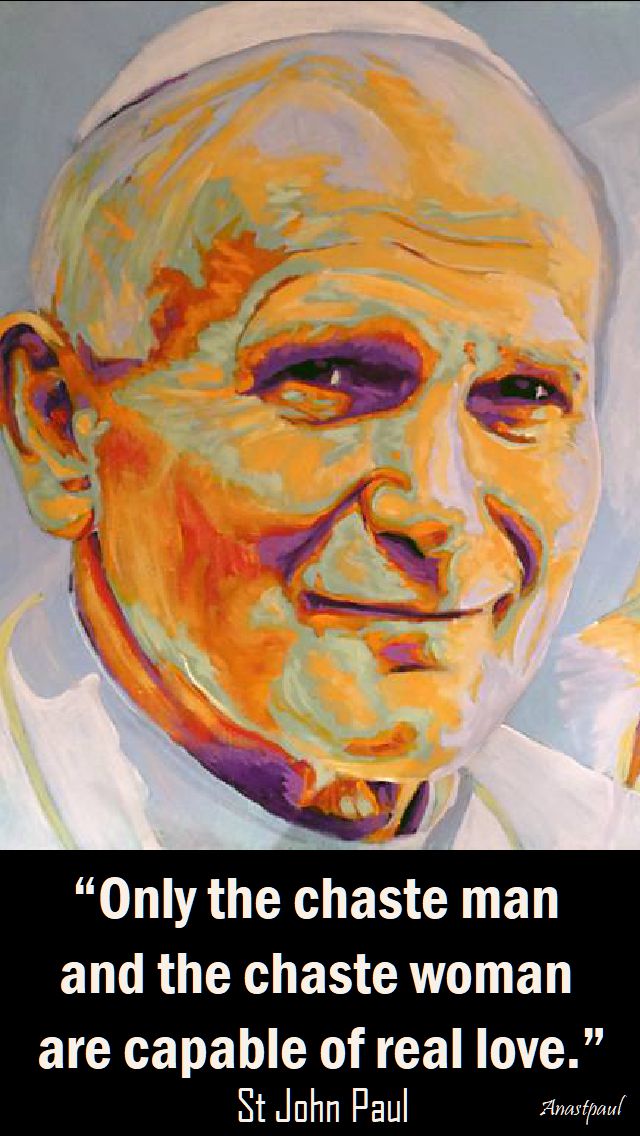
Quote Day One:“Only the chaste man and the chaste woman are capable of real love.”
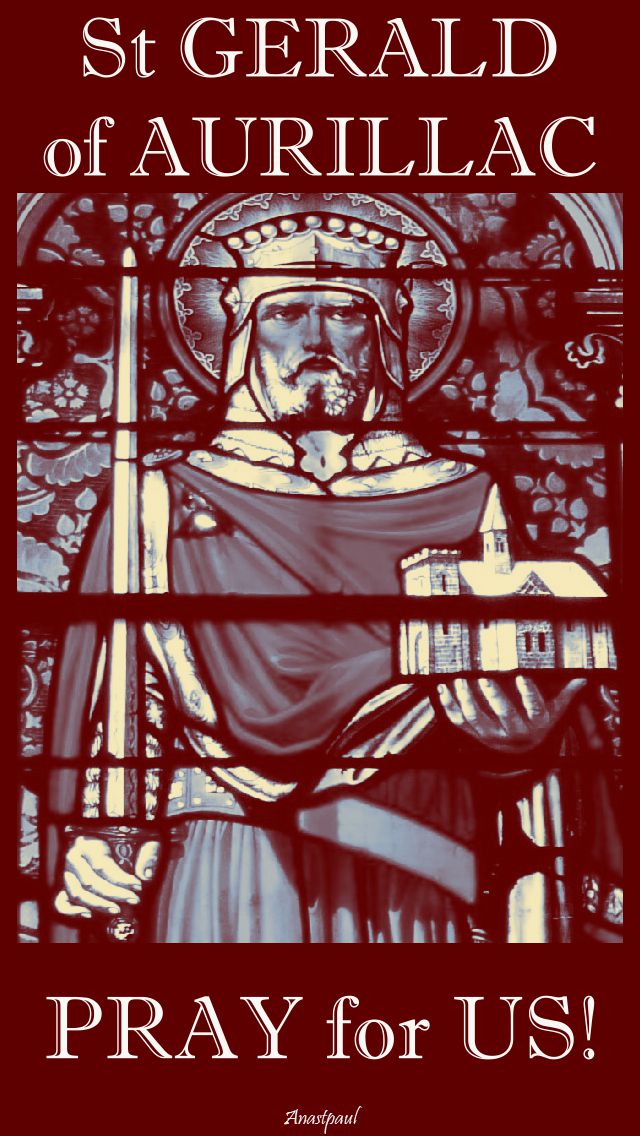
One Minute Reflection – 13 October – The Memorial of St Gerald of Aurillac
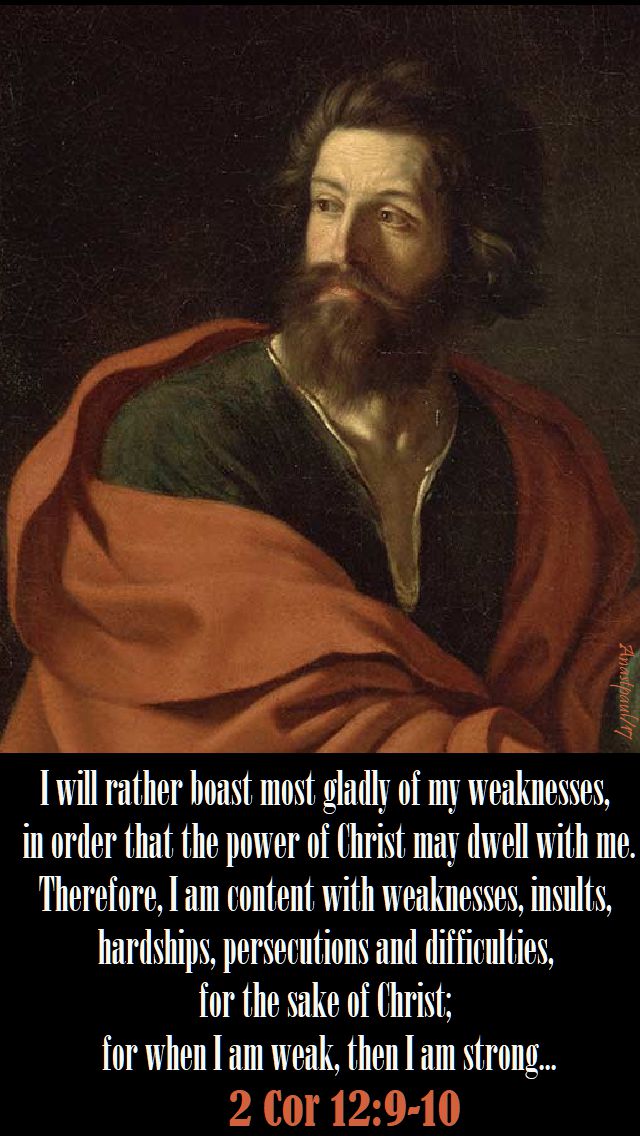
I will rather boast most gladly of my weaknesses, in order that the power of Christ may dwell with me. Therefore, I am content with weaknesses, insults, hardships, persecutions and difficulties, for the sake of Christ; for when I am weak, then I am strong….2 Cor 12:9-10
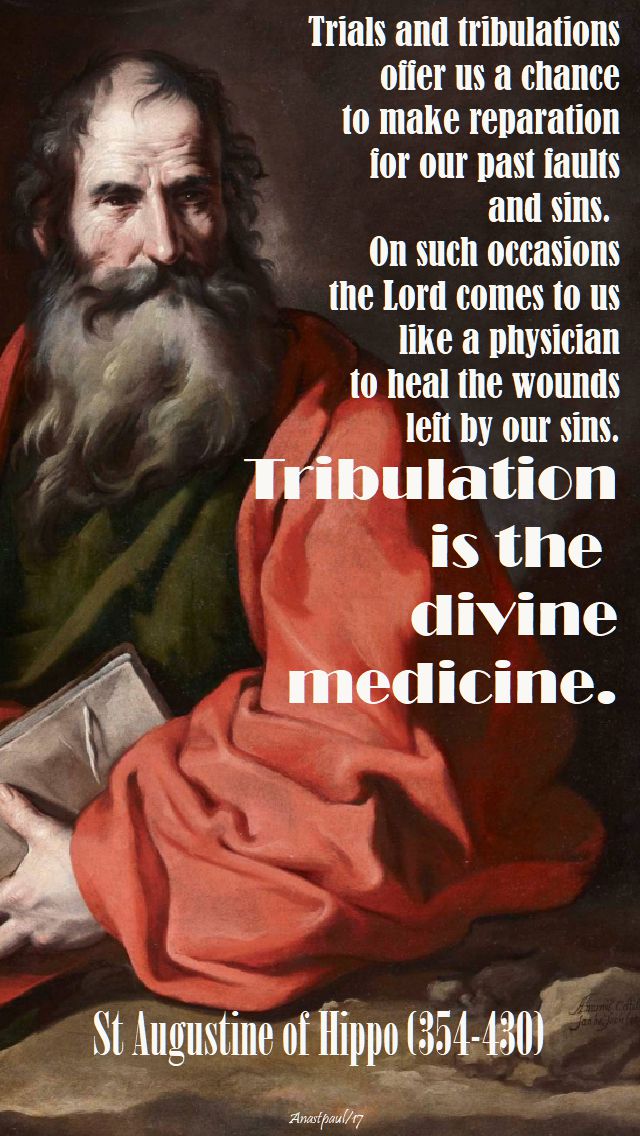
REFLECTION – “Trials and tribulations offer us a chance to make reparation for our past faults and sins.
On such occasions the Lord comes to us like a physician to heal the wounds left by our sins. Tribulation is the divine medicine.”…St Augustine of Hippo (354-430)
PRAYER – Almighty Father, let Your light so penetrate our minds, that walking by Your commandments, we may always follow You, our leader and our Guide in the path of Him who suffered and died for our love. St Gerald of Aurillac, you consecrated yourself and gave up your riches to the poor to follow the way of the Lord, please pray for us. Through Jesus Christ, our Lord in union with the Holy Spirit, one God forever and ever. Amen
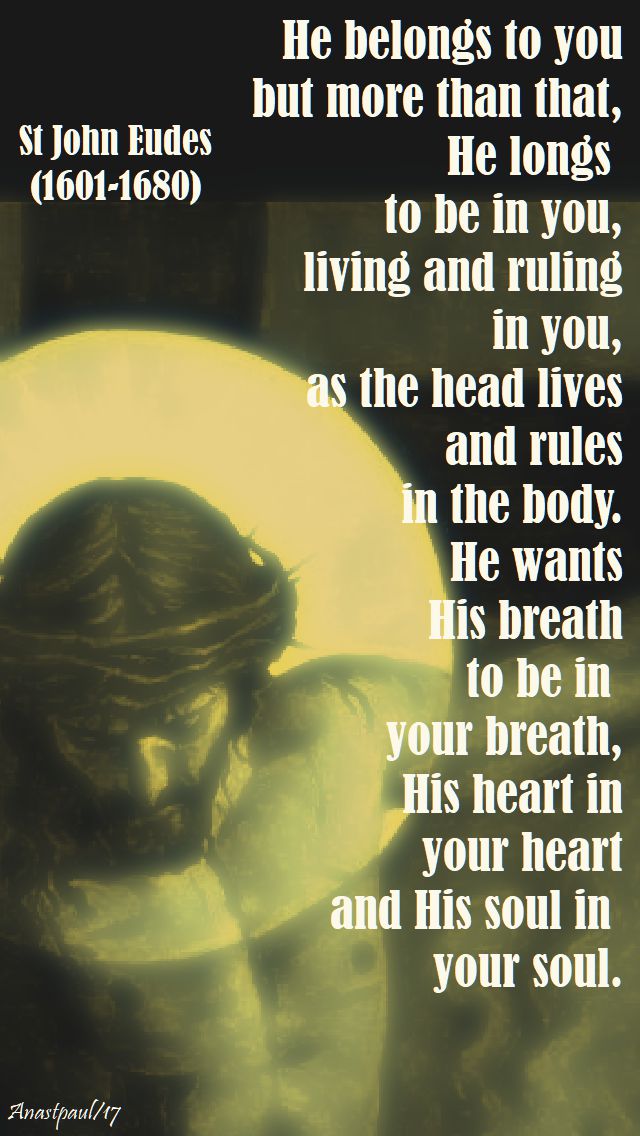
“He belongs to you but more than that, He longs to be in you, living and ruling in you, as the head lives and rules in the body. He wants His breath to be in your breath, His heart in your heart and His soul in your soul.”
St John Eudes
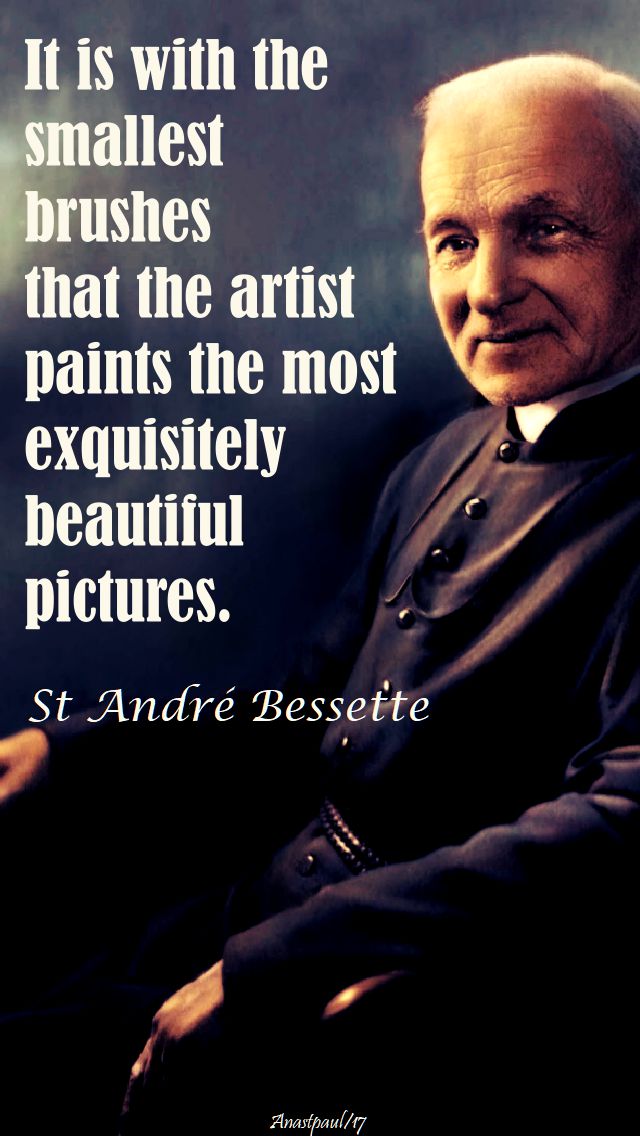
“It is with the smallest brushes that the artist paints the most exquisitely beautiful pictures.”
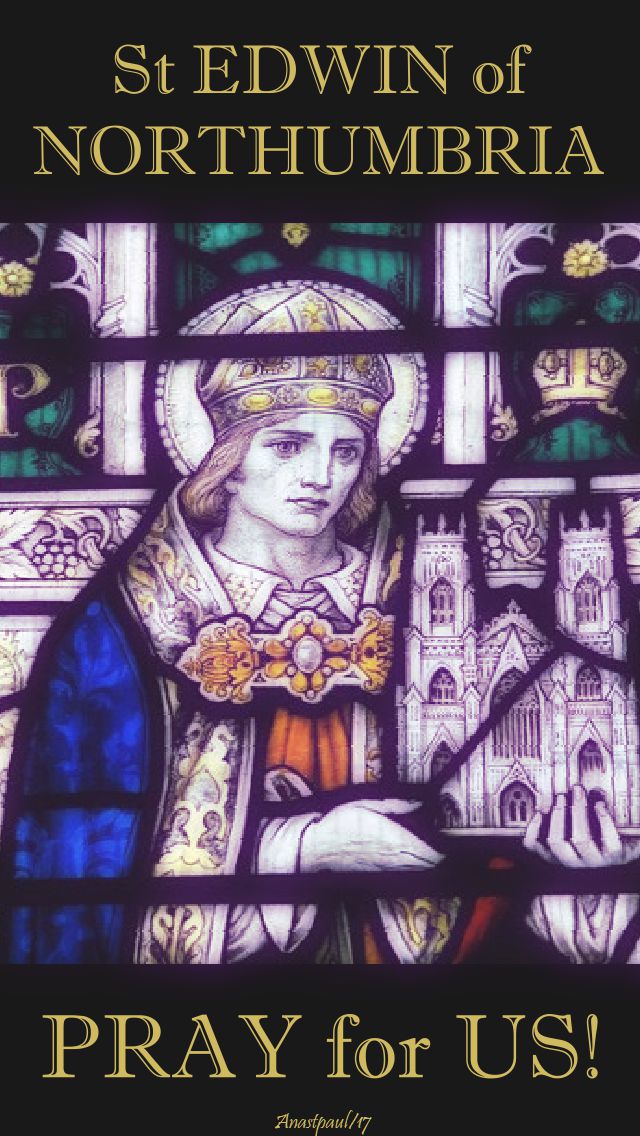
One Minute Reflection – 12 October – The Memorial of St Edwin of Northumbria
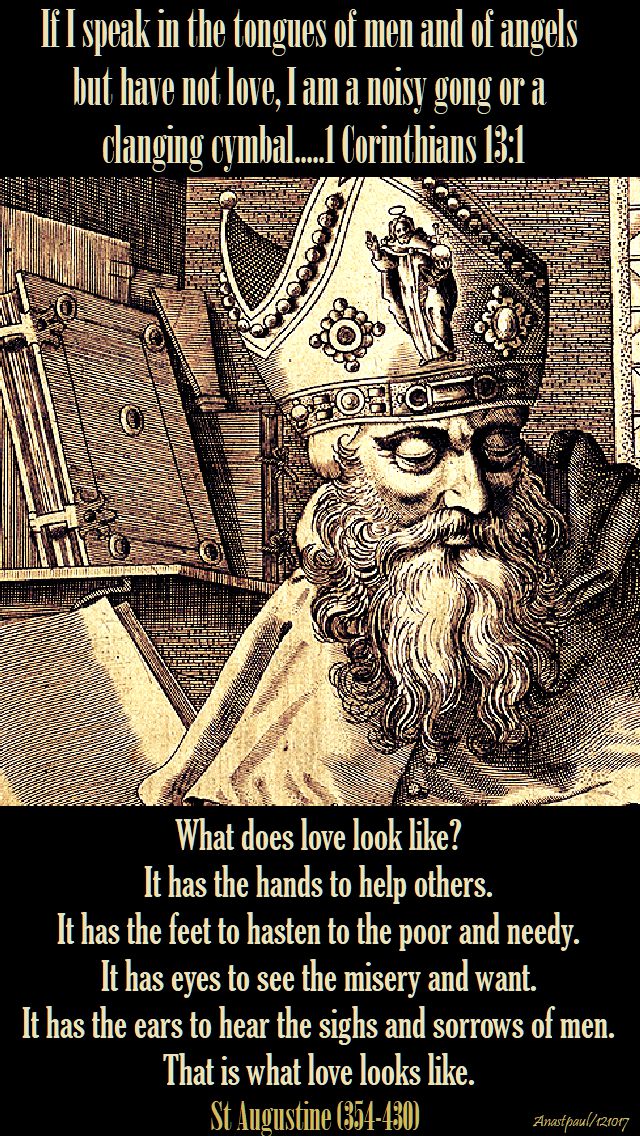
If I speak in the tongues of men and of angels but have not love, I am a noisy gong or a clanging cymbal. And if I have prophetic powers and understand all mysteries and all knowledge and if I have all faith, so as to remove mountains but have not love, I am nothing. If I give away all I have and if I deliver my body to be burned but have not love, I gain nothing.….1 Cor 13:1-3
REFLECTION – ““What does love look like?
It has the hands to help others.
It has the feet to hasten to the poor and needy.
It has eyes to see the misery and want.
It has the ears to hear the sighs and sorrows of men.
That is what love looks like.”
St Augustine (354-430)
PRAYER – Almighty, ever-living God, as You sent Your only Son to rescue us because Your love has no end, help to follow Your love and live in the way He showed us. St Edwin of Northumbria, once you learnt of the love of God, you brought it to your land and taught your people its true meaning, please pray for us, amen.
Quote/s of the Day – 10 October – The Memorial of St Francis Borgia SJ (1510-1572) and St Daniel Comboni (1831-1881)
“I am very sorry to lose the company of a man of your merit, a shining light of counsel, a model in the exercise of the highest offices of State and, because of your virtue and piety, a factor of edification for all my court. But I recognise that it would be unreasonable to dispute over you with the Master you have chosen to serve. It is, therefore, with sorrow that I grant you the permission you are requesting. I authorise you to renounce your fiefs and titles in favour of your firstborn son. The number of those who will envy you, will be greater than those who will imitate you, since it is easy to admire beautiful examples but difficult to follow them. I recommend myself to your prayers and I count upon you, to attract divine blessings over me, my States, and all Christendom.”
(King Charles V of Spain when he granted permission to St Francis to enter the novitiate of the Jesuits.)
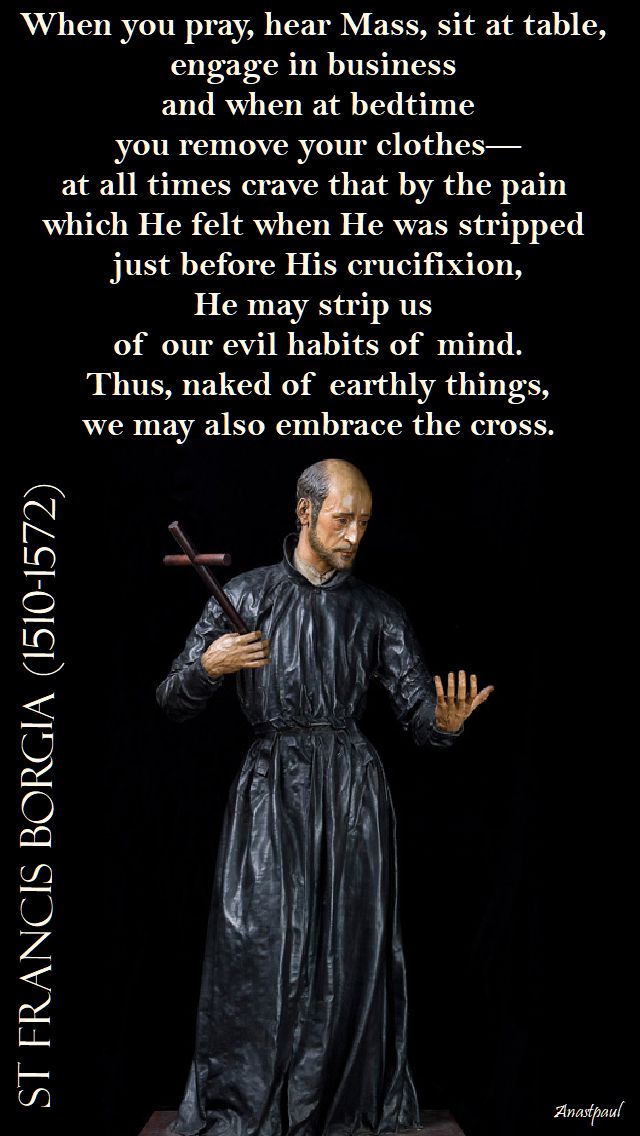
“When you pray, hear Mass, sit at table, engage in business and when at bedtime you remove your clothes— at all times crave that by the pain which He felt when He was stripped just before His crucifixion, He may strip us of our evil habits of mind. Thus, naked of earthly things, we may also embrace the cross.”
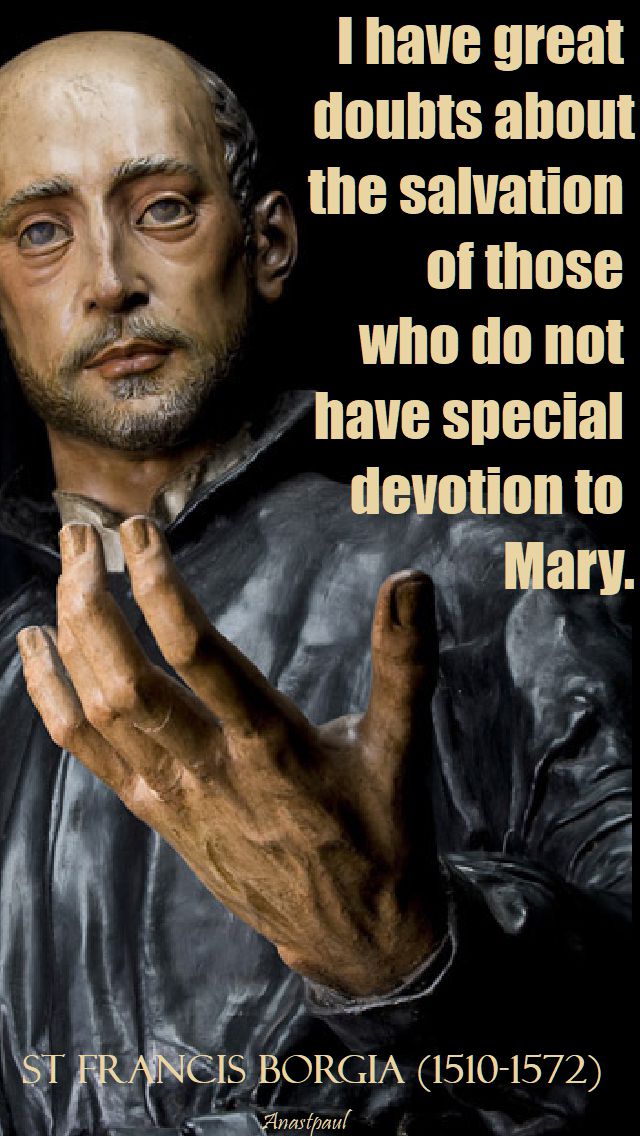
“I have great doubts about the salvation of those who do not have special devotion to Mary.”
St Francis Borgia (1510-1572)
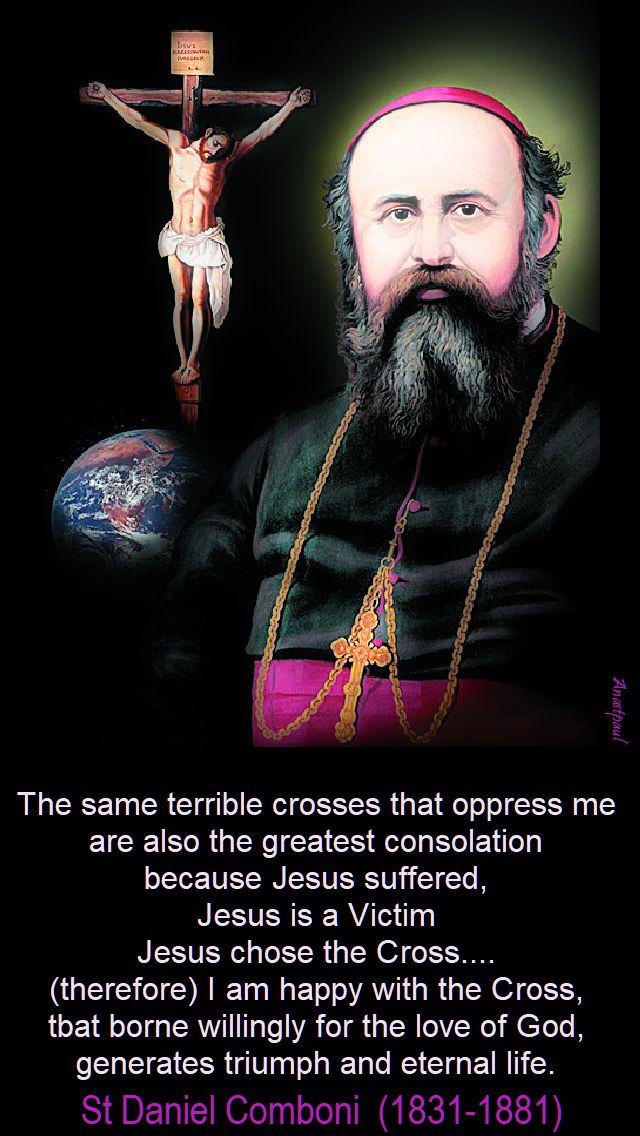
“The same terrible crosses that oppress me are also the greatest consolation because Jesus suffered, Jesus is a Victim Jesus chose the Cross…. (therefore) I am happy with the Cross, tbat borne willingly for the love of God, generates triumph and eternal life.”
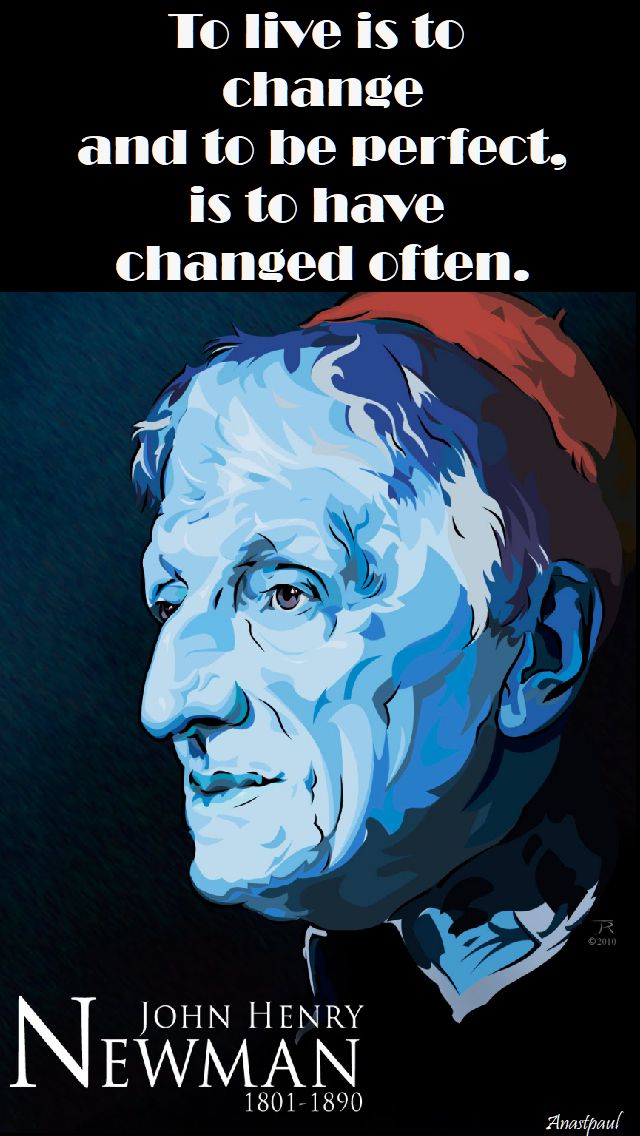
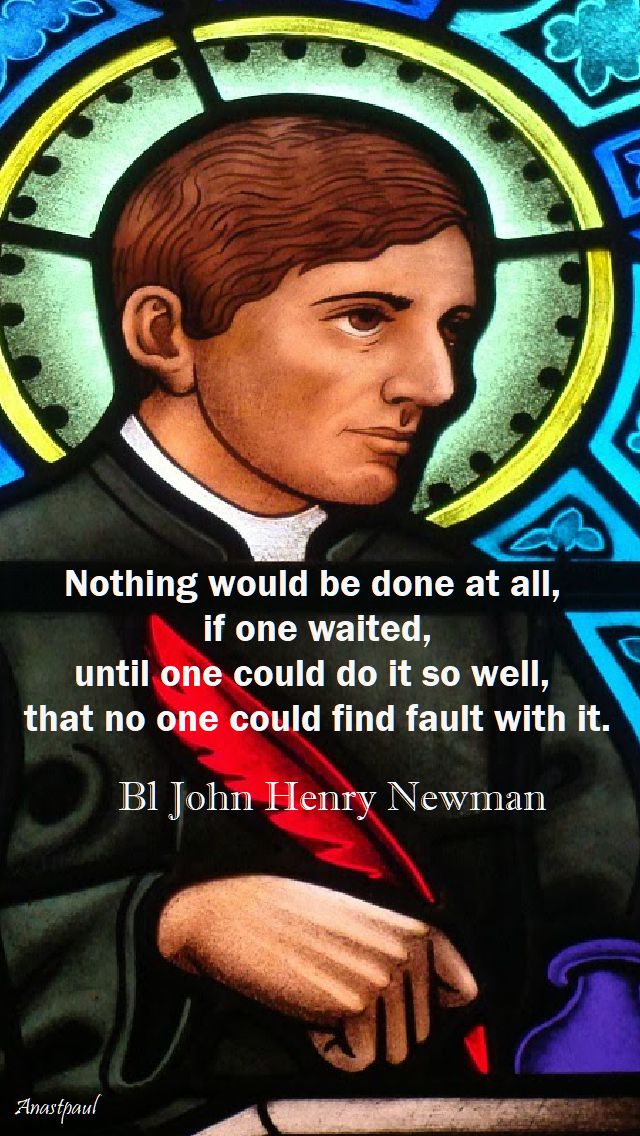
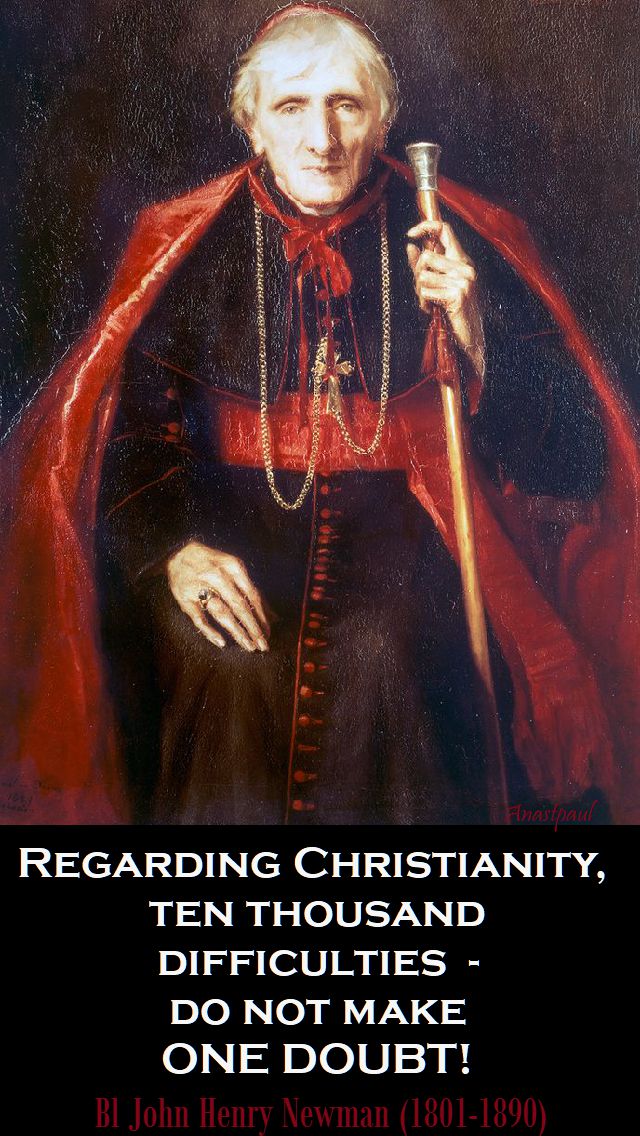
One Minute Reflection – 9 October – The Memorial of Blessed John Henry Newman (1801-1890)
But without faith it is impossible to please him, for anyone who approaches God must believe that he exists and that he rewards those who seek him....Hebrews 11:6
REFLECTION – “Oh that we could take that simple view of things, as to feel that the one thing which lies before us is to please God! What gain is it to please the world, to please the great, even to please those whom we love, compared with this? What gain is it to be applauded, admired, courted, followed, compared with this one aim, of not being disobedient to a heavenly vision? What can this world offer comparable with that insight into spiritual things, that keen faith, that heavenly peace, that high sanctity, that everlasting righteousness, that hope of glory, which they have who in sincerity love and follow our Lord Jesus Christ?”…Blessed John Henry Newman
PRAYER – “Dear Jesus, help me to spread Your fragrance everywhere I go.
Flood my soul with Your spirit and life.
Penetrate and possess my whole being so utterly,
that my life may only be a radiance of Yours.
Shine through me and be so in me
that every soul I come in contact with
may feel Your presence in my soul.
Let them look up and see no longer me but only Jesus!”
Blessed John Henry Newman, pray for us!
Thought for the Day – 8 October: The Eucharist — The Mystery Of Our Christ, by Karl Rahner (extract)
What happens when we celebrate the Eucharist? The simple answer is: the Lord’s Supper which He celebrated at the beginning of His passion becomes present among us and for us. If we are to understand this central element of our faith we must reflect on what happened at the Lord’s Supper and we must ponder what it means when it is said that this meal becomes present among us and for us.
………..And thus He says: “Take this body which is given for you, drink this blood poured out for you.” And through the power of His creative word which changes the subsoils of reality, He makes Himself exist in the form of bread and wine, the everyday sign of loving unity with His disciples, so that all of this – His sacrificed reality for their salvation – becomes manifest and manifestly operative; it truly belongs to them and enters into the centre of their being.
“Take, eat; this is my body. Drink. . . for this is my blood of the new covenant which is poured out for all.” They take and they are taken. Taken by the redeeming power of obedience and of love of the Lord, taken by His death which gives birth to life out of its dreadful void, encircled by the grace of God which, with the incomprehensible and consuming holiness of God, unites. They are embraced by love which joins them to each other, not destructively but –redemptively, enveloped by a love which unites them in an experience where otherwise each would die painfully in himself alone in his ultimate solitude. And by eating the dish of God’s mercy, they anticipate the eternal meal when God, no longer in Earthly symbols but in the accomplishment of His revealed glory, makes Himself into the eternal meal of the redeemed. And while they eat thus, they look for the day when the Lord will be entirely with them, the day on which He “will come again” (as they say). And the new and eternal covenant which has been bequeathed to them is celebrated as is their free acceptance of it. These are given in the power of this bread which unites them with the Lord who is the covenant and joins them one to another in the beginning of eternal life.
The Lord’s Supper becomes His presence among us and for us in the church’s celebration of the Eucharist. The church fulfills the fundamental order of the Lord: “Do this (what He Himself had done on the night He was betrayed) in remembrance of me.” The church does what the Lord had done, with the words which He Himself spoke when He gave His body and His blood in the form of bread and wine to His disciples as a pledge of eternal life. The church celebrates the Anamnesis, the “remembrance” of the meal that instituted the new covenant. The church recalls what once happened but does not bring about a repetition of the actual event which happened once and for all on Calvary. Rather, what happened then enters into our place and our time and acquires presence and redemptive power within our own being.
This is possible (if we may so try to understand the miracle of God) because the Lord’s Supper is not an event of the past. The free decision of absolute obedience and unconditional, unreserved love constitutes one of those moments of history in which a temporality becomes the definitive, the enduring and the eternal, not just a moment in which something evaporates into the void of the past. The elements of freedom and spirit always signify the birth of the eternal; in this context, what is temporal passes into time but also attains eternal validity by virtue of the pure essence of the decision itself by a spiritual person. This applies in an utterly unique way to the event of the Last Supper. What happened there as event once and for all is. It is. It is taken up in the eternity of God, it has passed over into the state of perfection in which is becomes permanence in the midst of time. For the Lord in this meal has wrought something that endures forever since His voluntary deeds come from the infinite primal grounds of the eternal Word of God itself and are a spiritual-human reality, like the creative words of Genesis.
He has wrought the “new” and thus the final covenant, as He Himself says.
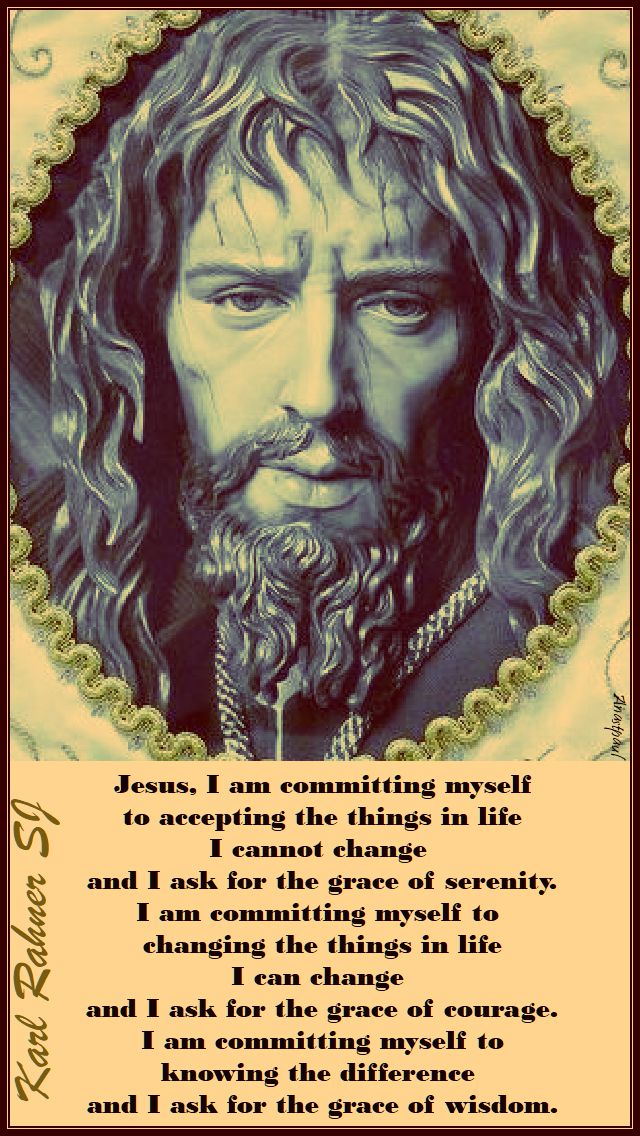
“Jesus, I am committing myself to accepting the things in life I cannot change and I ask for the grace of serenity. I am committing myself to changing the things in life I can change and I ask for the grace of courage. I am committing myself to knowing the difference and I ask for the grace of wisdom.”
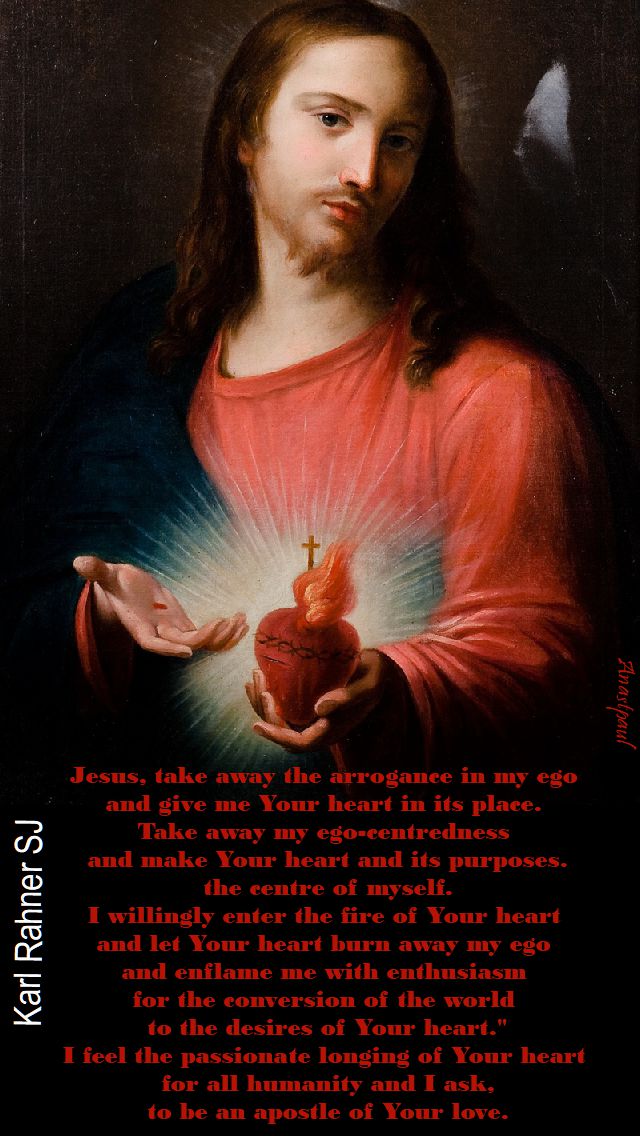
“Jesus, take away the arrogance in my ego and give me Your heart in its place. Take away my ego-centredness and make Your heart and its purposes. the centre of myself. I willingly enter the fire of Your heart and let Your heart burn away my ego and enflame me with enthusiasm for the conversion of the world to the desires of Your heart.” I feel the passionate longing of Your heart for all humanity and I ask to be an apostle of Your love.”
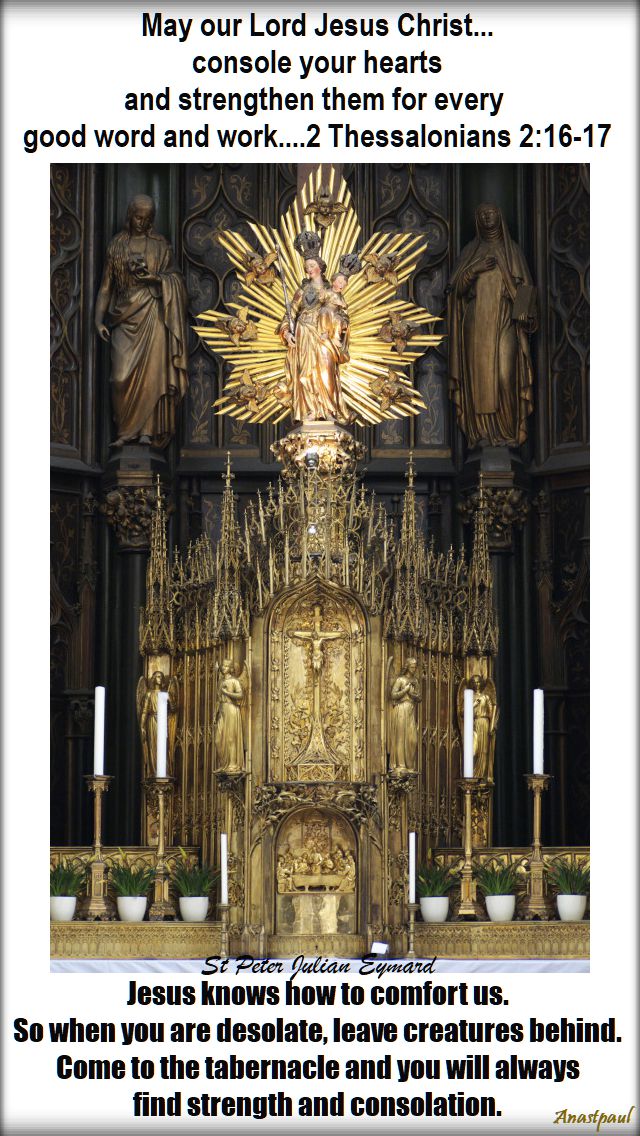
May our Lord Jesus Christ…console your hearts and strengthen them for every good word and work...2 Thessalonians 2:16-17
REFLECTION – “Jesus knows how to comfort us.
So when you are desolate, leave creatures behind.
Come to the tabernacle and you will always find strength and consolation.”…St Peter Julian Eymard
PRAYER – Lord Jesus, let me frequently have recourse to You in the Blessed Sacrament. O Sacrament most Holy, O Sacrament Divine, all praise and all thanksgiving, be every moment thine! Amen
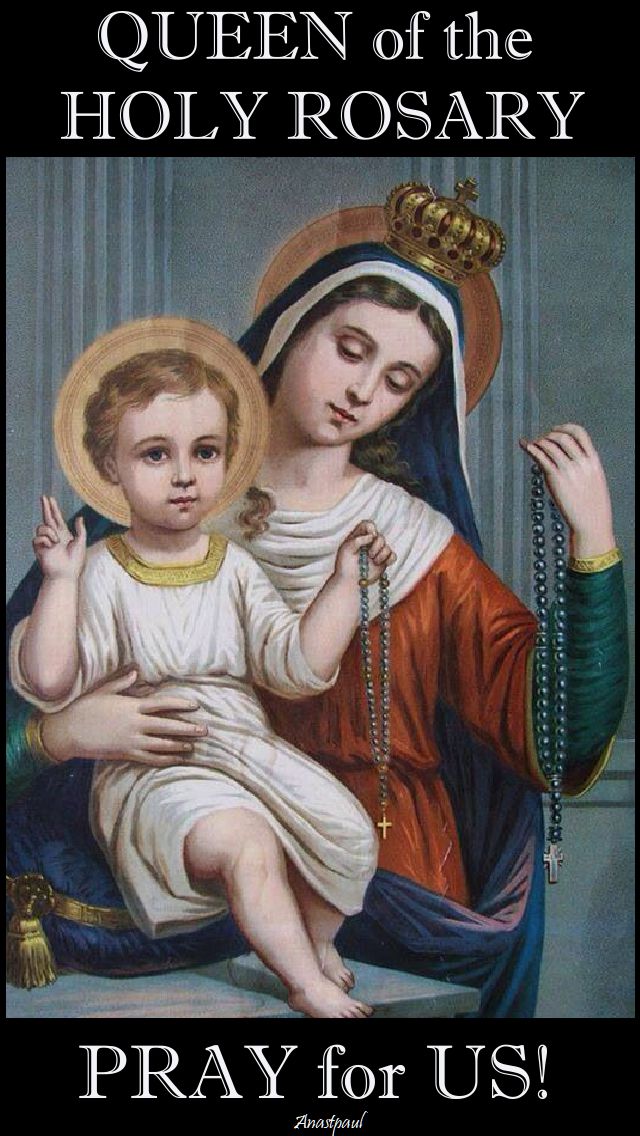
Quote/s of the Day – 7 October – The Memorial of Our Lady of the Most Holy Rosary
THE SEVEN BLESSINGS OF THE ROSARY
“The Rosary, recited with meditation on the mysteries, brings about the following marvelous results:
1. It gradually gives us a perfect knowledge of Jesus Christ;
2. It purifies our souls, washing away sin;
3. It gives us victory over all our enemies;
4. It makes it easy for us to practice virtue;
5. It sets us on fire with love of Our Blessed Lord;
6. It enriches us with graces and merits;
7. It supplies us with what is needed to pay,
all our debts to God and to our fellow men
and finally, it obtains all kinds of graces for us from Almighty God.”
St Louis Marie Grignion De Montfort (1673-1716)
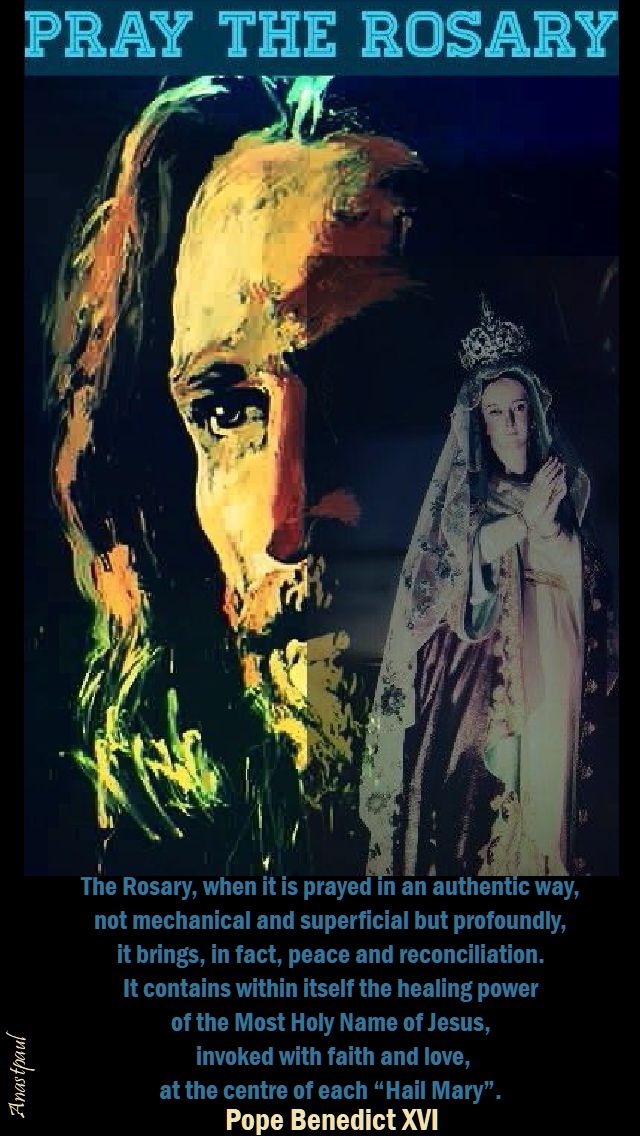
The Rosary, when it is prayed in an authentic way,
not mechanical and superficial but profoundly,
it brings, in fact, peace and reconciliation.
It contains within itself the healing power
of the Most Holy Name of Jesus,
invoked with faith and love,
at the centre of each “Hail Mary”.
One Minute Reflection – 7 October – The Memorial of Our Lady of the Most Holy Rosary
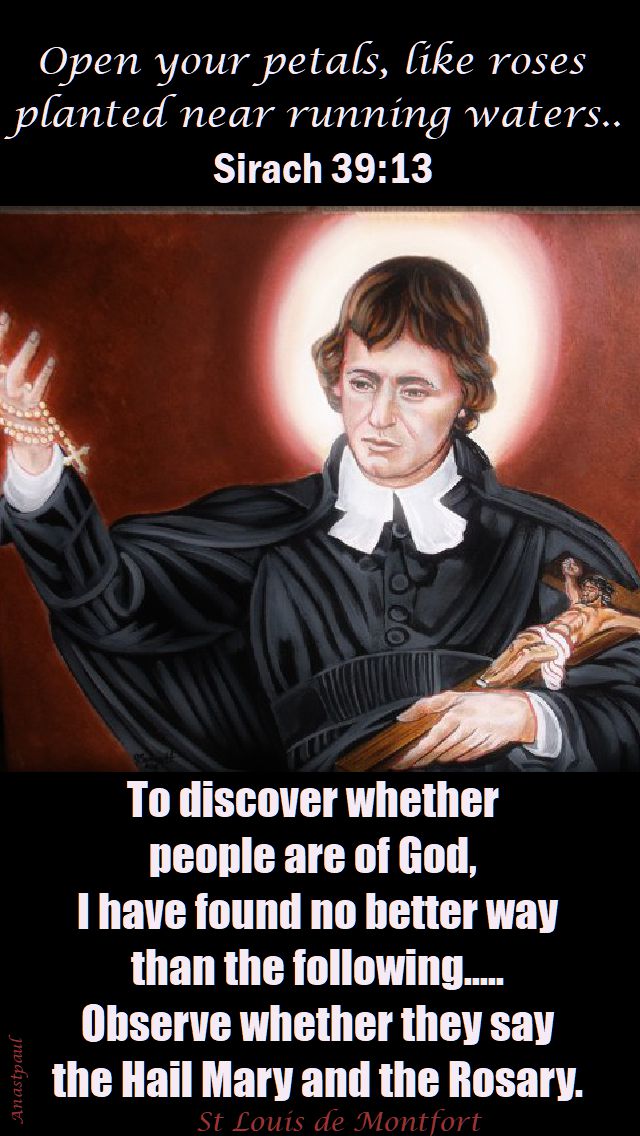
Open your petals, like roses planted near running waters...Sirach 39:13
REFLECTION – “To discover whether people are of God, I have found no better way than the following.
Observe whether they say the Hail Mary and the Rosary.”……St Louis Marie de Montfort
PRAYER – Lord, open our hearts to Your grace. May we, who learned to believe through the angel’s message, in the Incarnation of Christ, Your Son, be brought by His Passion and Cross, at the intercession of the Blessed Virgin Mary, to the glory of His Resurrection. Through Him who redeemed us in unity with the Holy Spirit, one God forever and ever. Our Lady of the Holy Rosary, pray for us, amen.
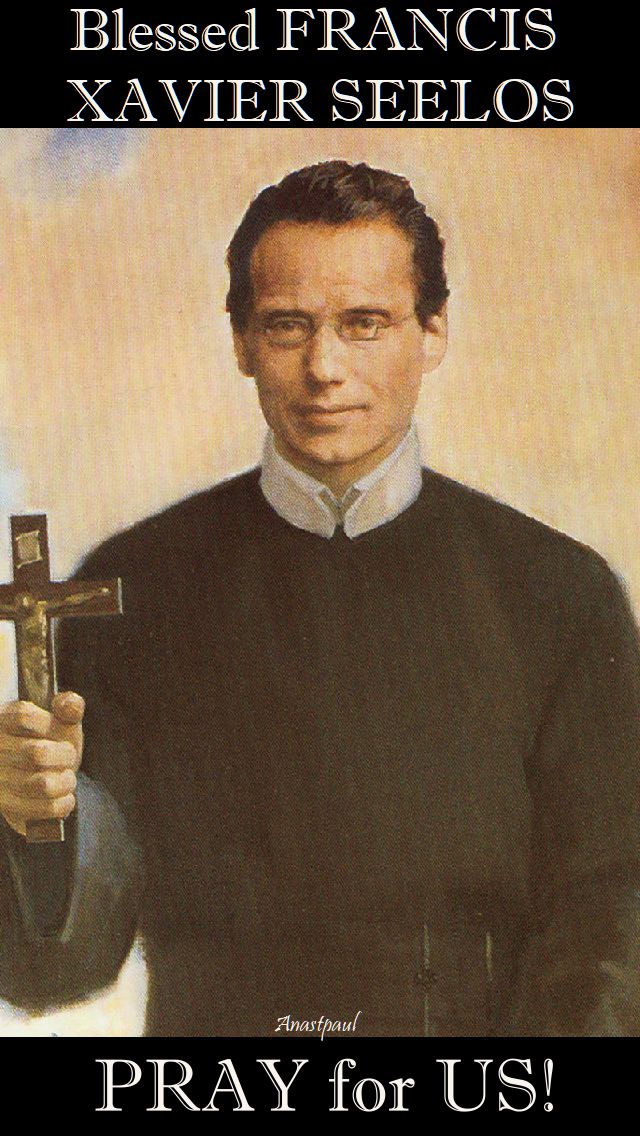
Celebrating and Learning from Blessed Francis Xavier Seelos – Memorial 5 October
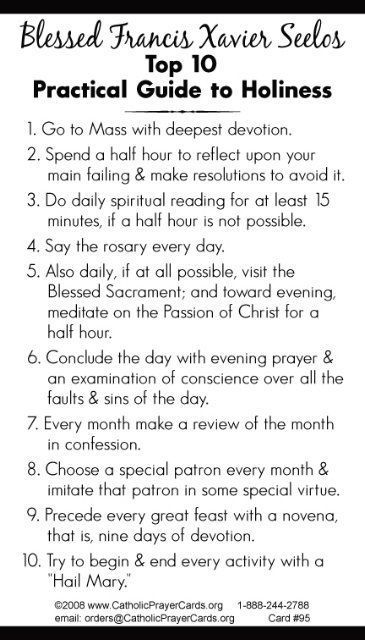
TOP 10 Practical Guide to Holiness
1. Go to Mass with deepest devotion. 2. Spend a half hour to reflect upon your main failing & make resolutions to avoid it. 3. Do daily spiritual reading for at least 15 minutes, if a half hour is not possible. 4. Say the rosary every day. 5. Also daily, if at all possible, visit the Blessed Sacrament and toward evening, meditate on the Passion of Christ for a half hour. 6. Conclude the day with evening prayer & an examination of conscience over all the faults & sins of the day. 7. Every month make a review of the month in confession. 8. Choose a special patron every month & imitate that patron in some special virtue. 9. Precede every great feast with a novena, that is, nine days of devotion. 10. Try to begin & end every activity with a “Hail Mary.”
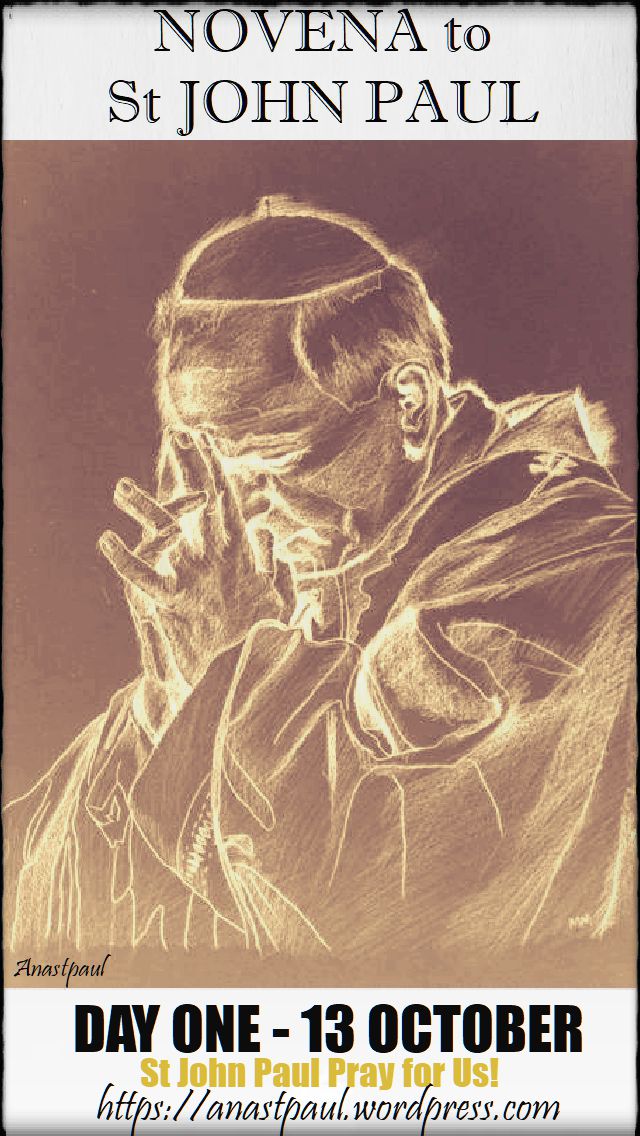
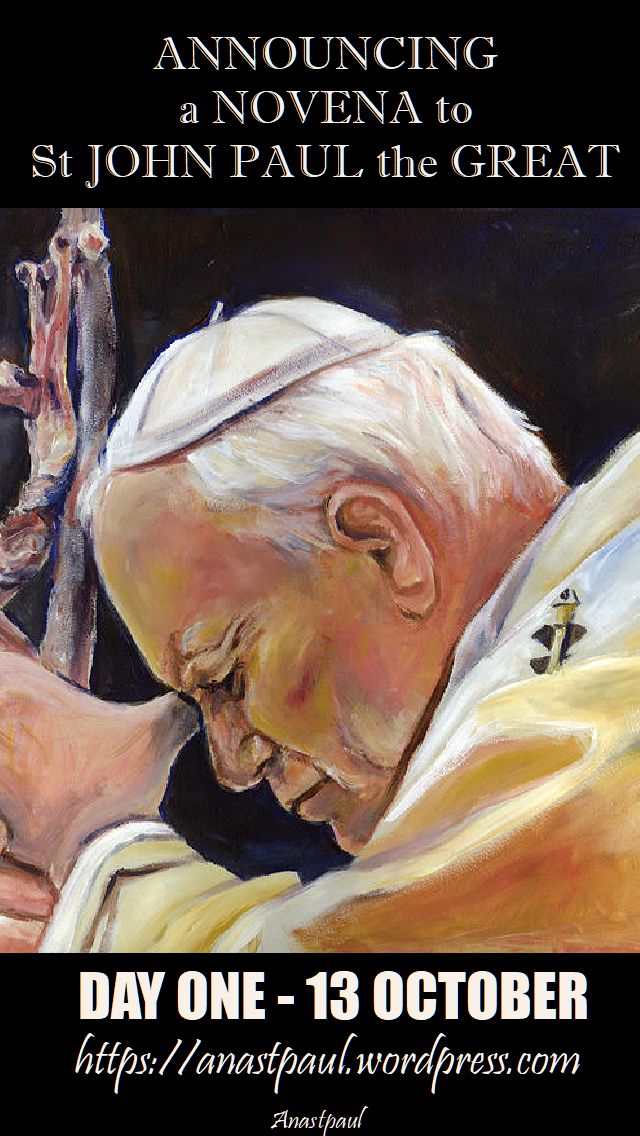
ANNOUNCING a Novena to St John Paul – Day One – 13 October
Leading up to the feast day of Saint John Paul the Great on 22 October, I invite you to join me in prayer to ask for his powerful intercession as well as learn something new about him each day.
Over nine days from 13 October, I will post a prayer to St John Paul, as well as a fact about him, a short Reflection by a great heart and mind about a great heart and mind and a quote that is perhaps less well known. Thus, we will join our prayers together to pray for all of our intentions and ask John Paul II to intercede for us.
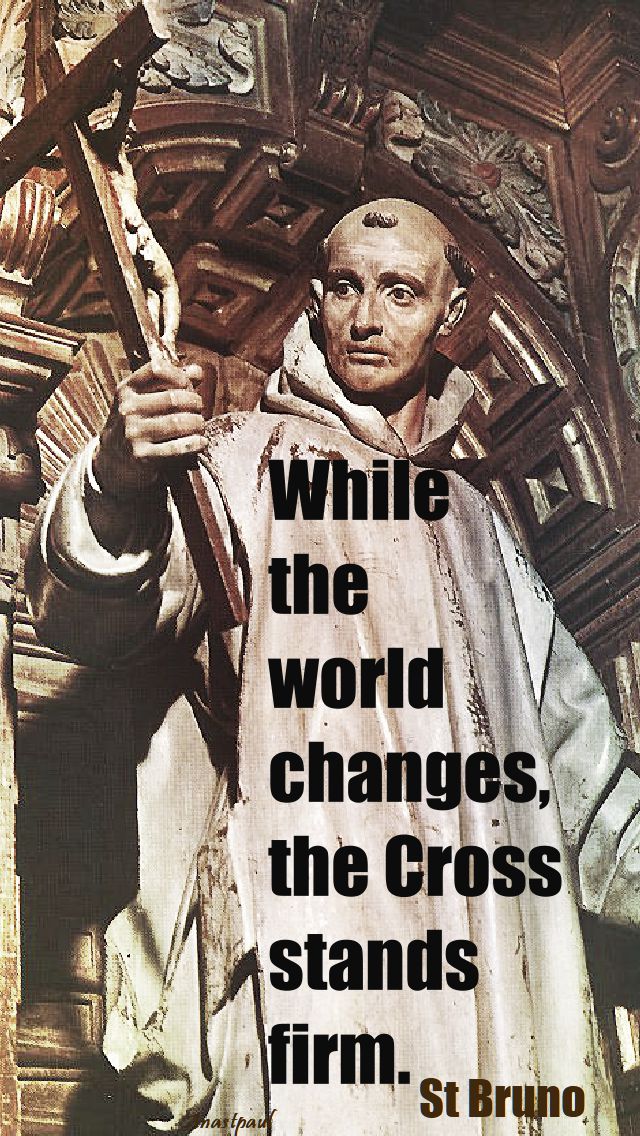
Quotes of the Day – – 6 October – The Memorial of St Bruno (c 1030-1101)
“While the world changes, the Cross stands firm.”
“By your work, you show what you love and what you know.”
“No act is charitable if it is not just.”
“In the solitude and silence of the wilderness.. for their labour in the contest, God gives his athletes the reward they desire: a peace that the world does not know and joy in the Holy Spirit.”
“If the bow is stretched for too long, it becomes slack and unfit for its purpose.”
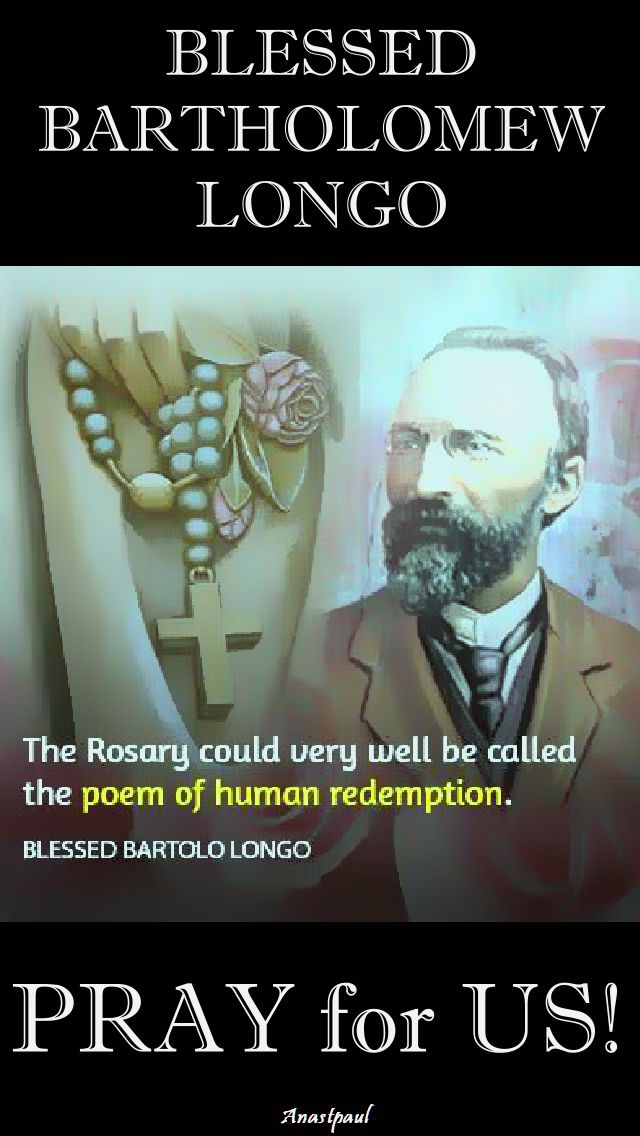
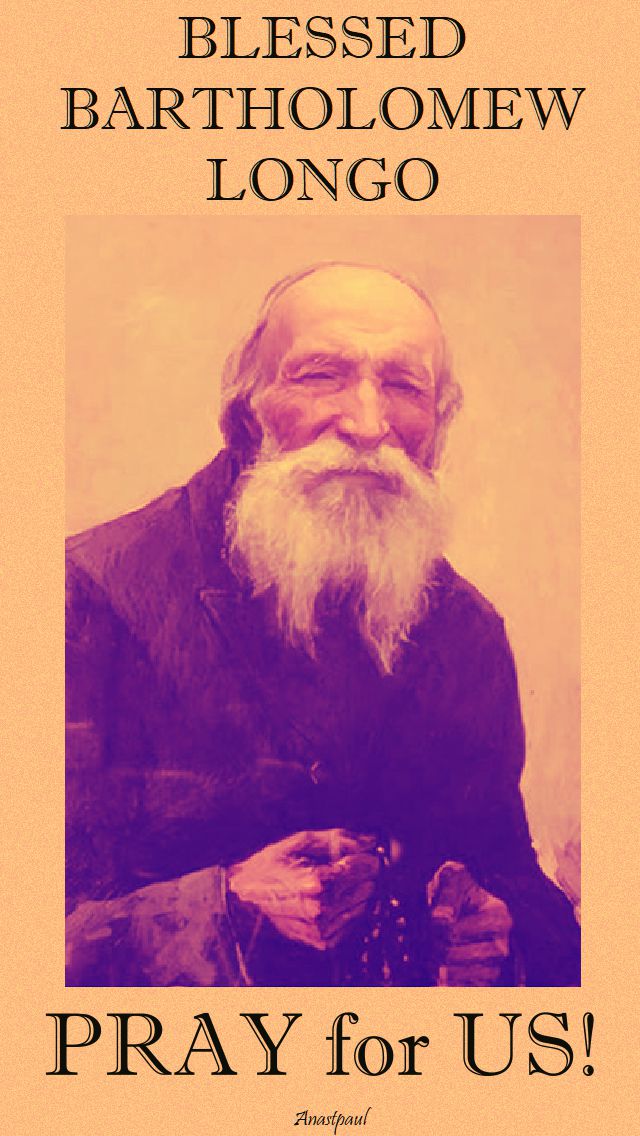
Thought for the Day – 5 October – The Memorial of Blessed Bartholomew Longo – Apostle of the Holy Rosary
Before entering the Shrine to recite the Holy Rosary with you, I paused briefly before the tomb of Bl Bartolo Longo and, praying, I asked myself: “Where did this great apostle of Mary find the energy and perseverance he needed to bring such an impressive work, now known across the world, to completion? Was it not in the Rosary, which he accepted as a true gift from Our Lady’s Heart?” Yes, that truly was how it happened! The experience of the Saints bears witness to it: this popular Marian prayer is a precious spiritual means to grow in intimacy with Jesus and to learn at the school of the Blessed Virgin always to fulfil the divine will. It is contemplation of the mysteries of Christ in spiritual union with Mary as the Servant of God Paul VI stressed in his Apostolic Exhortation Marialis cultus (n. 46) and as my venerable Predecessor John Paul II abundantly illustrated in his Apostolic Letter Rosarium Virginis Mariae that today I once again present in spirit to the Community of Pompeii and to each one of you. You who live and work here in Pompeii, especially you, dear priests, men and women religious and lay people involved in this unique portion of the Church, are all called to make Bl. Bartolo Longo’s charism your own and to become, to the extent and in the way that God grants to each one, authentic apostles of the Rosary.
To be apostles of the Rosary, however, it is necessary to experience personally the beauty and depth of this prayer which is simple and accessible to everyone. It is first of all necessary to let the Blessed Virgin take one by the hand to contemplate the Face of Christ: a joyful, luminous, sorrowful and glorious Face. Those who, like Mary and with her, cherish and ponder the mysteries of Jesus assiduously, increasingly assimilate his sentiments and are conformed to him. In this regard, I would like to quote a beautiful thought of Bl Bartolo Longo: “Just as two friends, frequently in each other’s company, tend to develop similar habits”, he wrote, “so too, by holding familiar converse with Jesus and the Blessed Virgin, by meditating on the mysteries of the Rosary and by living the same life in Holy Communion, we can become, to the extent of our lowliness, similar to them and can learn from these supreme models a life of humility, poverty, hiddenness, patience and perfection” (I Quindici Sabati del Santissimo Rosario, 27th edition, Pompeii, 1916, p. 27: cited in Rosarium Virginis Mariae, n. 15). POPE BENEDICT XVI – 19 October 2008
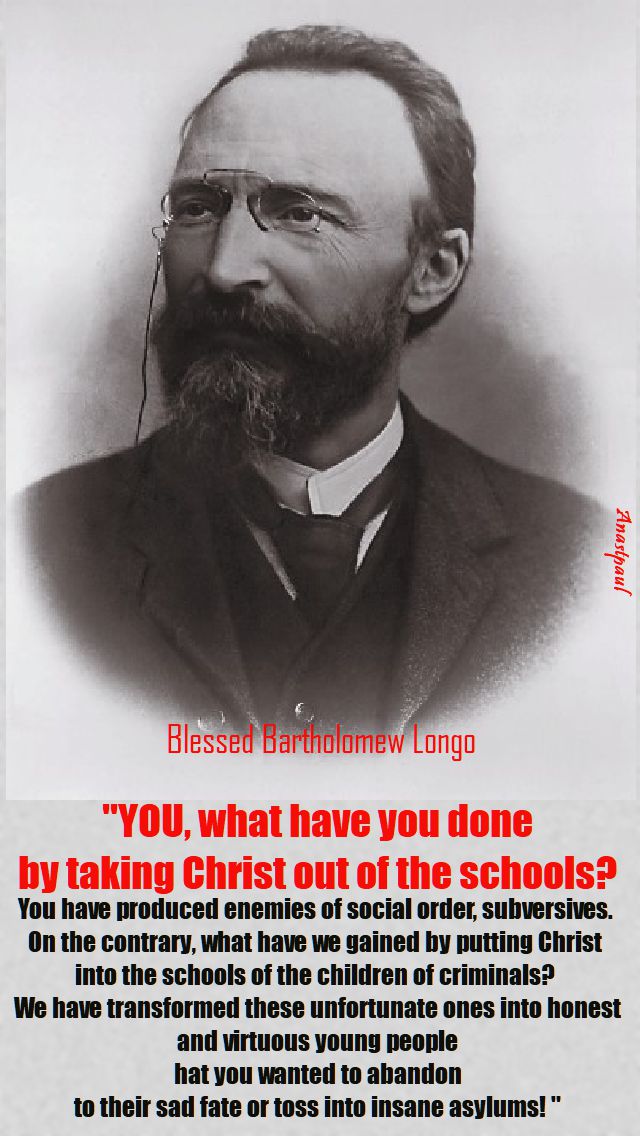
Quote/s of the Day – 5 October – The Memorial of Blessed Bartholomew Longo – Apostle of the Holy Rosary
“You, what have you done by taking Christ out of the schools? You have produced enemies of social order, subversives. On the contrary, what have we gained by putting Christ into the schools of the children of criminals? We have transformed these unfortunate ones into honest and virtuous young people that you wanted to abandon to their sad fate or toss into insane asylums! “
“The Rosary is the prayer dearest to Mary, most loved by the Saints, most frequently used by Christian peoples, most honoured by God with astounding wonders, most enriched with great promises, by the Virgin.”
One Minute Reflection – 5 October – The Memorial of Blessed Bartholomew Longo – Apostle of the Holy Rosary
Blessed is she who believed that there would be a fulfilment of what was spoken to her from the Lord……Luke 1: 45.
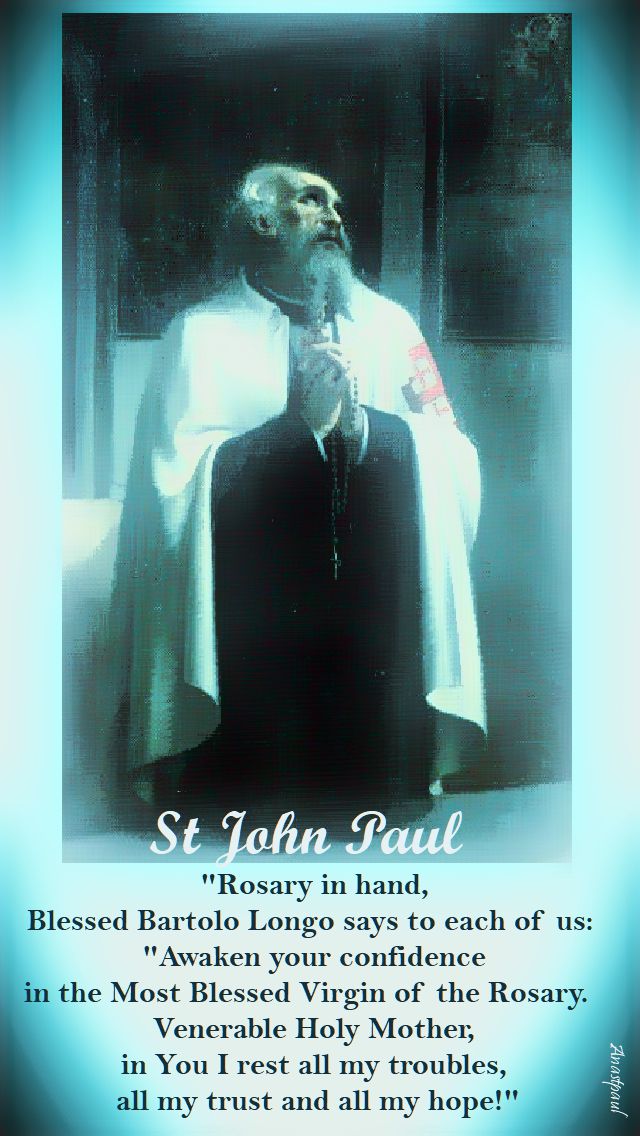
REFLECTION – “Rosary in hand, Blessed Bartolo Longo says to each of us: “Awaken your confidence in the Most Blessed Virgin of the Rosary. enerable Holy Mother, in You I rest all my troubles, all my trust and all my hope!” – St Pope John Paul II in his homily during the beatification ceremony for Blessed Bartholomew
PRAYER – And we exult you, O Mary Assumed into Heaven, as we contemplate you who have been glorified and, in the risen Christ, have become the co-worker of the Holy Spirit in communicating divine life to mankind. In you we see the goal of holiness to which God calls all the Church’s members. In your life we recognise the clear sign of the path to spiritual maturity and Christian holiness. With you, with Blessed Bartholomew Longo and with all the saints, we glorify God the Trinity, who sustains our earthly pilgrimage and lives and reigns for ever and ever. Amen (by St Pope John Paul Nov 2000)
Quote/s of the Day – 4 October – The Memorial of St Francis of Assisi (1181–1226)
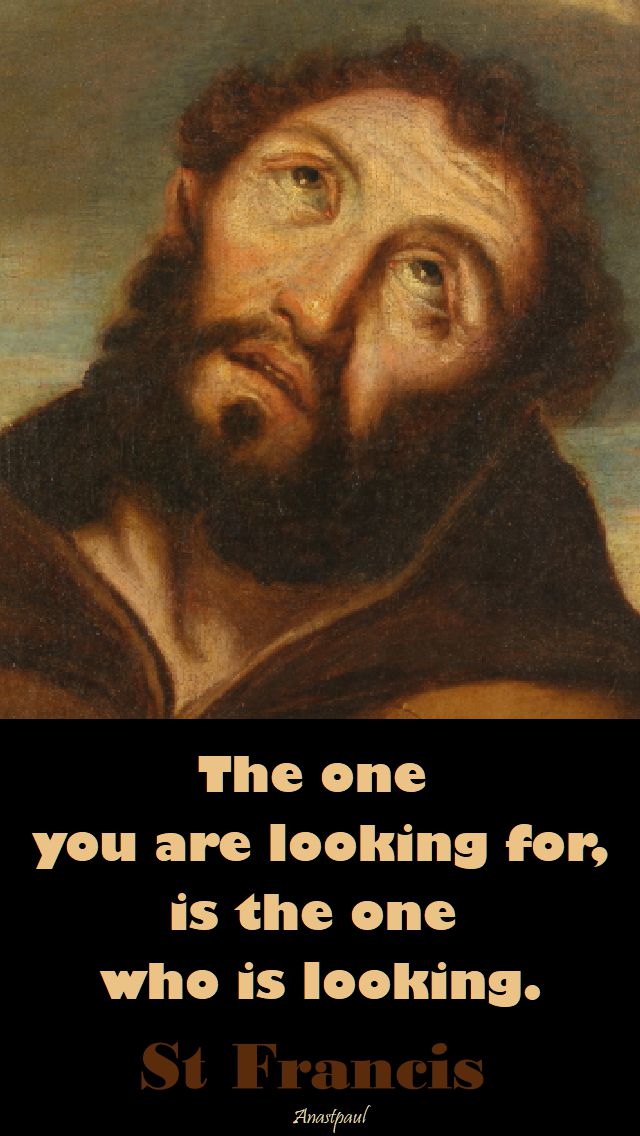
“The one you are looking for, is the one who is looking.”
“Let the whole world of mankind tremble, the whole world shake and the heavens exult when Christ, the Son of the living God, is on the altar in the hands of a priest. O admirable heights and sublime lowliness! O sublime humility! O humble sublimity! That the Lord of the universe, God and the Son of God, so humbles Himself that for our salvation, He hides Himself under the little form of bread! Look, brothers, at the humility of God and pour out your hearts before Him! Humble yourselves, as well, that you may be exalted by Him. Therefore, hold back nothing of yourselves, for yourselves, so that He, Who gives Himself totally to you, may receive you totally.”
“Therefore, O sons of men, how long will you be hard of heart? Why do you not recognize the truth and believe in the Son of God? See, daily He humbles Himself as when He came from the royal throne into the womb of the Virgin; daily He comes to us in a humble form; daily He comes down from the bosom of the Father upon the altar in the hands of the priest. And as He appeared to the holy apostles in true flesh, so now He reveals Himself to us in the sacred bread. As they saw only his flesh by means of their bodily slight, yet believed Him to be God as they contemplated Him with the eyes of faith, so, as we see bread and wine with [our] bodily eyes, we too are to see and firmly believe them to be His most holy Body and Blood living and true. And in this way the Lord is always with His faithful, as He Himself says: Behold I am with you even to the end of the world (cf. Mt. 28:30).”
“What is it that stands higher than words? ACTION. What is it that stands higher than action? SILENCE.”
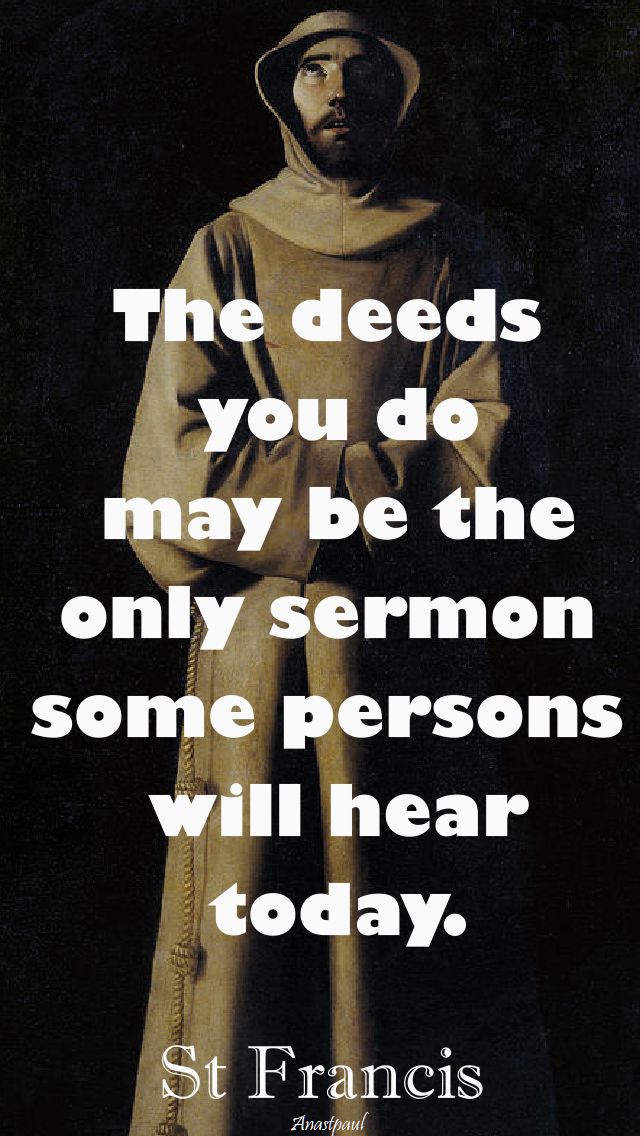
“The deeds you do may be the only sermon some persons will hear today.”
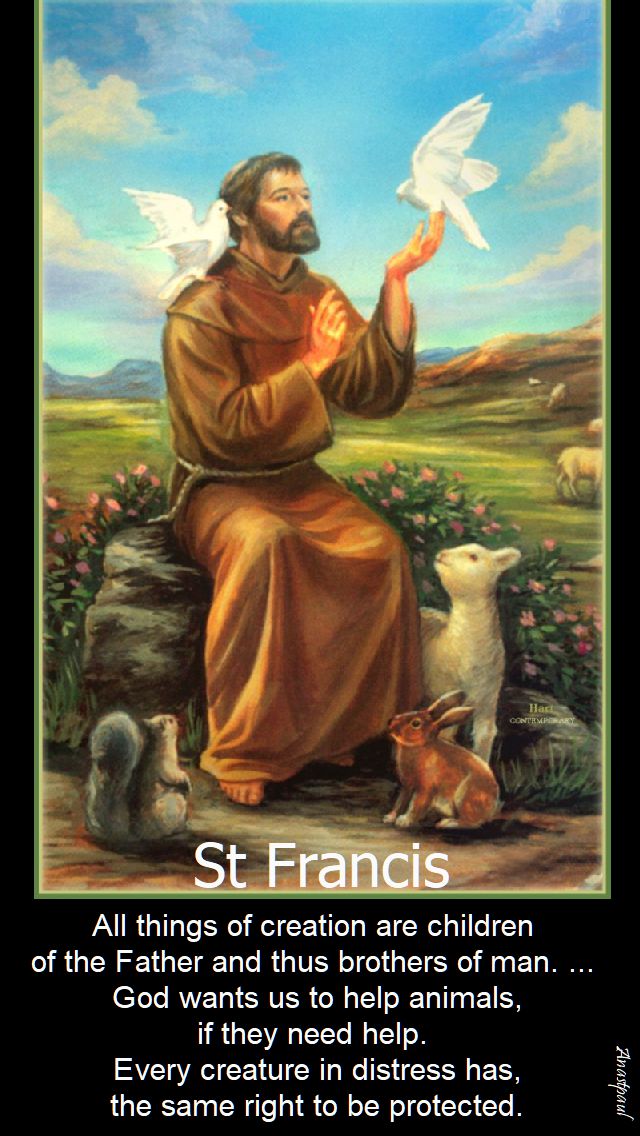
“All things of creation are children of the Father and thus brothers of man. … God wants us to help animals, if they need help. Every creature in distress has, the same right to be protected.”
One Minute Reflection – 4 October – The Memorial of St Francis of Assisi (1181–1226)
Then Jesus said to his disciples, “Amen, I say to you, it will be hard for one who is rich to enter the kingdom of heaven. Again I say to you, it is easier for a camel to pass through the eye of a needle than for one who is rich to enter the kingdom of God.”….Matthew 19:23-24
REFLECTION – “Remember that when you leave this earth, you can take with you nothing that you have received—only what you have given: a full heart, enriched by honest service, love, sacrifice and courage.”….St Francis of Assisi
PRAYER – Lord God, You made St Francis of Assisi, Christ-like in his poverty and humility, his gentleness and charity, his love and courage. Help us to walk in his ways that, with joy and love, we may follow Christ Your Son and be united with You. St Francis, pray for us, amen.
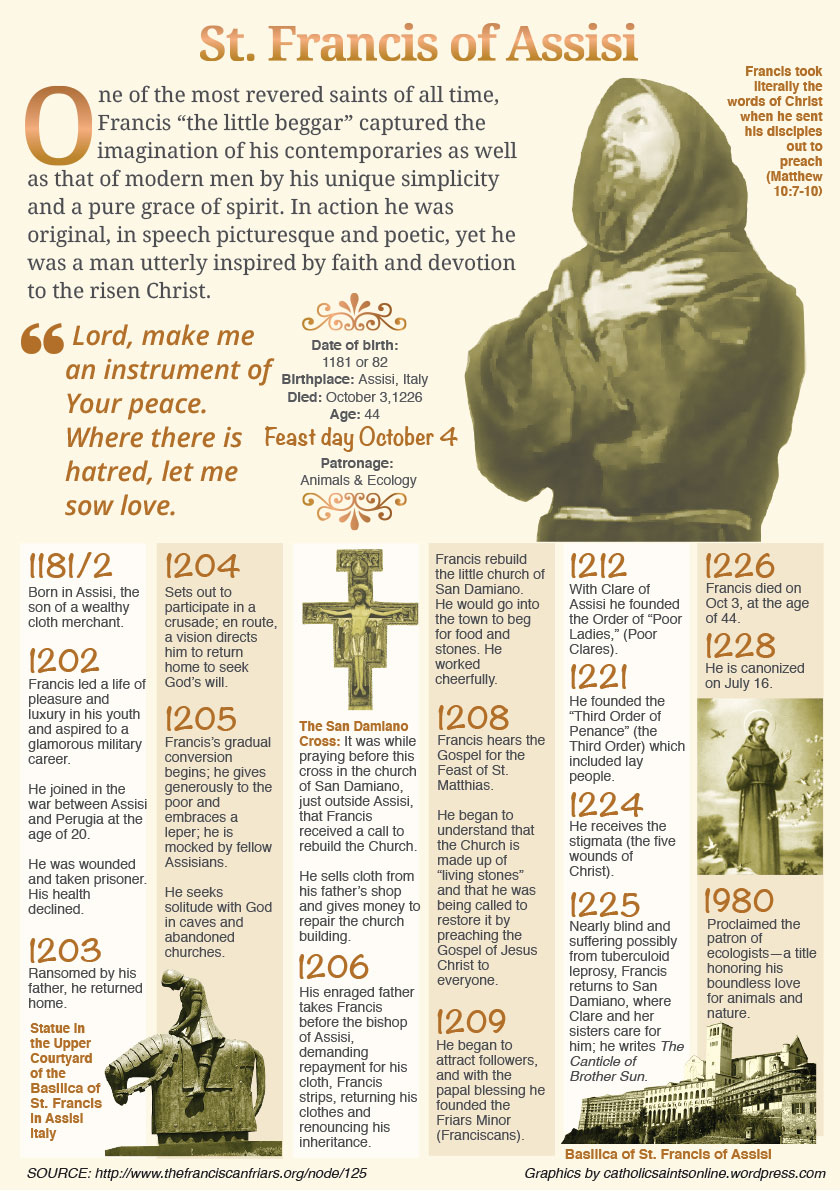
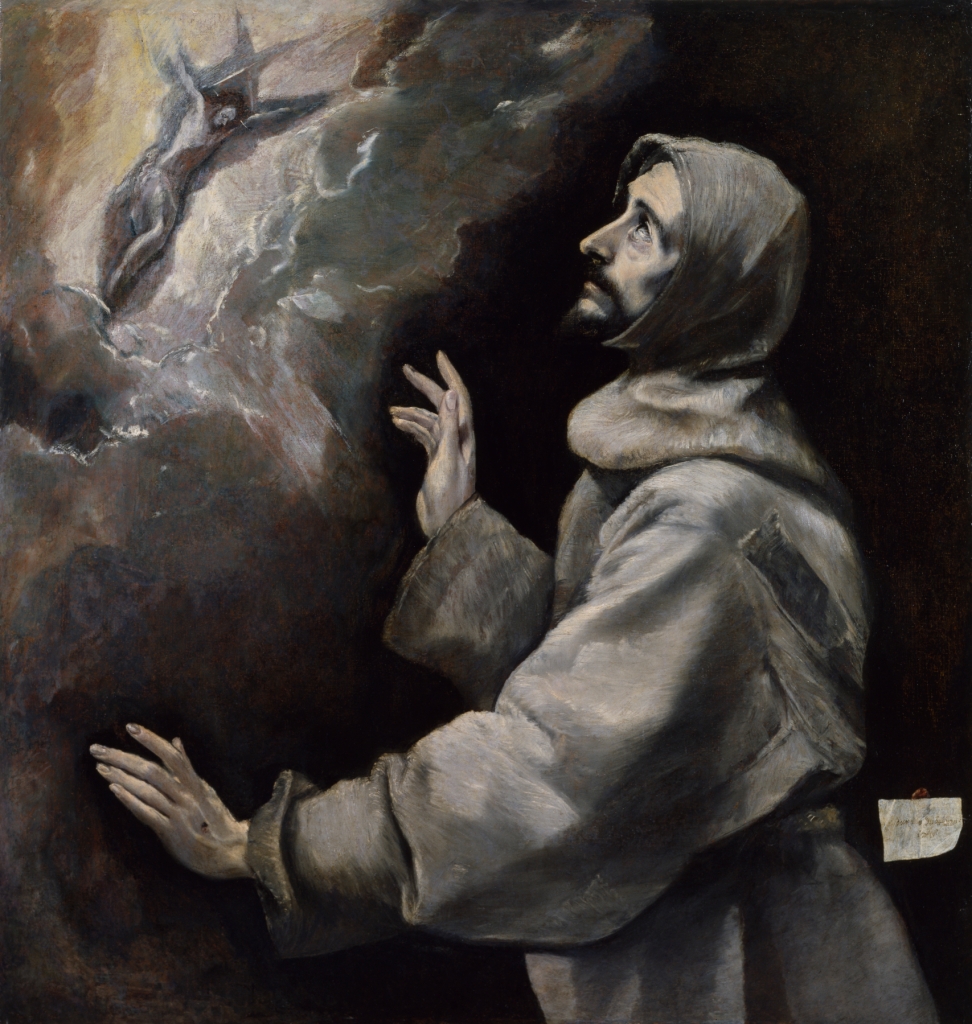
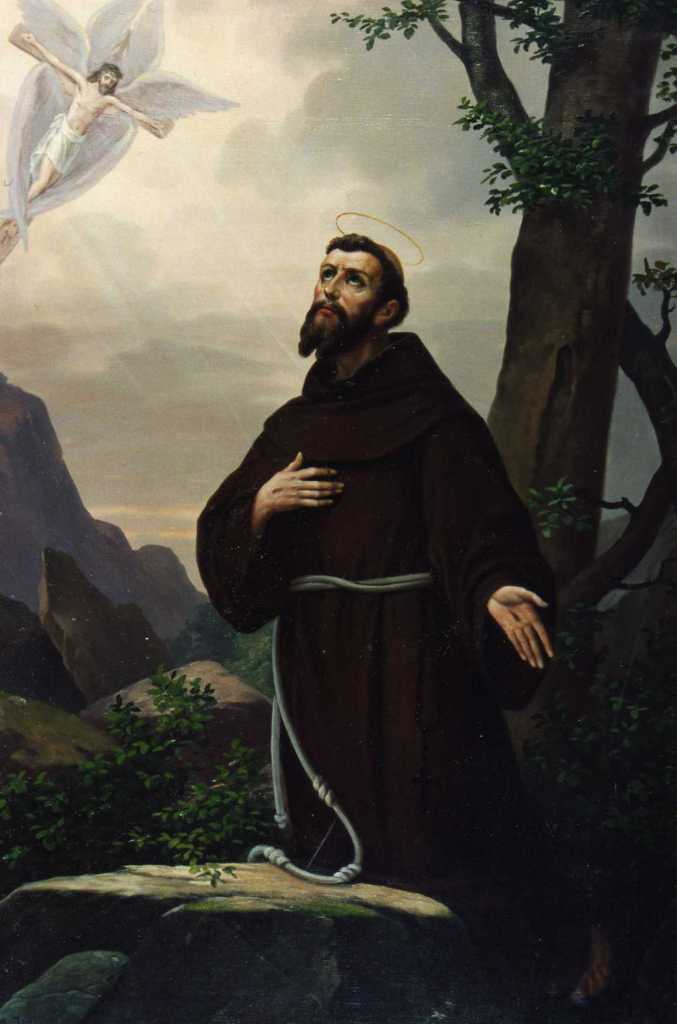
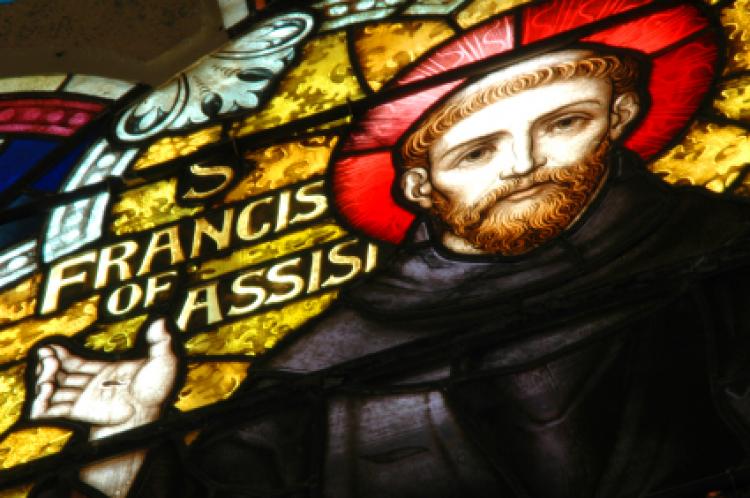
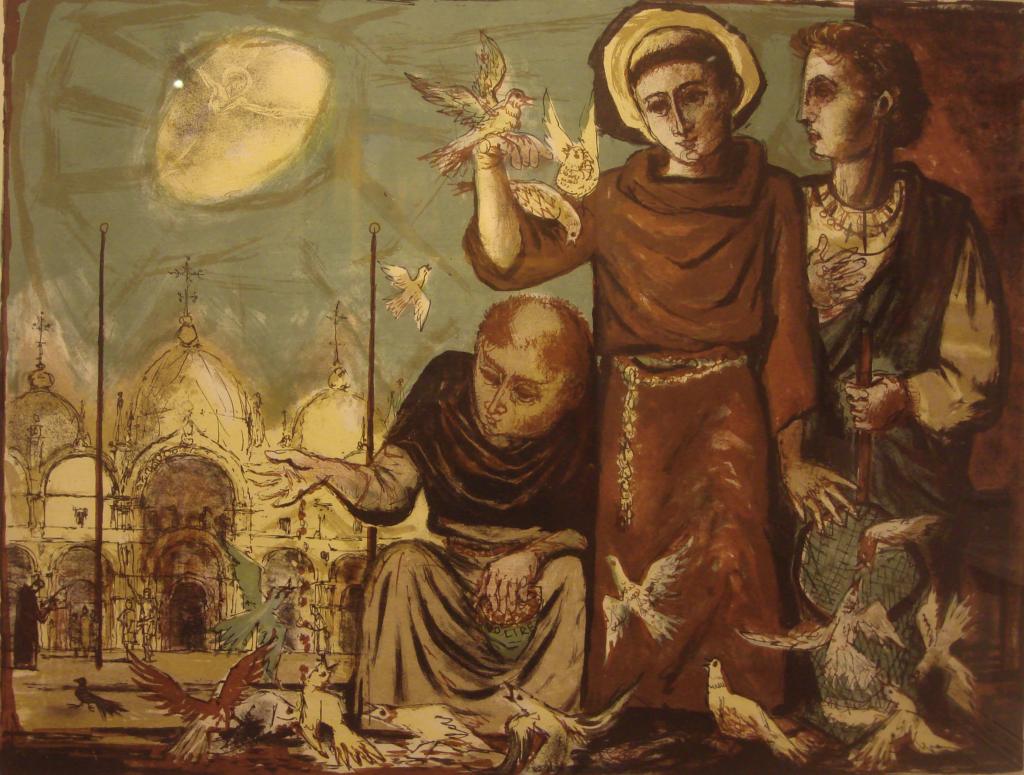
Saint of the Day – 4 October – St Francis of Assisi OFM Confessor, Religious, Deacon, Stigmatist and ounder, Apostle of the Holy Eucharist, the Blessed Virgin and of Charity, Preacher, Missionary, Mystic, Miracle-Worker, Co-patron of Italy, Founder of the Seraphic Order – the men’s Order of Friars Minor, the women’s Order of Saint Clare, the Third Order of Saint Francis and the Custody of the Holy Land, as well as being the Founder of the Nativity Crib and Manger as we know it today.
The oldest surviving depiction of Saint Francis is a fresco near the entrance of the Benedictine abbey of Subiaco, painted between March 1228 and March 1229. He is depicted without the stigmata but the image is a religious image and not a portrait.
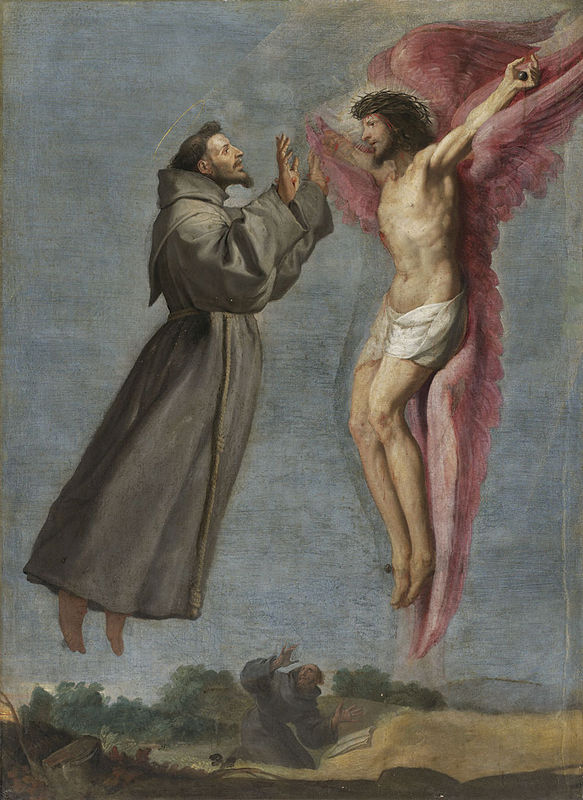
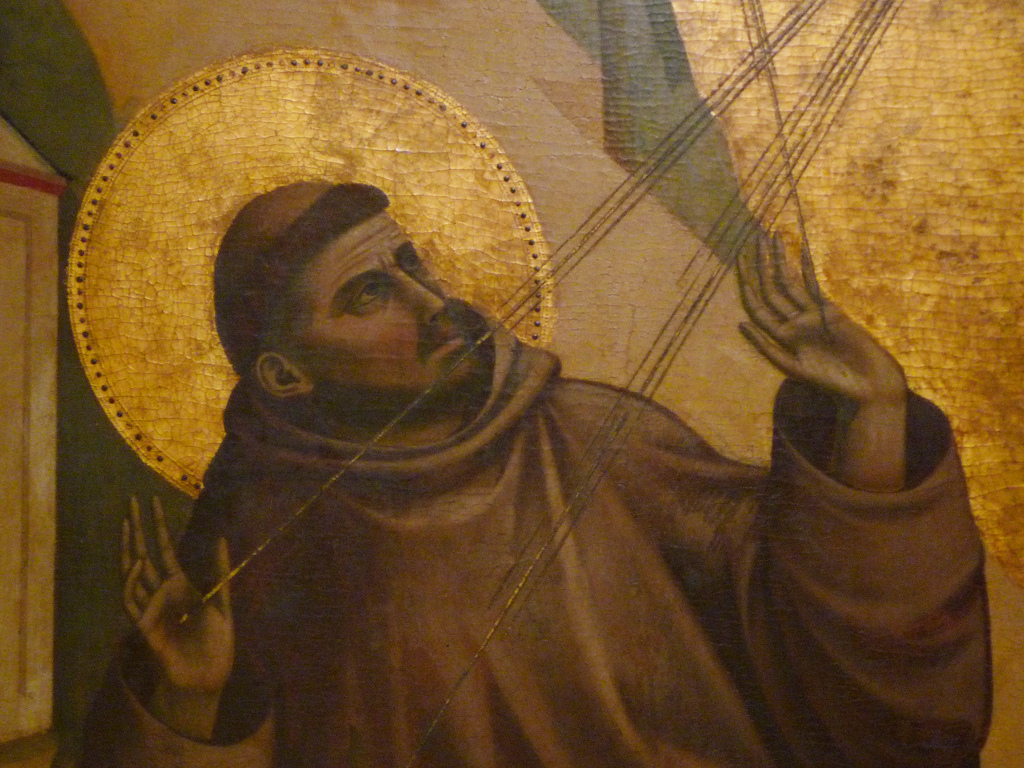
Born Giovanni di Pietro di Bernardone ( informally called Francesco by his Mother) – (1181 at Assisi, Umbria, Italy – 4 October 1226 at Portiuncula, Italy of natural causes). His relics are enshrined in the Basilica built and named for him in Assisi, Italy. St Francis was Canonised on 16 July 1228 by Pope Gregory IX. Patronages – • against dying alone• against fire• animal welfare societies• animals• birds• ecologists, ecology• environment, environmentalism, environmentalists• families• lace makers, lace workers• merchants• needle workers• peace• tapestry workers• zoos• Italy• Colorado• Catholic Action• Franciscan Order• 10 dioceses• 10 cities. Attributes – • apparition of Jesus• Christ child• birds• deer• fish• lamb• skull• stigmata• wolf. In 1224 he received the stigmata during the apparition of Seraphic angels in a religious ecstasy making him the first recorded person in Christian history to bear the wounds of Christ’s Passion. He died during the evening hours of 3 October 1226, while listening to a reading he had requested of Psalm 142 (141). Francis is one of the most venerated religious figures in history.
Francis was born in Assisi in 1182, the son of a wealthy cloth merchant, Pietro Bernardone, and his wife, Pica. He was baptised Giovanni (John) but soon gained the nickname Francesco because of his father’s close trading links with France.
Francis’ early years were not especially religious. He was a leader among the young men of Assisi, enjoying a good social life, singing and partying. His first biographer, Thomas of Celano, describes him as quite short, with black eyes, hair and beard; he had a long face, with a straight nose and small, upright ears. His arms were short but his hands and fingers slender and long. He had a strong, clear, sweet voice. Francis didn’t want to follow his father into the cloth trade; he wanted to be a knight. So at the age of twenty he joined the forces of Assisi in a minor skirmish with the neighbouring city of Perugia. He was captured and spent a year in a Perugian jail, until his father ransomed him. This became the first of a series of experiences through which God called Francis to the life which he finally embraced.
One of these experiences, at San Damiano, led to a rift with his father. Francis, in response to a voice from the crucifix in this tiny ruined Church, began to rebuild churches; when he ran out of money he took cloth from his father’s shop and sold it. His father disowned him before the bishop of Assisi and Francis in his turn stripped off his clothes, returning to his father everything he had received from him and promising that in future he would call only God his Father.
And thus, Francis of Assisi, this poor little man began a journey to astound and inspire the Church by taking the gospel literally—not in a narrow fundamentalist sense but by actually following all that Jesus said and did, joyfully, without limit and without a mite of self-importance.
Serious illness brought the young Francis to see the emptiness of his frolicking life as leader of Assisi’s youth. Prayer—lengthy and difficult—led him to a self-emptying like that of Christ, climaxed by embracing a leper he met on the road. It symbolised his complete obedience to what he had heard in prayer: “Francis! Everything you have loved and desired in the flesh it is your duty to despise and hate, if you wish to know my will. And when you have begun this, all that now seems sweet and lovely to you will become intolerable and bitter but all that you used to avoid will turn itself to great sweetness and exceeding joy.”
From the Cross in the neglected Chapel of San Damiano, Christ told him, “Francis, go out and build up my house, for it is nearly falling down.” Francis became the totally poor and humble workman.
He must have suspected a deeper meaning to “build up my house.” But he would have been content to be for the rest of his life the poor “nothing” man actually putting brick on brick in abandoned chapels. He gave up every material thing he had, piling even his clothes before his earthly father (who was demanding restitution for Francis’ “gifts” to the poor) so that he would be totally free to say, “Our Father in heaven.”
He was, for a time, considered to be a religious “nut,” begging from door to door when he could not get money for his work, bringing sadness or disgust to the hearts of his former friends, ridicule from the unthinking.
But genuineness will tell. A few people began to realise that this man was actually trying to be Christian. He really believed what Jesus said: “Announce the kingdom! Possess no gold or silver or copper in your purses, no traveling bag, no sandals, no staff” (see Lk 9:1-3).
Francis’ first rule for his followers was a collection of texts from the Gospels. He had no idea of founding an order but once it began he protected it and accepted all the legal structures needed to support it. His devotion and loyalty to the Church were absolute and highly exemplary at a time when various movements of reform tended to break the Church’s unity.
He was torn between a life devoted entirely to prayer and a life of active preaching of the Good News. He decerned in favour of the latter but always returned to solitude when he could. He wanted to be a missionary in Syria or in Africa but was prevented by shipwreck and illness in both cases. He did try to convert the sultan of Egypt during the Fifth Crusade.
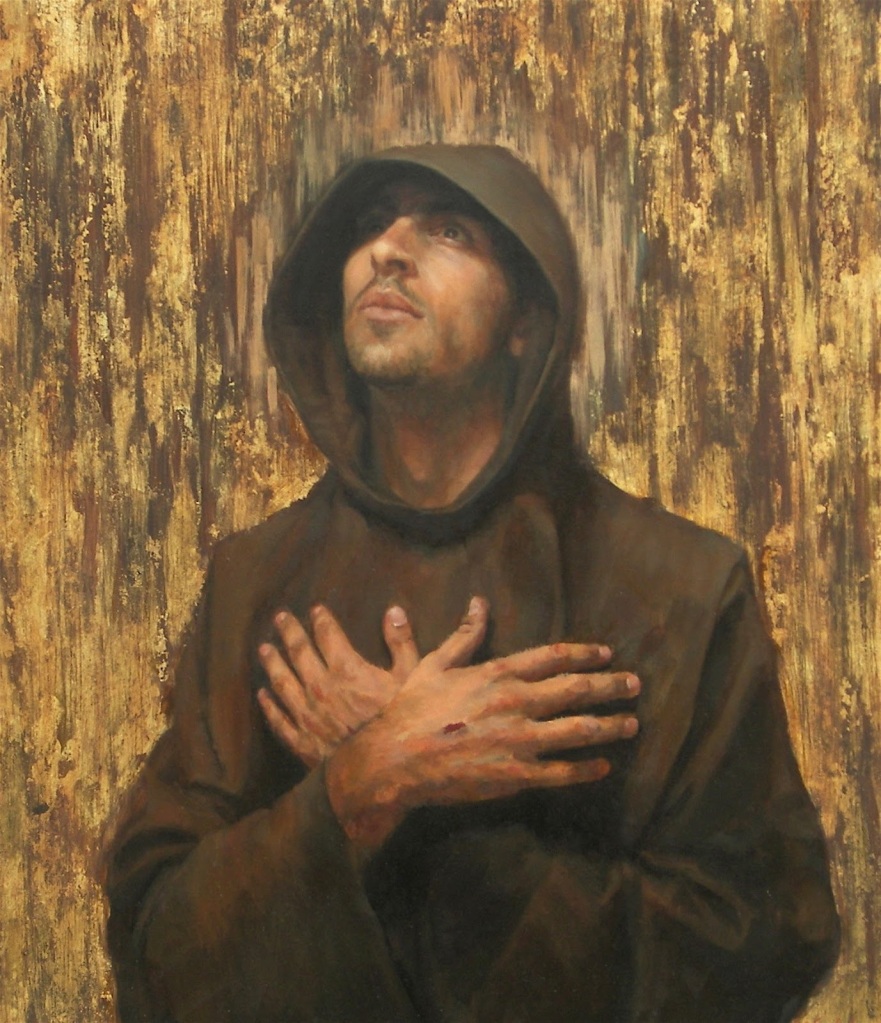
During the last years of his relatively short life (he died at 44) he was half blind and seriously ill. Two years before his death, he received the stigmata, the real and painful wounds of Christ in his hands, feet and side.
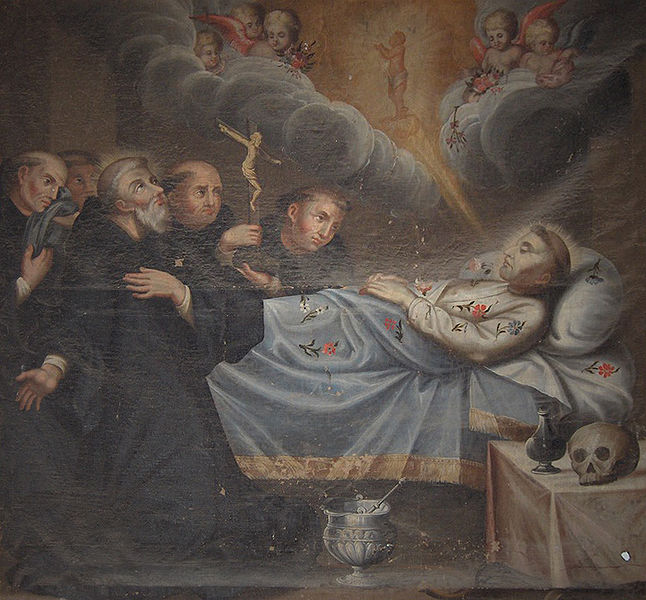
On his deathbed, he said over and over again the last addition to his Canticle of the Sun, “Be praised, O Lord, for our Sister Death.” He sang Psalm 141 and at the end asked his superior to have his clothes removed when the last hour came and for permission to expire lying naked on the earth, in imitation of his Lord.
On 13 March 2013, upon his election as Pope, Archbishop and Cardinal Jorge Mario Bergoglio of Argentina chose Francis as his papal name in honour of Saint Francis of Assisi, becoming Pope Francis I. At his first audience on 16 March 2013, Pope Francis told journalists that he had chosen the name in honour of Saint Francis of Assisi and had done so because he was especially concerned for the well-being of the poor. He explained that, as it was becoming clear during the conclave voting that he would be elected the new bishop of Rome, the Brazilian Cardinal Cláudio Hummes had embraced him and whispered, “Don’t forget the poor”, which had made Bergoglio think of the saint. Bergoglio had previously expressed his admiration for St Francis, explaining that “He brought to Christianity an idea of poverty against the luxury, pride, vanity of the civil and ecclesiastical powers of the time. He changed history.” Bergoglio’s selection of his papal name is the first time that a pope has been named Francis.
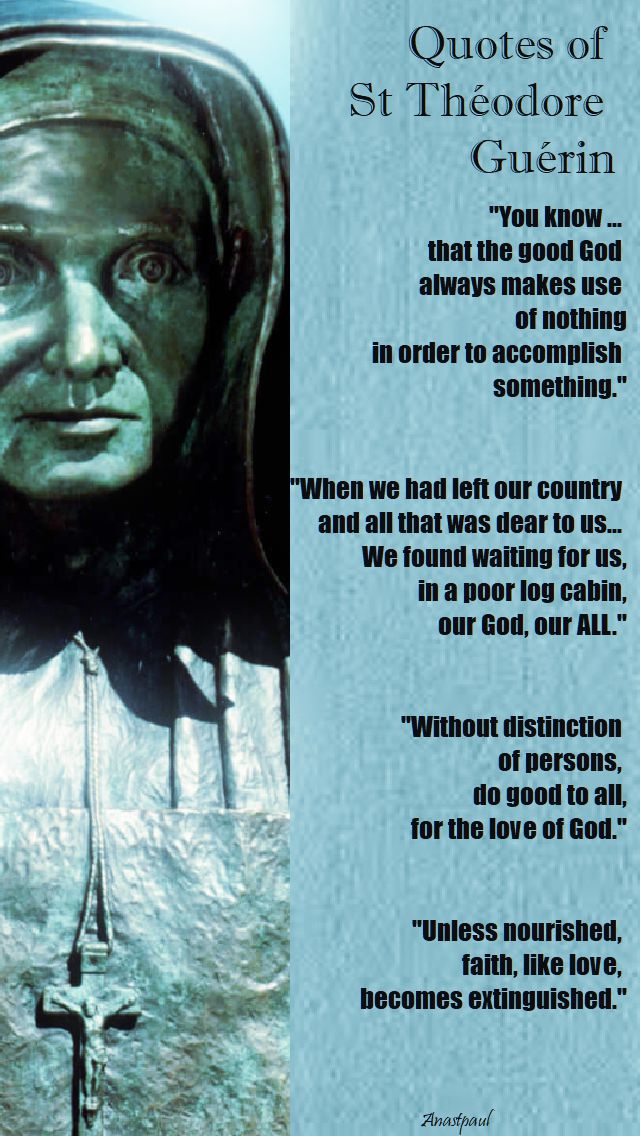
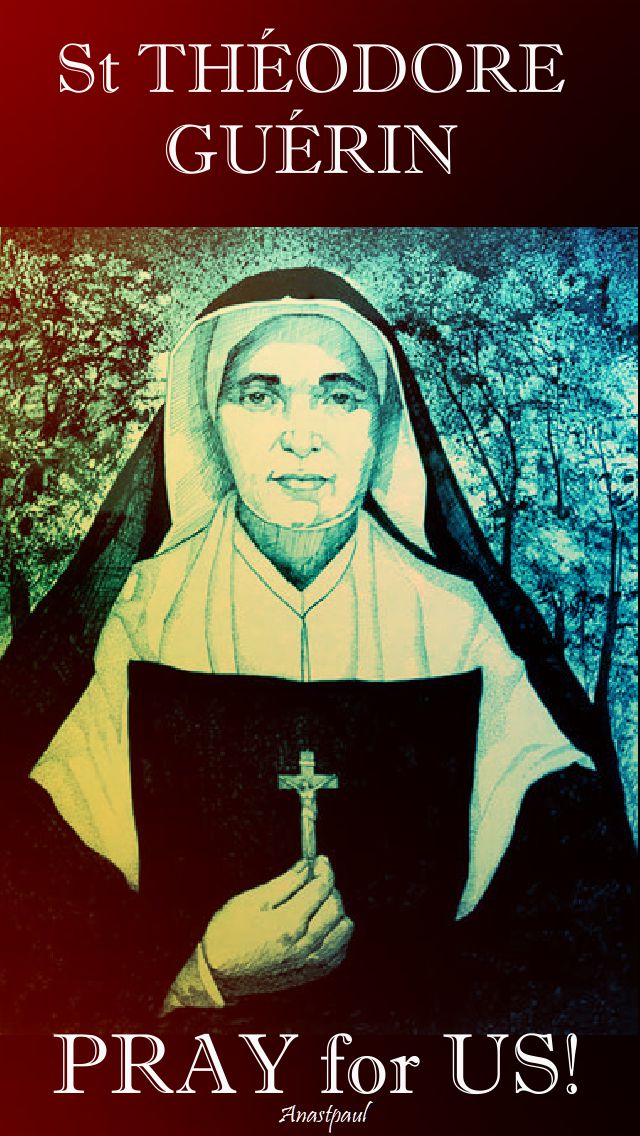
One Minute Reflection – October 3 – The Memorial of St Théodore Guérin
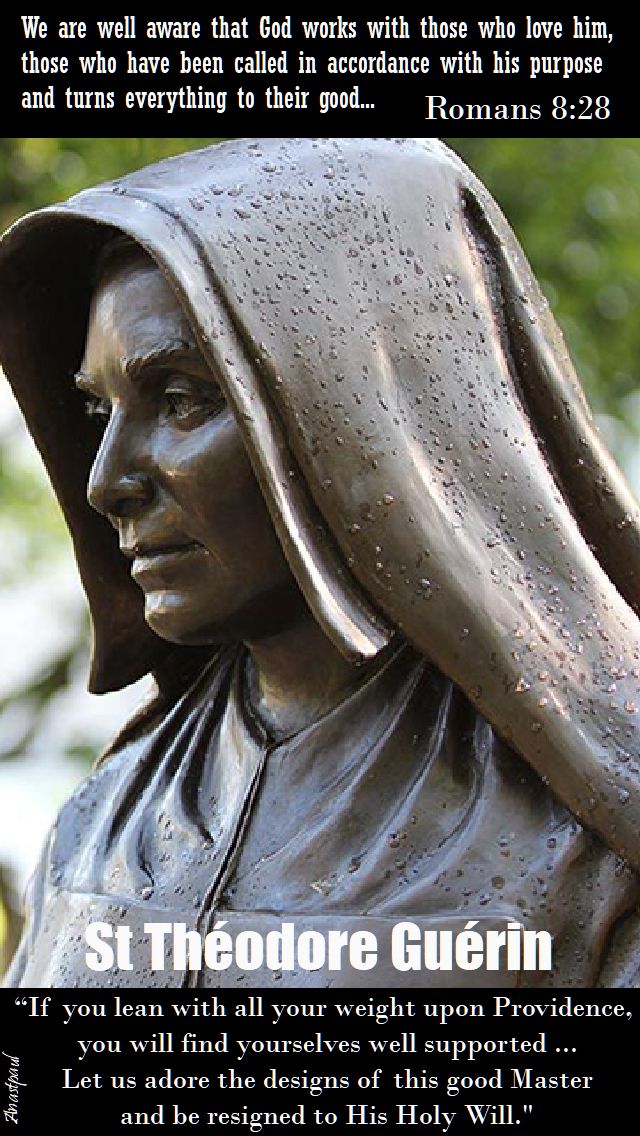
We are well aware that God works with those who love him, those who have been called in accordance with his purpose and turns everything to their good….Romans 8:28
REFLECTION – ““If you lean with all your weight upon Providence, you will find yourselves well supported ….Let us adore the designs of this good Master and be resigned to His Holy Will.” …St Theodore Guérin
PRAYER – Heavenly Father, increase my love and trust for and in You every day. Teach me total abandonment to Your loving providence and thus enable to do Your will in all things. St Mother Theodora Guérin, you who suffered great persecutions and trials but always abandoned yourself to the Divine Will, please pray for us that we learn to do the same, amen.


























 AnaStpaul
You must be logged in to post a comment.